Showing posts with label old houses. Show all posts

Sunday, January 1, 2012

XXVI. Rare Opportunity: Unique Architecture and History for Sale! (The Casa Tribunal in Malolos, Bulacan)

We take a break from the music momentarily and resume our akyat-bahay visits. In fact, we’re still in Malolos, still in the Santo Niño neighborhood, just a block away from the 1877 Bautista House, on the main Pariancillo road connecting Malolos with the next town, Paombong.

This is our target structure:
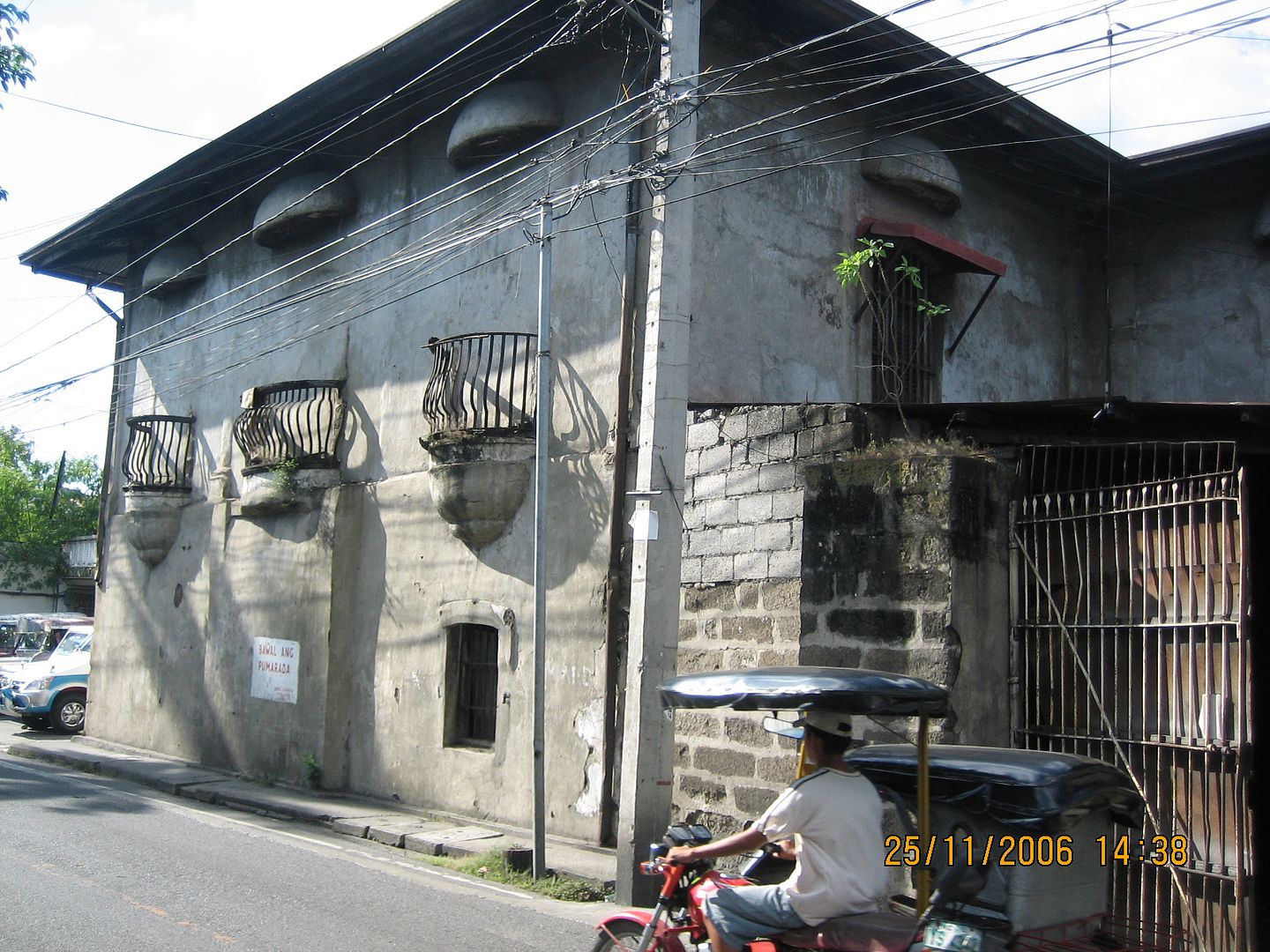

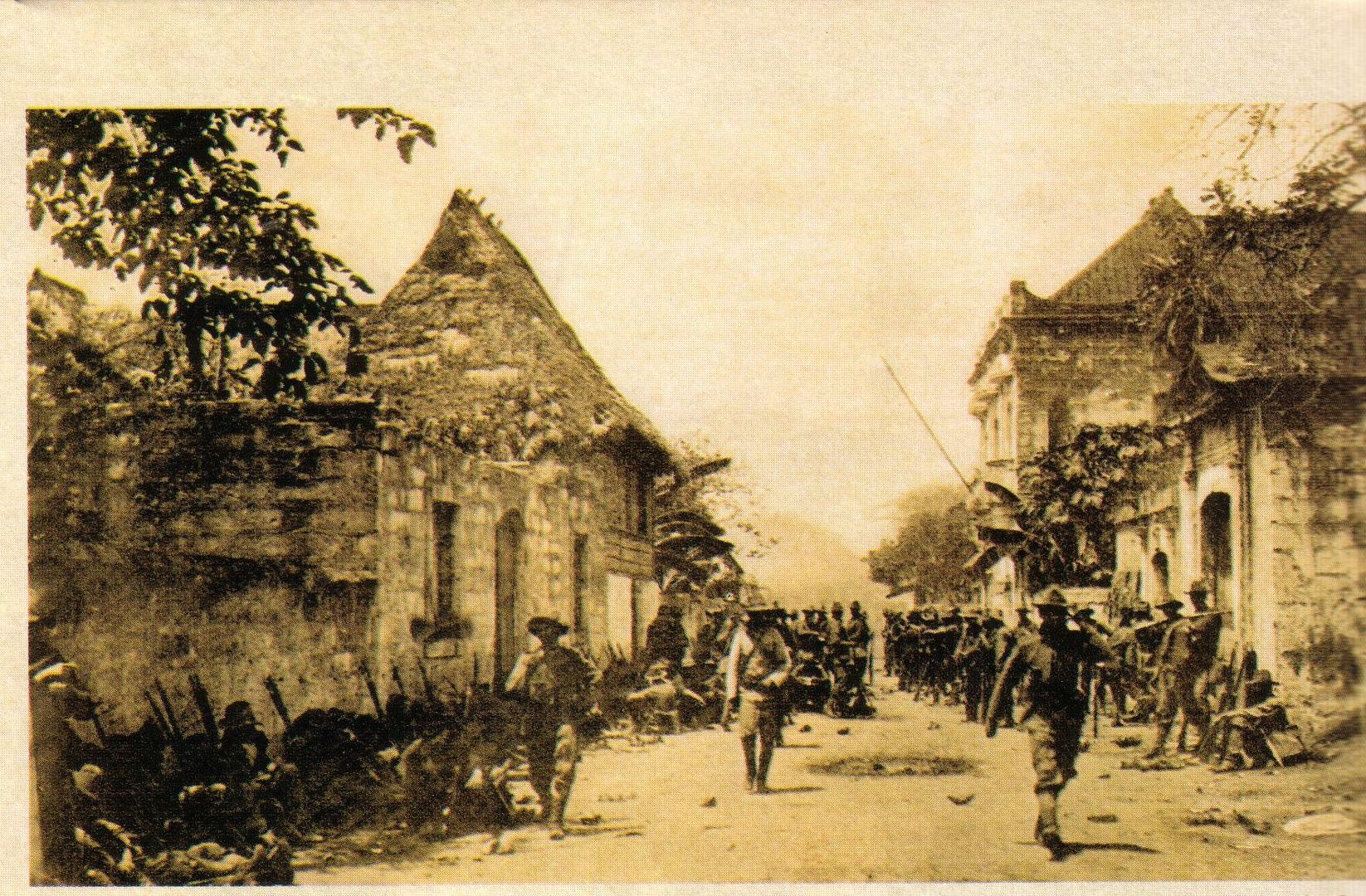
Before you think that I’ve gone completely bonkers from visiting old houses and have led you to some strange-looking bodega, I’ll have you know that this is a historic Malolos structure, from the early to middle part of the 19th century. Take a look at this photo:
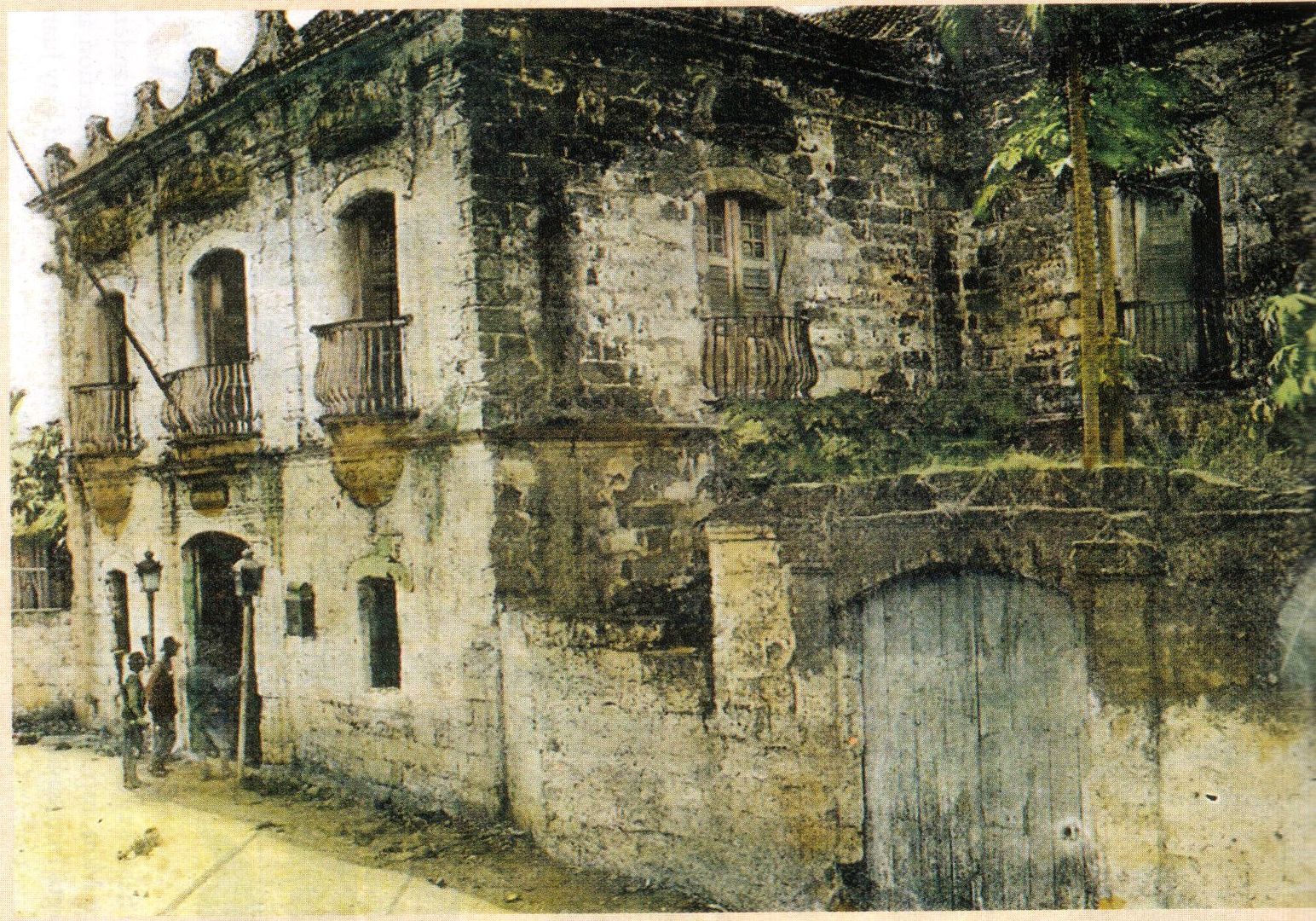


This old photograph, from the Nicanor G. Tiongson collection and published in his book “The Women of Malolos,” clearly shows how this structure looked like a little more than a hundred years ago. Dr. Tiongson states that after Malolos was divided into three towns (Malolos, Barasoain, and Santa Isabel) in 1859, this building became the Malolos casa tribunal (essentially, the municipal hall).

In his book, Dr. Tiongson adds that the building “witnessed the stormy municipal elections of the 1880’s and 1890’s.” When the Philippine Revolution broke out in 1898, it housed the Gobierno Militar de la Plaza. And in the early 1900’s, still according to Dr. Tiongson, it housed the pro-American Philippine Constabulary.


Here is another photo from the Tiongson collection, where it is clearly identifiable as the tile-roofed structure at the far end of the road.
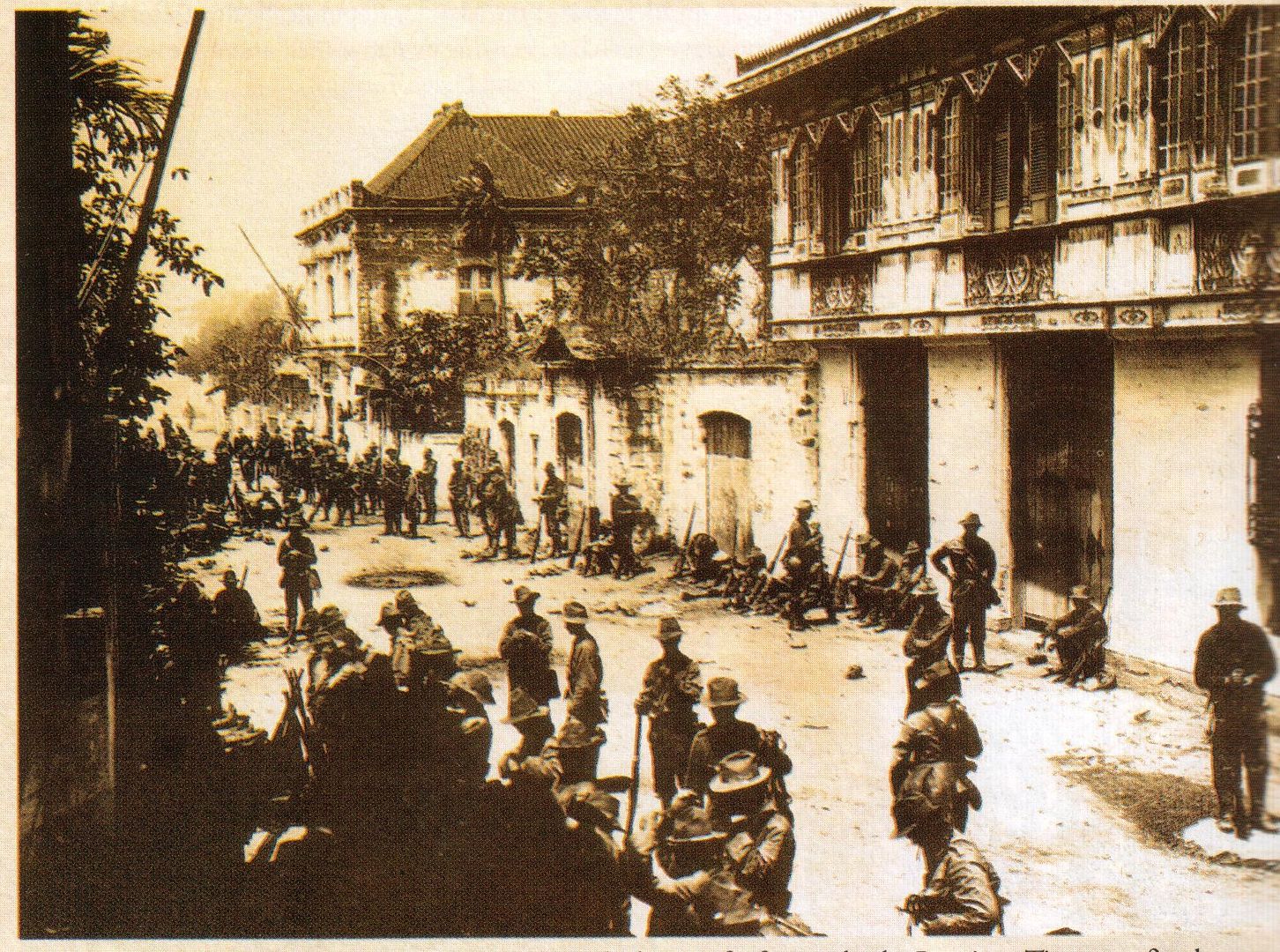


This one, from the Jonathan Best collection and also featured in Dr. Tiongson’s book, shows it in profile at the right-side background:


Other details of this structure’s history are vague. The property is now part of the estate of the Adriano Family, one of the town’s oldest and wealthiest families, whose grand mansion sits diagonally across the road from this and has since been restored and turned into the Meralco Malolos branch office. (Definitely a future akyat-bahay visit target.)

A mixture of conventional wisdom and conjecture indicates that this was originally a residential structure, built in a vaguely mainland Spanish style by the Adriano family in the early- to mid-19th century. When the new Malolos municipality was established in 1859, the family probably generously lent the structure to the new government, as anyway they had other residential properties available nearby. Such a “usufruct” arrangement continued through various changes of governments, until early in the 20th century, when possession must have reverted to the Adrianos. (The present-day Malolos municipio, just a few meters away from this old Casa Tribunal, and directly in front of the Cathedral, dates from 1940.)

More recent history tells us that this building was used for more commercial purposes – as recently as three years ago, it was the bodega and retail outlet of a wholesaler-distributor of salty snacks, candies, and sweets. This would easily explain why the large windows on both storeys have been bricked up (with the strange exception of the one on the extreme right-side on the ground floor) – we don’t want grubby fingers reaching through and taking some of that delicious junk food. In reality, though, the closing-up of the windows happened a long time ago – I have been a Malolos resident since birth, and I’ve never seen this structure with un-bricked-up windows ever.

But I’ve always been curious as to what it really was, and what it looked like inside. The opportunity came up recently, when the owners, who are trying to sell it, offered to show me in. So we open the main gate at the left side of the structure, still in the same place as it was a hundred years ago, but much altered.
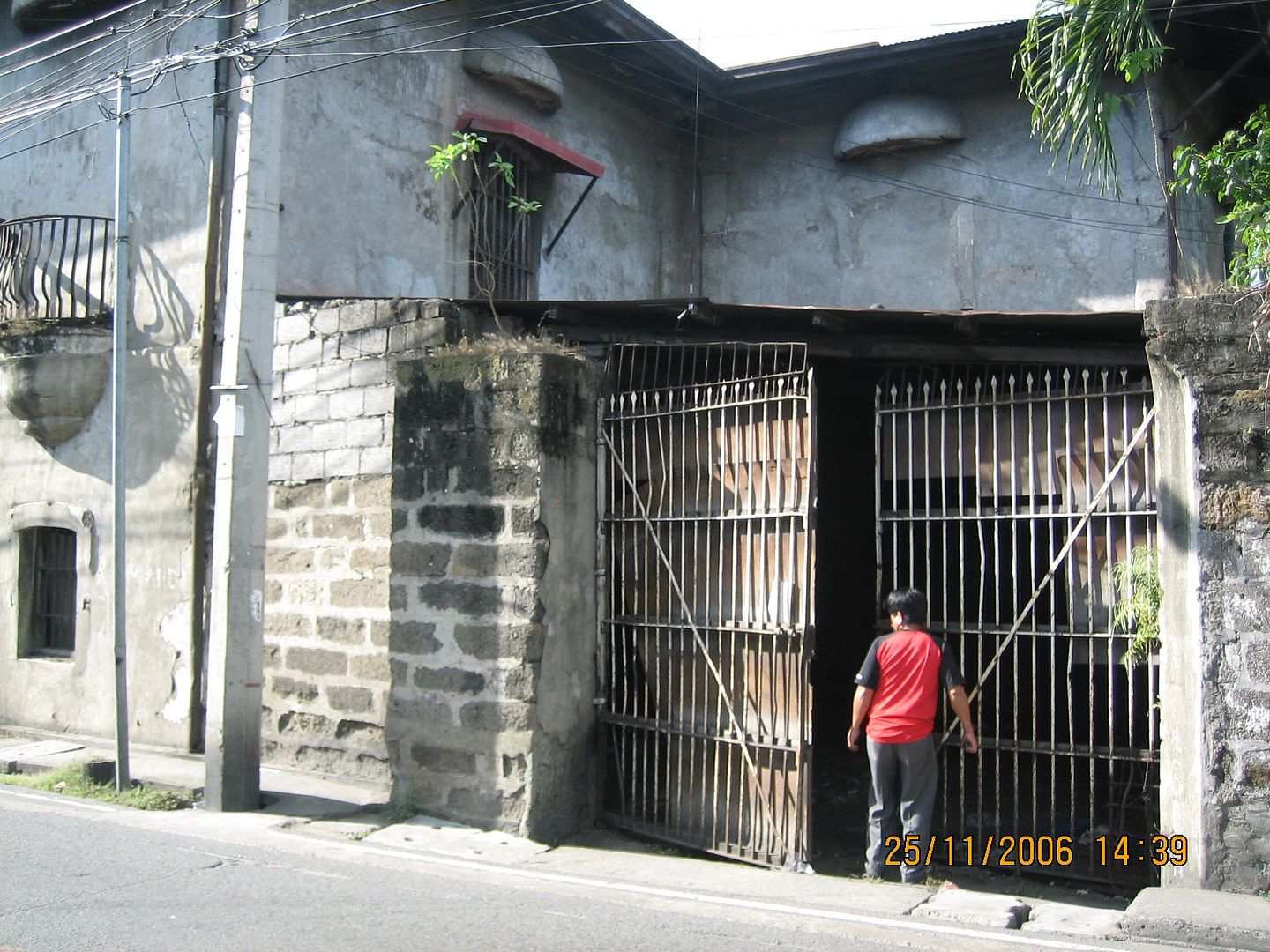

The right-side courtyard, previously an open space with a small garden, has since been roofed in. Here’s how it looks today:
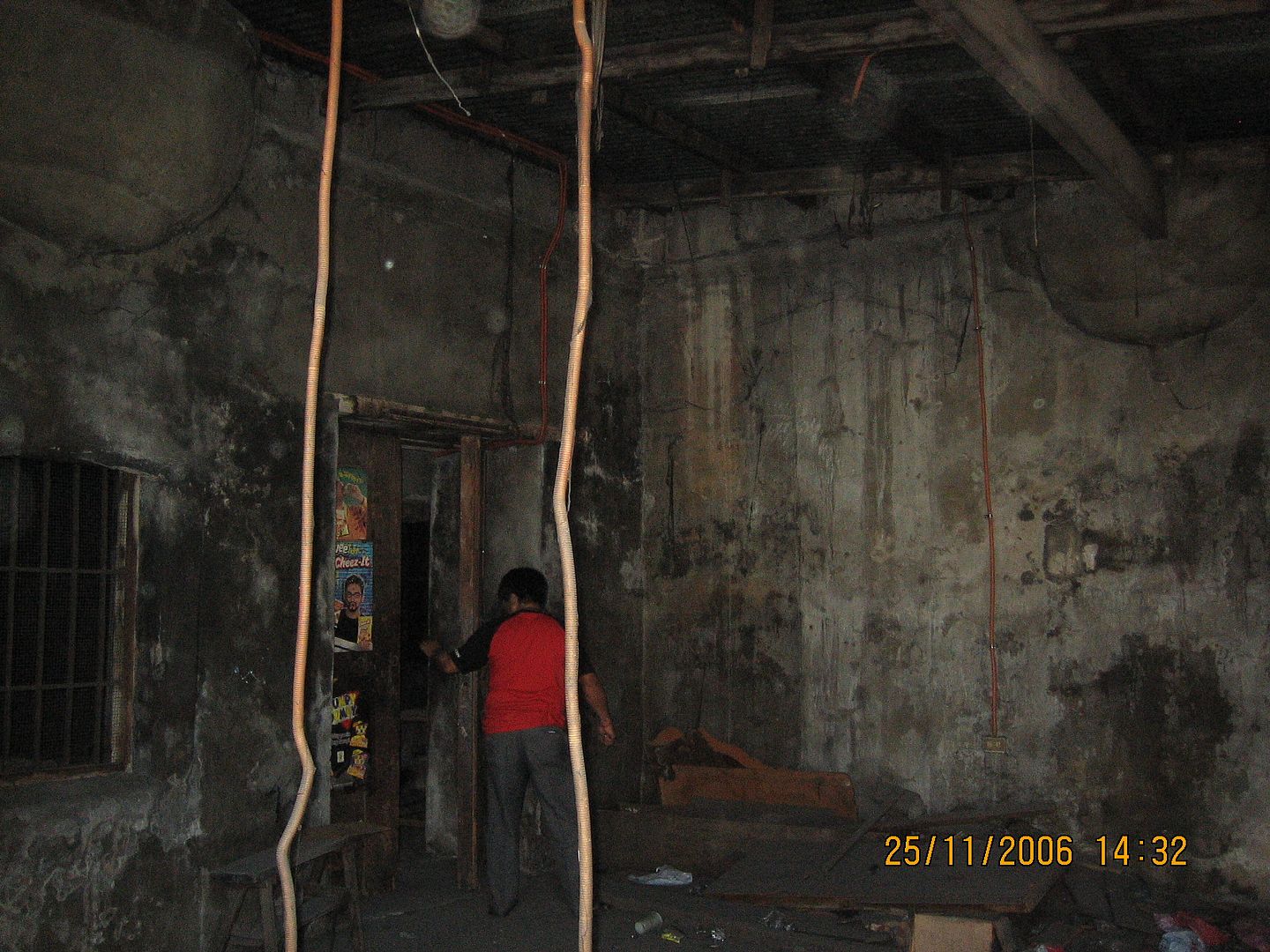

That doorway left-of-center is the structure’s main door. (That is, discounting the original main door that was right smack in the middle of the façade, long since bricked up as well.) We move closer, and see not only an unbricked-up window, but enough orbs to make ghost-hunters giddy with delight.
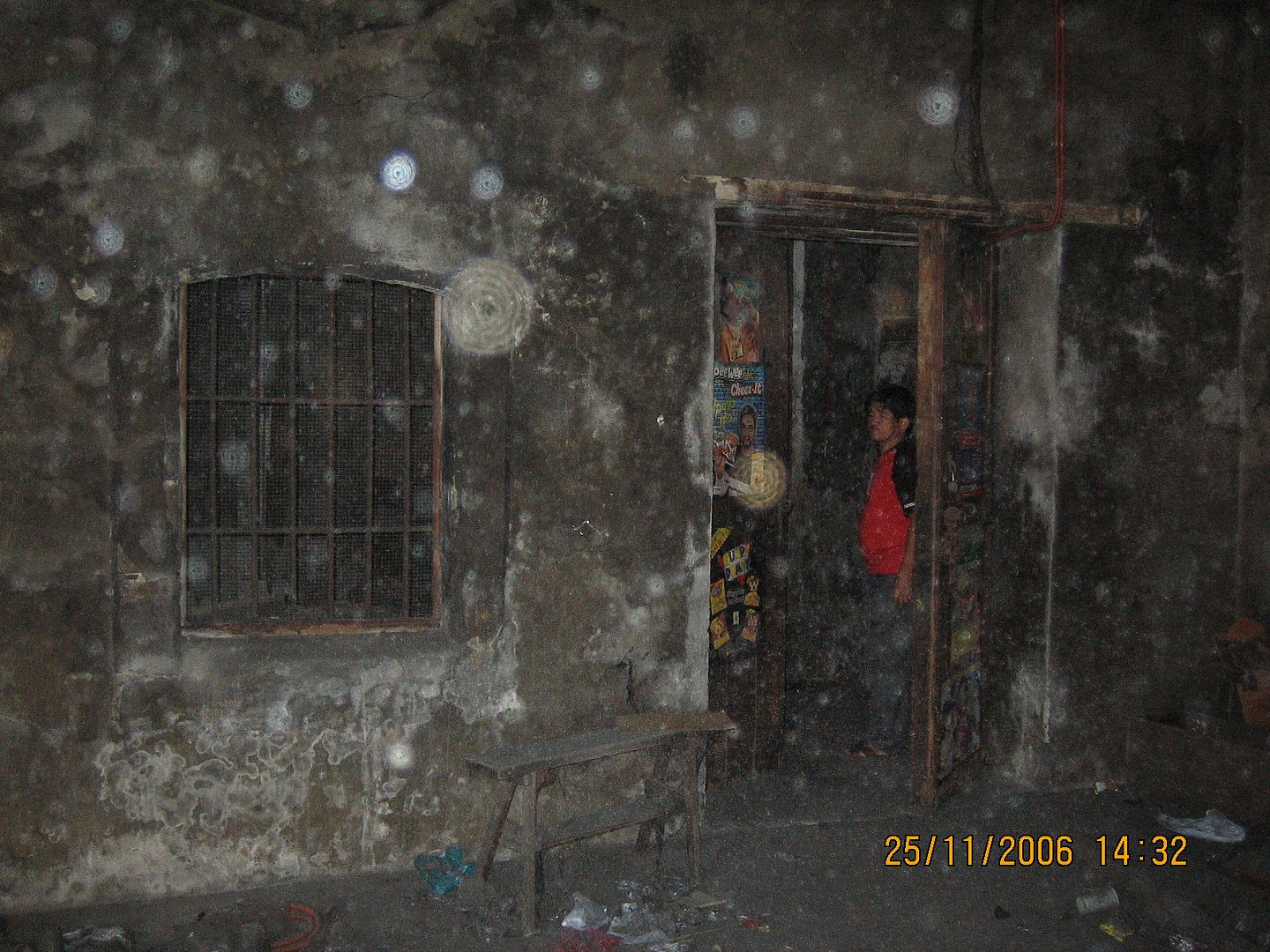

I especially like that big one near the window’s top right edge, and the gold-colored one near the center of the shot. Another shot just seconds later confirms the presence of plenty of orbs, though my two favourites seem to be a bit shy and have disappeared.
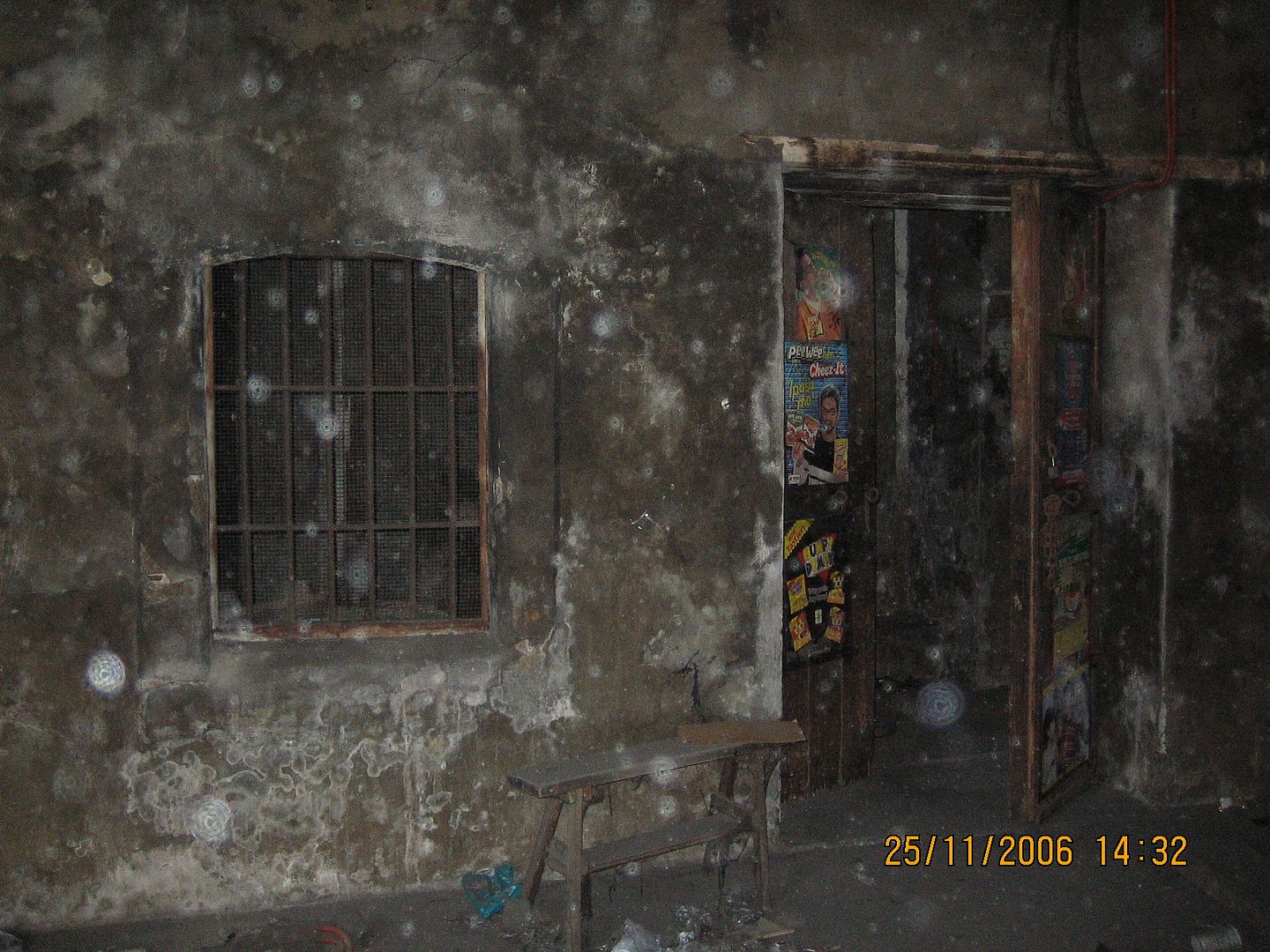

(What do these orbs, captured by digital photography but invisible to the naked eye, really mean? You can look it up on the internet, and you will find a frequent assertion that these represent “energy” – to cut a long convoluted pseudo-scientific explanation short, most likely the spirits of dead people. What do I think? I don’t really know what to think, and I really almost don’t care – as long as they don’t bother me [so far they haven’t], I won’t bother them, and we’ll get along just fine. Haha.)

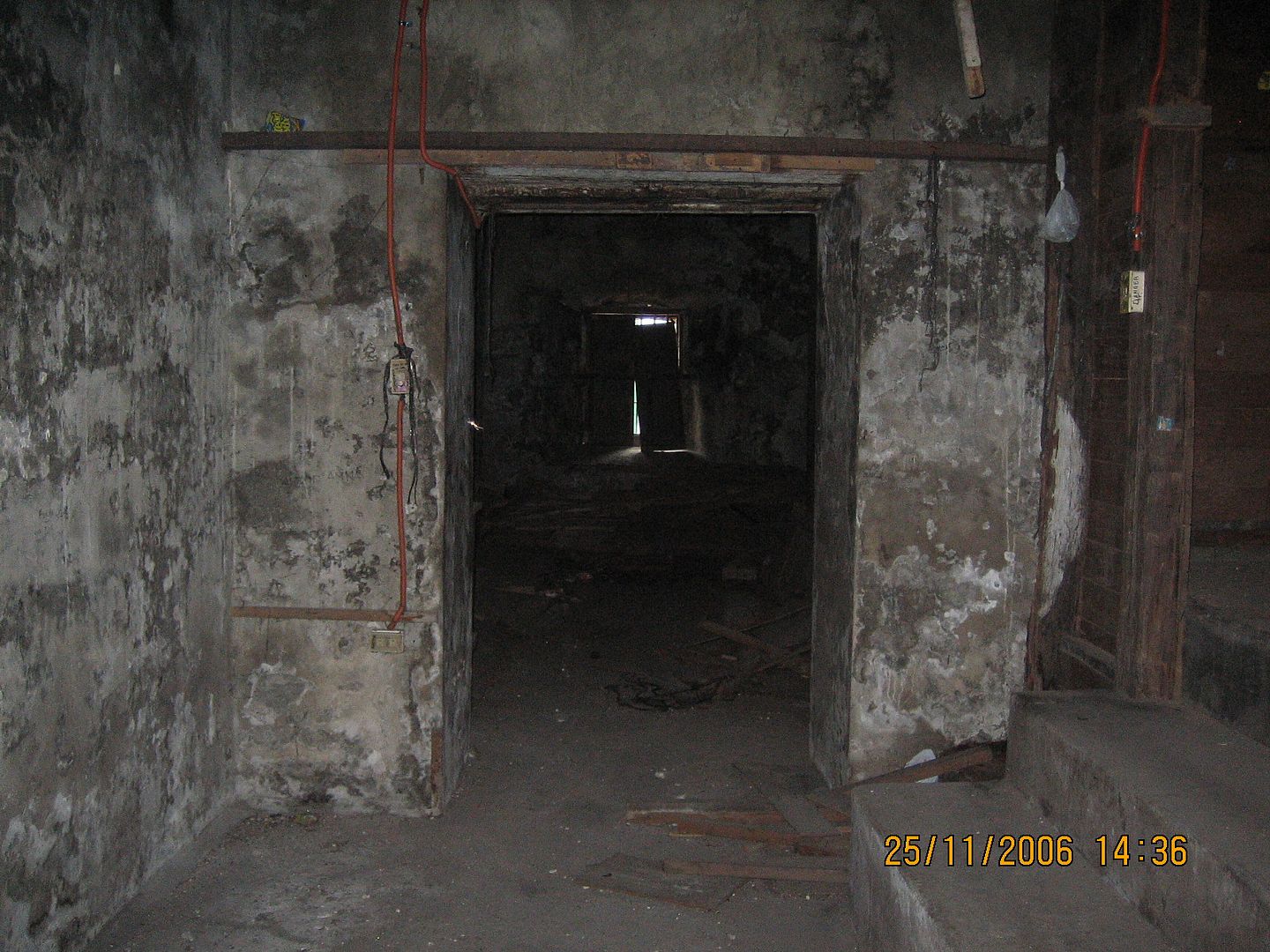
Anyway, we go through the main entrance, and see what’s inside. What’s inside is immense darkness, such that I couldn’t see the palm of my hand even if I held it directly in front of my eyes. Nonetheless, I keep taking photos, and I took this one of a doorway directly in front of the main entrance, presumably leading to the main hall on the ground floor. (A few orbs here as well, including a small bright one above.)

The one street-facing window that hasn’t been bricked up, as we saw in the exterior shot earlier, is also seen at the far end in these interior shots:
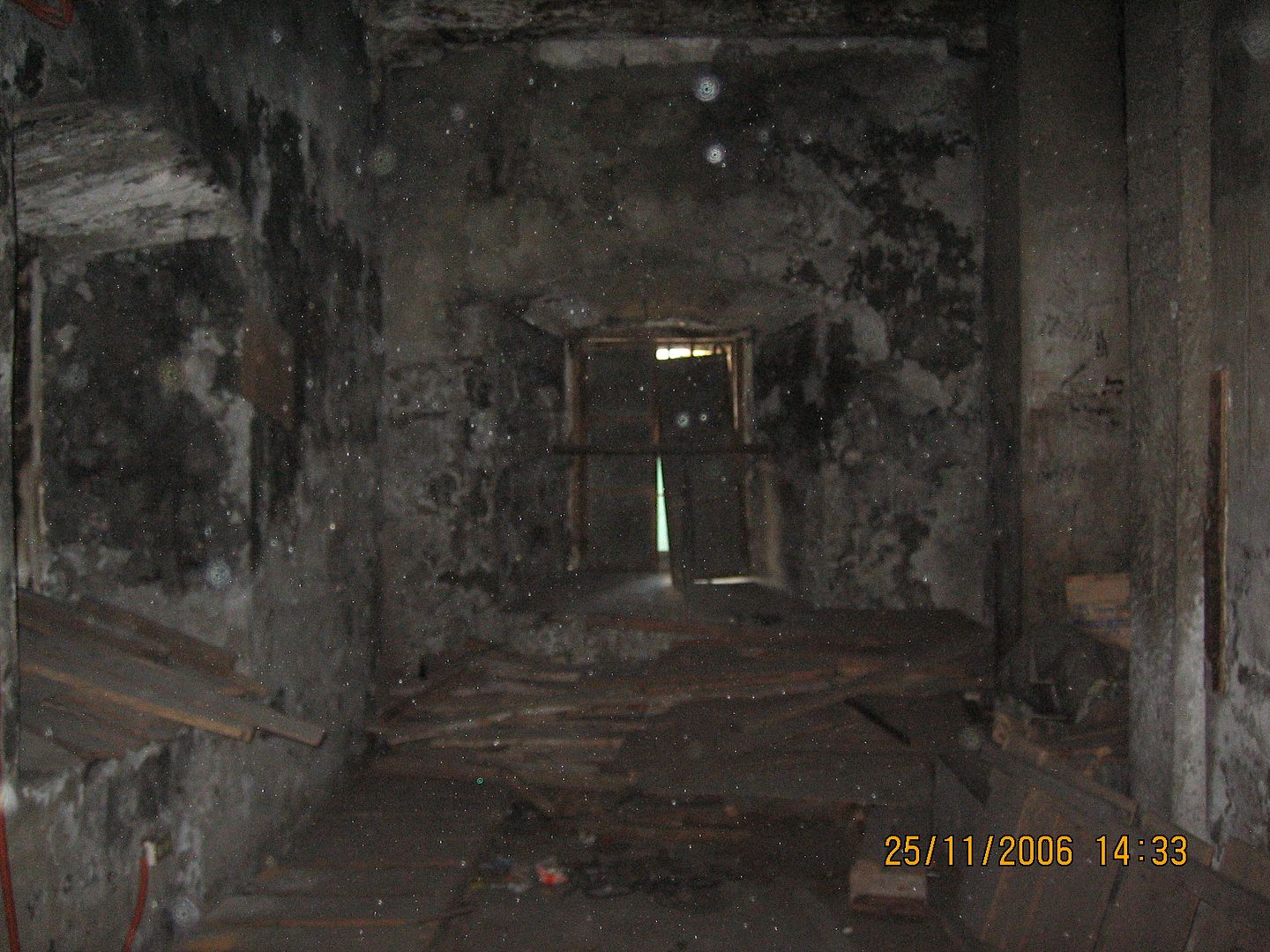

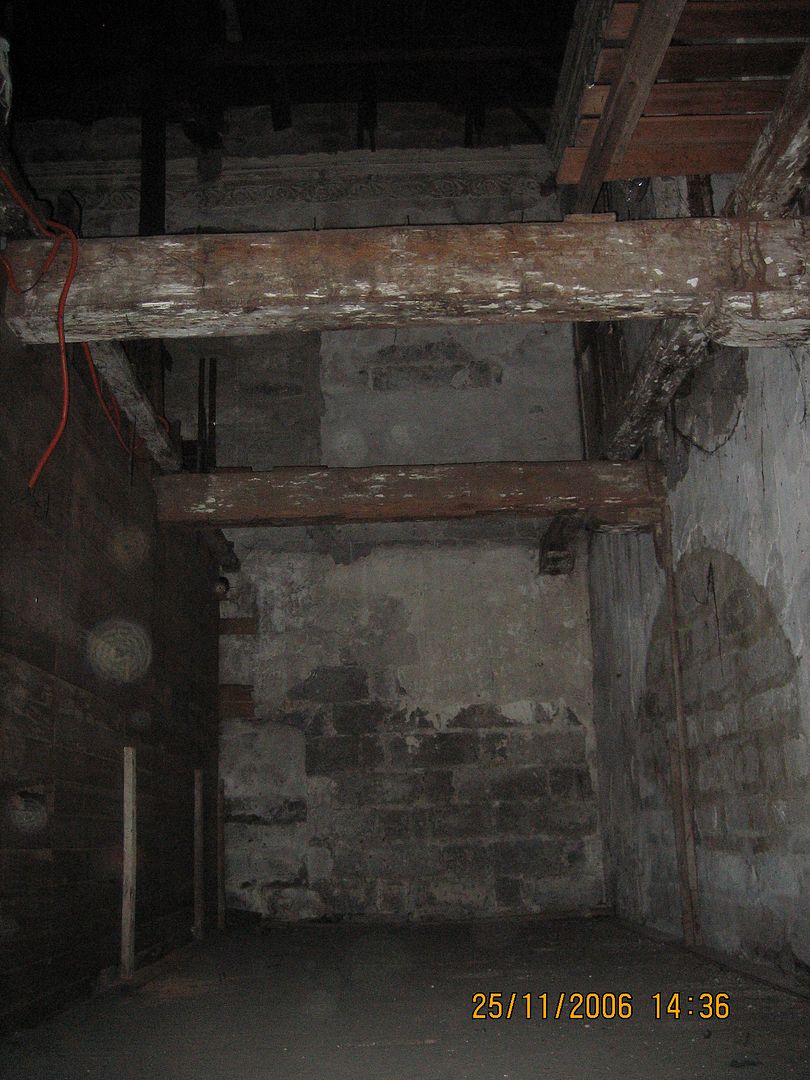
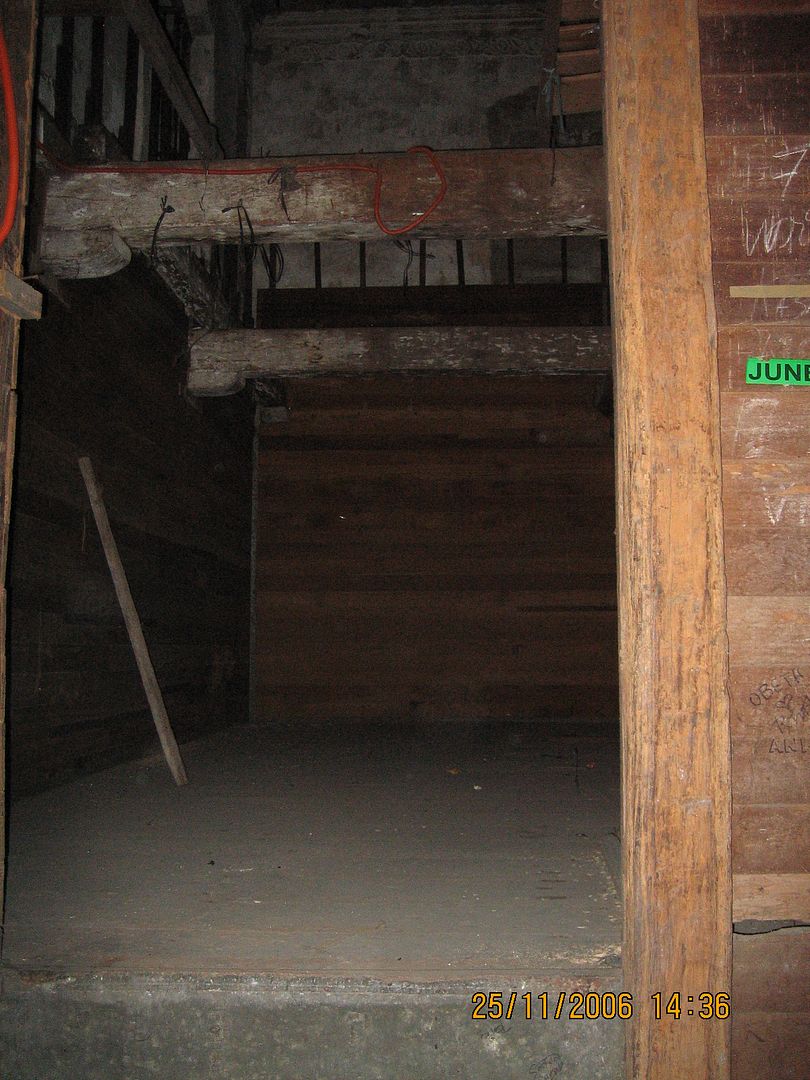
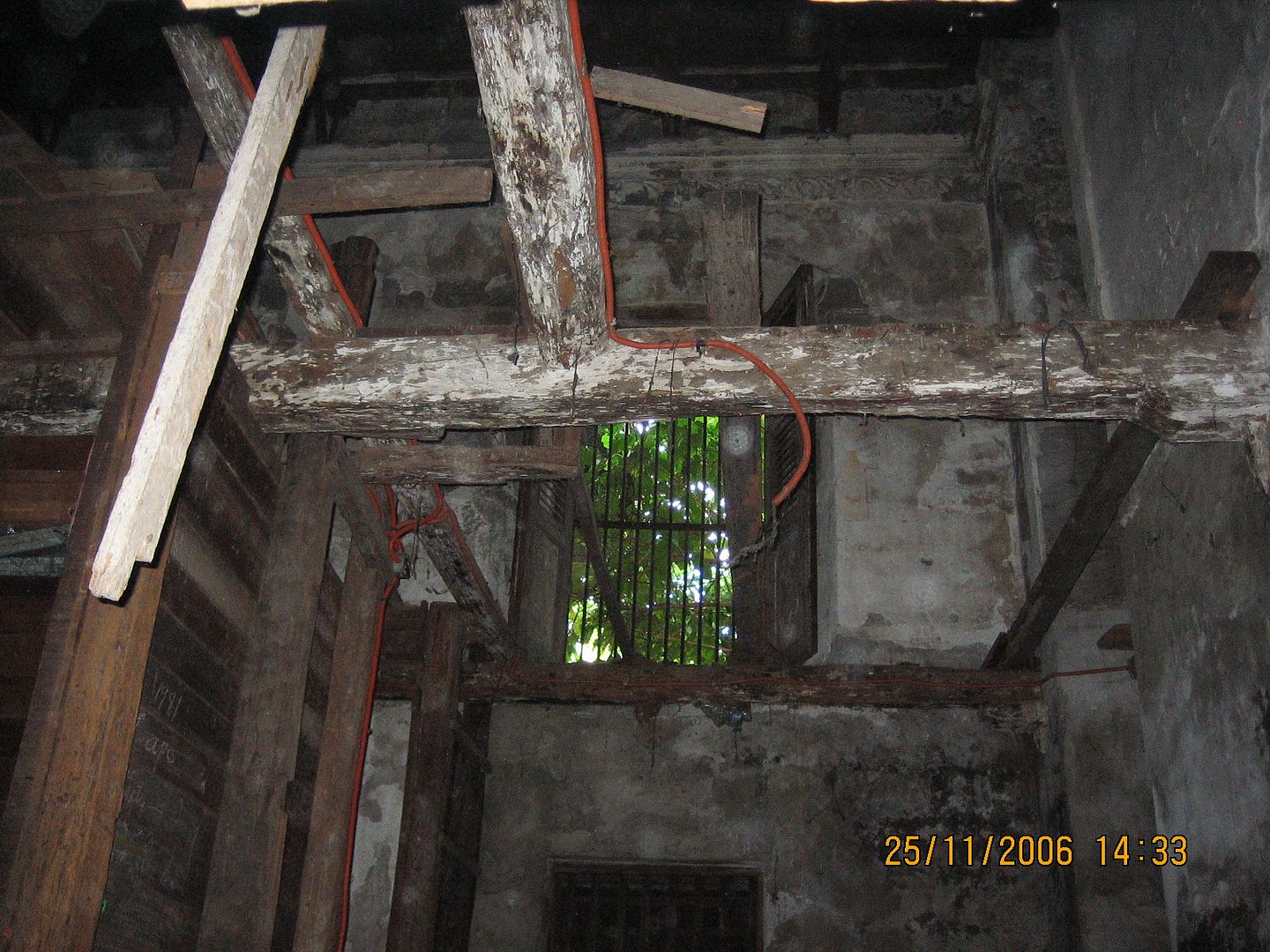
What was obviously a two-storey structure had since been raided for its second-storey floorboards such that only the framing beams remain.
A shot towards the rear of the structure reveals a small upstairs window, now visible through the second-storey framing where the floorboards used to be.

The ground floor areas towards the rear are in an equally forlorn condition.
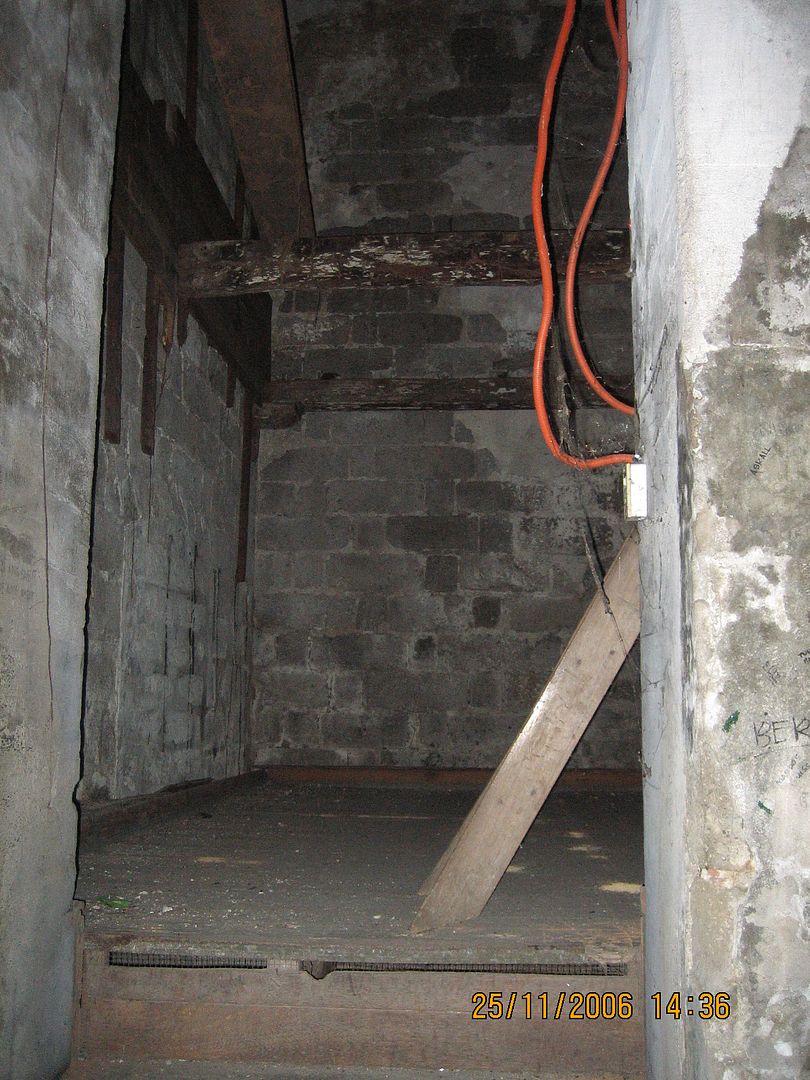


And apparently those orbs are a truly messy lot.
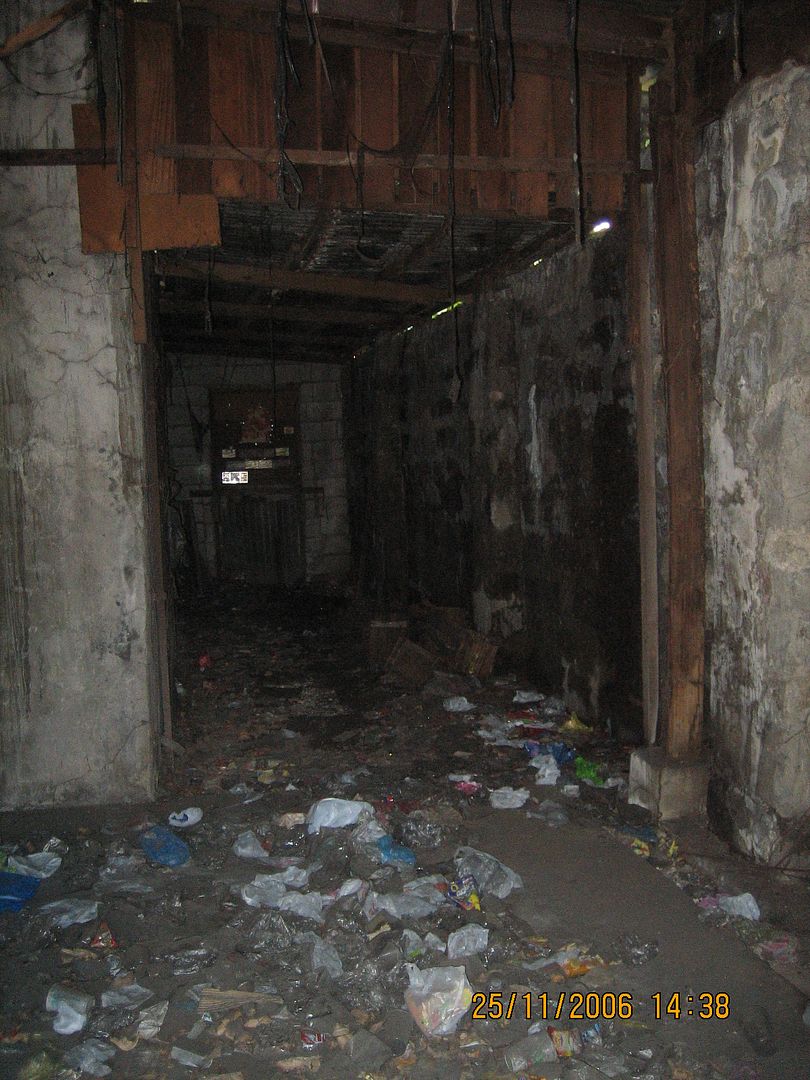


That’s all there is inside, really. All those years of being used as a bodega have eviscerated it, such that not only can we not tell if it might have originally functioned as a residence, but also can we not see how it might have been used as a municipio. All I could see (or not) was how it was used as a commercial warehouse. And, really, would you knowingly eat any snacks that were stored in this place?
  
But as a structure, historical or not, this place is truly unique. Hardly anywhere else, especially in Malolos, or even in Bulacan, can one find a full, unadulterated bahay na bato – both first and second storeys are in stone, likely of Bulacan adobe. (Sure, the second-storey floorboards were of wood, but that’s just appropriate for a living space, I guess.) And those pot-bellied second-floor windows with stone awnings above and metal grills around – exceedingly rare if not unique in these isles. One would have to look perhaps halfway around the world for anything similar of the same period.
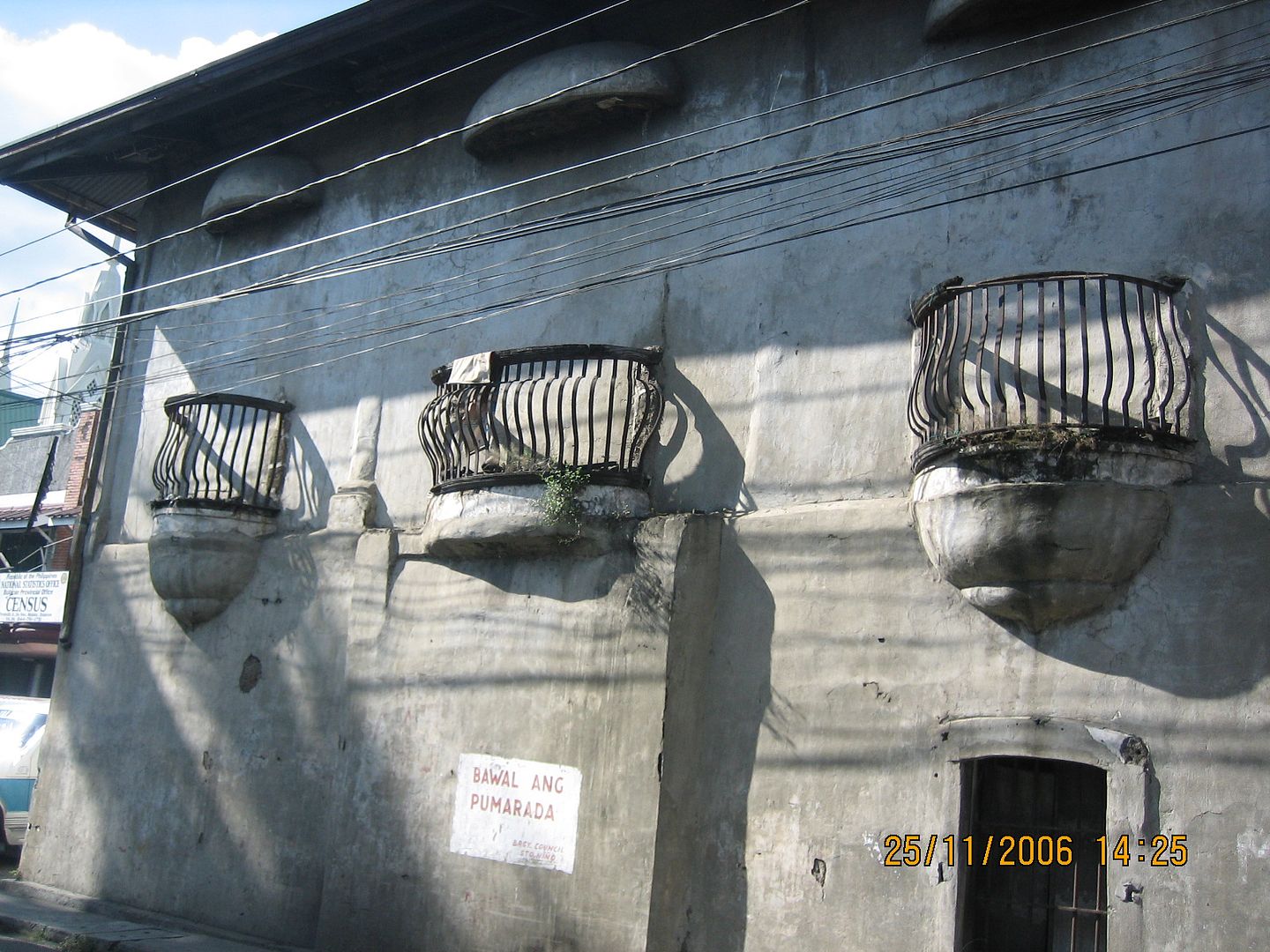

Could this be turned back into a gracious residence? I think so – one would only need to open up the bricked-up windows, remove the roof over the side courtyard, reinstall the necessary wooden floor for the second storey, and build a proper staircase going upstairs (if one could conjecture where the original might have been positioned). For a bit more privacy, the original main door in the center of the façade could be opened up as a window instead, and the main entrance left as it is today, connected to the right-side courtyard. The roof could also be restored to terracotta tile, as it was originally. These restoration tasks are not really as formidable as they might sound, and could be accomplished systematically by a competent architectural and construction team.
The real issue would be, would it be comfortable to use as a residence? Here things get a little dicey, as this structure is on the main Pariancillo road, a busy jeepney and tricycle passageway between Malolos and Paombong. In fact, this next shot, from the other side of the structure looking towards Malolos, is a rare one where the road is surprisingly clear of any such conveyances, except for that tricycle many seconds away.
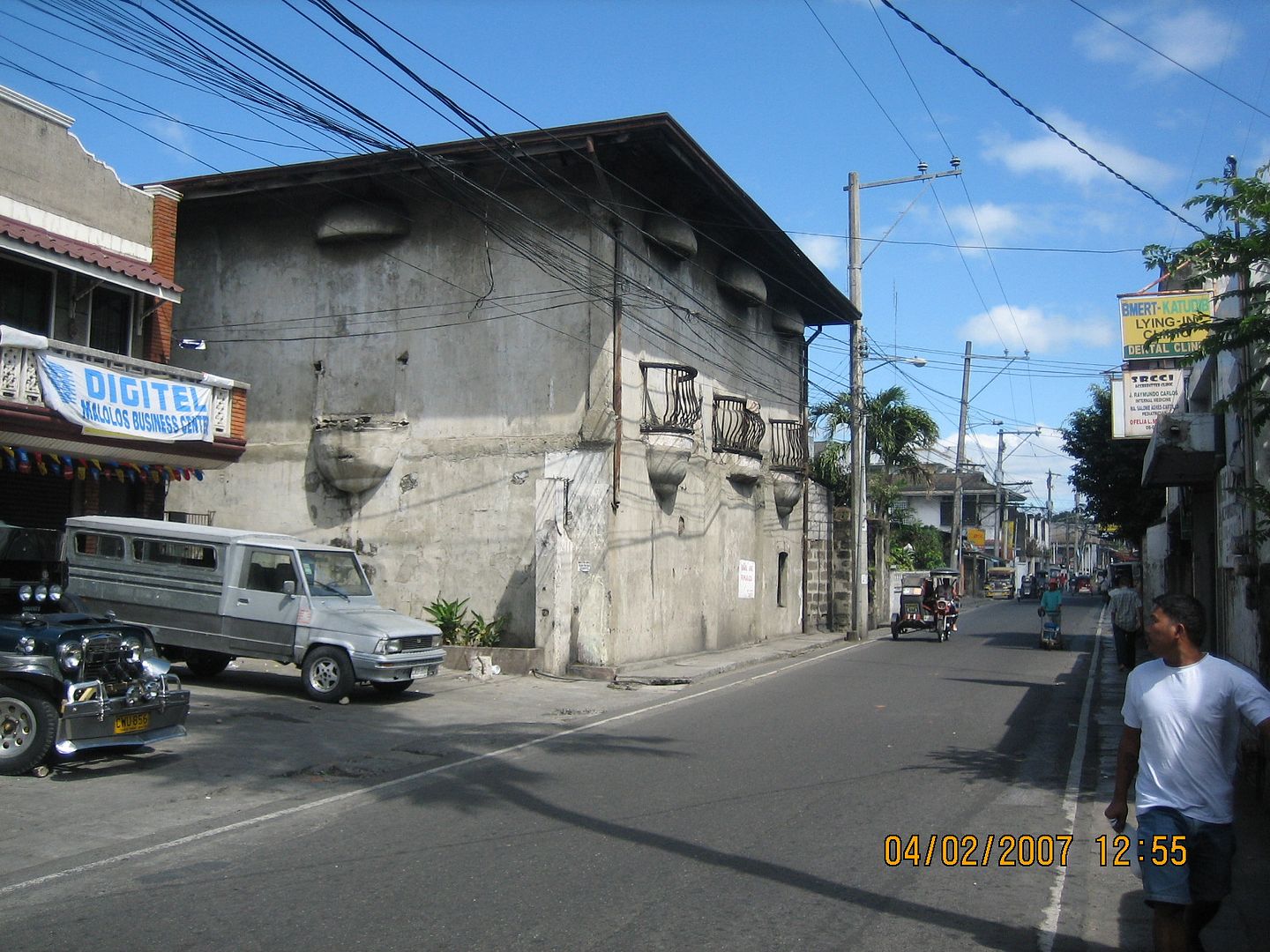

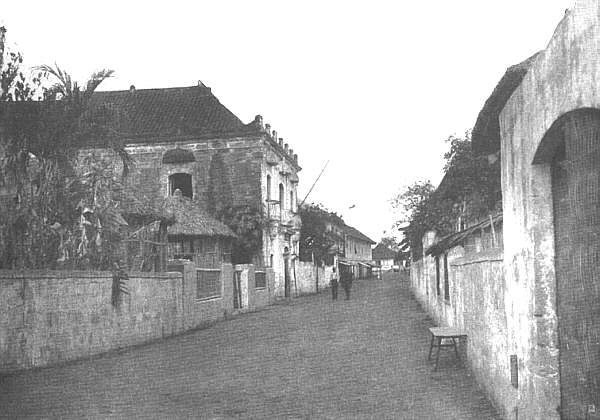
Contrast that to how the road from nearly the same angle looked a hundred years ago (in a photo grabbed from elsewhere on the net) – it was a virtual pedestrian zone.

The neighborhood has also become rather commercial, as its left-side neighbor, for example, is no longer a bahay kubo as it was a century ago, but is now a series of commercial spaces. This would probably make it a bit strange to open up the left-side balconied window and allow the world to enter your second-floor living room.
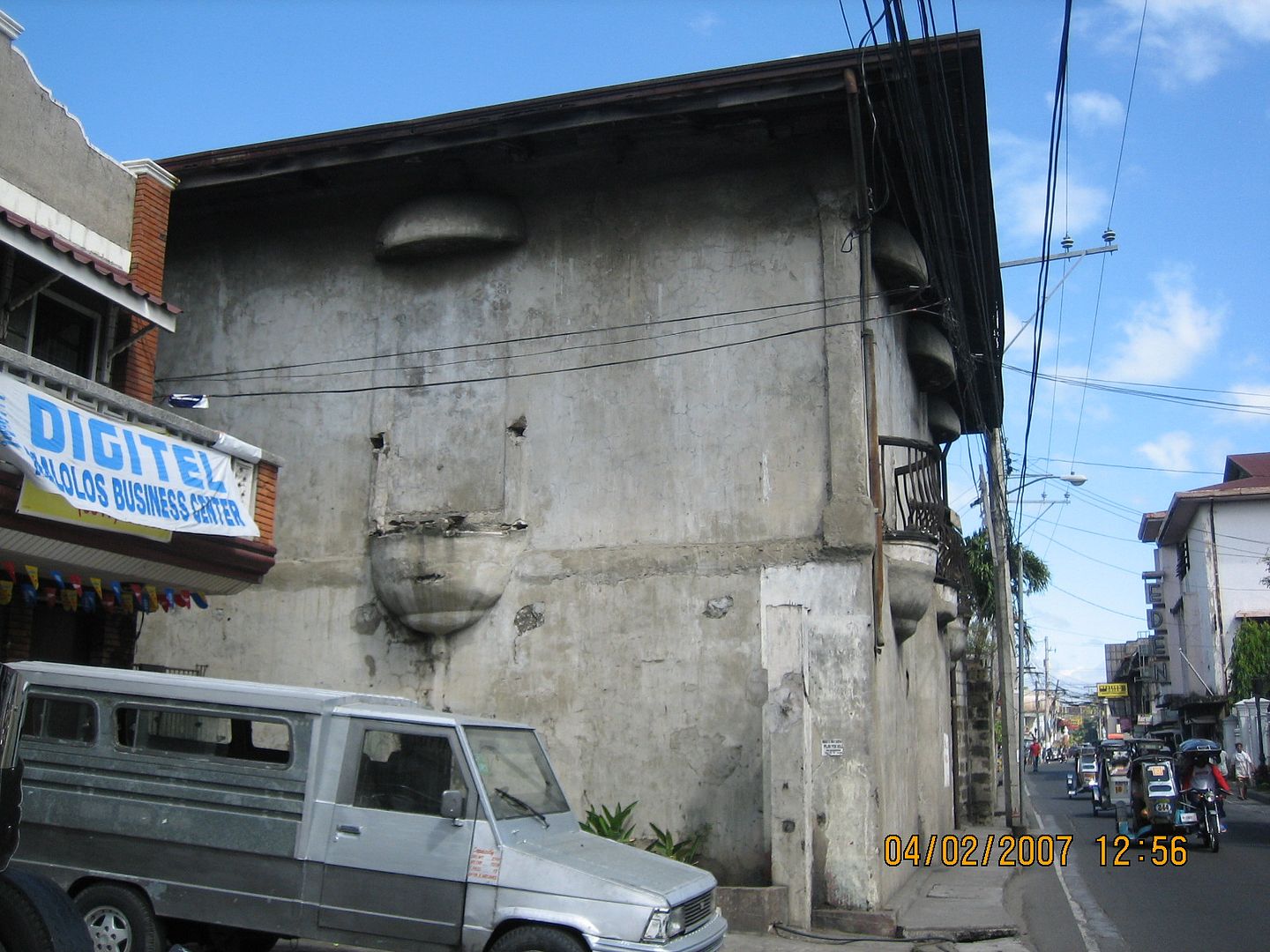

But this can’t just be demolished to make way for a new commercial structure – apart from its obvious architectural value, it is simply too historical to be written off. I believe that a good “reuse” strategy for this facility is called for. Perhaps as a set of offices (lawyers? insurance agents? bond salesmen? make-up ladies?). Or the headquarters or Malolos branch office of some cultural or civic or charitable non-governmental organization. Any other suggestions?

Then maybe even those orbs will decide to take a permanent hiatus.


Originally published on 11 March 2007.  All text and photos (except as otherwise indicated) copyright ©2007 by Leo D Cloma. The moral right of Leo D Cloma to be identified as the author of this work has been asserted.


Original comments:


puyat1981 wrote on Mar 12, '07
wow! you really are into this...conservation work and advocacy is great - is so cool!


overtureph wrote on Mar 15, '07
I agree it's a unique structure, even the styling. In my opinion, it looks Spanish-Mexican. Such a waste that it deteriorated to what it is today. It would be nice to be restored as a library, art gallery or even a restaurant.


rally65 wrote on Mar 15, '07
Why not come over and acquire it and open a library - art gallery - restaurant in it? We'll patronize it at least once a week!


arcastro57 wrote on Mar 15, '07
I see so many possibilities in this structure. Any takers yet?


rally65 wrote on Mar 15, '07
No takers so far -- it's already been on the market for a number of years. Take it!


overtureph wrote on Mar 15, '07
I don't have the funds for such an endeavor. I hope the heritage structure finds a benefactor soon.


ivanhenares wrote on Mar 17, '07
Hi Leo, why not get in touch with Dir. Ting de los Reyes of the DOT. He's among the stalwarts of the heritage group of Bulacan (I think it's called Pamana if I'm not mistaken)


rally65 wrote on Mar 18, '07
Thanks, Ivan. But what could Dr. de los Reyes do? I'm sure that he already knows anyway that this structure is for sale. Would he buy it himself?


ivanhenares wrote on Mar 19, '07
He could ask the governor to buy it.


rally65 wrote on Mar 19, '07
Hmmm....will see whom I can speak to around here.


qwertyuiop67 wrote on Apr 28, '07
Hello, you don't know me, but I came upon your blog by chance and I think it's one of the more interesting ones on Multiply. I happen to like old houses too, and I think it's unfortunate that they walled up the little balcony-like windows of this structure and plastered the facade with cement. I'm partial to stone houses that show the patina of age. =)


rally65 wrote on Apr 29, '07
Thanks for dropping by, Joan! If you like old houses, you've come to the right place. Do keep checking regularly -- I have many more (years' worth of) articles on old houses and other interesting stuff locked up in my head, just waiting to be released. ;-)


qwertyuiop67 wrote on May 3, '07
I was thinking that perhaps, when you've accumulated enough stuff, you could compile everything into a coffee-table book. I like how you use architectural terms and historical information in your descriptions --- makes your blog not only entertaining, but educational as well. =)


rally65 wrote on May 4, '07
Hi, Joan. That is the long-term objective, honestly. (Not sure though about the "coffee-table book" -- I don't take coffee. Ha ha.) In the meantime, I first have to develop more material. Now if I only had more time for this -- like many others, I simply have a full plate! Perhaps I need to re-orient my priorities. We'll see.


victorancheta wrote on May 6, '07
Here's a much clearer pic Leo.
How much are they asking for it? It's in a prime location.
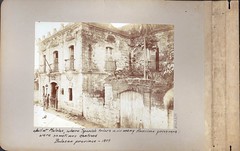
Gobierno Militar Malolos


rally65 wrote on May 6, '07
The seller told me, "Just make us an offer."

Why not go ahead, Victor?


rally65 wrote on May 6, '07
As Alex said, many possible uses for this structure can be imagined. I can think of at least a couple of feasible ones. But first I have to find a house for my family somewhere there.


johnada wrote on May 7, '07
The old municipal hall of Barili, Cebu is now a private home. I was disoriented when I went to the town because it looked a bit different. I asked my classmates what happened to the town and they enlightened me. It really is an imposing "house" in a provincial town.


rizalunderground wrote on Sep 17, '07
Orbs here and there...Hmmm... Paranormal? Looks creepy...The big spiral one is interesting....


larkjein wrote on Nov 6, '08
Hi! I used to live just down the street from this place, when I was a kid I called it "haunted kulungan" now I know why after seeing those orbs hehehe. I remember back in 1996-1997 I used to buy junk food (chippy, clover, cheese curls) from this place when they used it as a wholesale bodega for junk foods. If I win the lottery I would definitely buy the property :)


rally65 wrote on Nov 7, '08
larkjein said
"I used to live just down the street from this place, when I was a kid"
Where exactly did you live? Another ancestral structure?


rudyescoto wrote on Apr 10, '10, edited on Apr 10, '10
great...is it still there?


Yes, it is.

Sunday, May 1, 2011

XXI. Can't Get Enough of Vigan: Santos, Silver, and Shopping

Before we broke off for our three-part survey of aparadors and for the requisite Christmas feature, we were in Vigan. Actually, we haven’t left Vigan yet. We may be done with the ancestral houses, but there are other great places to visit in and around town. 

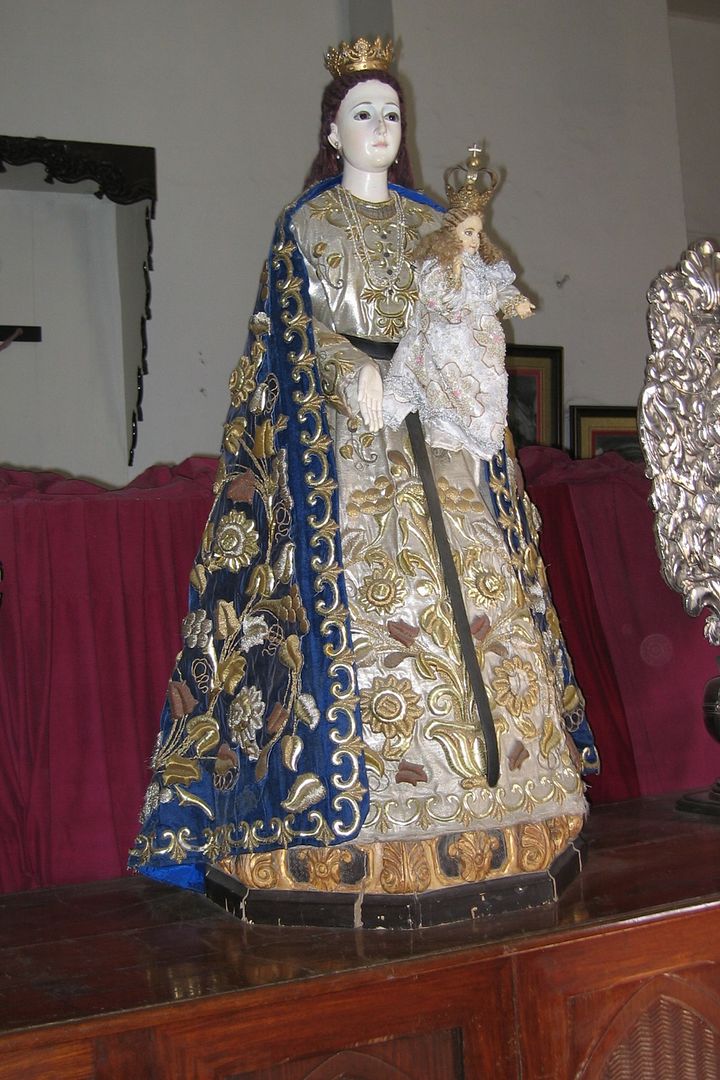
For starters, in the rear of the Vigan Cathedral is an interesting Museum, which displays a platoon of antique religious images, possibly all church-owned. I couldn’t check directly, lest I be arrested for attempted theft, but this looks like an ivory image of the Virgin and Child:


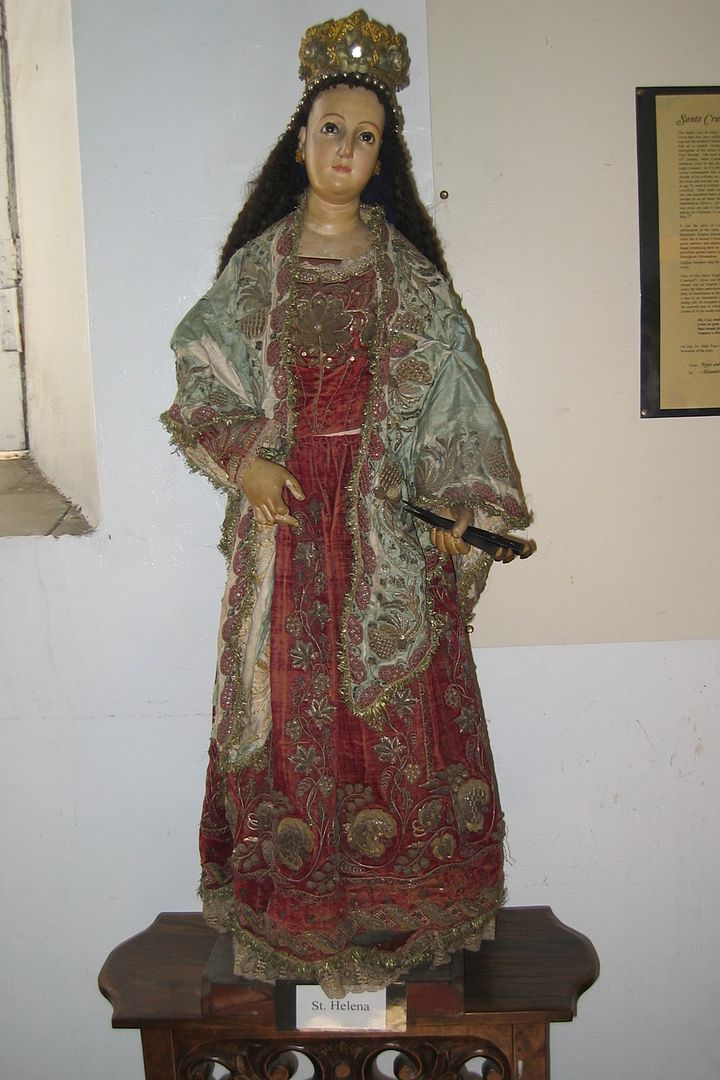
Here’s an image of Santa Elena, holding the nails that presumably she found together with the True Cross:


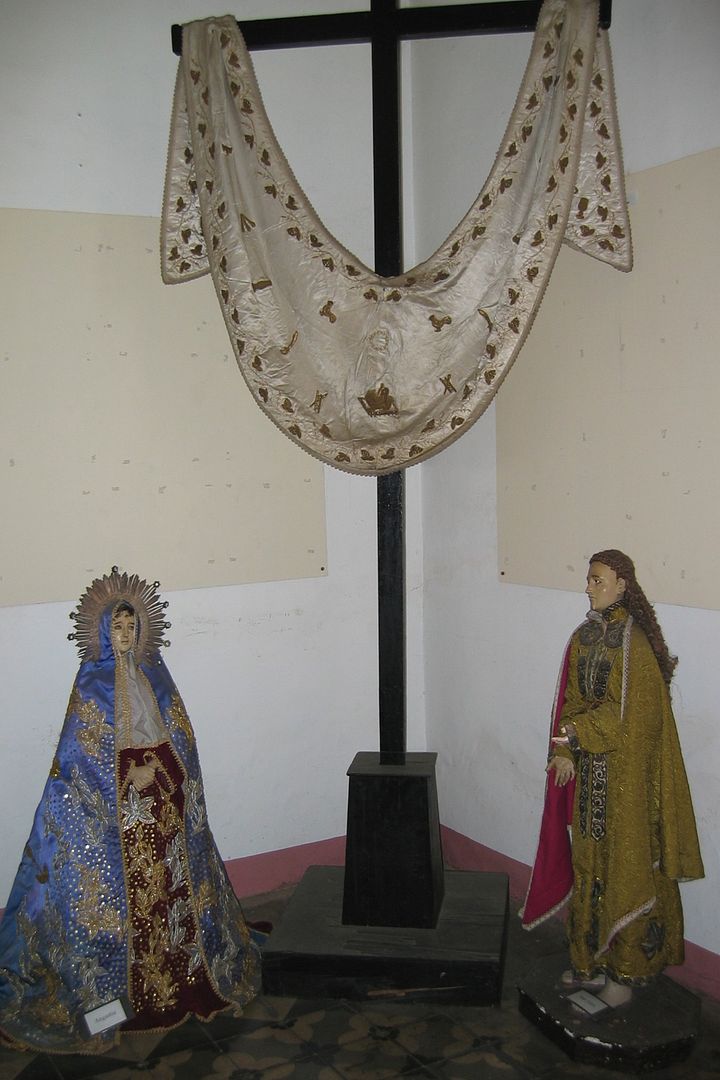
Here’s an incomplete Calvary tableau, with the Sorrowful Mother and Saint John:


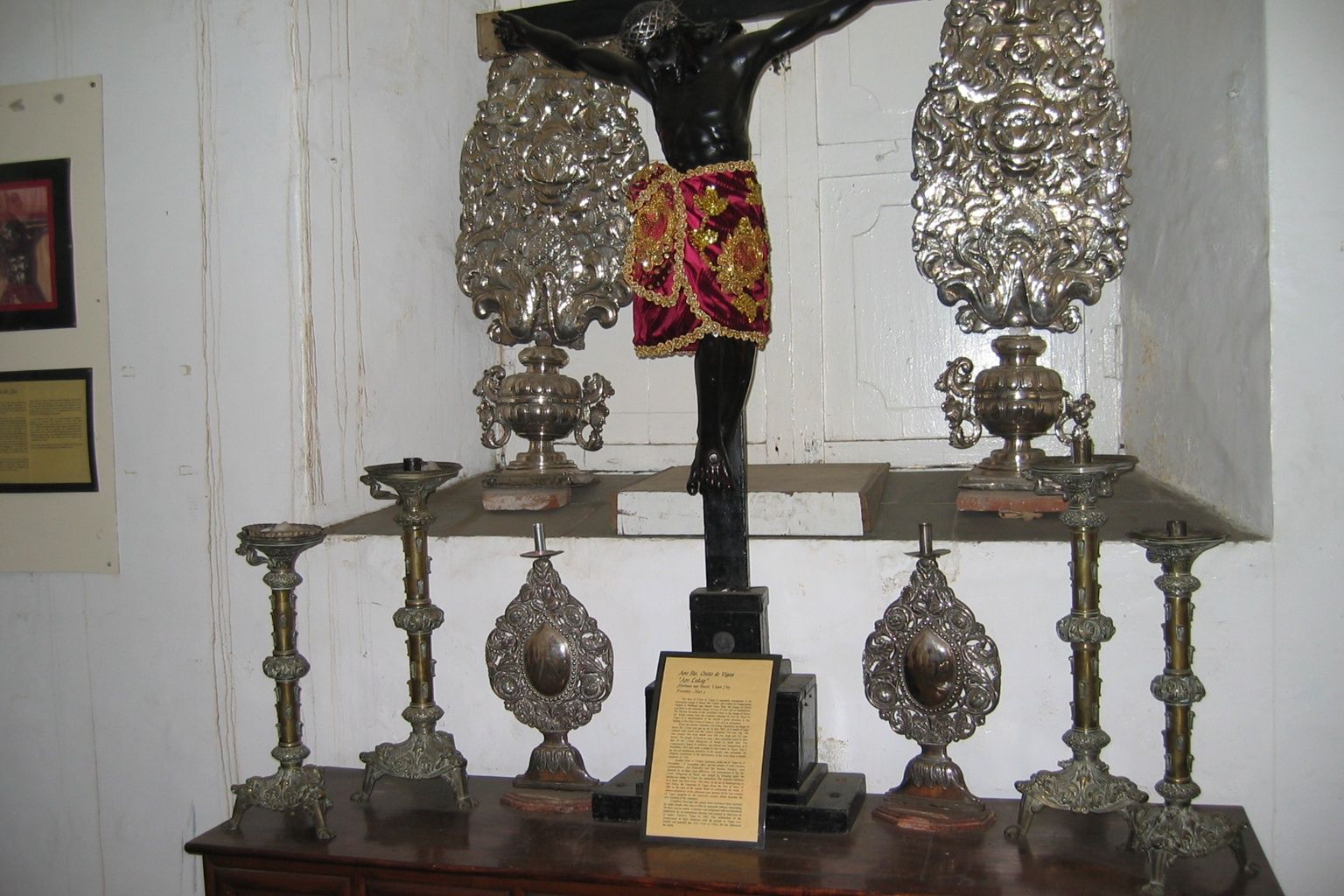
Apart from the jet-black Corpus on this Crucifix, allow yourself to be distracted by the ornate brass candlesticks and silver altar adornments around it:


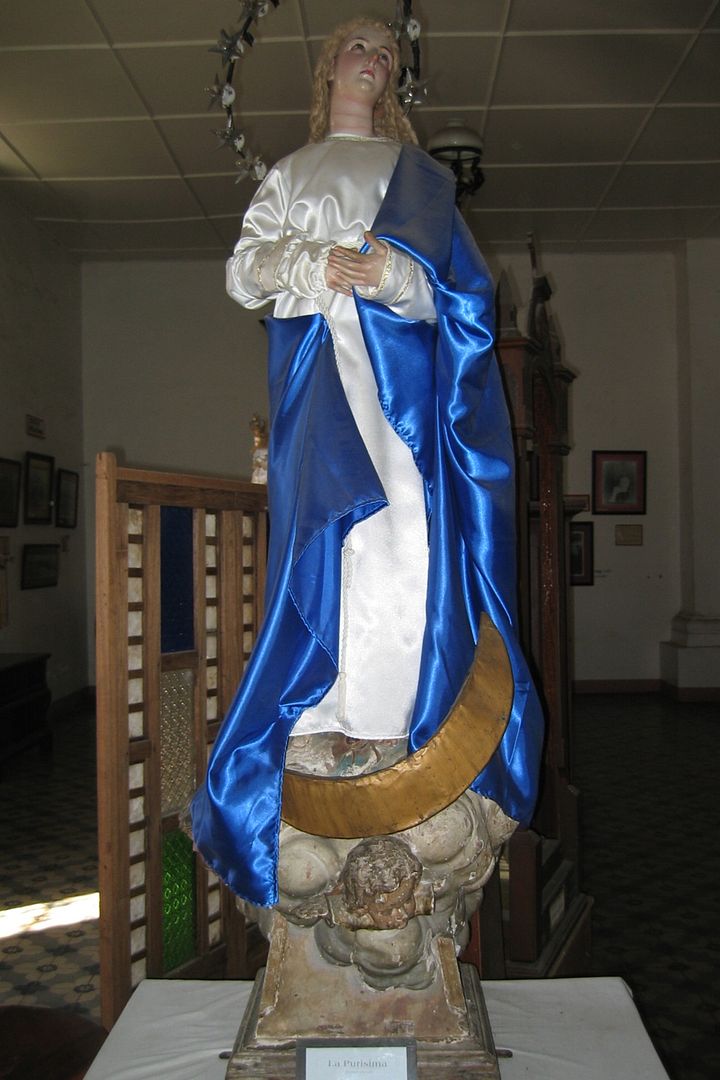
This Immaculate Conception is easy to identify because of her standard garment colors of blue and white and of that large quarter-moon jutting out from the clouds. 


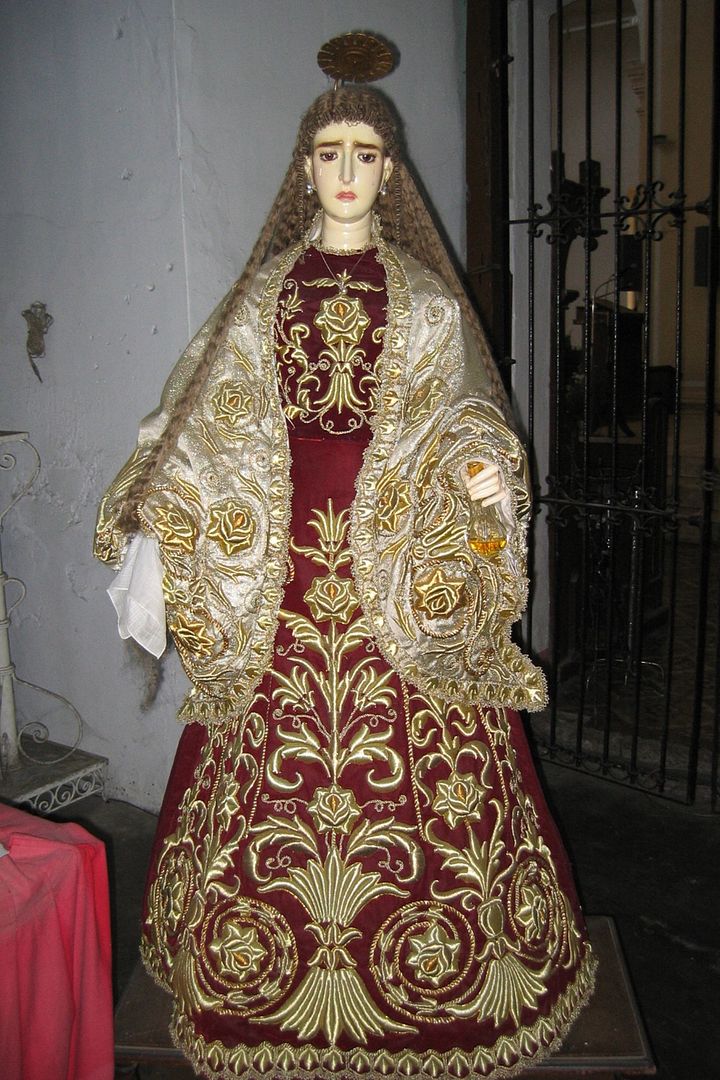
This next Holy Woman appears to be a traditional representation of Mary Magdalene, holding a bottle of perfume in one hand and her hair in the other, ready to perform the penitential act of perfuming the Lord’s feet and wiping it with her hair.


(N.B.: Please do not write to me complaining that I have erroneously identified the Penitent Woman in the Gospel account with the Magdalene. I have heard all that before. I have also been told [scolded] for identifying either or both of those Holy Women with Mary the sister of Martha and Lazarus. Let us please stop discussing this. In my view it is simply not an interesting subject, except maybe for church historians and Bible scholars.)


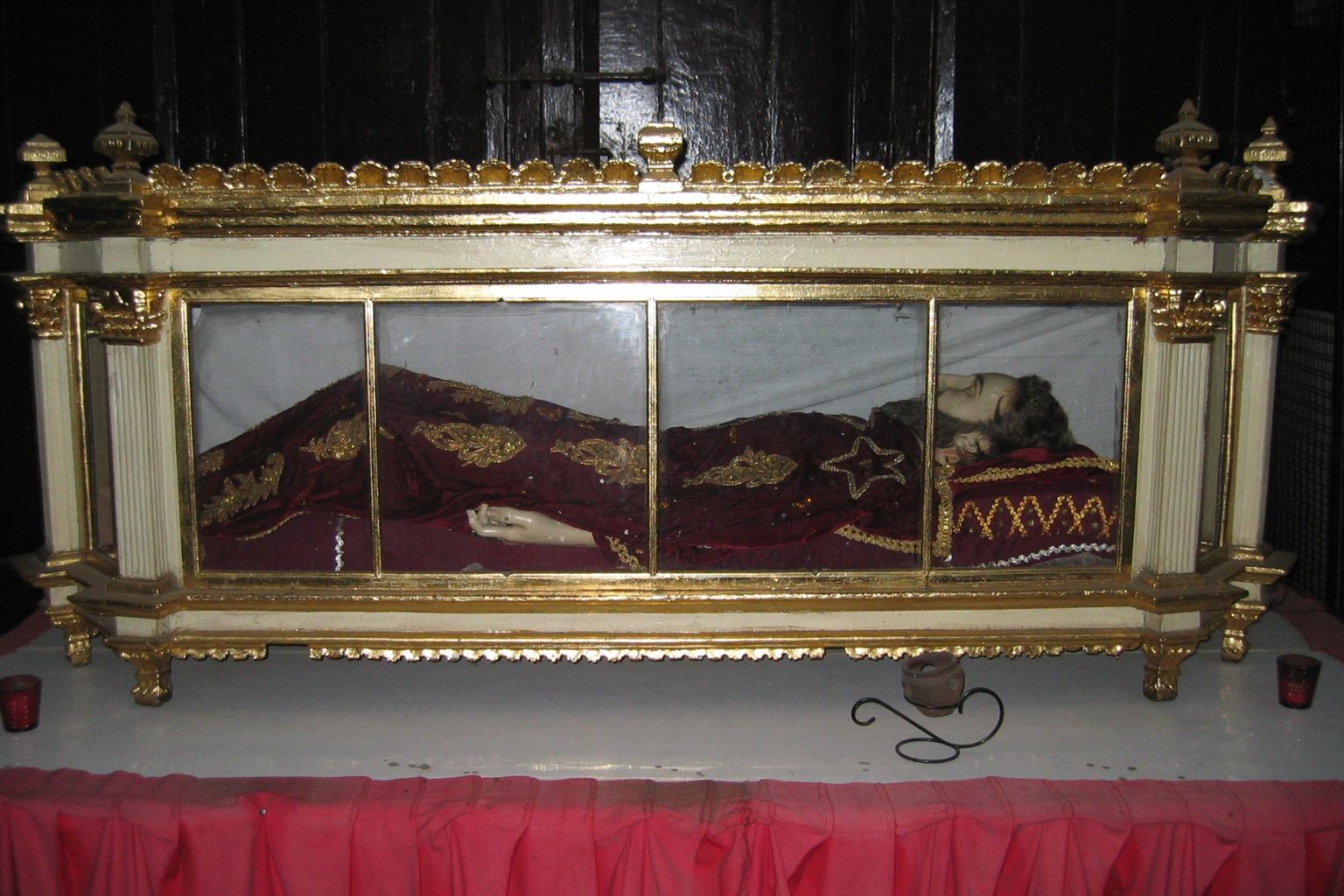
A church museum would be incomplete without a life-sized image of the Dead Christ:


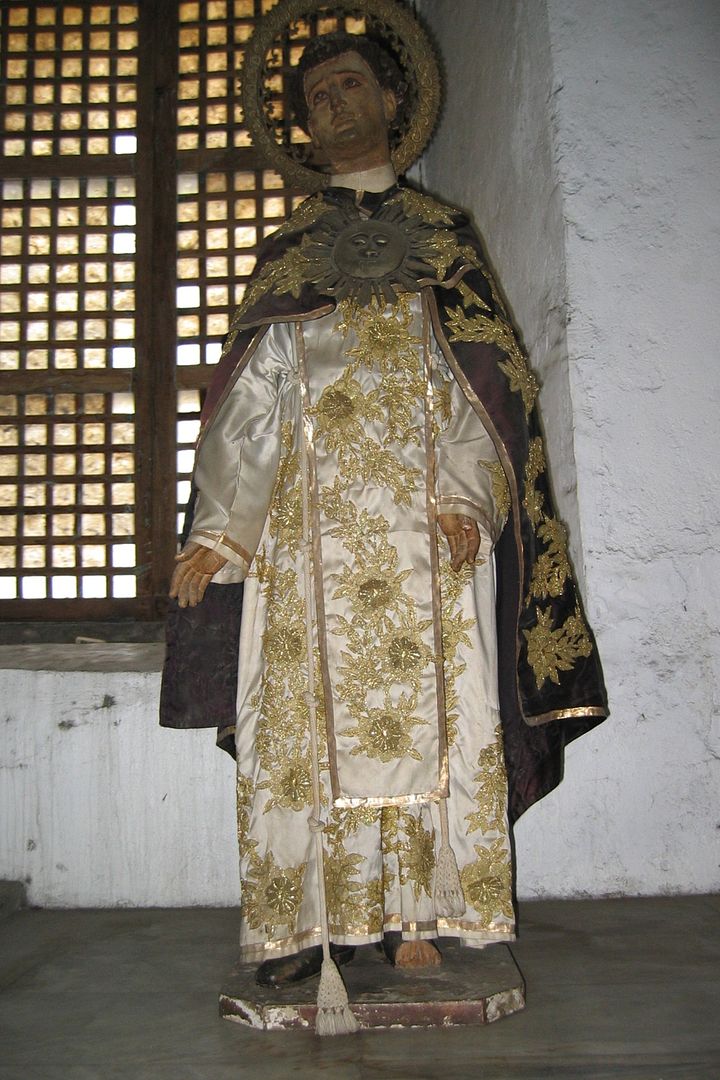
We now turn to a pair of Dominicans, Saint Thomas Aquinas (with a sun on his chest),


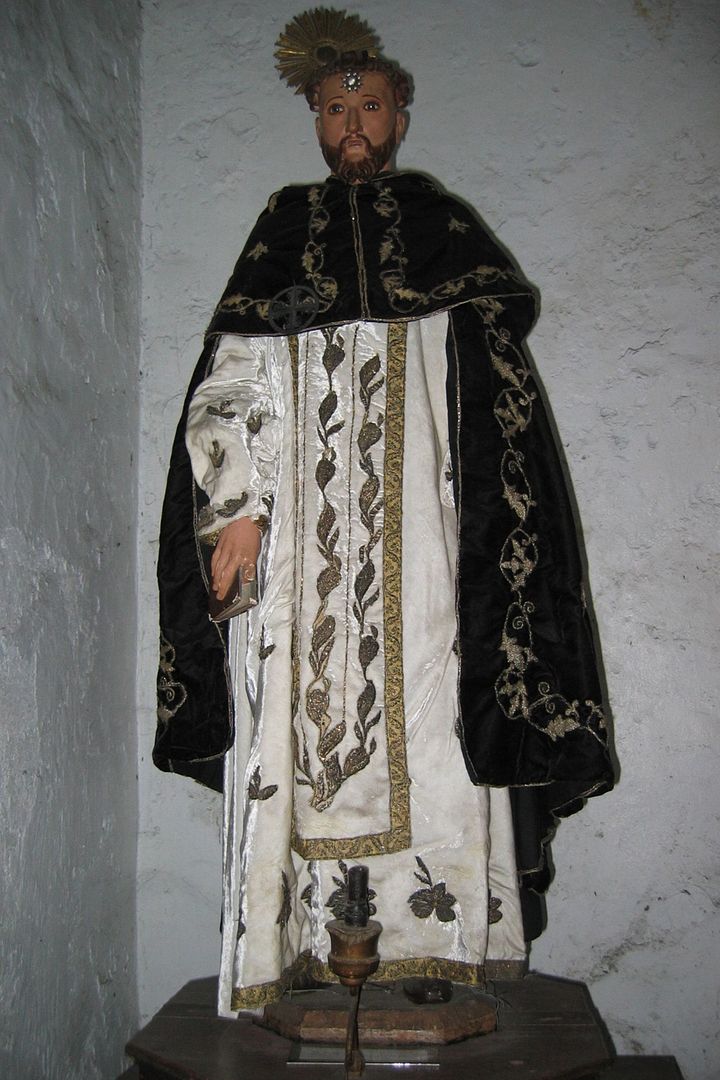
and the founder himself, Saint Dominic de Guzman.


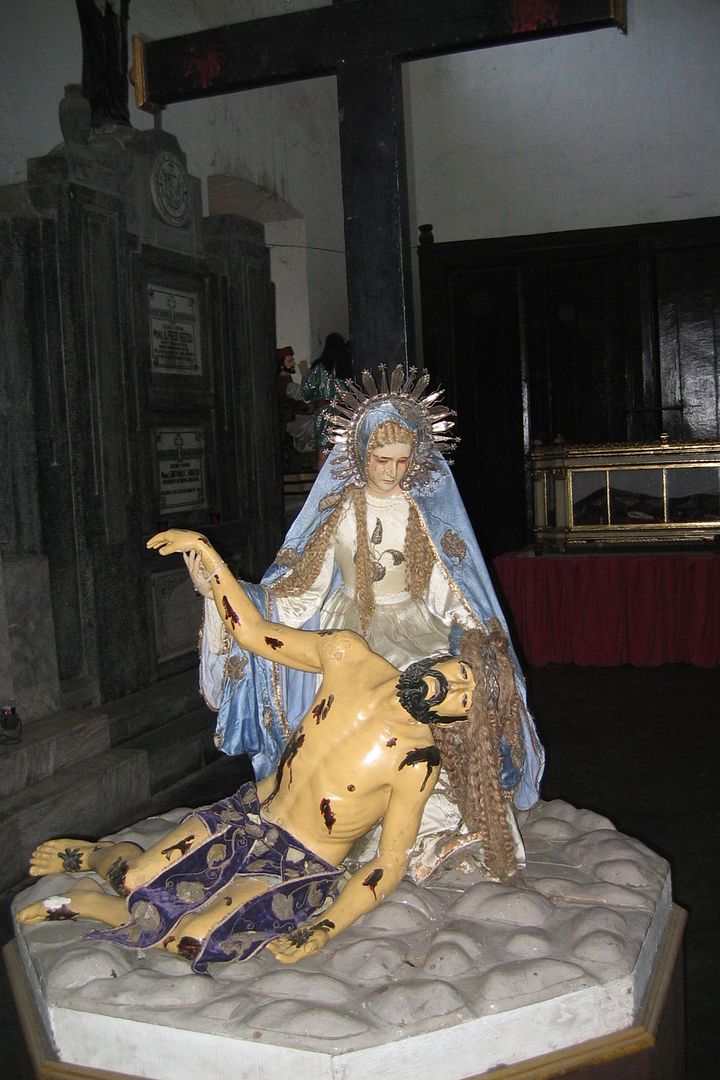
The museum also has a smaller-than-life tableau of the Pieta, with a classically-styled Virgin but folksy-looking Christ.


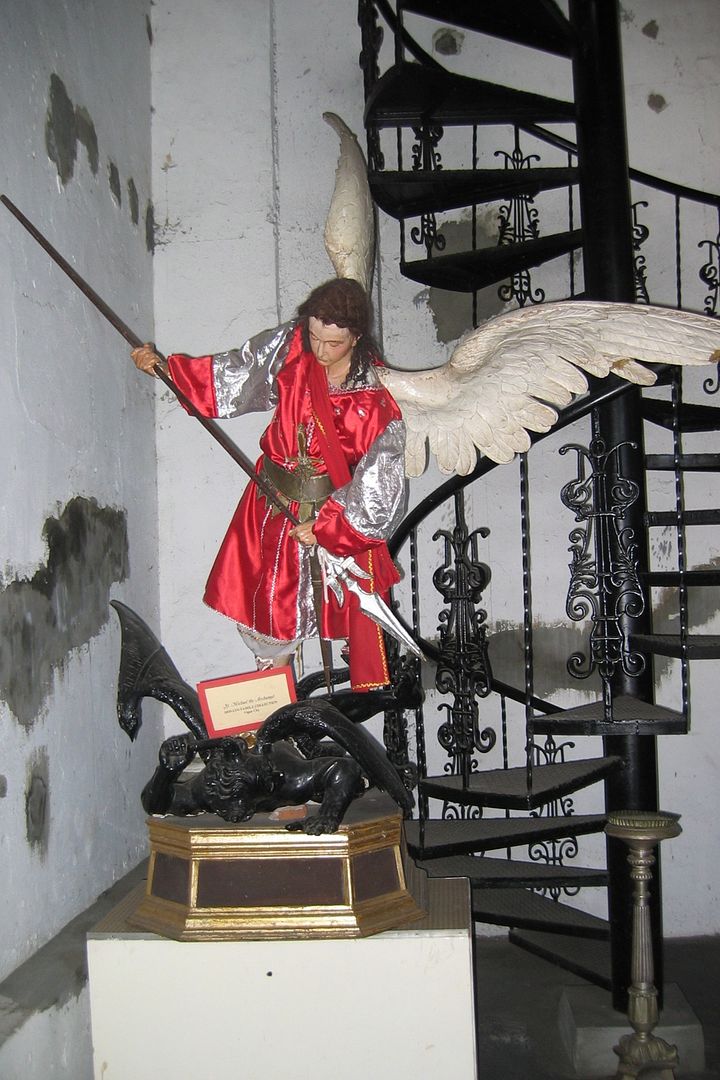
Probably the most impressive piece in this (apparently) permanent exhibit was Saint Michael contorting the heck out of the Devil.


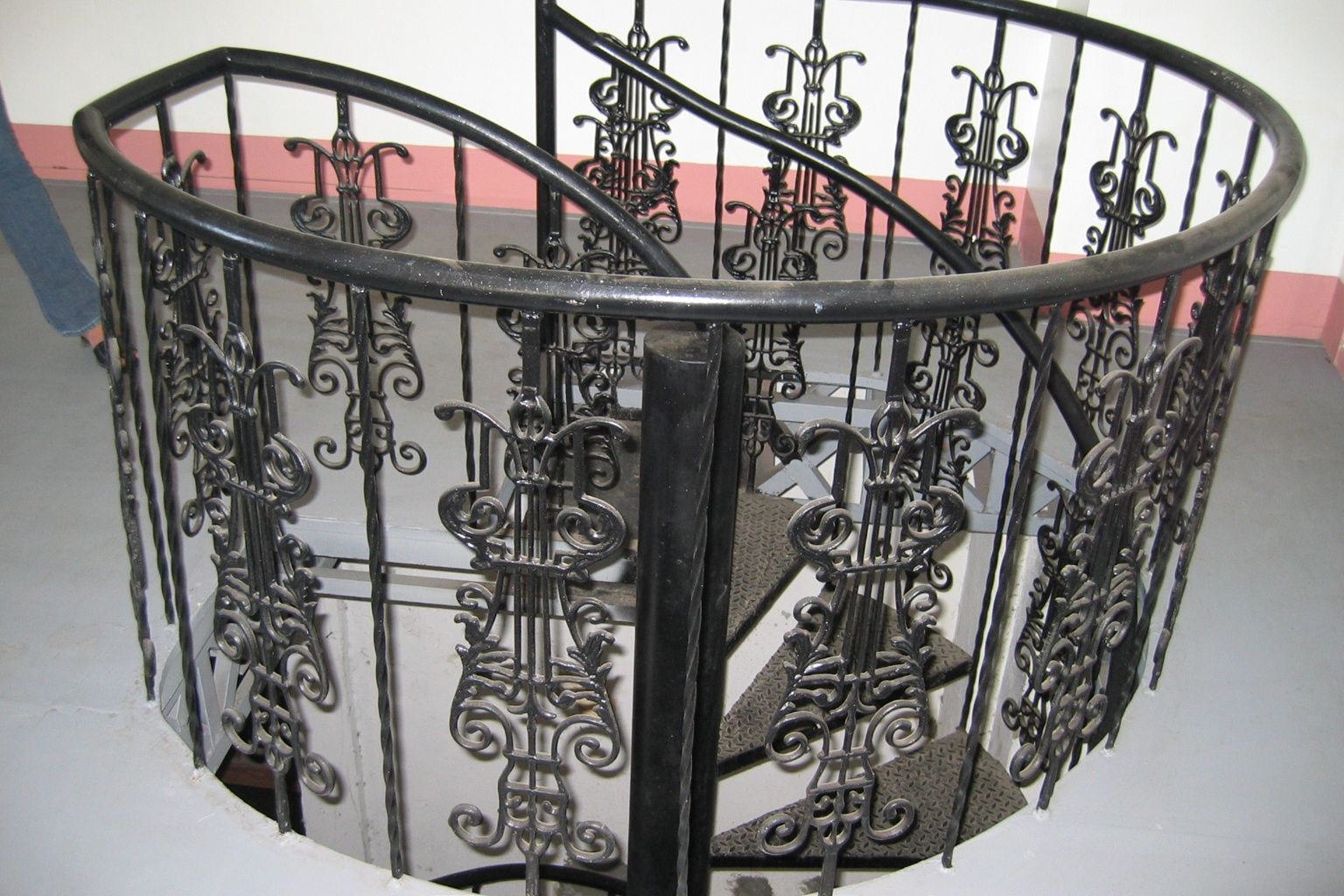
That spiral staircase behind Saint Michael was just too tempting to resist climbing, so I did not (resist, I mean). It led to another floor, which was still empty and undergoing renovation at the time; it appeared to be an additional room for possibly more exhibits. But at least I got to see the top of this staircase, whose details were suitably ornate (though perhaps not really antique and original):


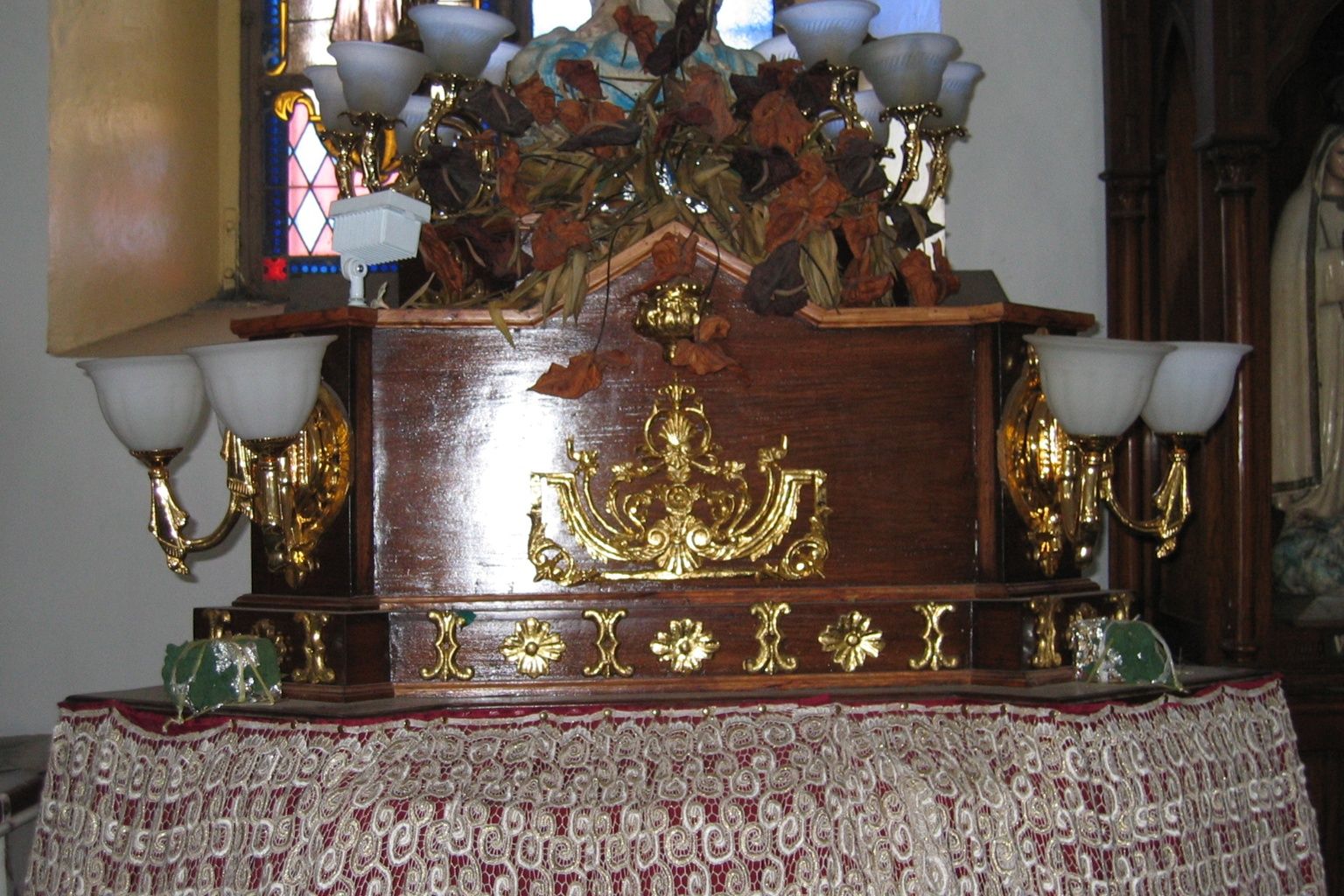
Our next stop is the Vigan Cathedral itself. Just wandering around the side aisles inside, we find an unmounted wooden carroza with gold-colored appliqués, just parked and ready to go.


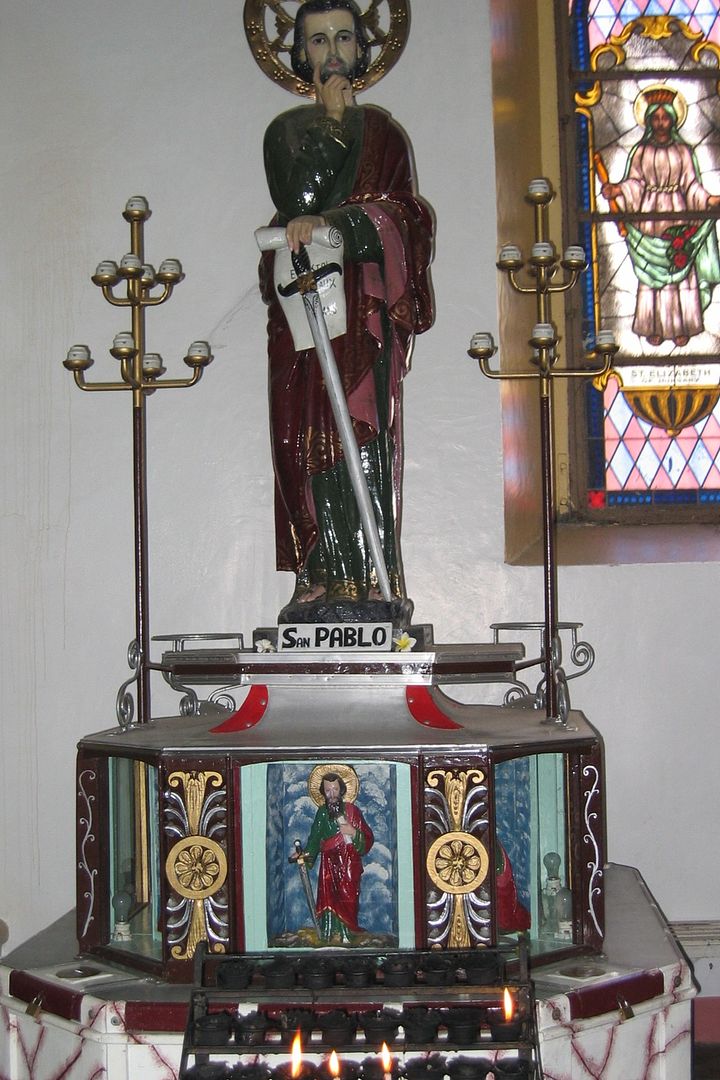
This next one is best described as a “faux-carroza” – you’d think it was one, until you try to push it and realize that it’s a solid stone structure, anchored to the floor. Saint Paul, Vigan’s patron, is wondering what in heaven’s name you were trying to do.


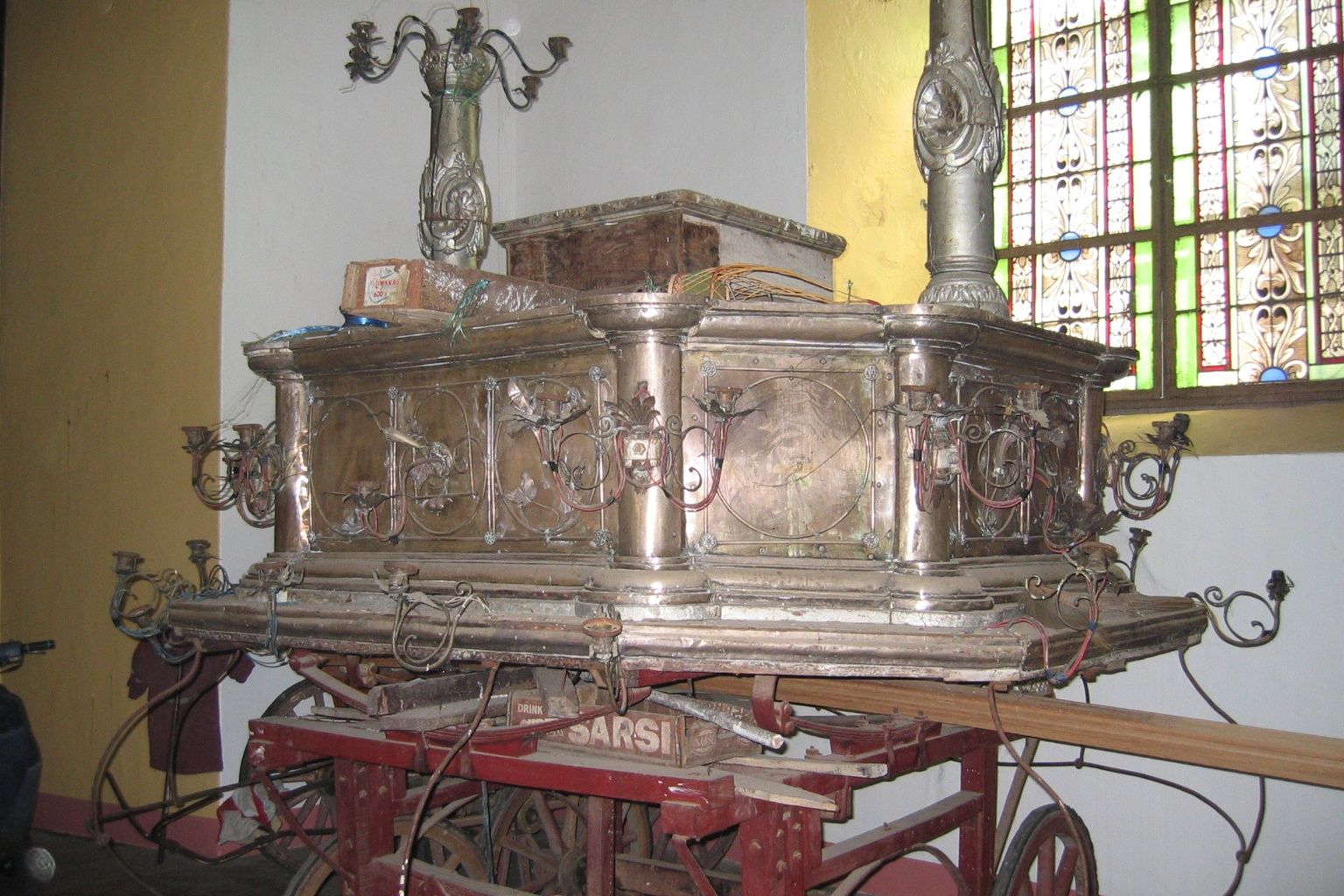
Finally, there’s another carroza parked in another corner. This is a most interesting one, as it’s silver (or silver-plated), and obviously started life as a shoulder-borne platform (anda), that just received a chassis and wheels later on. The neoclassical-cum-Art Nouveau design is unique and unusual. And never mind the use of a softdrink case to prop up the leaf-spring suspension system.


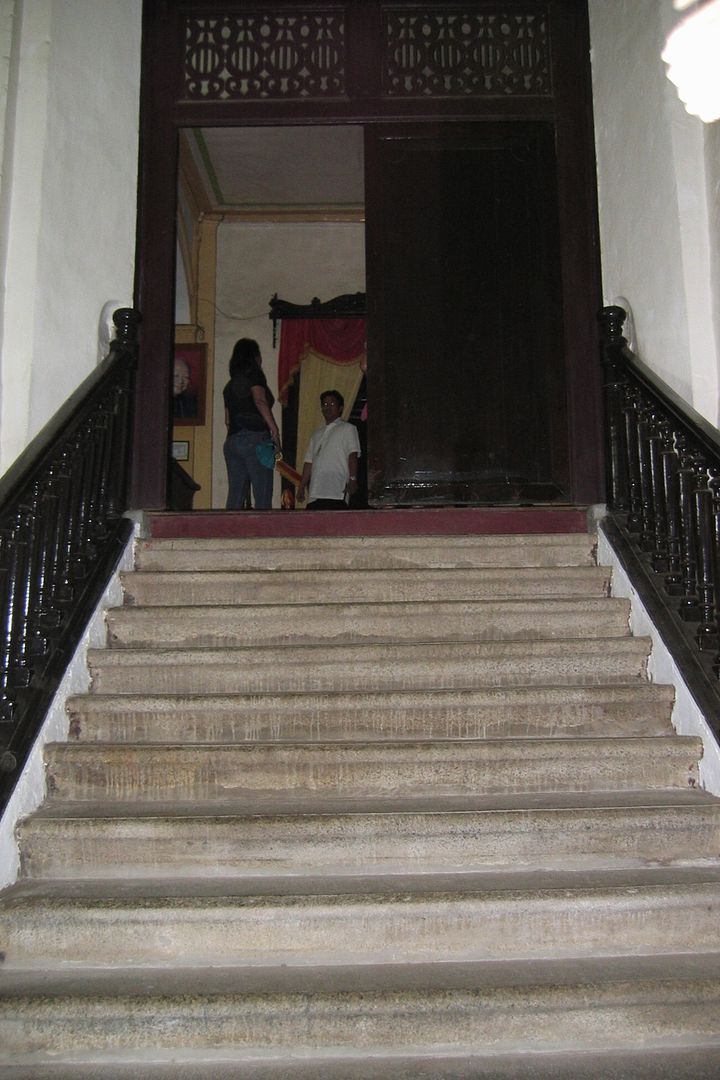
We next cross the street from the Cathedral and enter the adjacent building. This is the Archbishop’s Residence, yet another very old residential building in Vigan. It may be entered and visited, as the staff are quite hospitable, although photography is forbidden on the main (second) floor. This is unfortunate, as here is where one finds the most impressive displays of antique church treasures – mainly altar silver and ceremonial vestments. The interior spaces are expectedly old and impressive as well, with wide floorboards that automatically appeal to wood fetishists (like myself).


Given this restriction, we have to content ourselves with a photo of the entrance to this floor:


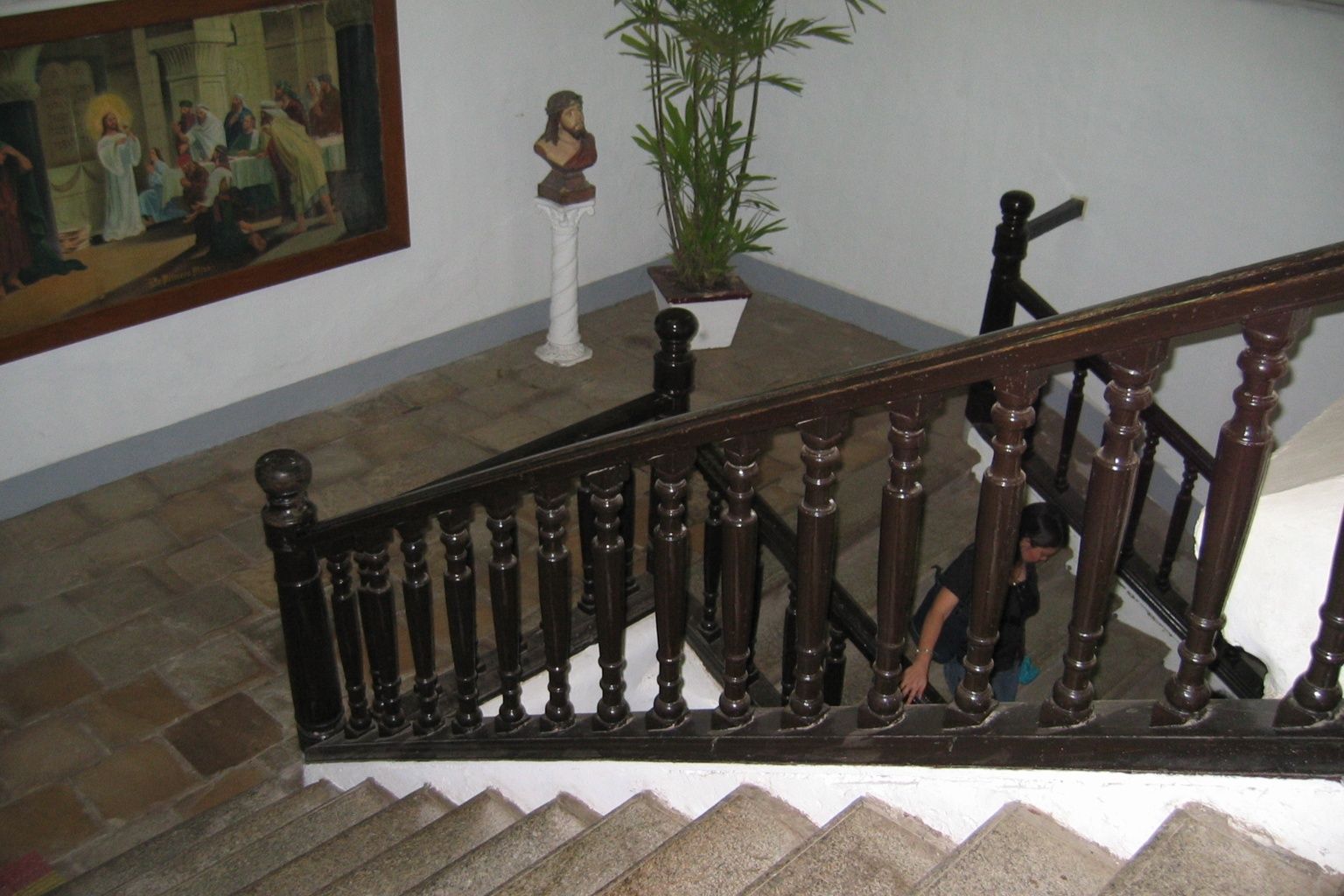
And with a shot of the wide balustraded staircase as we descend after our visit.


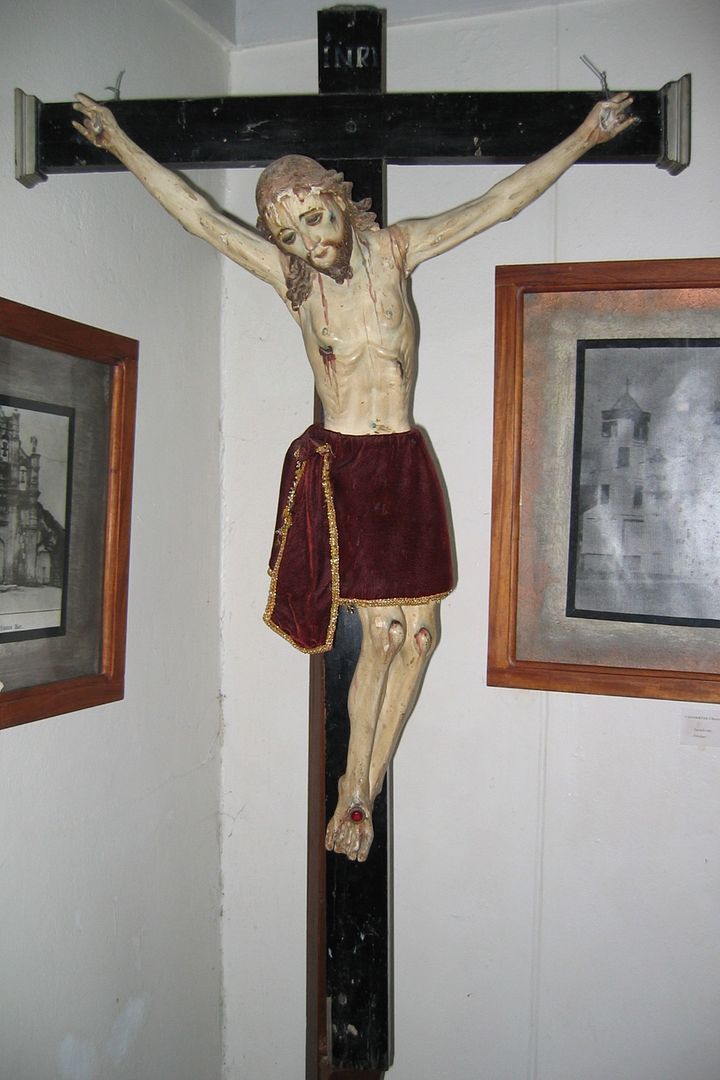
But hold on, our guide tells us. There is yet another museum, on the ground floor of this Archbishop’s Residence. And photography is allowed there. So what else do we do but click away, starting with this beautiful naïve-style Crucifix:


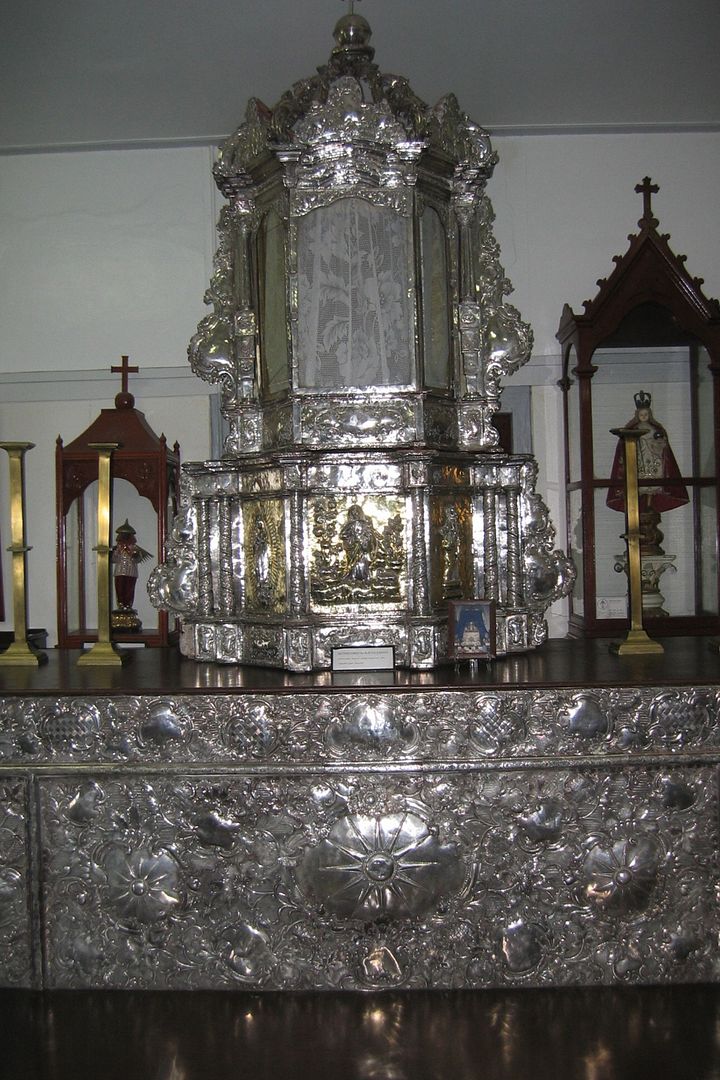
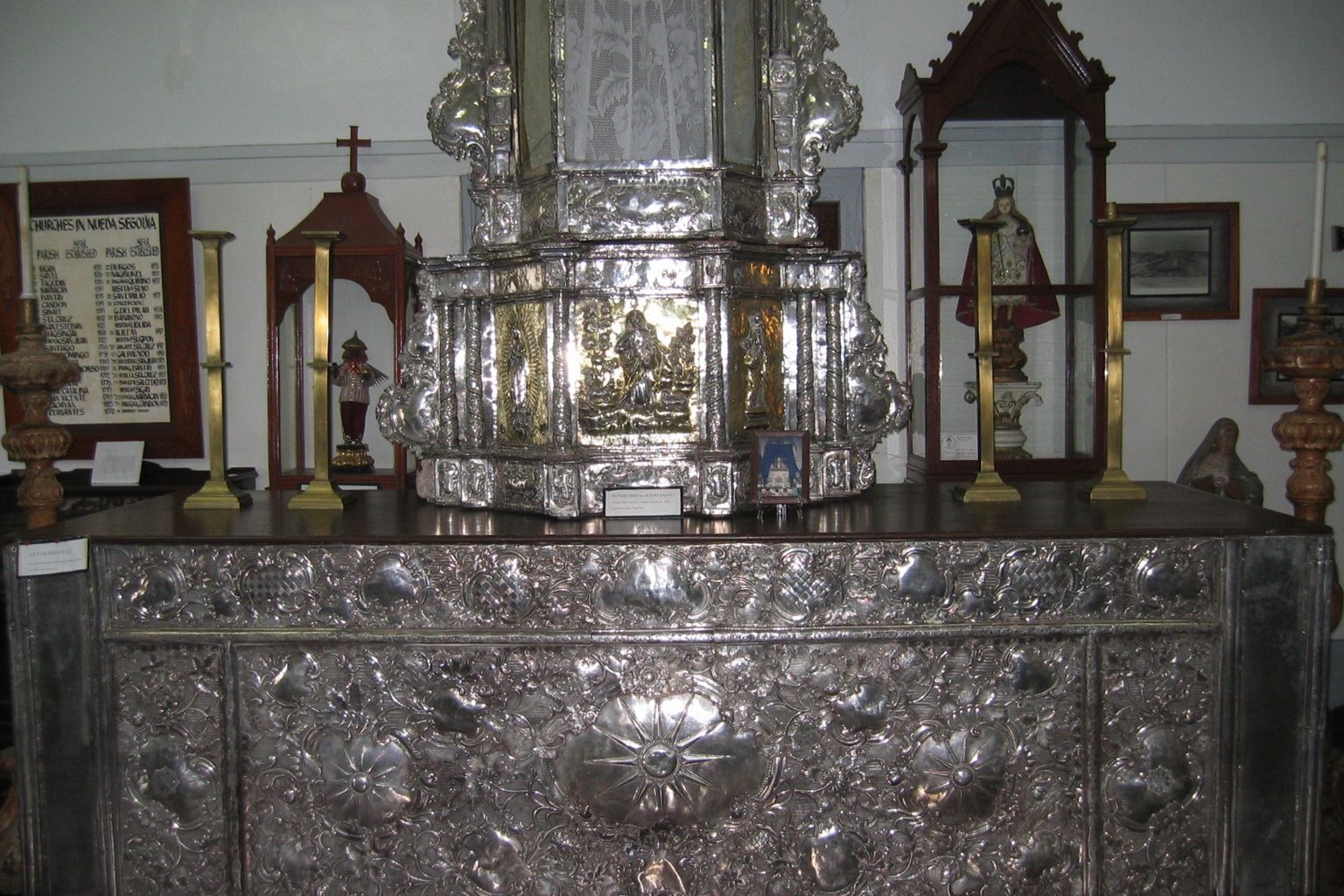
It’s not too bad that we didn’t get to photograph those magnificent silver altars on the second floor, because we have a somewhat more modest but still impressive example down here:


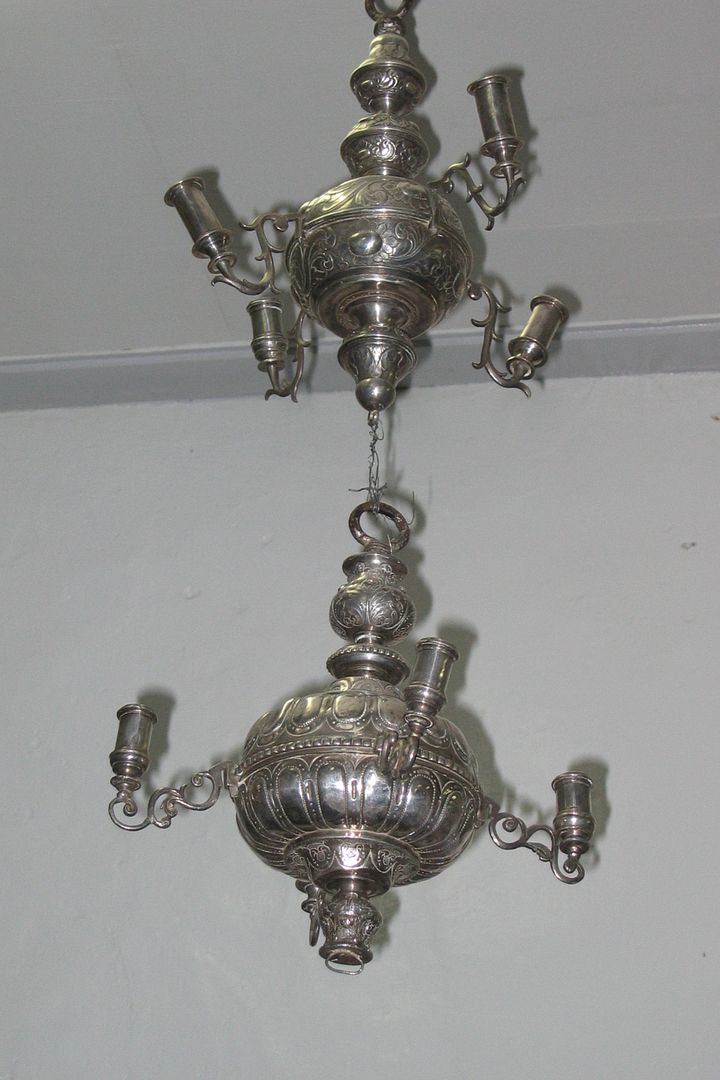
This unusual sanctuary lamp-candelabra blends in nicely here.


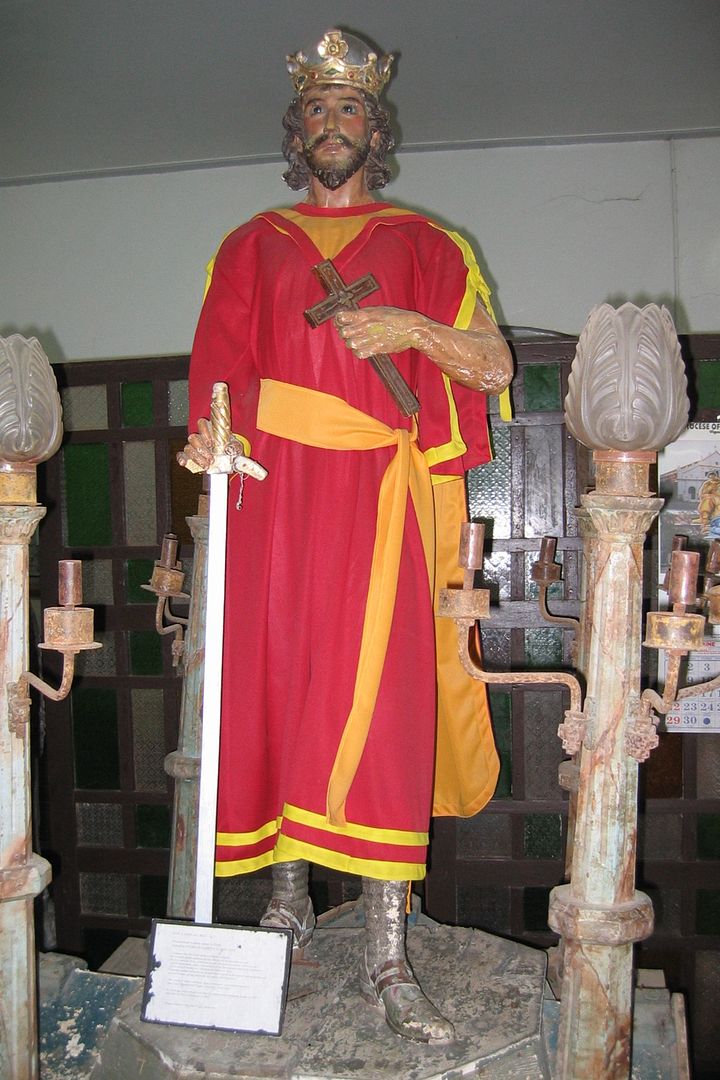
And finally, we meet up with this unusual character, presumably some medieval saint-king:


Subsequent inquiries and generous feedback from others lead one to hypothesize that this is most likely Saint Ferdinand, King of Castile, who lived from 1198 to 1252. As Ferdinand III, he reigned over Castile from 1217 and over Leon from 1230, permanently uniting the two kingdoms the following year. Many towns and cities named "San Fernando" were founded throughout the Spanish Empire, including the capital of neighboring La Union, and the present capital of Pampanga.

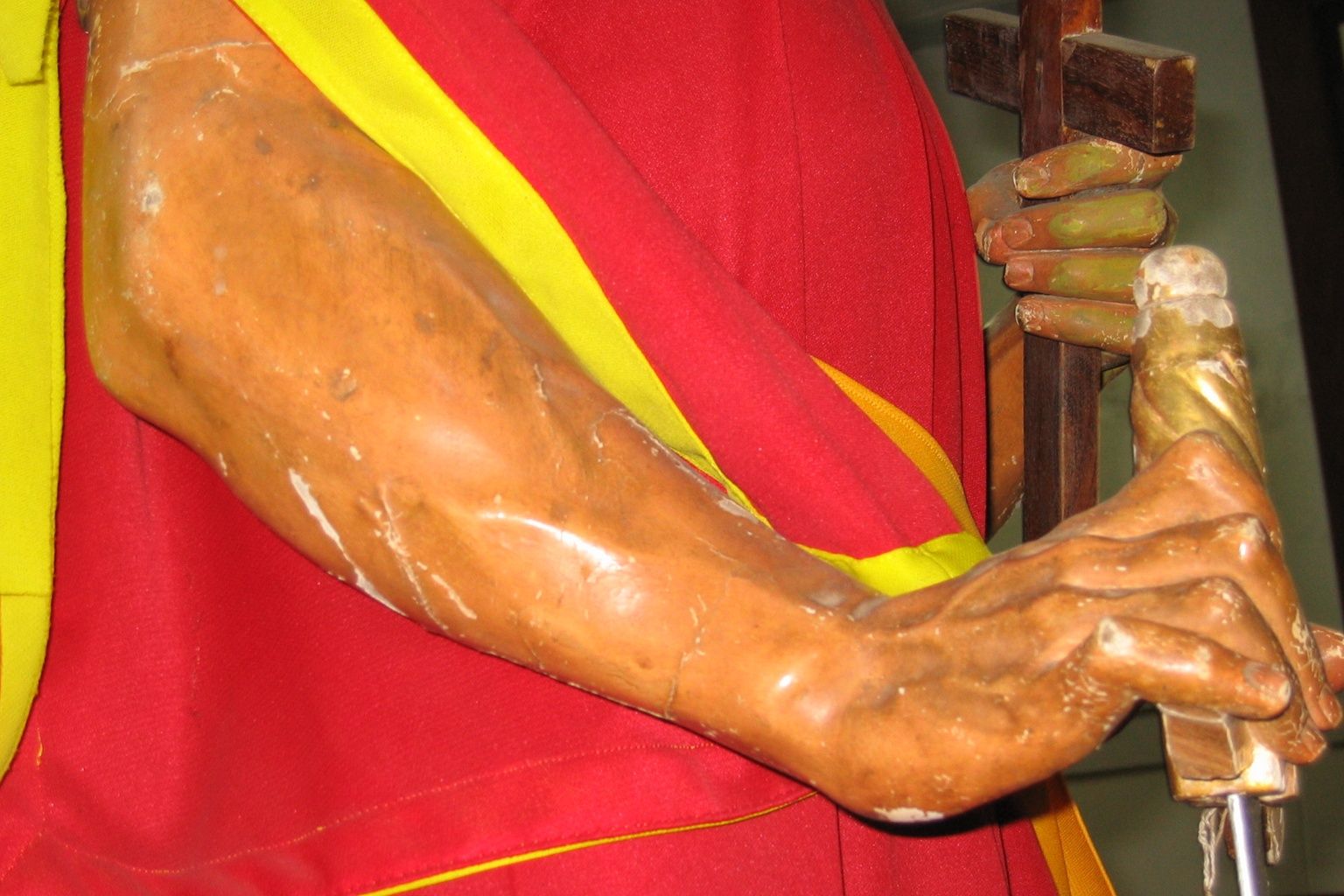
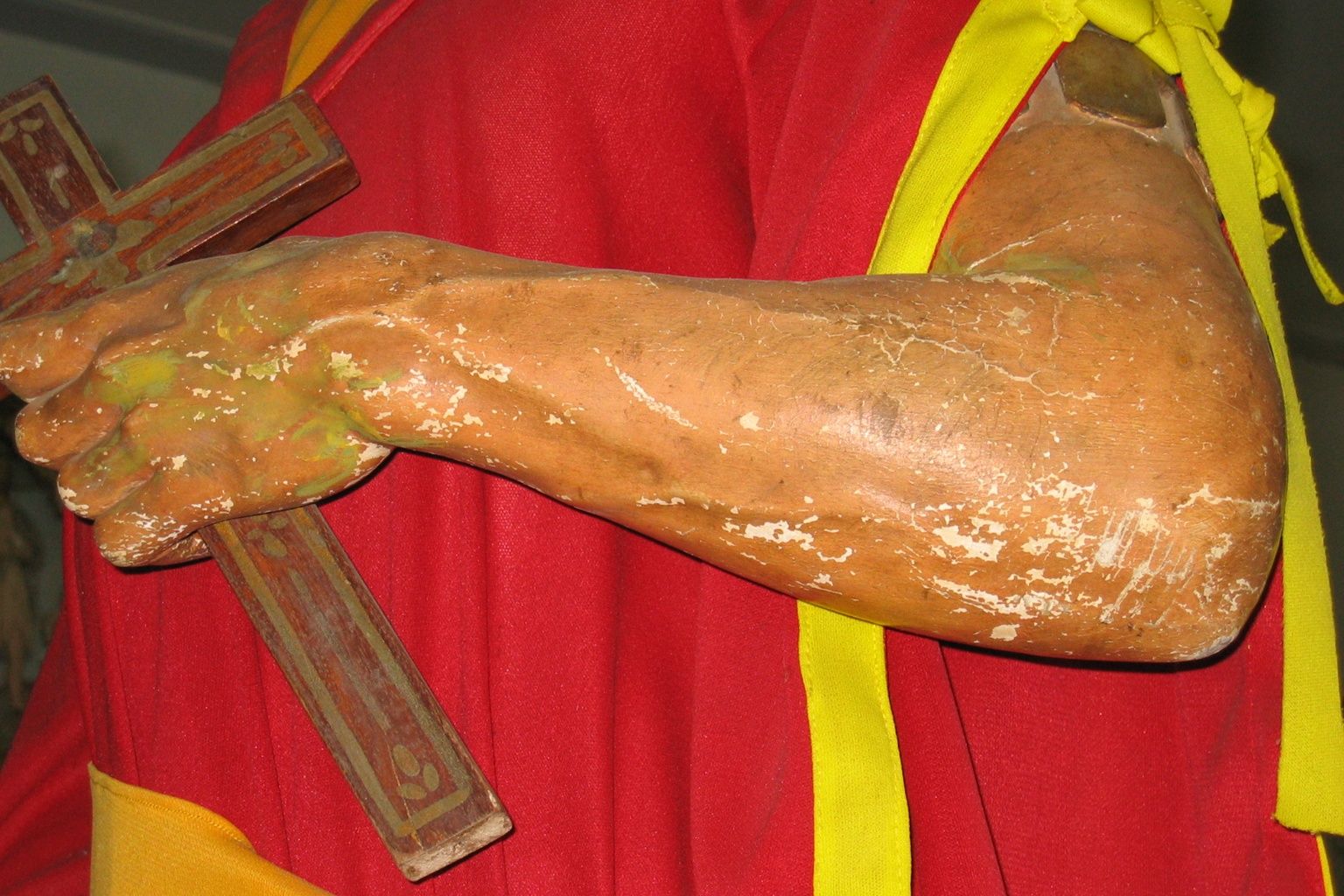
Though the image is now in need of restoration and refinishing, it is clearly evident that the original sculptor, probably early in the 20th century, paid close attention to detail, as can be seen here:


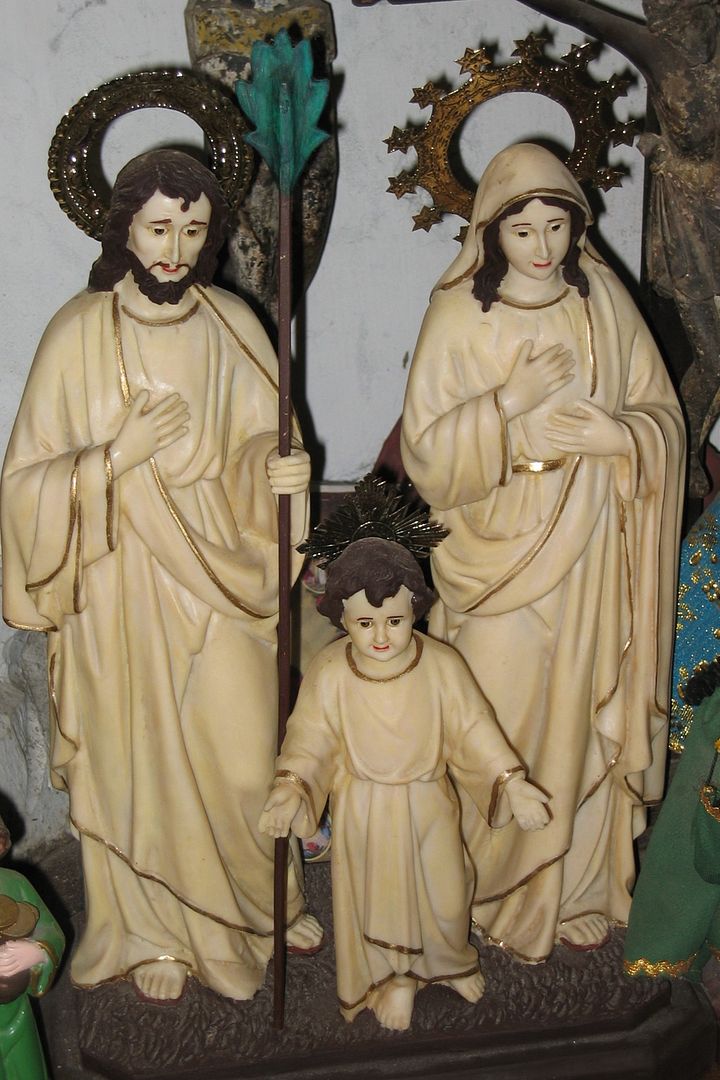
Just down the road from the Cathedral and into the main heritage area anchored by Crisologo Street is an array of souvenir and antique shops. There are many shops that sell reproduction antique “Vigan-style” furniture, whatever that means. There are also shops that proffer new religious images made of wood or composite material finished to look like ivory, such as this Holy Family tableau:


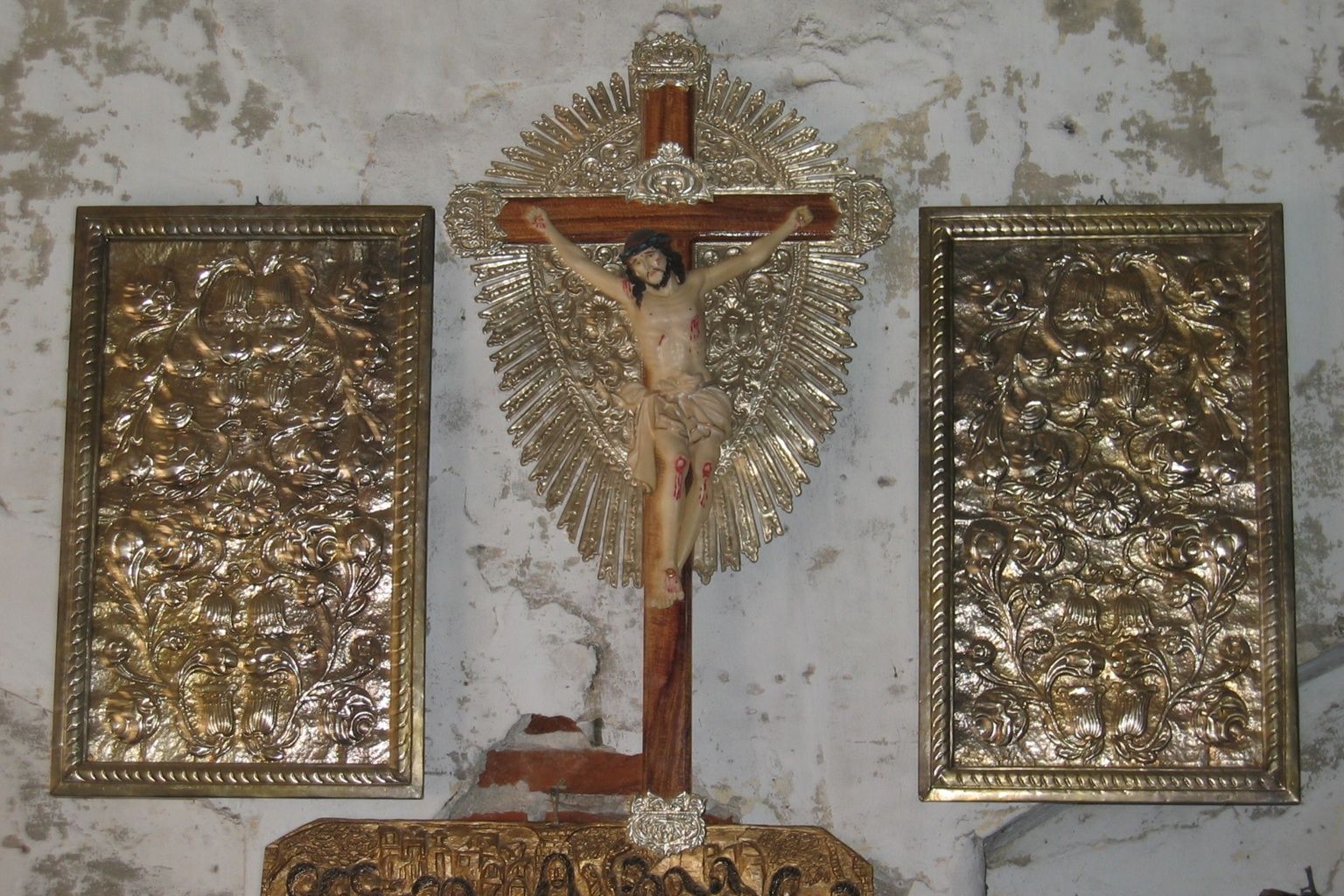
There are the more usual reproduction antique images in classical style, exemplified by this Crucifix displayed between decorative beaten-metal panels:


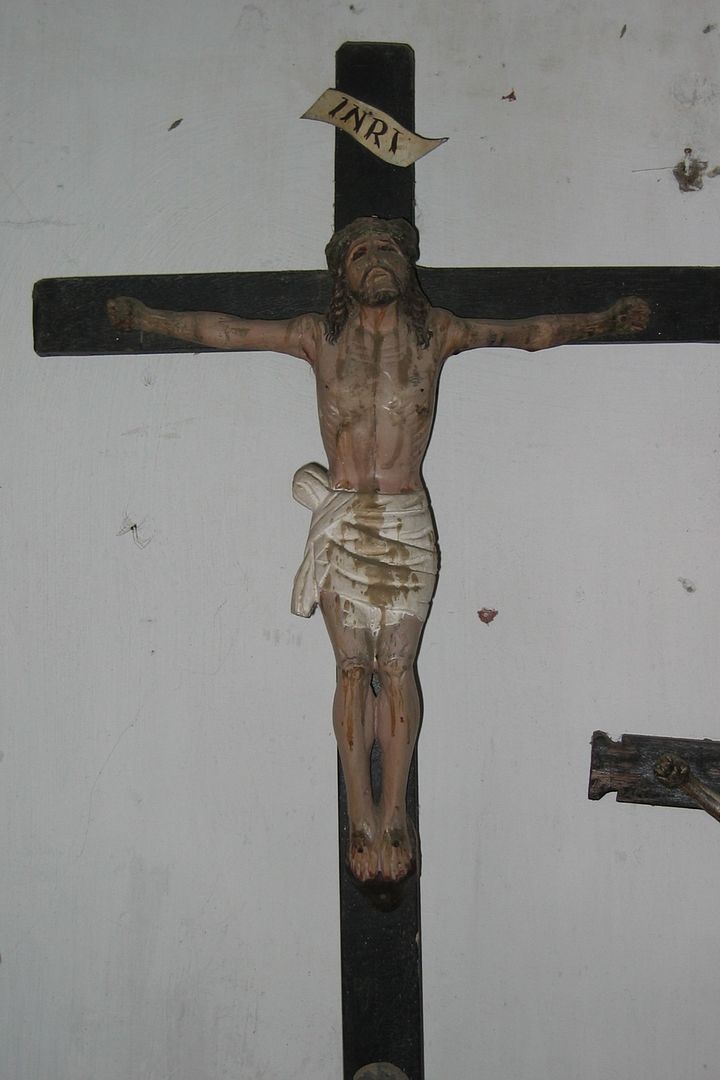
Or in primitive style, as with this larger Crucifix.


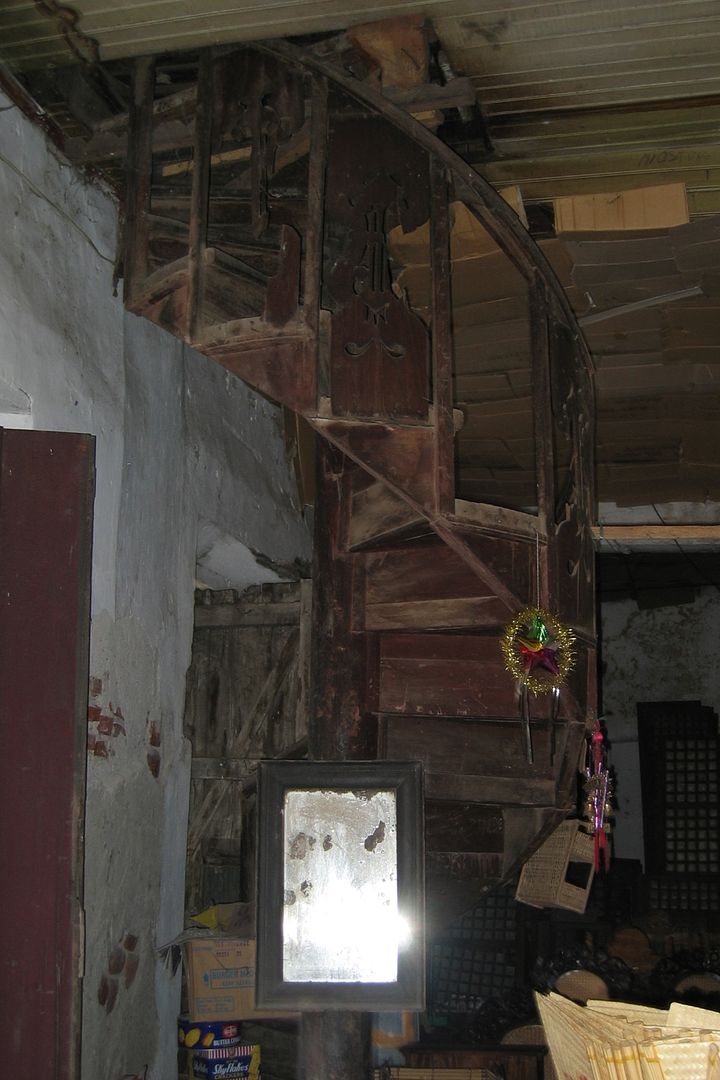
These shops are on the ground floors of the old Vigan mansions, so one shouldn’t be too surprised to see unsafe (or creepy -- choose your poison) -looking spiral staircases inside them, such as this one:


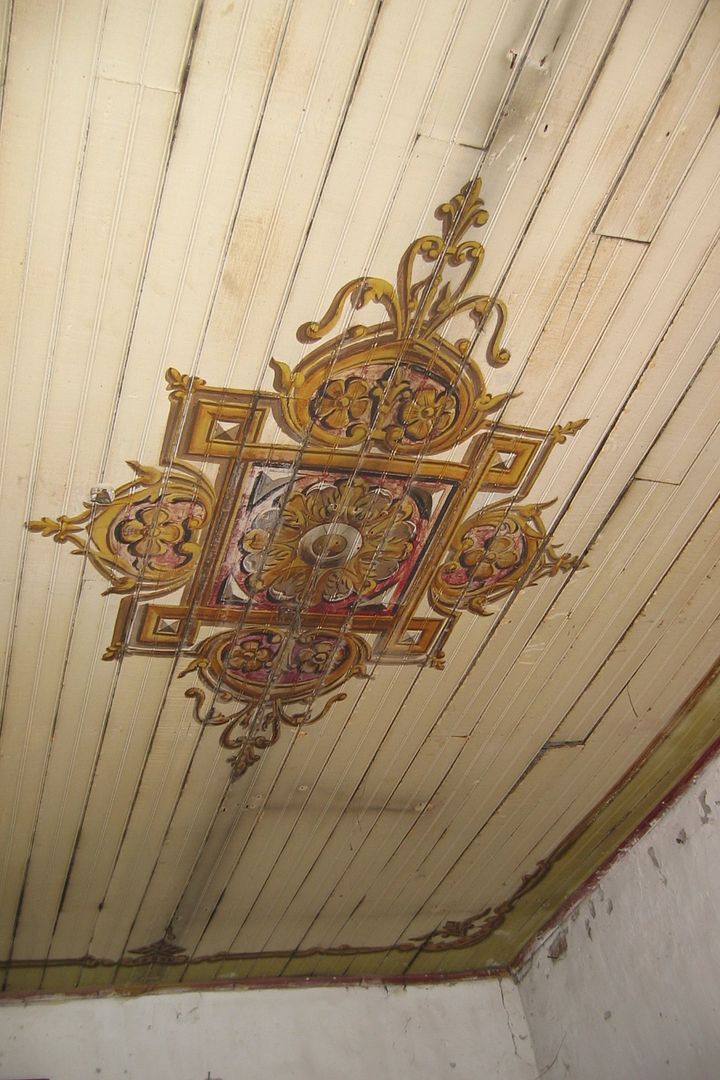
Or fancy painted ceilings like this:


A buyer's caveat is appropriate here: Beware of shops in Vigan, particularly those selling antique or reproduction antique furniture, that demand a deposit against your merchandise order or intended home delivery. They will ask you for a deposit of, say, five hundred pesos, to supposedly secure your reservation of an aparador or a baul (chest) pending delivery to your home (e.g., in Metro Manila) in a week or so. You will never see your five hundred pesos again, despite innumerable follow-ups. Fortunately, it would only be a relatively small write-off. But it’s still quite a racket, isn’t it, if they do it frequently enough to naïve city slickers.

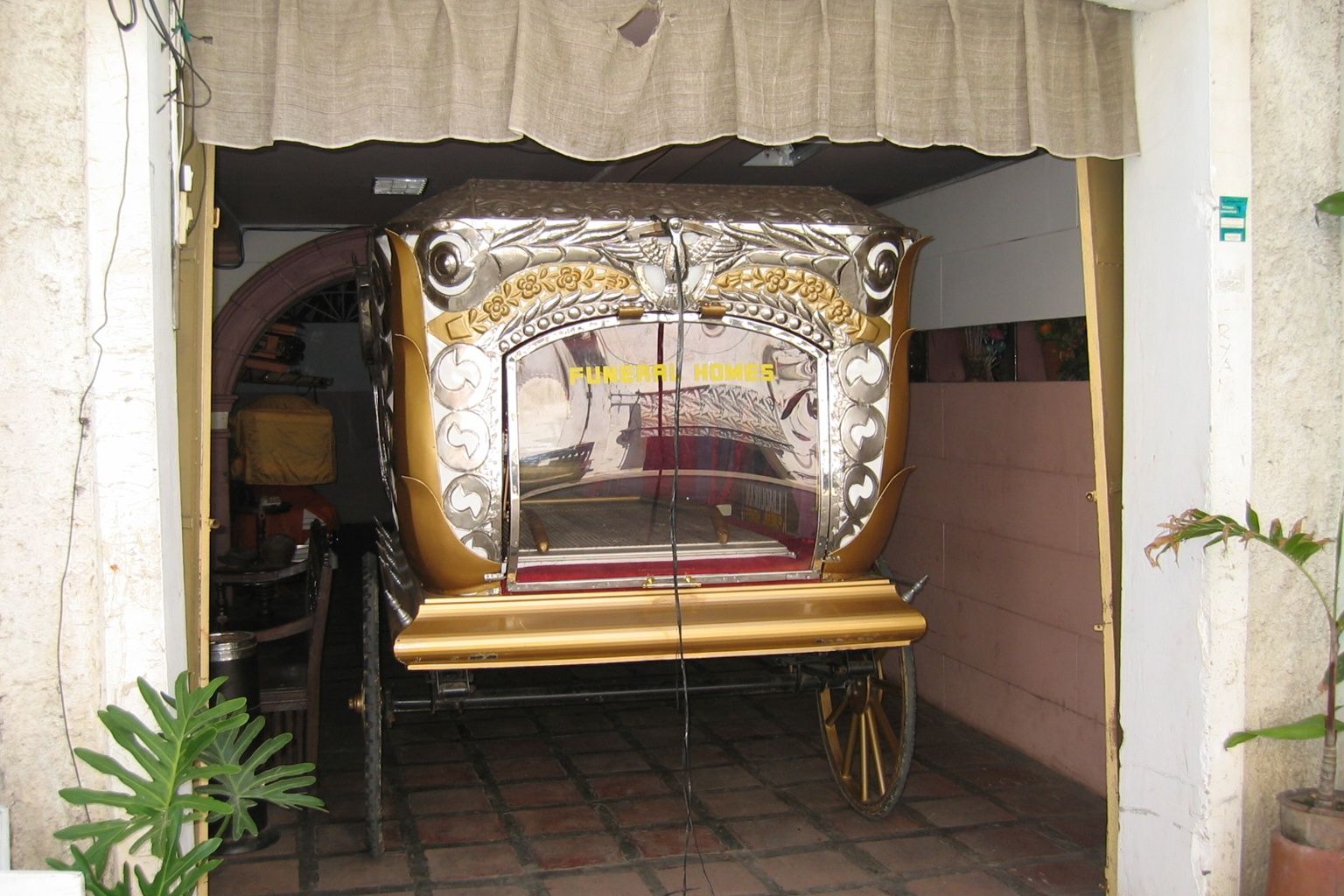
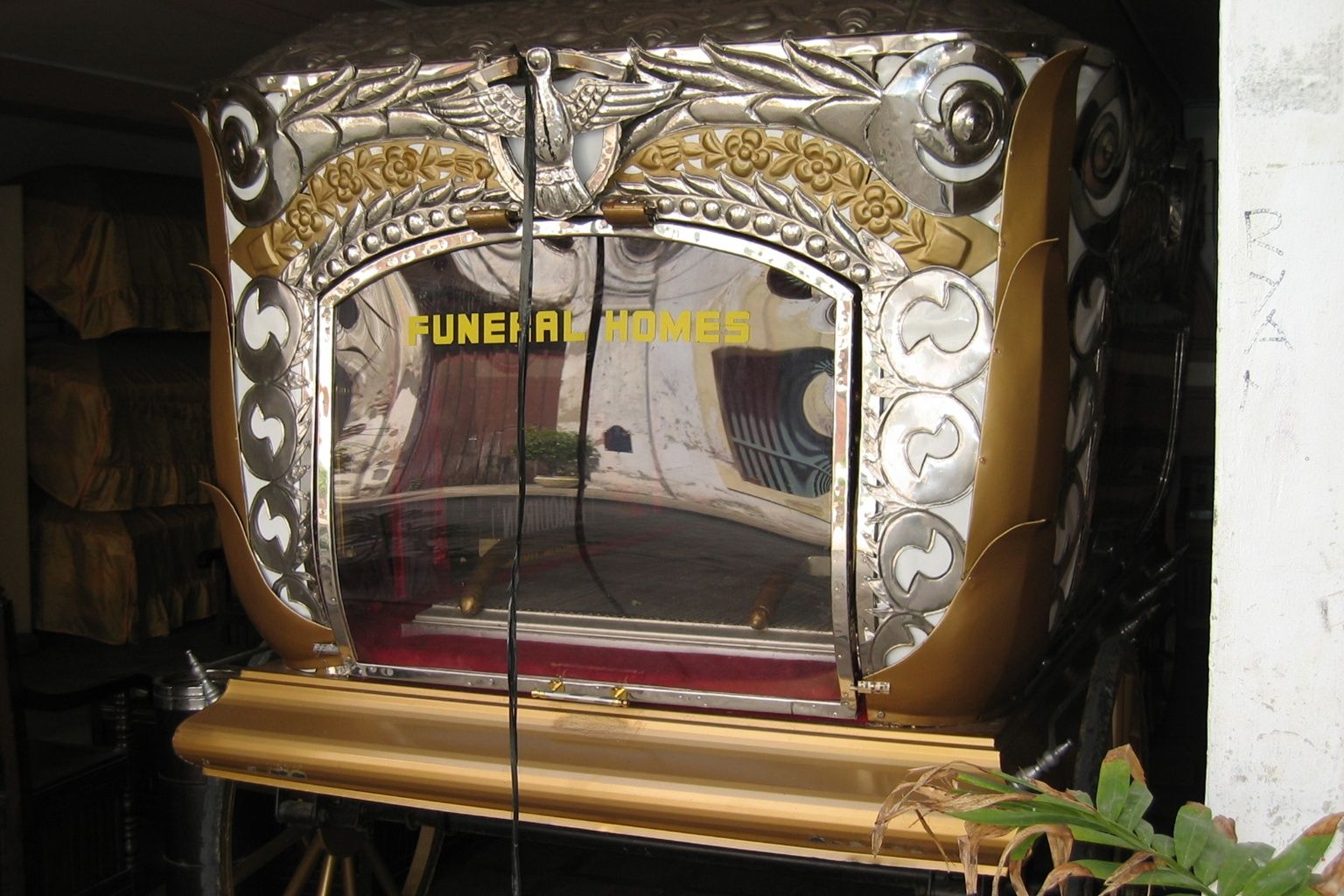
Thankfully, I had contented myself with the standard Vigan heritage town T-shirt (which comes in children’s sizes as well). But if you ever get victimized by an unscrupulous shop in Vigan, you may decide to take some drastic action and arrange to have the proprietor prematurely avail of the following service down the main road:


Well, at least he’d be going out in authentic Vigan style.


Originally published on 15 January 2007.  All text and photos copyright ©2007 by Leo D Cloma. The moral right of Leo D Cloma to be identified as the author of this work has been asserted.
Original comments:

arcastro57 wrote on Jan 17, '07
A feast for my eyes. I was breathless after reading your Vigan account.


rally65 wrote on Jan 17, '07
I was breathless myself during that actual real-time day. Ha! Ha!


noniboy wrote on Jan 17, '07
great experience


kalikun wrote on Jan 17, '07
You know, your site is also good as a tourist guide. I'll make sure I will visit these places when I go home.


victorancheta wrote on Jan 17, '07, edited on Jan 17, '07
There's an "de vestir"" Ivory Madonna and Child, a Virgen del Rosario I believe, here at the Vigan Museum. Is it still there?

Are they doing some renovations? Older pictures from this museum show a different layout and appearance.


I'm just happy that Vigan Church still has some of its treasure. I'm just afraid some dumbass collector would unscrupulously pay some of the staff to pilfer some of them one by one. Is the security lax?


rally65 wrote on Jan 17, '07
No, security wasn't lax at all -- there was always a uniformed guide or a security guard around. The security guards were neatly-dressed in short-sleeved barongs. There was almost always a token entrance fee, even as low as PHP 10, and a proper gate to control the flow of visitors and ensure that people don't just wander freely in and out of these places.

Vigan is highly aware of its status as a UNESCO World Heritage town -- everyone (from the Mayor to ordinary residents, even those who do not live in ancestral houses) seemed very knowledgeable and highly sensitive to their situation; I don't believe that any citizen would knowingly participate in a theft or pilferage anywhere in this city.


I took photos of every single image on display where photography was not forbidden. It's also possible that some images were elsewhere, in storage, or upstairs in the "no photography" floor.


kiko38 wrote on Jan 18, '07
Sir Leo,
It is so nice to see the pictures of these santos from St. Paul Metropolitan Cathedral in Vigan. Thanks for sharing them. It just like I'm back home again.


mike10017 wrote on Jan 18, '07
Those beaten metal panels, what were they for and how much were they? They would make nice carroza decor.


arcastro57 wrote on Jan 18, '07, edited on Jan 18, '07
The beaten metal panels I believe are actually reproduction altar frontals. I've seen similar ones in Pampanga and they go for about 4K apiece. Should cost less in Vigan. I like the ramilletes though...


robbyandharry wrote on Jan 18, '07
thanks leo for sharing these to us... para na din akong nagtravel pa-vigan :)


overtureph wrote on Jan 18, '07
Thanks for sharing your trip with us again. Could the saint you mentioned (San Estanislao de Ungria) be St. Louis of France (San Luis)?


rally65 wrote on Jan 18, '07
Normally, San Luis, Rey de Francia would be holding a Crown of Thorns, since that is what he supposedly recovered from the Holy Land during one of his Crusades. So I would guess that this medieval saint-king in Vigan isn't really him.


victorancheta wrote on Jan 18, '07, edited on Jan 18, '07
I think it's San Fernando Rey, which makes sense as he's a Spanish king and patron of a neighboring city, San Fernando, La Union.

Leo, I think that San Martin is really a Santo Tomas. :)


noniboy wrote on Jan 18, '07
victorancheta said
"I think it's San Fernando Rey, which makes sense as he's a Spanish king and patron of a neighboring city, San Fernando, La Union. Leo, I think that San Martin is really a Santo Tomas. :)" 
The dude with the sun on his chest is definitely Santo Tomas Aquino (Thomas Aquinas)


Possible, I guess. But was San Fernando Rey medieval -- when did he reign?


rally65 wrote on Jan 18, '07, edited on Jan 18, '07
Got it. Obviously I never even got within breathing distance of any Dominican institution. Will make changes as if it were always so. ;-) Thanks.


noniboy wrote on Jan 18, '07
rally65 said
"Got it. Obviously I never even got within breathing distance of any Dominican institution. Will make changes as if it were always so. ;-) Thanks.
hahahahahahaa. =p


victorancheta wrote on Jan 18, '07
Yes indeedly doo. San Fernando Rey is a medieval Spanish King. Quite a popular saint as there are numerous depictions of him scattered throughout the country but more abundant in Latin America.


arcastro57 wrote on Jan 19, '07
It's San Fernando, alright, King of Castille (and patron of San Fernando, Pampanga). The image is similar to that found in the city Cathedral. Saint Louis is a cousin of his.


Thanks, guys, for all the leads on the ID of this medieval saint-king. (However, I'll just reserve any necessary revisions to the text for when the book comes out -- when books have become obsolete.)


rally65 wrote on Jan 20, '07
On second thought, I decided to revise the text now to properly identify the medieval dude as Saint Ferdinand, King of Castile. I figured I might be too senile to do so if I wait until the book comes out. Thanks to you guys (and to Wikipedia) for the information.


techlonogy wrote on Feb 28, '08
Amen.


sunnycastillo wrote on Jul 9, '08
wow, i lived in vigan for a few months but never even get to these... i wonder if some of these statues are among those that they include in procession during holy week... thanks for the discovery!


sunnycastillo wrote on Jul 9, '08
And ey... the humor in the end is brilliant. i remember seeing one of those elaborate funeral processions ala Vigan... quite a show with a full marching band and crying ladies. :P


josemarihilario wrote on Jul 20, '09
Thanks Leo for this! I will definitely be more inquisitive next time I go to Vigan!


rally65 wrote on Jul 20, '09
josemarihilario said
"Thanks Leo for this! I will definitely be more inquisitive next time I go to Vigan!"   
Thanks for the visit and the appreciation!


josemarihilario wrote on Aug 8, '11
Again, thanks Leo! Just revisiting this thread and enjoying it once again!