Showing posts with label tercera caida. Show all posts

Wednesday, April 8, 2015

XXXII. SS-Files: Ang Pagkarapâ, Part Four – “Even the Orbs Love It”


What seemed like a pretty straightforward commission - deliver - set-up - go process for this Holy Week paso wasn’t really.   Although the yard of our ancestral house was large and expansive, there wasn’t actually any built structure available to house the carroza there. (That’s still a future family project.)  Instead, several weeks before that setting-up day on Palm Sunday Eve, my aunt asked a relative, who lived diagonally across and had a large rice mill (“kiskís,” as we call it there), now idle, if we could use her space to park the carroza and set up the paso there.

At first, the relative agreed, but within days, the offer was quickly rescinded.  As it turns out, she was a member of an iconoclastic “born-again” sect in the local community, and in fact the mothballed kiskís was used for their regular prayer gatherings.  She feared, quite rightly, that her co-religionists might expel her for welcoming her staunch Roman Catholic relatives’ processional tableau into her kiskís. Imagine them worshipping on Palm Sunday and denouncing the evils of “graven images” while seated right next to our “Pagkarapâ” – that would be quite surreal.  (What I would give to see that on video!)

Fortunately, there was another alternative, which involved the rice granary (kamalig, as we call it) of another aunt, actually the next-door neighbor to our ancestral house.  Like the kiskís across the road, the kamalig had a large garage right in front of it, and both structures adjoined this aunt’s own ancestral house.  She was frequently not in residence, as she lived, and ran a thriving business, in another part of town, rearing thousands of heads of pigs (a lucrative industry in these parts).  But she very kindly let us use her wide, empty, and tall-ceilinged kamalig-garage for our new processional paso.

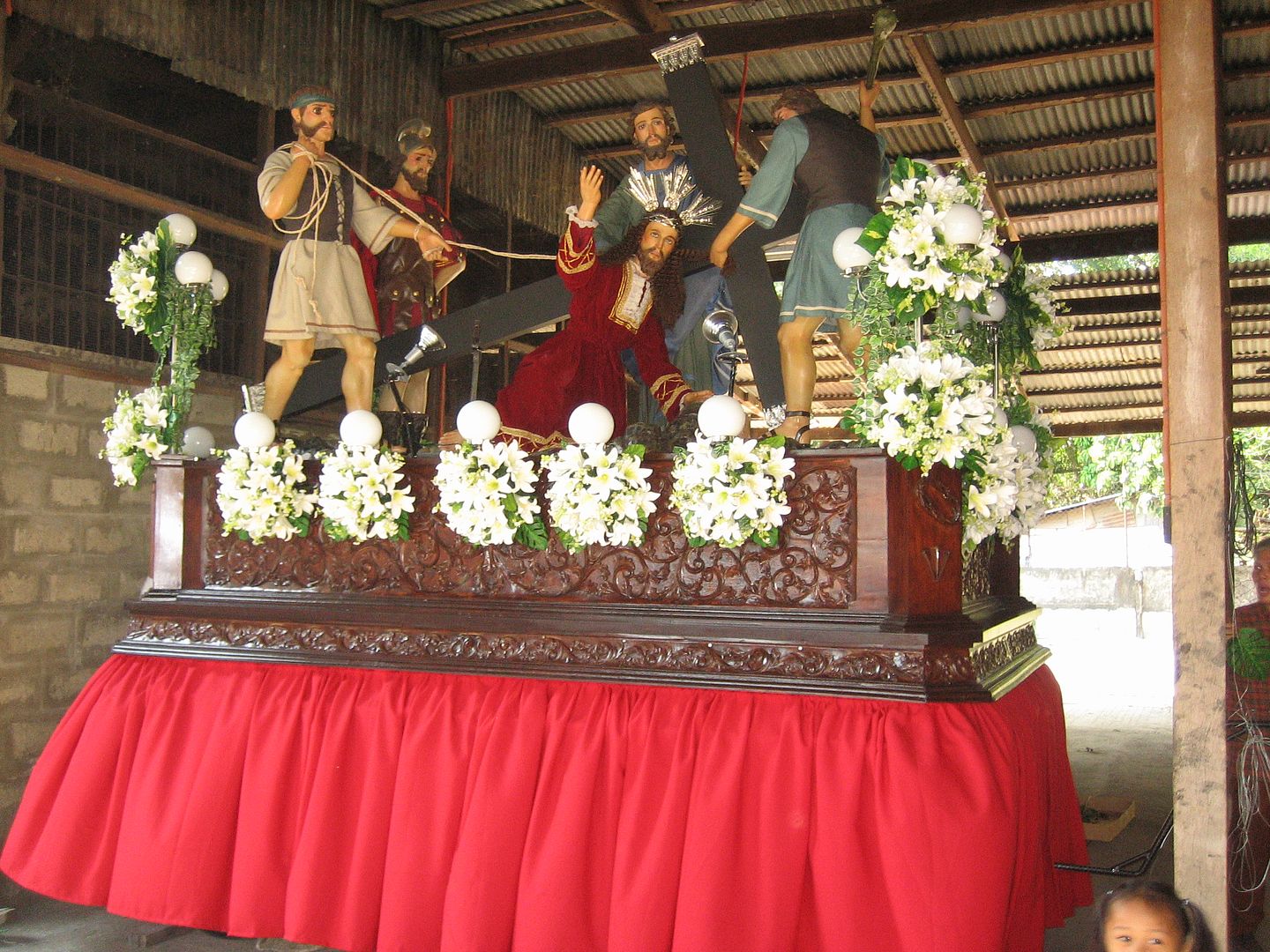
One of the risks that we foresaw with this processional tableau was its height. Based on a diagram that Kiko Vecin scribbled, the carroza itself was about (in metric terms) 206 cm wide, 360 cm long, and 195 cm tall.
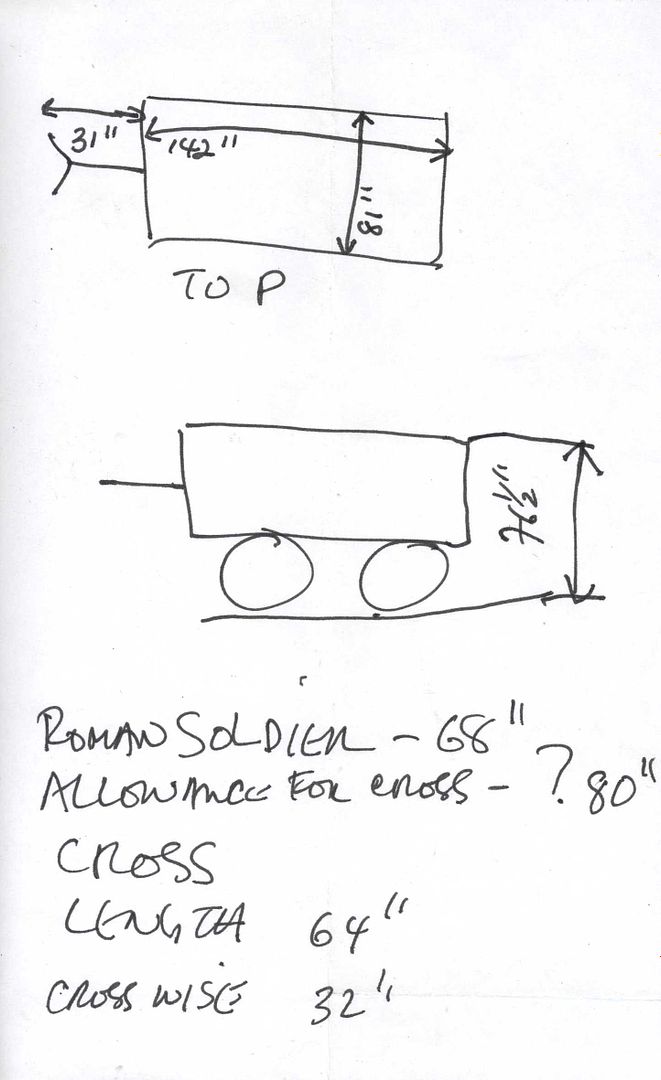


This is actually not very large, considering how massive and formidable it appears in person and in pictures (see Parts Two and Three).  Its length and width were well within the normal limits for unarticulated road vehicles.  However, laden with the tableau, its overall height rises to about four meters, or more than thirteen feet – still within the international minimum vertical clearance standard of 427 cm (fourteen feet), but certain to pose problems in some places.

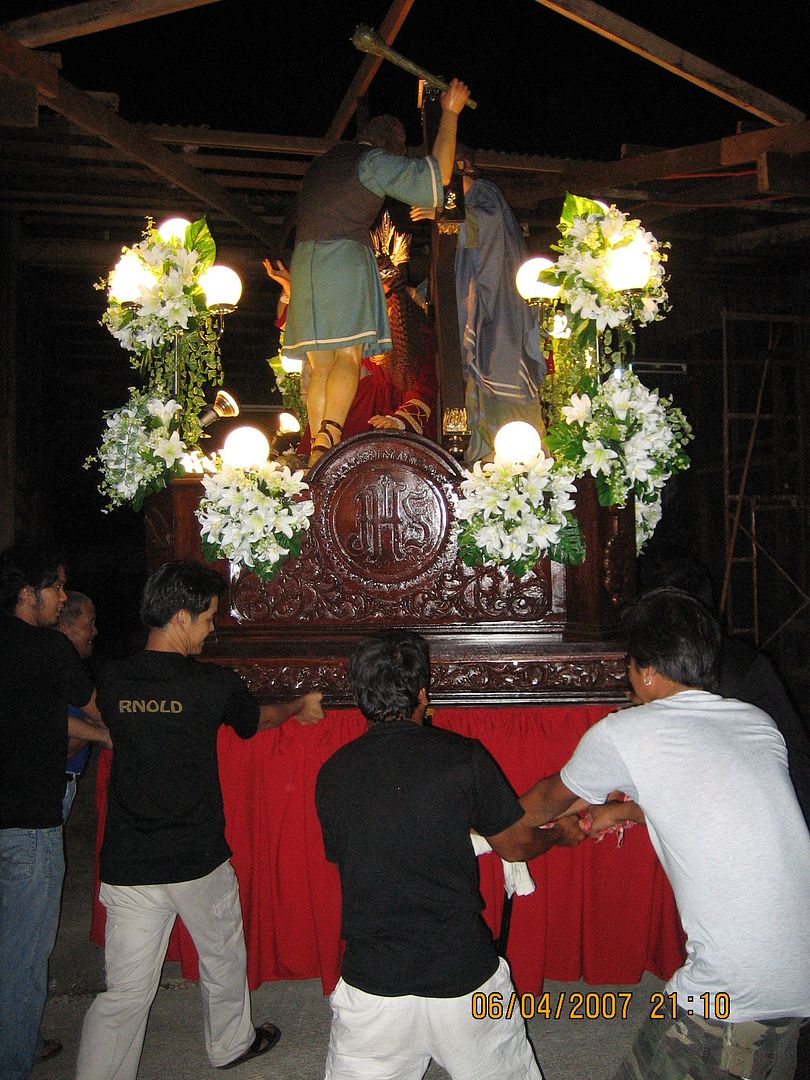
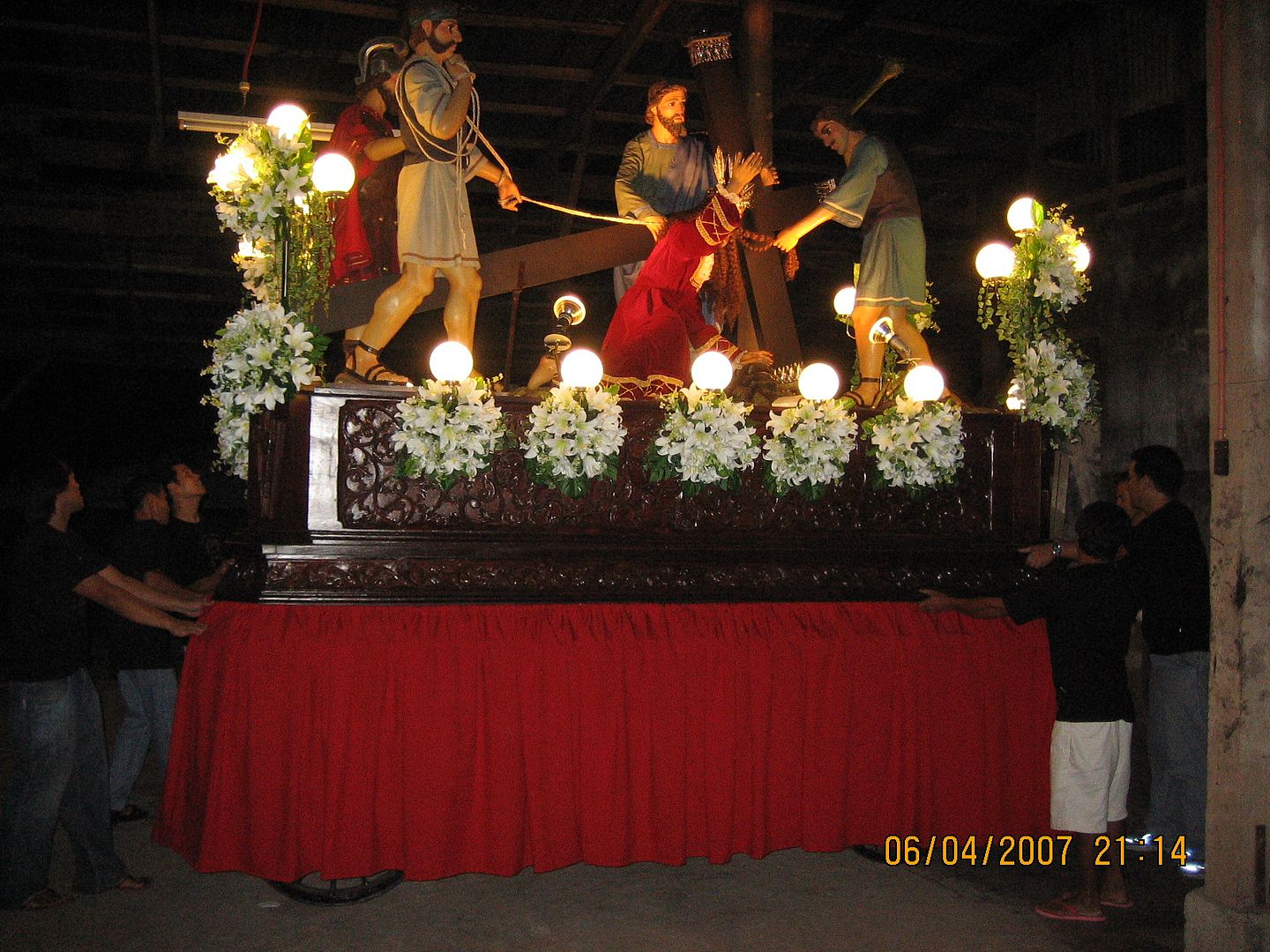
And in fact, as we were setting up the tableau on the carroza in that space next to the kamalig that Palm Sunday Eve, a real problem slowly dawned on us – we were trapped!  While the ceiling in the center of the garage was more than fourteen feet high, the roof sloped steeply downwards towards the entrance, such that at least the mace of the temple guard, the tip of the cross, and the captain’s helmet would have to be removed if we wanted to wheel the carroza out into the driveway and onto the road.


Clearly, the prospect of detaching and reattaching parts of the tableau upon leaving and entering this garage was no good. This called for drastic action.  We then called our master carpenter (who had also worked on the restoration of our own ancestral house next door over the previous two years), and presented the problem to him. He quite confidently recommended that the roof at the entrance be dismantled, and a new inverted-V-shaped structure be constructed to replace it, at the required fourteen-foot vertical clearance.  We then quickly obtained the owner’s permission, and had our carpenter start hacking away, ensuring that the Pagkarapâ paso could move in and out freely.

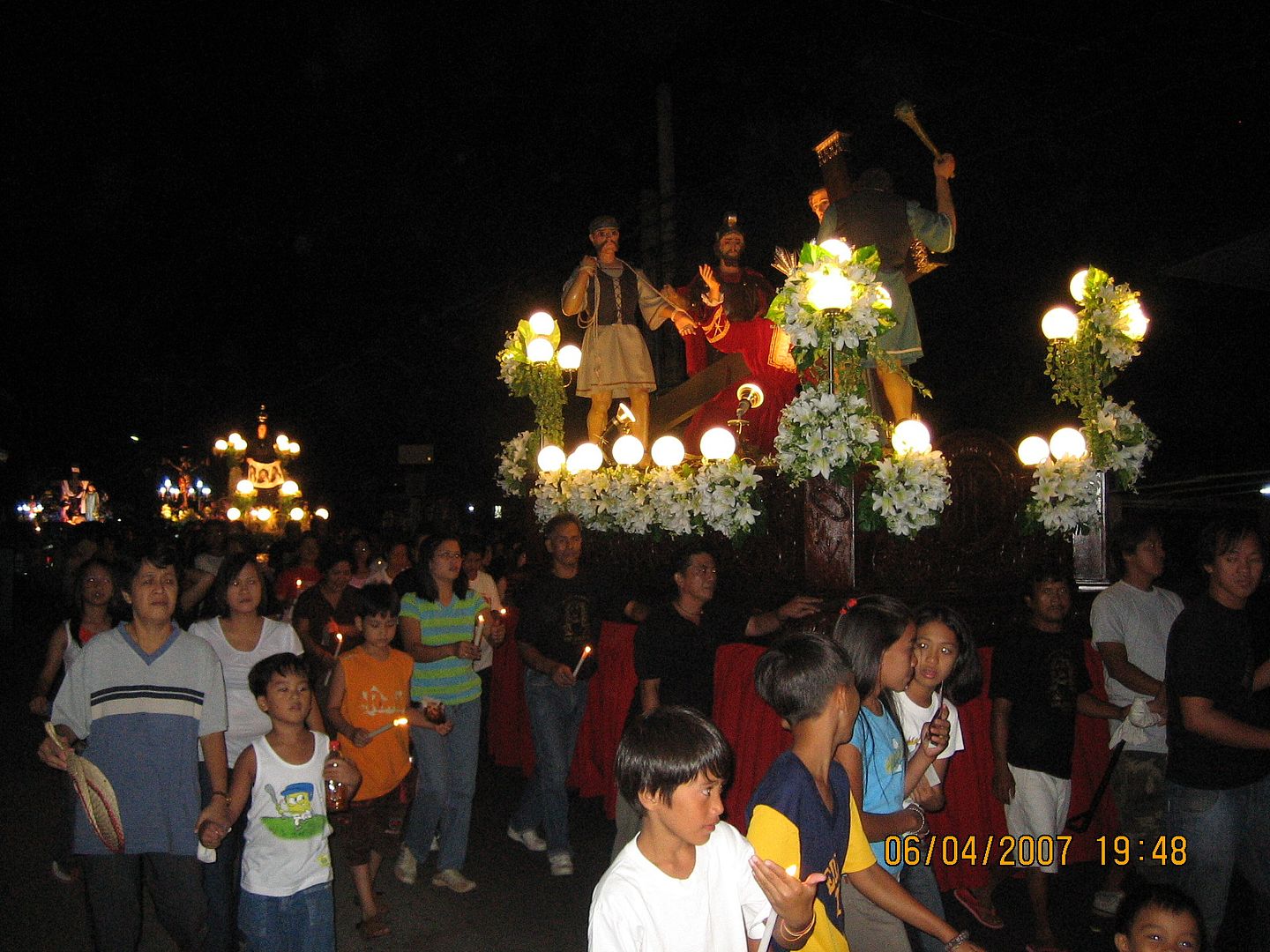
Well, not by itself obviously.  For the Holy Wednesday procession that was scheduled to begin at 6:30 pm, we push the carroza out the driveway shortly before 6:00 pm and begin our long trek to the church some distance away.  We cover the three or so kilometers in about twenty minutes, being the first to arrive at the church (apart from the church-owned pasos), and giving us both the Early-Bird and Eager-Beaver Awards.

This seemingly fast speed for what appears to be a bulky and heavy paso is no doubt attributable to the fact that its processional vehicle was actually very easy to “drive” – once we got over the virtual hump of moving it from a standing stop to a cruising speed, the well-engineered low-friction axles and wheels of the carroza and the nominal brawns of half-a-dozen assorted cousins, childhood playmates, and neighbors made the journey sufficiently zippy.  In fact, I recall that we even overtook an ice cream vendor and his pushcart along the way.  (Admittedly, he wasn’t after speed, but still….)

We were then asked to park in the yard of the public school across the church.  The church had no churchyard as such; in my childhood it was just an unassuming visita where an obviously old (some say 18th century), reputedly miraculous (unsurprisingly), half-life-sized image of the Crucified Christ was venerated.  Having been upgraded to parish church status a few years ago, certain improvements to the building fabric and physical facilities had since been undertaken, but since land does not materialize from nowhere, the schoolyard across the road is regularly commandeered for parking and other similar needs, making us grateful for this union of church and state at the barangay level.
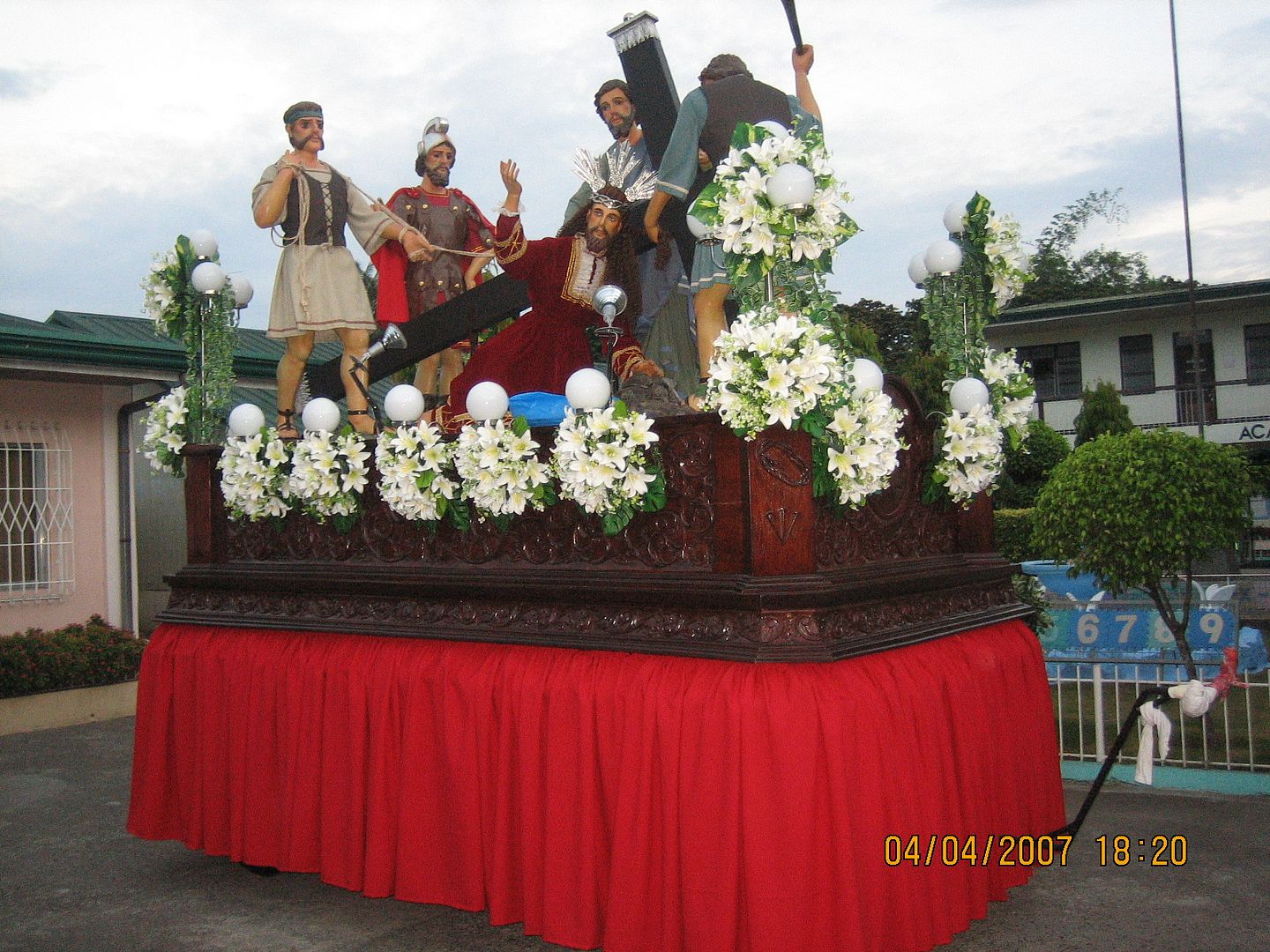


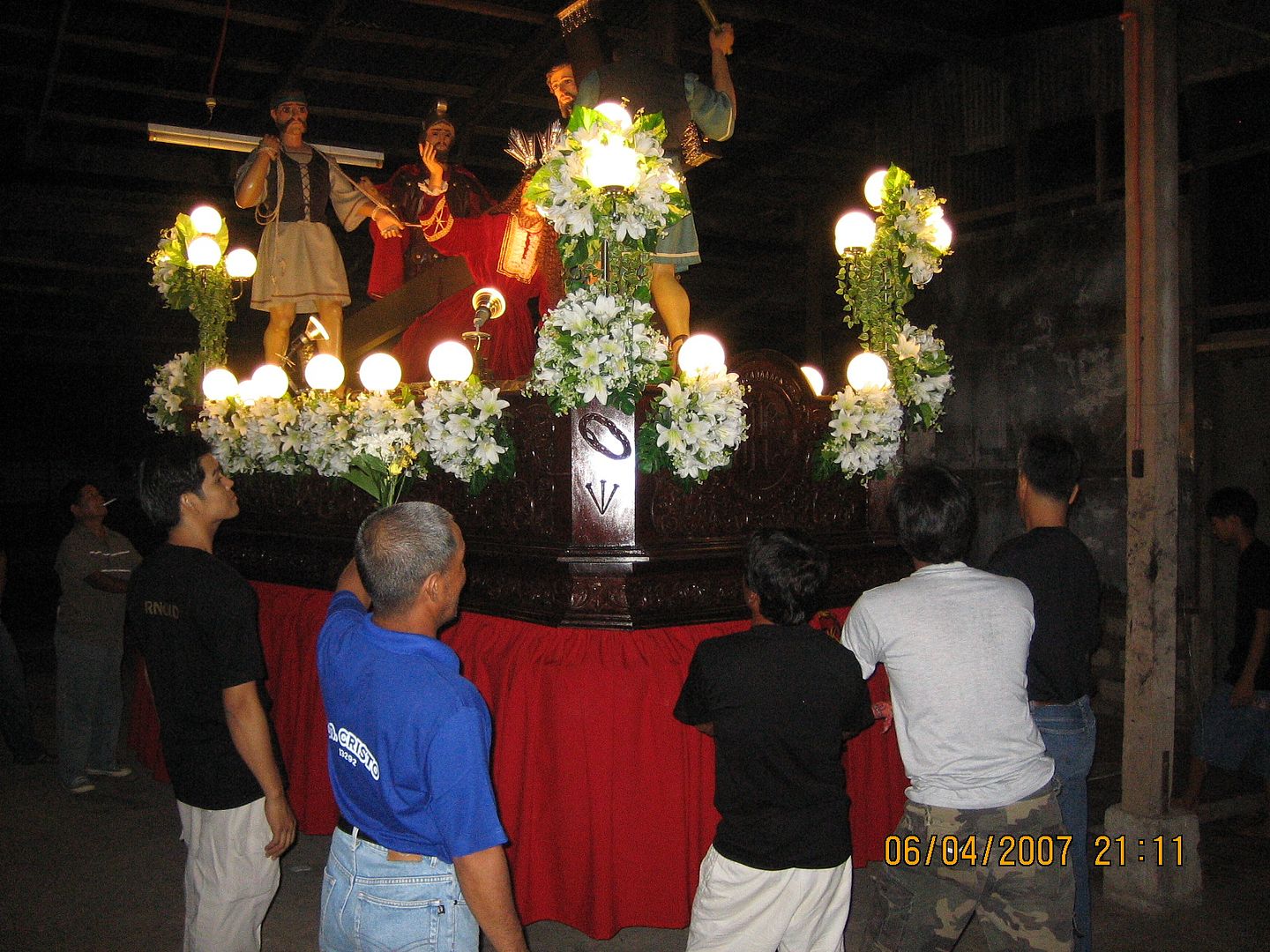
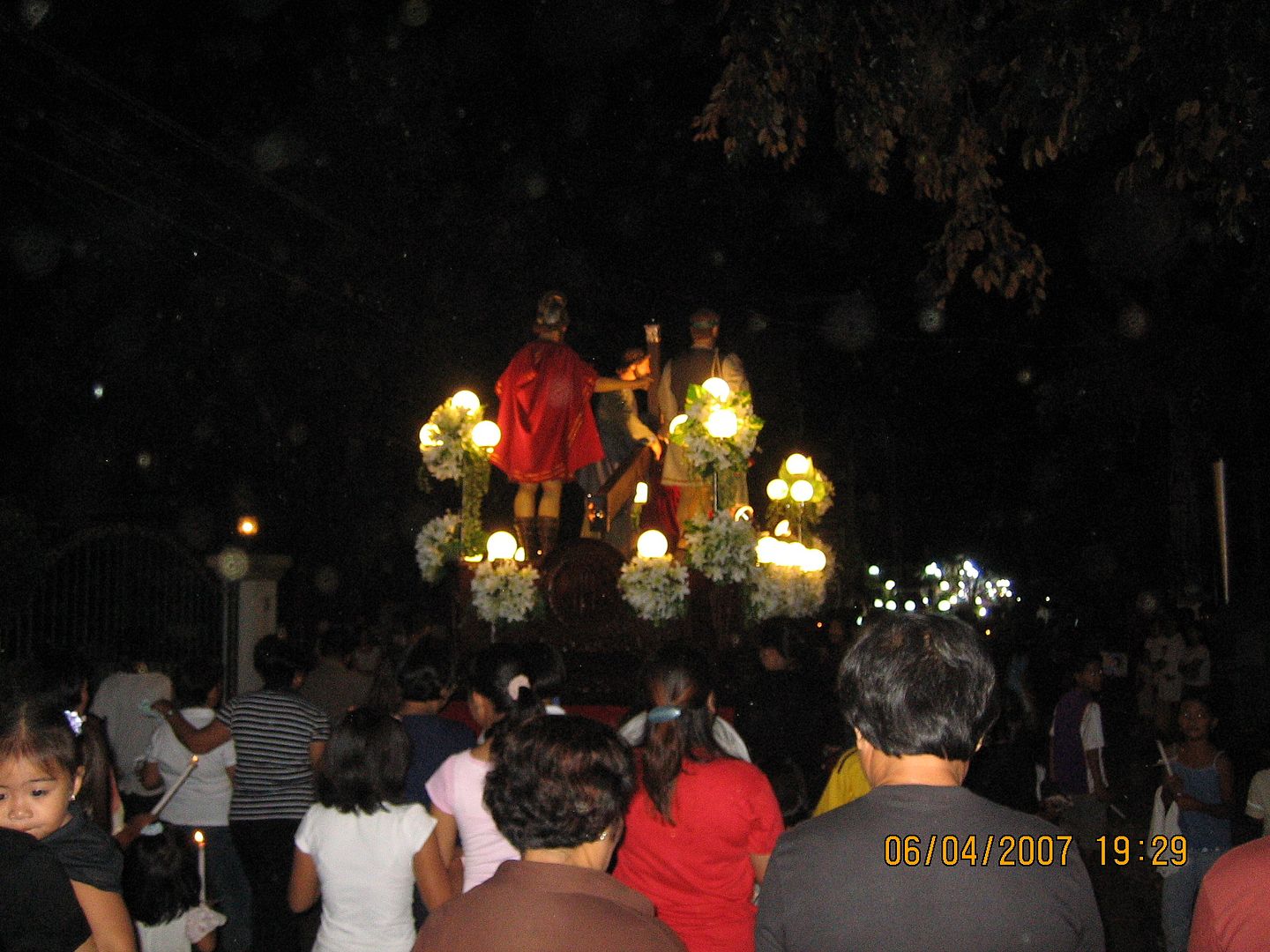
Right before the start of the procession, our friendly parish priest (a young guy who had been there ever since it first became a quasi-parish a few years ago) came over and had a nice chat with the family.  He stood silently for a minute or so just about where the above photo was taken from, obviously enthralled over the new addition to his processional line-up.  He then put on his stole and blessed the paso, walking around it and liberally sprinkling holy water at it.  Afterwards, he pronounced it the finest thing that he ever saw, and stated that he wanted to make this the benchmark for all future pasos in the parish.  Well, God bless us all, I say.

The Holy Wednesday procession was lengthier than I had expected – over three hours long, and winding down the main road in an easterly direction, off to a side road that leads to the main highway, back to the main road, off to another side road that loops around the neighboring barrio, back to the main road, then back to the church.

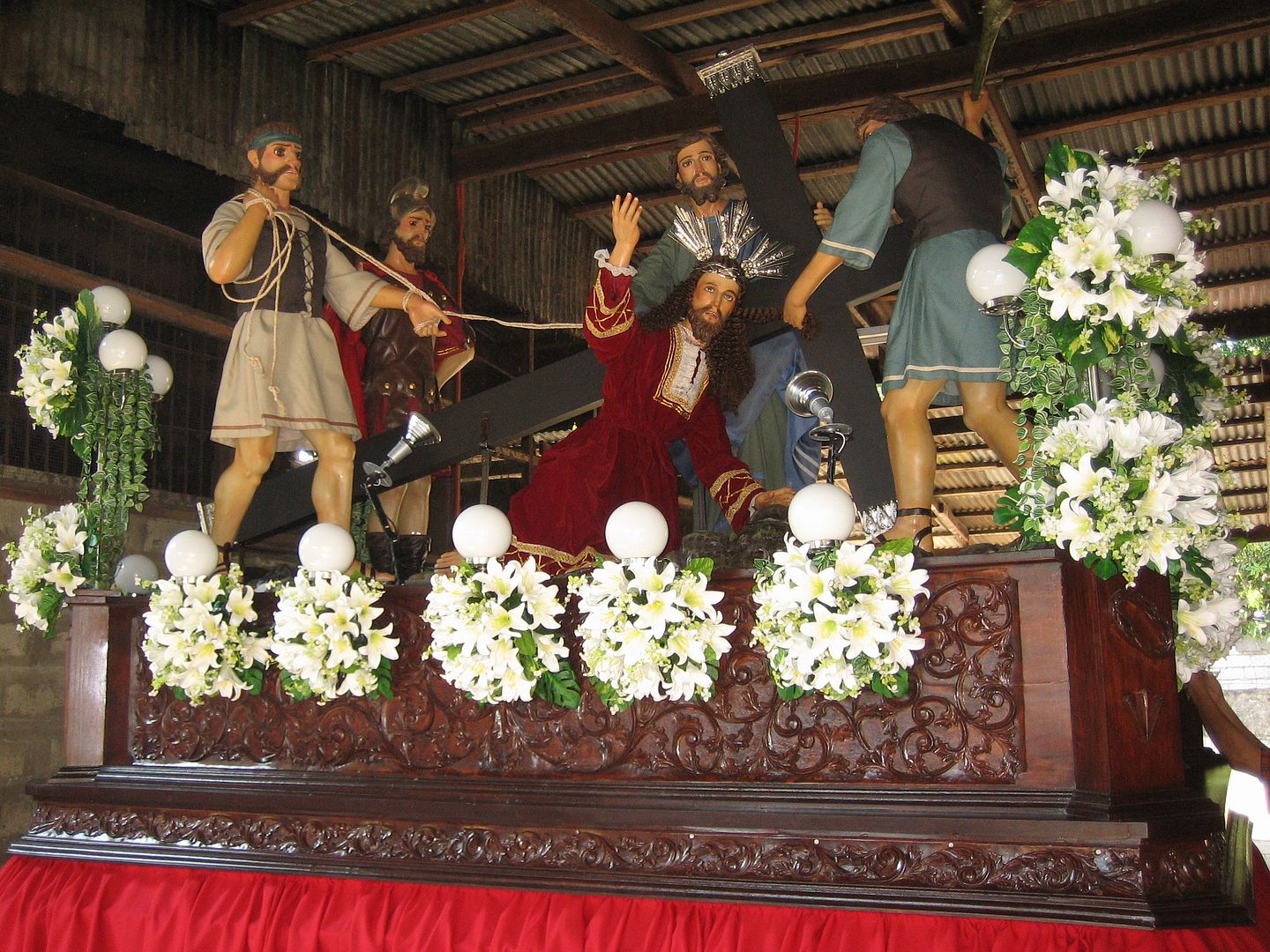
But throughout the long evening journey, this well-lit, generously-elevated, and elegantly-designed paso of “Ang Pagkarapâ ng Panginoon” was a consistently effective medium for public devotion and personal reflection, and perhaps private awe as well. 
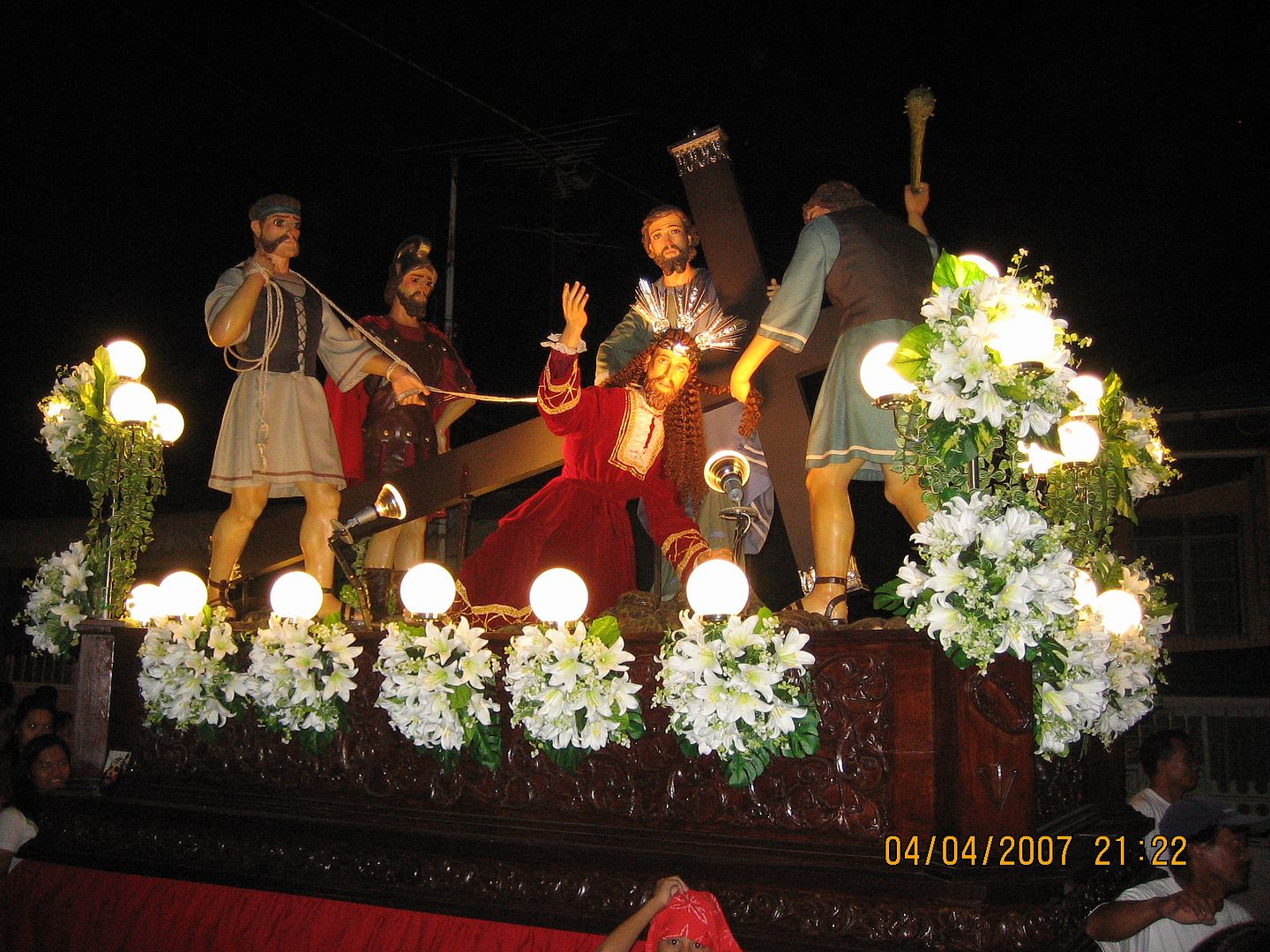

The only difficulty we encountered was something that my cousin had foreseen well – all those low-hanging wires and cables and tree branches along the processional route.  On Palm Sunday, he and a couple of his younger minions had surveyed the processional route and had noted down the exact spots where these low-hanging obstructions were present.

They had also armed themselves well for the actual procession with not just one but two twelve-foot bamboo poles with triangular ends, which wise carroza operators far and wide know to be an essential tool in this activity.  The idea behind having two poles was to ensure that even in the most densely-obstructed side streets, all low-hangers could be well-managed.  And if not, we would attach a sharp pair of garden shears to one of the poles and snip those pesky wires out of the way.  Fortunately, no such violence was found to be necessary during this Holy Wednesday procession, as even the most problematic-looking areas were navigated through quite smoothly.
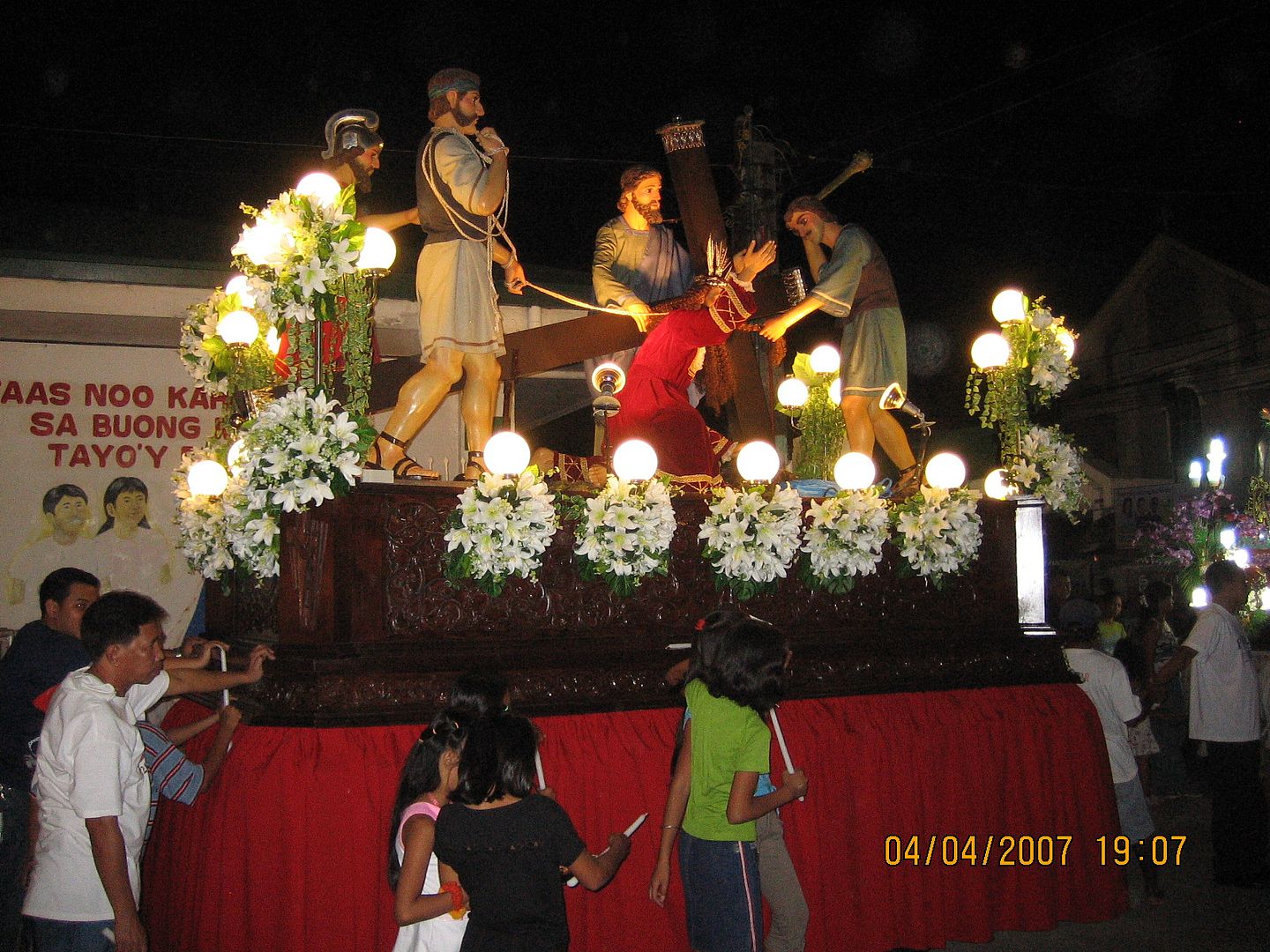


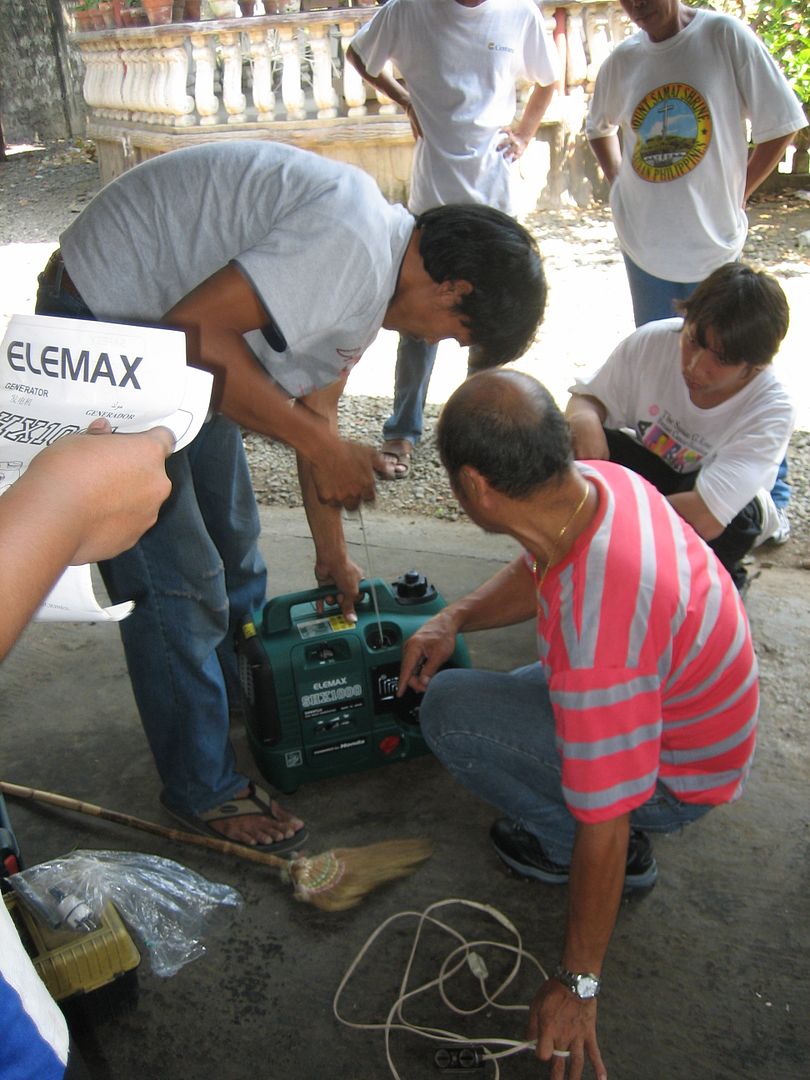
The other star performer of the evening was the Elemax-brand generator described in Part Three.  It fully lived up to its marketing hype of being super-compact, super-silent, and super-low-emission. Once my cousin had switched it on, it hummed silently and without any noticeable exhaust fumes.  For the latter, it helped that we had placed it in the middle portion of the under-belly of the carro, accessible through a side entrance in the middle of the starboard side.  This resulted in it being quite nicely hidden away by the flowing sayál and therefore allowing its minimal emissions to be dispersed.  For the former, we should thank the other paso owners, who all had humongous trailer-sized generators, enough to power the entire barangay individually, and producing sufficient noise to wake the comatose.

In contrast, some of the devotees walking with the Pagkarapâ would even say, “Oh, it’s so good of you to have used batteries instead of a noisy generator.”  Sometimes it was difficult to decide whether to ‘fess up and give up the illusion, or to say, “Yes, well, we really wanted our paso to be quiet and conducive to prayerful reflection.”  Ha ha ha.

And the best part was that throughout the nearly four hours that the carroza had to be lit that evening, including the journey at the end of the procession from the church back to its home base, not once did the tiny generator fail.  Whether from the front or the back, the paso was always well-lit, bathed in warm light, and a feast for devout eyes.
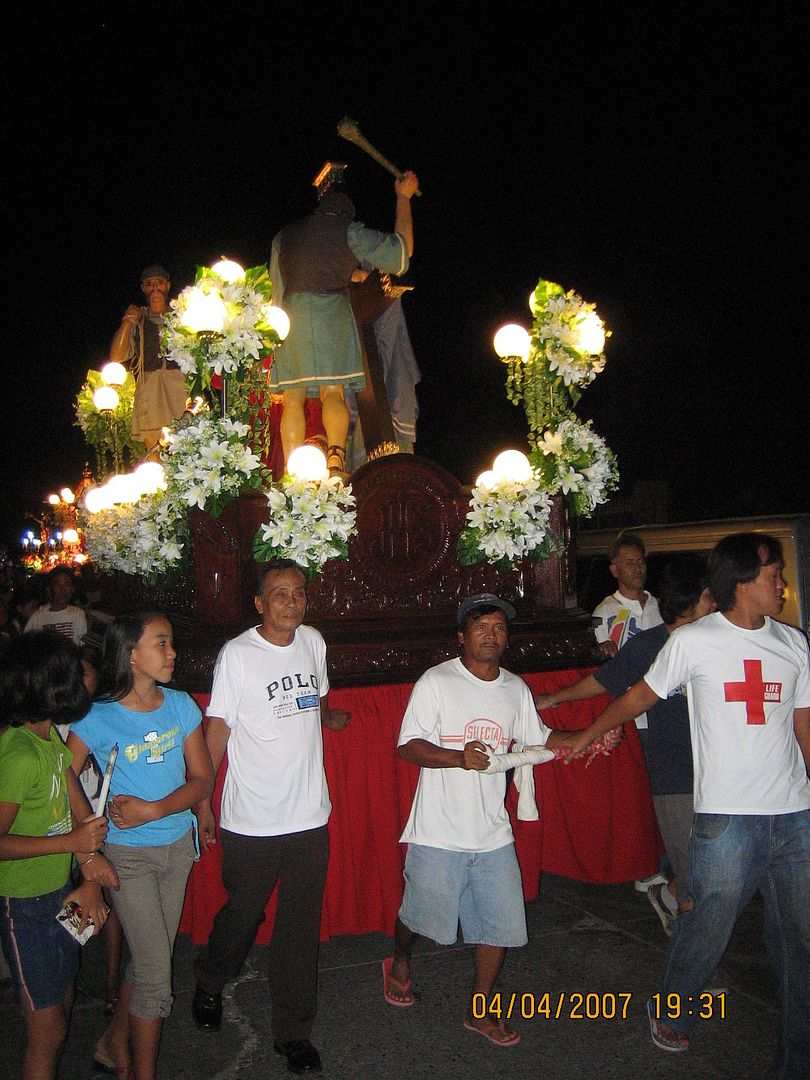
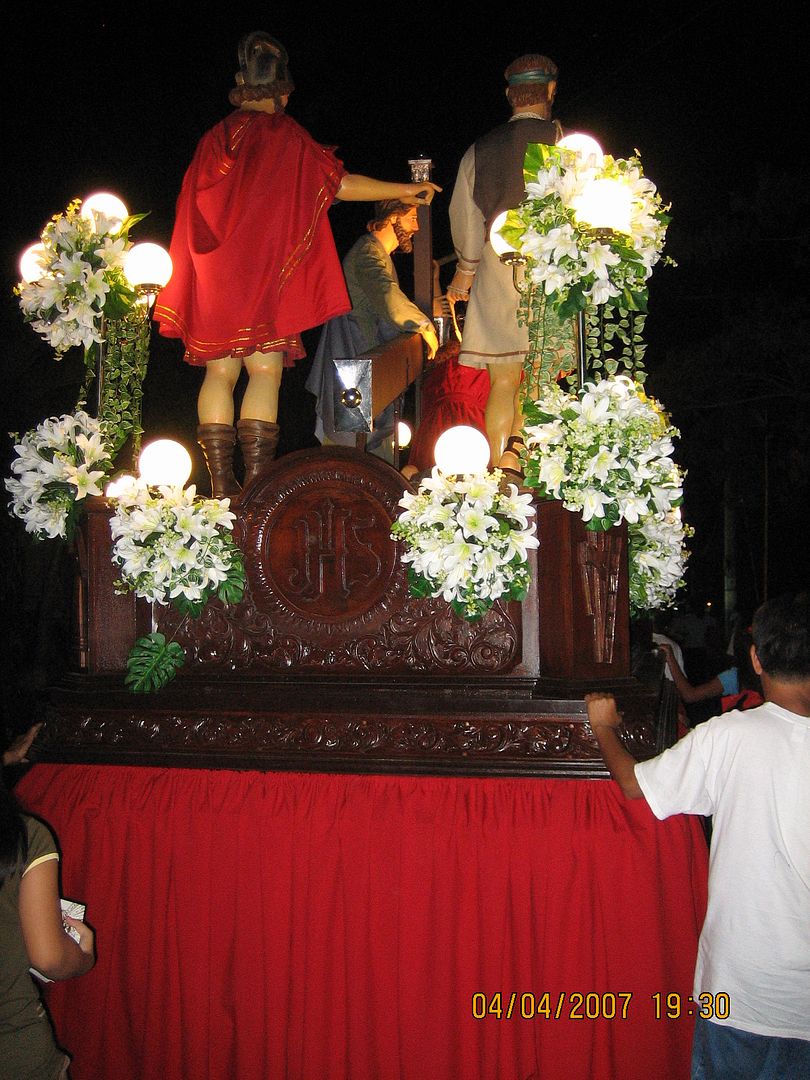

My cousin occasionally crawled under the carro (which wasn’t really so difficult as he could stand upright inside there despite his being quite tall) to check and make sure that there was enough unleaded gasoline remaining within, but even by the time we got home, the small tank was still half-full.  That’s four hours of continuous silent, unobtrusive, problem-free operation.  How many carroza owners around could report that? 


After a modest late evening snack of pansit and puto for family and friends who walked with the Pagkarapâ, it was time to hit the sack and recharge for the Good Friday procession.

For Good Friday, we knew the routine – leave home base at around 6 pm, do the carroza sprint to the schoolyard across the church, and wait for all the other noisy-as-a-jet-engine pasos to assemble.  This time, though, the processional route was still along the main road but in a westerly direction, taking us past our ancestral house and into the neighboring barangay, then a quick U-turn back past our house and on to the church.  While seemingly straightforward, this was also a considerable distance and took nearly as long as the three hours or so that the Holy Wednesday route needed to be covered.
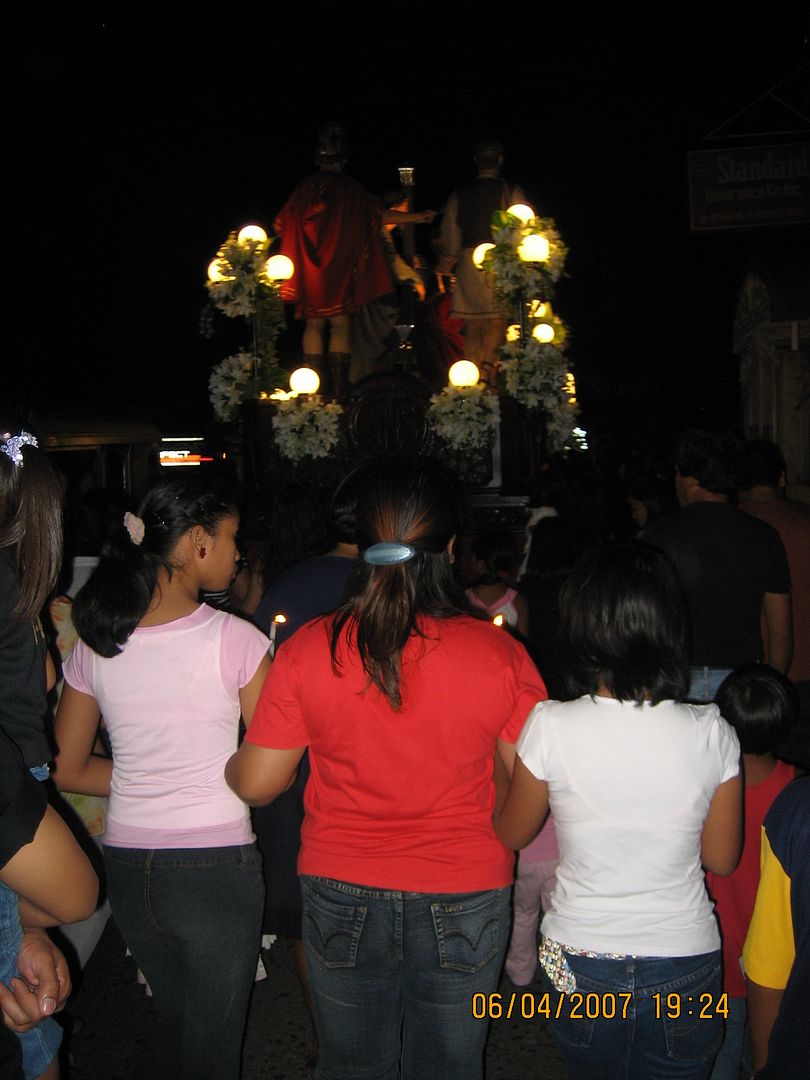


The main difference was that there were far more people this evening than two nights previously.  Obviously, more hometown kids were back from the city or wherever they were on Wednesday, which was still a regular working day.  I’d like to think though that people heard about “that exceptional new paso” in Caingin, San Rafael, Bulacan, and decided to venture out to see what all the fuss was about!

My grade-school-age nephew and his two sisters were busy during both evening processions, distributing copies of our specially-printed stampita, not only to those who walked with us in procession, but also to the more infirm (lazier? less devout?) who decided to stand or sit by the roadside and watch the action from a fixed position.


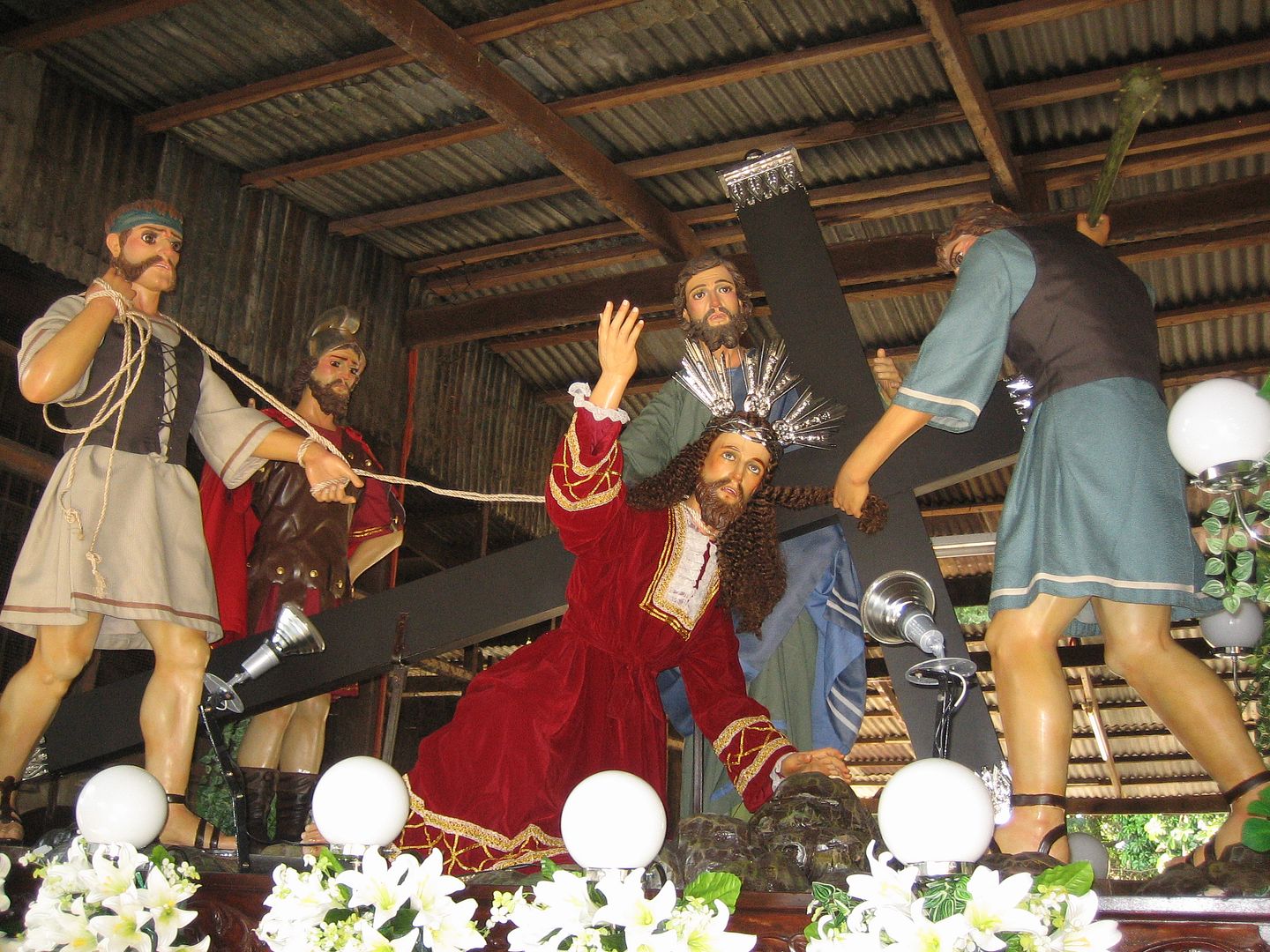
From my observation during both evenings, the most common response to the Pagkarapâ was a silent stare, no doubt because its unusual staging versus other equivalent tableaux required greater-than-average focus and concentration to fully appreciate the action – the hair-pulling, the noose around the neck, the mace raised to strike – and to absorb the total effect of the tableau.  But based on the expressions on the faces of the observers, there is little doubt that it got its message across.
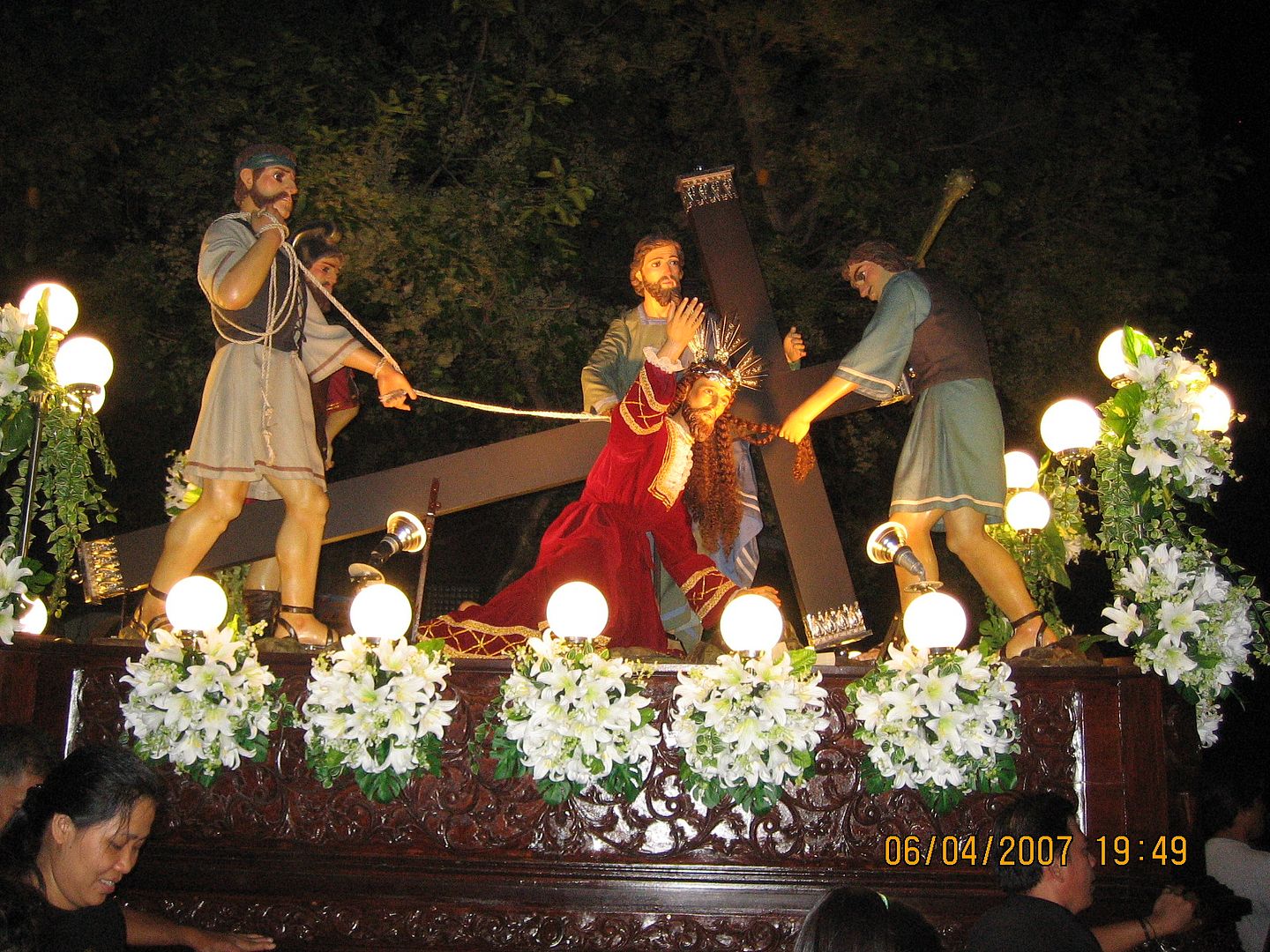
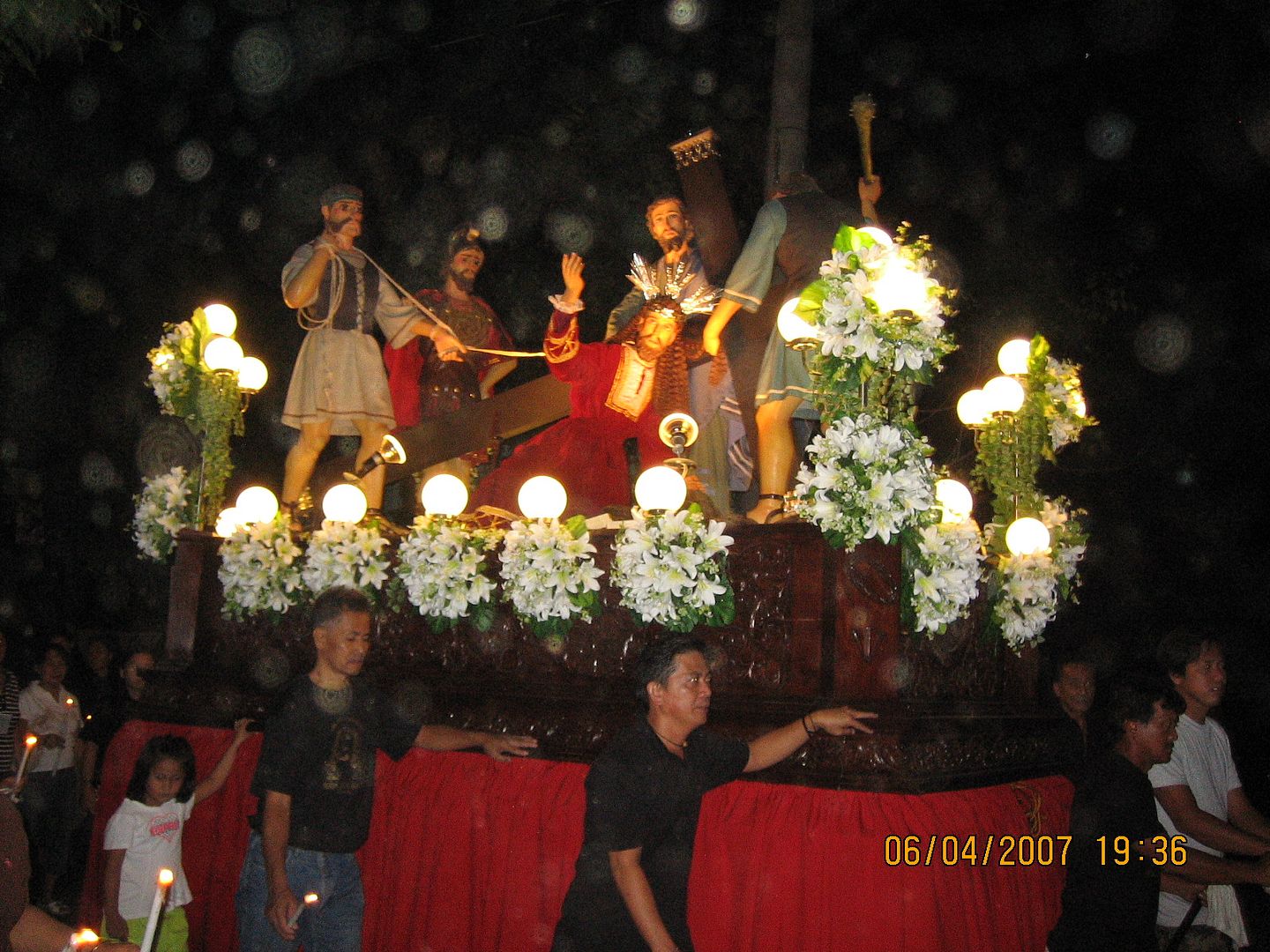
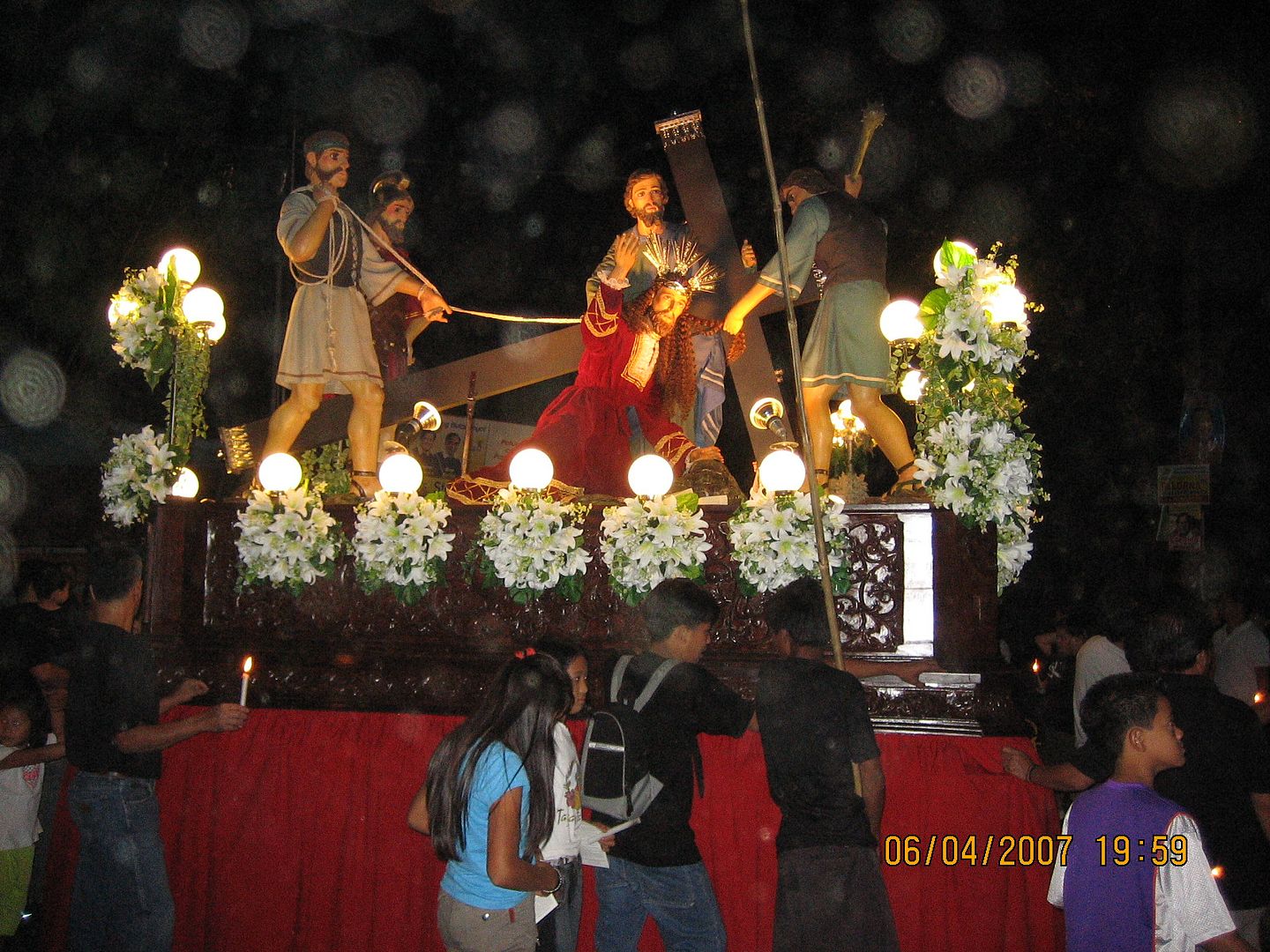
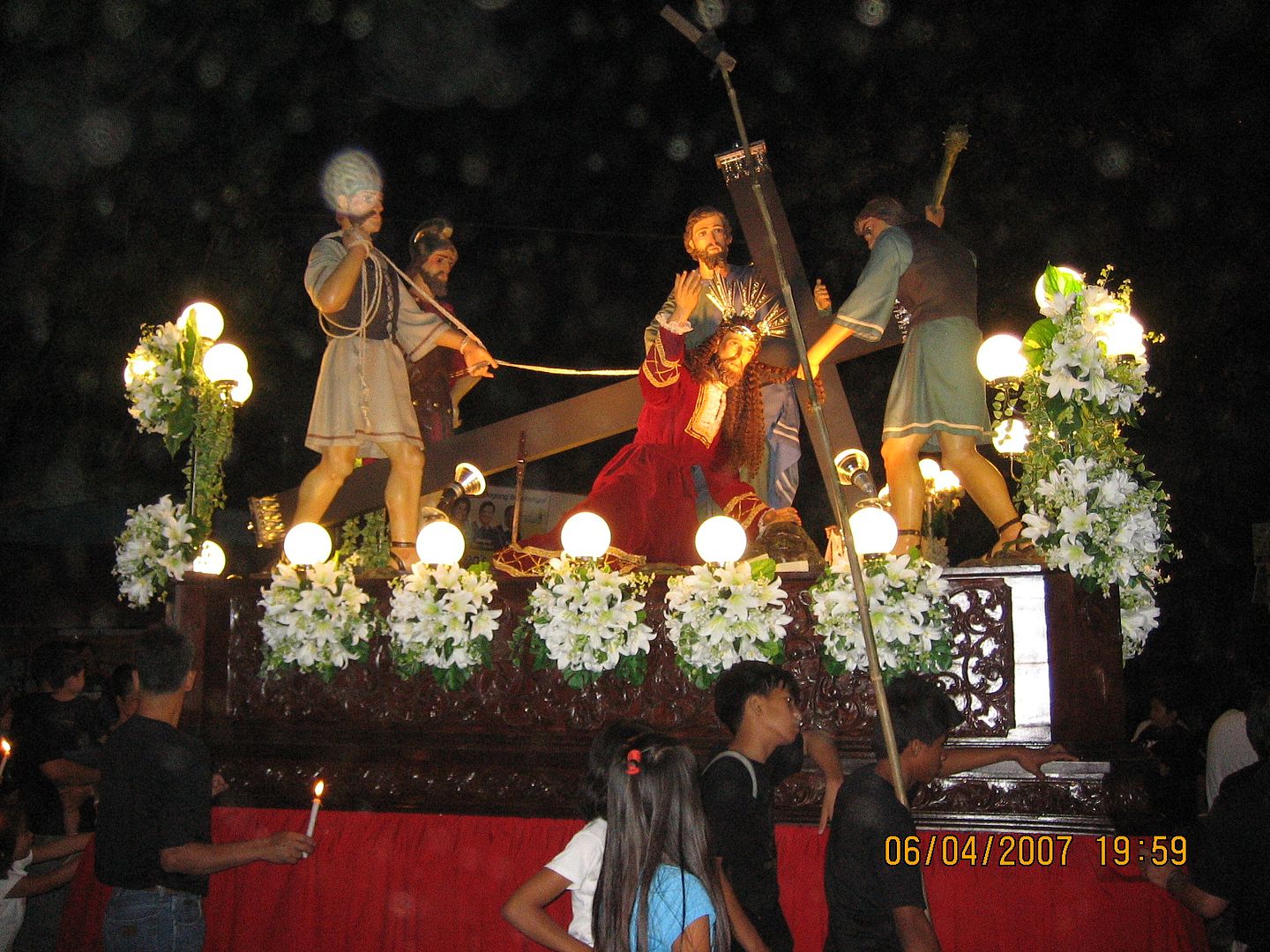
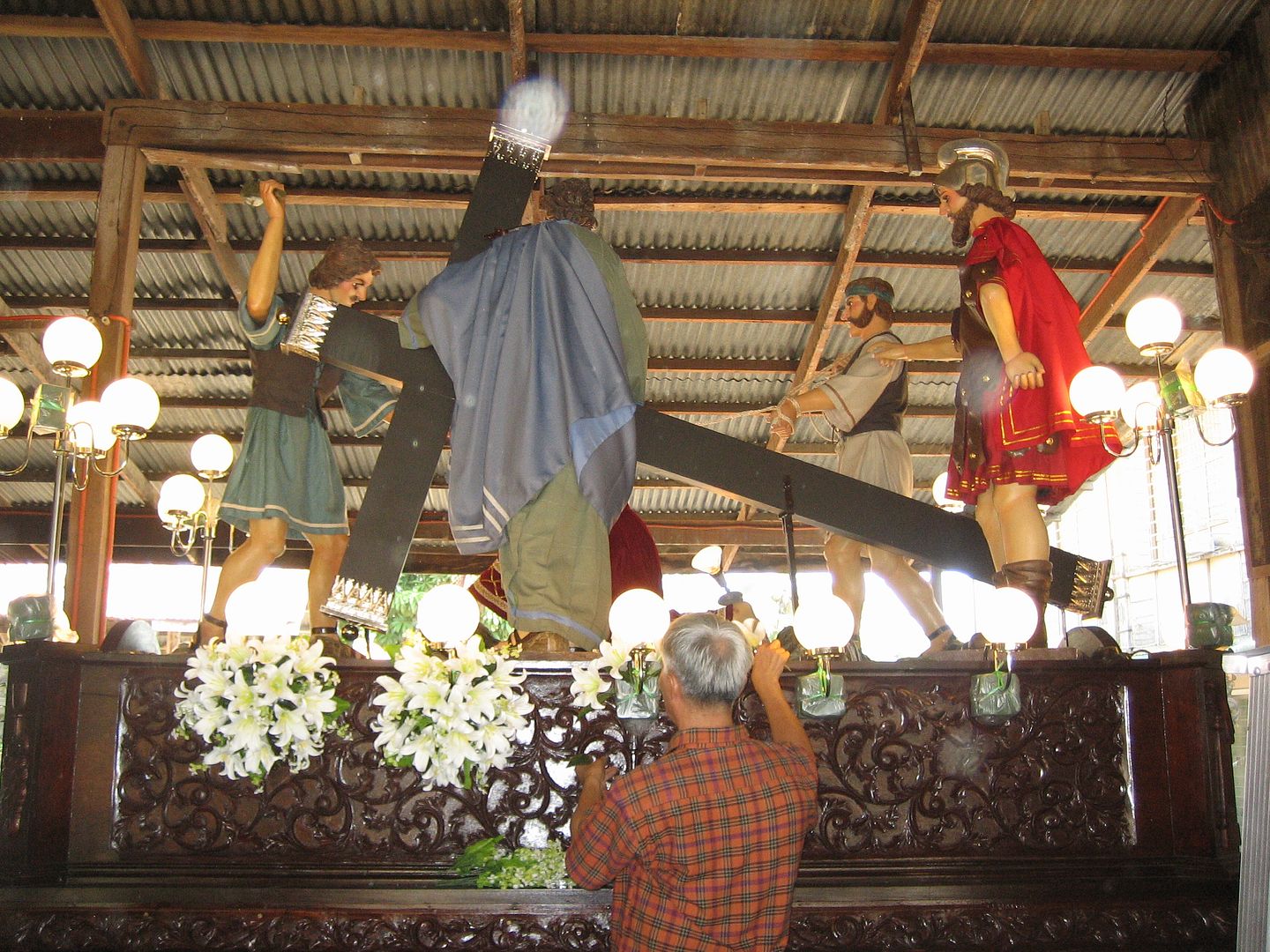
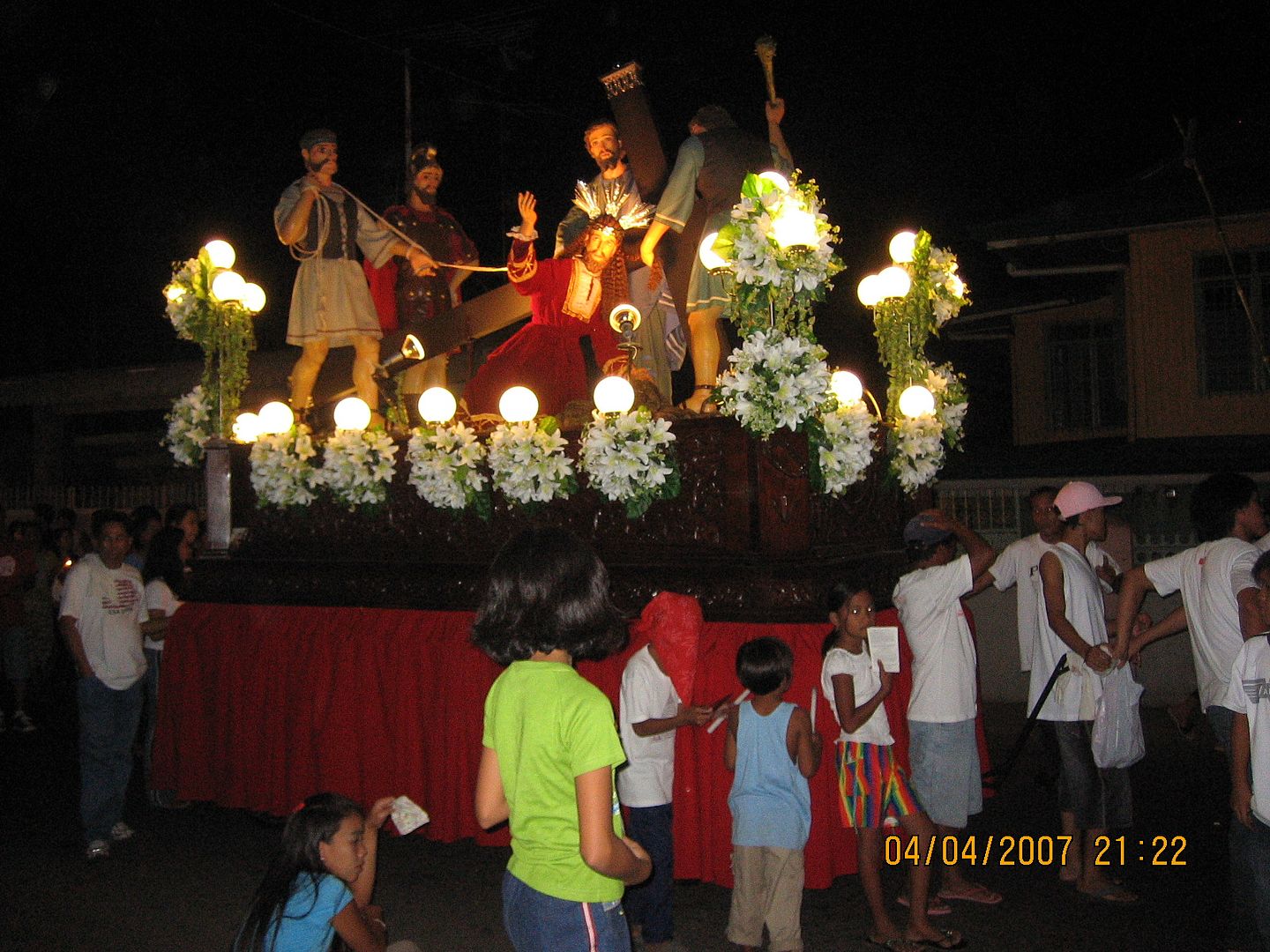
The final remarkable thing is that unlike Holy Wednesday, Good Friday evening seemed to be full of orbs.  For the uninitiated, these are those whitish transparent discs of light that show up occasionally in digital photographs, ruining what would have been a perfectly good shot, such as in this one:


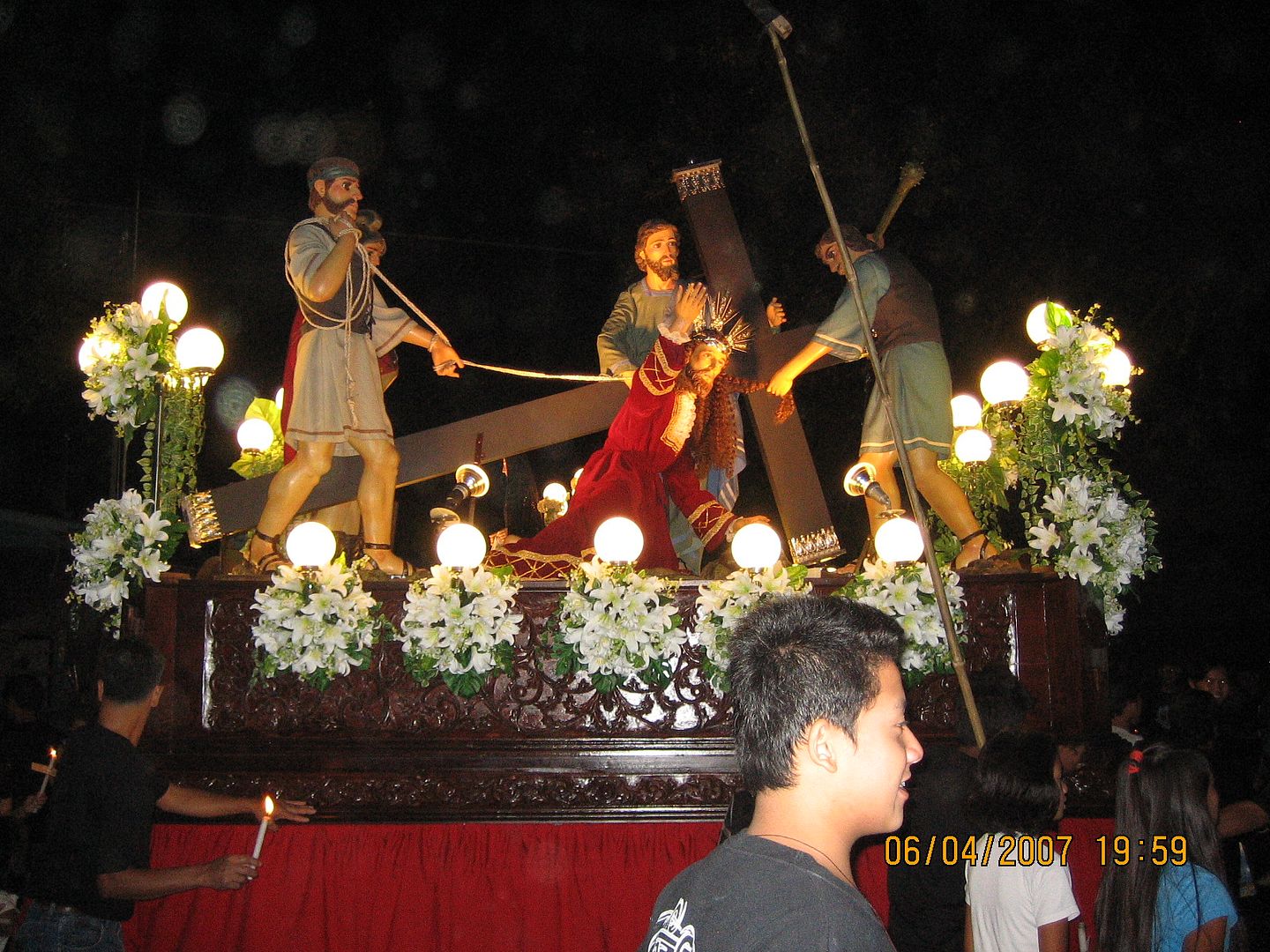
Other photos that I snapped just seconds before and after the above photo don’t show these orbs at all, so I don’t believe that they represent dust particles on the camera lens or in the air in between the camera and the subject of the photo.  These next three photos were shot within the same minute, in practically the same spot, and yet two seem more orb-riddled than the other, or at least they look very different from one shot to the next. 


If they aren’t dust particles, are they “elementals” (whatever that means)?  Angels?  The spirits of slaughtered pigs and other farm animals over the past century here in Barangay Caingin?  Well, whatever they represent, these orbs seemed to like the Pagkarapâ very much as well!

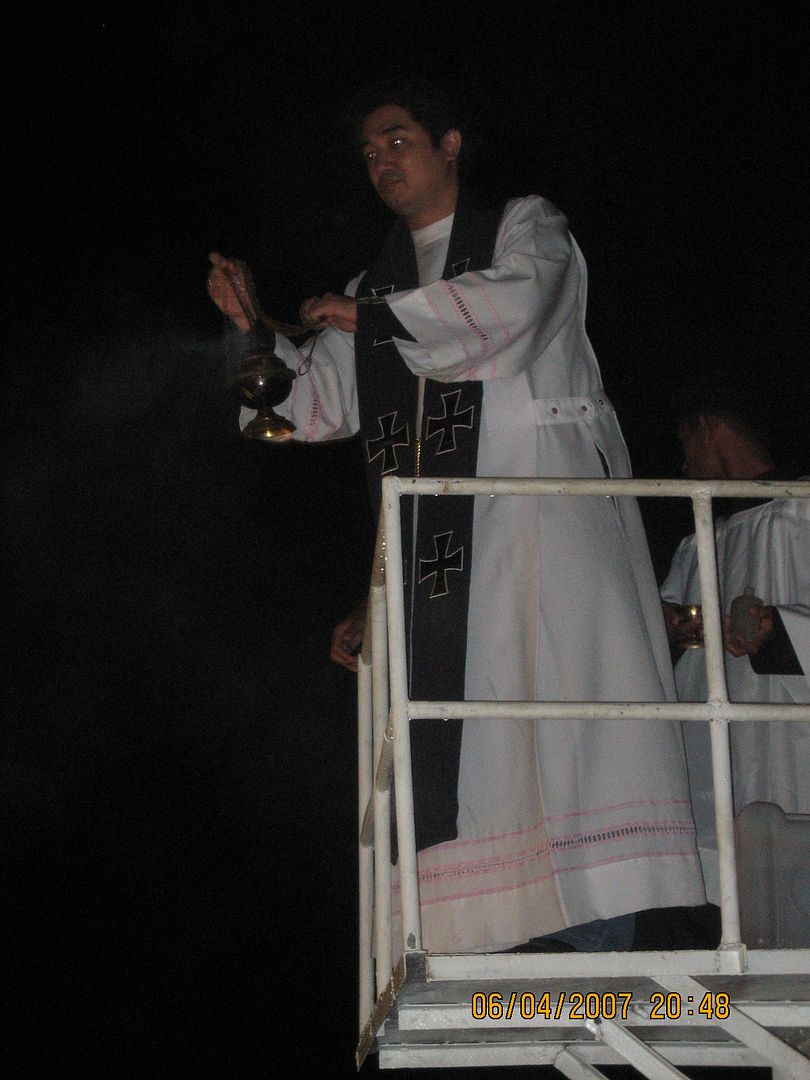
To exorcise ourselves of whatever evils those orbs (and any humans of ill will around) might be giving off, our always-reliable parish priest set himself up on a high platform, blessing the pasos as they returned to the church.  This he did by dispensing heavy clouds of incense, enough to mask the more intense odors of devotees after hours of walking in the hot summer night.  And as if that wasn’t enough, he also sprinkled holy water generously on the devotees themselves, providing some nominal moisture to the hot, dry, still, and stale air.



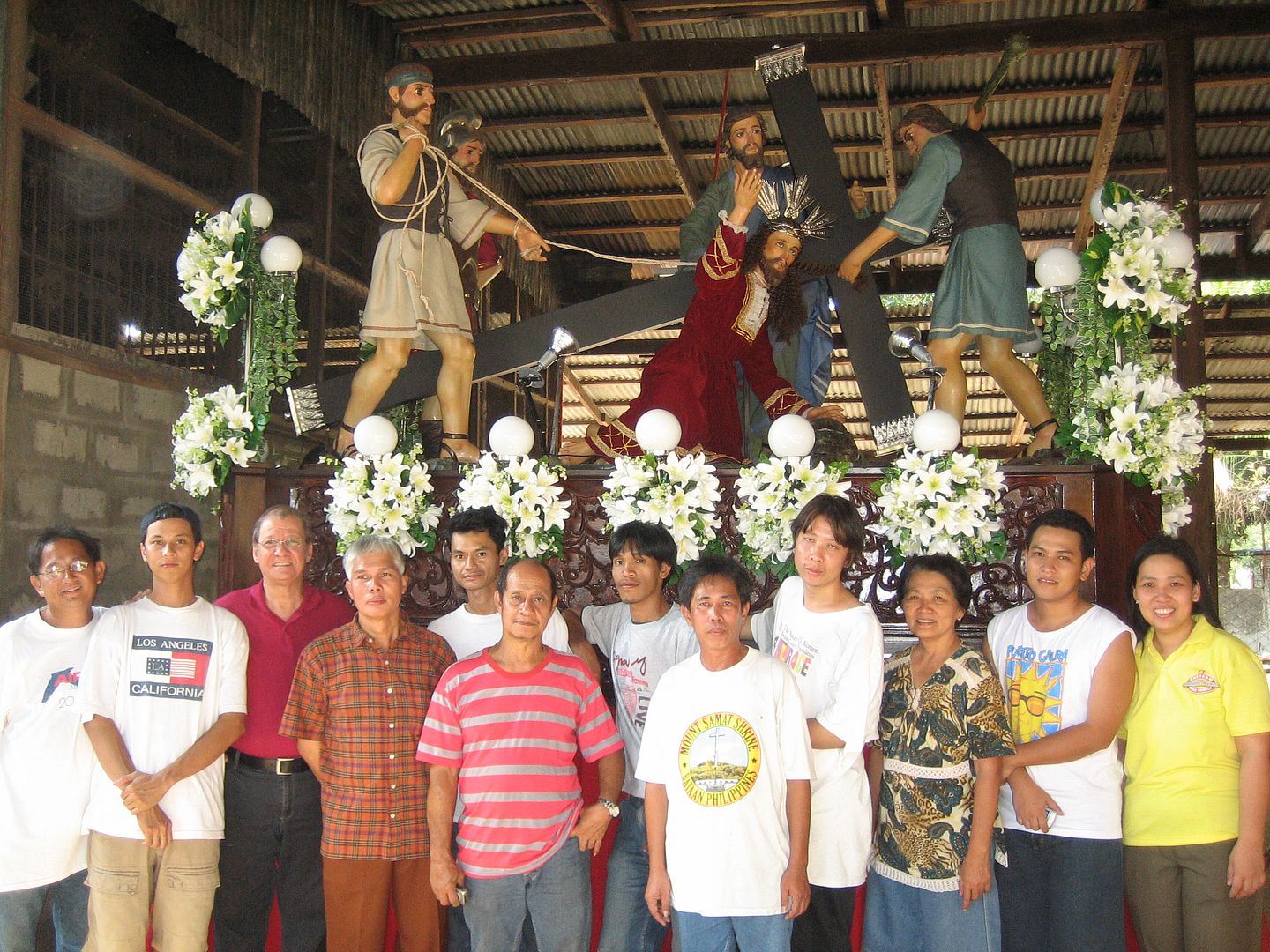
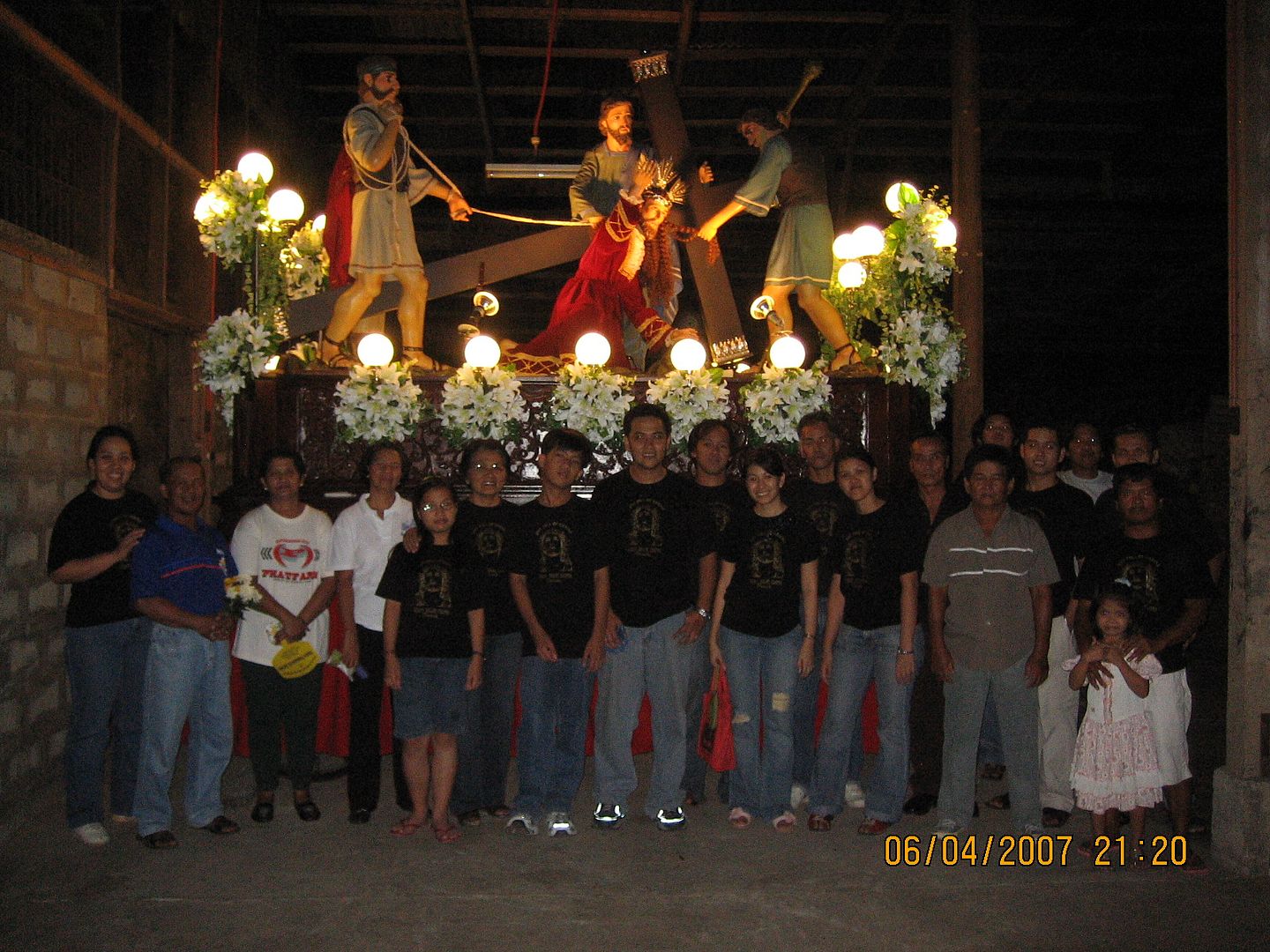
There was one last special touch that we had for Good Friday.  On his own initiative, my enterprising young cousin had printed off some custom-designed shirts for all our invited Pagkarapâ-ers to wear.  These apparently had been silkscreen-printed only within the last couple of days, but all who had been specifically invited by the family had at least some “uniform” to wear that evening, which would subsequently be a nice souvenir and token of appreciation as well.  Here, you’ll see some members of the Pagkarapâ gang wearing them as they manoeuvre the carro (more difficult than it looks, if you’ve not done it before) back into the garage. 
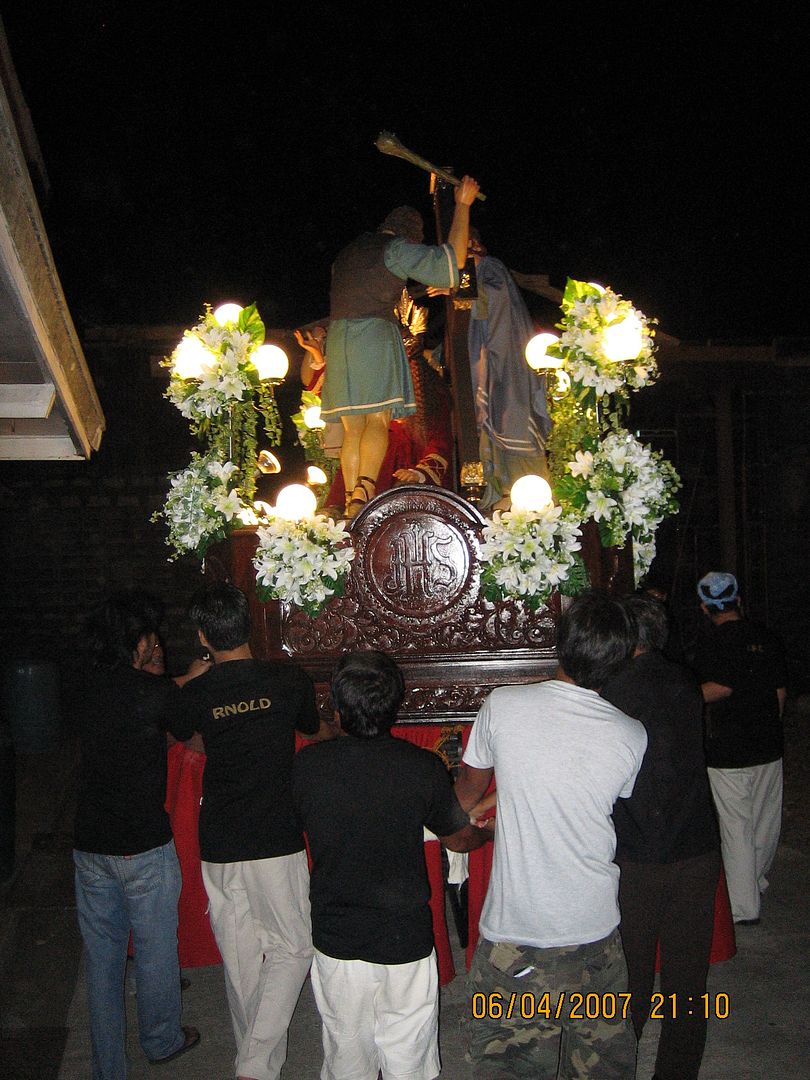


Next year, we’ll try for Nazareno-red golf shirts, if we can afford it. And matching tres potencias on headbands, why not? Ha ha.

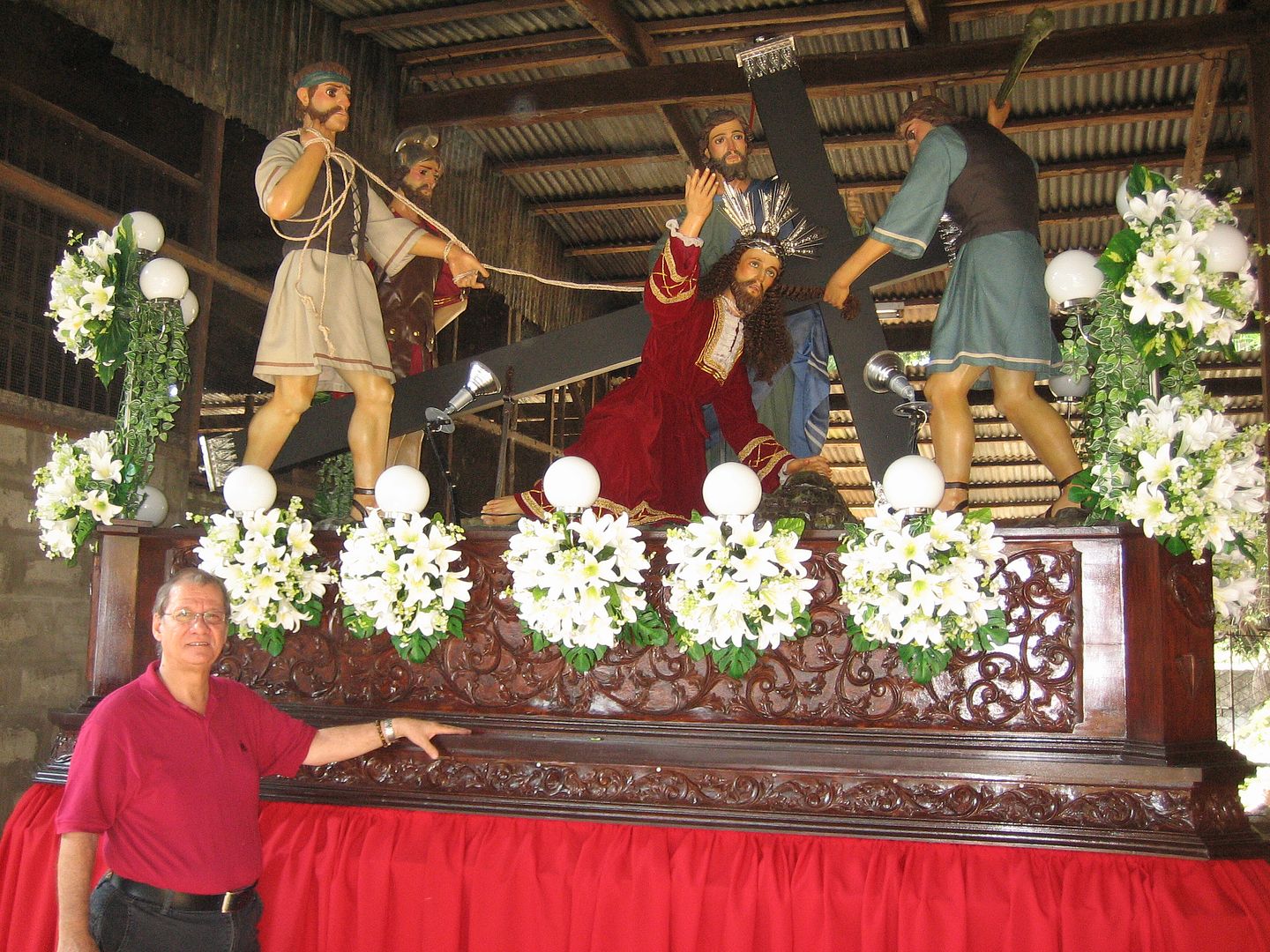
The carro having been repositioned in place, it was another good time to go for some Kodakán.

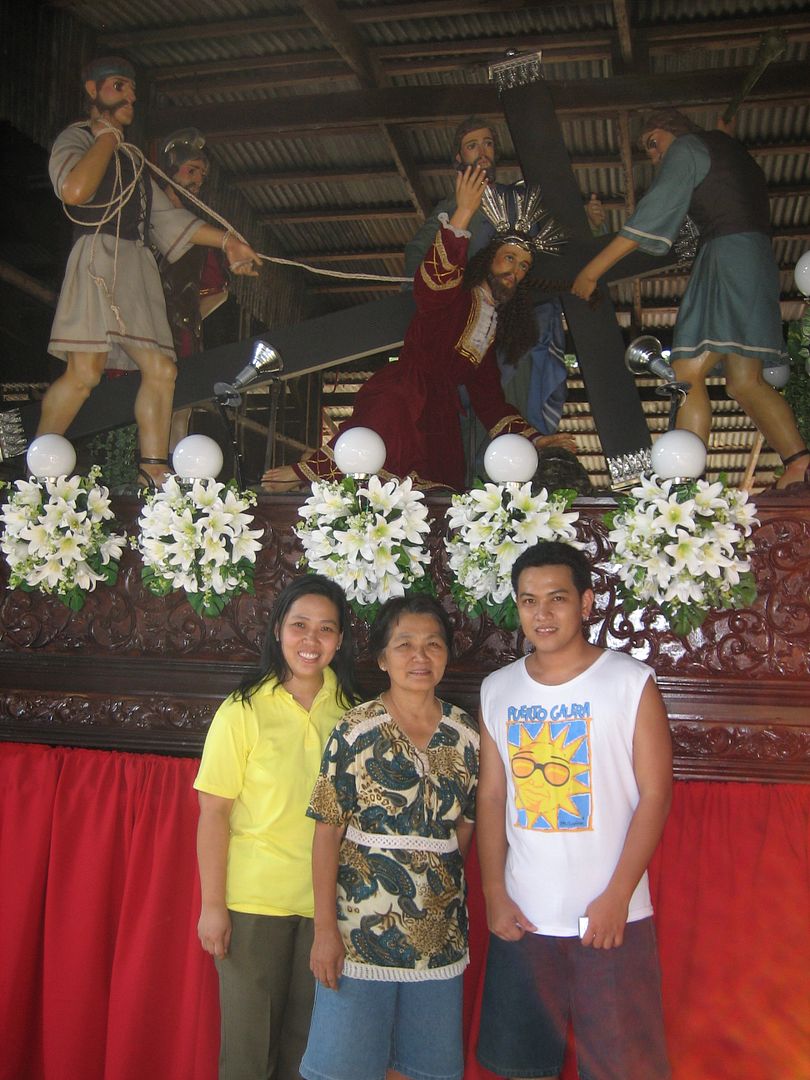
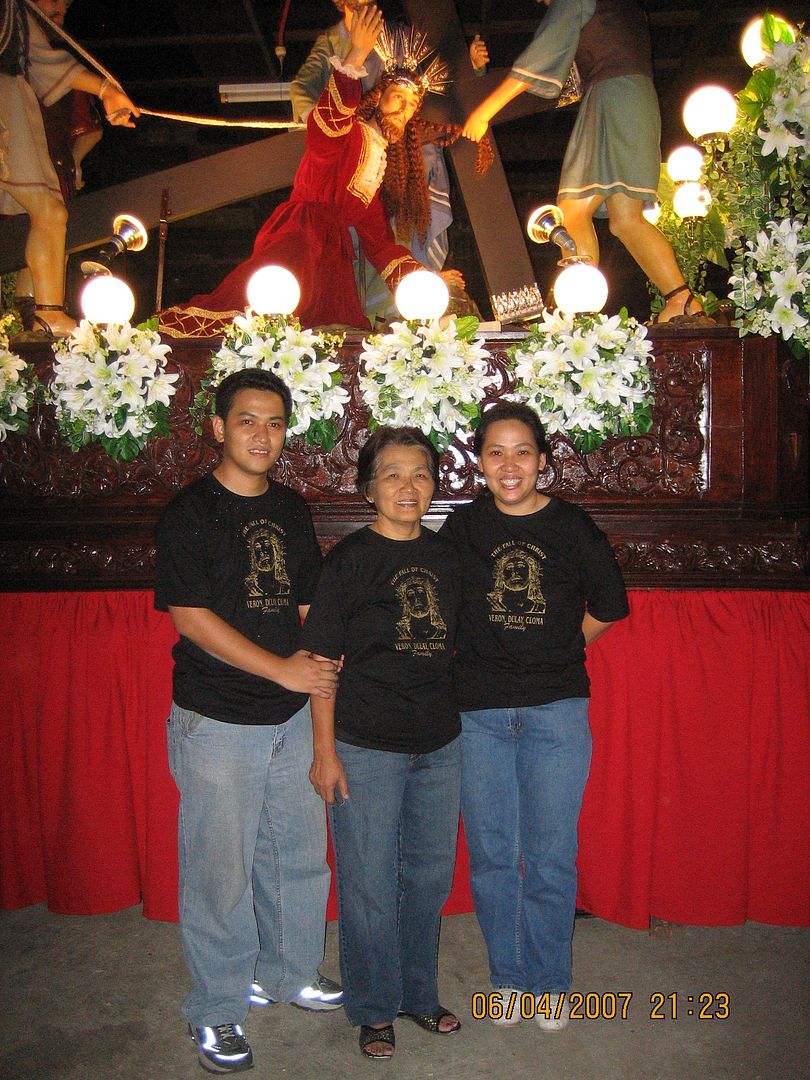
And finally, just my aunt and cousins as before:

Then after a modest repast of munggó with tinapá and other abstinence-observing dishes, it was time for everyone to get some much-needed rest.  The paso itself would remain in the garage throughout the Easter weekend, available for viewing by friends, relatives, neighbors, or the simply curious.  Easter Monday, being a public holiday this year, was a good time for my cousins to take everything down, pack away the flowers, fold away the sayál and the garments, and set the images aside.  The bodies were to be stored away; the supporting characters’ heads were to be placed on custom-made stands and kept inside an aparador to protect them from damage, and the Christ’s head and hands were to be displayed in our ancestral house’s living room, inside a beautiful antique balayong hardwood urna, also acquired from the Vecin Collection.
Thus passed quite uneventfully (no news is good news!) the Pagkarapâ’s first Holy Week run.  Salamat sa Diyos!  Until next year.  Let’s see if those orbs will decide to reappear.

- - - -

Watch out for future features from the SS-Files (Semana Santa Files), including exciting Holy Week reportage from various fields and fountains, moors and mountains.  (Wait -- that’s Christmas! Ha ha.)

- - - -

Originally published on 24 April 2007.  All text and photos copyright ©2007 Leo D Cloma. The moral right of Leo D Cloma to be identified as the author of this work has been asserted.

Original comments:
nsconsolacionycorrea wrote on Apr 27, '07
Hay!....DEO GRATIAS!!!...

Congratulations to your family for the Primera Salida Procesional of your Tercera Caida tableau.


robbyandharry wrote on Apr 27, '07
lol... leo, those orbs really loved your tercera caida... so many orbs in san rafael... maybe dead animals... (parang kilala ko itong line na to a...) hehehe

btw... congrats po for this wonderful tableau... now we have to wait for "Ang Banal na Hapunan" tableau... panigurado, idodocument mo yon mula sa paglililok hanggang sa paglabas... :)


dennisraymondm wrote on May 1, '07, edited on May 1, '07
Yup! At last I thought I was the only one capturing these ORBS! Most of the pics I took inside churches had these orbs and they occur only in churches and in cemeteries (as with my case). Just this morning, I took a shot at the altar of the Divina Pastora in Gapan, N.E., (my maternal grandparents' hometown) since it's her fiesta and lo and behold, two swirling orbs appeared. They seem to appear only in particular churches coz like last year, orbs appeared in my shots of Panglao and Tagbilaran churches in Bohol but not in other churches. When I returned this year, the orbs appeared only in the Tagbilaran church (since I did go to Panglao church this year) but not in the other churches. The La Salle Chapel in Taft Ave. shots (where the massacre of FSC Brothers, et. al. occured) had a couple of orbs and that was shot during daytime! Pics of the Cubao Cathedral I took last week had orbs galore like the shots of another flickr member done at the same church at a diffrent time! Zooming in on them seem to produce facial images. Well, what more can I say? Happy orb hunting whatever they are!


jayroberto wrote on Jul 1, '07
*clapclap*
Last Supper na!
I can hardly wait.


adlailara wrote on Nov 16, '07
The paso is extraordinarily beautiful and so is your story!!!


antigualla wrote on Feb 18, '09
Bow! Congratulations for an excellent paso and equally excellent story. Viva El Señor!


pasonanca wrote on Nov 30, '09
The realization of your Pagkarapa was indeed an awesome undertaking and devotion by your family and your unique santero, duly honored by your inimitable narrative.


rally65 wrote on Dec 3, '09
pasonanca said
"The realization of your Pagkarapa was indeed an awesome undertaking and devotion by your family and your unique santero, duly honored by your inimitable narrative."

Thanks for the visit and the appreciation!

Monday, April 6, 2015

XXXI. SS-Files: Ang Pagkarapâ, Part Three – “The Gang of the Fall of Christ”


Shortly after the “dress rehearsal” in early March, we had sent over the entire five-figure group to a photo studio in the Makati area.  The half-day session had yielded a generous number of useful shots of this new “Fall of Christ” (in very proper Tagalog, "Ang Pagkarapâ ng Panginoon") tableau.  The reason for having had this done was that my family and I wanted to produce a commemorative "stampita" (i.e., a prayer card) to mark the commissioning of this processional set of images.

My brother, who is the real art critic in the family, did the honors of choosing which of the many resulting pictures would be used for the stampita.  Out of the more than one hundred available, he chose this one: 


A little strange and anticlimactic, you might think, for what about the compassionate Simon of Cyrene, the bossy Roman Captain, the sadistic Jewish temple guards?  But I have to say that this was an excellent choice of stampita artwork, as it quite clearly focused attention on none other than the silently suffering Christ, ensuring that devotees were not distracted by the more “theatrical” elements of the tableau.

We had also earlier already composed a prayer for the back of the stampita.  This was essentially a conflation of the traditional Stations of the Cross prayers for the First Fall, the Second Fall, and the Third Fall, ensuring that there would be minimal fanatical debates about which of those "Falls" this tableau was supposed to represent.  The Pilipino version was most expertly translated from the English by our mother, the “academic Tagalog” expert in the family.

For both English and Pilipino versions, we remembered to give credit to the Francisco Vecin Workshop, and to indicate that the whole activity was being undertaken in memory of our late grandmother.


(To request a more readable soft copy of the stampita, just post a comment below or send me an email.)

We had sent off the selected cover photo and the back page text to a printer-friend of ours, who very capably delivered 10,000 copies of this postcard-sized (six inches tall by four inches wide) stampita on Thursday, March 29th.  [And if you failed to get your copy of this limited-edition keepsake, you've missed the opportunity to own something that will be a much-sought-after item a millenium from now, when paper no longer exists.  (Just send me a PM if you want one -- I'll try to scrounge around a remaindered copy for you.)]

- - - - -

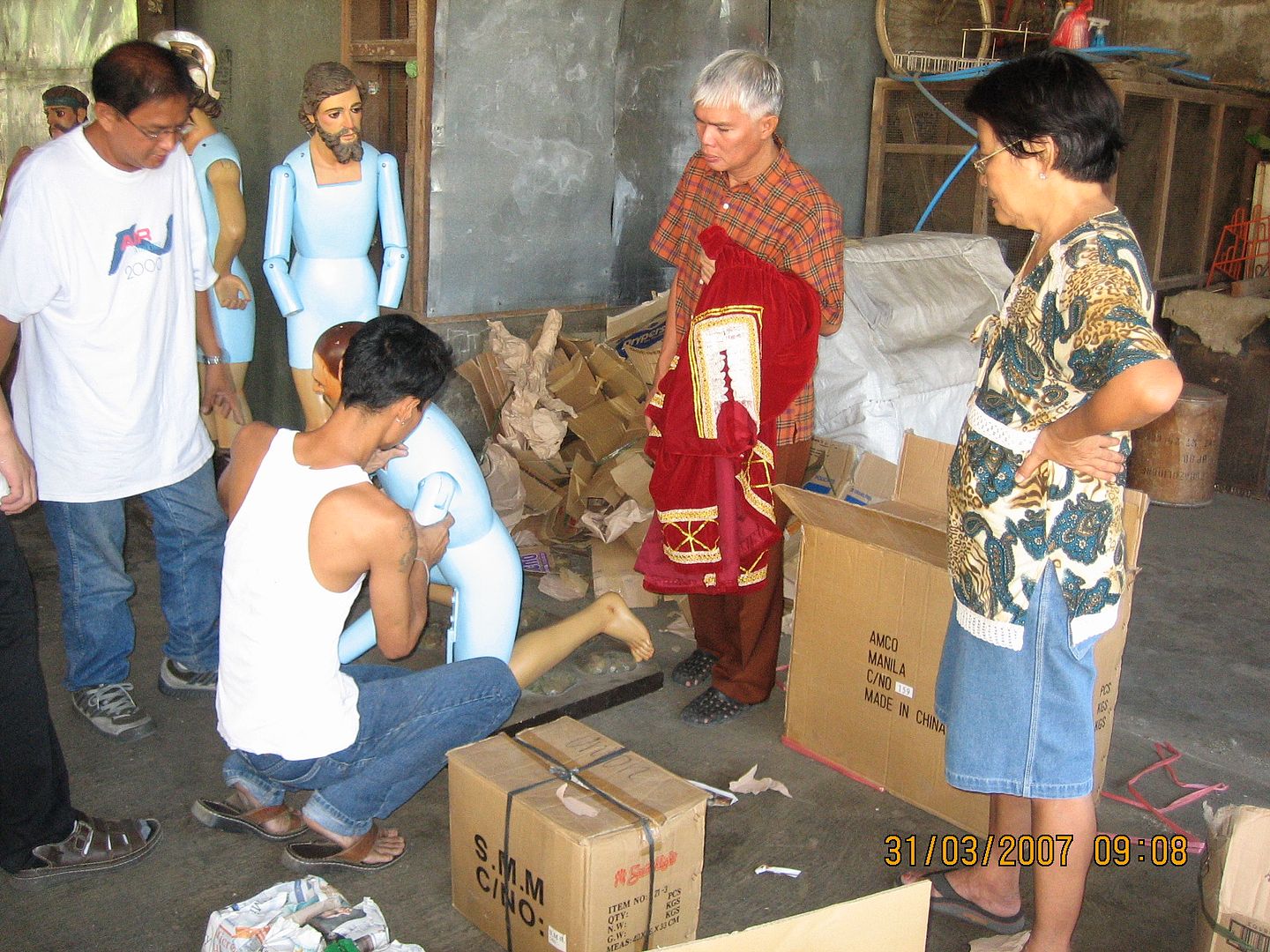
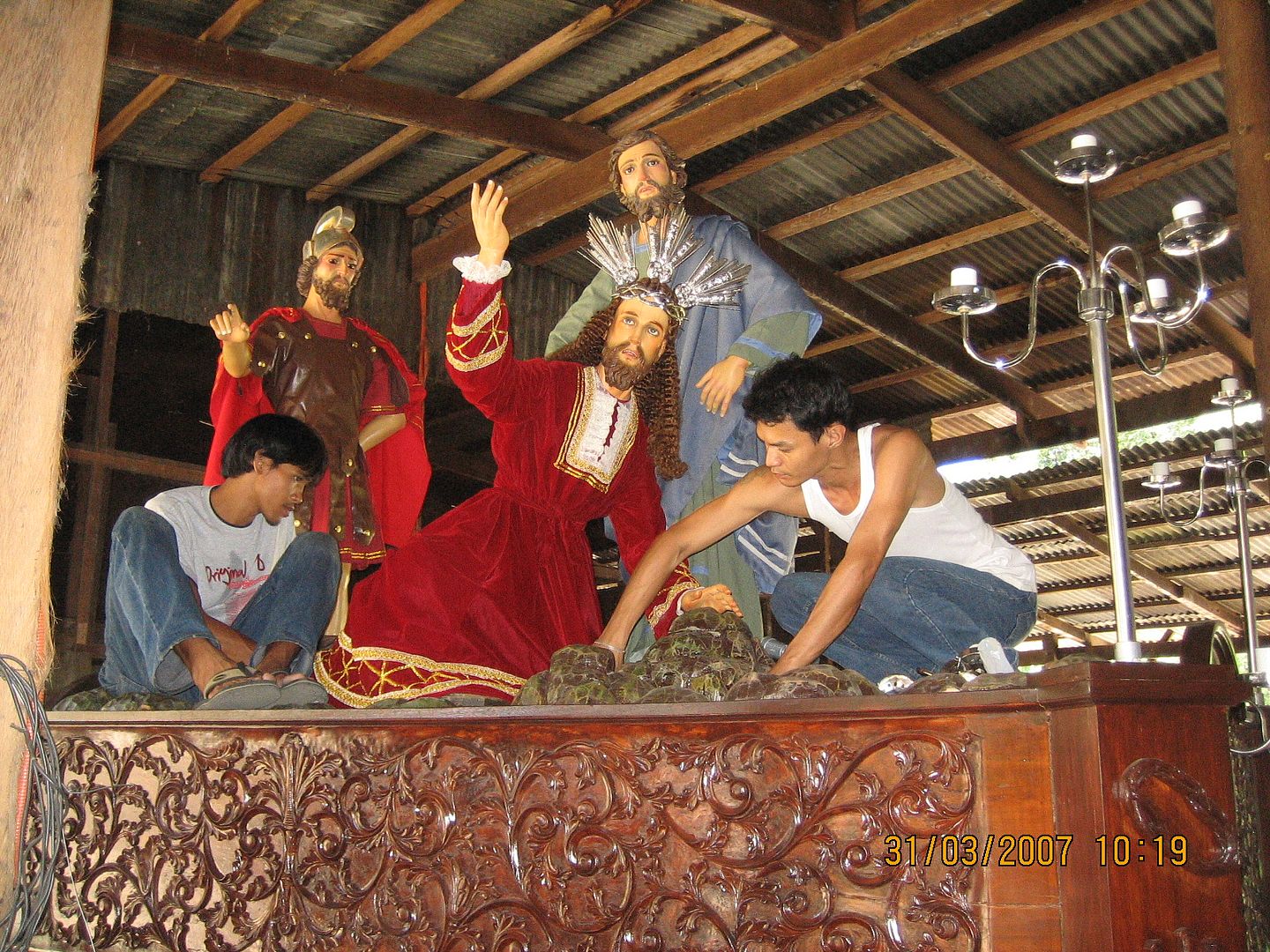
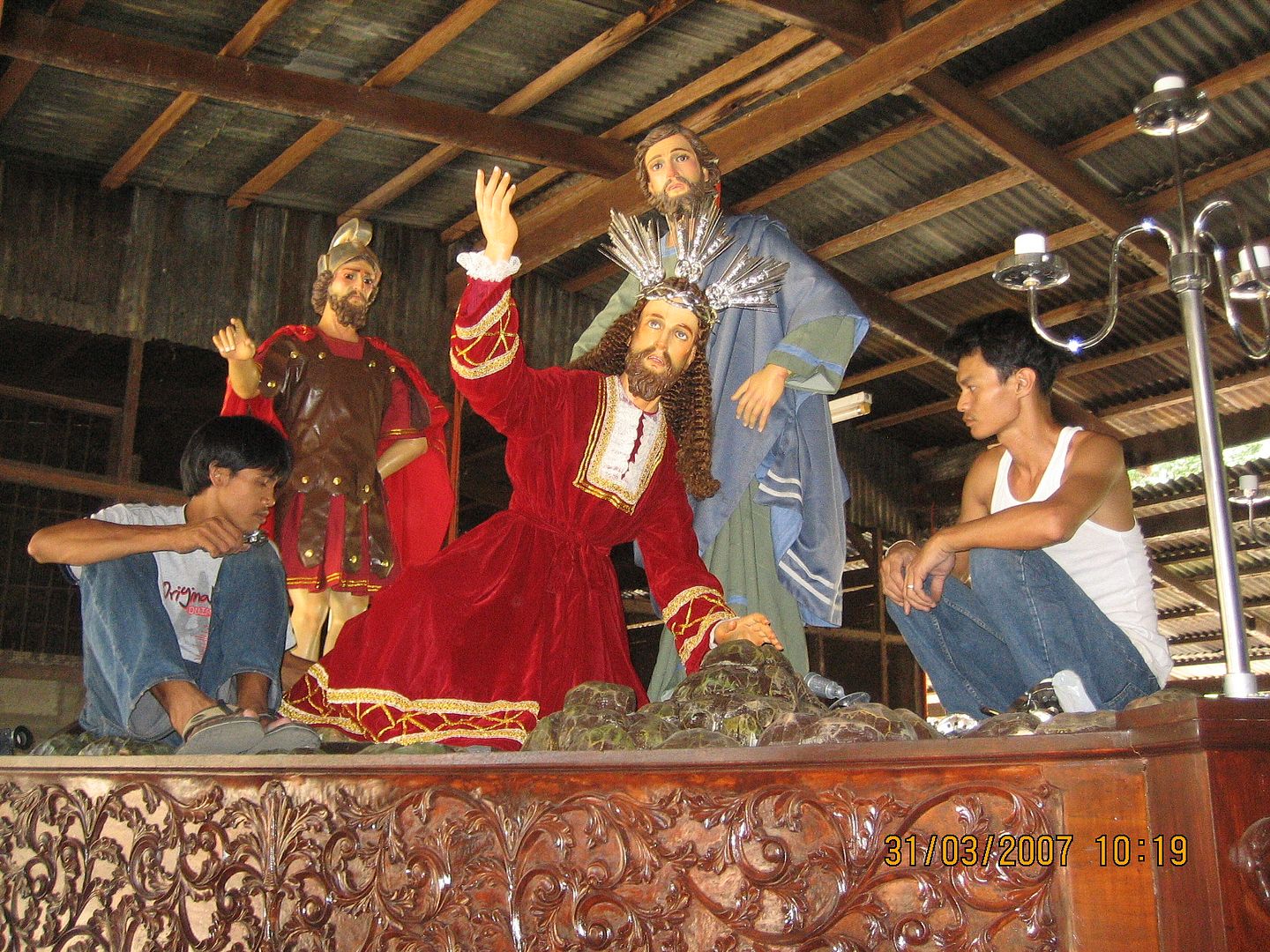
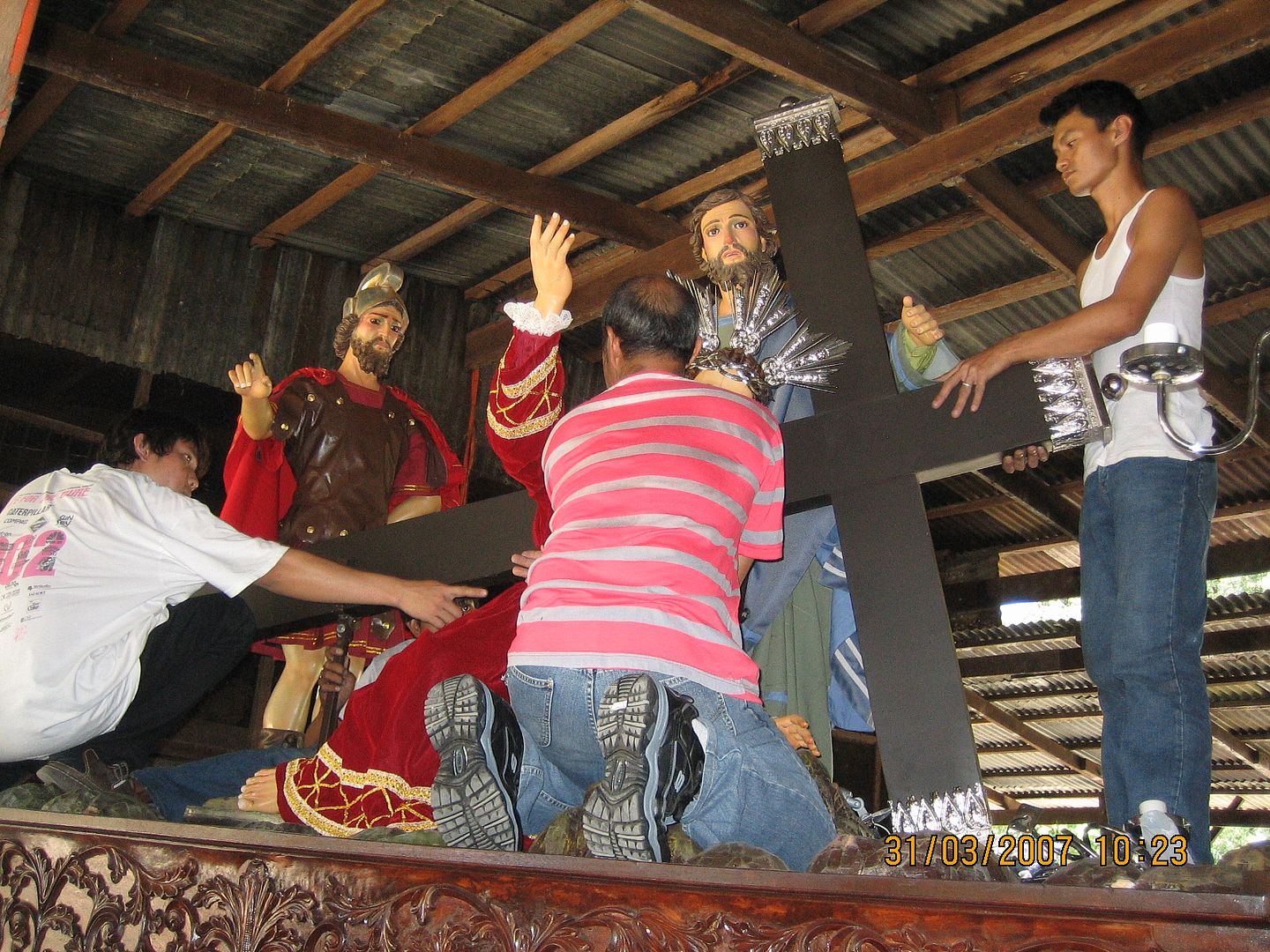
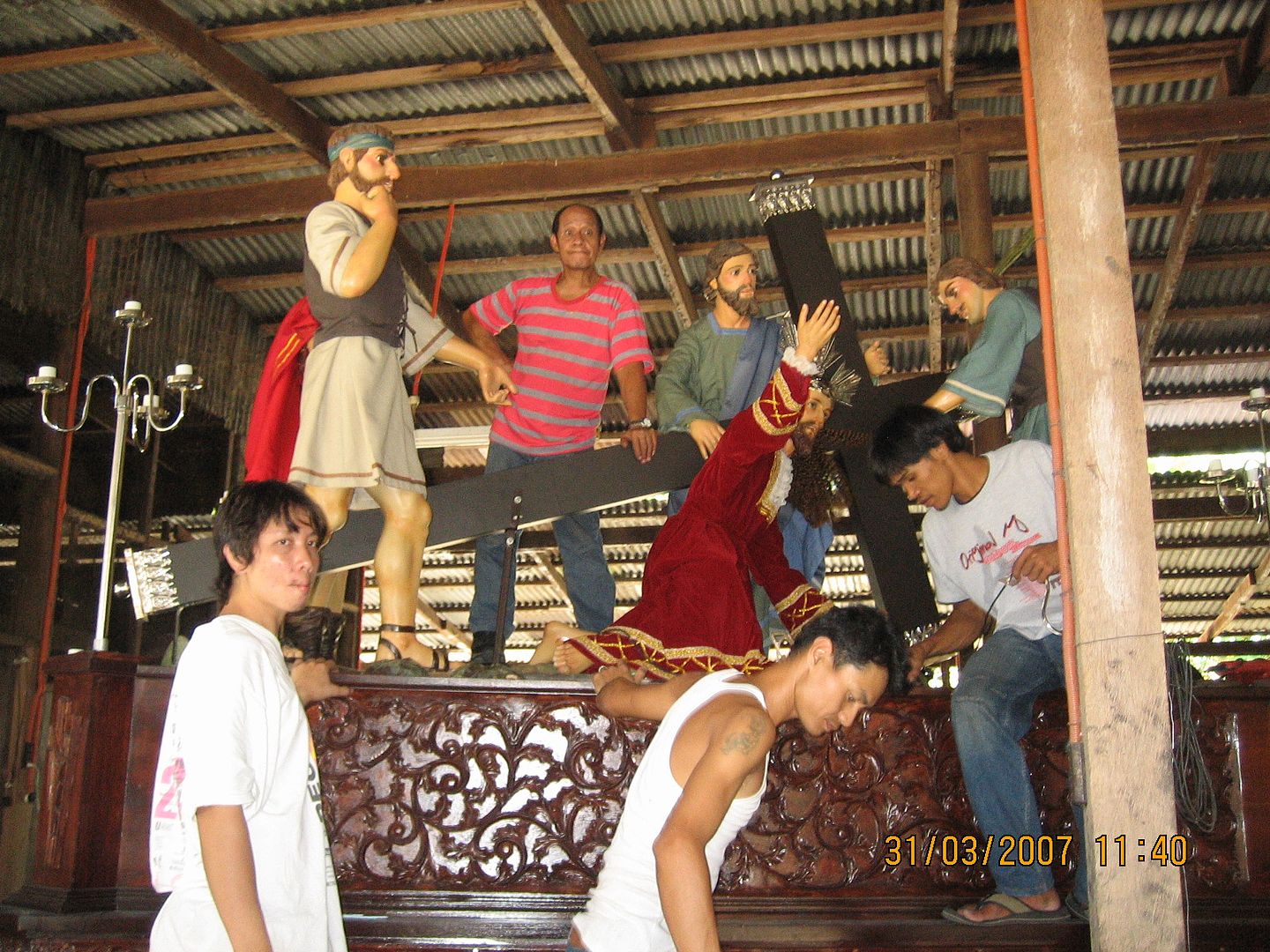
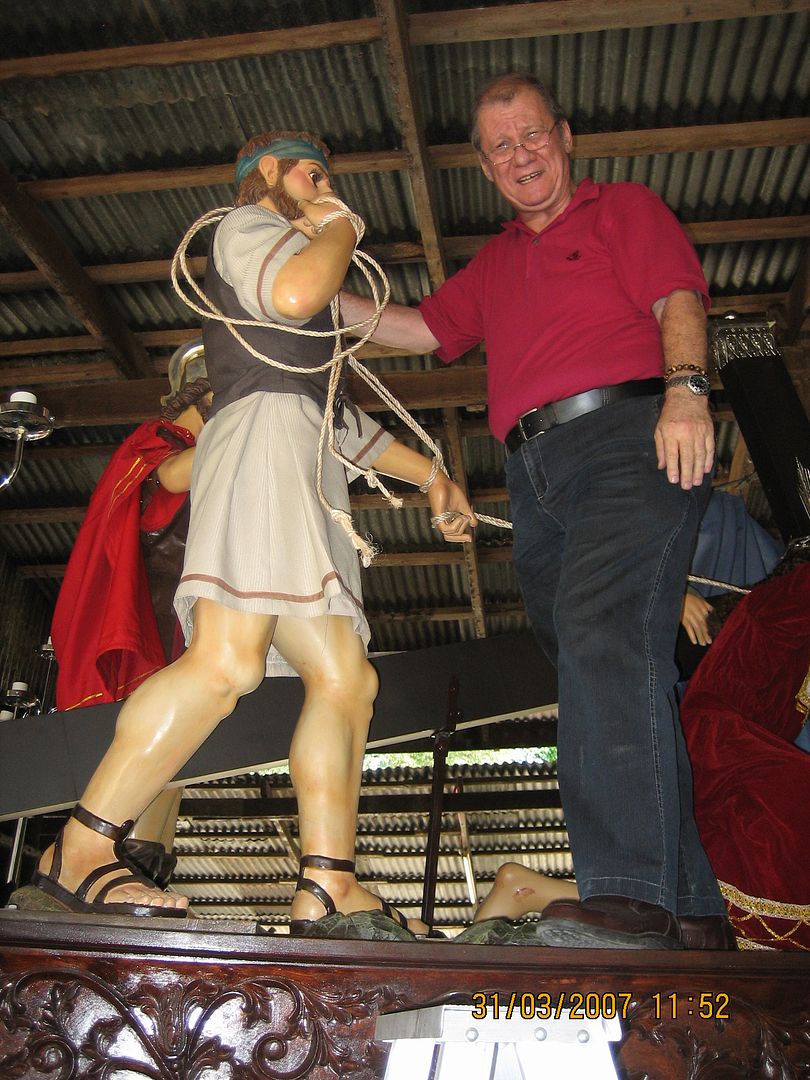
Finally, in keeping with the “delivery date” of March 2007 as indicated in the stampita, Saturday the 31st (Palm Sunday Eve) was a big day for everyone.  It was the day when the so-called “Gang of the Fall of Christ” got together and converged on the quiet and genuinely rural barrio of Caingin, San Rafael, Bulacan, to set up the whole tableau on its carroza and ensure that everything was ready for its first processional sojourn just a few days later, on Holy Wednesday.

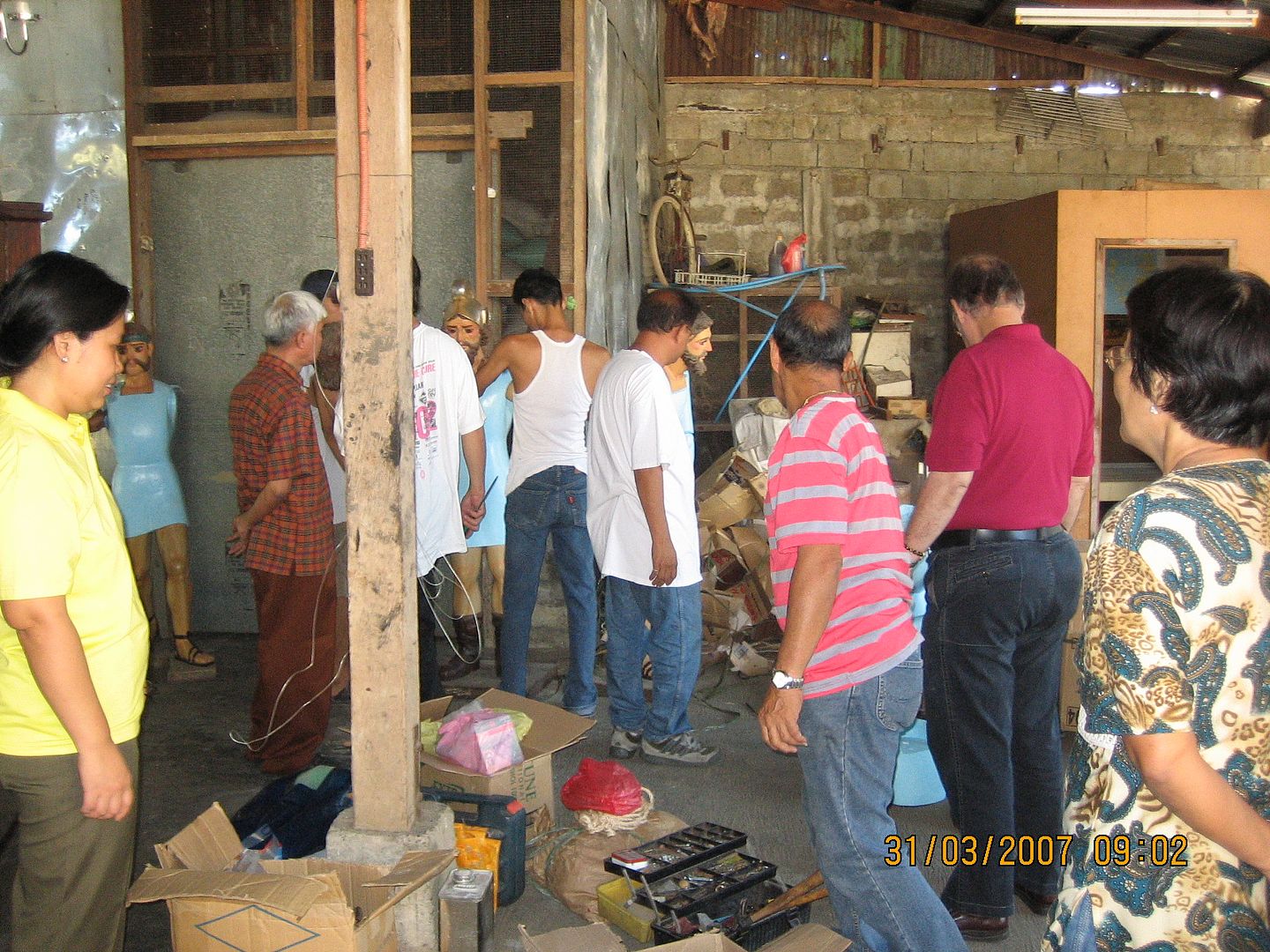
I had picked up Kiko Vecin and his crack team early in the morning, and we got into his car and mine and motored over to San Rafael, about an hour and a half away from Makati.  The first order of business was to go up to the dining room of our ancestral house there and sit down to a hearty Filipino breakfast, most expertly prepared by my aunt and cousins.  Then, as there was a lot to do, we got down to work right away.  First, everyone had to make sense of the apparent mess of materials that would be used throughout the day.


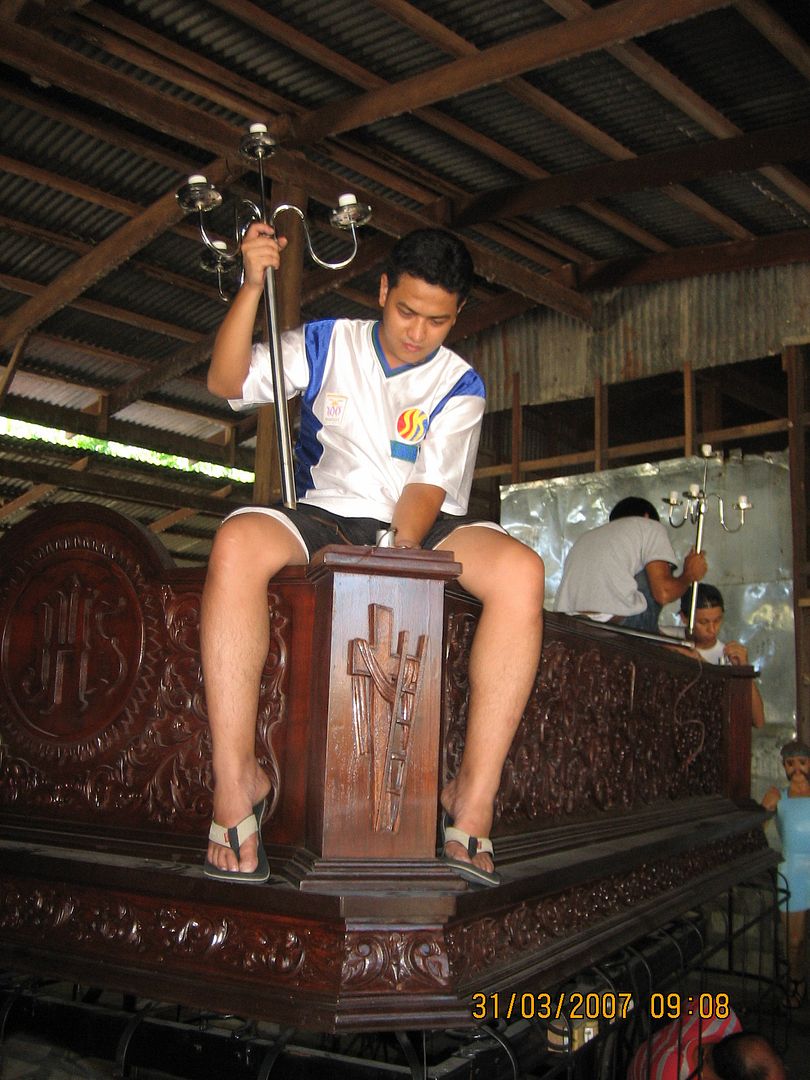
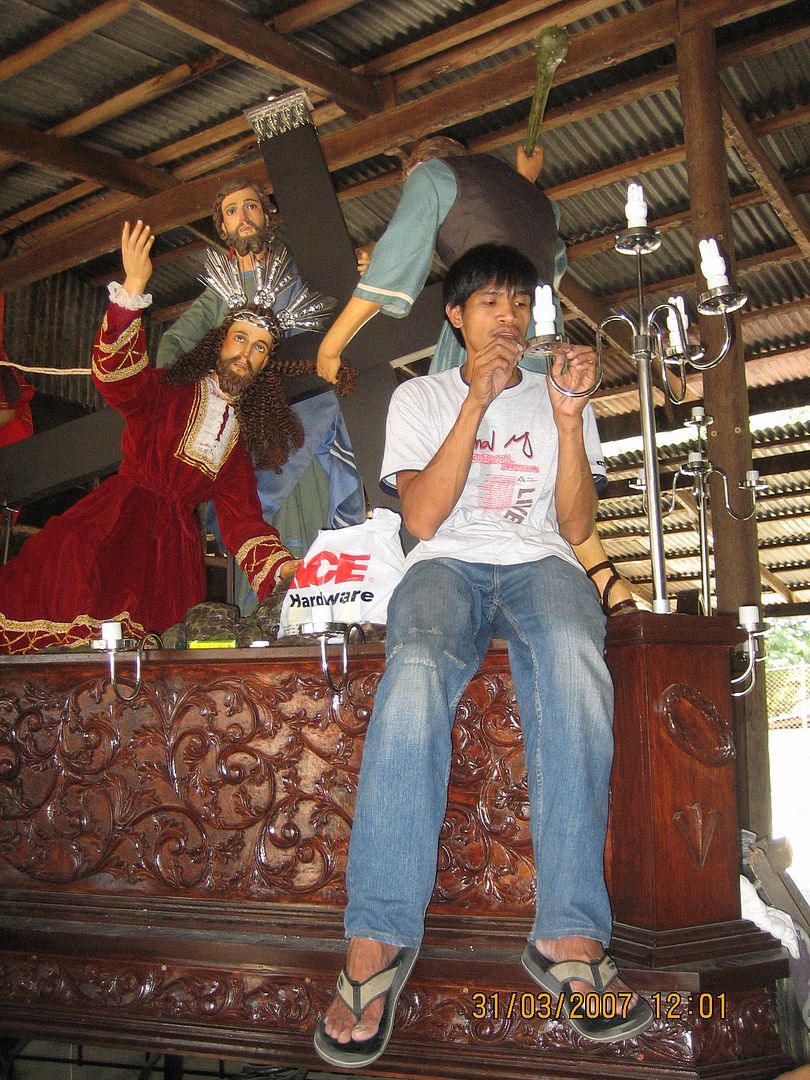
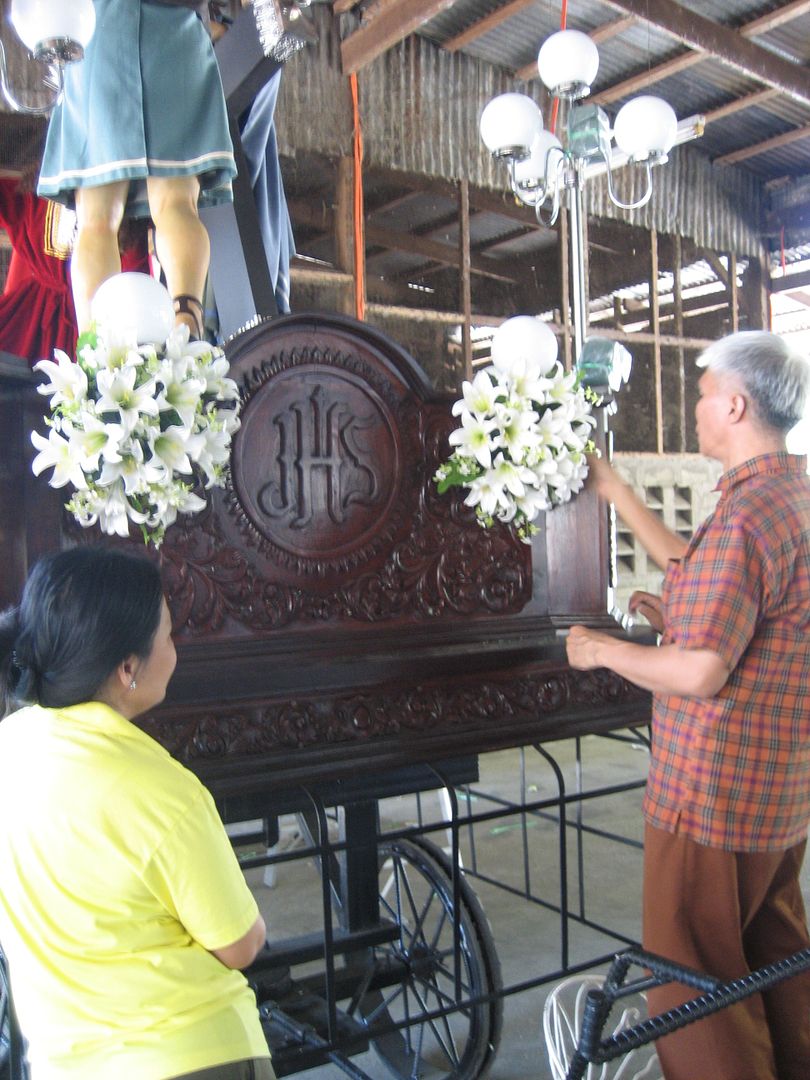
From then on, things proceeded quite methodically.  The carroza had been trucked over from Makati to San Rafael the day before, lacking only its corner arboltantes (lamp posts).  This my cousin takes upon himself to install, appearing to be quite the expert about it.


Meanwhile, the five images are assembled before their garments are put on.


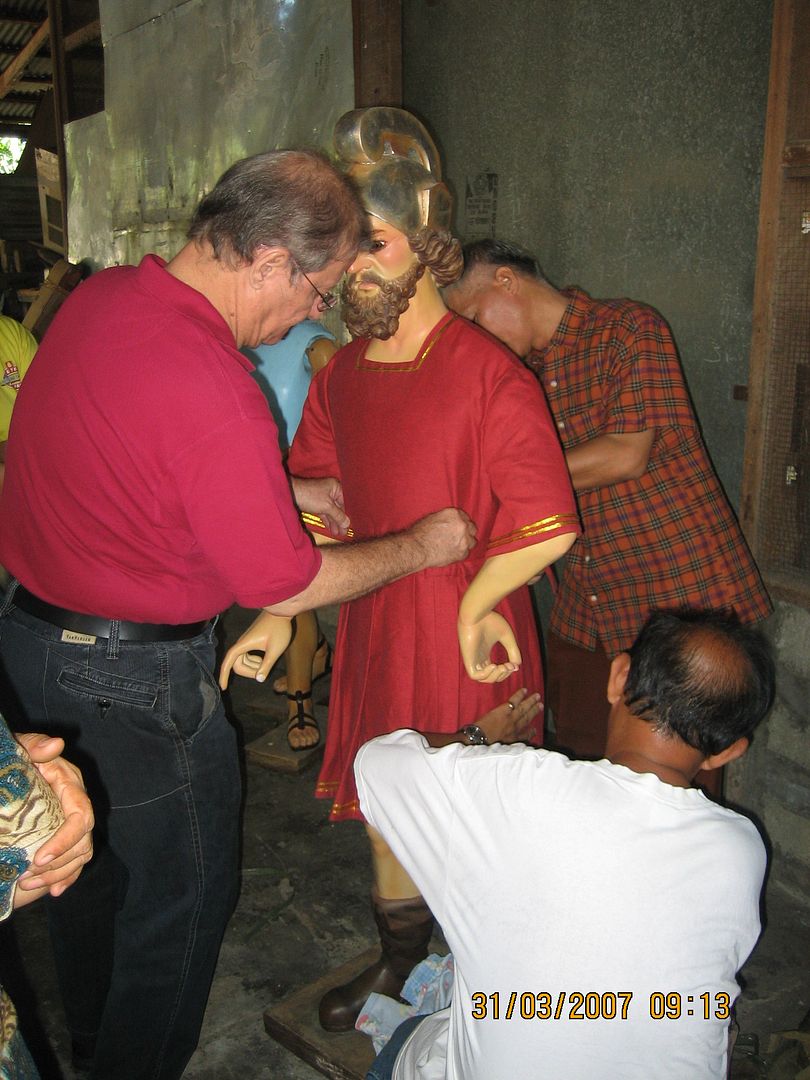
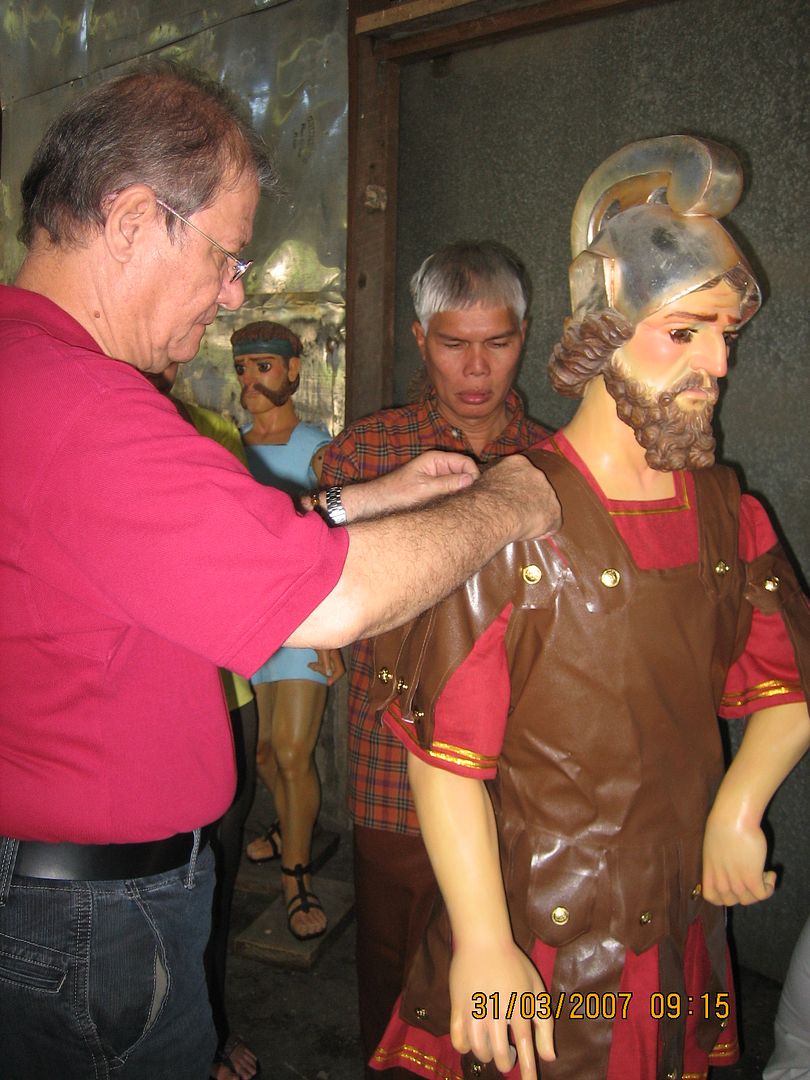
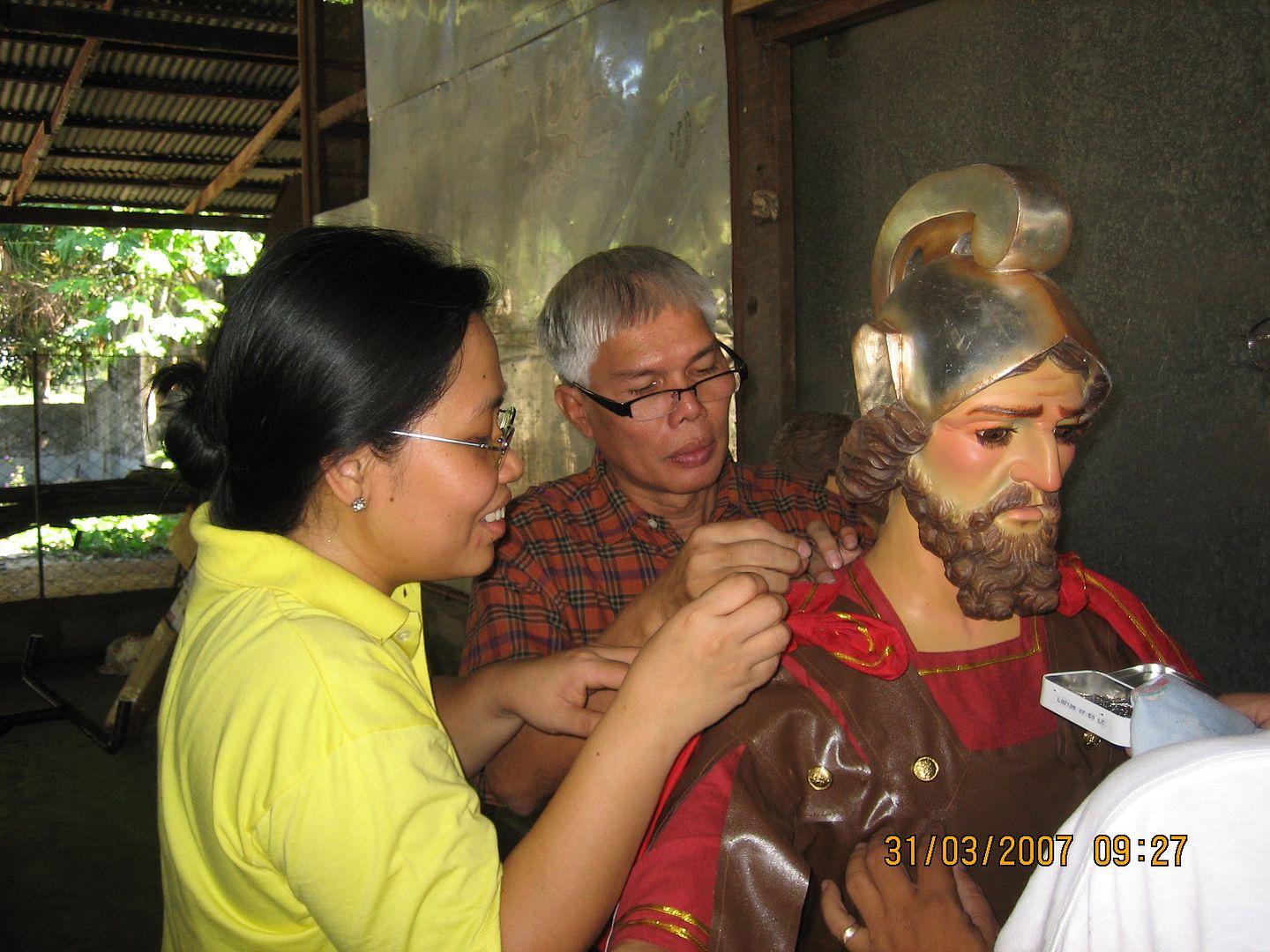
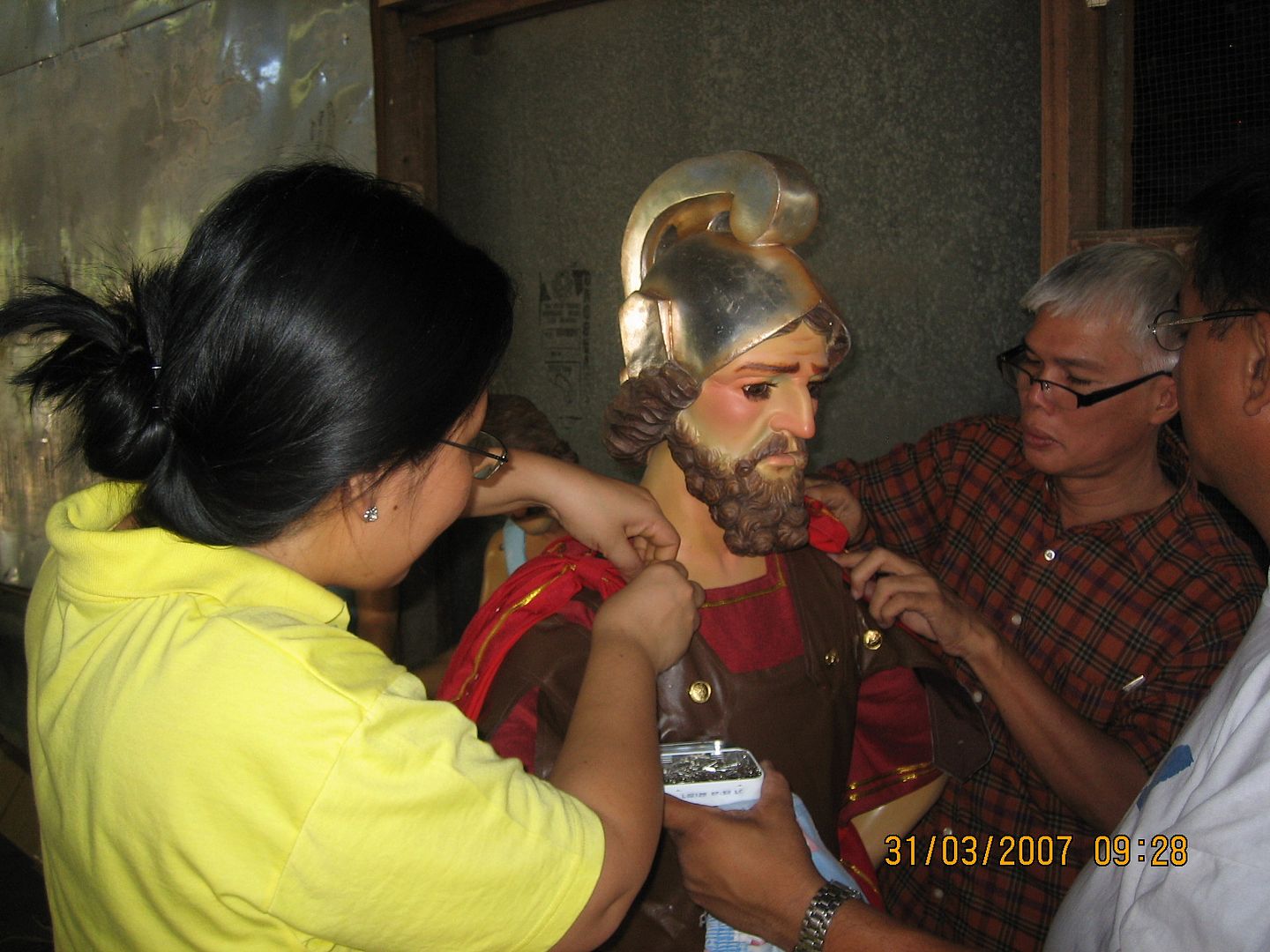
Kiko decides that the boss (the Captain) will get to be dressed first.


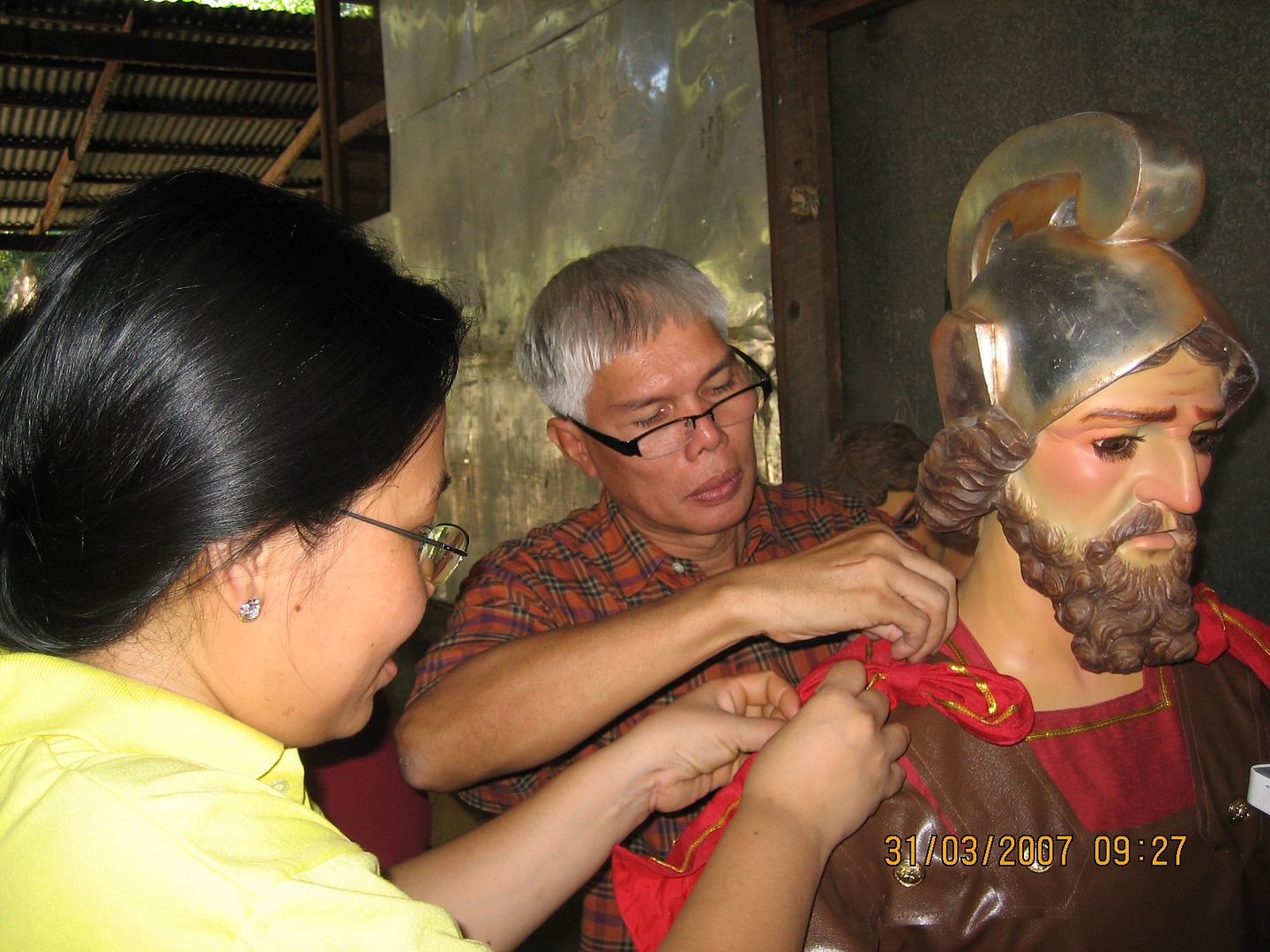
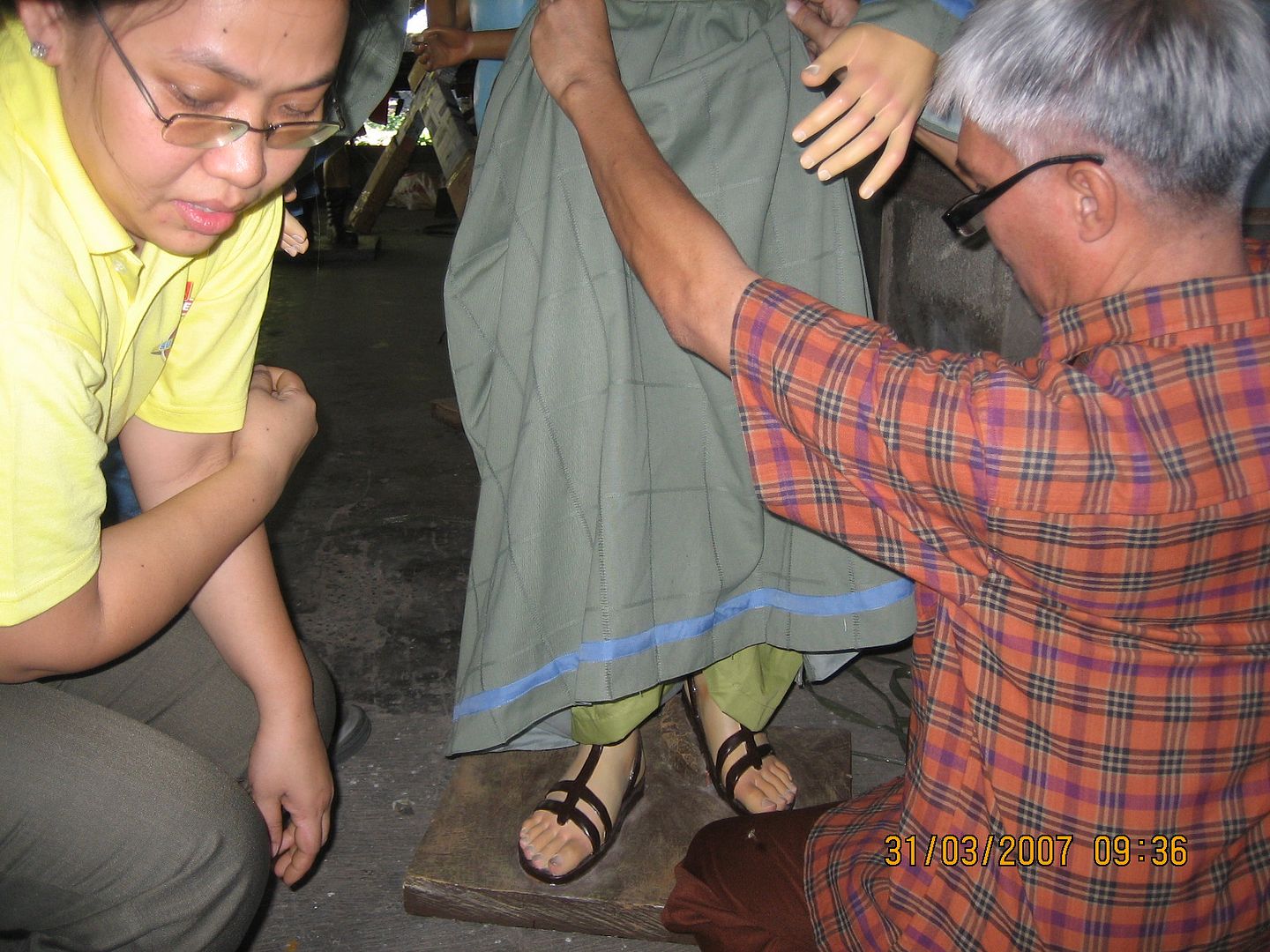
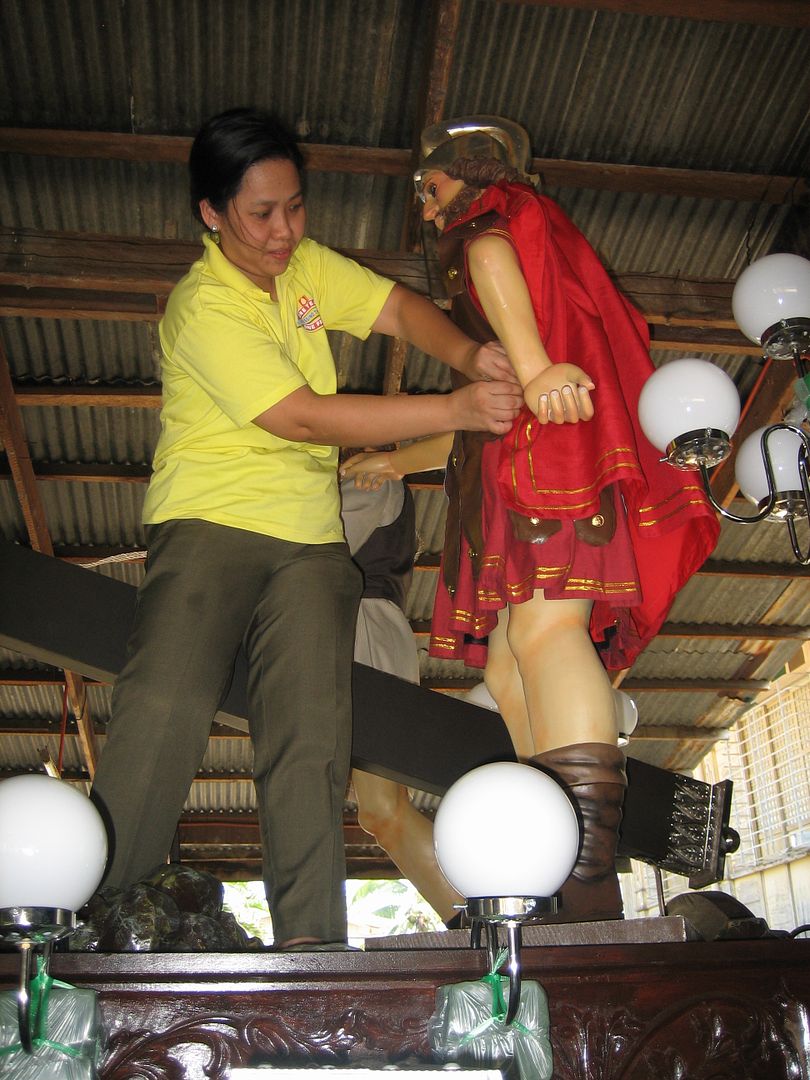
My other cousin, older sister of the “arboltante expert,” tries her hand at pinning the Captain’s flamboyant red cape to his brown leatherette over-garment, taking lessons as she goes along from Mr. Dardo de la Cruz, the Vecin Workshop’s regular processional image dresser, and a full member of the Gang.


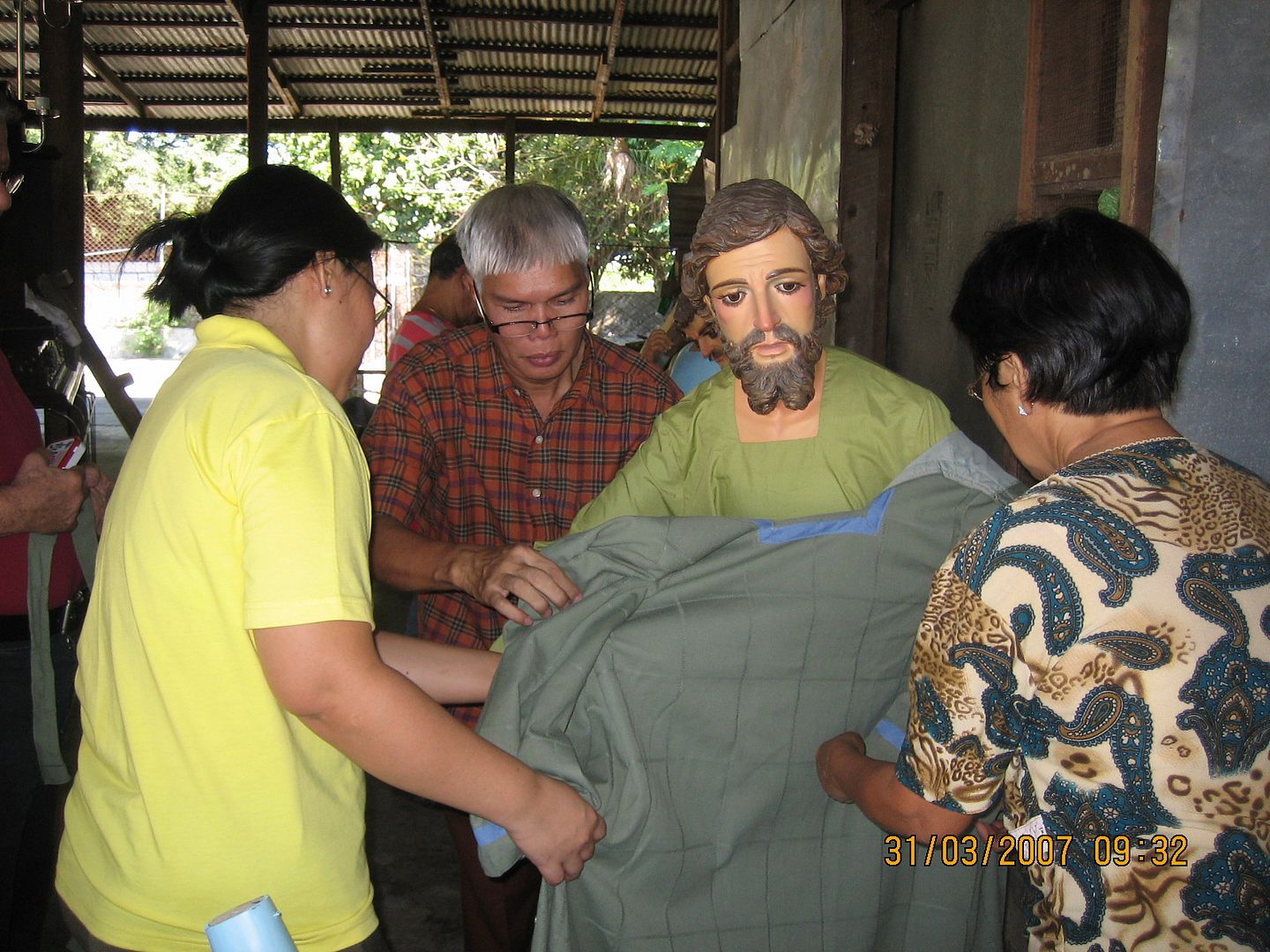
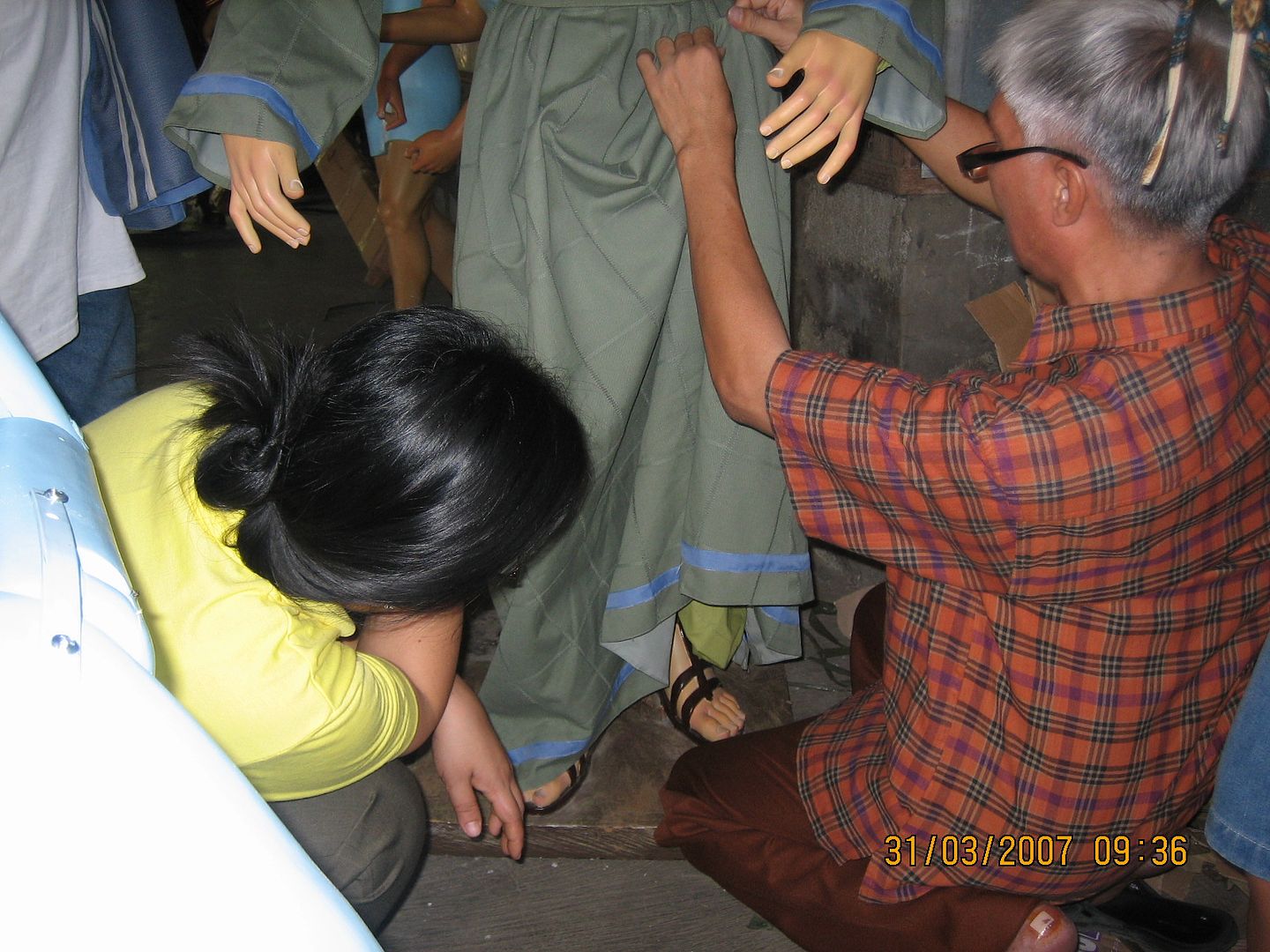
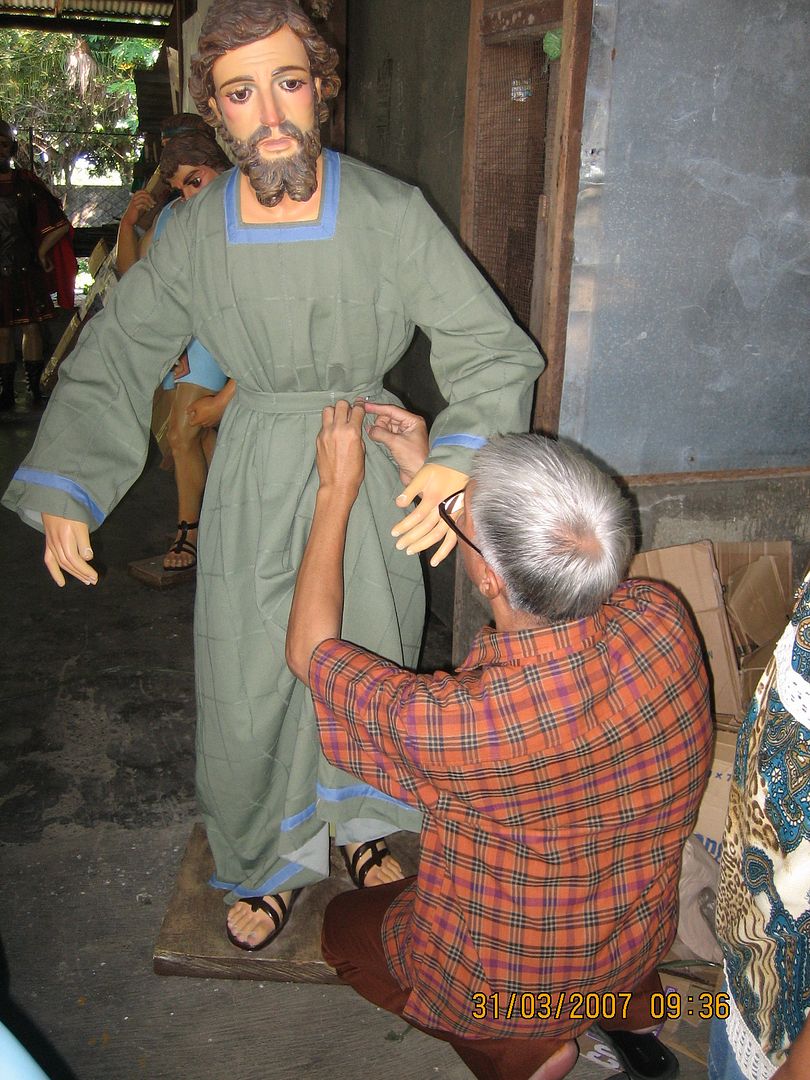
Simon of Cyrene is next. Even my aunt, who was previously just an observer, decides to dig in – it’s that much fun!


It will be clear from a close examination of the above photos that the Vecin Workshop’s standard for dressing processional images is quite high, with a minimum of three layers of clothing – an inner garment, a tunic over the inner garment, and a cape or cloak, which we will see Simon of Cyrene wearing later.

(I have seen many other processional images around with just one or two layers of clothing, often dispensing with the [apparently unnecessary and “not visible anyway”] inner garment.  In fact, from my observation, the inner garment has at least two important functions: first, to ensure, by having tight cuffs, that the wrists and arms are not seen (for the hands are often carved separately from the arms and therefore there is a visible gap between them), and, second, to provide some body and volume over the image’s mannequin structure so that the tunic and other outer garments fall in place gracefully.)

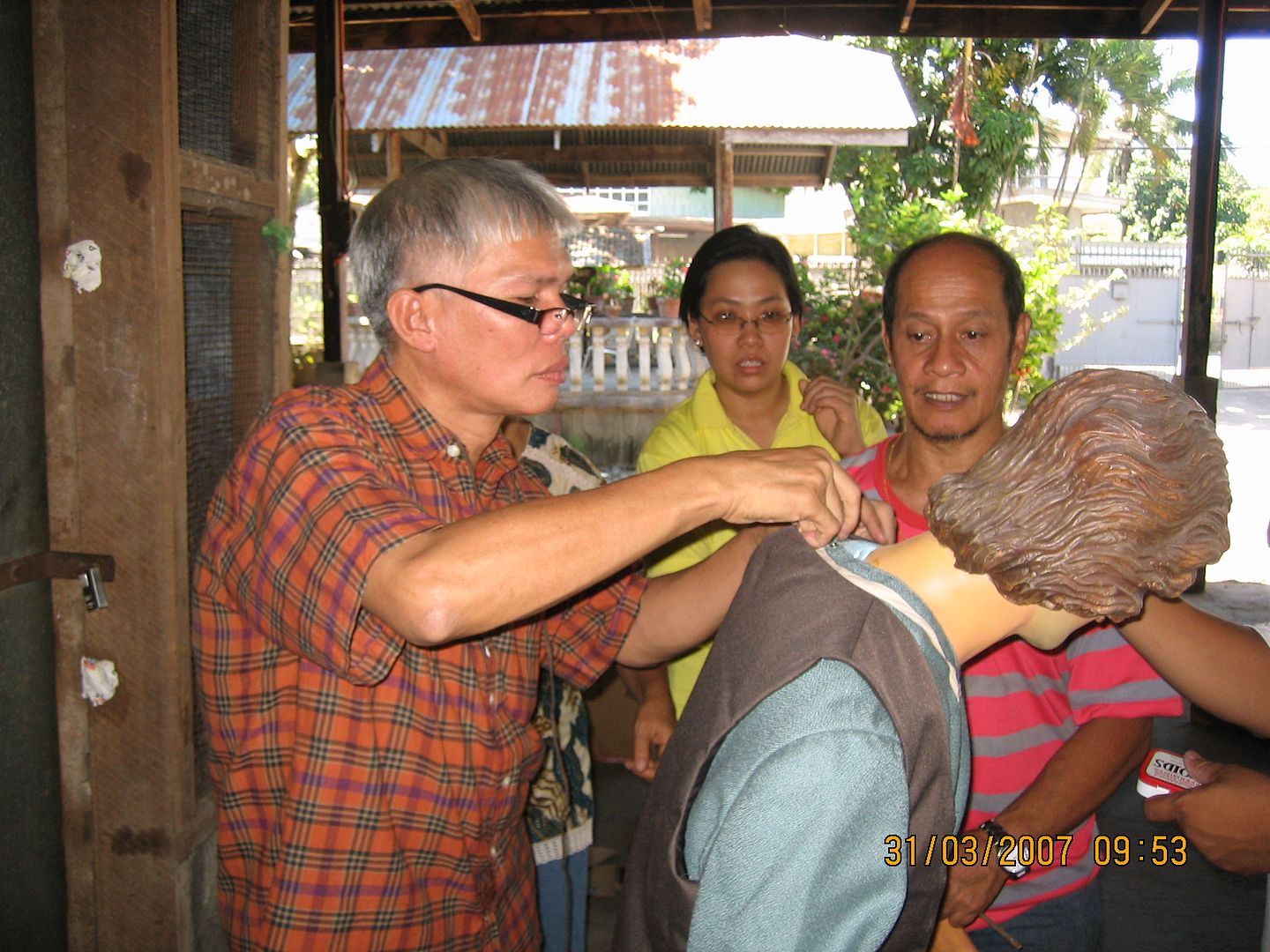
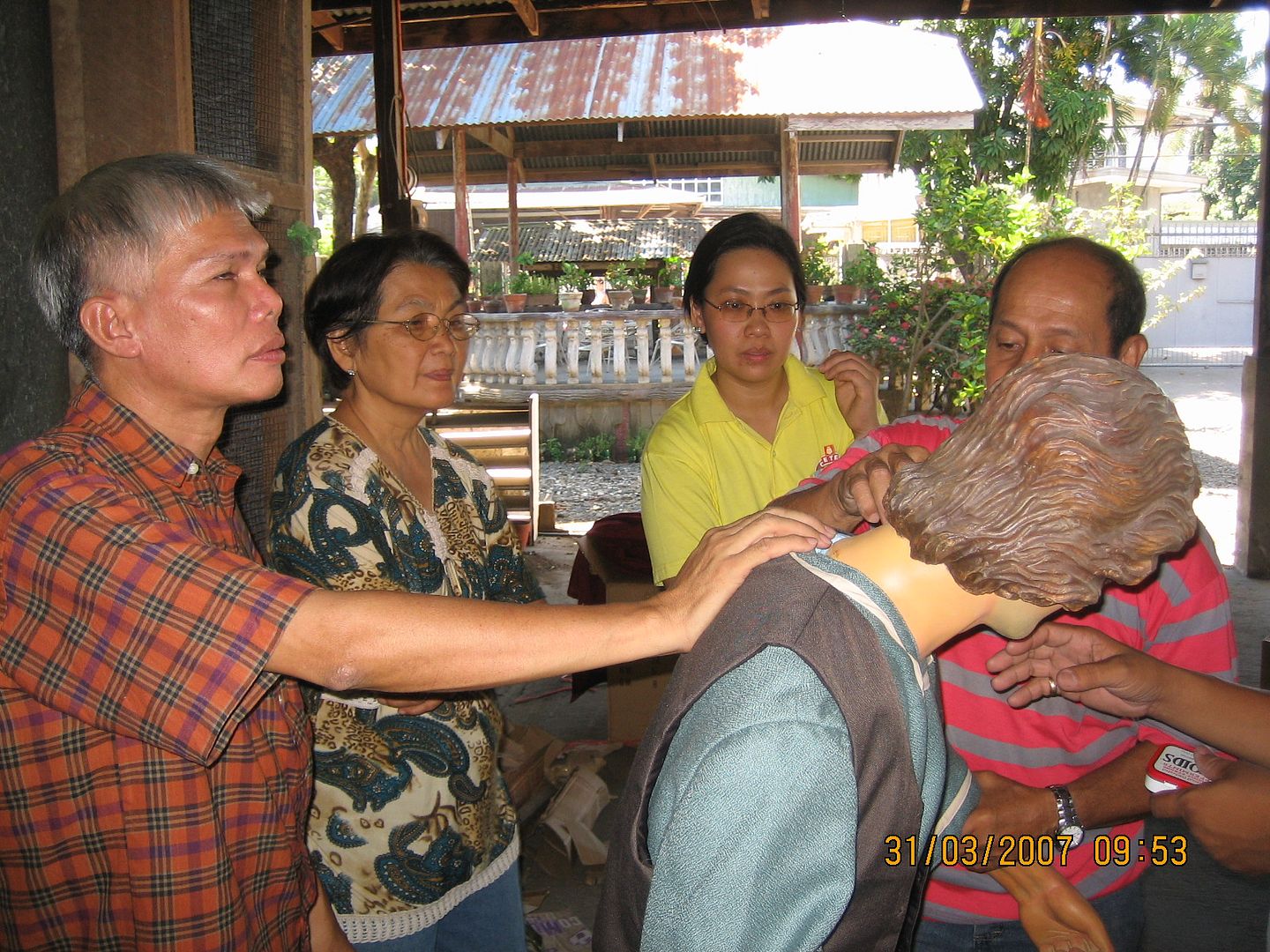
Dardo proceeds to work (very quickly and with extraordinary nimbleness, in my view -- hundreds of pins and not one prick!) on the two temple guards, one of which is seen here:


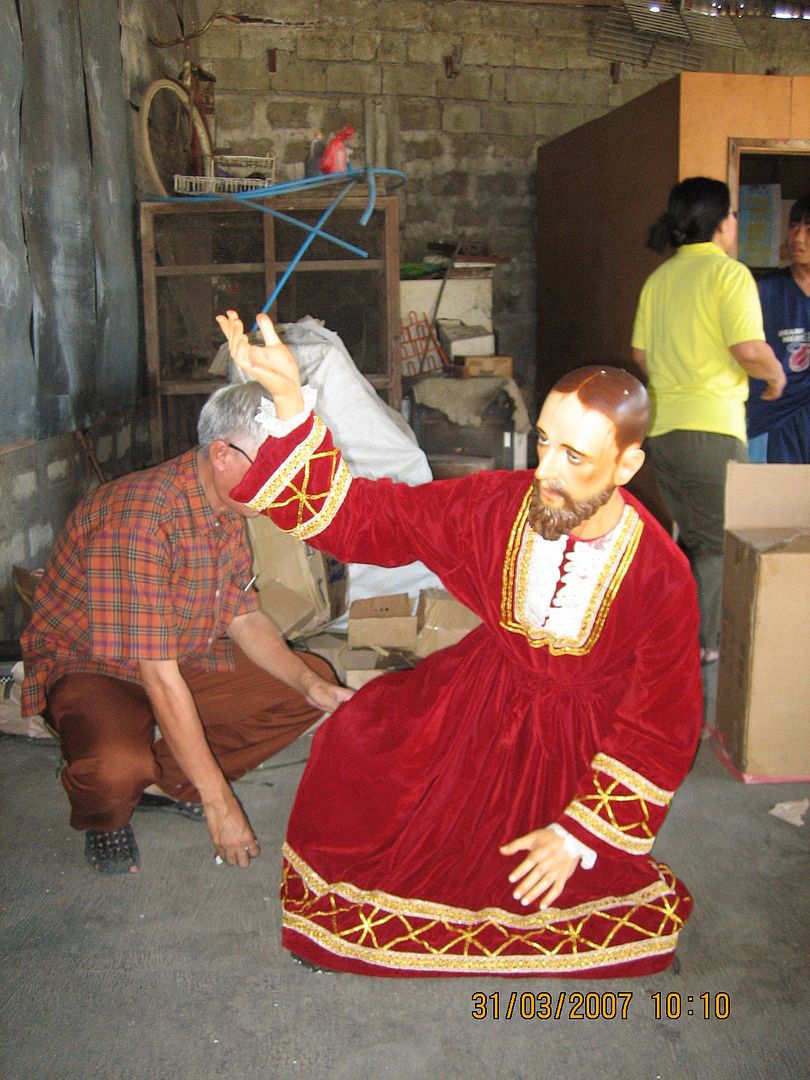
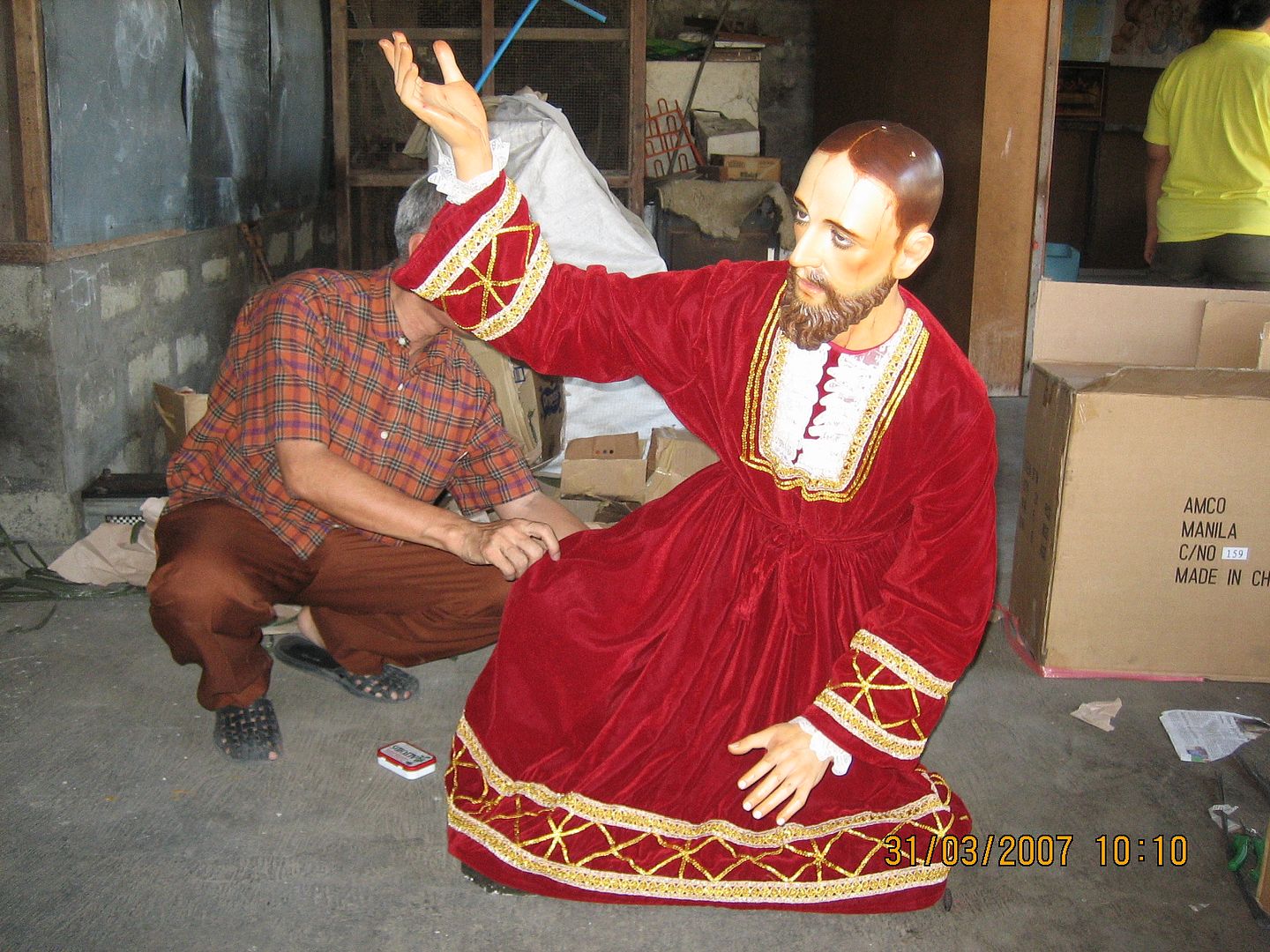
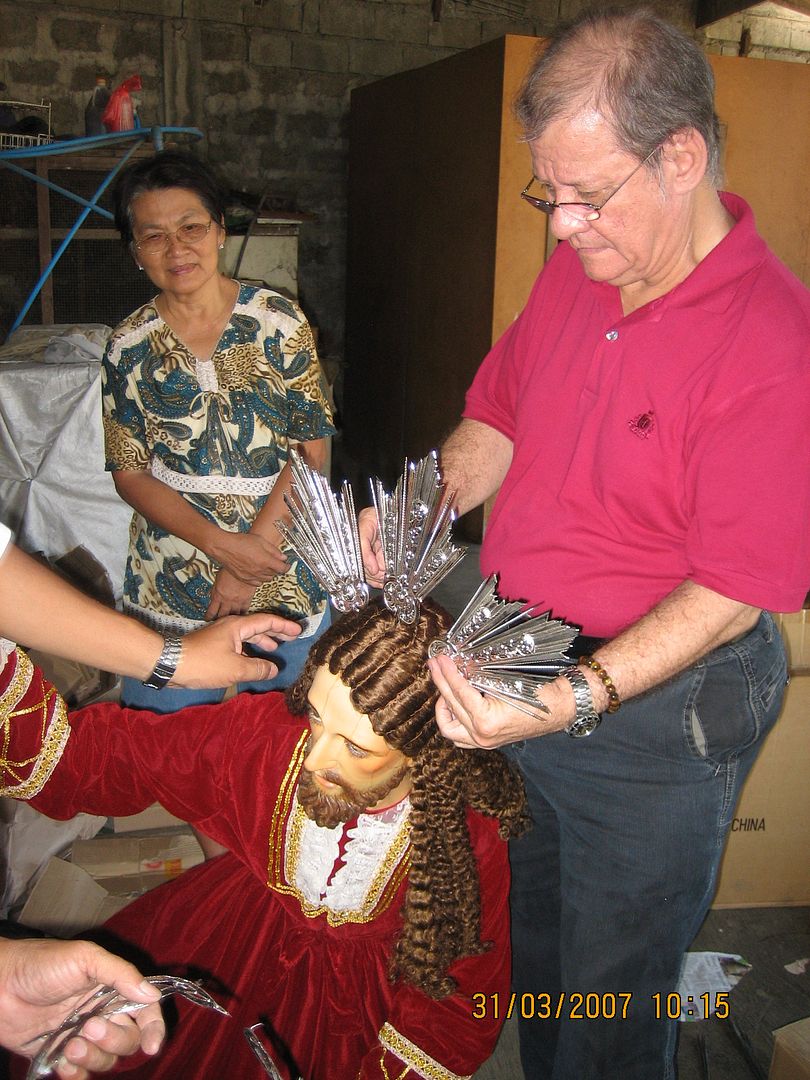
And then finally Dardo and Kiko work on the all-important figure of Christ, garbing Him in the simple yet elegant red velvet robe, putting on His jusi wig, and affixing His silver-plated “tres potencias” in place.


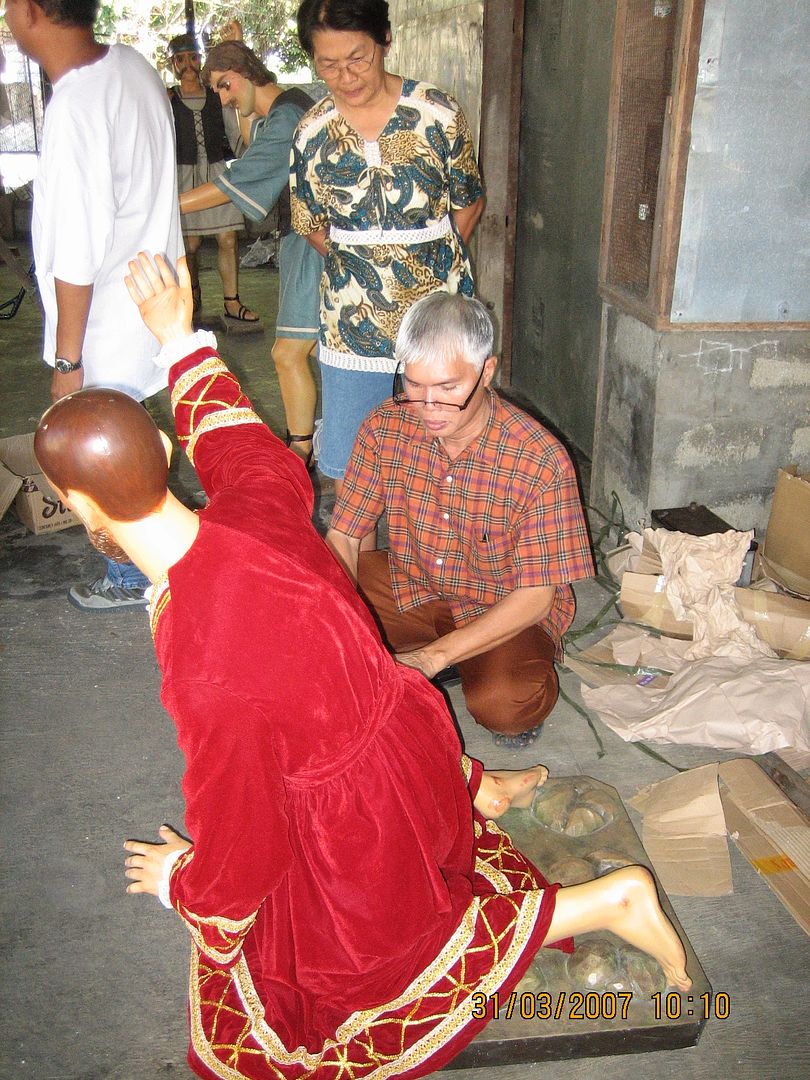
Then one by one, each figure (and the full-size cross) is brought up onto the carro and positioned firmly in their proper places with large nuts and bolts.


Kiko personally handles the final details of staging, including positioning the rope around Christ’s neck and through to the temple guard at the rear.


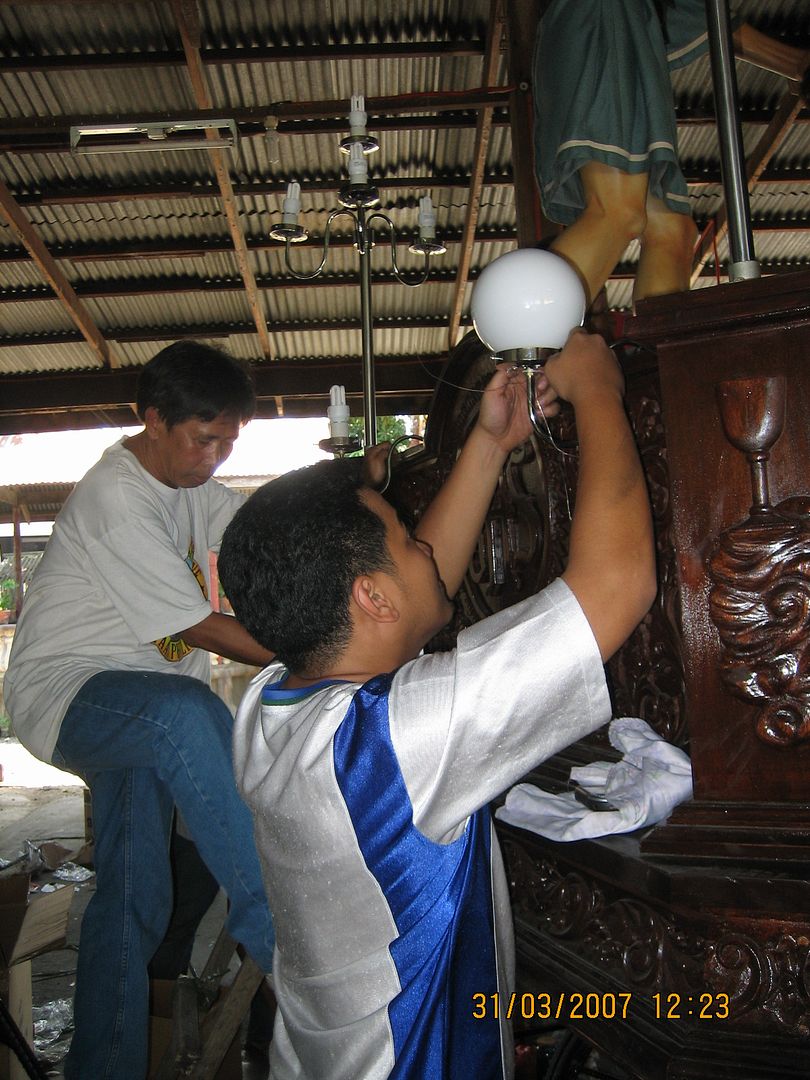
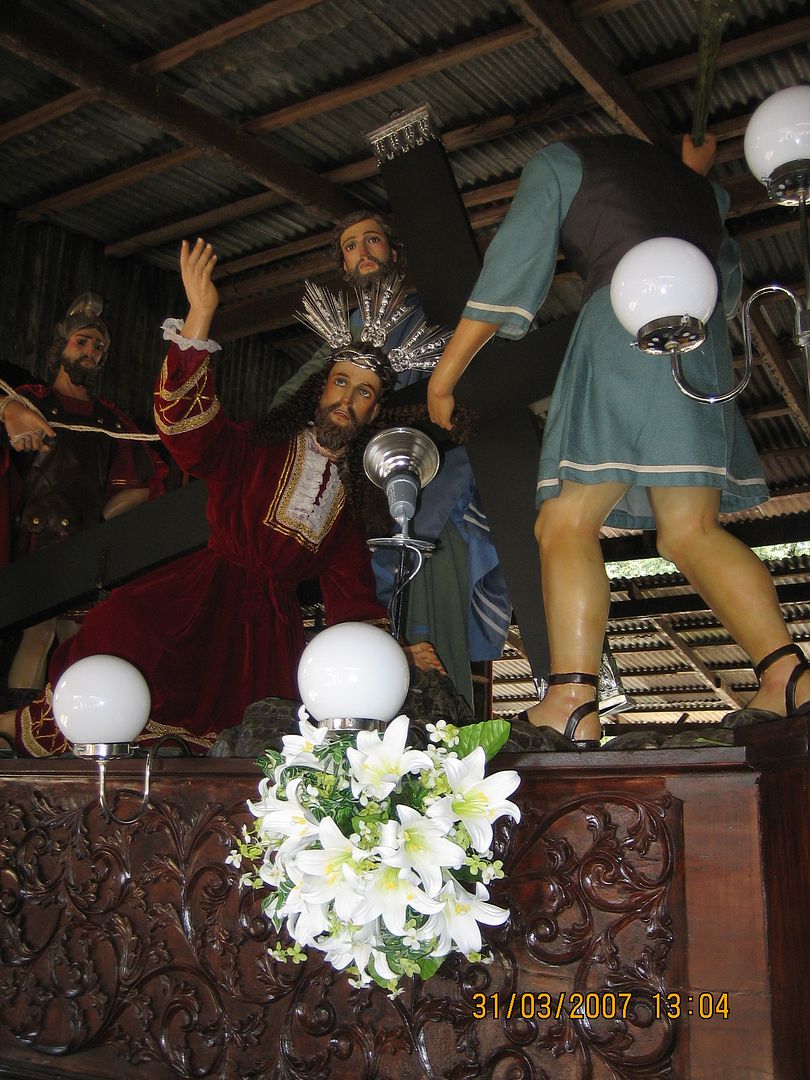
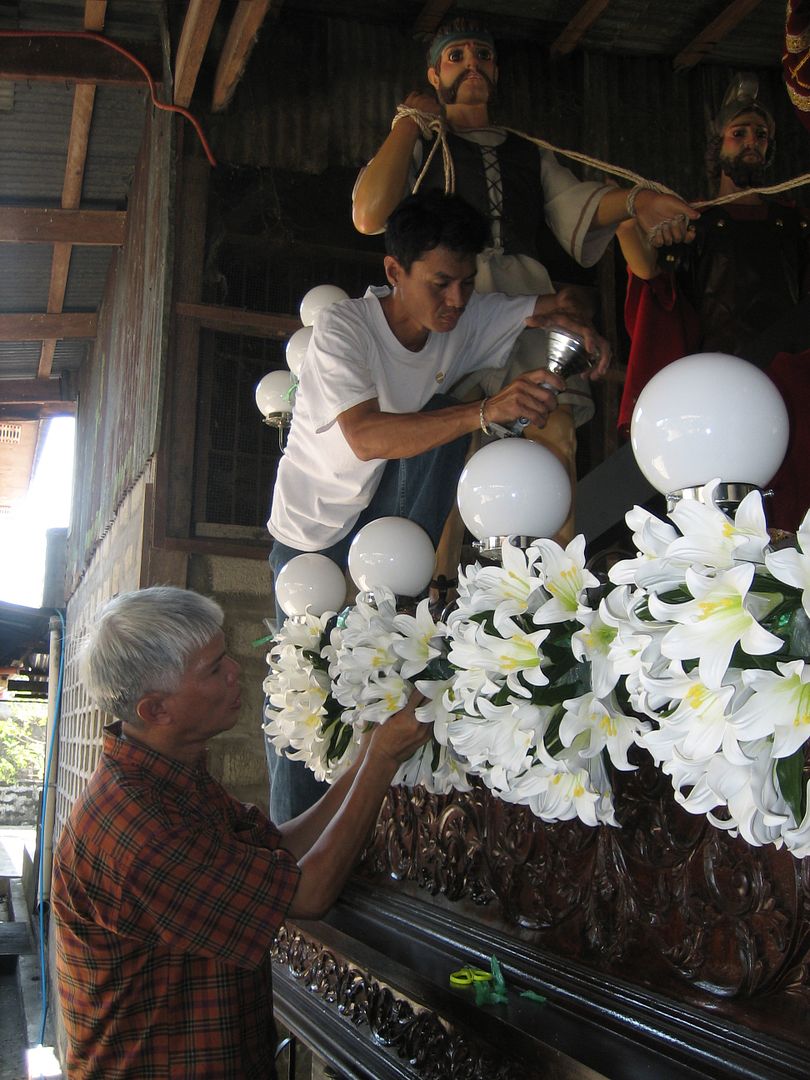
The pescantes (single-light-bulb perimeter sconces) are next attached, the light bulbs (“Philips High-Energy Compact Fluorescent Warm-White 8-Watt”) are screwed in, and the globo virinas (spherical milk-glass white-frosted light covers) are fixed in place.


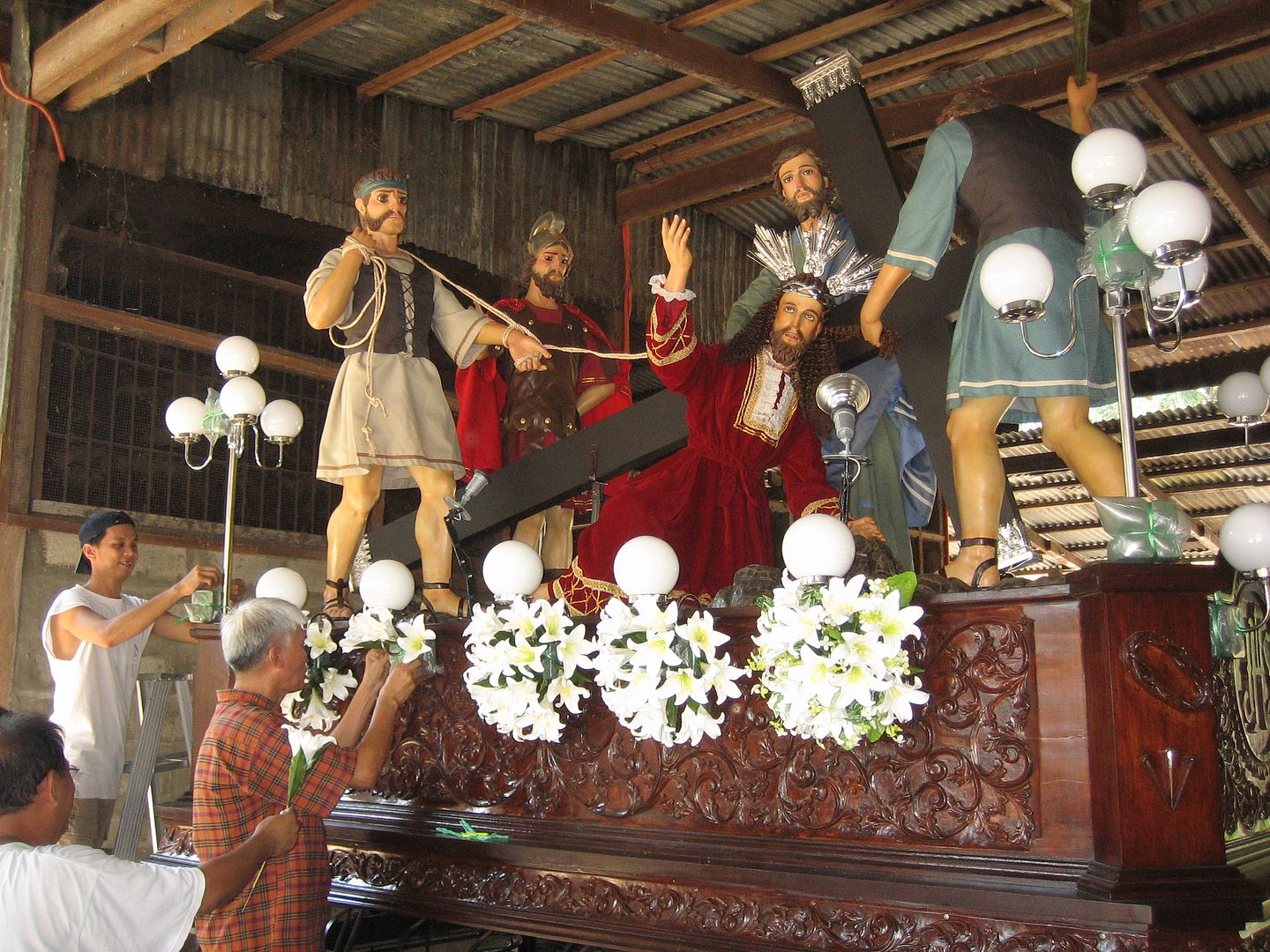
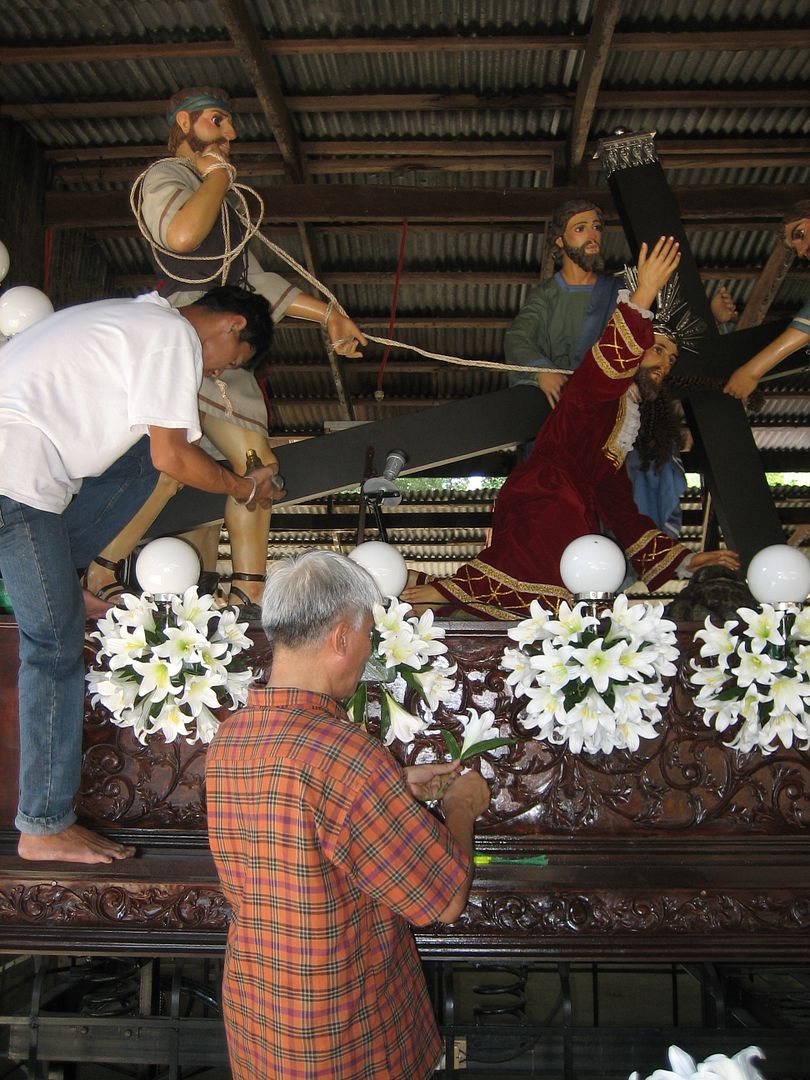
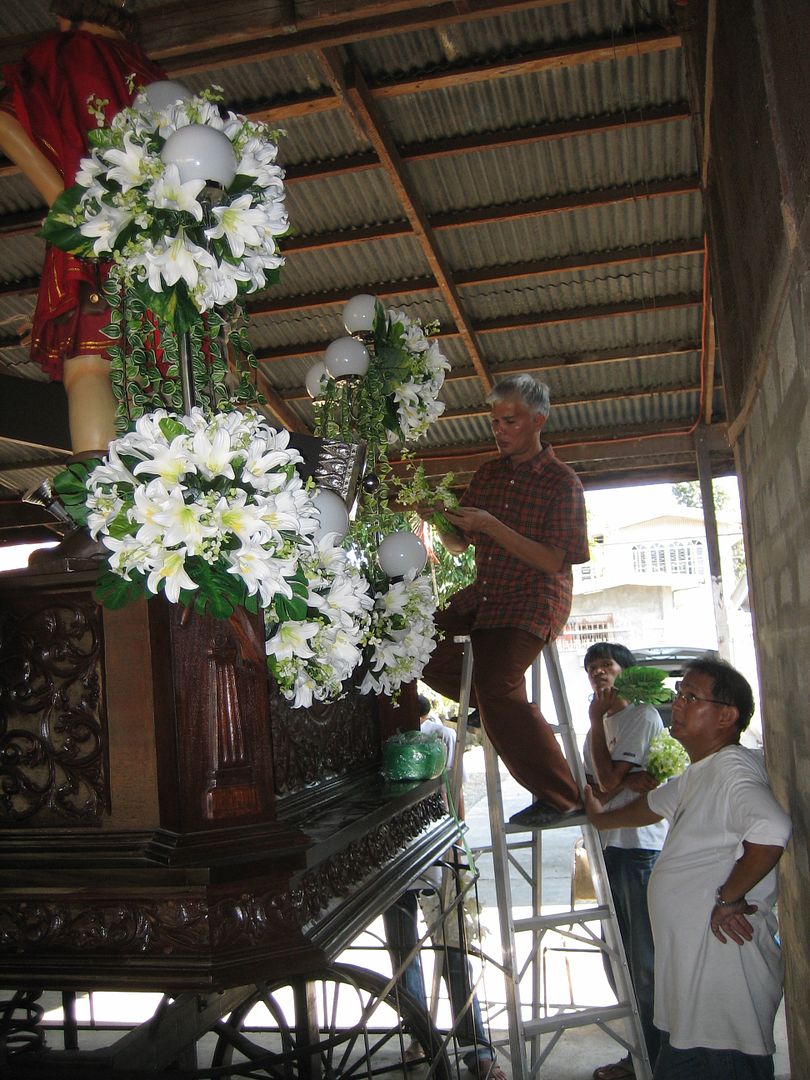
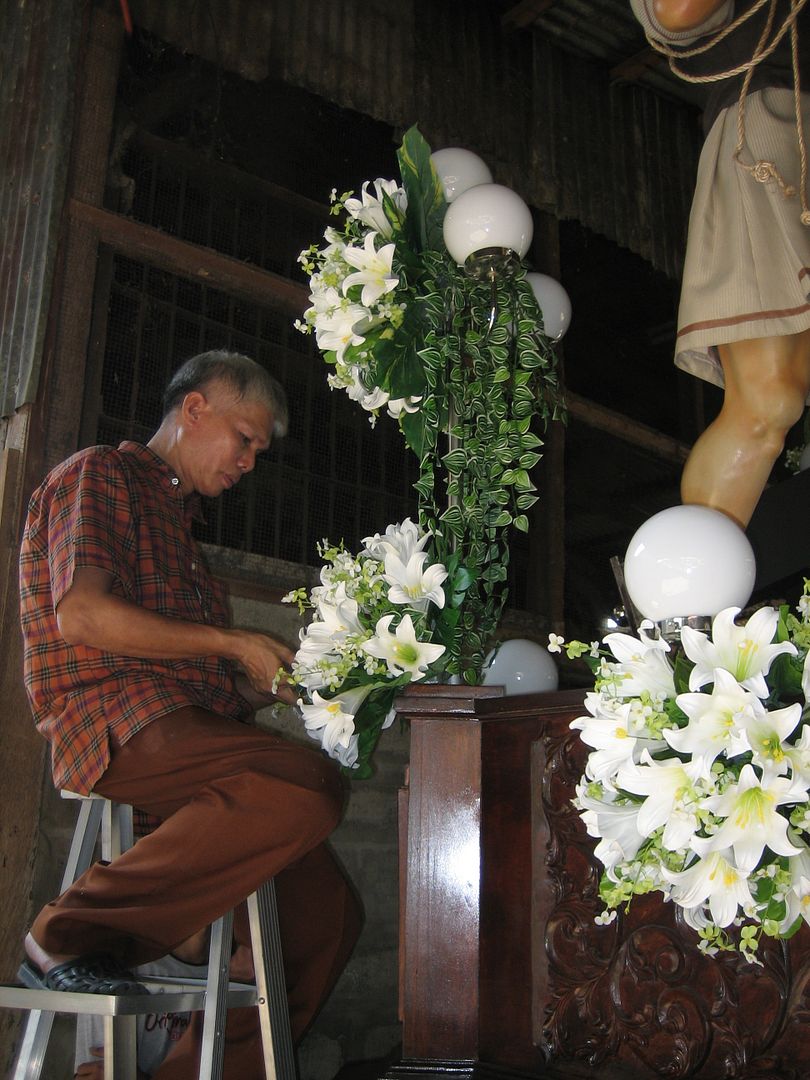
With all lighting fixtures installed, the last remaining phase of this setting-up is the floral decoration. Dardo de la Cruz is not only the Vecin Workshop’s regular image dresser and the official dresser as well of all of the Vecin Family’s own Holy Week processional images in Makati Poblacion (at least ten tableaux, all told). He is also a distinguished carroza decorator and is usually called in to work on the pasos of several other regular clients of the Vecin Workshop. Perhaps not too surprisingly, Kiko Vecin had brought him along on this all-important day as well.

In fact, Dardo and I had, just a few days earlier, taken a quick lunch-time trip to Divisoria to his favorite shop there offering very realistic-looking silk flowers. Having seen the carroza at the Vecin Workshop a few days earlier, he surveyed the shop’s product offerings and selected a number of items, including what I thought were deceivingly real-looking white lilies. (Well, I’m no botanist, so don’t send me emails on this point please.)

After being reminded by Kiko to keep it simple, go easy on the foliage, and make sure that the devotee on the ground will still have a flower-unimpeded view of the all parts of the tableau, Dardo offers the following test-flower-arrangement around a pescante for everyone’s review.


It quickly earns broad approval all-around, because not only does it achieve Kiko’s objectives of keeping it compact and simple and offering an unimpeded view of the action above, but it also somehow blends in with the sinewy Art Nouveau-style carvings on the carroza’s four slab-paneled sides.

After a quick lunch break for yet another hearty meal in our ancestral home’s dining room, we let Dardo take over the carro to complete the decorations, which he does surprisingly fast – just as fast as he was in dressing the figures earlier in the day.


While that’s going on, my cousin ascends the carro platform and makes a slight adjustment to the Captain’s cape, pinning the middle hem to his garment to ensure that his “akimbo” left arm is always visible.


And then she goes back to observing how Dardo does it all so well and so fast.


Meanwhile, the super-compact, super-silent, and super-low-emission 1000-watt Elemax generator (“Made in Japan, Powered by Honda”) is tested and started up.


This is then placed on a platform under the carro (gearheads would say that it’s “a mid-engine design”), and hooked up to the pre-installed electrical system. The final component is the “Nazareno-Red” (not quite “UP-Maroon”)-colored carroza “skirt,” which is usually called “sayal” in Tagalog, and in Spanish, “faldon” (literally, “big falda”).


Whether from the “starboard” side


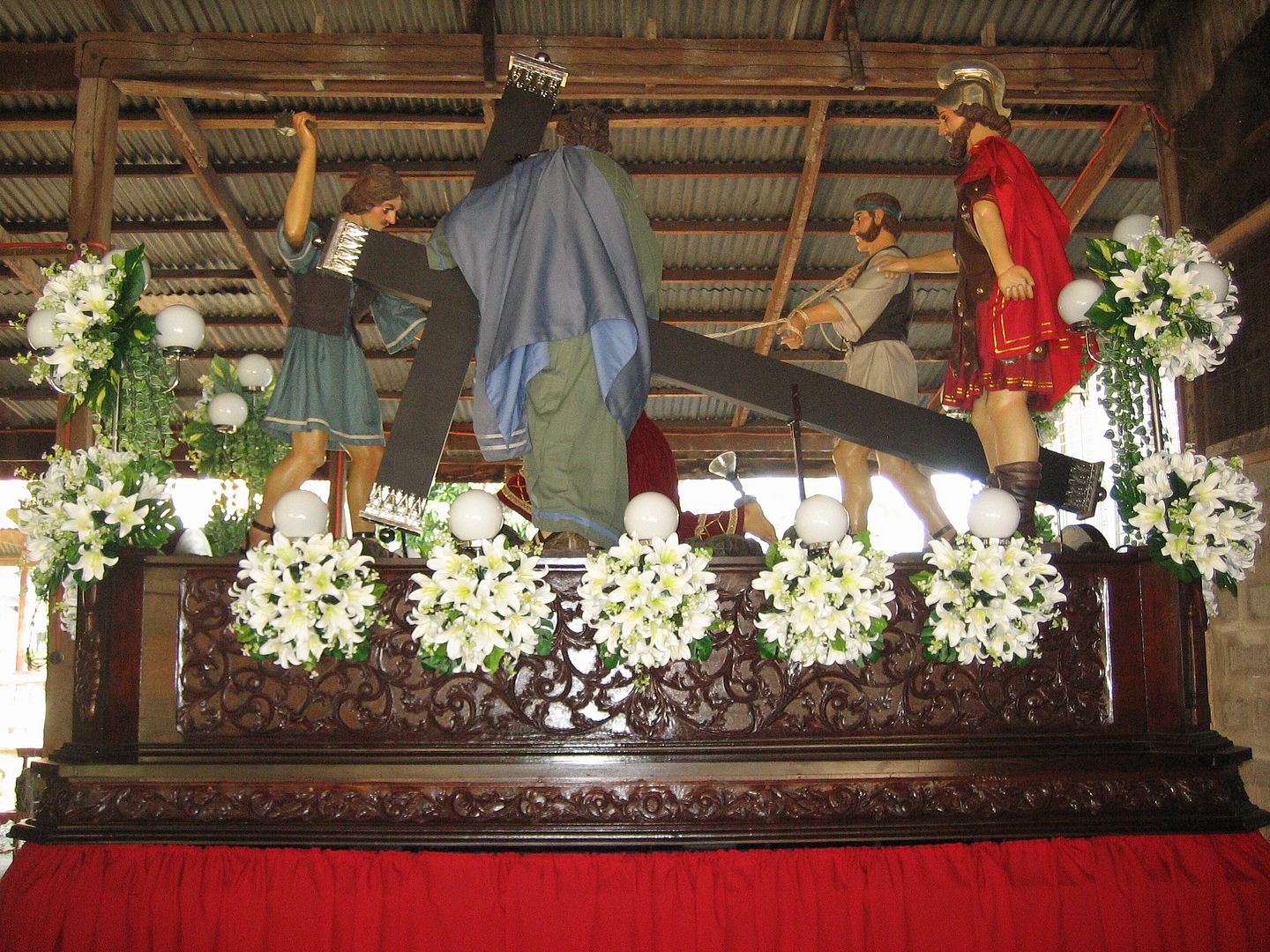
the “port” side (even though it’s really only the rear view of the action)


from a distance


or in tighter shots


the entire “paso” (tableau on carroza) was indisputably “beautiful, regal, and dramatic,” as one kind reviewer put it.

All the day’s work having been completed, it was time for much-deserved “Kodakan” (although I’ve been using Canon digital cameras for years), starting with the maestro santero himself.


And the proud owners-caretakers, my aunt and two cousins.


And then the whole Gang of the “Fall of Christ.”


But lest we forget the whole reason for all of this, I take a few more shots of the extraordinary image of our Most Serene Lord in His Sorrowful Passion and Painful Fall – a devotional masterpiece to be venerated for many generations to come, we're sure.


- - - - -

And, we're ready to roll! But first, we take a Palm Sunday to Holy Tuesday break, to recharge and get ready for the debut procession of Ang Pagkarapâ on Holy Wednesday.

Could anything possibly go wrong? No, of course not. We hope not. Maybe not. We'll see. God willing.

- - - - -


Originally published on 19 April 2007.  All text and photos copyright ©2007 Leo D Cloma. The moral right of Leo D Cloma to be identified as the author of this work has been asserted.
Original comments:


nsconsolacionycorrea wrote on Apr 21, '07
Mang Dardo is an artist!!!


rally65 wrote on Apr 21, '07
Nikki, this paso (and my family's other processional image of Santa Marta) has greatly benefited from very talented artists -- not just Mr. Vecin himself as the conceptualizer and designer, but also Dardo the image dresser and carro decorator, and perhaps more obviously the escultor and the encarnador in the Vecin Workshop, whom I talked about in the previous article.

There's also the Workshop's regular dressmaker, who selects only the finest European and Japanese fabrics with Mr. Vecin (in obscure locations in Manila). There's also their regular wigmaker, who supplies only properly-color-matched jusi wigs to Mr. Vecin's specs. And there's their metalsmith, who does all the haloes, diademas, tres potencias, and even those elaborate cantoneros (end-pieces) for the cross following original antique designs in Mr. Vecin's collection.


Good artists are always available, even in abundance. They only disappear if their custom is not patronized. We therefore need to keep engaging them as much and as frequently as possible.


So go ahead and commission your paso soon!


robbyandharry wrote on Apr 21, '07
thanks again for sending me some of your estampitas...

btw... yung mga images nasa karo sila from march untill april or did they removed and store them after the blessing and then put them back for the holy week?


rally65 wrote on Apr 21, '07
The images were set up on March 31, the day before Palm Sunday, and taken down a week later. So it's the normal period for keeping them there.


jvlian wrote on Apr 21, '07
at talagang sinubaybayan ko ang ss-files... at may to be continued pa., wow! galing!


alvinjay2000 wrote on Apr 22, '07
thank you rin for the estampitas, they have reached the islands of Guam.