Showing posts with label Cloma. Show all posts

Thursday, July 28, 2016

CXXXII: Give Art on Christmas Day 2014

This year, we had started really early in commissioning our Christmas card artwork.  Soon after the New Year, we had already zeroed in on the artwork.  In truth, we had contacted him the year before, but previous commissions had made it difficult for him to accept one for us in time for Christmas 2013.  Thus, an early start in time for Christmas 2014 was essential.

I had first seen one of his artworks online some years back, appropriately enough, also a Christmas subject.
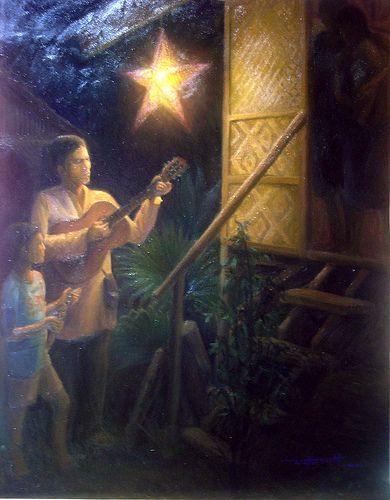

I thought, what a beautiful work, if rather melancholy, which in fact appealed to me.  And very Filipino too.  Later, I located other artworks of his online, on diverse subjects such as a typical market scene,
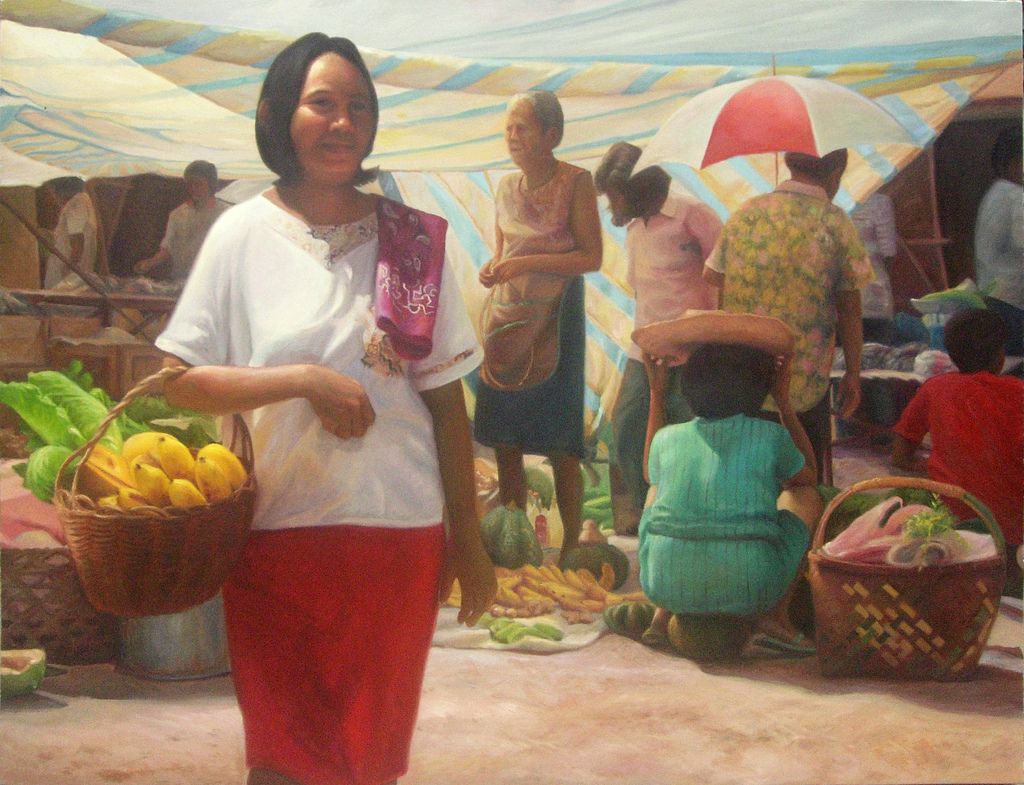

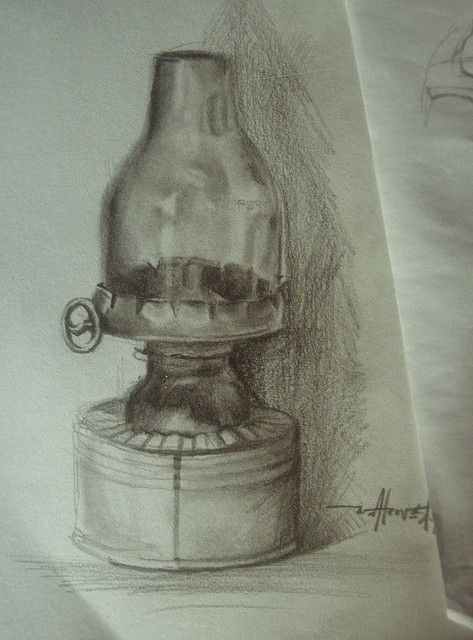
an oil lamp,

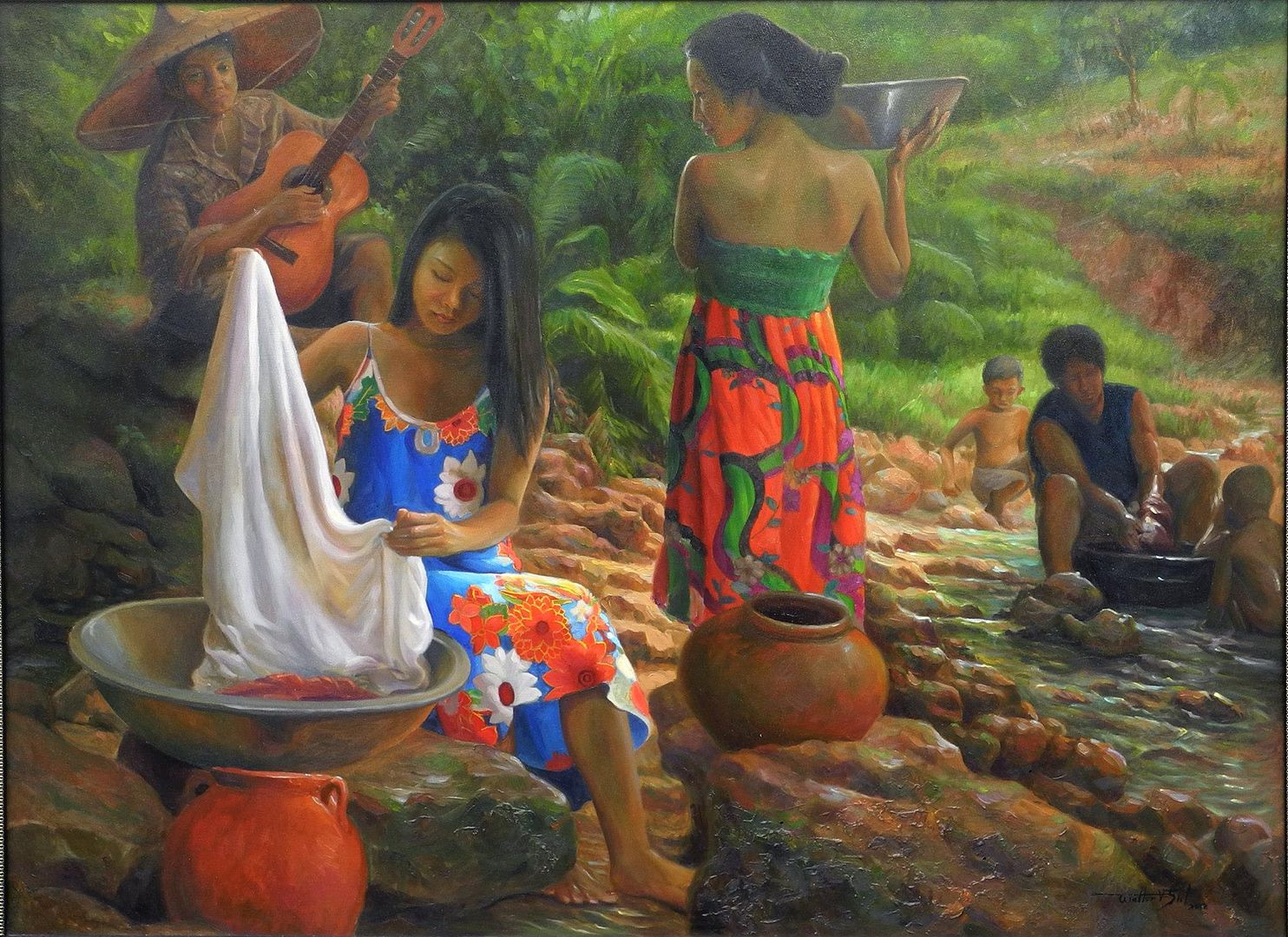
laundry women,

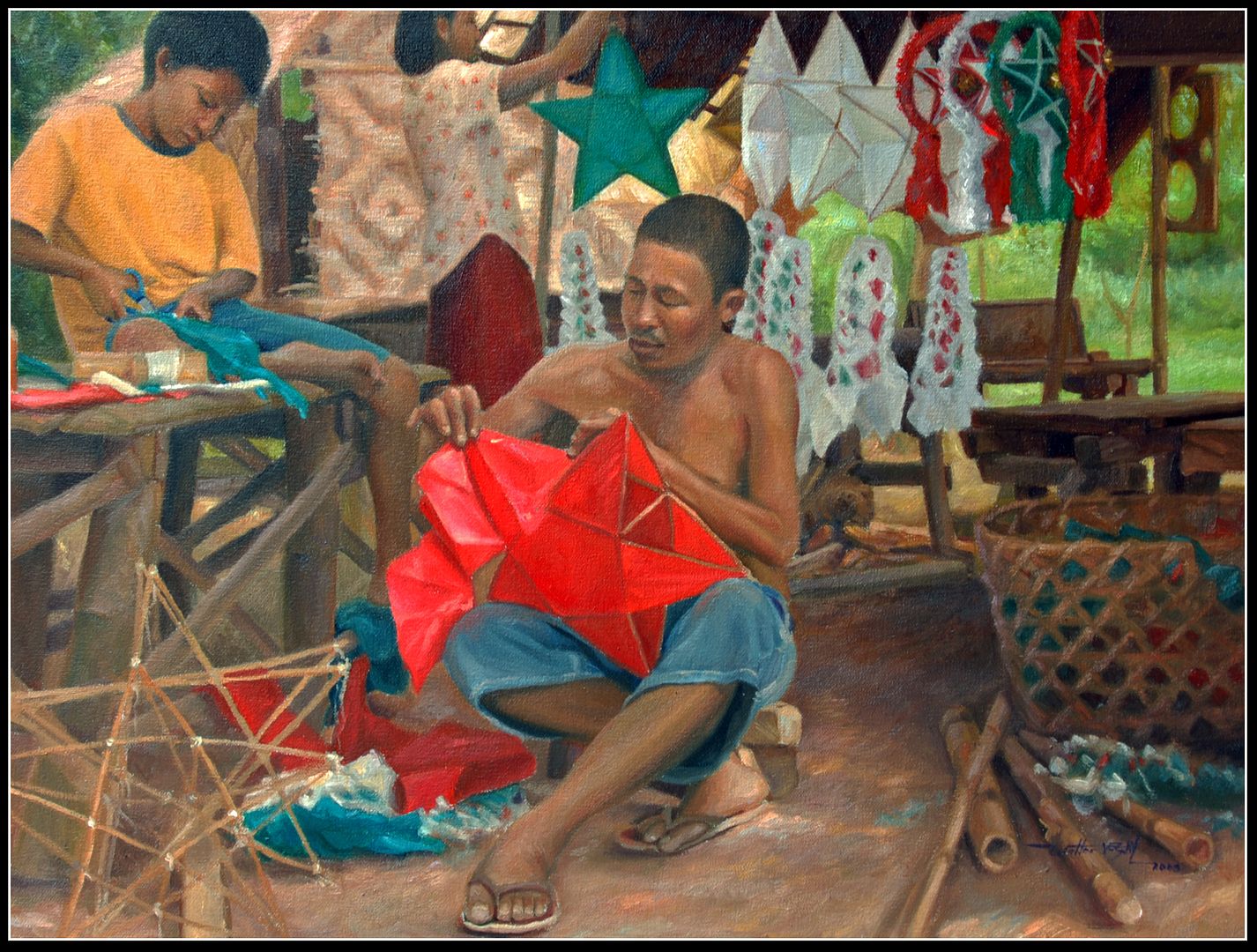
Christmas lantern makers,

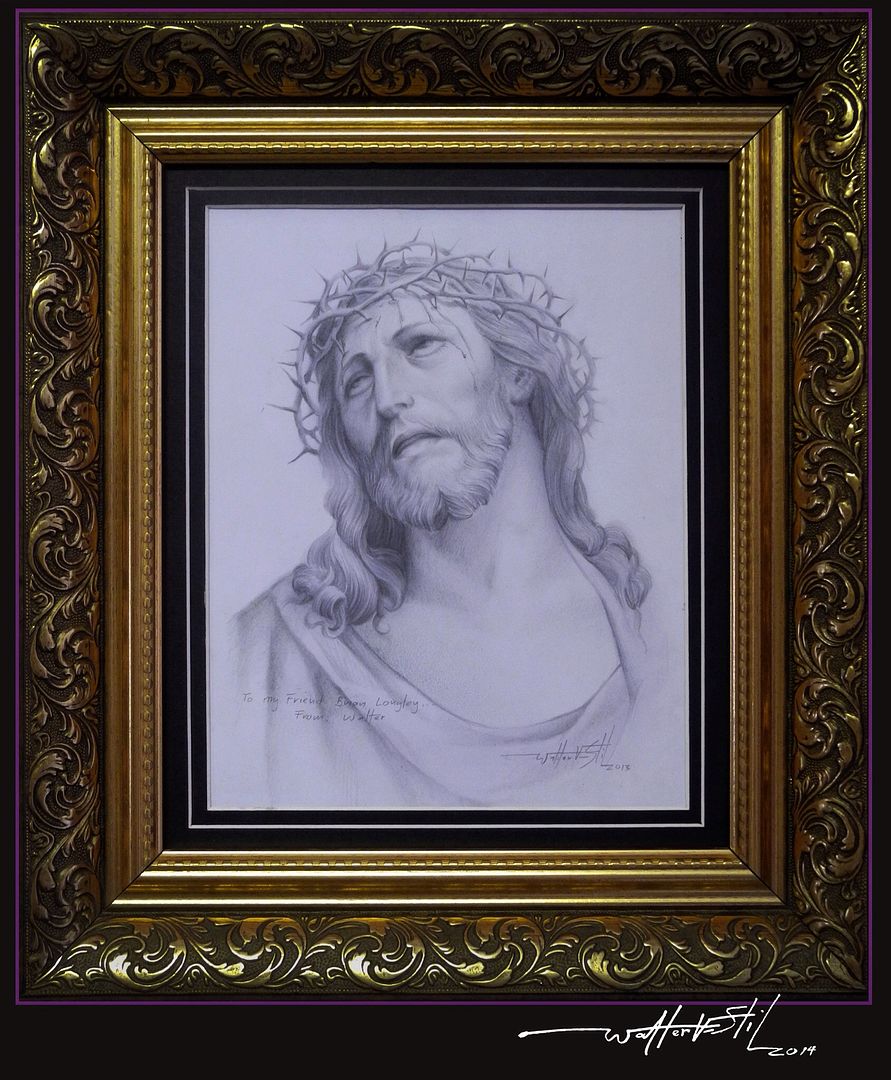
the head of Christ,

even a portrait of “Sister Vicky.”
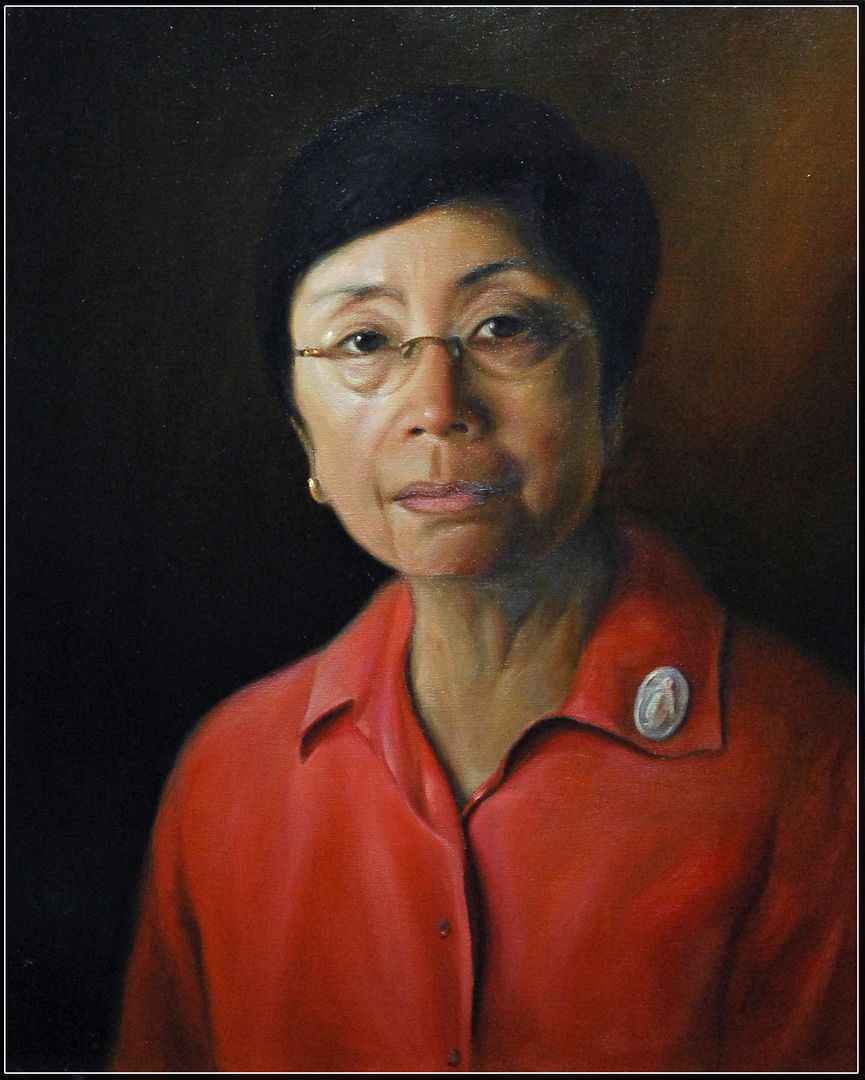

Clearly, the artist had sharpened his technique over time to achieve a near-perfect photorealistic style.  I therefore made a mental note to look up the artist one day.  And so, in early 2013, I did.

By mid-2013, when it was clear that any commissioned artwork from him would not make it in time, we agreed to at least think about possible subjects for the following year.  By October 2013, he had sent me some very interesting sketches.  And soon after that, we had come to a consensus as to our 2014 Christmas artwork.

In catechism back in primary school, we were taught that gifts are given on Christmas day to emulate the fabled Three Kings – or the Three Wise Men – actually Magi (literally, “Wise Men”) of indeterminate number, who happened to be bringing along three gifts – gold, frankincense, and myrrh, respectively symbolizing the three aspects of the gift-recipient Christ-Child: His Kingship (gold for kings), His Deity-ship (frankincense for worship in the temple), and His humanity (myrrh for embalming the dead).

While we don’t give each other gold, frankincense, and myrrh for Christmas (although you may still send me you gifts of gold – always welcome, no matter how late!), we still do expend plenty of time, energy, and money on finding the right present for each of the people on our list.  And Christmas mornings are particularly awaited, especially by children, expecting gifts from their godparents, parents, Santa Claus, or each other.

With this agreed theme in mind, our methodical artist gathered some of the neighbourhood children, staged them out-of-season, and photographed them thus:
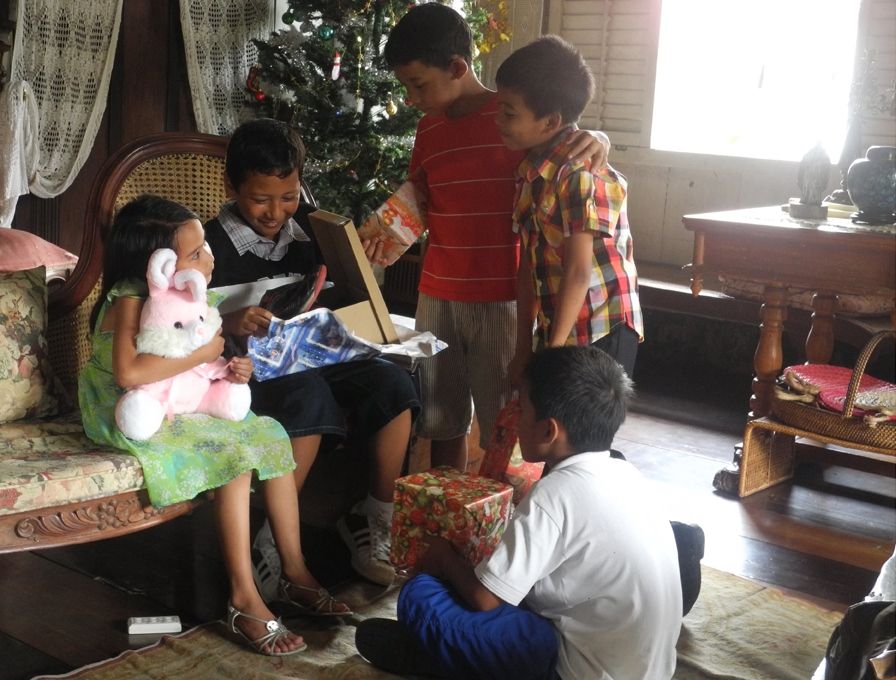

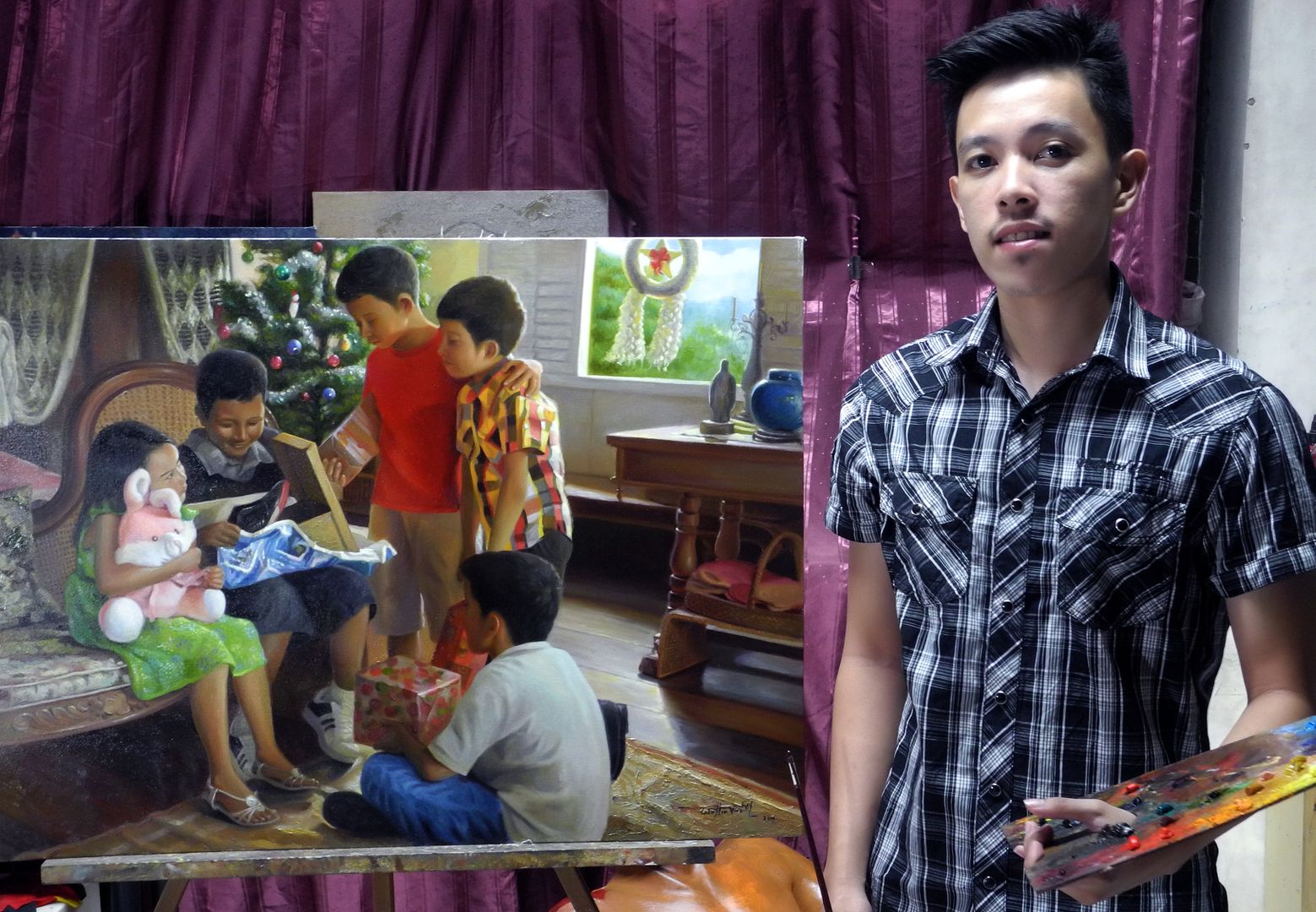
This then became the basis of the actual oil-on-canvas artwork, seen here in progress in March 2014, just missing a few more important details, such as what should hang in the wide-open window:


By April 1st, the artist could happily pose with the finished artwork.

And a few days later, it was enroute to us,
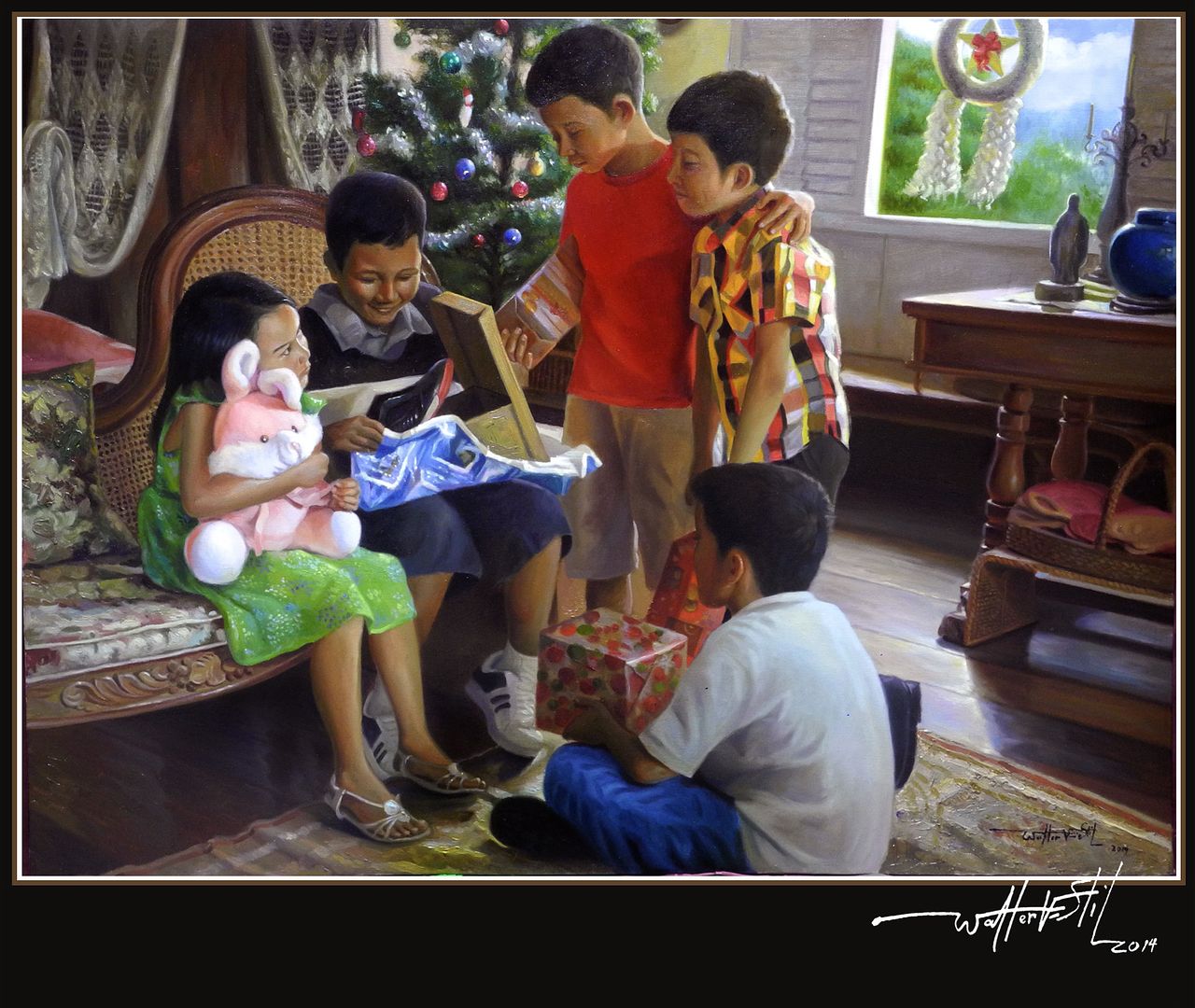

ready for professional photographing and eventual preparation for printing as Christmas cards.

There was a bit of a challenge at the printers’ as to how to adjust the artwork’s original colors, as initial print runs would come out too pale, too dark, or otherwise unappealing.  In the end, slightly more magenta seemed to work.  And so here is how the final printed card came out, more or less:
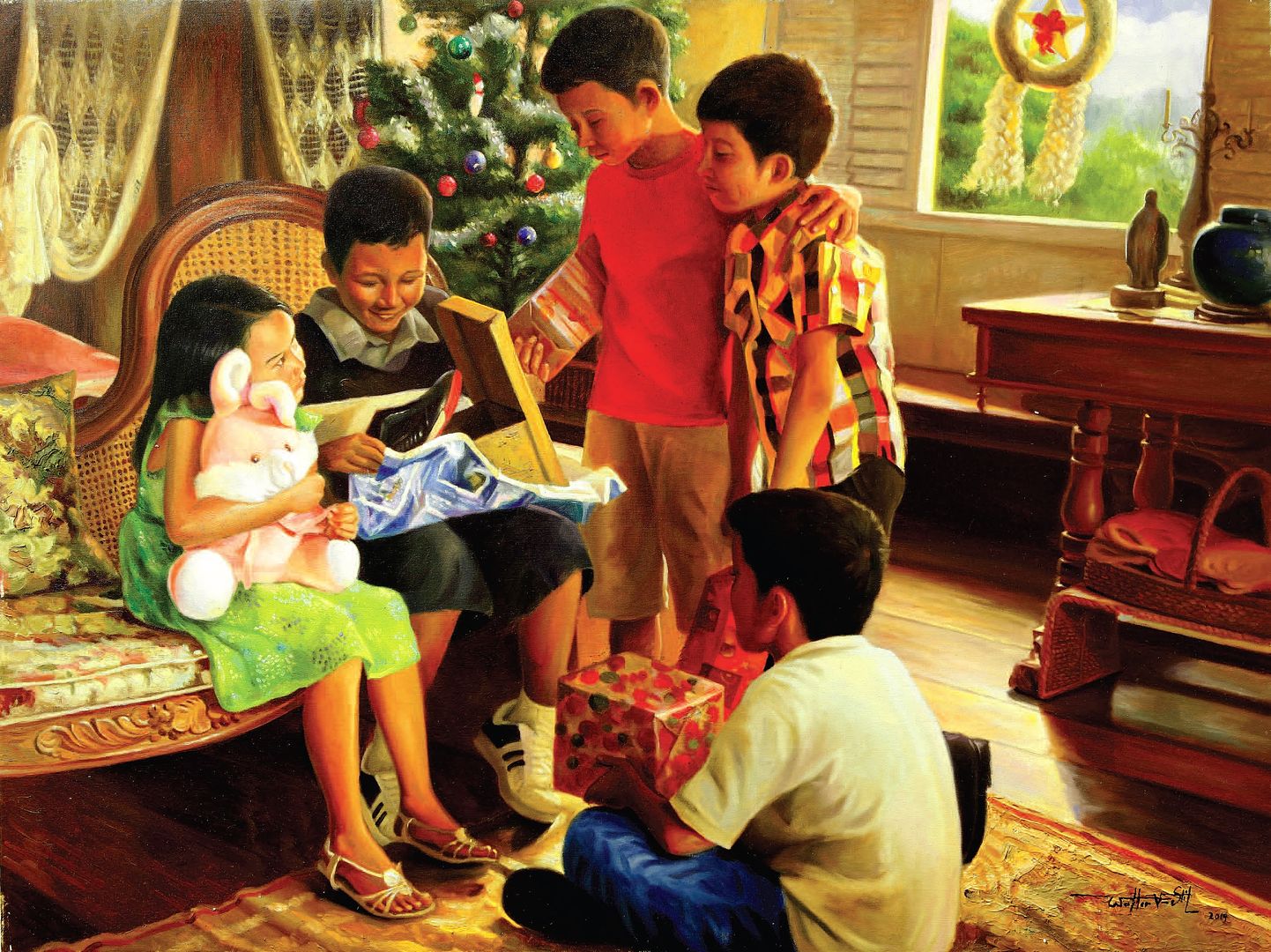

Walter Vestil
“EXCHANGING GIFTS”
Oil on canvas
24” x 32”
2014

*   *   *   *   *

And now, more about our heretofore unnamed artist:
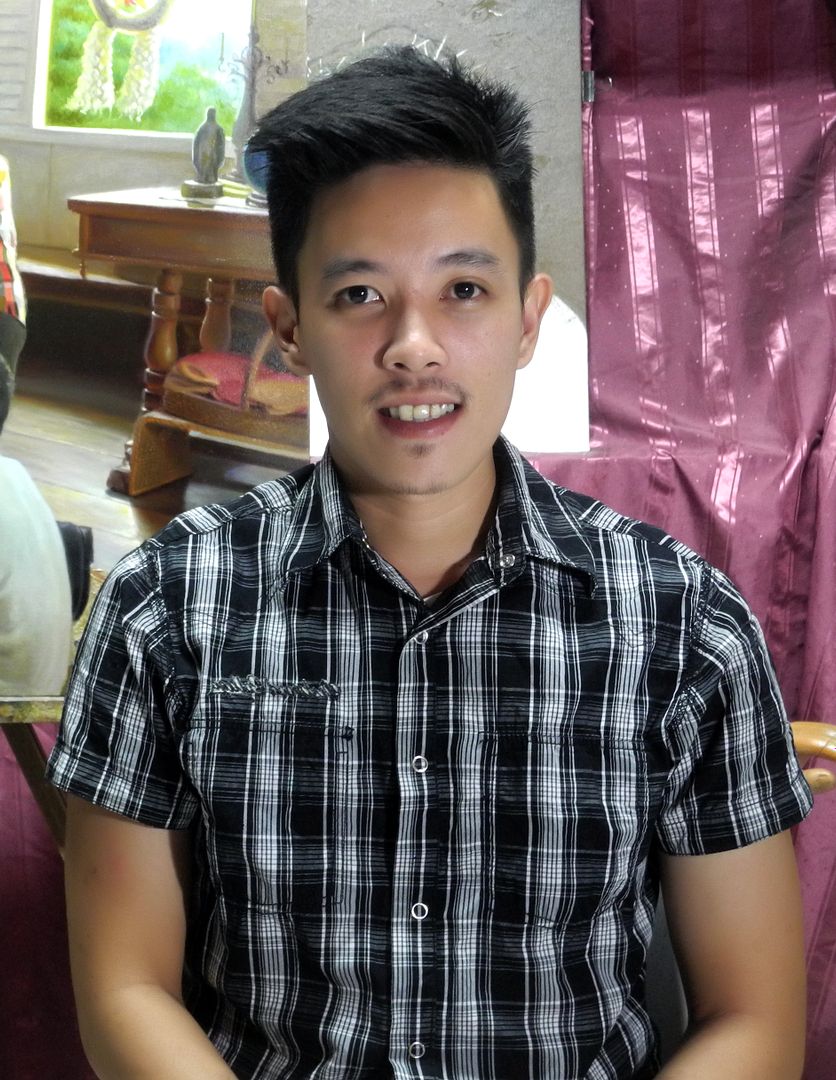

Born in 1988, Walter Vestil is a native of Carcar City, Cebu.  He began his artistic apprenticeship at the age of twelve with master artists Stanley Cui Señires and Facundo Galicano Tallo.  From 2003, he participated in several group exhibits in various venues in Cebu, and was a regular finalist of the annual Martino Abellana Painting Competition beginning that same year, winning the Grand Prize in 2008. 
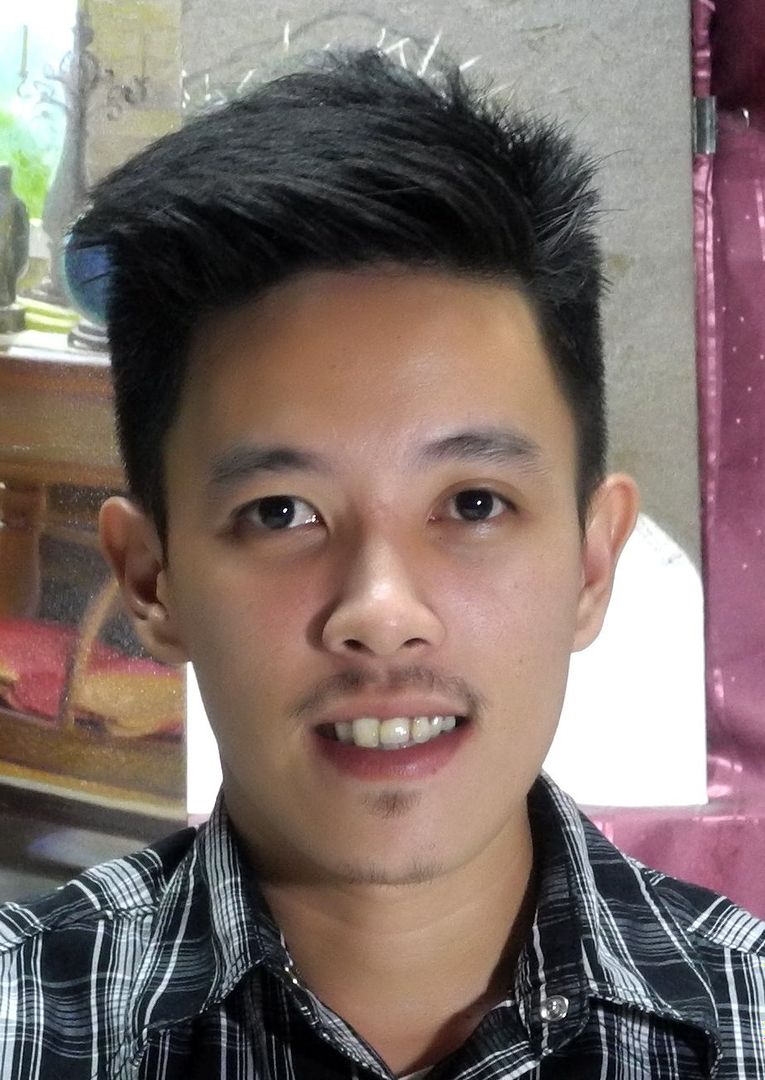

Walter’s appealing photorealistic style has gained him numerous commissions, including several portraits, from regular art patrons, mainly in Cebu.  “Exchanging Gifts” is only his second commission from outside Cebu.   Email: vanrijn_386@yahoo.com

*   *   *   *   *

And so, on this day the Feast of the Epiphany, (i.e., the Feast of the gifts-bearing Magi, on which day gifts were actually exchanged in times past, only to be supplanted later on by Christmas Day itself due to overly-eager gift-exchangers), my family and I would like to greet you and yours a

Merry Christmas and a Happy New Year!

Maligayang Paskó at Manigong Bagong Taón!

And all our prayers and best wishes for an excellent 2015 and beyond.


Originally published on 4 January 2015.  All text and photos (except where attributed otherwise) copyright ©2015 Leo D Cloma. The moral right of Leo D Cloma to be identified as the author of this work has been asserted.

CXXXI. Give Art on Christmas Day 2013

On this, the eleventh consecutive year of our family’s annual Christmas artwork commissioning, we didn’t have to look far for a suitable artist. 

Actually, that is only partly true, as we had at the outset made inquiries of a fair number of young artists in Manila, Bulacan, and even beyond as early as the start of the year, but they were all otherwise engaged in other projects, commissions, and upcoming one-man (or -woman) shows.  By September, or way beyond our usual internal mid-year deadline, we still had no Christmas artwork forthcoming.

And then, I realized that the answer was right under our noses, as it were.  For the eventual artist was someone whom I had known personally for many years, as his father was our chief electrician for our processional carrozas in Malolos each Holy Week, and he himself had been helping his father out in this yearly undertaking since he was a schoolboy.   The following biographical note provides a fuller backgrounder:

Born in 1991, Mark Christian P. Magno is a native of Paombong, Bulacan.  Christian is a self-taught artist who has been winning school and inter-school art competitions since childhood. 


Apart from the visual arts, his other passion is the culinary arts – he is a trained cook and worked as one after graduation from high school.  Consistent with this, Christian is currently a BS in Hotel and Restaurant Management freshman at the La Consolacion University Philippines in Malolos, Bulacan.  While balancing his artistic and culinary interests with his academic workload, he manages to be an all-around athlete and is also on the university’s varsity basketball team.  On Facebook: https://www.facebook.com/ychan.eunra

What the biographical note does not get into is that originally, his father had thought, or suggested, that the son might pursue a Fine Arts degree in college, as he knew that he was at least skilled in art production and could certainly develop such talents further with proper advanced studies.  The father had told me about this earlier in the year, which I fortunately recalled after all the other erstwhile artist candidates had proven unavailable or unsuitable.

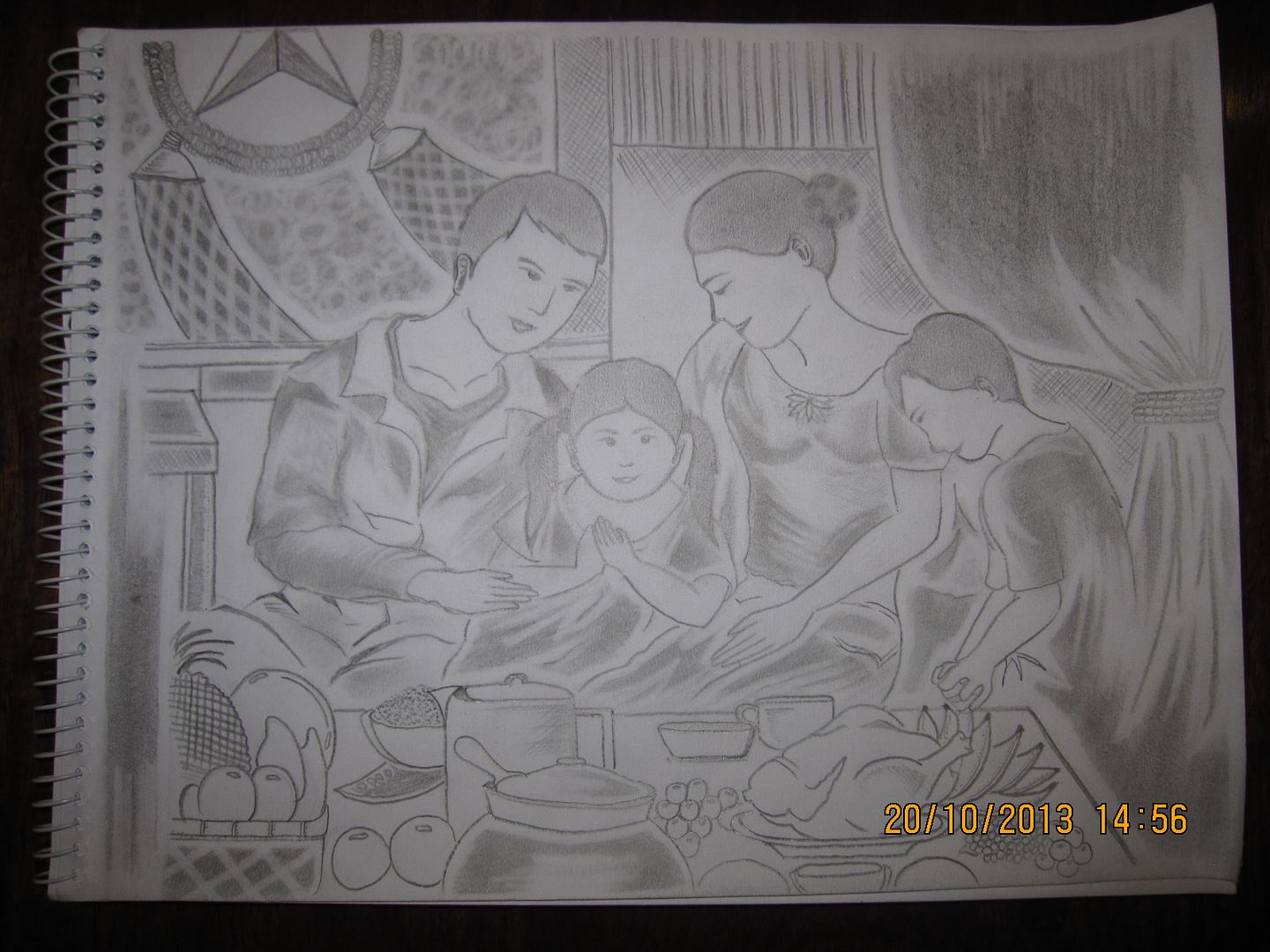
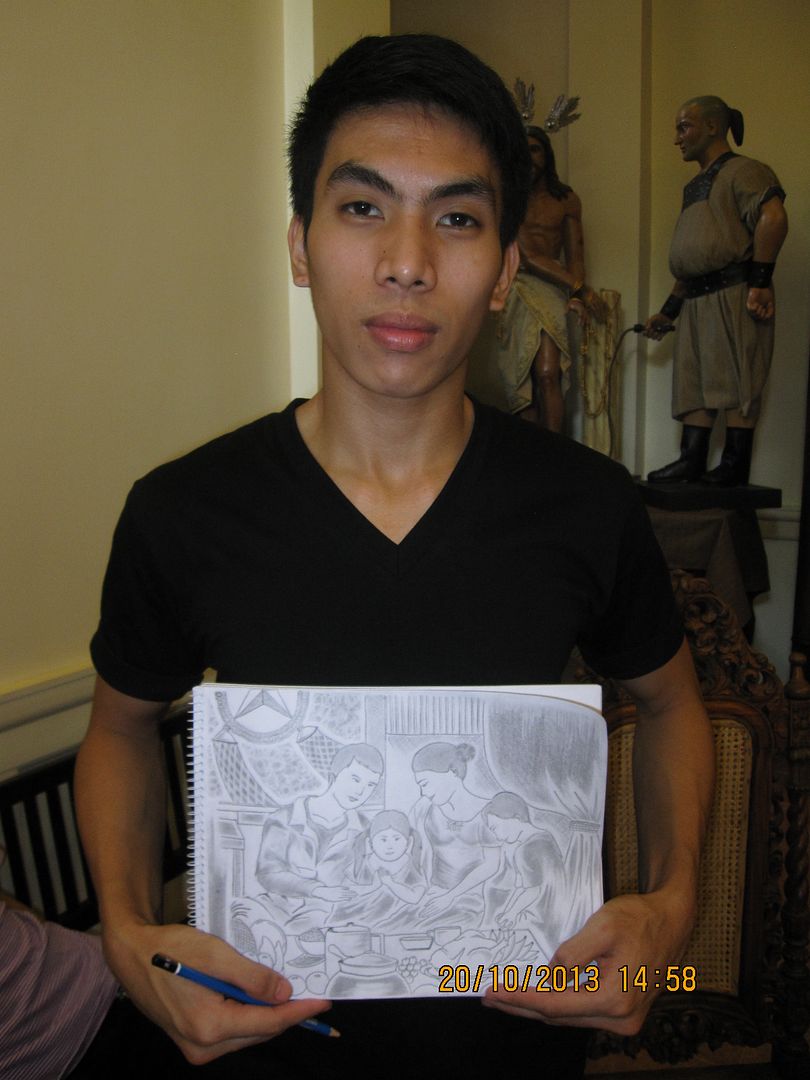
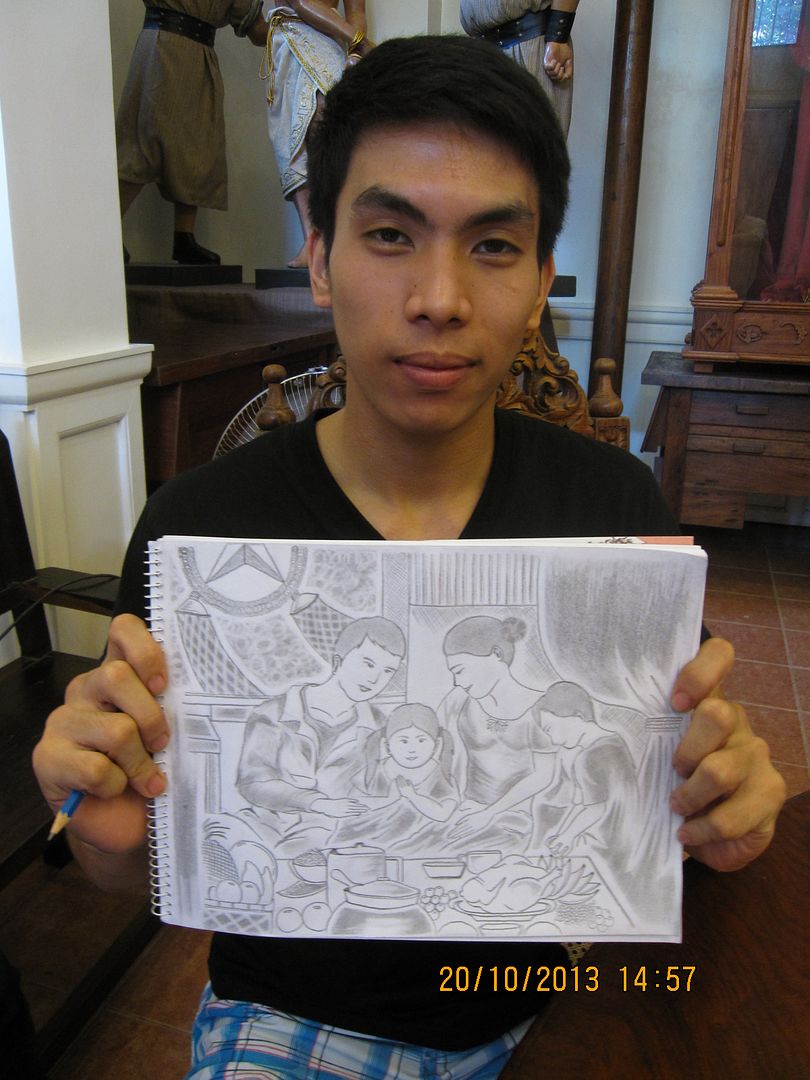
A quick conversation with Christian one Saturday to broach the subject proved most fruitful, with him quite enthused about the opportunity.  As a start, I asked him to sketch his proposed study for the prospective Christmas artwork, and here is what he showed me a week later:


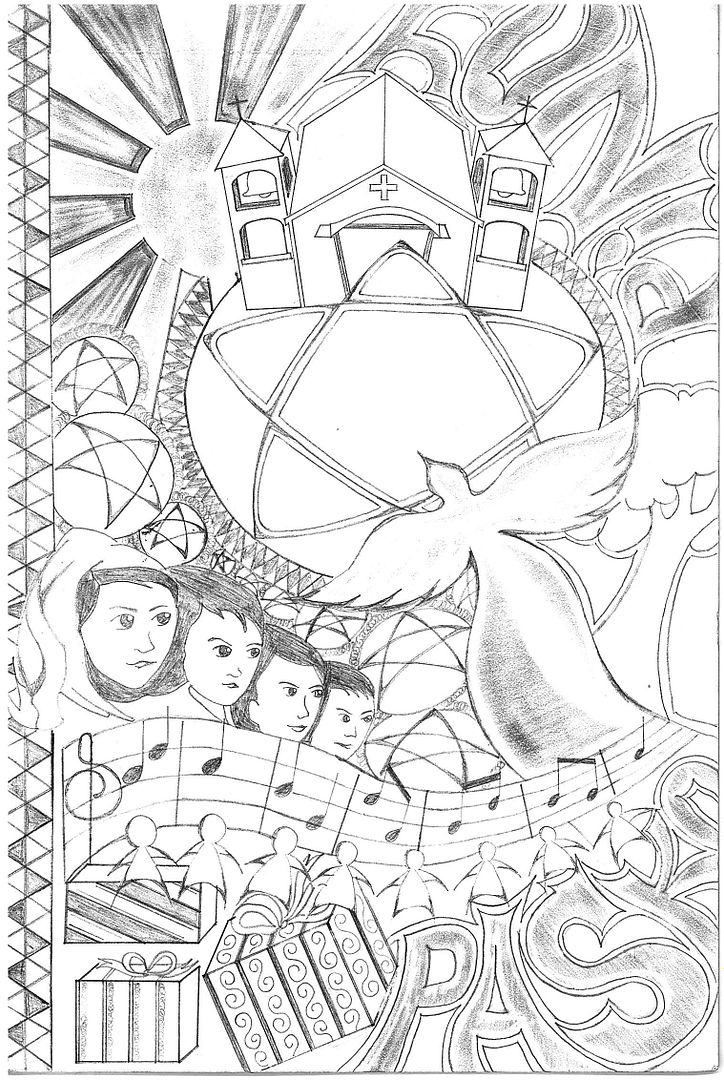
Obviously, Christian had a million Christmas-related ideas, and tried to accommodate all of them into this one sketch!  After a brief “master class” courtesy of our 2010 Christmas card artist, Chester Ocampo, Christian was inspired to reconsider and more tightly focus his response to our request for a simple representation of a quintessential Filipino Christmas.  The result was this depiction of a small family saying grace before sharing the traditional Christmas midnight feast. 

  
The artist’s pride in his new creation, even only in pencil sketch form, was evident.


Actually completing the artwork took several more weeks, as Christian himself admitted that he had never used acrylic, much less oil, and had never painted on canvas – his prolific output since early youth was exclusively with poster paint and other school art materials, and usually only on illustration board or some other paper surface. 

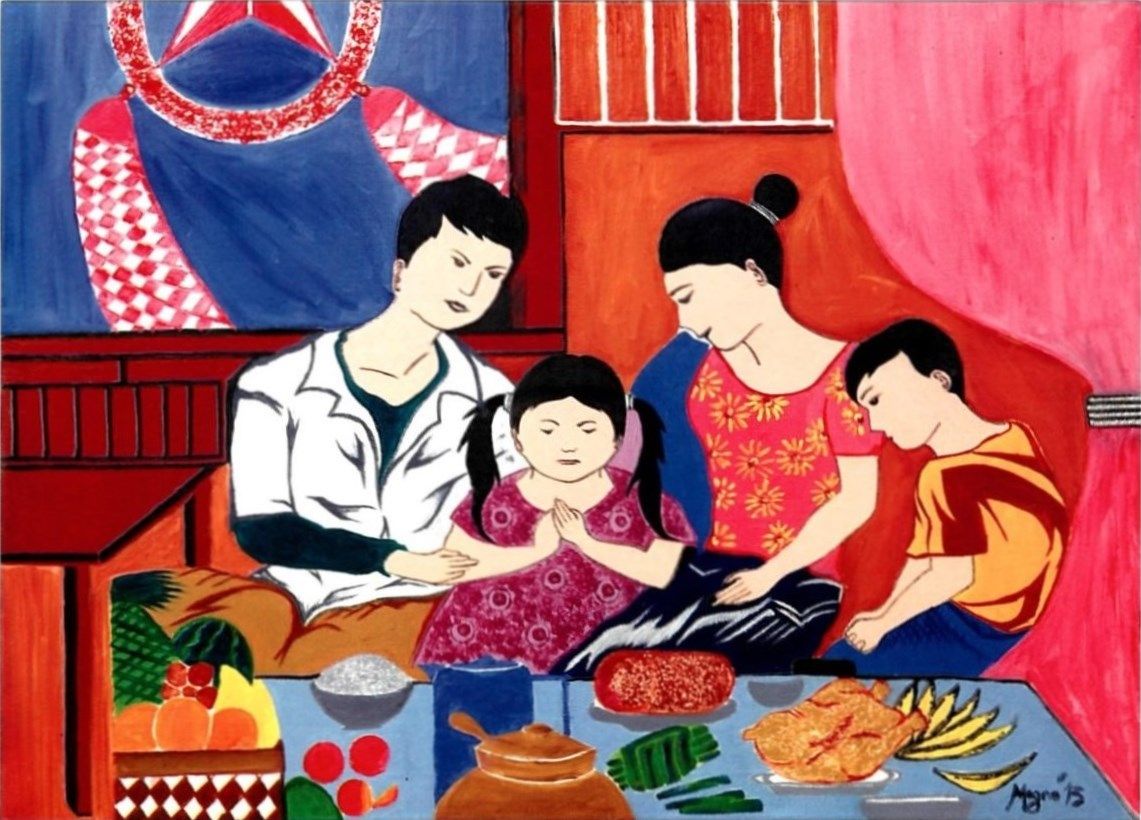
But persist he did, and the resulting finished artwork, in all its glorious color, was completed by November 10th, and sent off to the printer the following day.  As in years past, this digital image does not do full justice to the exuberance of the actual artwork, but it will do.

Christian Magno
NOCHE BUENA
Acrylic on canvas, 18” x 24”
2013

Therefore from Christian the artist and from my family and me, here’s to a

Merry Christmas and a Happy New Year!

Maligayang Paskó at Manigong Bagong Taón!

And all our prayers and best wishes for an excellent 2014 and beyond.

Originally published on 31 December 2013. All text and photos except where attributed otherwise) copyright ©2013 by Leo D Cloma. The moral right of Leo D Cloma to be identified as the author of this work has been asserted.

CXXX. Give Art on Christmas Day 2012


A uniquely Filipino visual art form from the 19th century is Letras y Figuras, where persons’ names are spelled out with individual letters that are each in turn formed by smaller figures – humans, animals, plants, and vignettes of Spanish colonial life.  Its leading proponent was Jose Honorato Lozano (1815-1885), who produced a few extant examples for private patrons, including FRANCISCO DE YRIARTE


and EULALIA N. de ROCA.


In the late 20th to early 21st centuries, the art form underwent a renaissance and gained new adherents, the foremost of whom is probably Alvaro Jimenez (born 1948) of San Fernando, Pampanga (see http://www.paintingsphilippines.com/).  He has produced to several commissions, including MABUHAY


and MARAMING SALAMAT.


We thought that it would be a good thing to also contribute to this mini-renaissance, so for our 2012 Christmas card, we therefore decided to commission a Letras y Figuras as well.  And as with most of our previous Christmas card artworks, we wanted to engage a young artist to create it. 

Despite our initial apprehensions, finding a young person who already understood the Letras y Figuras idiom came rather easily and fortuitously, as I found out that the daughter of a colleague had done several examples of this art form.  Her biographical note might explain why:

Ysabela Maria Parungao is a third year Visual Communications major at the College of Fine Arts of the University of the Philippines in Diliman.  Iya was also recently granted a scholarship under a South Korea – UP Diliman exchange program and commenced a one-year residency at Kyungpook National University in Daegu in August 2012.
 

Iya finished high school at Assumption Antipolo and was the Sangguniang Kabataan Chairperson in Barangay Concepcion Dos, Marikina City, from 2007 to 2011.  She is also a member of AdCore, a not-for-profit student-run advertising agency, and the Delta Lambda Sorority, both in UP Diliman.


Iya has exhibited her artworks since she was in high school.  She has a natural love for history and the arts and would like to use her talents to pursue a career in advertising in the future.

This was therefore a pretty straightforward task for her – do a “MALIGAYANG PASKO” in Letras y Figuras style.  She didn’t even need to do sketches or studies, I guessed.

Well, I thought it was straightforward, but then Iya tells me that all those letters just cannot fit in a six-inch-wide frame and still be intelligible as “figuras”.  Even on two rows, which is consistent with the 19th-century examples, the word “MALIGAYANG” would be awfully cramped.  She therefore sought permission to deviate slightly from the idiom, with just the “PASKO” in strict “figuras” and the “MALIGAYANG” rendered as parols (traditional Filipino Christmas lanterns).  Here’s how Iya’s first pen sketches looked like:


Here is the fully-figured artwork before coloring.


And here’s how the 5-inch-tall by 8-inch-wide artwork came out, fresh from Iya’s watercolor brush and ink pen:


I thought that the “parol” solution was extremely appropriate and therefore ingenious.  And the use of a pale blue background rather than the usual yellows or off-whites made the artwork firmly modern and original, while still contributing appreciably to more than 150 years of the Filipino Letras y Figuras canon.  

And here is how the final Christmas card came out a few weeks ago:


Merry Christmas and A Happy New Year!

Maligayang Paskó at Manigong Bagong Taón!


From the Veron-Dulay-Cloma Family of the Philippines


Originally published on 2 January 2013. All text and photos (except where attributed otherwise) copyright ©2012 by Leo D Cloma. The moral right of Leo D Cloma to be identified as the author of this work has been asserted.

Tuesday, July 5, 2016

CXVIII. Visita Iglesia (Plus) Bohol III: The Panglao Church

After that Loboc river cruise, our group next went off to pet some tarsiers.  As I don’t really like animals, much less want to be associated with their veritable torment in captivity, I basically withdrew from that activity and waited for the next stop.

Which turned out to be even more touristy as it was a visit to a "pasalubong" center.  At least I got to shop for native junk food and sugar fixes for my family.  And soon enough, it had turned dark and was time to go back to our lodgings in Panglao Island, off the coast of Tagbilaran, and freshen up for dinner.

I was actually looking forward to dinner, not only because I was genuinely hungry after all that moving around, but also as I had made an evening appointment to meet up with my long-lost (actually never-met) Cloma cousins who lived in Bohol.  And after innumerable dead-end stories (we blame the fact that our elders never really set us up for these impromptu reunions), they very generously offered to take me around the next day.  It being a free day for me, I was only too overjoyed to accept.

I rose early the next morning, had breakfast, and waited for my cousins to pick me up from the resort where I was billeted.  When they arrived, they mapped out our itinerary for me.  For starters, they said that since we were already on Panglao island, the natural first stop had to be Panglao town, at the far south-west end of the island.

Not only was it close by to where we already were, but it was a natural starting point for us in particular, since Panglao was after all the hometown of the Cloma clan.  Now how could I argue against that?

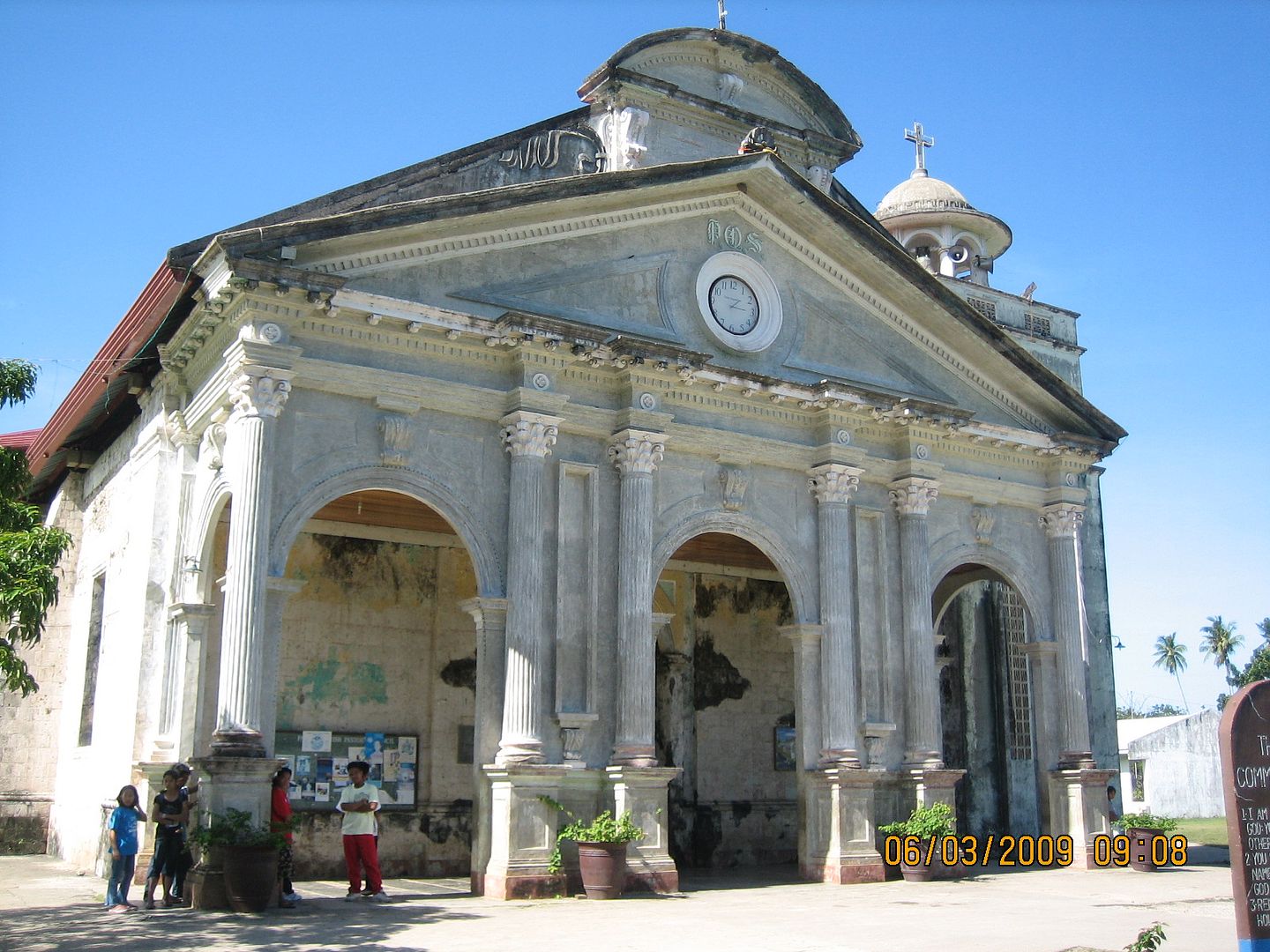
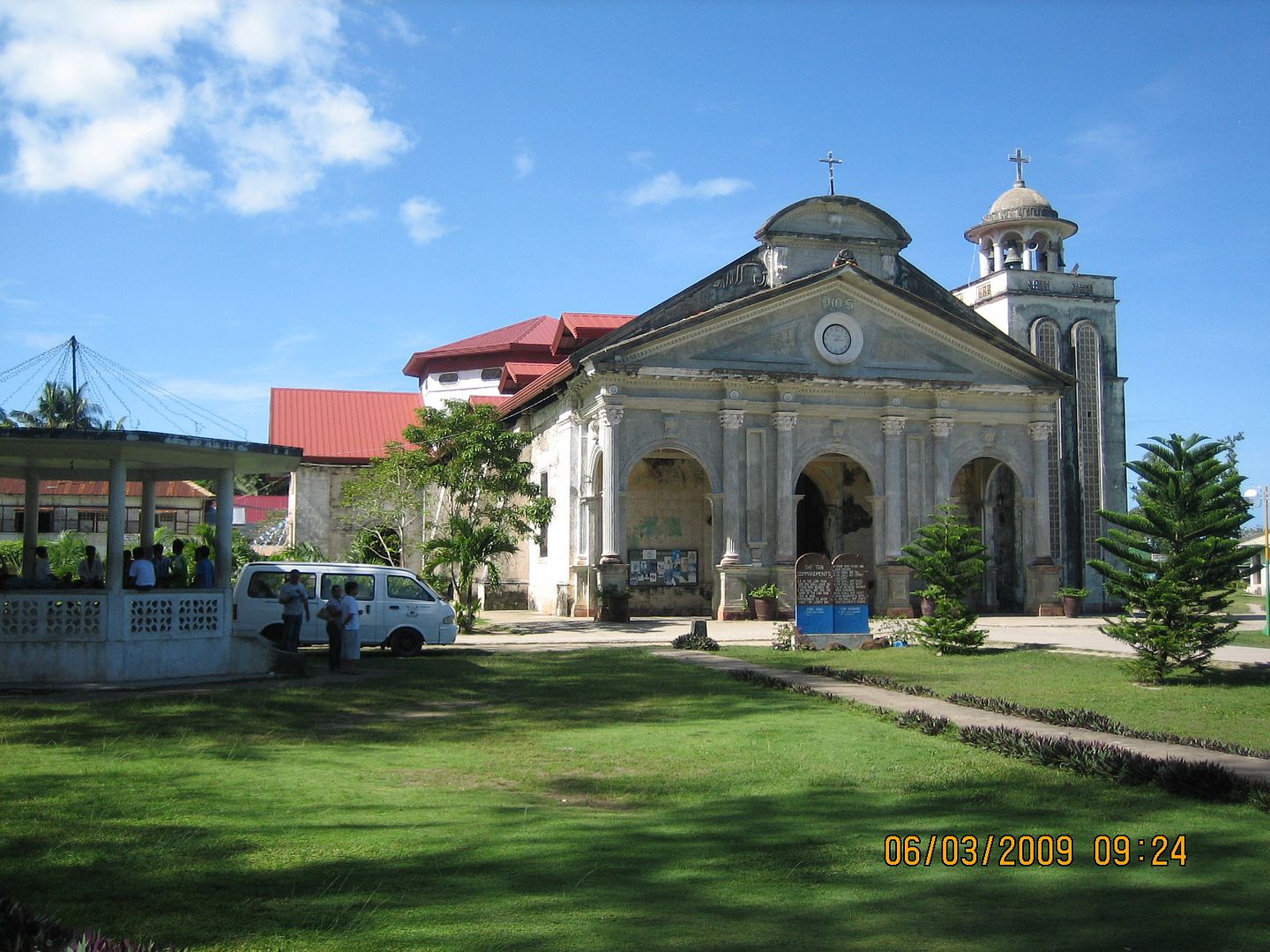
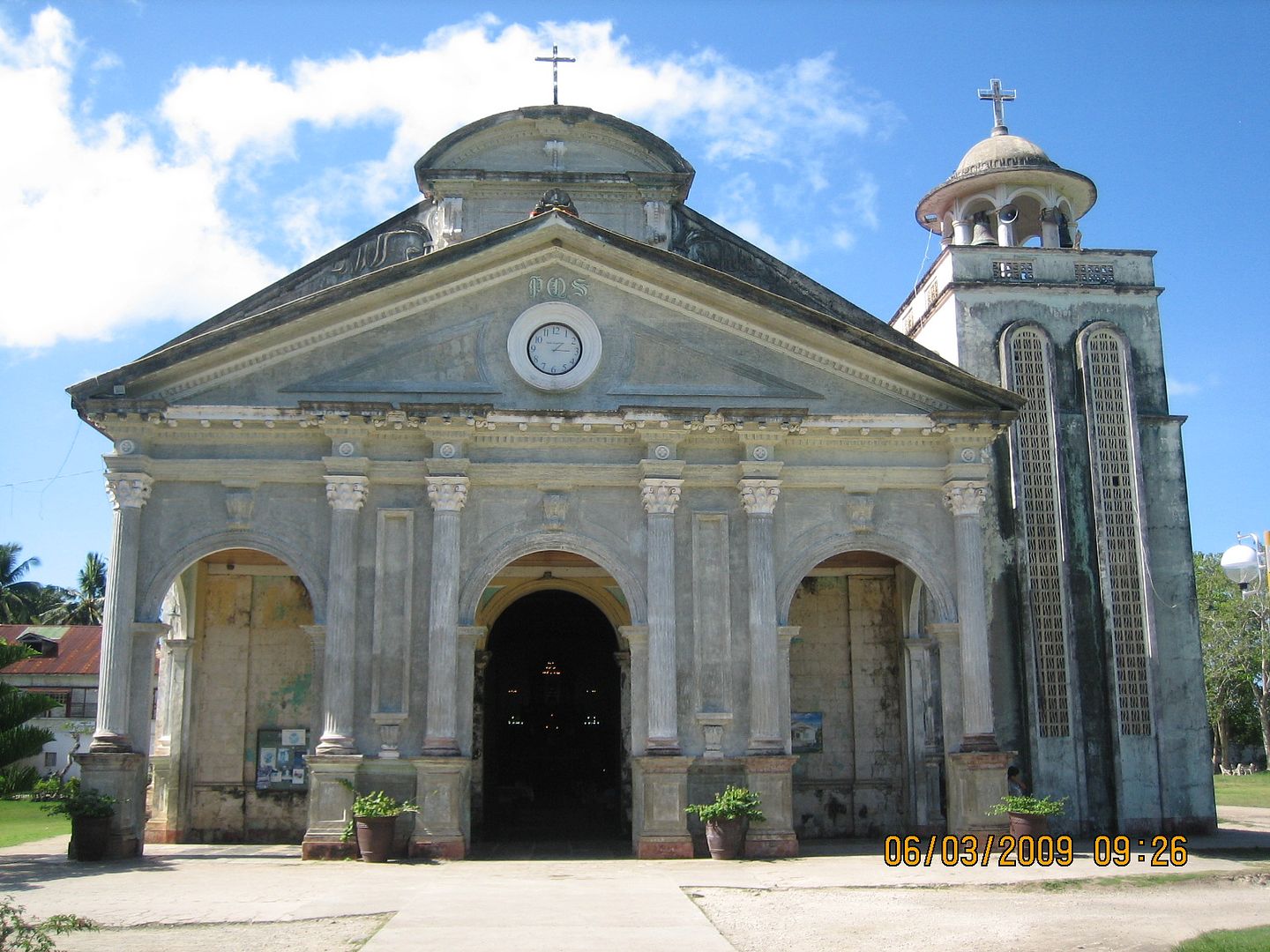
After a few minutes’ drive, we reached Panglao Church.


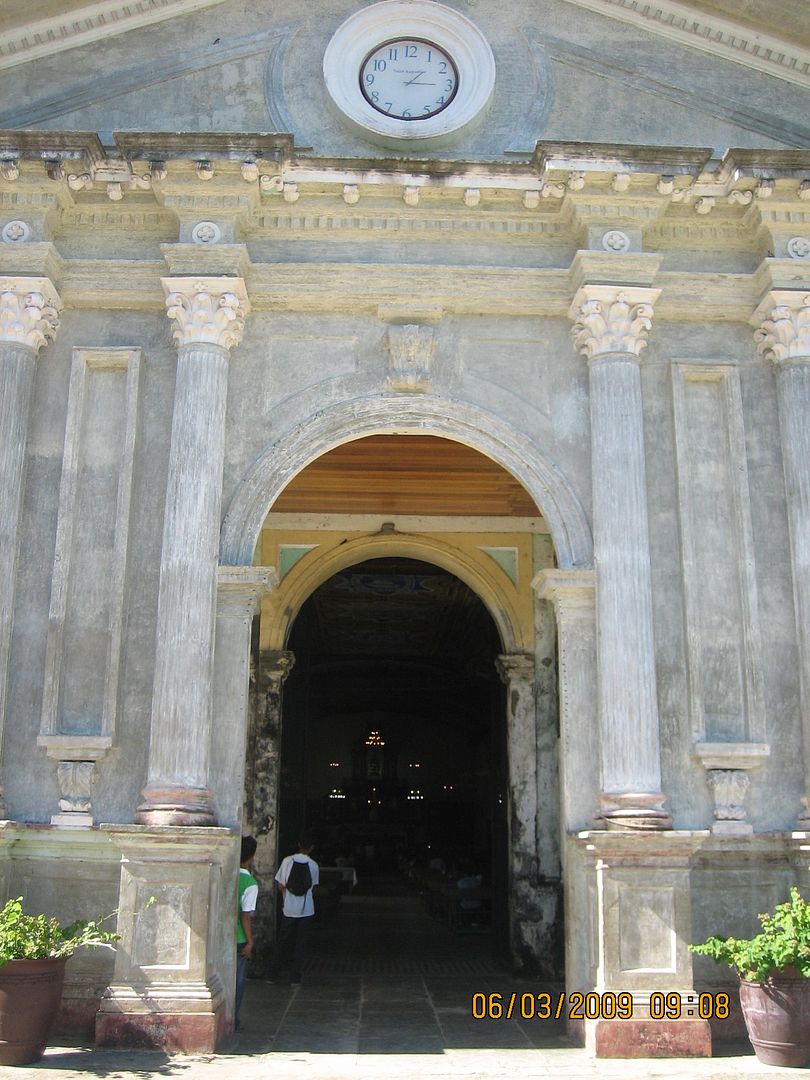
The façade of the church, which was begun in the 1890’s and was completed only in the 1920’s, is a wide portico similar to that of Baclayon Church, but unlike the latter, this was built in one go and not as a subsequent add-on to an earlier structure.  Overall it is impressive and imposing – as Regalado Trota Jose says in his very helpful “Visita Iglesia Bohol” book, it is of poured concrete, and features fancy Corinthian capitals.  There is also a large clock in the center of the pediment.


Above the clock is the inscription “P.Q.S.” in Gothic script.  The “Visita Iglesia Bohol” book enlightens us as to its significance – they are the initials of Padre Quiterio Sariguimba, Panglao’s parish priest from about 1920 to 1927, and who completed the structure originally begun in the 1890’s.  He is known for not only completing numerous building and renovation projects in the various Bohol parishes that he was assigned to (after Panglao, he had moved on to Jagna, Inabanga, and Maribojoc, among others), but for also proudly marking such achievements with his initials. (Shades of “Z” for Zorro?)

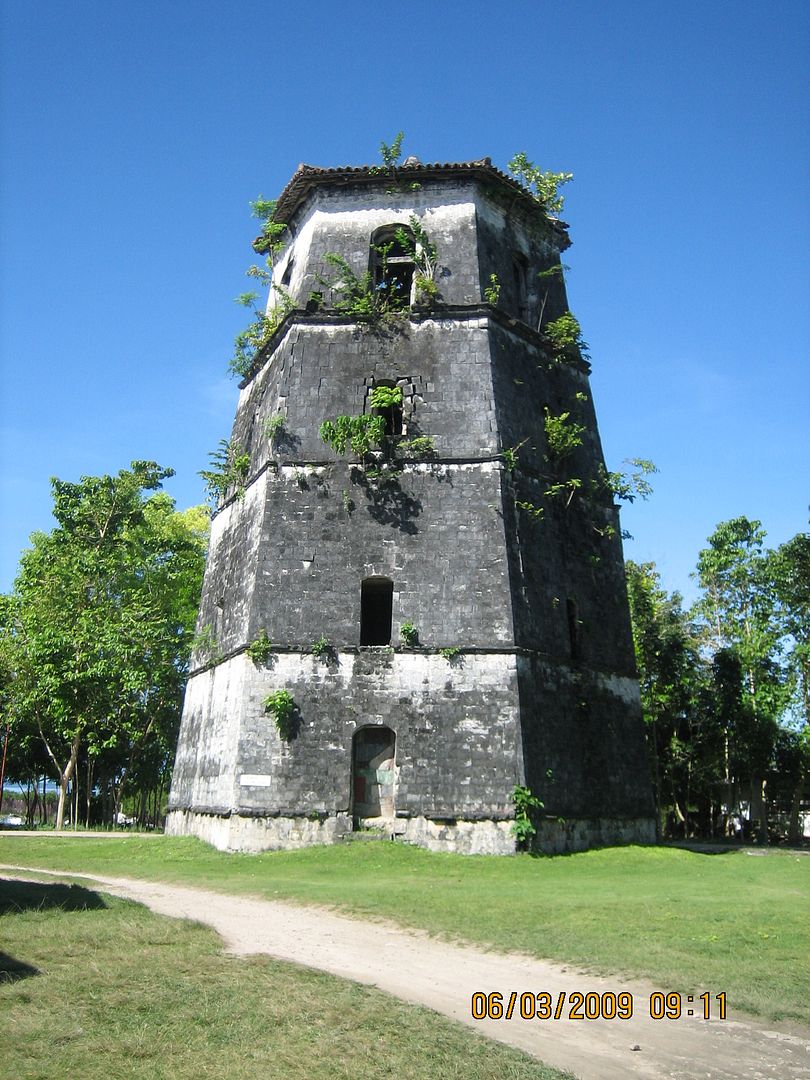
As there was still a Mass going on inside the church, I decided to first explore the outside while waiting for it to finish.  Behind the church and towards the right was a hefty four-storey stone watchtower that looked out to the sea, just a short distance away from the rear of the church.


Like the church’s façade this hexagonal tower is imposing and perhaps slightly intimidating.  It was shut and not open to visitors, likely because the interior staircase is either in bad shape or no longer in place, but according to the “Visita Iglesia Bohol” book, the presumed date of construction “1851” is inscribed somewhere inside the ground floor.

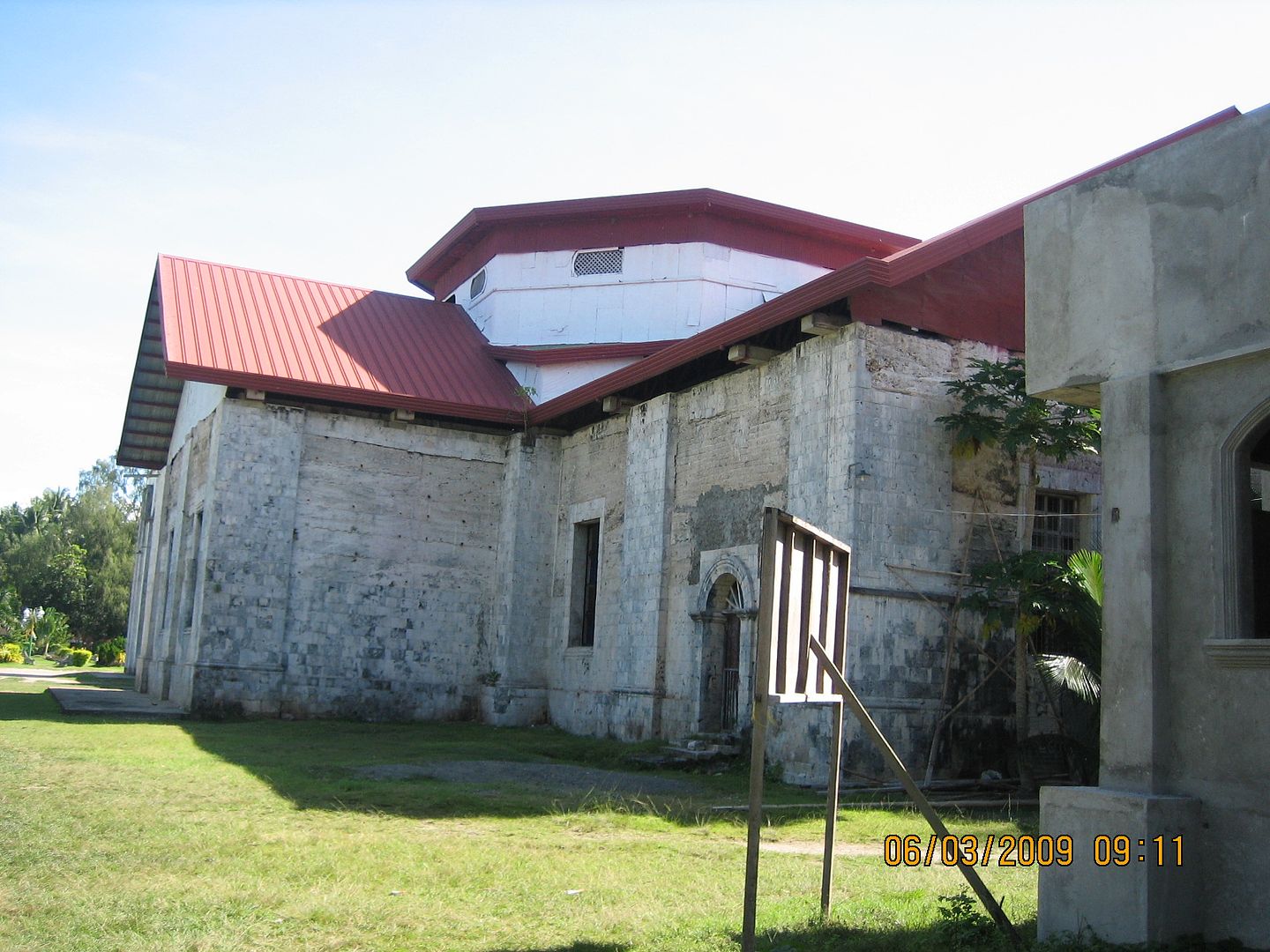
Walking back to the church, one appreciates the beautiful white coral stone used to construct it, which Padre Quiterio originally planned to sheath with cement plaster – it is probably fortunate that he ran out of time and funds to do so.  On the other hand, today’s Panglao parishioners seem to have done a respectable job of caring for their legacy from P.Q.S. – a handsome red roof covers the transept, nave, and the tall octagonal crossing overhead.


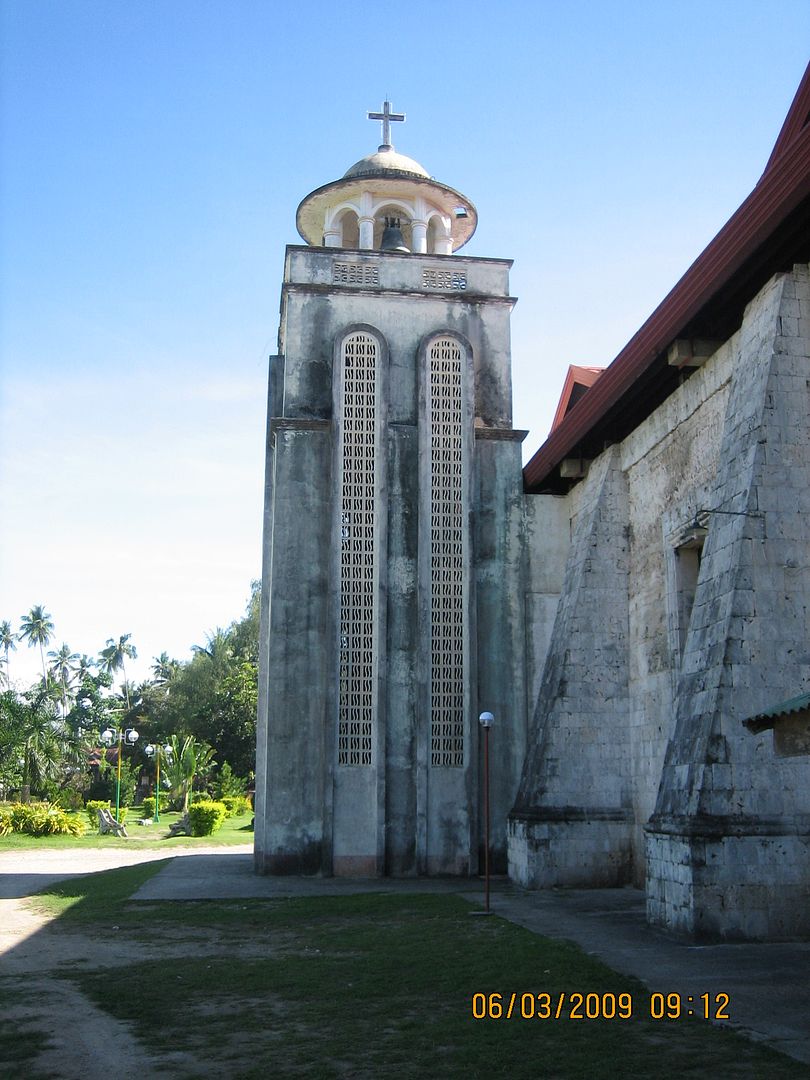
The belltower on the right side of the façade, seen here from behind, casts a long shadow on this sunny morning.


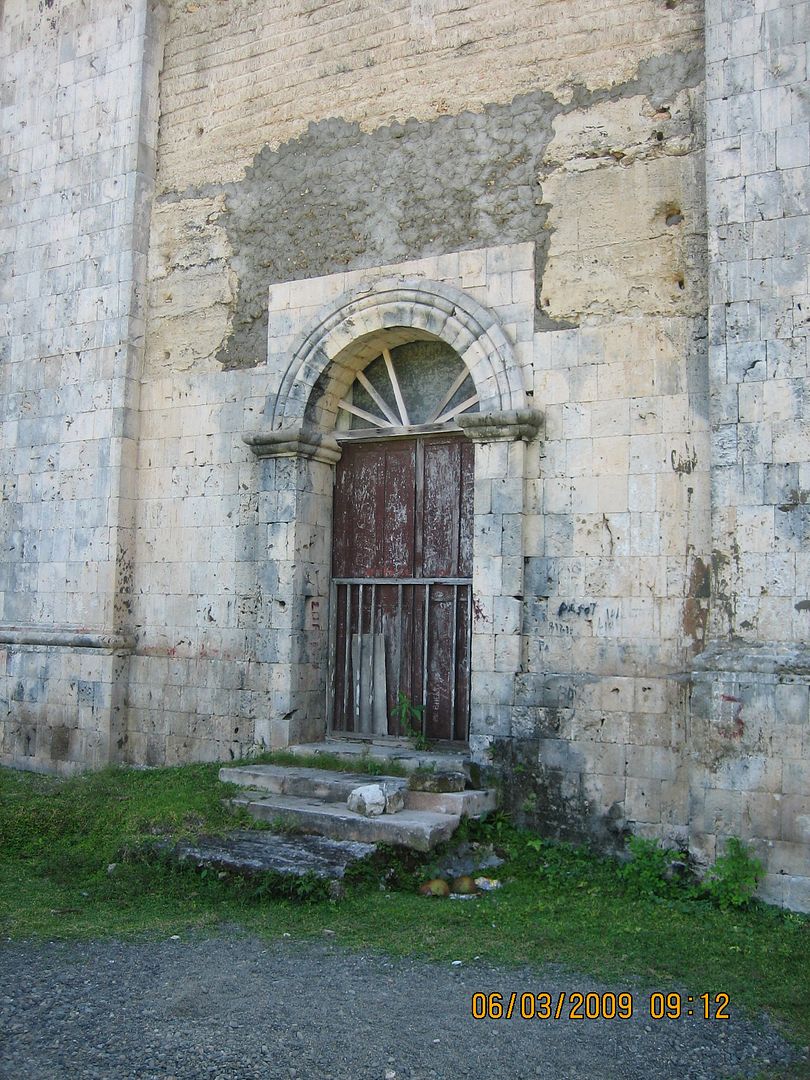
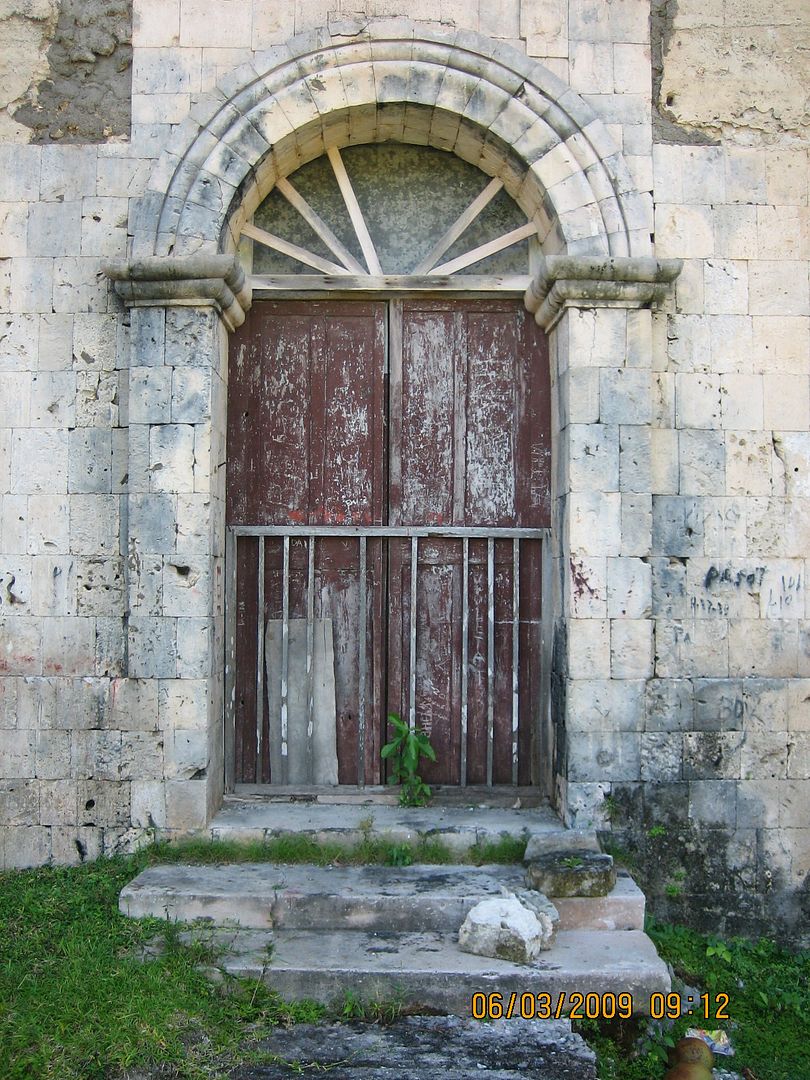
The side doors


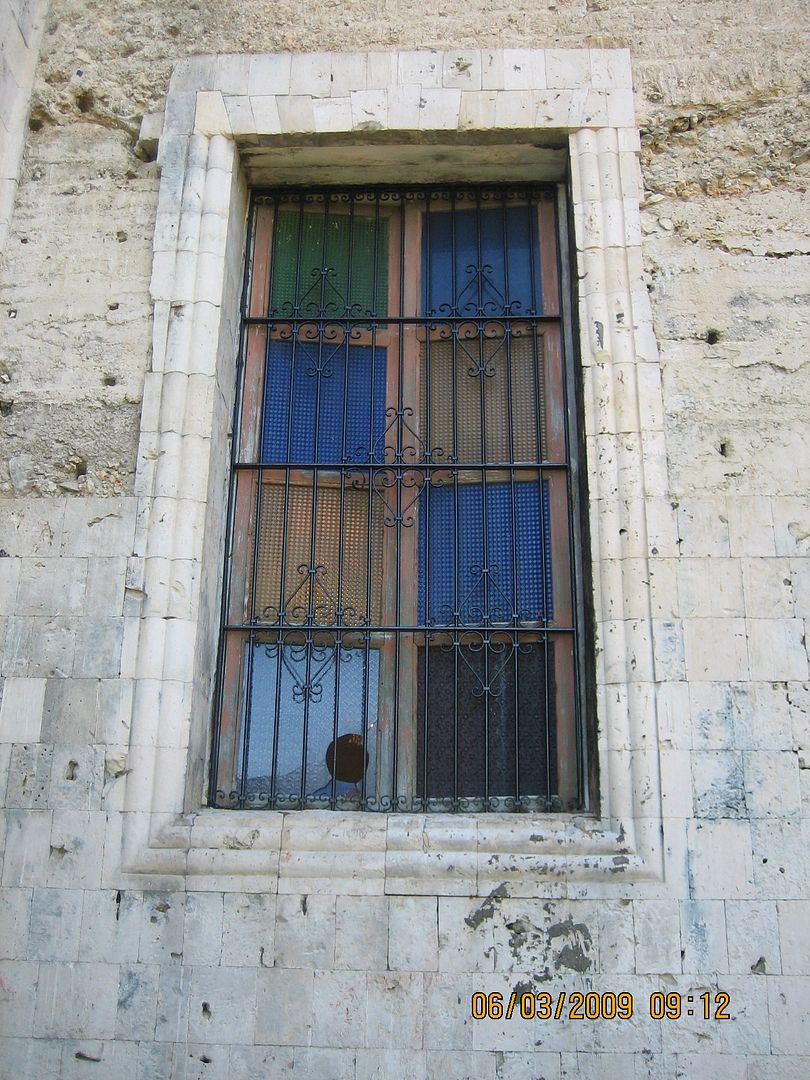
and windows


of the nave could stand some freshening up, but at least their surrounding stonework appears to be in fair shape.

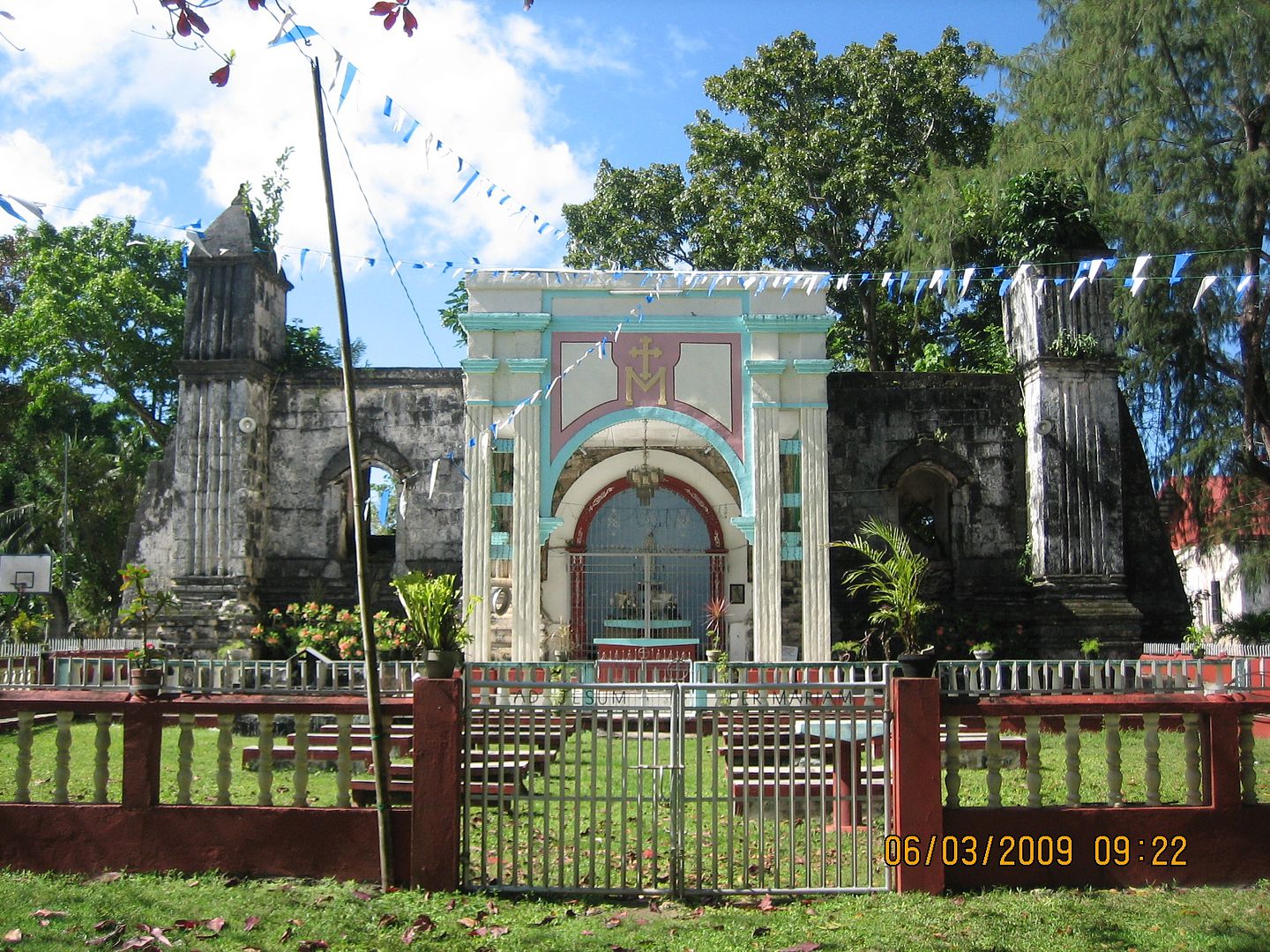
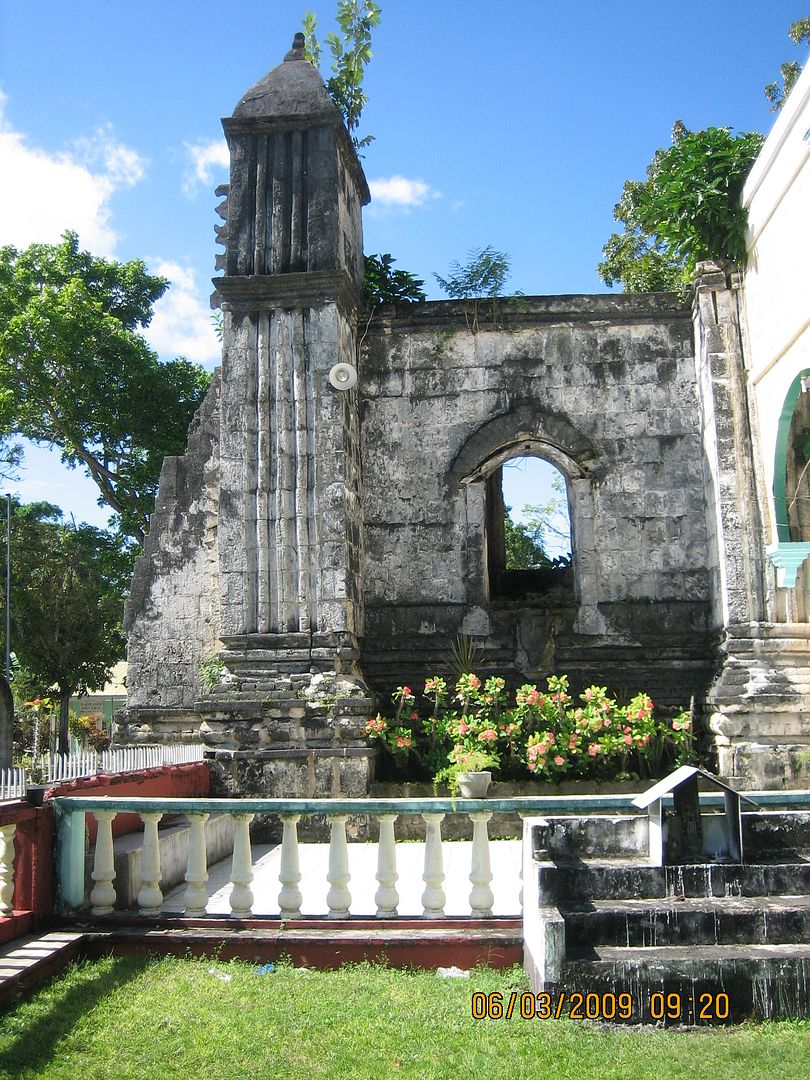
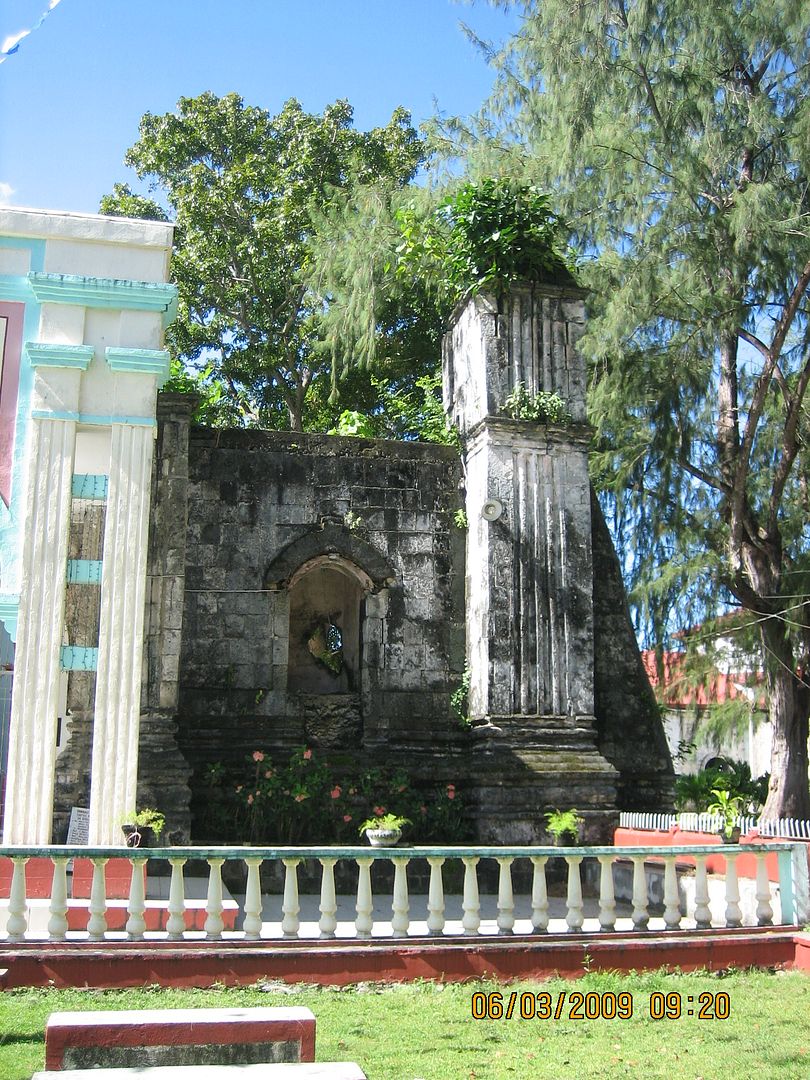
Elsewhere in the expansive church plaza, to the left of the façade and closer to the main road, are the ruins of what appears to be an earlier church.


According to the “Visita Iglesia Bohol” book, there is an inscription somewhere over the main entrance of the ruined façade (of which only the lower level remains) that dates the structure to 1858 or 1859.  However, I could not find it, as yet another portico add-on had been grafted on it.


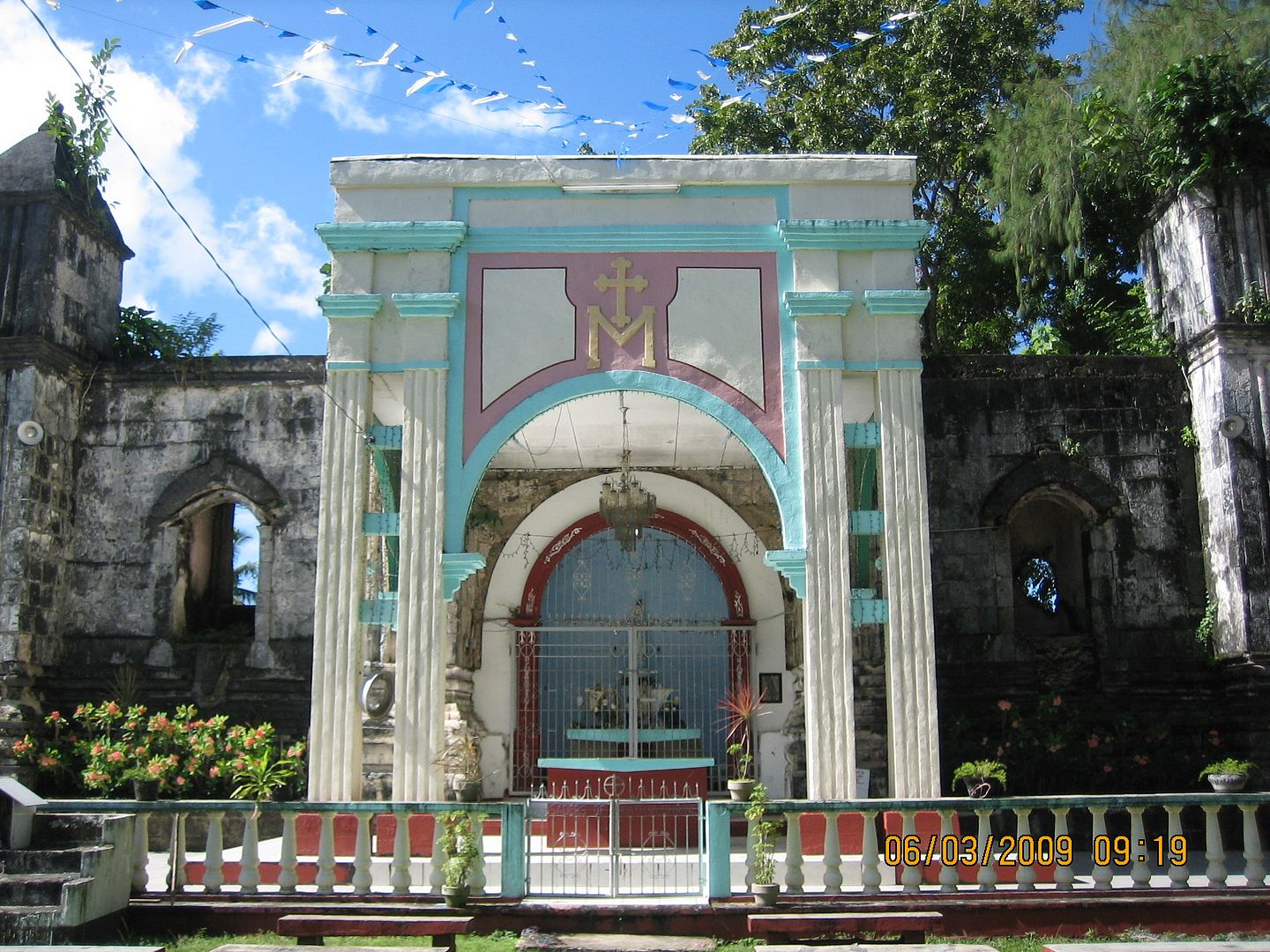
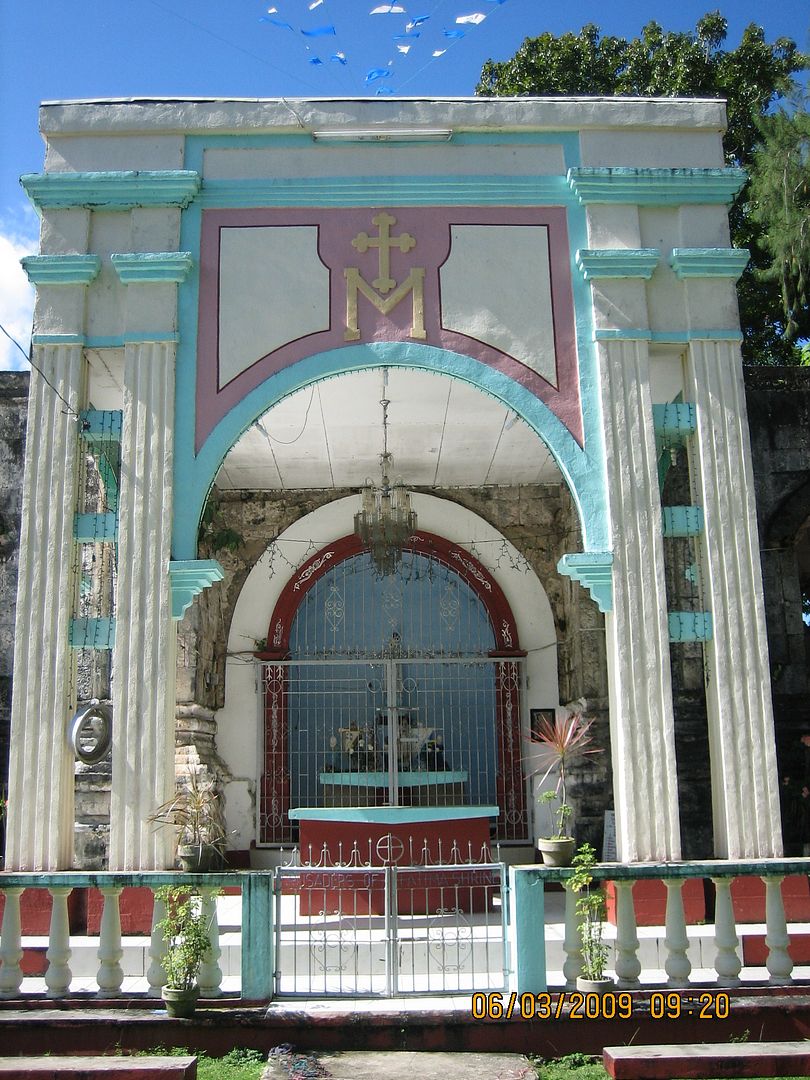
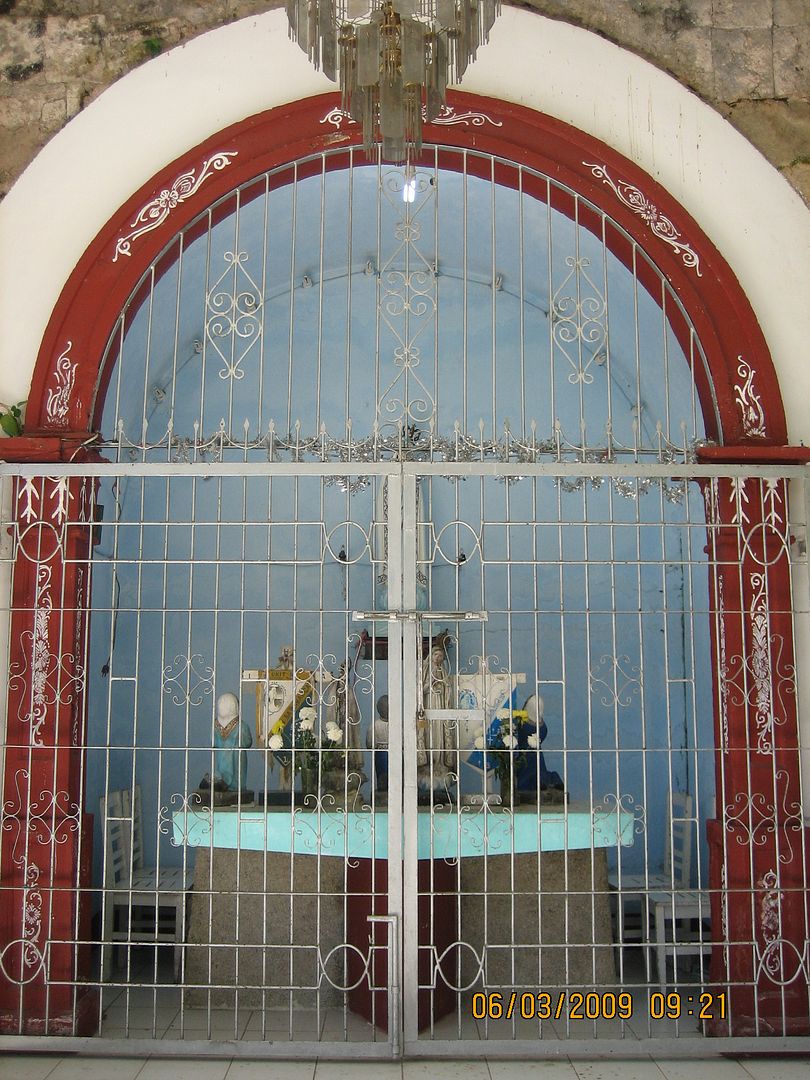
In fact, the ruins had since been converted into an outdoor shrine to Our Lady of Fatima, with the old church’s main doorway now the altar area,


and the area right in front of the façade now fenced in and furnished with park benches.


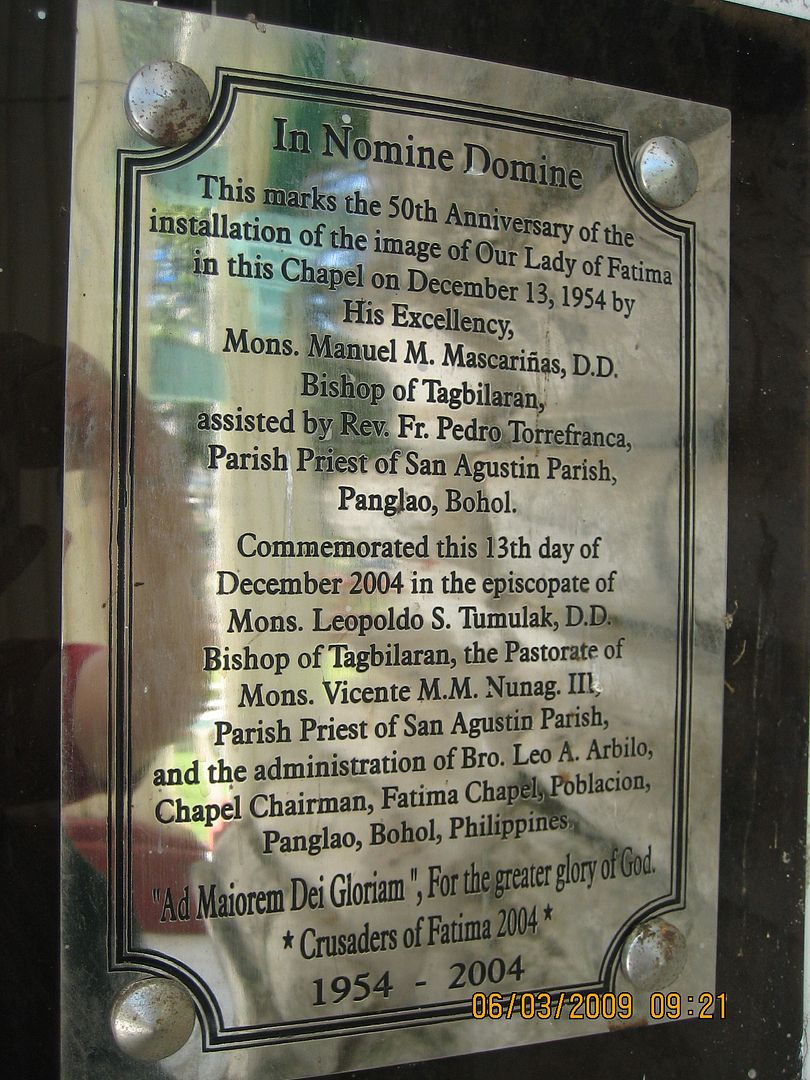
According to this 50th anniversary marker, the image of Our Lady of Fatima was installed here in 1954, which might have been shortly after its conversion to an outdoor shrine took place.


The conversion left the left and right sides of the facades uncovered, which one can still inspect for design details and 19th century construction techniques.


I still wonder, if this earlier church was built only in the late 1850's, why the decision to replace it seems to have been taken as early as the mid-1890's or after just thirty years or so of use.  Perhaps it simply was too small and too modest for the presumably increasingly prosperous parishioners of this town.  Looking out toward the newer church from beside the ruins of the older one, it certainly appears that the town got a virtual basilica as a result.


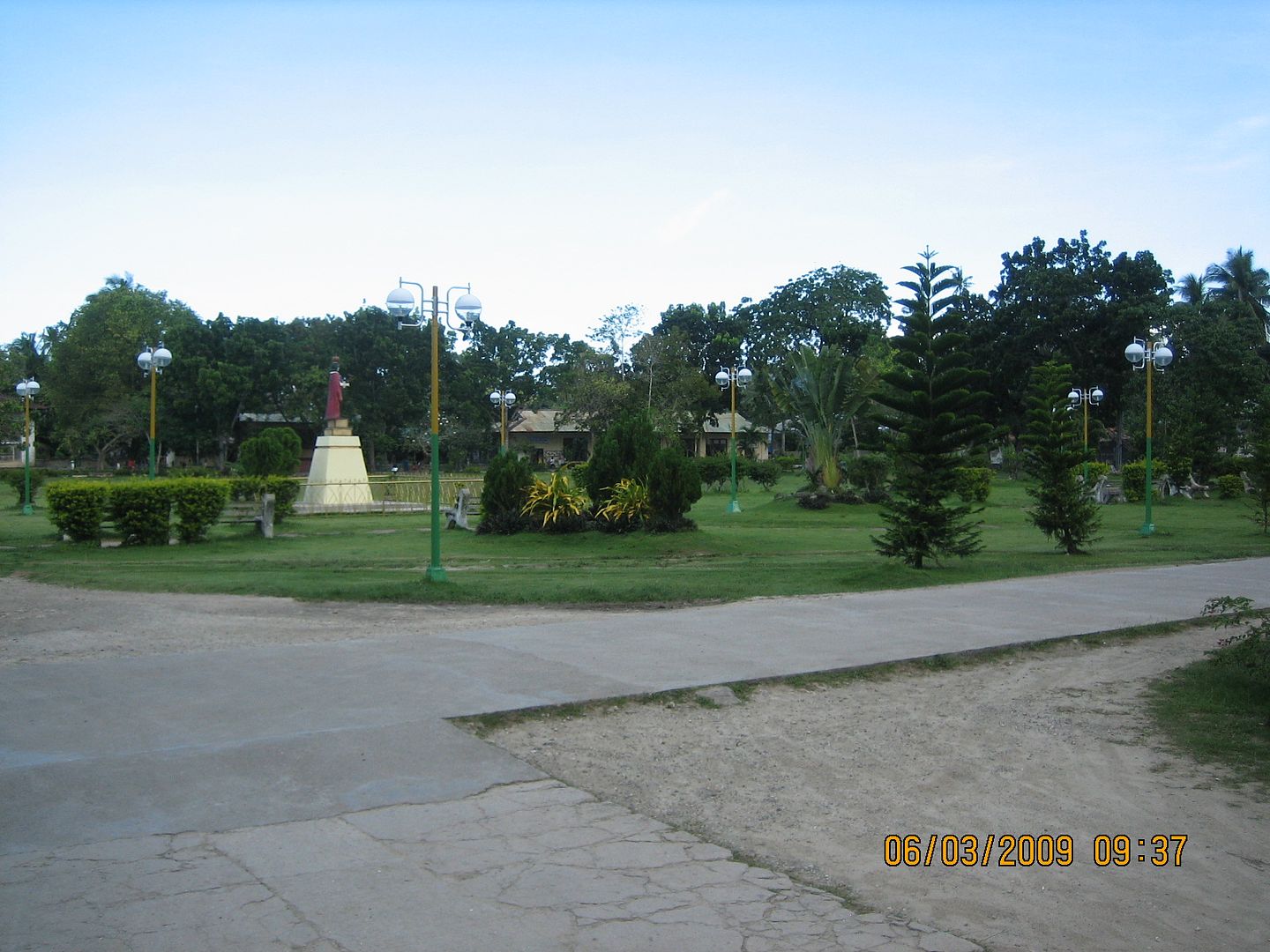
In the middle of the expansive front yard to the right of the ruins of the older church and in the foreground of the newer one


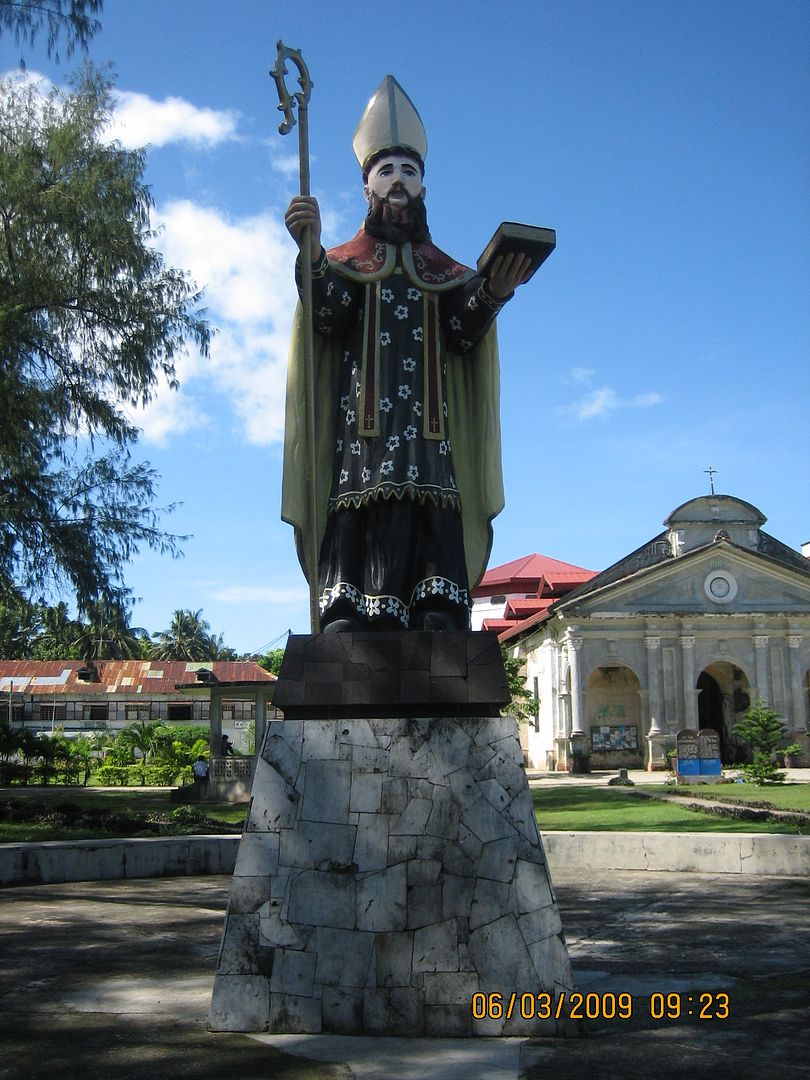
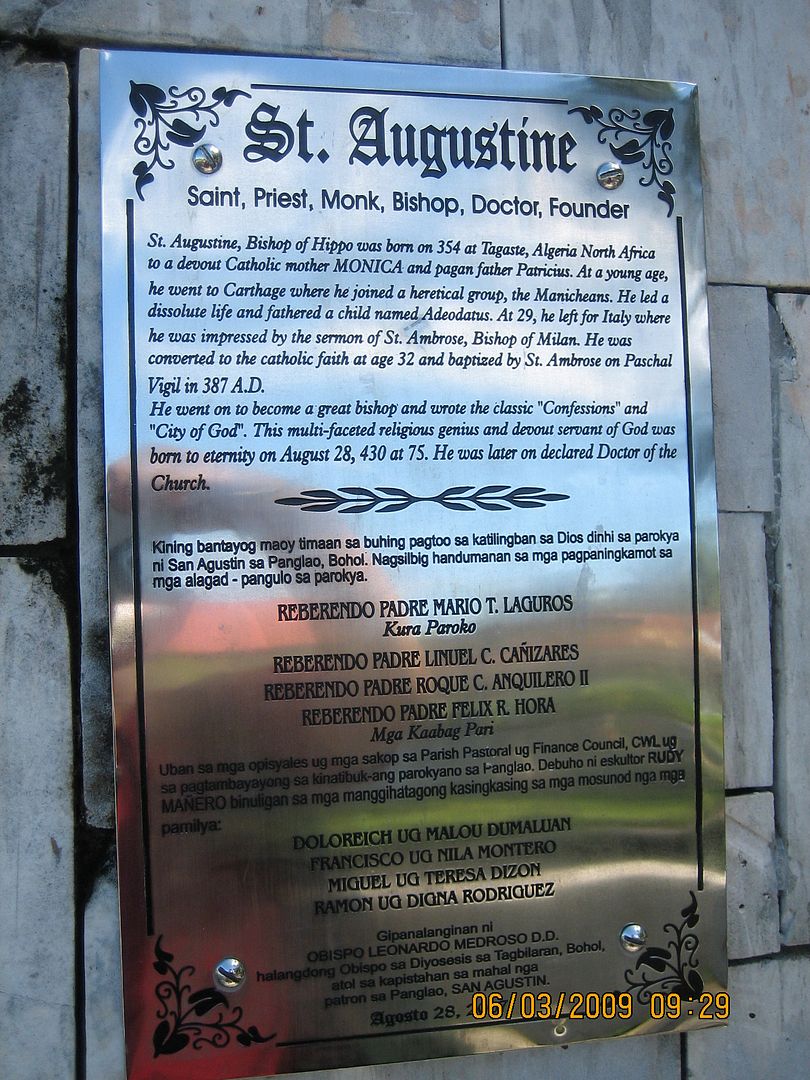
is this large painted concrete image of Saint Augustine, the town’s patron.


A marker on the base informs us that this was erected quite recently, in 2007, that it was blessed by the Bishop of Tagbilaran on the saint’s August 28th feast day, and that the sculptor was a certain Rudy Mañero.


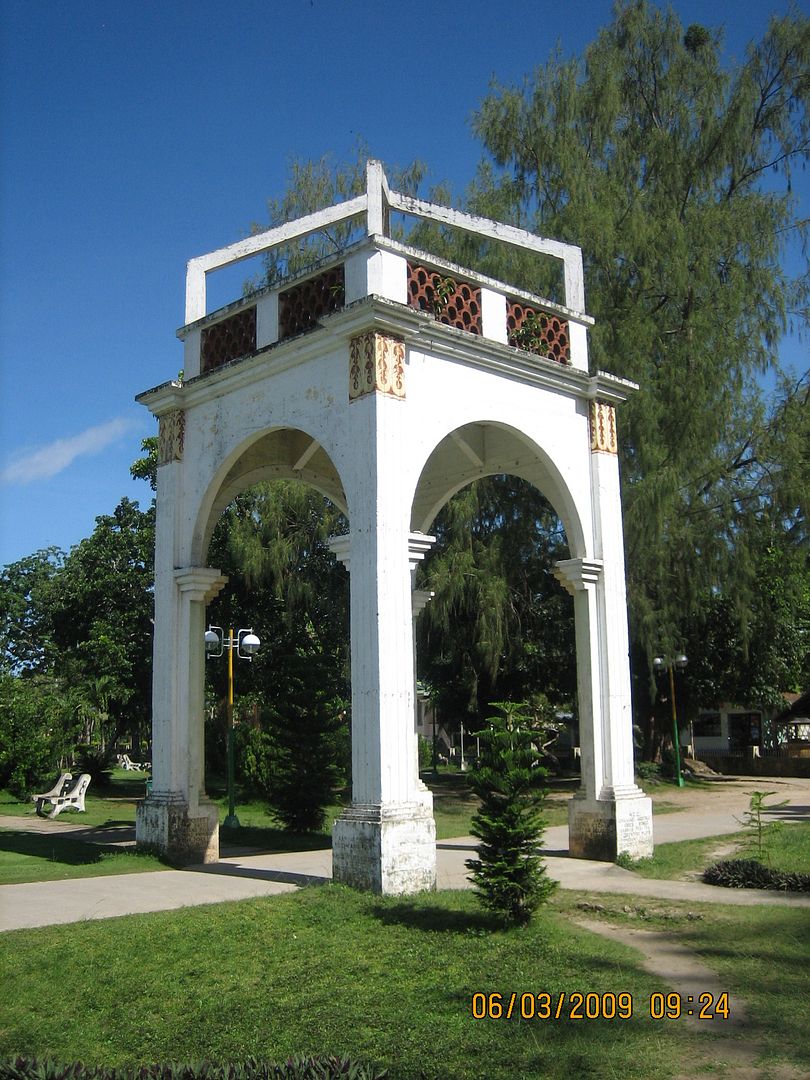
On a straight pathway connecting the main door of the new church at a perfect ninety-degree angle to the main road is this curious structure.


My Cloma cousins tell me that in fact many places in Bohol have structures just like this one in their church plazas.  They explain to me that this is where the child playing the part of the Angel ascends to and waits for the Salubong (Easter Sunday Dawn ceremony).  The karo of the Mater Alegria (the Blessed Virgin Mary as the Joyful Mother) is wheeled into position right under this structure,


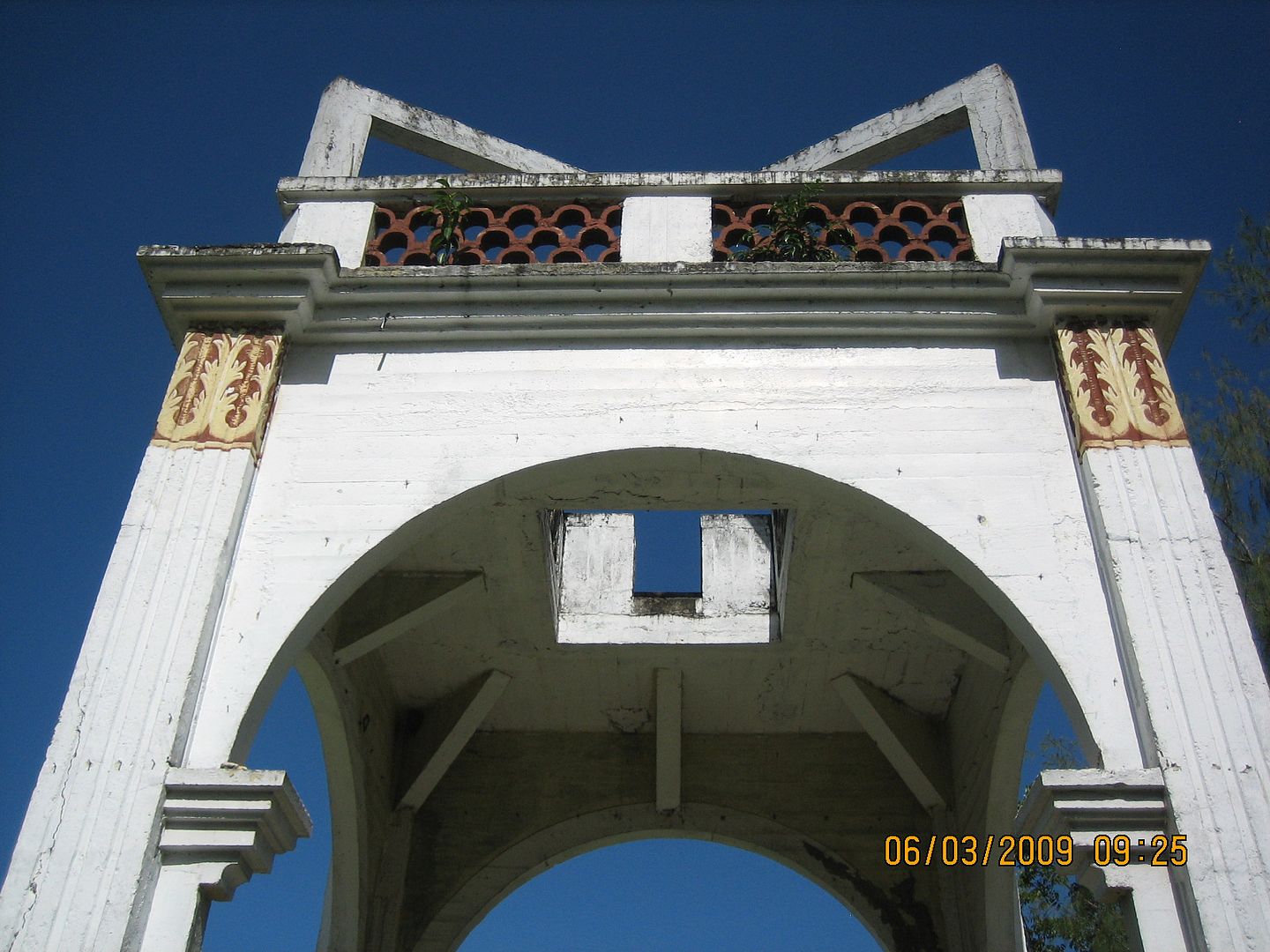
and through a hole in the floor of the upper platform,


the Child-Angel takes off the veil on the image while singing the Regina Cæli.

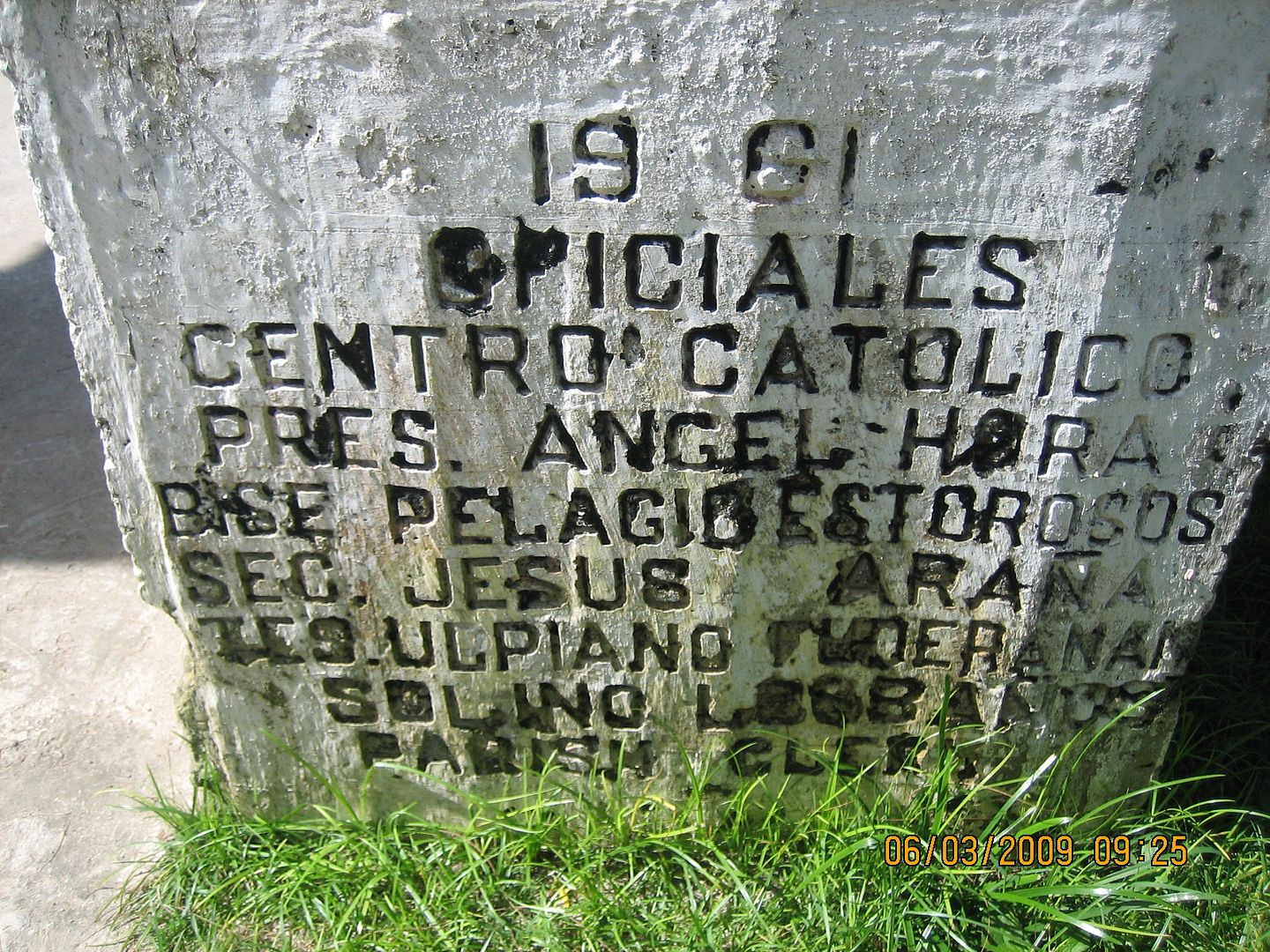
Based on inscriptions on the bases of the legs of the structure,


this was built in 1961,or nearly half a century ago.


Isn't it admirable that they would go to all this trouble and expense to build a structure that would only be used for a few minutes once a year?

From this structure, one gets a very good head-on frontal view of the church façade.


We walk back towards the church, and to its left side, where we view the old convento, likely contemporary with the older church and probably connected to it at the latter’s rear (which means that the old church must have been quite long, to make up for its apparent narrowness).


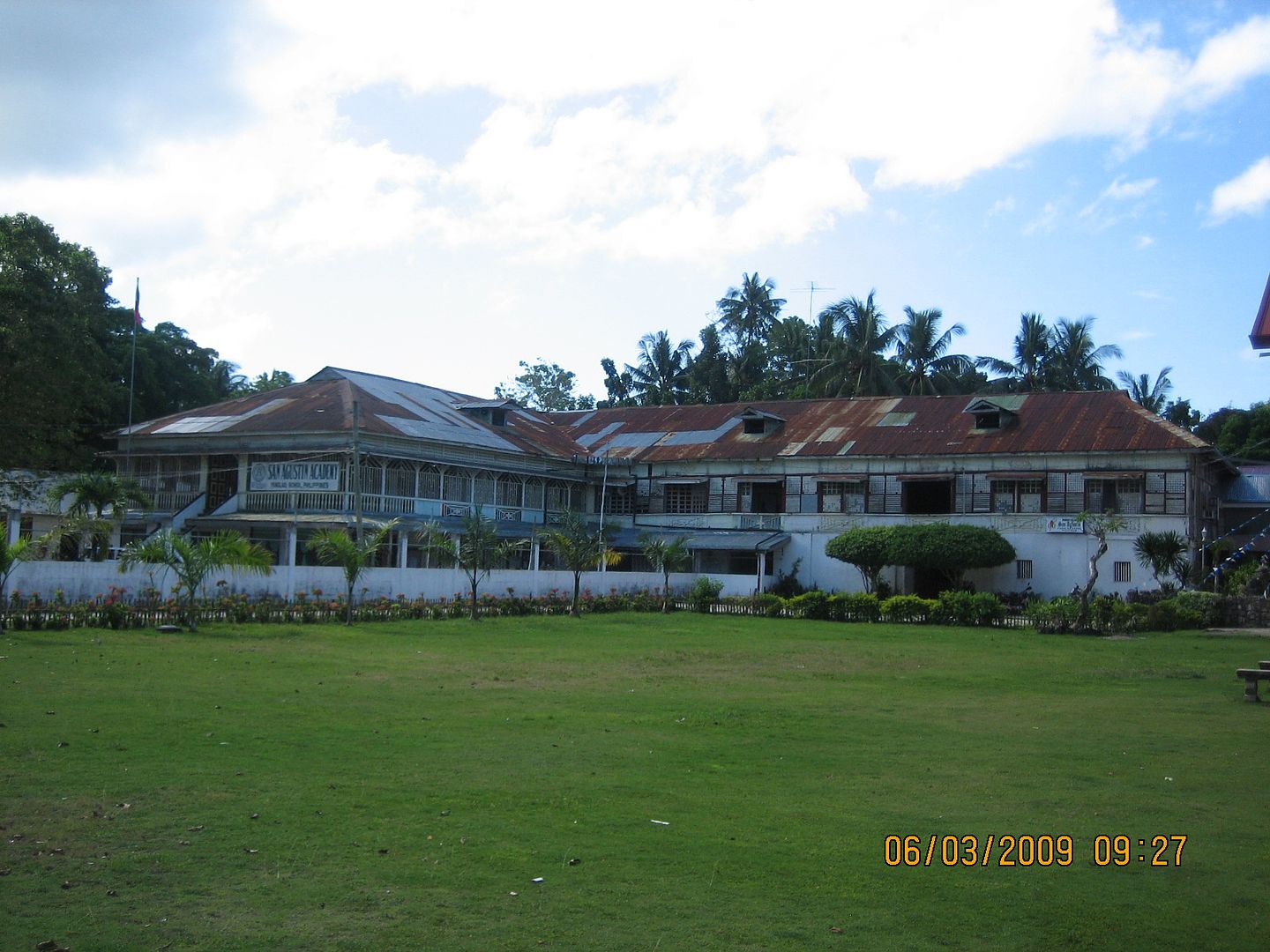
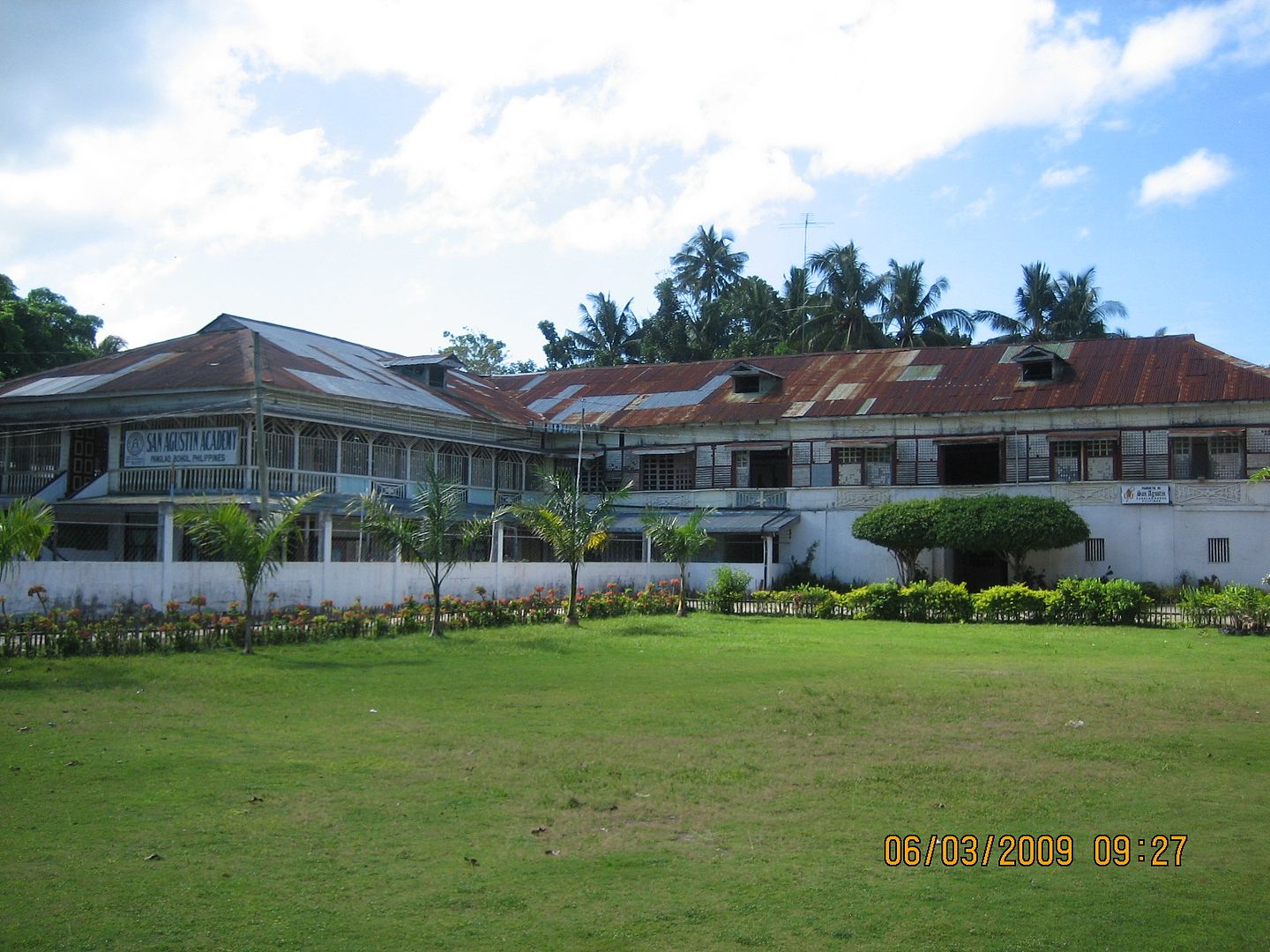
This L-shaped structure is now shared by the church rectory and the parochial school, the San Agustin Academy.


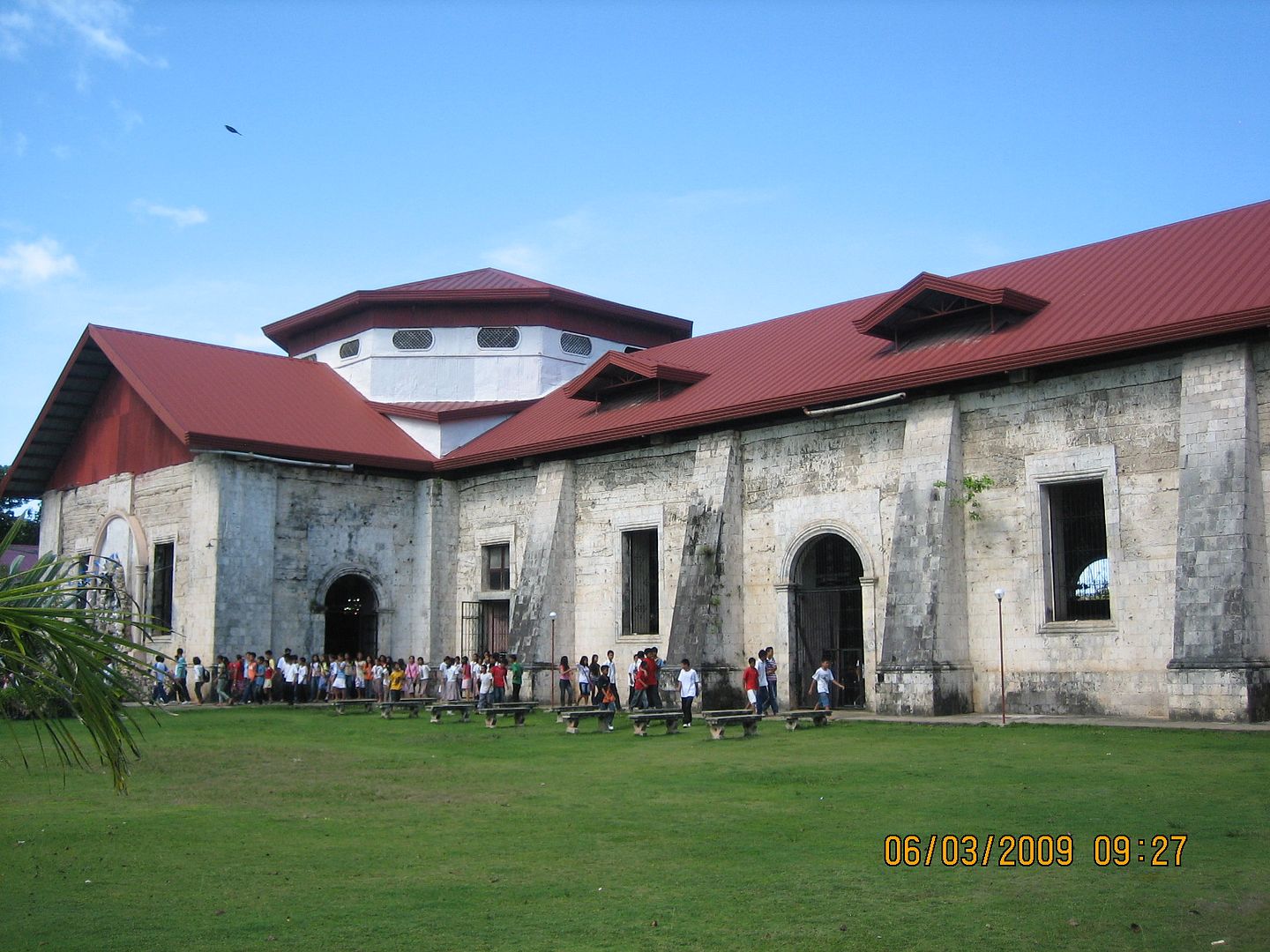
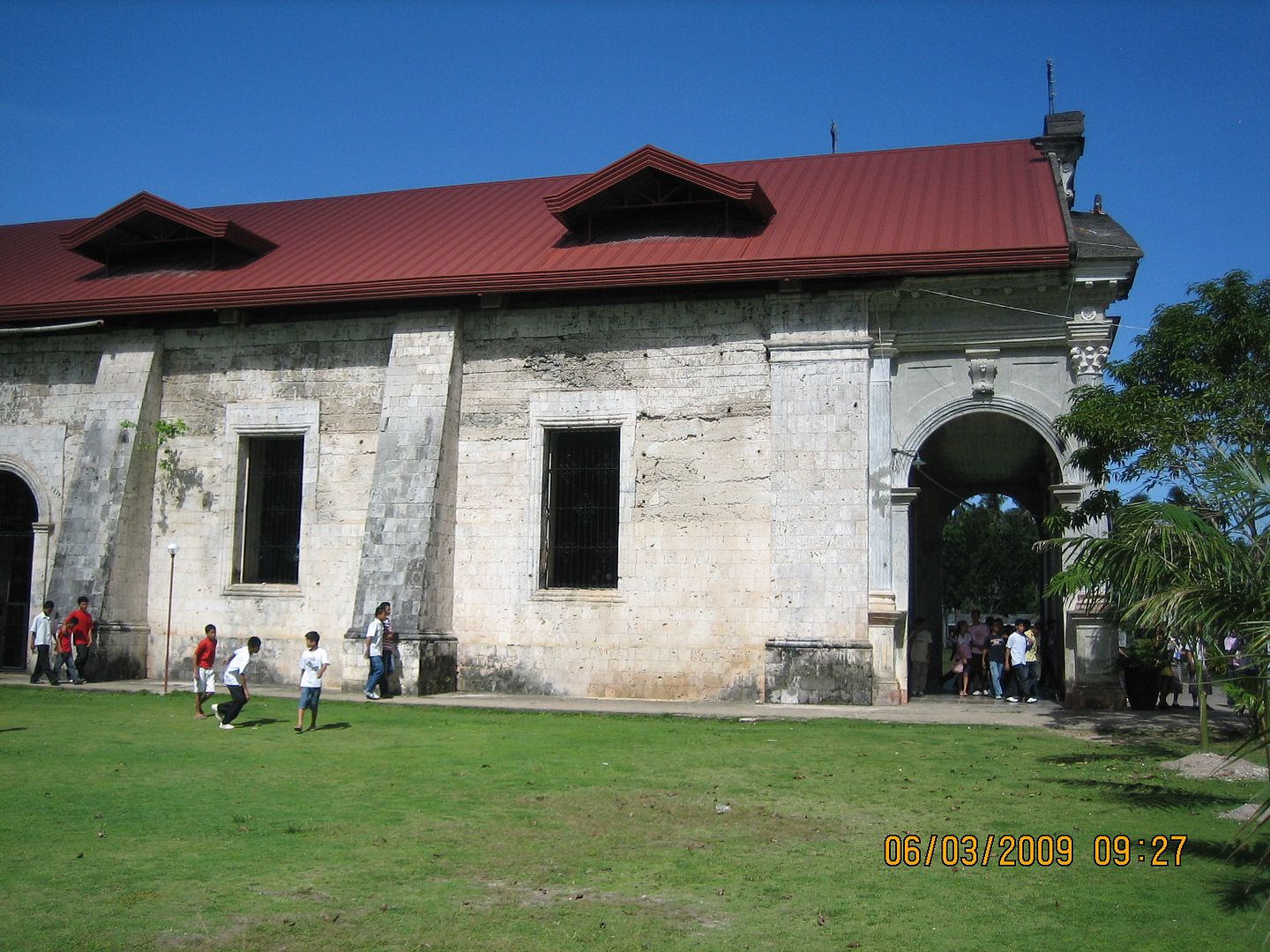
From right in front of the convent-school and across the grass-covered quadrangle, we get a good view of the church’s left-side elevation, again featuring its coral stone walls, new red roof with dormer-window-type exhausts, and octagonal crossing above.


The depth of the portico-façade is also better gauged from this side elevation.


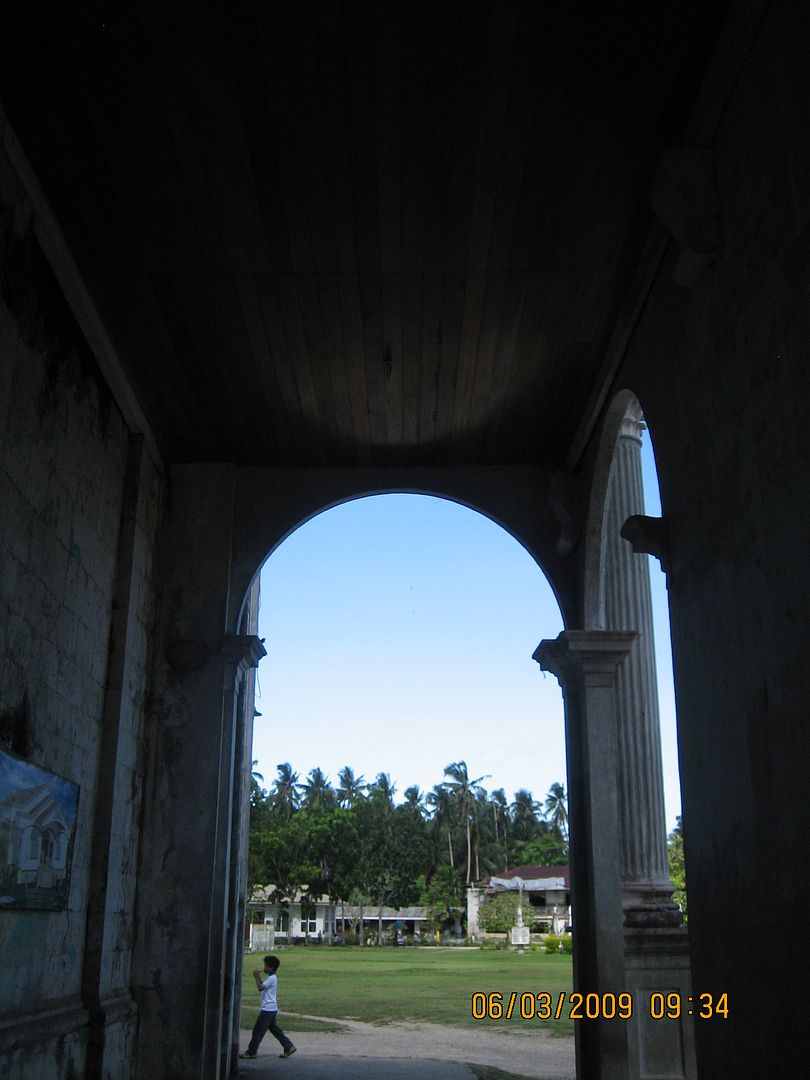
Noticing the hordes of young people (likely students of the parochial school) streaming out of the side and front doors, I realize that the morning Mass is over, so I make my way inside the church.  I pass via the porticoed entrance


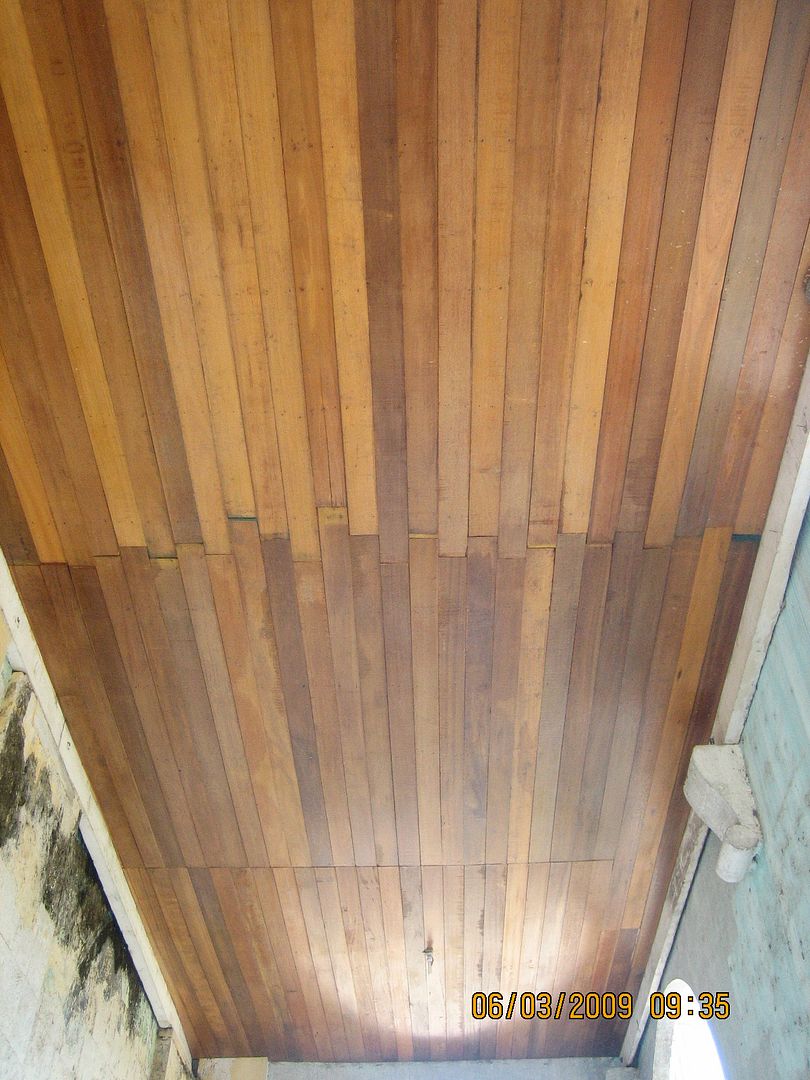
and note that the ceiling of the portico – which would also be right under the floor of the choirloft above, has been restored and is in very respectable shape.


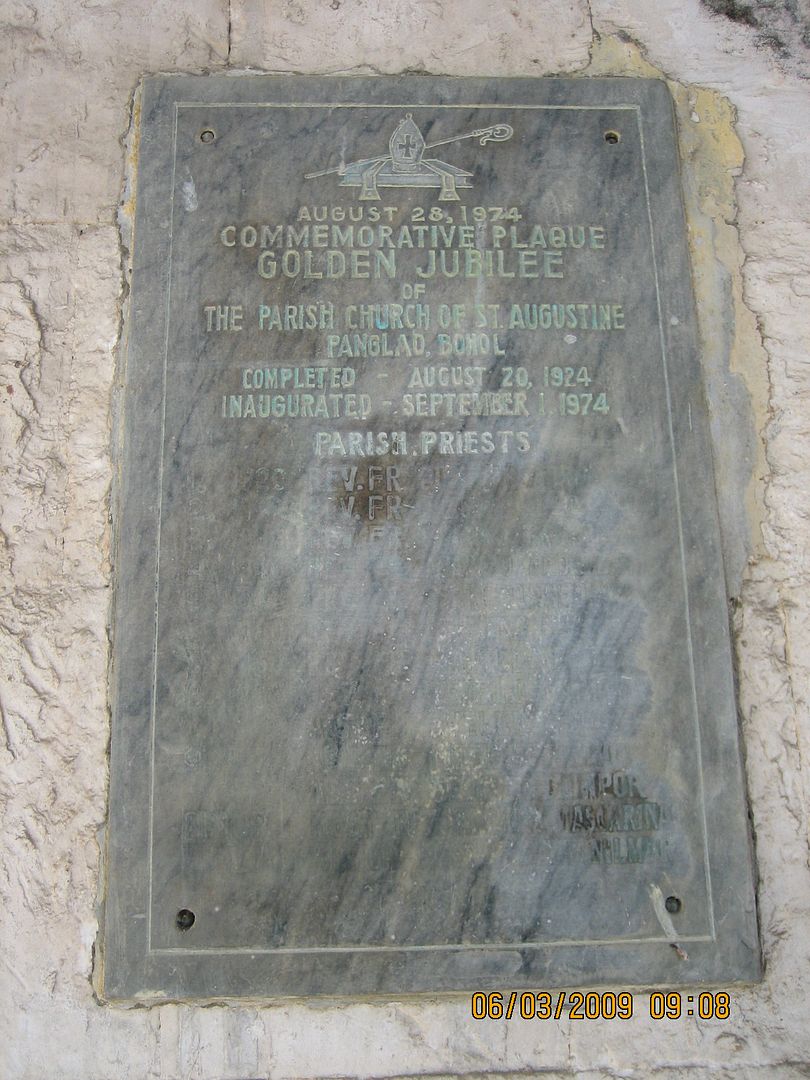
There is also a golden jubilee marker from 1974 on the wall inside the portico to commemorate the fifty years since the church was inaugurated.


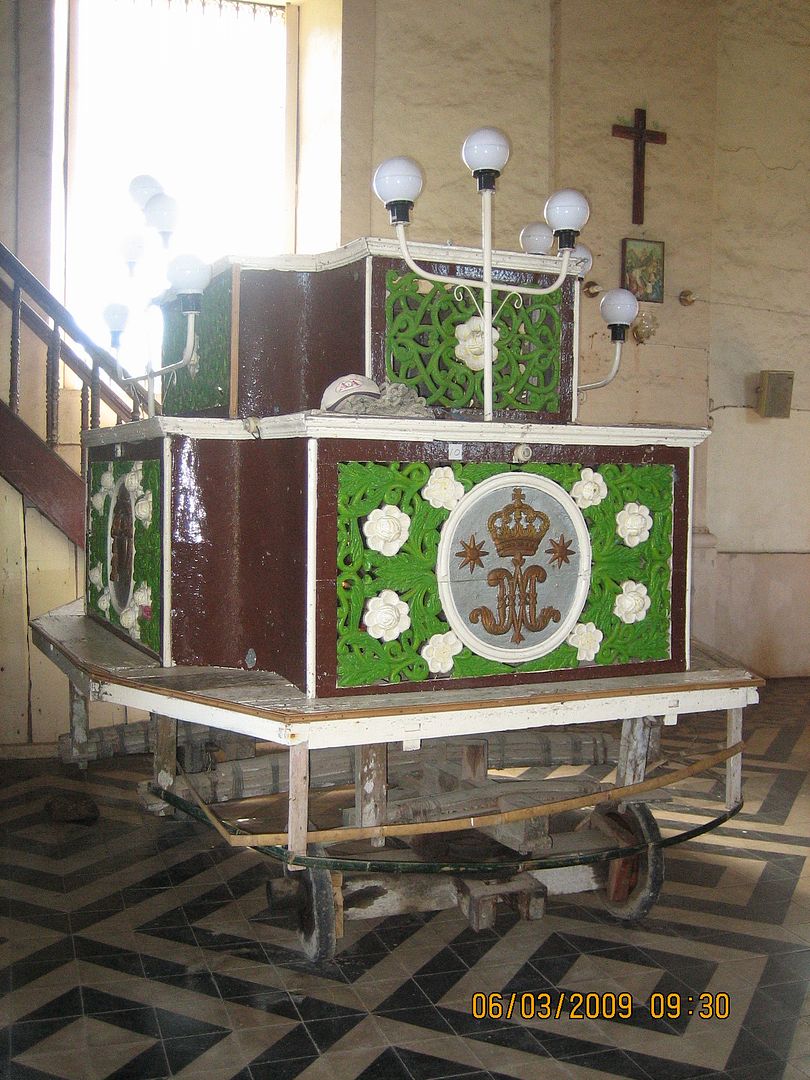
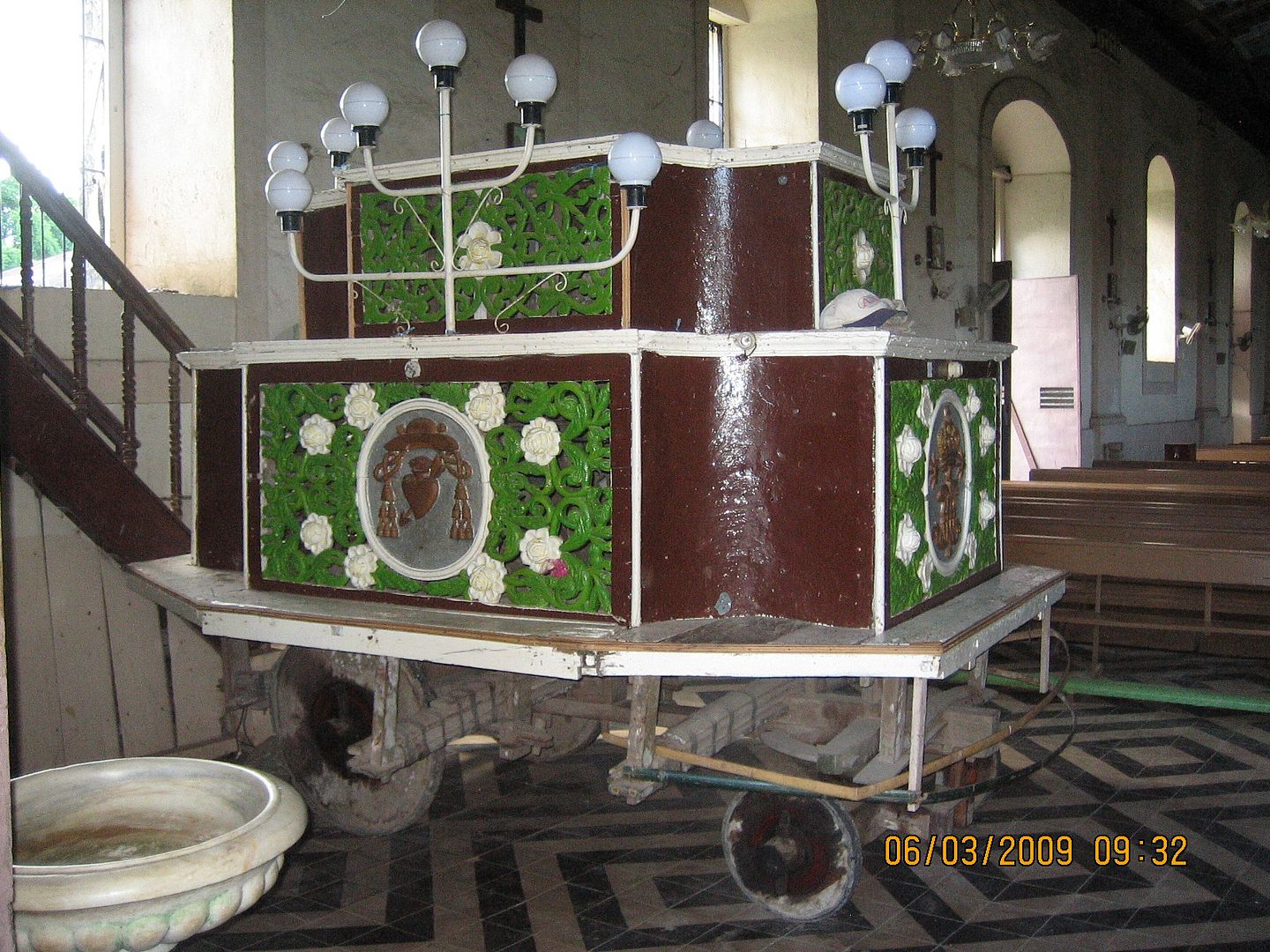
Right inside the main doors is an entrance vestibule, which also serves as the parking space for a strange-shaped carroza.


This no-nonsense battle tank of a karo has solid wheels, as well as Marian and other emblems.


I ask my cousin what processional image usually rides on top of this, and he says that he believes that the town’s Santo Entierro is mounted on it for Good Friday, strangely enough. I wonder if he has just misremembered.

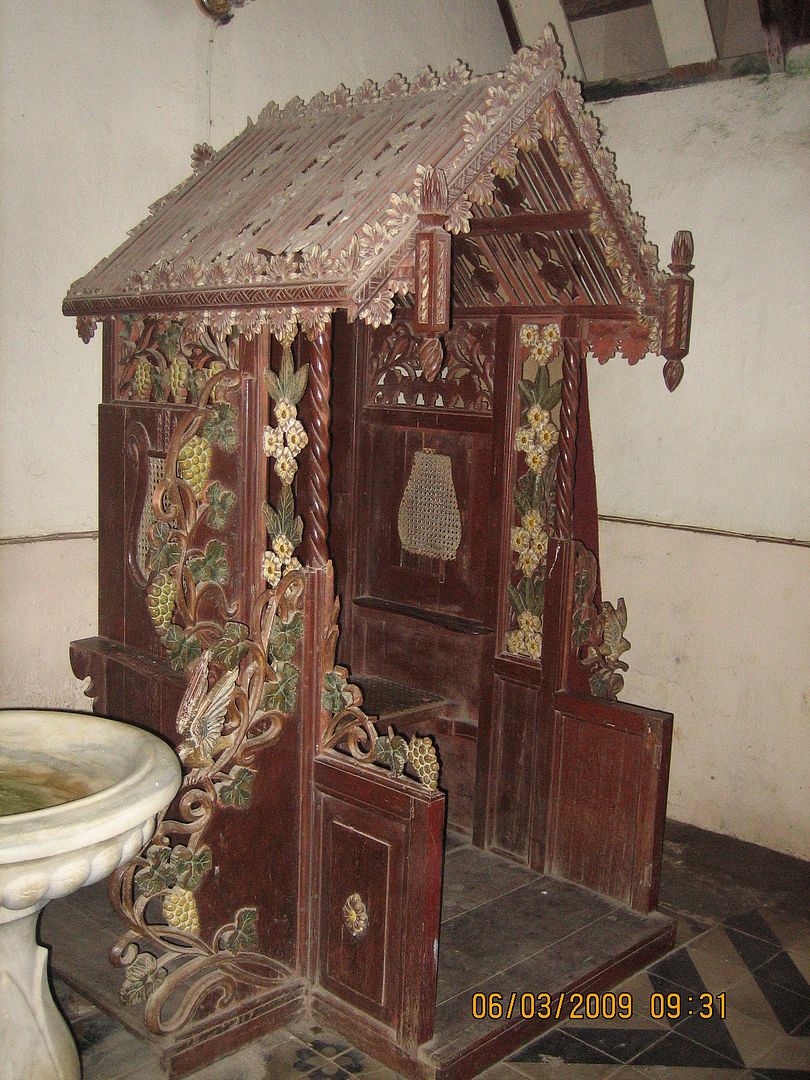
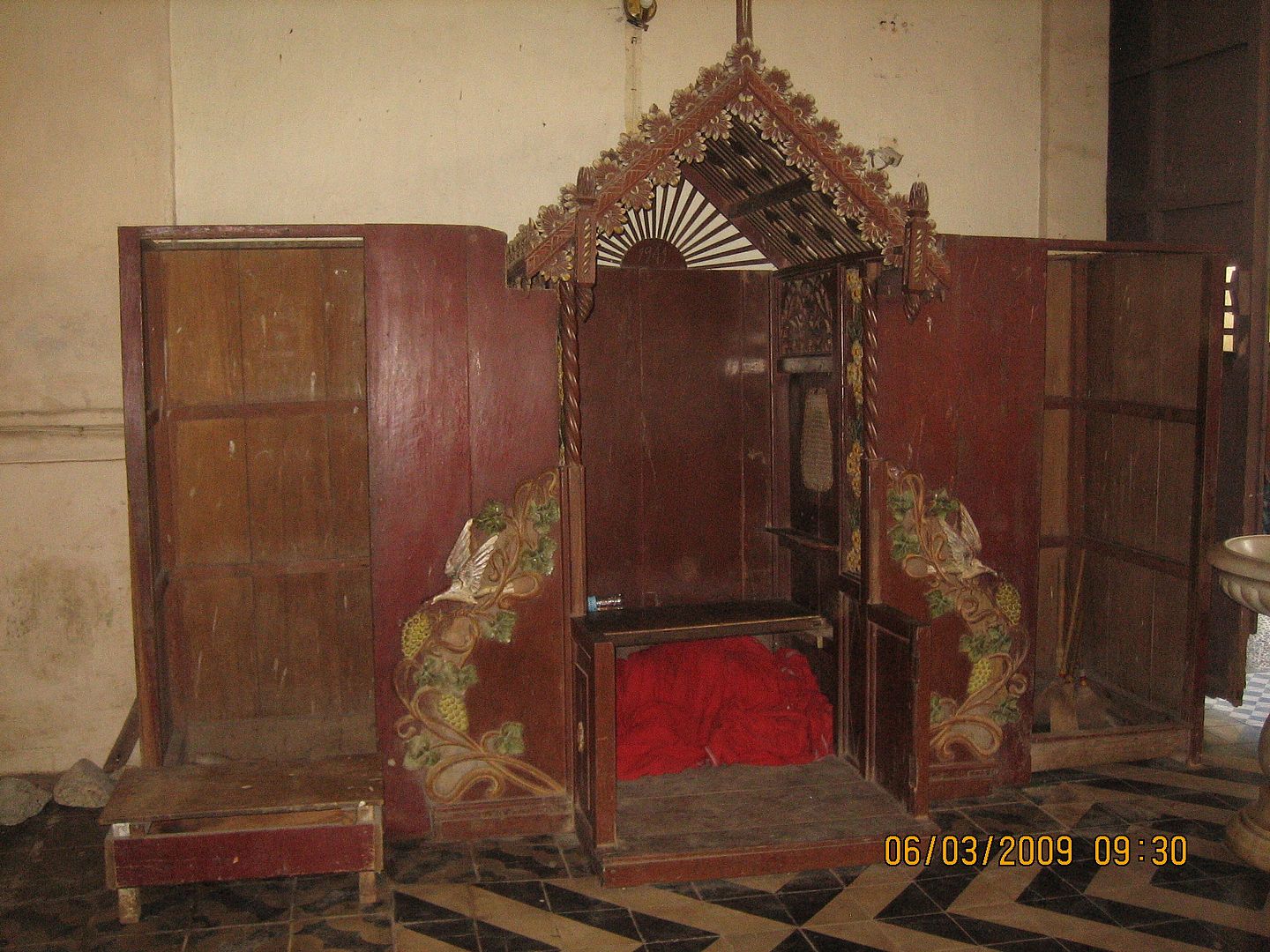
By the entrance are also two very interesting confession boxes, one an ornately-carved and polychromed specimen,


and the other a wider more articulated version of the first one with separate box sections for the penitents.


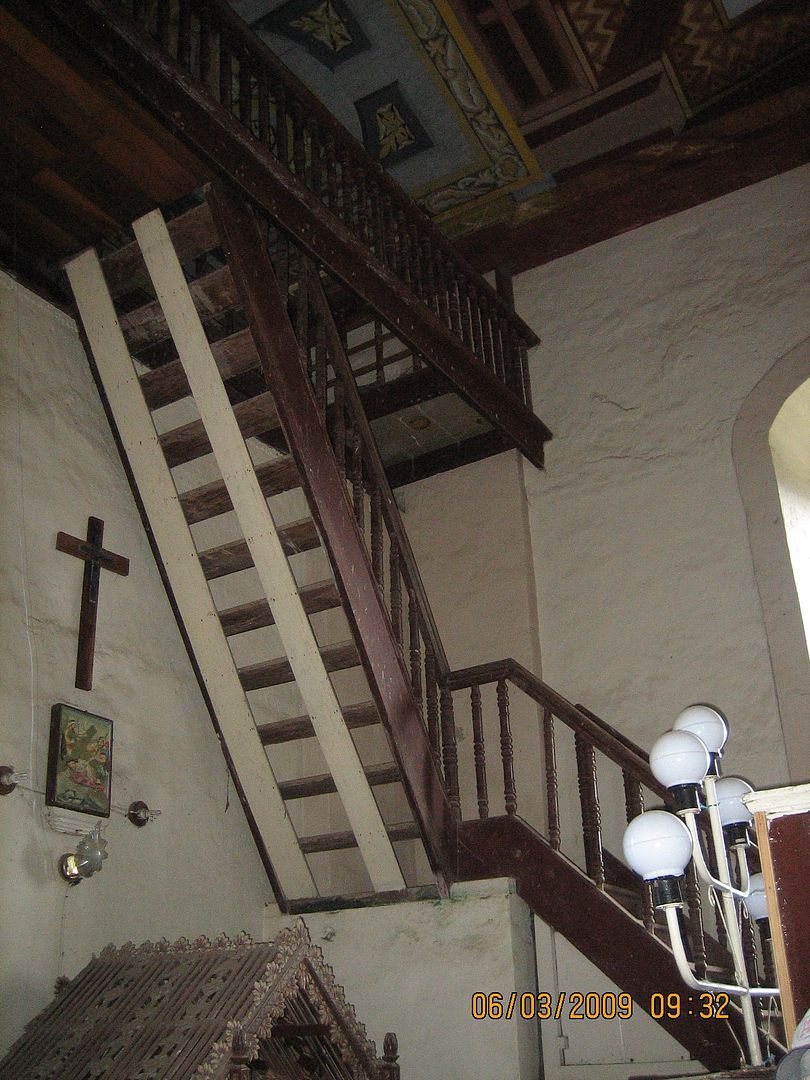
In a corner of the vestibule is a steep staircase that leads up to the choirloft.


Unlike the Baclayon church, Panglao does not have a pipe organ, likely because this church is a newer structure built after the golden age of Recollect-built pipe organs in Bohol in the late 18th to the early 19th centuries.

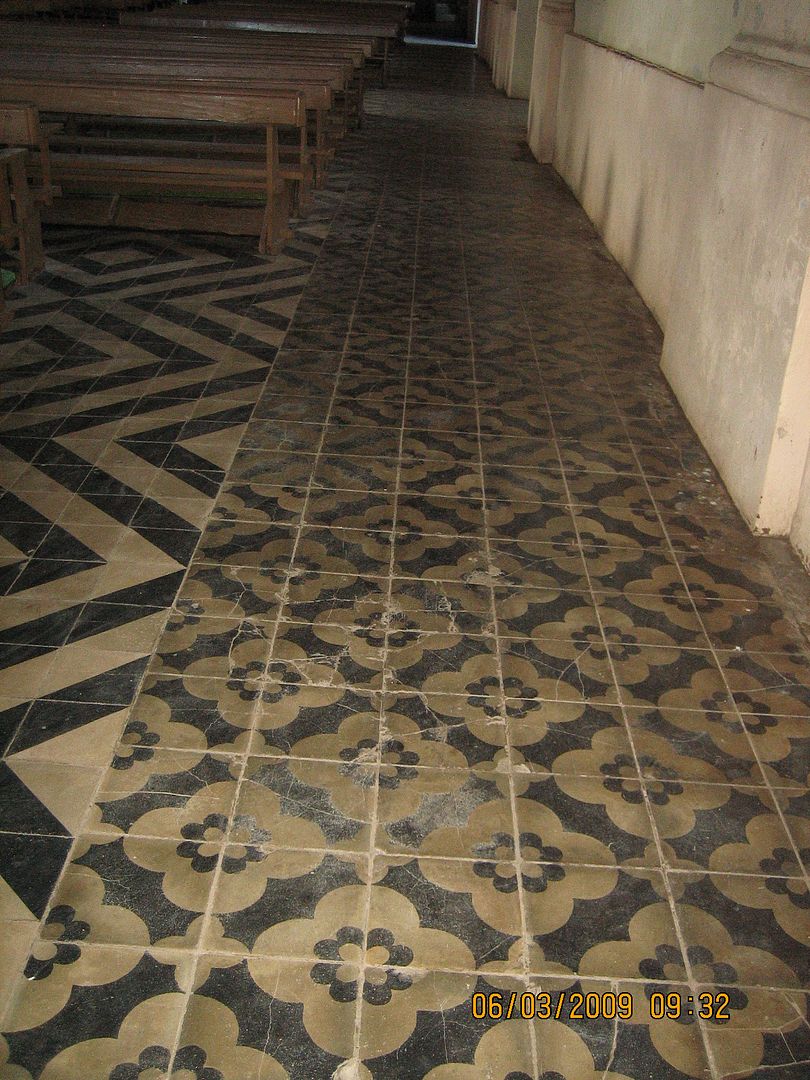
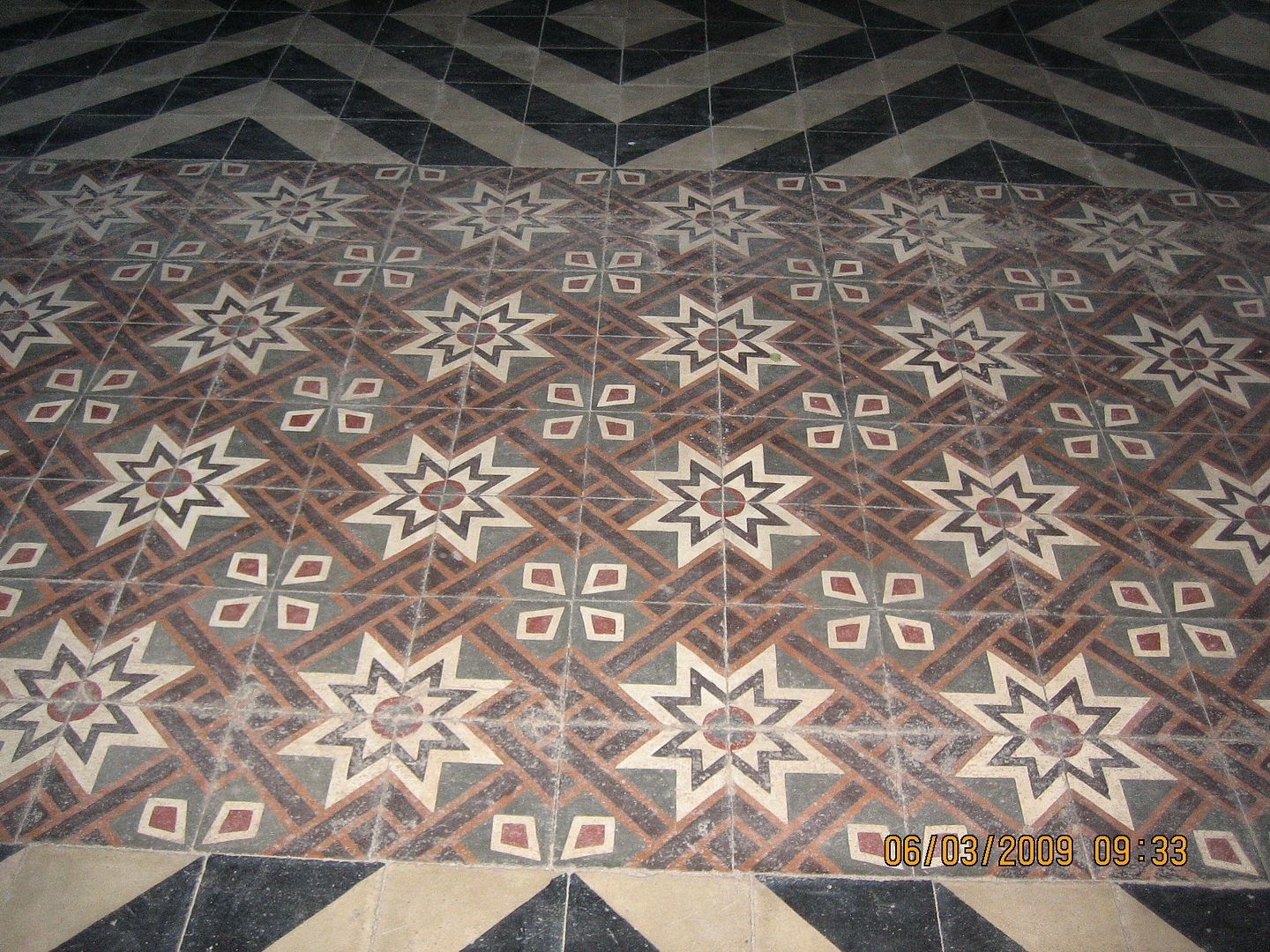
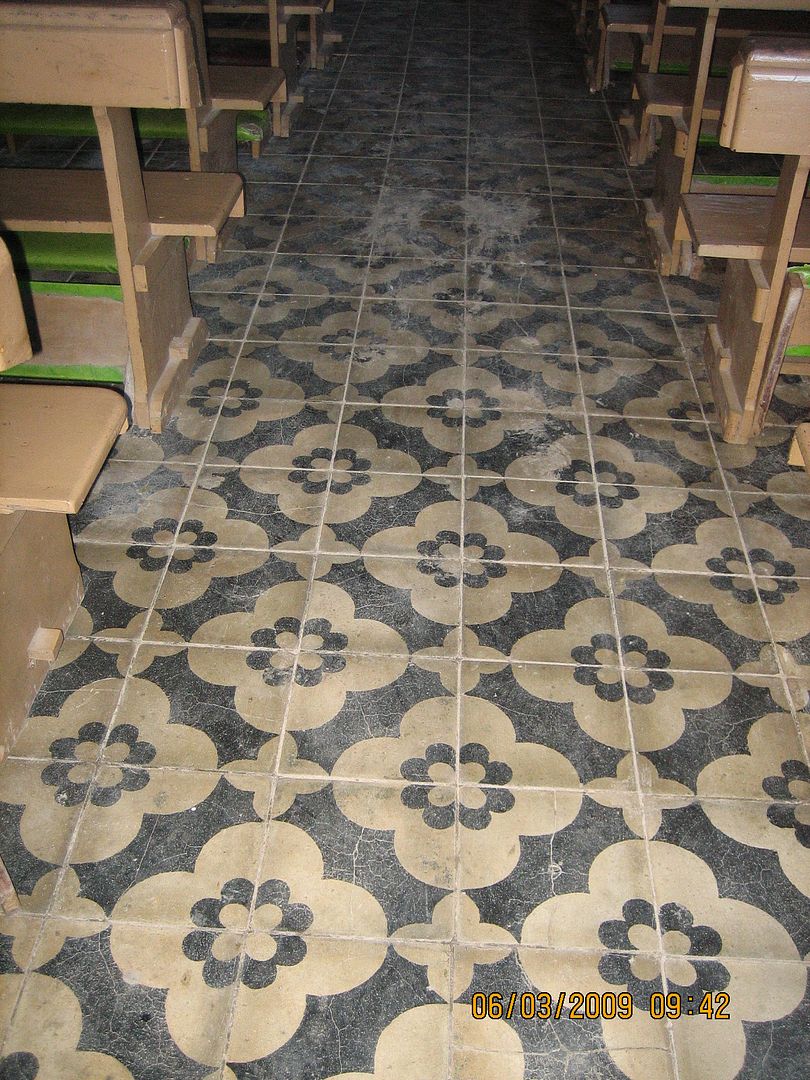
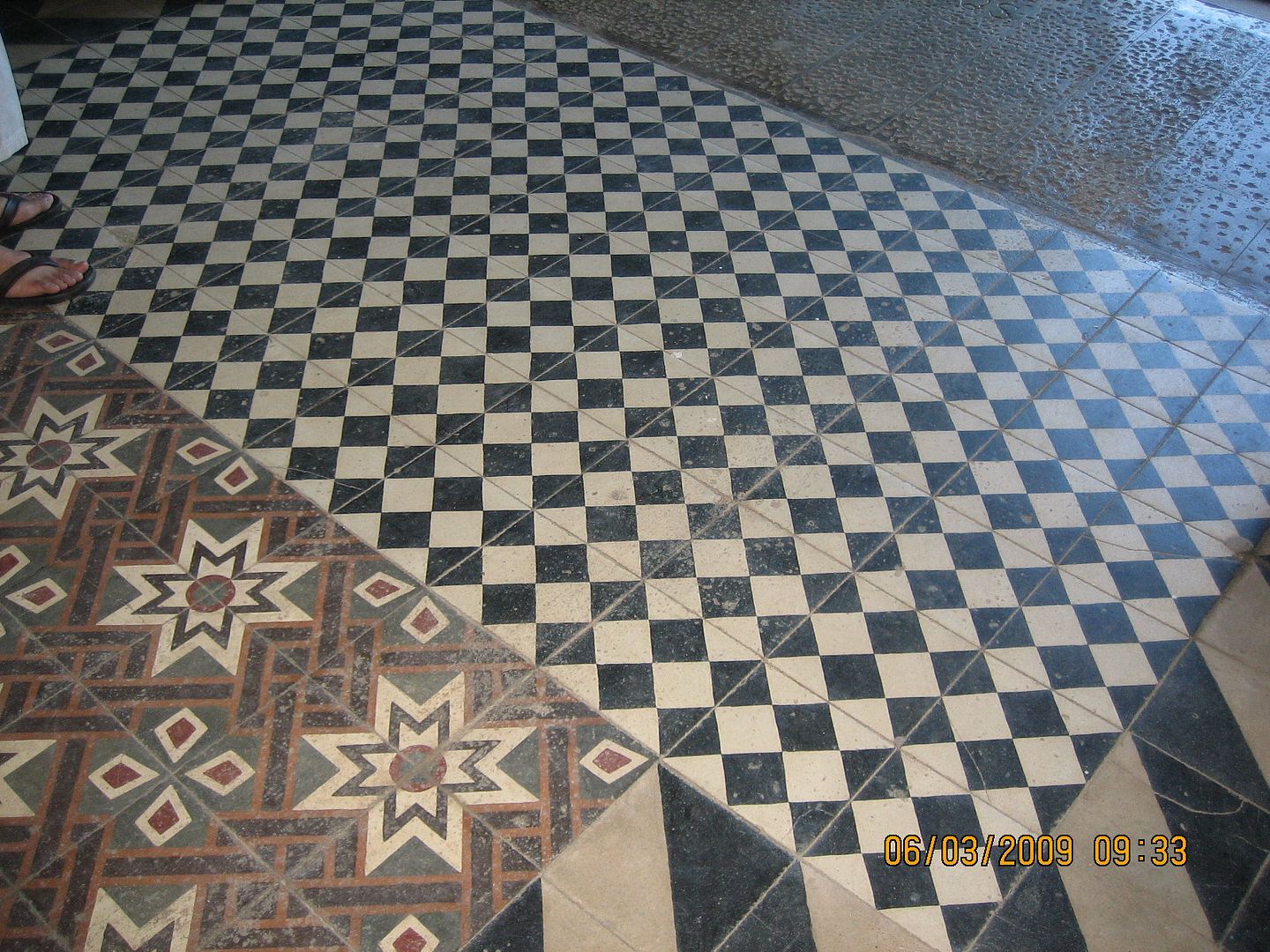
The floor’s original colored cement tiles


in different sizes


and designs


are all still in place


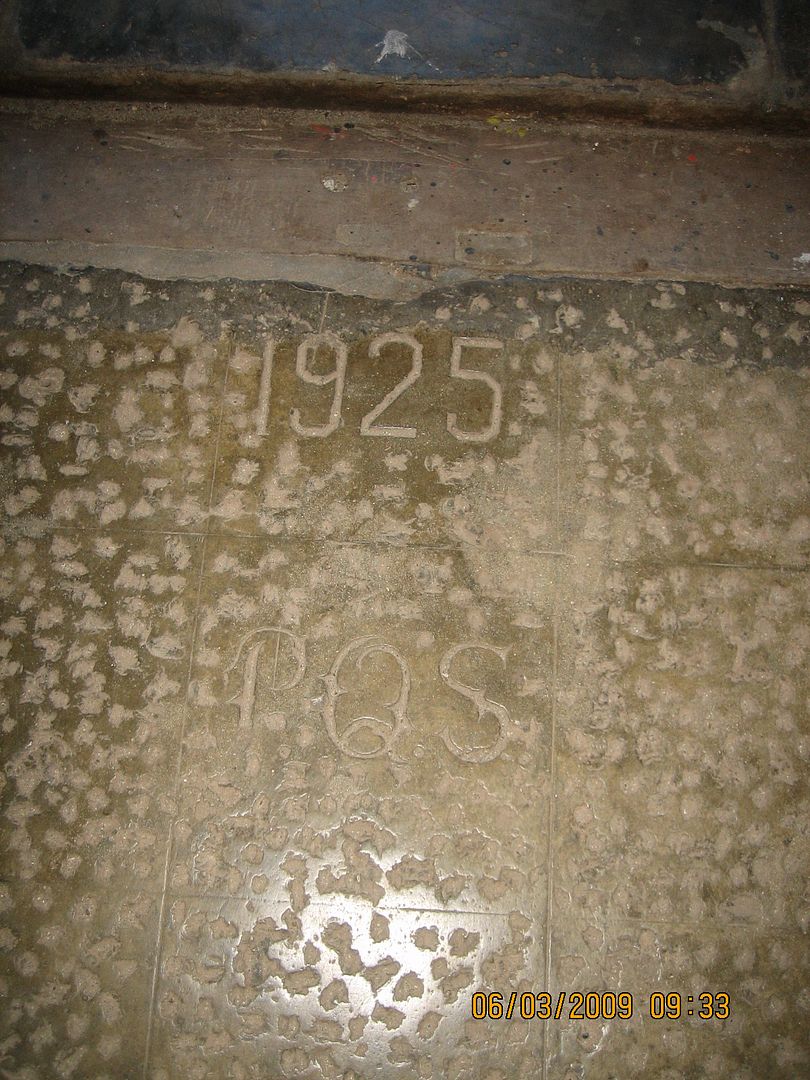
including this inscription into the cement of the floor by – who else – Padre Quiterio again, dated 1925, or shortly after the time that the church was opened for regular use, likely when the industrious parish priest completed laying the floor.


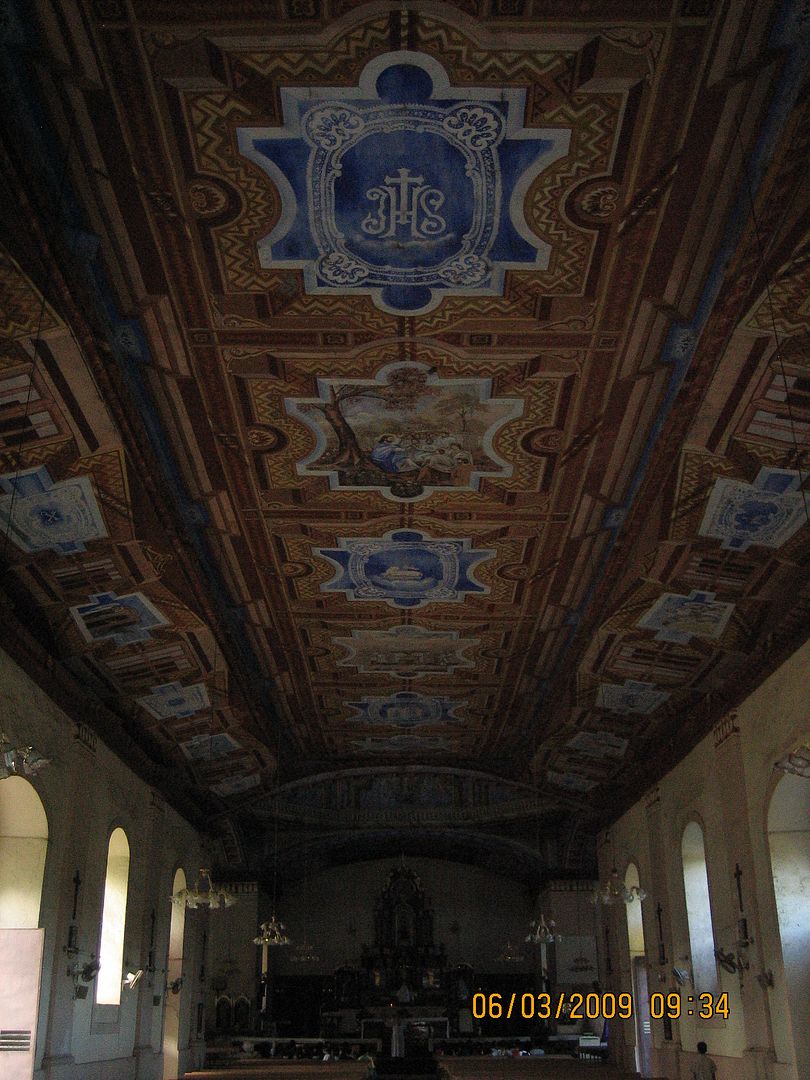
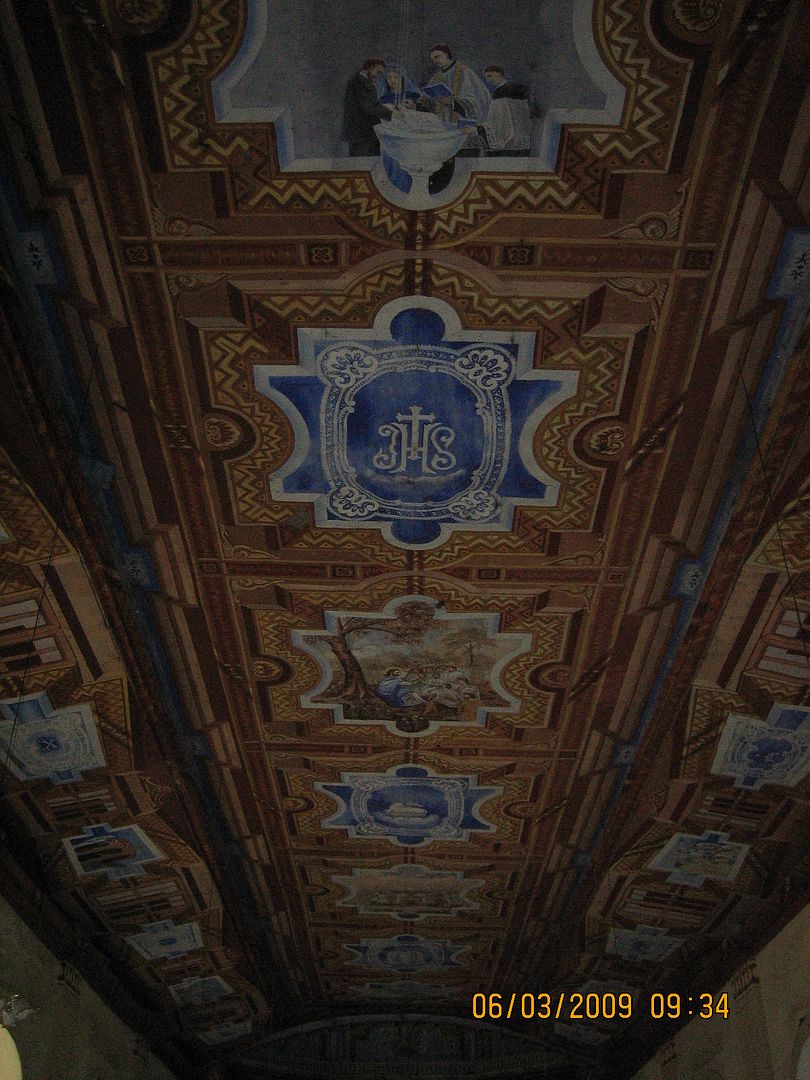
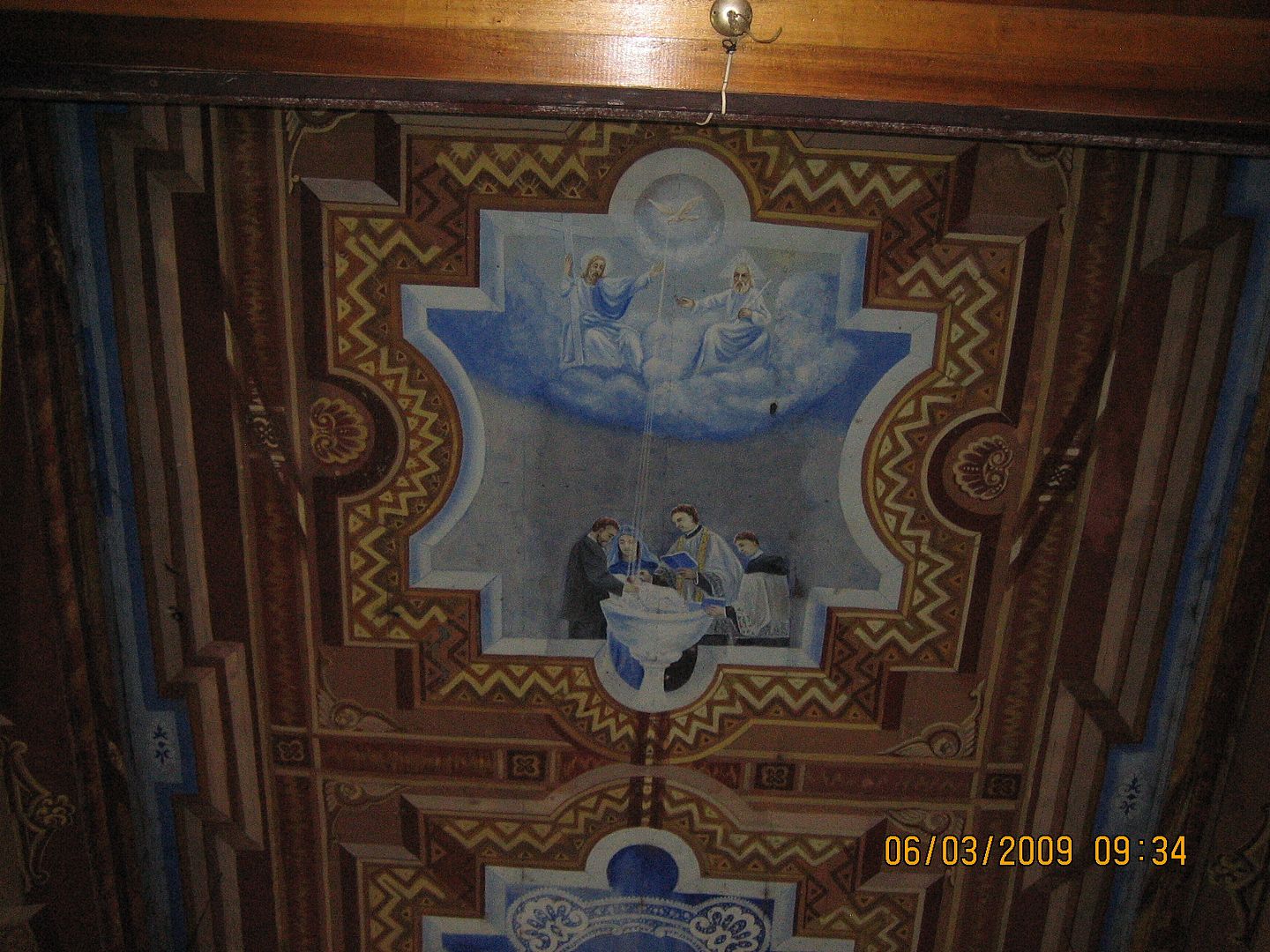
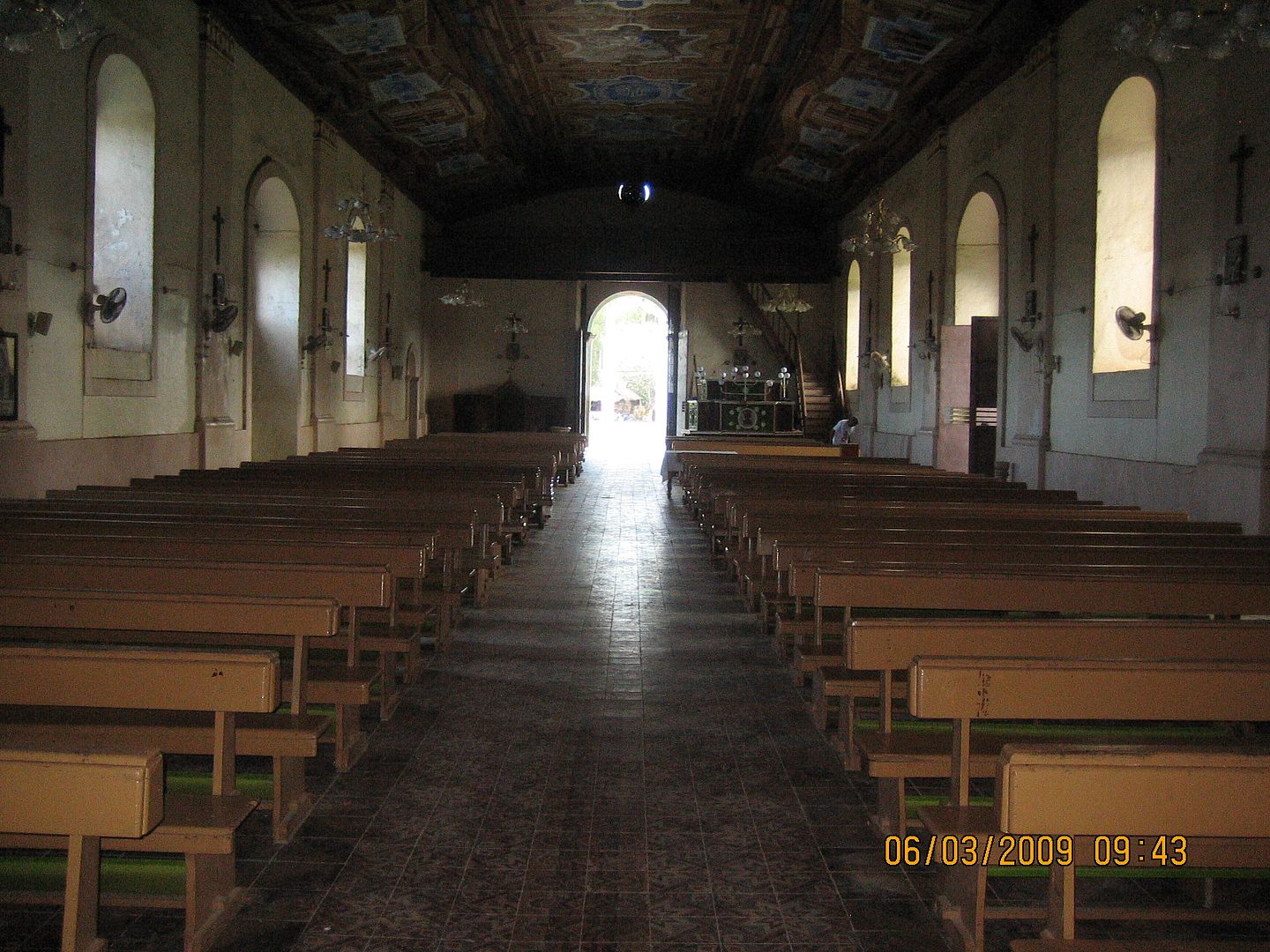
From the entrance vestibule, we make our way up the nave’s center aisle, and, while taking care not to trip, look at the beautiful painted ceiling, another common feature amongst pre-World War II churches in Bohol.


These Bohol church ceiling paintings were commissioned from two Cebu artists in the 1920’s and 1930’s, Ray Francia and Canuto Avila.


Regalado Trota Jose writes in “Visita Iglesia Bohol” that the ceiling paintings over the nave in Panglao Church are arguably the most unusual in Bohol, because among other things the painted frames are in shades of brown whereas the scenes within are in monochromatic lavender, and lavender and brown make a strange color combination. Perhaps P.Q.S. was somewhat color-blind?


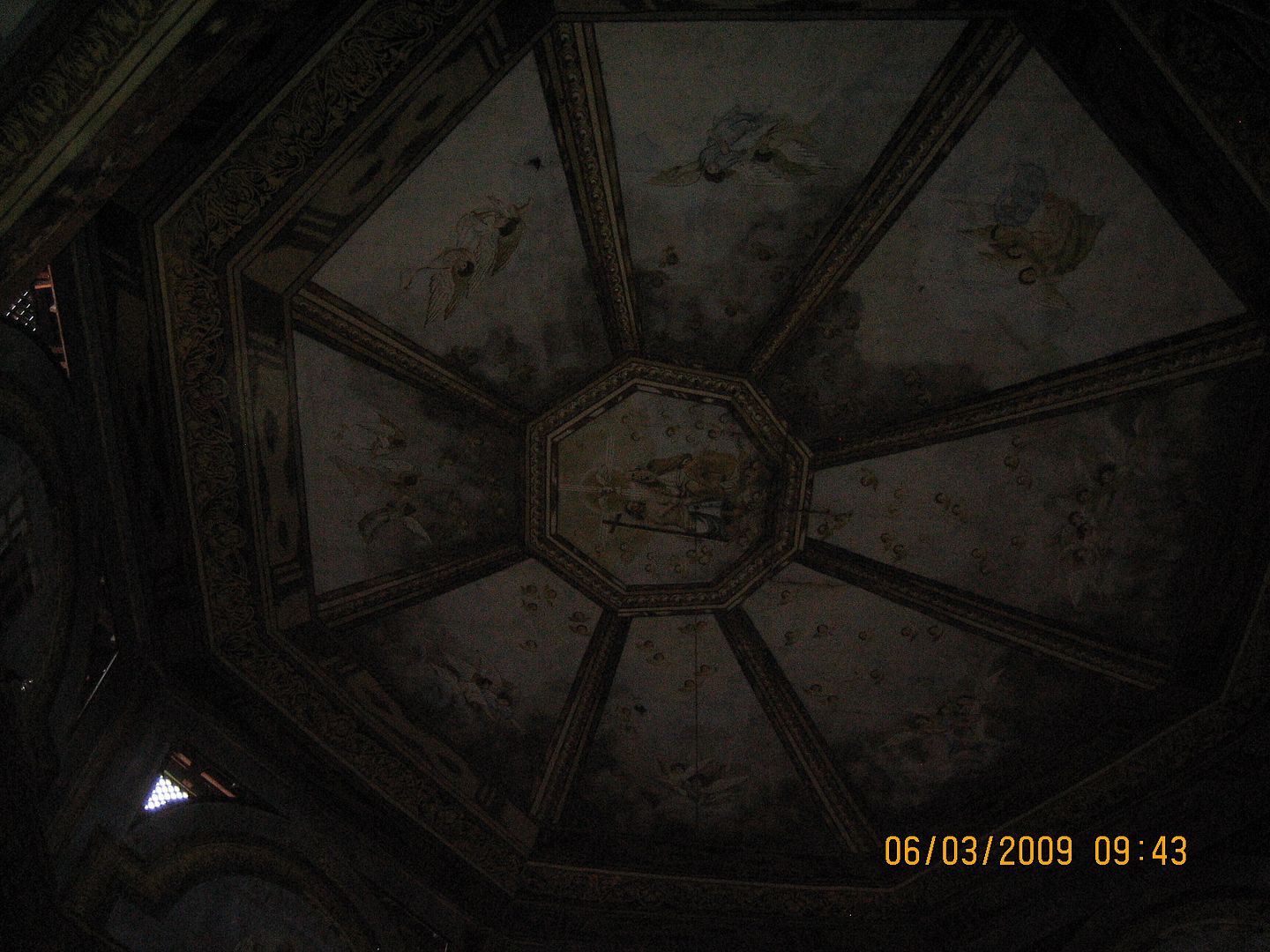
The design of the ceiling painting under the octagonal crossing-dome is impressive, though now appears faded somewhat.  Or perhaps my pocket camera and myopic eyes just could not capture its vivid detail.


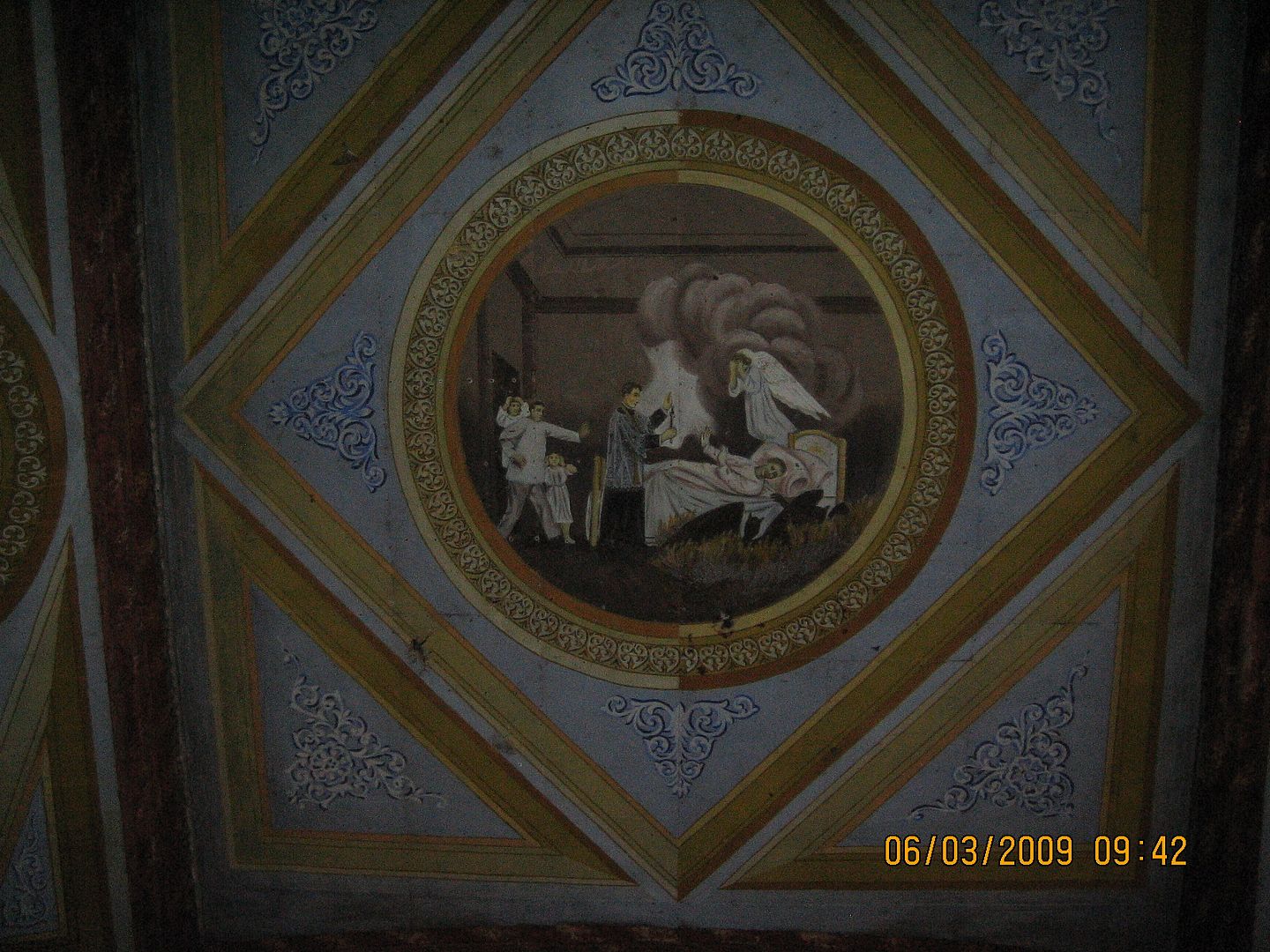
Some of the scenes depicted were quite compelling.  One of them appears to tell the story of a man on his deathbed refusing the last sacraments and instead leaning towards Hell, to the horror of his family, his guardian angel, and the priest.


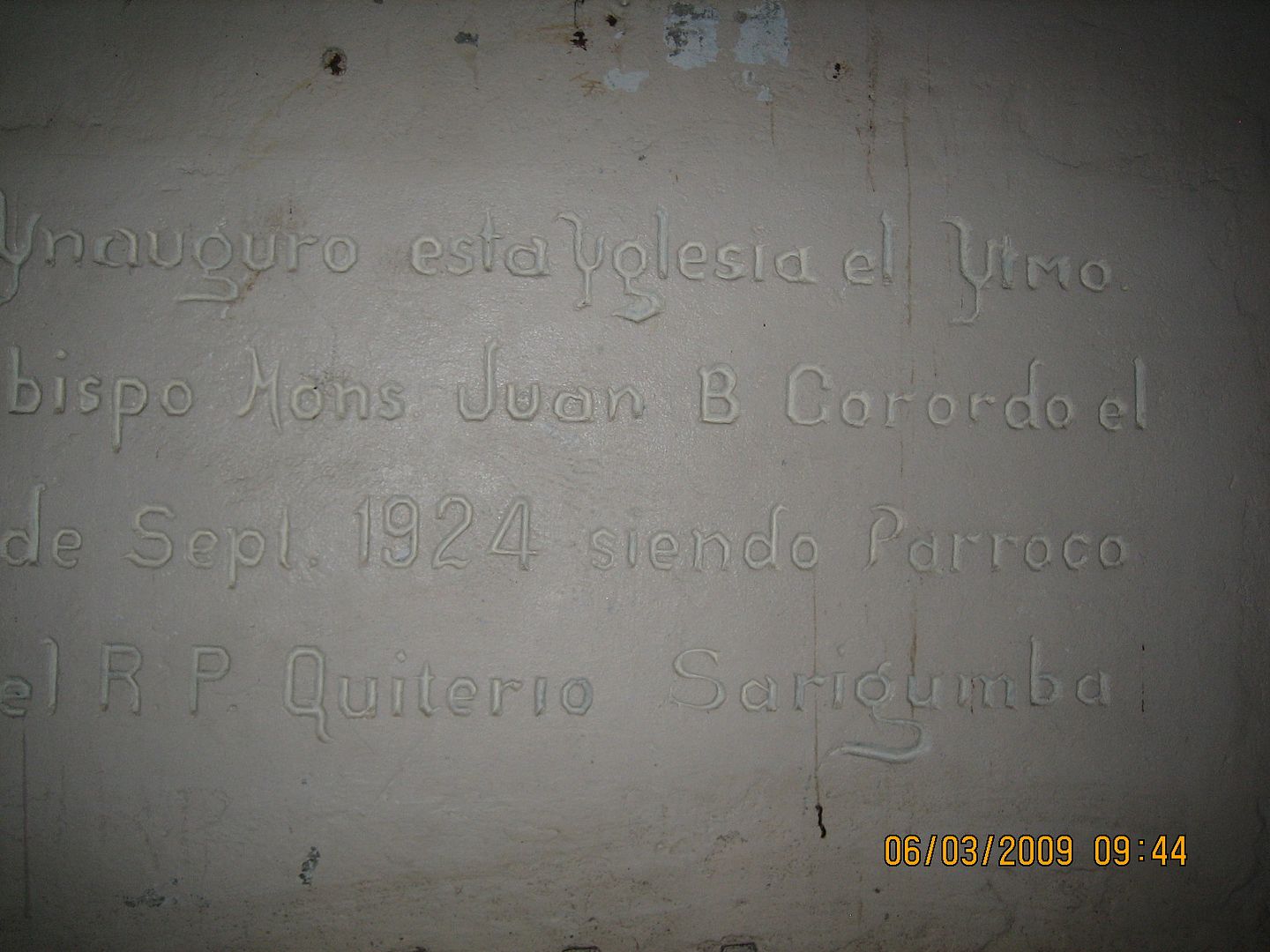
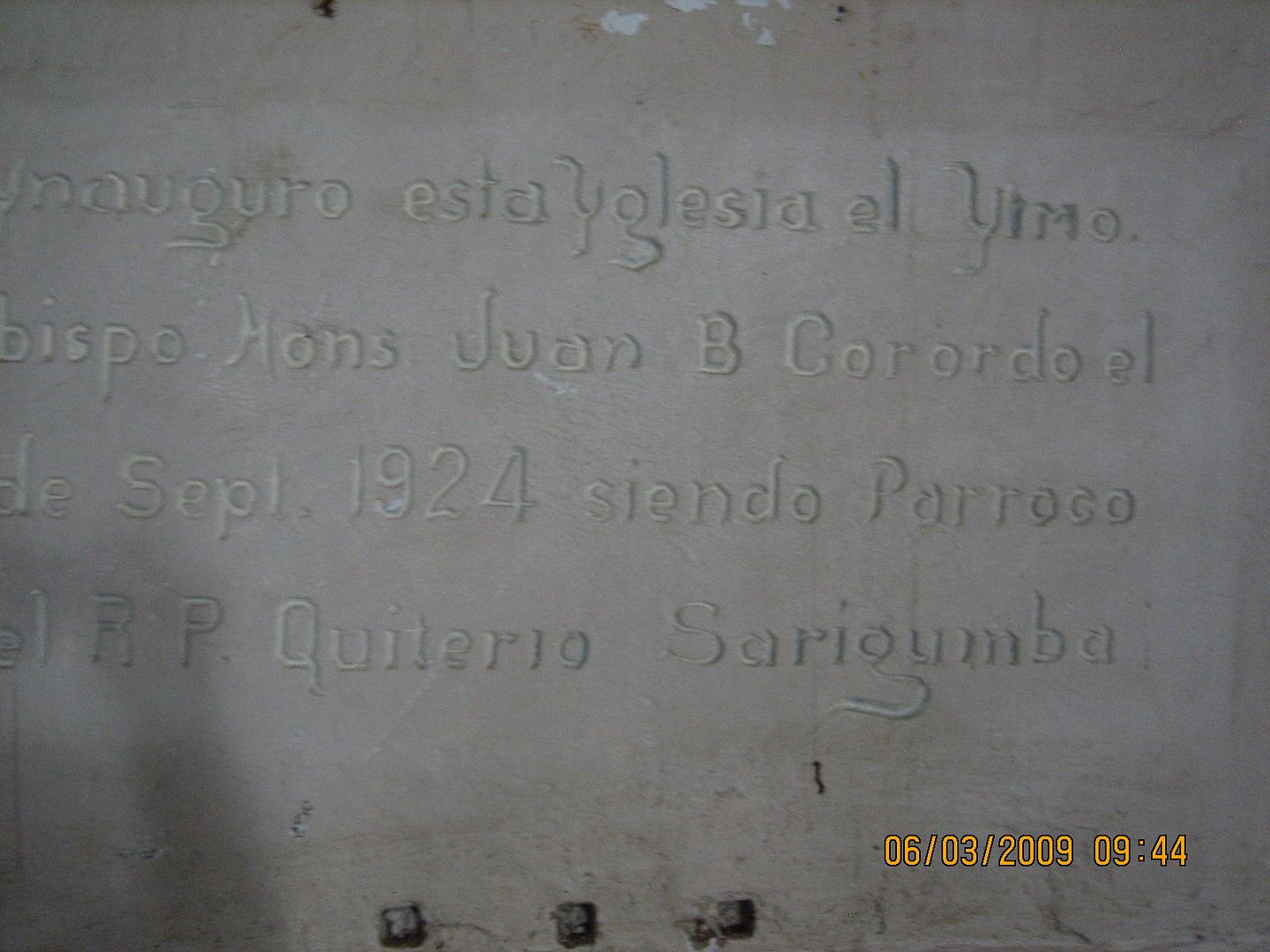
We spot another inscription in one corner of the crossing under the octagonal painted ceiling,


telling us that the church was inaugurated by Monsignor Juan Gorordo, the Bishop of Cebu, on September 1, 1924, during the term of parish priest Padre Quiterio Sariguimba.


P.Q.S. is really Bohol’s answer to “Kilroy was here,” isn’t it?

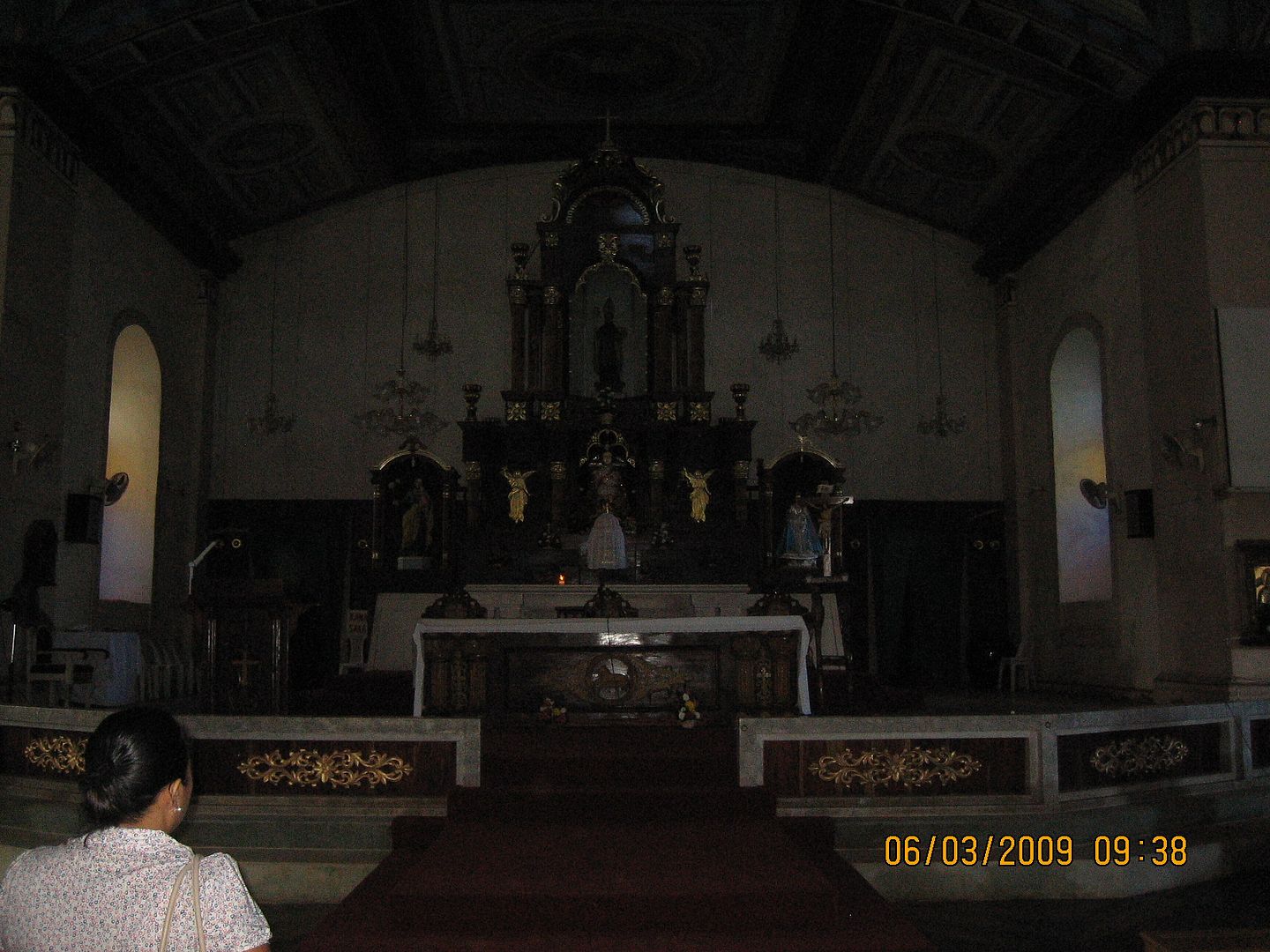
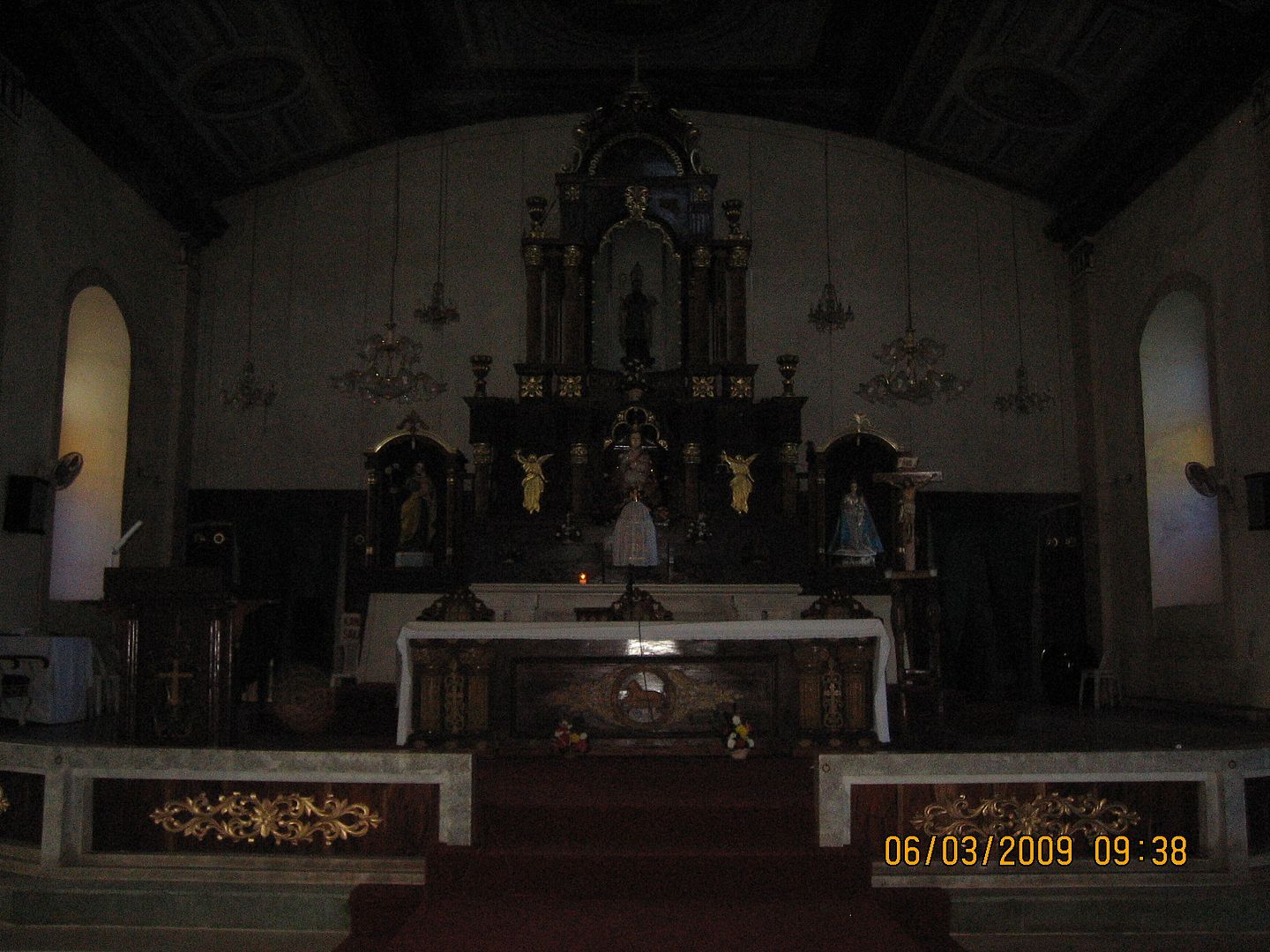
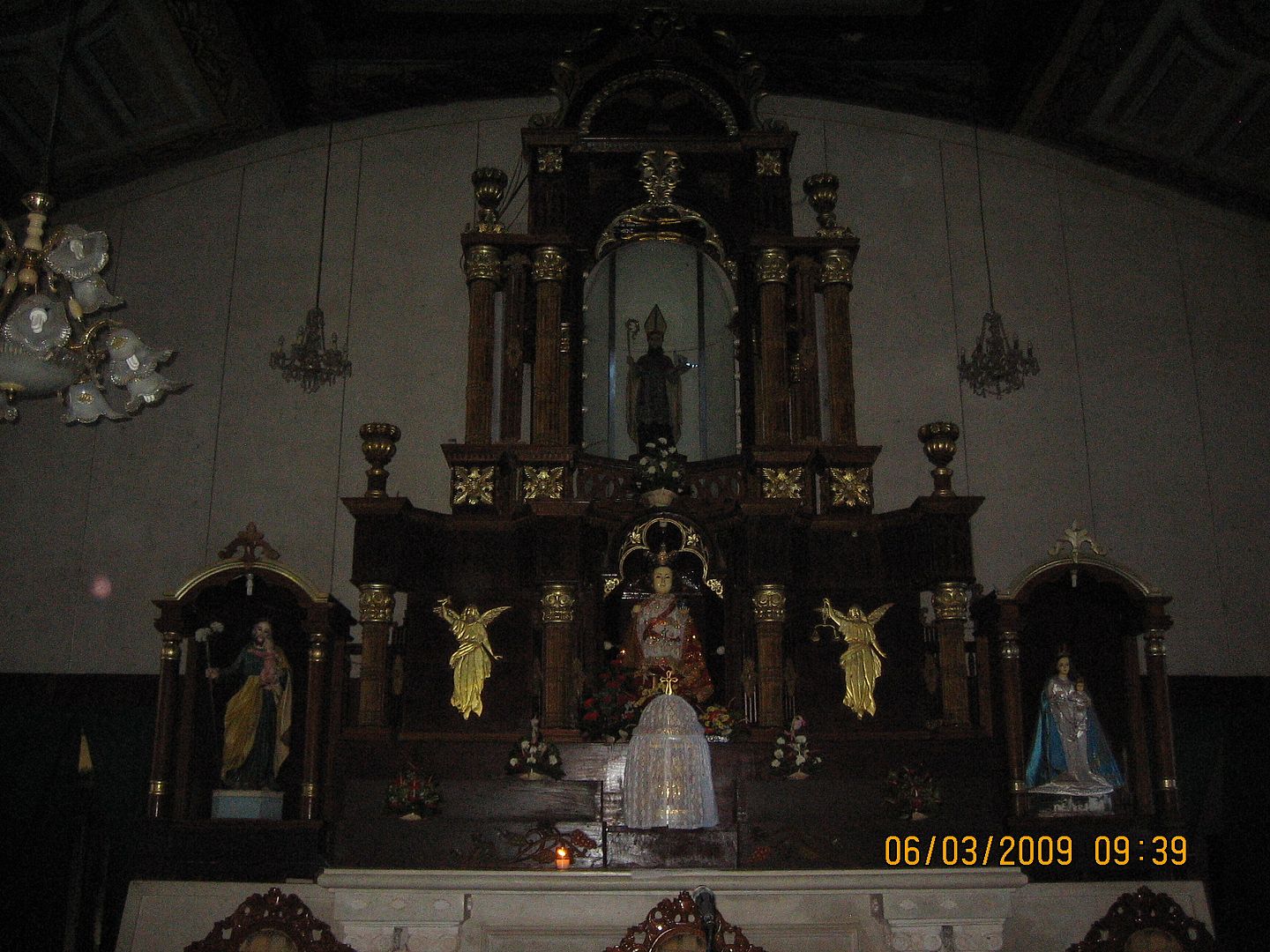
Approaching the main altar, one appreciates the simple retablo


in a tasteful neoclassical style,


with the Holy Child in the middle niche, Saint Joseph on the left, the Blessed Virgin Mary on the right, and Saint Augustine the town’s patron above.


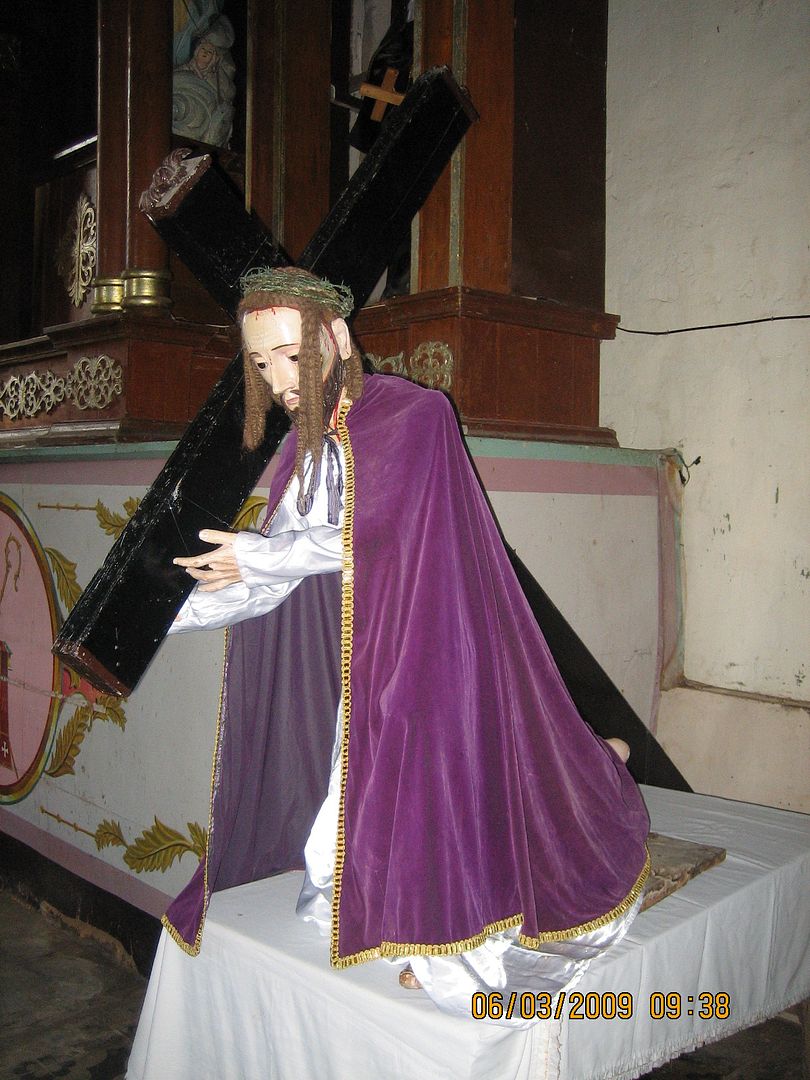
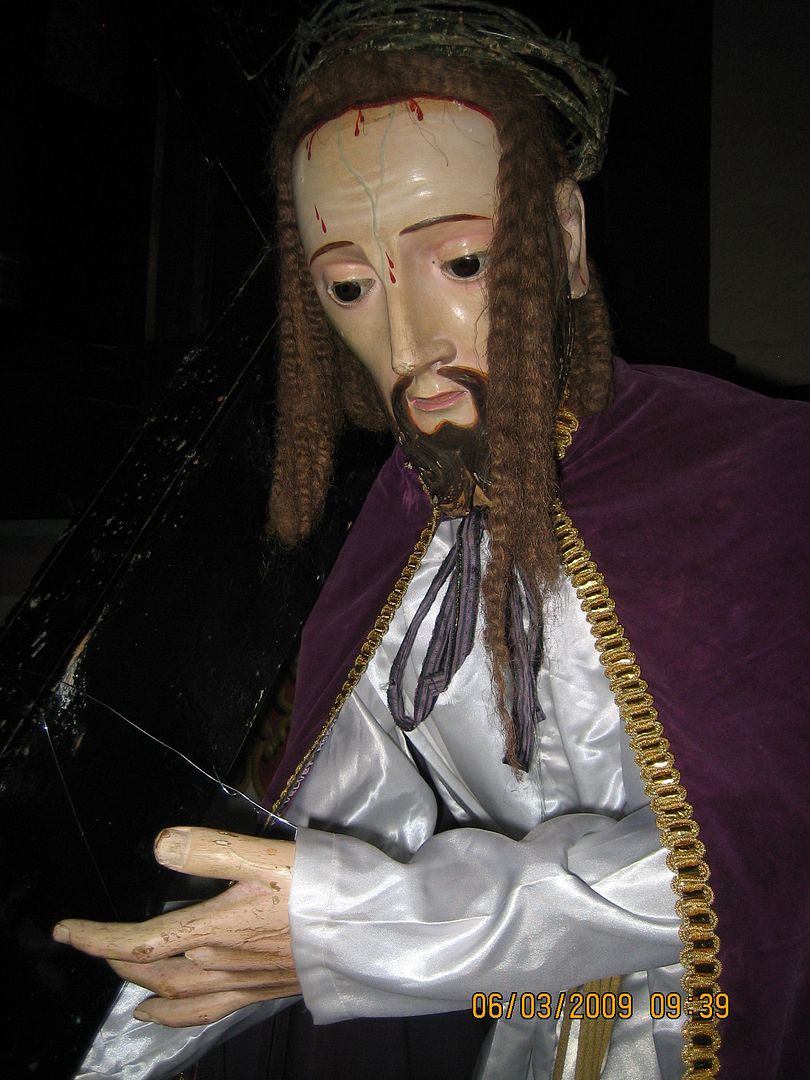
Because it was Lent, appropriate devotional images were positioned near the main altar.  These were an unpretentious and very stoic Nazareno,


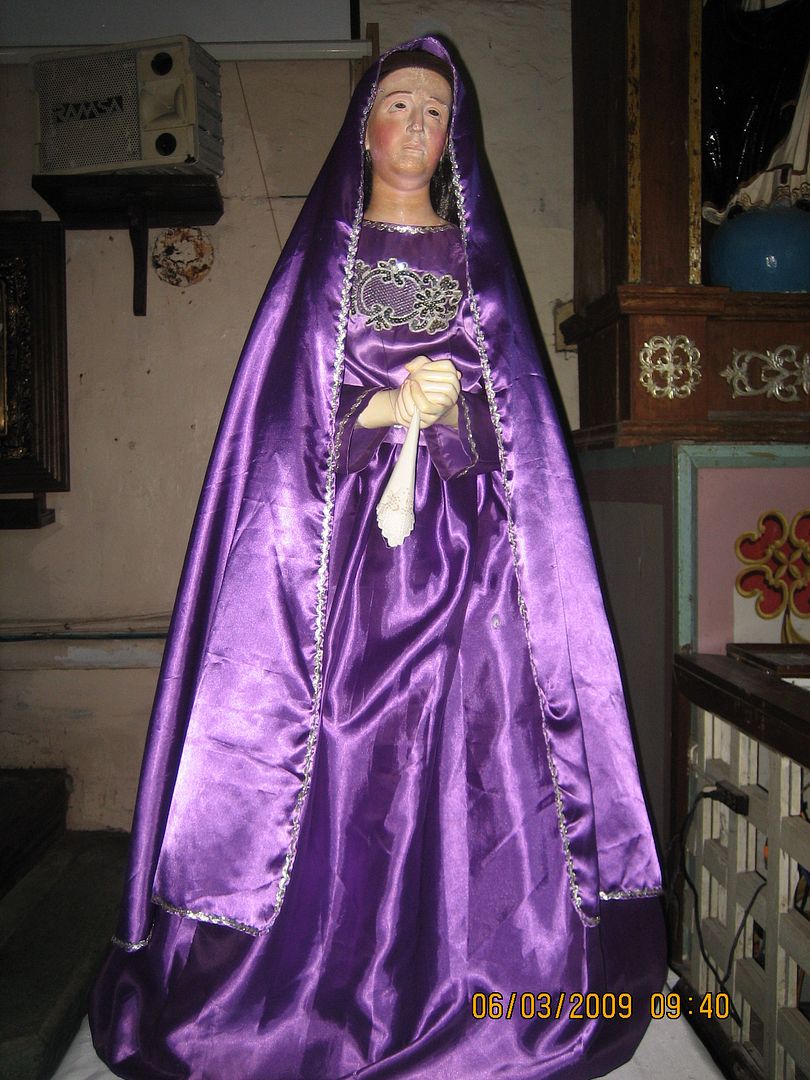
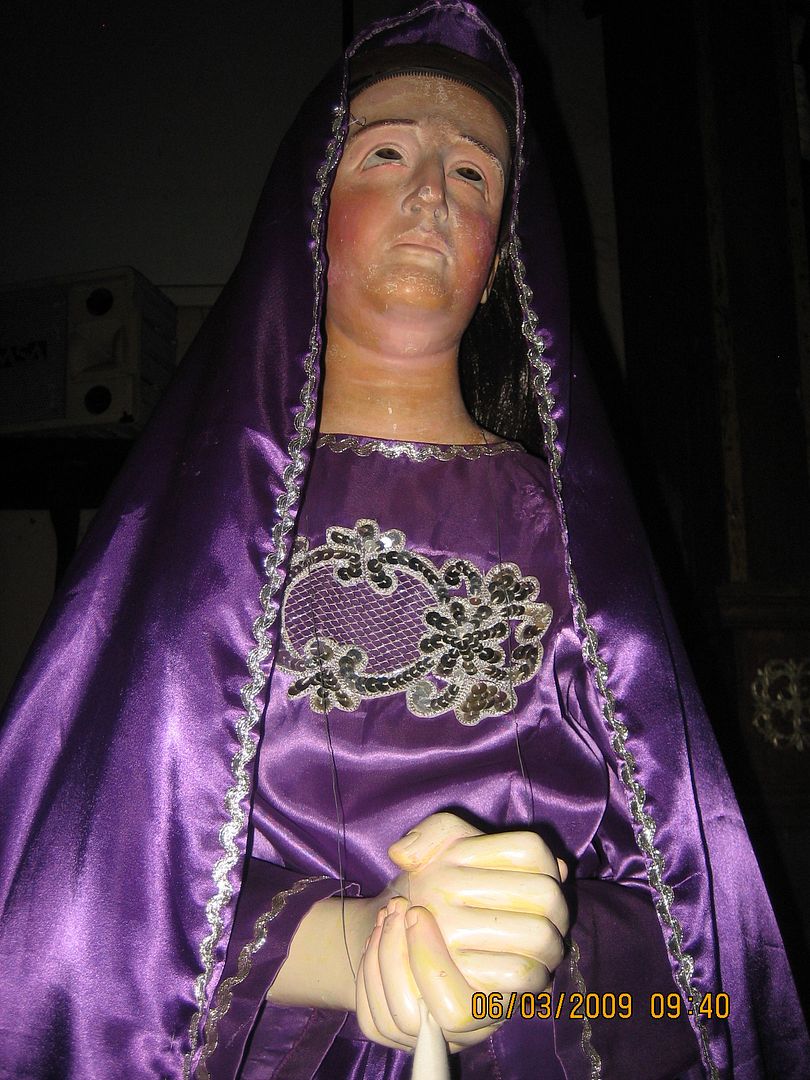
and a simple yet inconsolable Dolorosa,


both likely Good Friday processional images as well.

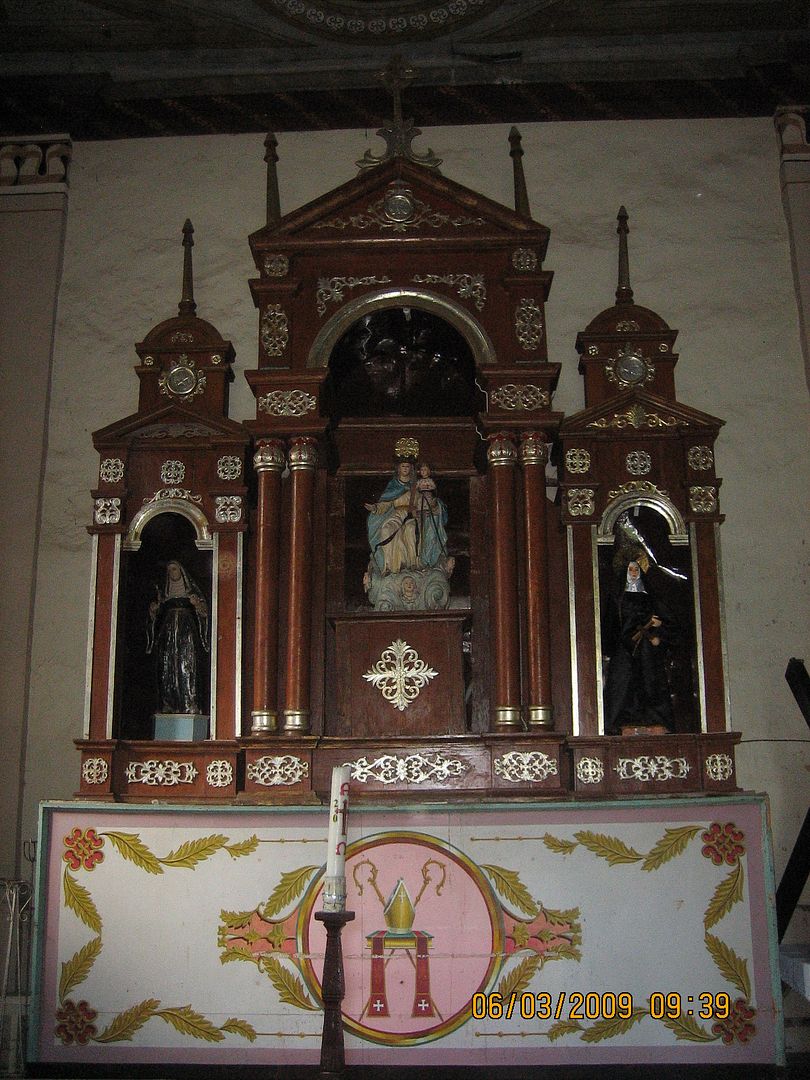
The retablo on the left-side altar is a smaller version of the main one,


with the Madonna and Child in the center, flanked by female saints in the side niches.

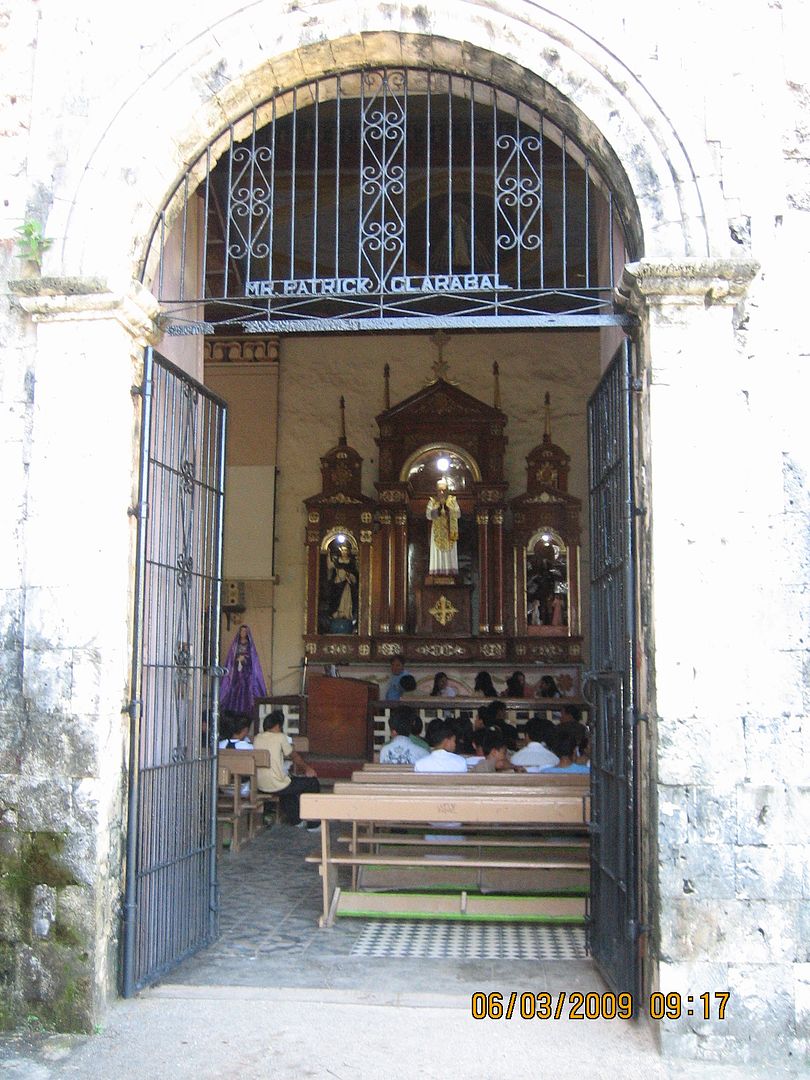
On the right-side altar, here seen through a side door,


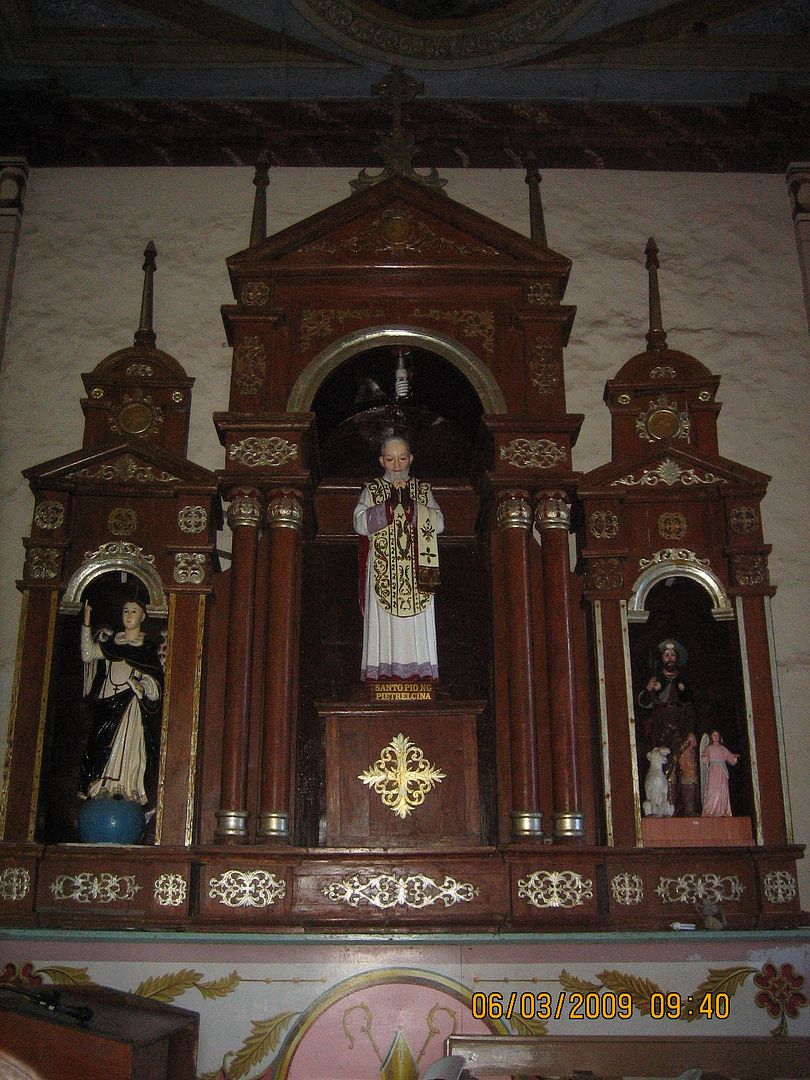
is the twin to the retablo on the left arm of the transept,


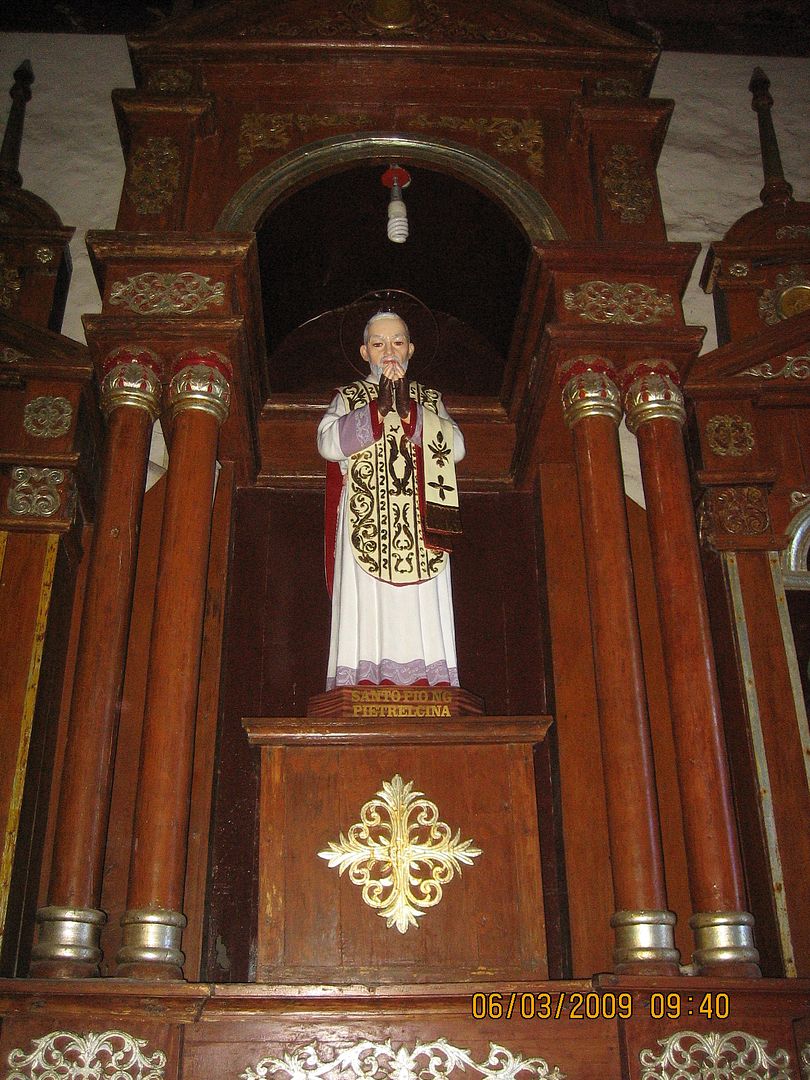
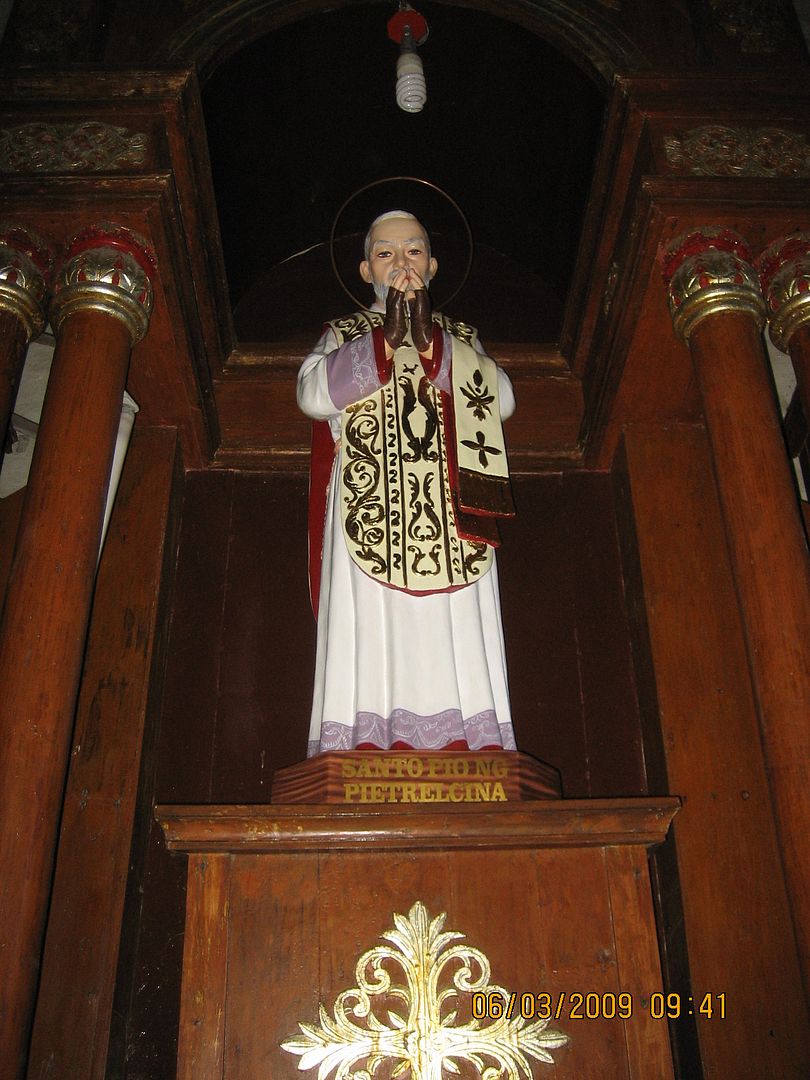
with Padre Pio in the middle niche


(obviously not an antique image as he died only in 1968),


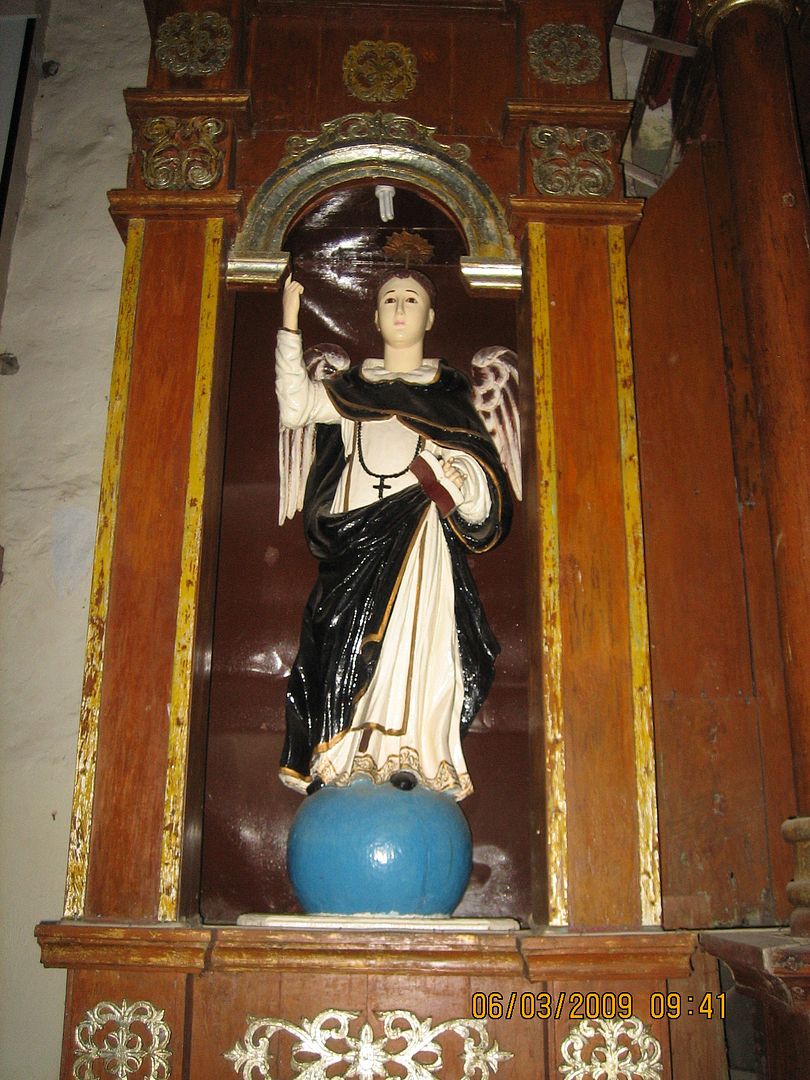
Saint Vincent Ferrer on the left,


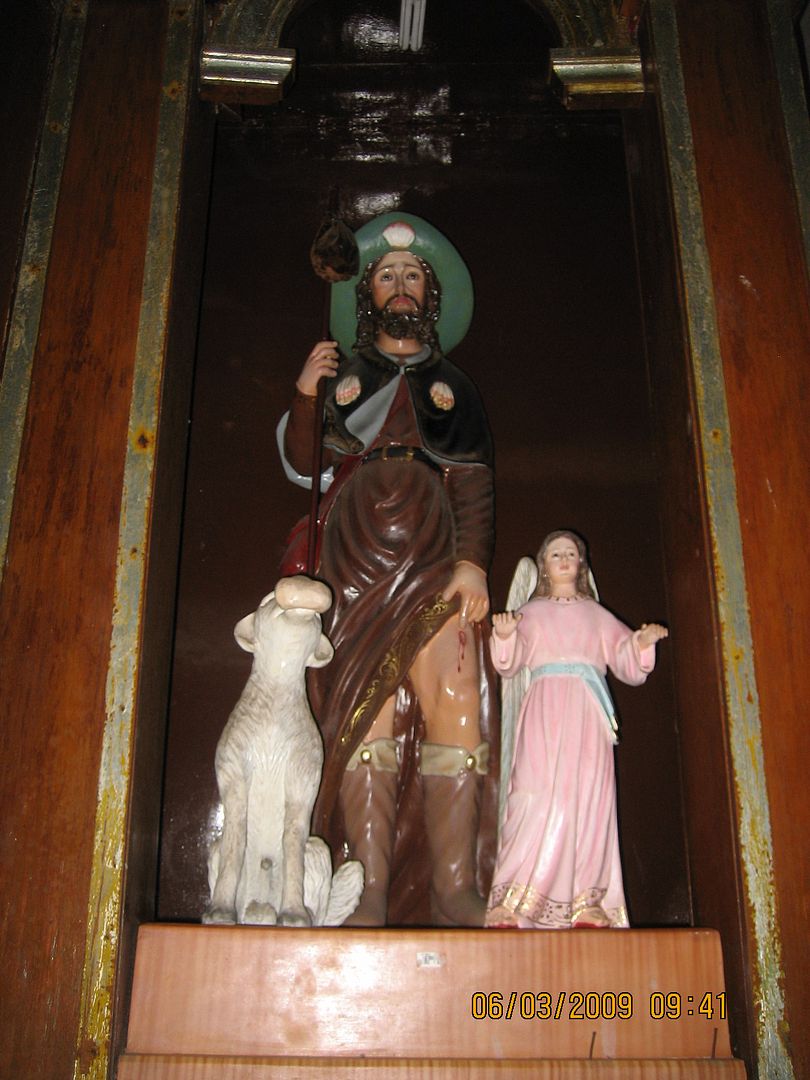
and Saint Roche de Montpellier on the right.


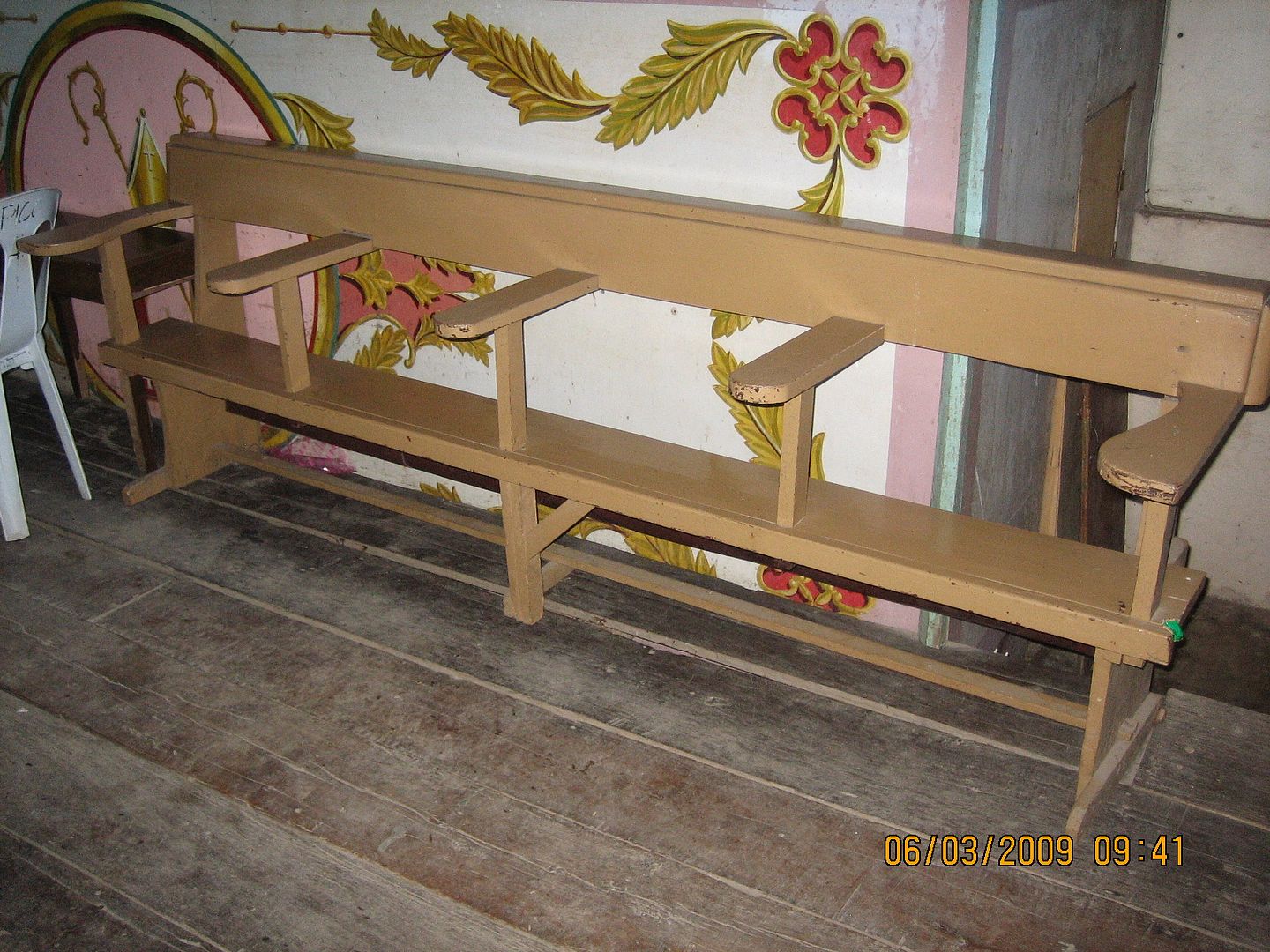
This right side altar also doubled as the de facto choir stall, and the choir members usually sat on this bench positioned against the colorfully decorated wall under the retablo.


We now make our way down the center aisle and turn towards the main entrance, to prepare to leave Panglao Church.


And think to myself that if I had grown up and lived in this, the hometown of my ancients, it would not be a bad thing to have this be my parish church.  Not at all.

Originally published on 27 March 2011.  All text and photos copyright ©2011 Leo D Cloma. The moral right of Leo D Cloma to be identified as the author of this work has been asserted.


Original comments:

anen21999 wrote on Apr 9, '11
When I was there.I was able to witness some women get fresh water from a well located right in the middle of the church nave. They said that the water is miraculously sweet and fresh while the other wells around are salty.

rally65 wrote on Apr 9, '11
anen21999 said
When I was there.I was able to witness some women get fresh water from a well located right in the middle of the church nave. They said that the water is miraculously sweet and fresh while the other wells around are salty.

Might you be referring to Dauis Church, on the other end of Panglao island? That's the one with a spring in the middle of the church.

dennisraymondm wrote on Apr 9, '11, edited on Apr 9, '11
I have toured Bohol 4 times since 2006 ganda! Try Iloilo and Guimaras, superb churches, was there Apr2-4.

You are right. I have mixed them up.

rally65 wrote on Apr 9, '11
dennisraymondm said
I have toured Bohol 4 times since 2006 ganda! Try Iloilo and Guimaras, superb churches, was there Apr2-4.

Yes, I have yet to go to those places -- on my to-do list.

arcastro57 wrote on Apr 11, '11
What a funky looking carroza and confessional box.

rally65 wrote on Apr 11, '11
arcastro57 said
What a funky looking carroza and confessional box.
Maybe those are examples of "Bohol Baroque"?

johnada wrote on Apr 11, '11
I did not know that anything is nice in this town. My cousin wanted us to build a house in Panglao and I was not excited about the beach, but your pictures make it very interesting now.

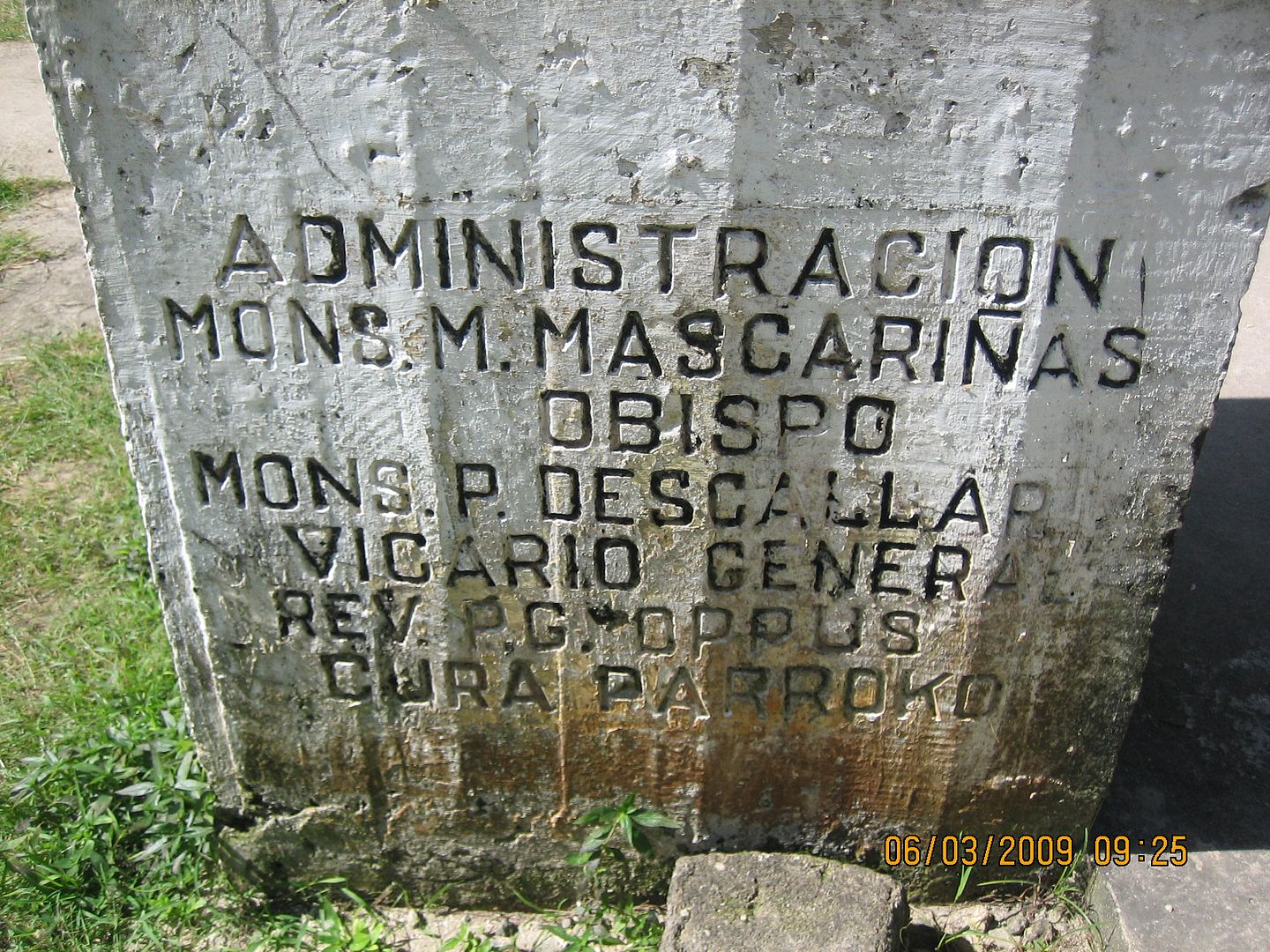
My claws are just about to rip out that 50th anniversary marker for abbreviating Monsignor as Mons. ha ha ha

rally65 wrote on Apr 11, '11
johnada said
I did not know that anything is nice in this town. My cousin wanted us to build a house in Panglao and I was not excited about the beach, but your pictures make it very interesting now. 

My claws are just about to rip out that 50th anniversary marker for abbreviating Monsignor as Mons. ha ha ha


I think Panglao is a very nice town to live in. It was clean, quiet, and spacious.

victorancheta wrote on Apr 13, '11, edited on Apr 13, '11
a beautiful church with equally handsome furniture. really love the mismatched tile floors.
an odd carrozza indeed. almost like it's made of old altar pieces.
i seriously hate modern add-on porte-cochères and the pretentious reasoning behind them. that ruined church must have been beautiful without it.

rally65 wrote on Apr 14, '11
victorancheta said
a beautiful church with equally handsome furniture. really love the mismatched tile floors.
an odd carrozza indeed. almost like it's made of old altar pieces.
i seriously hate modern add-on porte-cochères and the pretentious reasoning behind them. that ruined church must have been beautiful without it.


Fortunately the portico of this church was not a later add-on, and is therefore well integrated into the overall neoclassical design of the facade.

johnada wrote on Apr 28, '11
Leo, this video shows why the once-a-year use of the tower structure for the salubong is a necessity in Bohol.Once again, that center of tradition, Loboc shows why. This guy has videos and pictures of the Holy Week procession too.

http://www.facebook.com/?ref=logo#!/video/video.php?v=1707467122048

andyleighton wrote on Apr 8
Hi Leo,
Thanks, an interesting read, I was recently at this church and was taking photos for my website, do you know what the significance is of the 'concrete' benches out the front of the church, the seating wood looks very old but the concrete supporting structure looks relatively recent ... perhaps the wood is from original pews? ... also any idea what the name of the old ruins is beside the church? ..thanks for any help. andy

rally65 wrote on Apr 8
andyleighton said
Hi Leo,
Thanks, an interesting read, I was recently at this church and was taking photos for my website, do you know what the significance is of the 'concrete' benches out the front of the church, the seating wood looks very old but the concrete supporting structure looks relatively recent ... perhaps the wood is from original pews? ... also any idea what the name of the old ruins is beside the church? ..thanks for any help. andy


Which concrete benches -- the ones in front of the ruins of the old church? It doesn't appear that the ruins have a particular name -- I believe that that is simply the previous Panglao Church structure.

andyleighton wrote on Apr 8, edited on Apr 8
thanks for the reply Leo,
I have put a picture of one of the benches in my profile picture, there are around 10 of them in front right of the main church, thanks,
andy
http://www.andyleighton.com

rally65 wrote on Apr 8
andyleighton said
thanks for the reply Leo,
I have put a picture of one of the benches in my profile picture, there are around 10 of them in front right of the main church, thanks,
andy
http://www.andyleighton.com

Thanks -- I saw your photo. Strangely, I totally missed these -- I guess I had supposed them to be thoroughly modern and therefore dismissable! But indeed they might be repurposed wooden parts from old pews. I should check them out at the next opportunity.

By the way, your shot of the Baclayon Church retablo (main altar) is beautiful! Unfortunately I could not take a similar shot when I was there because a funeral mass was in progress at the time!

andyleighton wrote on Apr 9
Let me know Leo, if you manage to get back to the Panglao Church and have a look at the benches ... thanks very much for your time.

The inside of the Baclayon church is quite remarkable, stop by my website in a month or two and I will have a couple hundred photos from Panglao, Bohol and Cebu City on there, cheers