The town of San Rafael
The Parish of Caingin, based in the large barangay of the same name, was established first as a quasi-parish some time in the 1990’s, and subsequently confirmed as a parish in its own right some years ago. The parish church is a slightly enlarged version of the already relatively large bisita (village chapel) that lies almost equidistantly from the old parish church in the Bayan and the Sabang bridge that connects San Rafael with Baliwag town.
The Caingin bisita, which had existed for longer than anyone around (and even those who had passed on) could remember, was most likely originally built to house a very old and reputedly miraculous Crucifix. It is for this reason that it is called the Parish of Santo Cristo, or the Crucified Christ.
It is fair to expect a parish so dedicated to have appropriately devout Holy Week activities, so we venture to this, actually my family’s ancestral village, to check it out first hand.
The Parish of Caingin, based in the large barangay of the same name, was established first as a quasi-parish some time in the 1990’s, and subsequently confirmed as a parish in its own right some years ago. The parish church is a slightly enlarged version of the already relatively large bisita (village chapel) that lies almost equidistantly from the old parish church in the Bayan and the Sabang bridge that connects San Rafael with Baliwag town.
The Caingin bisita, which had existed for longer than anyone around (and even those who had passed on) could remember, was most likely originally built to house a very old and reputedly miraculous Crucifix. It is for this reason that it is called the Parish of Santo Cristo, or the Crucified Christ.
It is fair to expect a parish so dedicated to have appropriately devout Holy Week activities, so we venture to this, actually my family’s ancestral village, to check it out first hand.
Because it is a relatively new parish, its Holy Week processional line-up is not yet very long. Several of the tableaux and images must have been “spun off” from the Bayan’s processional line-up, which even then must have been quite complete – today that already includes some thirty-five carrozas, most of which we featured in the immediately previous installment of this series.
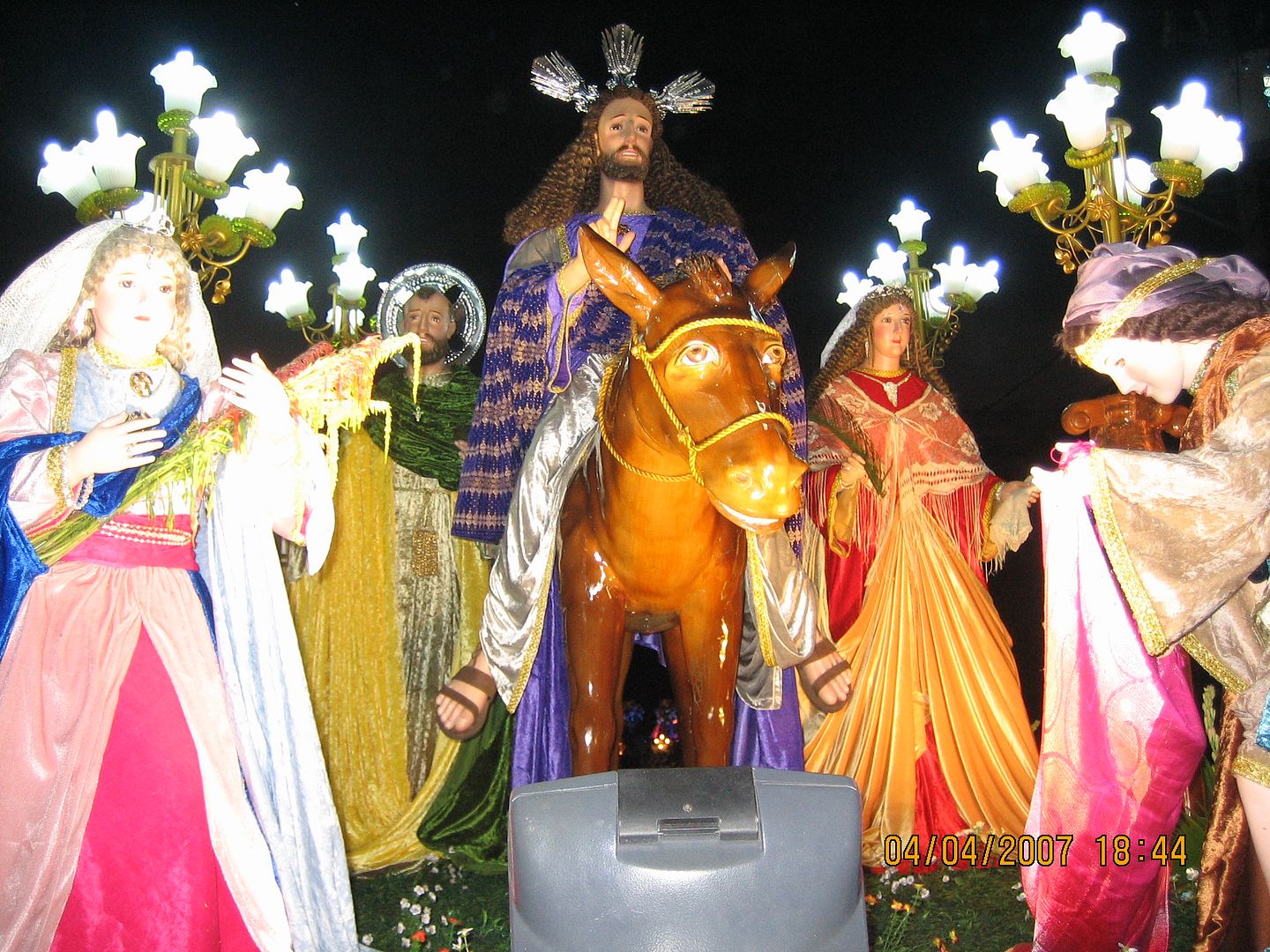
In fact, at least one or two of the just fourteen members of Caingin’s processional line-up strive to be “versatile,” by doing some sort of double-duty. A case in point is the very first one in the line-up, “San Pedro at ang Maluwalhating Pagpasok ni Jesus sa
Because there is no individual image of Saint Peter that brings up the front of this procession, the owners of this tableau must have figured that it could just let the Saint Peter image that is part of the group play this role somewhat.
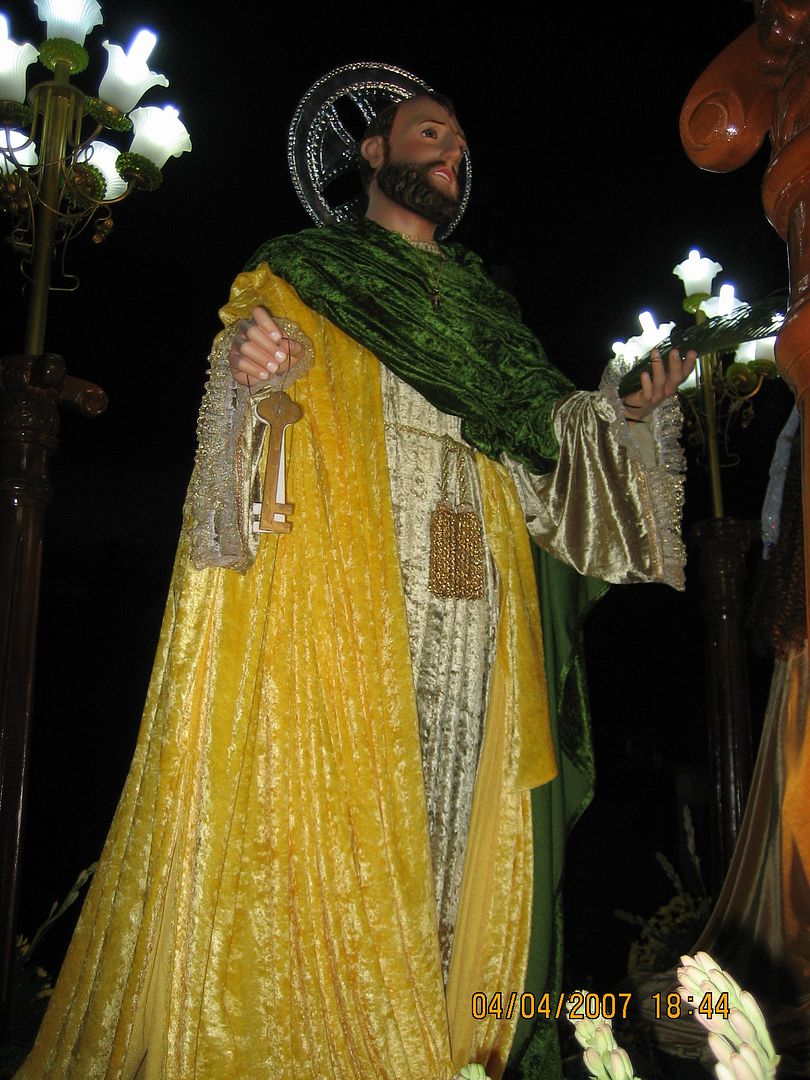
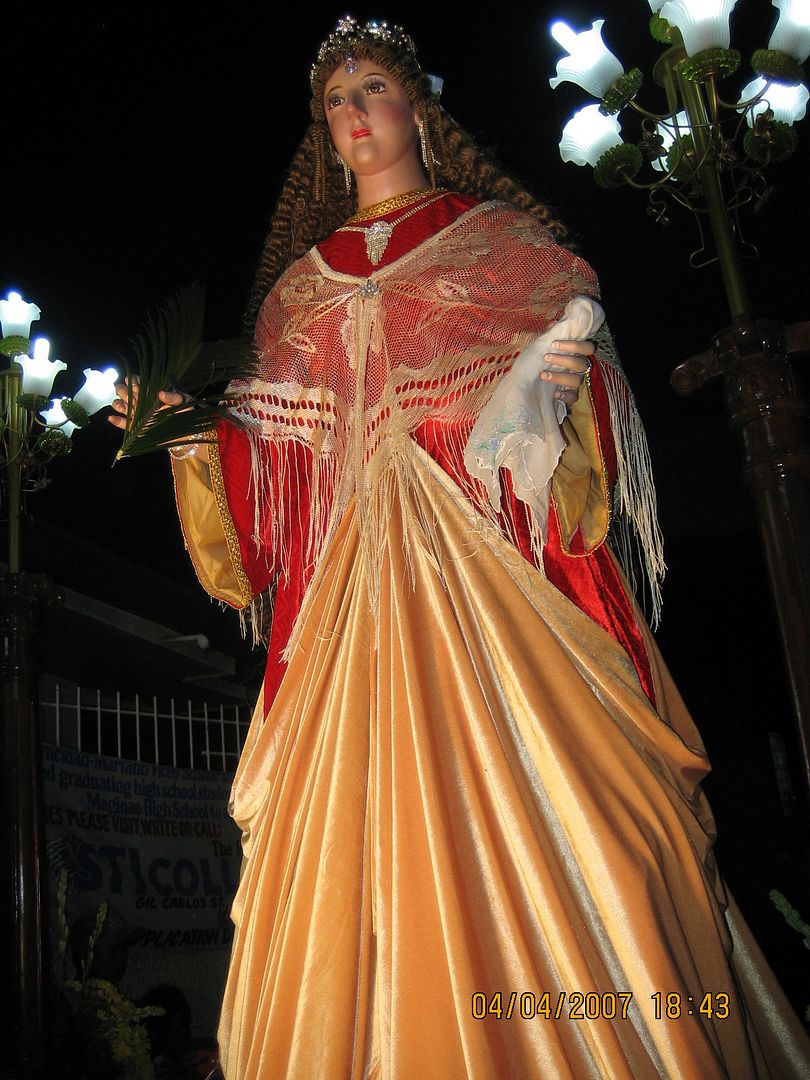
No doubt the other members of the team, including a richly-dressed Holy Woman (perhaps Mary Magdalene?),
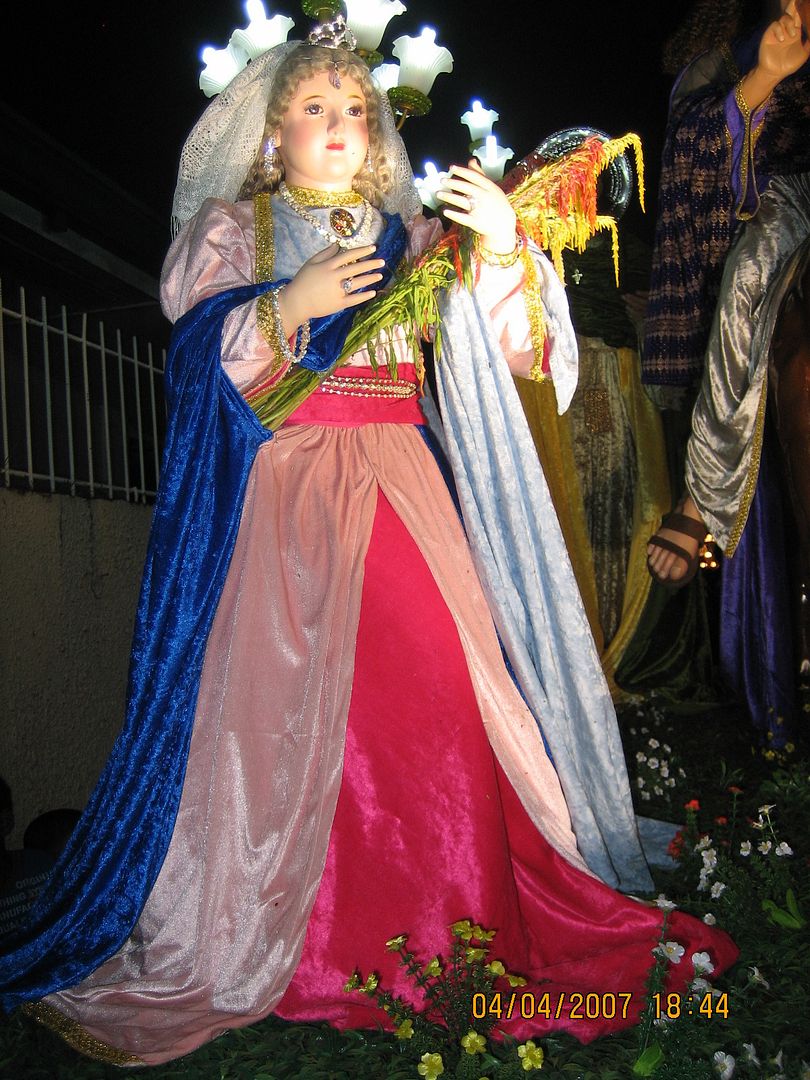
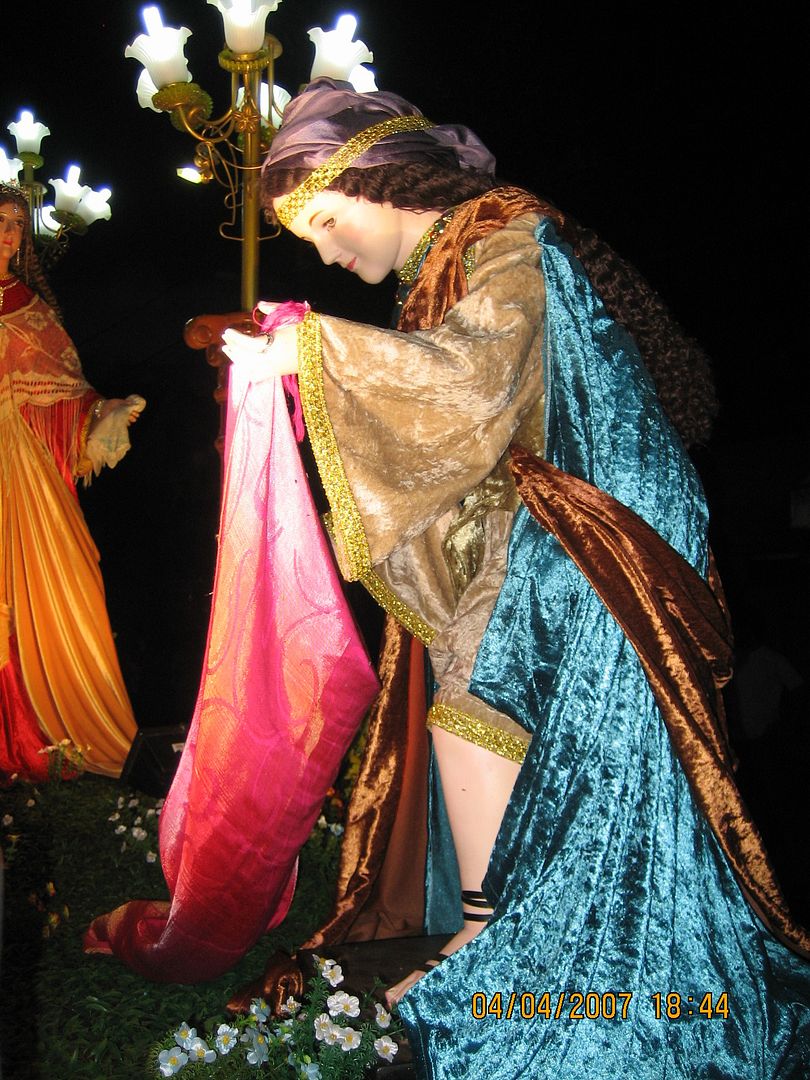
two far-too-wealthily garbed Jewish peasant girls,
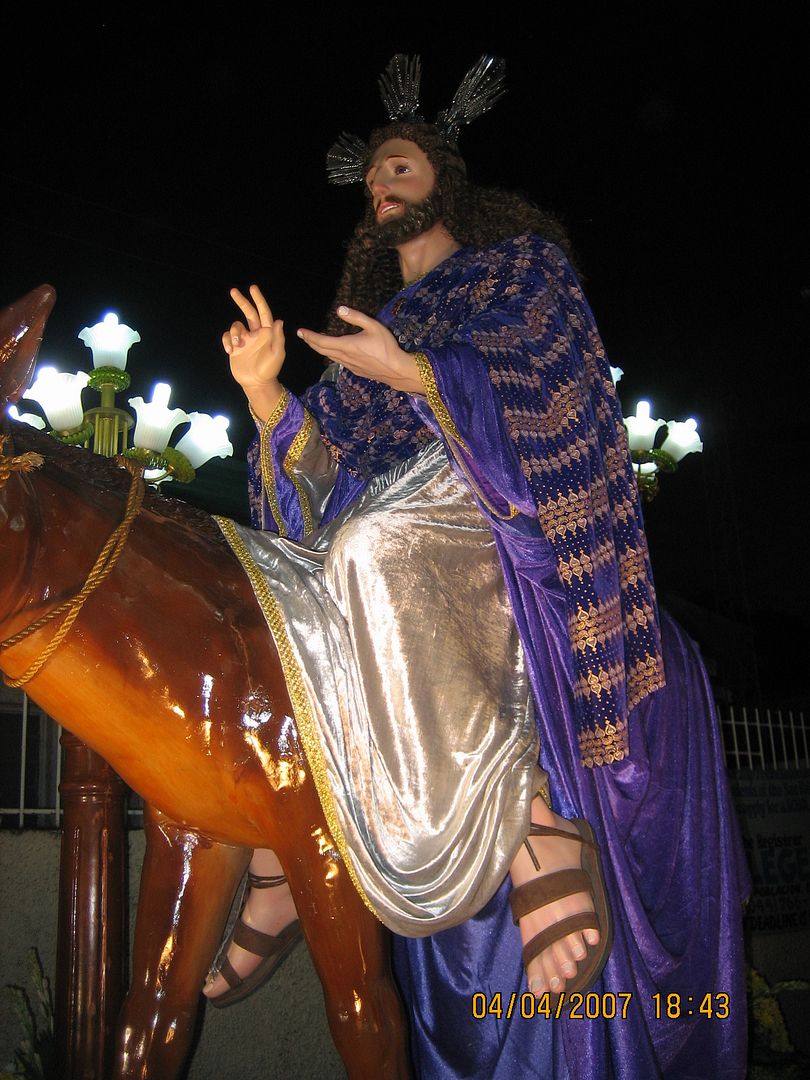
and the Christ on a perspiring donkey
don’t seem to mind at all.
Unfortunately the use of overly-bright white lights makes the ensemble appear rather ghostly, much to the apparent amusement of the donkey.
Hopefully some generous parishioner will step up and contribute a good solo processional image of Saint Peter so that it may head up a gradually-expanded line-up in the near future.
The second member of the line-up, “Ang Pagsasalo nina Jesus, San Juan, at ng Mahal na Ina” [Jesus, John, and the Blessed Mother Share a Meal] clearly betrays the undue influence that the egregious Holy Week processions in the neighboring town of Baliwag have over this young parish.
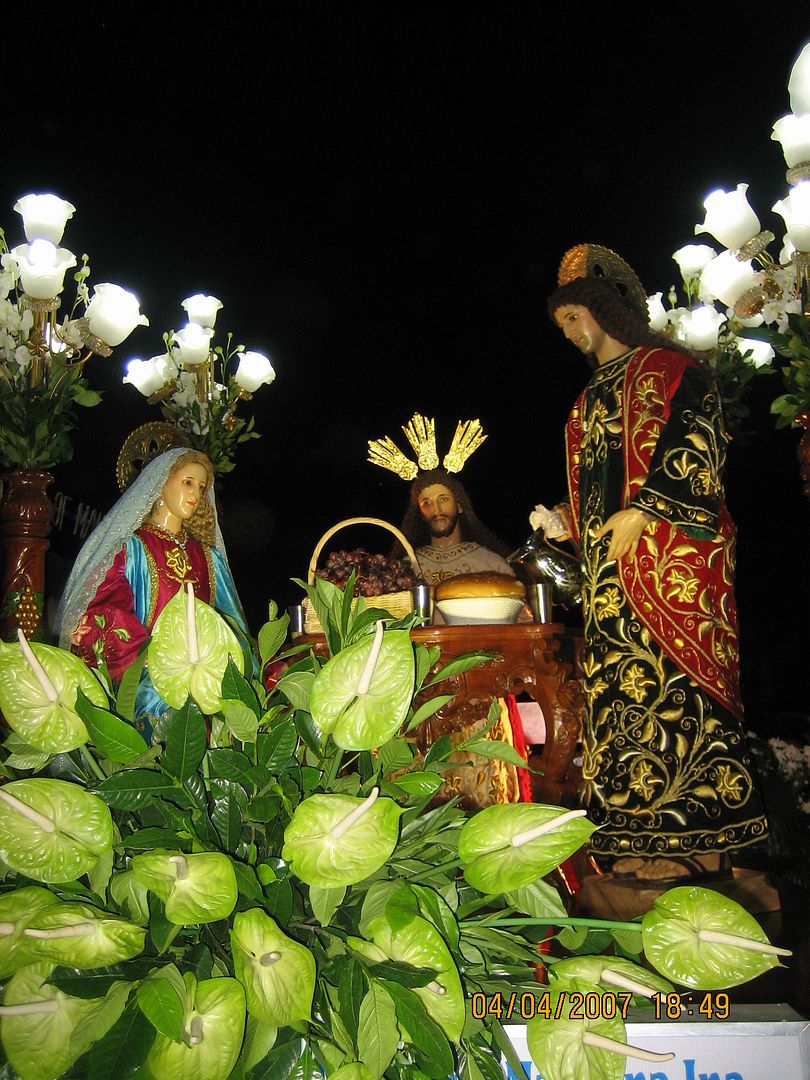
There are at least two telltale signs of the Baliwag influence. First, the tableau is decked out far too sumptuously, with gold-embroidered garments,The second member of the line-up, “Ang Pagsasalo nina Jesus, San Juan, at ng Mahal na Ina” [Jesus, John, and the Blessed Mother Share a Meal] clearly betrays the undue influence that the egregious Holy Week processions in the neighboring town of Baliwag have over this young parish.
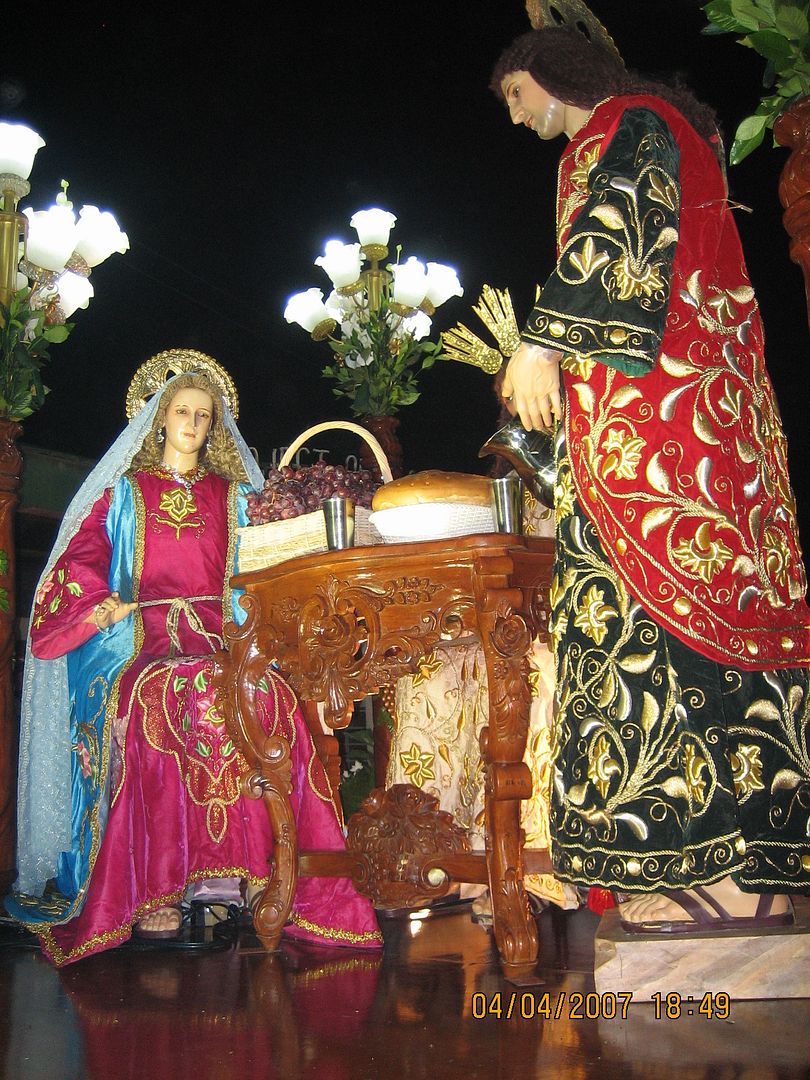
an ornately carved console table as a dining table,
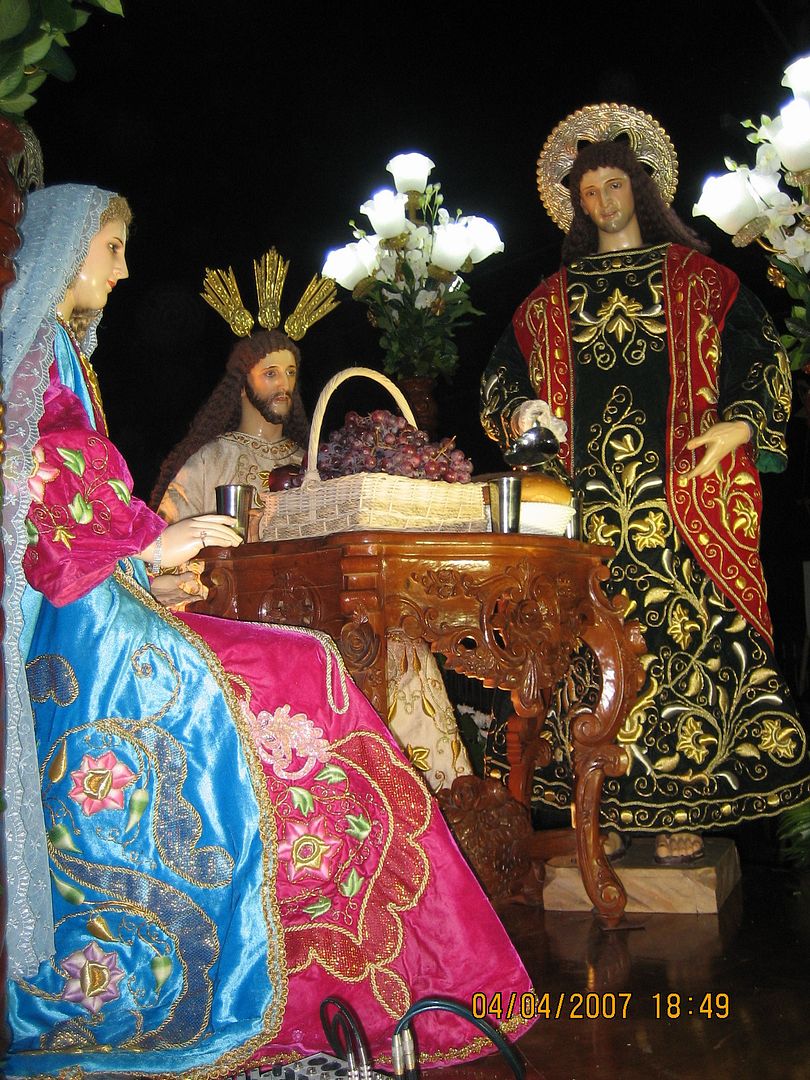
and pewter-like cups, a large basket of grapes and a humongous loaf of bread positioned in front of a an intimidated-looking Christ.
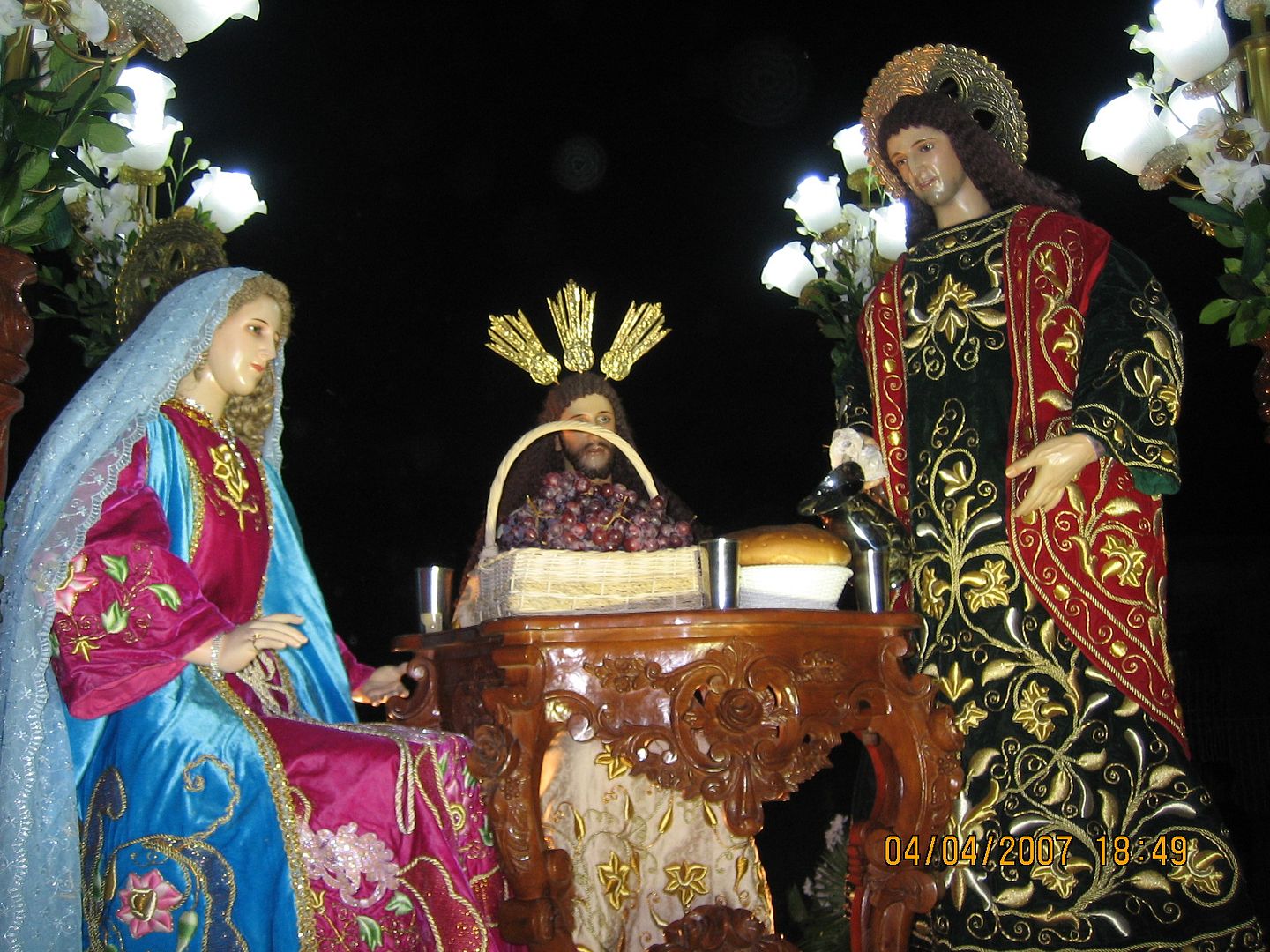
The second Baliwag effect is that of potential irrelevance. For this scene is not found in scripture, and is based only on the text of the Mahal na Pasyon. It is thus unclear what the devotional significance of depicting such a scene as this is, except perhaps to portray these divine personages as having led an unremarkable domestic life as well. Not a good use of devotional resources, in my view. And that console table ought to be returned to its nouveau-riche home.
Another potentially irrelevant non-scripture-based tableau is third in the line-up, “Ang Pamamaalam ni Jesus sa Kanyang Ina” [Jesus Bids His Mother Farewell].
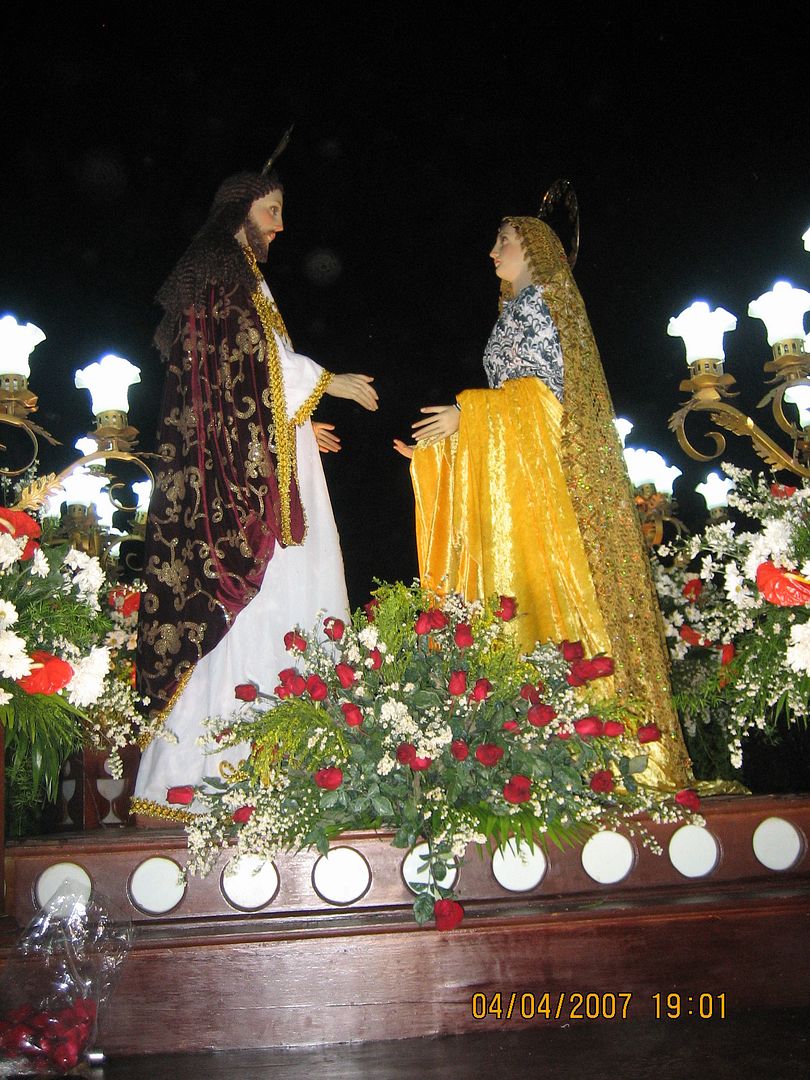
Again, the use of white lights does not flatter this scene, and the row of bright discs along the perimeter of the carroza does not enhance artistic appreciation either.
Next is “Ang Panalangin sa Halamanan” [The Agony in the Garden]. At last we’re back on track with the first sorrowful mystery.
Next is “Ang Panalangin sa Halamanan” [The Agony in the Garden]. At last we’re back on track with the first sorrowful mystery.
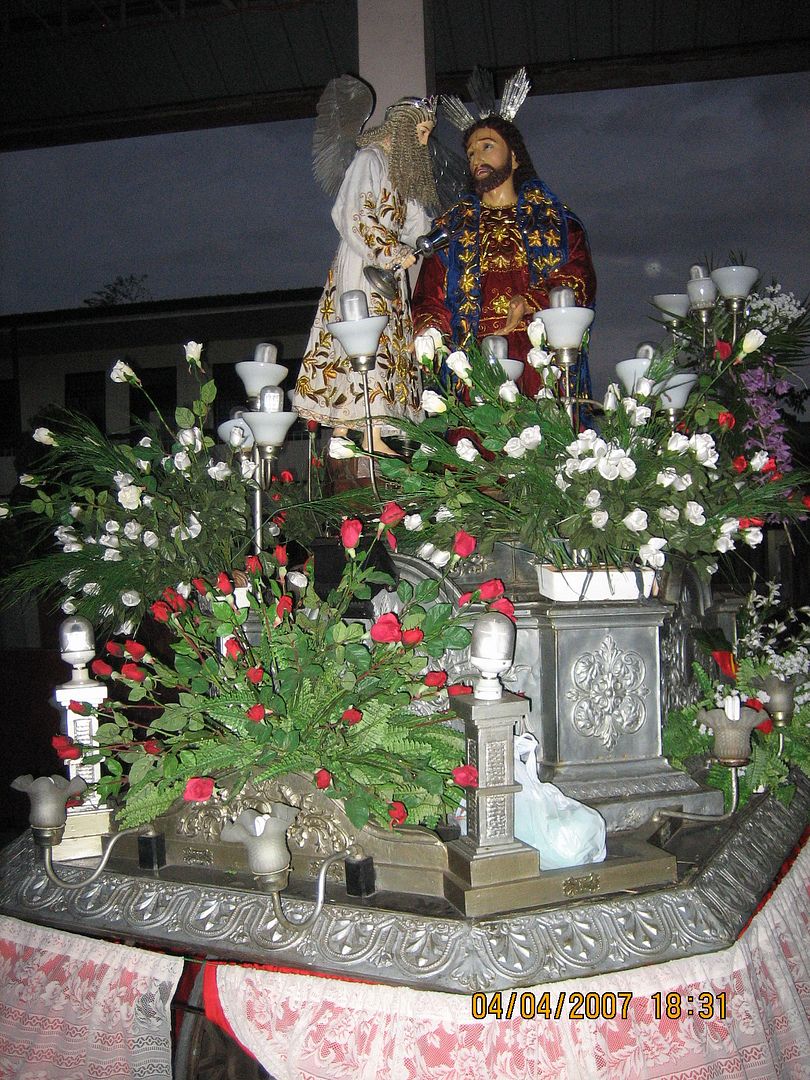
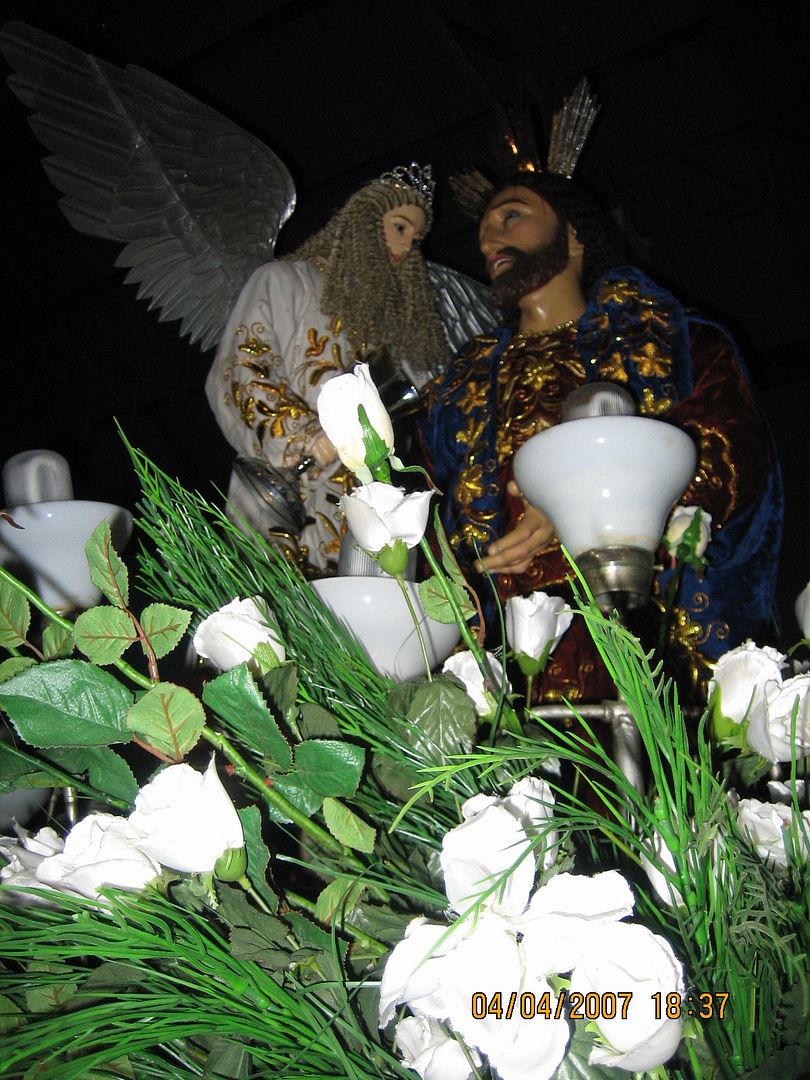
This looks to be a vintage image that was previously processed in the Bayan for some time, with a folk-looking Christ paired with a mid-sized angel with front-falling long hair that at first glance appears to give him a beard.
“Si Jesus na Nakagapos sa Haliging Bato” [Christ at the Pillar] comes next.
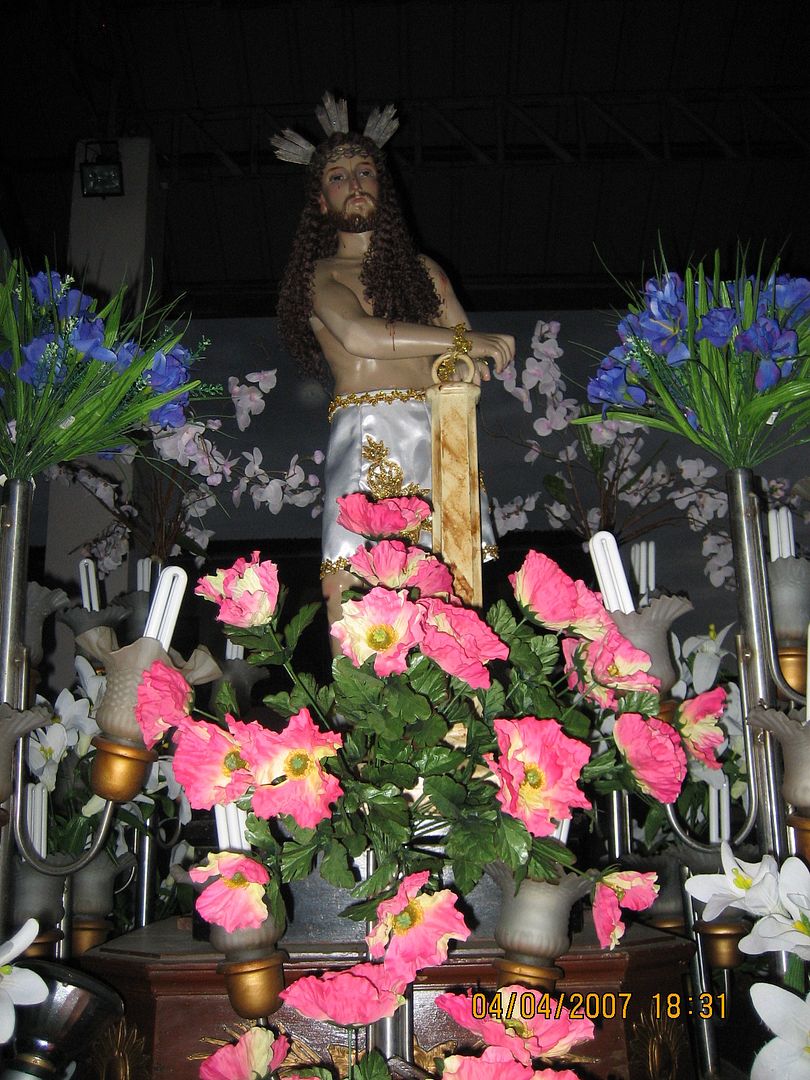
The stern-looking Christ somehow struggles to win our sympathy, and is not helped by the simultaneously over-colorful and anemic floral decoration.
Whatever sympathy failed to be gained by that Christ might instead go to this sad and desperate-looking one, of the “Ecce Homo.”
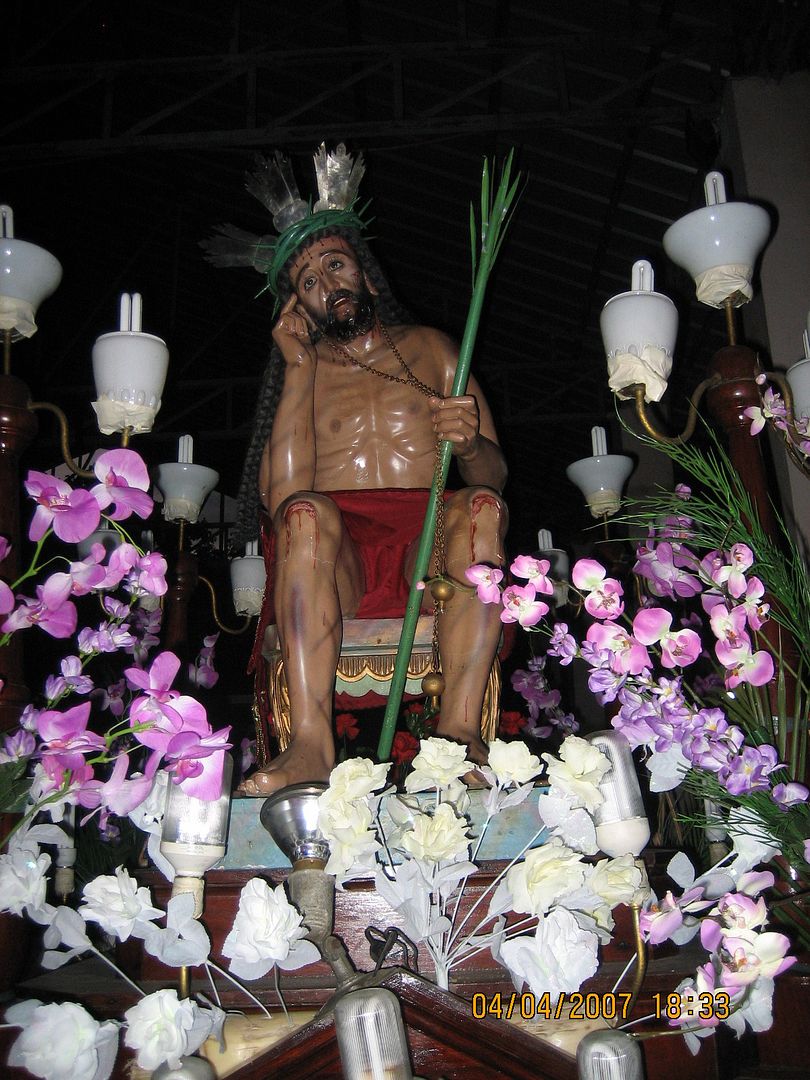
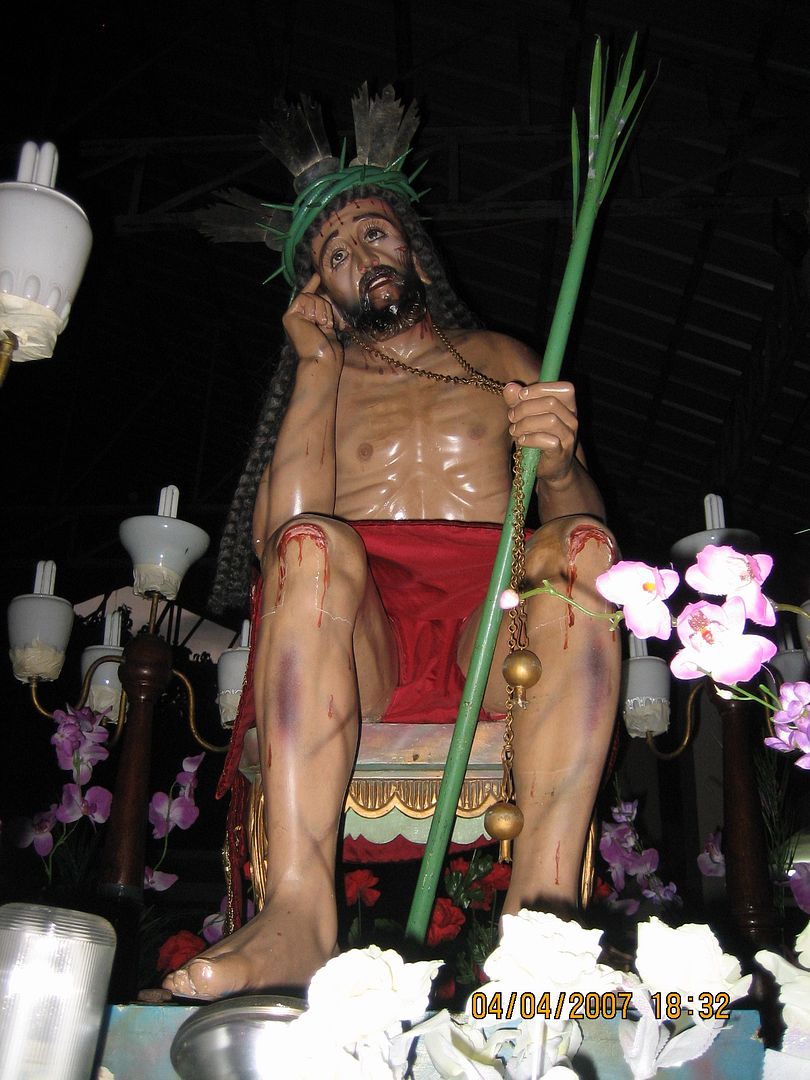
This folk-style rendition of the classic “Señor de la Paciencia” features freshly-cut-looking (and therefore very green) scepter and crown of thorns, and somewhat anatomically-incorrect purple outlines of veins on the legs.
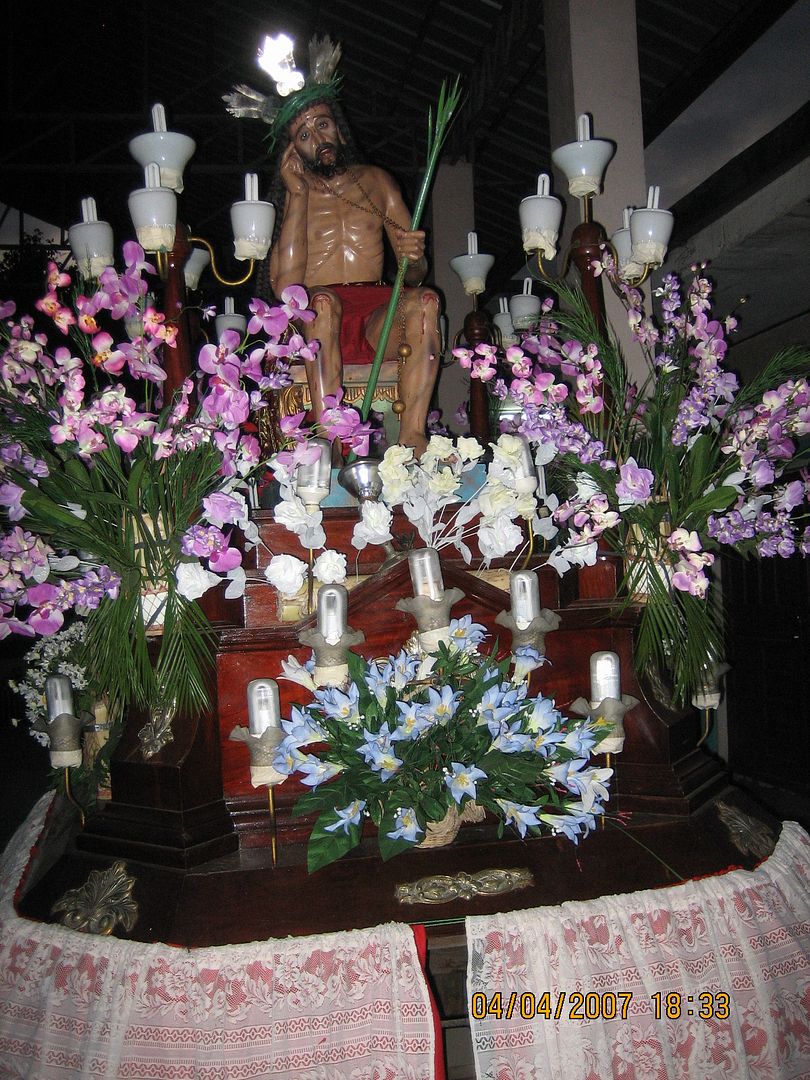
Its carroza is a nice one though, in a handsome shade of Philippine hardwood with subdued metal appliqués.
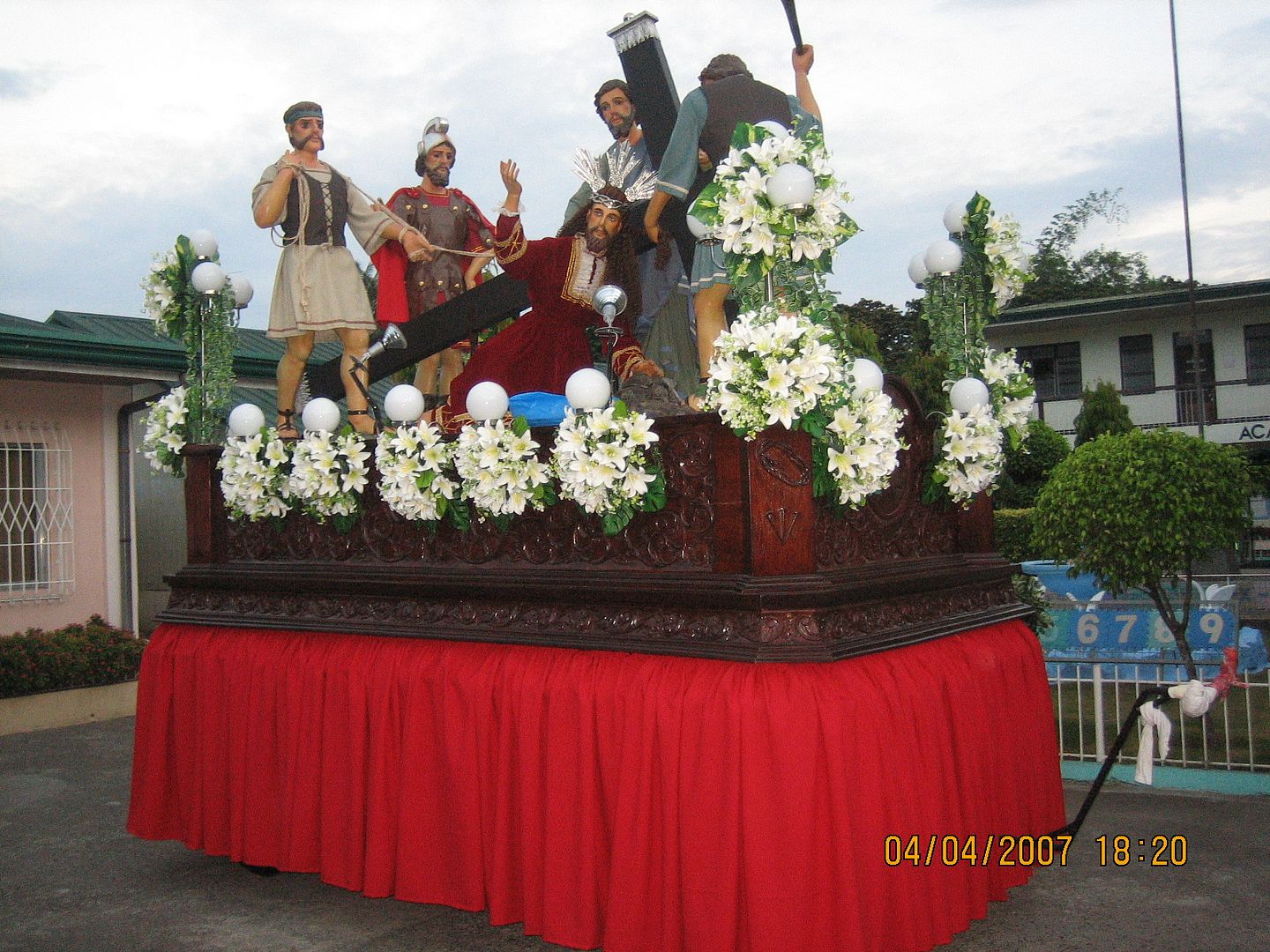
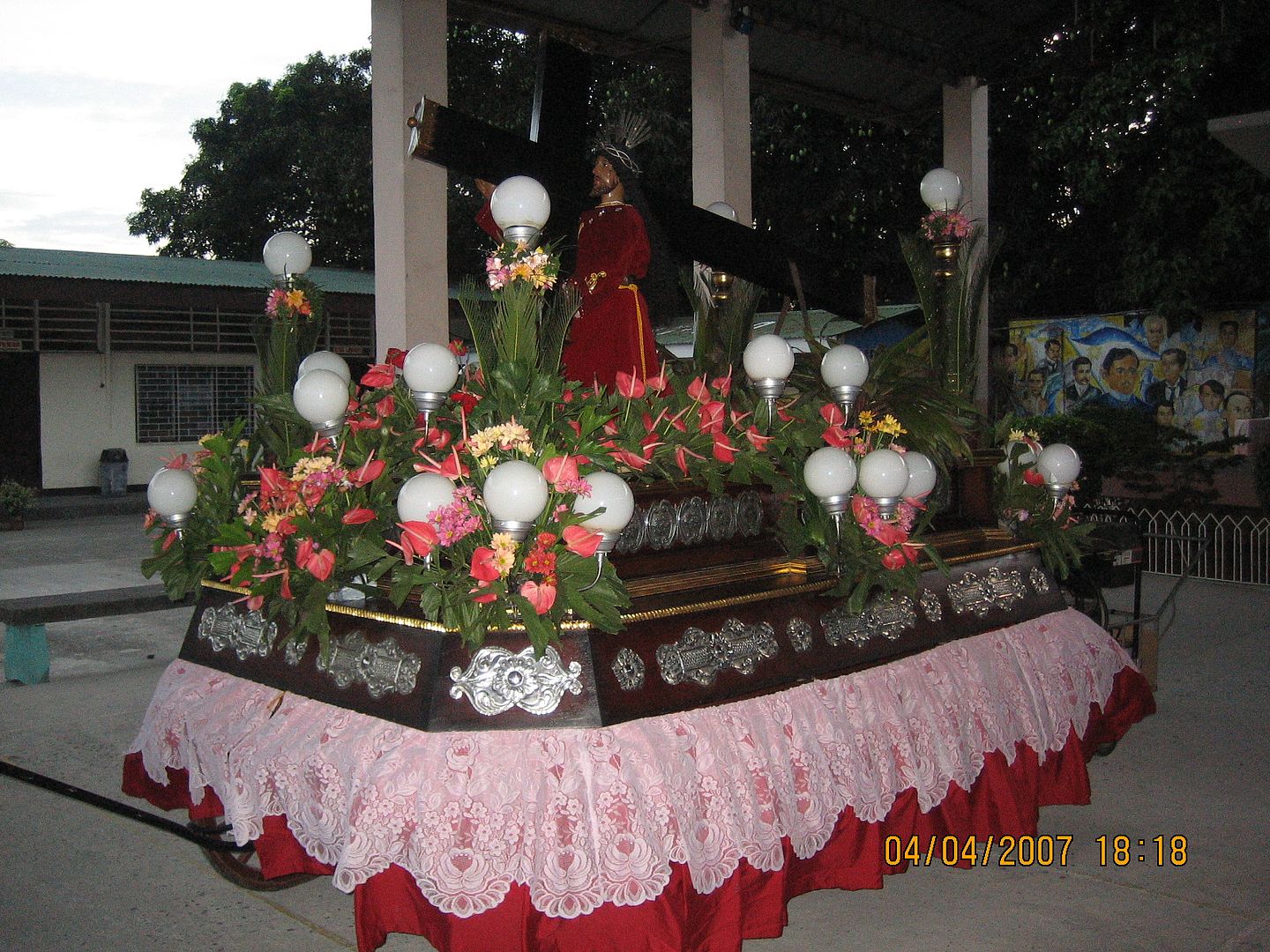
The "Señor Nazareno" [Christ Carries His Cross] comes next. Like most other Nazarenos in the Philippines
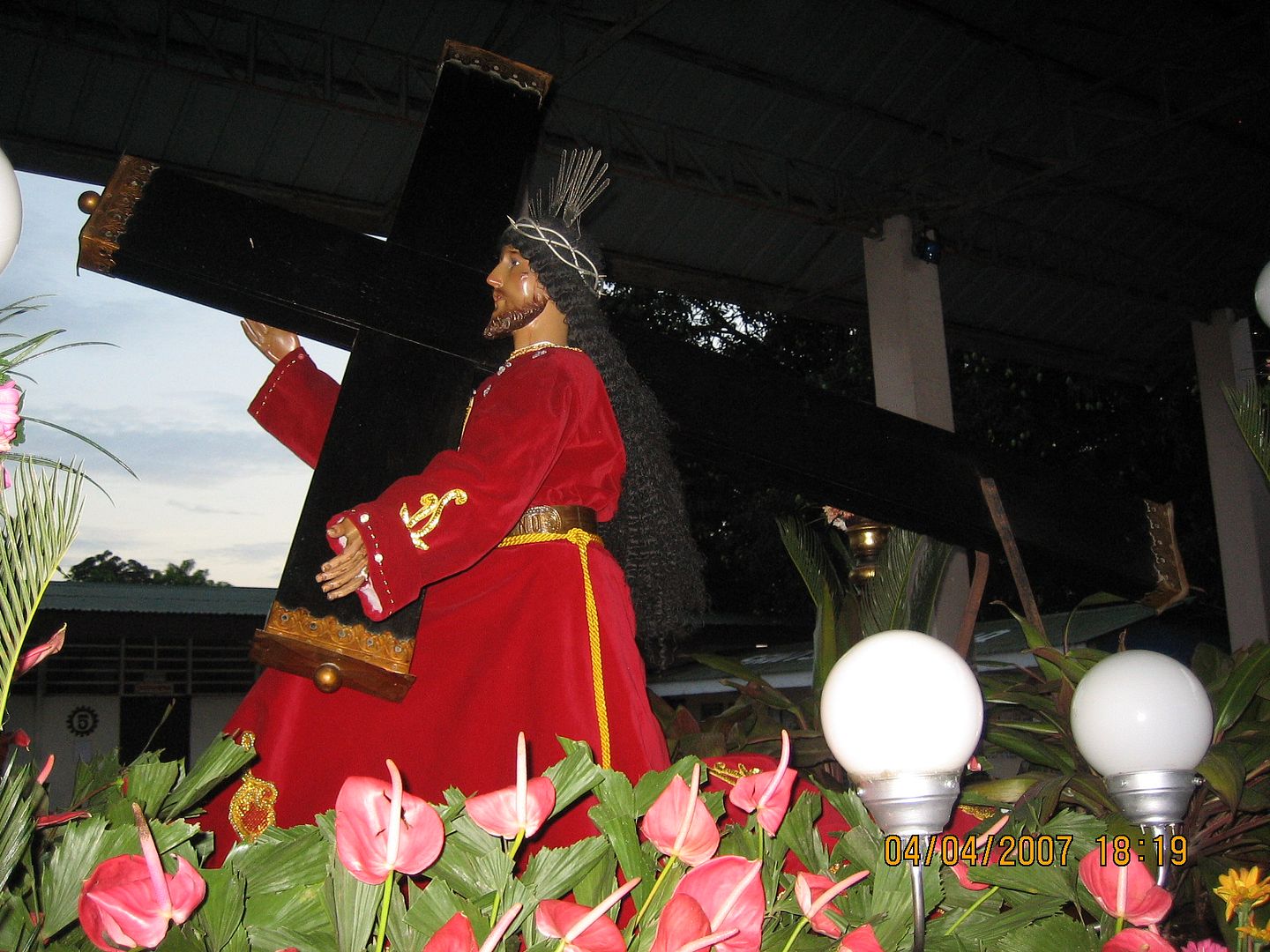
It has a classical carroza though, with proper globo-type milk glass lighting fixture virinas and metal appliqués on a dark hardwood base.
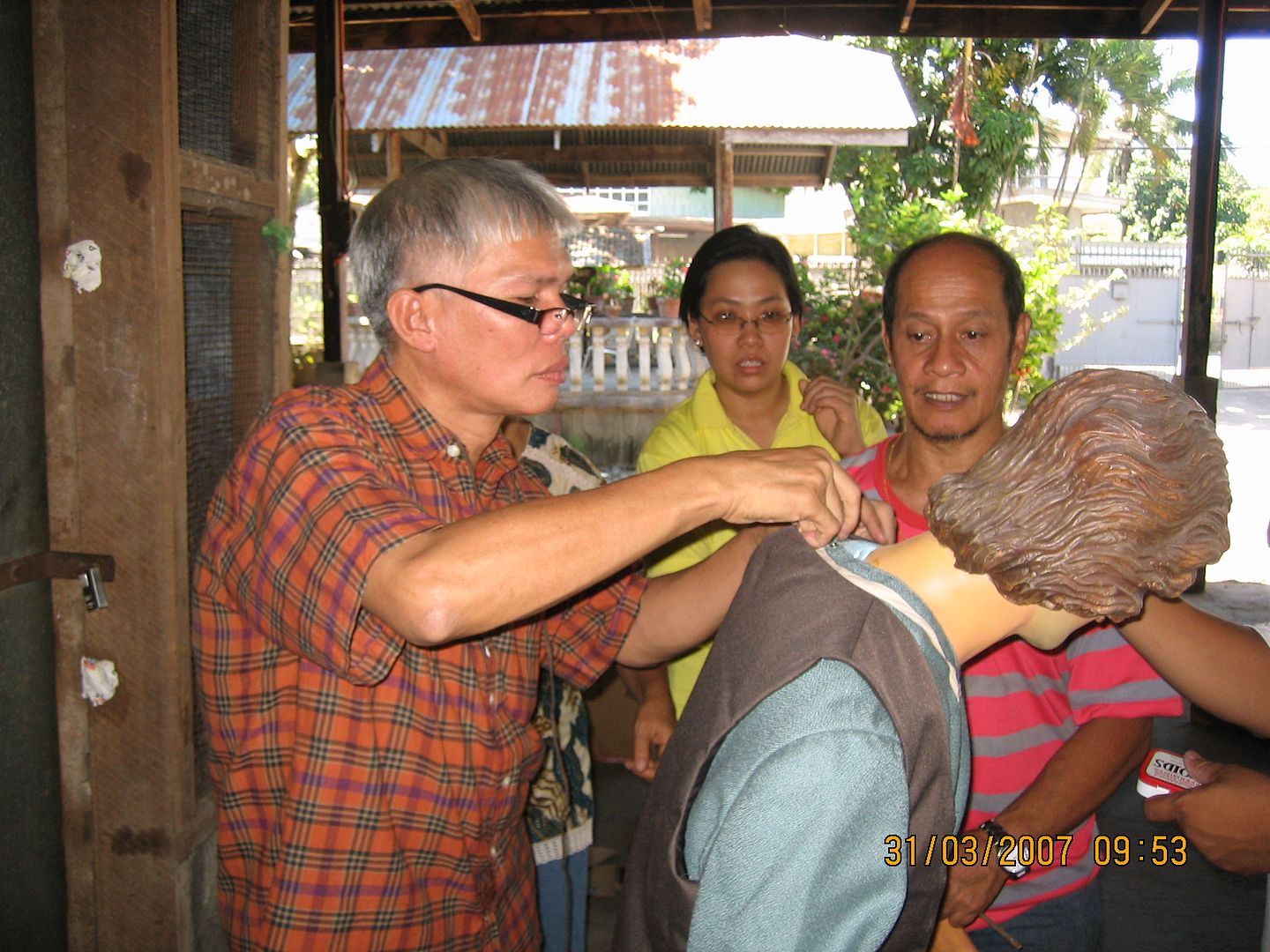
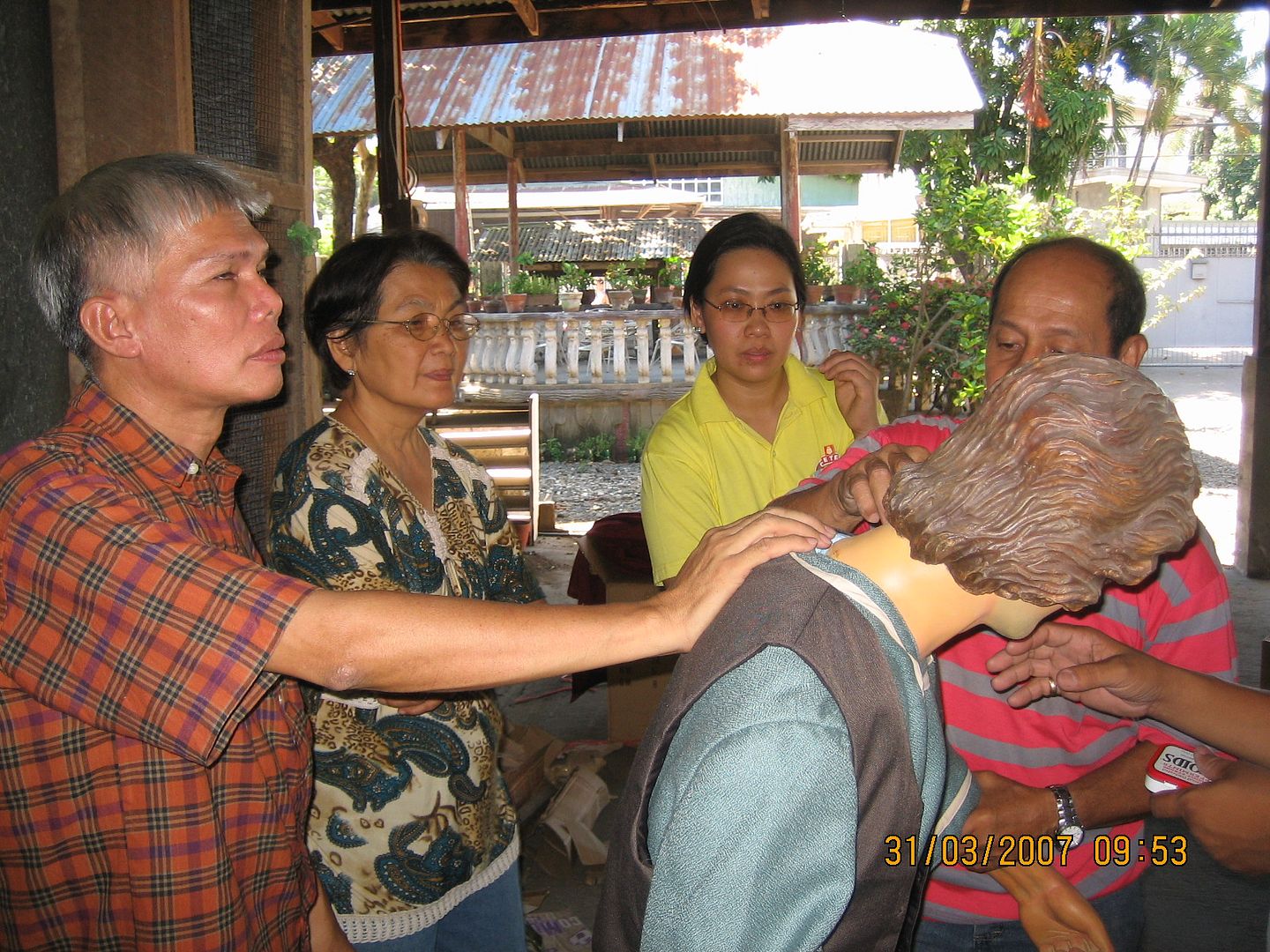
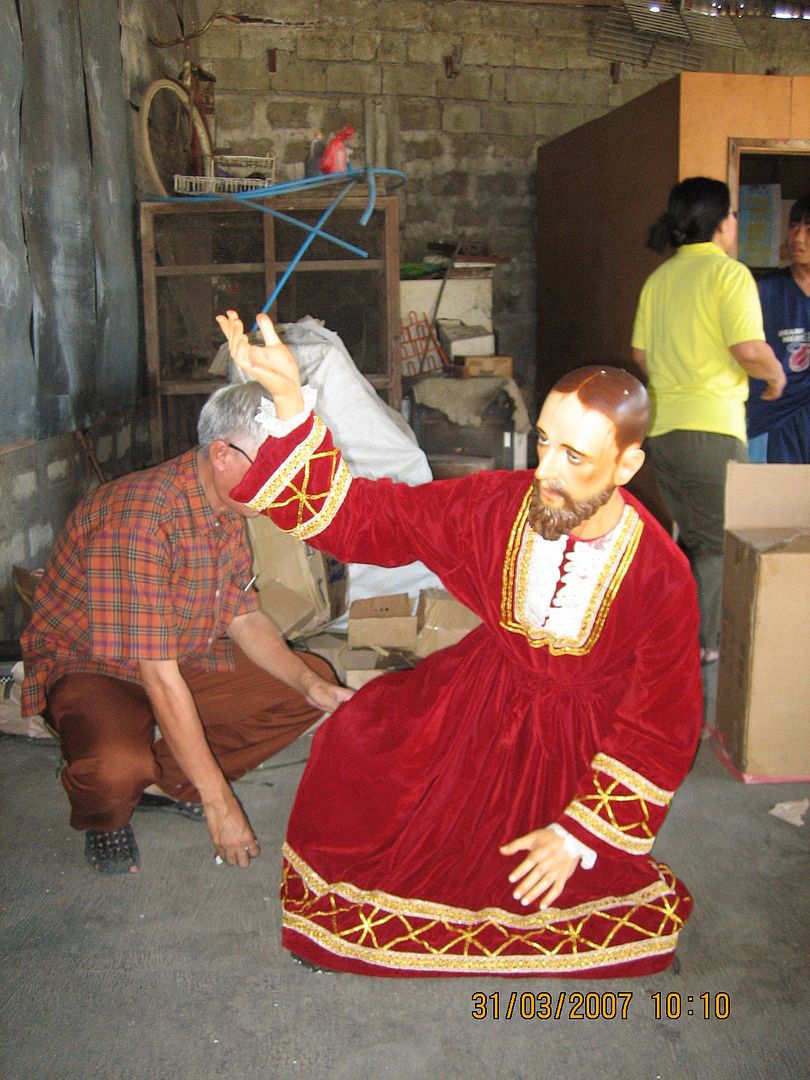
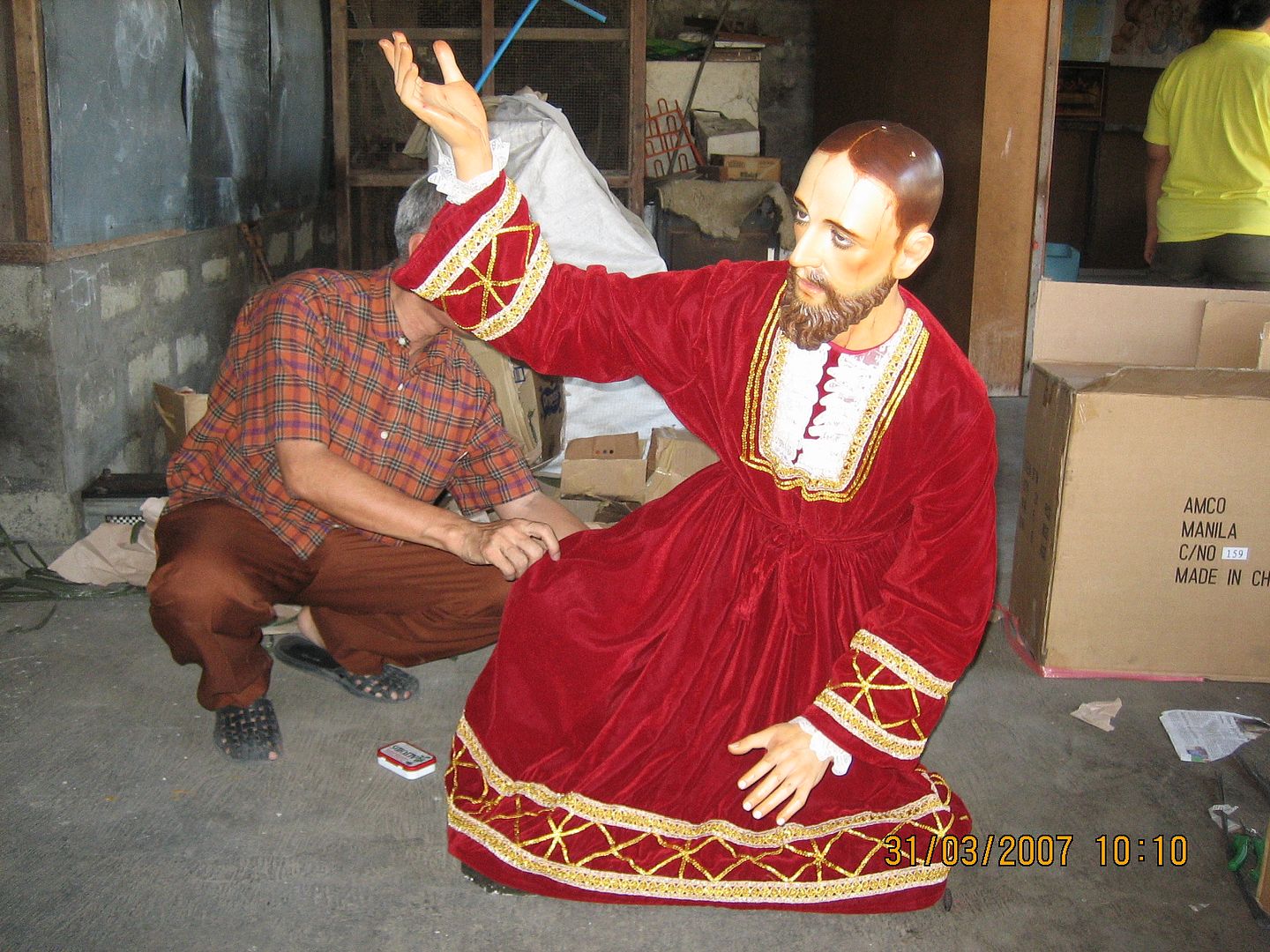
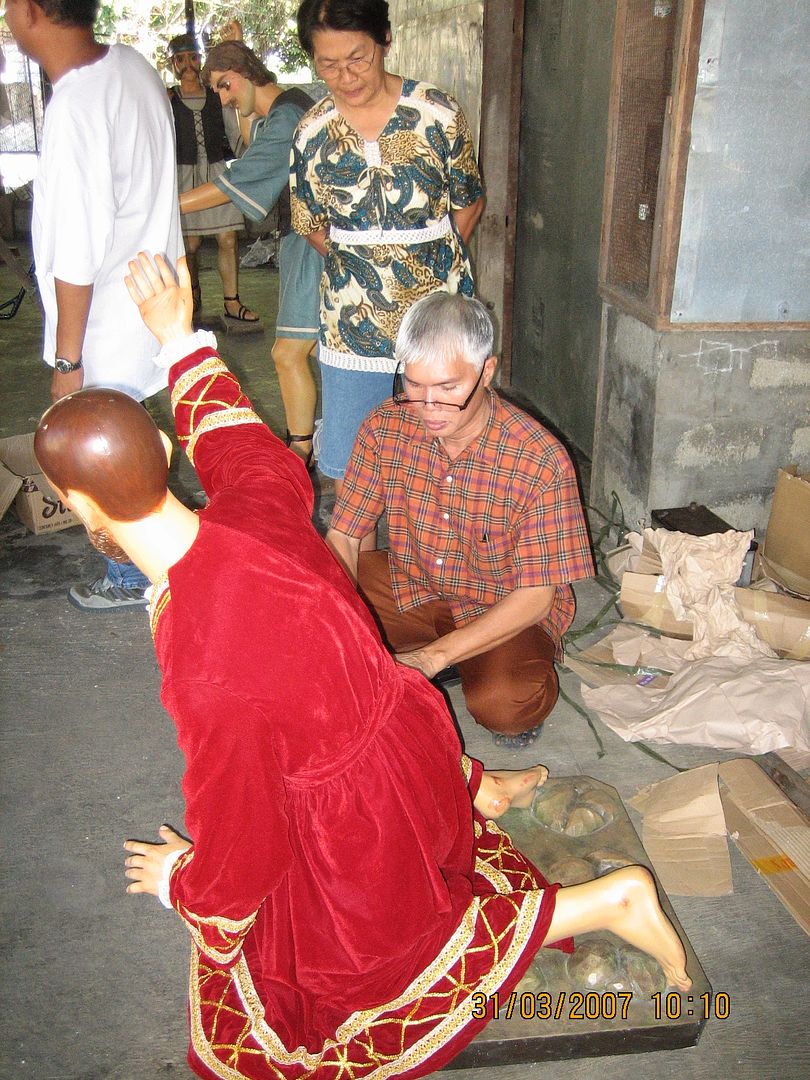
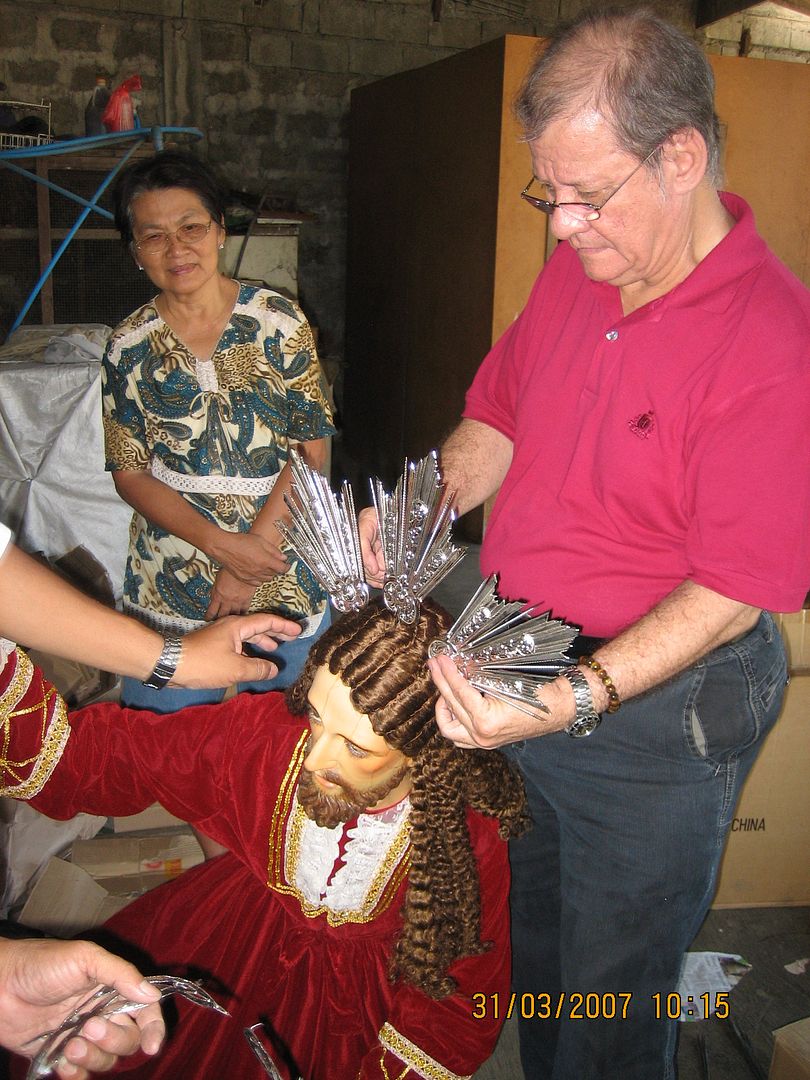
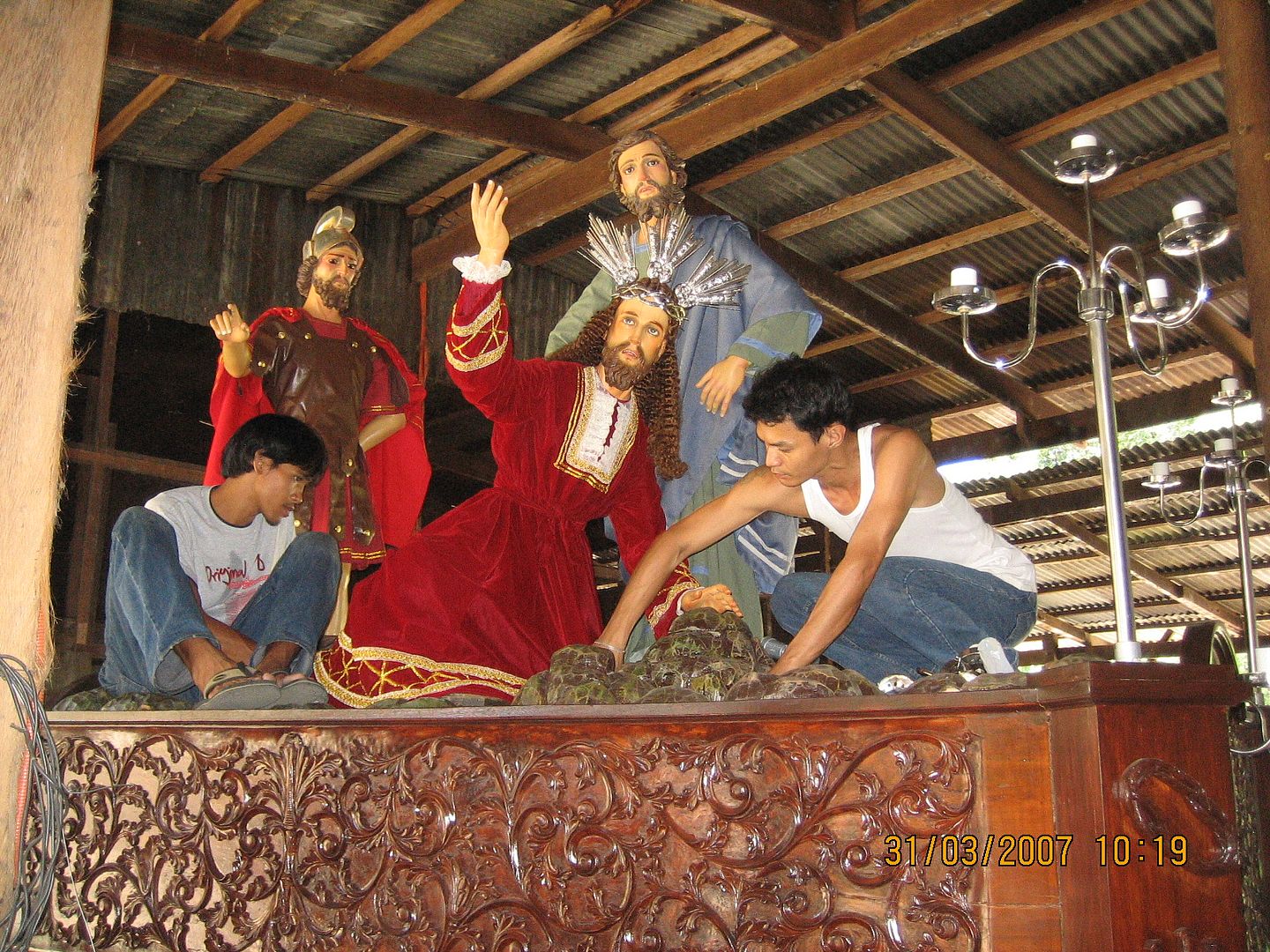
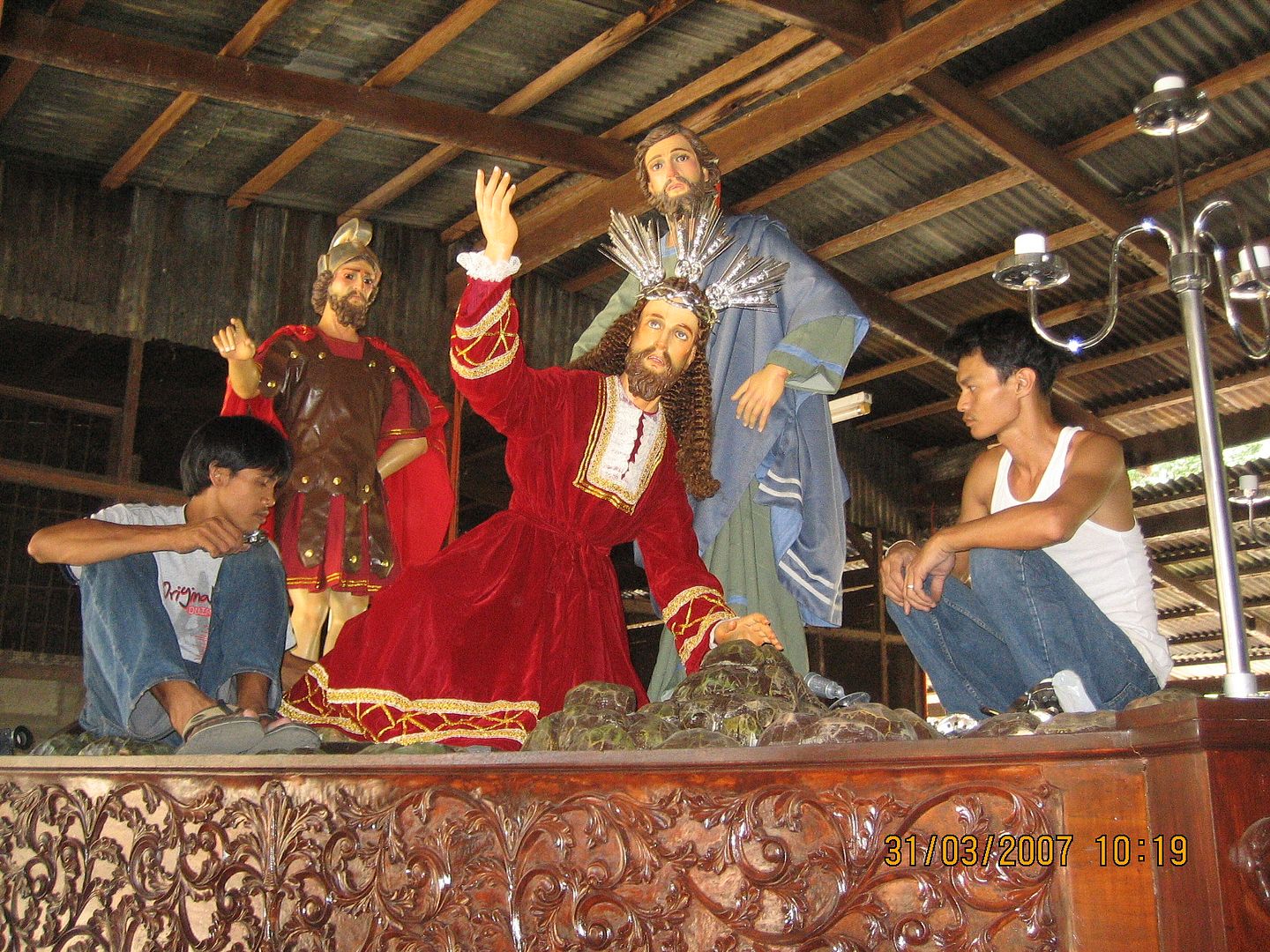
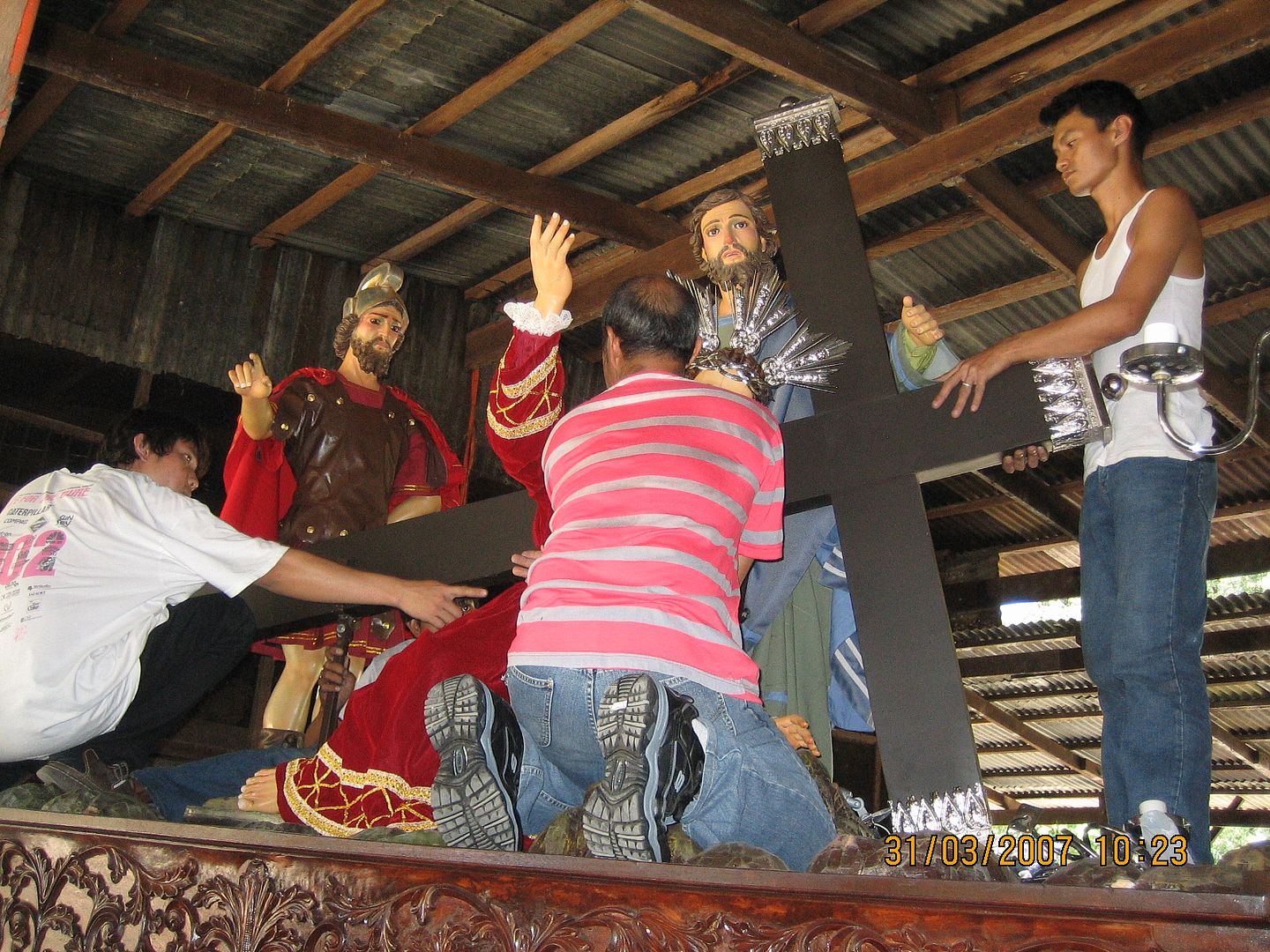
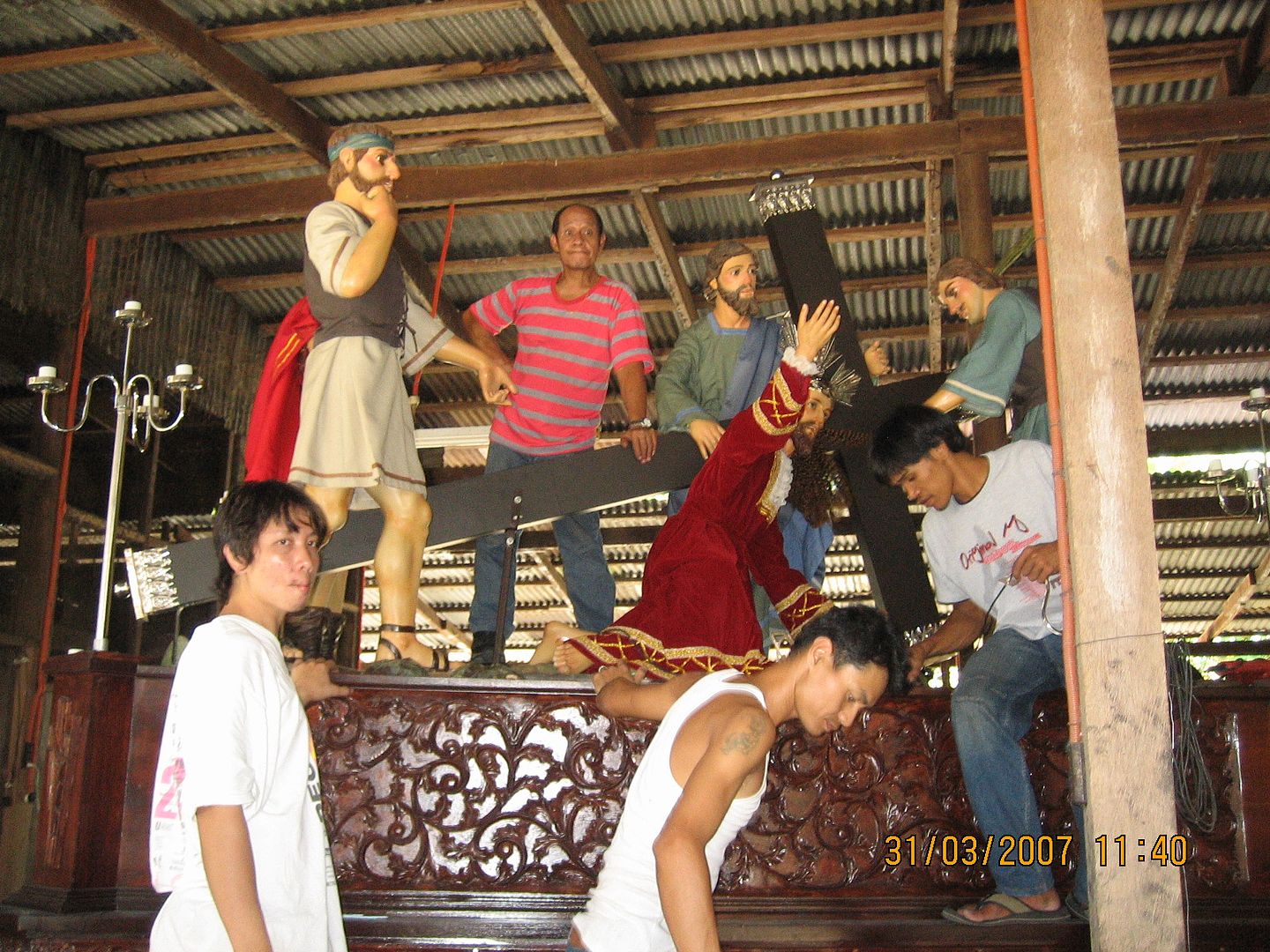
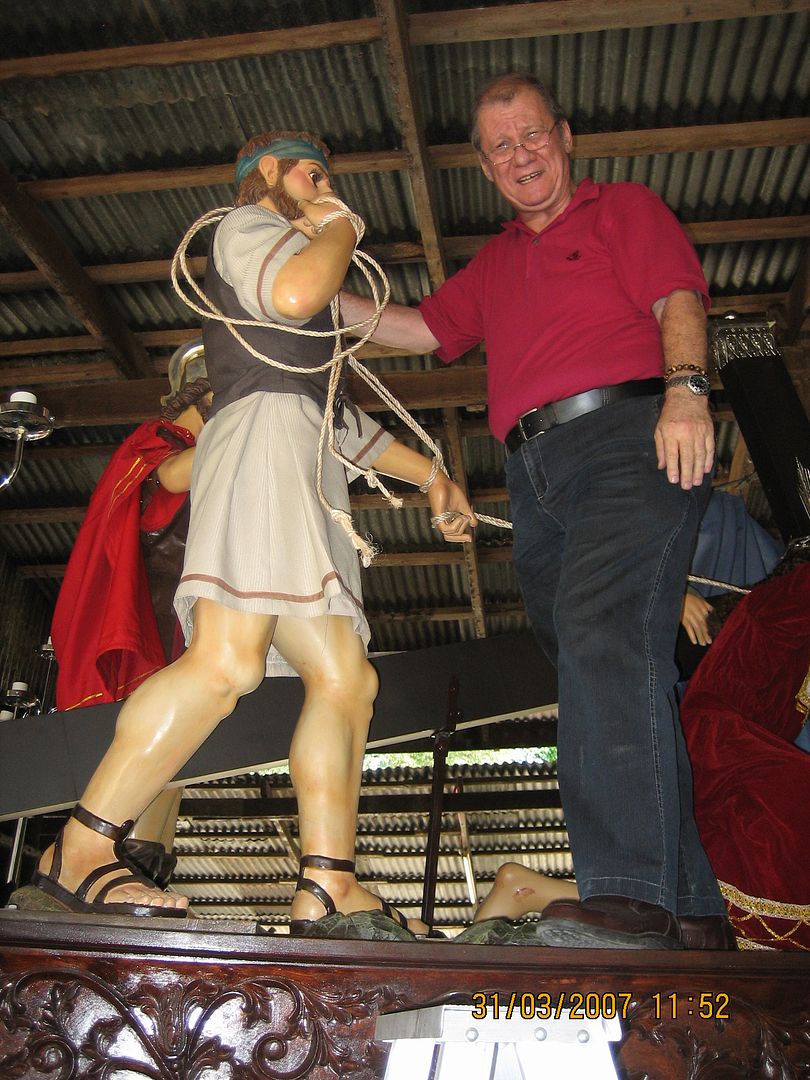
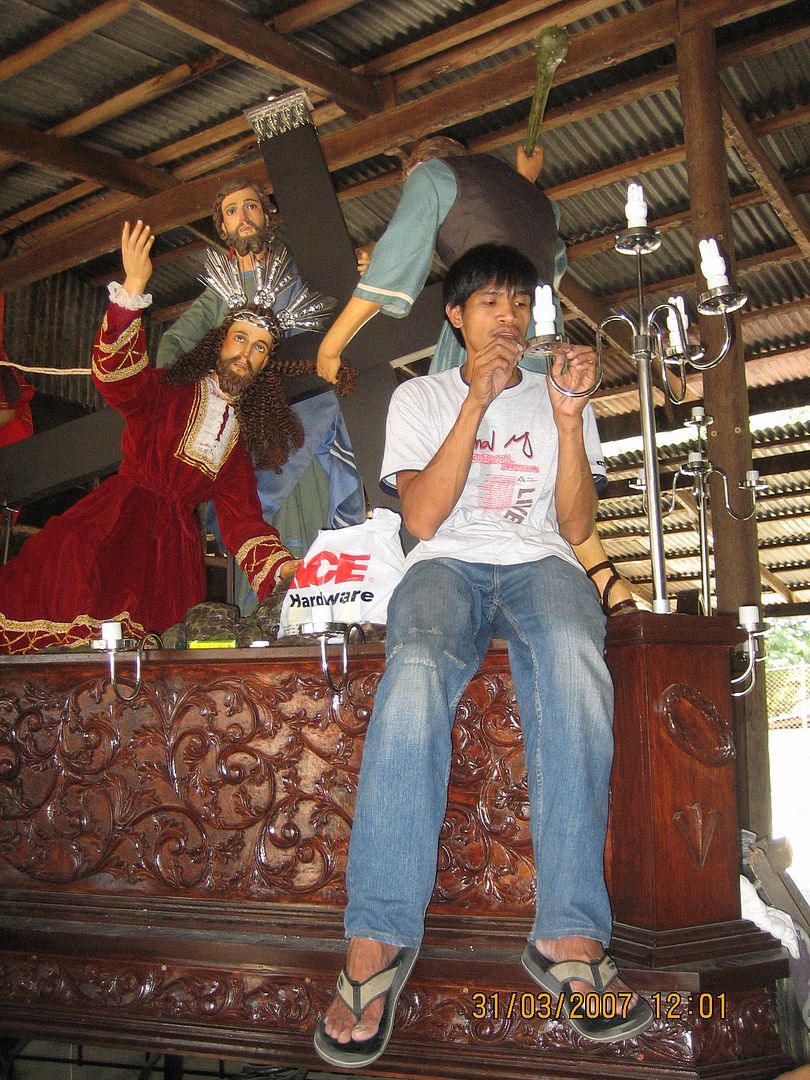
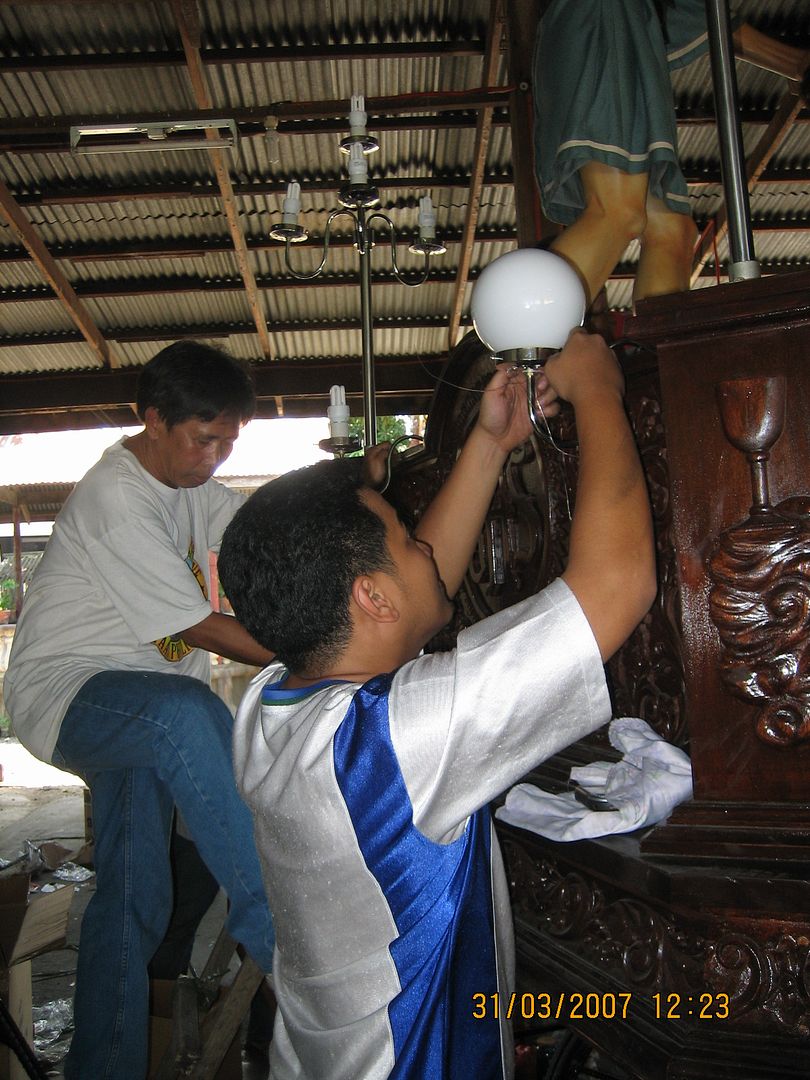
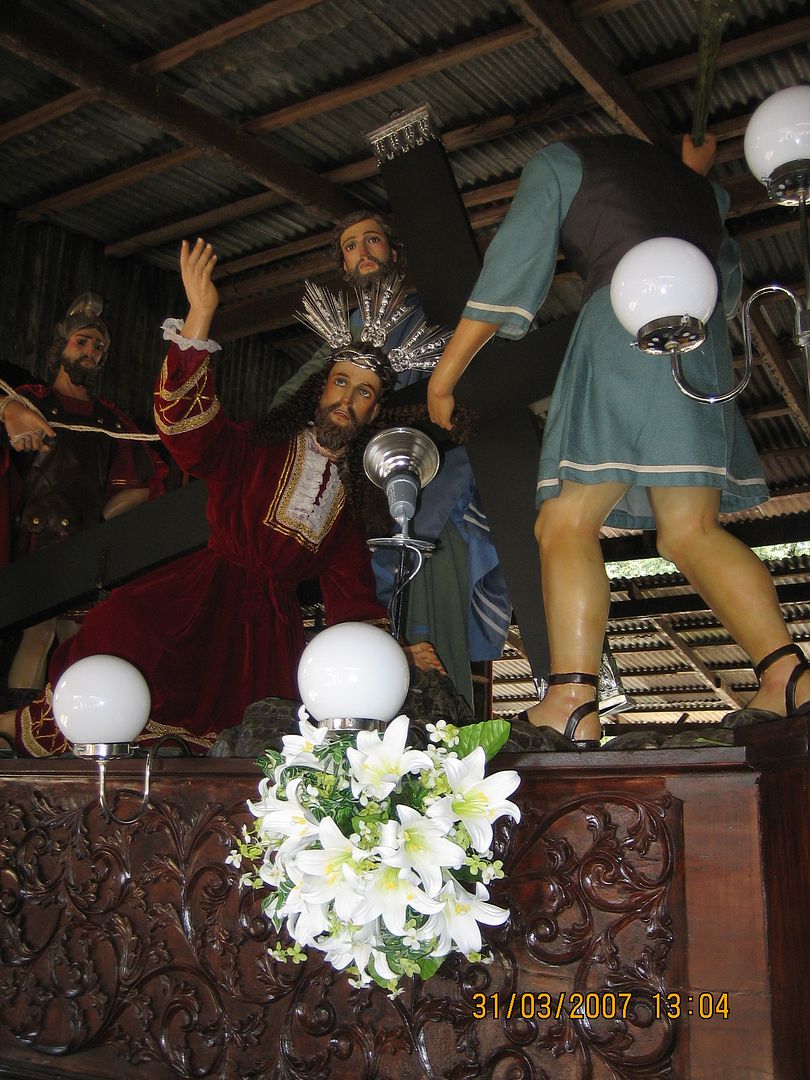
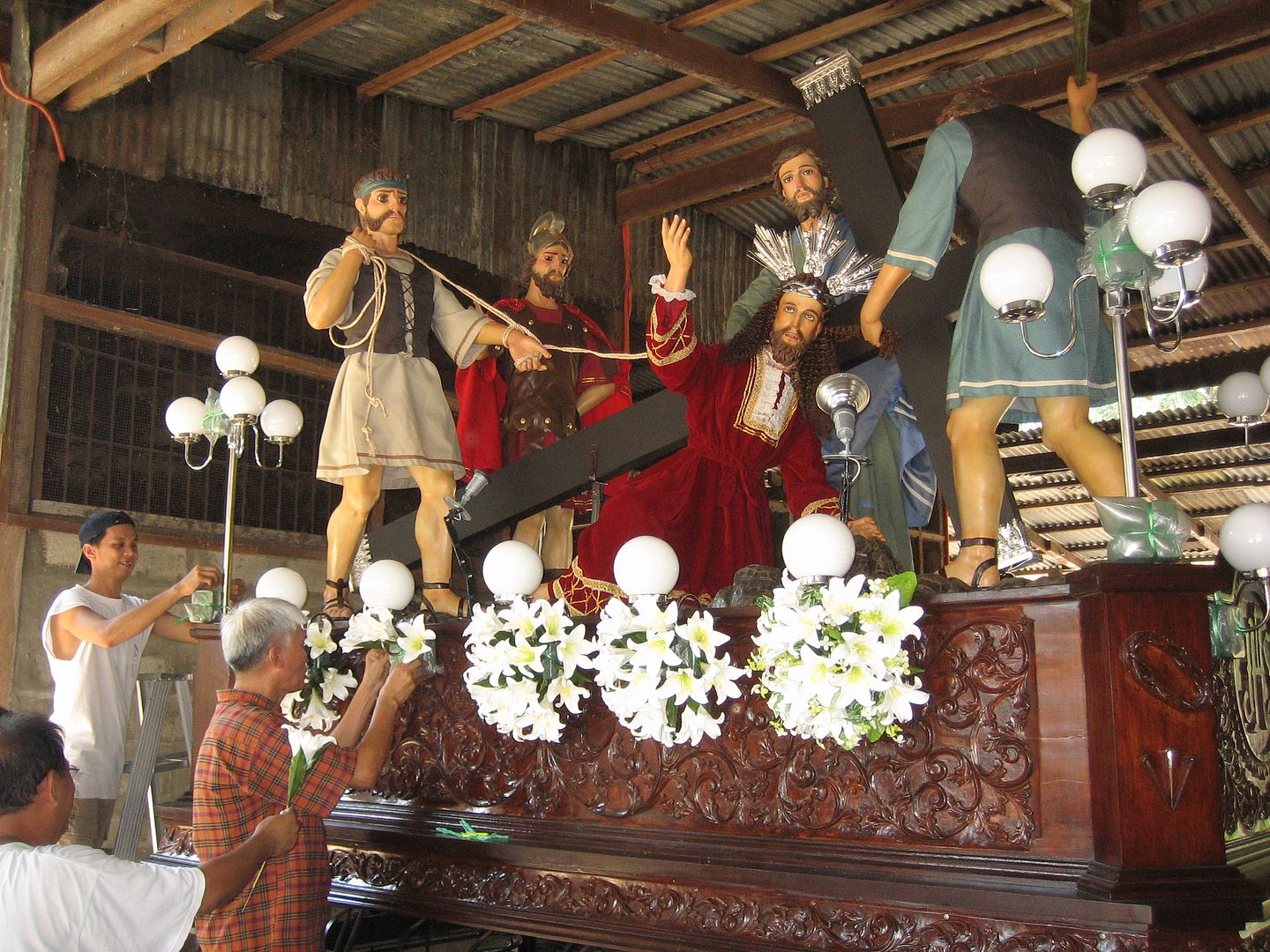
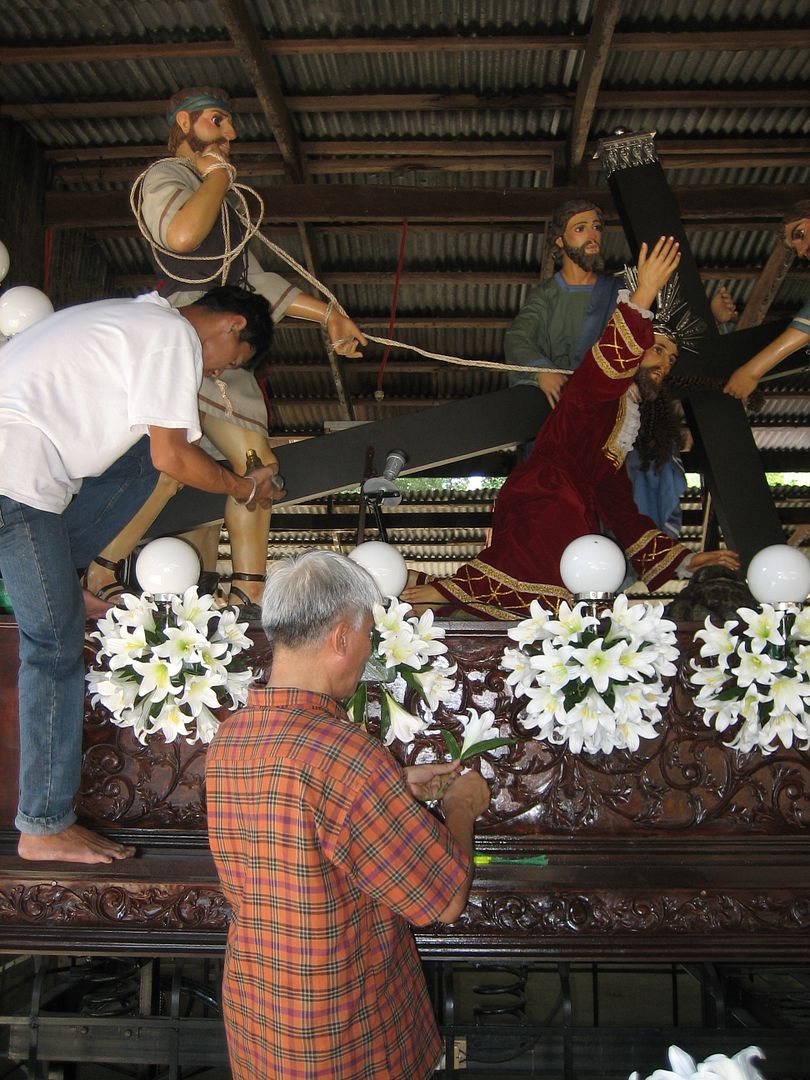
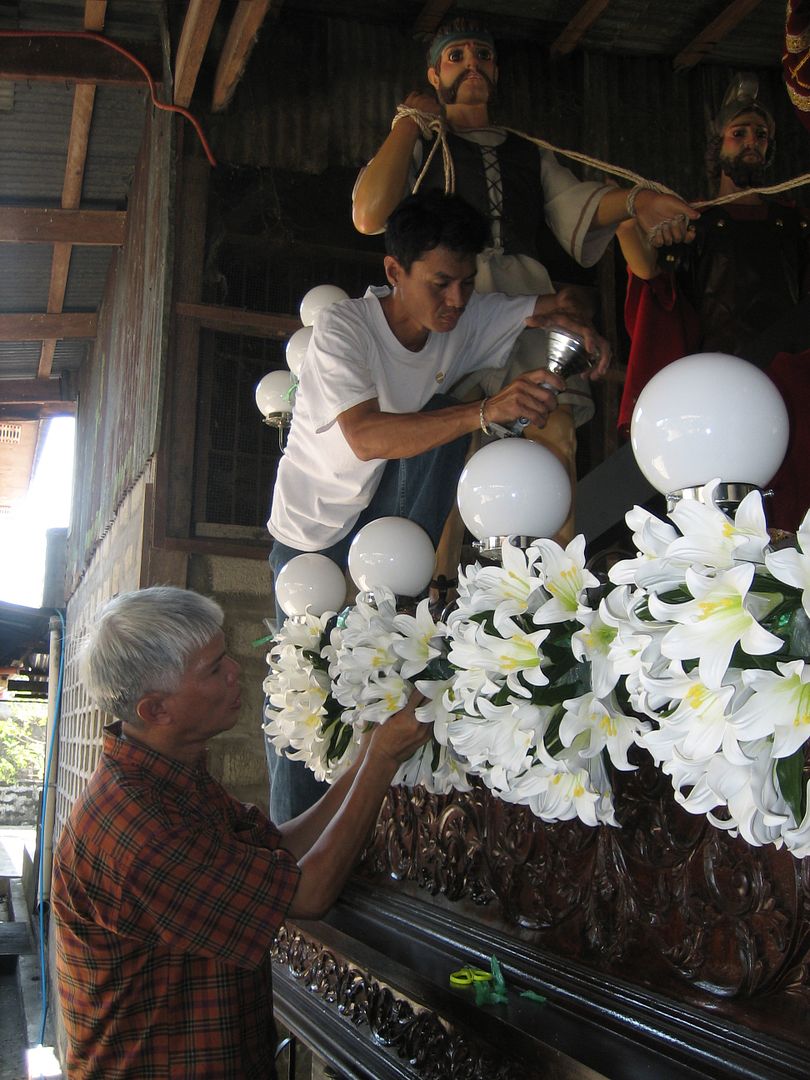
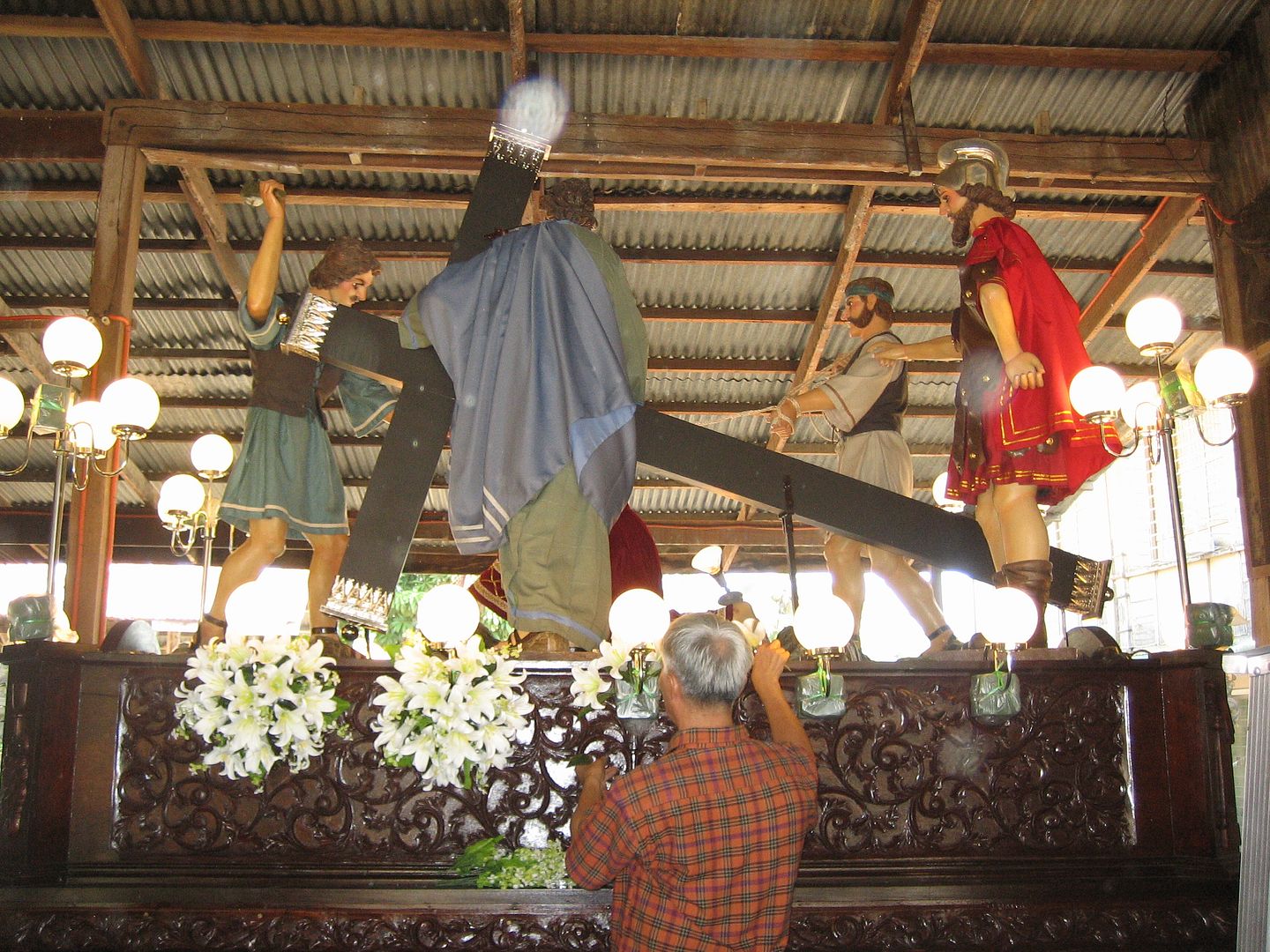
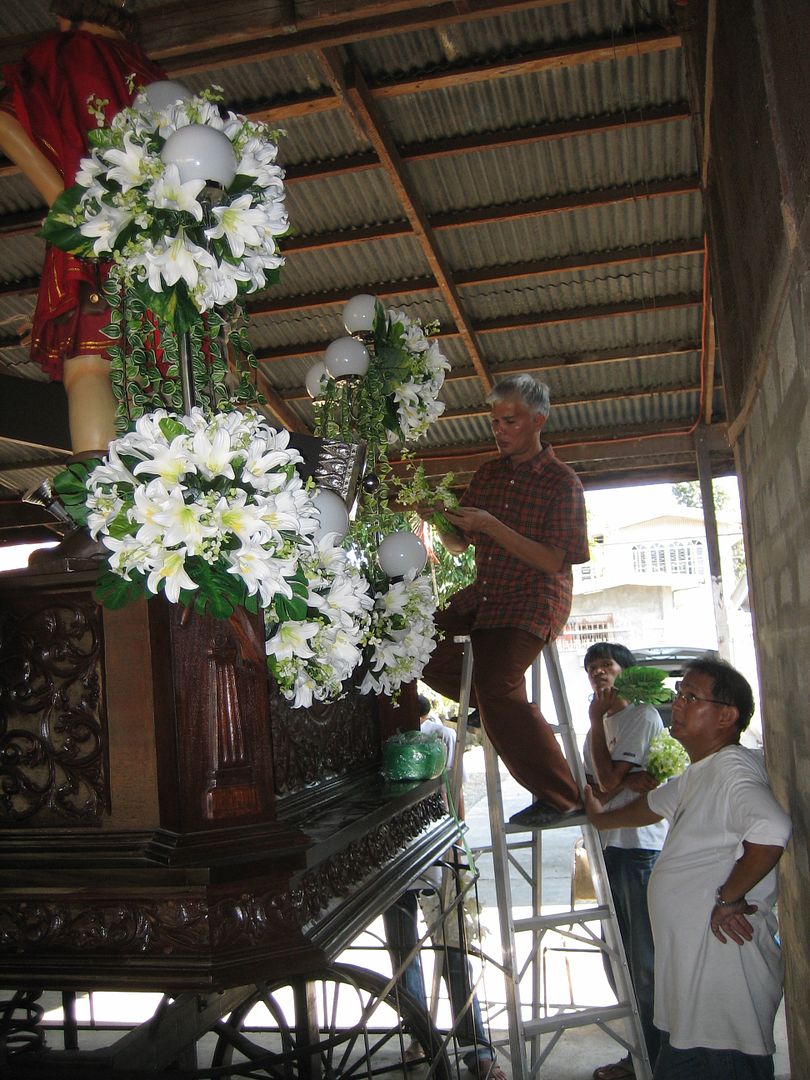
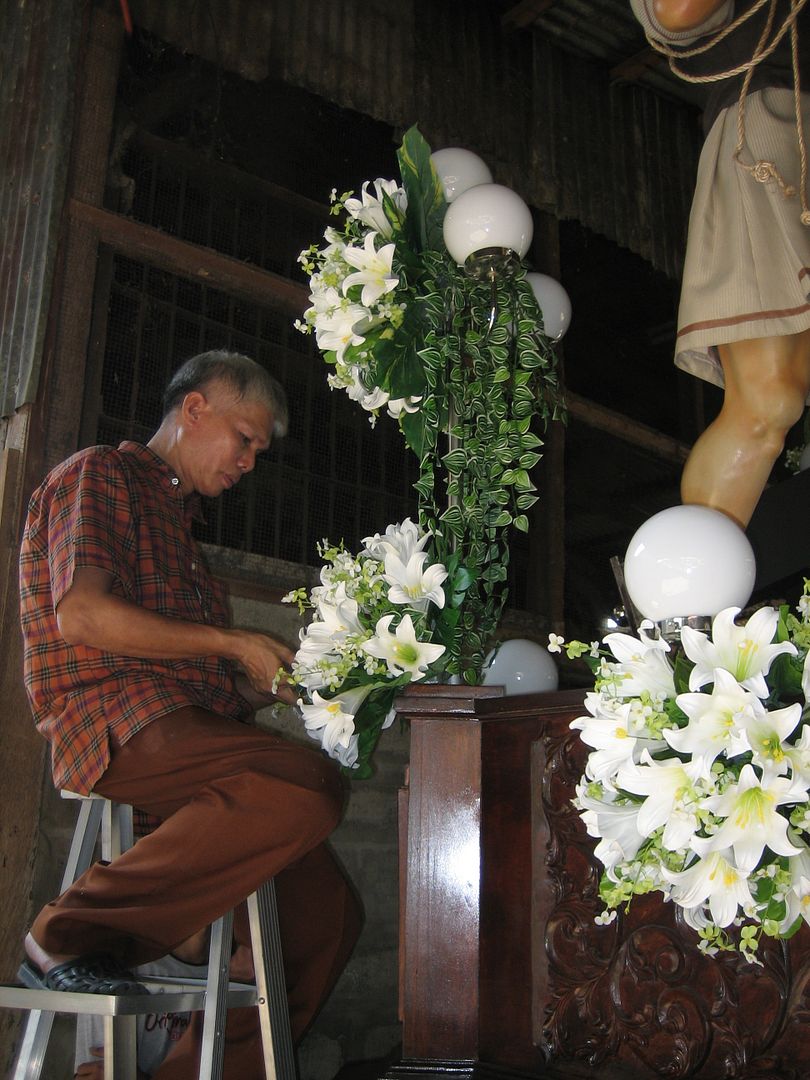
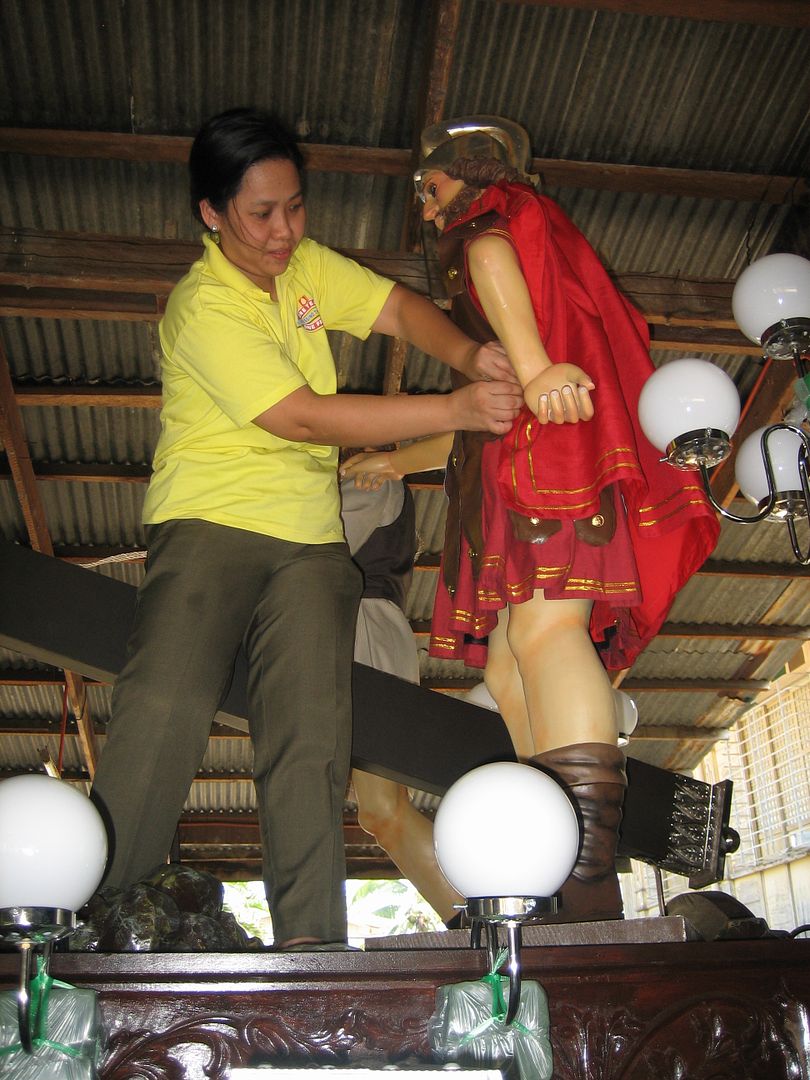
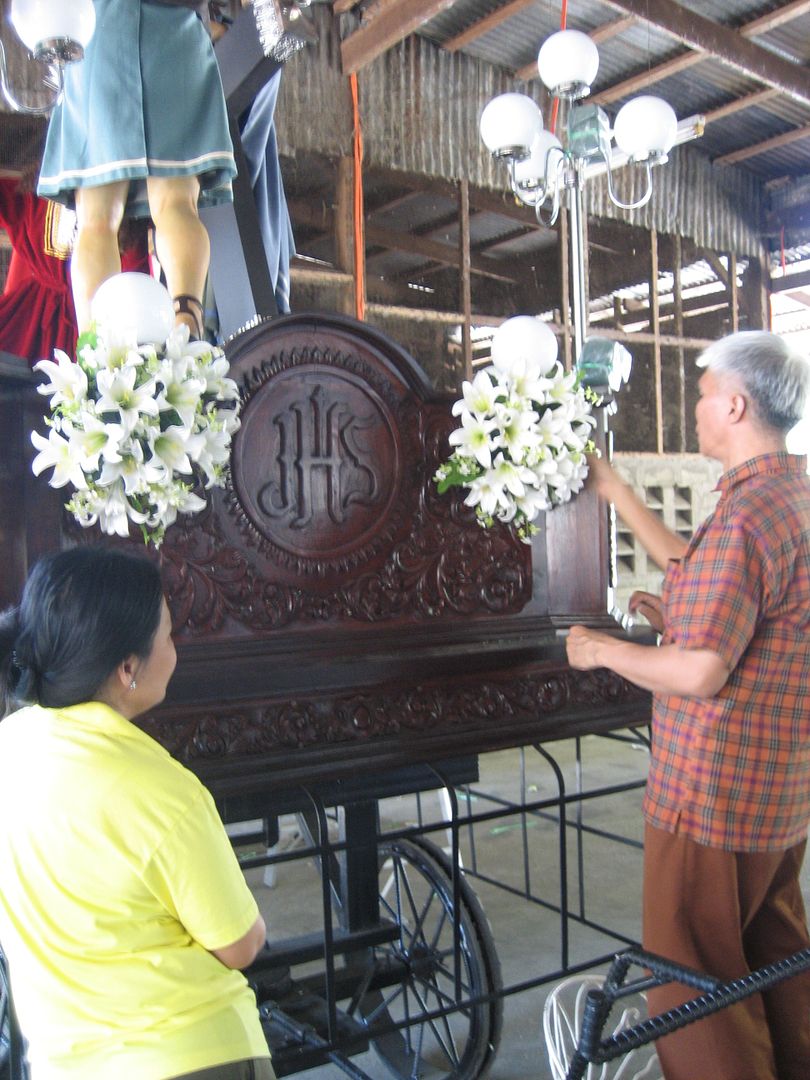
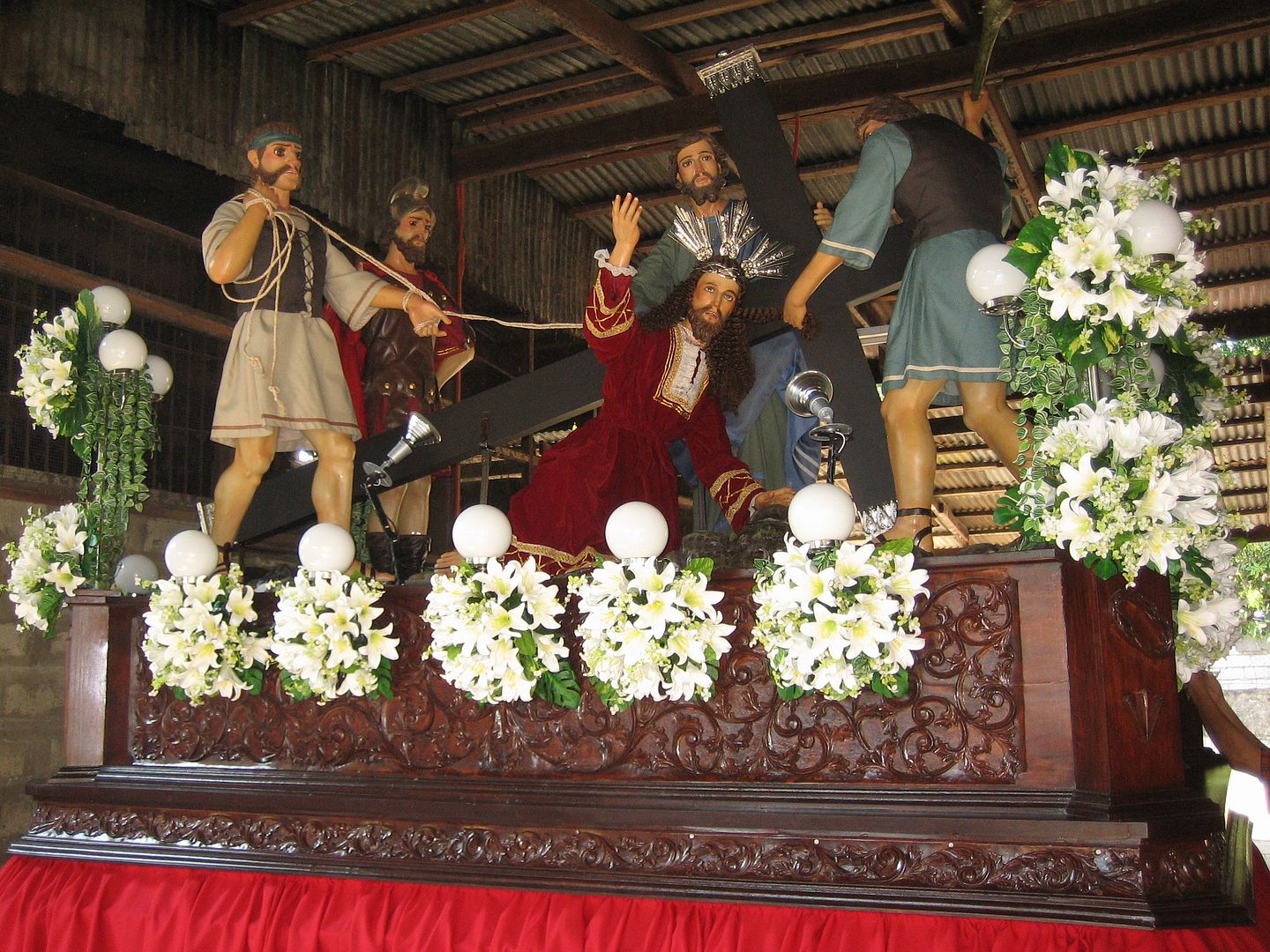
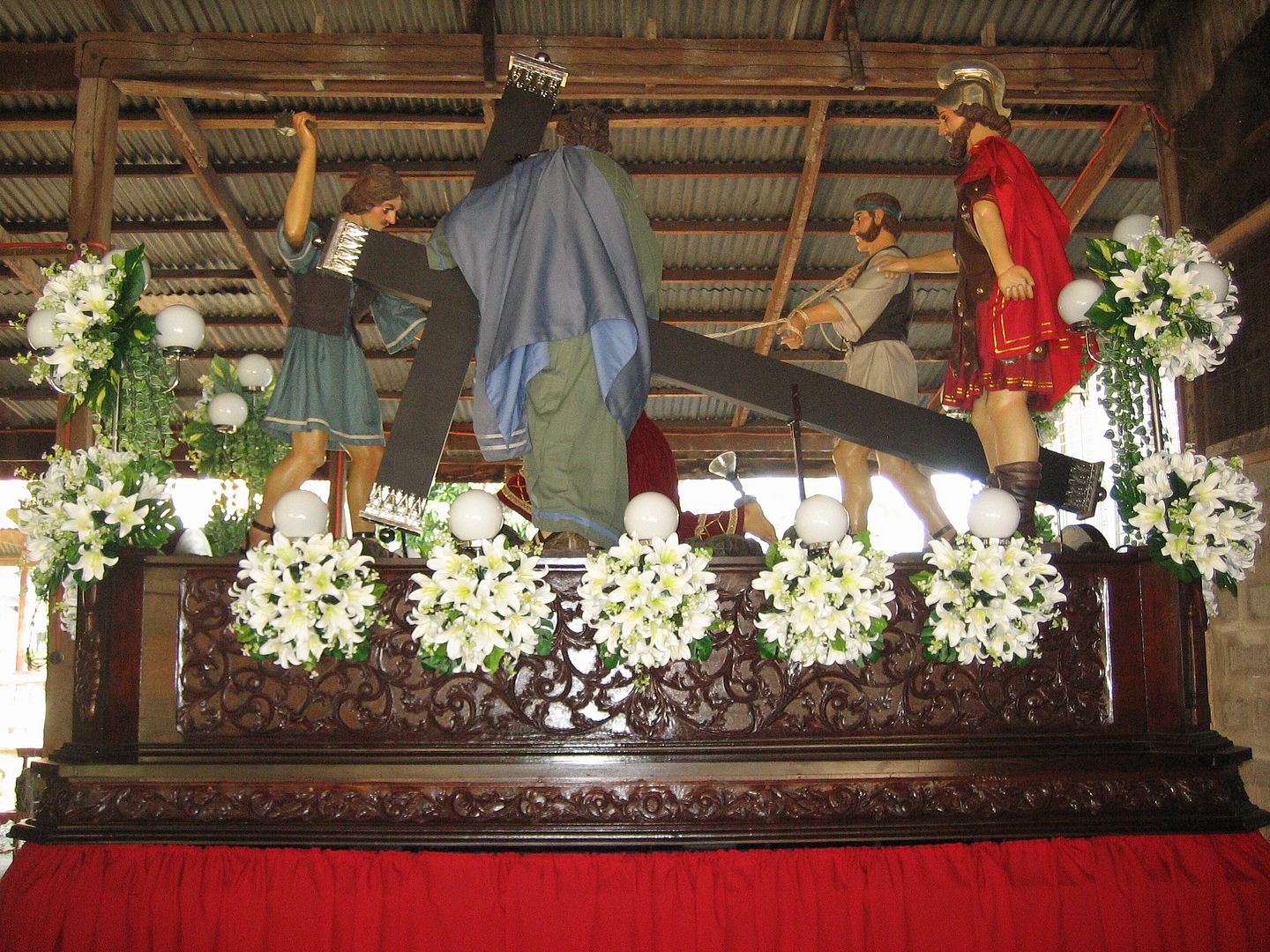
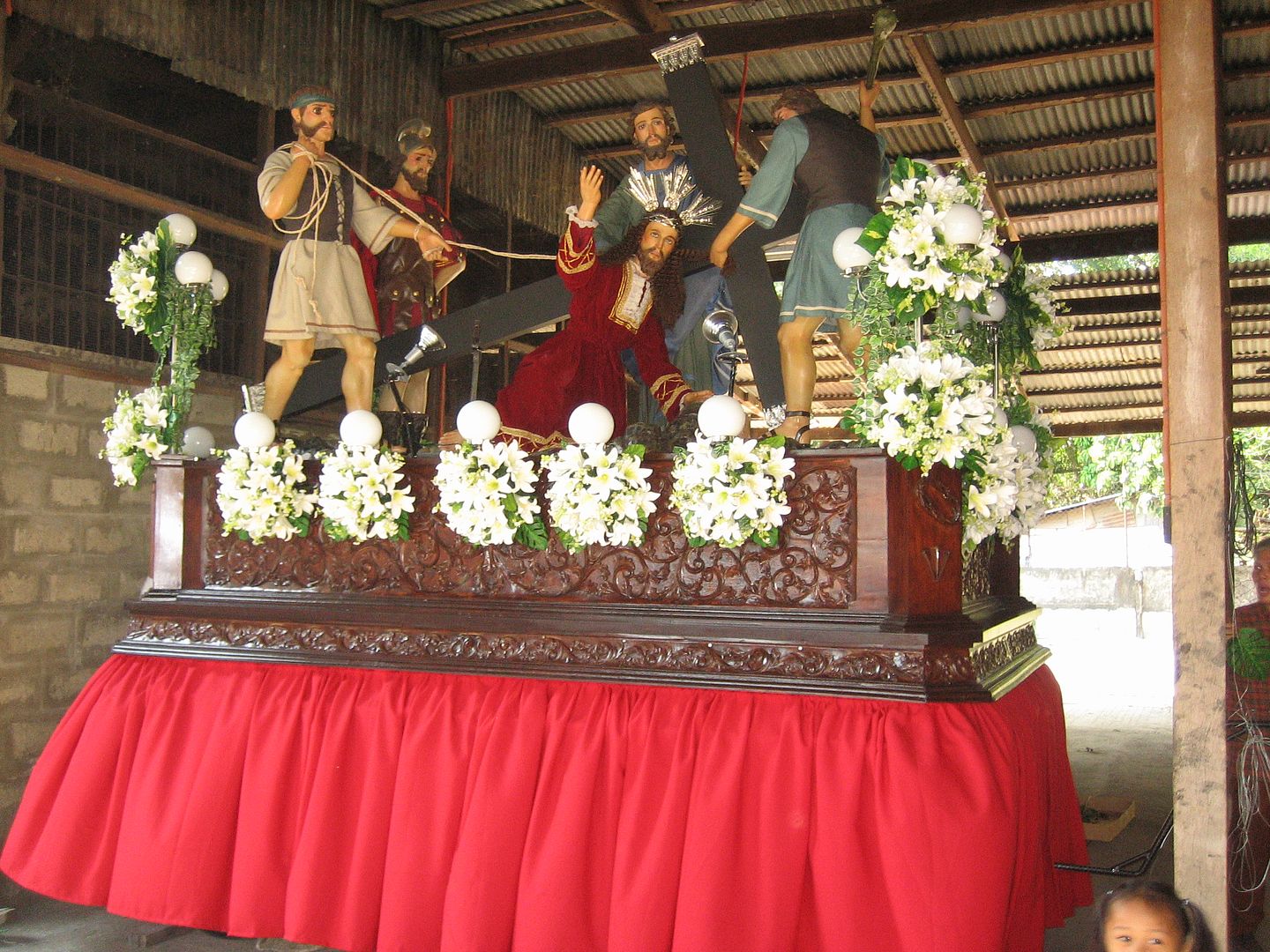
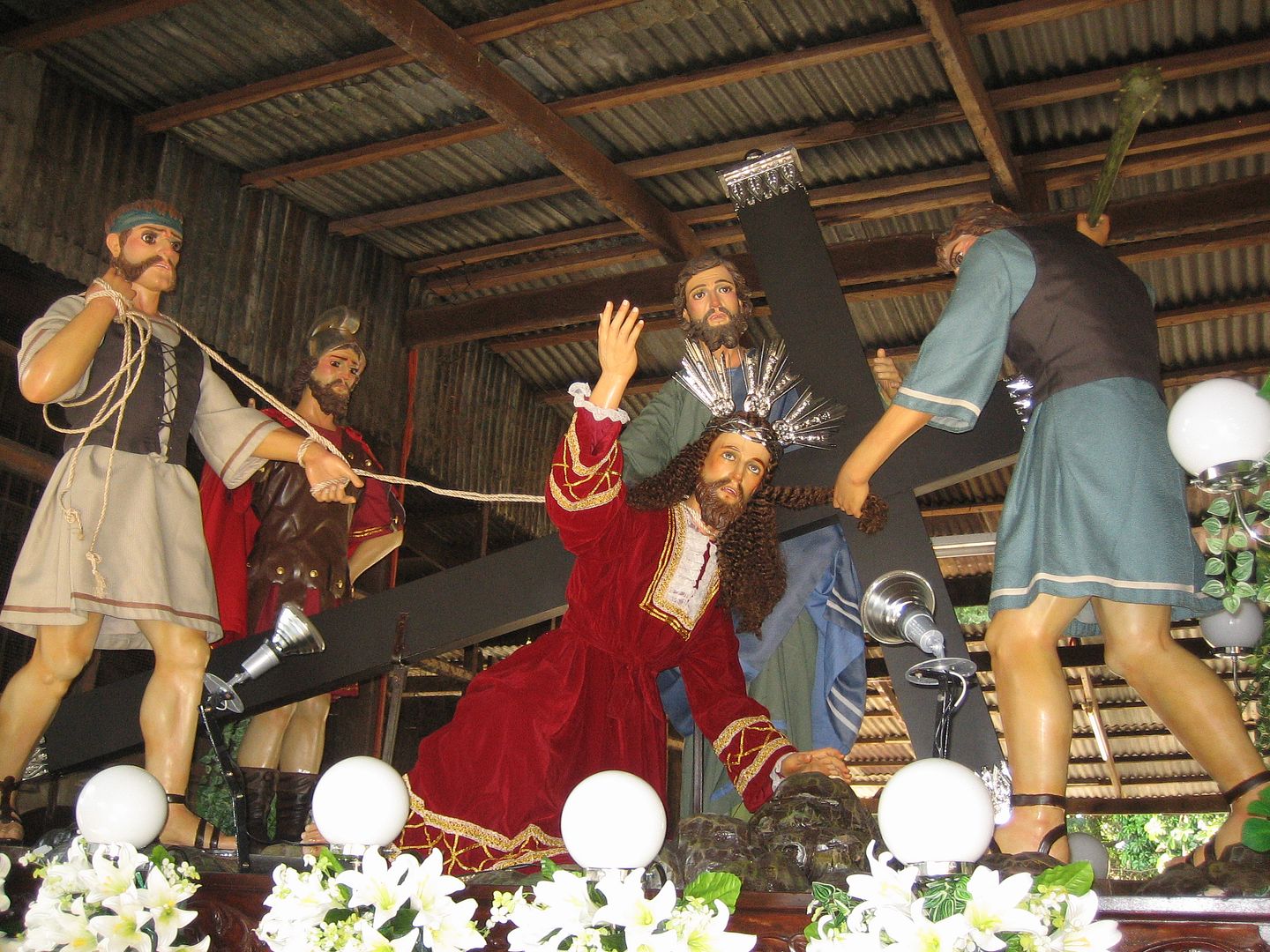
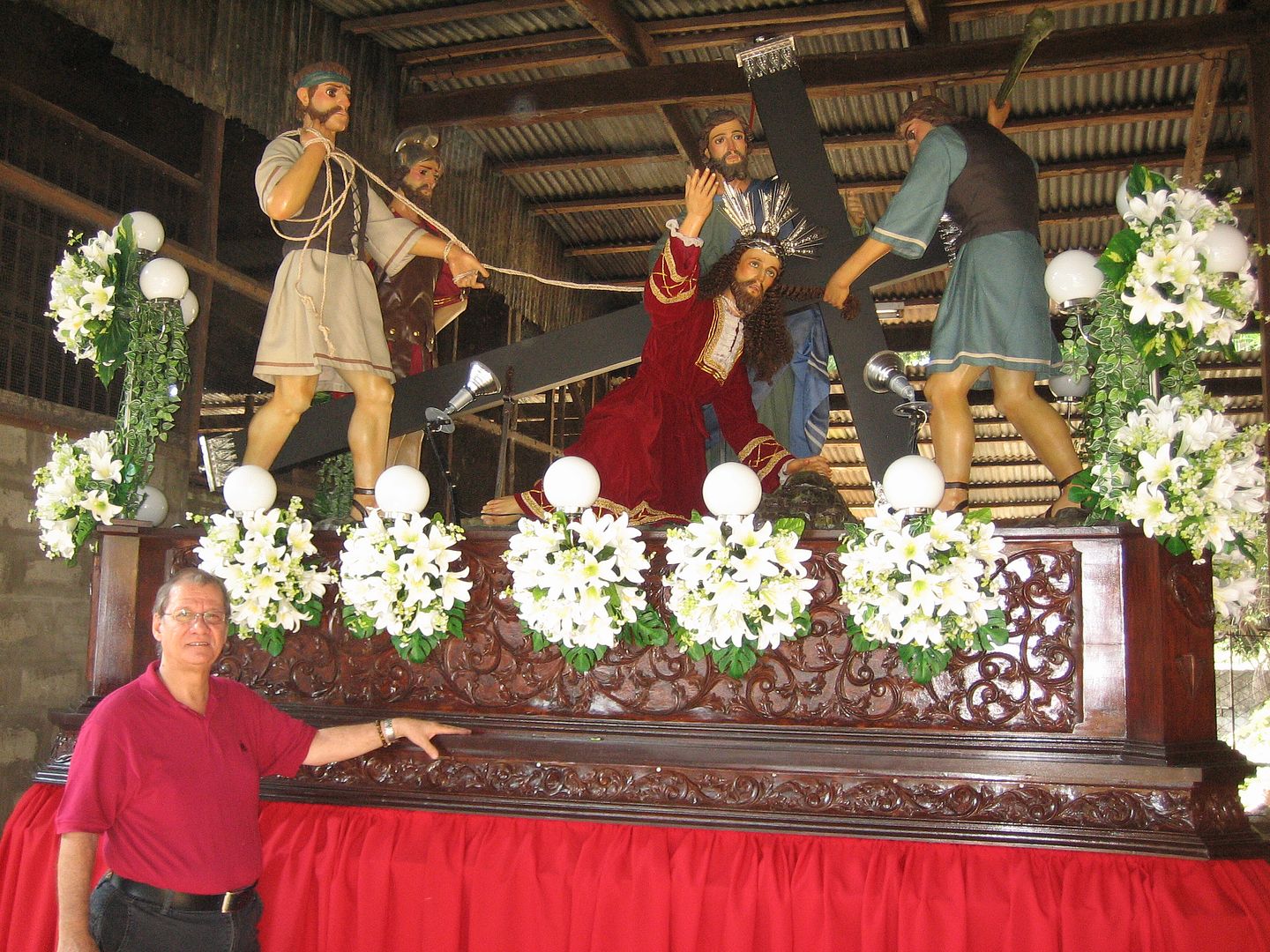
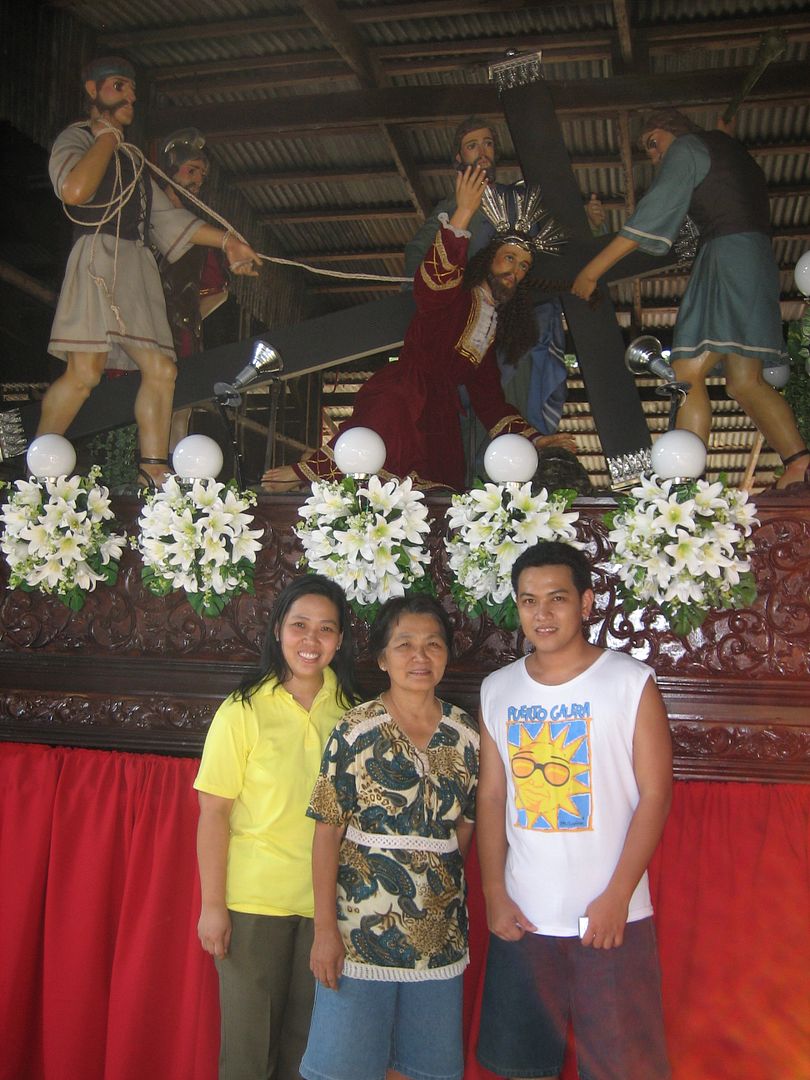
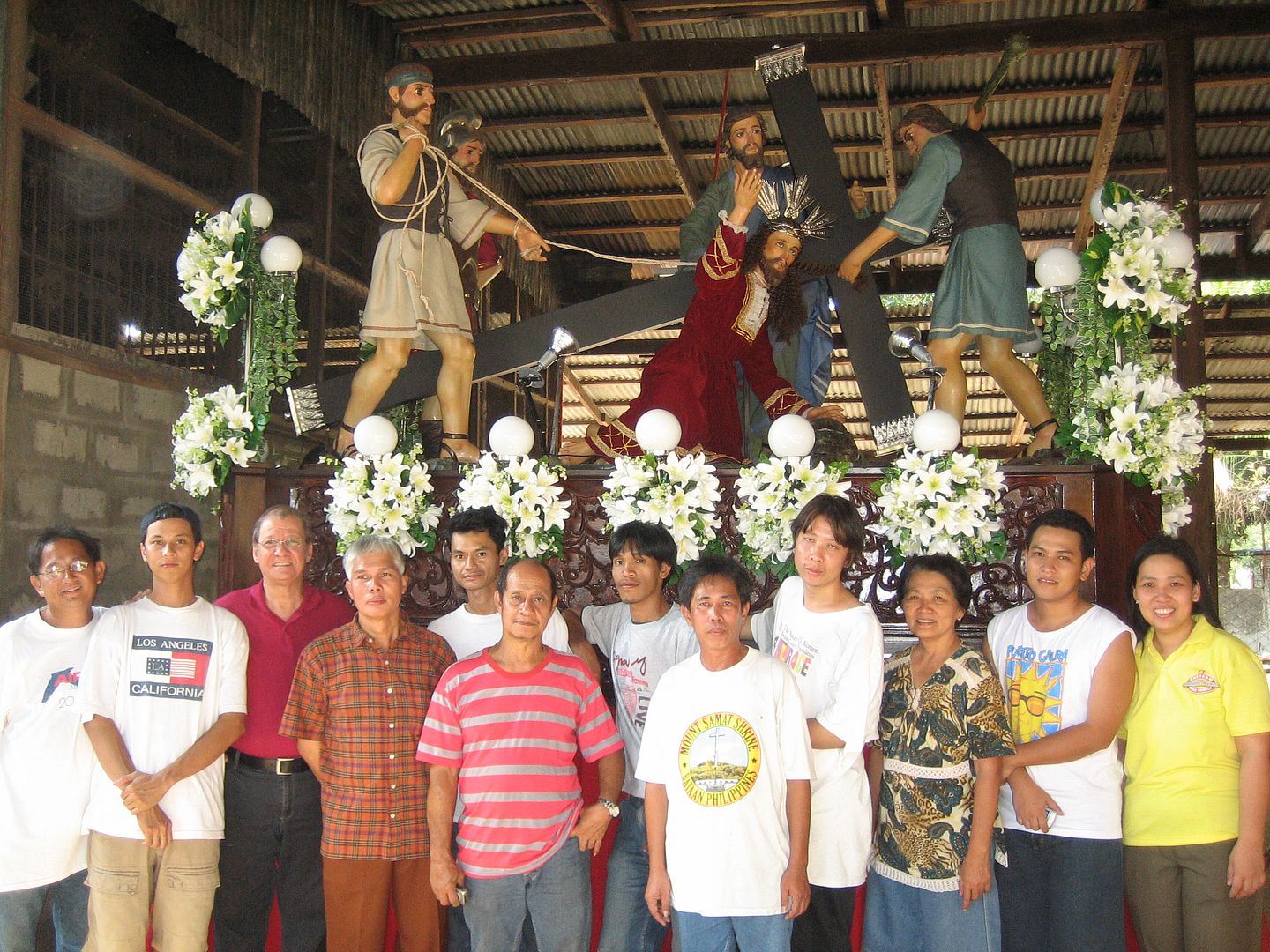
Our family’s “Pagkarapâ ng Panginoon” [The Fall of Christ], or to use its scripture-referenced title “Si Jesus ay Tinulungan ni Simon na taga-Cirene” [Jesus is Helped by Simon of Cyrene to Carry His Cross], is next. A four-part series has already been written about this tableau, so instead of commenting further here, just view these sample photos
And click on these links:
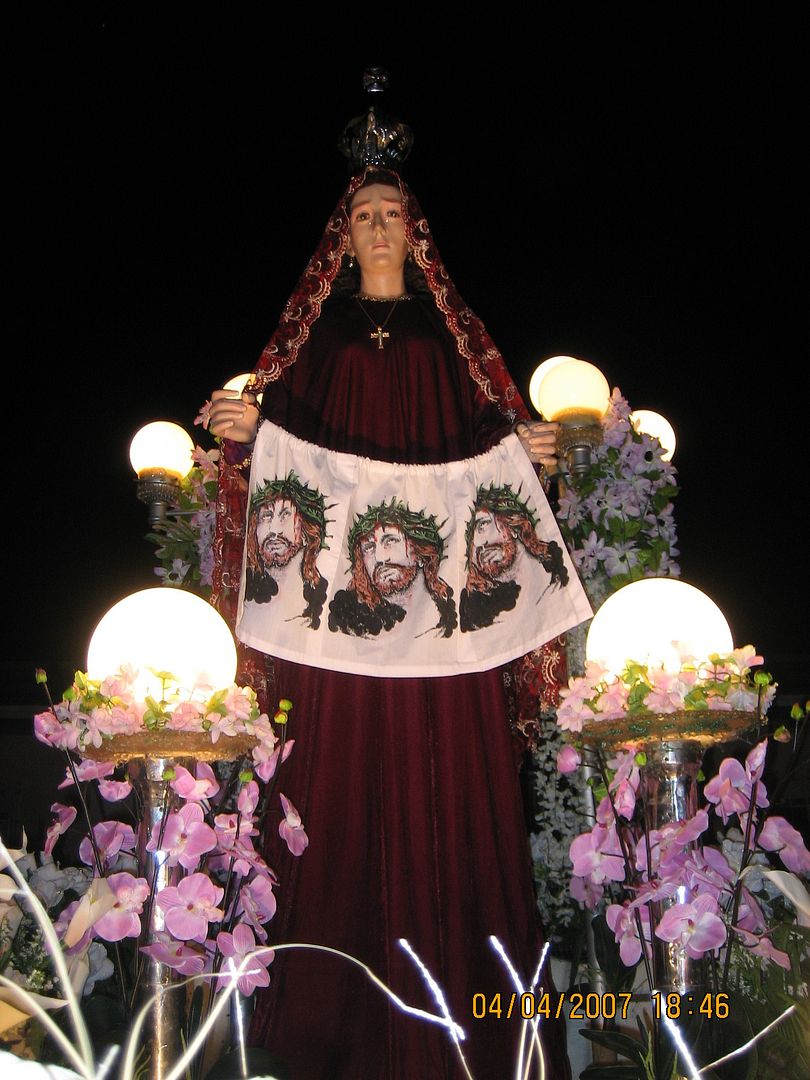
Next is “Ang Paglalahad ni Veronica ng Tatlong Mukha ni Jesus” [Veronica Reveals the Three Faces of Jesus on her Kerchief].
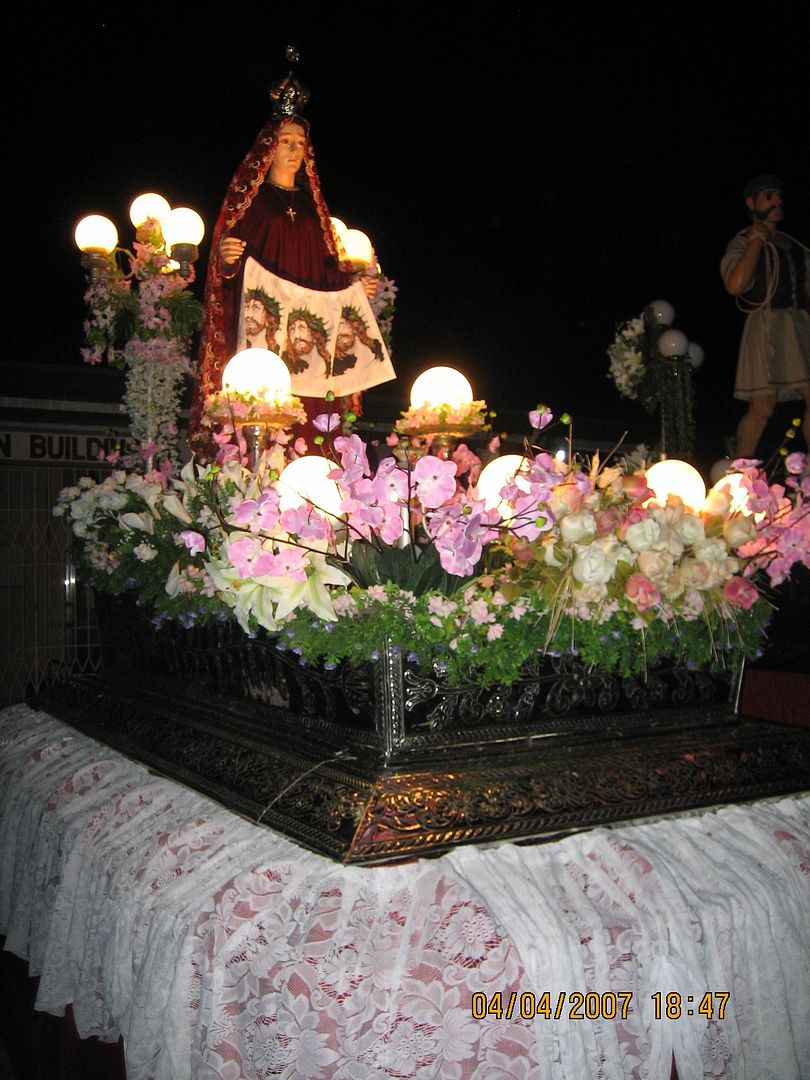
This image is appropriately dressed in mourning, in an elegant shade of maroon.
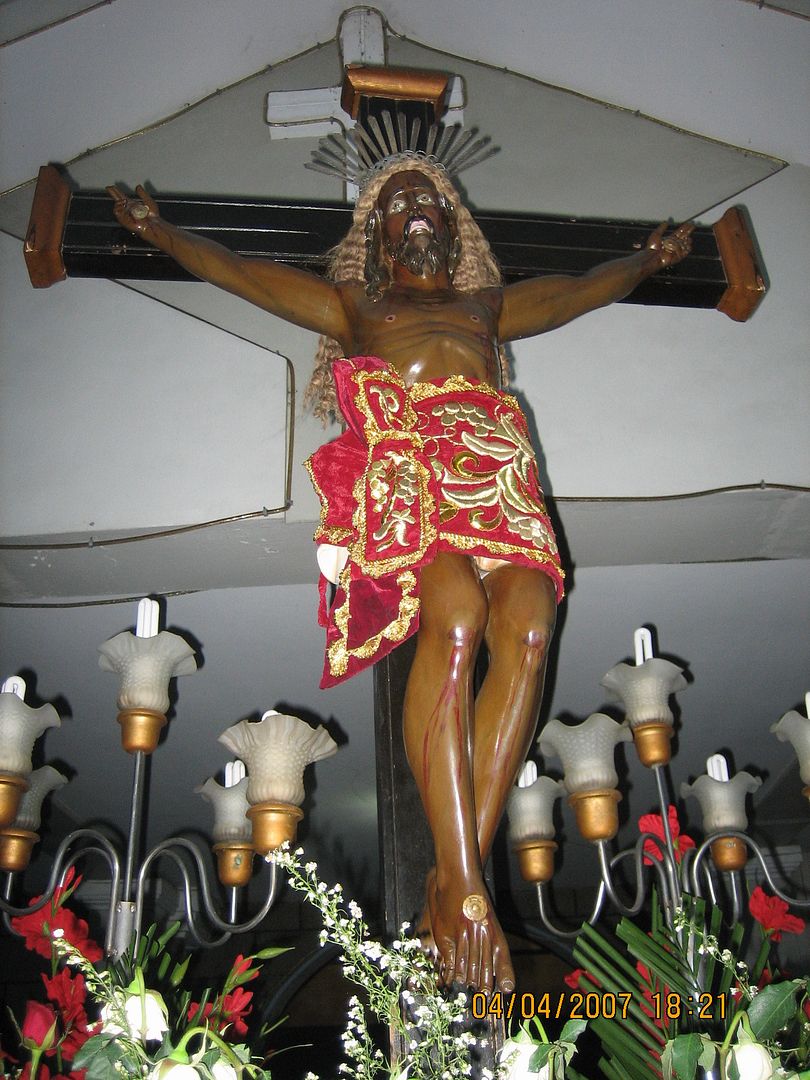
The parish’s titular patron, “Ang Mahal na Señor Santo Cristo” [Our Holy Lord the Christ] is deservedly an important member of this processional line-up.
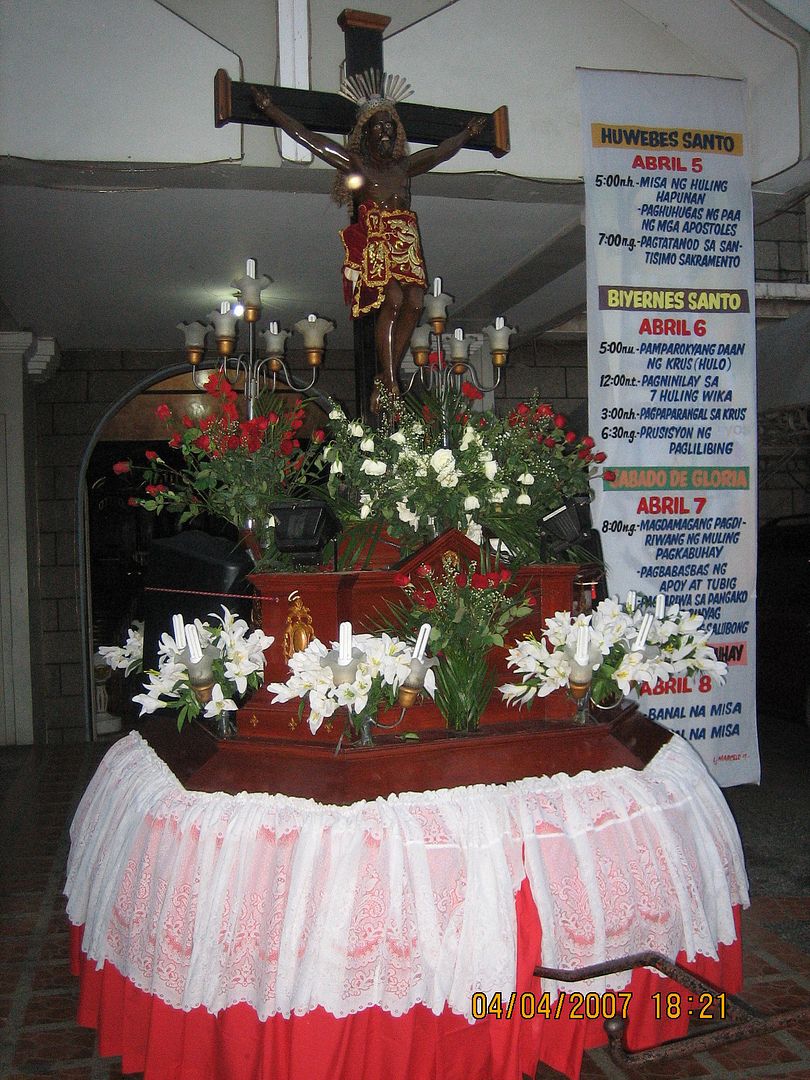
The processional image is actually a replica of the original image referred to earlier, and now permanently enshrined in the church altar.
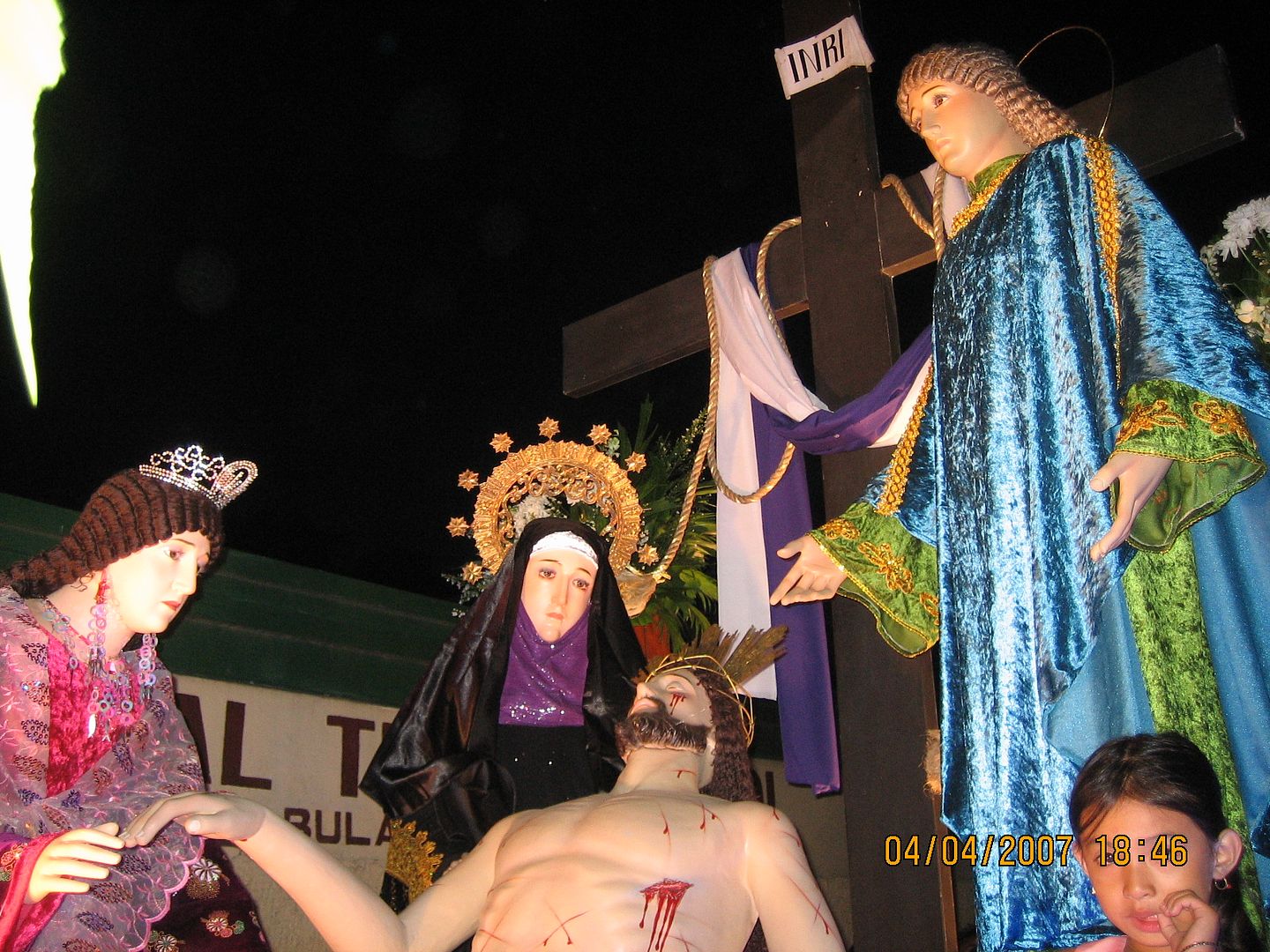
Following this is “Si Jesus sa Kandungan ng Kanyang Ina (Pieta)” [Jesus is Cradled by His Mother].
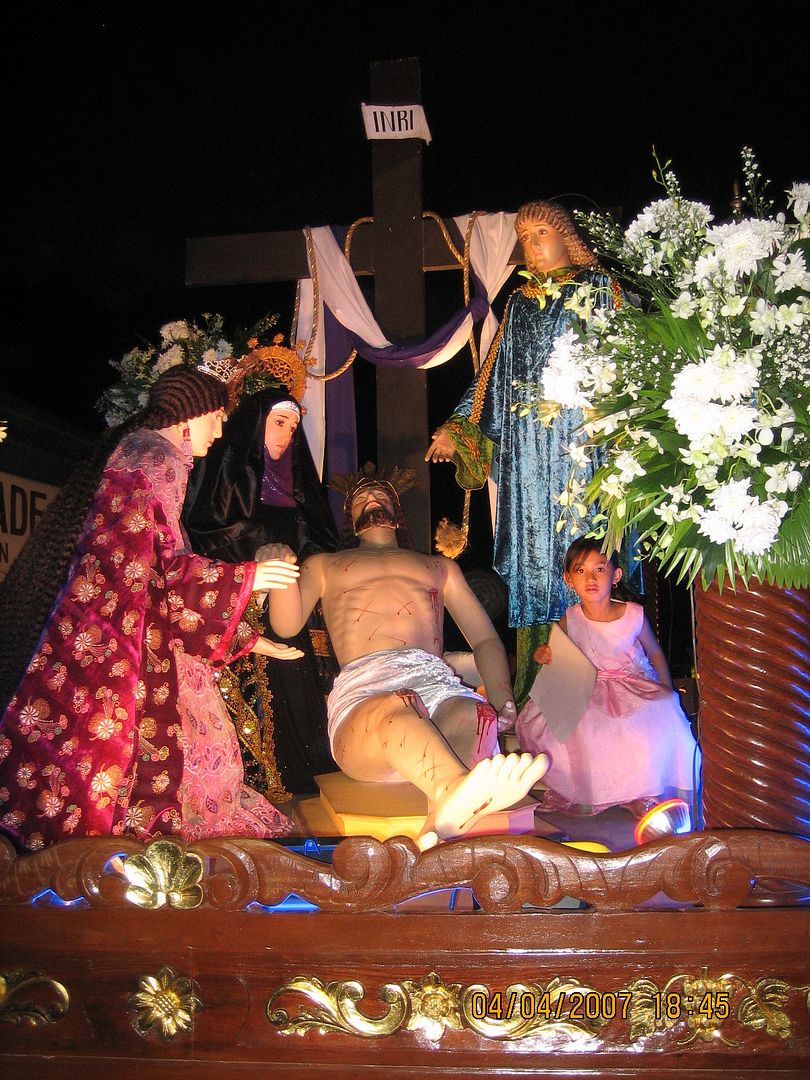
While not exactly depicting a cradling in the Blessed Mother’s lap, this scene does seem to benefit from the presence of an extra-scriptural character, seen in the lower right-hand corner.
Inevitably, next comes “Ang Bangkay ni Jesus (Sto. Entierro)” [The Dead Christ (The Holy Burial)].
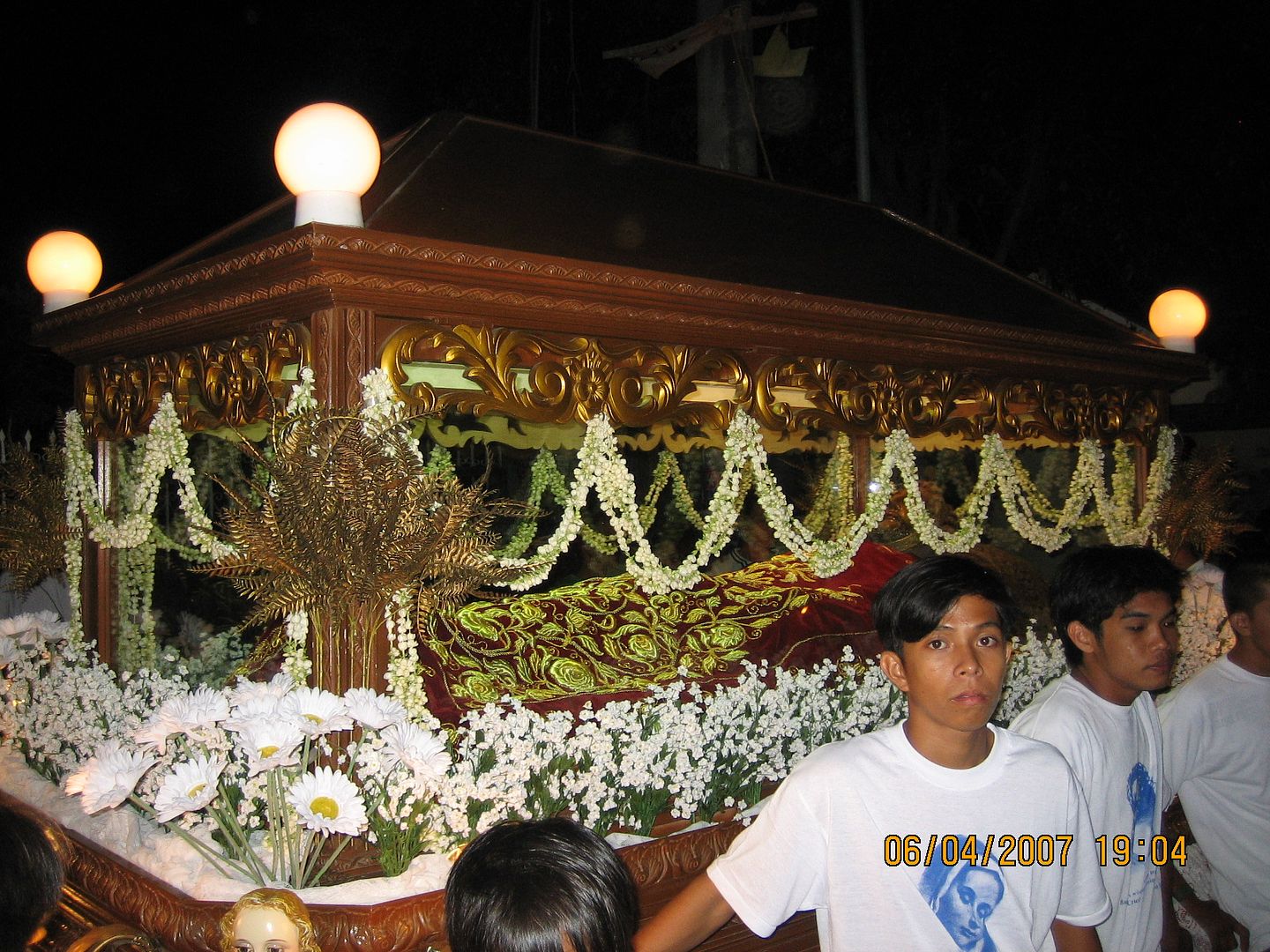
The image is a dark-colored traditional-style Dead Christ, complete with gold-embroidered maroon blanket and metal chin.
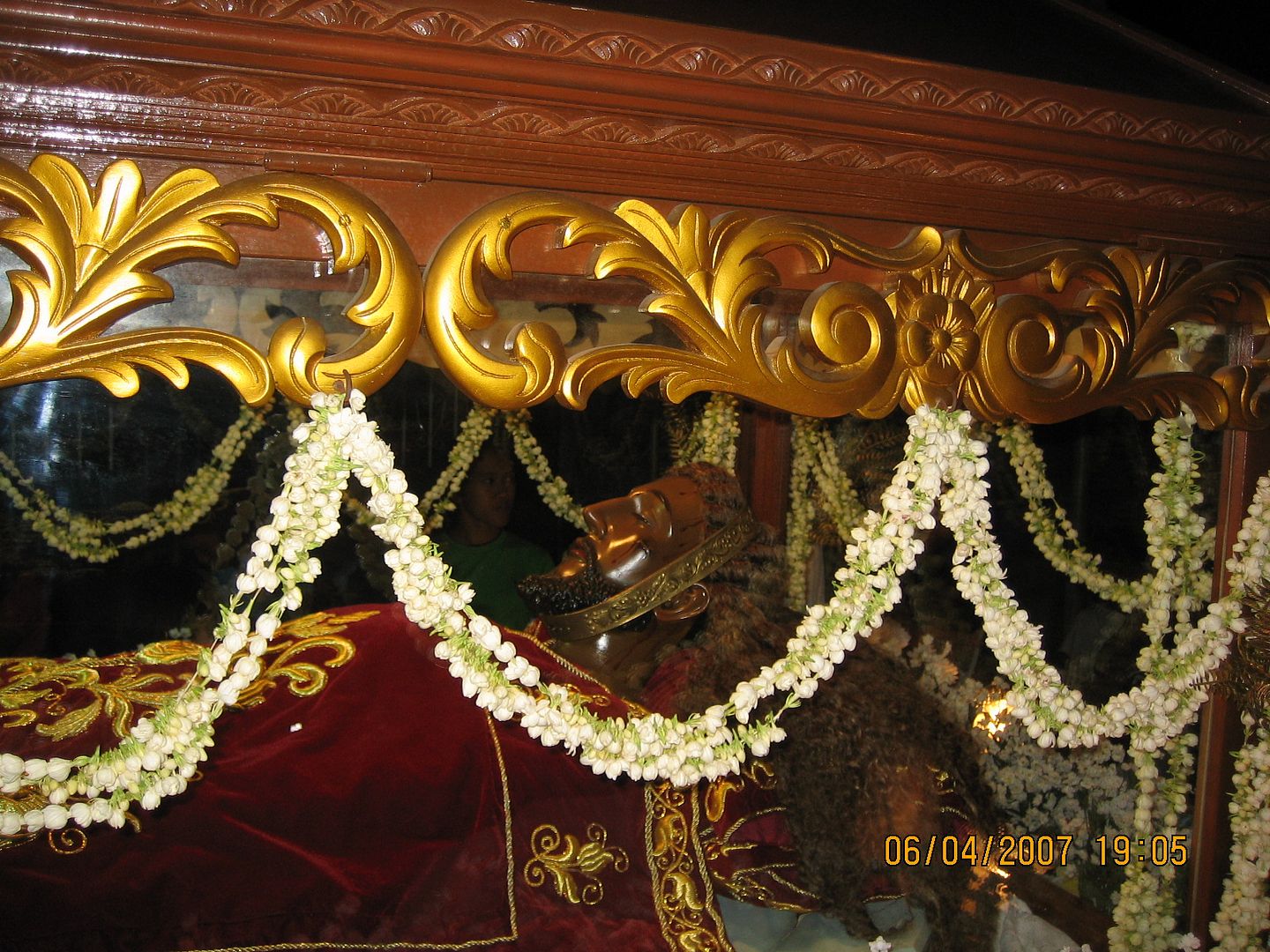
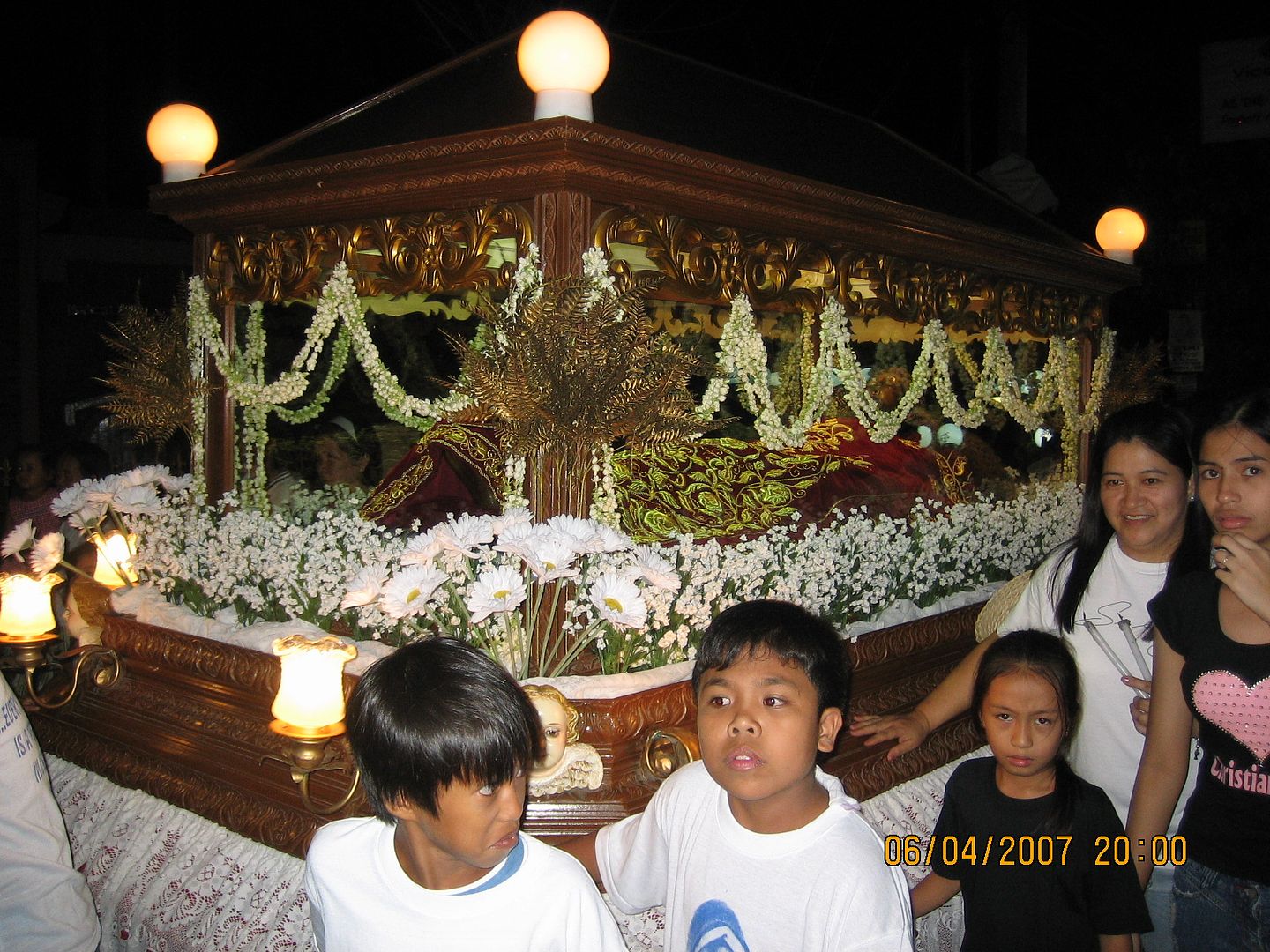
The calandra (funeral coach) itself is new, as perhaps the image too is, but despite the somewhat too generous sampaguita garlands (yes, we’re definitely in Bulacan), is actually tastefully done overall, obviously the pride and joy of its owning family.
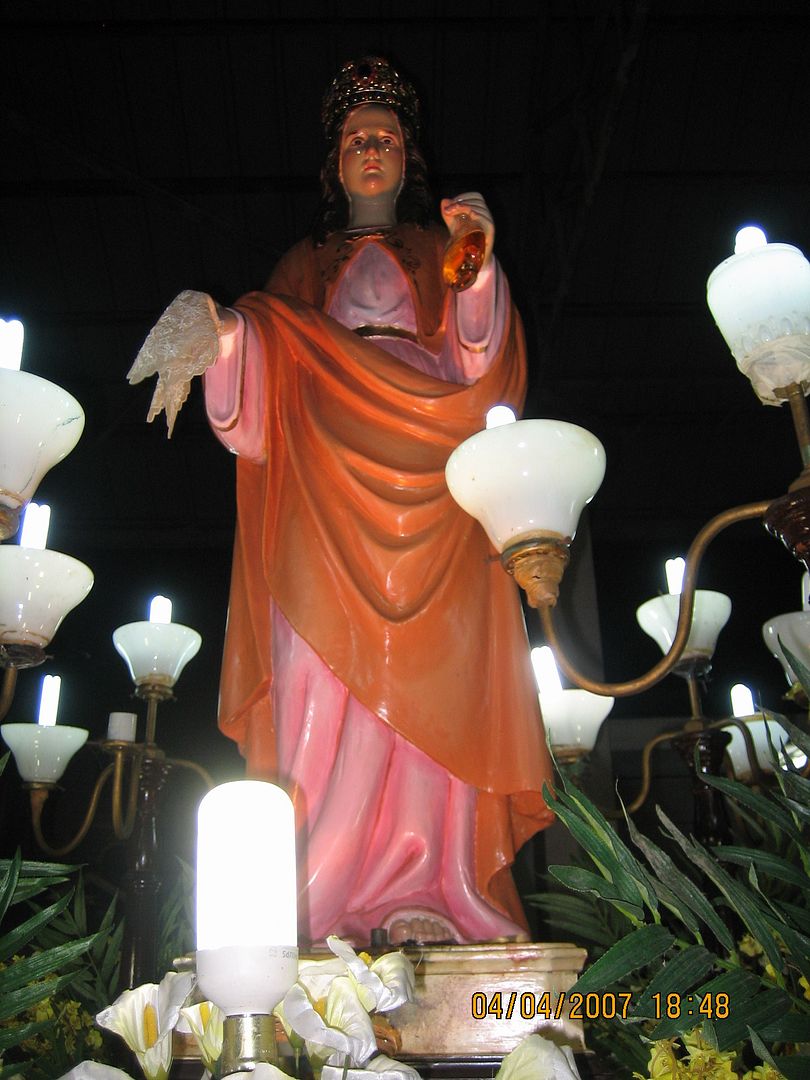
This parish’s limited processional line-up only has two mourners so far, the first one Santa Maria Magdalena [Saint Mary Magdalene], a fully-carved image with handkerchief in one hand and bottle of perfume in the other.
The other mourner and the very last member of the procession is, not too surprisingly, “Ang Mahal na Inang Nagdadalamhati (Mater Dolorosa)” [The Sorrowful Mother]. Except she didn’t seem too sorrowfully dressed on this Holy Wednesday when I snapped the photos.
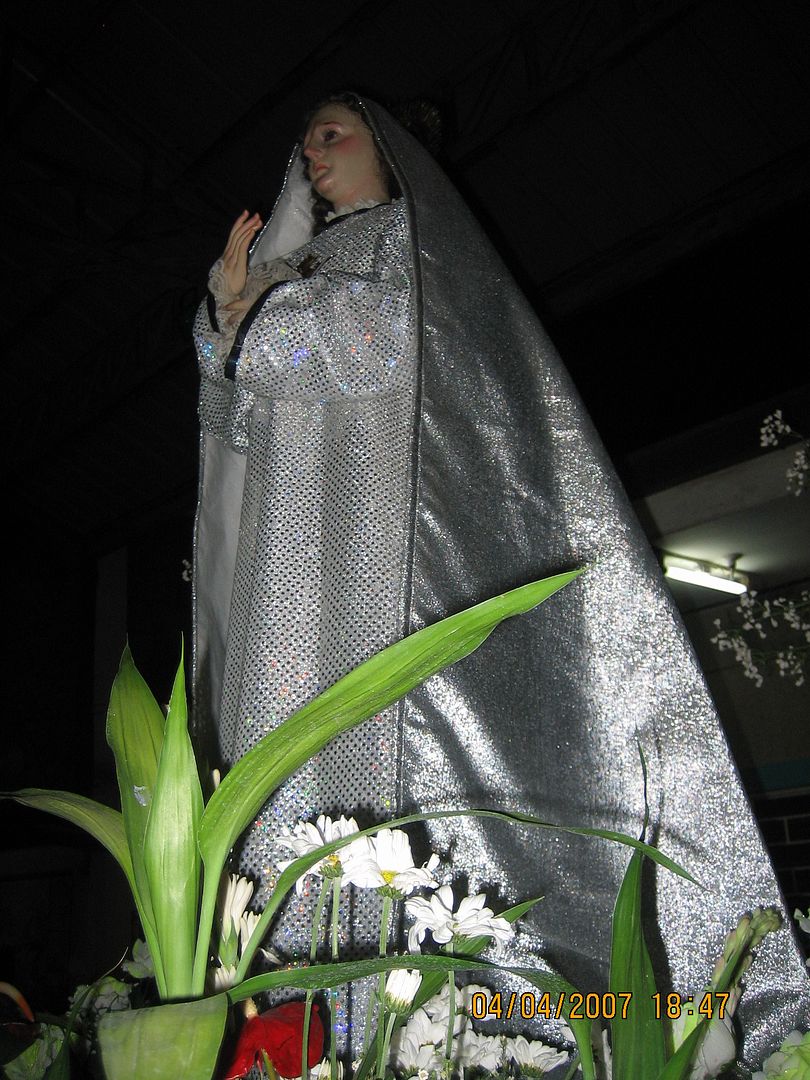
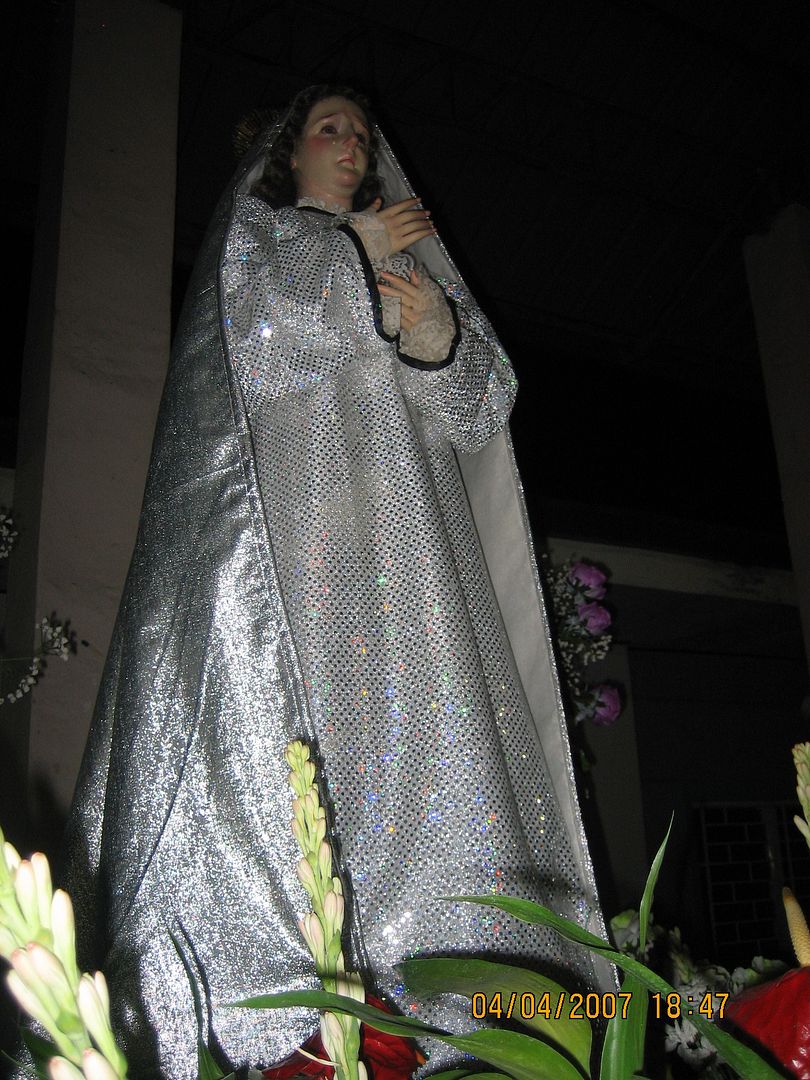
And thus ends the fourteen-piece processional line-up in this parish.
Clearly, Caingin has a lot of room to accommodate important processional images from the Holy Week tradition – not only key characters like Saint John the Evangelist but also scenes from the Passion itself, such as the Scourging at the Pillar and Christ Before Pilate. But it’s still a young parish – doubtless in just a few years, this processional line-up will be vastly more complete, rivaling those of neighboring parishes. Let’s wait and see.
Original comments:
arcastro57 wrote on Mar 4, '08
My, just like watching a movie with accompanying review!
|
starshadowrivaulx wrote on Mar 4, '08
This is the first time I've seen a Dolorosa dressed in white. The one that my mother's family maintains in Tabaco, Albay, is always adorned in black or deep purple.
|
sieshto wrote on Mar 4, '08
nice one leo... naentertain na naman ako. =)
|
rally65 wrote on Mar 4, '08
starshadowrivaulx said
This is the first time I've seen a Dolorosa dressed in white. The one that my mother's family maintains in Tabaco, Albay, is always adorned in black or deep purple.
I do think that the owner had inadvertently used the garments intended for the "Mater Alegria" image for Easter Sunday -- typically the Holy Wednesday garments for the Dolorosa are in deep purple, and on Good Friday they're in black.
|
mike10017 wrote on Mar 4, '08
Finally, lumabas na! Thanks Leo. Maganda yung Oracion. Hindi ba diyan lumalabas ang Santa Marta mo?
|
rally65 wrote on Mar 5, '08
The Santa Marta belongs to my aunt, who lives in a parish in Guiguinto, Bulacan. Some day I will get around to write about it -- our family's first ever processional image.
|
starshadowrivaulx wrote on Mar 5, '08
That sounds about right!
:) |
alfredhw wrote on Mar 25, '08
hi and the pagpsok belongs to me and my family and the criticisms are ok we know that but i heard that many people think that ur carroza is to tall and nindi daw nila makita............. thats wat s0me people say po peAce!!!!!
|
alfredhw wrote on Mar 26, '08, edited on Mar 26, '08
and oh yah fr. norby was the one who gave the name it was just "Ang Maluwalhating Pagpasok ni Jesus sa Jerusalem" but he just added the "san pedro"..............and the other jewish child is a boy!!!!!! n0t a girl ..... ^____^
|
rally65 wrote on Mar 26, '08
Yes, our carroza is deliberately tall -- not meant to be viewed by short people. Ha ha ha.
|
alfredhw wrote on Mar 26, '08
hahahaha is right but dont think that im getting affected by ur critisisms bec they are just there o improve stuff.................
|
rally65 wrote on Mar 26, '08
Absolutely -- let's continue to criticize everything and everyone around us! (My favorite hobby. Ha ha ha.)
|
safire23 wrote on Mar 28, '08
ang ganda kaya un pagpasok and ung pamamaalam hindi mo ba un nakikita!!!!!!!!!!!
|
safire23 wrote on Mar 28, '08
do u have anything aginst the usage of white light huh???????????? DO U!!!!!!!!!!!!!!!!!!!!!!! siguro puro yellow lights ang nasa bahay mo!!!!!!!!!!
|
rally65 wrote on Mar 28, '08
safire23--
1. Yes, both those tableaux were discussed in this article -- please reread for better comprehension. 2. I don't believe that daylight bulbs are appropriate for processional images, as they make the images look like ghosts. I have said this many times throughout this SS-Files series. Thanks for reading nonetheless. |
safire23 wrote on Apr 1, '08, edited on Apr 1, '08
ohh iam so sorry i didnt know that you spoke in a language which is much more better to use that filipino ok
1. I said that the "pagpasok ni hesus sa herusalem" and the "pamamaalam ni hesus sa kanyang mahal na ina" were both truly beautiful and nice!!!! _ _ _ _ _ _!!!!! 2. So what if the use of white lights make them appear ghostly why did you see that MORE OF THE CARROZAS USE WHITE LIGHTS!!! _ _ _ _!!!!!!!!!!!!! i hate u muuuuuuuuuuuuuwah |
rally65 wrote on Apr 1, '08
Sorry, I truly don't understand what you are trying to say. Tagalugin mo na lang siguro.
|
paualysmaya wrote on Apr 20, '08
Gorgeous shots Leo and funny photo illustrations too. lolz!. Oh well, some light bulbs are dummies blinding my eyes.
Lolz! A comment is like a planet "Saturn deciding it's a more valuable planet than Mars because it has rings." Thanks to you for featuring the Holy Week in Caingin, San Rafael, Bulacan. More extra power. Cheers! |