Showing posts with label Panglao Island. Show all posts

Tuesday, July 5, 2016

CXX. Visita Iglesia (Plus) Bohol V – The Dauis Church

After having our fill of Panglao town – with visits to both the church and our putative ancestral house, my Cloma cousins and I went off to the other end of Panglao island, to Dauis town, right next to the bridge that connects this island to the capital city Tagbilaran on the main Bohol island.

According to Regalado Trota Jose’s “Visita Iglesia Bohol” book, the present Dauis Church began to be built in 1863, but construction took many decades to progress, with the present neoclassical façade largely completed only in the 1920’s.
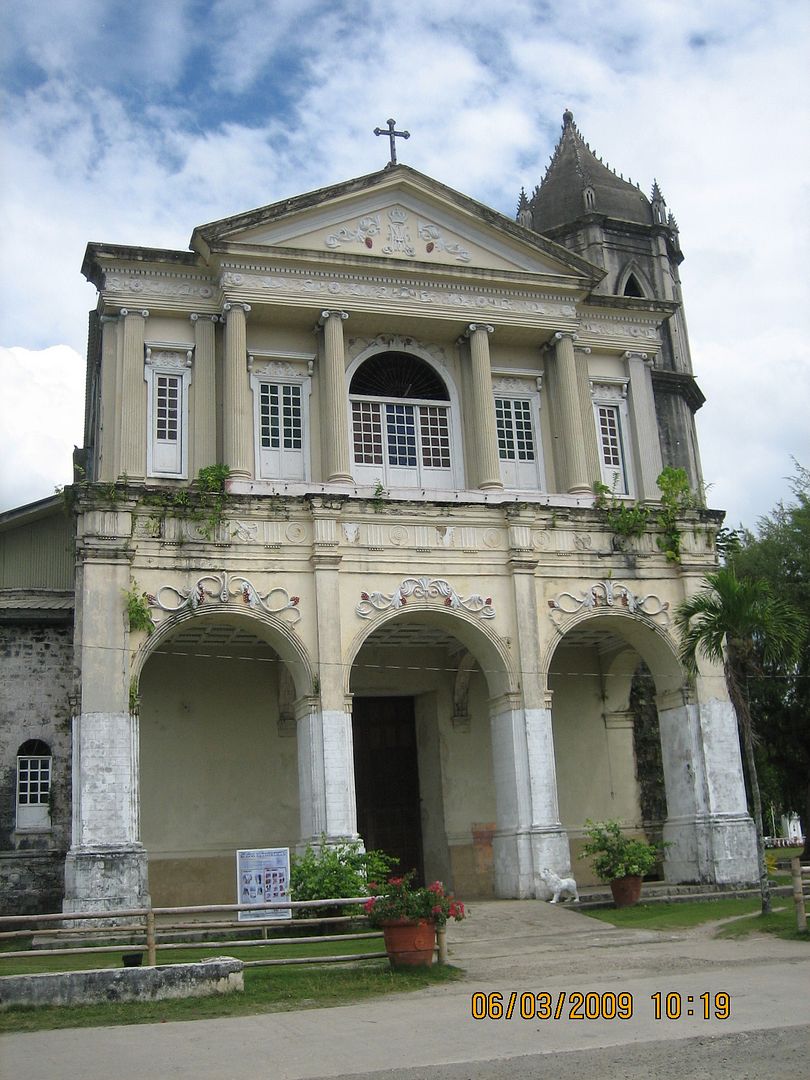

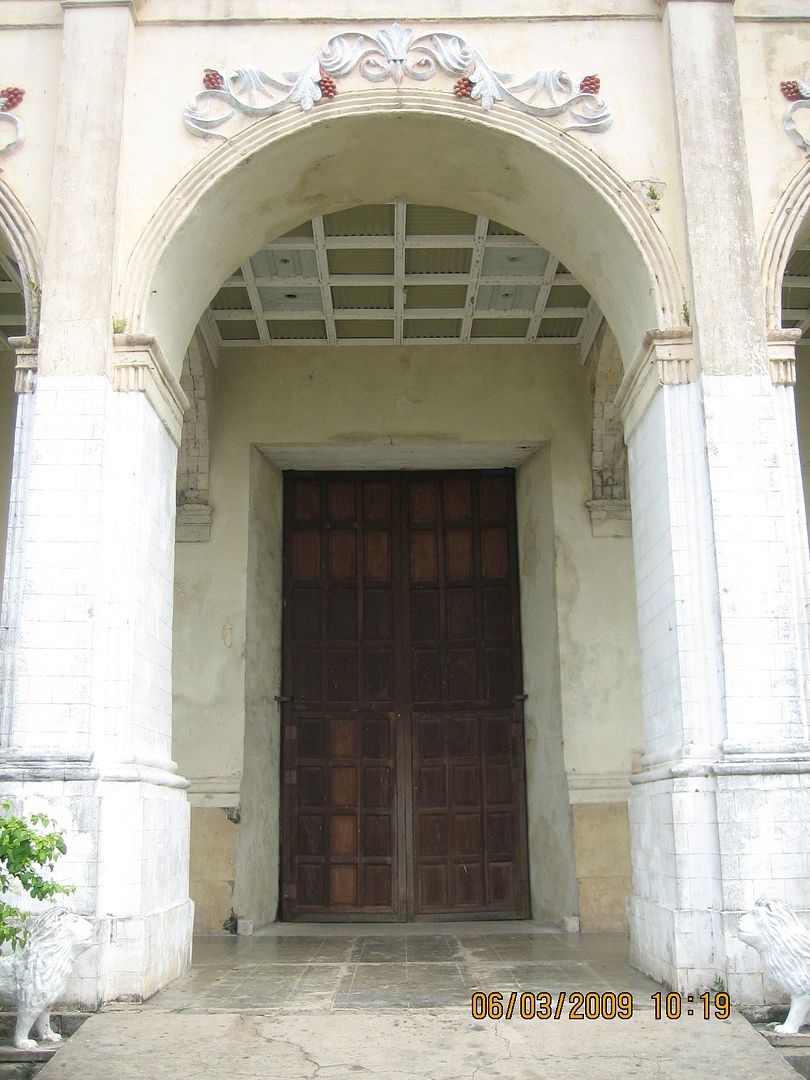
It being a weekday, the main entrance was shut,

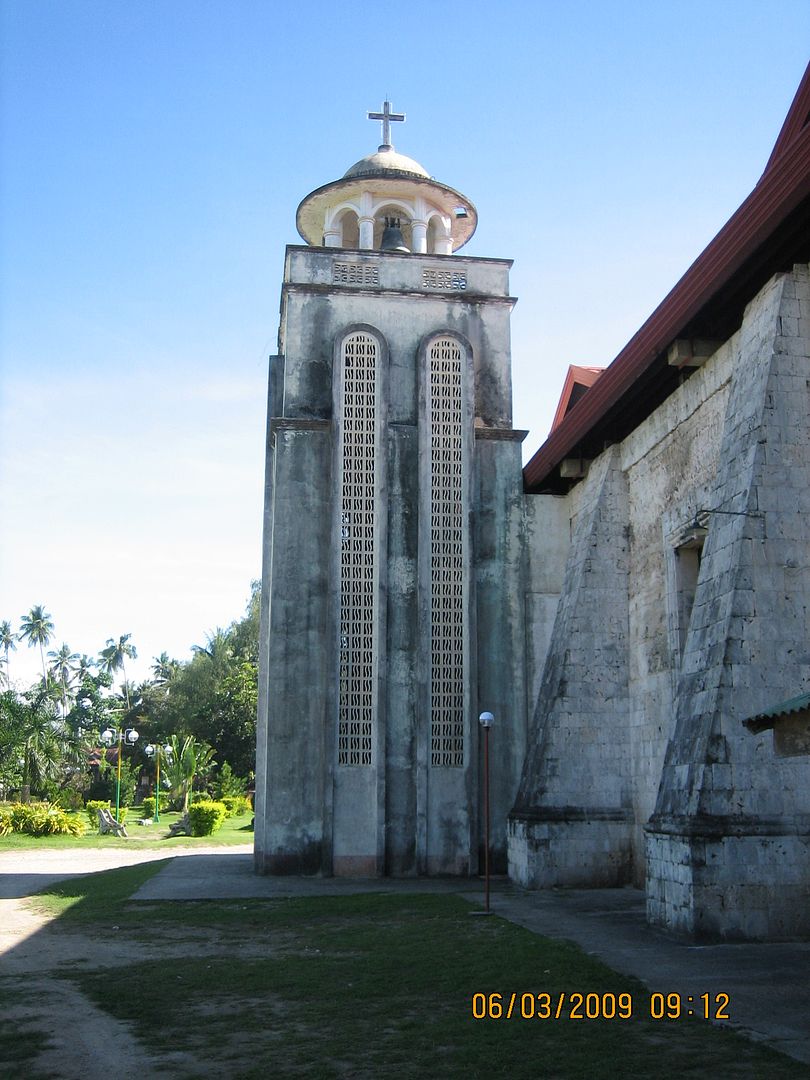
so we went around to the right side to seek other means of access.  From this side, one observes that the architectural style shifts from neoclassical to neo-gothic, as seen in the decorations on the belfry
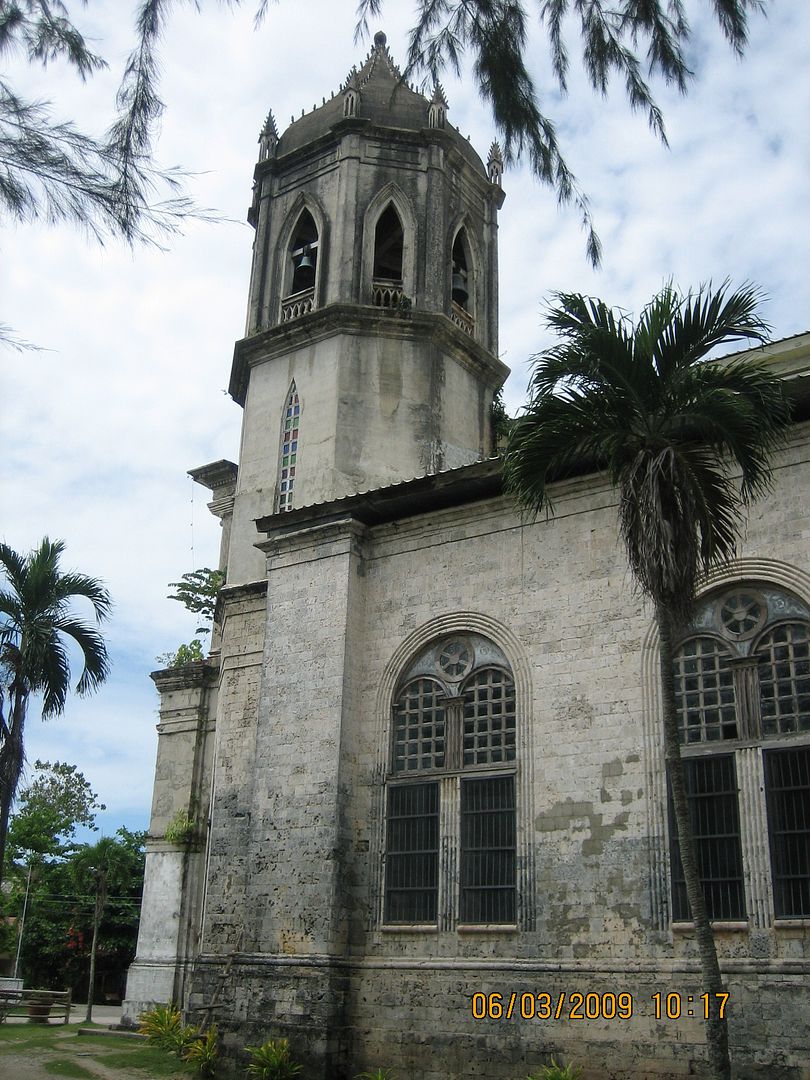

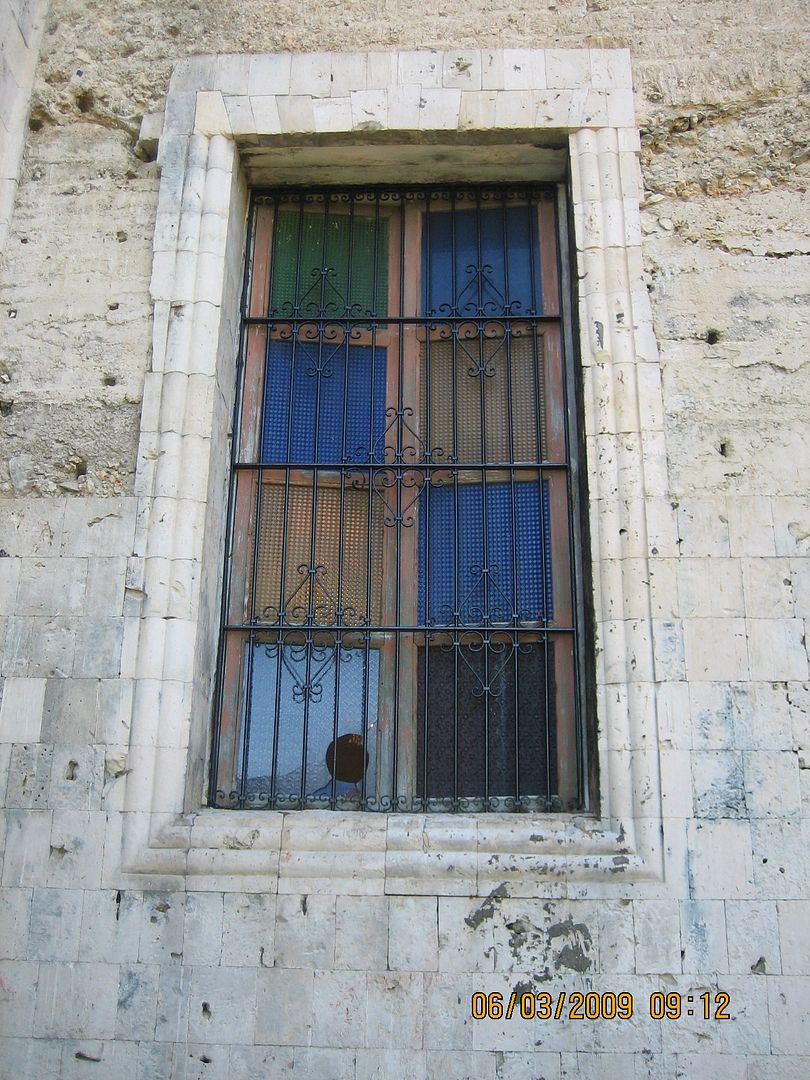
and the windows on this side.
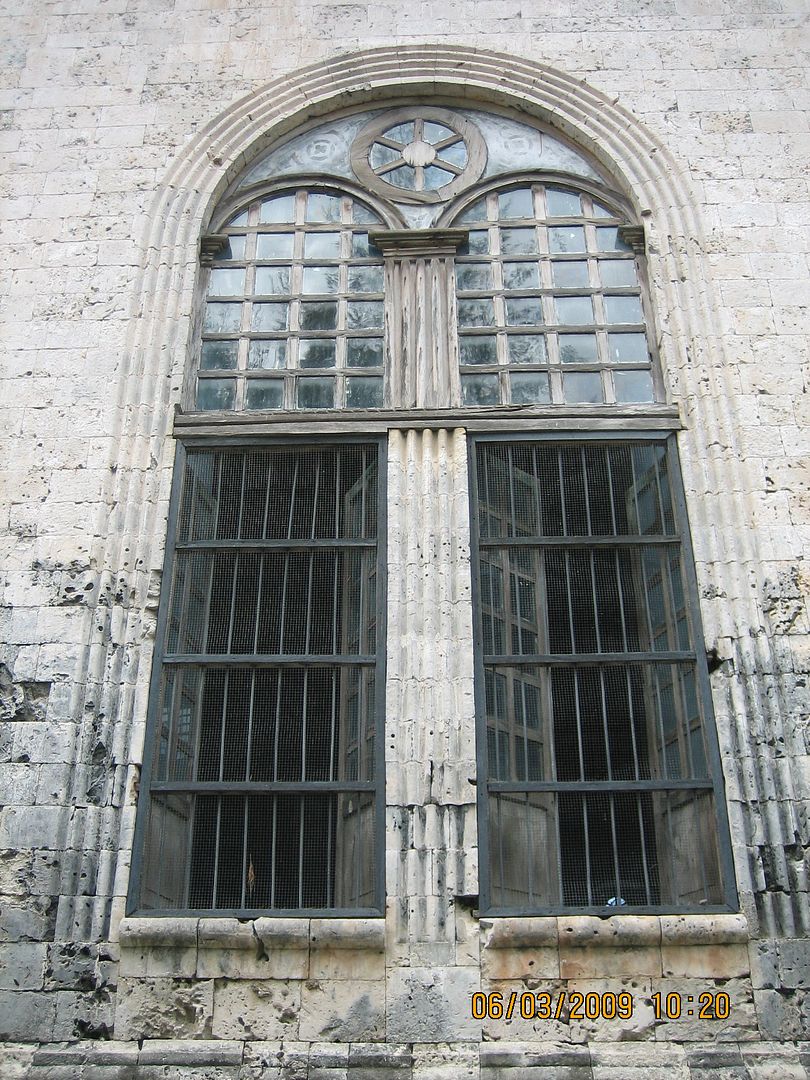

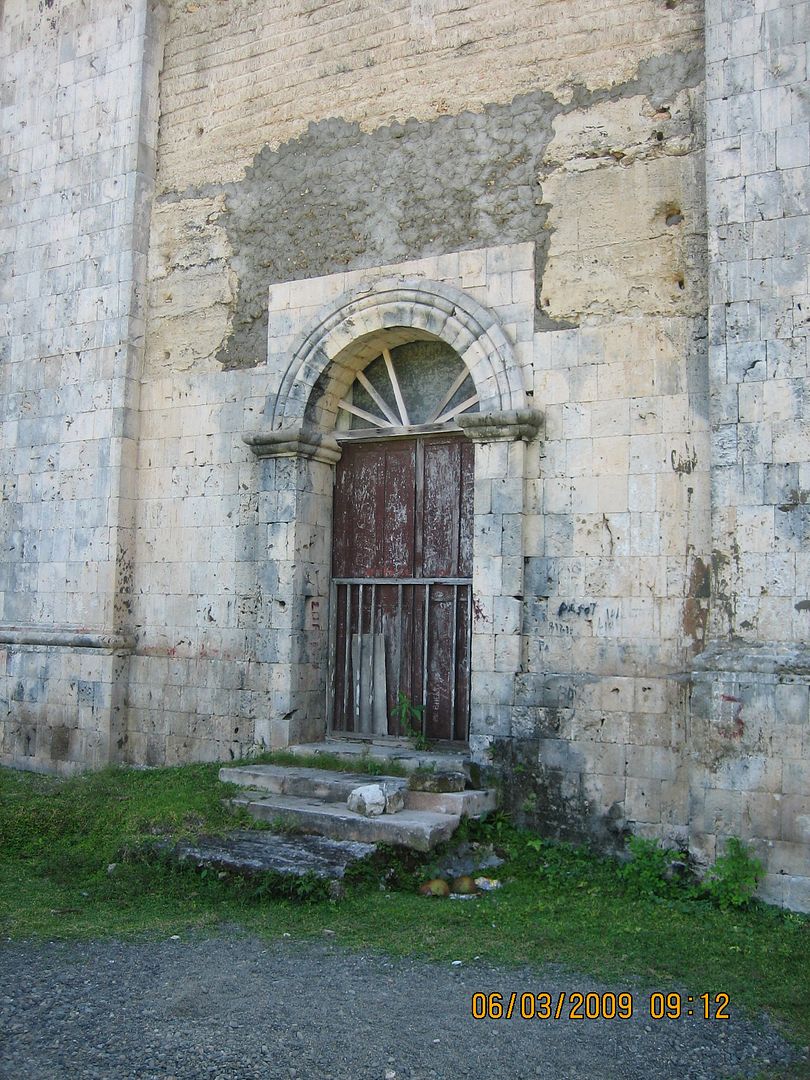
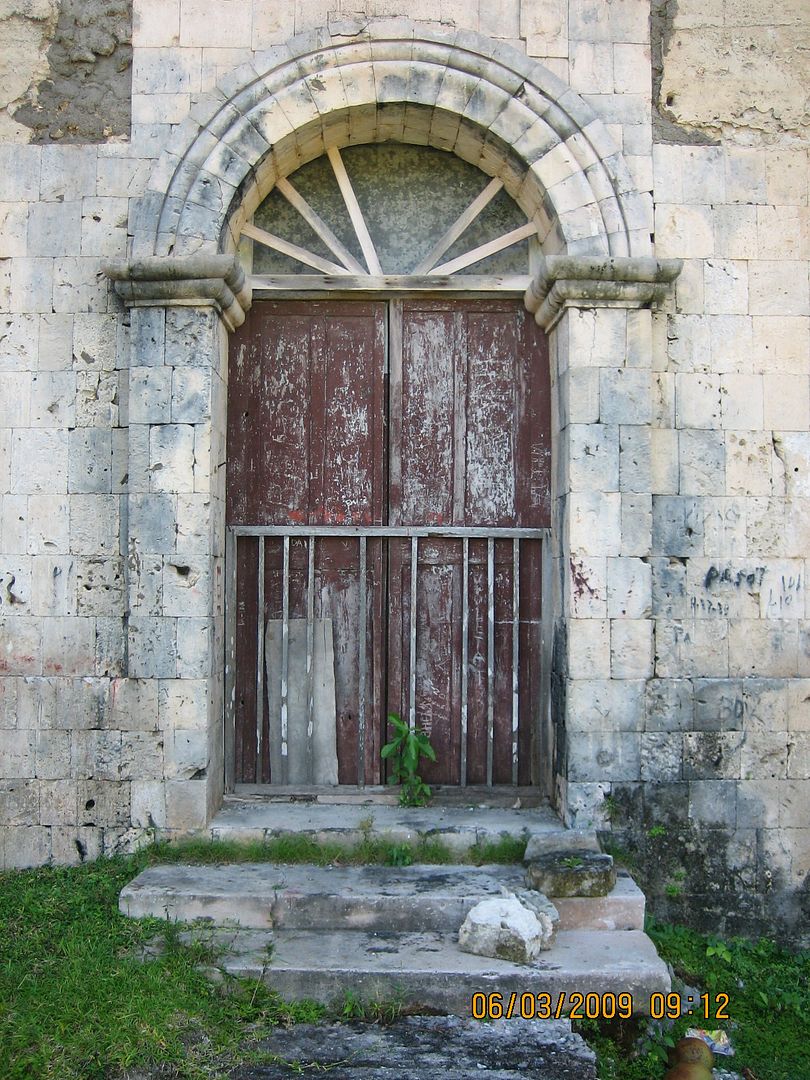
On this elevation as well is a large door to the side of the nave, unfortunately also shut.
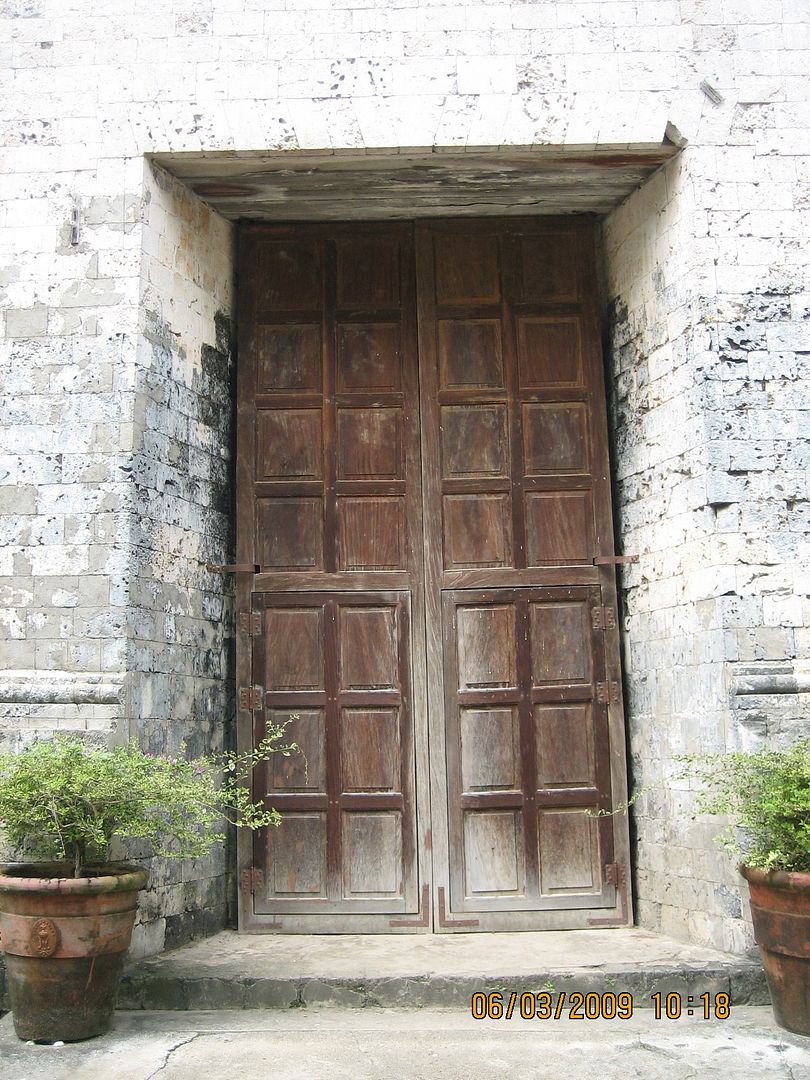

Further down, however, is another large doorway, this one wide open,
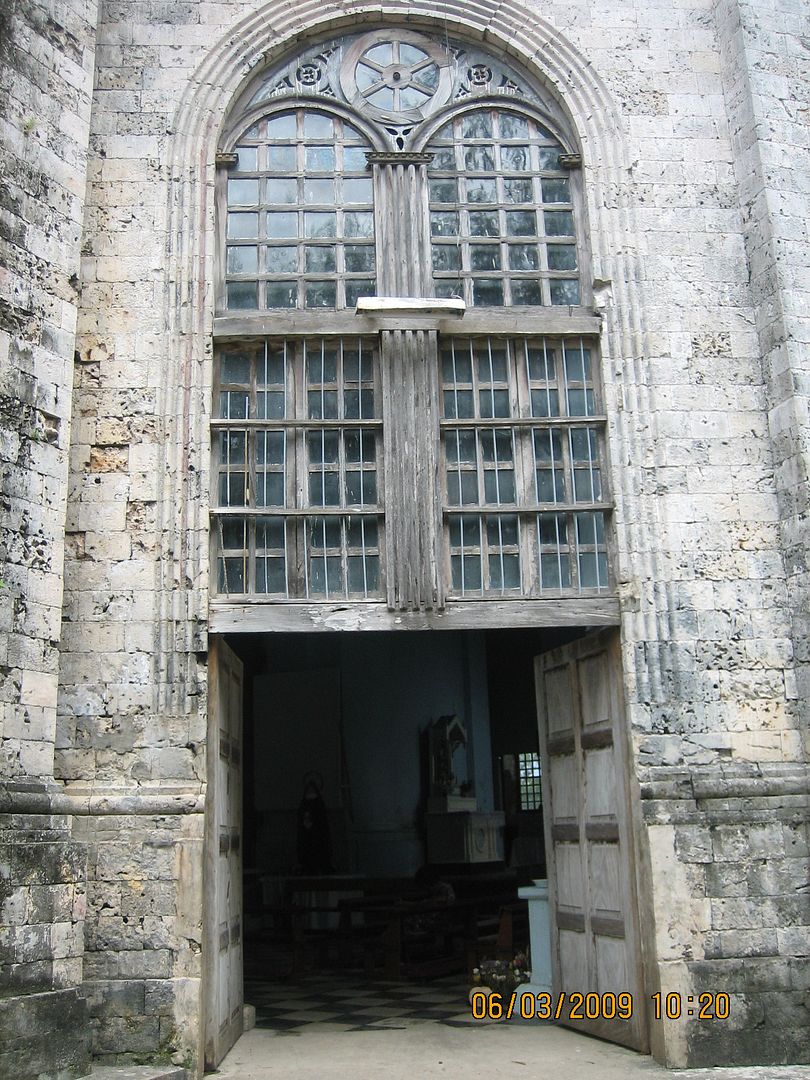

which leads directly to the right-side transept of the church.

This enabled me to start exploring the interior, beginning with the right-side altarpiece.
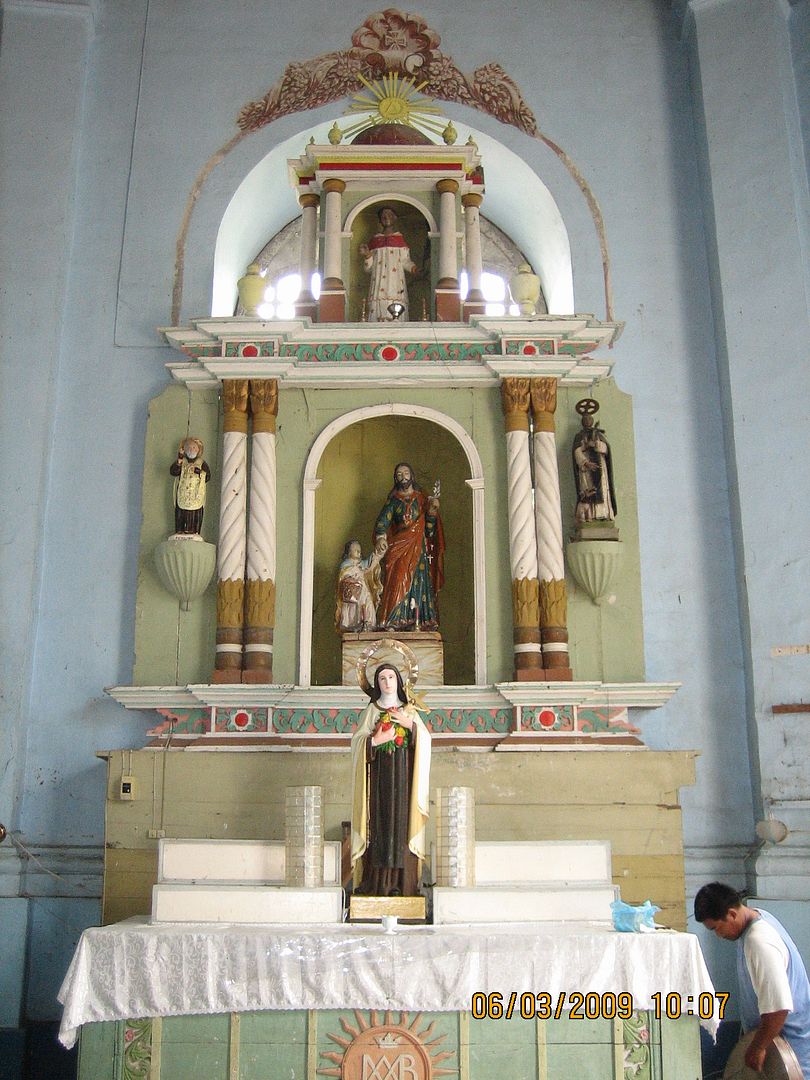

Behind the sanctuary area was an array of images, hidden from the general view, including this (presumably) Virgen de las Flores,
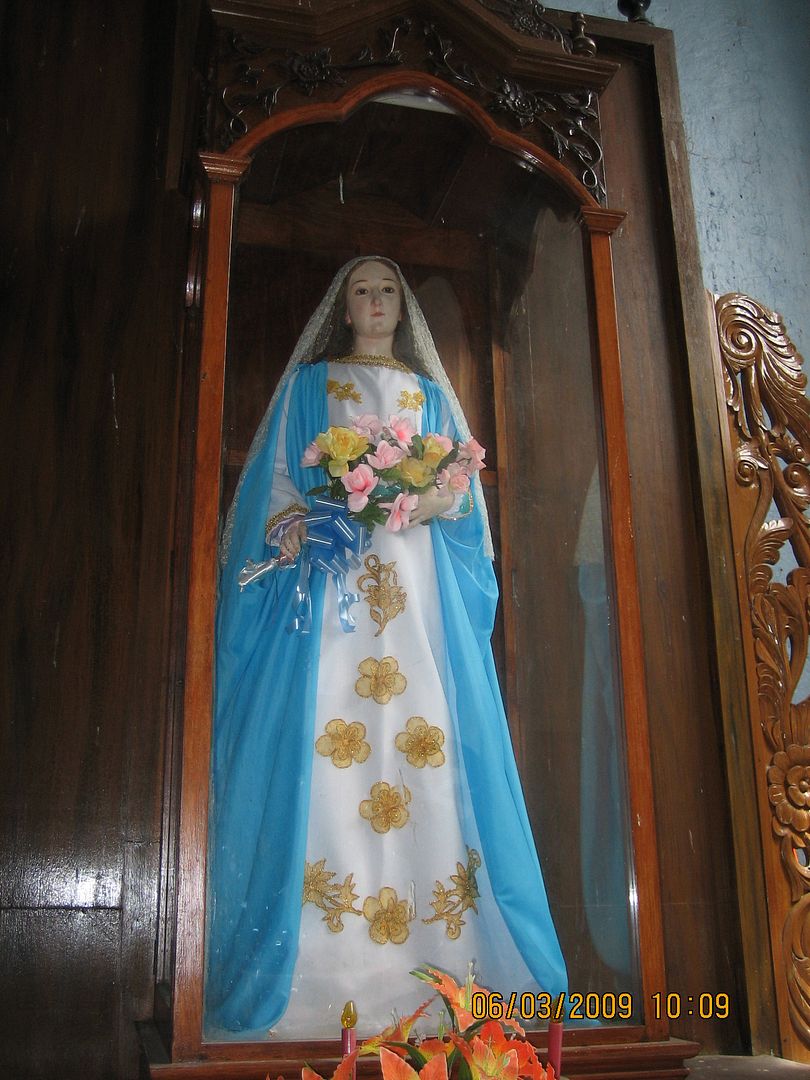

this Immaculate Heart of Mary,
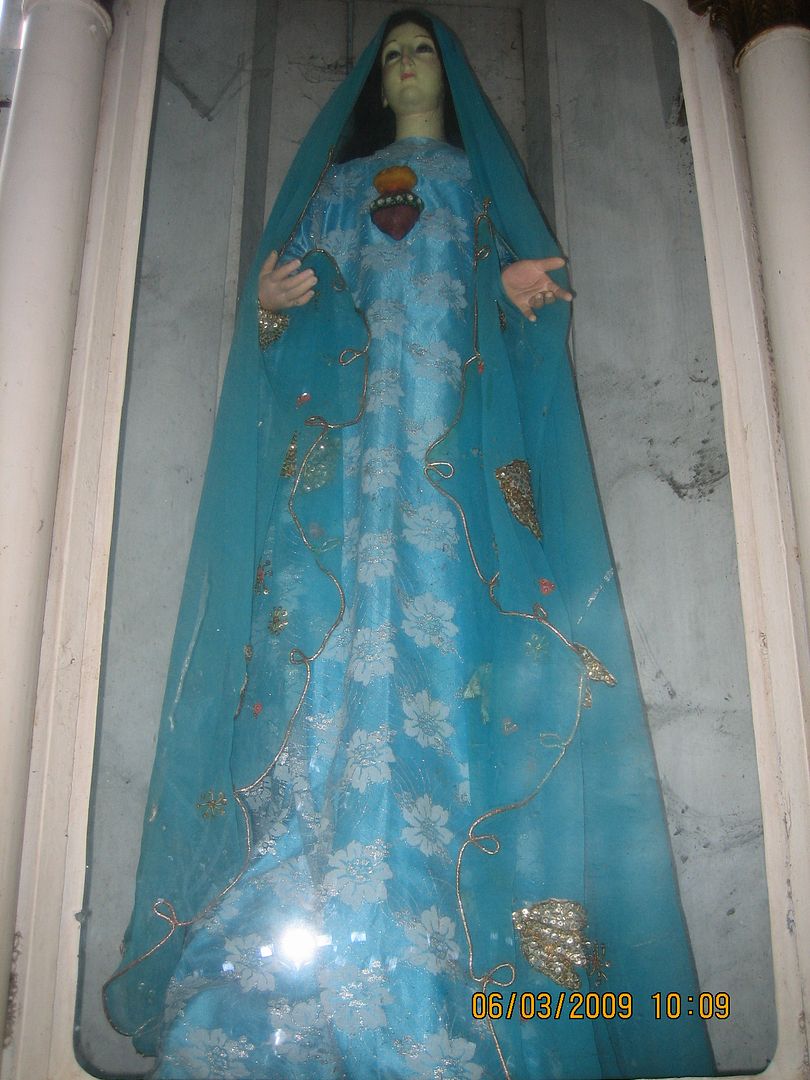

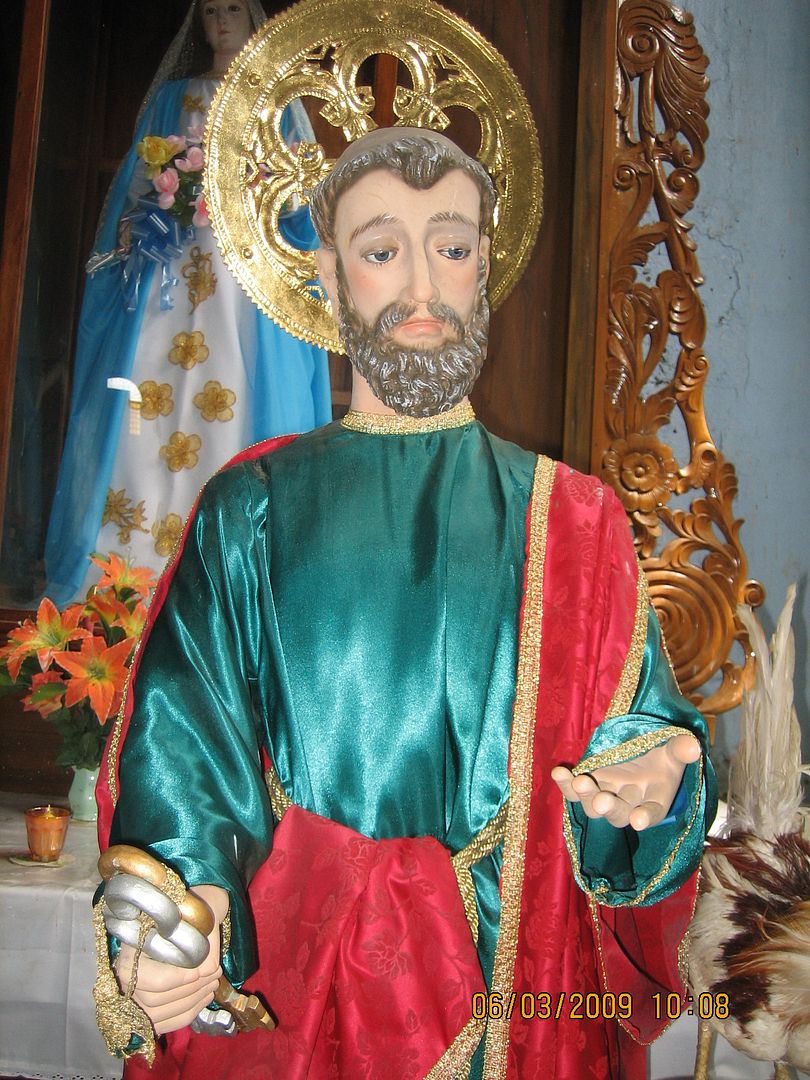
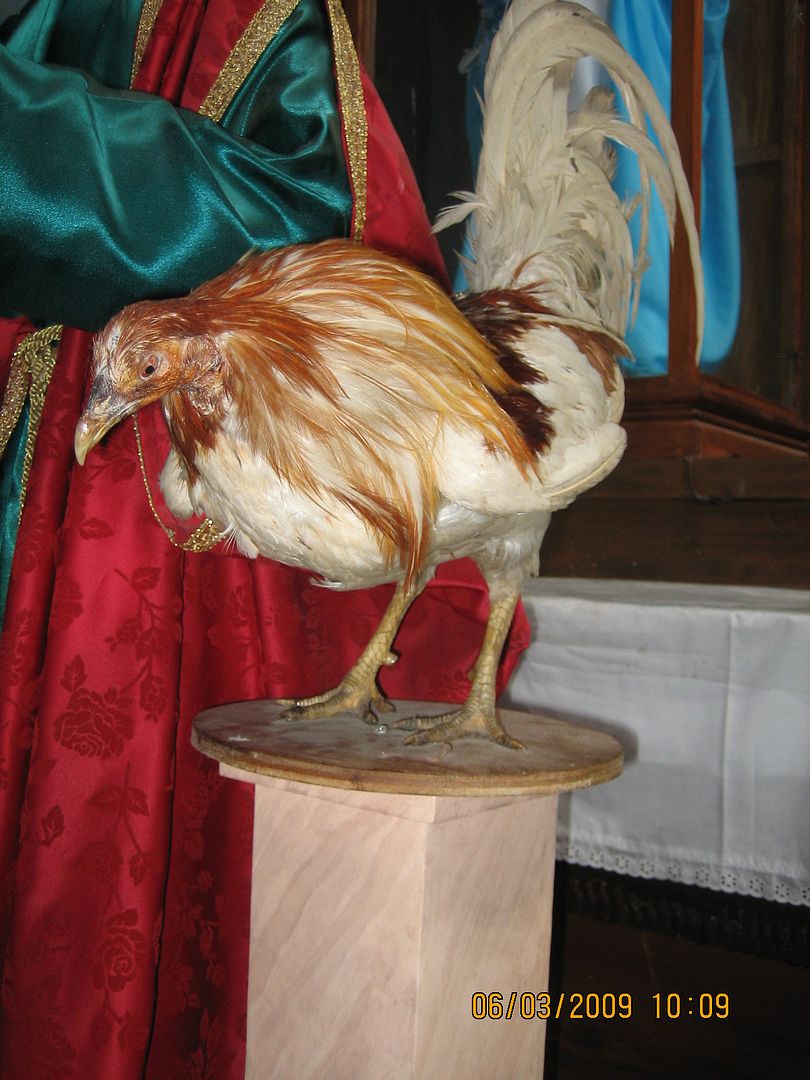
and this Saint Peter,
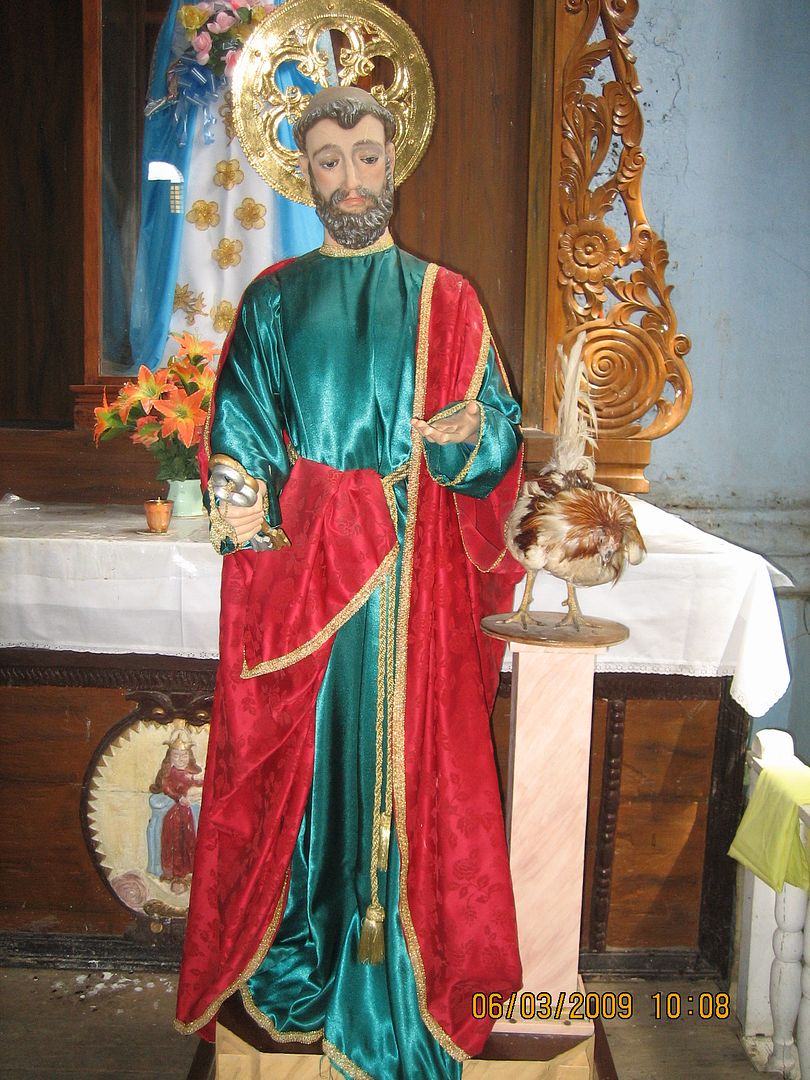


with its requisite rooster – taxidermied even, apparently.

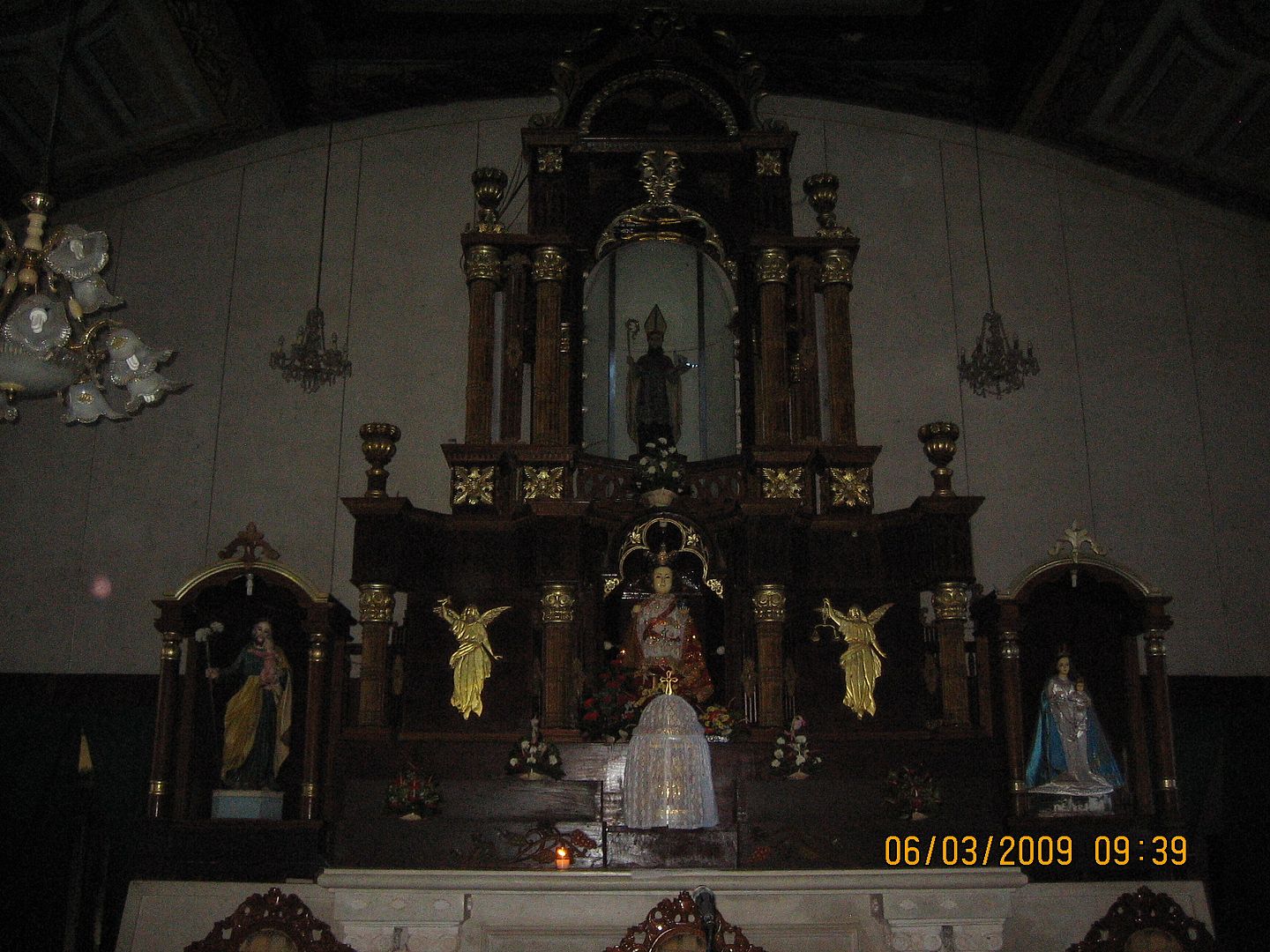
Back in the sanctuary, I next take a look at the main altar, dedicated to Dauis’ patroness, Our Lady of the Assumption.
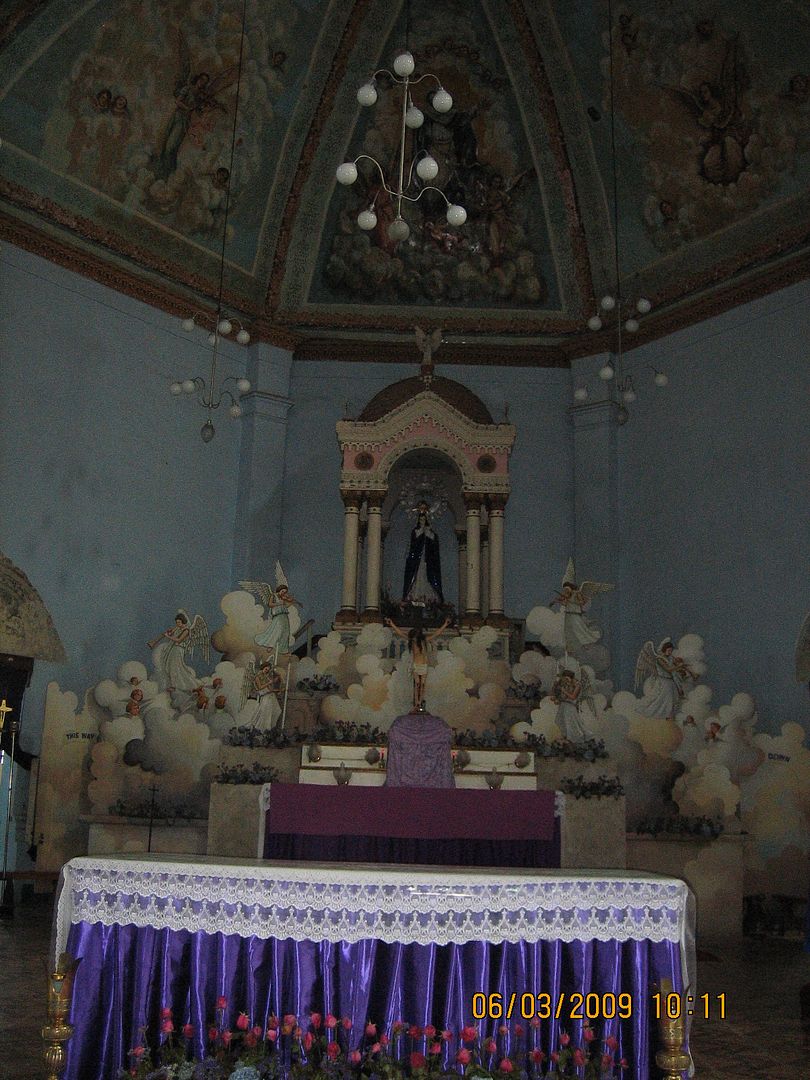

Both image and retablo are rather too small and unimpressive, in my view.

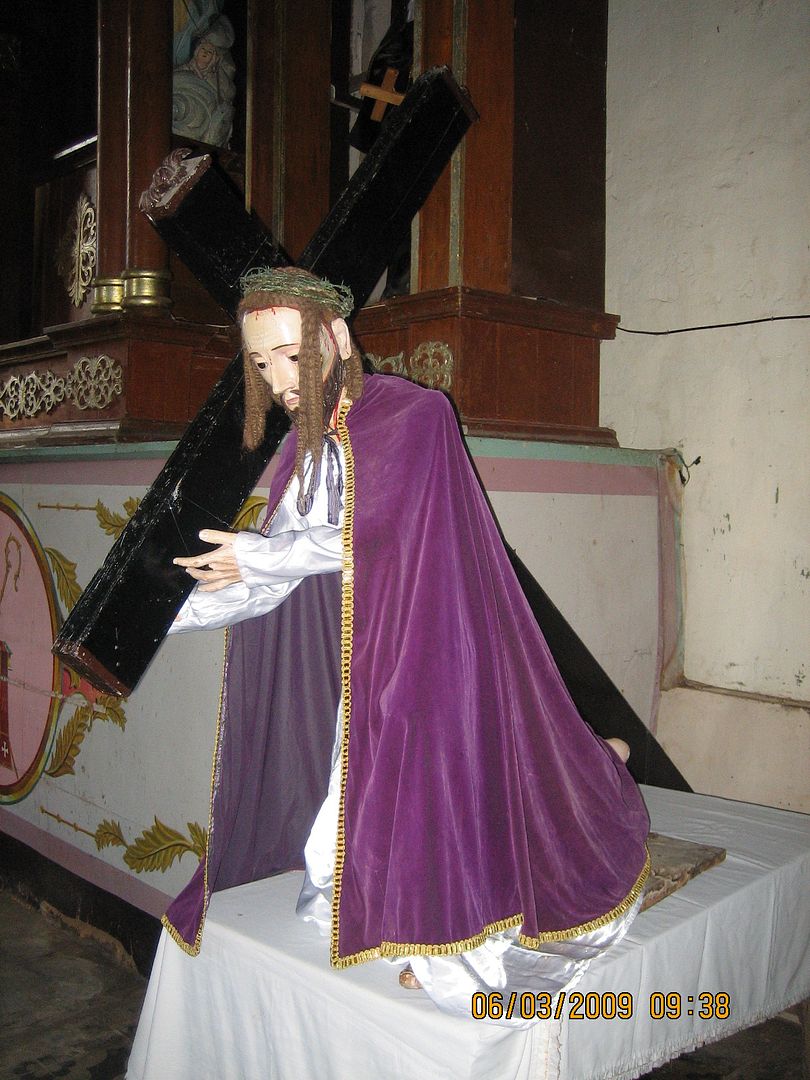
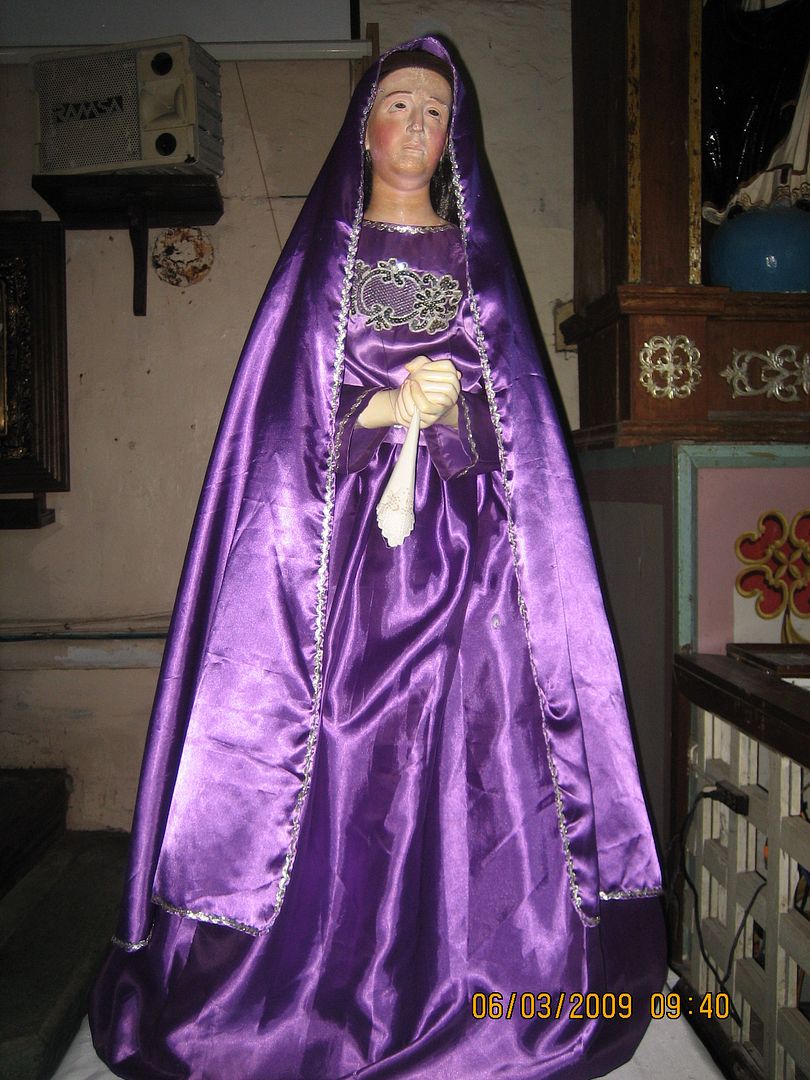
Near the altar are more Holy Week images presented for veneration, just as in Panglao church – this being early in the Lenten season.  There was a mournful Dolorosa,
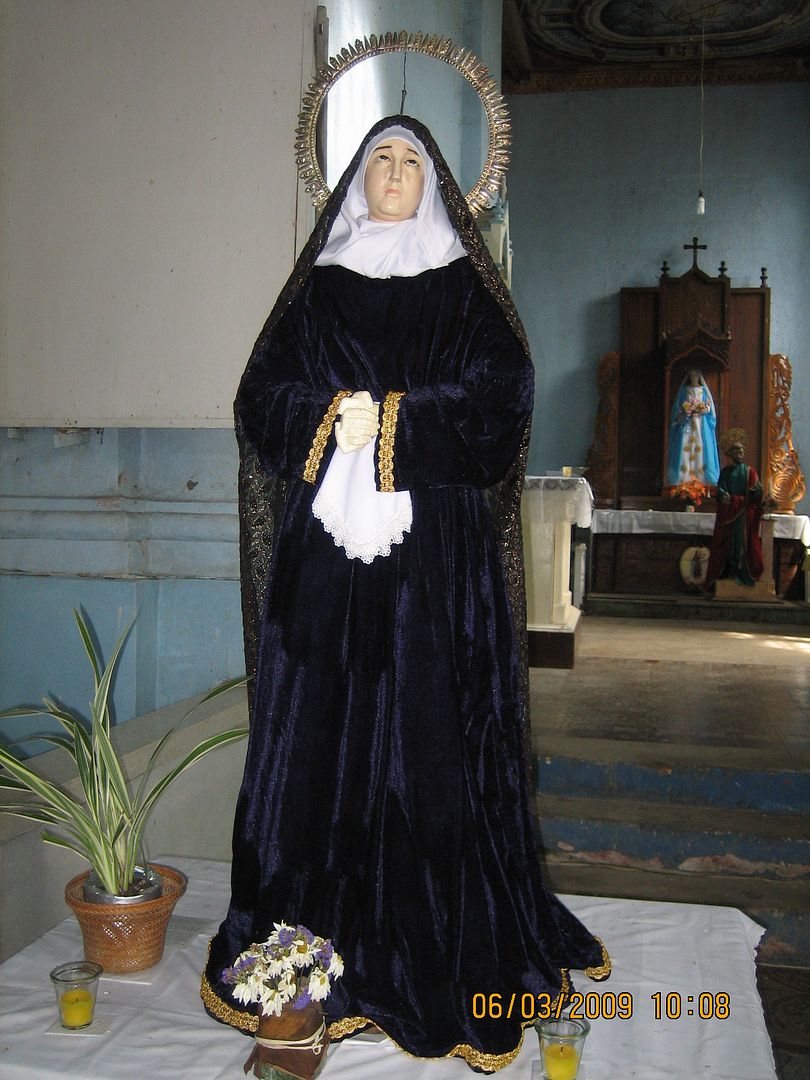
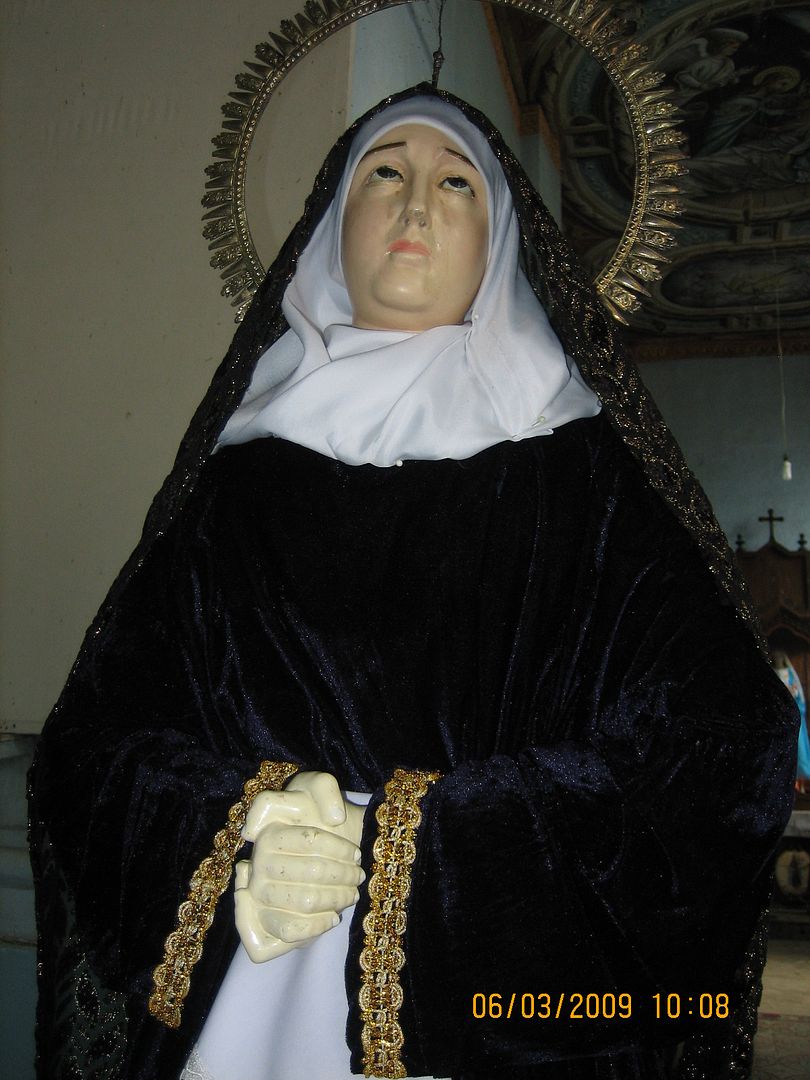


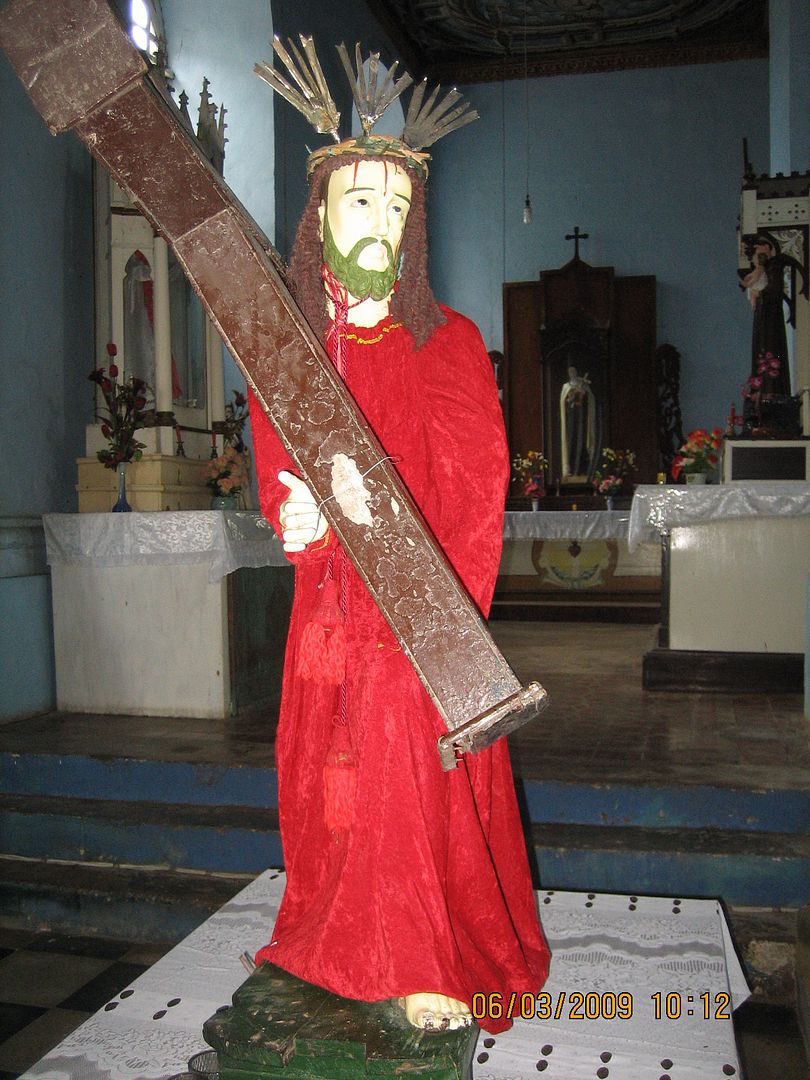
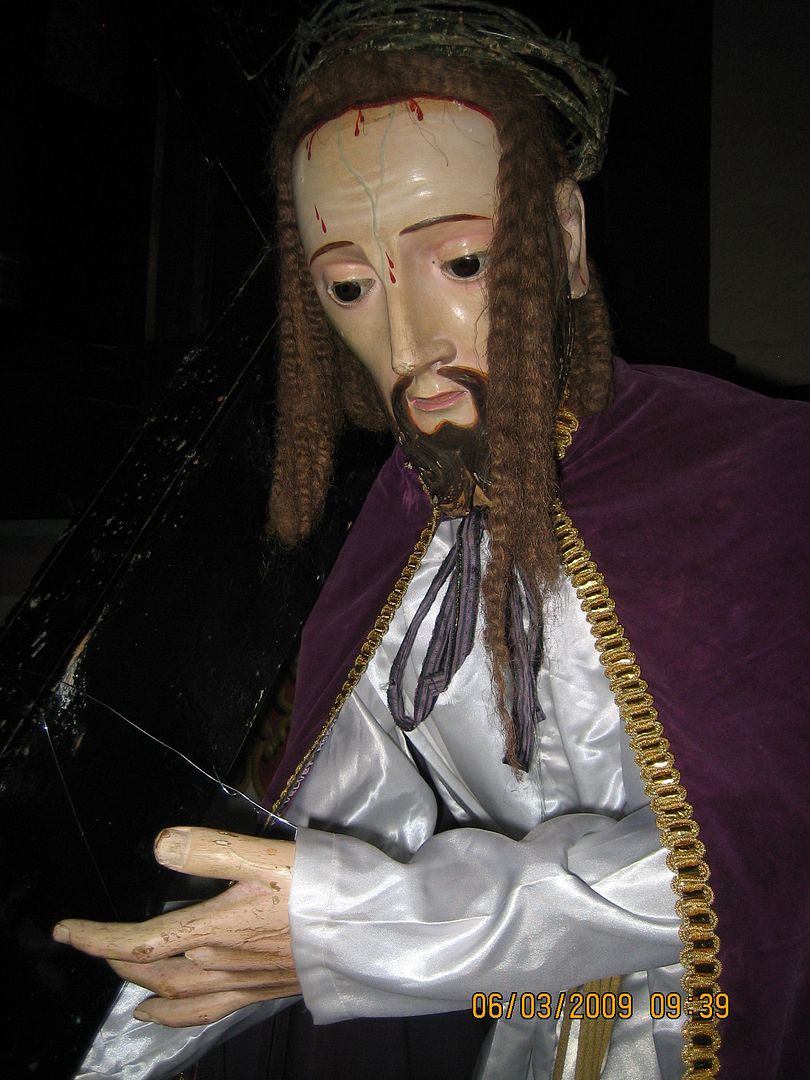
and a green-bearded
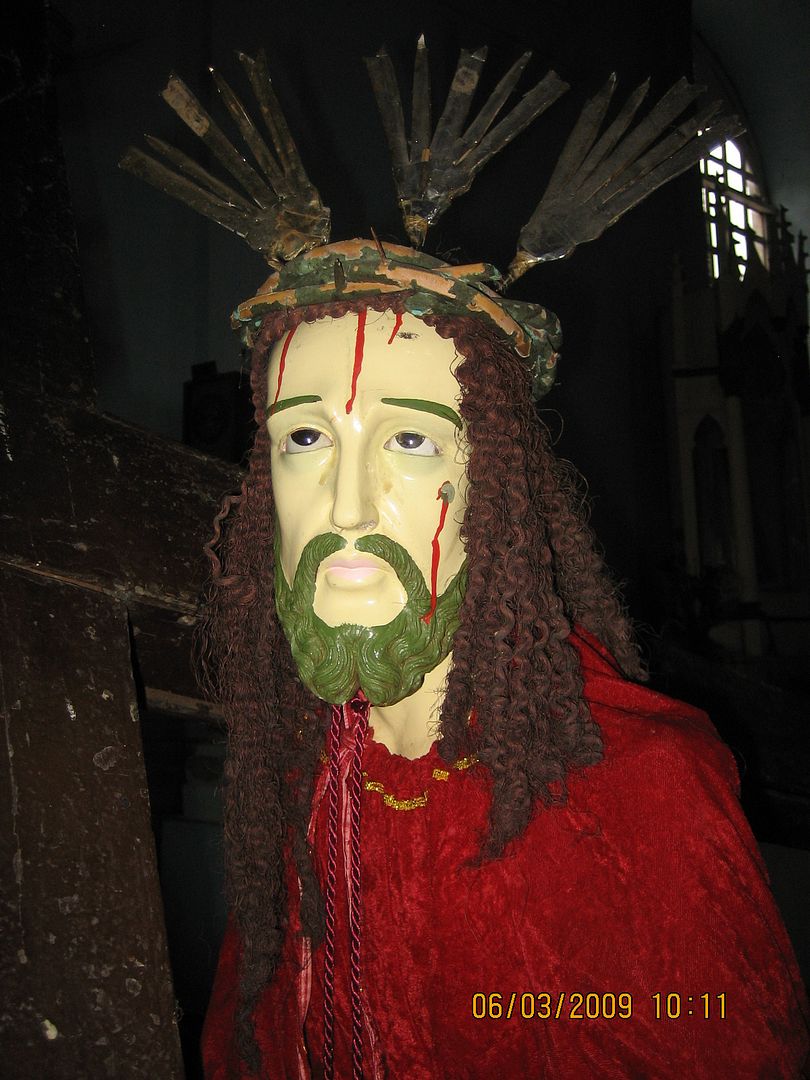


but otherwise devotionally-appropriate Nazareno.
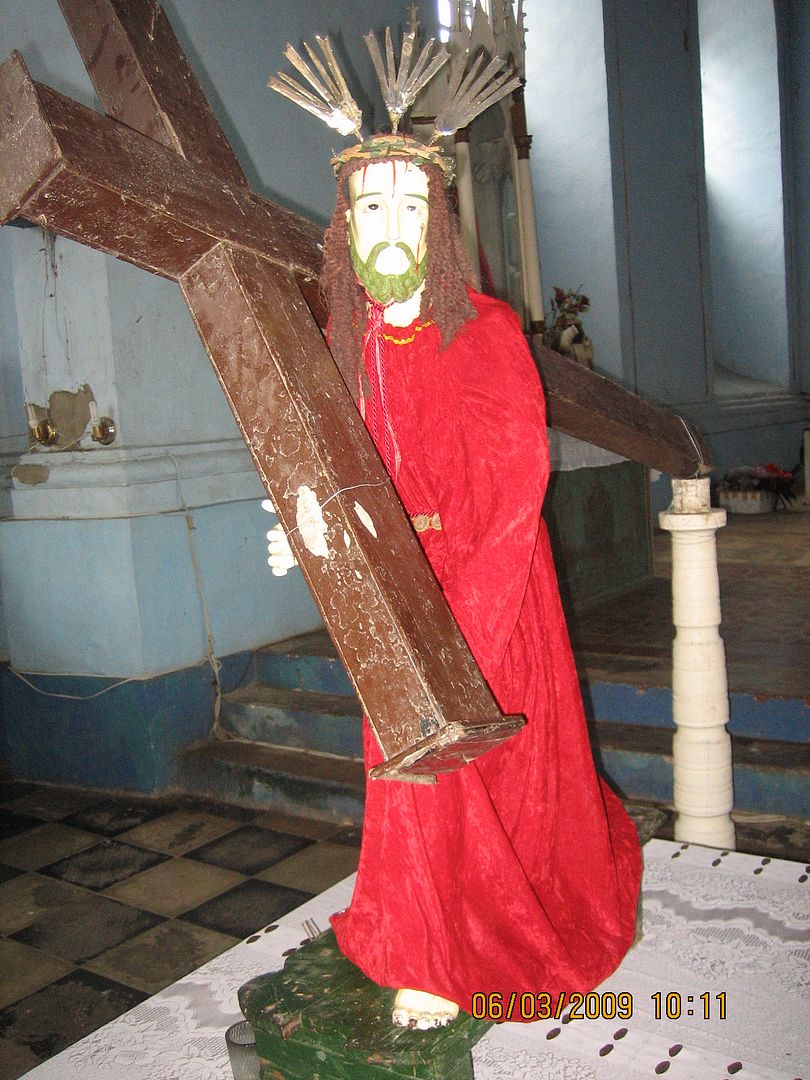

Elsewhere in the checkerboard-tile-floored nave,
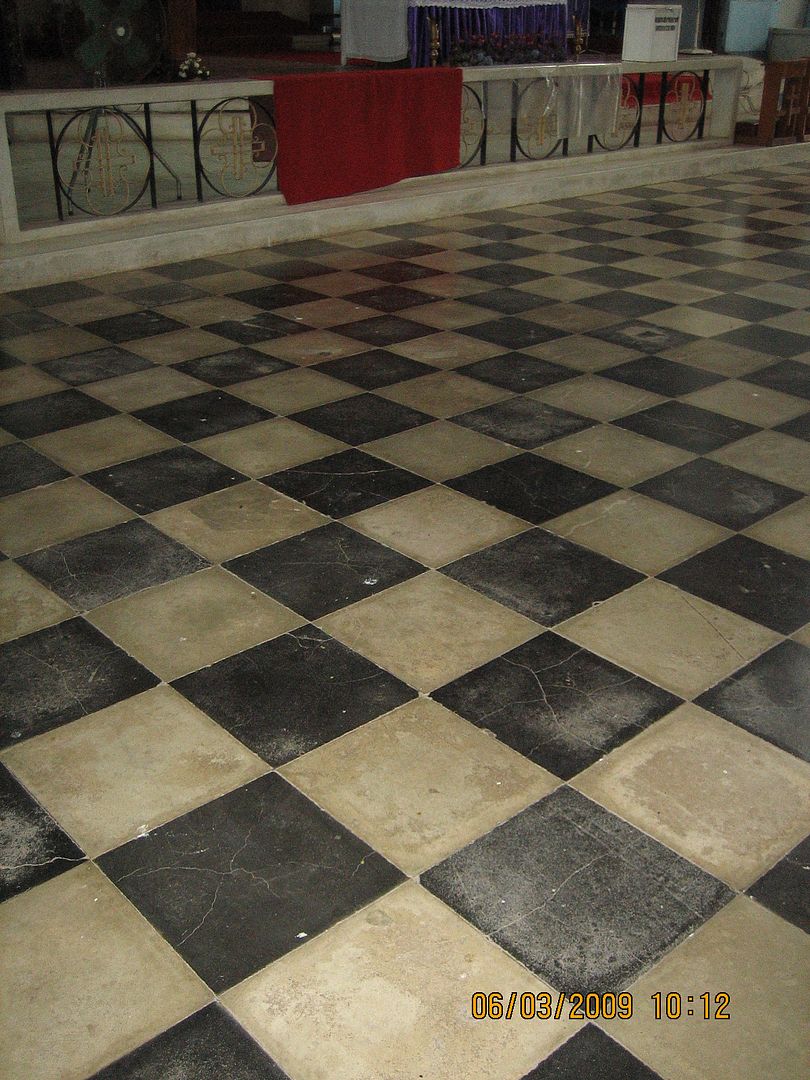

were a Pieta
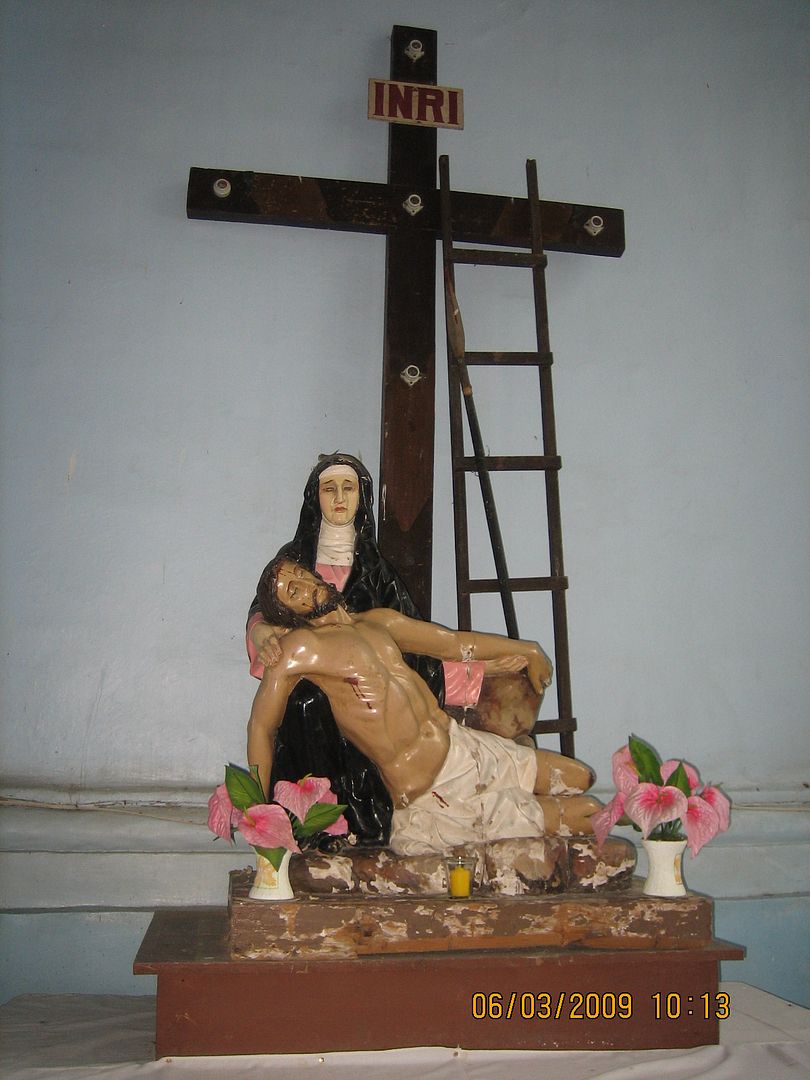

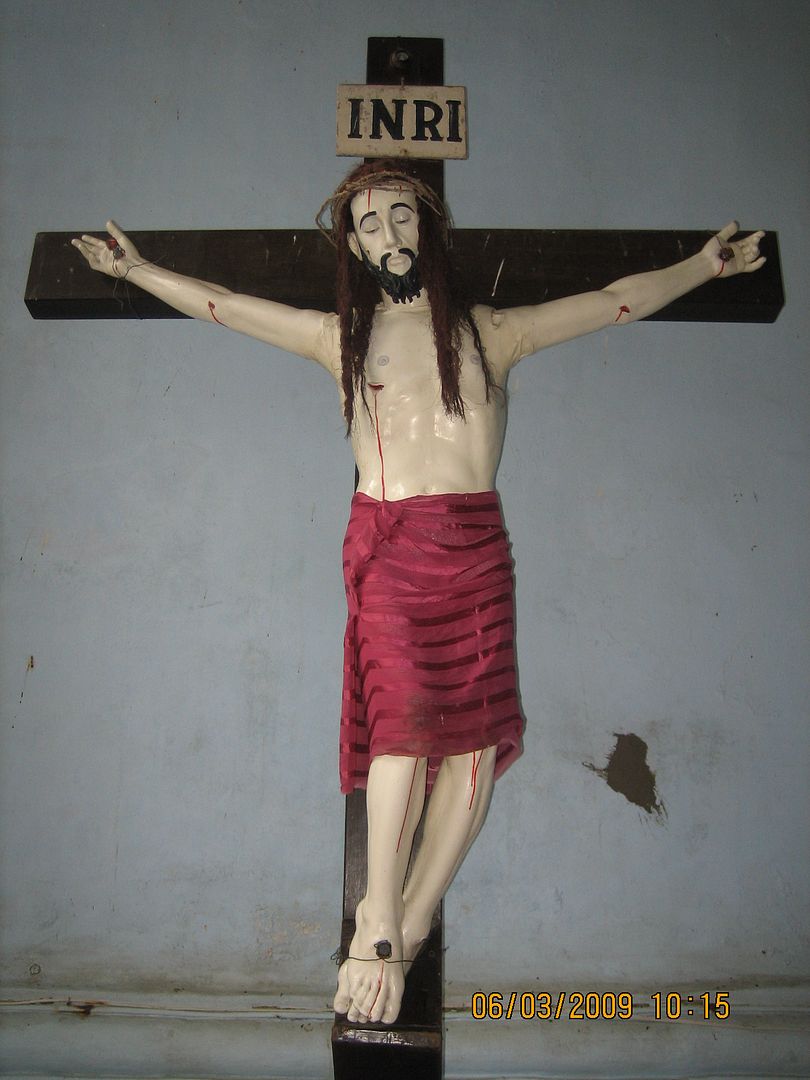
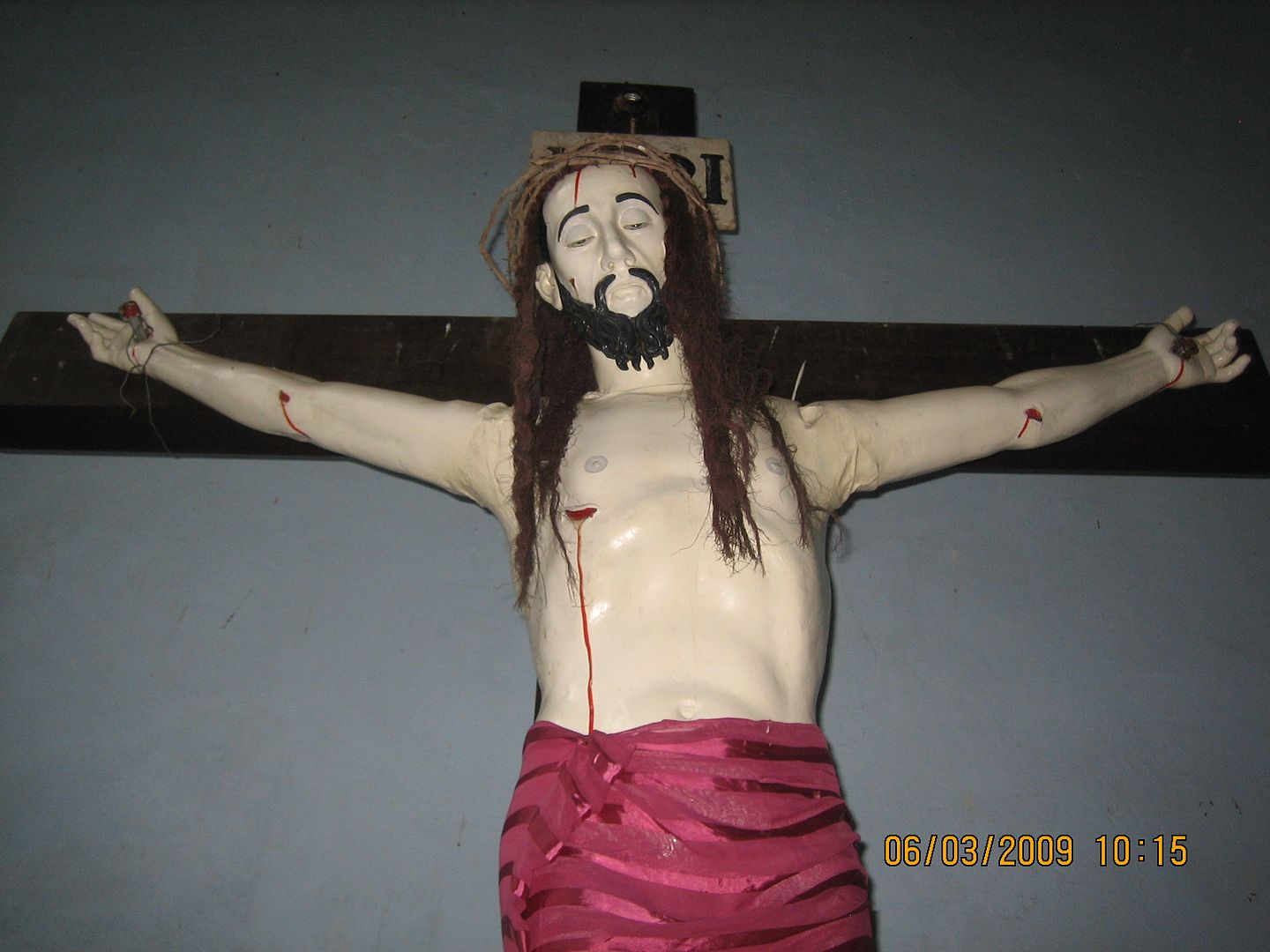
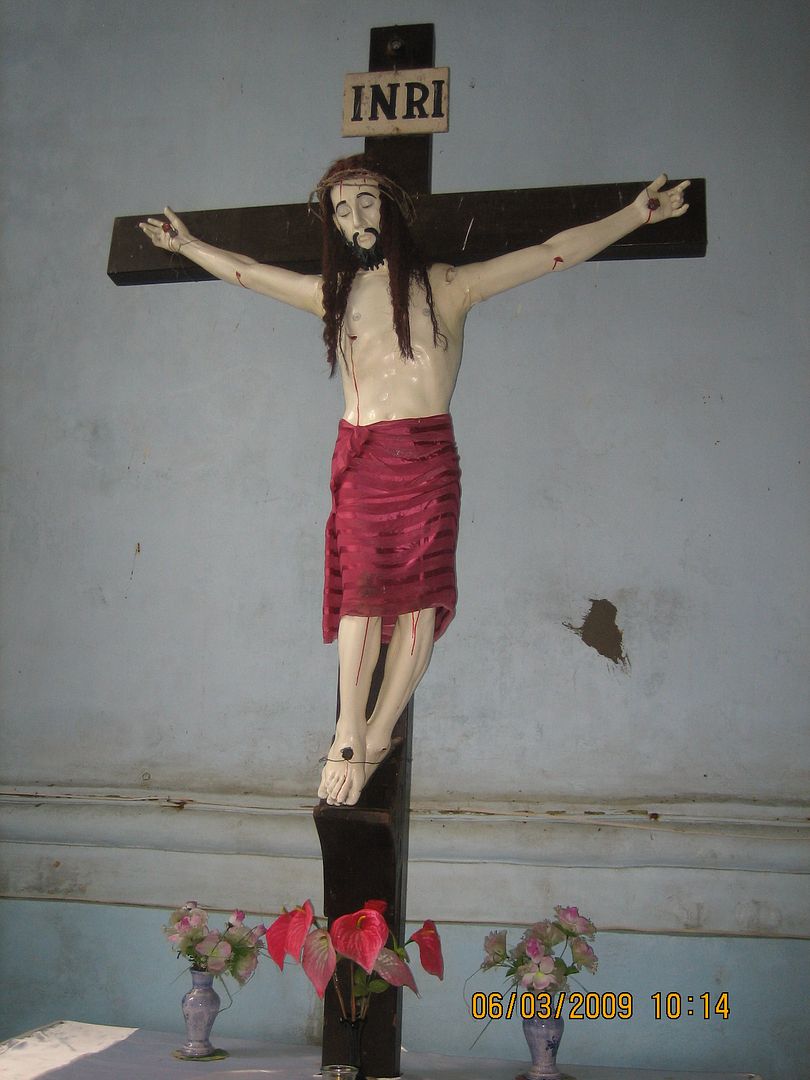
and a large Crucified Christ.


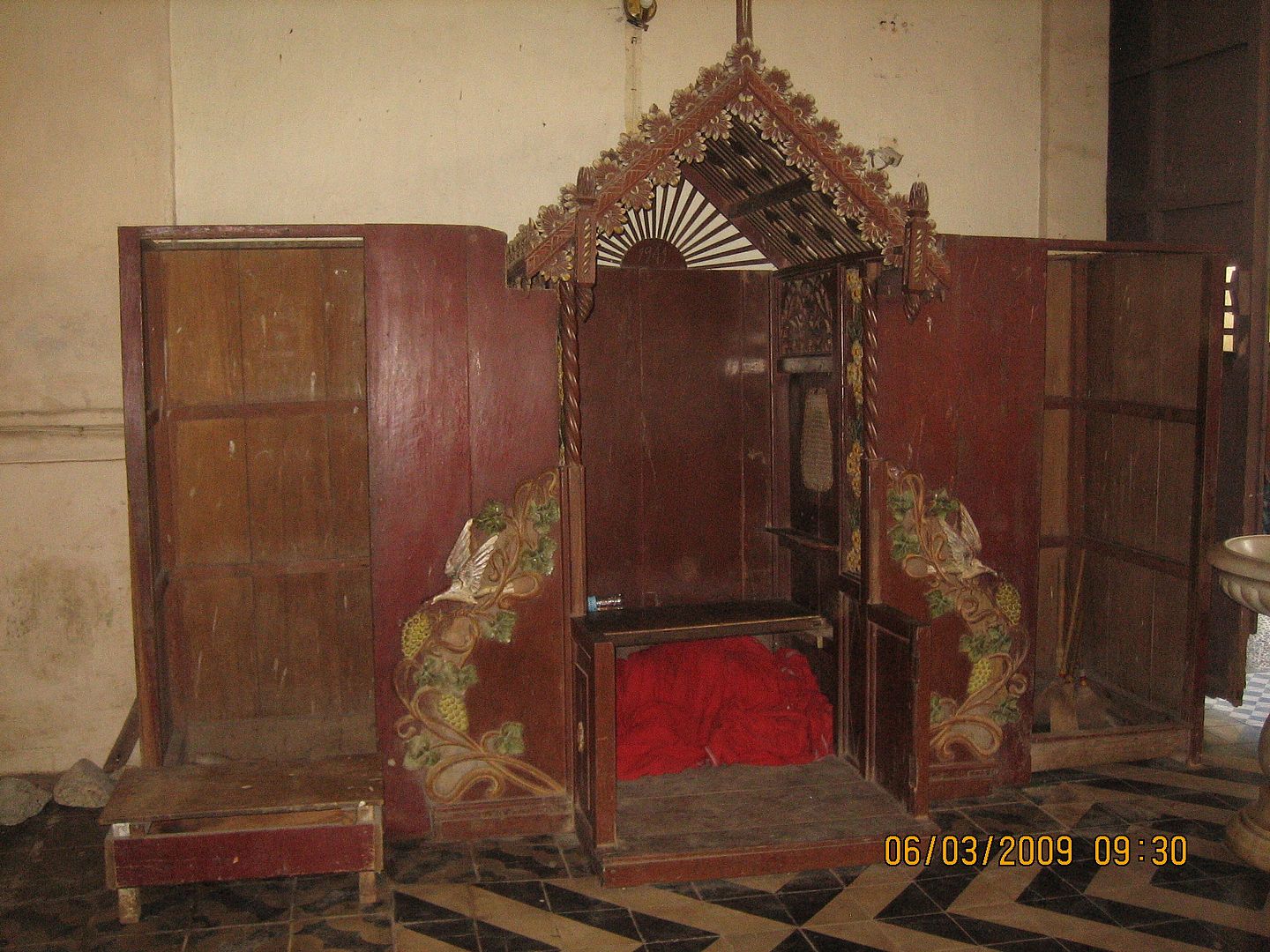
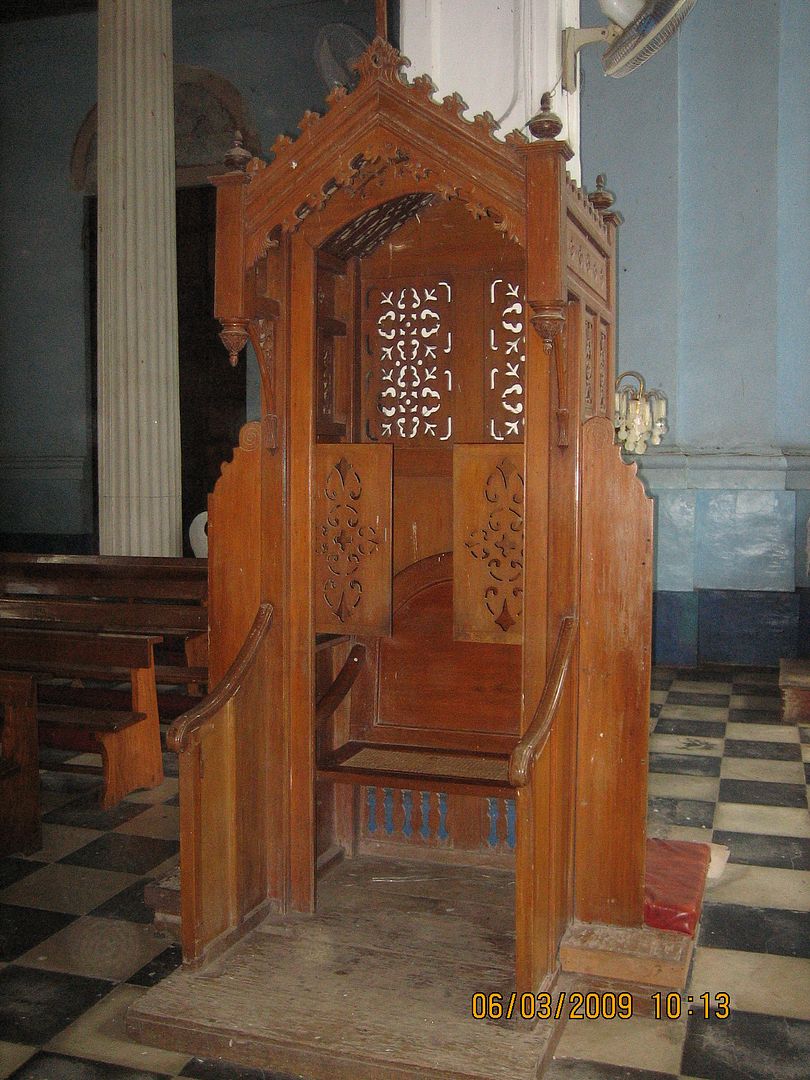
Other articles of interest here were an elaborately carved and pierced confessional,

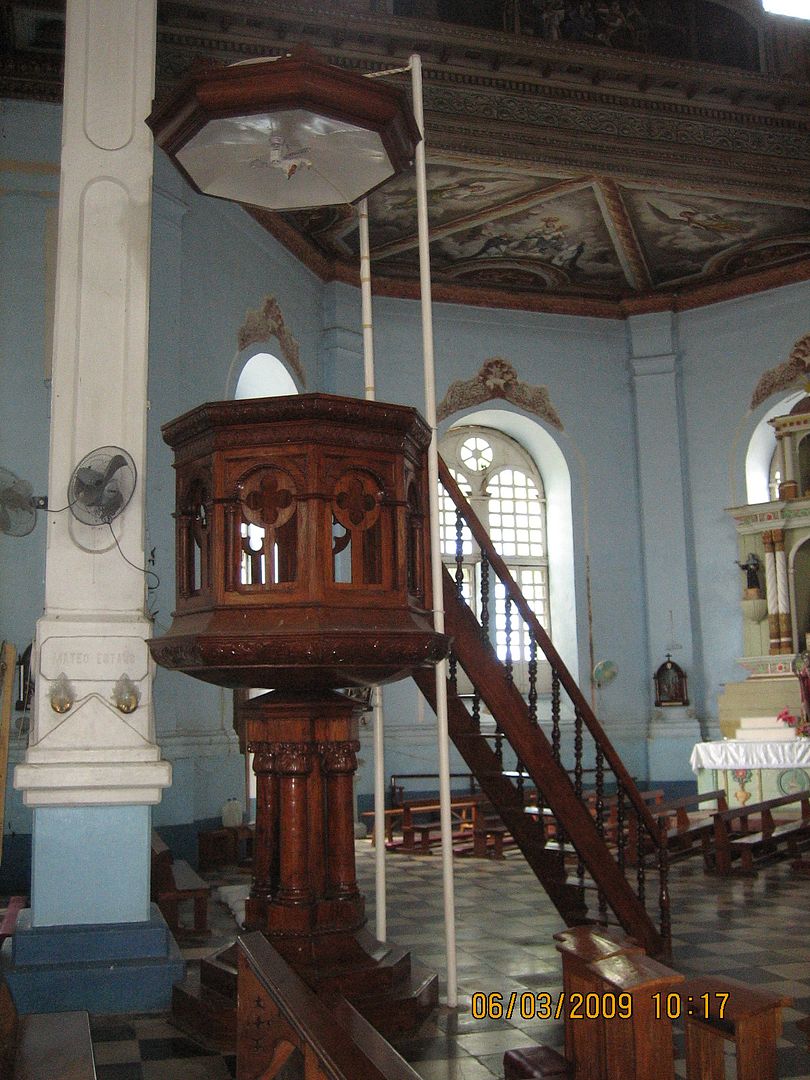
and the neoclassical pulpit.

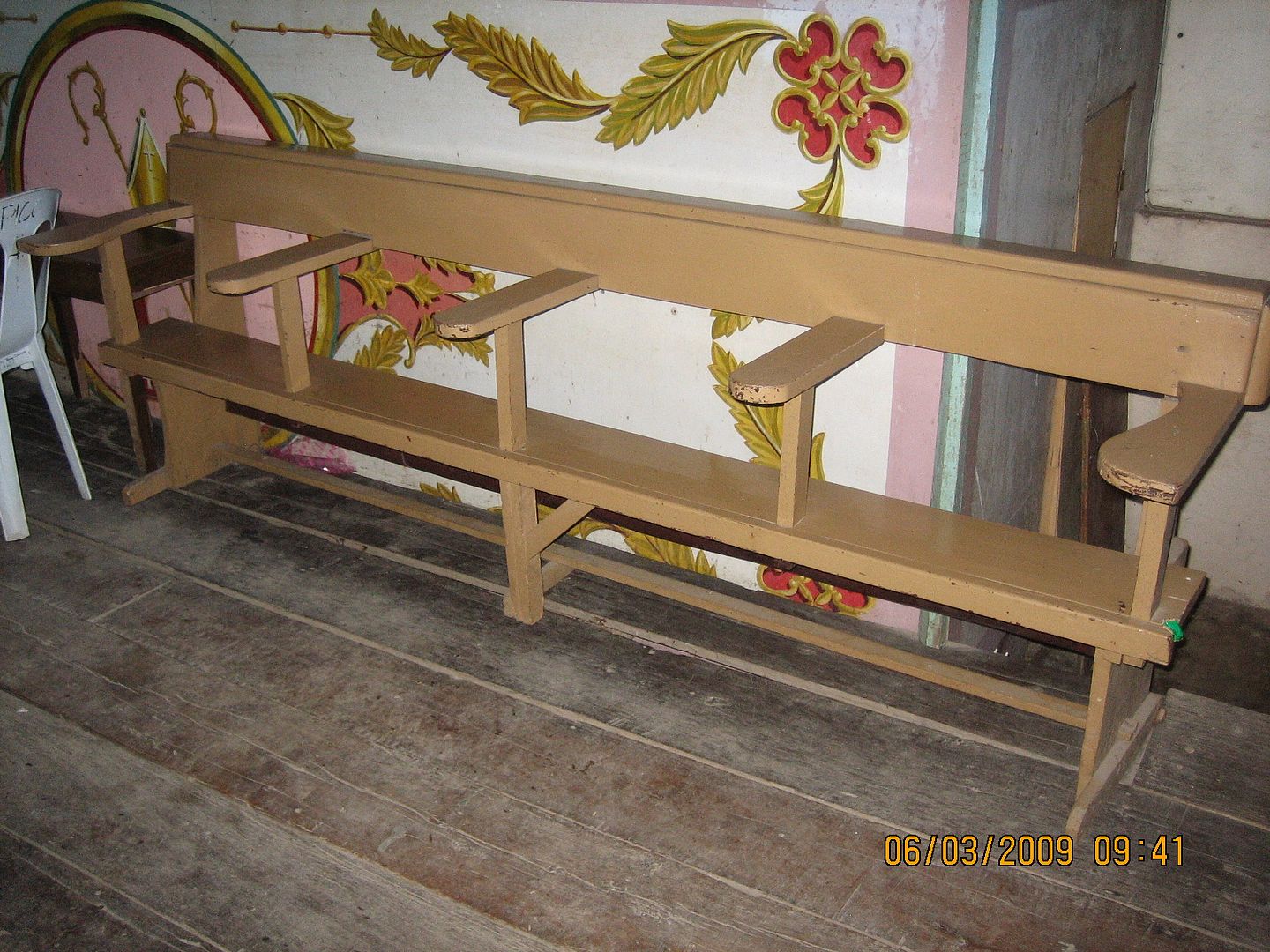
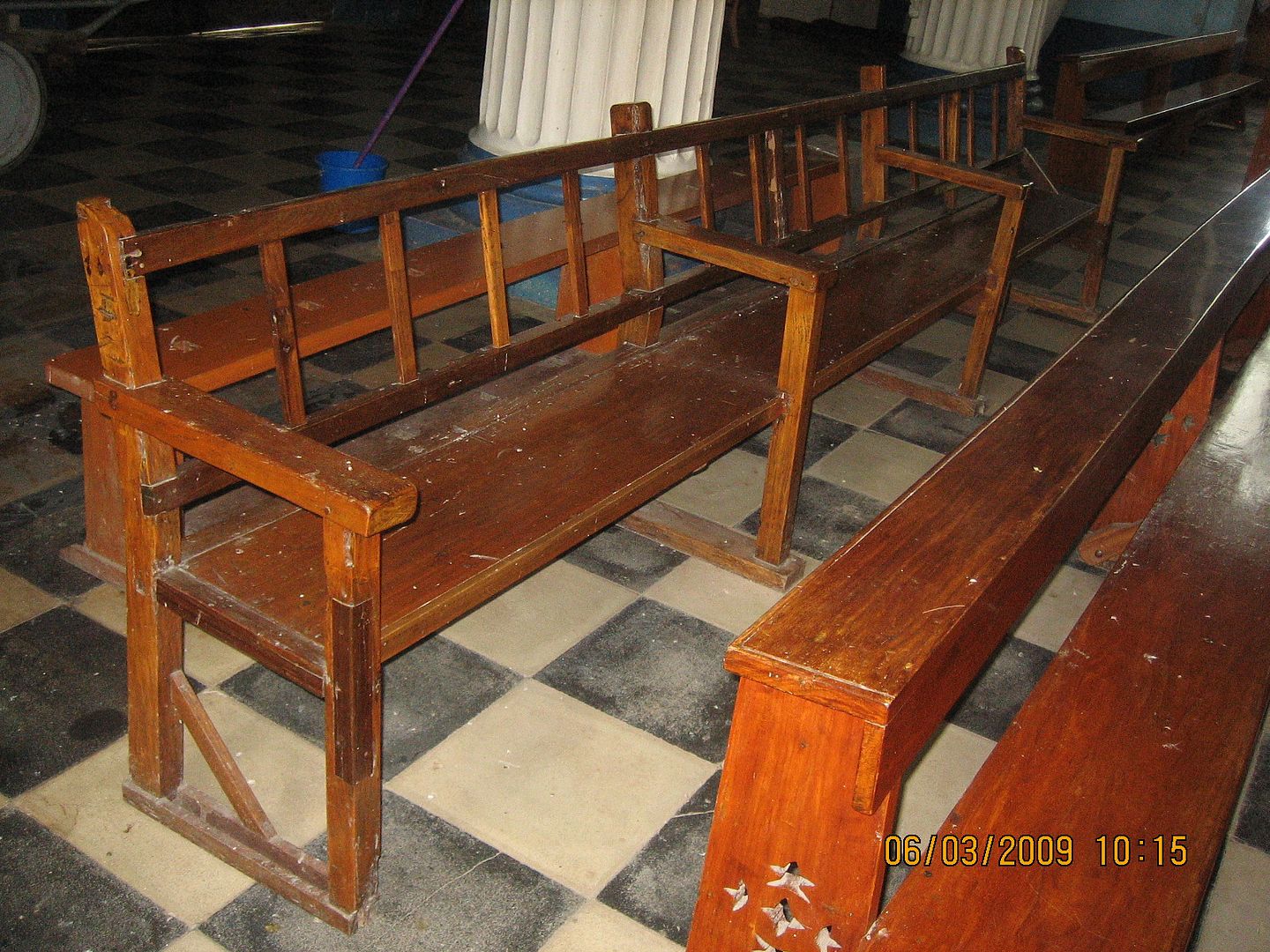
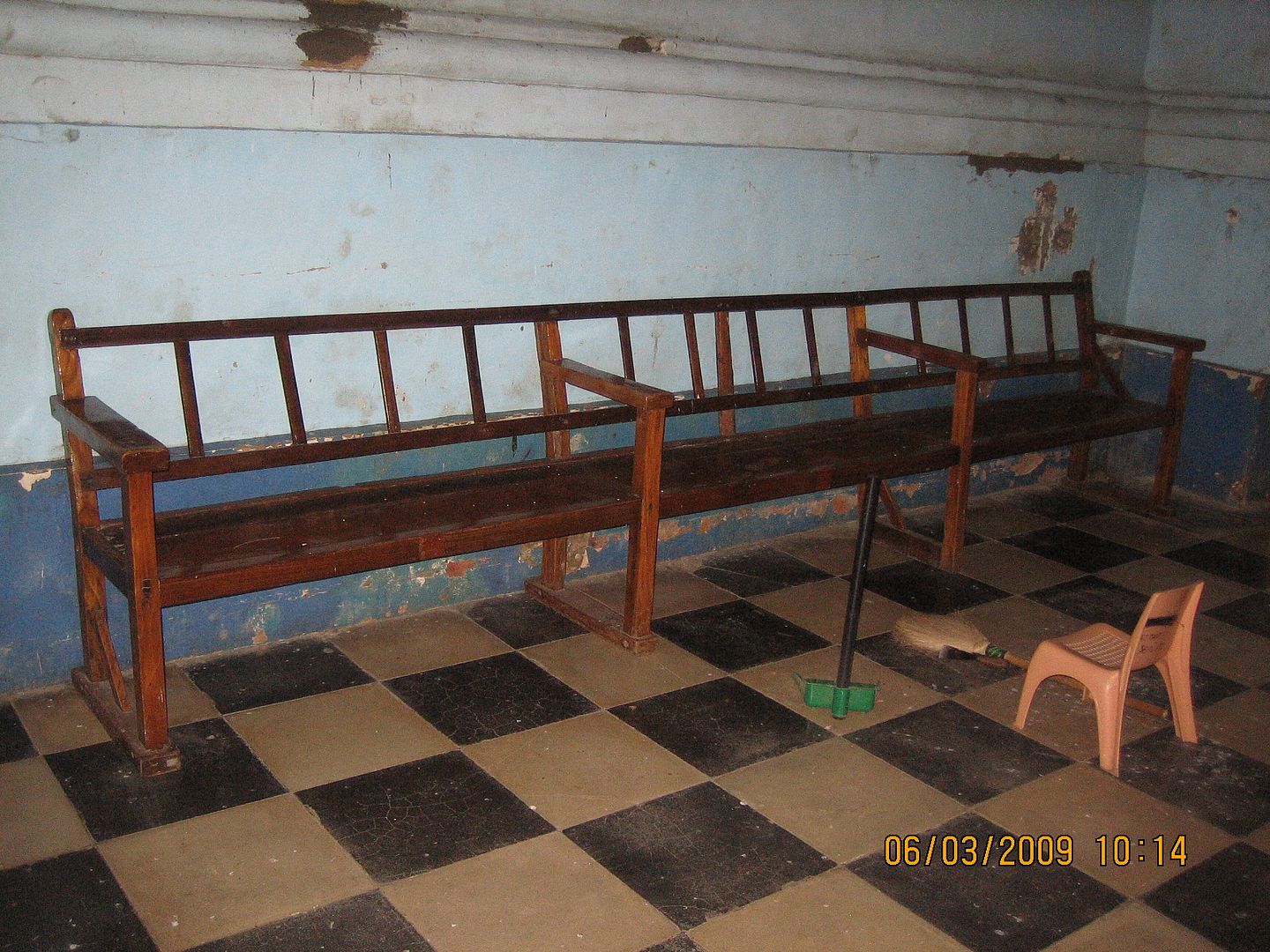
Towards the rear of the nave were a couple of long pews, left over from an older generation before the newer pews in the rest of the nave were brought in,

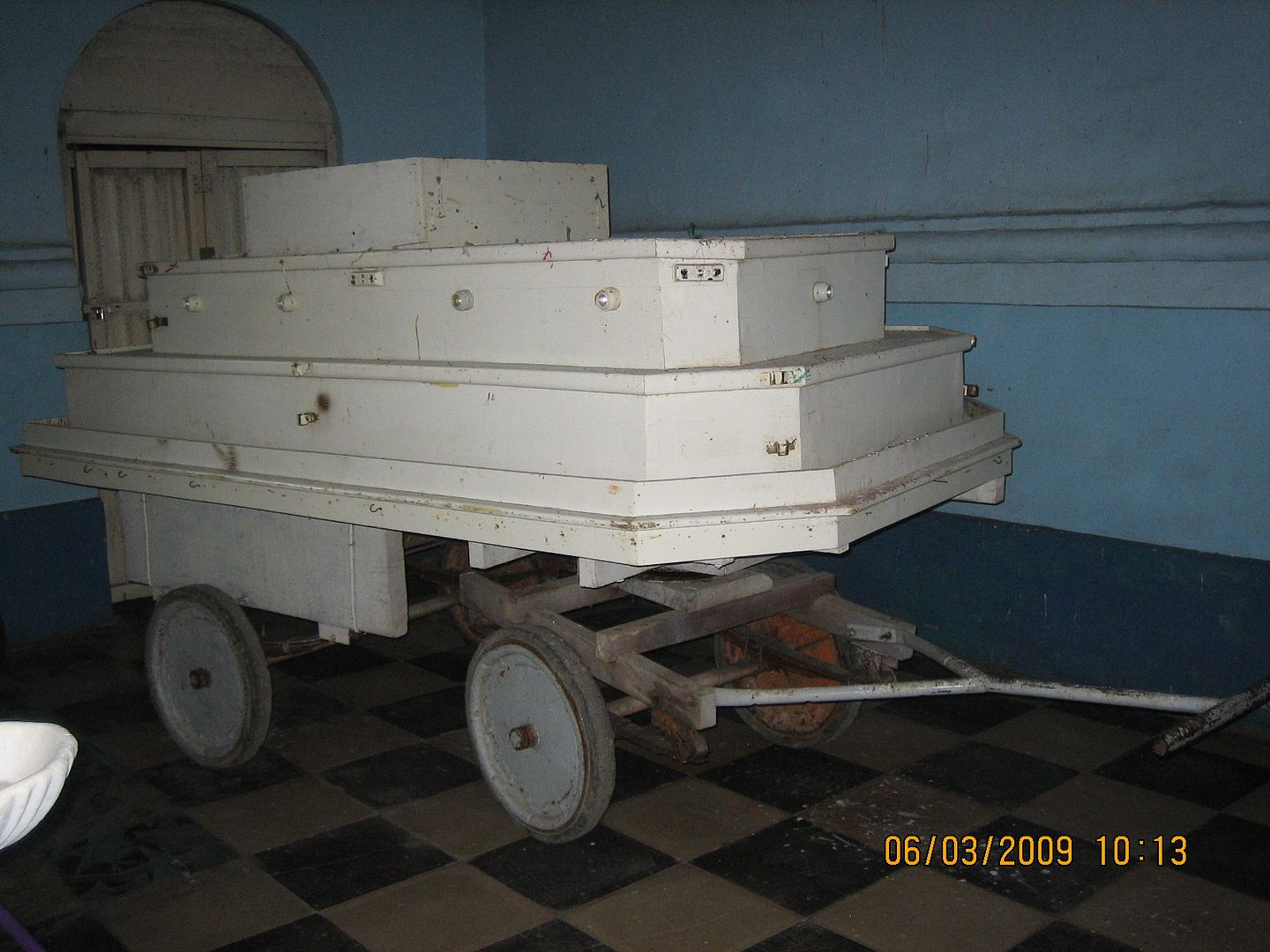
and a no-nonsense, utilitarian, whitewashed carroza.

These were right in front of the main door,
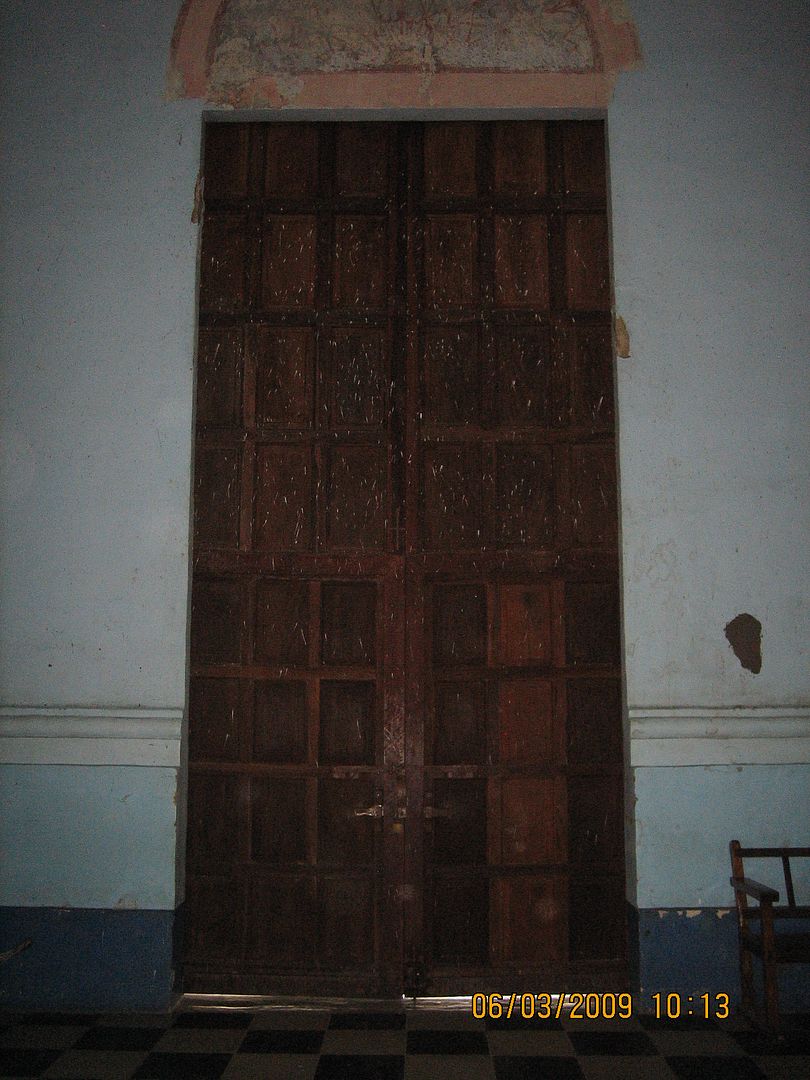

which, as we saw earlier from the outside, was firmly closed.

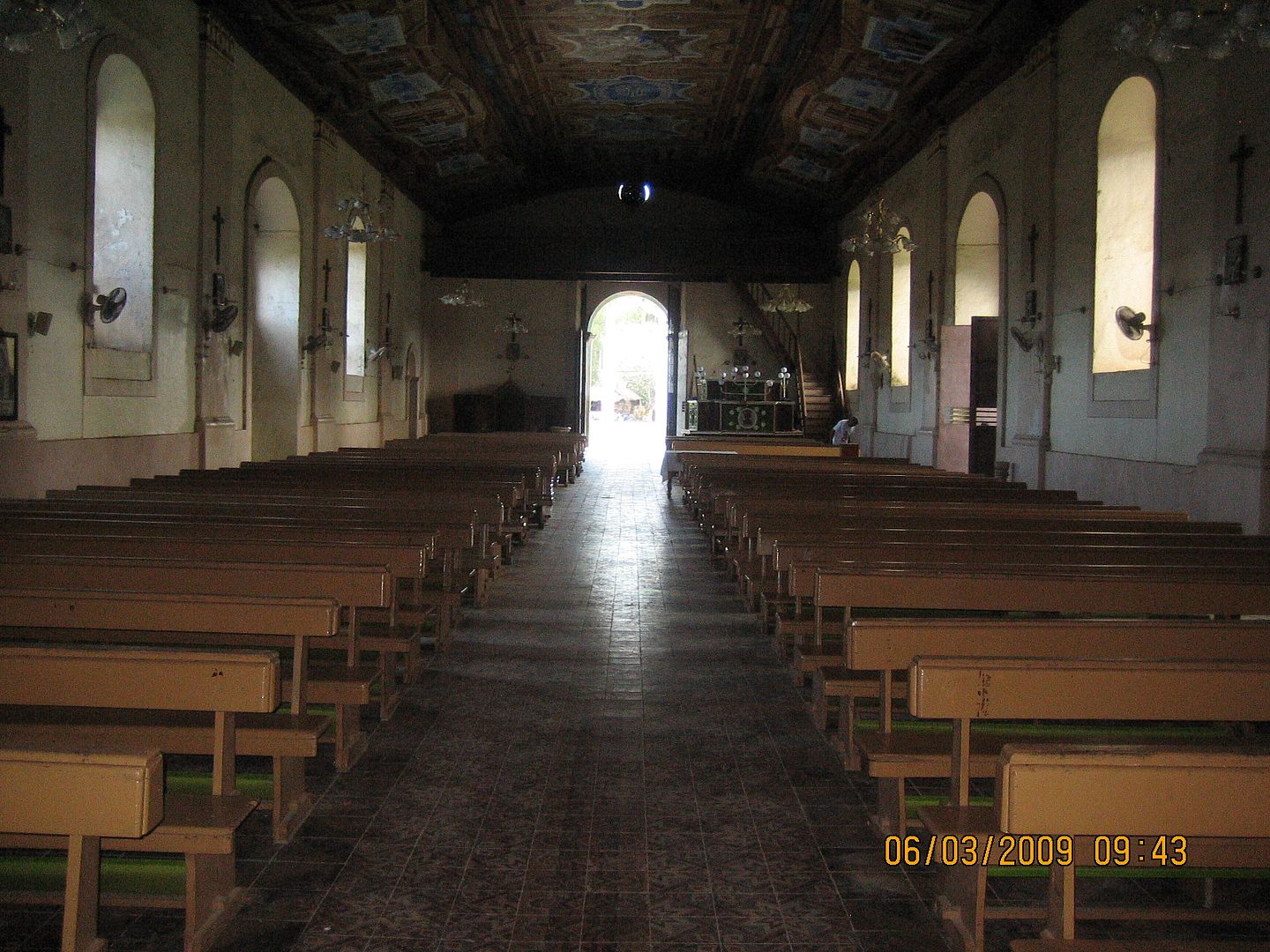
From this end, one gets a good view of what the “Visita Iglesia Bohol” book refers to as the “basilica plan” – a high central nave flanked by lower-ceilinged aisles on either side.
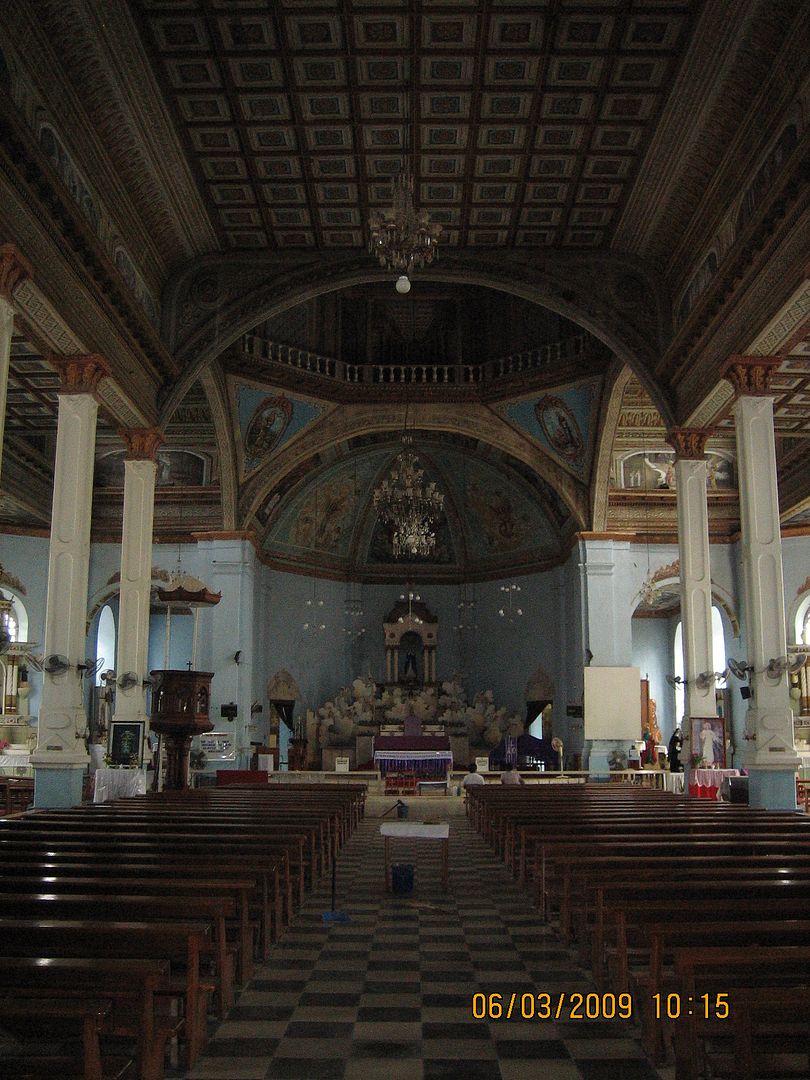
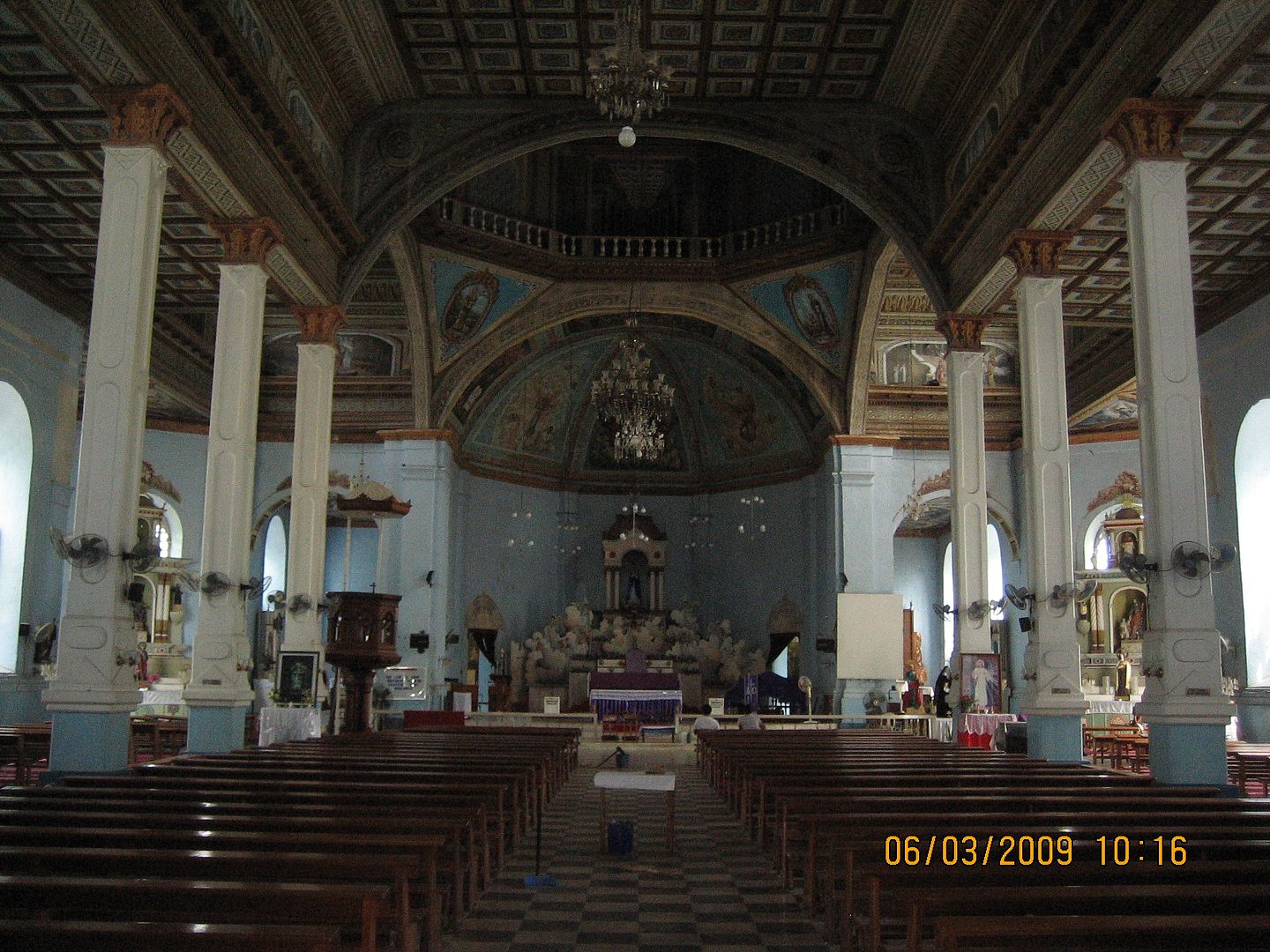


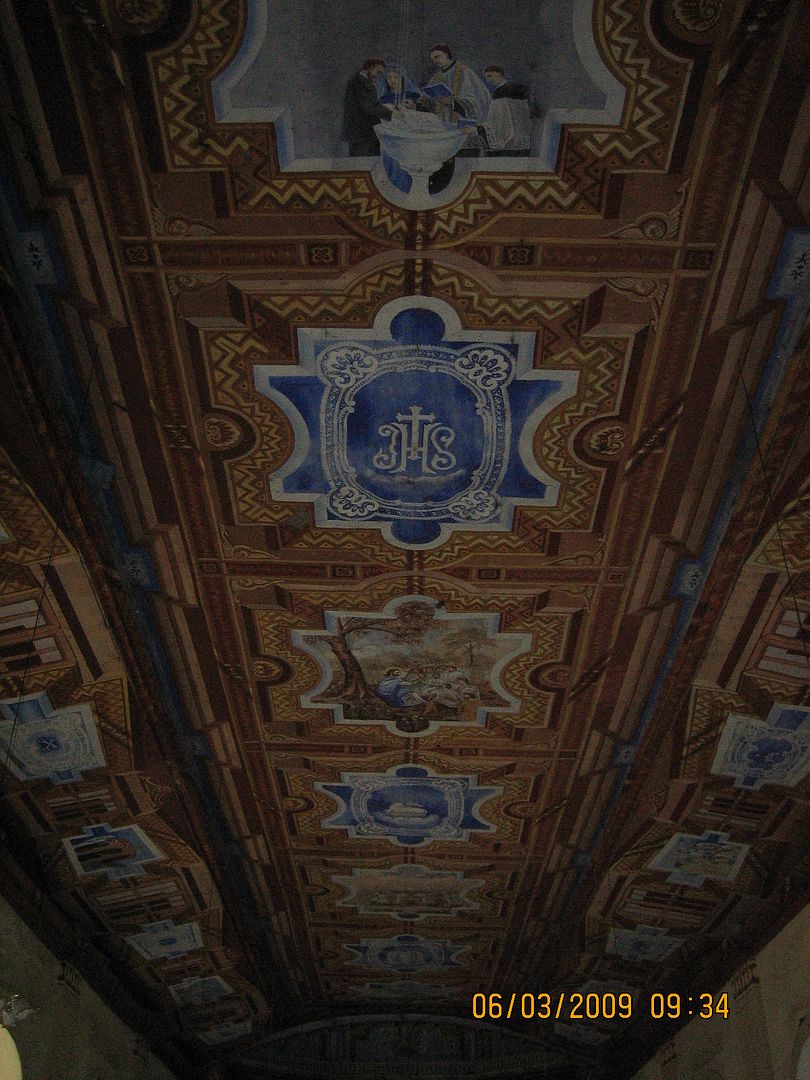
And perhaps in emulation of several genuine Roman basilicas (basilicae?), the ceiling is painted not with religious scenes and holy figures as in Panglao (and in fact other Bohol churches), but with decorations simulating a Renaissance-style coffered ceiling.
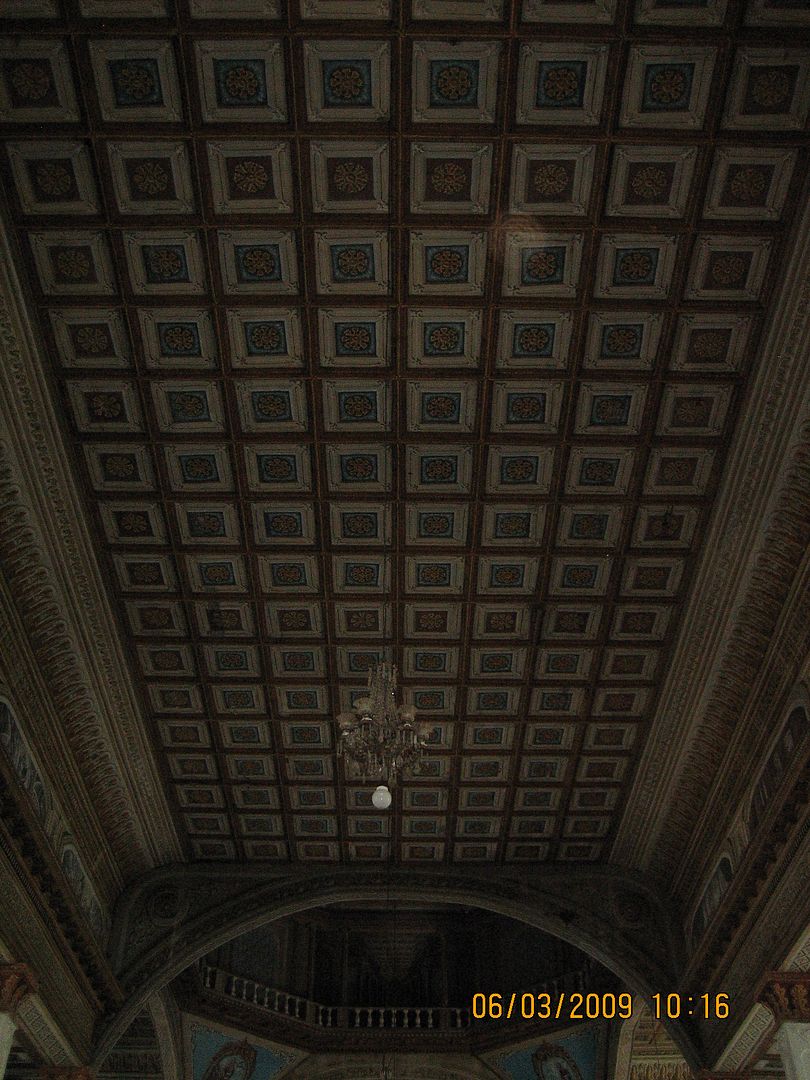
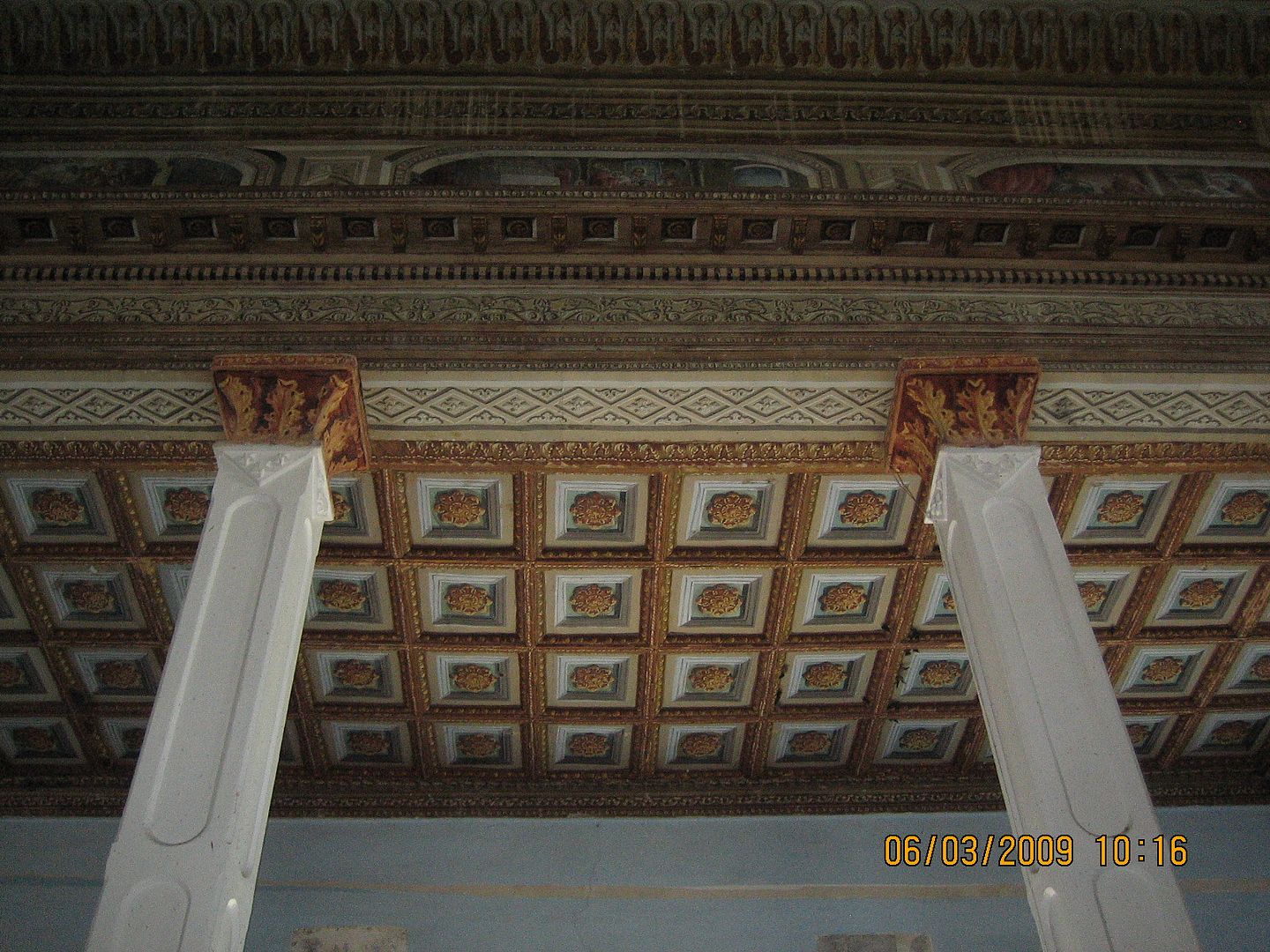

But perhaps the most remarkable feature of Dauis Church is a small well, set in the floor right in front of the main altar and under the table in this next photo, that is supposed to have sprung miraculously when parishioners once had to seek refuge within the building during a pirate attack many many generations ago.
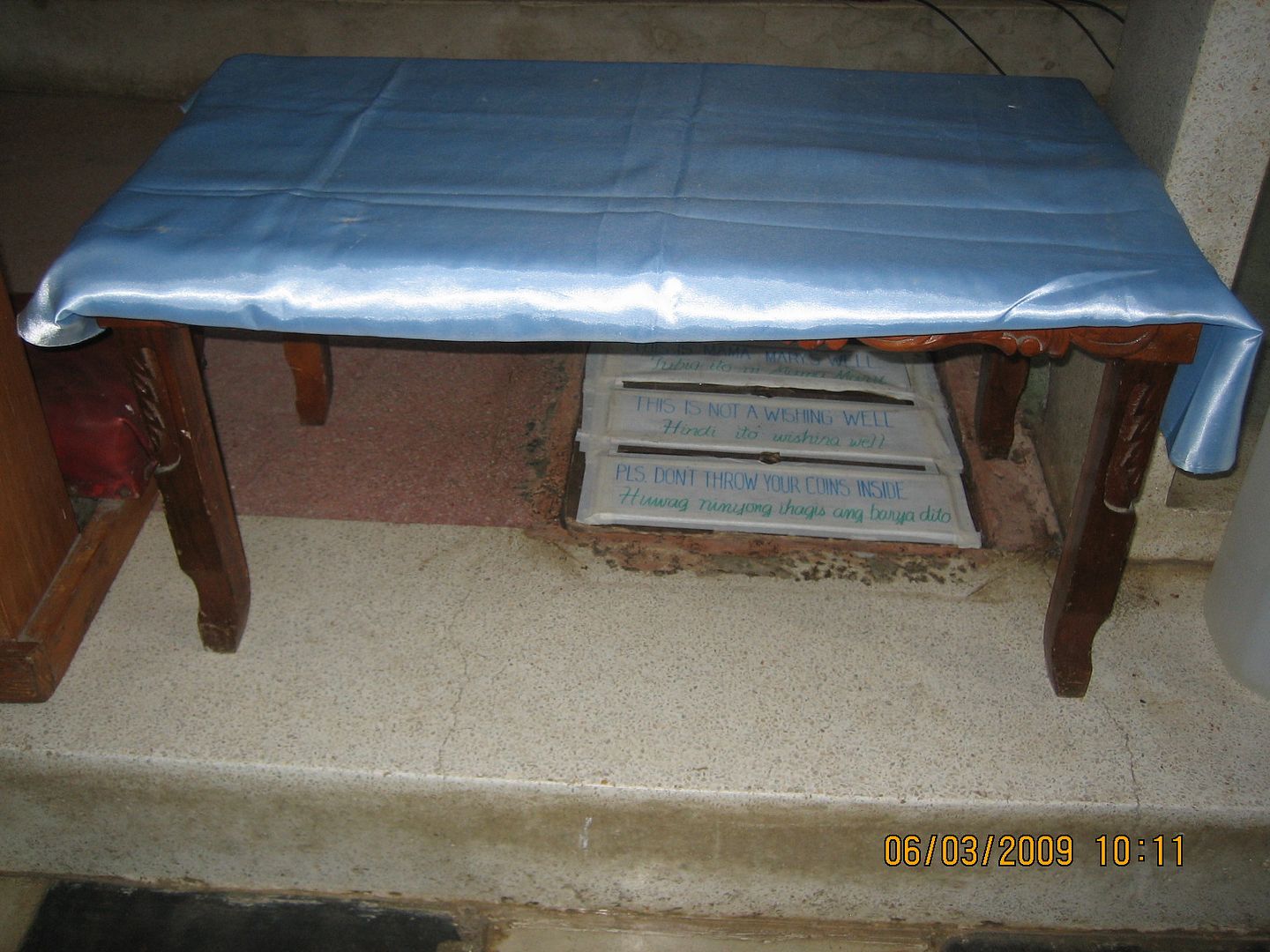

Supposedly the water remains fresh and potable, quite unlike the salty water from the sea just a few meters away.  But only if well-meaning but clueless pilgrims don’t throw coins into it as if it were a wishing well!

Leaving the church the way we entered, our attention is called by this sign, directing us to a souvenir shop in the old convento at the back.
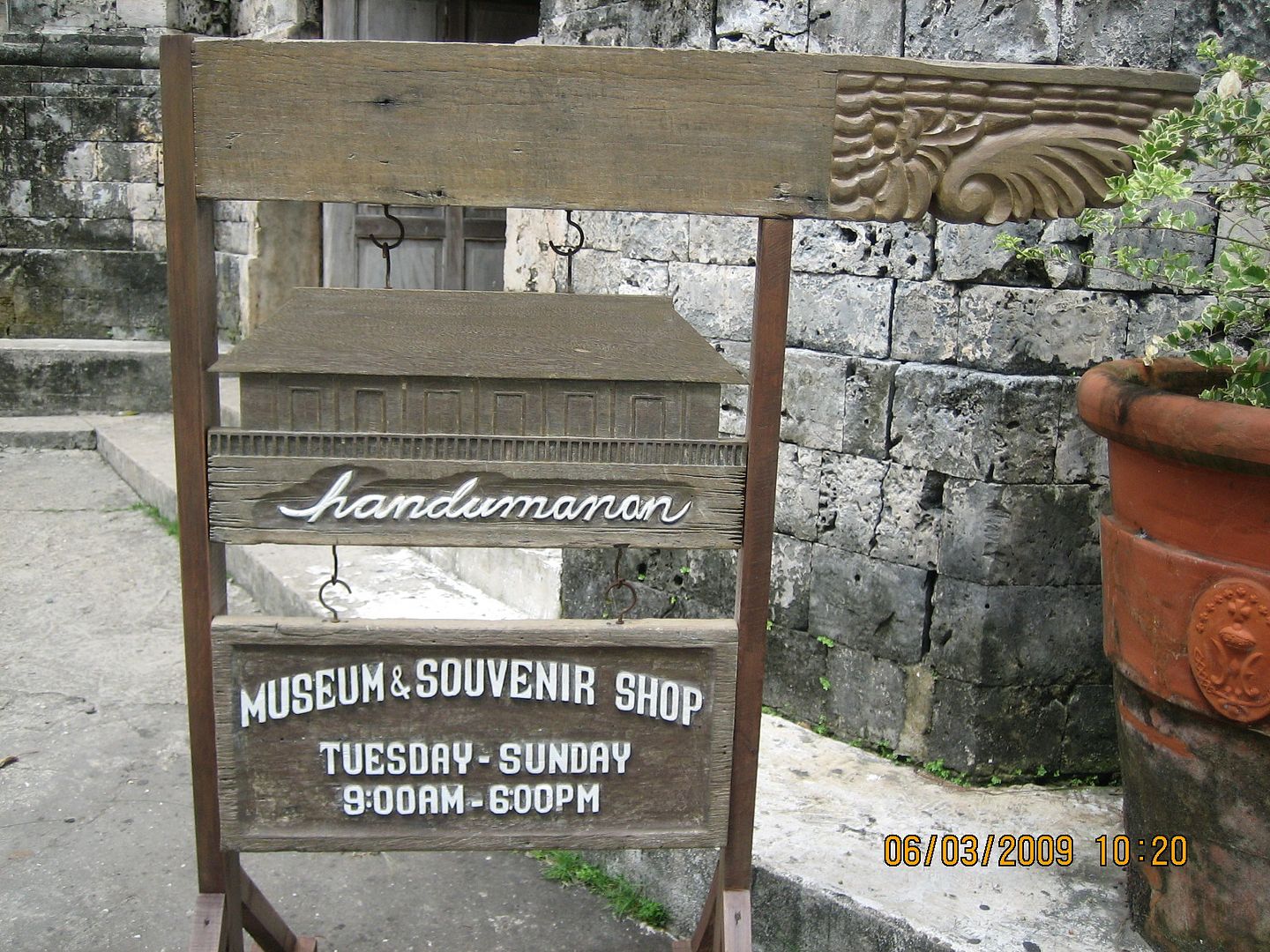

We’ll check it out later.

Elsewhere by the side of the church is what appears to be the parish office, unfortunately not sympathetically matched to the style of the rest of the structure.
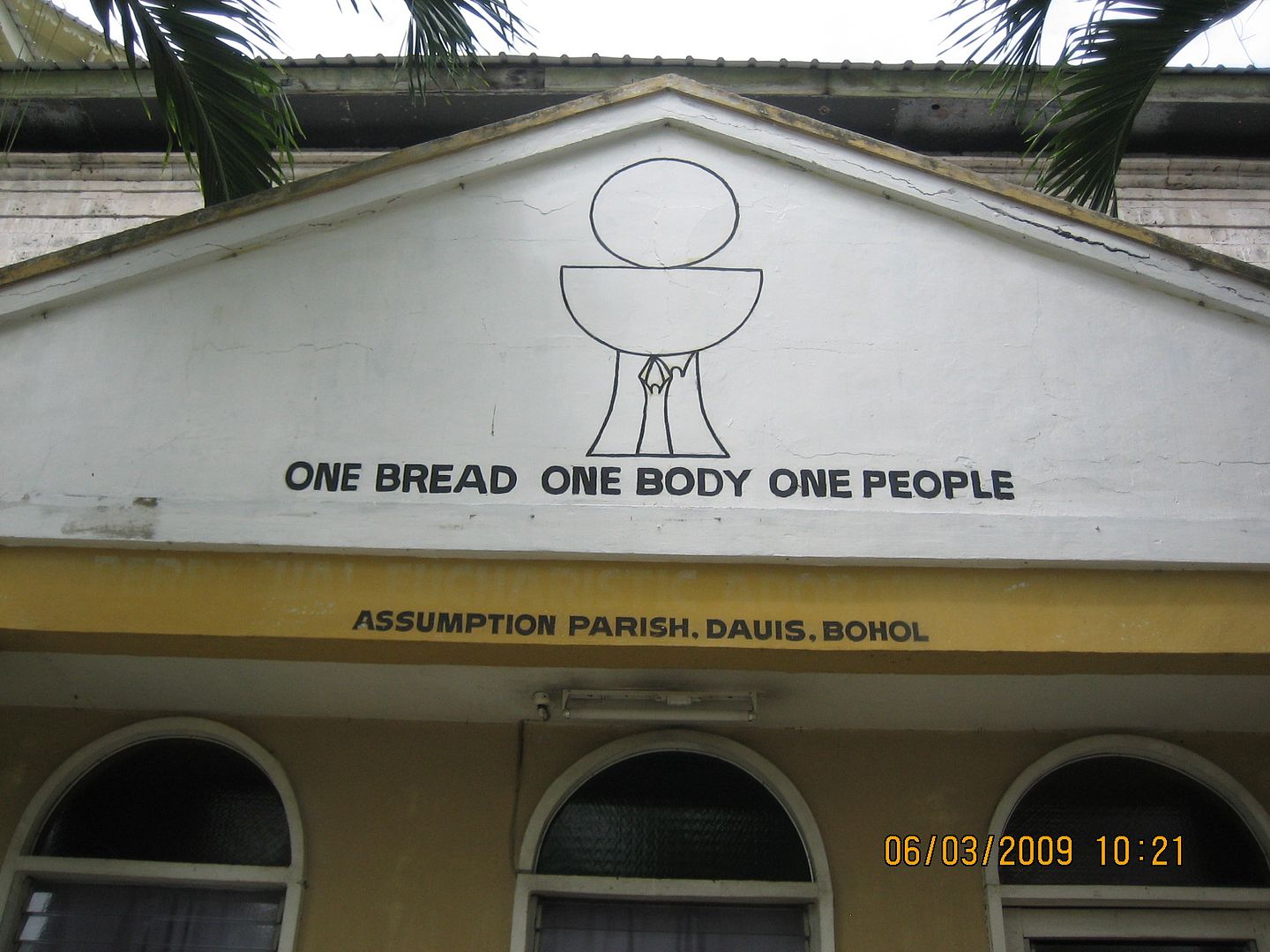

The very back of the church, right behind the main altar and the area where we had earlier seen several holy images lined up, is what might be mistaken for another façade.
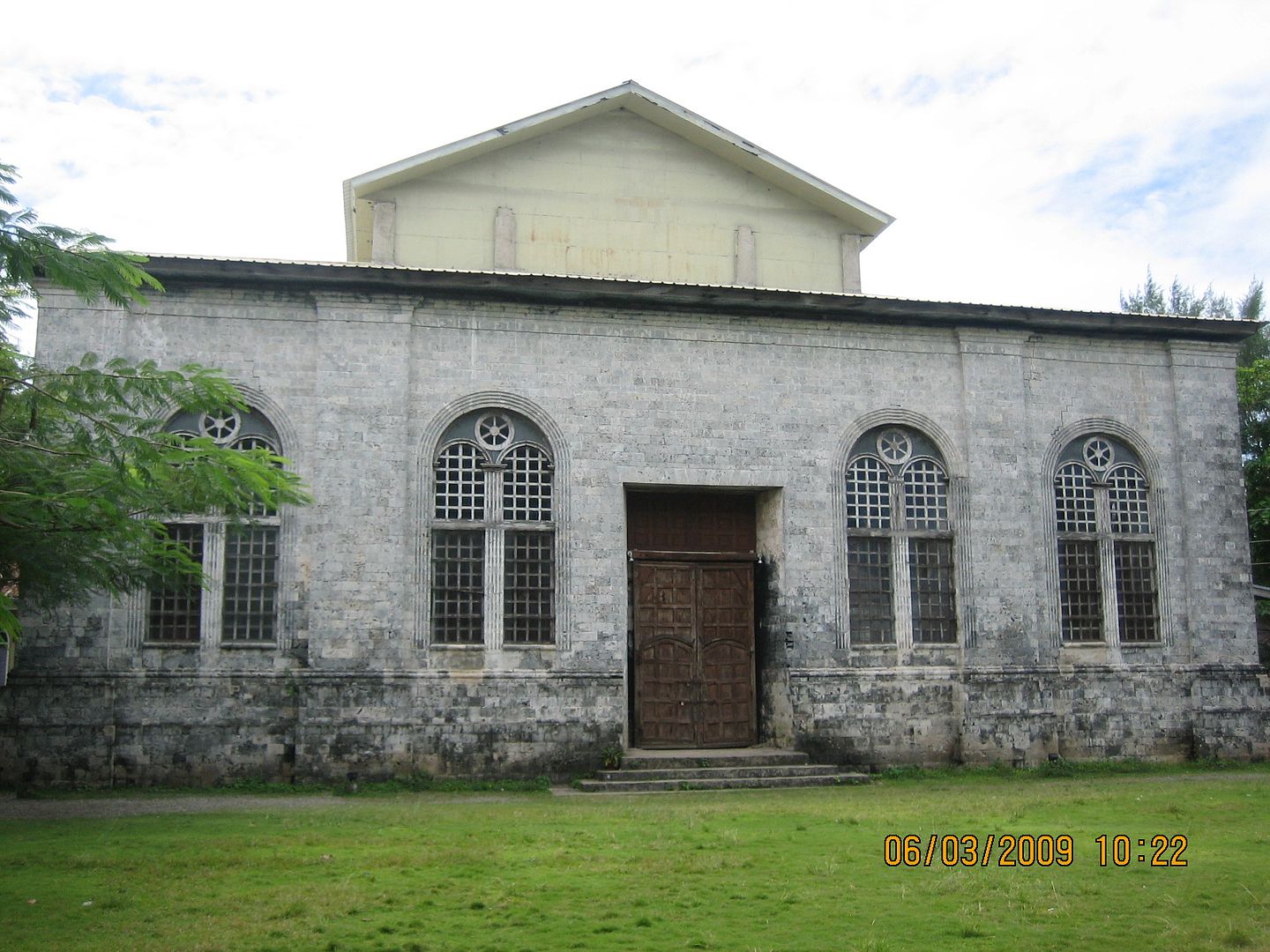

I suppose that this is through where the parish priest and other religious staff originally passed on the way to the church from the convento across the yard, which is not directly connected to the church building.
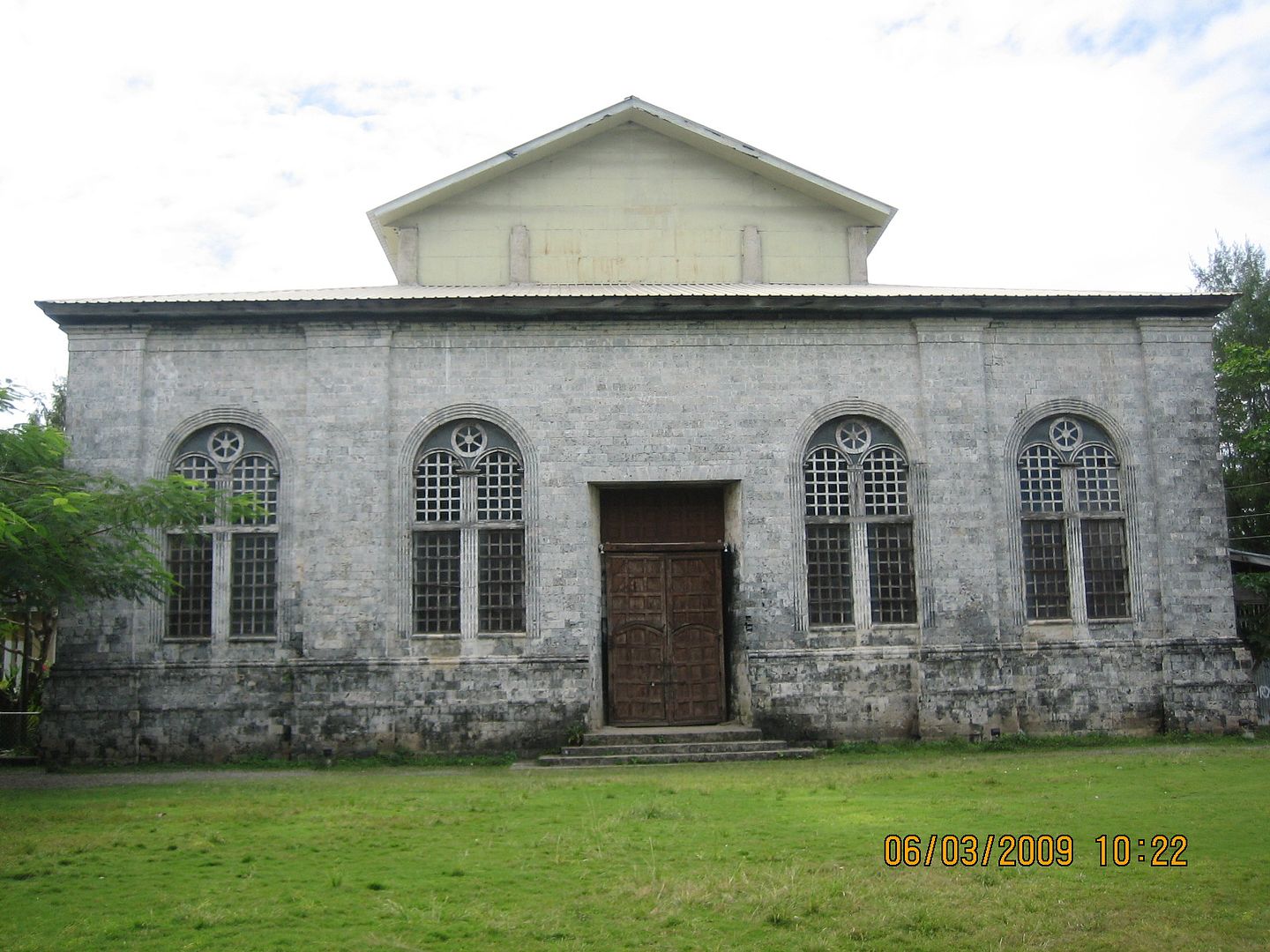

The convento itself is a large building with wrap-around exposed balconies, recently meticulously renovated.
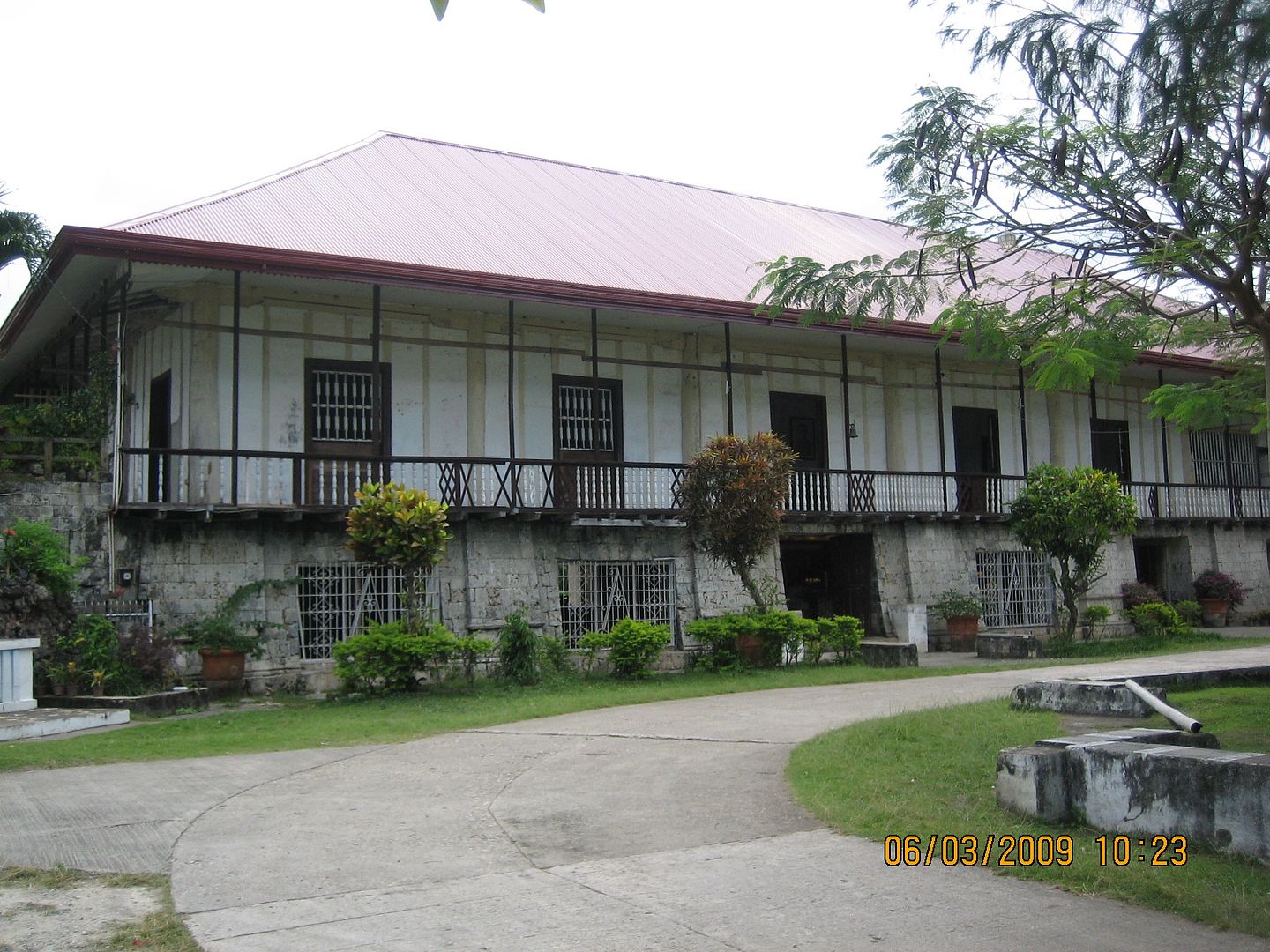

Apart from the aforementioned souvenir shop, there is a coffee shop and a small museum on the ground floor, all set up by the Ayala Foundation, who are generous benefactors of the Dauis Church Complex.

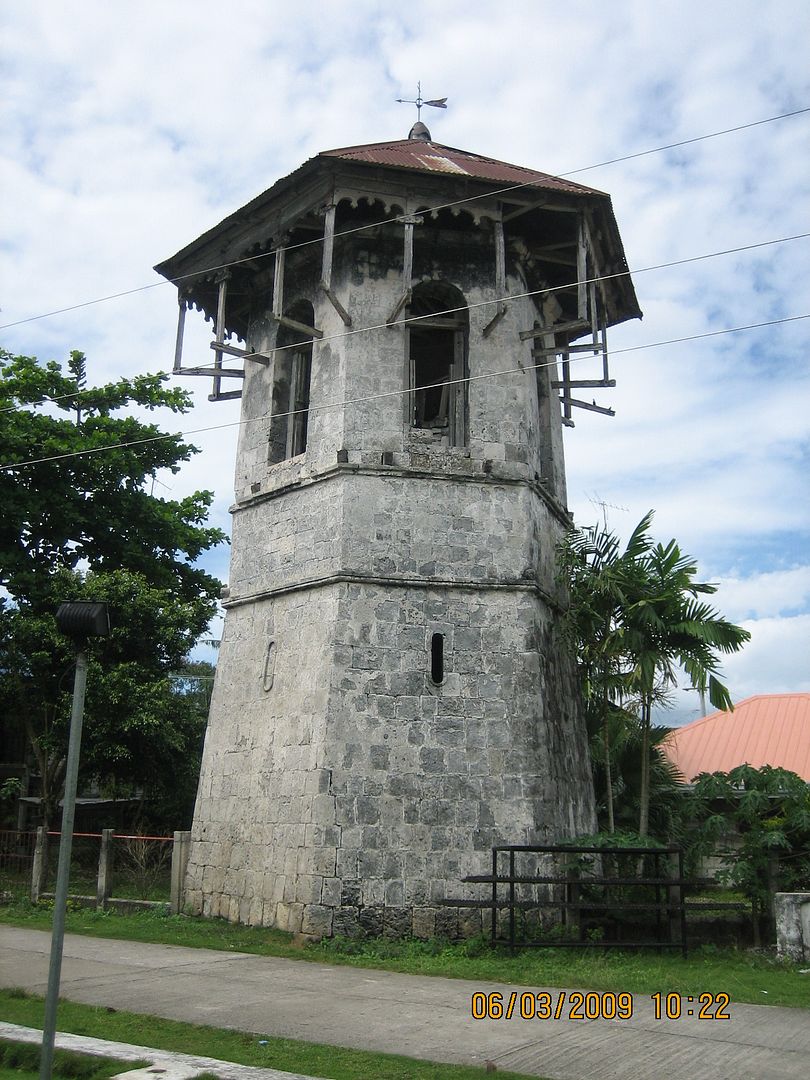
The only part of the complex that we haven't really checked out is the other side of the large open space bounded by the convento and the rear of the church.  Here, there is a hexagonal tower that was originally built by the Jesuits in the 18th century as a lookout against pirates.

Also overlooking the sea is this religious monument, with painted concrete figures of the Immaculate Heart, Saint Joseph, and other saints.
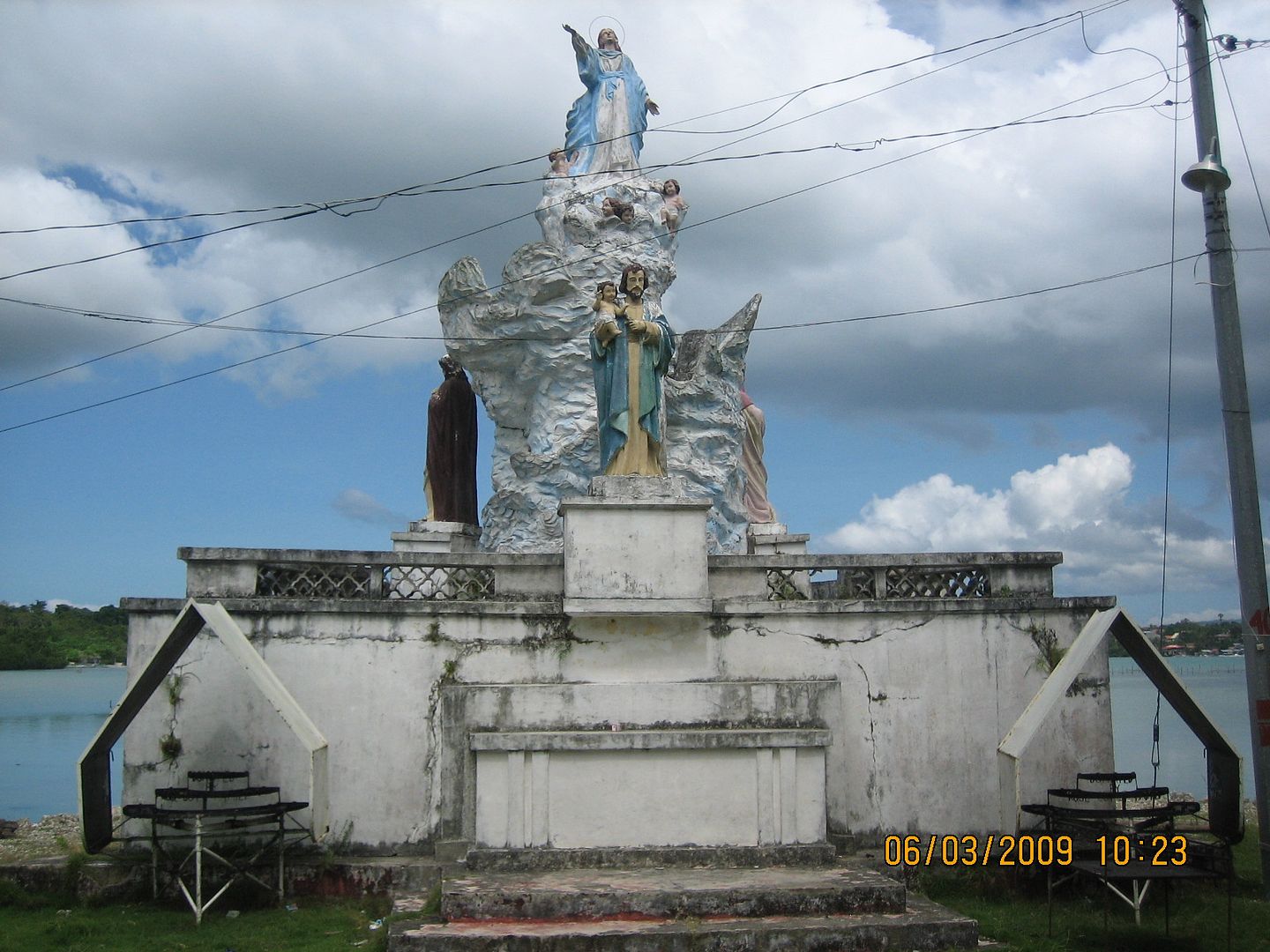

Actually it overlooks not the sea but the main island of Bohol, which is where our next stop will be.

Originally published on 8 May 2011.  All text and photos copyright ©2011 Leo D Cloma. The moral right of Leo D Cloma to be identified as the author of this work has been asserted.
CXIX. Visita Iglesia (Plus) Bohol IV -- Intermission: The Cloma Ancestral House

I did mention in the previous article on our visit to Panglao Church that the town of Panglao was significant to me because it was the reputed hometown of the Cloma Family.  After that visit to the church, I was very pleased with myself, not only because the church itself was quite appealing as we had previously seen, but also because I had finally been to the place where my ancestors supposedly lived and worshipped.

With that, I therefore felt that we could get on with this Visita Iglesia itinerary and move on to the next church.  My Cloma cousins who were with me, however, had a different plan – they told me that it was insufficient for us to just drop by our hometown church; we also had to visit our ancestral house!

At that moment, all I could think was, how stupid of me, of course if Panglao was the original hometown of the Cloma Clan, then there must be an ancestral house there somewhere.  Therefore, we must do an Akyat-Bahay of the Cloma Ancestral House in Panglao.

About a block away from the front of the church was where the Cloma Ancestral House stood.


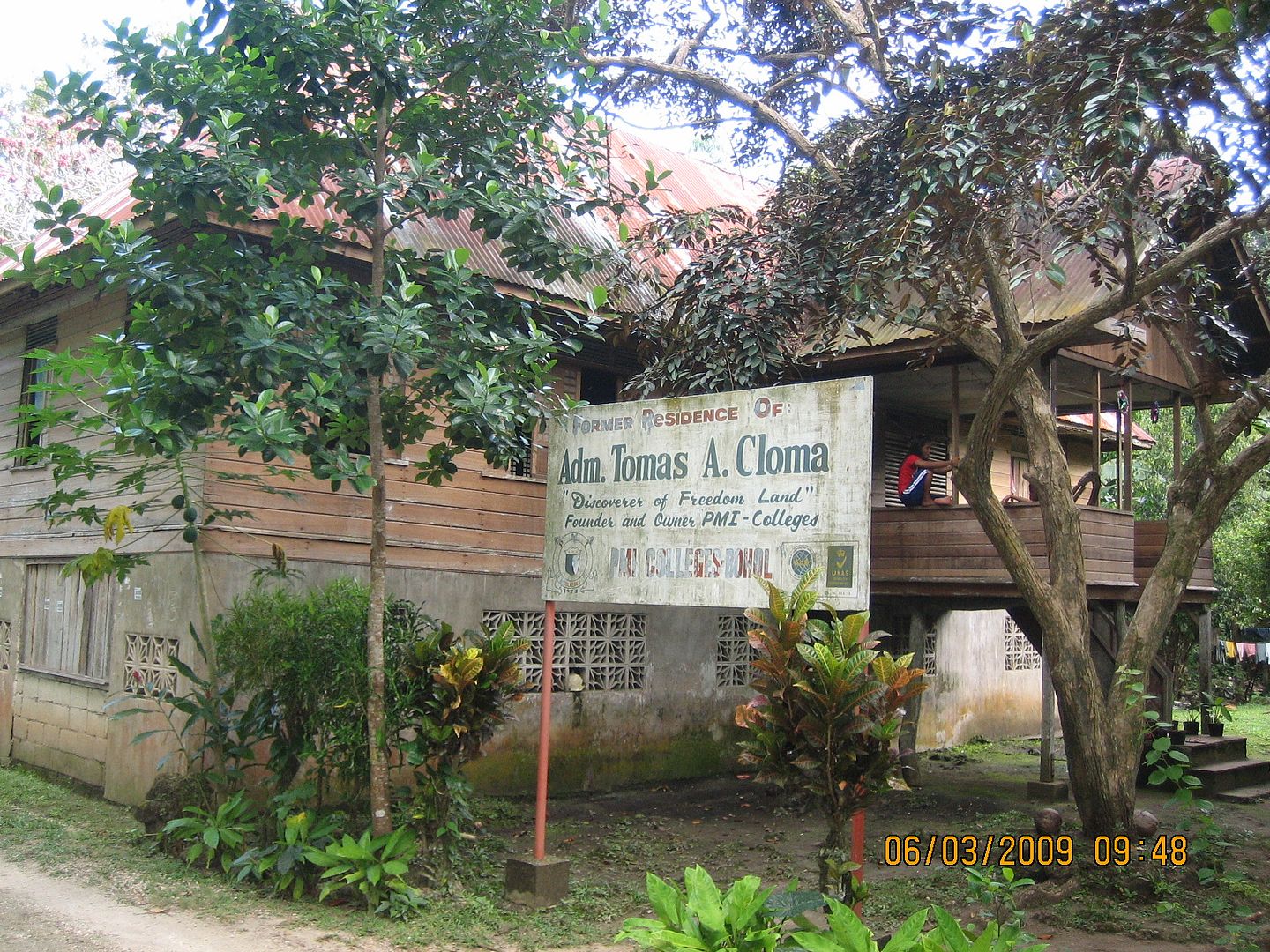
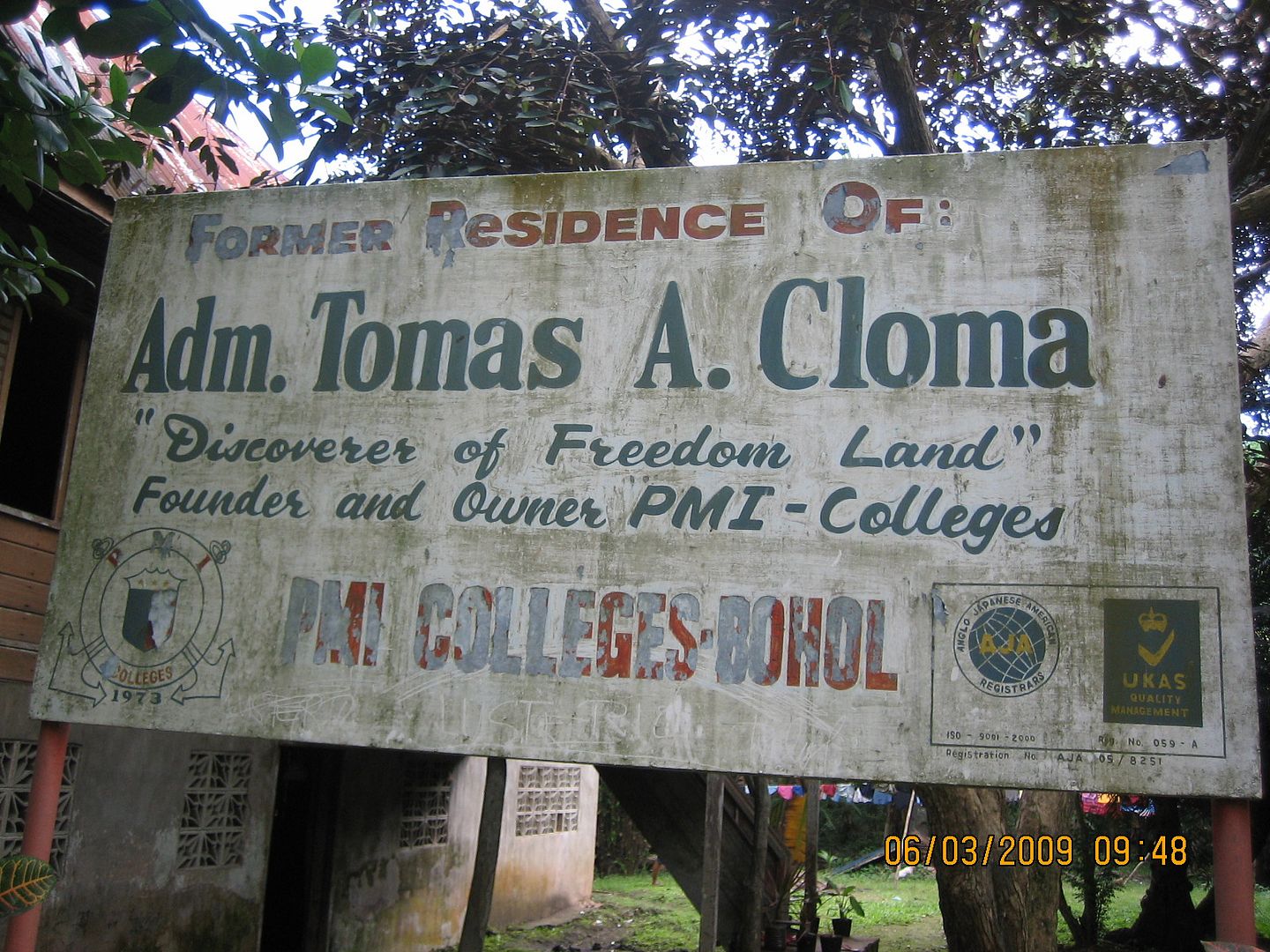
It was actually impossible to miss, since it had this sign right next to it.


The sign read, “Former Residence of Adm. Tomas A. Cloma, ‘Discover of Freedom Land,’ Founder and Owner PMI-Colleges.”

This isn’t the place for a full biography of Tomas Cloma (1904-1996), but it can be asserted here that he was a fairly significant figure in 20th century Philippine history, and the sign clues the reader in as to why.  He was my father’s father’s cousin, and because my grandfather disappeared during World War II (he was an urban guerilla and was presumed killed by the Japanese), his orphaned family looked up to Tomas as some sort of father figure.  My father worked for him briefly at the aforesaid PMI (Philippine Maritime Institute) at its Manila campus, and he was also a principal sponsor at my parents’ wedding in 1965.

One final factoid about the venerable Tomas – I was told that he was not actually an “Admiral,” though that might have been an honorary title that he received subsequently given his many seafaring-related accomplishments; he was however a lawyer, admitted to the Philippine bar in 1941.

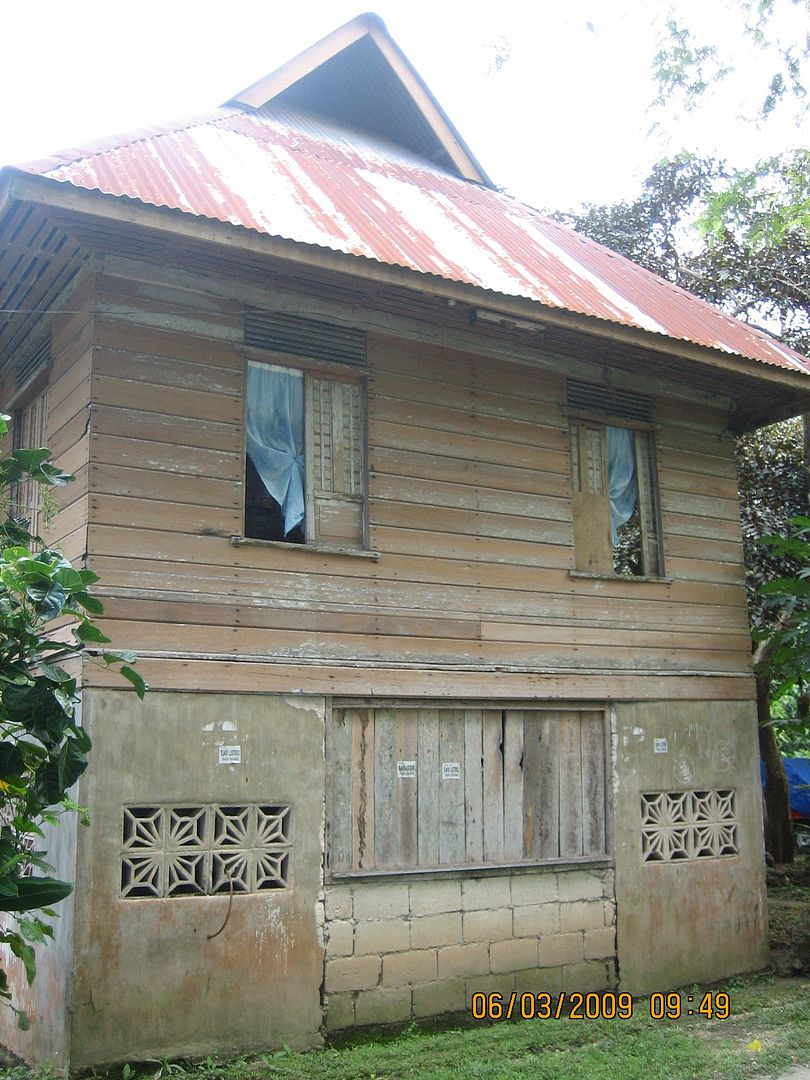
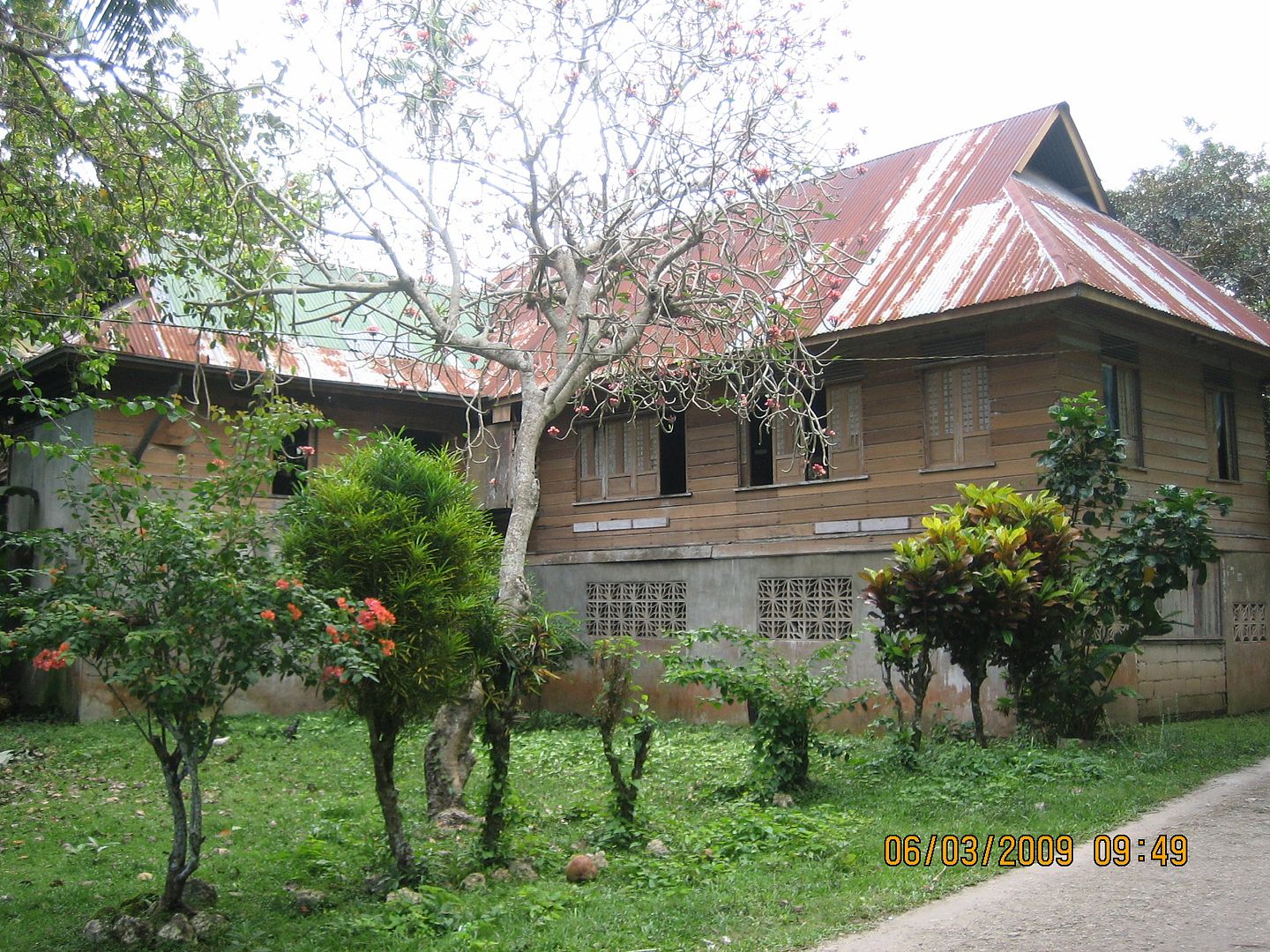
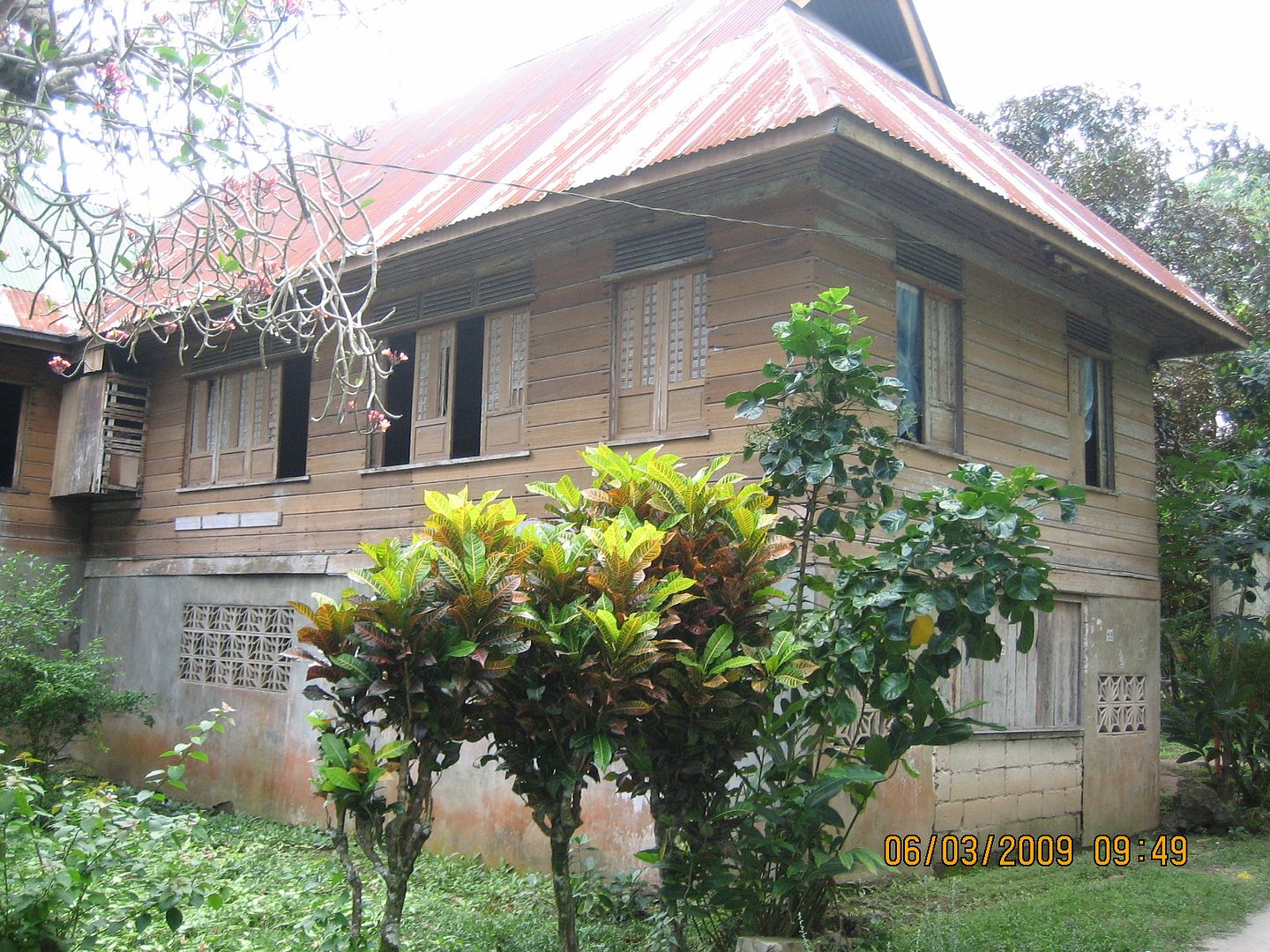
The structure now referred to as the Cloma Ancestral House was the house in which he is believed to have grown up in and maybe even born.  It is a simple unpretentious affair, with a clapboard second-storey exterior and a hollow-block-and-cement ground-floor skirt.


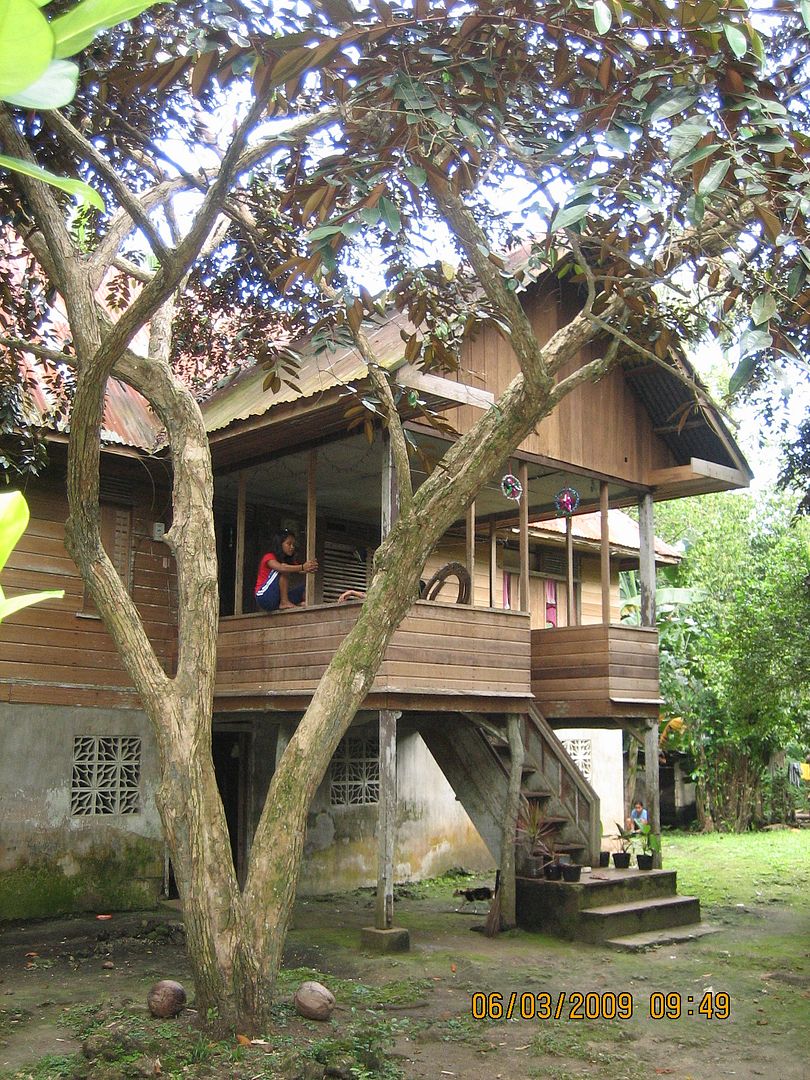
This sort of construction may indicate that the original house was a traditional bahay kubo, where the nipa walls were subsequently replaced with wood, and where the bamboo stilts were simply augmented by and enclosed in concrete.


It might have also been substantially enlarged from the original structure – today, the structure is L-shaped and significantly larger than a typical bahay kubo.


The entrance to the second storey, presumably still the house’s main floor, is via a short flight of steps up a balcón (roofed porch).  Access to the ground floor, on the other hand, is via a door immediately beneath the porch.


Unfortunately, we couldn’t enter the house to check out the interior.  Apart from the fact that it appeared unlikely that there were any original furniture pieces still within, my cousins told me that the house was currently tenanted, and it would probably not be convenient for us (who weren’t technically their landlords anyway) to just enter on the basis of our say-so (or our family name).  Perhaps we could do so on a future visit, when appropriate arrangements could be made in advance.

In any event, the structure was in fair shape and looked like it was reasonably maintained.


However, I could not avoid painting a mental picture of how much better it could be, if it were in the hands of a real Cloma such as this one.

(And I would actually consider it, after I’ve cleared my outstanding projects list – sometime in the middle of this century, in time for Tomas Cloma’s 150th birth anniversary. By which time I will be nearly as old as he was when he died!)

Originally published on 10 February 2011.  All text and photos copyright ©2011 Leo D Cloma. The moral right of Leo D Cloma to be identified as the author of this work has been asserted.

Original comments:

johnada wrote on May 8, '11
I like houses like this, simple and easy to the eyes.I do hope you will manage to do what you want in Bohol.

rally65 wrote on May 8, '11
johnada said
I like houses like this, simple and easy to the eyes.I do hope you will manage to do what you want in Bohol.

We'll see if I live long enough!

docsalgado wrote on Jun 17, '11
Go Leo, i cant wait to see this house back to its feet and better. I have more reasons to go with you to Bohol.

CXVIII. Visita Iglesia (Plus) Bohol III: The Panglao Church

After that Loboc river cruise, our group next went off to pet some tarsiers.  As I don’t really like animals, much less want to be associated with their veritable torment in captivity, I basically withdrew from that activity and waited for the next stop.

Which turned out to be even more touristy as it was a visit to a "pasalubong" center.  At least I got to shop for native junk food and sugar fixes for my family.  And soon enough, it had turned dark and was time to go back to our lodgings in Panglao Island, off the coast of Tagbilaran, and freshen up for dinner.

I was actually looking forward to dinner, not only because I was genuinely hungry after all that moving around, but also as I had made an evening appointment to meet up with my long-lost (actually never-met) Cloma cousins who lived in Bohol.  And after innumerable dead-end stories (we blame the fact that our elders never really set us up for these impromptu reunions), they very generously offered to take me around the next day.  It being a free day for me, I was only too overjoyed to accept.

I rose early the next morning, had breakfast, and waited for my cousins to pick me up from the resort where I was billeted.  When they arrived, they mapped out our itinerary for me.  For starters, they said that since we were already on Panglao island, the natural first stop had to be Panglao town, at the far south-west end of the island.

Not only was it close by to where we already were, but it was a natural starting point for us in particular, since Panglao was after all the hometown of the Cloma clan.  Now how could I argue against that?

After a few minutes’ drive, we reached Panglao Church.


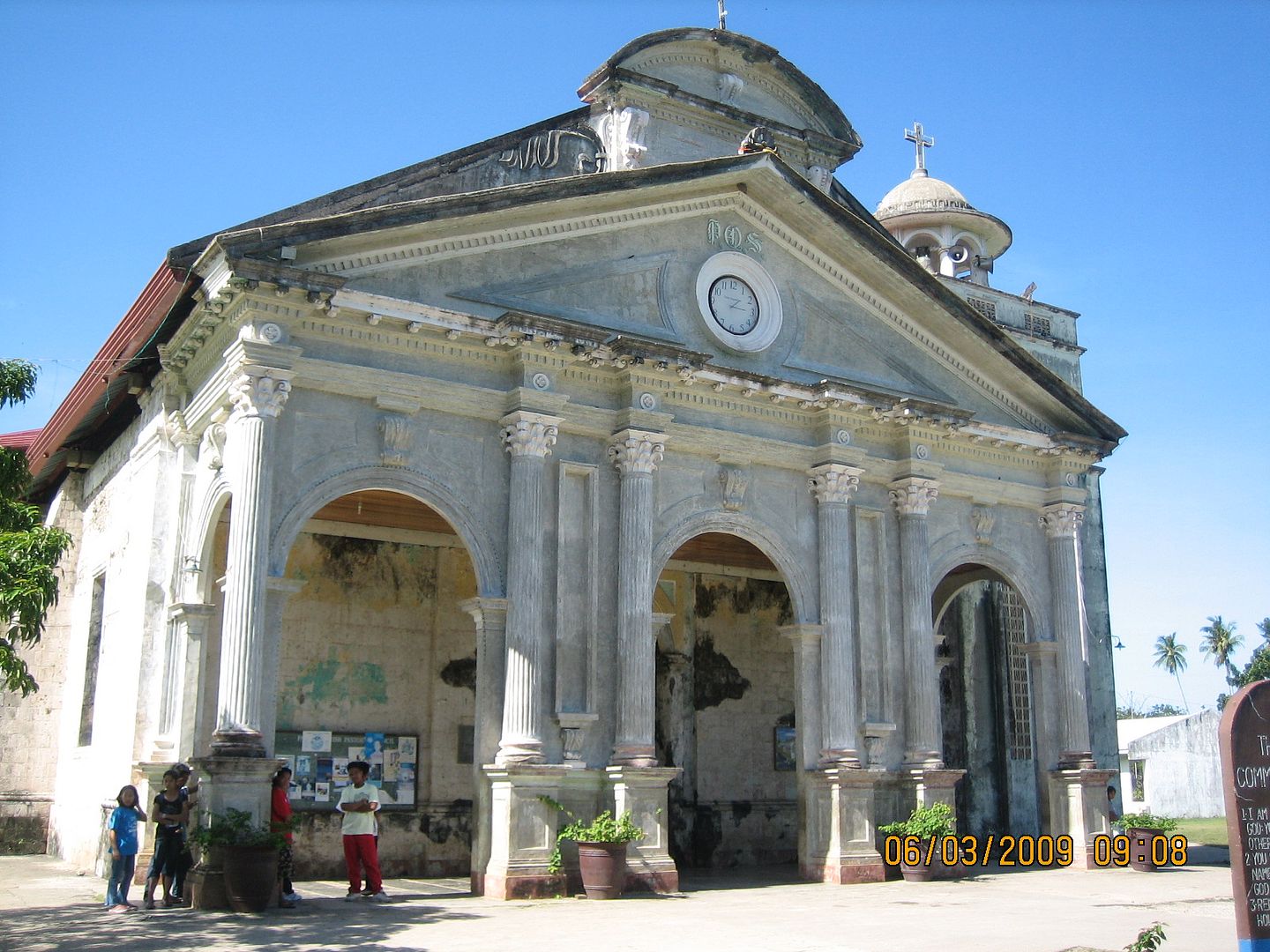
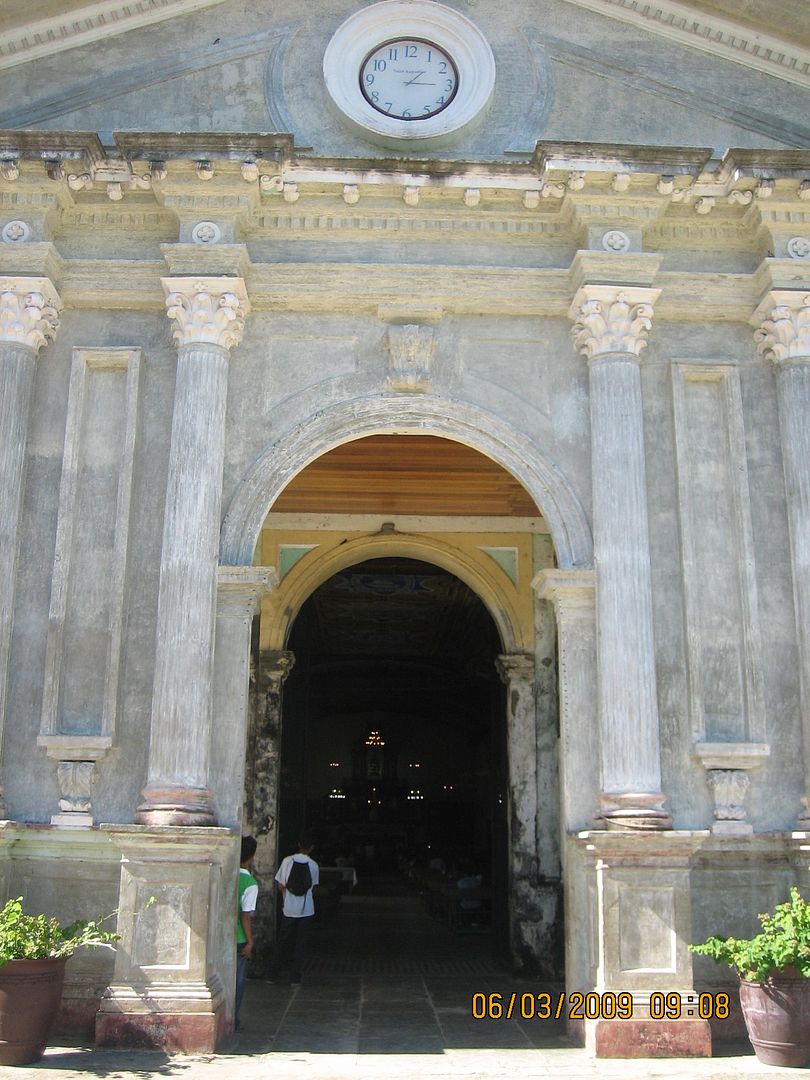
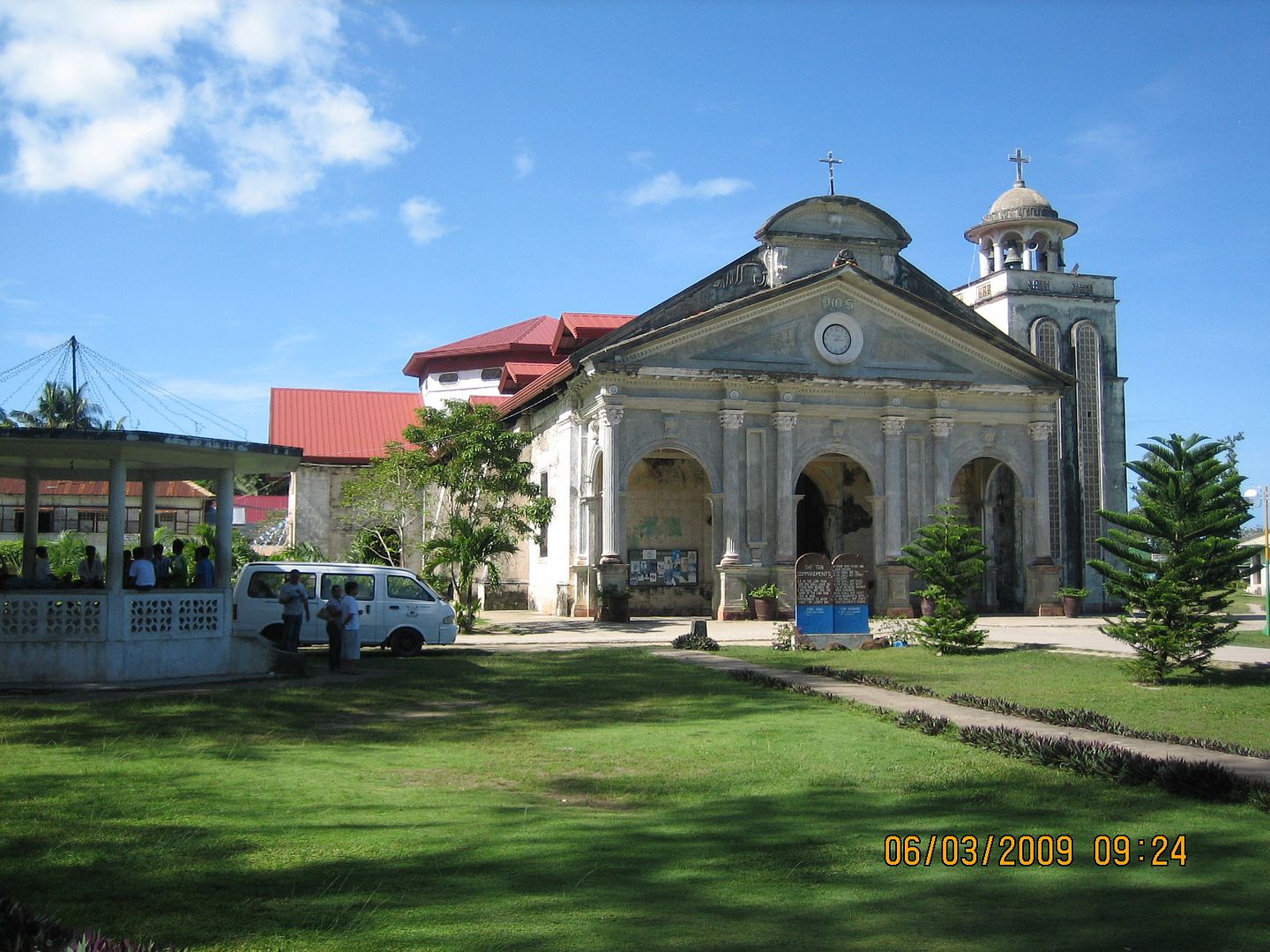
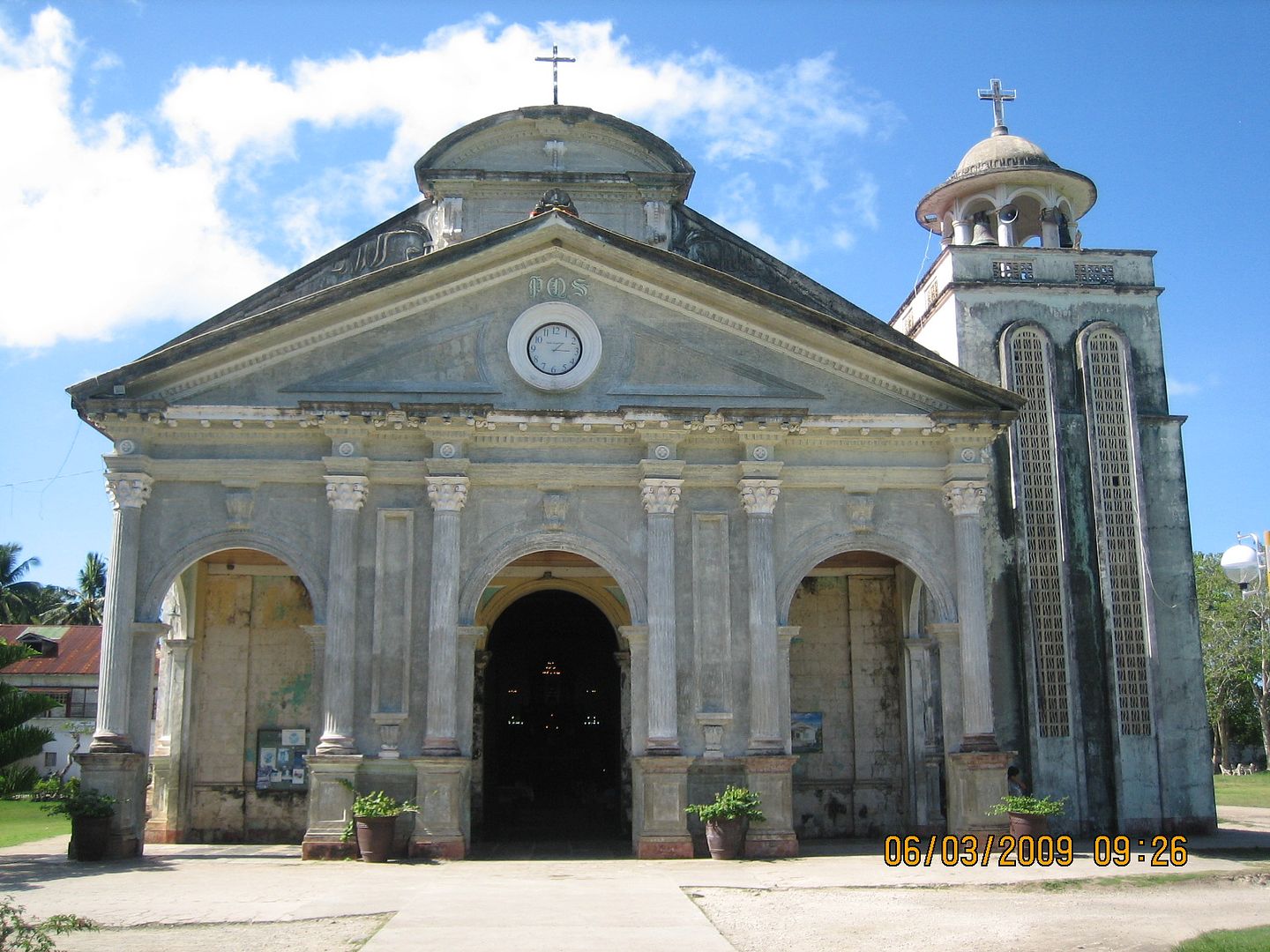
The façade of the church, which was begun in the 1890’s and was completed only in the 1920’s, is a wide portico similar to that of Baclayon Church, but unlike the latter, this was built in one go and not as a subsequent add-on to an earlier structure.  Overall it is impressive and imposing – as Regalado Trota Jose says in his very helpful “Visita Iglesia Bohol” book, it is of poured concrete, and features fancy Corinthian capitals.  There is also a large clock in the center of the pediment.


Above the clock is the inscription “P.Q.S.” in Gothic script.  The “Visita Iglesia Bohol” book enlightens us as to its significance – they are the initials of Padre Quiterio Sariguimba, Panglao’s parish priest from about 1920 to 1927, and who completed the structure originally begun in the 1890’s.  He is known for not only completing numerous building and renovation projects in the various Bohol parishes that he was assigned to (after Panglao, he had moved on to Jagna, Inabanga, and Maribojoc, among others), but for also proudly marking such achievements with his initials. (Shades of “Z” for Zorro?)

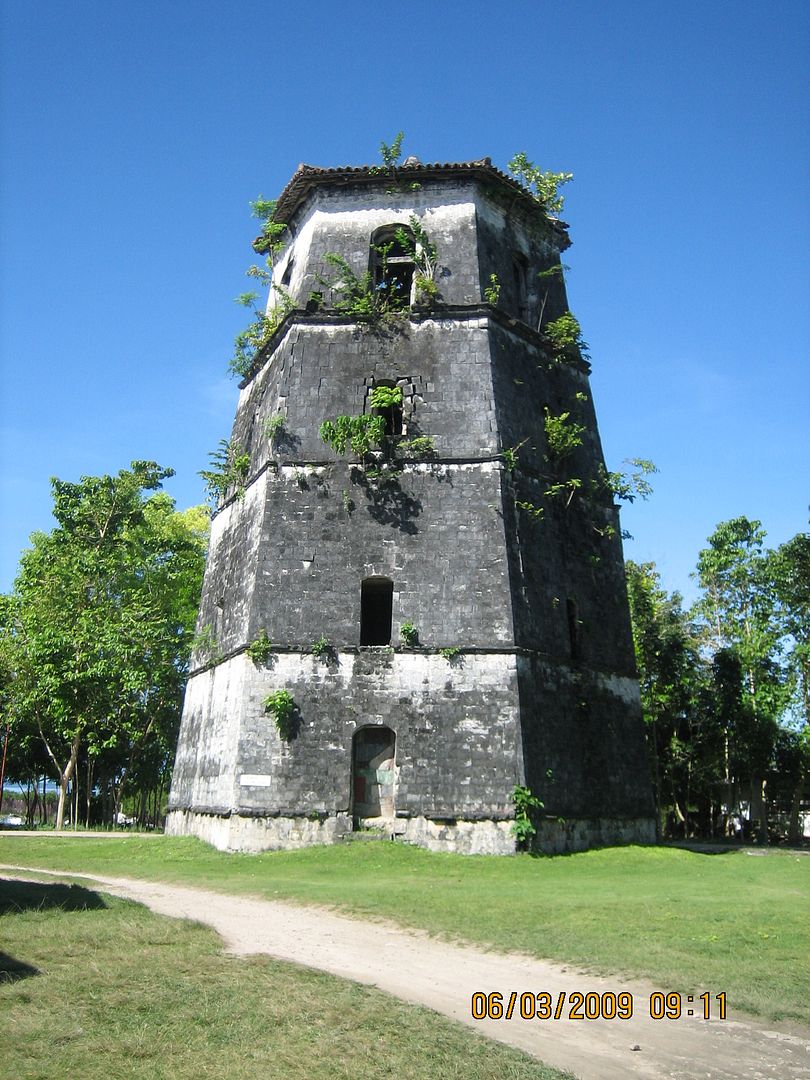
As there was still a Mass going on inside the church, I decided to first explore the outside while waiting for it to finish.  Behind the church and towards the right was a hefty four-storey stone watchtower that looked out to the sea, just a short distance away from the rear of the church.


Like the church’s façade this hexagonal tower is imposing and perhaps slightly intimidating.  It was shut and not open to visitors, likely because the interior staircase is either in bad shape or no longer in place, but according to the “Visita Iglesia Bohol” book, the presumed date of construction “1851” is inscribed somewhere inside the ground floor.

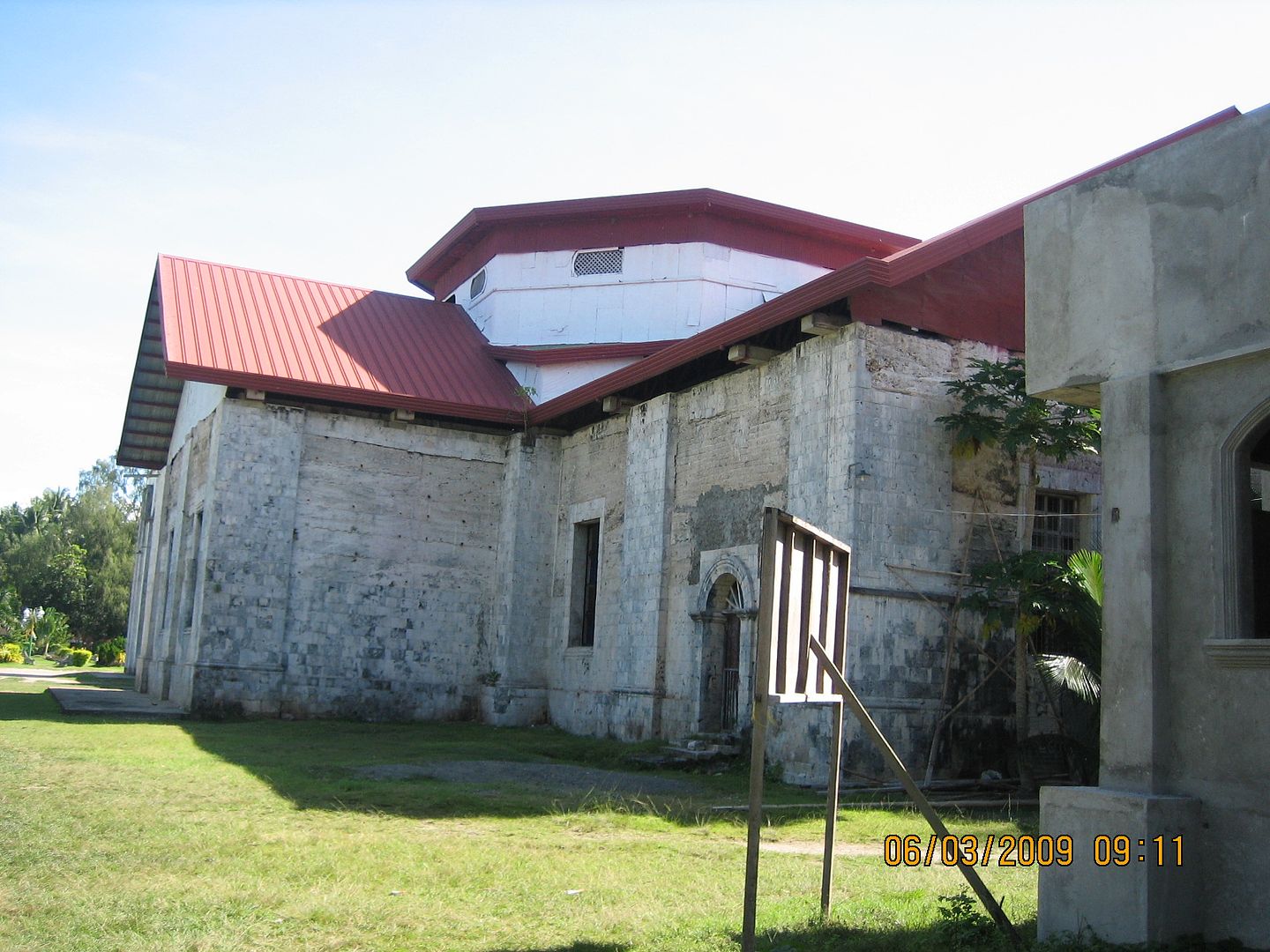
Walking back to the church, one appreciates the beautiful white coral stone used to construct it, which Padre Quiterio originally planned to sheath with cement plaster – it is probably fortunate that he ran out of time and funds to do so.  On the other hand, today’s Panglao parishioners seem to have done a respectable job of caring for their legacy from P.Q.S. – a handsome red roof covers the transept, nave, and the tall octagonal crossing overhead.


The belltower on the right side of the façade, seen here from behind, casts a long shadow on this sunny morning.


The side doors


and windows


of the nave could stand some freshening up, but at least their surrounding stonework appears to be in fair shape.

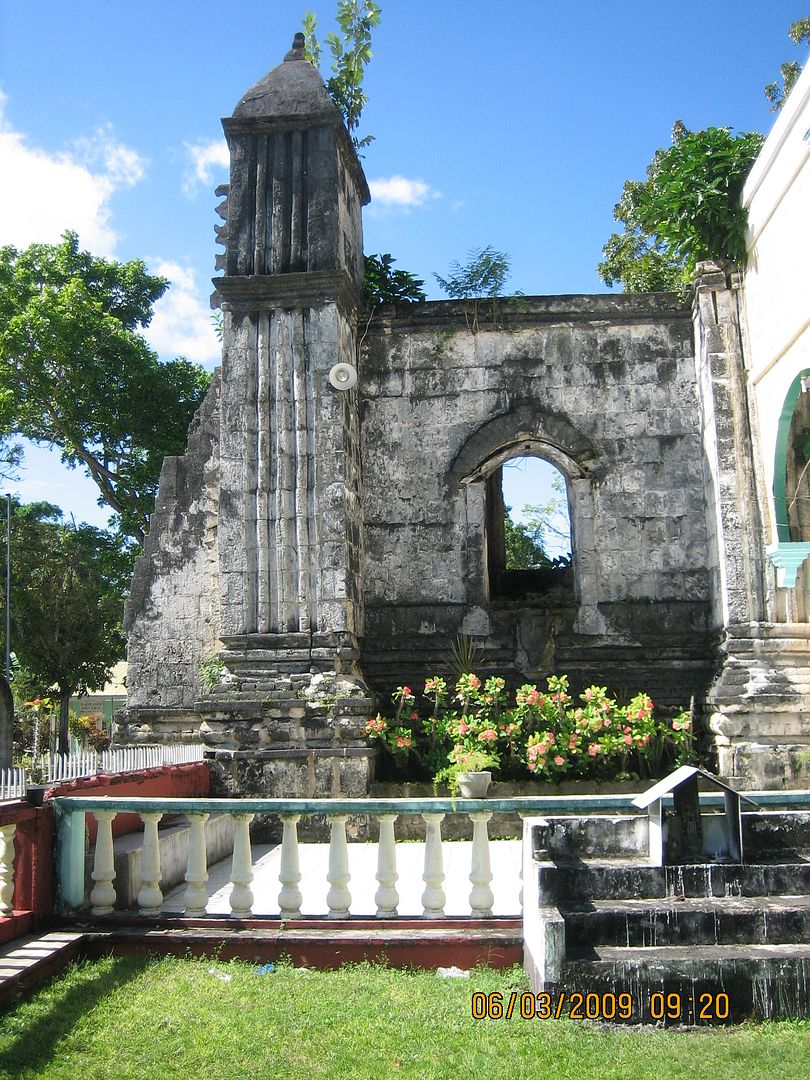
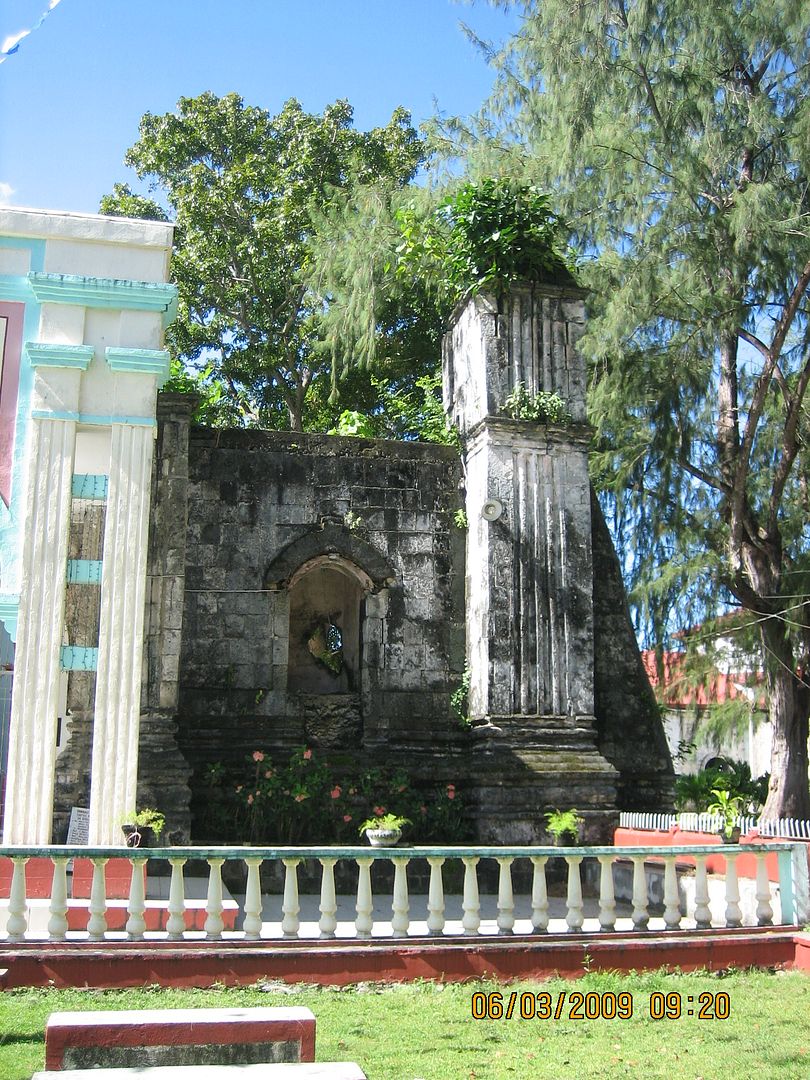
Elsewhere in the expansive church plaza, to the left of the façade and closer to the main road, are the ruins of what appears to be an earlier church.


According to the “Visita Iglesia Bohol” book, there is an inscription somewhere over the main entrance of the ruined façade (of which only the lower level remains) that dates the structure to 1858 or 1859.  However, I could not find it, as yet another portico add-on had been grafted on it.


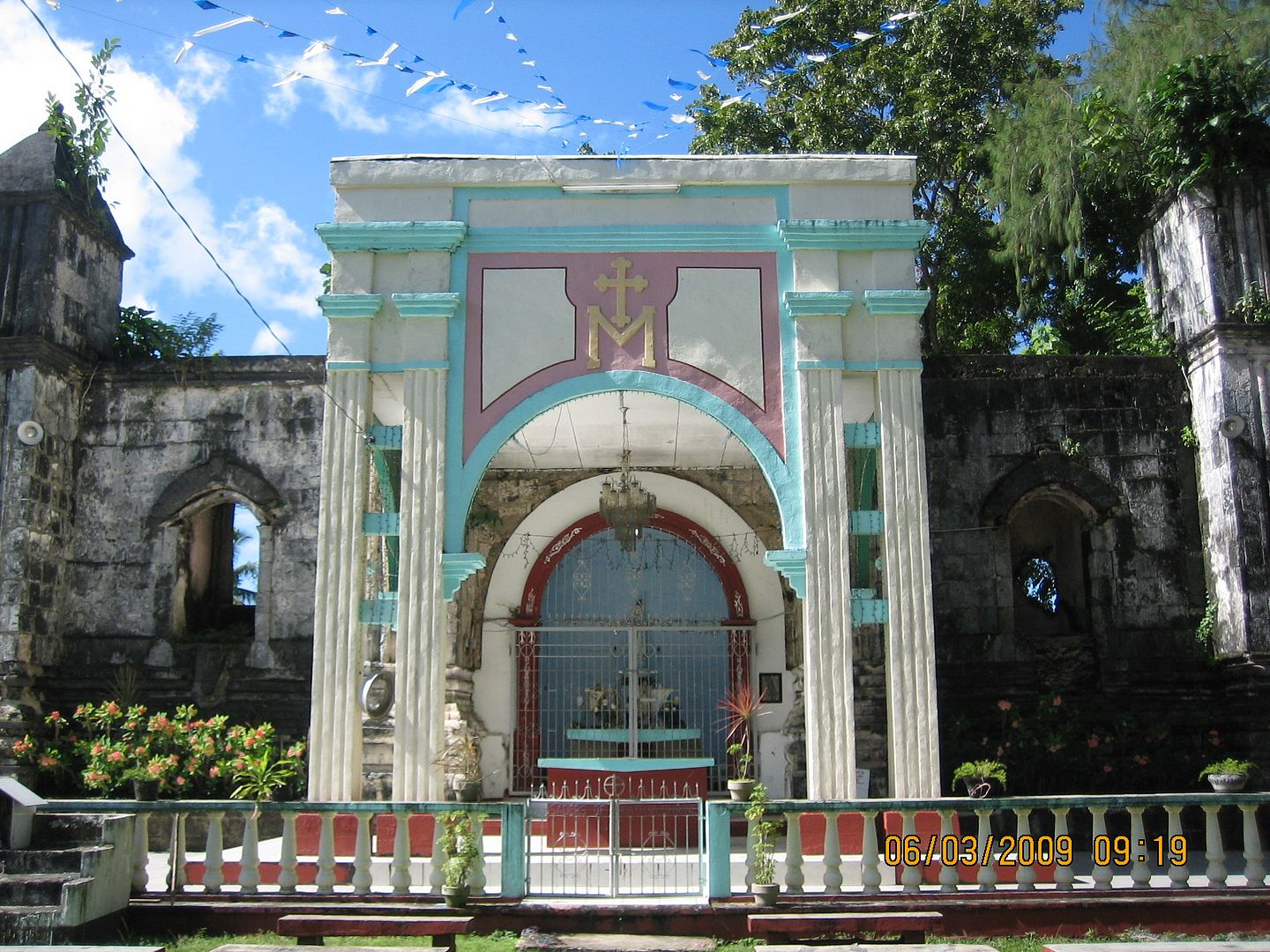
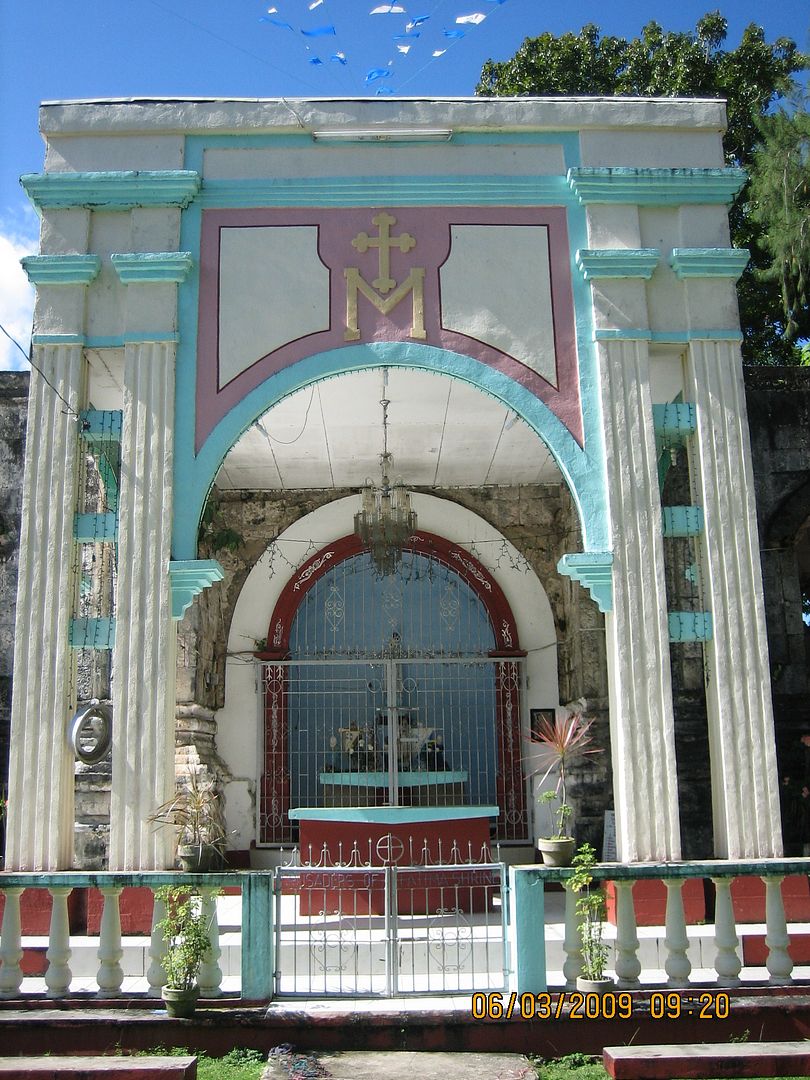
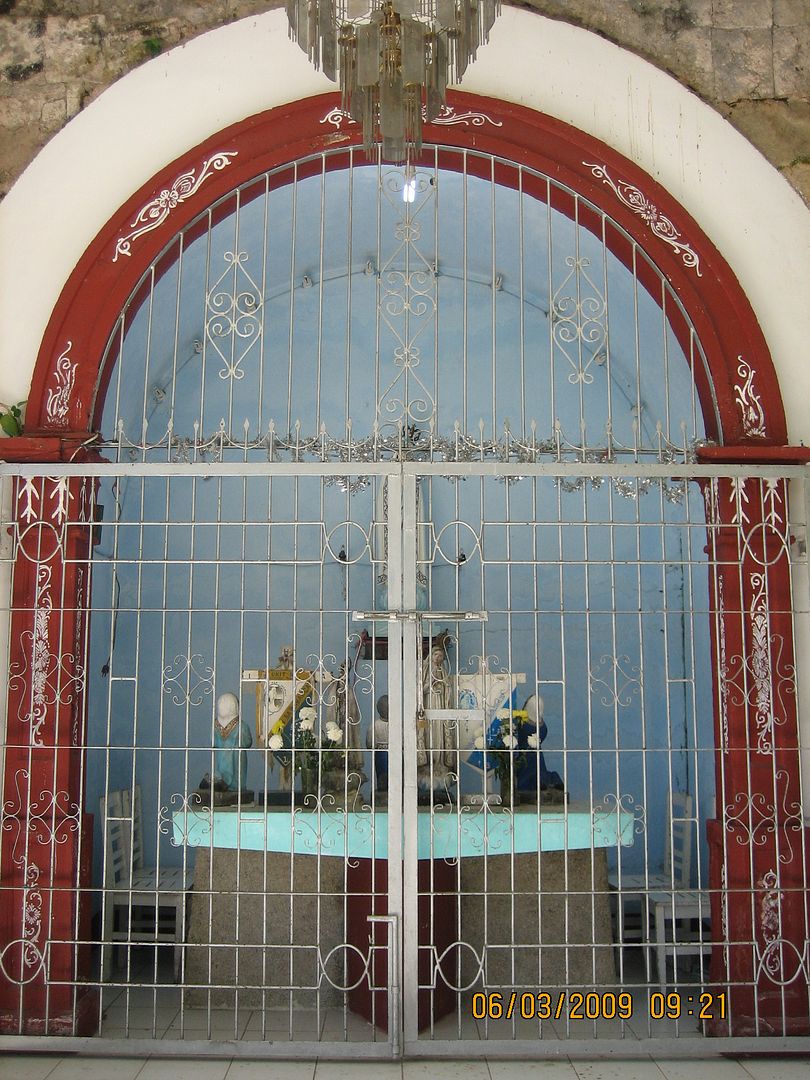
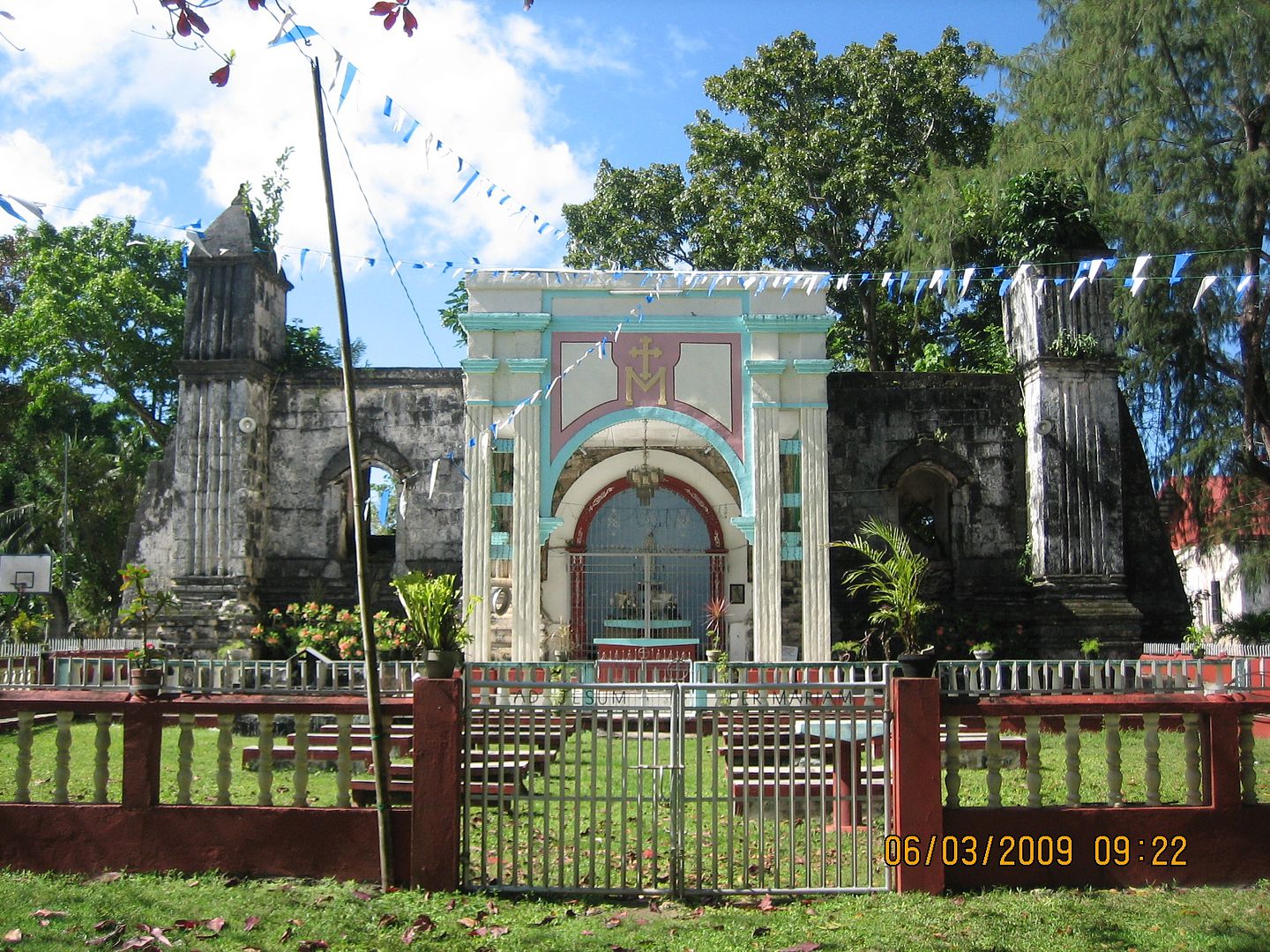
In fact, the ruins had since been converted into an outdoor shrine to Our Lady of Fatima, with the old church’s main doorway now the altar area,


and the area right in front of the façade now fenced in and furnished with park benches.


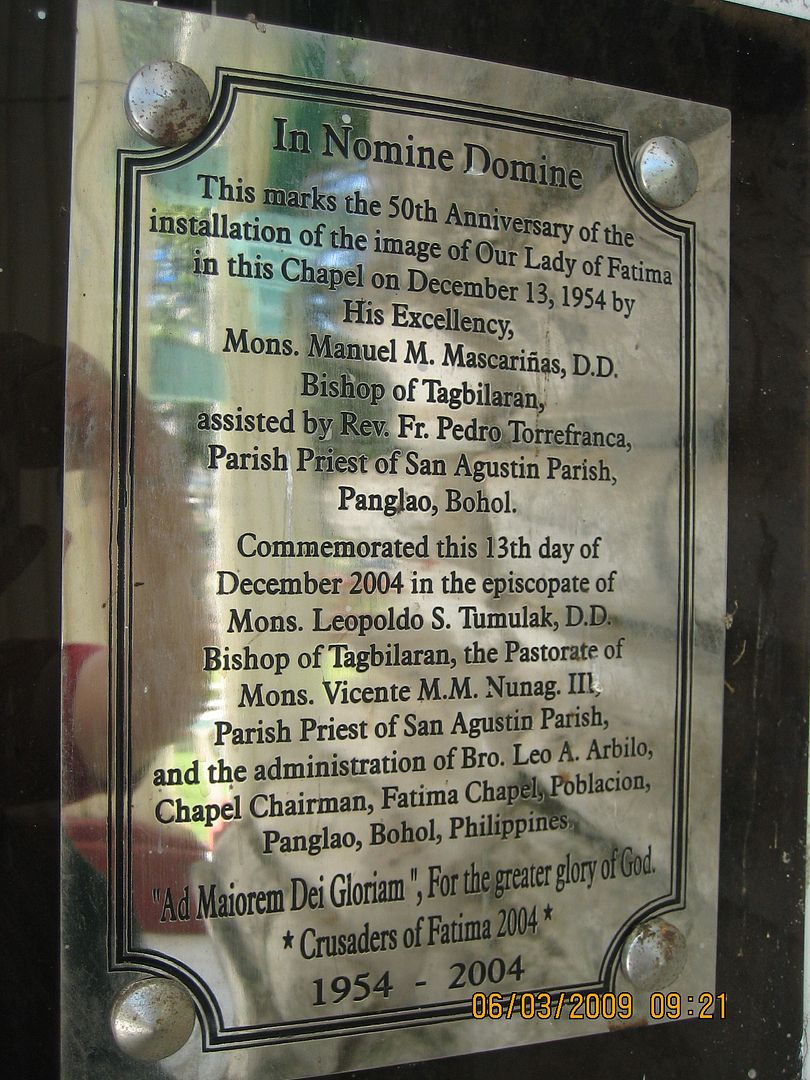
According to this 50th anniversary marker, the image of Our Lady of Fatima was installed here in 1954, which might have been shortly after its conversion to an outdoor shrine took place.


The conversion left the left and right sides of the facades uncovered, which one can still inspect for design details and 19th century construction techniques.


I still wonder, if this earlier church was built only in the late 1850's, why the decision to replace it seems to have been taken as early as the mid-1890's or after just thirty years or so of use.  Perhaps it simply was too small and too modest for the presumably increasingly prosperous parishioners of this town.  Looking out toward the newer church from beside the ruins of the older one, it certainly appears that the town got a virtual basilica as a result.


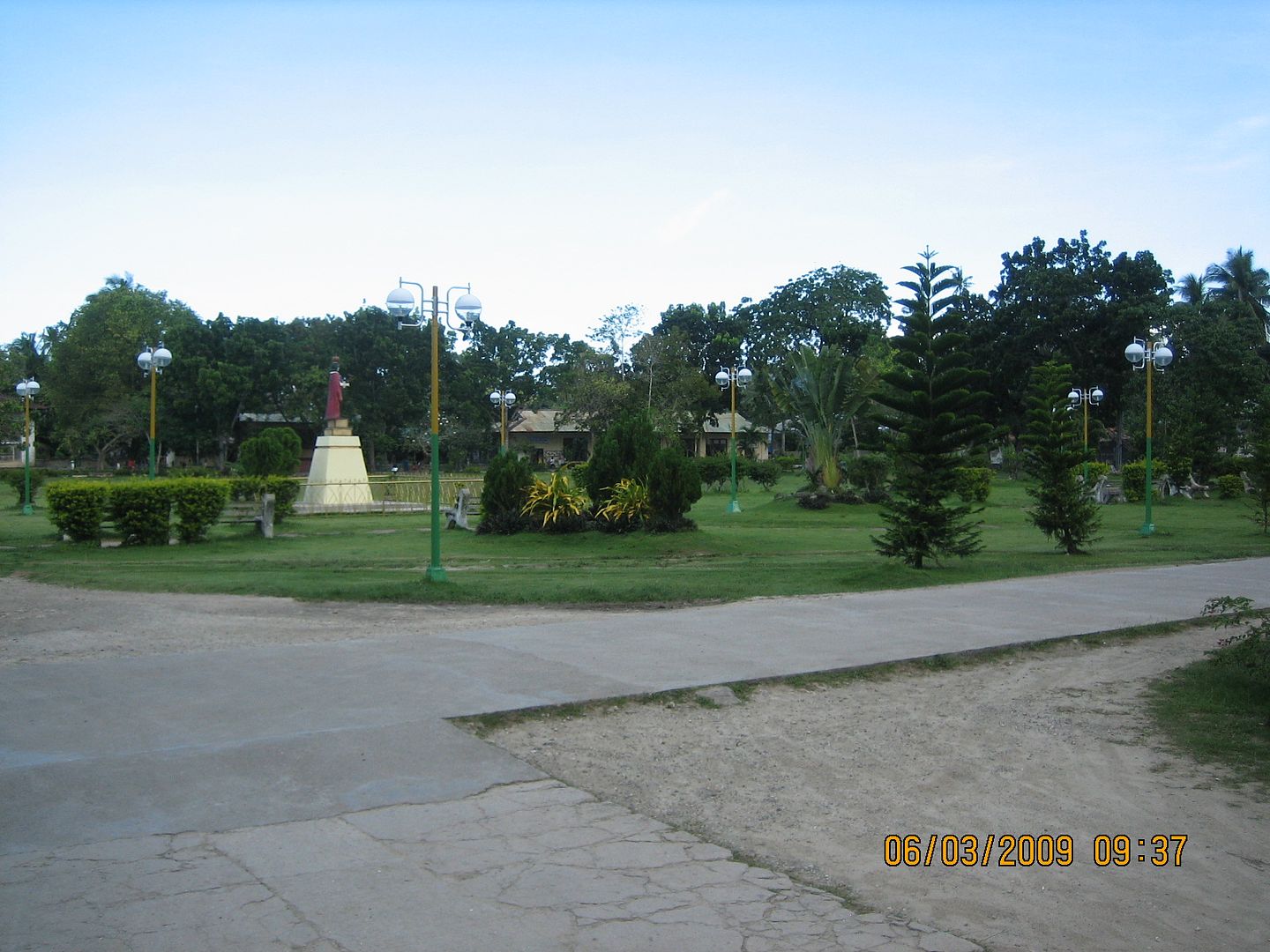
In the middle of the expansive front yard to the right of the ruins of the older church and in the foreground of the newer one


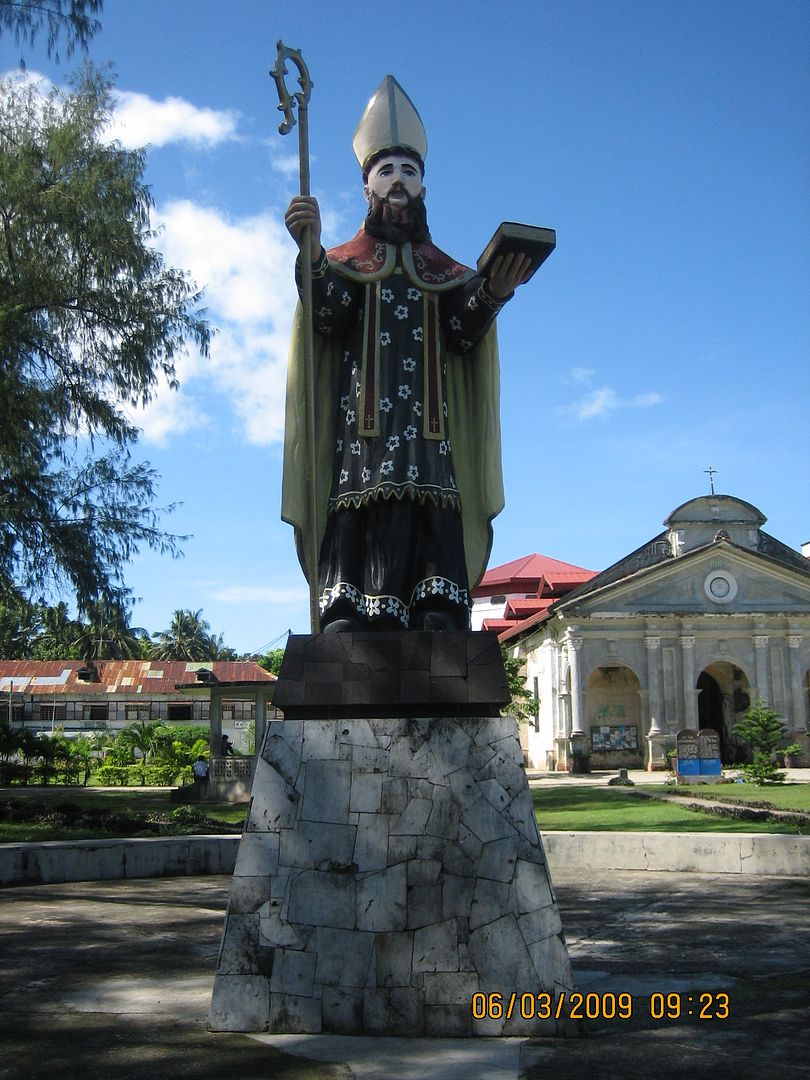
is this large painted concrete image of Saint Augustine, the town’s patron.


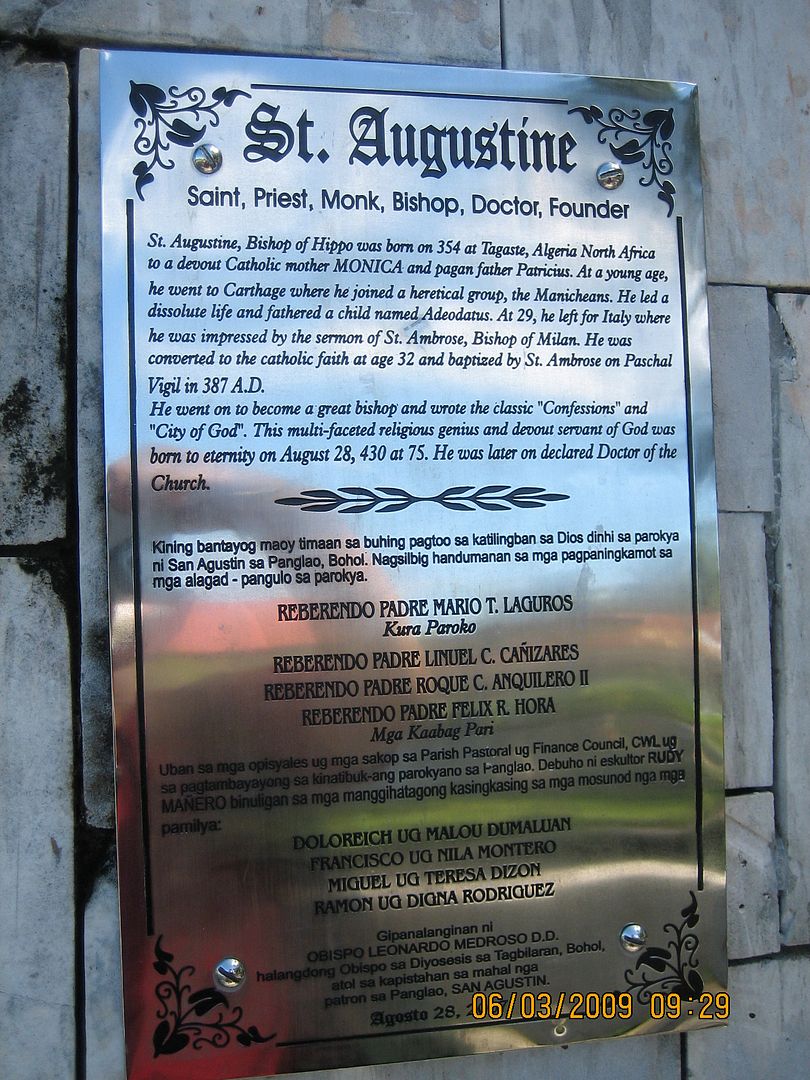
A marker on the base informs us that this was erected quite recently, in 2007, that it was blessed by the Bishop of Tagbilaran on the saint’s August 28th feast day, and that the sculptor was a certain Rudy Mañero.


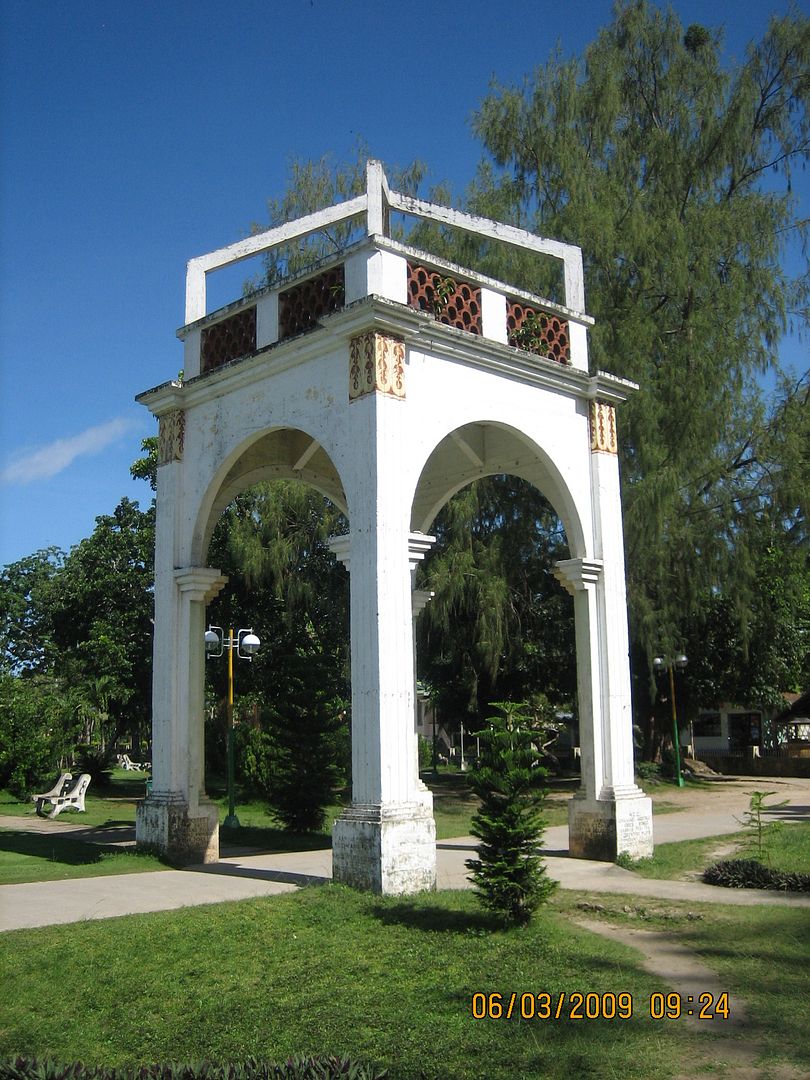
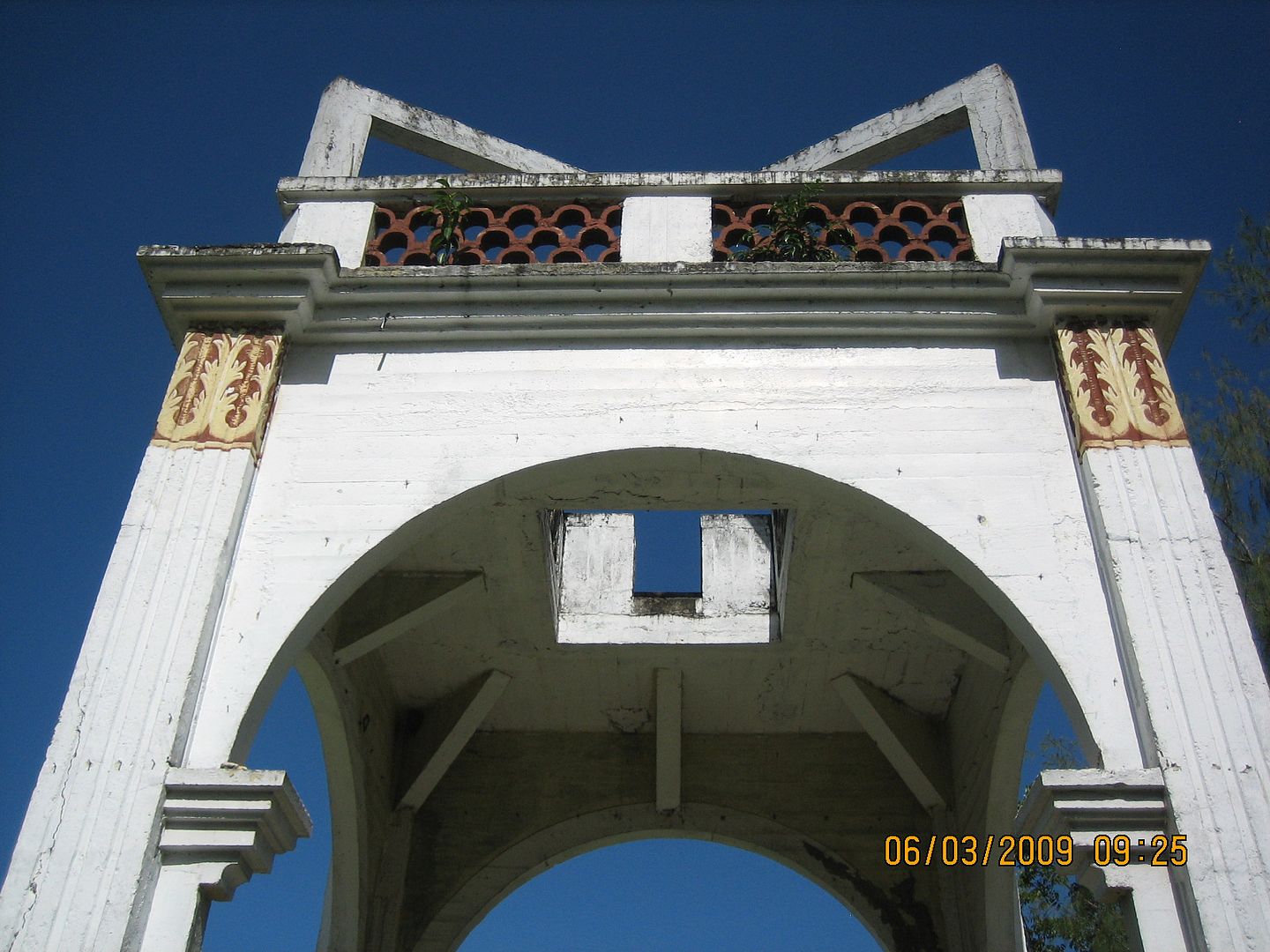
On a straight pathway connecting the main door of the new church at a perfect ninety-degree angle to the main road is this curious structure.


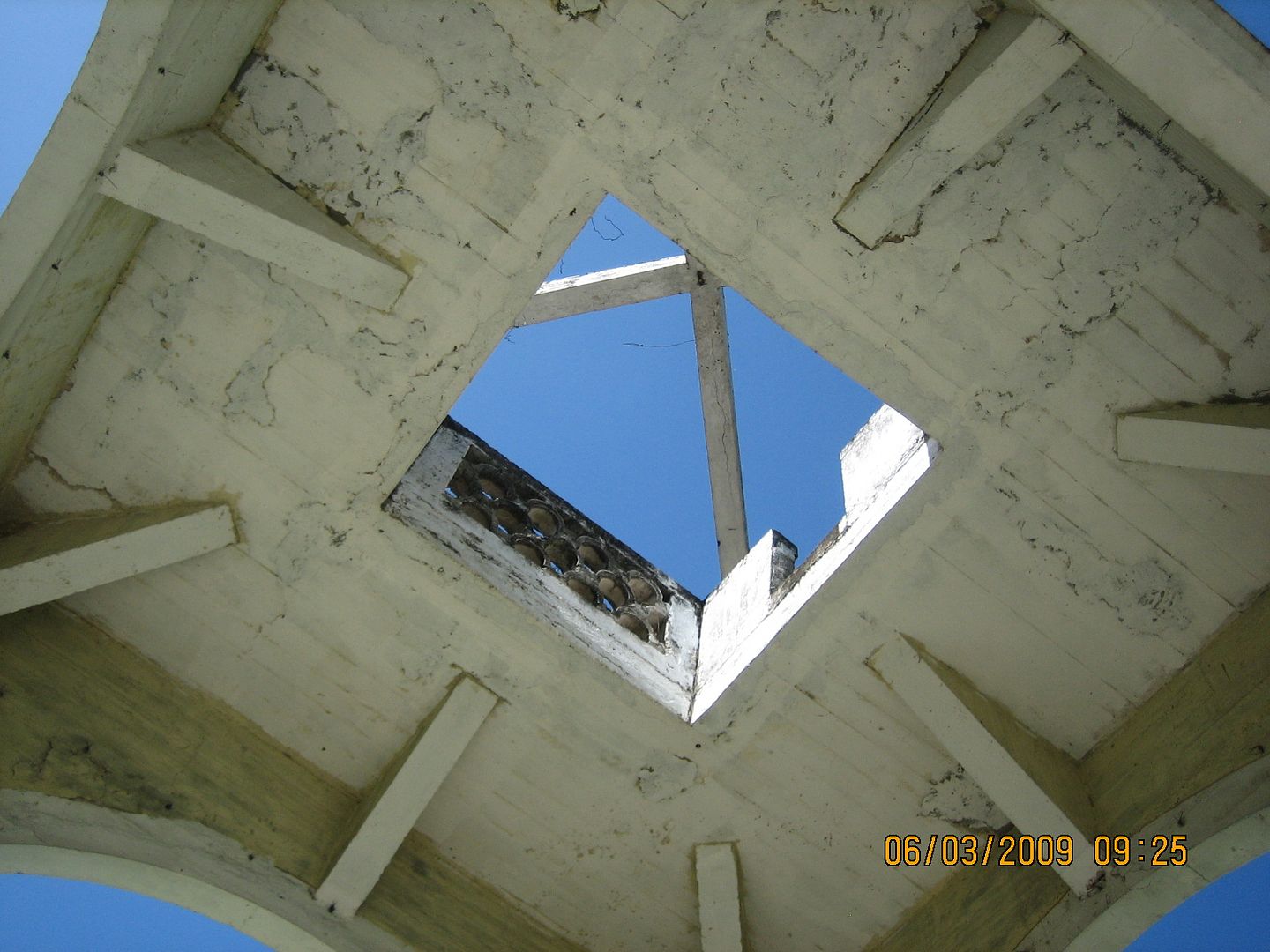
My Cloma cousins tell me that in fact many places in Bohol have structures just like this one in their church plazas.  They explain to me that this is where the child playing the part of the Angel ascends to and waits for the Salubong (Easter Sunday Dawn ceremony).  The karo of the Mater Alegria (the Blessed Virgin Mary as the Joyful Mother) is wheeled into position right under this structure,


and through a hole in the floor of the upper platform,


the Child-Angel takes off the veil on the image while singing the Regina Cæli.

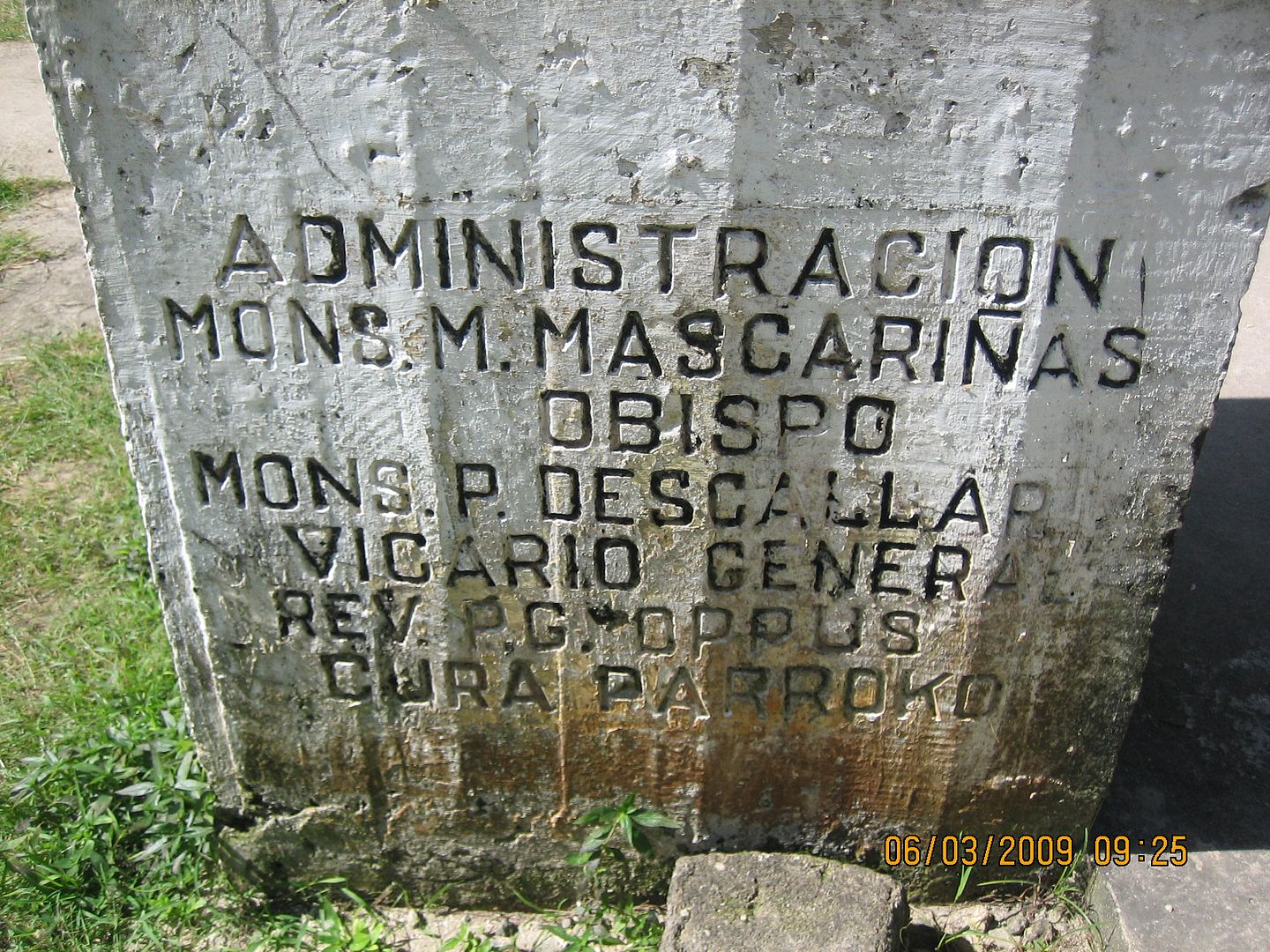
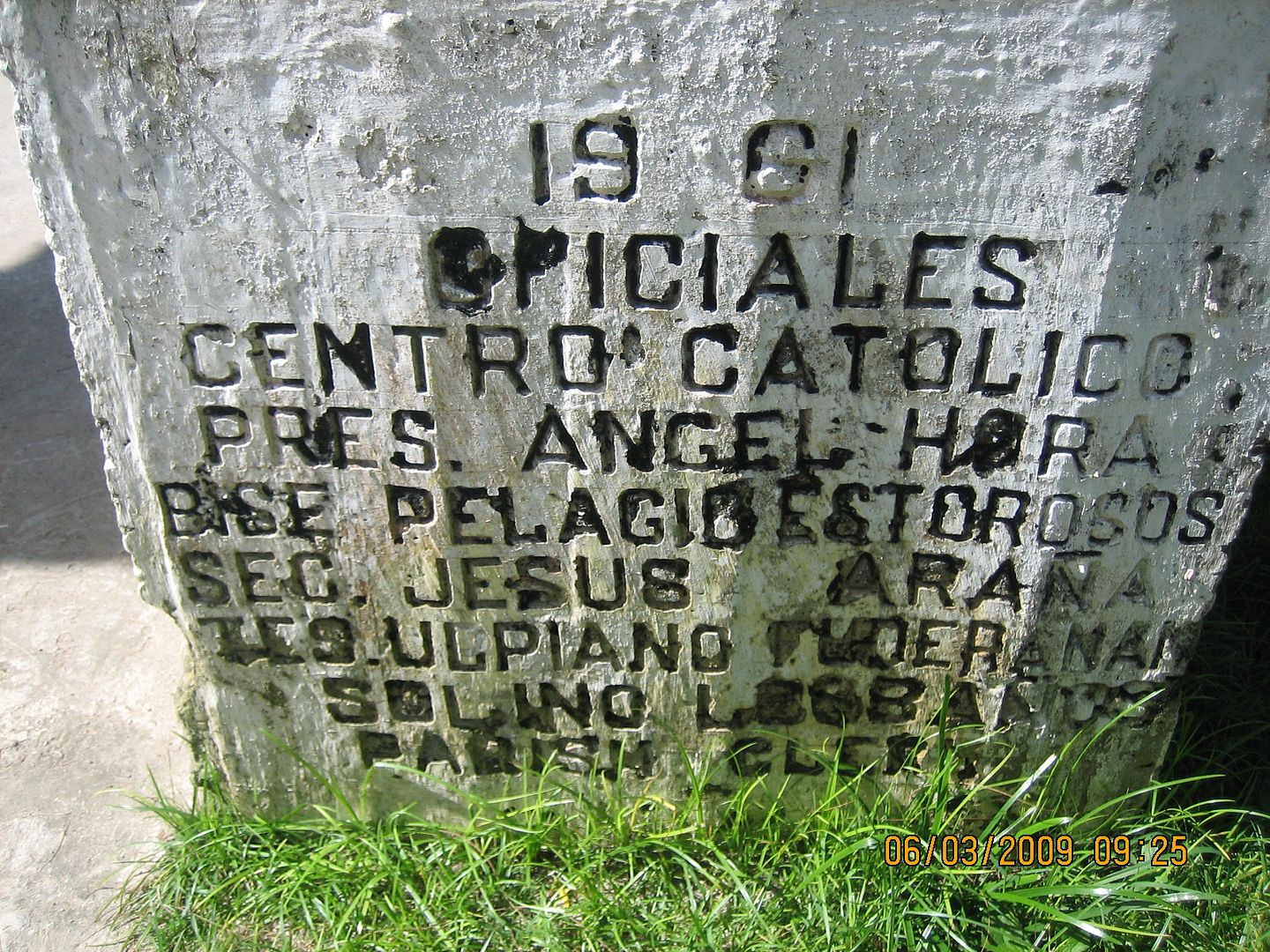
Based on inscriptions on the bases of the legs of the structure,


this was built in 1961,or nearly half a century ago.


Isn't it admirable that they would go to all this trouble and expense to build a structure that would only be used for a few minutes once a year?

From this structure, one gets a very good head-on frontal view of the church façade.


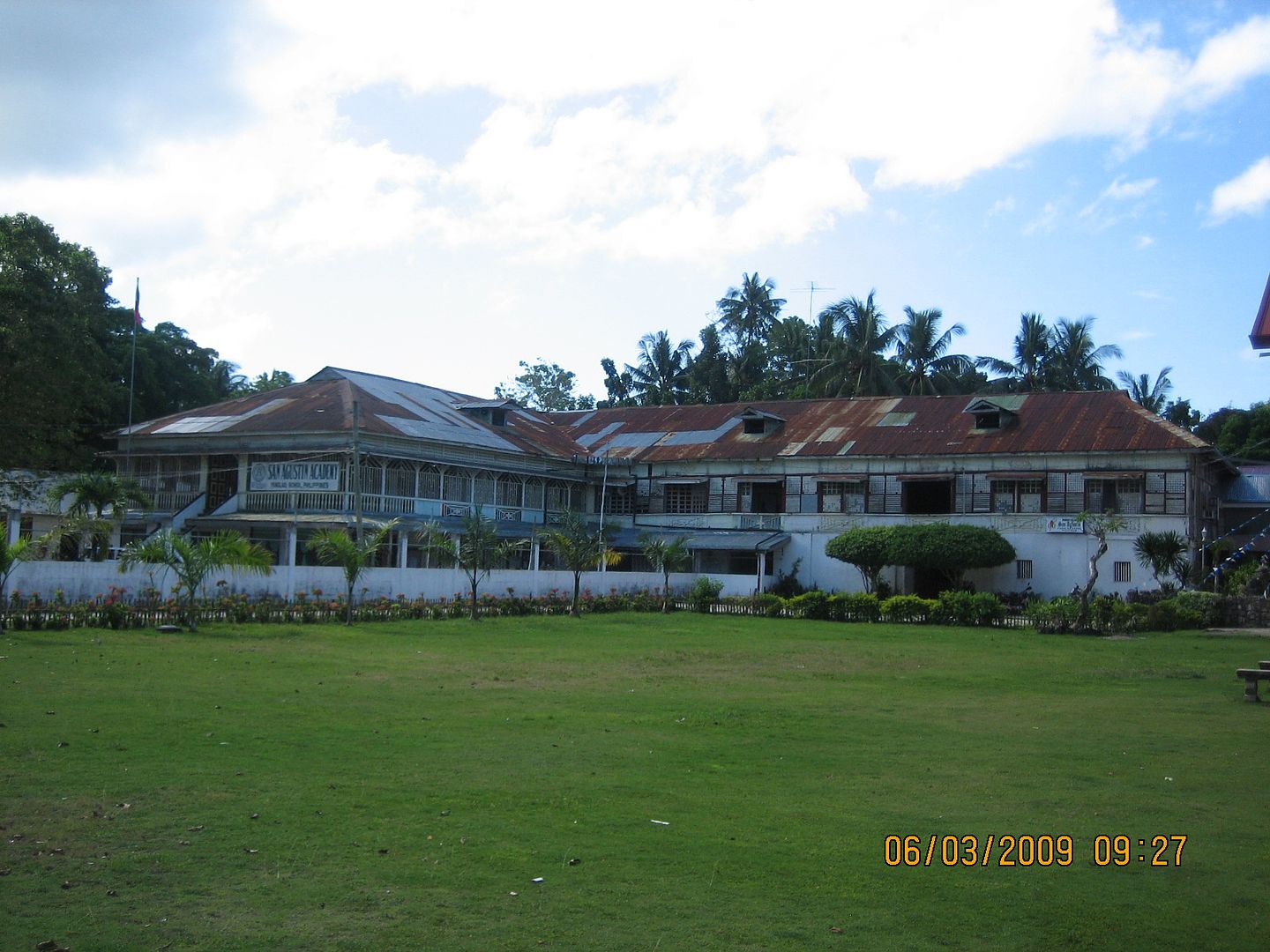
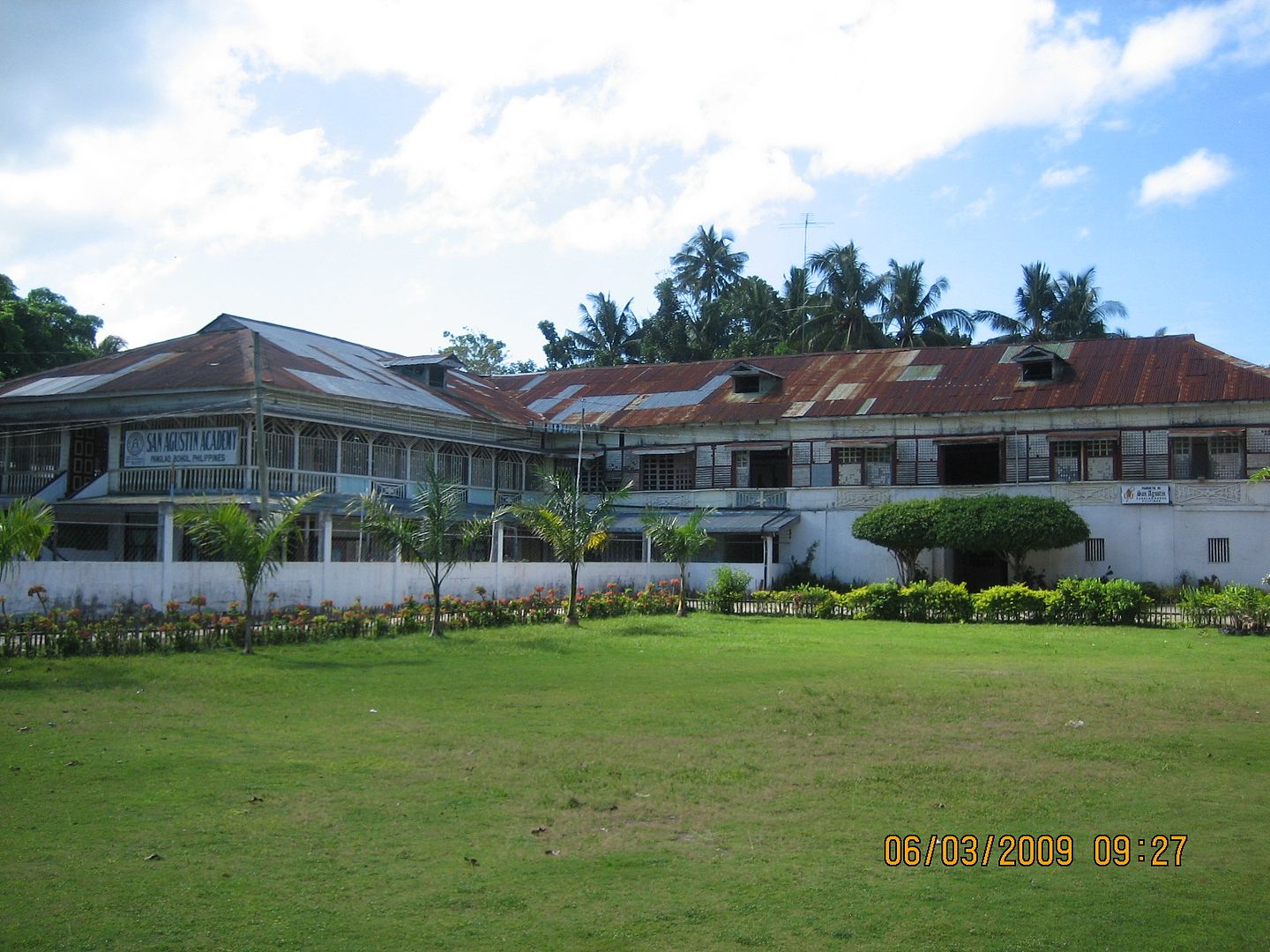
We walk back towards the church, and to its left side, where we view the old convento, likely contemporary with the older church and probably connected to it at the latter’s rear (which means that the old church must have been quite long, to make up for its apparent narrowness).


This L-shaped structure is now shared by the church rectory and the parochial school, the San Agustin Academy.


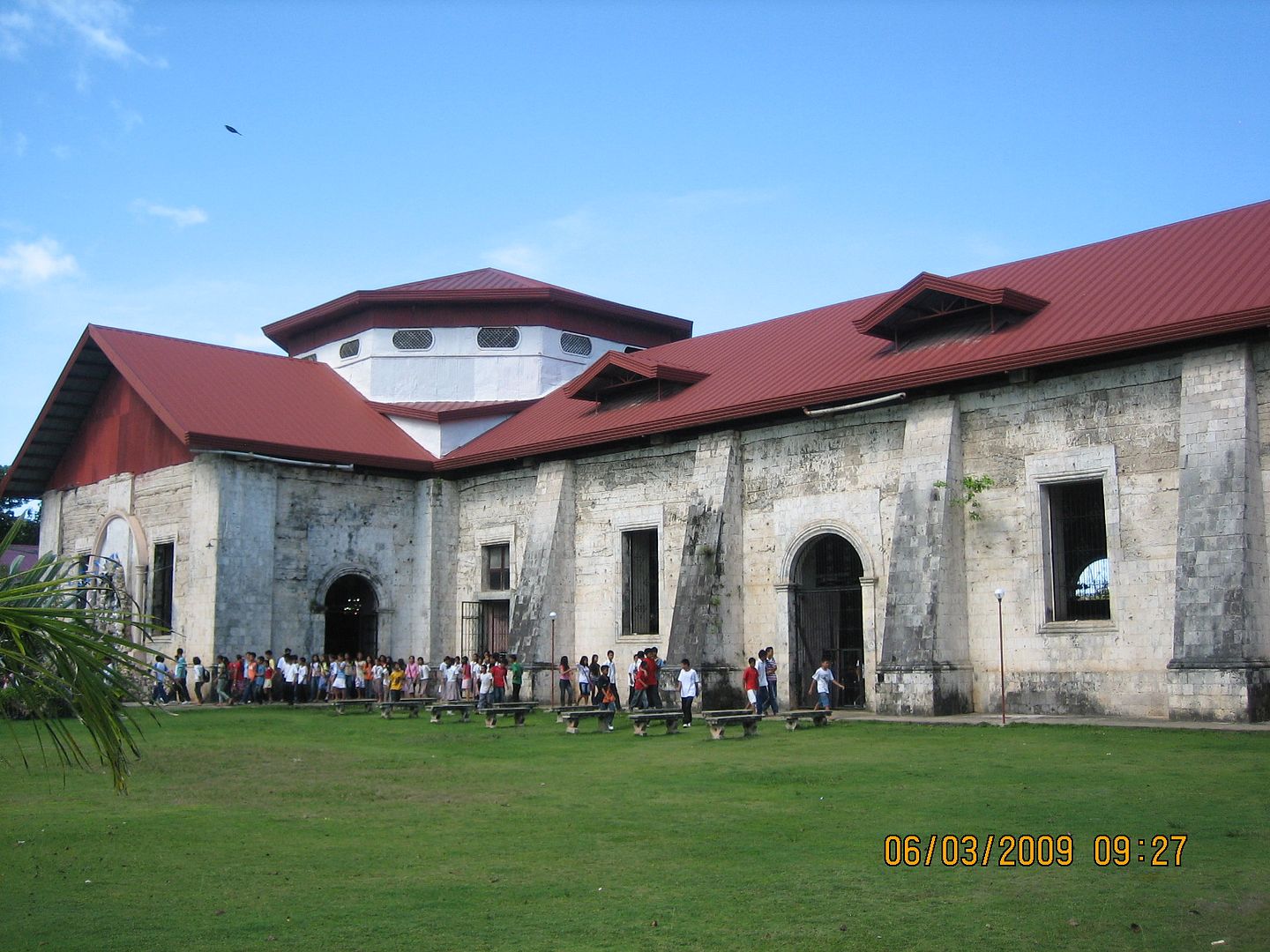
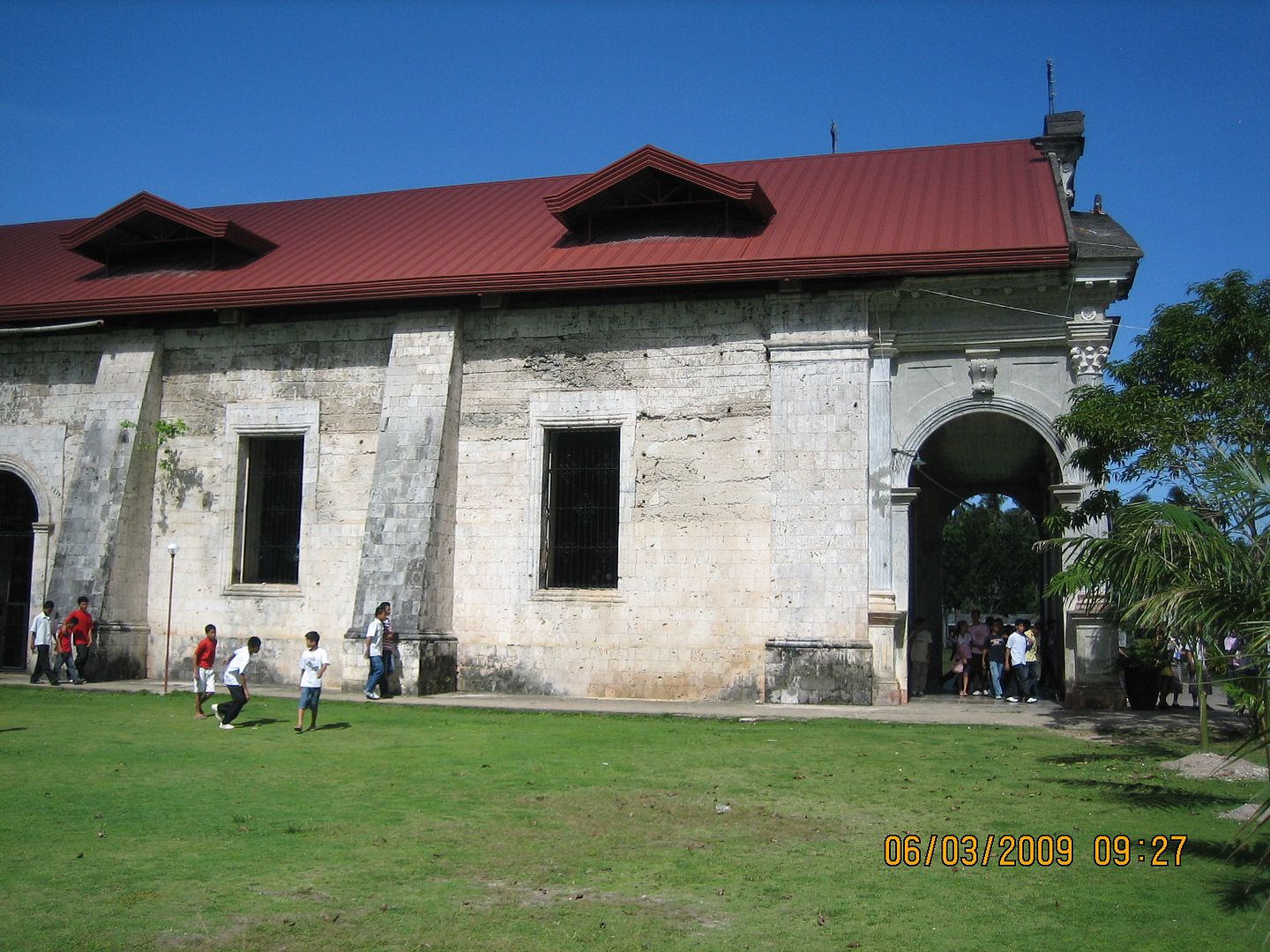
From right in front of the convent-school and across the grass-covered quadrangle, we get a good view of the church’s left-side elevation, again featuring its coral stone walls, new red roof with dormer-window-type exhausts, and octagonal crossing above.


The depth of the portico-façade is also better gauged from this side elevation.


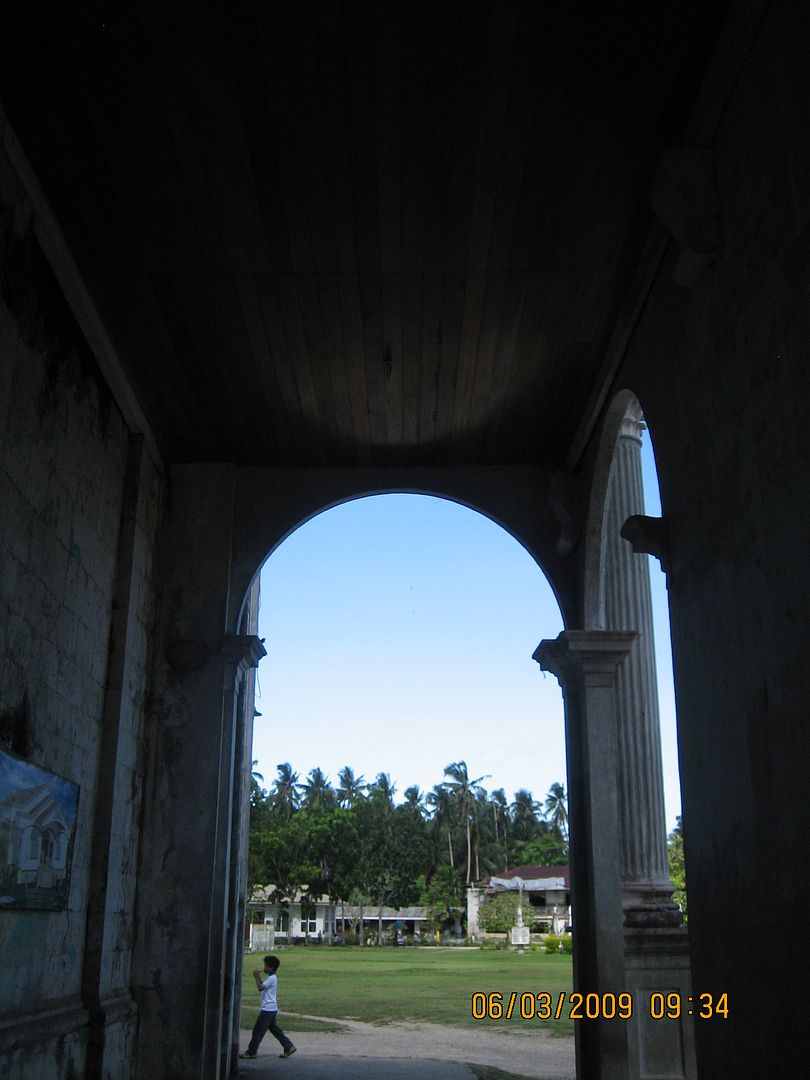
Noticing the hordes of young people (likely students of the parochial school) streaming out of the side and front doors, I realize that the morning Mass is over, so I make my way inside the church.  I pass via the porticoed entrance


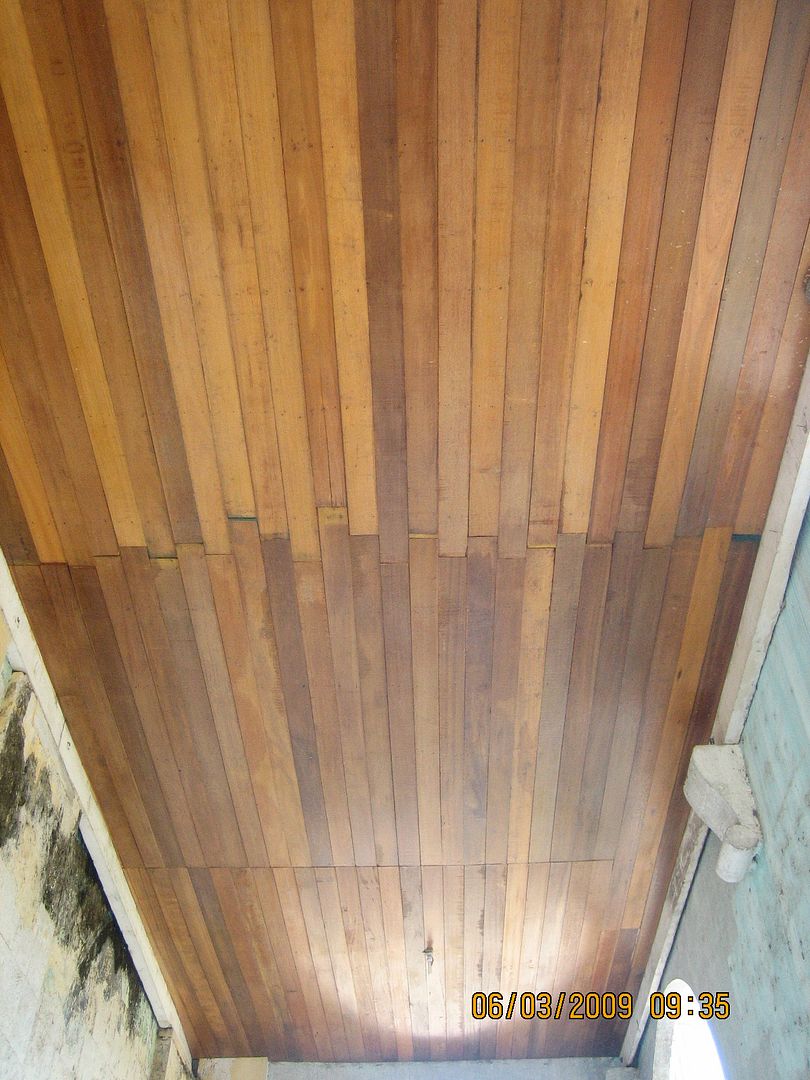
and note that the ceiling of the portico – which would also be right under the floor of the choirloft above, has been restored and is in very respectable shape.


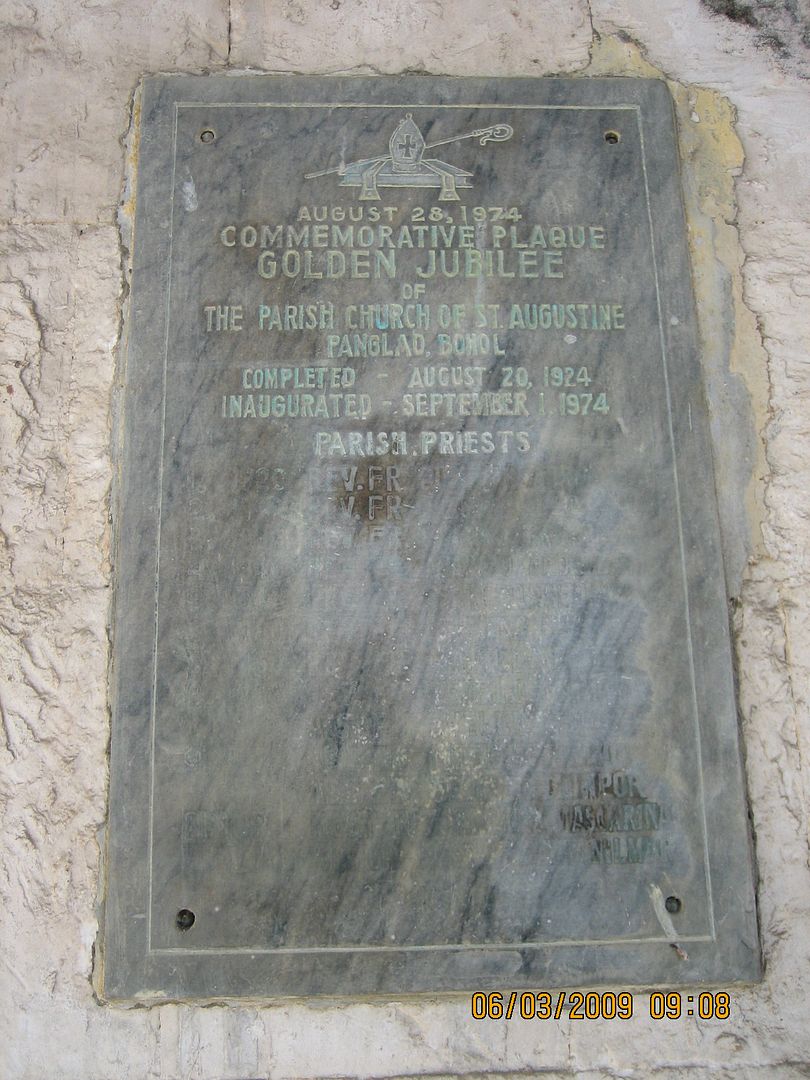
There is also a golden jubilee marker from 1974 on the wall inside the portico to commemorate the fifty years since the church was inaugurated.


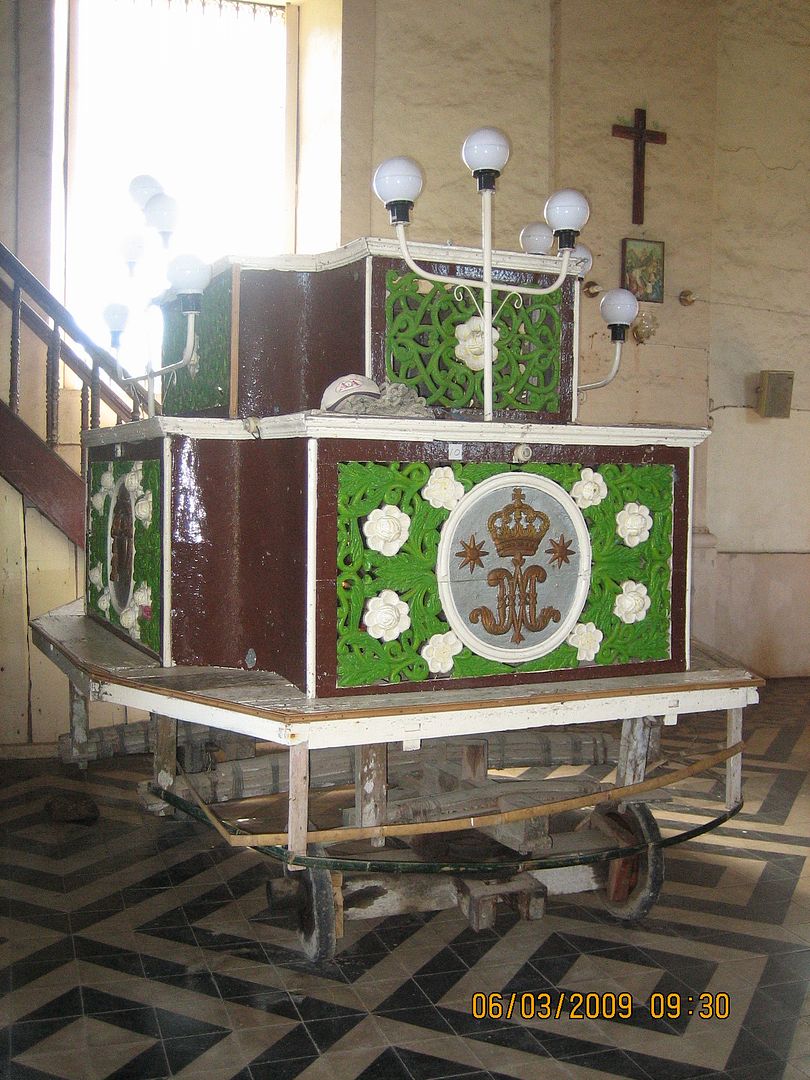
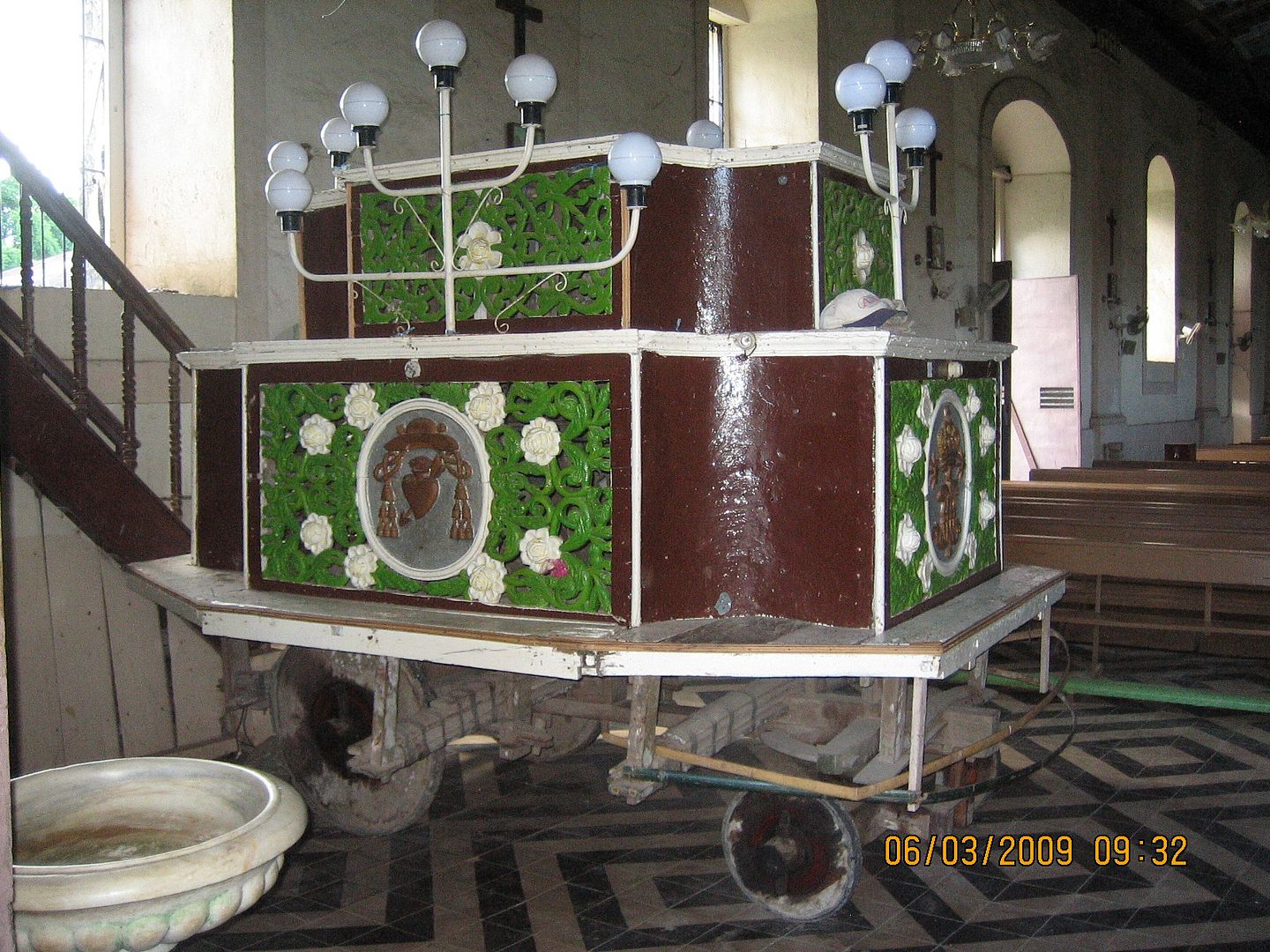
Right inside the main doors is an entrance vestibule, which also serves as the parking space for a strange-shaped carroza.


This no-nonsense battle tank of a karo has solid wheels, as well as Marian and other emblems.


I ask my cousin what processional image usually rides on top of this, and he says that he believes that the town’s Santo Entierro is mounted on it for Good Friday, strangely enough. I wonder if he has just misremembered.

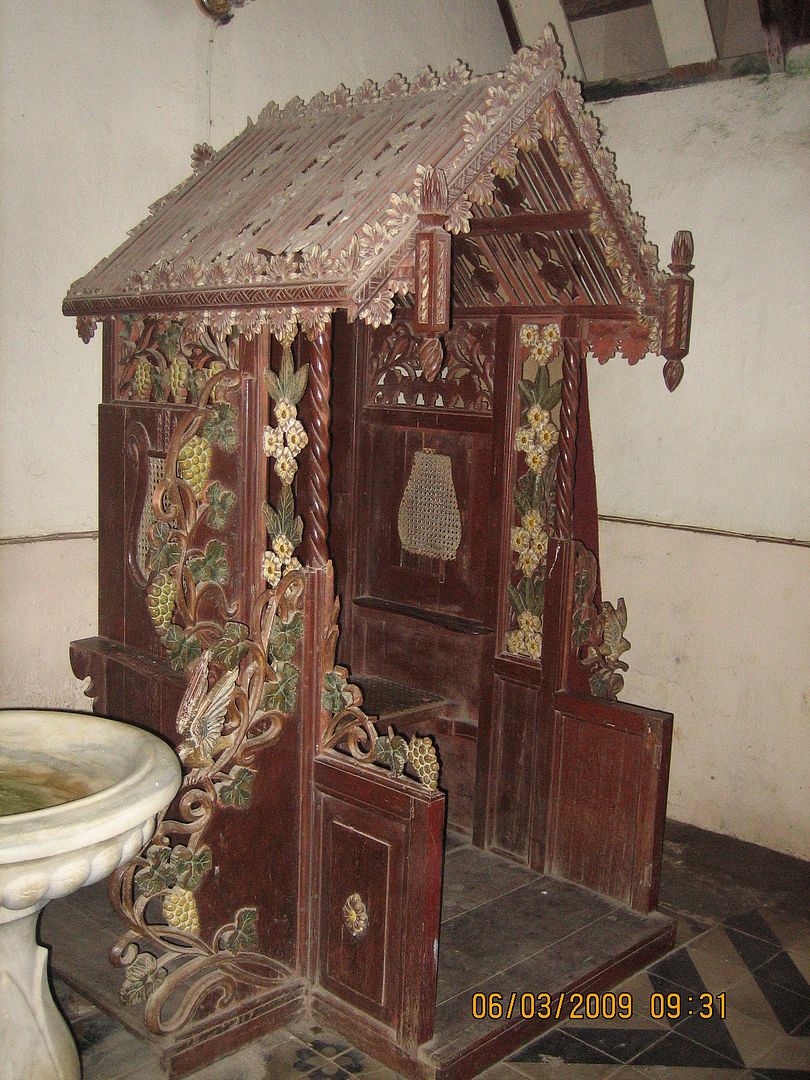
By the entrance are also two very interesting confession boxes, one an ornately-carved and polychromed specimen,


and the other a wider more articulated version of the first one with separate box sections for the penitents.


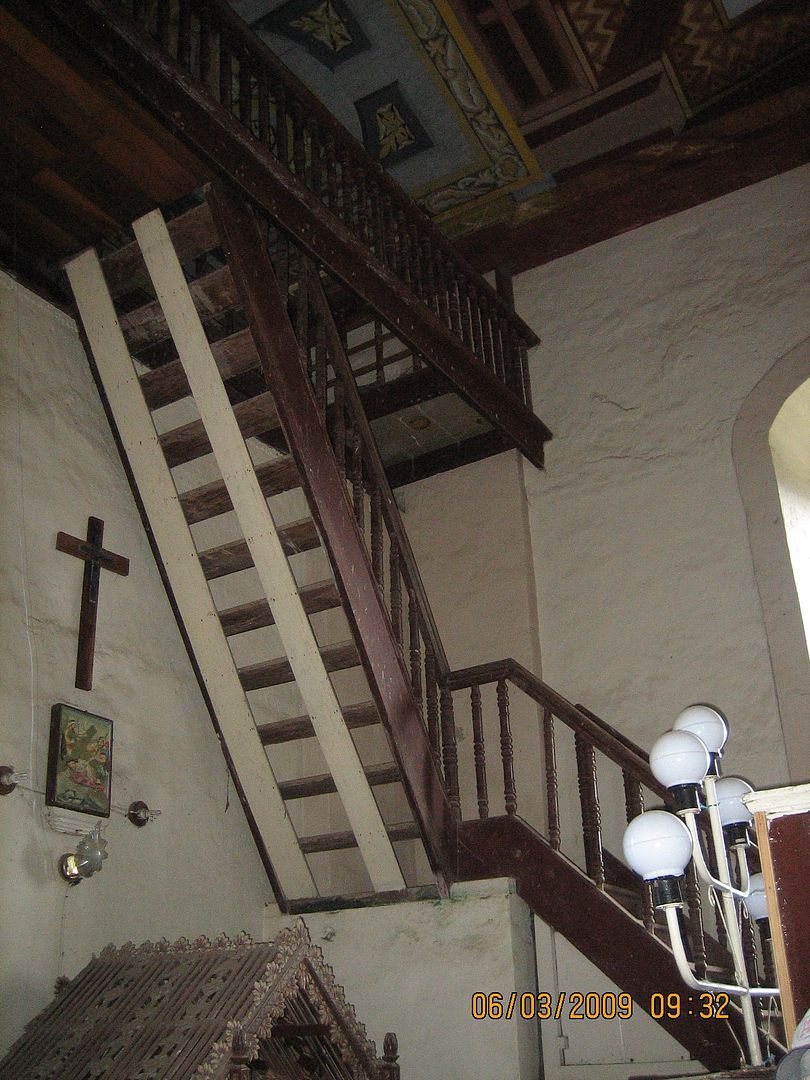
In a corner of the vestibule is a steep staircase that leads up to the choirloft.


Unlike the Baclayon church, Panglao does not have a pipe organ, likely because this church is a newer structure built after the golden age of Recollect-built pipe organs in Bohol in the late 18th to the early 19th centuries.

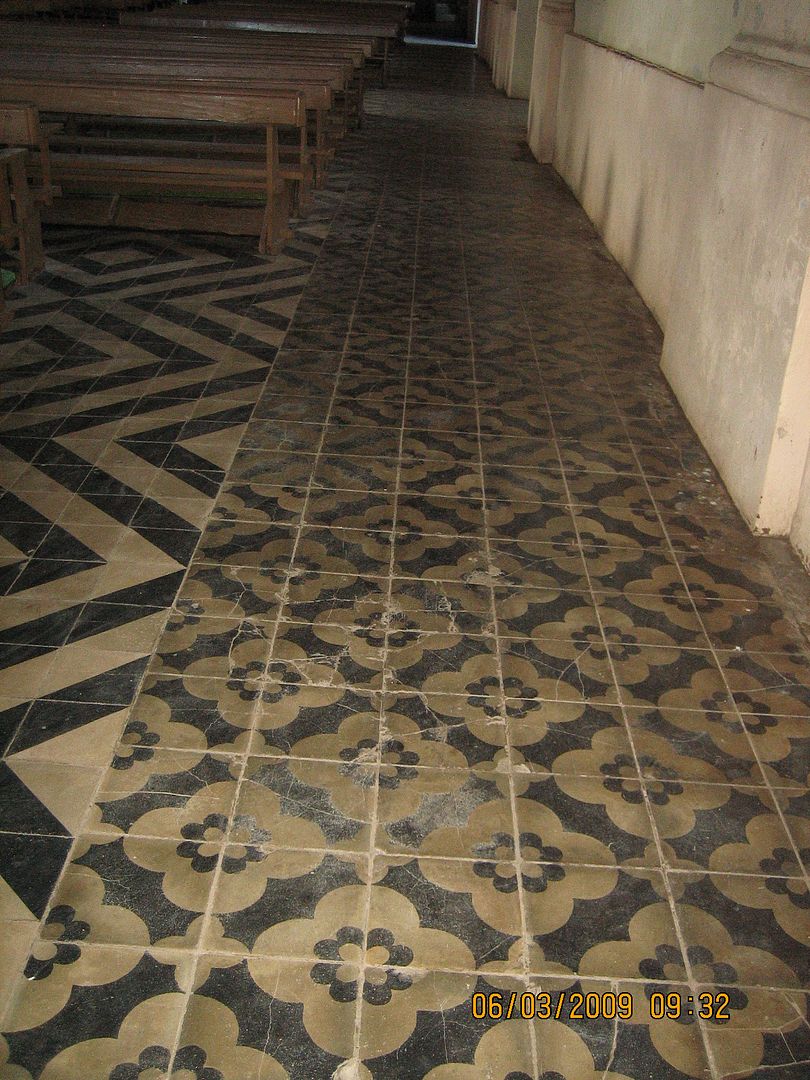
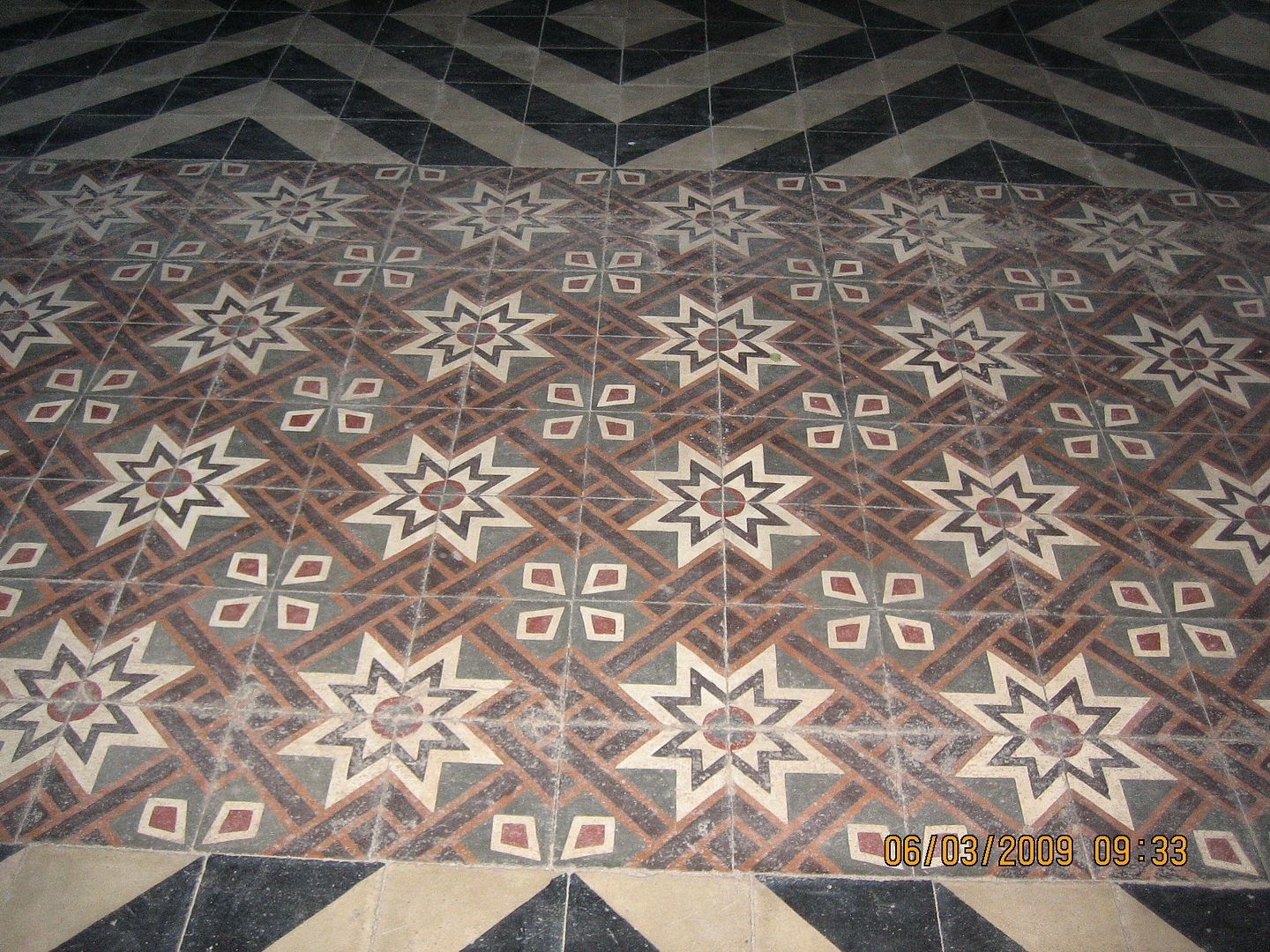
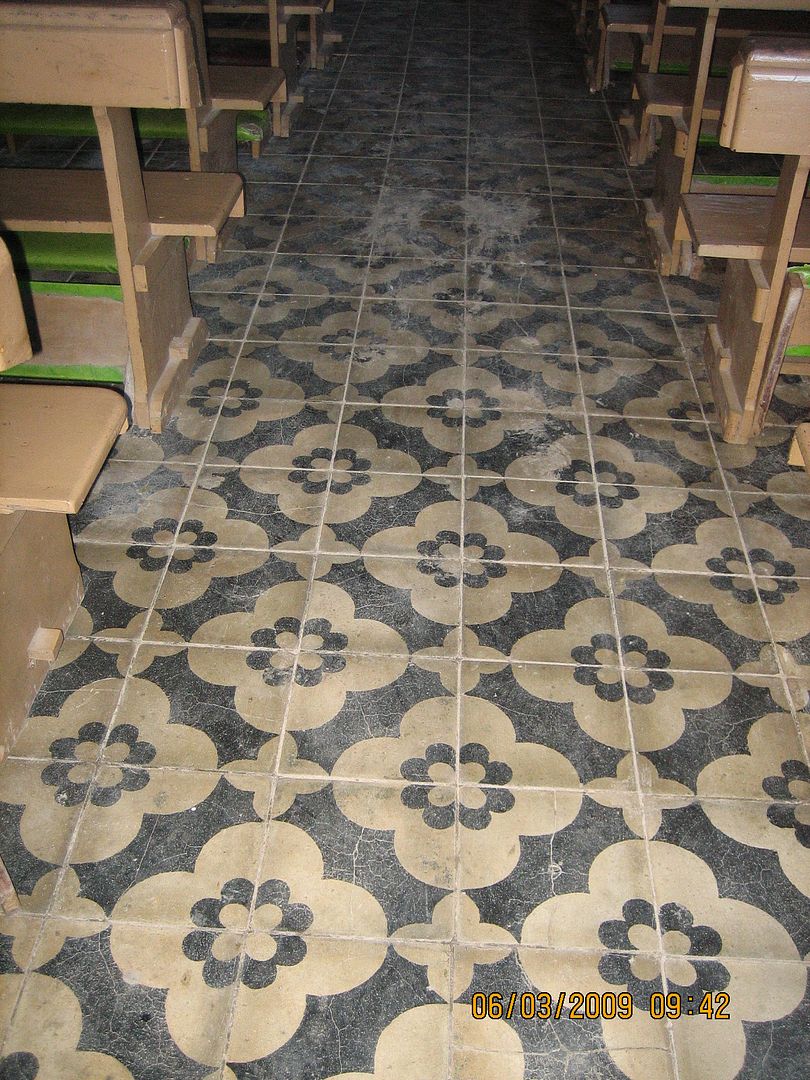
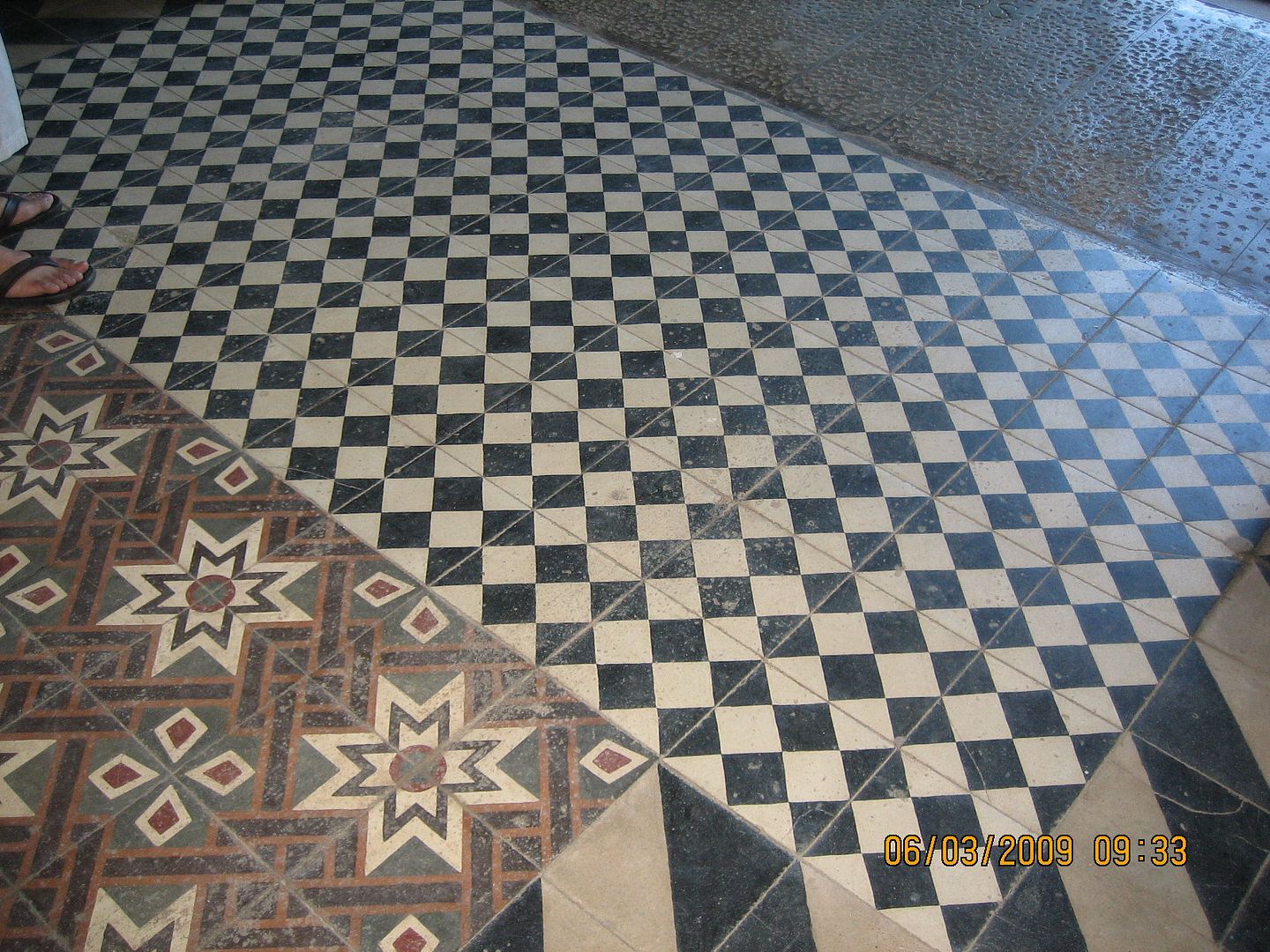
The floor’s original colored cement tiles


in different sizes


and designs


are all still in place


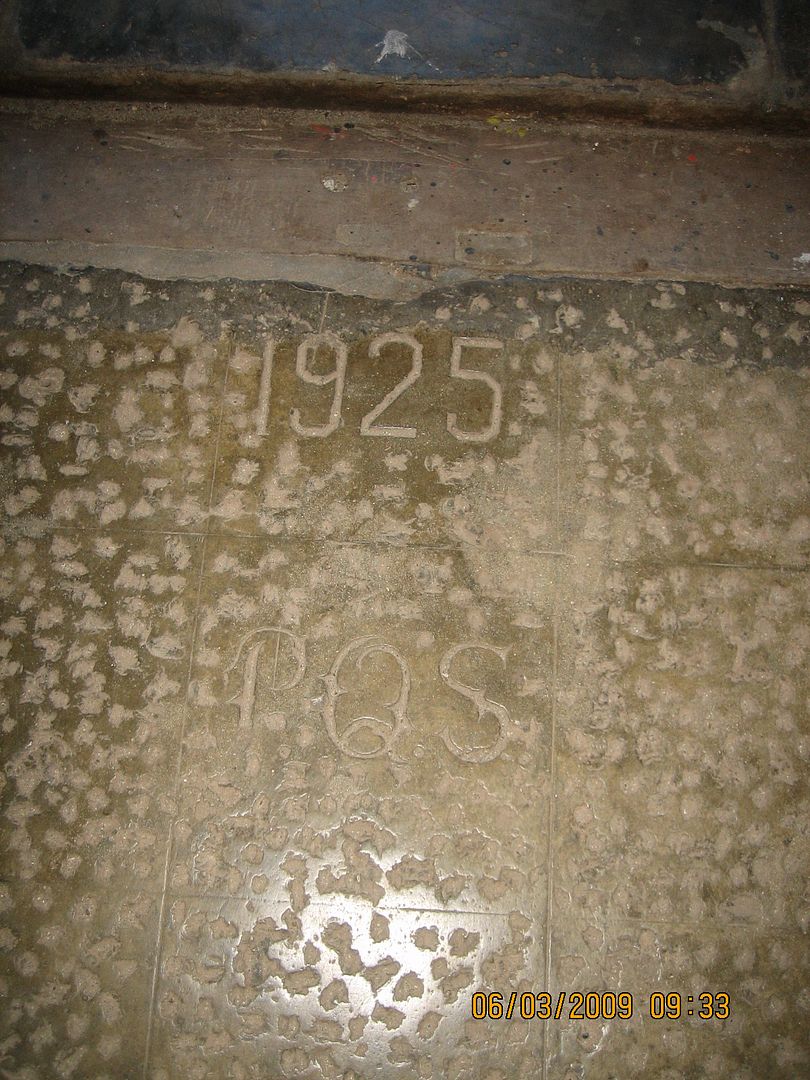
including this inscription into the cement of the floor by – who else – Padre Quiterio again, dated 1925, or shortly after the time that the church was opened for regular use, likely when the industrious parish priest completed laying the floor.


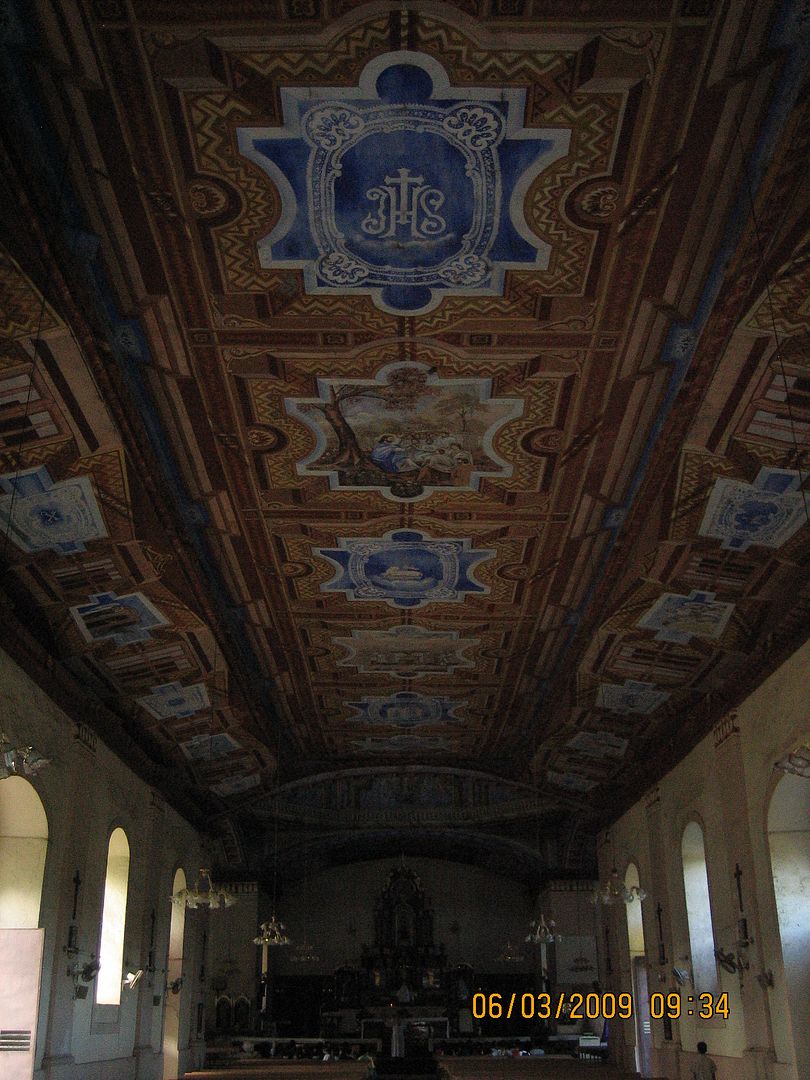
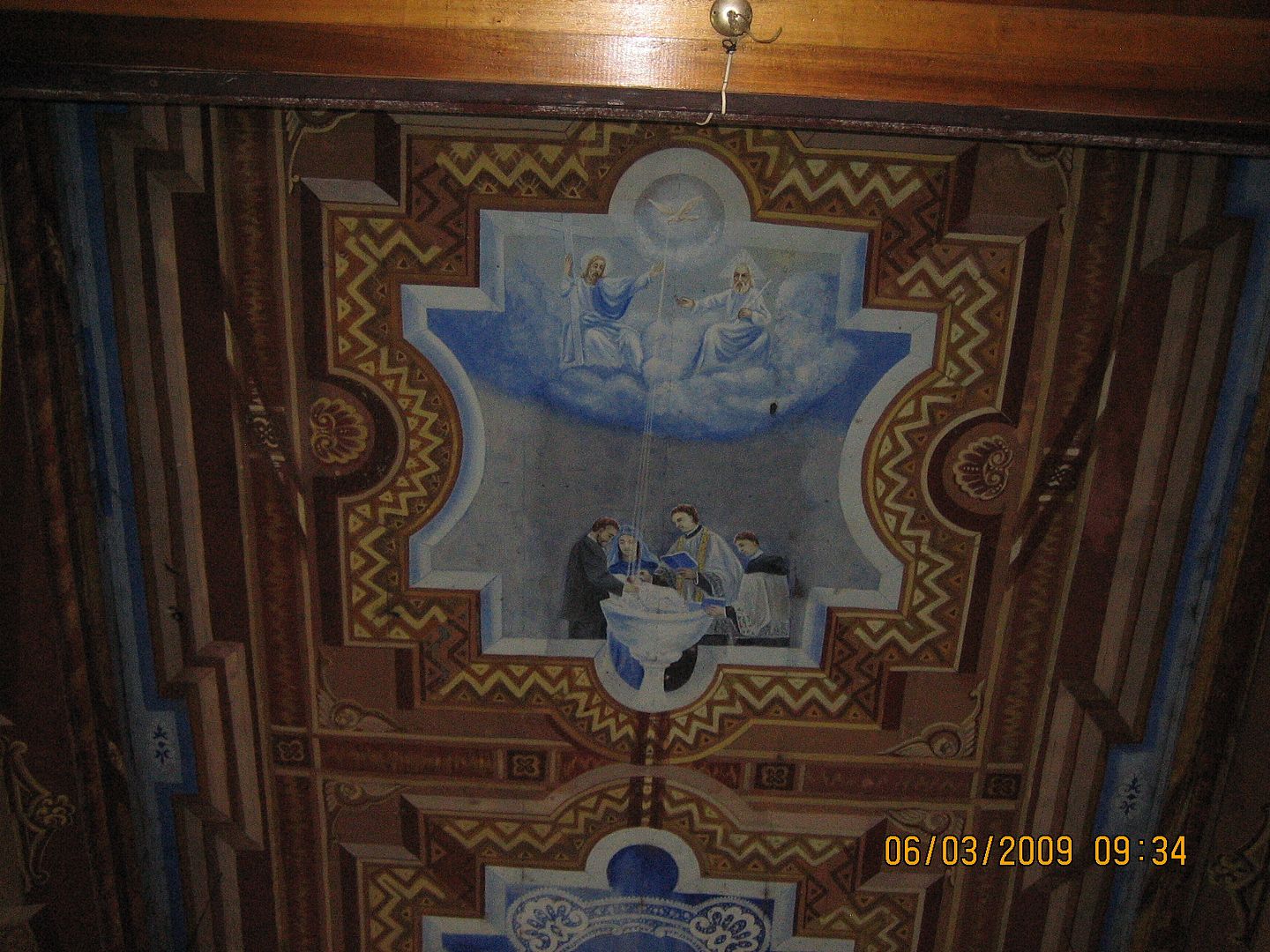
From the entrance vestibule, we make our way up the nave’s center aisle, and, while taking care not to trip, look at the beautiful painted ceiling, another common feature amongst pre-World War II churches in Bohol.


These Bohol church ceiling paintings were commissioned from two Cebu artists in the 1920’s and 1930’s, Ray Francia and Canuto Avila.


Regalado Trota Jose writes in “Visita Iglesia Bohol” that the ceiling paintings over the nave in Panglao Church are arguably the most unusual in Bohol, because among other things the painted frames are in shades of brown whereas the scenes within are in monochromatic lavender, and lavender and brown make a strange color combination. Perhaps P.Q.S. was somewhat color-blind?


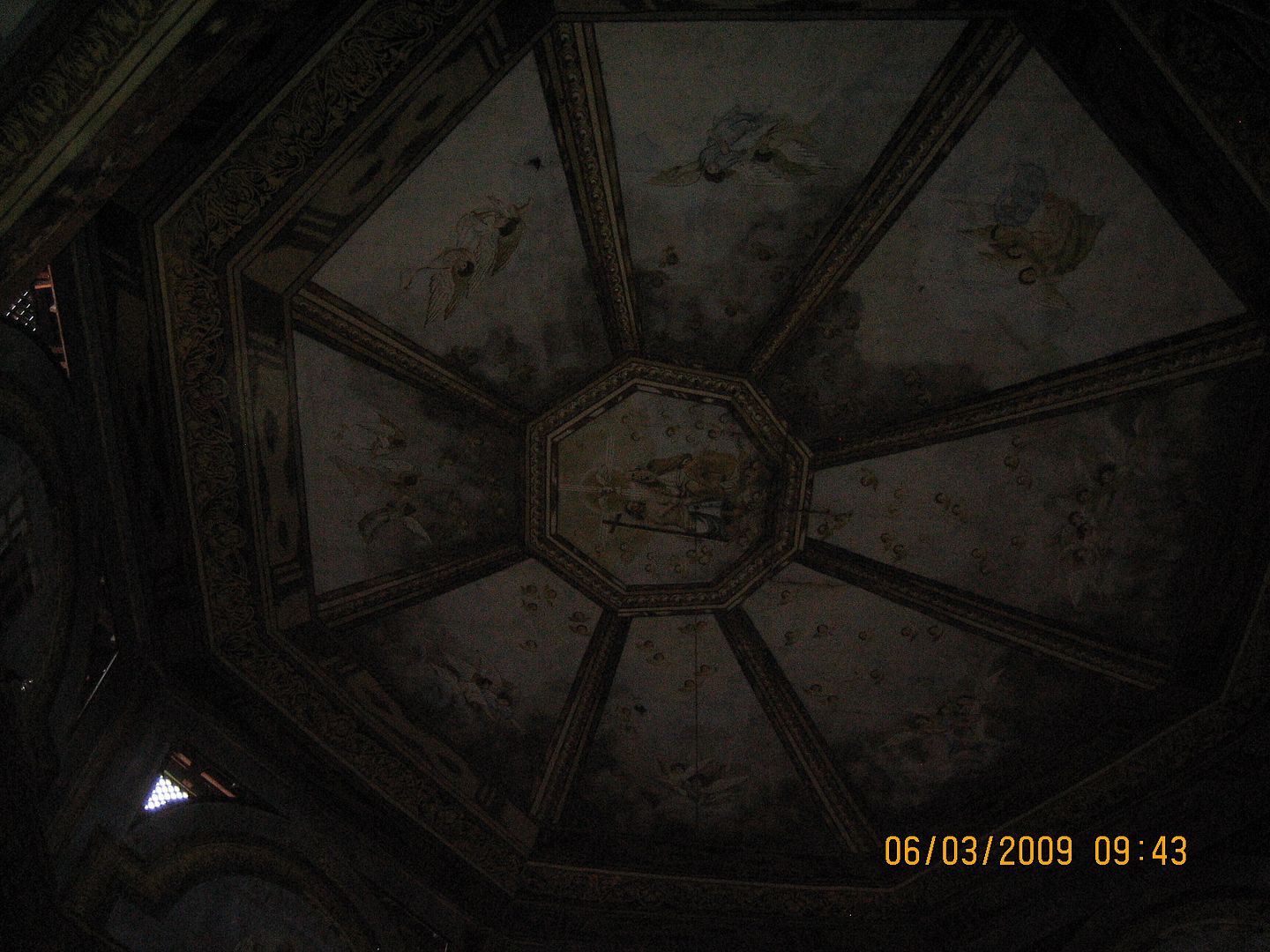
The design of the ceiling painting under the octagonal crossing-dome is impressive, though now appears faded somewhat.  Or perhaps my pocket camera and myopic eyes just could not capture its vivid detail.


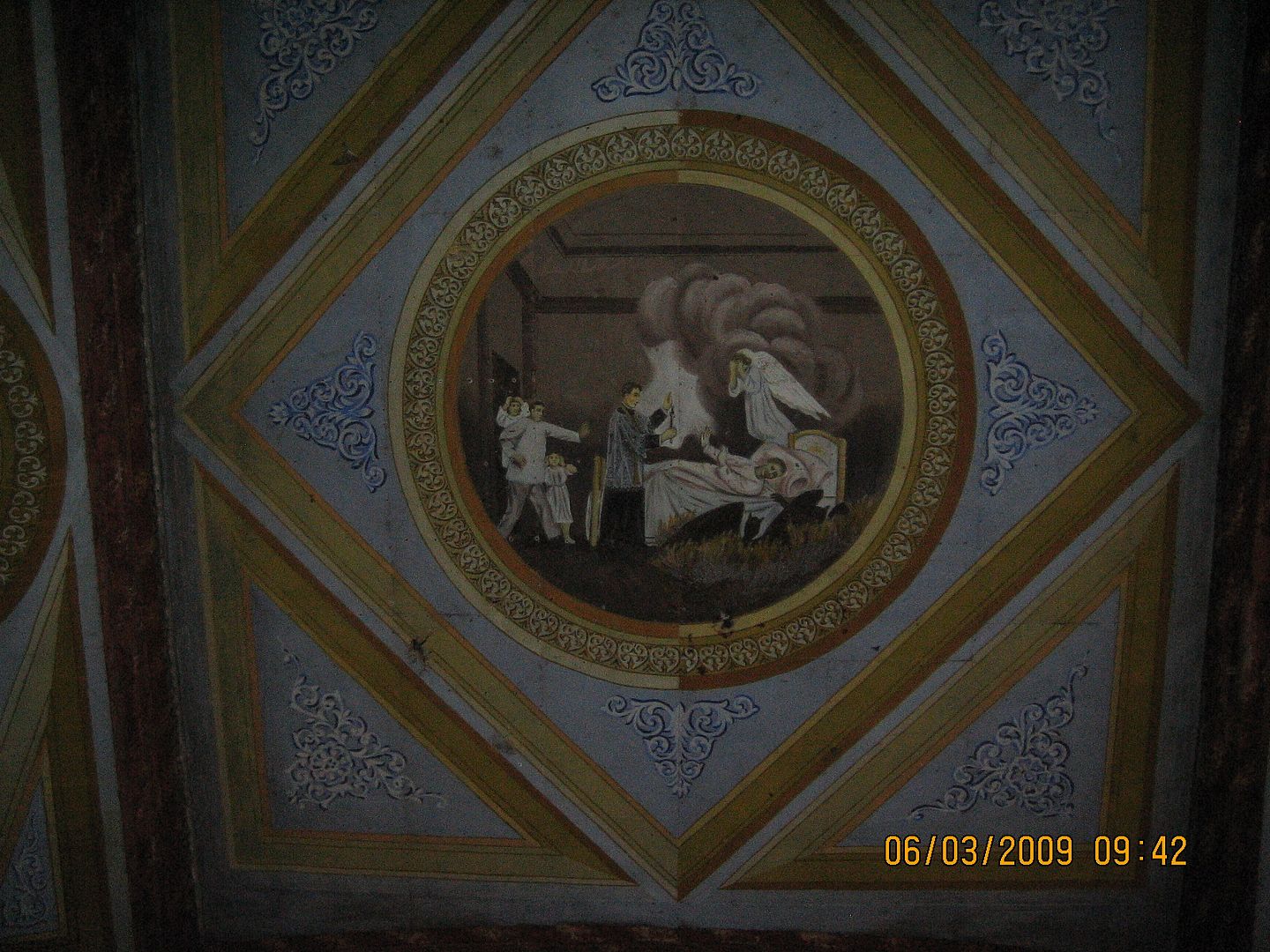
Some of the scenes depicted were quite compelling.  One of them appears to tell the story of a man on his deathbed refusing the last sacraments and instead leaning towards Hell, to the horror of his family, his guardian angel, and the priest.


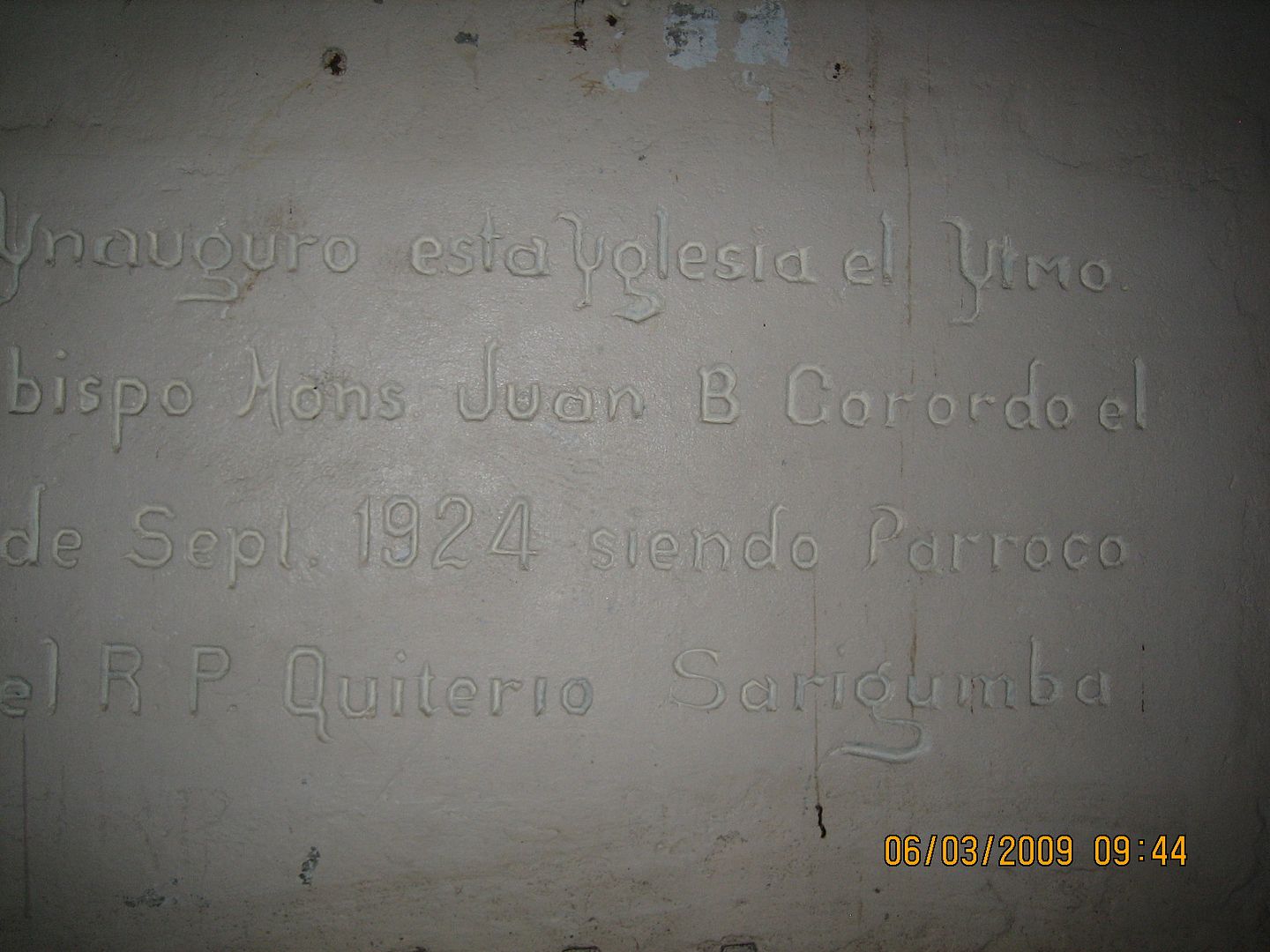
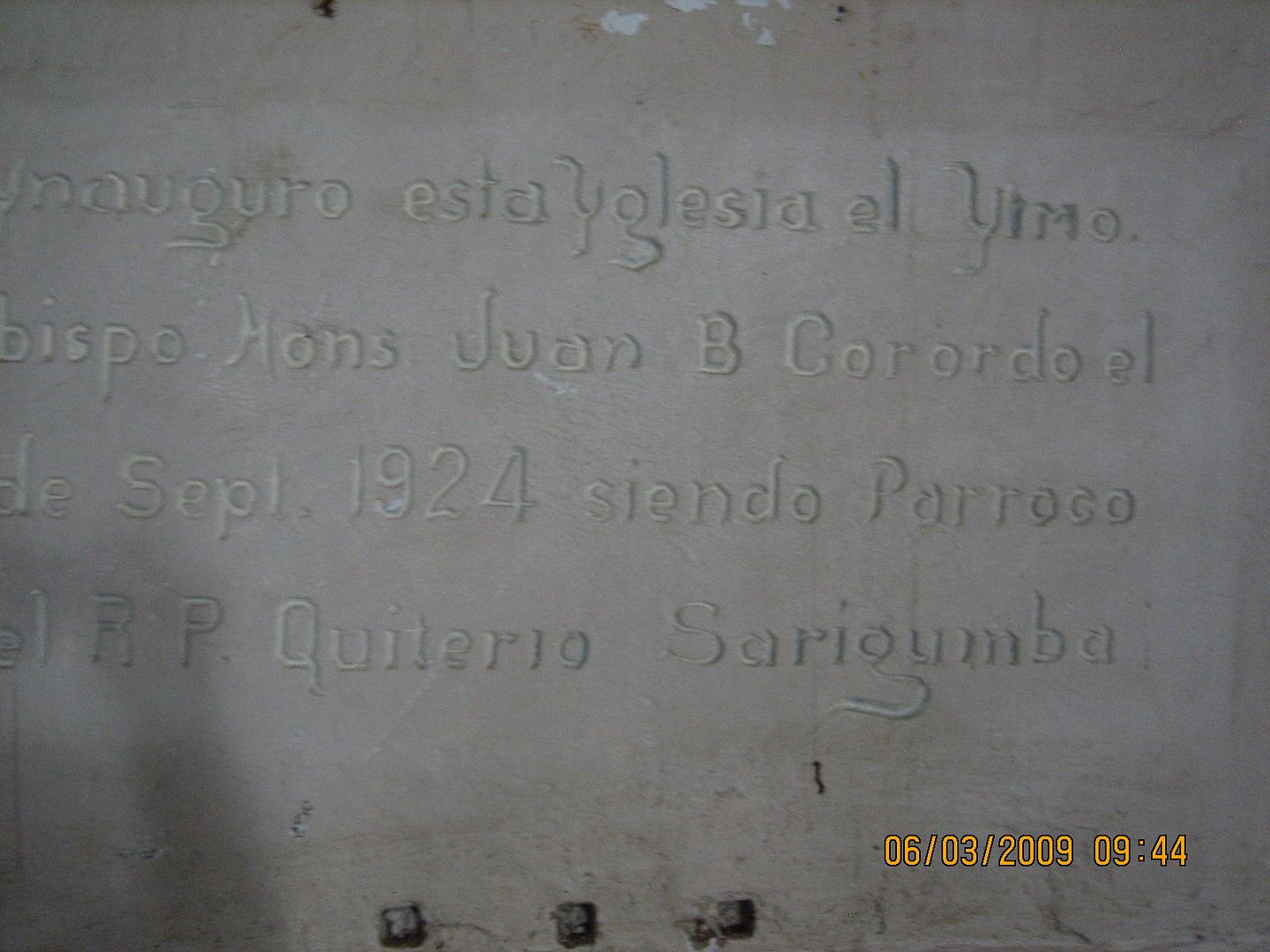
We spot another inscription in one corner of the crossing under the octagonal painted ceiling,


telling us that the church was inaugurated by Monsignor Juan Gorordo, the Bishop of Cebu, on September 1, 1924, during the term of parish priest Padre Quiterio Sariguimba.


P.Q.S. is really Bohol’s answer to “Kilroy was here,” isn’t it?

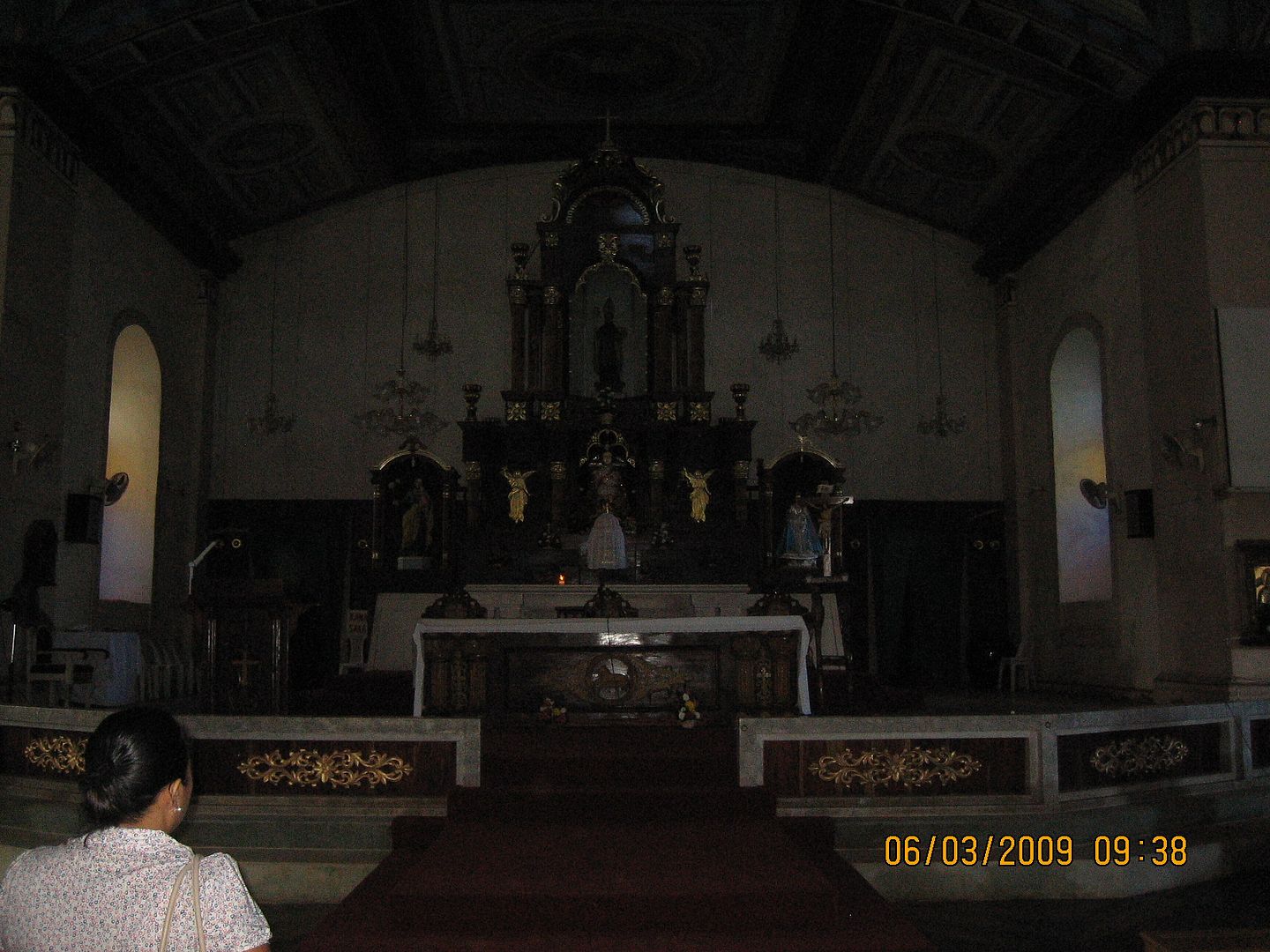
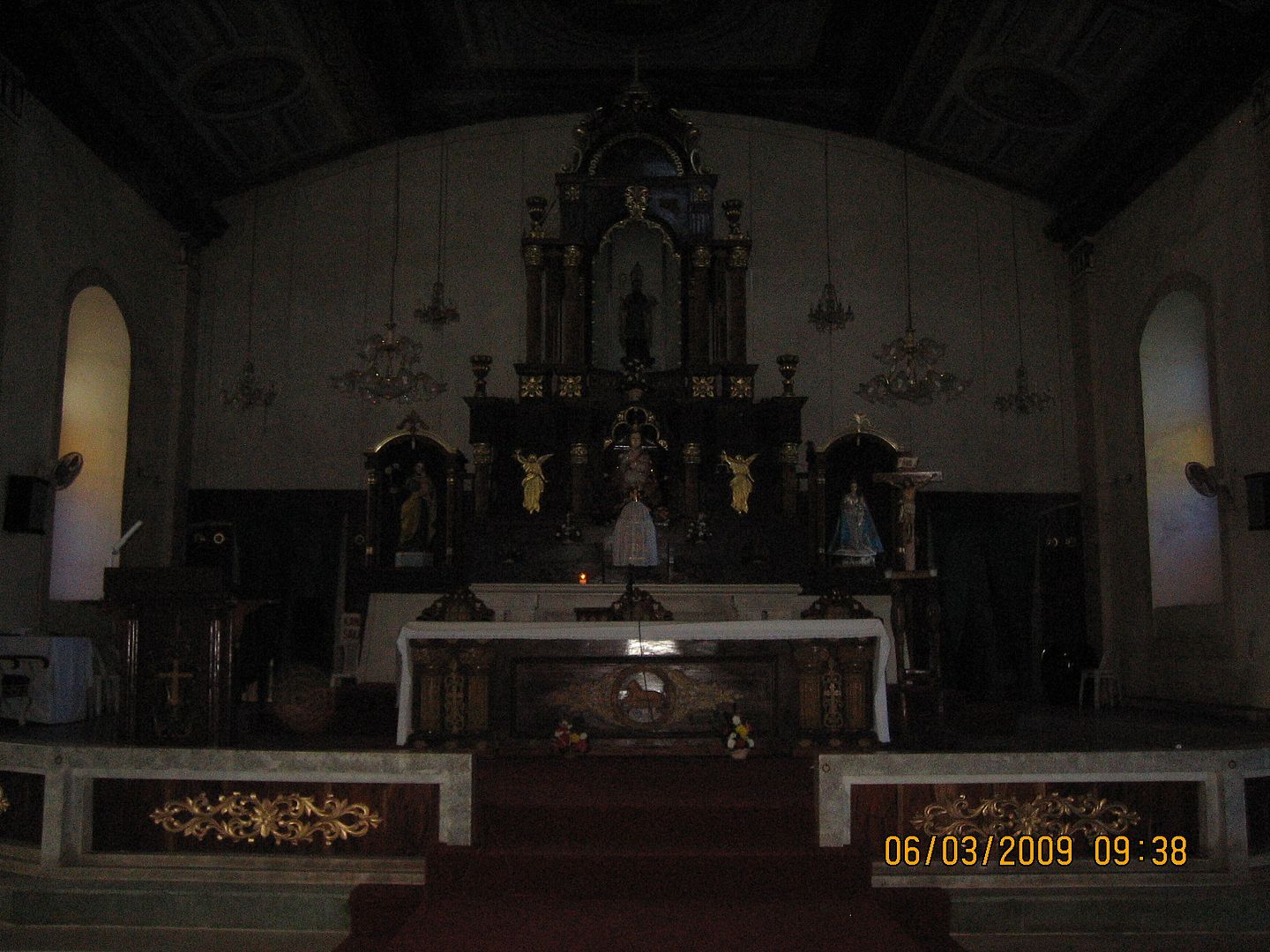
Approaching the main altar, one appreciates the simple retablo


in a tasteful neoclassical style,


with the Holy Child in the middle niche, Saint Joseph on the left, the Blessed Virgin Mary on the right, and Saint Augustine the town’s patron above.


Because it was Lent, appropriate devotional images were positioned near the main altar.  These were an unpretentious and very stoic Nazareno,


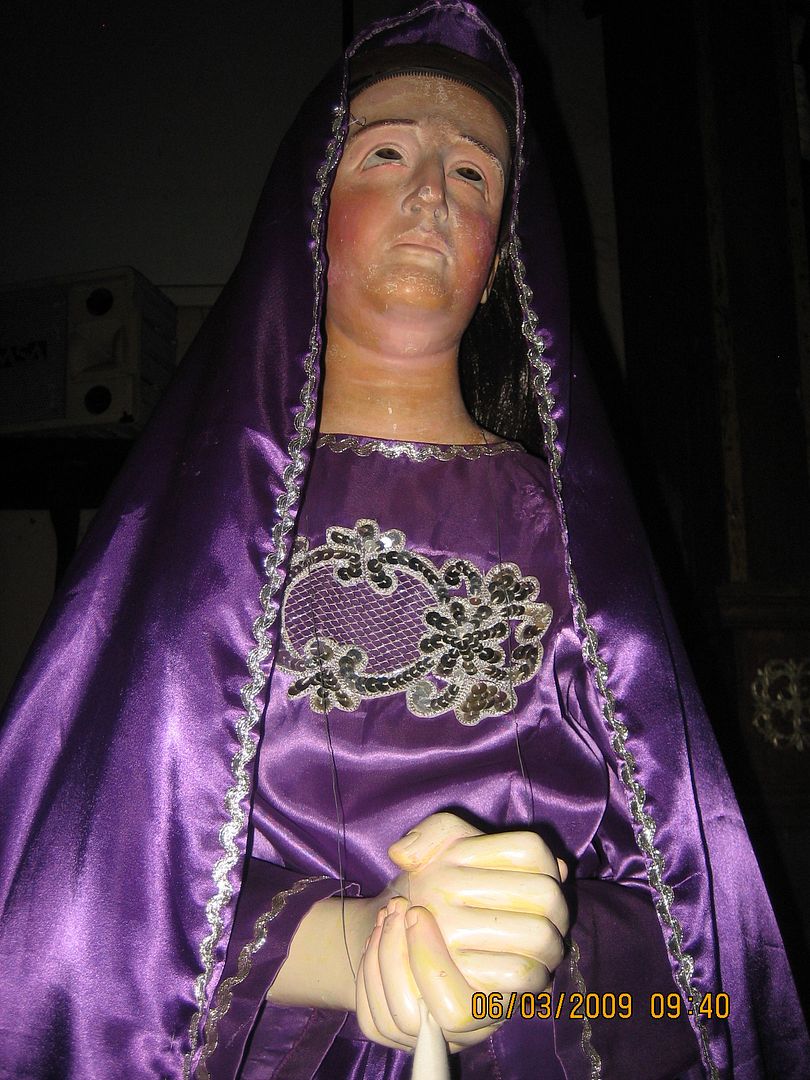
and a simple yet inconsolable Dolorosa,


both likely Good Friday processional images as well.

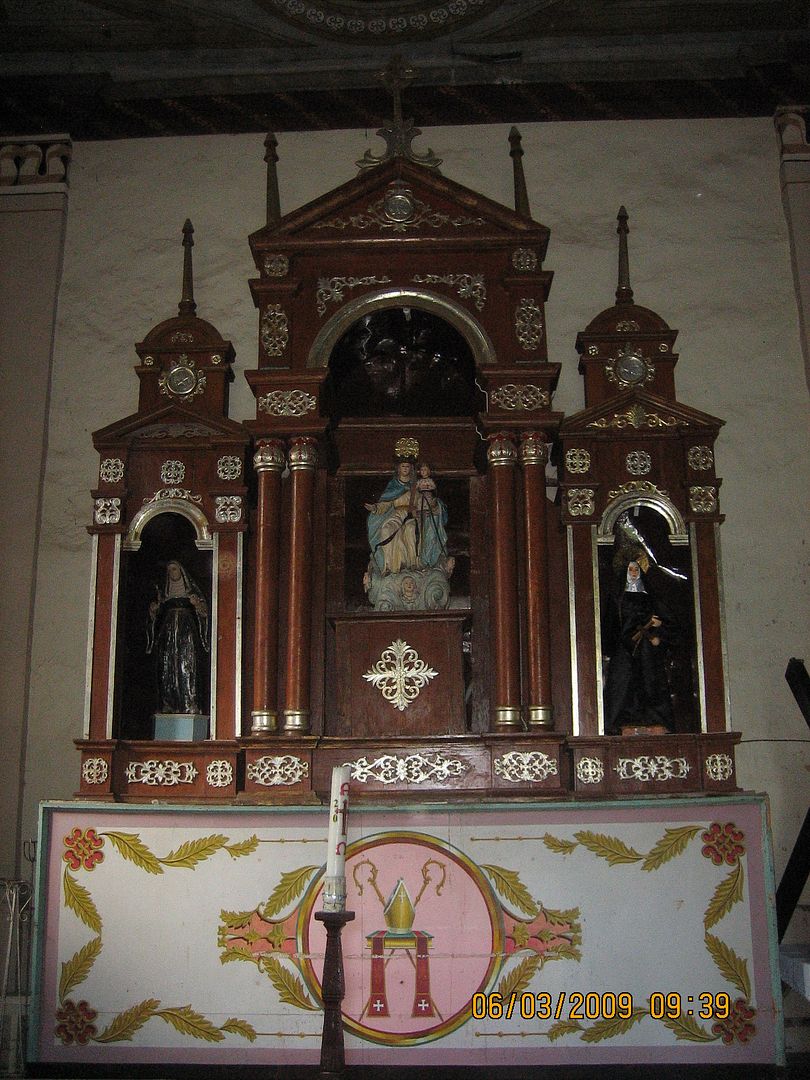
The retablo on the left-side altar is a smaller version of the main one,


with the Madonna and Child in the center, flanked by female saints in the side niches.

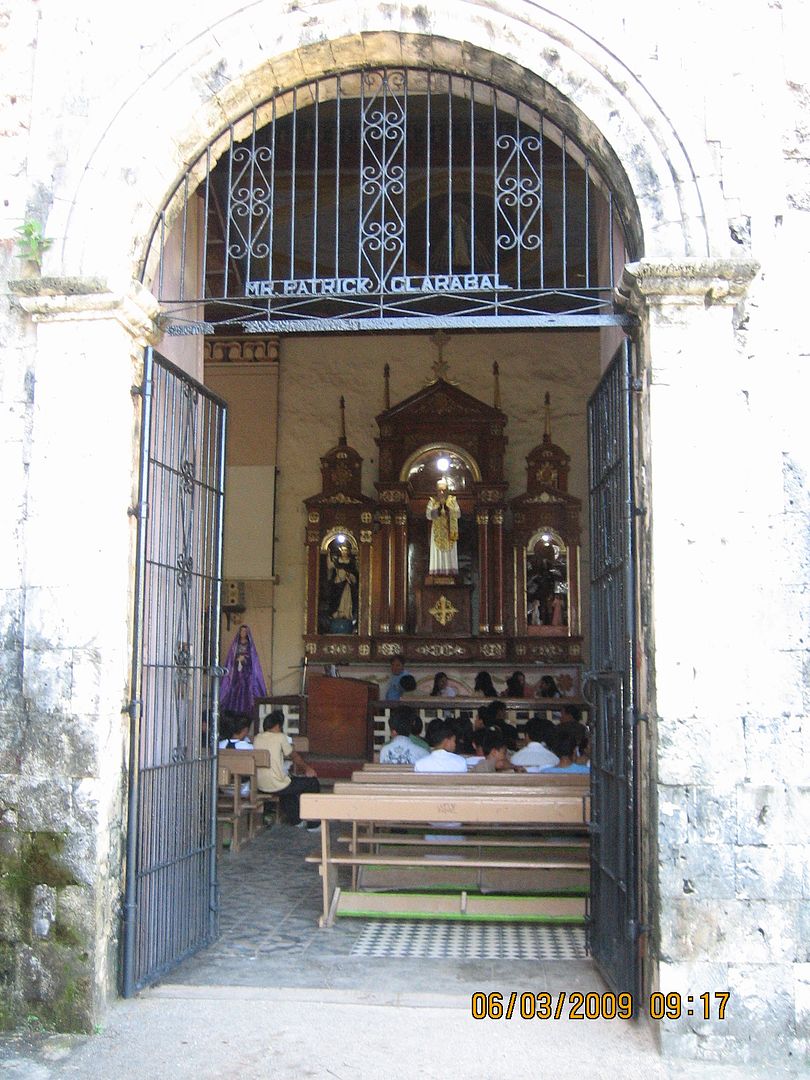
On the right-side altar, here seen through a side door,


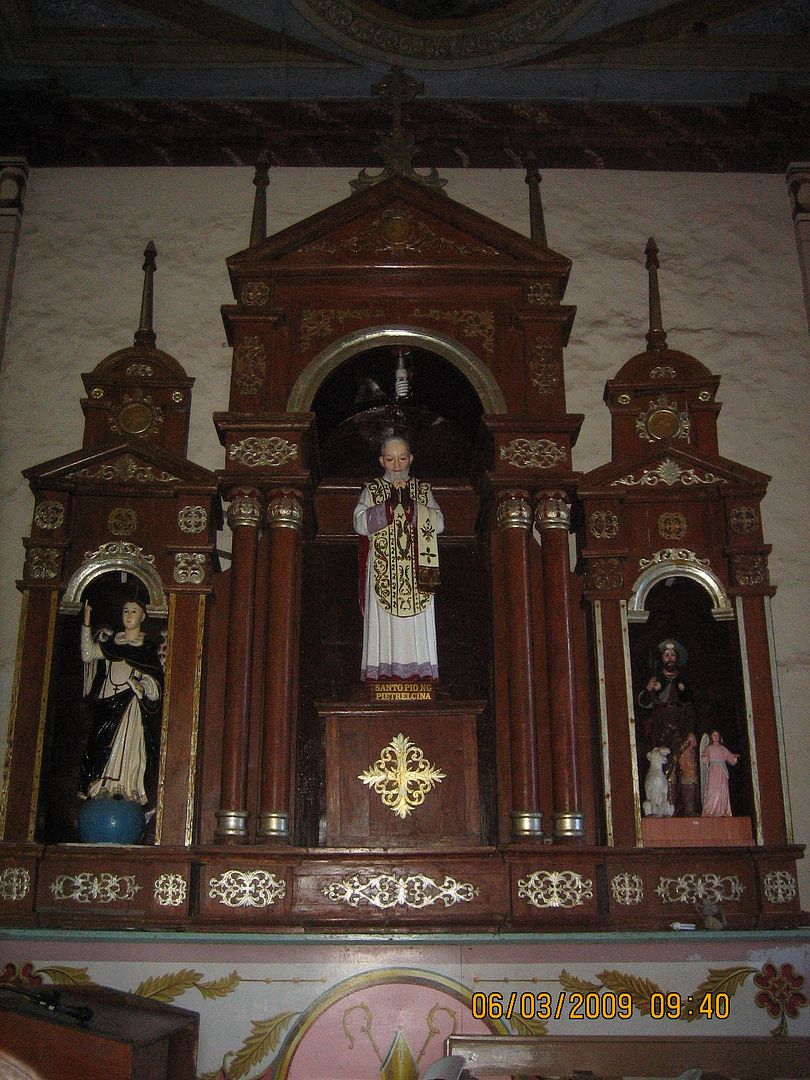
is the twin to the retablo on the left arm of the transept,


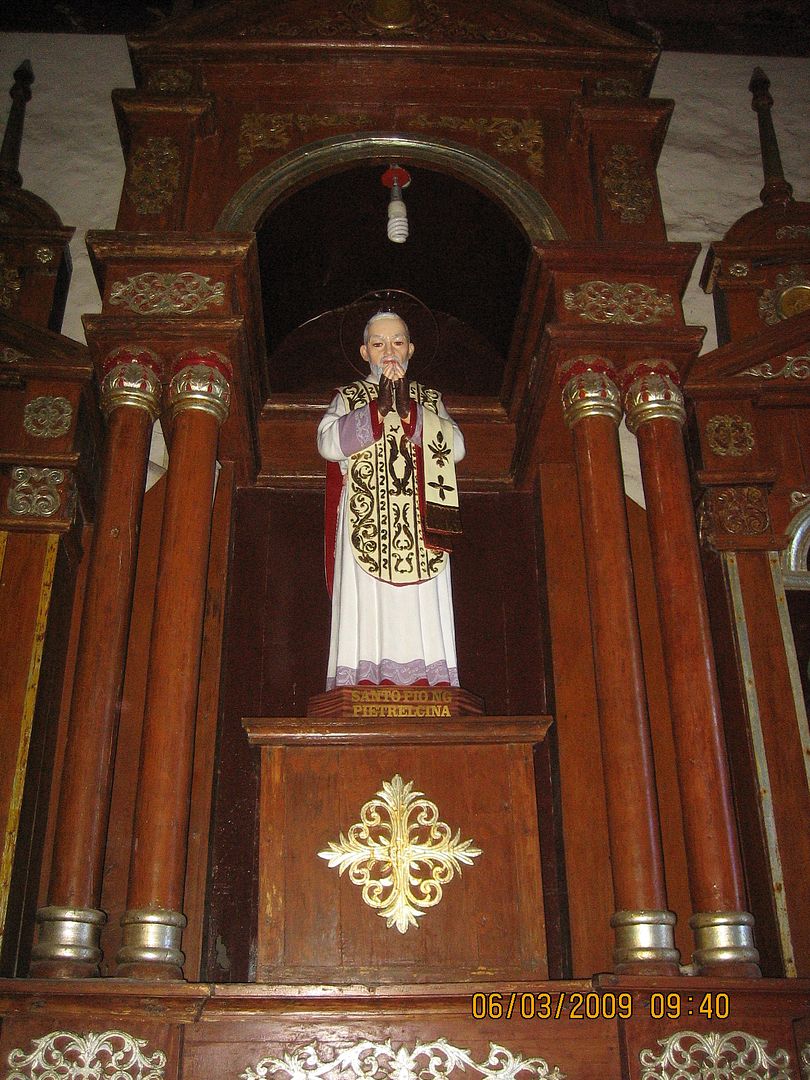
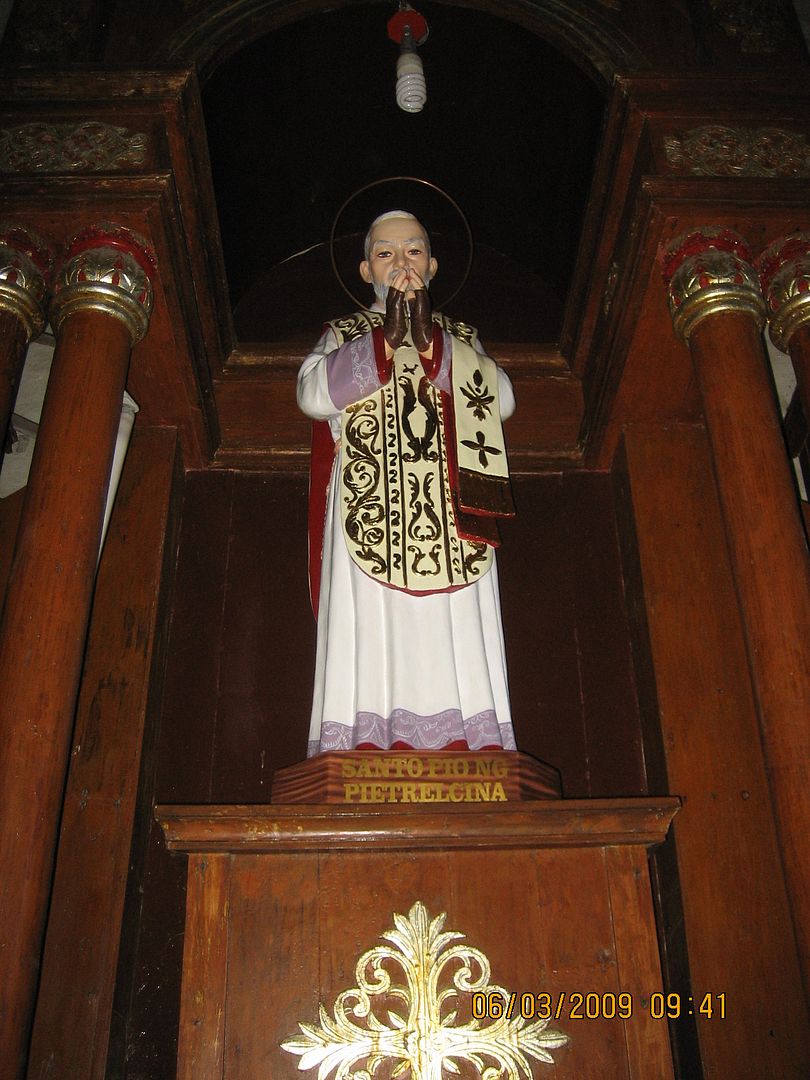
with Padre Pio in the middle niche


(obviously not an antique image as he died only in 1968),


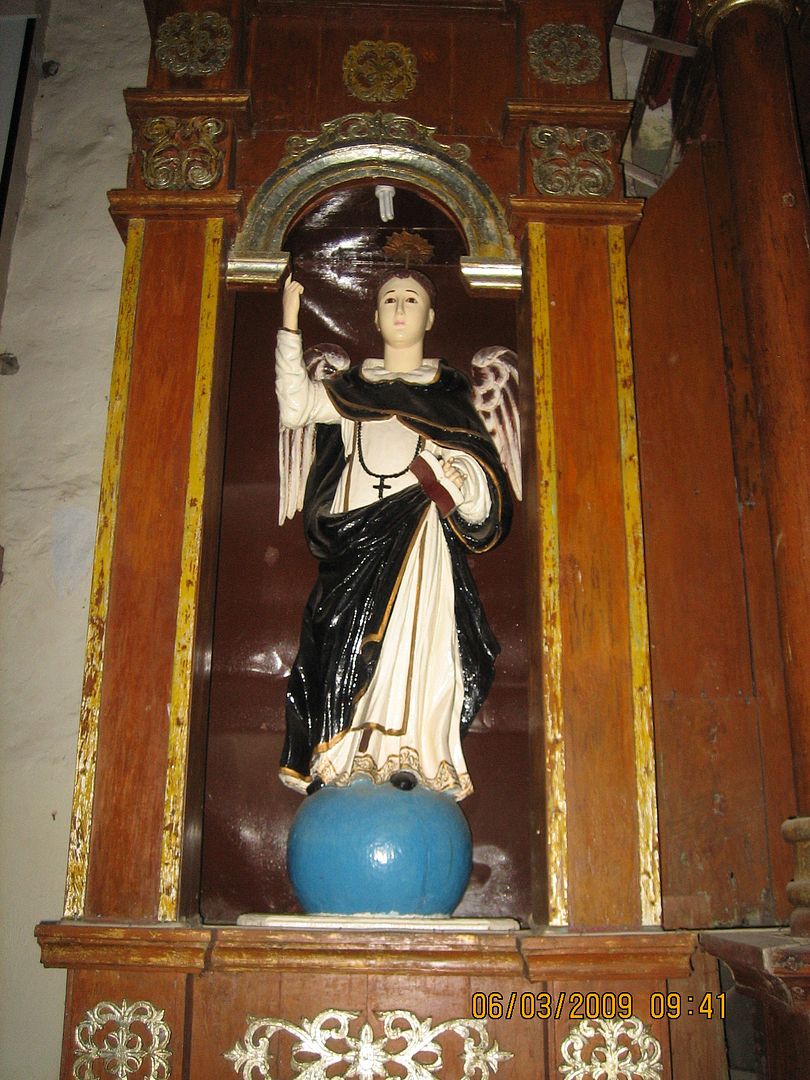
Saint Vincent Ferrer on the left,


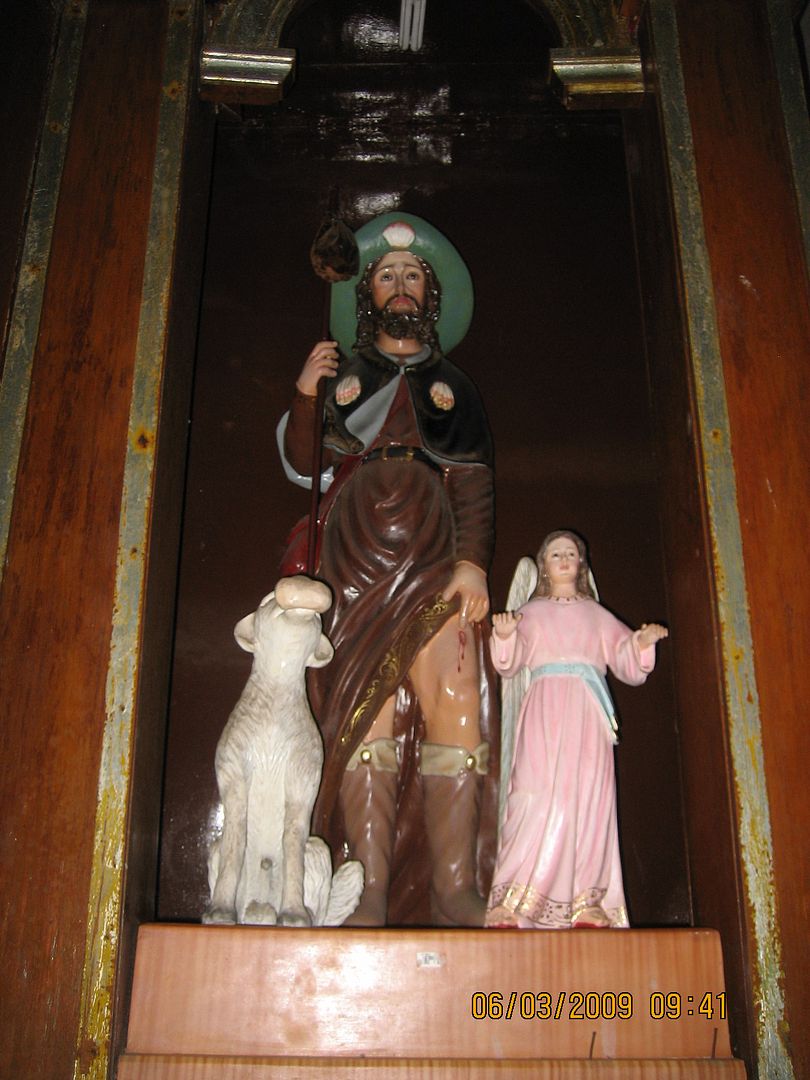
and Saint Roche de Montpellier on the right.


This right side altar also doubled as the de facto choir stall, and the choir members usually sat on this bench positioned against the colorfully decorated wall under the retablo.


We now make our way down the center aisle and turn towards the main entrance, to prepare to leave Panglao Church.


And think to myself that if I had grown up and lived in this, the hometown of my ancients, it would not be a bad thing to have this be my parish church.  Not at all.

Originally published on 27 March 2011.  All text and photos copyright ©2011 Leo D Cloma. The moral right of Leo D Cloma to be identified as the author of this work has been asserted.


Original comments:

anen21999 wrote on Apr 9, '11
When I was there.I was able to witness some women get fresh water from a well located right in the middle of the church nave. They said that the water is miraculously sweet and fresh while the other wells around are salty.

rally65 wrote on Apr 9, '11
anen21999 said
When I was there.I was able to witness some women get fresh water from a well located right in the middle of the church nave. They said that the water is miraculously sweet and fresh while the other wells around are salty.

Might you be referring to Dauis Church, on the other end of Panglao island? That's the one with a spring in the middle of the church.

dennisraymondm wrote on Apr 9, '11, edited on Apr 9, '11
I have toured Bohol 4 times since 2006 ganda! Try Iloilo and Guimaras, superb churches, was there Apr2-4.

You are right. I have mixed them up.

rally65 wrote on Apr 9, '11
dennisraymondm said
I have toured Bohol 4 times since 2006 ganda! Try Iloilo and Guimaras, superb churches, was there Apr2-4.

Yes, I have yet to go to those places -- on my to-do list.

arcastro57 wrote on Apr 11, '11
What a funky looking carroza and confessional box.

rally65 wrote on Apr 11, '11
arcastro57 said
What a funky looking carroza and confessional box.
Maybe those are examples of "Bohol Baroque"?

johnada wrote on Apr 11, '11
I did not know that anything is nice in this town. My cousin wanted us to build a house in Panglao and I was not excited about the beach, but your pictures make it very interesting now.

My claws are just about to rip out that 50th anniversary marker for abbreviating Monsignor as Mons. ha ha ha

rally65 wrote on Apr 11, '11
johnada said
I did not know that anything is nice in this town. My cousin wanted us to build a house in Panglao and I was not excited about the beach, but your pictures make it very interesting now. 

My claws are just about to rip out that 50th anniversary marker for abbreviating Monsignor as Mons. ha ha ha


I think Panglao is a very nice town to live in. It was clean, quiet, and spacious.

victorancheta wrote on Apr 13, '11, edited on Apr 13, '11
a beautiful church with equally handsome furniture. really love the mismatched tile floors.
an odd carrozza indeed. almost like it's made of old altar pieces.
i seriously hate modern add-on porte-cochères and the pretentious reasoning behind them. that ruined church must have been beautiful without it.

rally65 wrote on Apr 14, '11
victorancheta said
a beautiful church with equally handsome furniture. really love the mismatched tile floors.
an odd carrozza indeed. almost like it's made of old altar pieces.
i seriously hate modern add-on porte-cochères and the pretentious reasoning behind them. that ruined church must have been beautiful without it.


Fortunately the portico of this church was not a later add-on, and is therefore well integrated into the overall neoclassical design of the facade.

johnada wrote on Apr 28, '11
Leo, this video shows why the once-a-year use of the tower structure for the salubong is a necessity in Bohol.Once again, that center of tradition, Loboc shows why. This guy has videos and pictures of the Holy Week procession too.

http://www.facebook.com/?ref=logo#!/video/video.php?v=1707467122048

andyleighton wrote on Apr 8
Hi Leo,
Thanks, an interesting read, I was recently at this church and was taking photos for my website, do you know what the significance is of the 'concrete' benches out the front of the church, the seating wood looks very old but the concrete supporting structure looks relatively recent ... perhaps the wood is from original pews? ... also any idea what the name of the old ruins is beside the church? ..thanks for any help. andy

rally65 wrote on Apr 8
andyleighton said
Hi Leo,
Thanks, an interesting read, I was recently at this church and was taking photos for my website, do you know what the significance is of the 'concrete' benches out the front of the church, the seating wood looks very old but the concrete supporting structure looks relatively recent ... perhaps the wood is from original pews? ... also any idea what the name of the old ruins is beside the church? ..thanks for any help. andy


Which concrete benches -- the ones in front of the ruins of the old church? It doesn't appear that the ruins have a particular name -- I believe that that is simply the previous Panglao Church structure.

andyleighton wrote on Apr 8, edited on Apr 8
thanks for the reply Leo,
I have put a picture of one of the benches in my profile picture, there are around 10 of them in front right of the main church, thanks,
andy
http://www.andyleighton.com

rally65 wrote on Apr 8
andyleighton said
thanks for the reply Leo,
I have put a picture of one of the benches in my profile picture, there are around 10 of them in front right of the main church, thanks,
andy
http://www.andyleighton.com

Thanks -- I saw your photo. Strangely, I totally missed these -- I guess I had supposed them to be thoroughly modern and therefore dismissable! But indeed they might be repurposed wooden parts from old pews. I should check them out at the next opportunity.

By the way, your shot of the Baclayon Church retablo (main altar) is beautiful! Unfortunately I could not take a similar shot when I was there because a funeral mass was in progress at the time!

andyleighton wrote on Apr 9
Let me know Leo, if you manage to get back to the Panglao Church and have a look at the benches ... thanks very much for your time.

The inside of the Baclayon church is quite remarkable, stop by my website in a month or two and I will have a couple hundred photos from Panglao, Bohol and Cebu City on there, cheers