Showing posts with label choir. Show all posts

Wednesday, April 8, 2015

XXXIV. Cantat Bis Orat 5: God is Gone Up With a Merry Noise: Music for Ascension Day


(Fifth in the “Praying Twice” Series)

“Cantat Bis Orat.” [“To sing is to pray twice.”] – Saint Augustine.

As I start to write this, it is Thursday May the 17th, Ascension Day, and ironically a public holiday here in predominantly Muslim Indonesia where I just happen to be.  I got back from High Mass at 11:00 this morning at the Saint Peter Canisius International Roman Catholic Parish Church (actually at the Gereja Santa Theresia [Saint Therese Church] in Menteng, a few blocks from where I’m staying in the embassy district) where I always go on Saturday afternoons.

The service was great, the homily by the Indonesian Jesuit celebrant stimulating as always, and the full-bodied (and full-blooded) singing by the predominantly expatriate Filipino choir inspiring, as might be expected.

Except that none of the music seemed to have been written specifically for the Feast of the Ascension of Our Lord.  So obsessive-compulsive me felt impelled to rummage through my family’s music library to see what might be available.

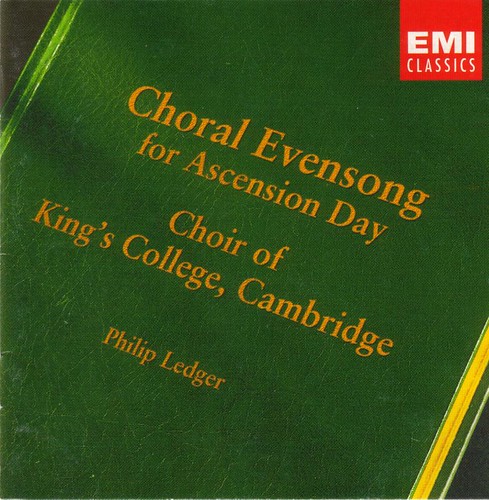
I tell you, being obsessive-compulsive always pays off. I had previously written about The Choir of King’s College, Cambridge (see Cantat Bis Orat, Part Three – King David’s Songbook with the World’s Two Best Choirs).  In that article, I had mentioned that in 1978, this choir recorded an album “Choral Evensong for Ascension Day” under the direction of their then Director of Music, Sir Philip Ledger.


And in that article, I had already included a sample track from this album, a setting of Psalm 24, “The Earth is the Lord’s” by Sir Joseph Barnby (1838-1896).

Well, it seems like as good a day as any (in fact, the best day of all) to listen to this entire album again.  This is essentially a recording of an Anglican Church service, which has a substantial degree of similarity in form to a Roman Catholic Mass, in that it also has hymns and readings from scripture.  The term “choral evensong” signals us to the fact that with the exception of a few prayers and readings, the entire service is sung, in this case by the outstanding King’s College Choir.  And for this Feast Day, all the texts have been selected to emphasize the glory and hope that we ought to identify with the Ascension of the Lord.

The service opens with the Introit, “Alleluia, Ascendit Deus,” in a brief setting by William Byrd (1543-1623) to the original Latin text.

Alleluia, Ascendit Deus
Et Dominus in voce tubae. Alleluia.

[Alleluia: God is gone up with a merry noise,
And the Lord with the sound of the trumpet. Alleluia.]

After a few opening prayers and the Psalm 24 setting by Joseph Barnby that we had listened to in the earlier article, the congregation joins the choir in the hymn “The head that once was crowned with thorns” with music by Jeremiah Clarke and words by Thomas Kelly.

The head that once was crowned with thorns
is crowned with glory now.
A royal diadem adorns
the mighty Victor’s brow.

A few more readings and responses later comes a popular choral showcase from Jacobean England, a setting of Psalm 47, “O Clap Your Hands” by Orlando Gibbons (1583-1625).  This is, a bit unusually, in eight parts, that is, in the usual soprano, alto, tenor, and bass, but for divided choir.

O clap your hands together, all ye people:
O sing unto God with the voice of melody.
For the Lord is high, and to be feared:
He is the great King of all the earth.

This is followed immediately by a Latin motet “Ascendit Deus,” by Peter Philips (1561-1628), a Gibbons contemporary who chose to live in exile on the Continent than be subject to persecution in his native England because of his loyalty to the Roman Catholic Church.  This setting of the Antiphon for Ascension Day is in five parts (including two soprano parts), and ends with a bouncy and appealing final “Alleluia.”

Ascendit Deus in jubilatione,
Et Dominus in voce tubae.
Alleluia.
Dominus in coelo paravit sedem suam.
Alleluia.

[God is gone up with a merry noise:
And the Lord with the sound of the trumpet.
Alleluia.
The Lord hath prepared his seat in heaven.
Alleluia.]

And after a few more closing prayers and a final blessing, the service winds down with a congregational hymn, “The Lord Ascendeth Up On High,” with original music attributed to Martin Luther and adapted and harmonized by Johann Sebastian Bach (1685-1750).  The English text is by A. T. Russell (1806-1874).

The Lord ascendeth up on high,
Loud anthems round him swelling;
The Lord hath triumphed gloriously,
In power and might excelling:
Hell and the grave are captive led;
Lo, he returns, our glorious Head,
To his eternal dwelling.

I know what some of you are thinking – this is all so square and “high-church” establishment-sounding.  And it’s not even Roman Catholic. Even if the Peter Philips “Ascendit Deus” was written by a loyal Roman Catholic Englishman.

Not to worry, we have something else. Two Christmases ago, in December 2005, I was in one of those “anticipated” Simbang Gabi (Nine-Day Dawn Masses), which, if that sounds confusing to you, you’re not the only one – they’re actually celebrated the night before, usually at 6:00 pm of the previous day.  This was at the Santuario de San Antonio along McKinley Road in Makati City, not far from my office.

It was a normal uneventful Advent Novena Mass, except that during the Communion, the solitary music provider, a young lady with an acoustic guitar, sang what struck me as a most interesting, most refreshing church song, something that I had not heard before.

Like some new song heard once on the radio, I promptly forget about it.  Then several months later, while on an extended business trip to Australia, I found myself spending Ascension Sunday in Melbourne Cathedral, an opulent Neo-Gothic masterpiece put together by Irish and Italian settlers in the 19th century.  The High Mass, celebrated by the Archbishop himself, was satisfyingly grand.

What made it even grander was that the all-male Choir of Melbourne Cathedral was on hand, and although they could never hope to be at par with the Choir of King’s College Cambridge, their presence ensured that the service was sufficiently musical to keep even jaded foreigners like me perked up.

And guess what, for the Communion Hymn, that song that I had heard in Makati some months before all came back.

Christ, be our light!
Shine in our hearts.
Shine through the darkness.
Christ, be our light!
Shine in your church
Gathered today.

The refrain had a beautiful descant part (top-line harmonic counterpoint) sung by the choir’s boy sopranos.  Obviously their Choirmaster liked the piece so much that they even reprised it and used it also as the Recessional Hymn on that Ascension Day.

Subsequent digging and research allowed me to identify the piece as “Christ, Be Our Light” and to find a decent recording.
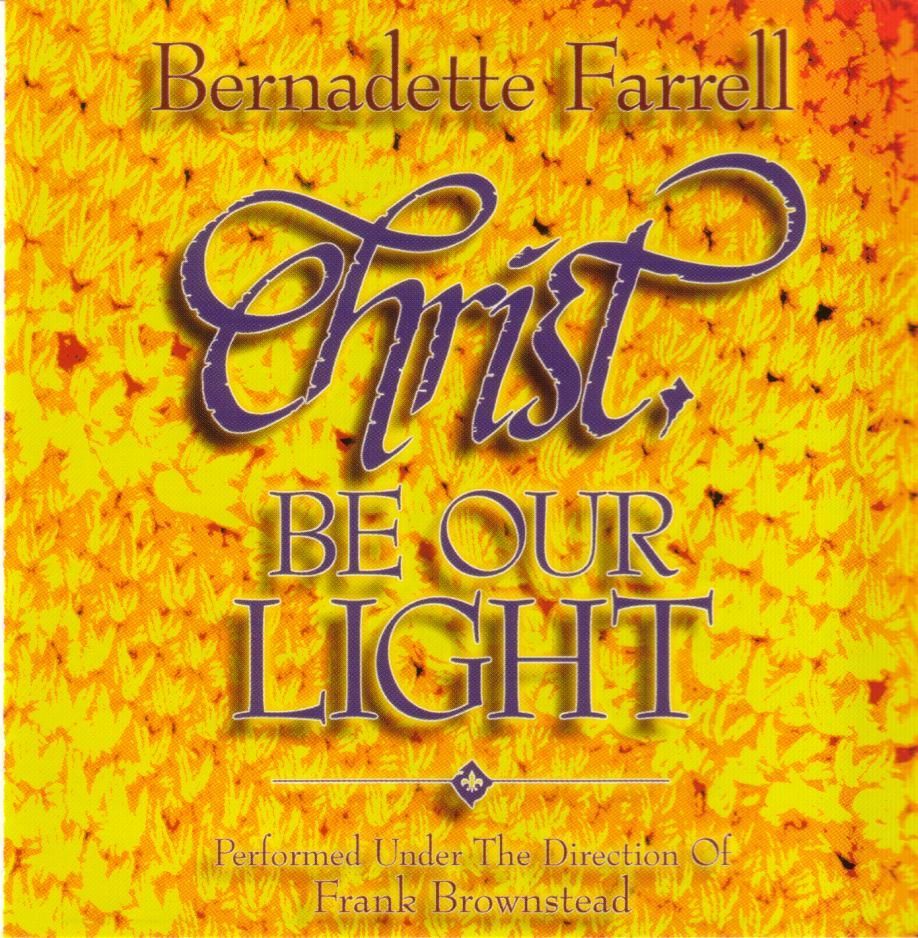


This piece was composed in 1993 by Bernadette Farrell, a prolific British Roman Catholic hymnwriter, born in 1957.
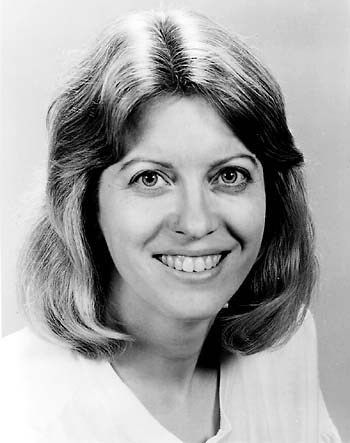

In her performance notes for this work, the composer herself writes:

“This song was originally written for the dedication of a church, St. Gabriel’s in Upper Holloway. The assembly was to be in semi-darkness, with only the Paschal candle burning. The light would spread around the church during the song as individual candles were lit. Something was needed which could be sung without words or rehearsal.

“The text is appropriate for many different occasions. The refrain is for everyone, while the verses might be sung by a soloist or group. Sing the refrain strongly, emphasizing the first beat of the measure. And, as always, only introduce the descant once the melody is swinging.”

In fact, I thought that this hymn was quite fitting not only that Advent evening when I first heard it, but also that cold Ascension Sunday morning when I heard it (and sung along to it) again.


Listen to it, sing along, let the melody swing, and make a merry noise!


Originally published on 17 May 2007.  Text copyright ©2007 by Leo D Cloma. The moral right of Leo D Cloma to be identified as the author of this work has been asserted. Musical examples are owned by their respective copyright holders and are used only for review and demonstration purposes.

Sunday, January 1, 2012

XXVIII. Cantat Bis Orat, Part Four – A Three-Hundred-Year-Old Filipino Lenten Sing-Along


We’ve already started Holy Week, and in the Philippines, this signals the observance of a great number of traditional practices developed over the past few centuries of Christianity in these islands.  The most musical one of these is definitely the Pasyon, or Filipino Lenten chant. Its origins seem to date back to at least the 17th century, with prayers and catechism texts authored by the early Spanish missionaries and set to chants used by the indigenous people.

The first milestone in its development is probably the versified narrative of the Passion, beginning with the Last Supper and ending with the Resurrection, authored by Gaspar Aquino de Belen of Rosario, Batangas, and published in 1703.  Over the following century, the narrative had slowly expanded to include even the Creation from the Book of Genesis.

In 1814, a major editorial effort culminated in the publication of “Kasaysayan ng pasyong mahal ni Jesucristong panginoon natin na sukat ipag-alab ng puso ng sinumang babasa,” also called “Pasyong Mahal” (The Sacred Passion).  Essentially, the initiative sought to rewrite or delete unorthodox texts and content from whatever was in current use at that time.  The editor of this church-sponsored project was a priest named Mariano Pilapil, and as a consequence, this pasyon is also known as “Pasyong Pilapil.”  Like the 1703 version, this newer edition continued the use of the Spanish “quintilla” format – a set of five verses, each of eight syllables, and with rhyming endings. 

Since then, various other editions have appeared, especially in Philippine languages other than Tagalog.  By the early post-World War II years, the entire nation was apparently Pasyon-literate in their own regional languages.

Today, the chanting of the Pasyon seems to be in relative currency, though various quarters complain that it is a dying tradition, brought about by the scarcity of traditional singers familiar with the “way it is supposed to be sung.”  The obvious next step is therefore, let’s simply learn how it’s meant to be sung.  And the obvious question is, do we have any recordings that we can use as references so that we can become self-taught Pasyon chanters? 

The answer is a bit complicated, so let me start with a simple version.  No, I have not come across any broadly-published documentary-type field recordings of actual Pasyon chanters in action.  This is a pity, because in order to learn how these chants are to be properly sung, it is best to listen to how they were ACTUALLY sung in some home or visita during Holy Week.
 
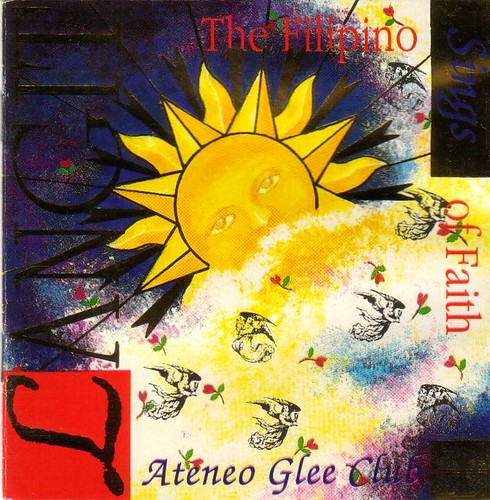
Instead, what is available are a couple of recordings of funky, modernized versions of the Pasyon.  The first one of these is inside the album “Langit: The Filipino Sings of Faith” from the Ateneo Glee Club.


There are four short tracks here that are excerpts from the Pasyon text, and do base their music on traditional Pasyon chants.  The album opens with “Pagsilang,” using the following stanza from the Pasyon: 

Nang malaon nang totoo, 
taong maikapat na libo, 
mulang lalangin ang mundo 
siyang nganing pagparito 
niyong sasakop sa tao. 

Because it has been arranged for a young modern choir, it is either really refreshing and innovative, or is irritatingly self-conscious and potentially irreverent, depending on your musical taste and religious profile.  I recommend listening to “Pagsilang” to see which part of the spectrum of listeners you might be in.  If you like what you hear, go ahead with the other tracks such as “Buhay,” “Handog," and “Alay” as well.

This recording just doesn’t do it for me, as I can’t imagine my family, friends, and fellow parishioners in Bulacan singing anything this way, especially not a religious text for Holy Week, unfortunately. 


(the Ateneo Glee Club singing Regina Caeli, an Easter antiphon)

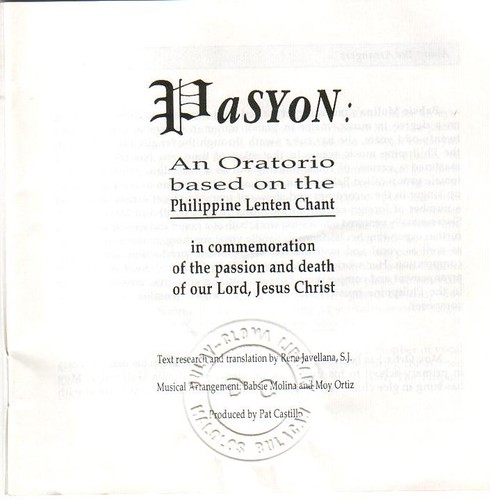
Another creative and innovative effort is the album “Pasyon: An Oratorio based on the Philippine Lenten Chant.”


This makes use of excerpts from the 1703 and 1814 editions to come up with a classical-style oratorio to commemorate the passion and death of the Lord.  The text selections highlight the fact that the beauty of Tagalog poetry, even in the earlier-described quintilla format, lay not in rhyme or meter, but in the juxtaposition of either contradictory or complementary images.  This compare-and-contrast aesthetic is referred to as “talinghaga” even by modern-day Tagalogs.  In “Panalangin,” the first track on this album, we can try to identify what the “matalinghaga” aspects might be: 

O Diyos sa kalangitan 
hari ng sangkalupaan 
Diyos na walang kapantay 
mabait, lubhang maalam  
at puno ng karunungan, 

Ikaw ang amang tibobos 
nang nangungulilang lubos 
Amang di matapos-tapos 
maawai’t mapagkukop 
sa taong lupa’t alabok,

Iyong itulot sa amin 
Diyos Amang maawain 
mangyaring aming dalitin 
hirap, sakit at hilahil 
ng Anak mong ginigiliw. 

Some of the people behind this project were also involved in the “Langit” recording, so musically, the two albums are similar, as the above listening example shows.  The basic chants used are of the most common melodies still current today; the production notes credit the province of Bulacan as the field source for these.  On the other hand, the album also features an unusual traditional chant from Santo Tomas, Batangas, that starts of with a “Na na na na.”  In the track “Huling Hapunan”, we can find out how this works. 

Ay ano nga’y nalikmo na 
Si Jesus na Poong Ama 
Siya sampu ng kasama
Doon sa kakanan nila 
 At nagwika kapagdaka 

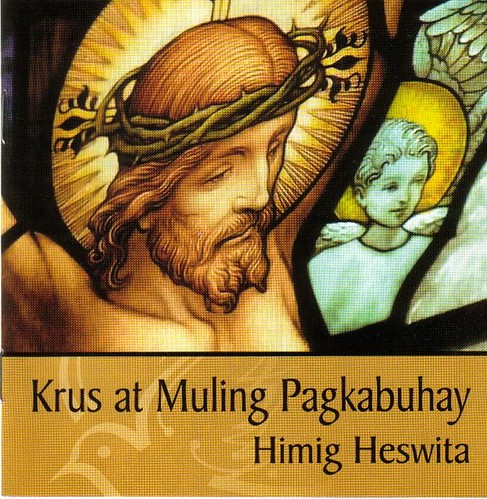
Obviously, this still doesn’t meet our requirements for self-edification.  Our last hope is “Krus at Muling Pagkabuhay” from Himig Heswita of the Jesuit Communications Foundation at the Ateneo de Manila University, published in 2003.   

 
This promisingly offers fourteen different “Pasyon Himig” (chant melodies), which the authors each characterize as possessing one of several possible qualities: “angkop sa karaniwang salaysay” (appropriate for normal narratives), “angkop sa bahagi ng salaysay na tigib ng hapis” (appropriate for sorrowful parts of the narrative), “angkop sa mga salita ng Panginoon” (appropriate to lines spoken by the Lord), and so on.

Interestingly, the texts used in this recording are not from the old traditional Pasyon texts, but are taken from the “Aklat ng Pagmimisa sa Roma,” or the Roman Missal in Tagalog, published in 1981.  This ensures that all its contents are liturgical and orthodox, rather than simply traditional or, worse, folksy.

It then becomes a simple matter of matching up the texts, which cover Palm Sunday to Easter Sunday, to the appropriate chant melodies, as to whether they are meant to be sad, happy, and so forth.

The first two of the fourteen chants are probably the most common, and should be familiar to just about any Holy Week church-goer in at least the Tagalog-speaking regions.  In fact, from my childhood listening experience, these two are always used together, with the first used for the odd-numbered Pasyon stanzas, and the second used for the even-numbered ones.  Here are the words of Himig 1 and Himig 2 here (even if they’re not arranged in the manner that I’ve just described):  

Himig 1 
Poong makapangyarihan 
Lumikha ng sanlibutan 
lupa’y iyong inilagay 
nang matatag at matibay 
sa tubig ng karagatan 

Himig 2
Kay Kristo, Haring Mesiyas
Sumalubong nang may galak
Taglay ang manga palaspas
Manga batang iyong anak 
Jerusalem na mapalad 

In my view, this is valuable not only because it offers the fourteen different Pasyon chant melodies as previously mentioned, but also because it comes fully documented with a book with complete liturgical texts beyond the ones included in the recording.  In fact, beyond the texts set to Pasyon chant, the album includes a “bonus track” at the end, a popular hymn frequently used in the Mass, “Pag-Ibig Mo, Ama.” 

Moreover, the book includes the printed musical notation so that your pianist or organist (or a musically-literate guitarist who can play from musical notes rather than guitar chords) can play the main melody so that the singers can follow, as well as improvise the chordal and bass accompaniment.

I would have, however, preferred to listen to a wider variety of voices, as all of the singers in this album seem to be young, male, and Atenean.  This is rather unlike the typical Pasyon singer, who would be older, female, and possibly a full-time homemaker in one of the Tagalog-speaking provinces around Manila.  I’m sure some small effort could have been expended to find other good singers who could have lent some authenticity to this recording.  

It would also have been better to make use of other accompanying instruments other than a synthesized piano – for example, a normal guitar, or a small electric organ, as this would probably be a more typical accompaniment as well.  Or why not even unaccompanied, but harmonized, vocal arrangements, in two, three, or four parts?  

My final beef with this recording is that, even with the ubiquitous Himig 1 and Himig 2, the recorded performances are not perfectly accurate – based on my hearing, they’re not the sung in the same way, meter- and beat-wise, as how they are sung even today in Bulacan.  And the harmonized accompaniment too is inferior to what is used and played in places like Malolos.  Not really being a trained musicologist, I can’t really explain it in precise musical terms, but one only needs to visit Barasoain Church on Holy Thursday or Good Friday and compare how the choir and congregation sing these two melodies versus the recorded versions here.

Overall, though, this is a worthy effort and fills a huge gap in our knowledge and understanding of this most important form of Philippine religious music.  But we still want to listen to an authentic field recording that documents an actual Pasyon “performance.”  It doesn’t have to be the whole eighteen- to twenty-hour saga of the entire Pasyon book, and video is a nice bonus but is not an essential.  Hopefully, some day, one such recording will turn up, and it will be a good one too. 


Originally published on 18 March 2007.  Text copyright ©2007 by Leo D Cloma. The moral right of Leo D Cloma to be identified as the author of this work has been asserted. Musical examples are owned by their respective copyright holders and are used only for review and demonstration purposes. 

Original comments:


illuminati1 wrote on Jul 19, '07
thanks for the download and lyrics


tandang1 wrote on Feb 1, '08
can u tell me where I can get a downloadable copy of the words of Tagalog Mass please?
You can contact me at kevin@padrepio.org.au


rally65 wrote on Feb 12, '08
Sorry, I don't actually know where the Tagalog mass text may be downloaded from. I suggest that you try doing an internet search.


ivanrondelsalditos wrote on Mar 7, '08
can i have the chords? for himig 1 and himig 2? please?


ivanrondelsalditos wrote on Mar 7, '08
salamat


rally65 wrote on Mar 8, '08
The music for the pasyon himig examples is given in the book. Please try to get the book and look for the chords in there.


pabasa2011 wrote on Apr 15, '09
For the benefit of the Filipino children born outside the Philippines do you think it's possible to have the pasyong mahal translated in English? The tradition is brought over here in California (at least) and it will make more sense and perhaps draw their interest (even other nationalities') if they could at least "pray" or "sing-along" with it.

Thanks.


rally65 wrote on Apr 15, '09
That's certainly a good idea. I just don't know who might be capable of undertaking this initiative (translating musical lyrics from one language to another while retaining "sing-ability" is always a challenge). Hope someone steps forward.


XXVII. Cantat Bis Orat, Part Three – King David’s Songbook with the World’s Two Best Choirs


“To sing is to pray twice” wasn’t lost at all on the ancients – it is sometimes easy to forget that the Old Testament has a fair number of examples of musical material, from the obviously-titled Song of Solomon (also called the Song of Songs) to the Lamentations of Jeremiah (better sung than wailed).   Our clear modern-day favorites are the Psalms. The ancient Greek word meant “songs sung to a harp,” but harpists were not always readily available throughout the past three-odd millennia, so since two thousand years ago, “psalms” simply became synonymous with “songs.”


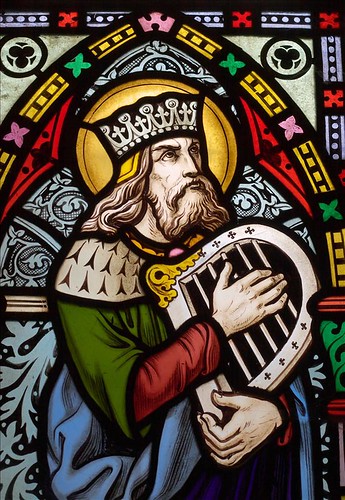
Traditionally, the Psalms are attributed to King David (of David and Goliath fame), who is said to have based his song-writing output on the works of earlier “psalmists” including Adam and Moses.  Since we don’t have any of Adam’s or Moses’ songs on-hand, it is difficult to say just how closely David copied his forebears’ styles.  Which is just as well, I suppose. 


In reality, even though about half of the one hundred and fifty numbered Psalms include David’s name, they are all most likely the work of several authors, or groups of authors.  Since they weren’t formally written down in Hebrew until nearly half a millennium after King David reigned, they must have relied on recited and / or sung transmission of any materials actually originating from David.

Psalms have always been in use for worship throughout Christian history.  The Holy Mass always includes a Responsorial Psalm, which is nothing but a rearrangement of the Psalm texts into verses with an antiphonal response from the congregation.  This is often sung, though you’d be lucky to have a good cantor to sing the verses and a good song leader to teach the congregation how to sing the response properly.   

There are also many musical arrangements of the Psalms, in English, Pilipino, or other Philippine languages, in current use throughout the Philippines.  Of course, these are not appropriate to be sung in place of the prescribed Responsorial Psalm for the day’s Mass, unless the texts actually refer to the same Psalm.  We’ve also already heard a Taizé example of a setting of Psalm 34, “Qui regarde vers dieu resplendira” (Look to God and you will shine), and in fact there are numerous other Psalm settings in the extensive Taizé repertoire.


We now look at a sampling of different Psalm settings, from other musical traditions, starting with “Anglican Chant.”  This refers to the practice in the Church of England (i.e., the church originally established by Henry VIII to break-away from the Roman Catholic Church) of chanting the Psalms to English texts, using a simple harmonized melody in seven, fourteen, twenty-one, or twenty-eight bars.  The precise melodies and harmonies evolved from the 16th century onwards, but were probably pretty much established by the 18th century, and were fully developed in the Victorian era, with chant settings authored by distinguished English composers in the 19th century, as we’re about to hear.

First is a setting of Psalm 84, “O how amiable are thy dwellings” with a chant composed by Sir Hubert Parry (1848-1918).  This is from the album “The Sound of King’s,” (EMI CDZ 7 62852 2) an anthology of choral works performed by what many say is the world’s best choir, the Choir of King’s College, Cambridge. 


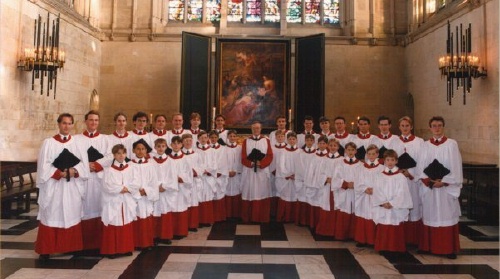
Here is a recent photograph of the choir in their home chapel in King’s College, a famous structure with acoustics that make them sound even better than they already do to begin with. 


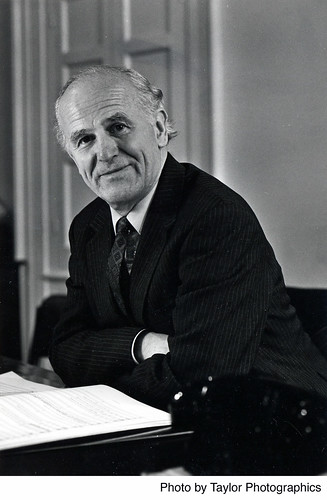
In their rendition of Psalm 84, which dates from 1969, they were led by their then Director of Music, the venerable Sir David Willcocks, who retired in 1974, but is still an active musician to this day.


The choir recorded all one hundred fifty Psalms in Anglican Chant during Mr. Willcocks’ tenure there, with him usually playing the small accompanying pipe organ. This allowed the choir to demonstrate various variations of Anglican chant – including where verses are sung alternately by the higher voices (boy sopranos and male altos) and by the lower voices (tenors and basses), or by half of the choir (half of the sopranos, altos, tenors, and basses), and then by the other half. 

As a matter of fact, choirs in Anglican churches are usually positioned into two halves straddling the nave of the chapel or church, with the halves referred to as “cantori” (the half positioned on the cantor’s side) and “decani” (the half positioned on the dean’s side). So depending on the chant arrangement used, one could achieve a “stereophonic” effect with volume increasing or decreasing, and shifting from left to right to center. I recommend listening to their recording of Psalm 84 again and try to see what dynamics were used by the King’s College Choir with Parry’s chant arrangement.


After Mr. Willcocks retired, he was succeeded as Director of Music by Sir Philip Ledger, who also made many recordings with the choir. 


In 1978, they recorded Choral Evensong for Ascension Day,” (EMI DCM 5 65102 2) a recording of the service for that feast day. The program included a setting of Psalm 24, “The Earth is the Lord’s,” with a chant composed by Sir Joseph Barnby (1838-1896).


From these two tracks, one may observe that despite the gap of nearly a decade and the leadership of two different conductors, the choir’s sound has not changed at all. It is indeed paradoxical that despite the fact that the choir’s membership constantly changes – the boys’ voices break and therefore trebles usually stay in the choir for no more than three years, and the choral scholars leave the choir after graduation from the university – the choir sounds exactly the same from year to year. Just another example of how a religious musical tradition is transmitted through the ages – perhaps directly, in a manner of speaking, from old King David himself!

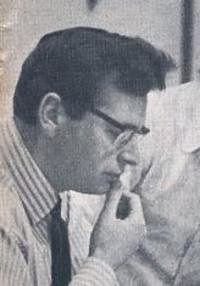
The current Director of Music at King’s College, Cambridge is Stephen Cleobury, who succeeded Mr. Ledger in 1982. 


He too has recorded prolifically with the choir. In the album “The Sound of King’s” cited earlier, there is a recording of “Miserere mei, Deus” (Have mercy on me, O God), made in 1984, not long after Mr. Cleobury took over.  This piece is a setting of Psalm 51 composed by Gregorio Allegri (1582-1652), priest, composer, and member of the Sistine Chapel Choir in Rome. 


(A 1987 version of the piece conducted by Stephen Cleobury by the King's College Cambridge)

(Another version of the piece)

The well-known story about this piece is that to preserve its exclusivity, the church forbade copies from being published. That changed when the fourteen-year-old Wolfgang Amadeus Mozart, visiting Rome in 1770, heard it performed, and transcribed it from memory.  It is not difficult to hear why the choir would have wanted to keep the work to themselves, or why the young Mozart would have wanted to write it down after hearing it – the choral arrangement is both sublime and striking, perfectly suited to a musical work of repentance and penance. It being the Lenten season now, this work, usually performed on Ash Wednesday, is an entirely appropriate musical reflection for us at this time.

Psalm 51, “Miserere mei, Deus”


Miserere mei, Deus,
secundum magnam misericordiam tuam;
et secundum multitudinem miserationum tuarum,
dele iniquitatem meam.
Amplius lava me ab iniquitate mea,
et a peccato meo munda me.

Have mercy on me, God,
in accordance with your great mercy;
and in accordance with the greatness of your pity,
destroy my wrong-doing.
Furthermore, wash me of my wrong-doing,
and cleanse me of my sin.

In reality, this is an abridged version from the original recording, and includes only verses (stanzas) 1 to 4 and 17 to 20.  There are several famous recordings of this venerable work truly worth dipping into, with perhaps one of the first all-time classical lollipops being a recording made, in an excellent English translation, by the Choir of King’s College, Cambridge also, way back in March 1963. The soloist who hits all those other-worldly high C’s was a boy treble in the choir named Roy Goodman, who has since had an outstanding performing and recording career as a violinist, keyboardist, and opera and orchestral conductor. Try to look for this original recording, now reissued on a CD album titled Allegri: Miserere (Decca 466 373-2).


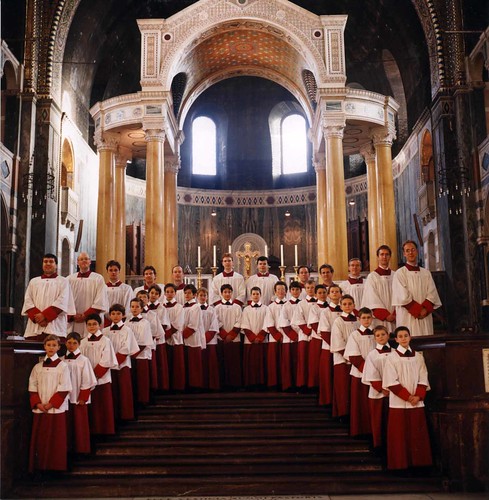
If you want to listen to Allegri: Miserere in the original Latin, the best recording that I have listened to is the one by what I think is the best choir in the world (despite what the King’s College Choir fans might say) – the Choir of Westminster Cathedral in London. This is the major Roman Catholic Cathedral in the UK, so I’m probably biased on at least two counts: (1) I’m a Roman Catholic, and (2) I’ve actually attended Sunday High Mass in the Cathedral with the choir on hand on a few occasions. But I’m not the only one who thinks they’re outstanding – they are among the most awarded choirs in the world, with Gramophone Awards received for some of their recordings, and they continue to sell plenty of CDs of their recordings, of which they make frequently.


(a recent recording of the piece from the Choir of Westminster)


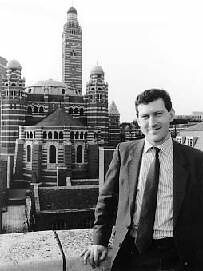
Credit must likewise go to the choir’s Master of Music, James O’Donnell, who joins a distinguished roster of choir directors since the Cathedral was founded about (only!) a hundred years ago.


Interestingly, Stephen Cleobury was Master of Music at Westminster Cathedral prior to moving to King’s College, Cambridge. And in 2000, Mr. O’Donnell was “pirated” by nearby Westminster Abbey (an Anglican church), to be succeeded by a former student, Martin Baker, who now leads the choir in its daily sung Masses and Vespers, probably unique in the Roman Catholic world.

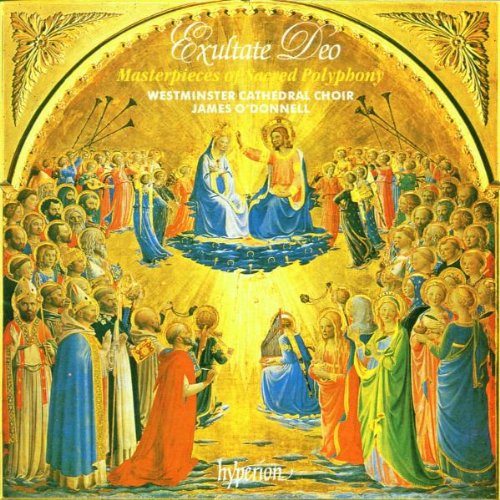
Again, their Allegri: Miserere lasts nearly twelve minutes.  I do strongly recommend the album that it comes from: Masterpieces of Sacred Polyphony; Westminster Cathedral Choir, directed by James O’Donnell. This was recorded in 1995 and is published as Hyperion Records CDA 66850. 


The last track in that album is a six-voice choral setting of Psalm 97, “Cantate Domino,” composed by the late renaissance-to-early baroque composed Claudio Monteverdi (1567-1643).

Cantate Domino canticum novum,
cantata et benedicite nomini ejus,
quia mirabilia fecit.
Cantate et exultate et psallite,
psallite in cithara et voce psalmi,
quia mirabilia fecit.

Sing to the Lord a new song,
sing and bless his name,
for he has done marvelous things.
Sing and rejoice and sing praise,
sing praise with the lute and with the sound of a hymn,
for he has done marvelous things.

This joyous setting, perfectly matched to this very popular Psalm’s message, is most exuberantly delivered by Mr. O’Donnell’s full-throated boys (sopranos and altos) and men (countertenors, tenors, and basses) in the expansive acoustic of the Cathedral. To my ears, this piece is a short (two-and-a-half minute) but solid demonstration of why this is the best choir in the world.

Have another listen and see if you don’t agree that they make old King David proud. And the Lord Himself as well, no doubt.


Originally published on 18 March 2007.  Text copyright ©2007 by Leo D Cloma. The moral right of Leo D Cloma to be identified as the author of this work has been asserted. Musical examples are owned by their respective copyright holders and are used only for review and demonstration purposes.