Showing posts with label filipino. Show all posts

Friday, July 29, 2016

CXXXIII. Give Art on Christmas Day 2015

We were introduced to this year’s Christmas card artist by an old friend from Bulacan who happened to be the artist’s aunt.  She was all praises for her nephew, which made me a bit sceptical because, you know, if you can’t rely on your kin to give you an endorsement, you’ve got other bigger problems.

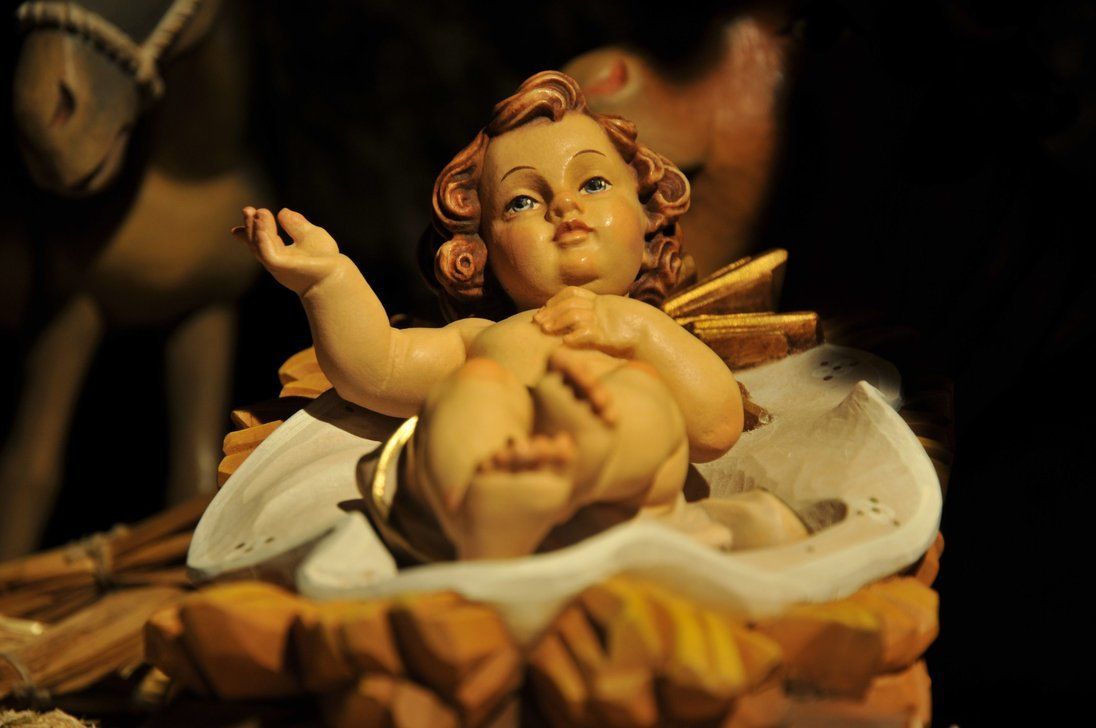
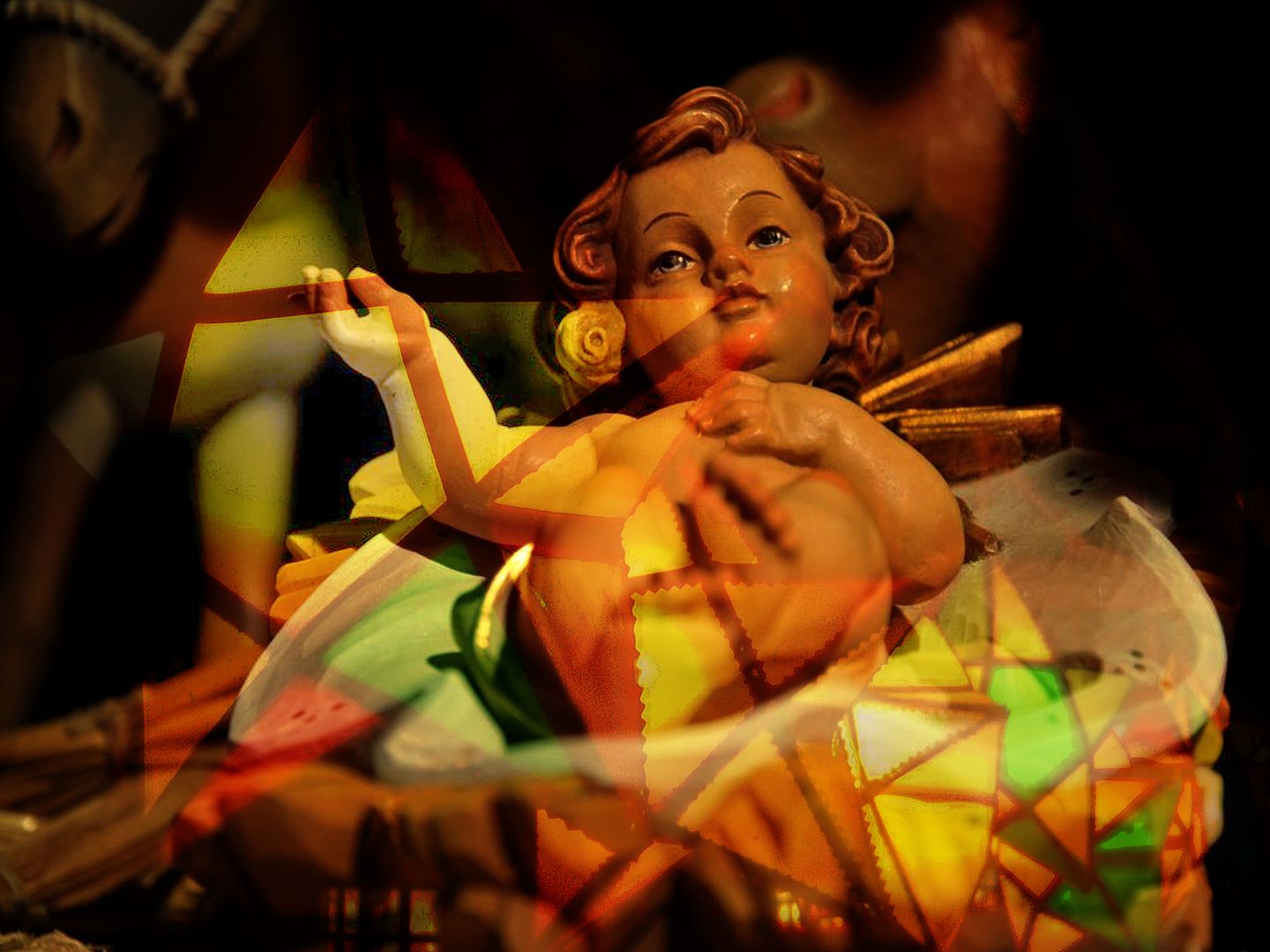
I contacted the artist and asked him to send me some ideas for Christmas-appropriate themes.  In due course, he sent me some interesting snapshots that he had done adapted into studies, including this series on the Christ-Child in the manger:


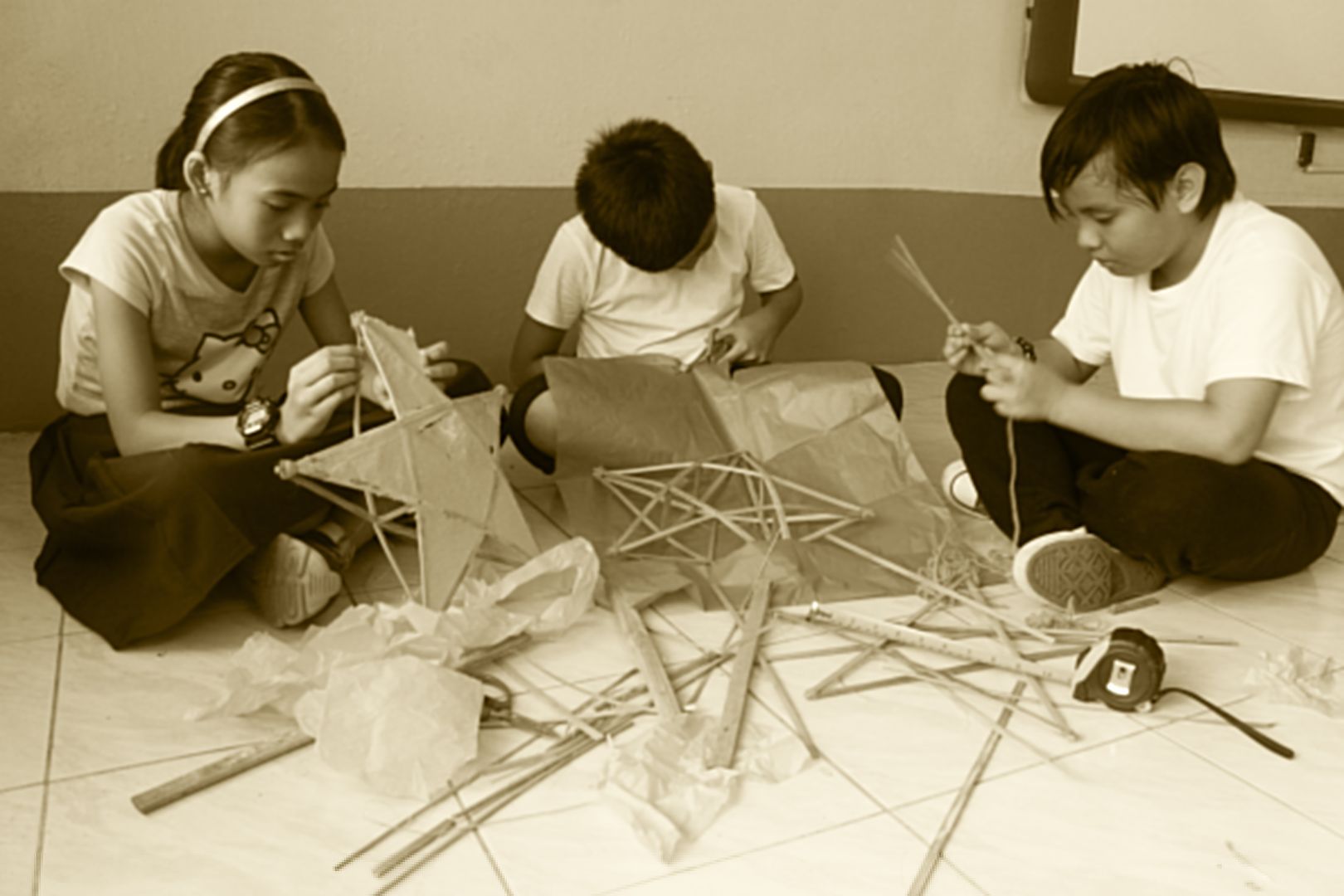
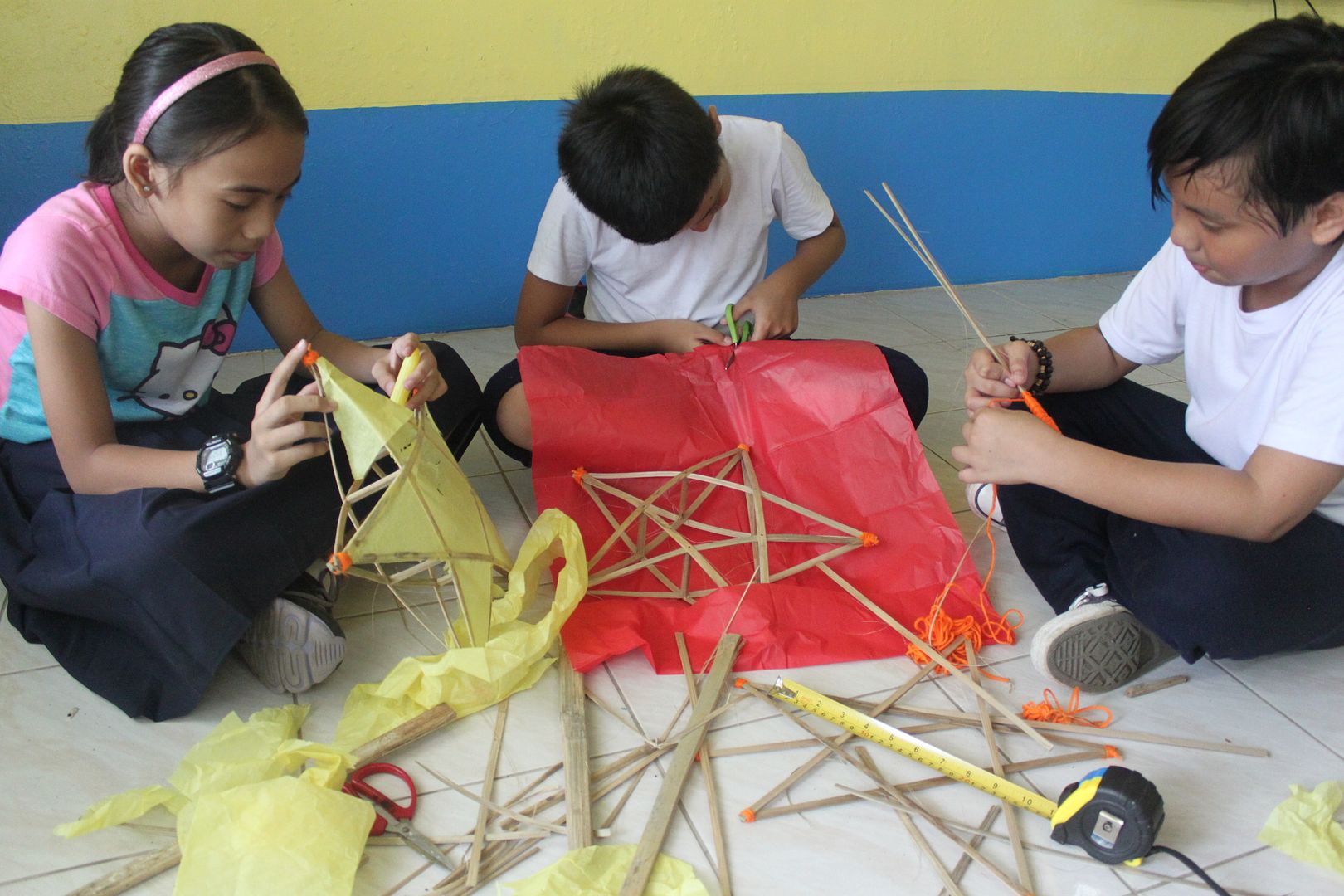
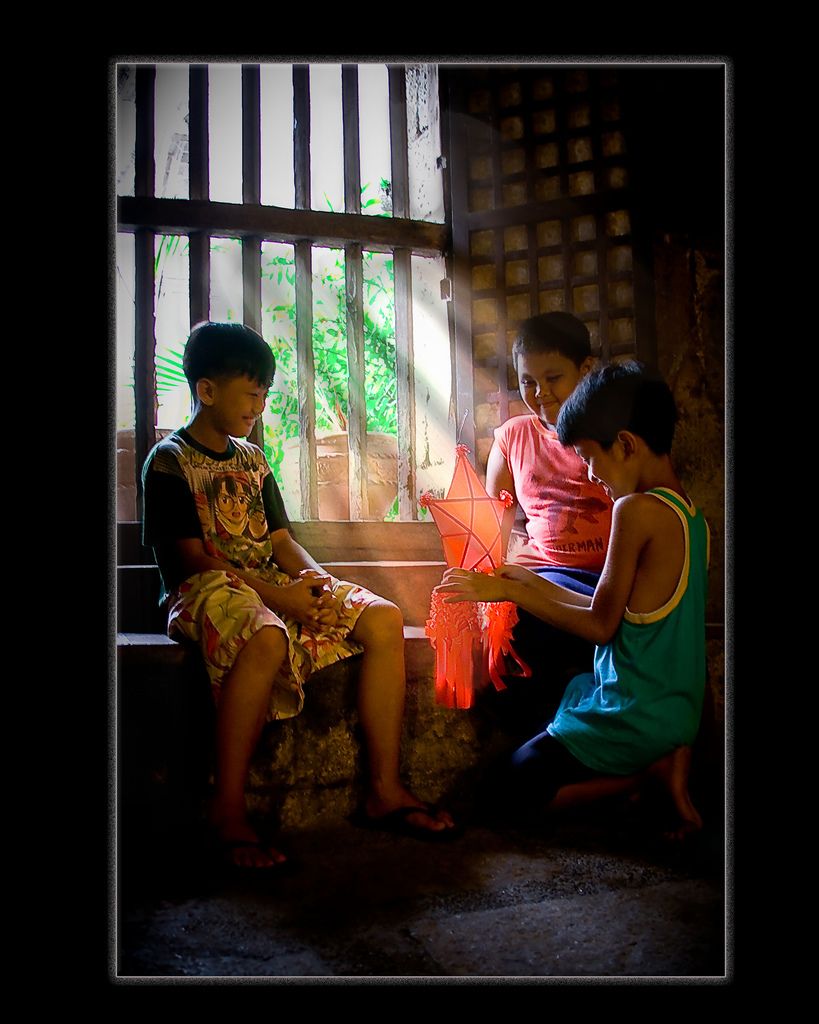
Rather more interesting was a set of photos and studies of children making Christmas lanterns:


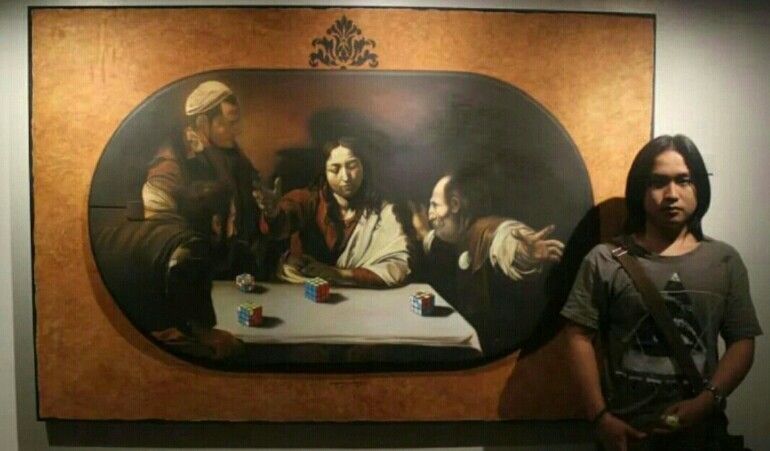
It was becoming apparent to me that this artist had a distinctive style – photorealistic, certainly, but irreverent as well.  Here is his take on a famous Caravaggio painting of “Christ at Emmaus”:


The artwork is painted on a salvaged hardwood tabletop, seen to scale in this shot of the artist beside it:


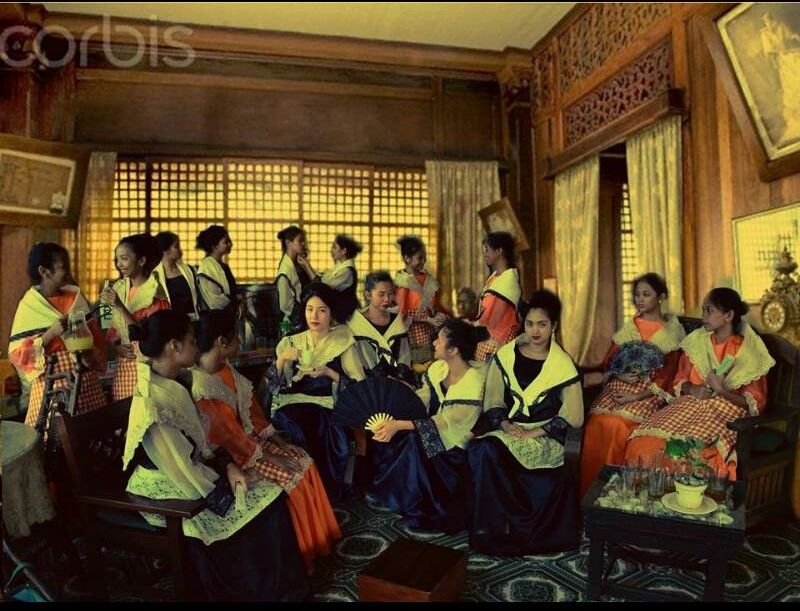
At the time we were discussing our Christmas artwork, he was also planning a large-scale painting on “The Women of Malolos”, inspired by the group of young ladies made famous by Jose Rizal’s letter to them in 1889.  Here is the photograph that he staged for this project:


And one study that came out of it is this one:


He said that he had not yet begun this artwork as he had not yet found a taker for it, possibly because its large size (eight feet wide by four feet tall, or even larger if desired) will require a special place.  So if you happen to have a large blank wall in your home, and are game for something that will definitely be noticed by visitors and talked about, why not go for this?

Our artist’s most famous artwork to-date (possibly now challenged by our Christmas card) is this prize-winning masterpiece from two years ago, “Natalo Ako”, about which more later.


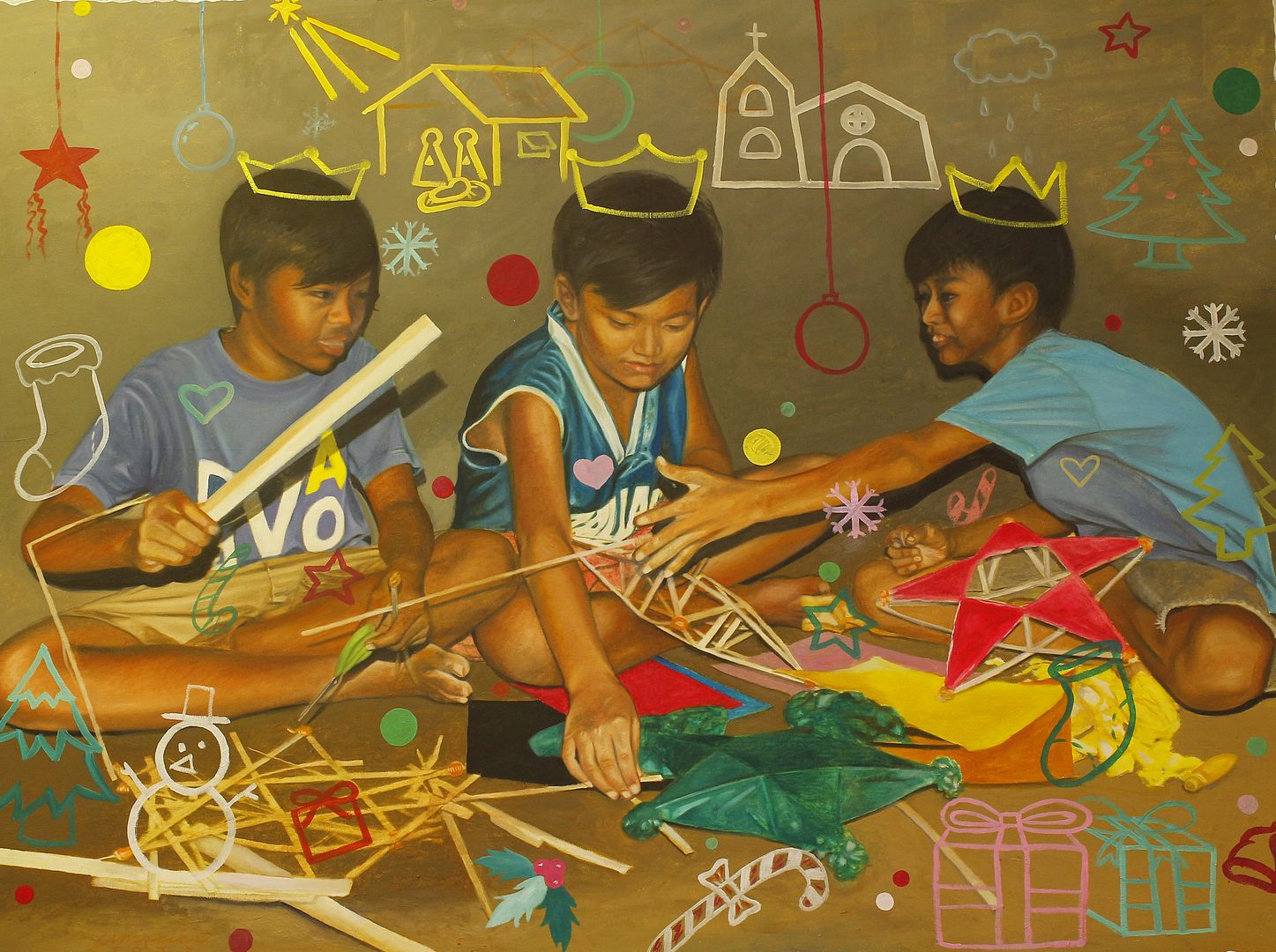
Returning to our Christmas artwork, we eventually converged on the subject of children making Christmas lanterns.  Here it is in production in the artist’s home workshop:


The finished artwork is our largest Christmas piece ever, measuring four feet wide by three feet tall:


Kiko Marquez
“THREE KINGS”
Oil on canvas
36” x 48” / 91 cm x 122 cm
2015


Born in 1993, Jay Roque Aguinaldo Marquez is a native of Hagonoy, Bulacan, and is pursuing a bachelor’s degree in Fine Arts at the Bulacan State University in Malolos City.  Despite his relative youth, Kiko is already a prolific painter, illustrator, photographer, and layout artist.  He has participated in several group exhibitions including those at ManilART (SMX MOA, 2012), at the Art Center (SM MegaMall, 2013), and at the Philippine International Art Fair (SM Aura, 2014).

Kiko Marquez’s artworks might be described as “photorealism with passion,” most famously exemplified by his grand prize-winning work, “Natalo Ako,” for the Shell National Student Art Competition in 2013: what first appeared to be a blown-up photograph of a freshly-harvested human heart but upon closer examination is revealed to be a hyperrealistic image resulting from numerous brush strokes and several layers of oil paint.  In many of Kiko’s works, photorealism is also combined with what might be thought of as “controlled whimsy,” as in the carefully-positioned doodles in this Christmas-themed artwork, “Three Kings.” 

Contact Kiko Marquez and view his other artworks via his Facebook page: https://www.facebook.com/jhaypixelated

And so, from Kiko via me and my family,

Merry Christmas and a Happy New Year!

Maligayang Pasko at Manigong Bagong Taon!


Originally published on 3 January 2016.  All text and photos (except where attributed otherwise) copyright ©2016 Leo D Cloma. The moral right of Leo D Cloma to be identified as the author of this work has been asserted.

Thursday, July 28, 2016

CXXXII: Give Art on Christmas Day 2014

This year, we had started really early in commissioning our Christmas card artwork.  Soon after the New Year, we had already zeroed in on the artwork.  In truth, we had contacted him the year before, but previous commissions had made it difficult for him to accept one for us in time for Christmas 2013.  Thus, an early start in time for Christmas 2014 was essential.

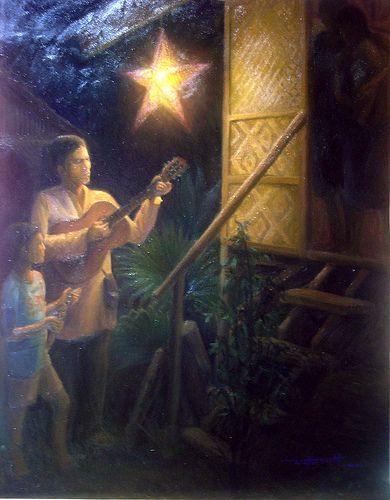
I had first seen one of his artworks online some years back, appropriately enough, also a Christmas subject.


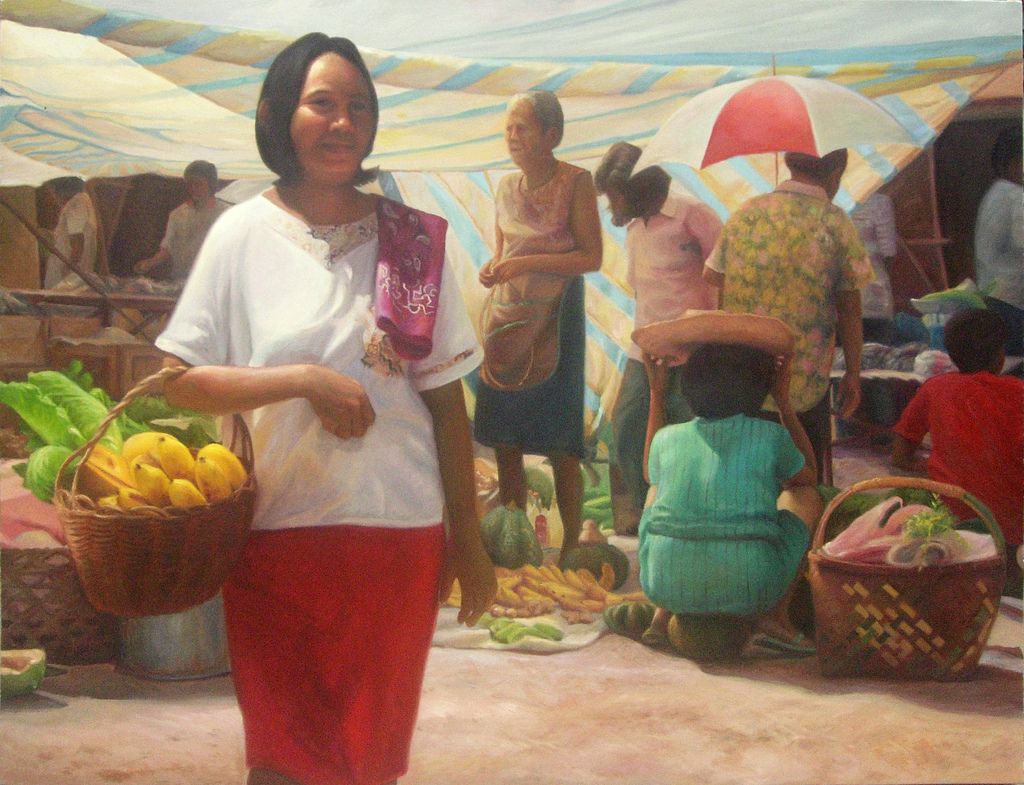
I thought, what a beautiful work, if rather melancholy, which in fact appealed to me.  And very Filipino too.  Later, I located other artworks of his online, on diverse subjects such as a typical market scene,


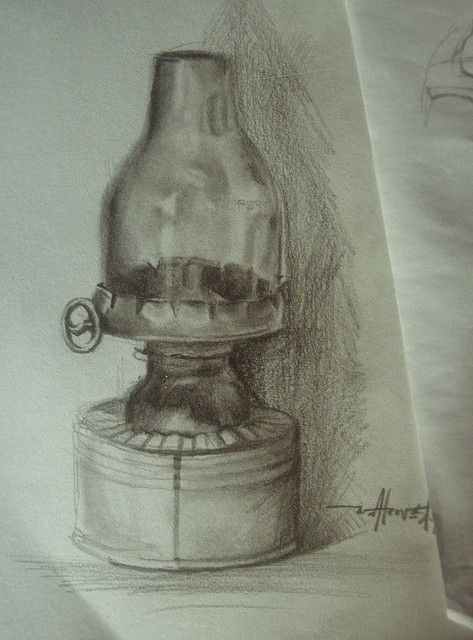
an oil lamp,


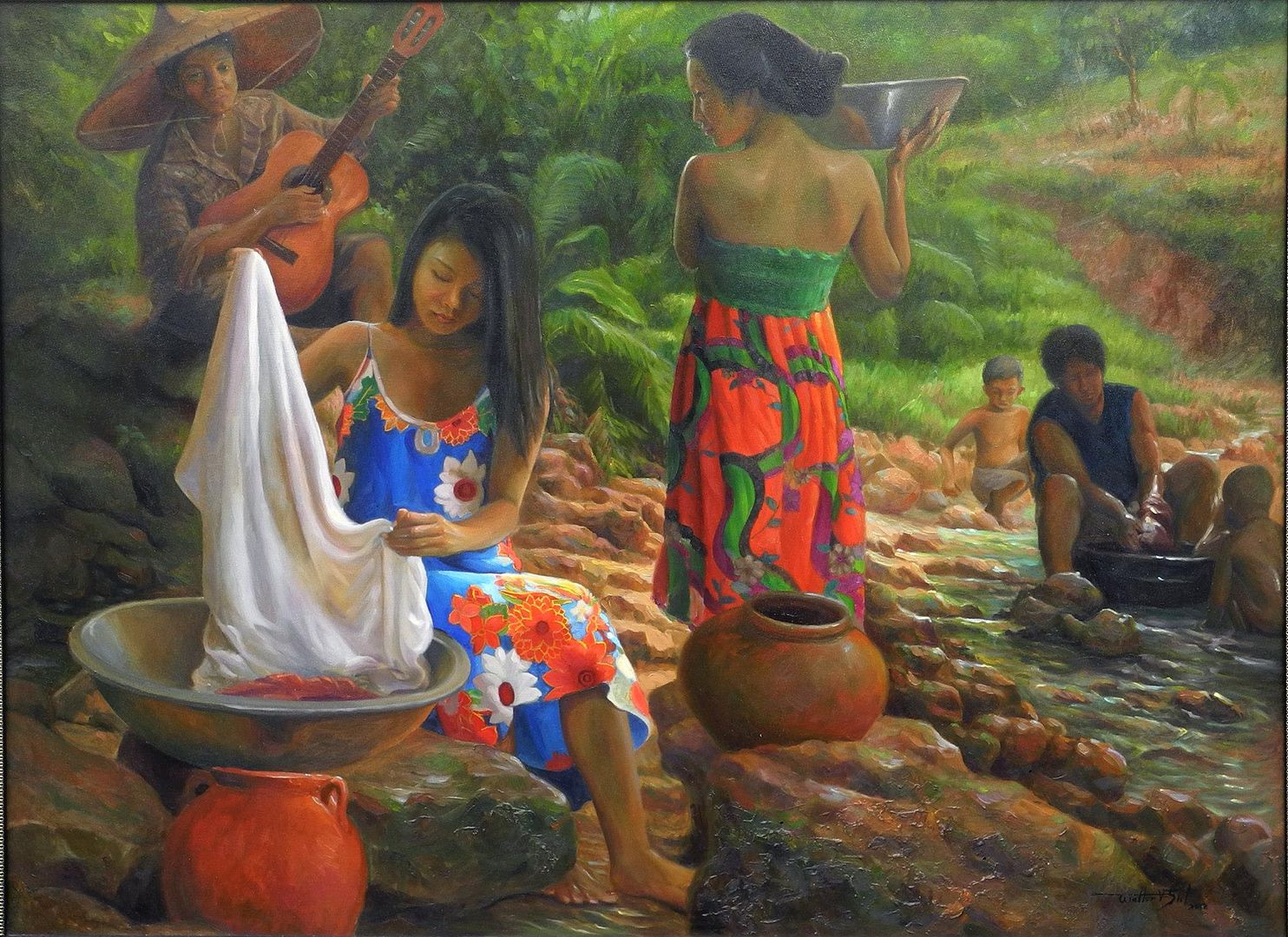
laundry women,


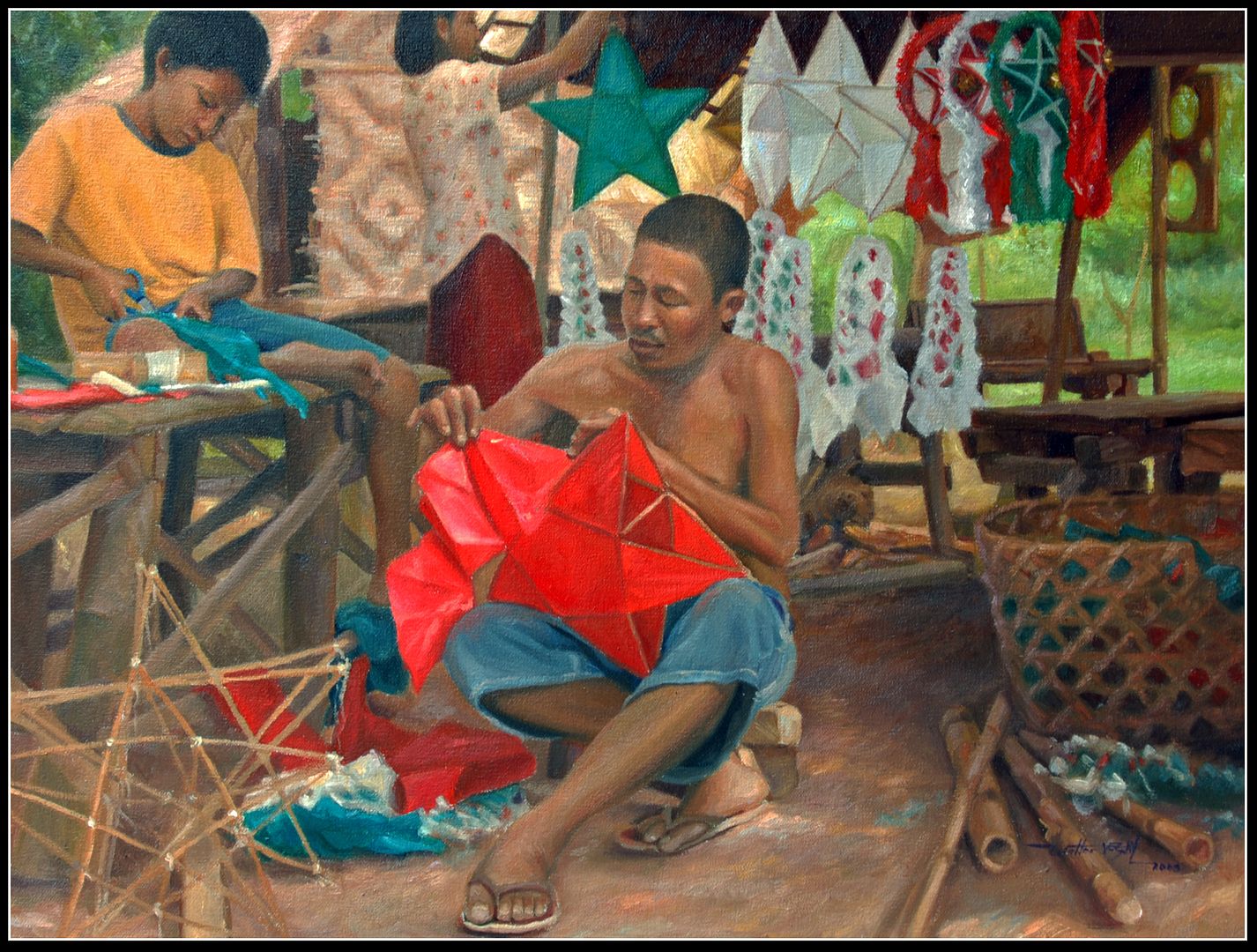
Christmas lantern makers,


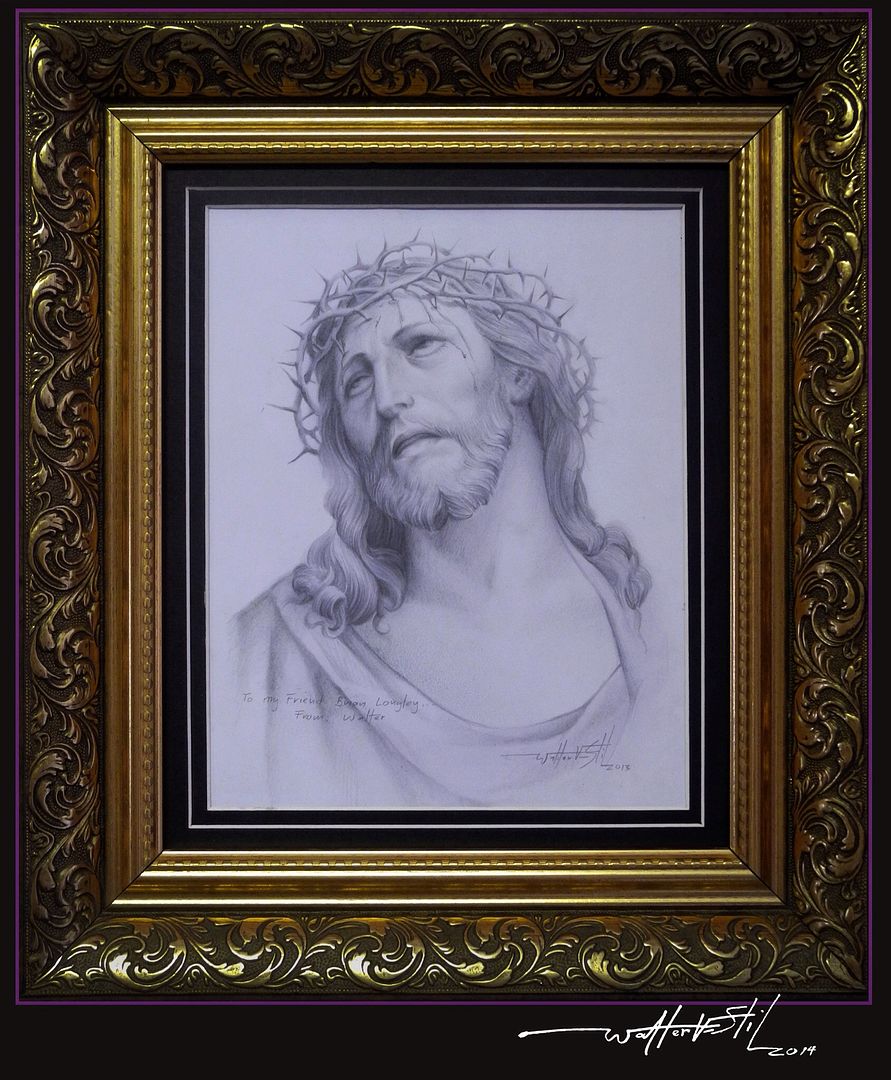
the head of Christ,


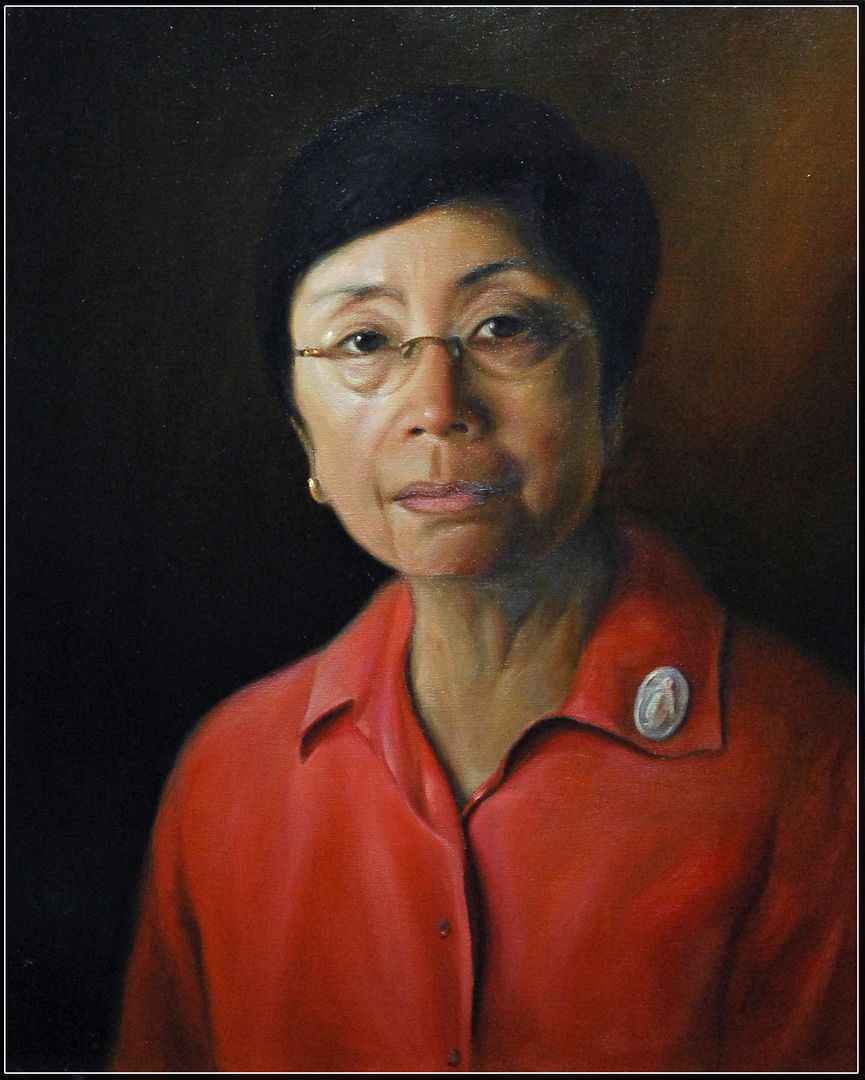
even a portrait of “Sister Vicky.”


Clearly, the artist had sharpened his technique over time to achieve a near-perfect photorealistic style.  I therefore made a mental note to look up the artist one day.  And so, in early 2013, I did.

By mid-2013, when it was clear that any commissioned artwork from him would not make it in time, we agreed to at least think about possible subjects for the following year.  By October 2013, he had sent me some very interesting sketches.  And soon after that, we had come to a consensus as to our 2014 Christmas artwork.

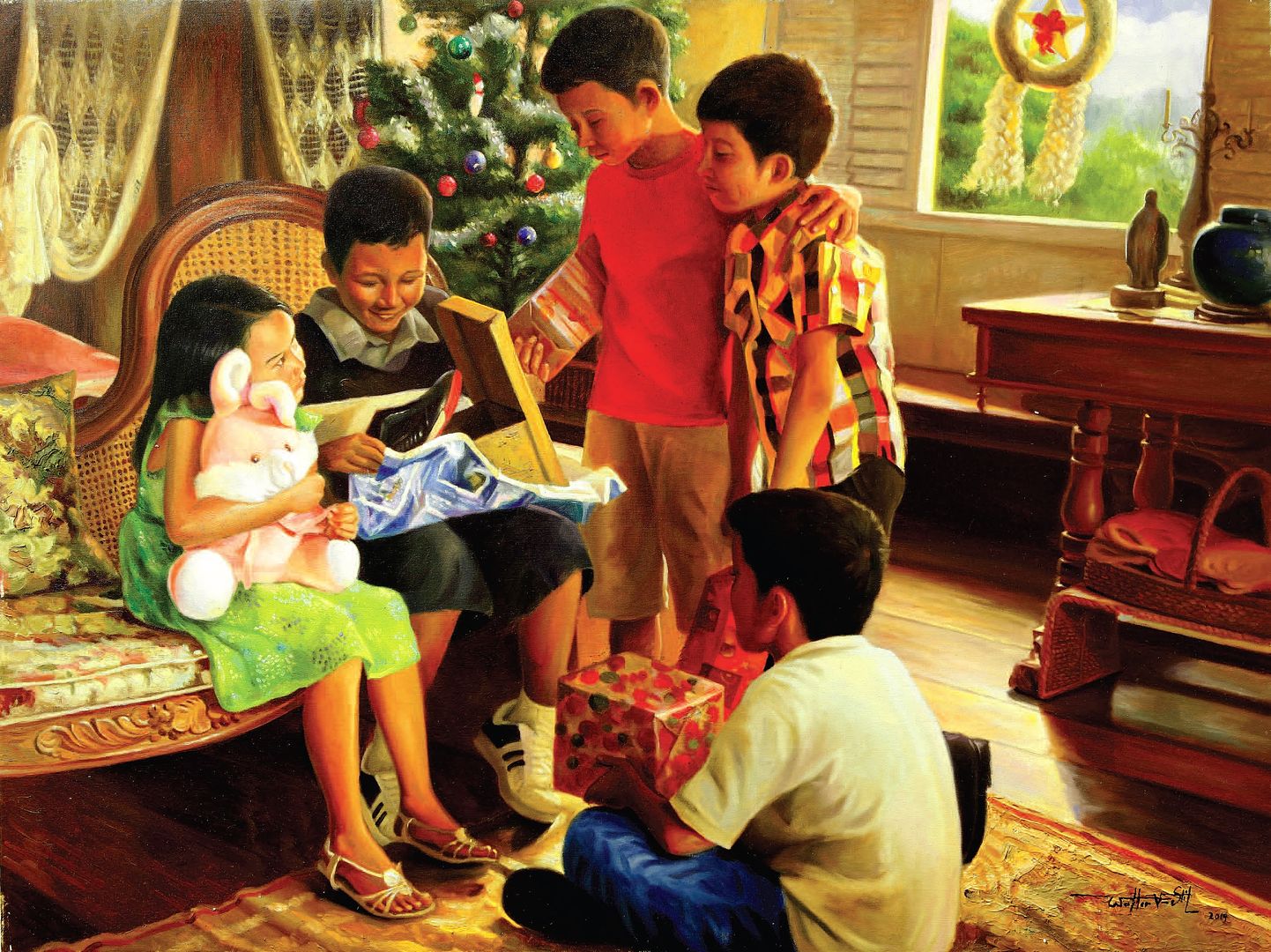
In catechism back in primary school, we were taught that gifts are given on Christmas day to emulate the fabled Three Kings – or the Three Wise Men – actually Magi (literally, “Wise Men”) of indeterminate number, who happened to be bringing along three gifts – gold, frankincense, and myrrh, respectively symbolizing the three aspects of the gift-recipient Christ-Child: His Kingship (gold for kings), His Deity-ship (frankincense for worship in the temple), and His humanity (myrrh for embalming the dead).

While we don’t give each other gold, frankincense, and myrrh for Christmas (although you may still send me you gifts of gold – always welcome, no matter how late!), we still do expend plenty of time, energy, and money on finding the right present for each of the people on our list.  And Christmas mornings are particularly awaited, especially by children, expecting gifts from their godparents, parents, Santa Claus, or each other.

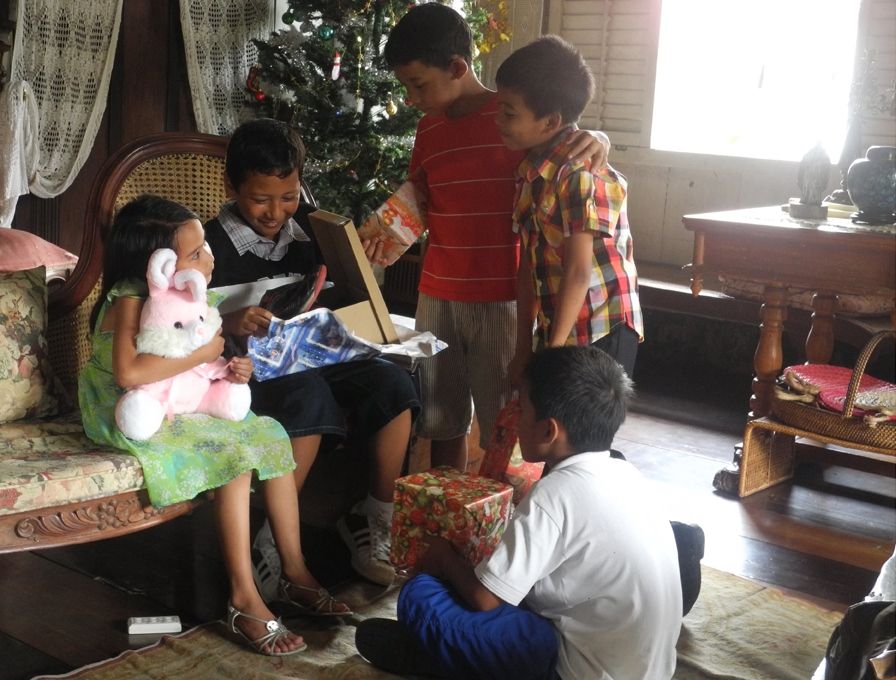
With this agreed theme in mind, our methodical artist gathered some of the neighbourhood children, staged them out-of-season, and photographed them thus:


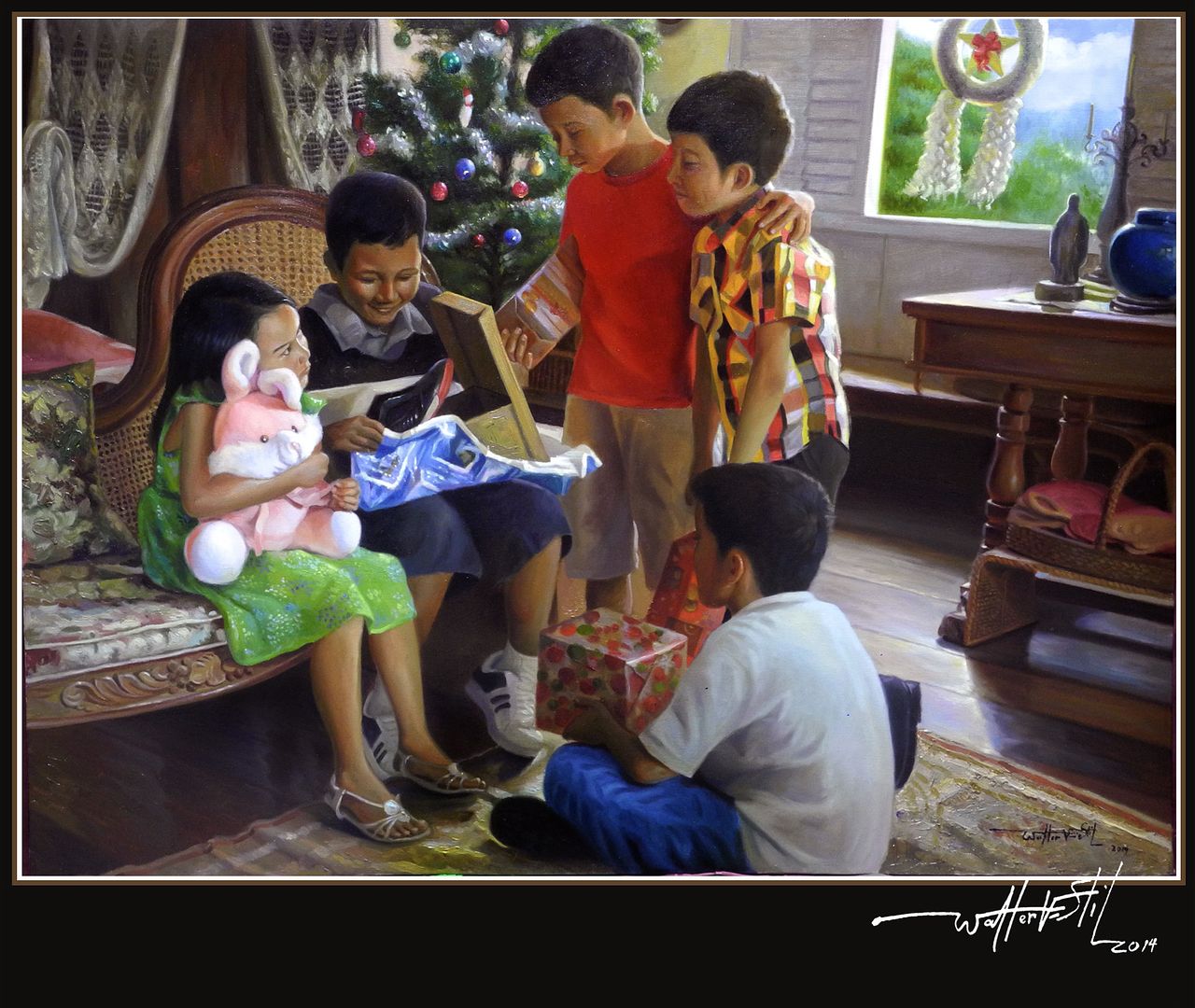
This then became the basis of the actual oil-on-canvas artwork, seen here in progress in March 2014, just missing a few more important details, such as what should hang in the wide-open window:


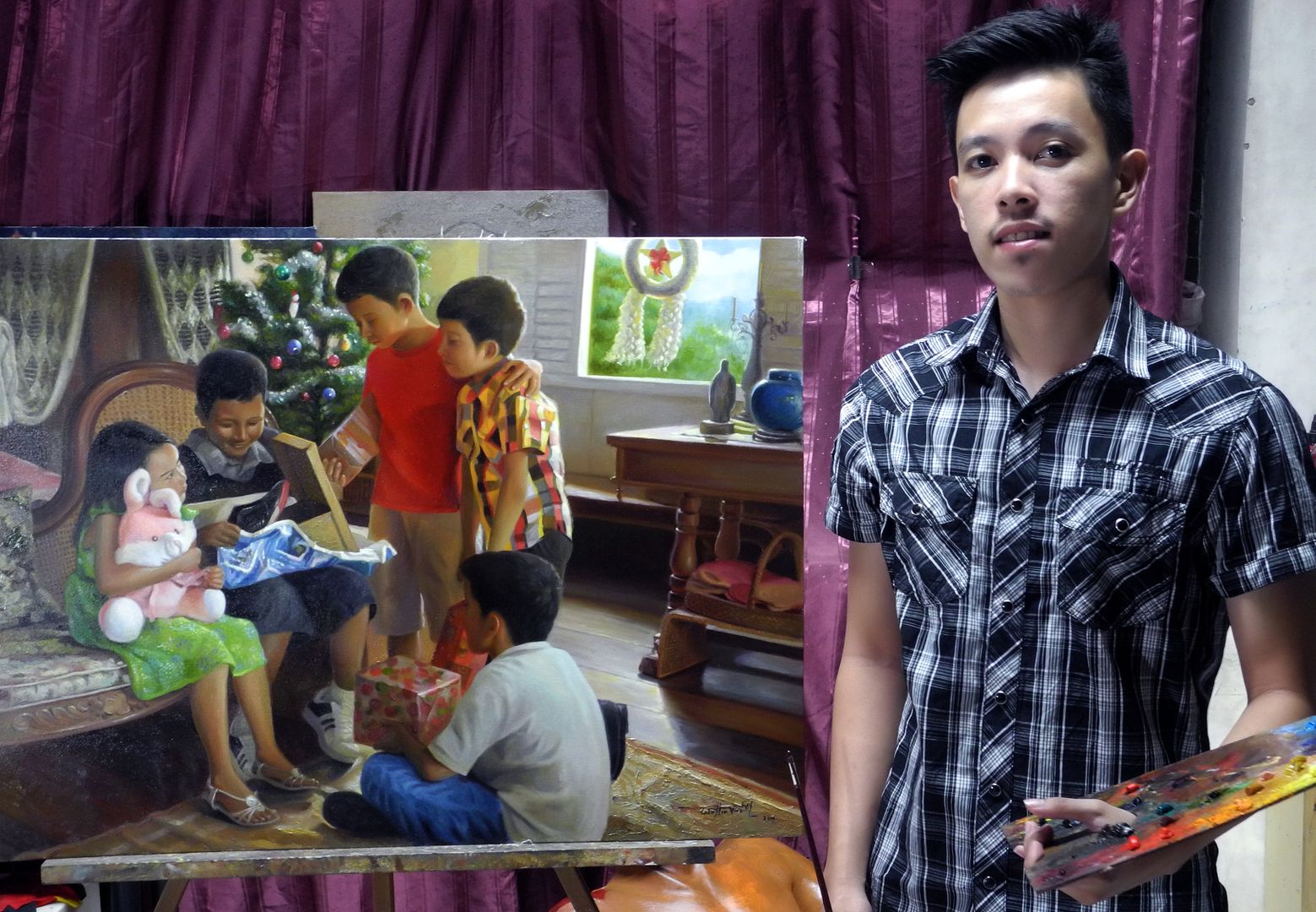
By April 1st, the artist could happily pose with the finished artwork.


And a few days later, it was enroute to us,


ready for professional photographing and eventual preparation for printing as Christmas cards.

There was a bit of a challenge at the printers’ as to how to adjust the artwork’s original colors, as initial print runs would come out too pale, too dark, or otherwise unappealing.  In the end, slightly more magenta seemed to work.  And so here is how the final printed card came out, more or less:


Walter Vestil
“EXCHANGING GIFTS”
Oil on canvas
24” x 32”
2014

*   *   *   *   *

And now, more about our heretofore unnamed artist:


Born in 1988, Walter Vestil is a native of Carcar City, Cebu.  He began his artistic apprenticeship at the age of twelve with master artists Stanley Cui Señires and Facundo Galicano Tallo.  From 2003, he participated in several group exhibits in various venues in Cebu, and was a regular finalist of the annual Martino Abellana Painting Competition beginning that same year, winning the Grand Prize in 2008. 


Walter’s appealing photorealistic style has gained him numerous commissions, including several portraits, from regular art patrons, mainly in Cebu.  “Exchanging Gifts” is only his second commission from outside Cebu.   Email: vanrijn_386@yahoo.com

*   *   *   *   *

And so, on this day the Feast of the Epiphany, (i.e., the Feast of the gifts-bearing Magi, on which day gifts were actually exchanged in times past, only to be supplanted later on by Christmas Day itself due to overly-eager gift-exchangers), my family and I would like to greet you and yours a

Merry Christmas and a Happy New Year!

Maligayang Paskó at Manigong Bagong Taón!

And all our prayers and best wishes for an excellent 2015 and beyond.


Originally published on 4 January 2015.  All text and photos (except where attributed otherwise) copyright ©2015 Leo D Cloma. The moral right of Leo D Cloma to be identified as the author of this work has been asserted.

CXXXI. Give Art on Christmas Day 2013

On this, the eleventh consecutive year of our family’s annual Christmas artwork commissioning, we didn’t have to look far for a suitable artist. 

Actually, that is only partly true, as we had at the outset made inquiries of a fair number of young artists in Manila, Bulacan, and even beyond as early as the start of the year, but they were all otherwise engaged in other projects, commissions, and upcoming one-man (or -woman) shows.  By September, or way beyond our usual internal mid-year deadline, we still had no Christmas artwork forthcoming.

And then, I realized that the answer was right under our noses, as it were.  For the eventual artist was someone whom I had known personally for many years, as his father was our chief electrician for our processional carrozas in Malolos each Holy Week, and he himself had been helping his father out in this yearly undertaking since he was a schoolboy.   The following biographical note provides a fuller backgrounder:

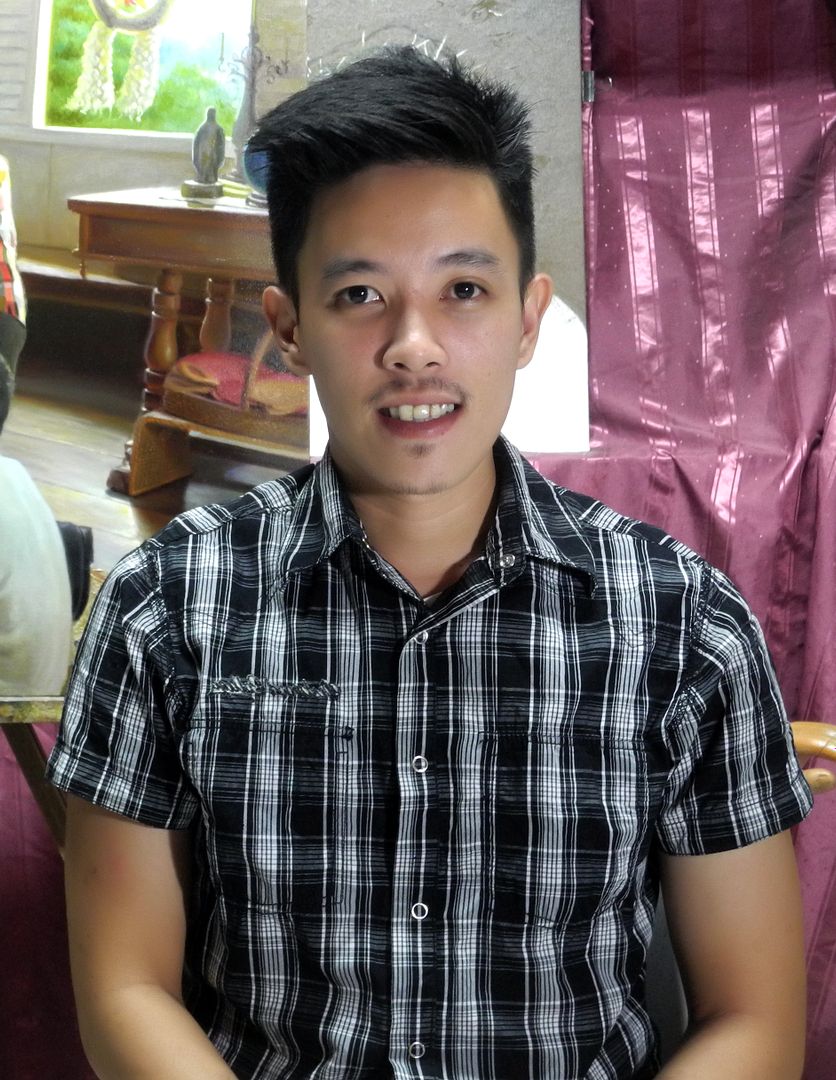
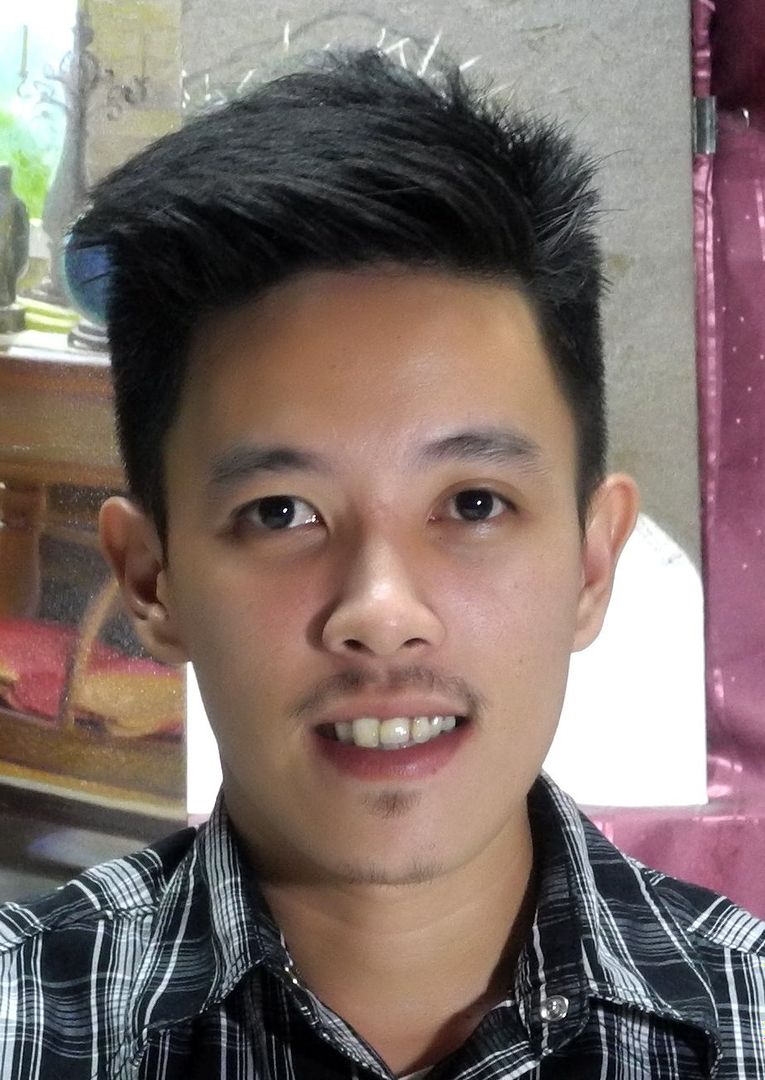
Born in 1991, Mark Christian P. Magno is a native of Paombong, Bulacan.  Christian is a self-taught artist who has been winning school and inter-school art competitions since childhood. 


Apart from the visual arts, his other passion is the culinary arts – he is a trained cook and worked as one after graduation from high school.  Consistent with this, Christian is currently a BS in Hotel and Restaurant Management freshman at the La Consolacion University Philippines in Malolos, Bulacan.  While balancing his artistic and culinary interests with his academic workload, he manages to be an all-around athlete and is also on the university’s varsity basketball team.  On Facebook: https://www.facebook.com/ychan.eunra

What the biographical note does not get into is that originally, his father had thought, or suggested, that the son might pursue a Fine Arts degree in college, as he knew that he was at least skilled in art production and could certainly develop such talents further with proper advanced studies.  The father had told me about this earlier in the year, which I fortunately recalled after all the other erstwhile artist candidates had proven unavailable or unsuitable.

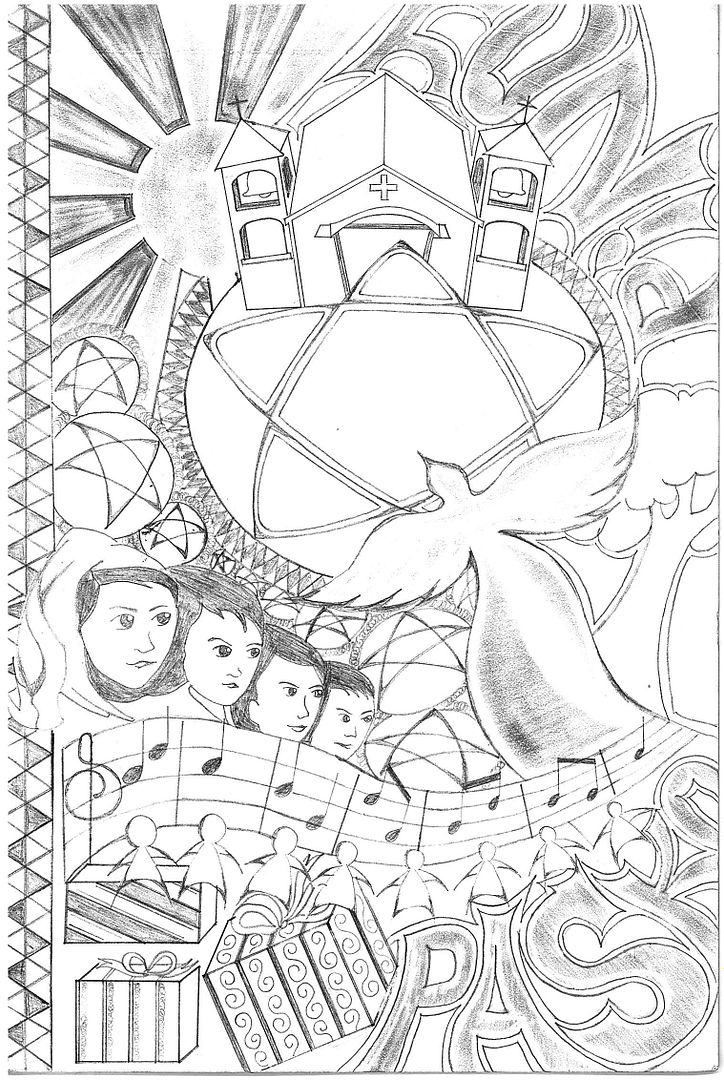
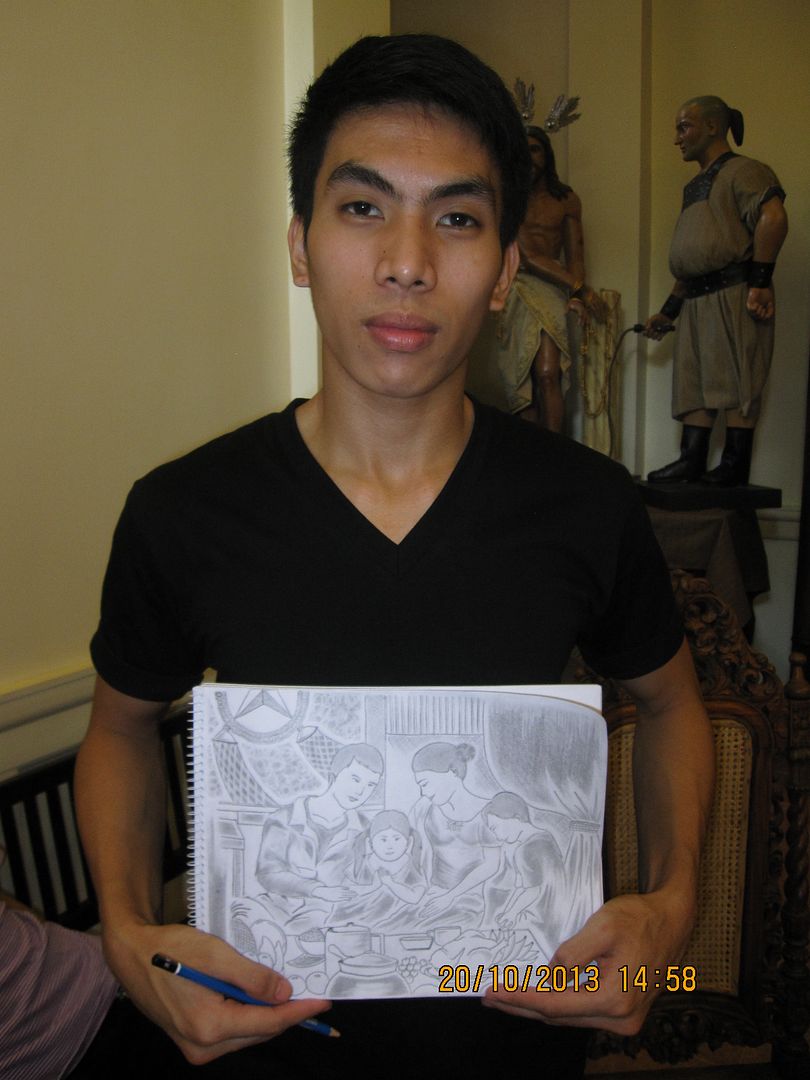
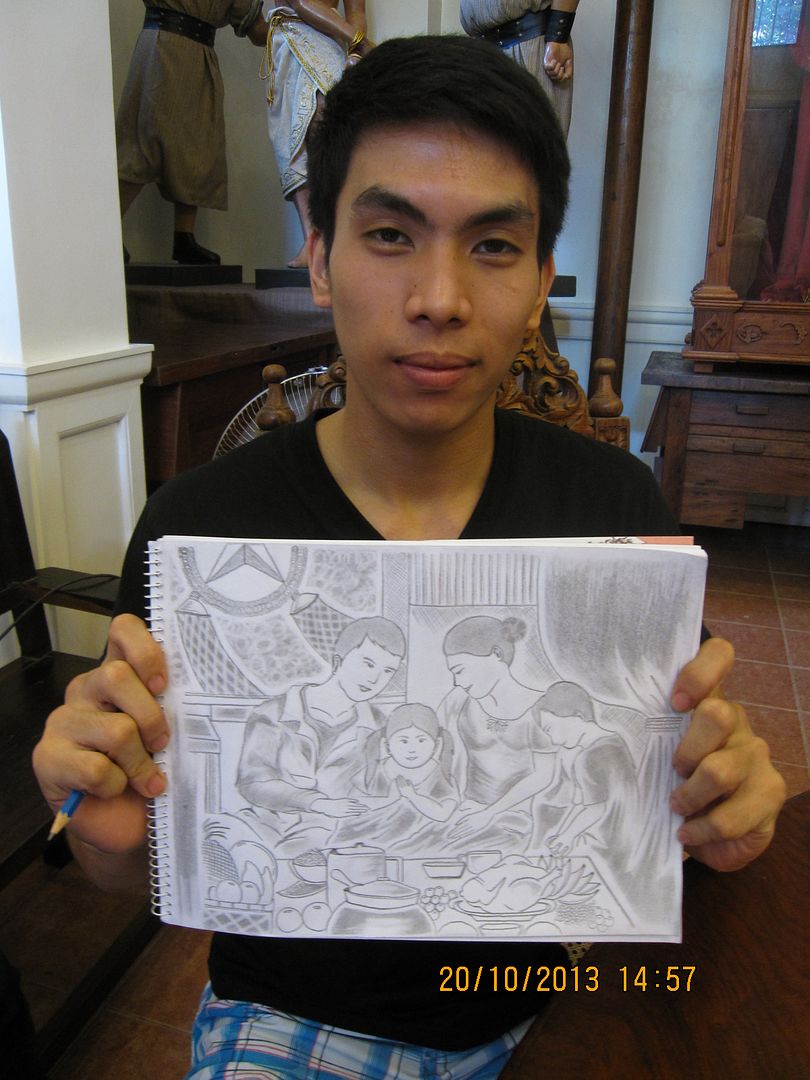
A quick conversation with Christian one Saturday to broach the subject proved most fruitful, with him quite enthused about the opportunity.  As a start, I asked him to sketch his proposed study for the prospective Christmas artwork, and here is what he showed me a week later:


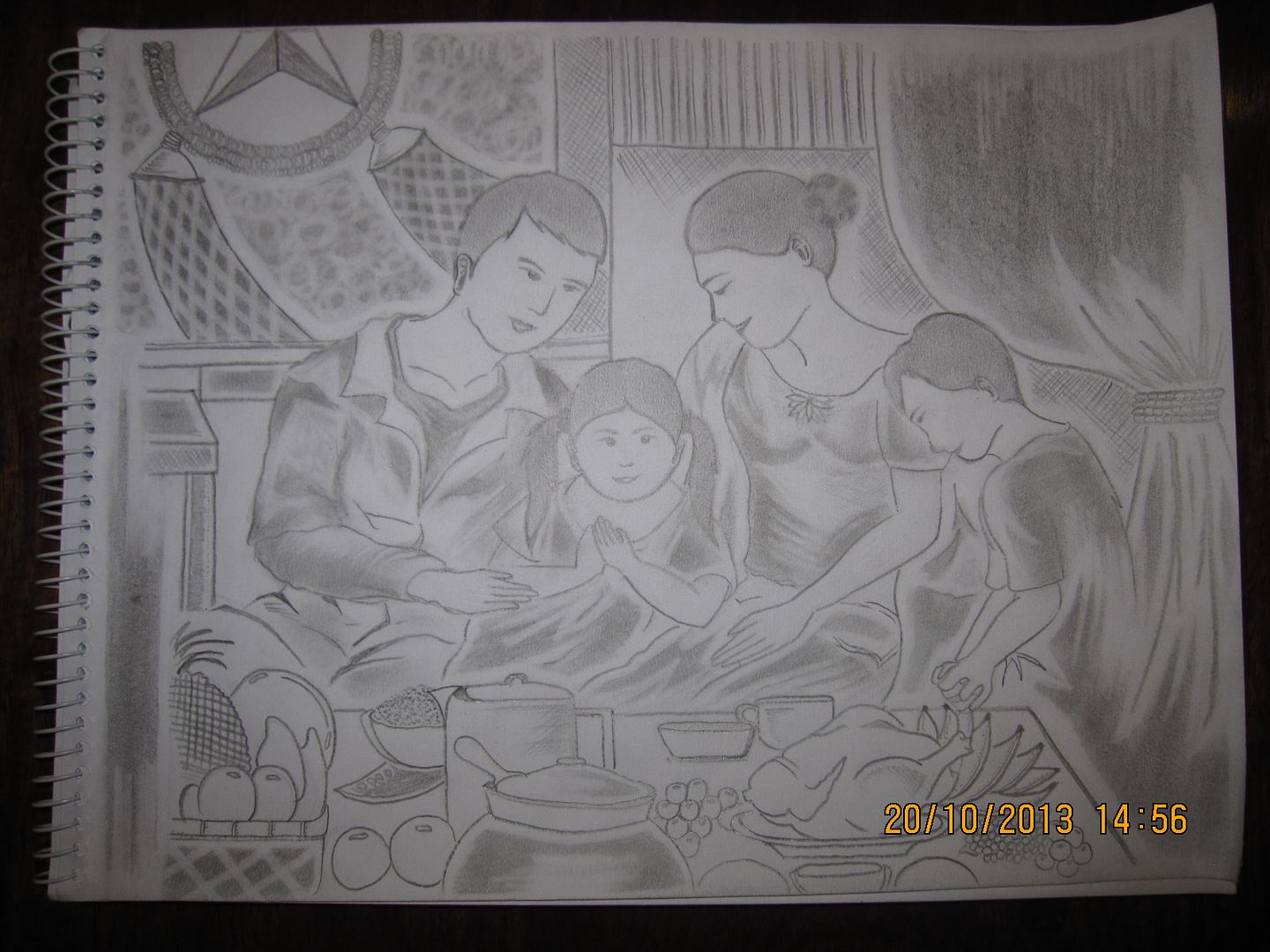
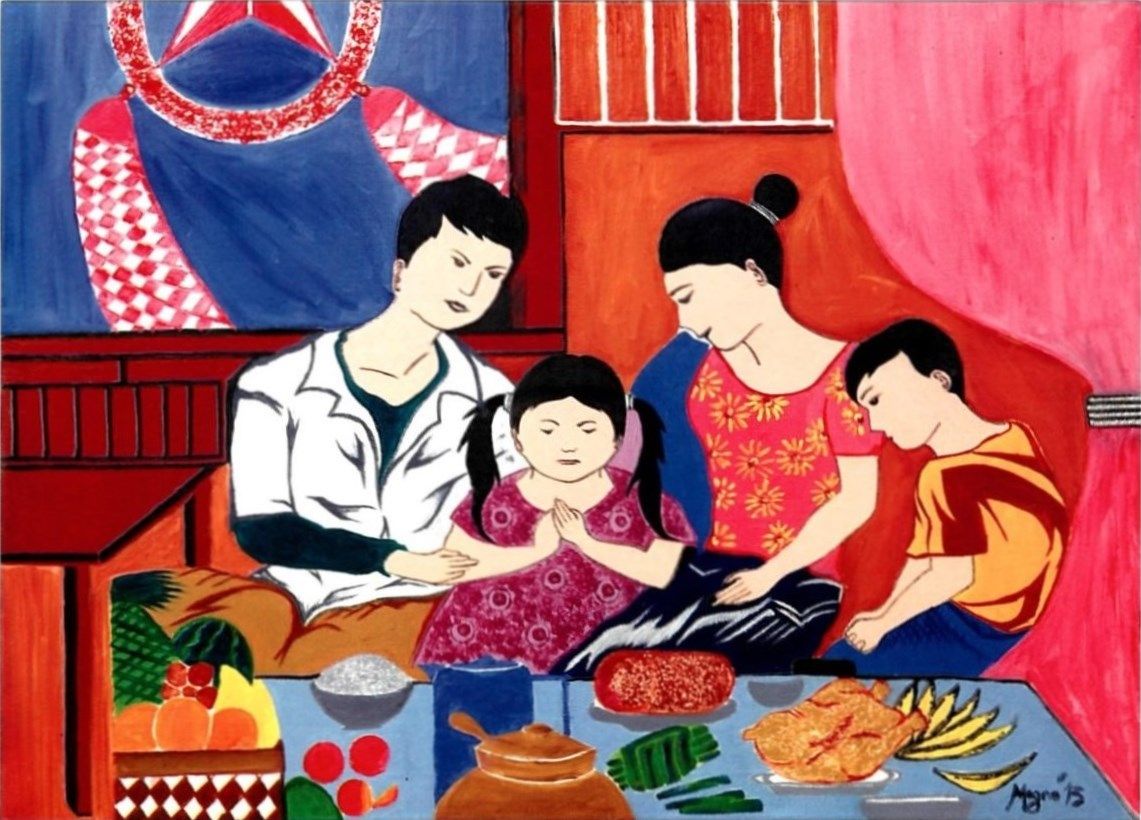
Obviously, Christian had a million Christmas-related ideas, and tried to accommodate all of them into this one sketch!  After a brief “master class” courtesy of our 2010 Christmas card artist, Chester Ocampo, Christian was inspired to reconsider and more tightly focus his response to our request for a simple representation of a quintessential Filipino Christmas.  The result was this depiction of a small family saying grace before sharing the traditional Christmas midnight feast. 

  
The artist’s pride in his new creation, even only in pencil sketch form, was evident.


Actually completing the artwork took several more weeks, as Christian himself admitted that he had never used acrylic, much less oil, and had never painted on canvas – his prolific output since early youth was exclusively with poster paint and other school art materials, and usually only on illustration board or some other paper surface. 

But persist he did, and the resulting finished artwork, in all its glorious color, was completed by November 10th, and sent off to the printer the following day.  As in years past, this digital image does not do full justice to the exuberance of the actual artwork, but it will do.

Christian Magno
NOCHE BUENA
Acrylic on canvas, 18” x 24”
2013

Therefore from Christian the artist and from my family and me, here’s to a

Merry Christmas and a Happy New Year!

Maligayang Paskó at Manigong Bagong Taón!

And all our prayers and best wishes for an excellent 2014 and beyond.

Originally published on 31 December 2013. All text and photos except where attributed otherwise) copyright ©2013 by Leo D Cloma. The moral right of Leo D Cloma to be identified as the author of this work has been asserted.

CXXX. Give Art on Christmas Day 2012


A uniquely Filipino visual art form from the 19th century is Letras y Figuras, where persons’ names are spelled out with individual letters that are each in turn formed by smaller figures – humans, animals, plants, and vignettes of Spanish colonial life.  Its leading proponent was Jose Honorato Lozano (1815-1885), who produced a few extant examples for private patrons, including FRANCISCO DE YRIARTE


and EULALIA N. de ROCA.


In the late 20th to early 21st centuries, the art form underwent a renaissance and gained new adherents, the foremost of whom is probably Alvaro Jimenez (born 1948) of San Fernando, Pampanga (see http://www.paintingsphilippines.com/).  He has produced to several commissions, including MABUHAY


and MARAMING SALAMAT.


We thought that it would be a good thing to also contribute to this mini-renaissance, so for our 2012 Christmas card, we therefore decided to commission a Letras y Figuras as well.  And as with most of our previous Christmas card artworks, we wanted to engage a young artist to create it. 

Despite our initial apprehensions, finding a young person who already understood the Letras y Figuras idiom came rather easily and fortuitously, as I found out that the daughter of a colleague had done several examples of this art form.  Her biographical note might explain why:

Ysabela Maria Parungao is a third year Visual Communications major at the College of Fine Arts of the University of the Philippines in Diliman.  Iya was also recently granted a scholarship under a South Korea – UP Diliman exchange program and commenced a one-year residency at Kyungpook National University in Daegu in August 2012.
 

Iya finished high school at Assumption Antipolo and was the Sangguniang Kabataan Chairperson in Barangay Concepcion Dos, Marikina City, from 2007 to 2011.  She is also a member of AdCore, a not-for-profit student-run advertising agency, and the Delta Lambda Sorority, both in UP Diliman.


Iya has exhibited her artworks since she was in high school.  She has a natural love for history and the arts and would like to use her talents to pursue a career in advertising in the future.

This was therefore a pretty straightforward task for her – do a “MALIGAYANG PASKO” in Letras y Figuras style.  She didn’t even need to do sketches or studies, I guessed.

Well, I thought it was straightforward, but then Iya tells me that all those letters just cannot fit in a six-inch-wide frame and still be intelligible as “figuras”.  Even on two rows, which is consistent with the 19th-century examples, the word “MALIGAYANG” would be awfully cramped.  She therefore sought permission to deviate slightly from the idiom, with just the “PASKO” in strict “figuras” and the “MALIGAYANG” rendered as parols (traditional Filipino Christmas lanterns).  Here’s how Iya’s first pen sketches looked like:


Here is the fully-figured artwork before coloring.


And here’s how the 5-inch-tall by 8-inch-wide artwork came out, fresh from Iya’s watercolor brush and ink pen:


I thought that the “parol” solution was extremely appropriate and therefore ingenious.  And the use of a pale blue background rather than the usual yellows or off-whites made the artwork firmly modern and original, while still contributing appreciably to more than 150 years of the Filipino Letras y Figuras canon.  

And here is how the final Christmas card came out a few weeks ago:


Merry Christmas and A Happy New Year!

Maligayang Paskó at Manigong Bagong Taón!


From the Veron-Dulay-Cloma Family of the Philippines


Originally published on 2 January 2013. All text and photos (except where attributed otherwise) copyright ©2012 by Leo D Cloma. The moral right of Leo D Cloma to be identified as the author of this work has been asserted.

Monday, January 4, 2016

LXIV. My Forwarding Address Fifty Years Hence, Part Two

(Continued from Part One)

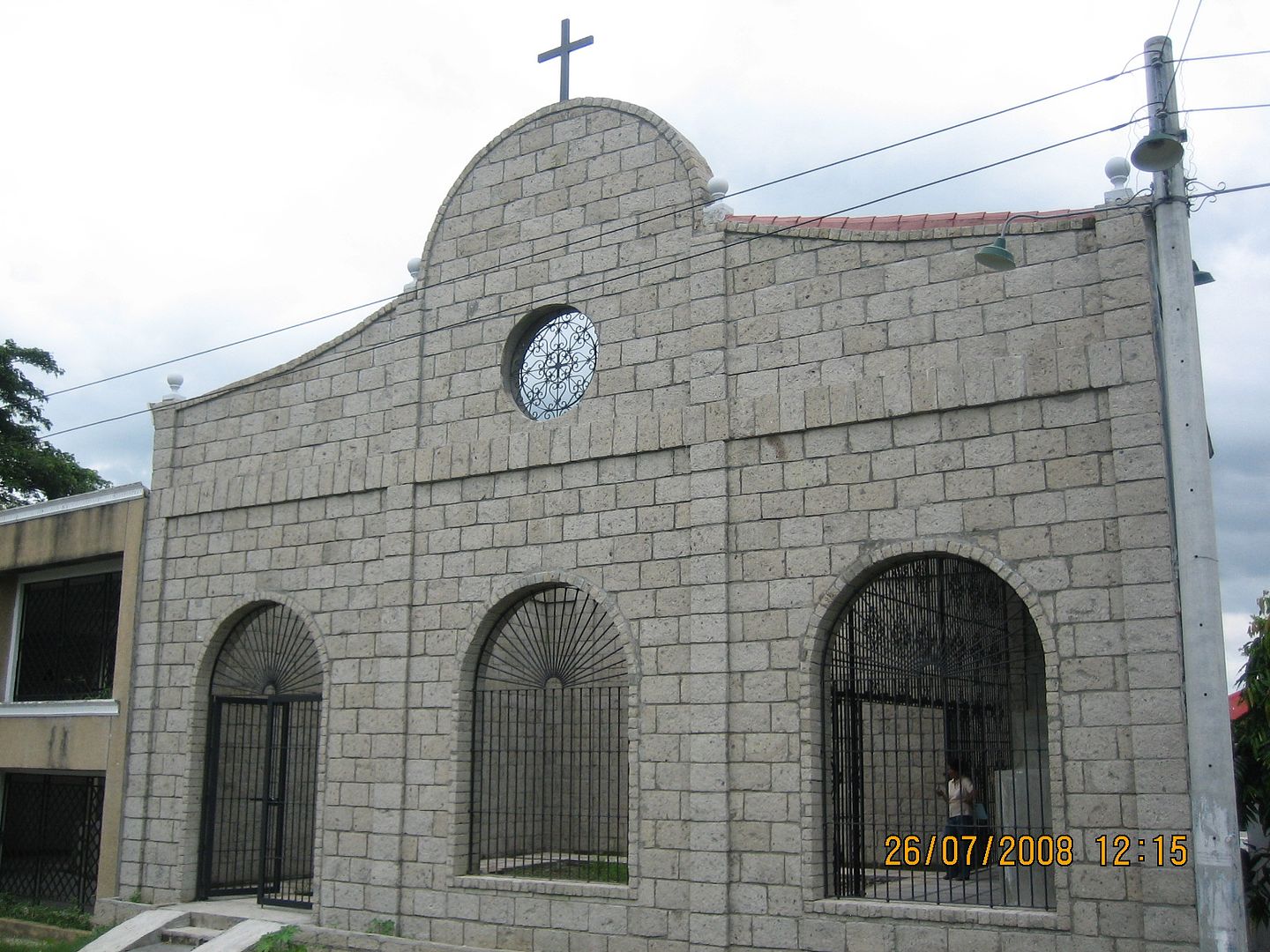
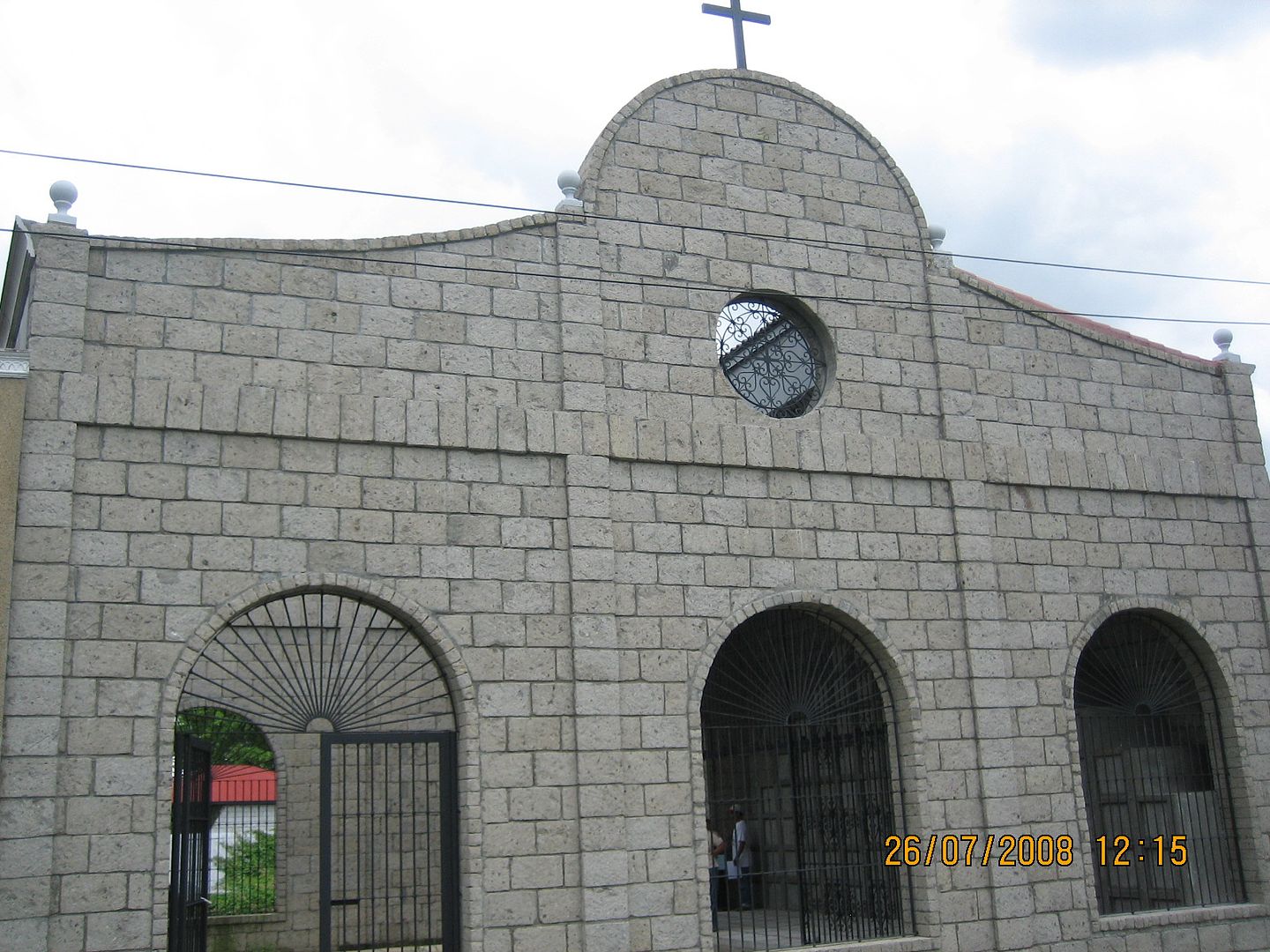
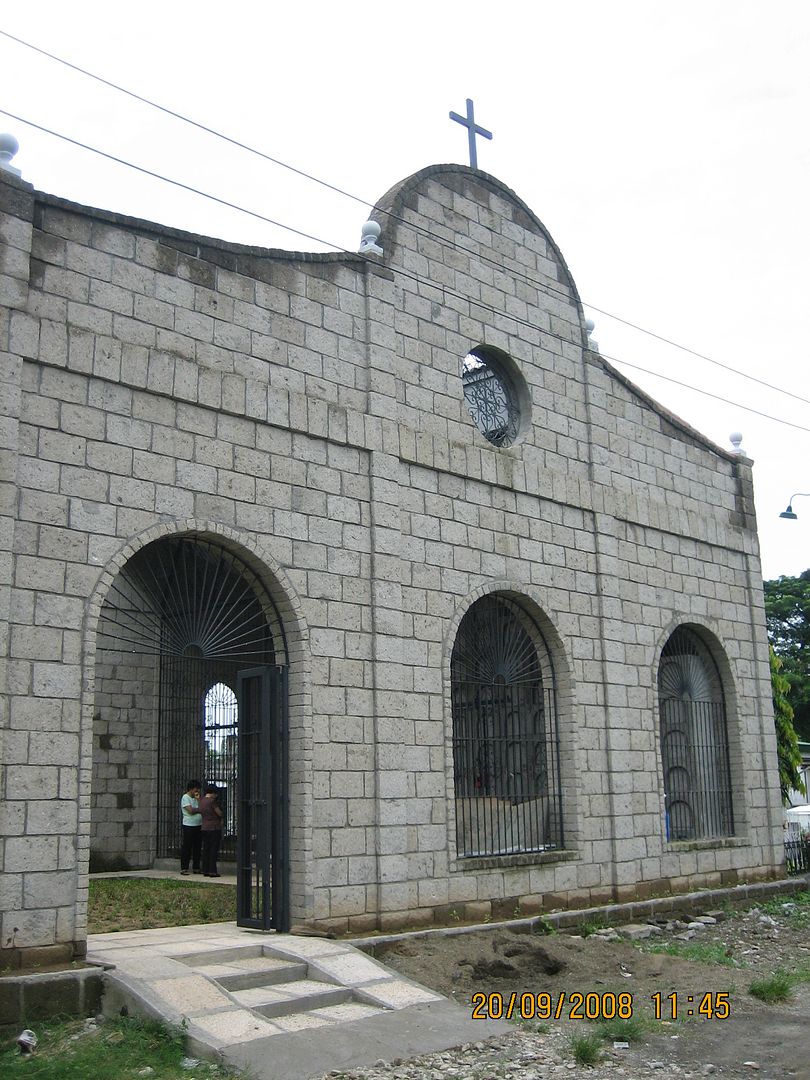
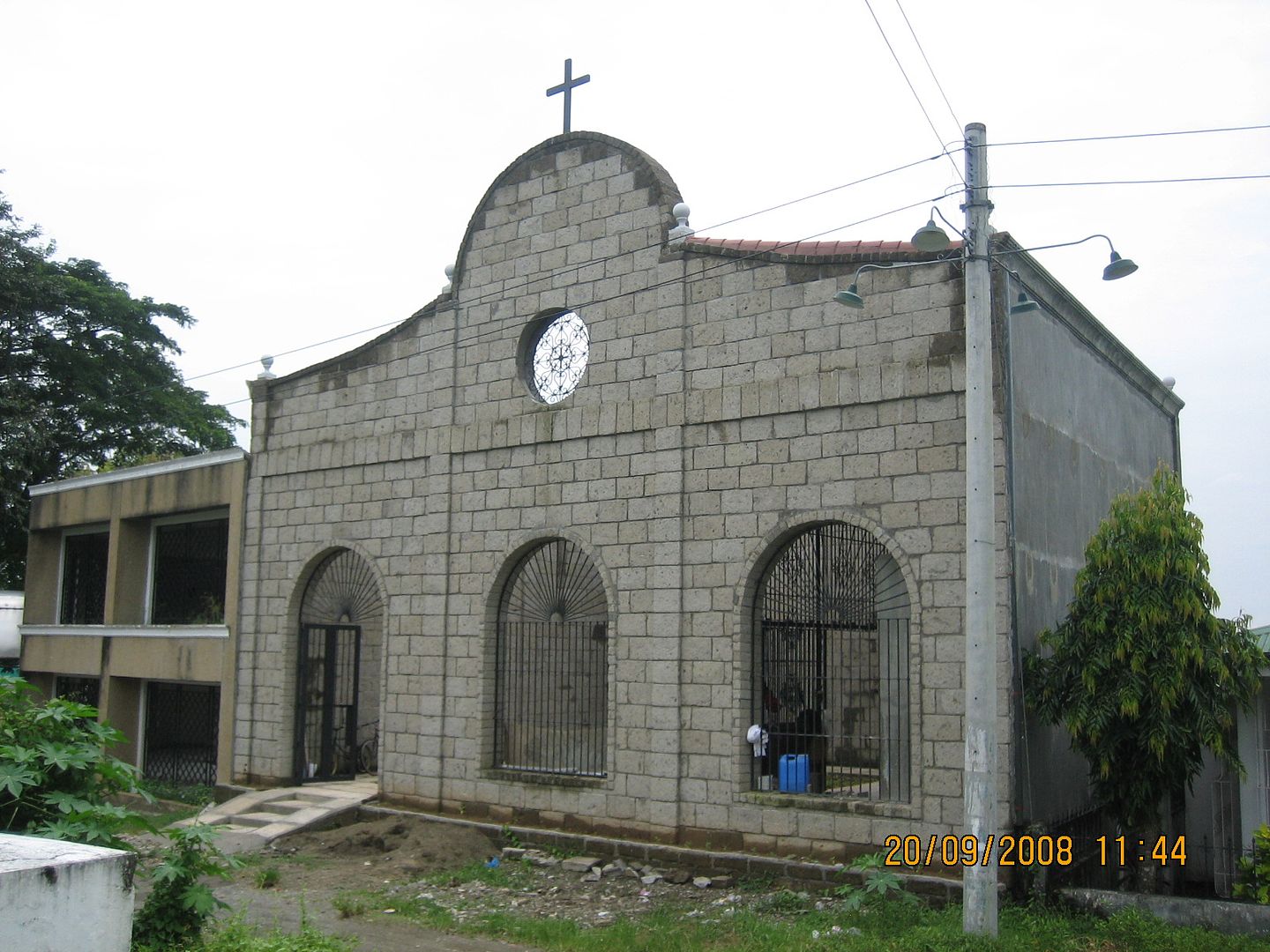
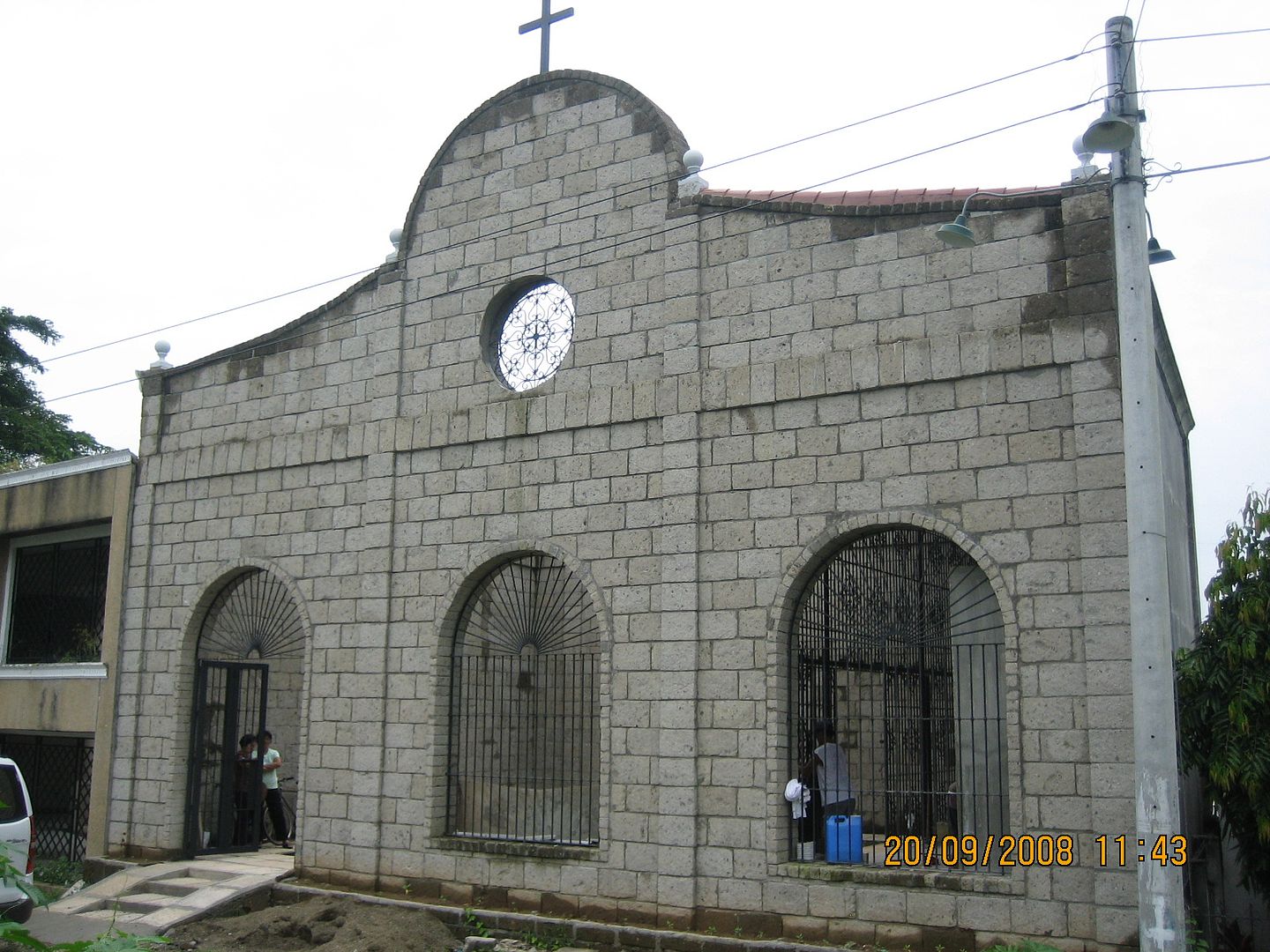
By July 26th, or a little over three months before All Saints’ Day, the structure was complete, with the red-tegula (tile) roof over the niche area barely visible from the front elevation.


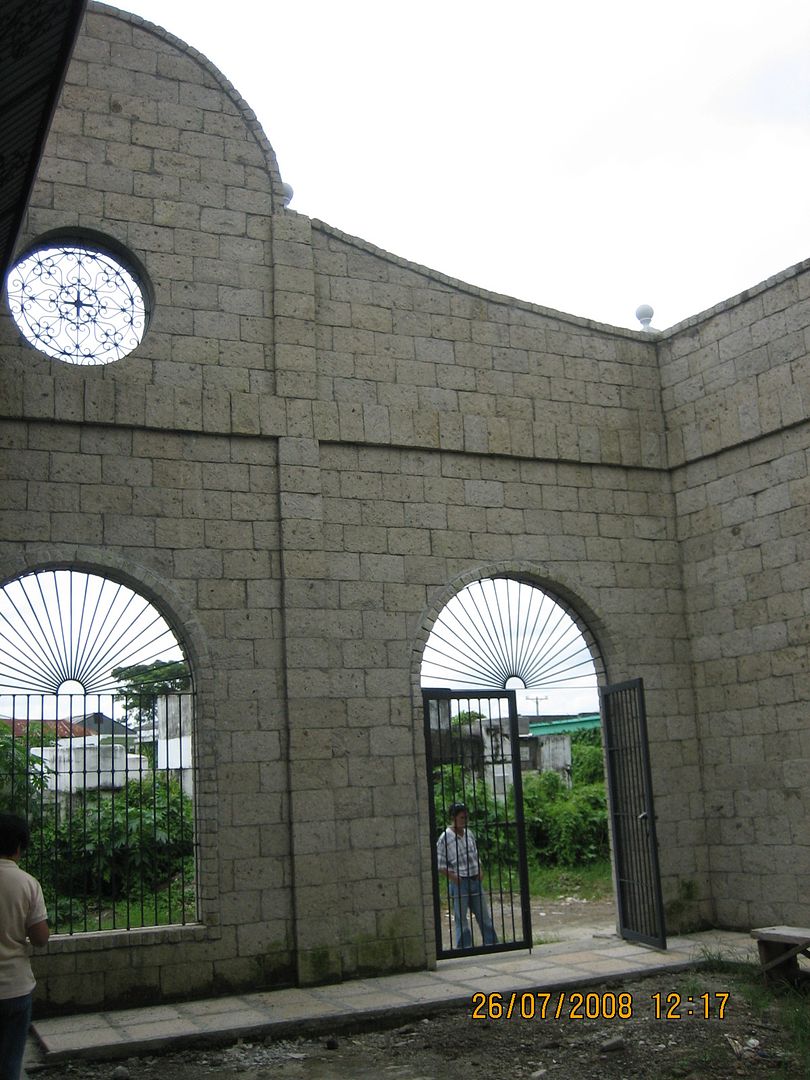
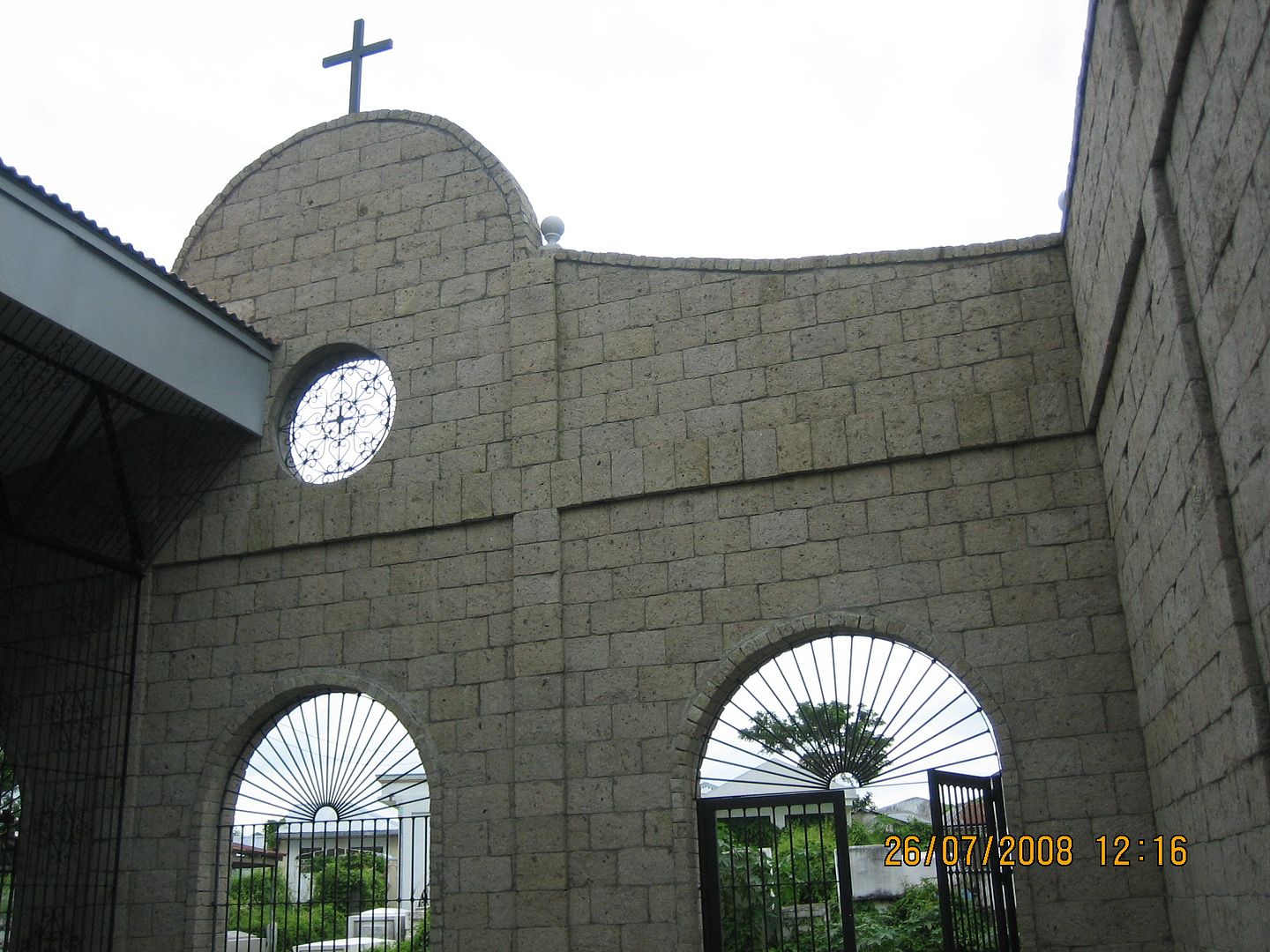
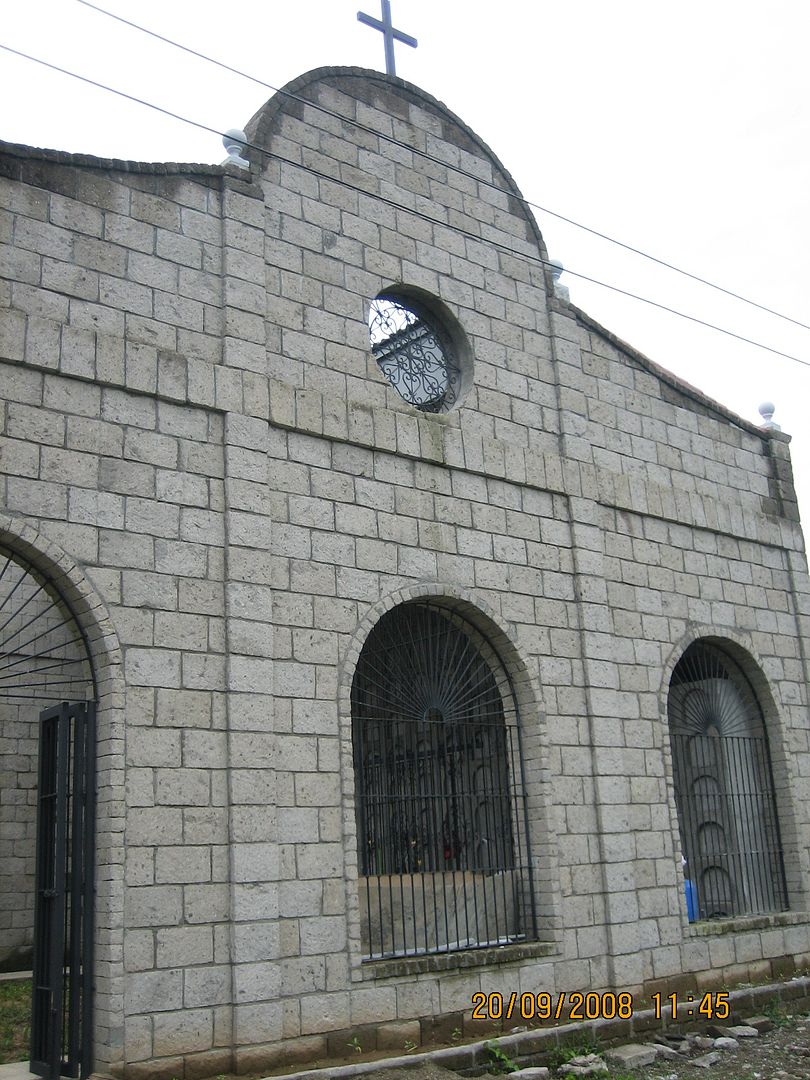
Precast ceramic globes were used as finials on the façade and on top of the walls.  They might look like carroza virinas, but no, they won’t light up except maybe if they reflect moonlight.


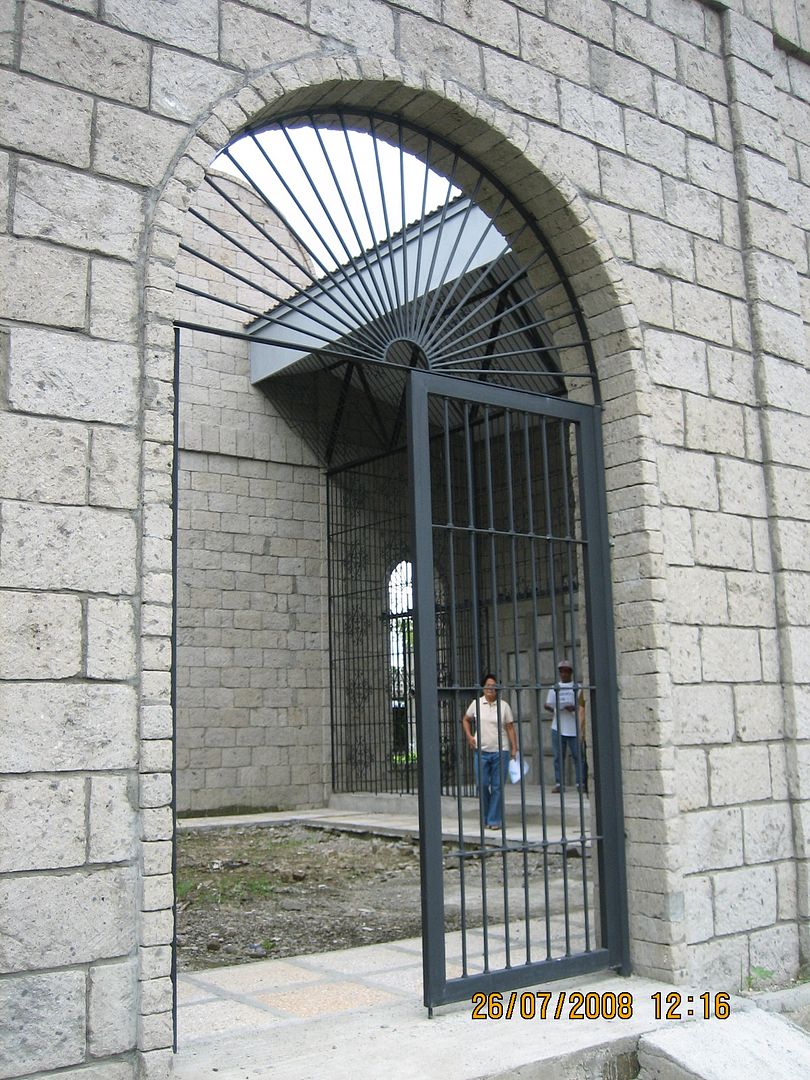
Complementing the iron-grilled windows, the iron gate was of a straightforward design.


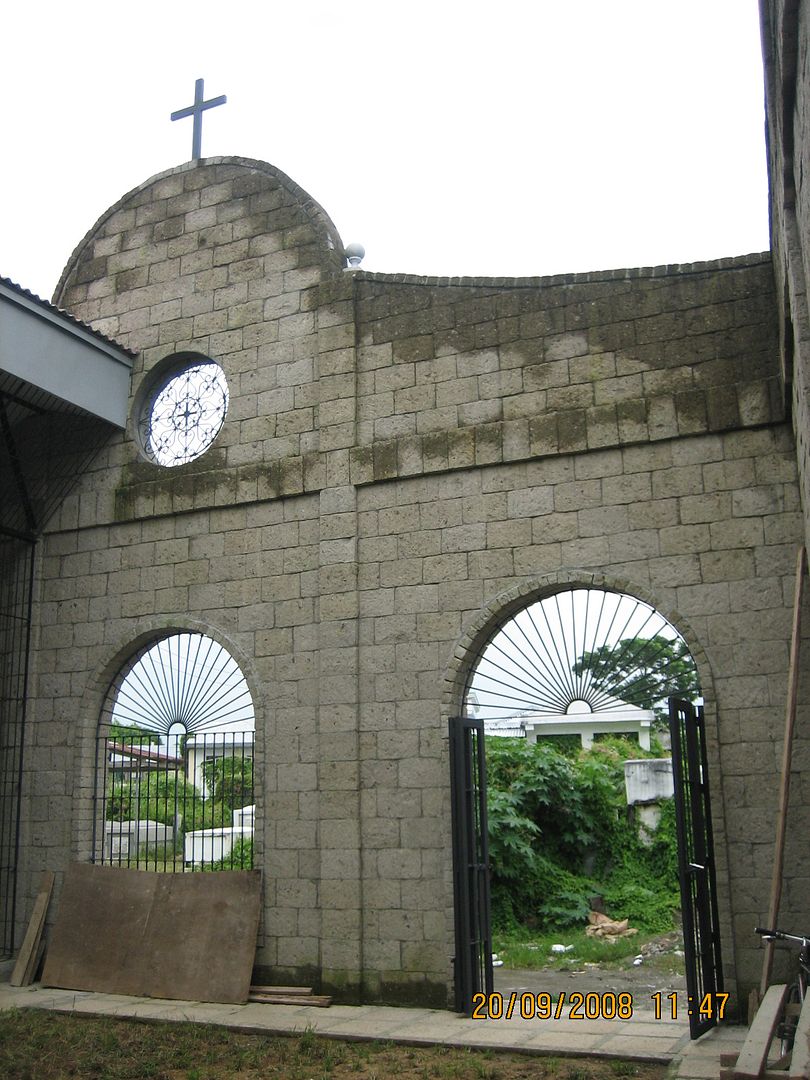
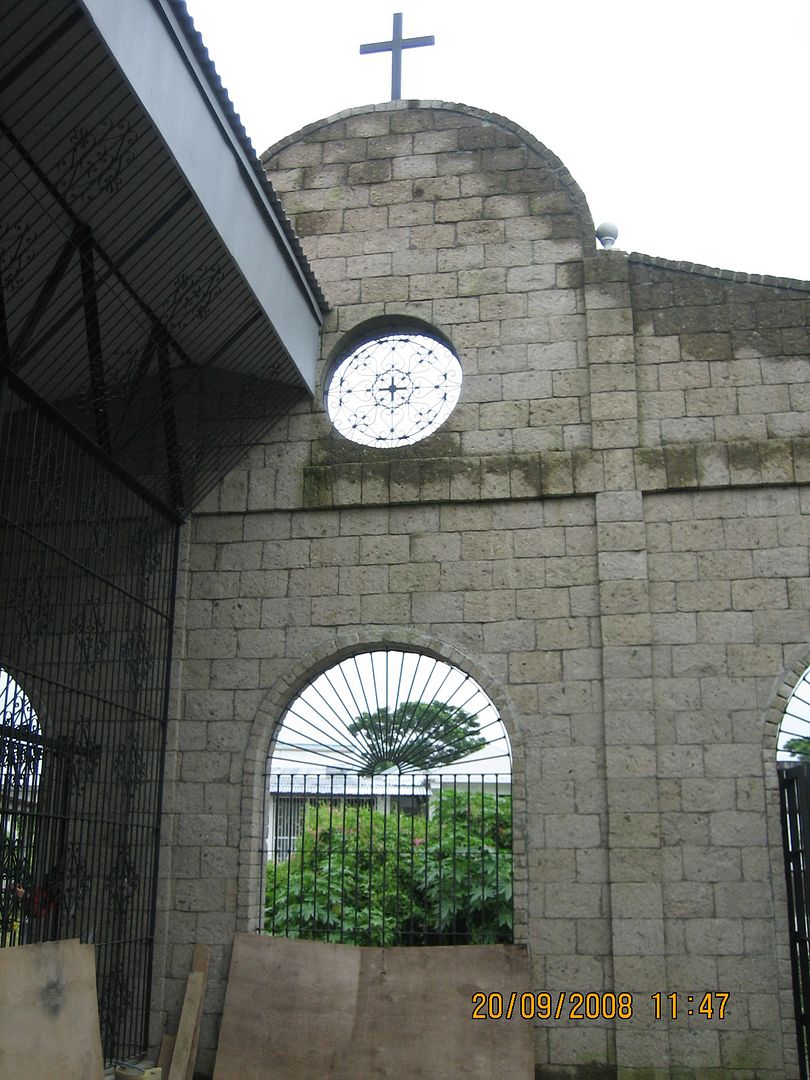
The rose window was as large as it could be without getting in the way of supporting beams on the façade and of the roof line over the niches.


The niches were now topped by a row of four slots, instead of just two initially, because it had since been decided that both sets of great-grandparents (not just the Veróns but the Dulays as well) would be accommodated herein.


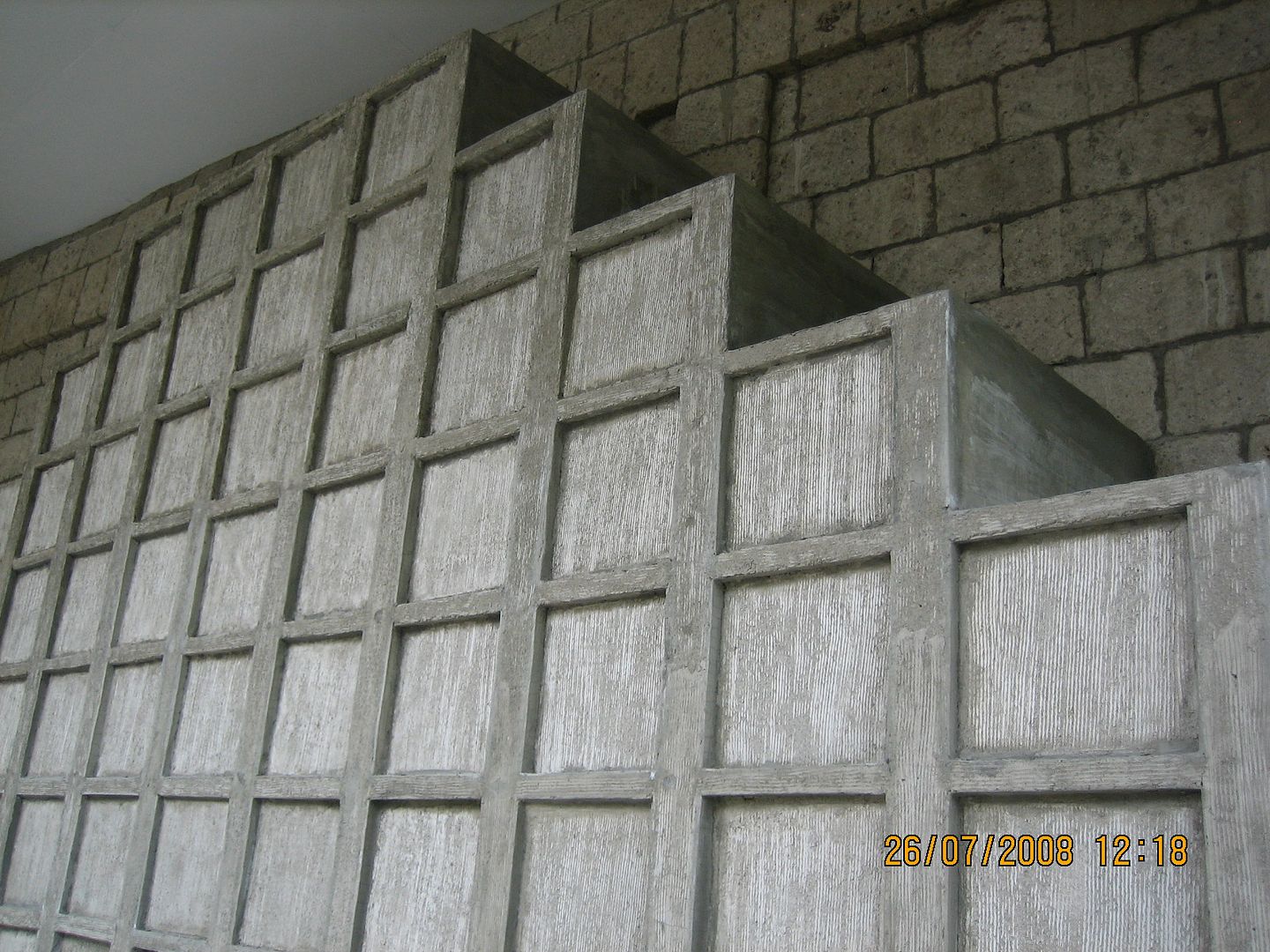
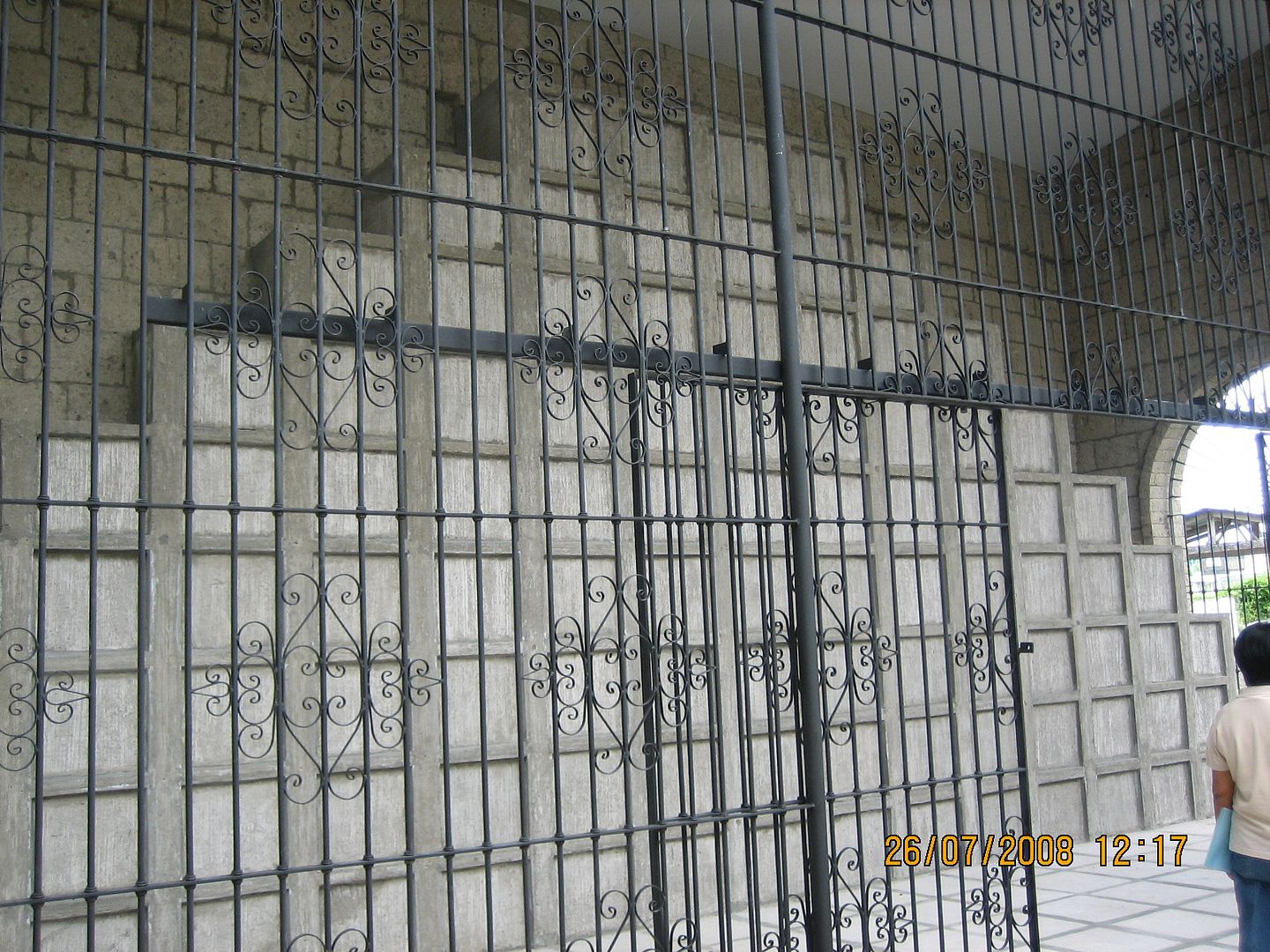
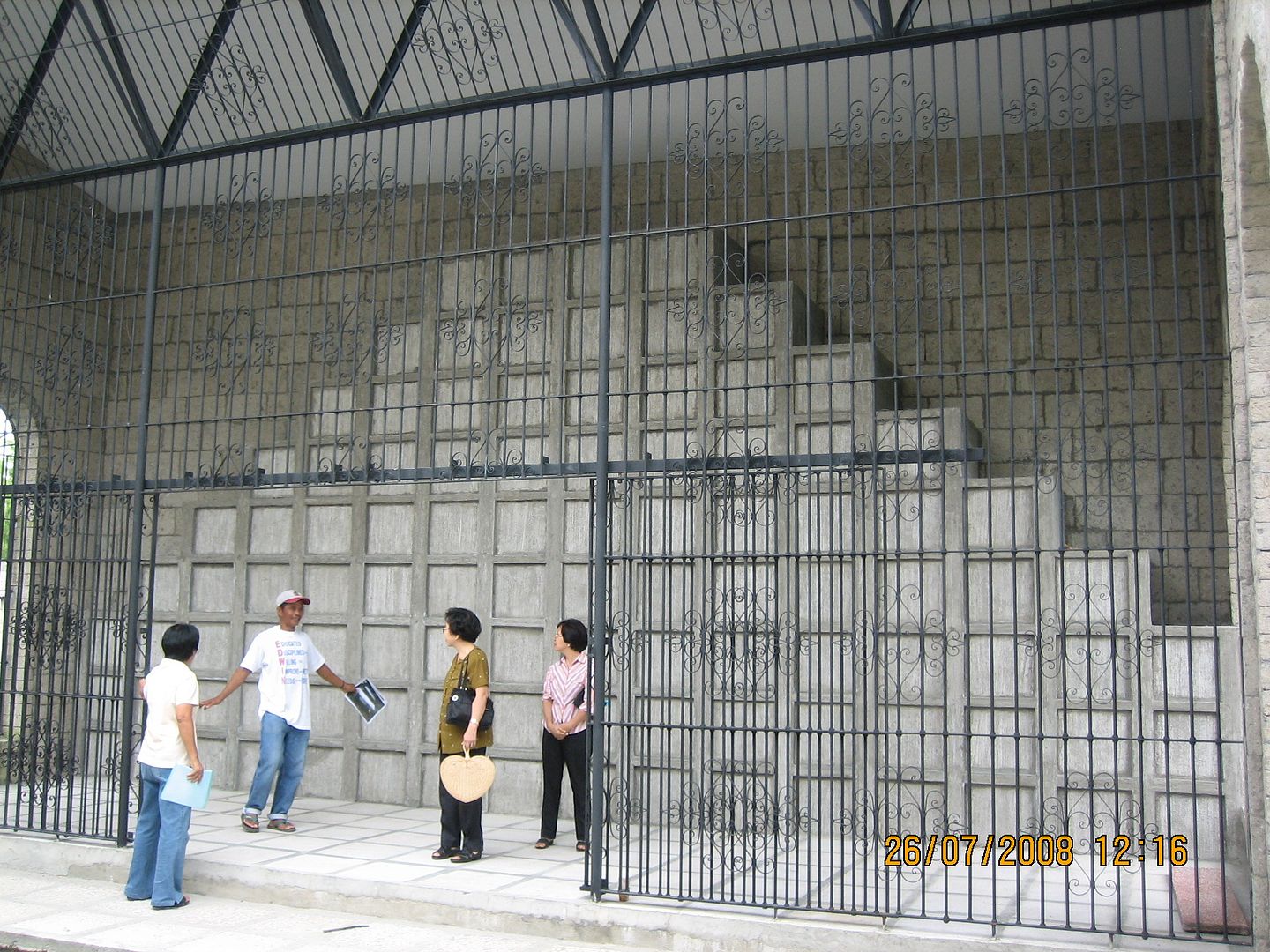
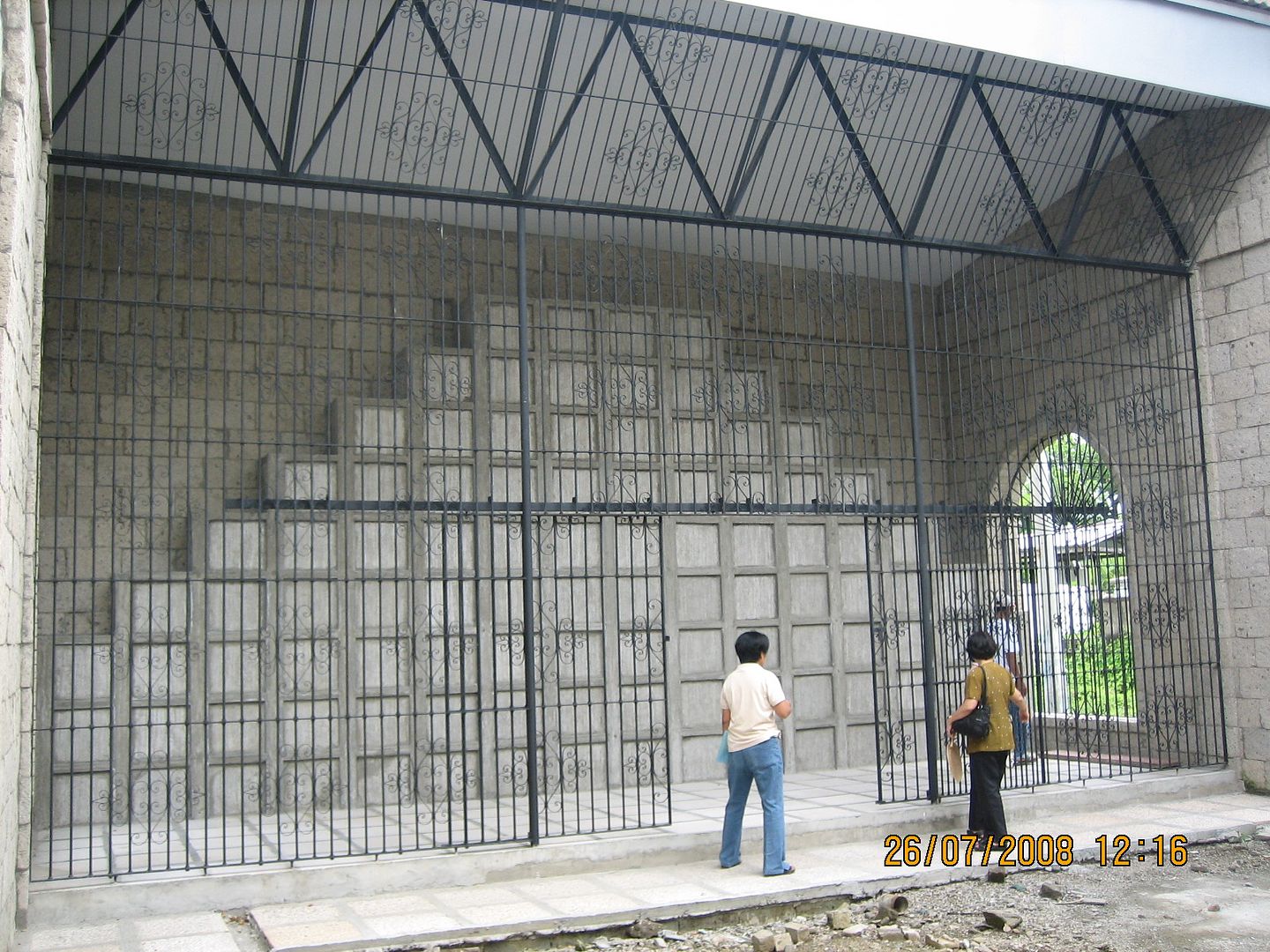
But as had always been intended, the niche area was very organized and neat to look at, whether viewed from the front


from the left


or from the right.


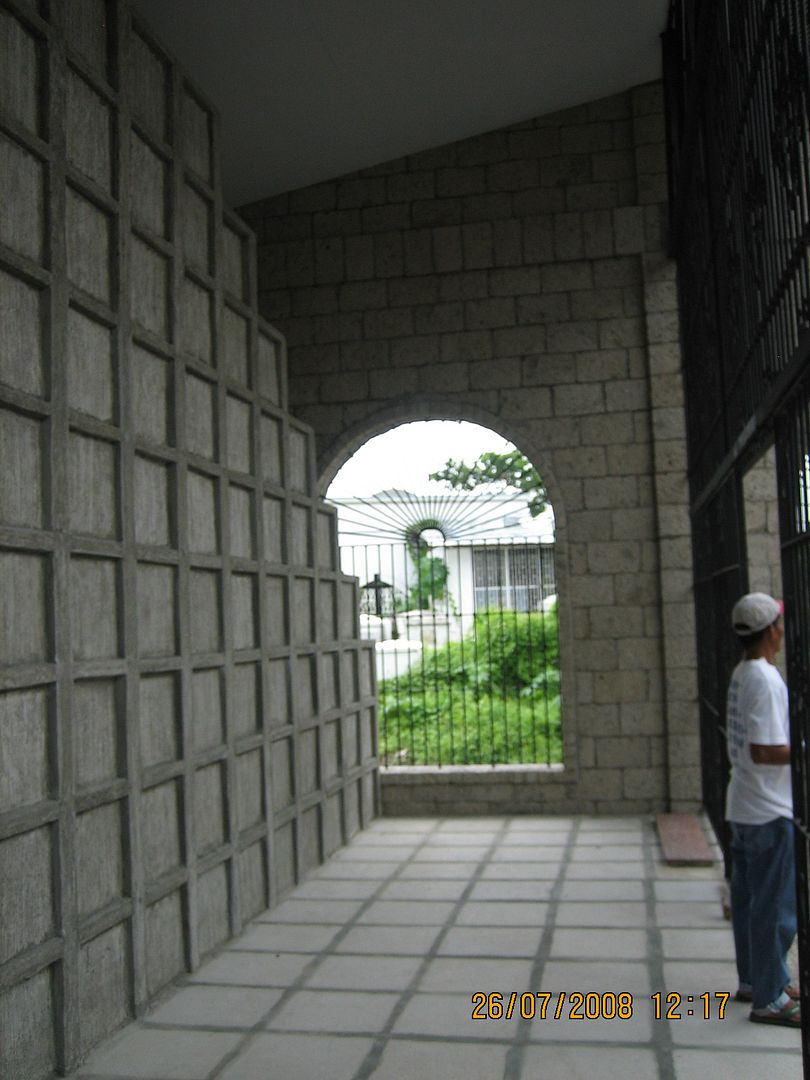
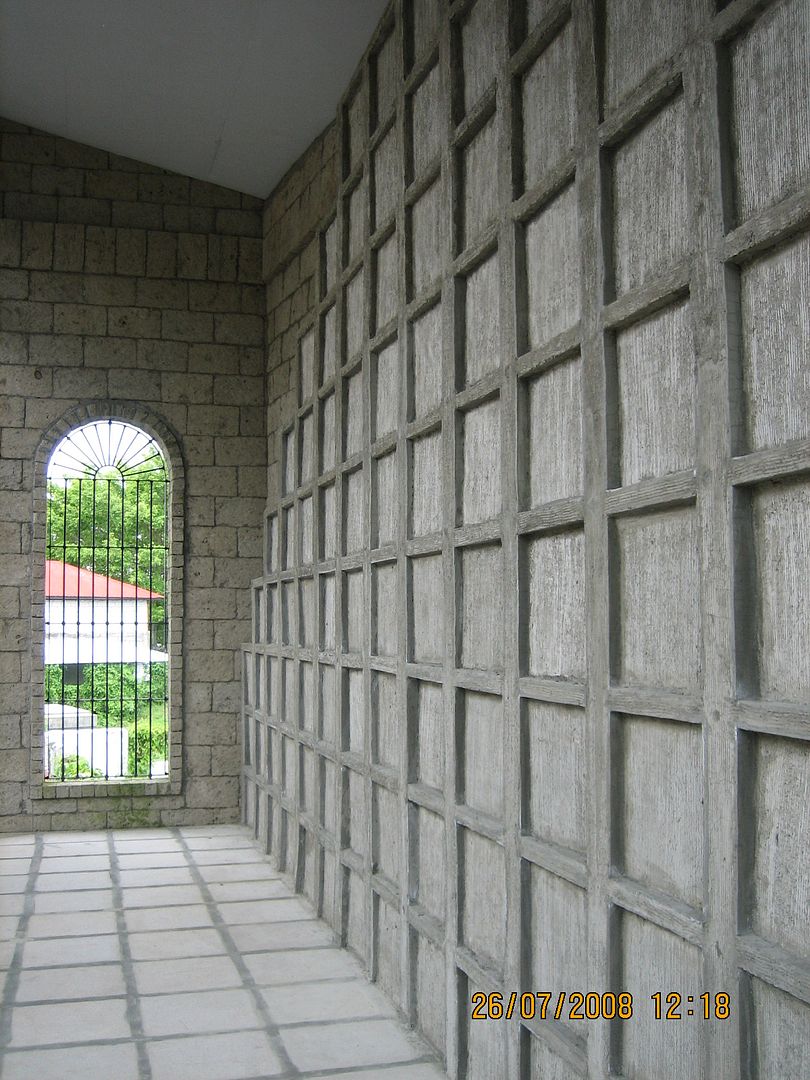
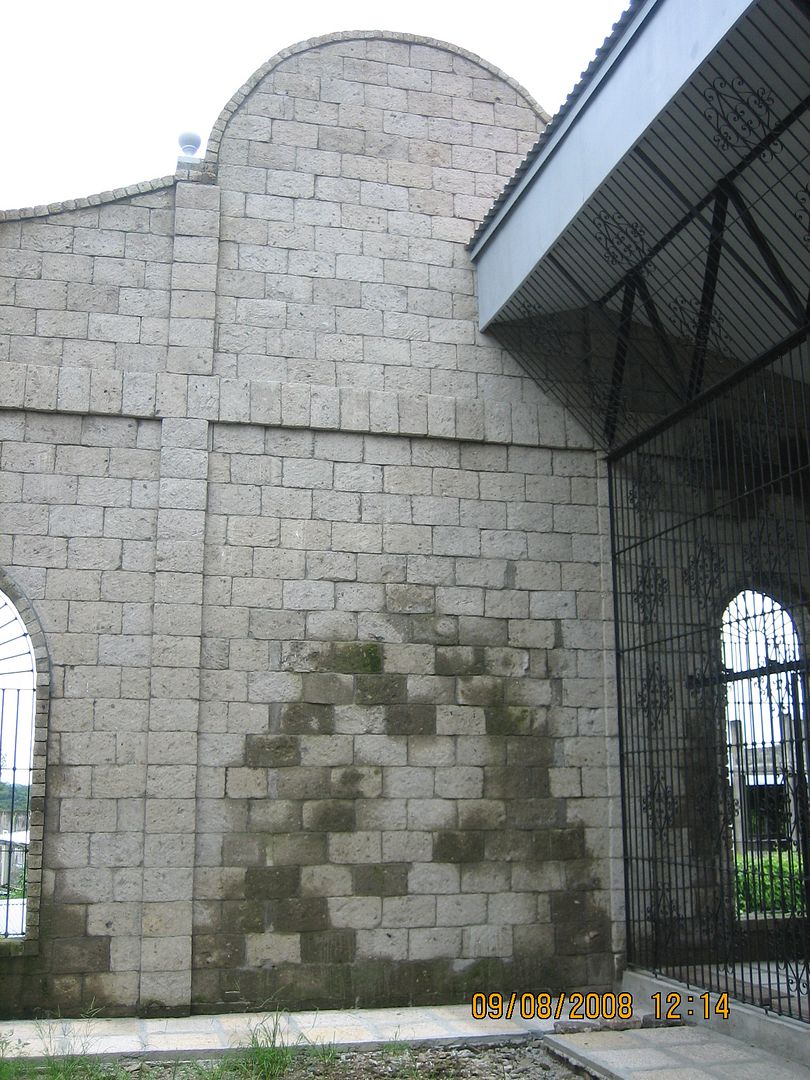
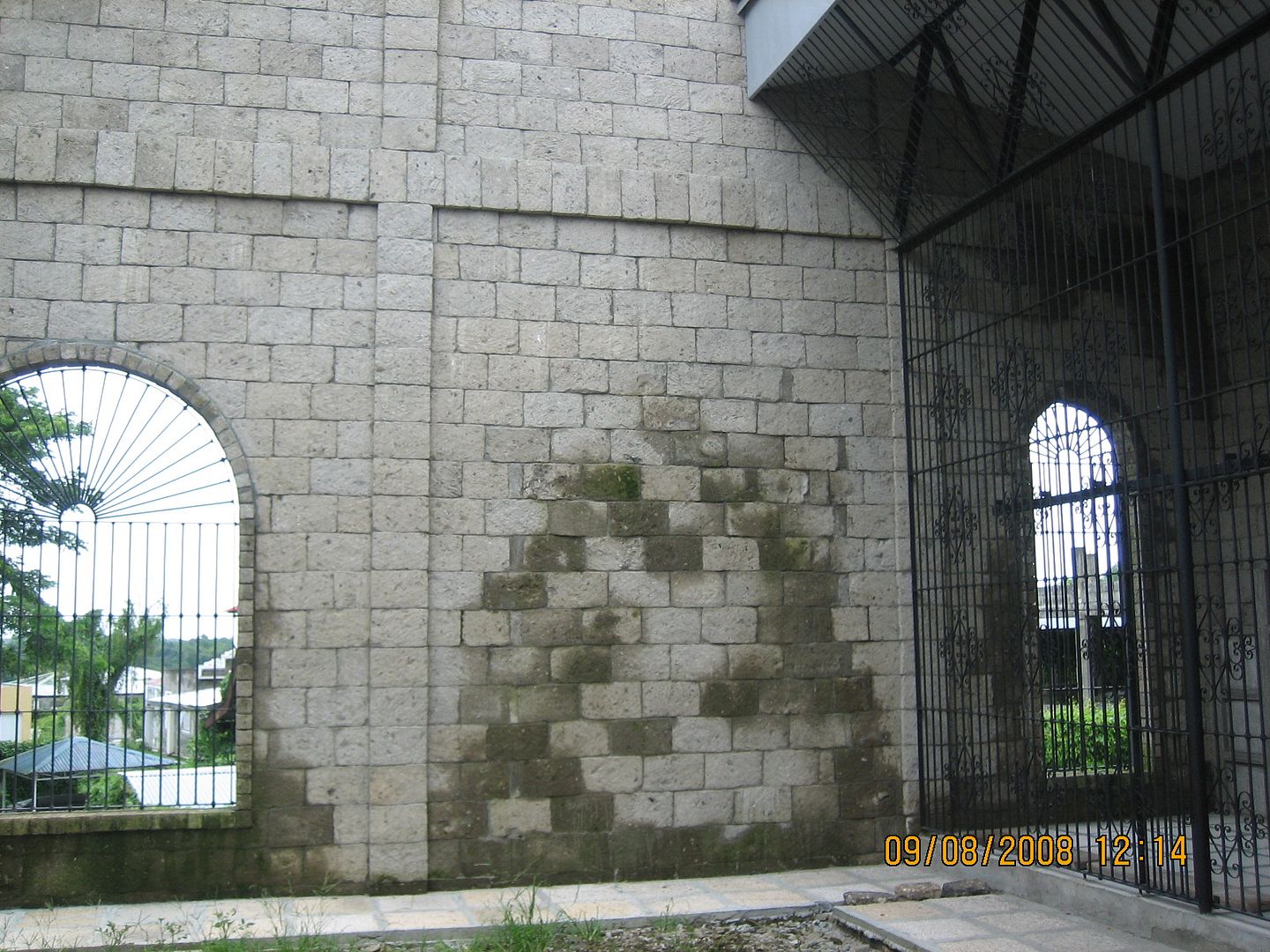
A brief visit on August 9th gave some assurance that moss was growing naturally on the rear wall, no longer necessitating the application of fertilizer (!) on the adobe surfaces as was suggested previously, in order to achieve an ancient, weathered appearance.


While it had been earlier decided to expand the first of the nine rows from two niches to four to accommodate both sets of our maternal great grandparents, a subsequent “recount” revealed that the third row, originally consisting of eight niches following the original design, would now be inadequate by at least three niches.  (And no, this was not an ex-future futile attempt to cheat death on the part of some living family members, but perhaps simply a counting mistake.)

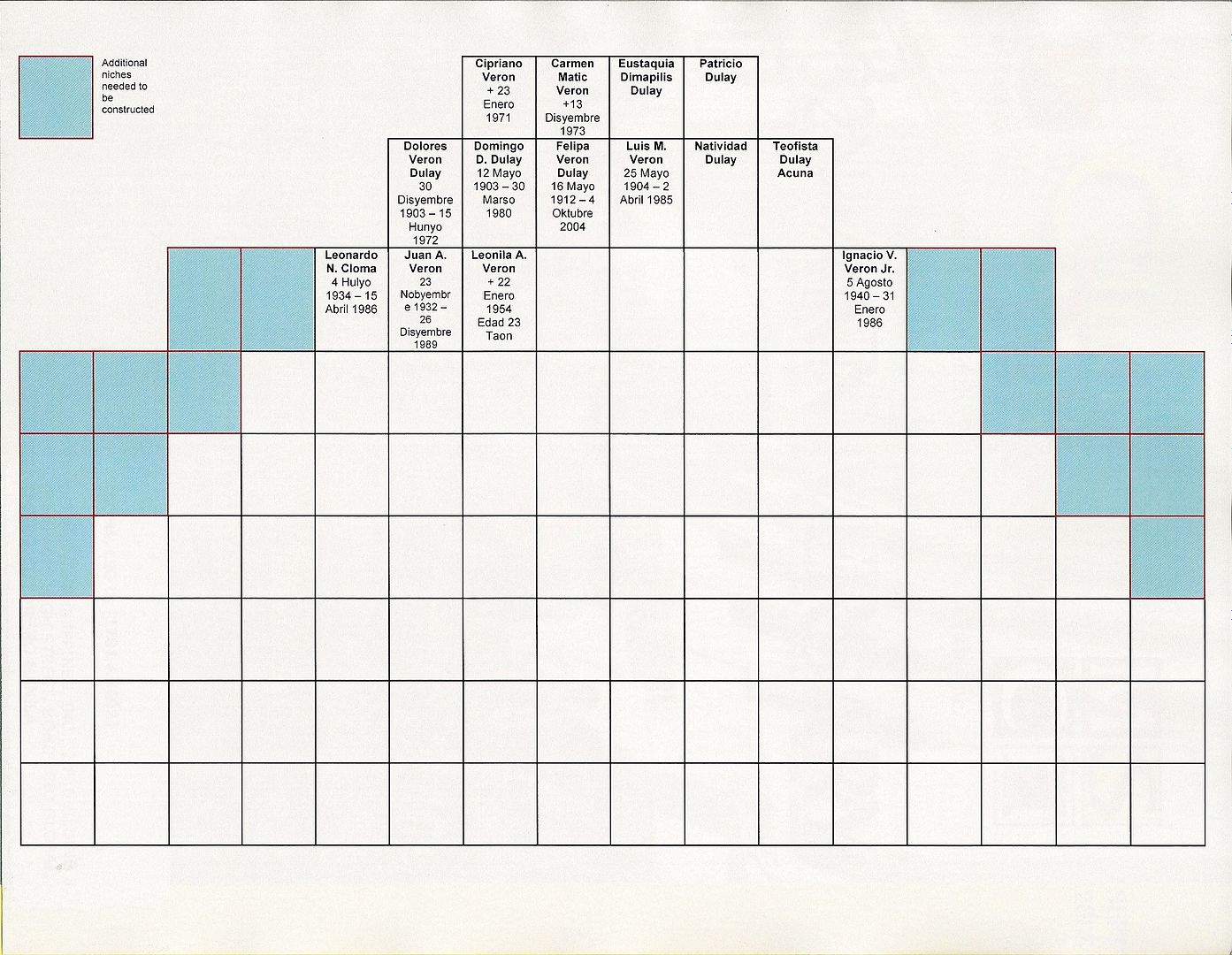
We therefore decided to add four niches to the third row (since the addition of only three would make it unsymmetric), as well as to maximize all lower rows to sixteen niches each, to avoid any future niche shortage problems.  The additional niches that needed to be constructed are shown in blue in the following diagram.


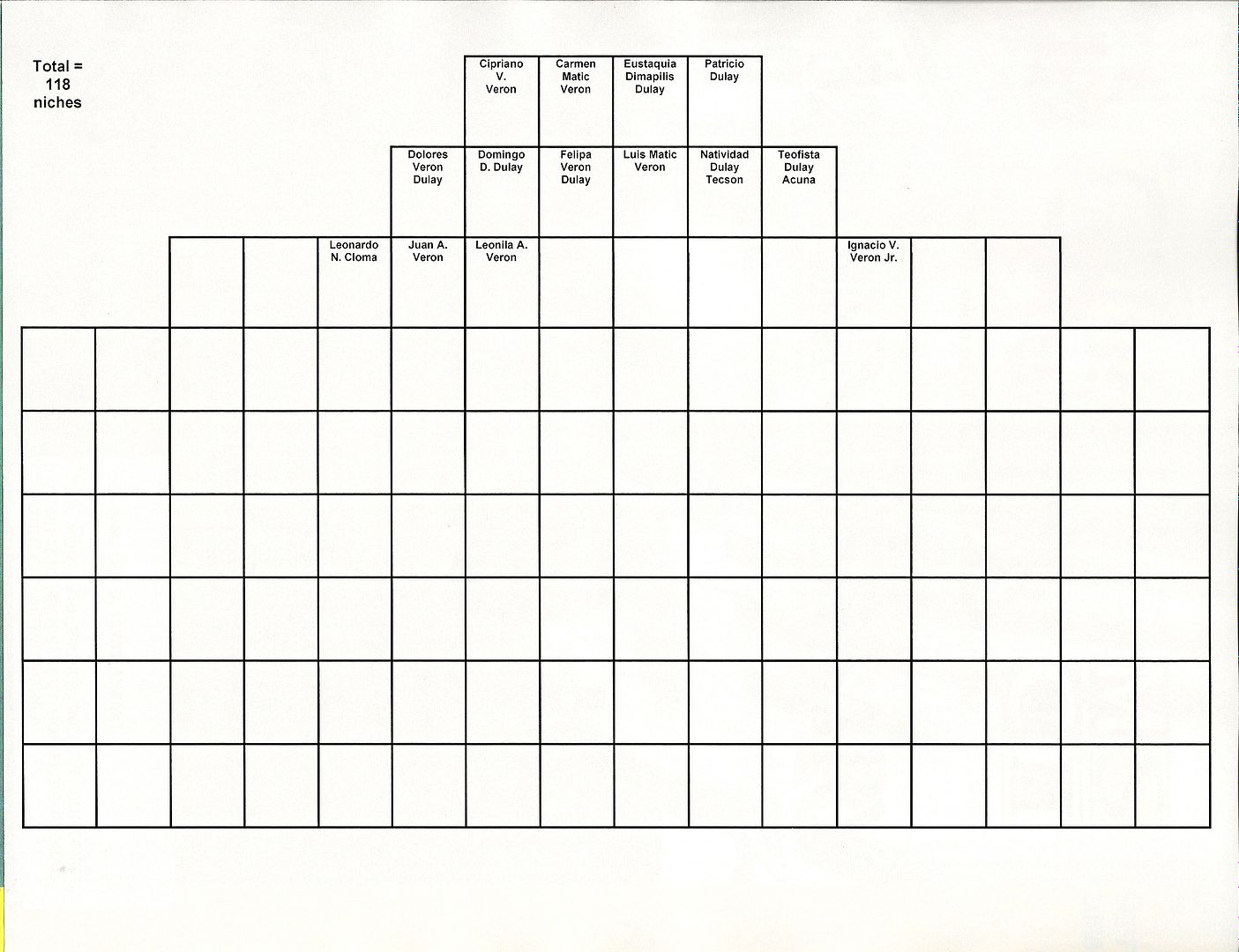
Within a quick two weeks, the (undetectable) additions had been completed, and the number of niches now totaled one hundred and eighteen, with the top two rows fully occupied by four in the first and six in the second, and with the third row of twelve niches having four occupants so far, for a total of fourteen current residents in all. 


With All Saints’ Day 2008 approaching, it was time to get on with that most important final step – the provision of new tombstones.  The previous tombstones were obviously going to be unsuitable, as they were (1) large and rectangular, significantly larger than the fronts of the new niches, and (2) stuck to the original full-body niches, now under several feet of soil.

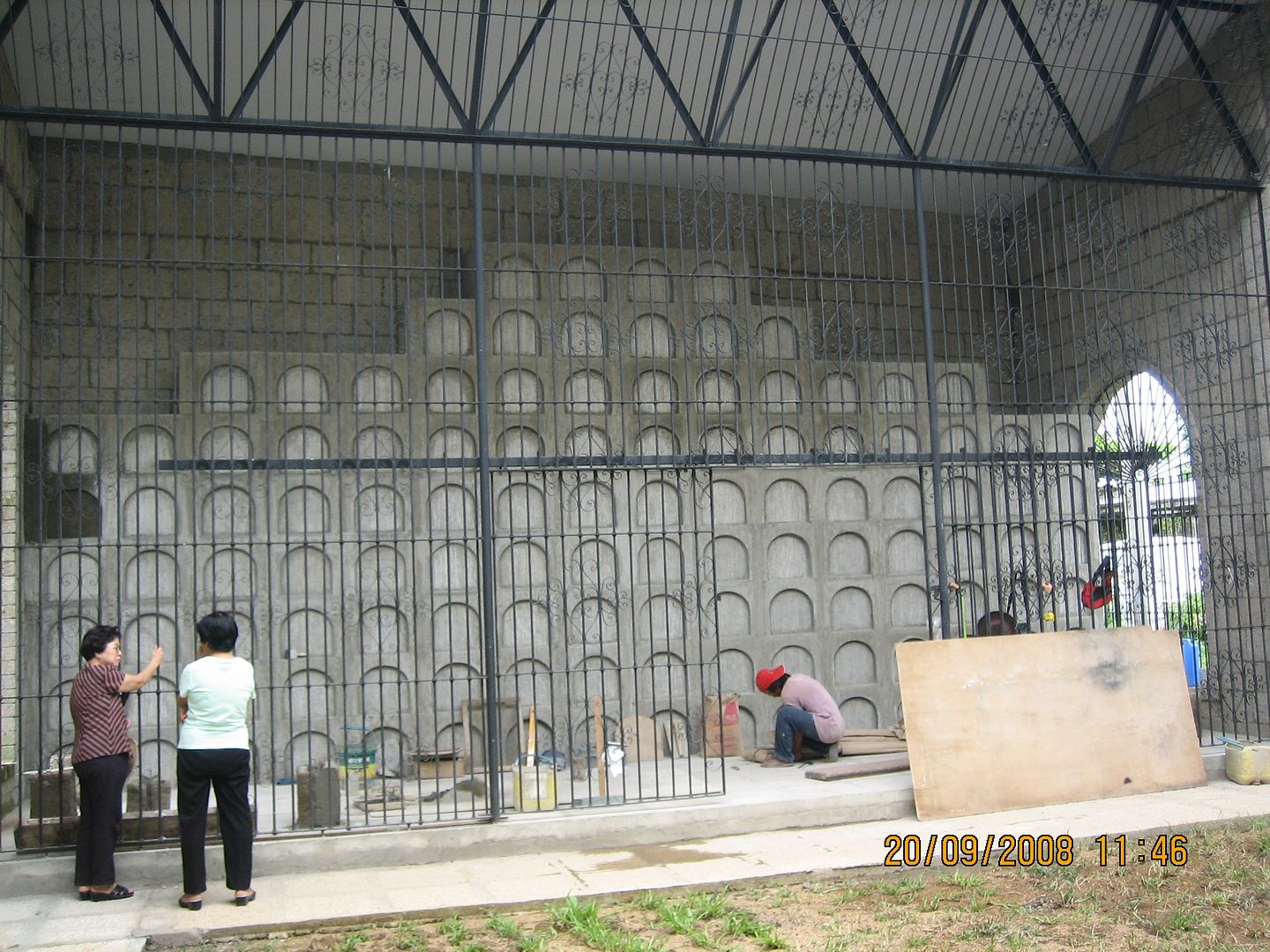
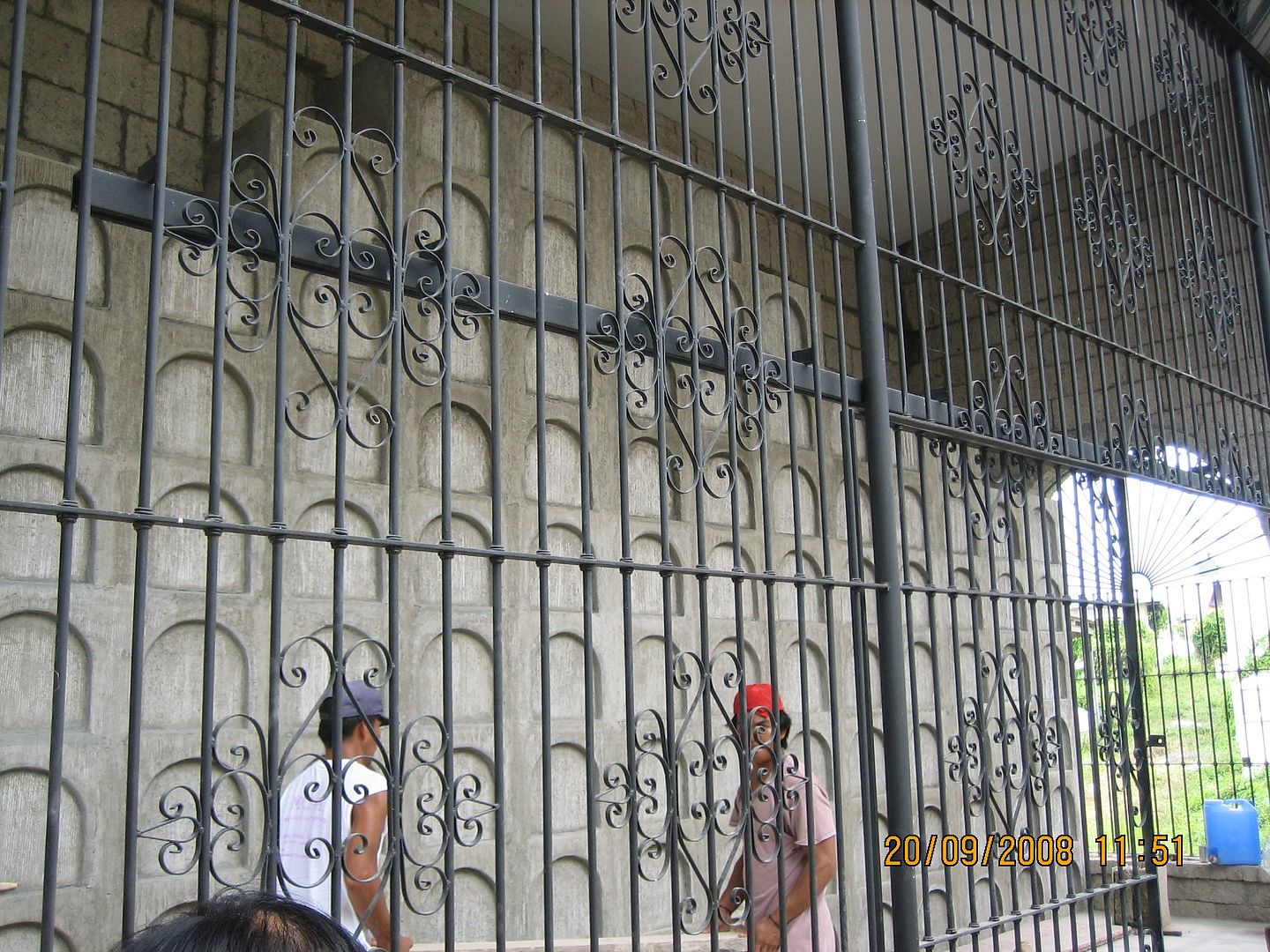
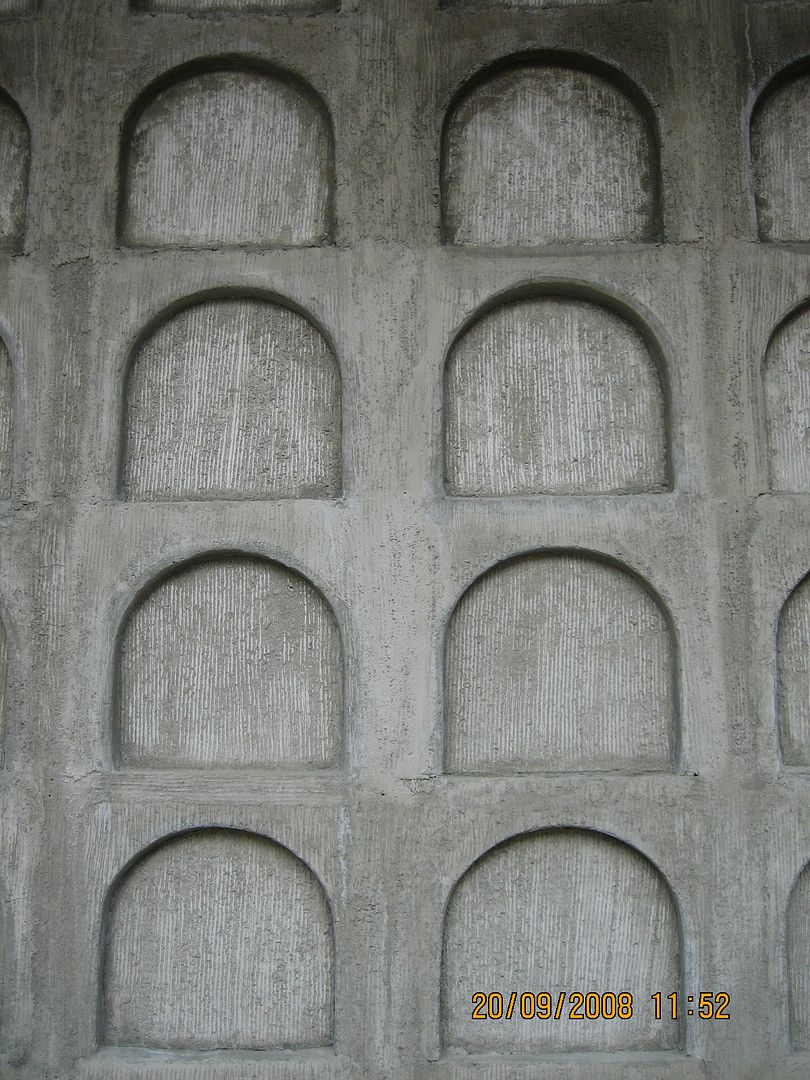
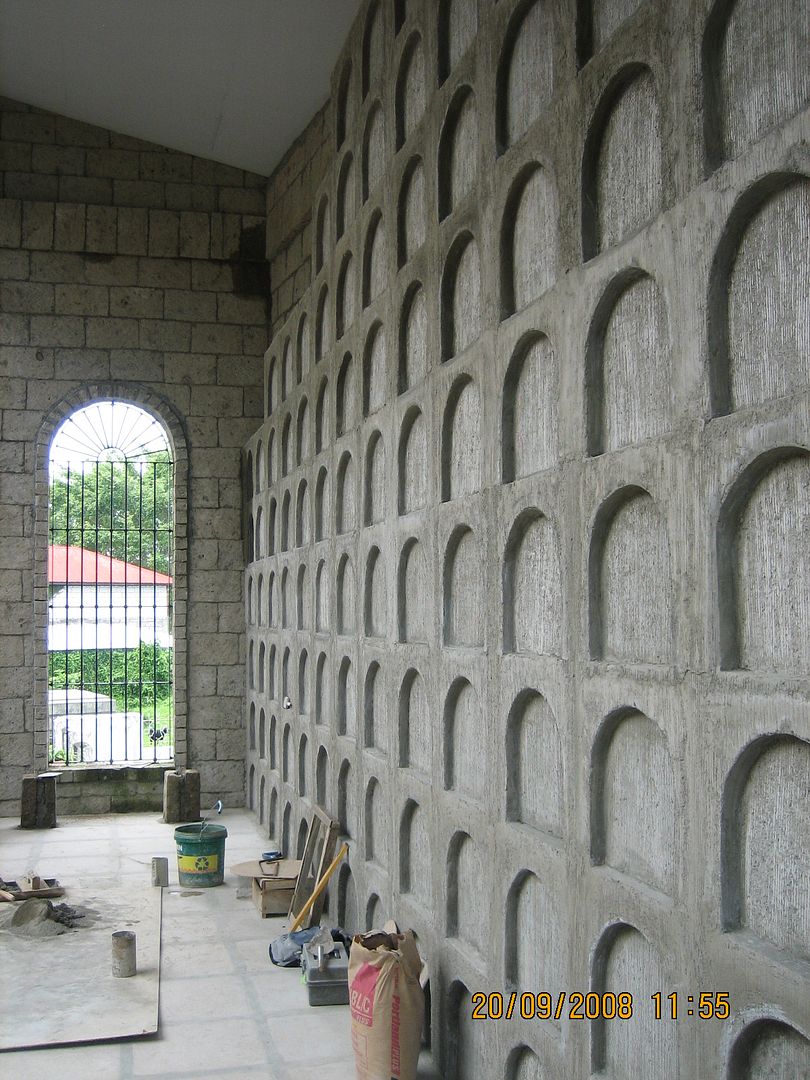
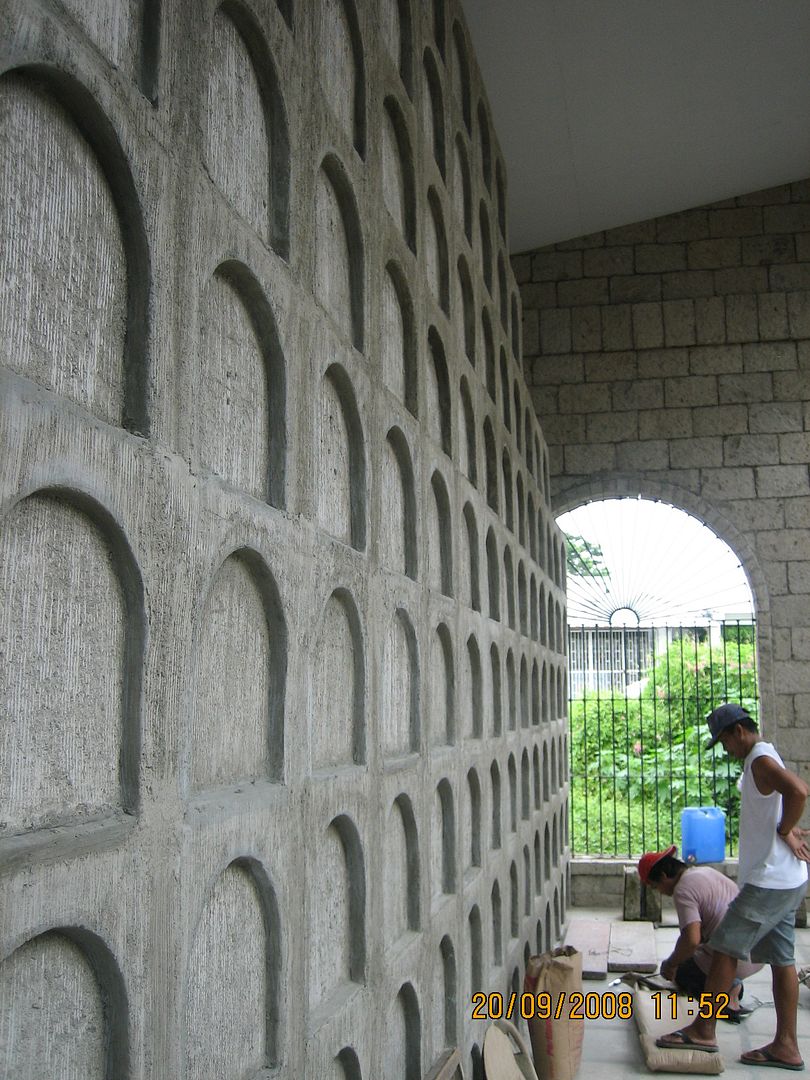
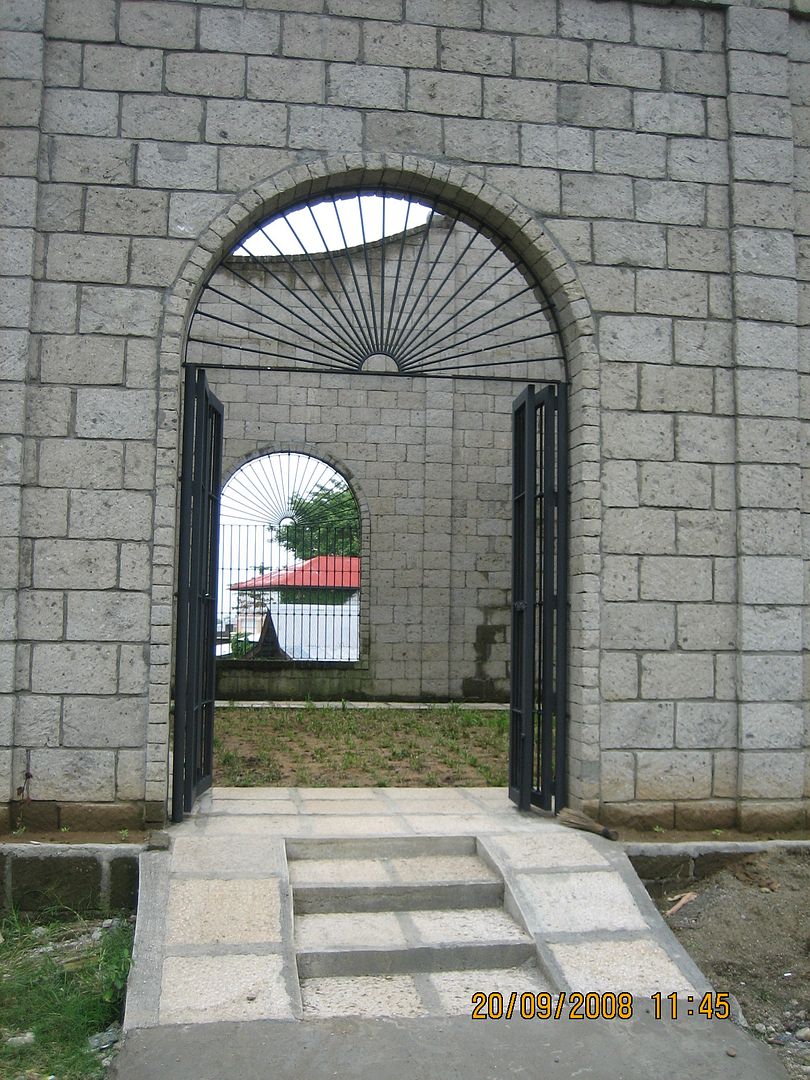
We had previously decided to go for arch-shaped tombstones, inspired by the niche fronts in the Nagcarlan Cemetery, as well as the hundred-year-old tombstones in the San Rafael Parish Church nearby.  By our September 20th visit, or barely six weeks before All Saints’ Day, the arch-shaped niche fronts were complete, ready to receive their custom-made fitted tombstones.


To ensure uniformity, our masons traced an arch-topped shape on plywood, closely following examples inside San Rafael Church, and used this in forming the niche fronts


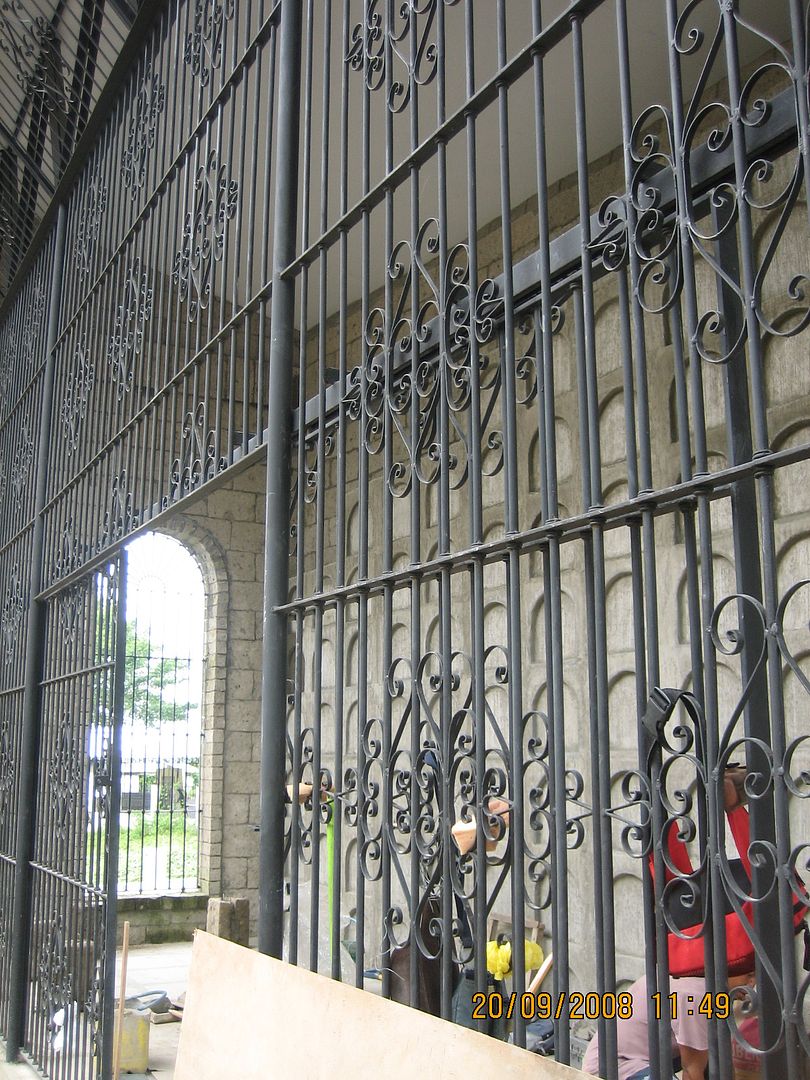
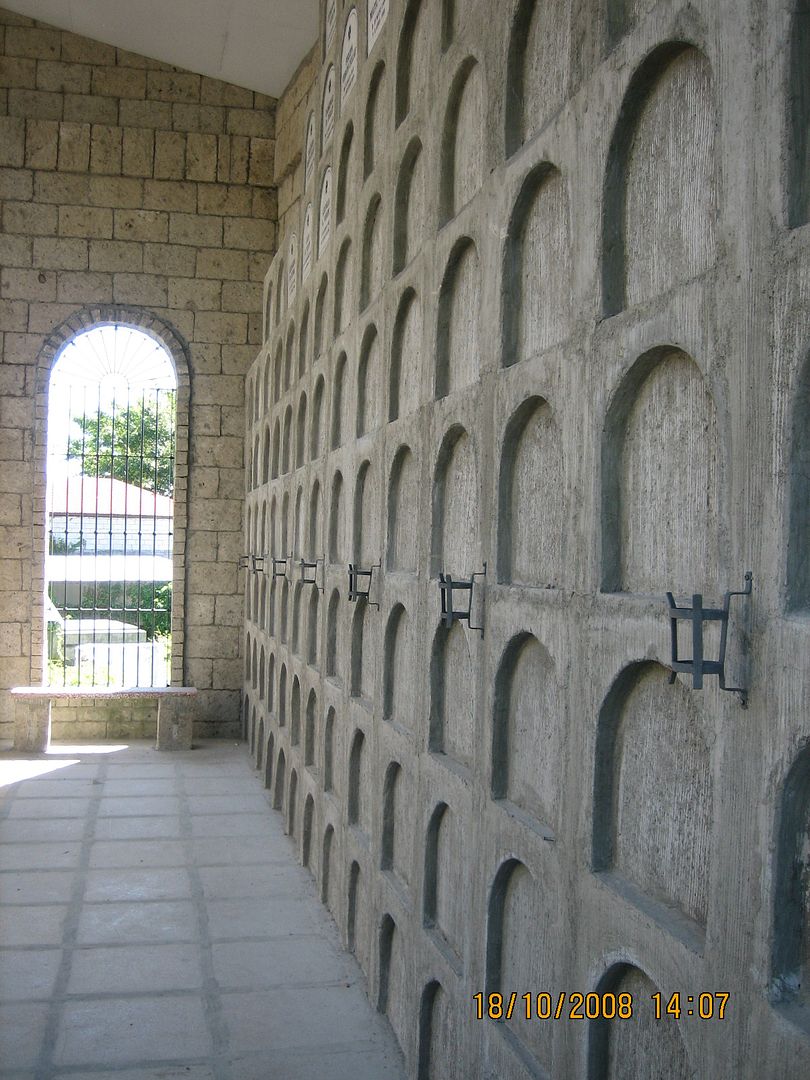
The resulting wall of niches was an interesting sight, even from extreme angles.


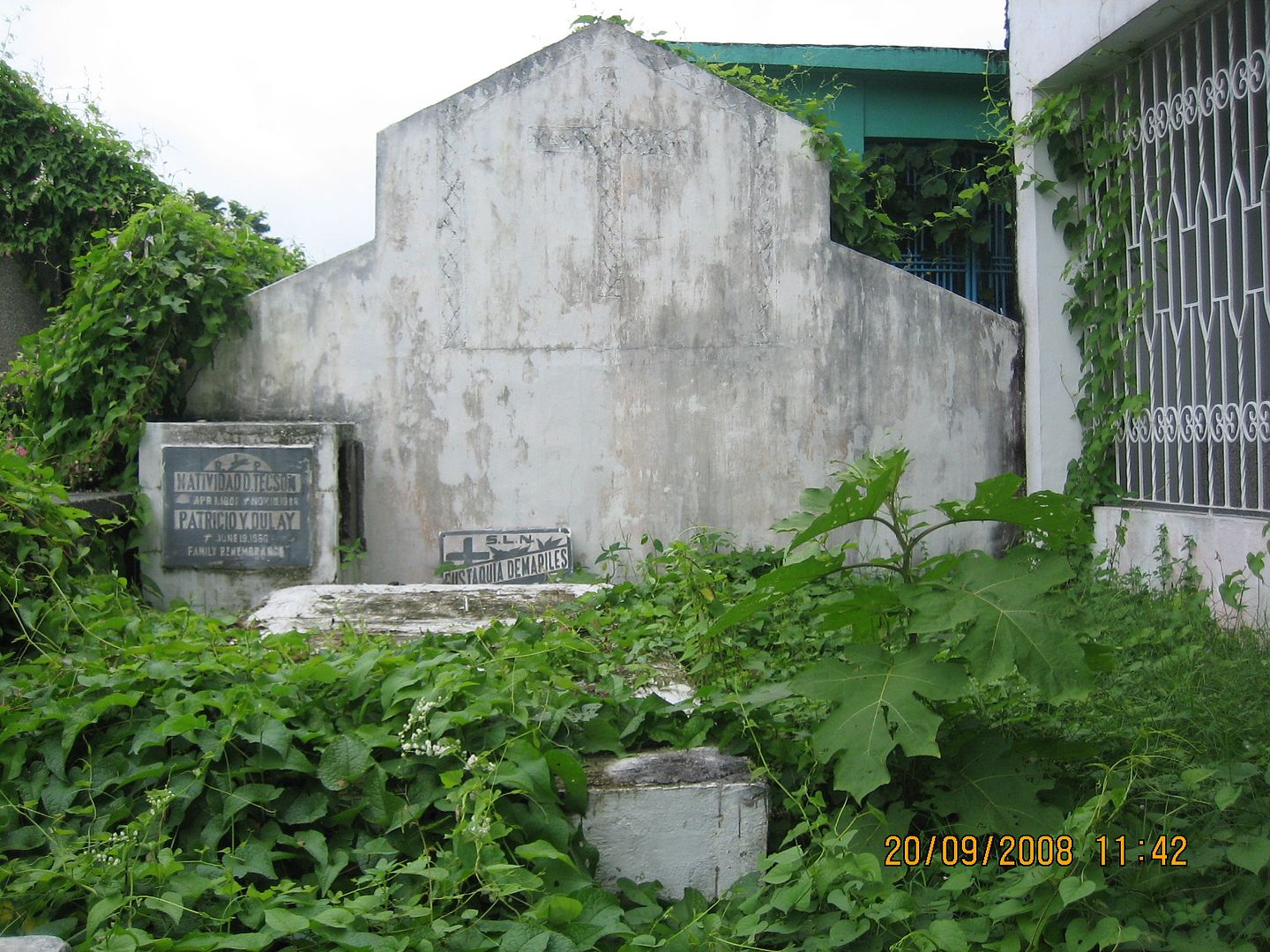
Diagonally across this mausoleum was a smaller plot containing the remains of our Dulay great-grandparents and two of their daughters.


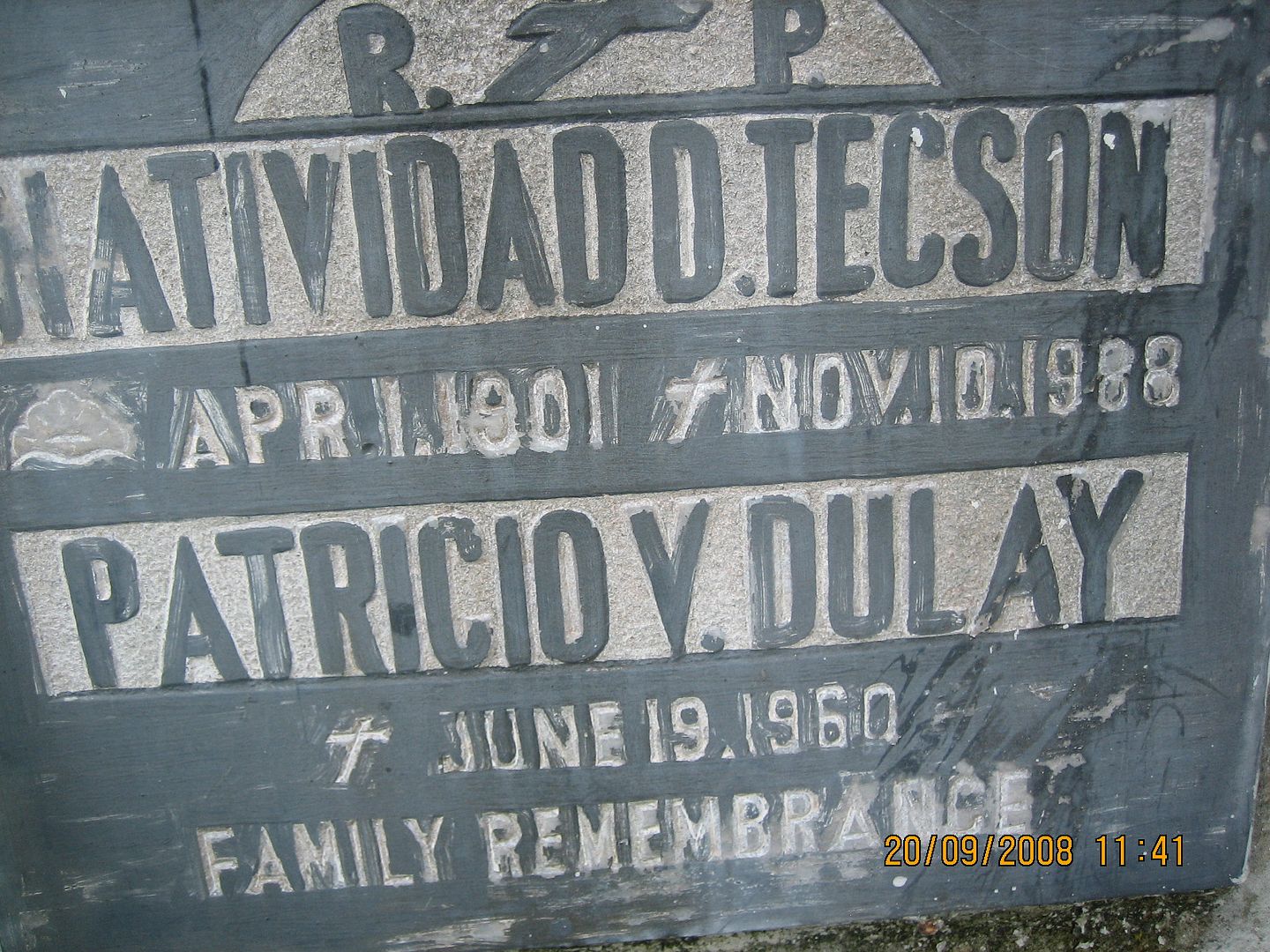
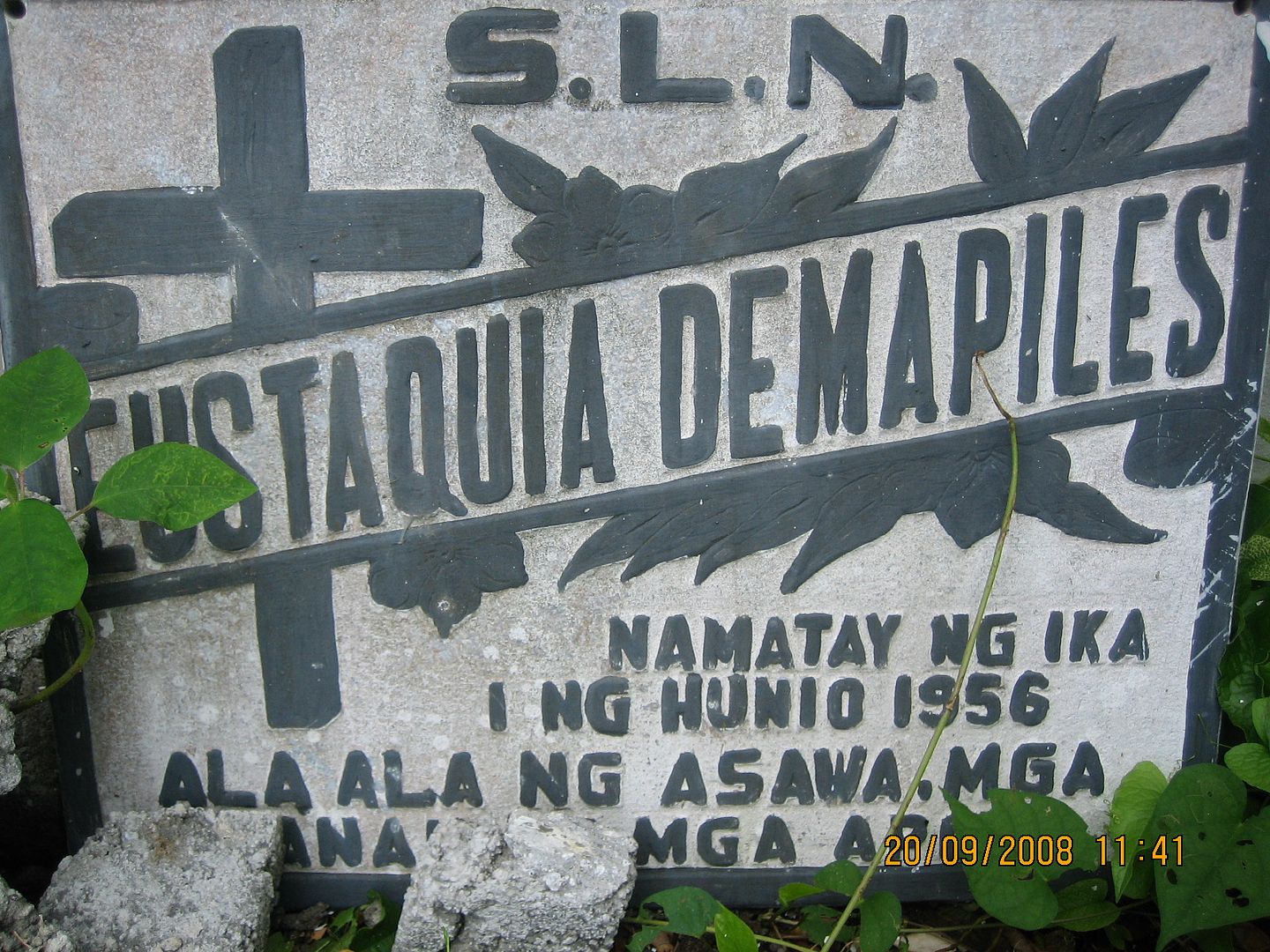
Except for the most recent burial here in 2007, all their remains had already been transferred to the niches in the new mausoleum.  I however had to photograph the old tombstones to keep a record of the dates of their deaths.


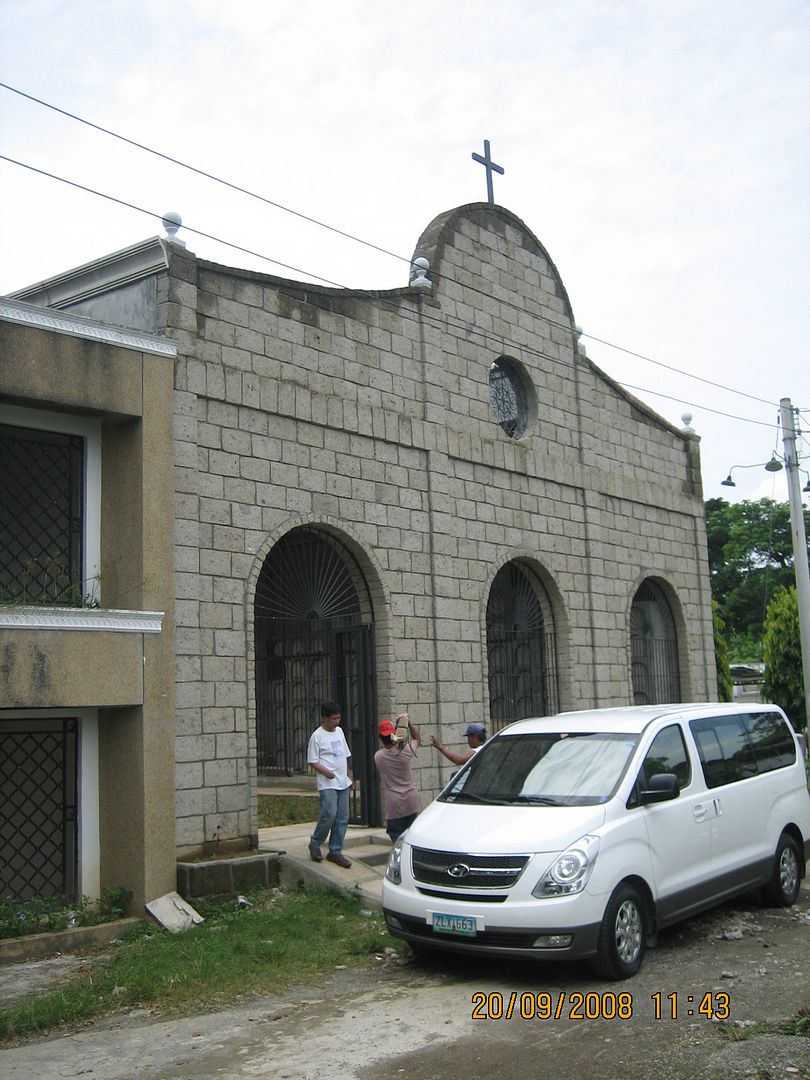
Looking back across the street to the larger, newly-rebuilt mausoleum, here is the view.


Walking uphill along the cemetery road, one tries to take in the mausoleum’s tall and wide façade.


Going slightly past the mausoleum further along the road, here’s what the view looks like.


Returning to the mausoleum’s doorway, we are welcomed (not yet as residents but as visitors) by a ramp made with the rough underside (for traction) of 20-inch square slabs of piedra china (Chinese granite), and by the wrought-iron gate’s folding panels on both left- and right-side leaves (newly-reconfigured from the single-panel door leaves previously to minimize the swing area).


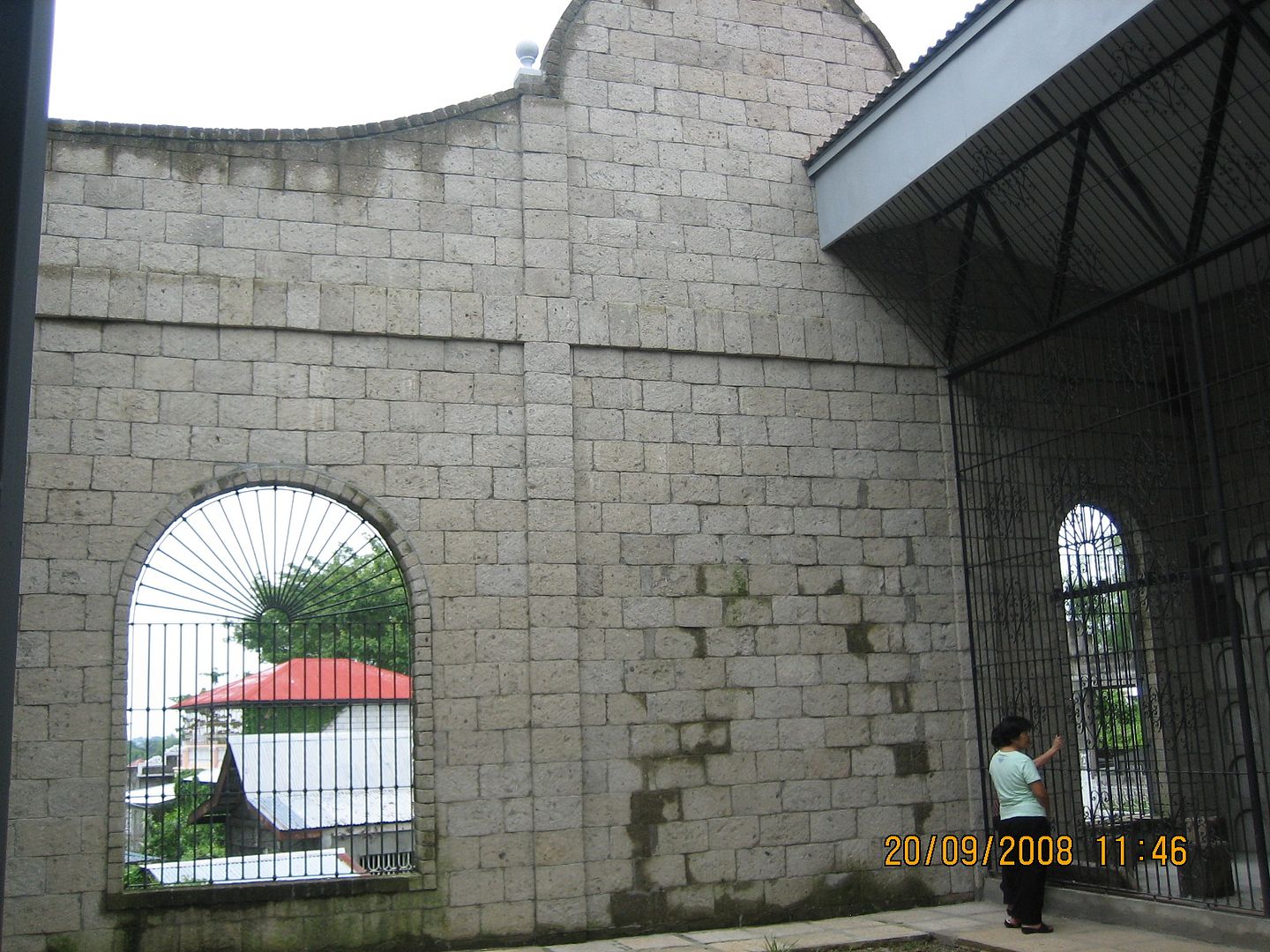
And inside, the rain-drenched walls were starting to acquire more naturally-grown moss.


I left the San Rafael Cemetery with the names, birthdates, and deathdates of our fourteen mausoleum residents, as well as a plywood copy of the arch-shaped pattern used for forming the niche fronts.  I then took these to a marble supplier highly recommended to us by friends, Prit Enterprises in Guadalupe, Makati City.

From the plywood pattern, the Prit people were able to cut white Indian marble (labeled “Rhapsody” in their catalogue) to the exact required shapes and sizes, and subsequently etch the relevant names and dates using computer-based technology and a sandblasting process, avoiding manual chiseling altogether and completing each tombstone’s inscriptions in just under half an hour.  In just a few days, the fourteen tombstones were ready for pick-up, which I then delivered to San Rafael on Saturday October 4th, less than a month before All Saints’ Day.

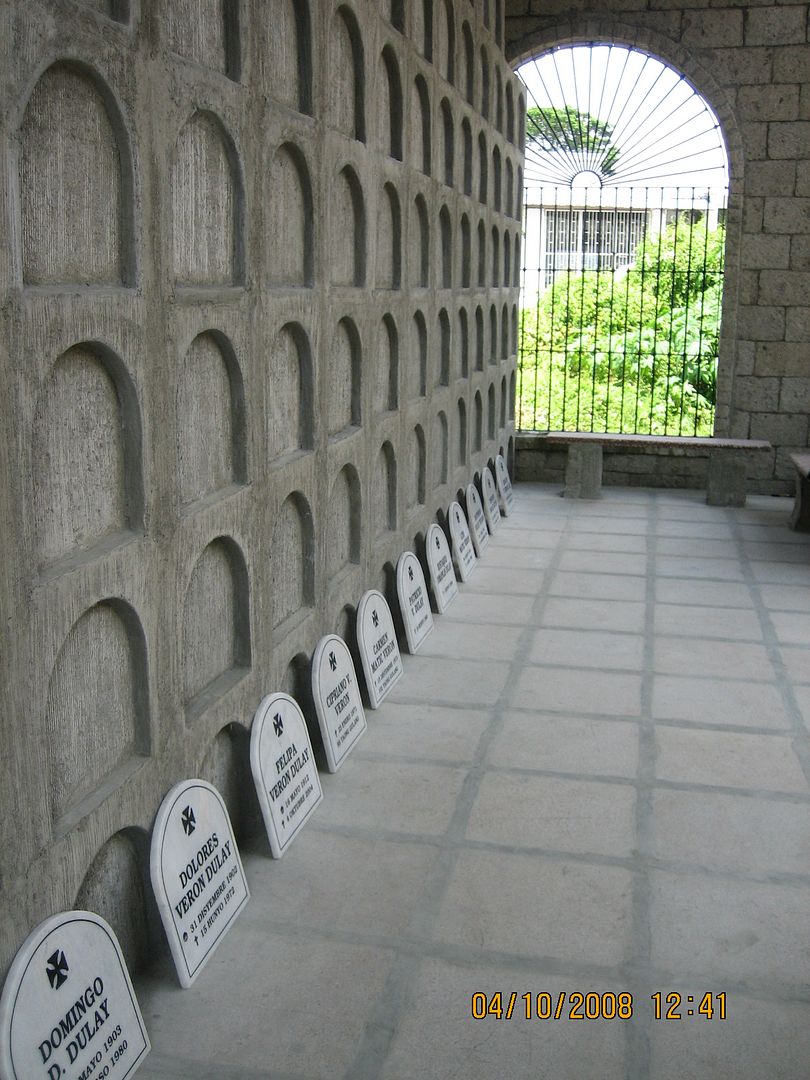
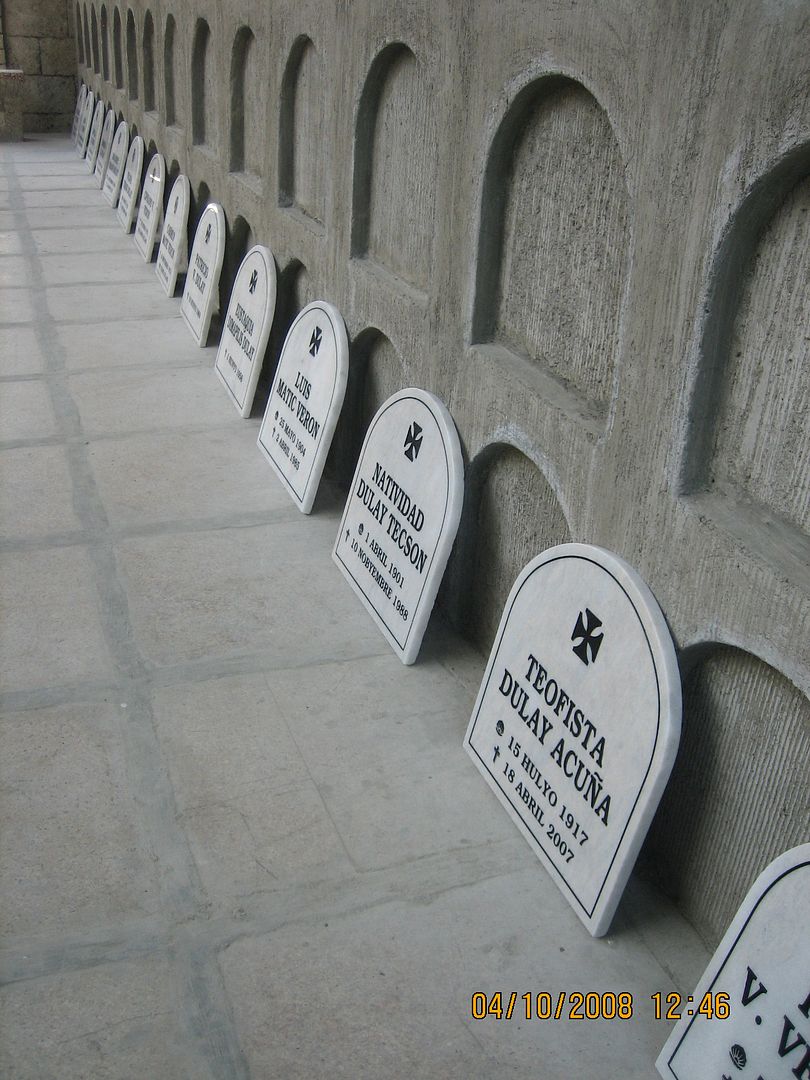
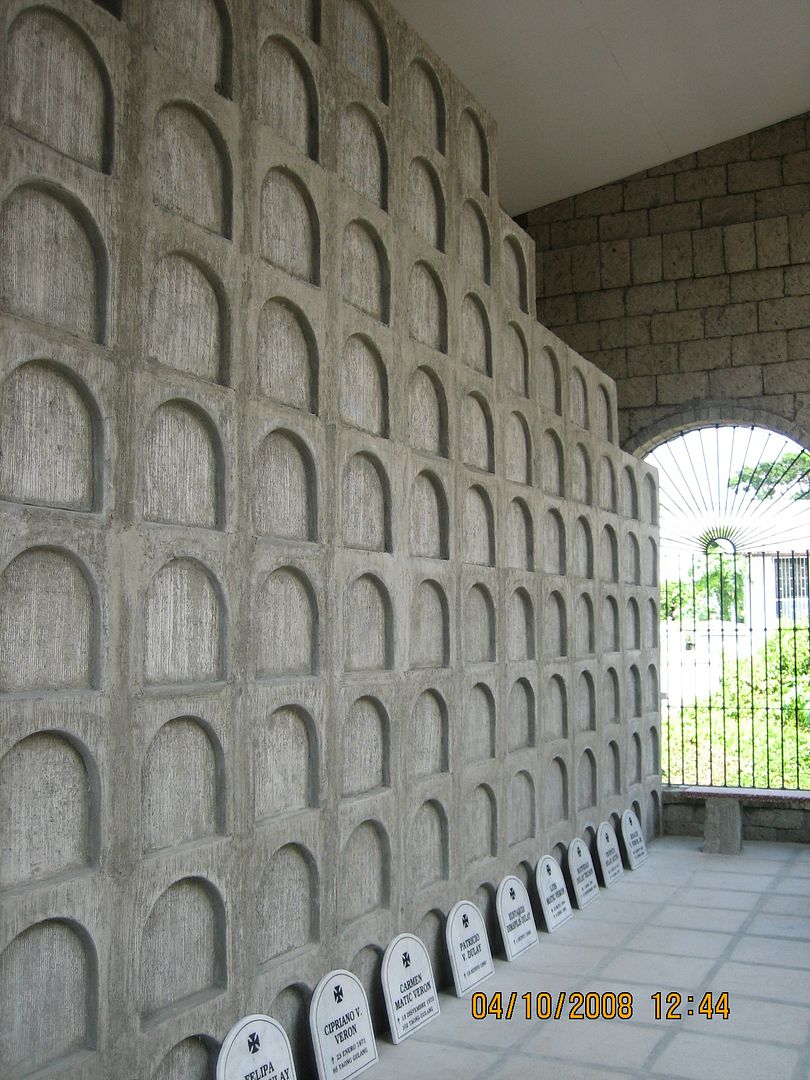
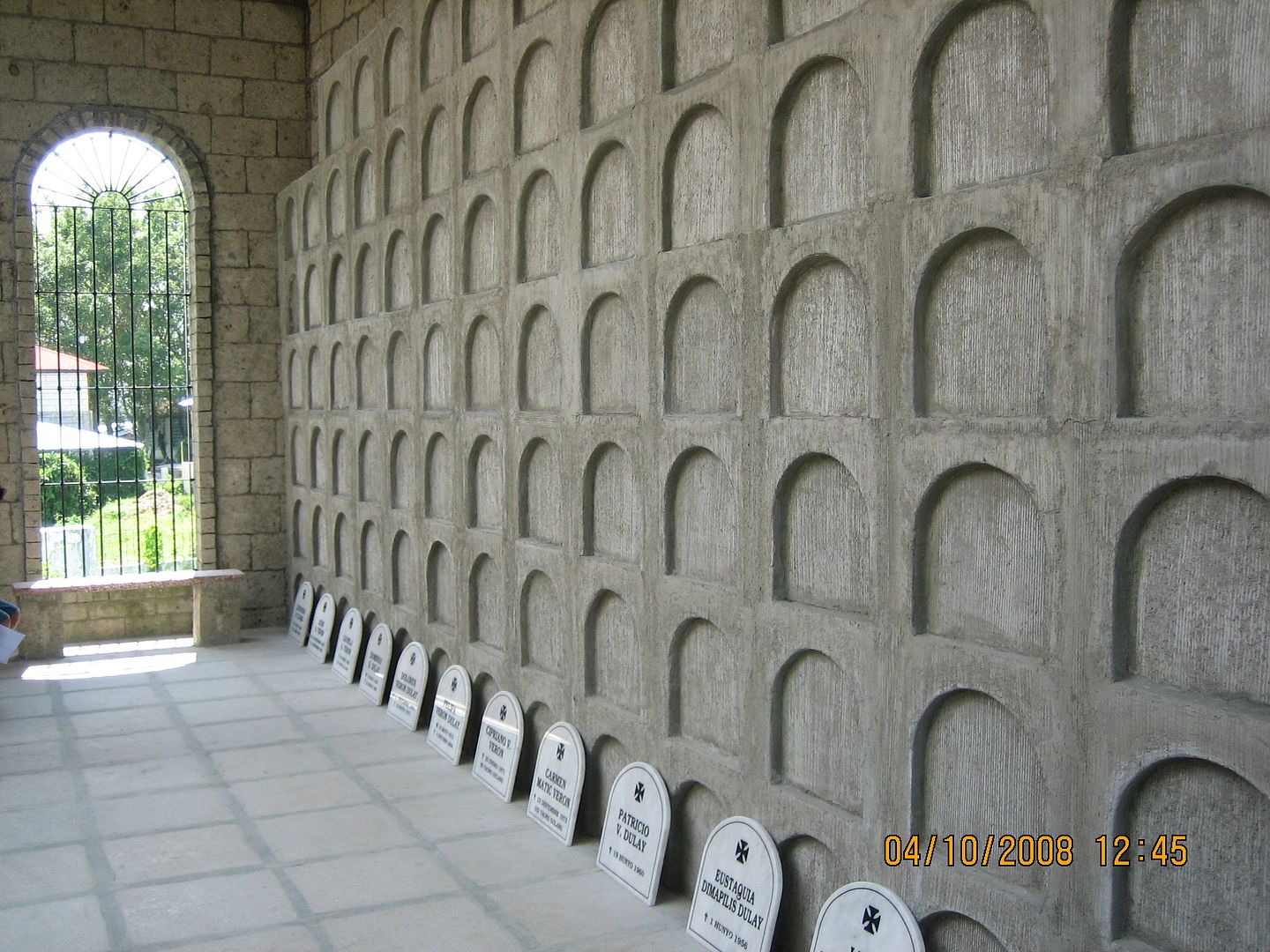
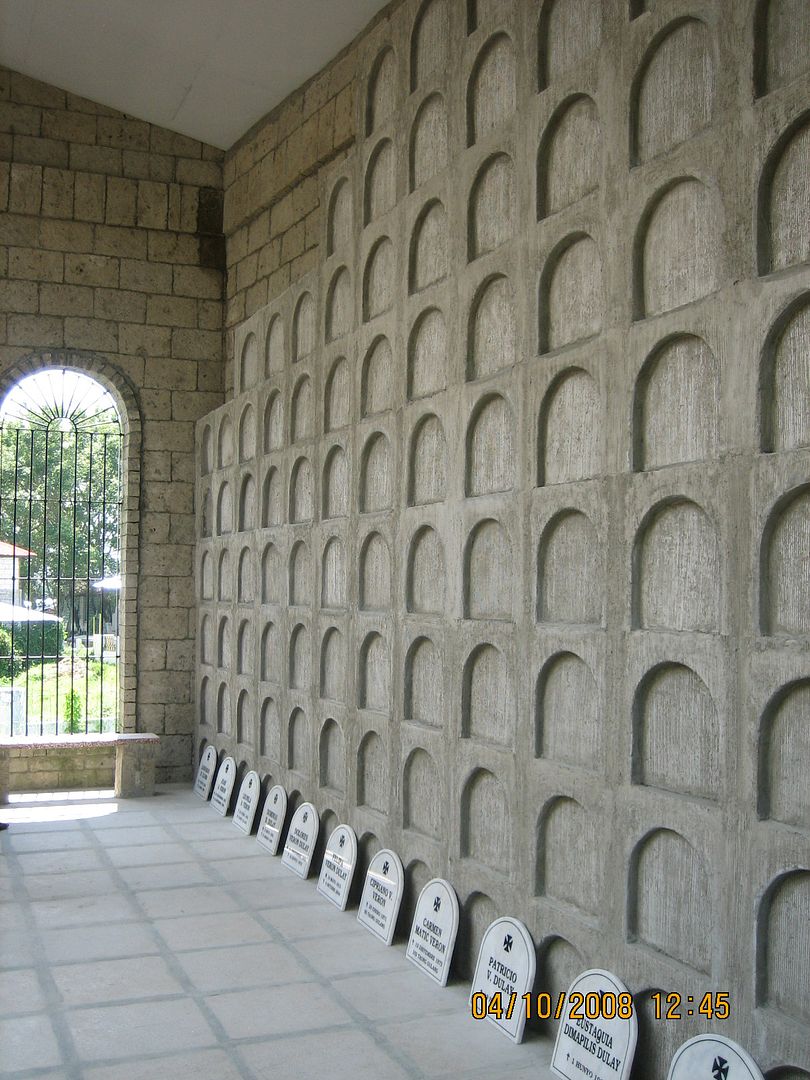
I laid them in a neat row on the floor and leaned them against the niches, on the smooth floor (also made of 20" x 20" piedra china slabs like the entrance steps, but with the smooth side instead exposed here)


just to check for overall color compatibility.


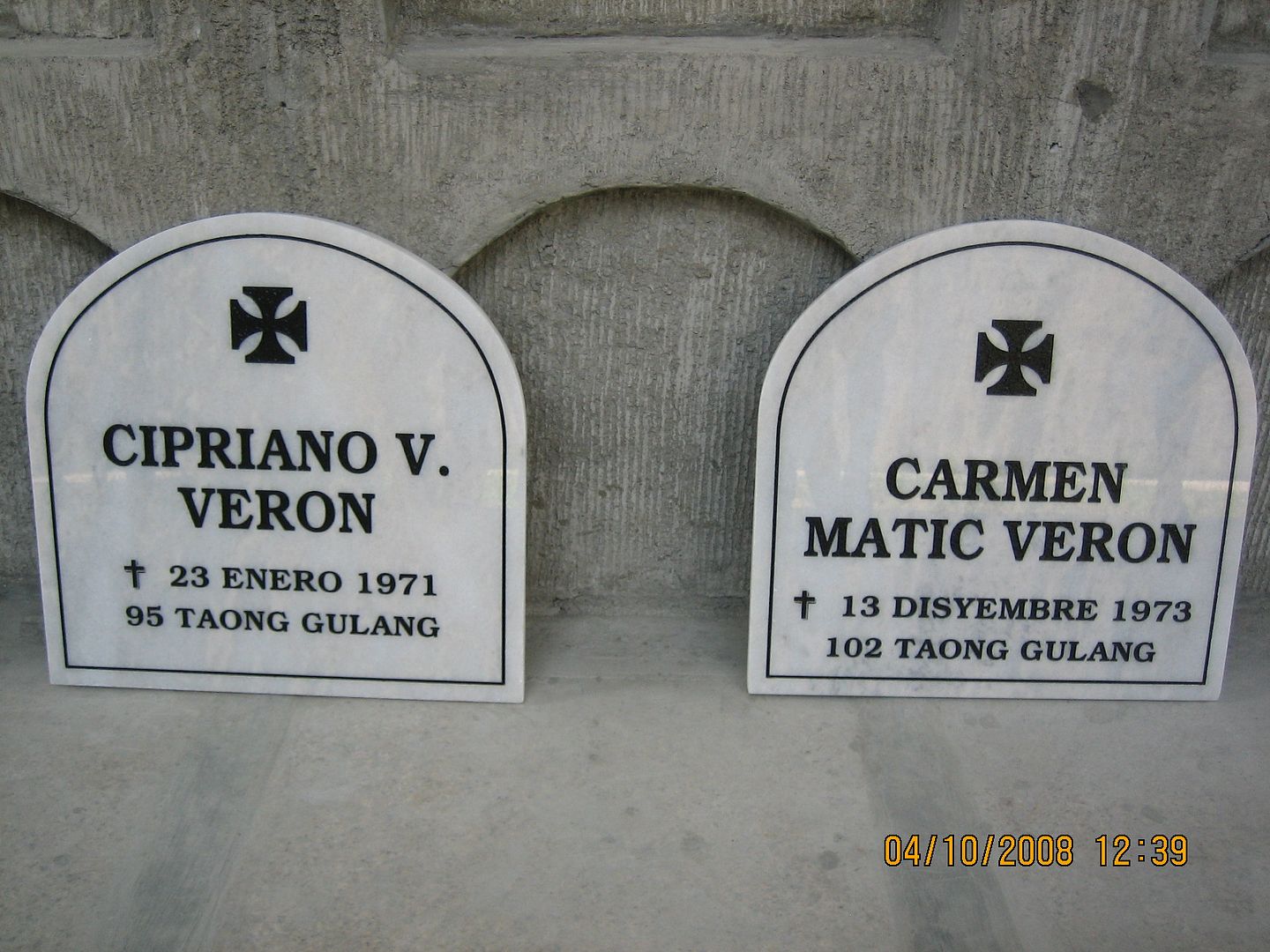
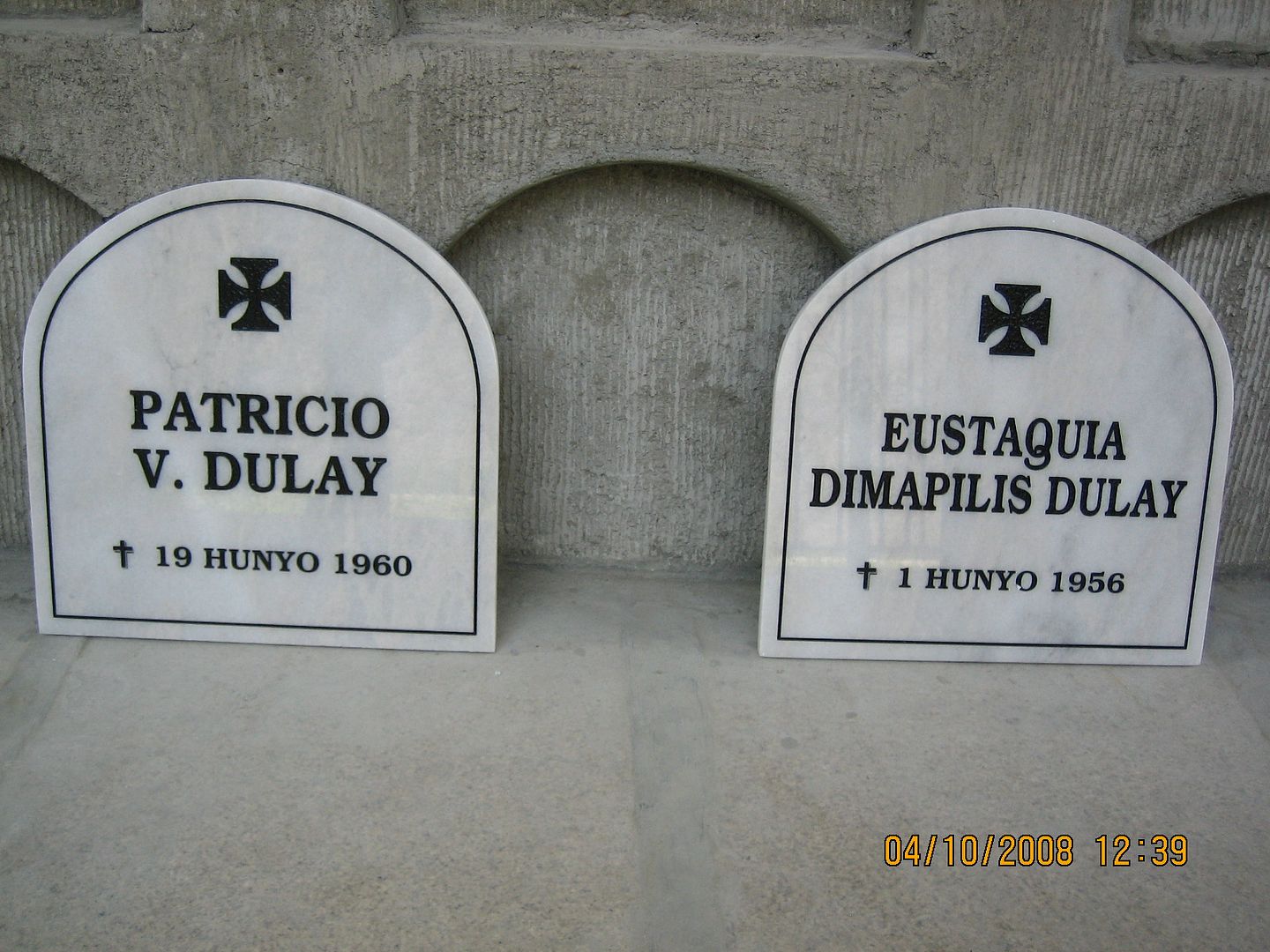
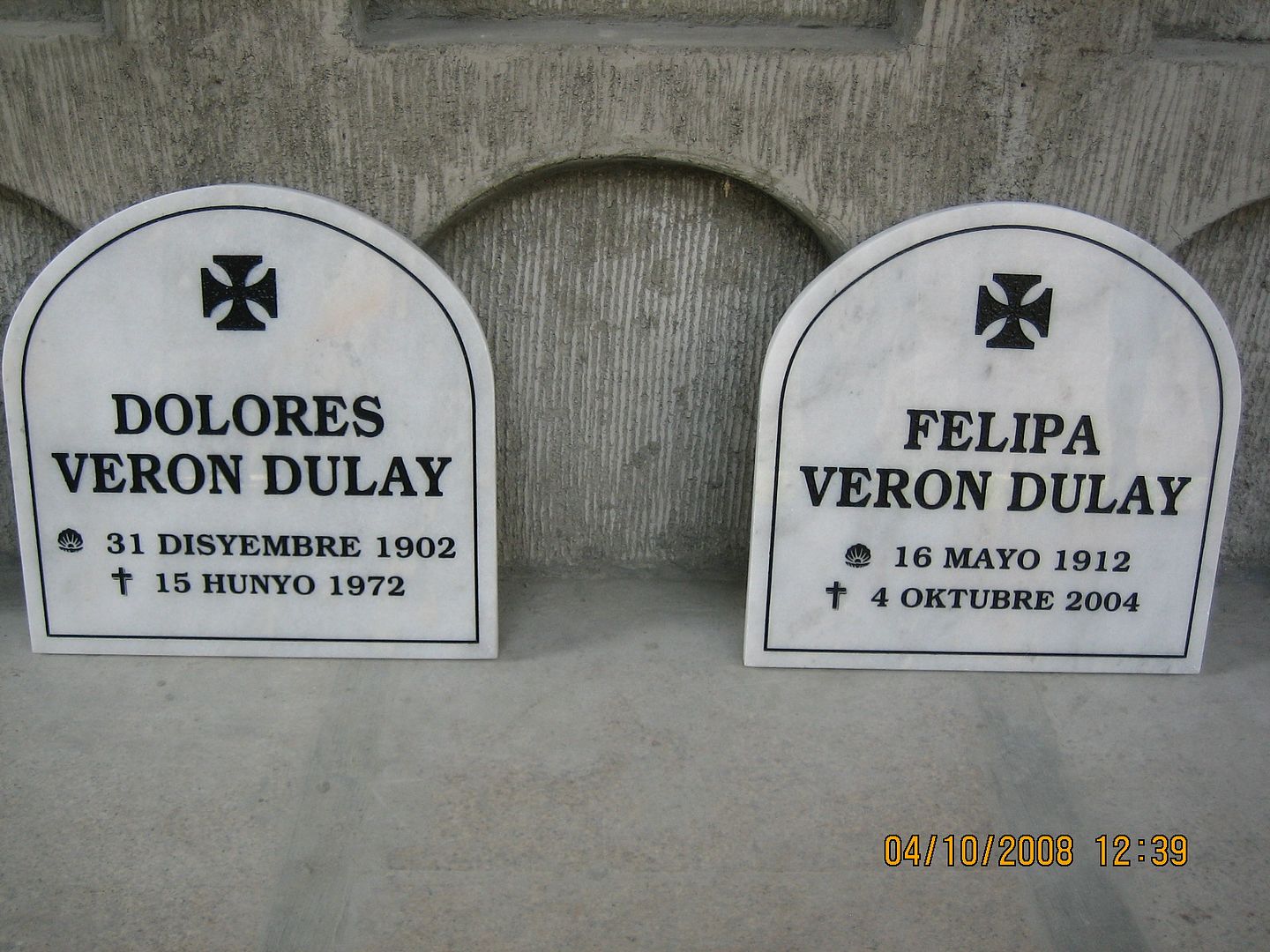
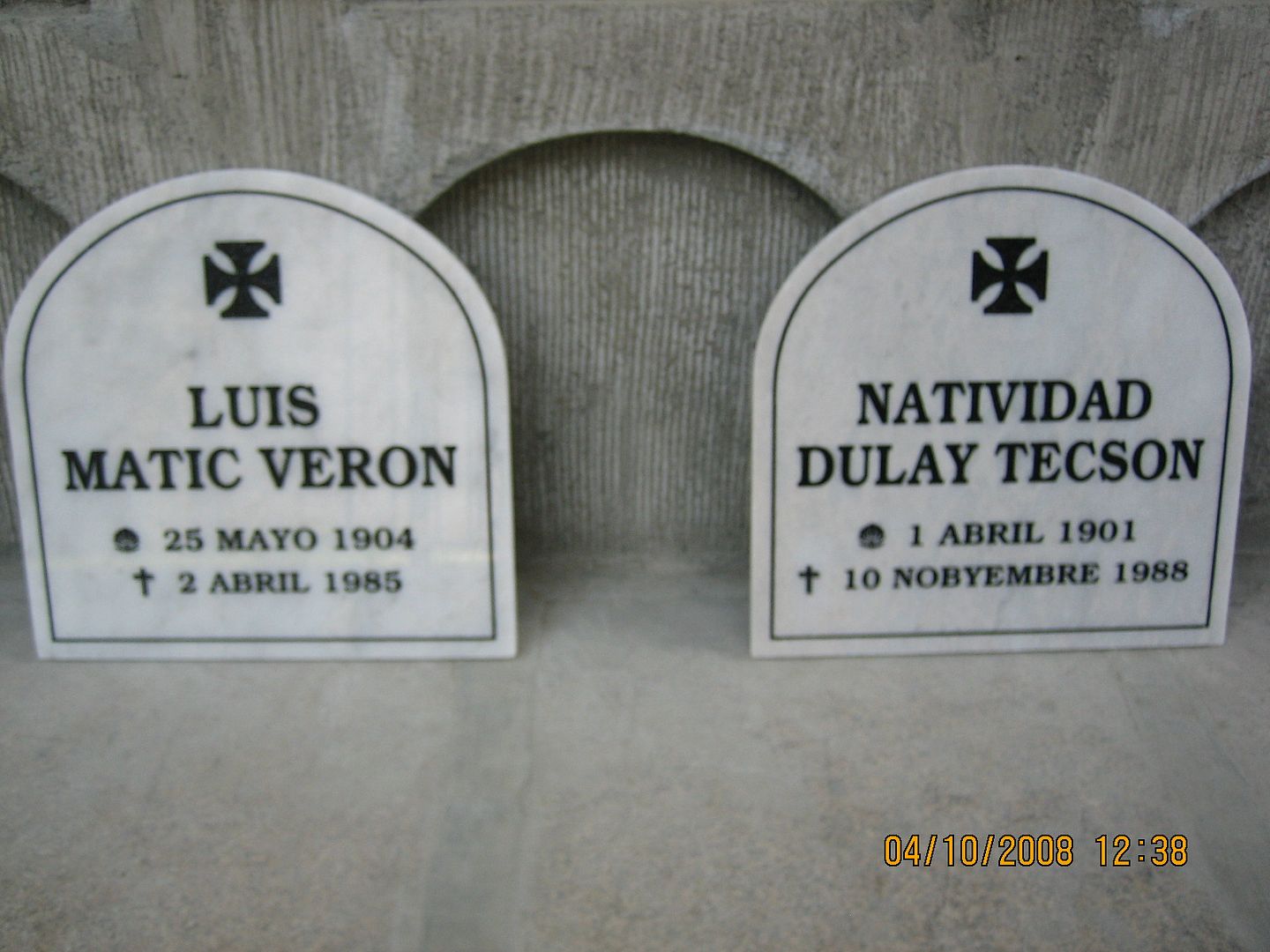
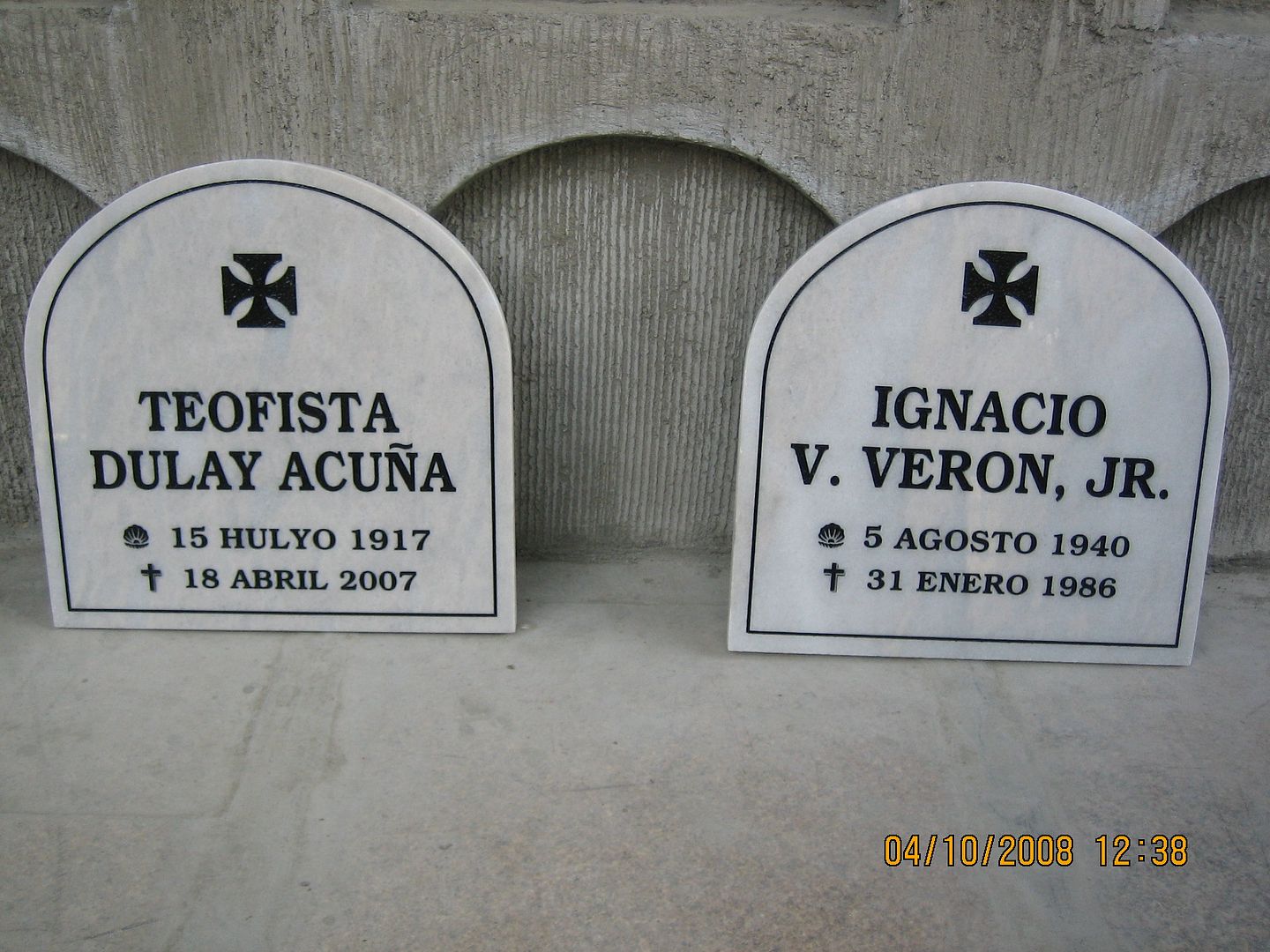
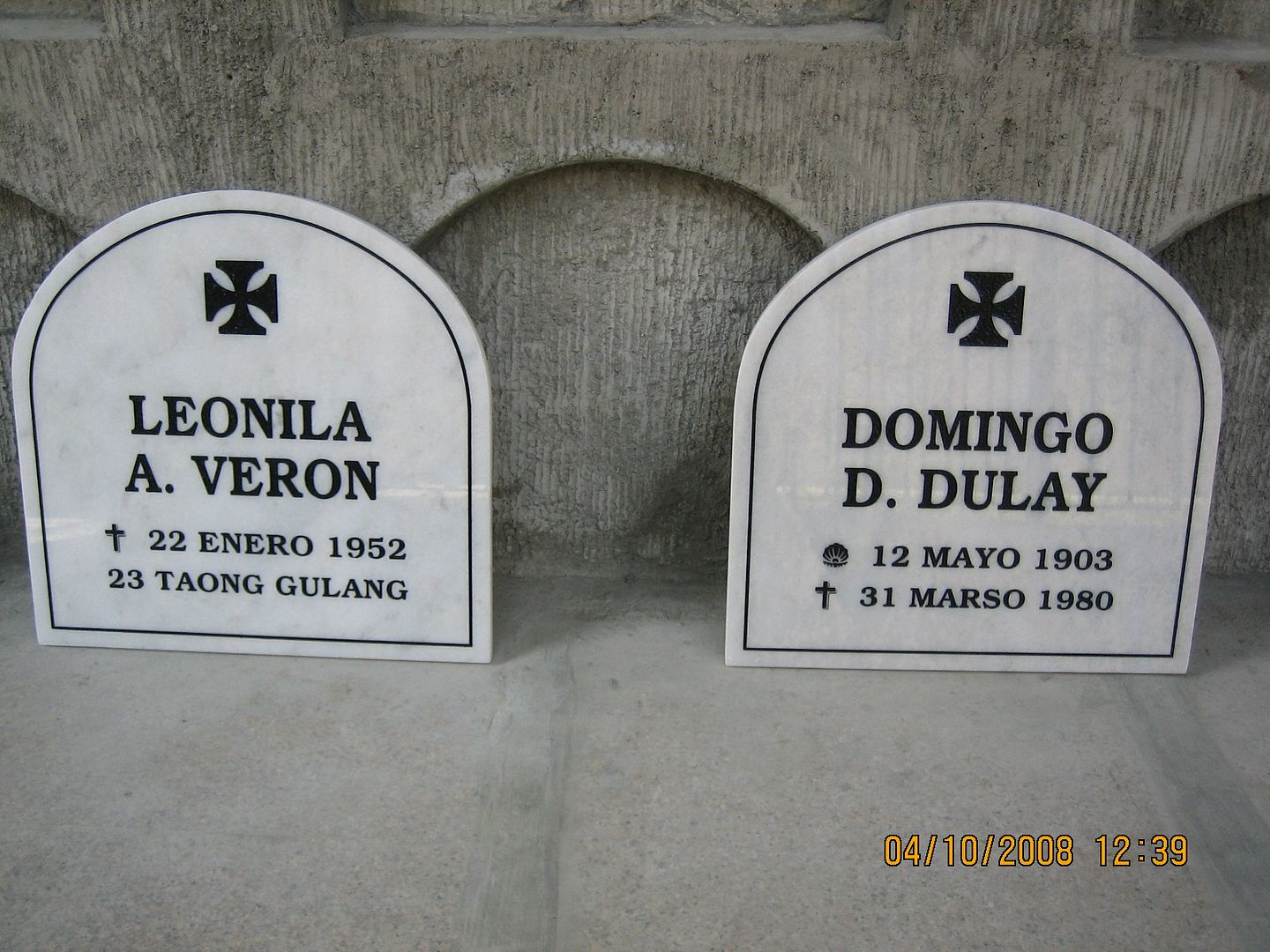
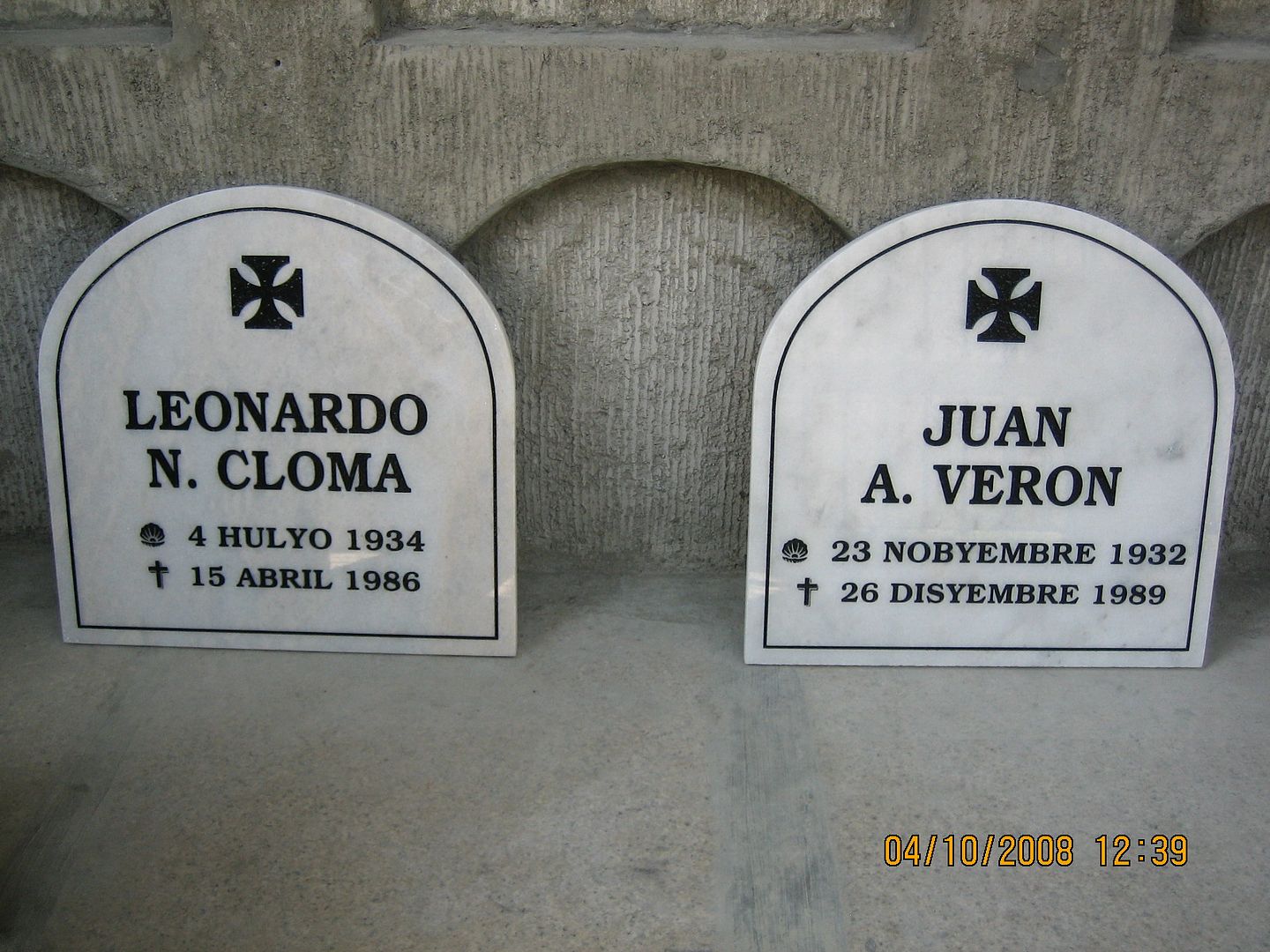
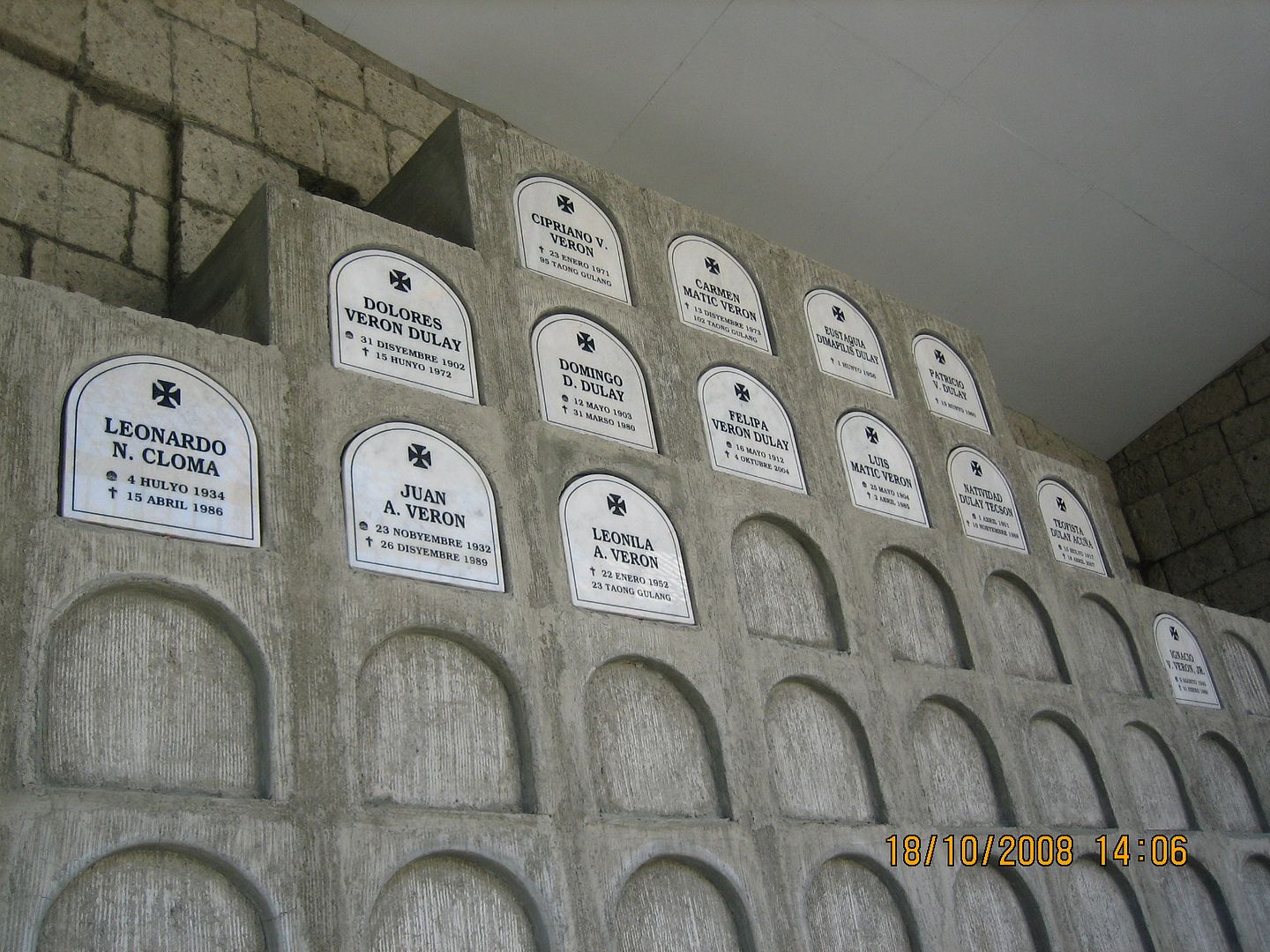
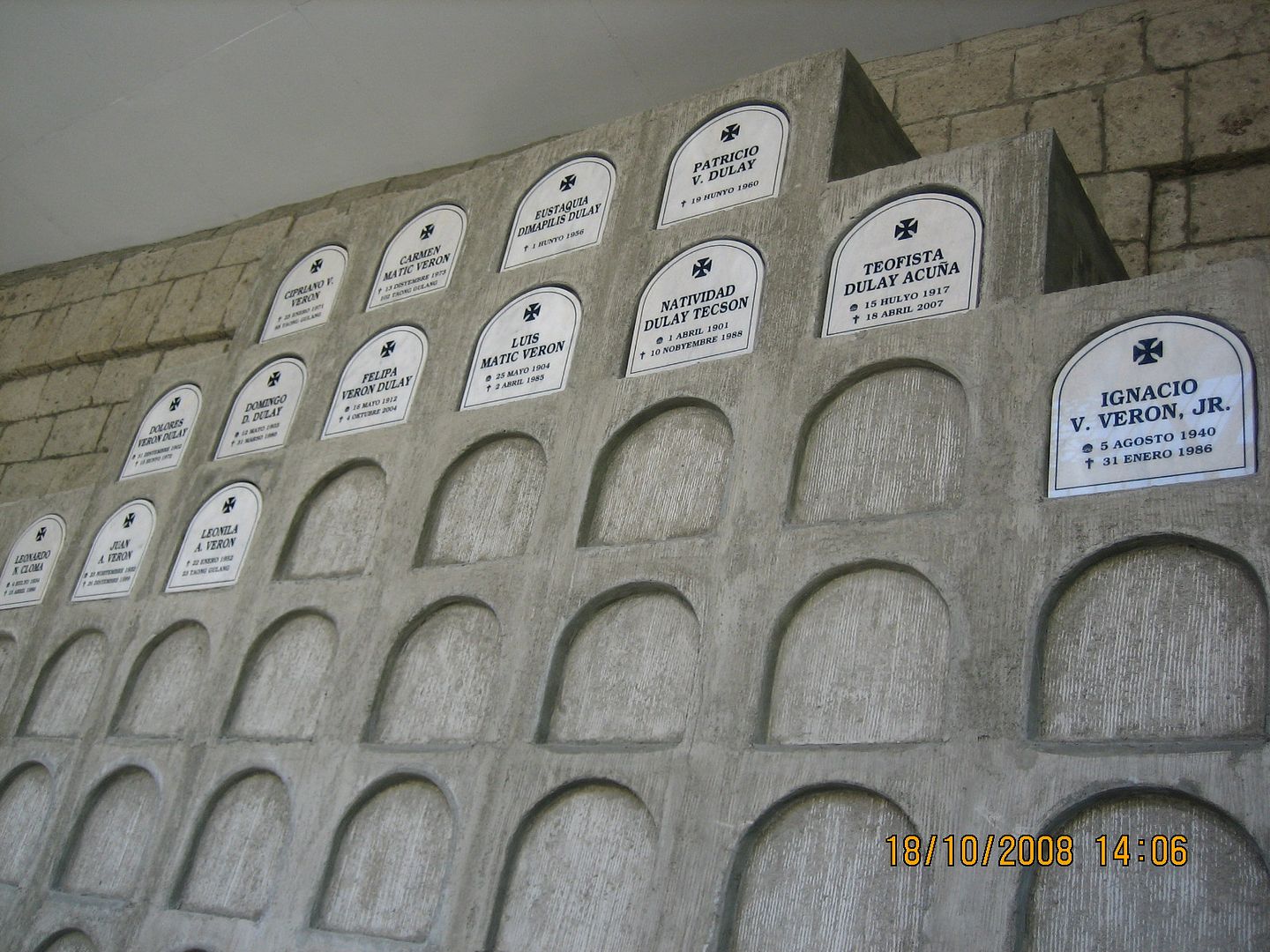
Which also allowed me to photograph each pair of tombstones for documentation purposes.  And run down the list of residents, for all of you to get to know them better (since it is unlikely that you will meet any of them, at least not in this lifetime).

Cipriano V. Verón and Carmen Matic Verón were my mother’s maternal grandparents.  As Tatang Panô and Ináng Carmen died only on 23 January 1971 and 13 December 1973, I remember them quite well from my early childhood.  They themselves did not know precisely when they were born, but using certain snippets of information (e.g., she was older than he was by about five years; she was about thirty when she married; their eldest child was born about a year after marriage), it was conjectured that they were born in around 1876 and 1871 respectively; he was about ninety-five at his death; and she was about a hundred and two when she died.


Patricio V. Dulay and Eustaquia Dimapilis Dulay were my mother’s paternal grandparents.  (Her maiden name is actually misspelled in the original lapida that we saw earlier.)   Again, there are no records of when Ingkóng Tisyo and Impóng Takya were born, but assuming that they were contemporaries of their balaes, they would have been octogenarians when they died on 19 June 1960 and 1 June 1956 respectively.  Looking at photos of them taken in the 1950’s, this conjecture of their ages is entirely plausible.

An interesting observation is that both their deaths in the month of June must be a natural consequence of their having been great devotees of the Sacred Heart of Jesus – they would walk hand-in-hand to early morning Mass every day, crossing the plaza to the San Rafael Church directly across their house until shortly before they died.


The next row is occupied by children of both these venerable San Rafael couples.  Dolores Verón Dulay (31 December 1902 – 15 June 1972) was the eldest child of Tatang Panô and Ináng Carmen.  “Loleng” was a much-awarded Mathematics and English teacher at the Bulacan High School (later the Marcelo H. del Pilar High School) in Malolos, teaching Calculus to high school students decades before it became the norm.

One of her three sisters (one settled in Malolos and is buried there; the other one migrated to the USA in the 1950’s and died there a few years ago) was Felipa Verón Dulay (16 May 1912 – 4 October 2004), who, like her Até, was a schoolteacher.  Except that Felíng taught Grade One in the Caingin (San Rafael) Elementary School for four decades, and several generations of Caingin natives have therefore undergone her schoolmarming.  Because she had been buried less than five years ago, her remains are not yet suitable for relocation to the niche area, and are still in their original above-ground (now underground) niche beneath this new Mausoleum.


Luis Matic Verón (25 May 1904 – 2 April 1985) was one of two sons of Tatang Panô and Ináng Carmen (the other was a World War II guerilla and was never found, presumed killed).   Like his father, he was a professional farmer and personally tilled the family-owned farmlands in the area.  Also like his father, he exhibited the prominent Verón forehead, i.e., a well-receded hairline.  (Now you know where I get it from.)

Natividad Dulay Tecson (1 April 1901 – 10 November 1988) was the eldest child of Ingkong Tisyo and Impong Takya.  “Nanang Tabâ” (yes, she was on the heavy side -- I wonder which came first, her nickname or her physique?) was a part-time entrepreneur (roadside canteens) and full-time housewife (she was married, and widowed, twice).  Nonetheless, she found time to care for her parents in old age, perhaps partly because she had no children.  Like her parents, she was originally buried in the small Dulay Mausoleum across the street, and now joins them in this new improved Verón-Dulay Mausoleum.


Teofista Dulay Acuña (15 July 1917 – 18 April 2007) was the youngest sibling of Nanang Tabâ, and was a schoolteacher.  Like her Até, Nanang Inê was married and widowed twice, but remained childless.  She shared housekeeping and parent-caregiving duties with her Até as well.  Because she died just a year and a half ago, her remains will stay in the old Dulay Mausoleum until they are suitable for relocation to the Verón-Dulay Mausoleum niches, perhaps a couple or so years from now.

One of those on the third row of niches is Ignacio V. Verón, Jr. (5 August 1940 – 31 January 1986).  “Junior” was the son of another of Tatang Panô’s and Ináng Carmen’s daughters, who just happened to marry a Verón first cousin, hence Junior's (retained maternal) surname.  Like his grandfather Tatang Panó and his uncle Luis, he was a professional farmer, and although he was born in Malolos (his mother had relocated there to marry his father, who was from the Malolos branch of the family), he relocated to San Rafael for this purpose.  He sadly died relatively early due to liver disease.


Another member of the third row is Leonila A. Verón, who was Luis’ eldest daughter.  “Lilay” was a famed beauty in her time, and her extant photographs certainly provide evidence of this.  Sadly, she died on 22 January 1952 from acute typhoid fever.  Her birthdate is unrecorded, but family members are certain that she was just twenty-three years old at the time of her death.

The final member of the second row is Domingo D. Dulay (12 May 1903 – 31 March 1980), eldest son of Ingkóng Tisyo and Impóng Takya.  “Menggoy” married Loleng in the early 1930’s, and they settled in Malolos, he to work for the provincial government, and she to be a schoolteacher in the provincial high school.  (Among their four children is my mother.)  Some years after Loleng died, this ever-practical family conveniently arranged for Menggoy the widower (by then in his 70's) to marry Loleng’s younger spinster sister Felíng (by then in her 60's), allowing them to provide each other the security and companionship that they both needed in old age.  Thus did these two families become linked twice over.


One of the last two members of the third row is Leonardo N. Cloma (4 July 1934 – 15 April 1986).  “Nardo” married the eldest daughter of Menggoy and Loleng in January 1965, relocated to Malolos from Pasig, and shortly afterwards became my father.  He founded and managed a number of business enterprises in and around town for the better part of the two decades that he was a (completely-assimilated) Malolos resident.  His own father was originally from Bohol (where it seems all Clomas originate), relocated to Pasig at a young age, married into a local family, and was presumed killed as an urban guerilla during World War II.

Finally, Juan A. Verón (23 November 1932 – 26 December 1989) was one of Luis’ sons and was Lilay’s brother.  “Juaníng” was a professional engineer and engineering professor, and needless to say, also exhibited the prominent Verón forehead.  His widow Lilia is now the head of the family’s San Rafael branch, and was the persevering onsite manager for this family mausoleum project.


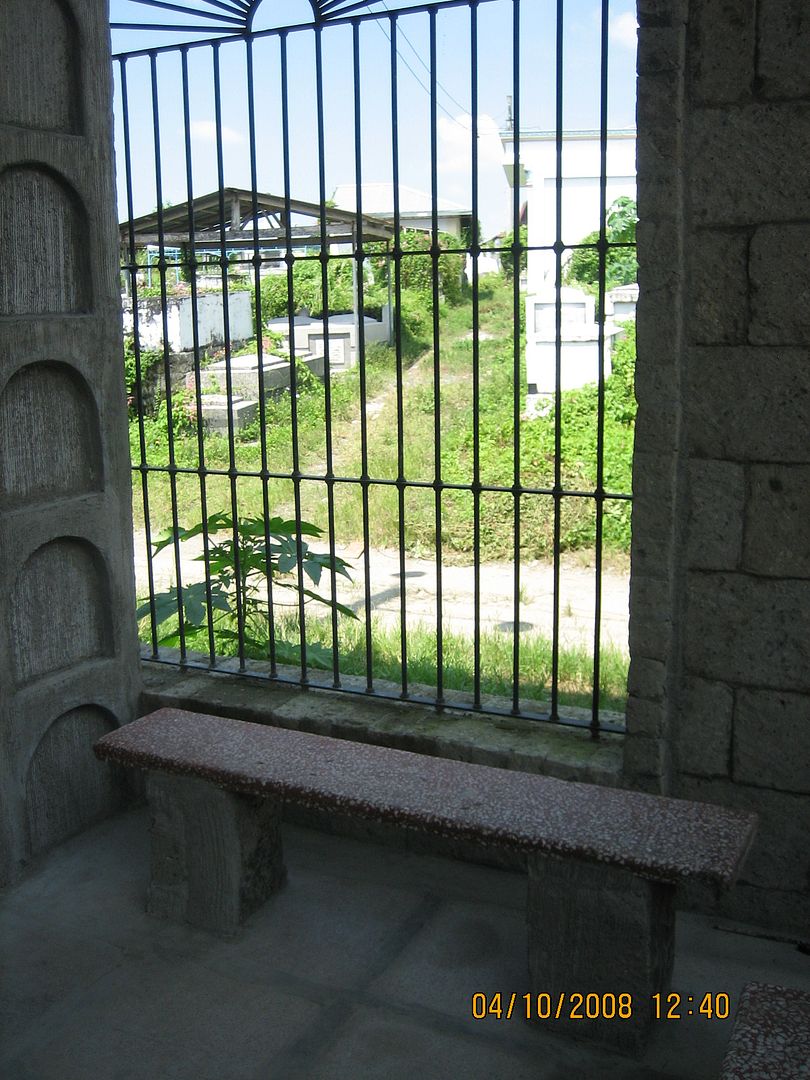
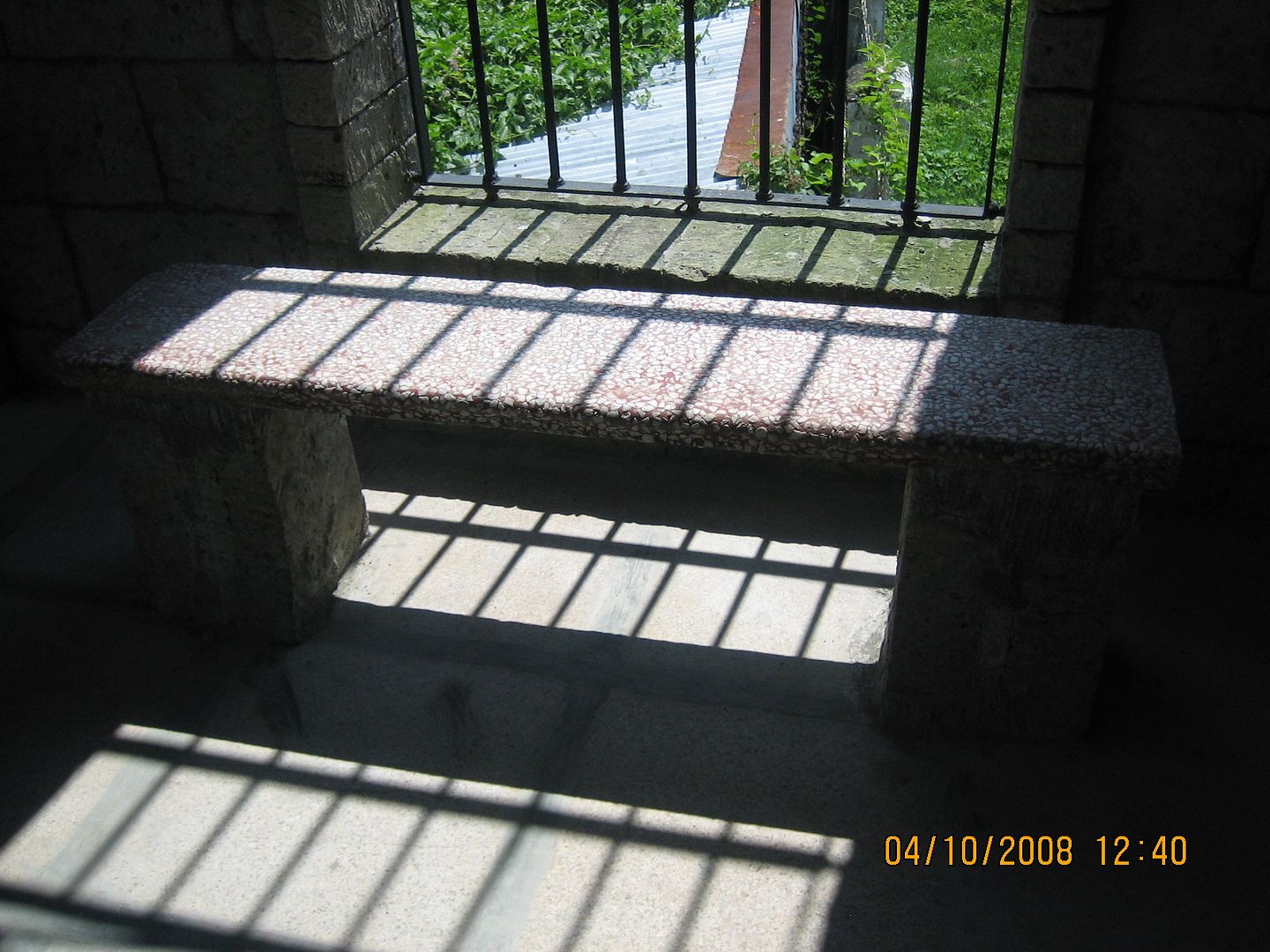
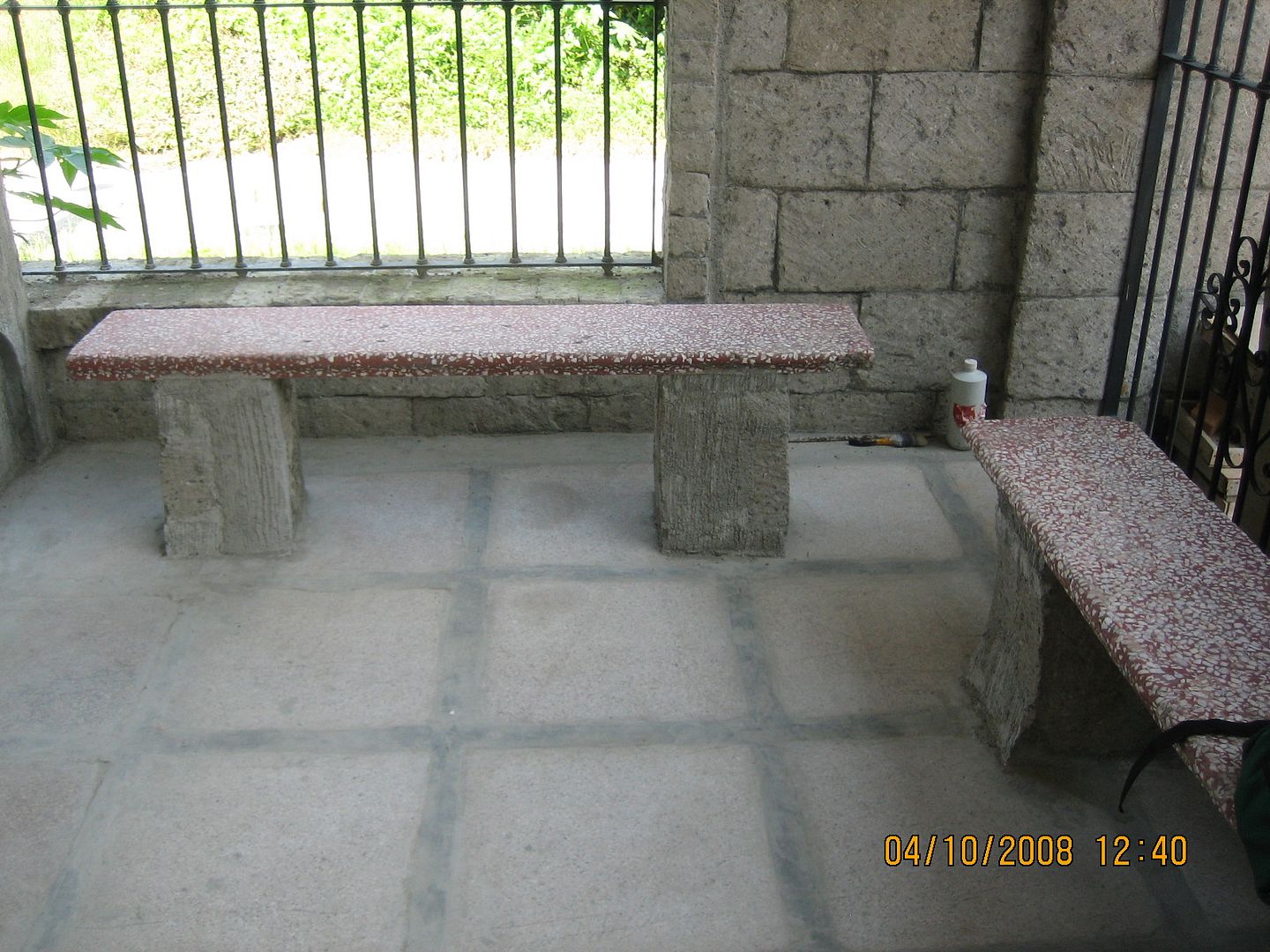
At this point, one might rest on one of the four granite benches (slabs salvaged from the treads of a pre-war mansion’s staircase and found in an antique shop’s bodega).


Two slabs are positioned at right angles at each end of the niche area.


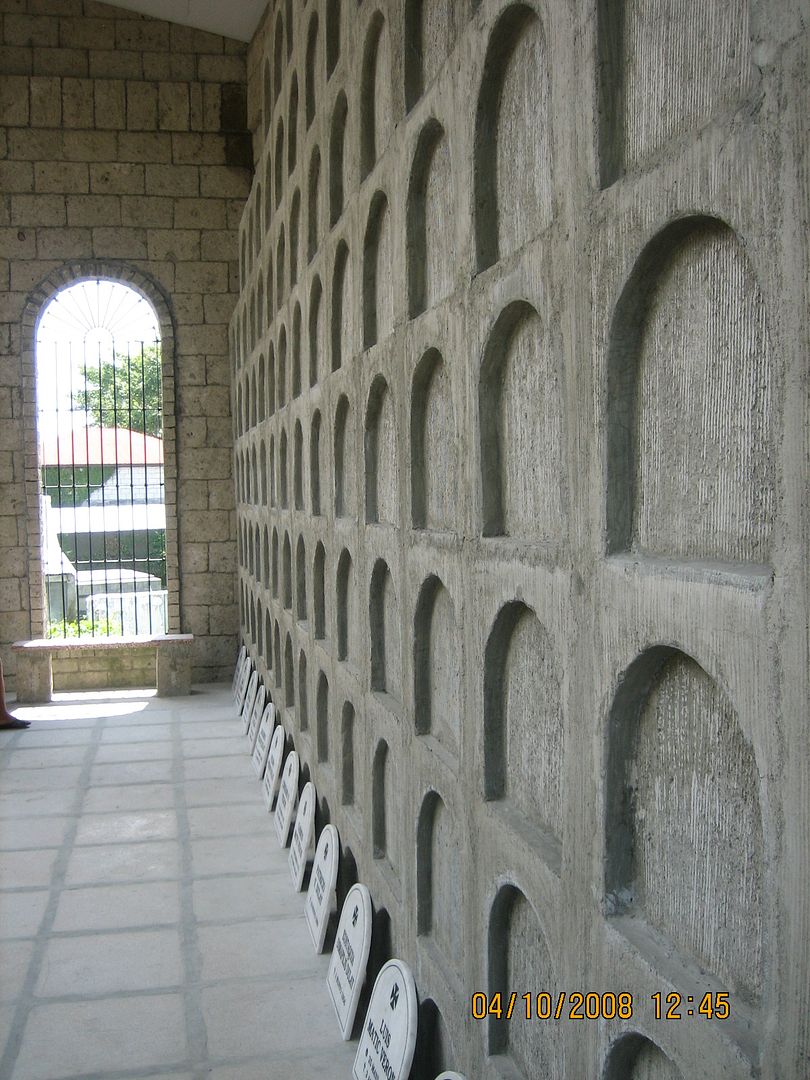
And before leaving, I took an acute-angle view from one end, just to check for (near-) geometric perfection.


On Saturday October 18th, exactly two weeks before All Saints’ Day, the tombstones were affixed to the niches.


And even if the relatively fresh remains of Felíng and Inê were not yet in their assigned slots, we attached their new tombstones to their assigned slots nonetheless, since they’re not all that difficult to remove and return in place anyway.


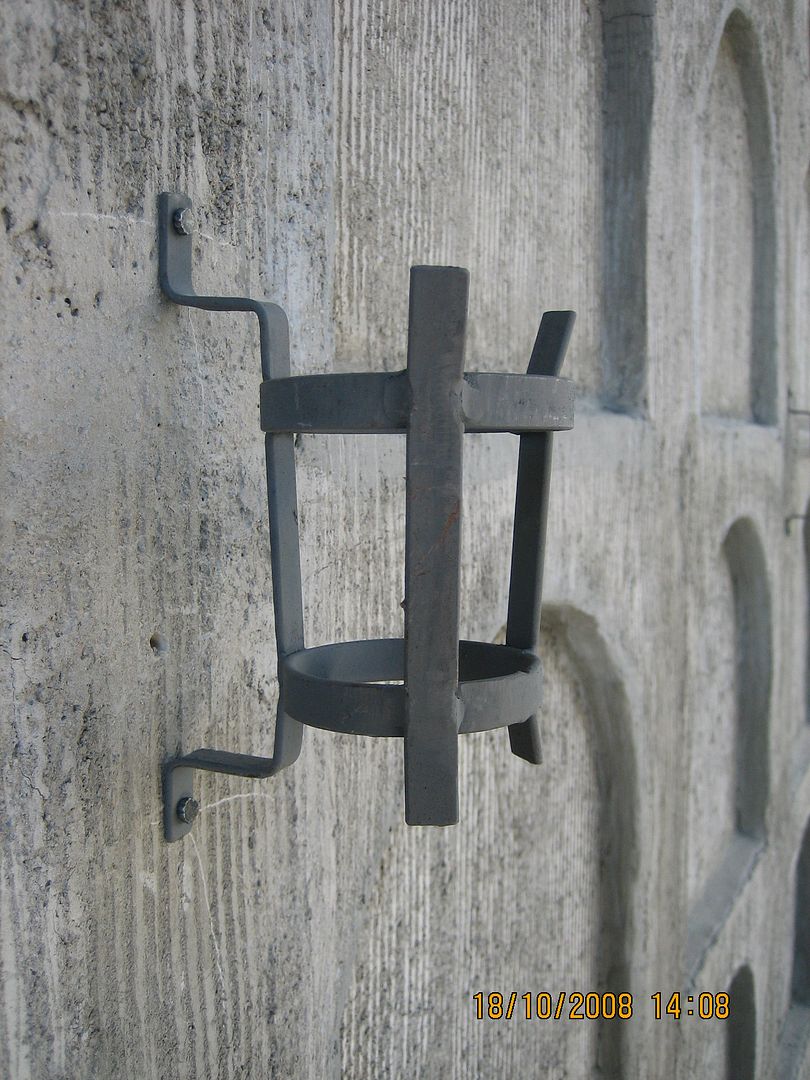
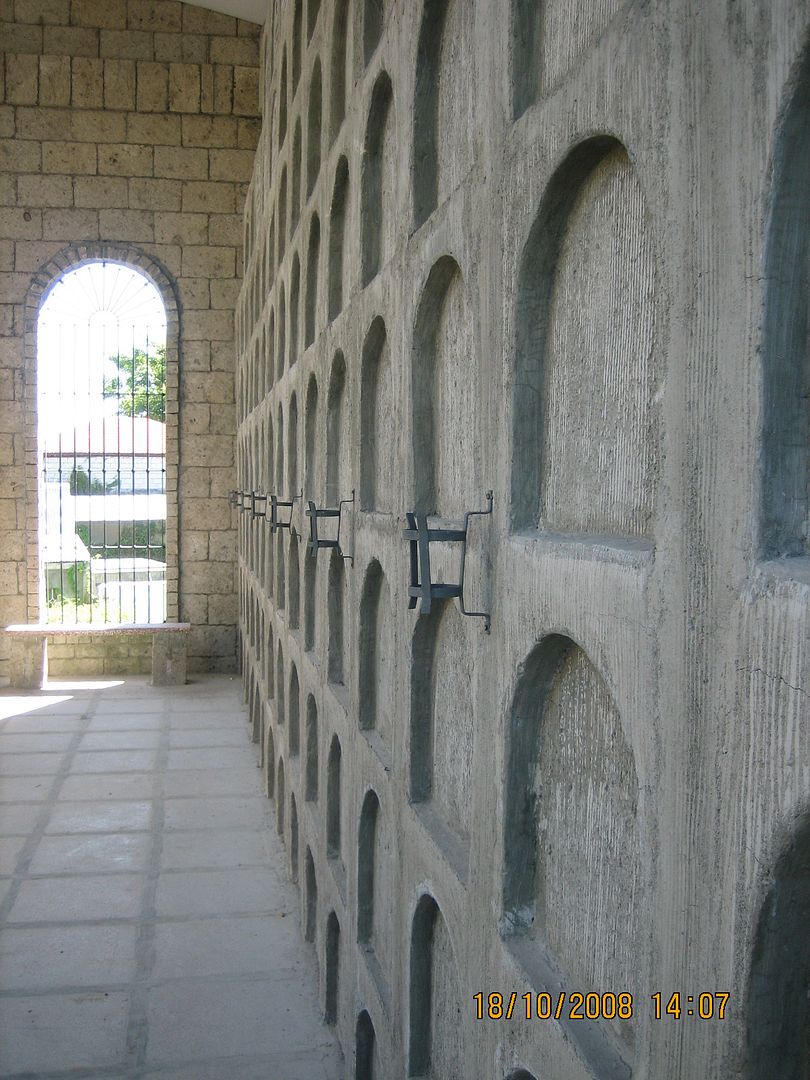
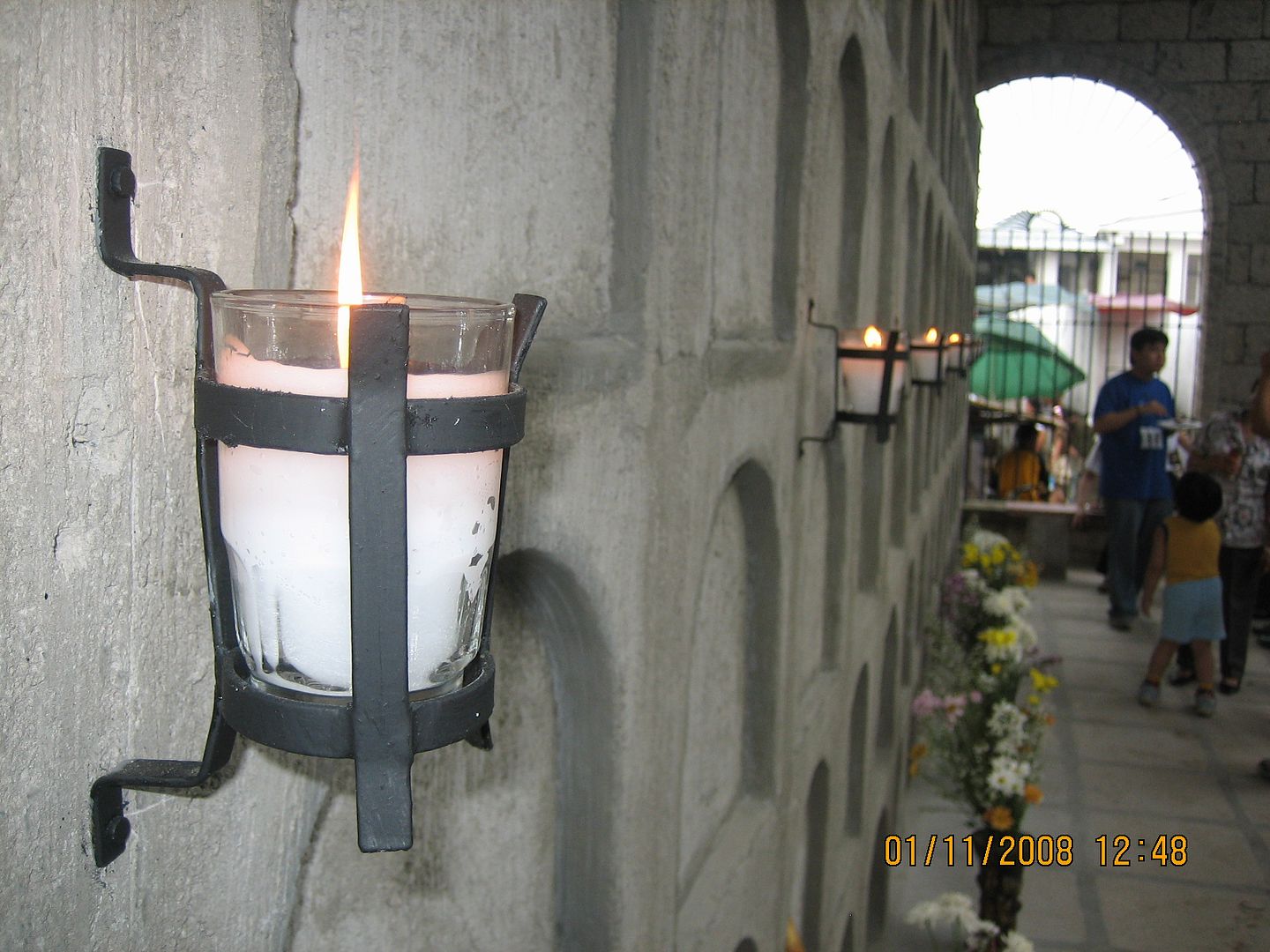
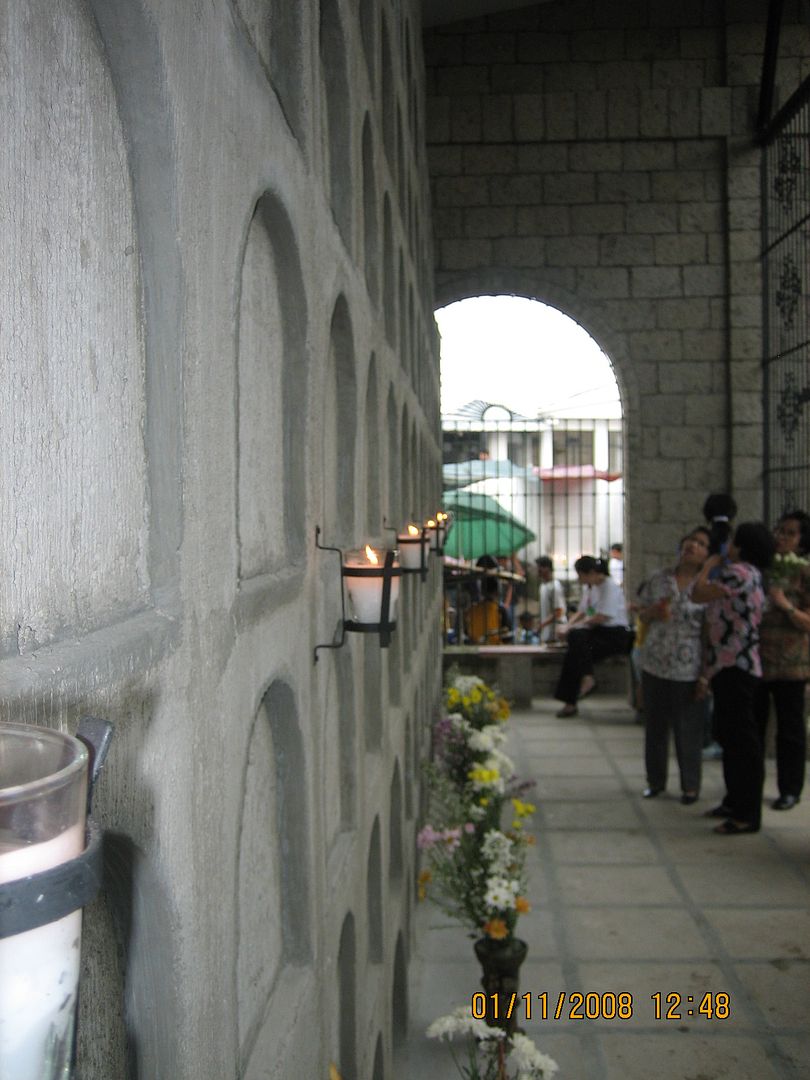
Additionally, the iron candle holders had been affixed to the wall of niches at shoulder level, right above the third row from the bottom.


There is one candle holder positioned at every other column division, for a total of eight candle holders in all.


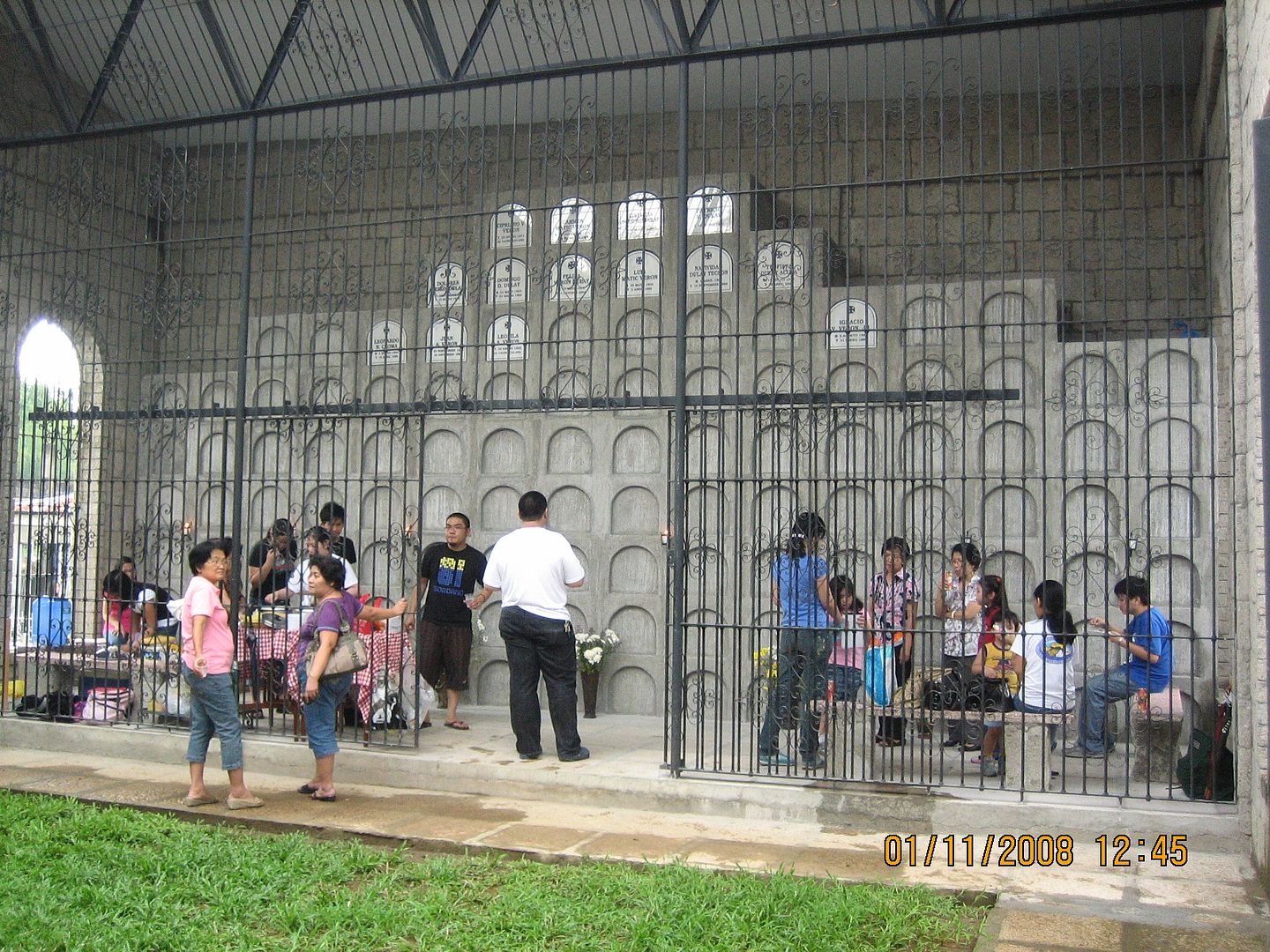
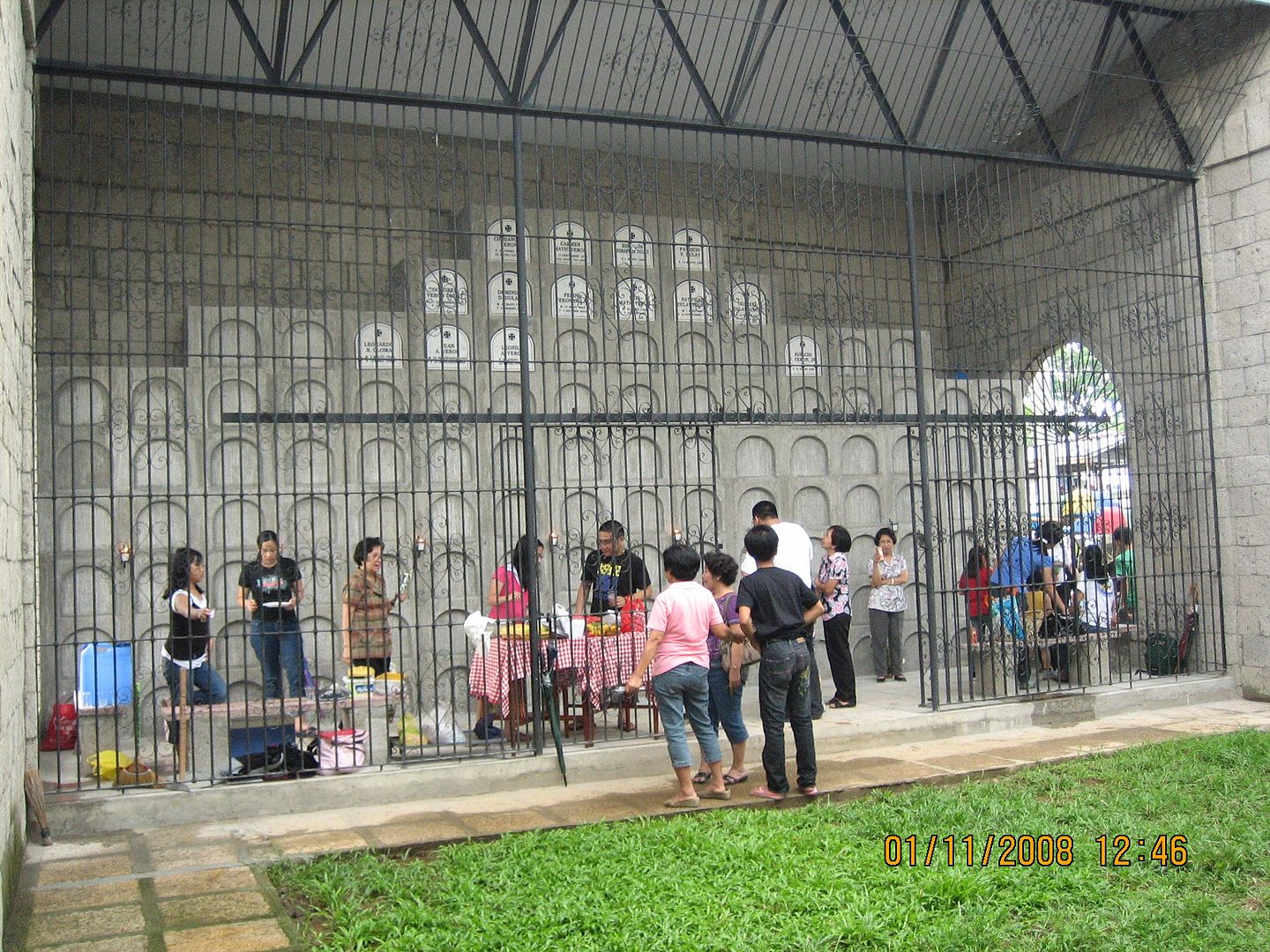
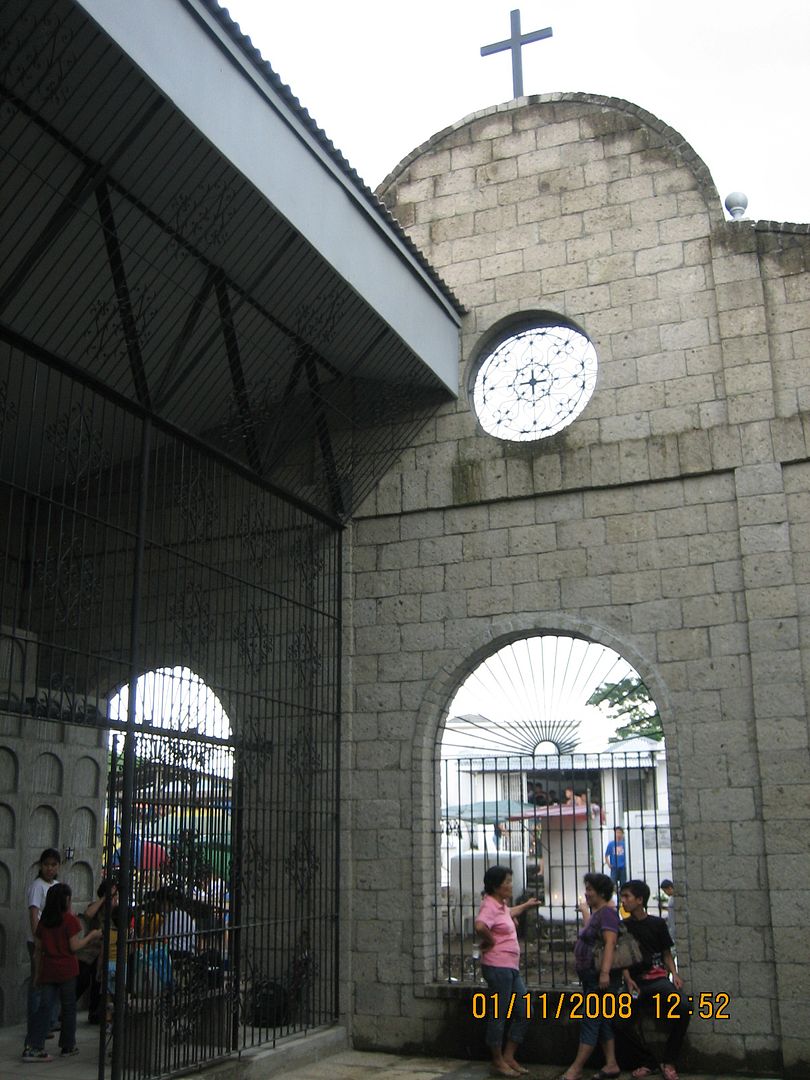
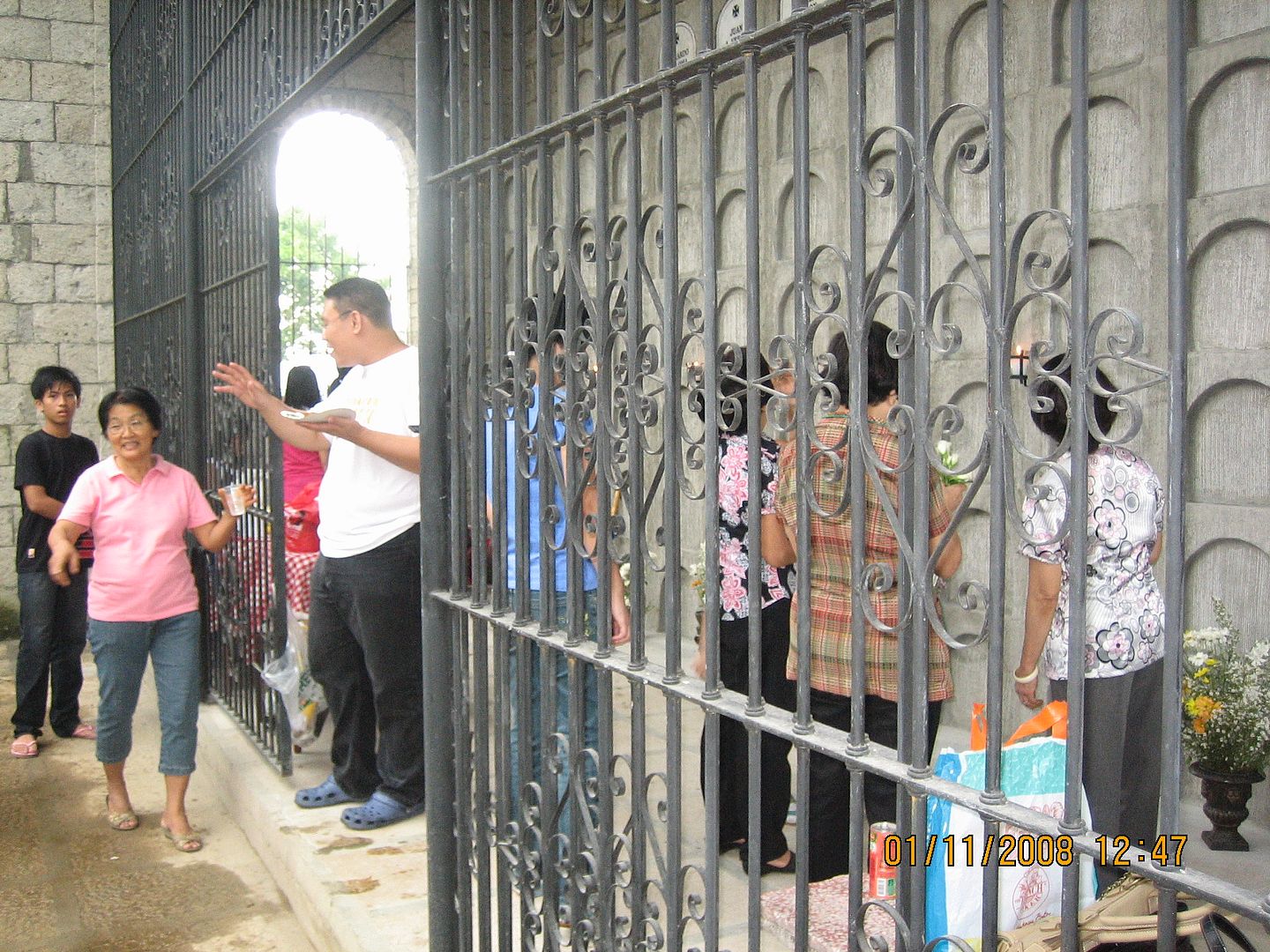
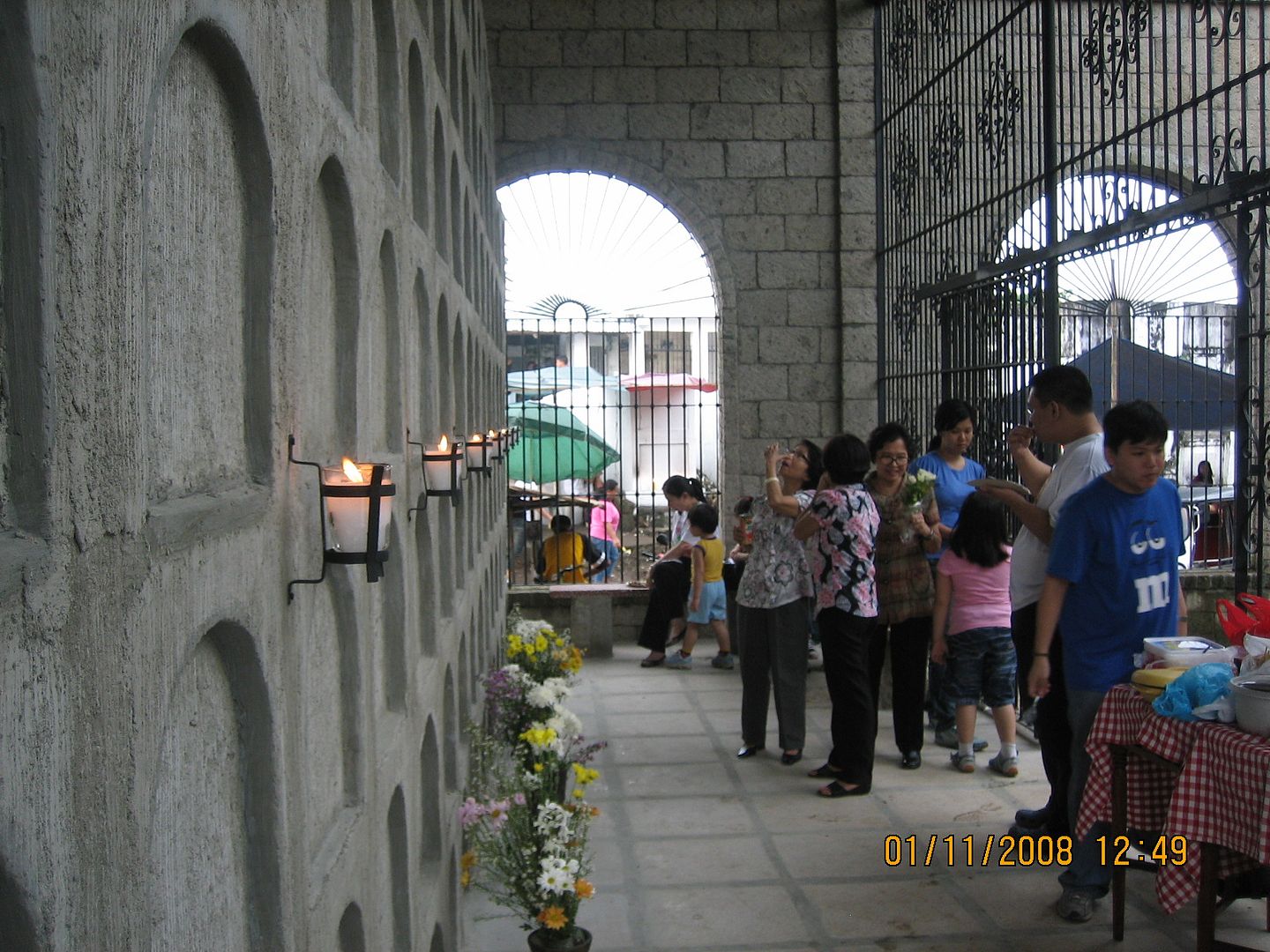
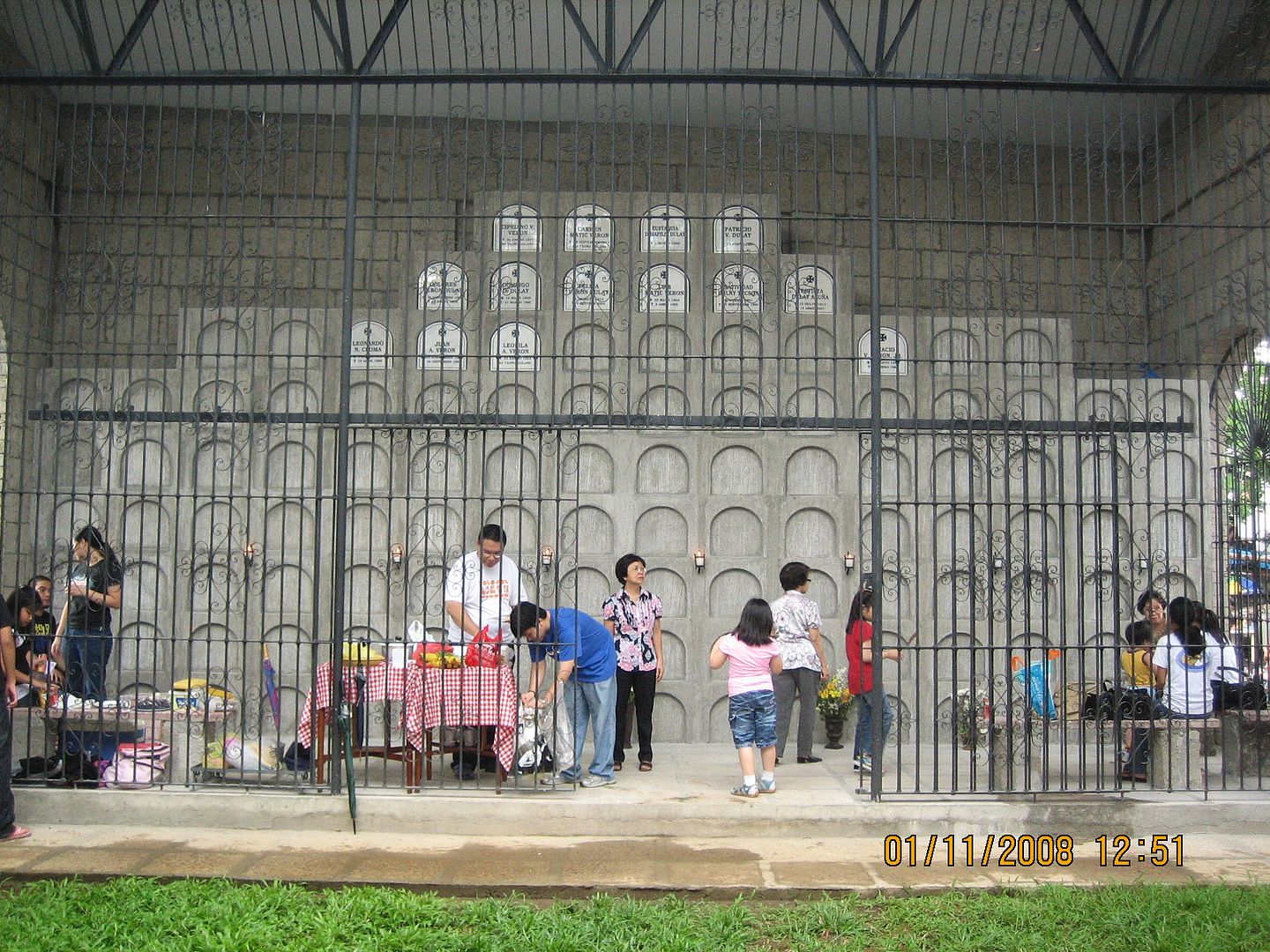
By All Saints’ Day, everything was in place. Family members and guests hung out in the comfort of the roofed niche area while rain drizzled all around.


The rain not only caused the structure’s walls to acquire light vegetation and desirable water stains,


but also allowed the carabao grass (transplanted from various wild-growing roadsides in the vicinity, rather than via a professional landscaping service) in the quadrangle to thicken, bordered by the same 20" x 20" piedra china slabs (rough side exposed) that made up the floor of the niche area (smooth side exposed) and the entrance steps (rough side exposed).


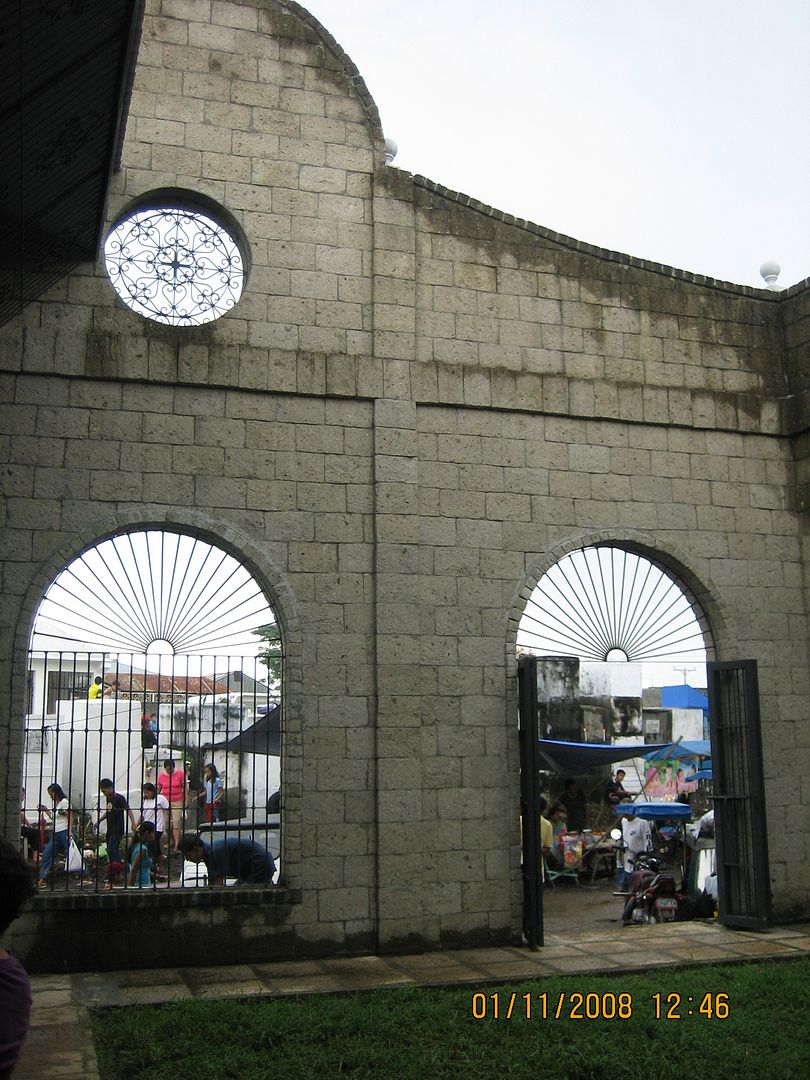
Despite the intermittent rain, the sky was clear enough most of the day to enable the structure’s profile to be clearly seen, even from within.


It was just as well, as the road outside was far too congested and muddy to let me take a photo of the façade.

Fortunately, we were comfortable inside our spanking-new yet trying-to-look-old family mausoleum for several hours that day, doing all the usual things that Filipinos do on All Saints’ Day – chatting,


keeping candles lit,


looking at (way-too-high-up) tombstones,


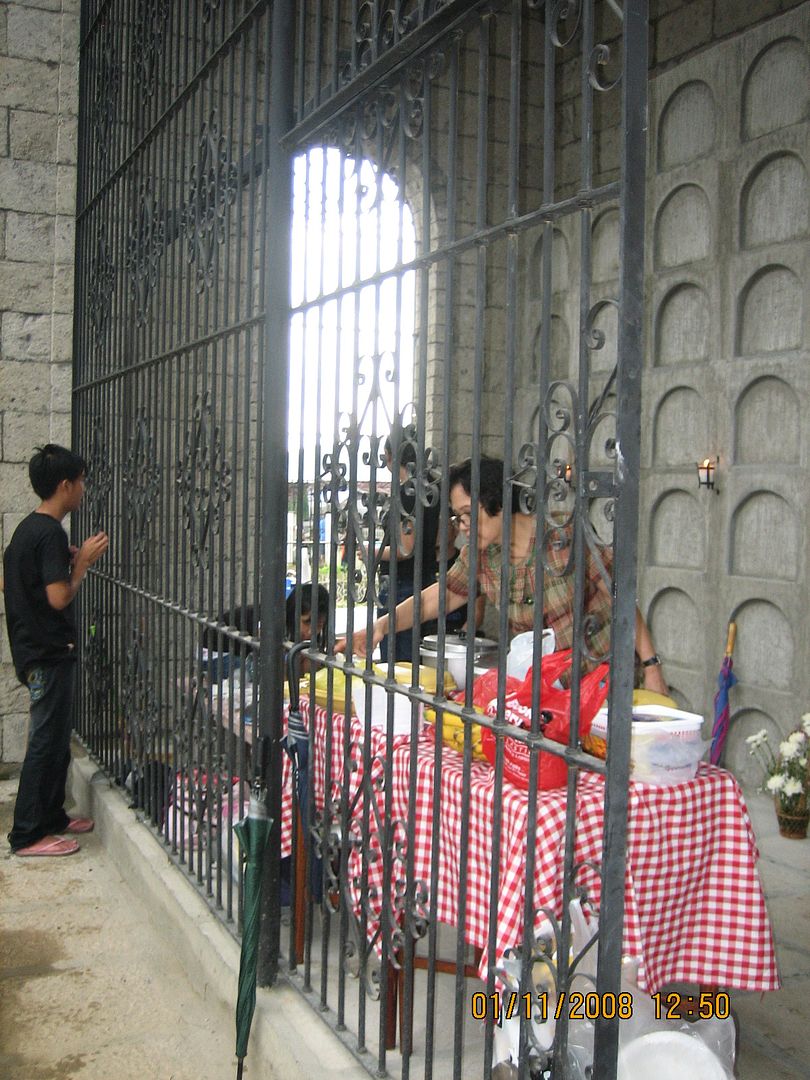
preparing and serving food,


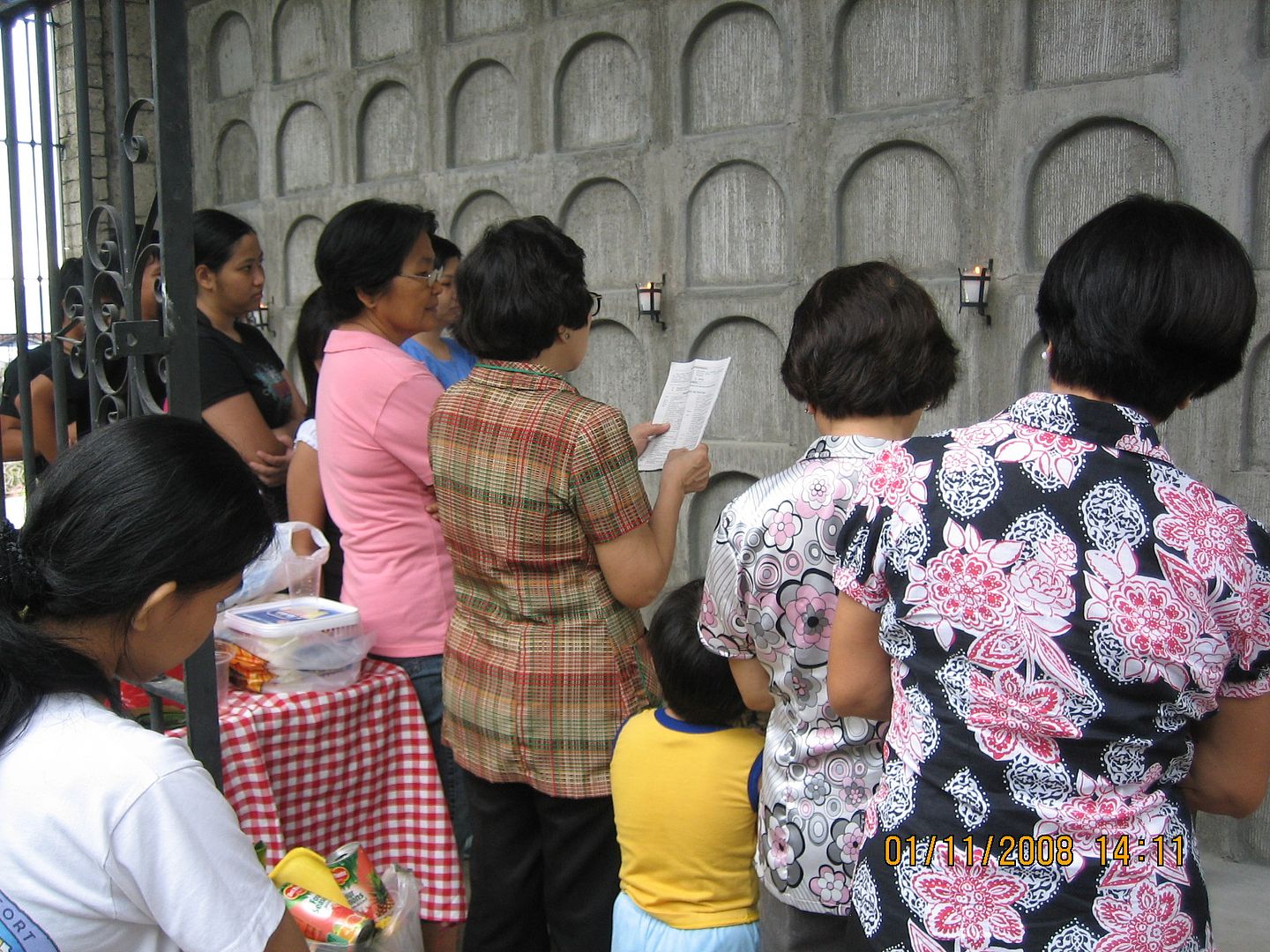
praying for the dear departed,


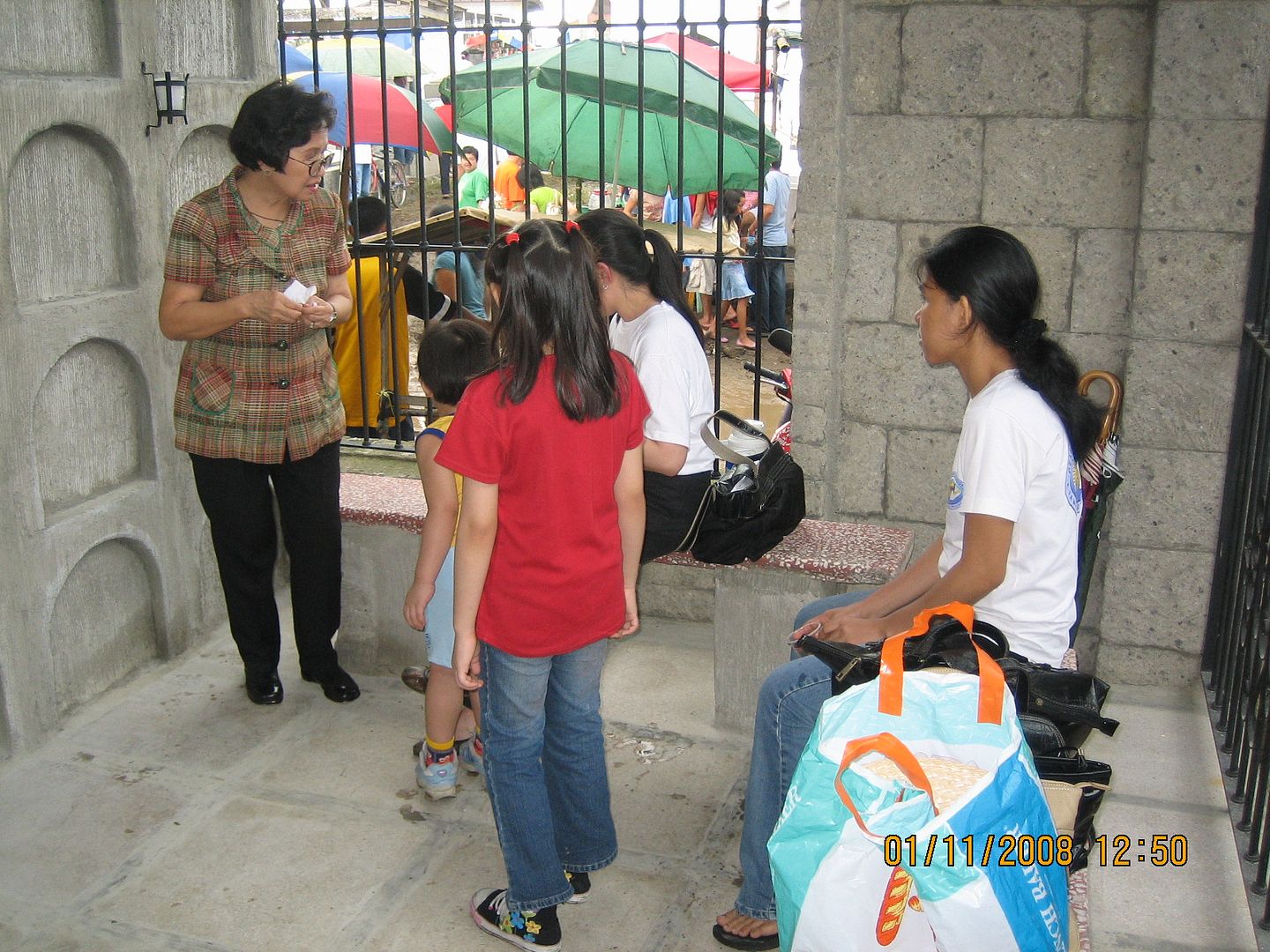
and just hanging out.


And as for me, you know where to find me fifty years from now – somewhere in the fourth row from the top.


Originally published on 29 November 2008.  All text and photos copyright ©2008 by Leo D Cloma. The moral right of Leo D Cloma to be identified as the author of this work has been asserted.

Original comments:

wow!

Wow! Nice! Great taste in design Mr. Cloma.

Congratulations Mr. Cloma! A job well done...

Thanks for the appreciations.

Now, on to the next projects. Ha ha.

angelflame061589 wrote on Dec 14, '08
Very nice po! Very well done!
;-)

i like the concept tito

Amazing project Leo.
Congratulations!

antigualla wrote on Apr 11, '09
Leo, nakakahiya mang aminin dito sa multiply, pero sasabihin ko na rin: NAKAKAINGGIT TALAGA! Hahaha. I just hope that someday, I will have the patience to honor my ancestors and immediate family members with a worthy mausoleum. Ang galing mo, Igan. Congrats!

rally65 wrote on Apr 13, '09
Thanks for the appreciation, Louie. If you like visiting cemeteries, do visit this one if you get the chance.


timmoffy wrote on May 11, '09
hi, any relation to the dulays of Northern Samar? Just curious....thanks!

timmoffy said
hi, any relation to the dulays of Northern Samar? Just curious....thanks!
My Dulay ancestors from San Rafael, Bulacan originally migrated there from the Ilocos region, so I don't believe that I am closely related to the Dulays of Northern Samar.