Showing posts with label missa. Show all posts

Sunday, January 1, 2012

XXVIII. Cantat Bis Orat, Part Four – A Three-Hundred-Year-Old Filipino Lenten Sing-Along


We’ve already started Holy Week, and in the Philippines, this signals the observance of a great number of traditional practices developed over the past few centuries of Christianity in these islands.  The most musical one of these is definitely the Pasyon, or Filipino Lenten chant. Its origins seem to date back to at least the 17th century, with prayers and catechism texts authored by the early Spanish missionaries and set to chants used by the indigenous people.

The first milestone in its development is probably the versified narrative of the Passion, beginning with the Last Supper and ending with the Resurrection, authored by Gaspar Aquino de Belen of Rosario, Batangas, and published in 1703.  Over the following century, the narrative had slowly expanded to include even the Creation from the Book of Genesis.

In 1814, a major editorial effort culminated in the publication of “Kasaysayan ng pasyong mahal ni Jesucristong panginoon natin na sukat ipag-alab ng puso ng sinumang babasa,” also called “Pasyong Mahal” (The Sacred Passion).  Essentially, the initiative sought to rewrite or delete unorthodox texts and content from whatever was in current use at that time.  The editor of this church-sponsored project was a priest named Mariano Pilapil, and as a consequence, this pasyon is also known as “Pasyong Pilapil.”  Like the 1703 version, this newer edition continued the use of the Spanish “quintilla” format – a set of five verses, each of eight syllables, and with rhyming endings. 

Since then, various other editions have appeared, especially in Philippine languages other than Tagalog.  By the early post-World War II years, the entire nation was apparently Pasyon-literate in their own regional languages.

Today, the chanting of the Pasyon seems to be in relative currency, though various quarters complain that it is a dying tradition, brought about by the scarcity of traditional singers familiar with the “way it is supposed to be sung.”  The obvious next step is therefore, let’s simply learn how it’s meant to be sung.  And the obvious question is, do we have any recordings that we can use as references so that we can become self-taught Pasyon chanters? 

The answer is a bit complicated, so let me start with a simple version.  No, I have not come across any broadly-published documentary-type field recordings of actual Pasyon chanters in action.  This is a pity, because in order to learn how these chants are to be properly sung, it is best to listen to how they were ACTUALLY sung in some home or visita during Holy Week.
 
Instead, what is available are a couple of recordings of funky, modernized versions of the Pasyon.  The first one of these is inside the album “Langit: The Filipino Sings of Faith” from the Ateneo Glee Club.
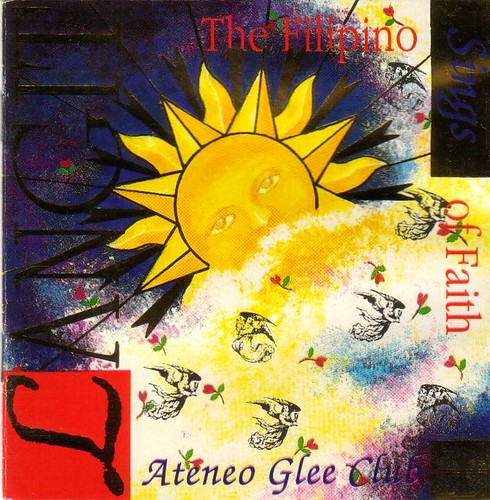

There are four short tracks here that are excerpts from the Pasyon text, and do base their music on traditional Pasyon chants.  The album opens with “Pagsilang,” using the following stanza from the Pasyon: 
Nang malaon nang totoo, 
taong maikapat na libo, 
mulang lalangin ang mundo 
siyang nganing pagparito 
niyong sasakop sa tao. 

Because it has been arranged for a young modern choir, it is either really refreshing and innovative, or is irritatingly self-conscious and potentially irreverent, depending on your musical taste and religious profile.  I recommend listening to “Pagsilang” to see which part of the spectrum of listeners you might be in.  If you like what you hear, go ahead with the other tracks such as “Buhay,” “Handog," and “Alay” as well.

This recording just doesn’t do it for me, as I can’t imagine my family, friends, and fellow parishioners in Bulacan singing anything this way, especially not a religious text for Holy Week, unfortunately. 


(the Ateneo Glee Club singing Regina Caeli, an Easter antiphon)

Another creative and innovative effort is the album “Pasyon: An Oratorio based on the Philippine Lenten Chant.”
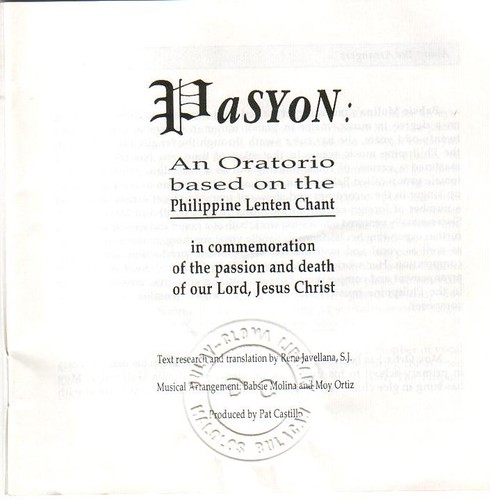


This makes use of excerpts from the 1703 and 1814 editions to come up with a classical-style oratorio to commemorate the passion and death of the Lord.  The text selections highlight the fact that the beauty of Tagalog poetry, even in the earlier-described quintilla format, lay not in rhyme or meter, but in the juxtaposition of either contradictory or complementary images.  This compare-and-contrast aesthetic is referred to as “talinghaga” even by modern-day Tagalogs.  In “Panalangin,” the first track on this album, we can try to identify what the “matalinghaga” aspects might be: 

O Diyos sa kalangitan 
hari ng sangkalupaan 
Diyos na walang kapantay 
mabait, lubhang maalam  
at puno ng karunungan, 

Ikaw ang amang tibobos 
nang nangungulilang lubos 
Amang di matapos-tapos 
maawai’t mapagkukop 
sa taong lupa’t alabok,

Iyong itulot sa amin 
Diyos Amang maawain 
mangyaring aming dalitin 
hirap, sakit at hilahil 
ng Anak mong ginigiliw. 

Some of the people behind this project were also involved in the “Langit” recording, so musically, the two albums are similar, as the above listening example shows.  The basic chants used are of the most common melodies still current today; the production notes credit the province of Bulacan as the field source for these.  On the other hand, the album also features an unusual traditional chant from Santo Tomas, Batangas, that starts of with a “Na na na na.”  In the track “Huling Hapunan”, we can find out how this works. 

Ay ano nga’y nalikmo na 
Si Jesus na Poong Ama 
Siya sampu ng kasama
Doon sa kakanan nila 
 At nagwika kapagdaka 

Obviously, this still doesn’t meet our requirements for self-edification.  Our last hope is “Krus at Muling Pagkabuhay” from Himig Heswita of the Jesuit Communications Foundation at the Ateneo de Manila University, published in 2003.   
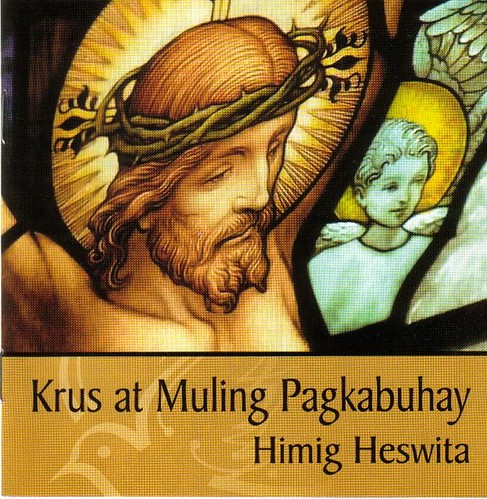
 
This promisingly offers fourteen different “Pasyon Himig” (chant melodies), which the authors each characterize as possessing one of several possible qualities: “angkop sa karaniwang salaysay” (appropriate for normal narratives), “angkop sa bahagi ng salaysay na tigib ng hapis” (appropriate for sorrowful parts of the narrative), “angkop sa mga salita ng Panginoon” (appropriate to lines spoken by the Lord), and so on.

Interestingly, the texts used in this recording are not from the old traditional Pasyon texts, but are taken from the “Aklat ng Pagmimisa sa Roma,” or the Roman Missal in Tagalog, published in 1981.  This ensures that all its contents are liturgical and orthodox, rather than simply traditional or, worse, folksy.

It then becomes a simple matter of matching up the texts, which cover Palm Sunday to Easter Sunday, to the appropriate chant melodies, as to whether they are meant to be sad, happy, and so forth.

The first two of the fourteen chants are probably the most common, and should be familiar to just about any Holy Week church-goer in at least the Tagalog-speaking regions.  In fact, from my childhood listening experience, these two are always used together, with the first used for the odd-numbered Pasyon stanzas, and the second used for the even-numbered ones.  Here are the words of Himig 1 and Himig 2 here (even if they’re not arranged in the manner that I’ve just described):  

Himig 1 
Poong makapangyarihan 
Lumikha ng sanlibutan 
lupa’y iyong inilagay 
nang matatag at matibay 
sa tubig ng karagatan 

Himig 2
Kay Kristo, Haring Mesiyas
Sumalubong nang may galak
Taglay ang manga palaspas
Manga batang iyong anak 
Jerusalem na mapalad 

In my view, this is valuable not only because it offers the fourteen different Pasyon chant melodies as previously mentioned, but also because it comes fully documented with a book with complete liturgical texts beyond the ones included in the recording.  In fact, beyond the texts set to Pasyon chant, the album includes a “bonus track” at the end, a popular hymn frequently used in the Mass, “Pag-Ibig Mo, Ama.” 

Moreover, the book includes the printed musical notation so that your pianist or organist (or a musically-literate guitarist who can play from musical notes rather than guitar chords) can play the main melody so that the singers can follow, as well as improvise the chordal and bass accompaniment.

I would have, however, preferred to listen to a wider variety of voices, as all of the singers in this album seem to be young, male, and Atenean.  This is rather unlike the typical Pasyon singer, who would be older, female, and possibly a full-time homemaker in one of the Tagalog-speaking provinces around Manila.  I’m sure some small effort could have been expended to find other good singers who could have lent some authenticity to this recording.  

It would also have been better to make use of other accompanying instruments other than a synthesized piano – for example, a normal guitar, or a small electric organ, as this would probably be a more typical accompaniment as well.  Or why not even unaccompanied, but harmonized, vocal arrangements, in two, three, or four parts?  

My final beef with this recording is that, even with the ubiquitous Himig 1 and Himig 2, the recorded performances are not perfectly accurate – based on my hearing, they’re not the sung in the same way, meter- and beat-wise, as how they are sung even today in Bulacan.  And the harmonized accompaniment too is inferior to what is used and played in places like Malolos.  Not really being a trained musicologist, I can’t really explain it in precise musical terms, but one only needs to visit Barasoain Church on Holy Thursday or Good Friday and compare how the choir and congregation sing these two melodies versus the recorded versions here.

Overall, though, this is a worthy effort and fills a huge gap in our knowledge and understanding of this most important form of Philippine religious music.  But we still want to listen to an authentic field recording that documents an actual Pasyon “performance.”  It doesn’t have to be the whole eighteen- to twenty-hour saga of the entire Pasyon book, and video is a nice bonus but is not an essential.  Hopefully, some day, one such recording will turn up, and it will be a good one too. 


Originally published on 18 March 2007.  Text copyright ©2007 by Leo D Cloma. The moral right of Leo D Cloma to be identified as the author of this work has been asserted. Musical examples are owned by their respective copyright holders and are used only for review and demonstration purposes. 

Original comments:


illuminati1 wrote on Jul 19, '07
thanks for the download and lyrics


tandang1 wrote on Feb 1, '08
can u tell me where I can get a downloadable copy of the words of Tagalog Mass please?
You can contact me at kevin@padrepio.org.au


rally65 wrote on Feb 12, '08
Sorry, I don't actually know where the Tagalog mass text may be downloaded from. I suggest that you try doing an internet search.


ivanrondelsalditos wrote on Mar 7, '08
can i have the chords? for himig 1 and himig 2? please?


ivanrondelsalditos wrote on Mar 7, '08
salamat


rally65 wrote on Mar 8, '08
The music for the pasyon himig examples is given in the book. Please try to get the book and look for the chords in there.


pabasa2011 wrote on Apr 15, '09
For the benefit of the Filipino children born outside the Philippines do you think it's possible to have the pasyong mahal translated in English? The tradition is brought over here in California (at least) and it will make more sense and perhaps draw their interest (even other nationalities') if they could at least "pray" or "sing-along" with it.

Thanks.


rally65 wrote on Apr 15, '09
That's certainly a good idea. I just don't know who might be capable of undertaking this initiative (translating musical lyrics from one language to another while retaining "sing-ability" is always a challenge). Hope someone steps forward.


Sunday, May 1, 2011

XXIV. "Cantat Bis Orat" -- Sacred Music, Part One


With Ash Wednesday and therefore Lent less than a week away, it’s a better time than ever to do a change of pace, and explore some religious and spiritual material that we might not have otherwise found the opportunity to consider before. For example, we could do a survey of not-so-widely-known prayers and devotions.  Better yet, because Saint Augustine is supposed to have said, “Cantat bis orat” – “To sing is to pray twice” – why don’t we do a series of brief listening tours of religious music.  Let’s.

Musical Masses

We start with what I remember Sister Rosarita from over thirty years ago telling us bug-eyed kids was the highest form of prayer – the Holy Mass.  Now, if we’re all good Catholics here, we should be going to Mass every Sunday, and some of us probably even hear Mass daily.  After fifteen-odd years of being a daily mass-goer myself (except for periods of time when I was living and working abroad and it just wasn’t possible—no thanks to the apathetic French and the atheistic Chinese), I’m still occasionally surprised that I’m not bored out of my wits with this devotion.  But for those of you with shorter attention spans, here’s the solution – a sung Mass!


In reality, this is nothing new.  The Holy Sacrifice of the Mass must have been sung even during the early Christian era.  A “Missa Cantata” has probably been a standard feature of the liturgy during major feast days and solemnities, from the time that Christianity became the religion of the Establishment in the ancient Roman empire.  Much later on, medieval, renaissance, and baroque composers from Italy to Germany to France to England took their stabs at the challenge of setting the Holy Mass to music, not only to demonstrate to their noble patrons, many of whom were high church officials, that they were exemplary Catholics, but also no doubt to show off their artistic talents.

Fast forward to the present.  There have been a number of musical settings of the Mass composed in the past fifty or so years, but without the patronage of the established Church or of pious and wealthy individuals, such examples have obviously been scarce.  The arrival of Vatican II reforms in the late 1960’s, allowing among other things the use of the vernacular for the Mass versus the previous Latin-only rule, probably decreased the need for Sung Masses, since anyway the devout wouldn’t need to be “entertained” as much as before, because they could actually understand what was going on, more or less.

In the Philippines, we have over the last few decades had a bumper crop of music for the Mass, from a respectable and growing roster of Filipino religious composers.  However, there haven’t been many integrally-composed Filipino Masses, in the style of the classical composers of two or three hundred years ago.  In fact, the only one I have come across was a most interesting composition from someone who has been for a long time and still is a well-known and widely-acclaimed composer of popular music, Ryan Cayabyab.

Ryan Cayabyab: Misa (1983)


On 24 December 1982, Cayabyab completed a “Misa,” for mixed chorus, a capella (without instrumental accompaniment), for his graduation requirement in Composition from the University of the Philippines College of Music.  This work subsequently received its first public performance on 4 March 1983 with the U.P. Concert Chorus under its then director, Professor Rey T. Paguio.  These same artists subsequently recorded the work, and it was released in mid-1983 by Jem Recording Company on cassette (and perhaps on vinyl disc as well).

I’m not aware if this album was ever re-issued on CD, but I was lucky to save my old cassette copy, which I had easily converted not only to a safety CD copy but also to the MP3 format, from which we can examine some excerpts.

Unlike your usual songs for the Mass used in churches up and down the Philippine Islands, Cayabyab sticks to the standard Latin texts.  Also, he conforms to the classical convention that the Sung Mass only has five parts: Kyrie, Gloria, Credo, Sanctus, and Agnus Dei.  What makes this Misa different is that it could only have been written by a modern-day Filipino composer – in a manner of speaking, it possesses an undeniably contemporary sound that nonetheless conveys a prayerful tone and a deep spirituality.

The first of its parts, the Kyrie, is very striking.  The soloists sing the first “Kyrie Eleison” (“Lord, have mercy”) section as an interwoven series of incantations, which individually sound like the Muslim call to prayer.  The succeeding “Christe Eleison” (“Christ, have mercy”) section, sung by the full choir, is relatively more conventional but is still extremely powerful.  The final “Kyrie Eleison” section is essentially a reprise of the first section, and therefore serves to “tie things up,” as it were.  Overall, this opening of “Misa” very effectively conveys a plea for mercy, consistent with the original Latin (actually Greek) text.


(an interpretation of the Kyrie by the University of South Carolina Graduate Vocal Ensemble) 

Then there is the Agnus Dei, the last of this Misa’s five parts.  The choir almost whispers the opening “Lamb of God, who takes away the sins of the world,” and is answered by a clear-voiced full-throated soprano singing “Have mercy on us.”  This exchange is repeated once, consistent with the standard text.  The final “Lamb of God…” from the choir is of course followed by “Grant us peace” from the soprano.  The entire sequence is repeated from the beginning, and ends with a very peaceful fade – again, quite consistent with the text.


(an interpretation of Sanctus and Agnus Dei by Schola Cantorum Carolina)

Since there aren’t rich pickings for musical settings of the Mass in modern-day Philippines, the perfect foil is to go back to the classical era – to the specific “classical” (as opposed to baroque or romantic) period, whose standard bearer is perhaps Wolfgang Amadeus Mozart.  Raised in a devoutly Catholic milieu, and employed by Prince-Archbishops among others, Mozart had many opportunities to write musical Masses.  Even his final work, the famous and controversial Requiem, is nothing but a musical setting of the Mass for the Dead.

However, today we instead turn to his contemporary, Franz Josef Haydn, who was not only older than Mozart, but also outlived him by nearly two decades.  Like Mozart, Haydn was Austrian and operated in a staunchly Roman Catholic environment; he therefore had ample opportunities to compose Masses.  Indeed he composed over a dozen of them, but for me, the best one is his first, composed when he was only about seventeen years old, shortly after he had left the choir school of Saint Stephen’s Cathedral, probably because his voice had just broken (which in centuries past came later than it does now).


Haydn: Missa Brevis in F Major (1749)


Haydn’s Missa Brevis, literally “brief mass” – is a real gem.  The story is that in his old age, ill and bedridden, the composer came across the manuscript of this work that he had written over half a century earlier, and had since assumed to have been lost.  According to a biographer, Haydn was much cheered by the recovery.  “What specially pleases me in this little work,” said Haydn, “is the melody and a certain youthful fire.”

In fact, although the composer had completely forgotten its existence, this work, the Missa brevis a due soprani (“Short Mass for Two Sopranos”) had actually circulated quite widely, with copies to be found in many Austrian monasteries and even parish churches. 

The recording that I have of the Missa Brevis  has it with two Handel works, the Ode for the Birthday of Queen Anne and the Anthem for the Foundling Hospital),This very short composition is always coupled with other Haydn works, and even with those of other composers is one of my favourite pieces of music of all time, which is significant as I personally prefer baroque and instrumental music, and this work is neither.  It helps that it is performed exceptionally well by the Choir of Christ Church Cathedral Oxford, an all-male collegiate choir (with grade-school-aged boy trebles singing the soprano parts) that is also one of the top choirs in England Its director, Simon Preston, trained as an organ scholar (organist and assistant choirmaster) with the Choir of King’s College Cambridge (an even more illustrious choir) in the late 1950's to the early 1960's under the venerable Sir David Willcocks.

Even the instrumentalists used in this recording are outstanding, as they’re from my favourite orchestra of all time, the Academy of Ancient Music, who perform only using period instruments – originals or authentic copies – appropriate to the music being played.  Their founder and director, Christopher Hogwood, is an outstanding keyboard player in his own right, and in this recording plays the chamber organ as part of the basso continuo (bass part, together with other bass instruments, e.g., cello and double bass).

And the two sopranos, Judith Nelson and Emma Kirkby, are pioneers of the “early-music-movement” in England, and were part of the Christopher Hogwood and Simon Preston stable of vocal soloists.  Kirkby is still actively performing to this day, looking and sounding nearly as fresh and youthful as she did in the 1970’s when she first came on the scene.  Nelson was in Manila a few years ago for the Bamboo Organ Festival, but unfortunately she hadn’t sipped of the fountain of youth as much as Kirkby seems to have – she was old, wobbly, and wrinkled – and that was just her voice.

The work was scored for the two aforementioned sopranos (originally two boy trebles), a standard four-part choir (again, originally an all-male choir with boys taking the soprano part), and a small orchestra of two violins and bass.  In the above mentioned recording, the orchestra consists of two groups of violins (five first violins and five second violins) and a bass section comprised of a small pipe organ, cello, and double bass.  

Since it is literally a short mass, the opening, Kyrie Eleison, does not waste any time and uses all these musical forces immediately.  The choir and orchestra come in strongly on the very first beat, and the two sopranos sing variations on the theme.  The second “Christe Eleison” section is melodically different but structurally similar with perhaps more use made of the sopranos, but then everything is tied up neatly in the final “Kyrie Eleison” section, which is just a reprise of the first, just like in Cayabyab’s Misa.

The next two parts, Gloria and Credo, are structurally similar, no doubt because they are longer – these prayers are familiarly the “Glory to God in the Highest” and the Apostle’s Creed (actually the Nicene Creed, which is an older form, preferred in the older Latin Mass).  Both of these begin with the Deacon-Cantor (or the Priest-Celebrant, if he can sing well enough) intoning the first line, “Gloria in Excelsis Deo,” and “Credo in Unum Deum.”  This is immediately followed by the full choir responding strongly with the succeeding lines.  In both these parts, the two soprano soloists interject their own solo lines, for example beginning with the “Laudamus te….” in the Gloria, which allows them to show off their vocal abilities with very tuneful flourishes and twisting and turning melodies.

The other thing about the Gloria and Credo is that they both demonstrate the practice of “telescoping” – which was a technique used by composers like Haydn to shorten the performing duration of their pieces by running the sung texts simultaneously (by having different voices in the choir sing different texts at the same time) or into each other.  This tactic of making lines overlap was obviously necessary if Haydn was to achieve a “brief mass” – in our recording, the whole Mass lasts just fourteen minutes.  But because it seemed to give more importance to the music than to the words, these telescoping practices were much frowned upon by the church hierarchy and were even subsequently expressly forbidden for sacred music.

The Sanctus (Holy Holy Holy, Lord, God of Power and Might…), is probably the most serious-sounding of the work’s six parts, at least at the start.  Then almost out of nowhere, there is a mad rush for the ending “Hosanna in Excelsis,” and the whole thing is over in less than a minute.  This is followed by the Benedictus, is what we today think of as an integral part of “Sanctus” – “Blessed is he who comes in the name of the Lord” – but in the classical Masses, they were sometimes set apart. Haydn conformed to this convention as well.   Unusually, it opens with an extended instrumental introduction from the orchestra, and only the two sopranos sing the low slow flowing melodic lines, almost like the choir was being allowed to take a break.  Then, before everyone manages to relax, the choir jumps back in and returns with “Hosanna in Excelsis” to end, just as in the previous “Sanctus” section.

The final part, Agnus Dei, is my favourite, like its counterpart in Cayabyab’s Misa.  It starts out very serious and grave, befitting the text, “Lamb of God who takes away the sins of the world, have mercy on us….”  This is repeated once as customary, and for the third time the choir sings “Lamb of God…,” but instead of responding “Grant us peace” in the same way that they sang “Have mercy on us,” a total change of mood and pace ensues and what comes is a happy-snappy-flowing “Dona nobis pacem.”  If this music sounds familiar, complete with the two sopranos’ melodious interjections, it is because Haydn simply lifted it from the first part, “Kyrie Eleison.”  Thus this Missa Brevis begins and ends on literally the same happy musical notes.

This recording is actually thirty years old this year, but has probably never been bested.  It helps that Haydn’s Missa Brevis is not so often performed or recorded, but even in absolute terms, I believe that this piece – both as a musical work and as a recorded performance – is exceptional. 

At the end of the day, what makes for a proper sung Mass is not really the individual parts, but that all the parts are recognizably part of a musically coherent suite.


(another recording of Haydn's Missa Brevis in F Major with Krisztina Laki and Julia Hamari as sopranos)

The Challenge

Finally, it’s probably too much to expect seventeen-year-olds of today to do a Haydn, but would any young Filipino composers out there be ready, willing, and able to create a complete Filipino “Missa Brevis” a la Haydn?  Apart from having parts that form a coherent musical whole, we should avoid telescoping; instead of an orchestra, we may just employ a guitar or organ; we could also make the soprano soloists optional, and use English or Pilipino instead of Latin.  To expand things a bit, we can even add in the Our Father / Ama Namin to the suite.  If one part of the Mass (e.g., the Glory to God, or the Holy Holy Holy) has already been composed, the obvious task is to compose the other parts to match it and complete the Mass.  What say, young musicians of good will?


Originally published on 15 February 2007.  Copyright ©2007 by Leo D Cloma. The moral right of Leo D Cloma to be identified as the author of this work has been asserted. 


Original comments:


puyat1981 wrote on Feb 23, '07
well writen :)


rally65 wrote on Feb 25, '07
Thanks -- hope you liked the musical excerpts also.