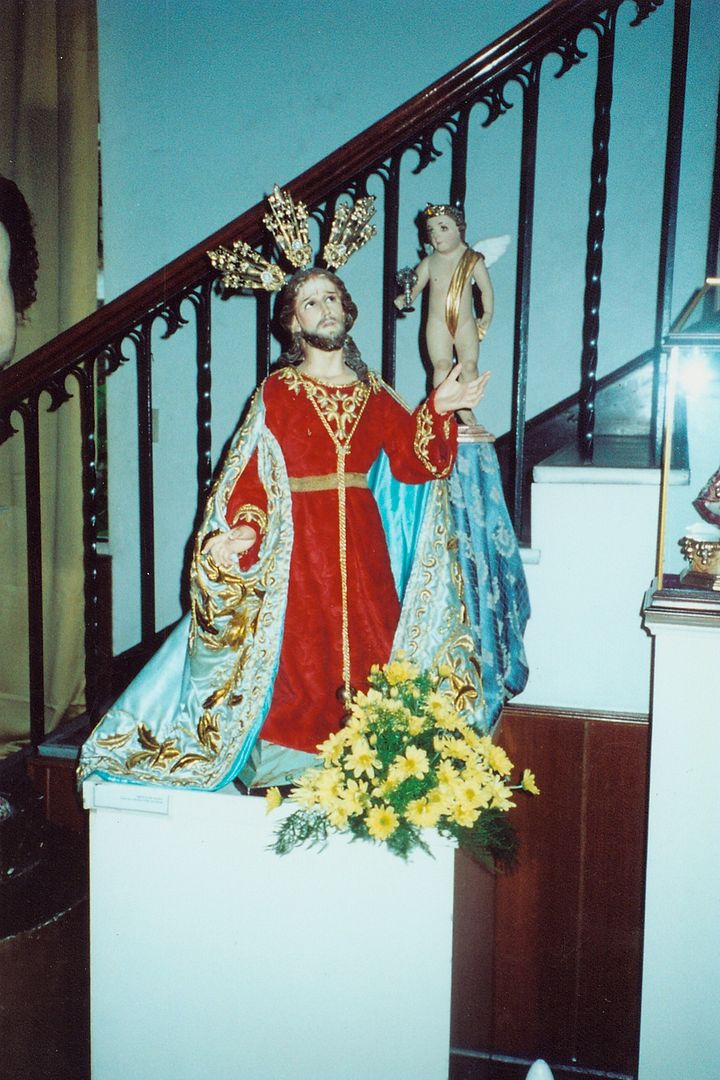
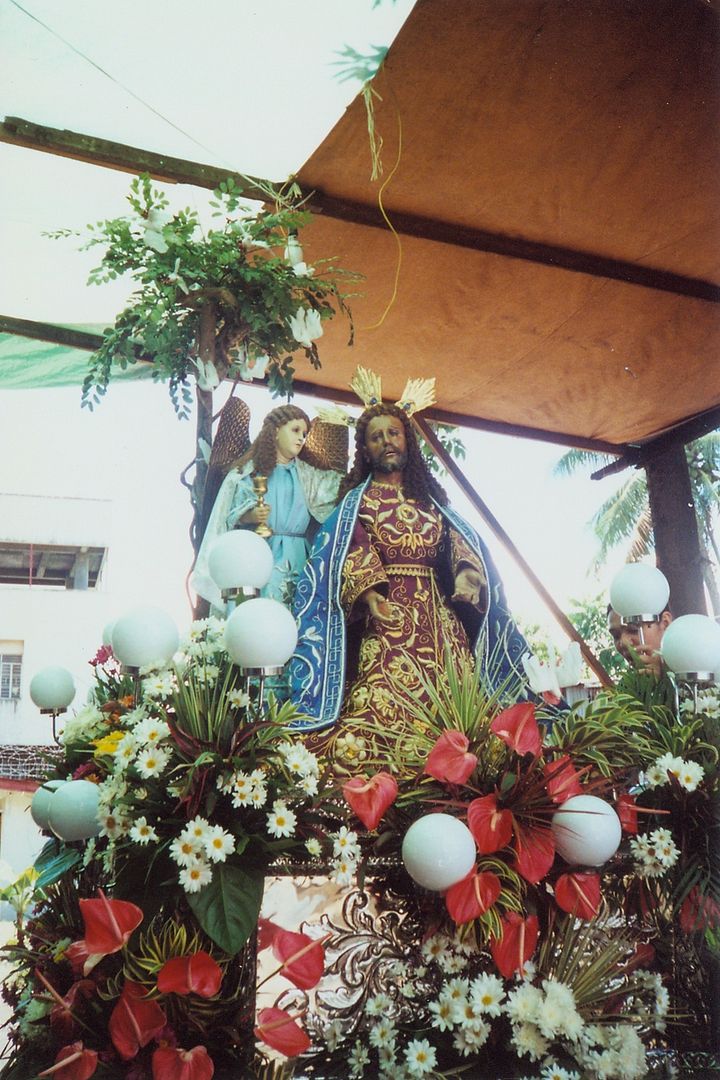
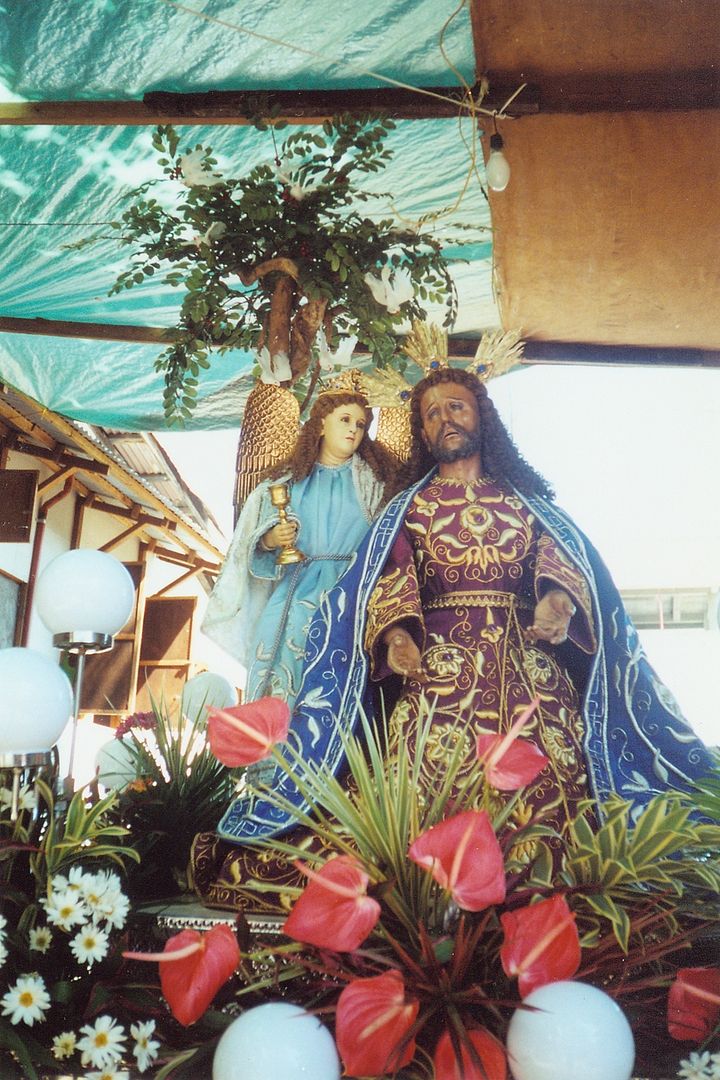
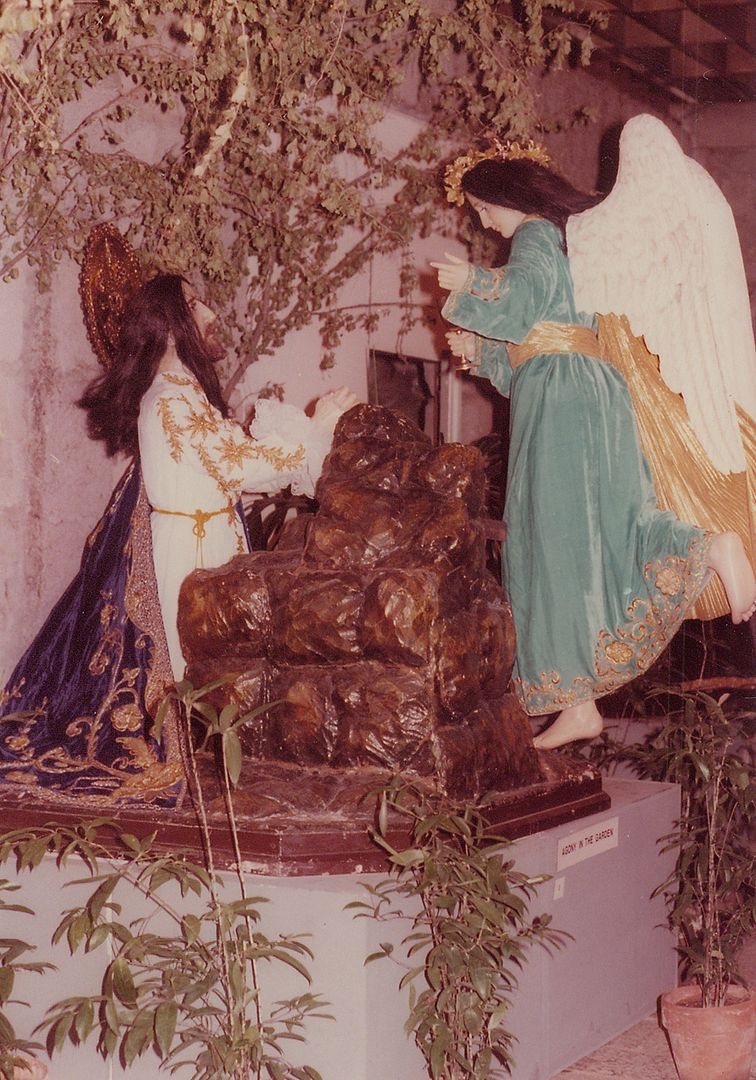
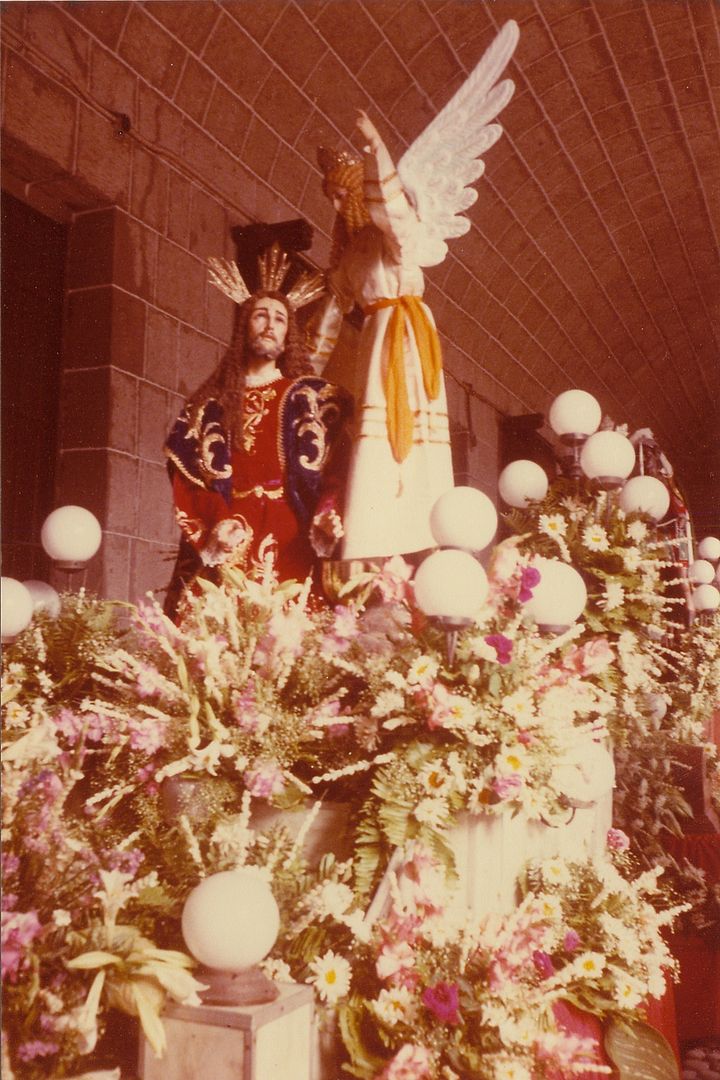
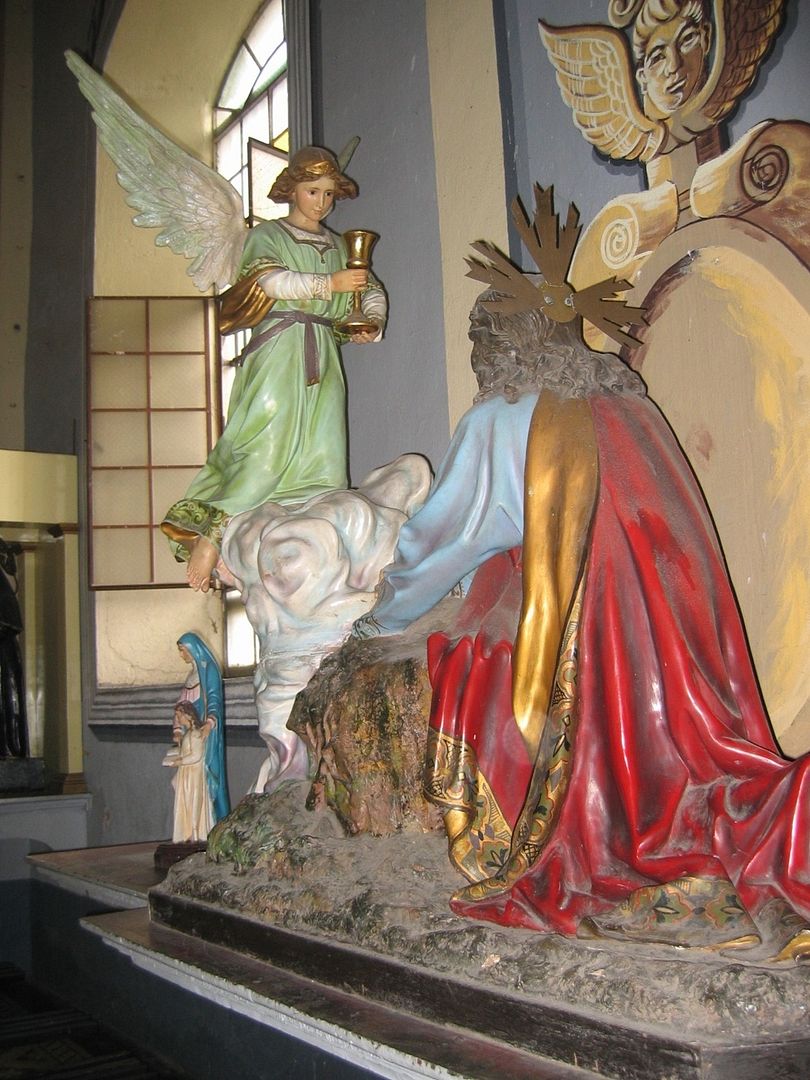
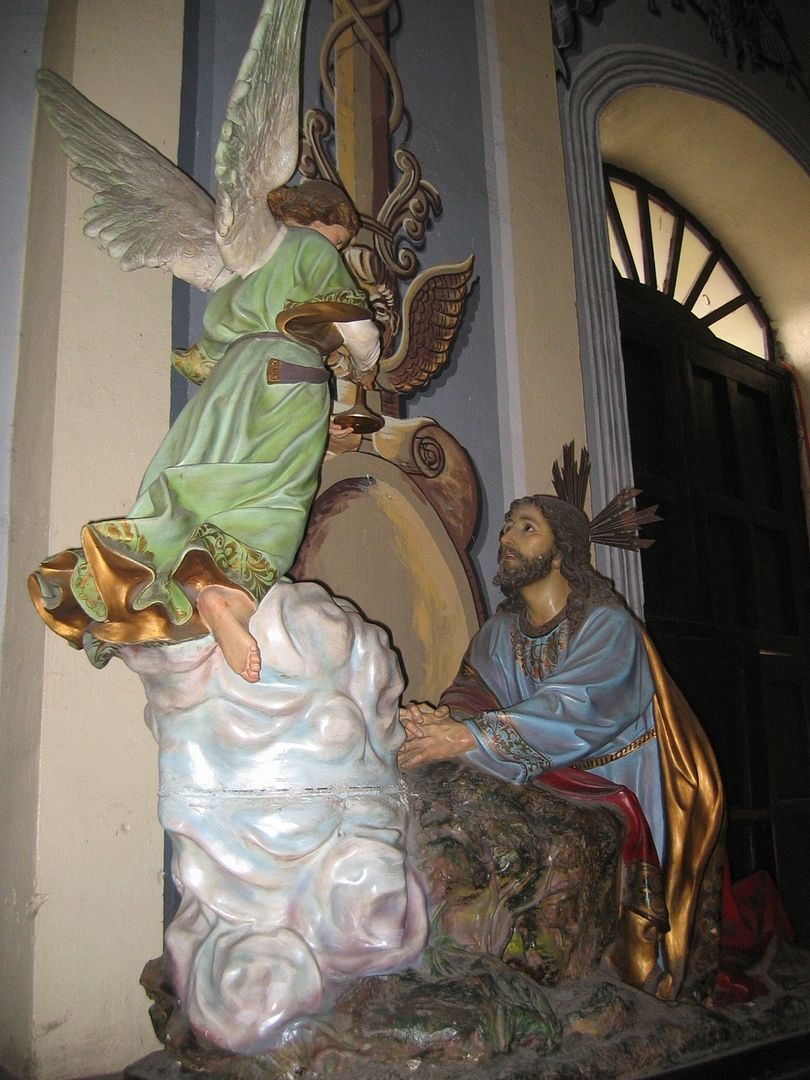
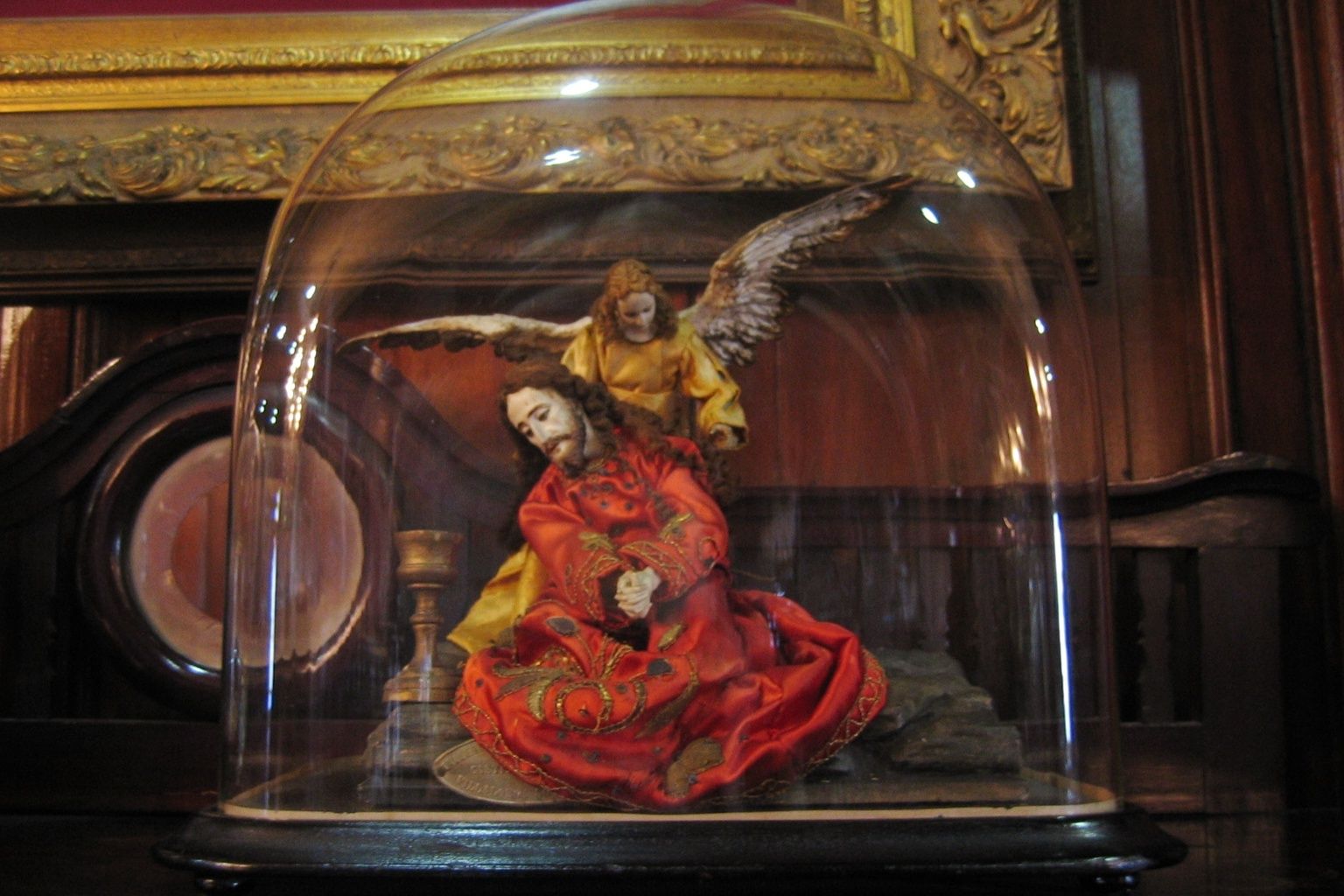
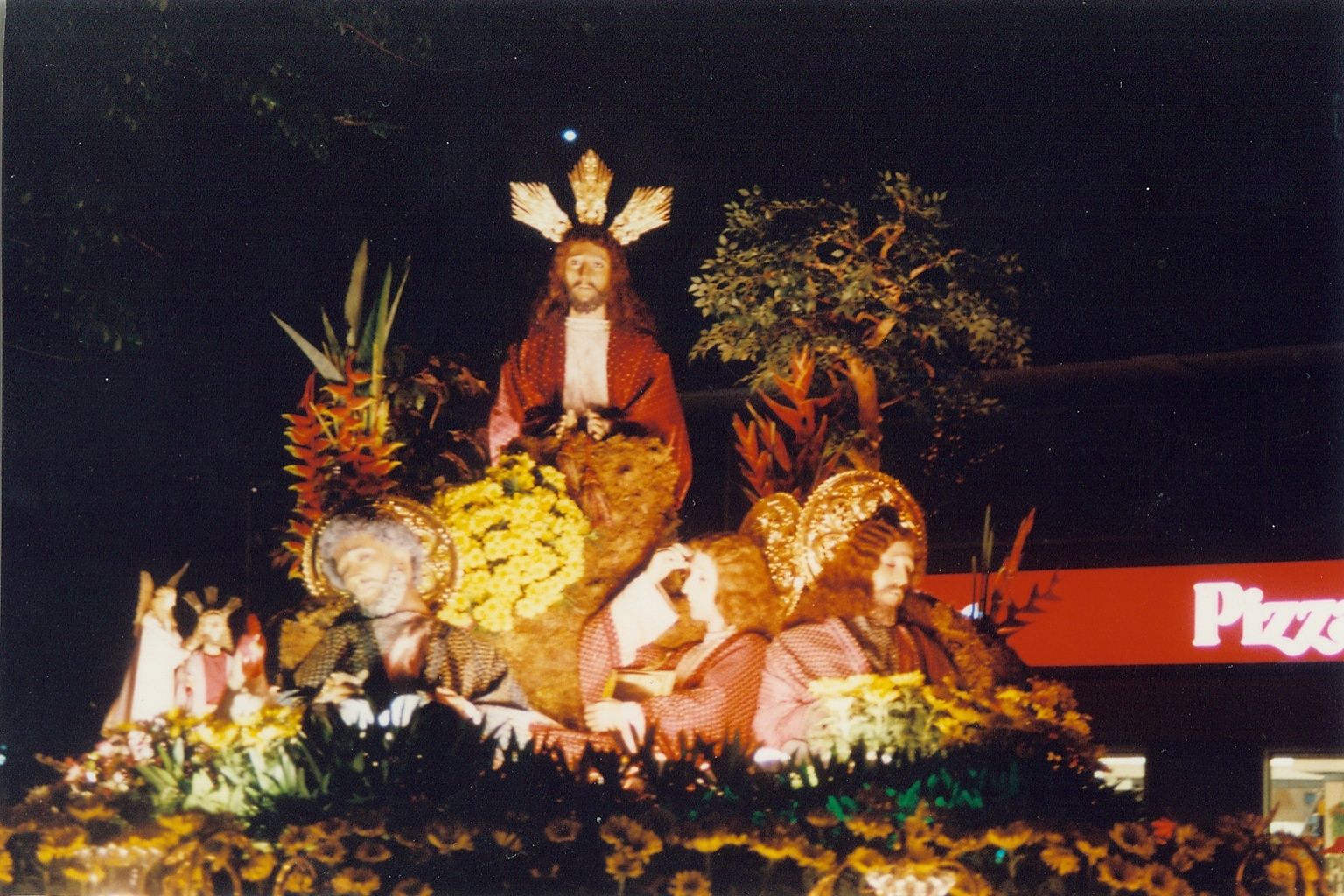
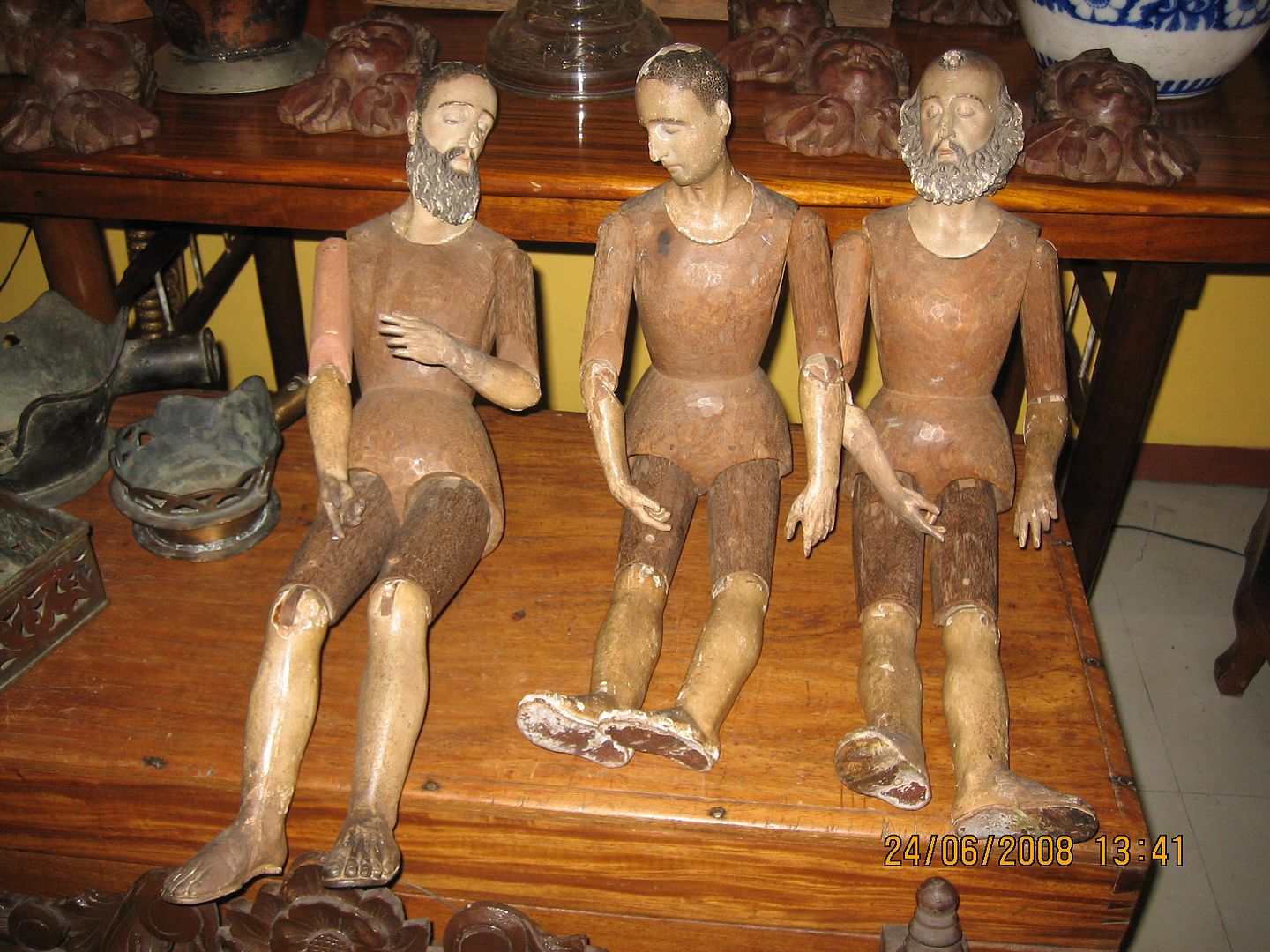
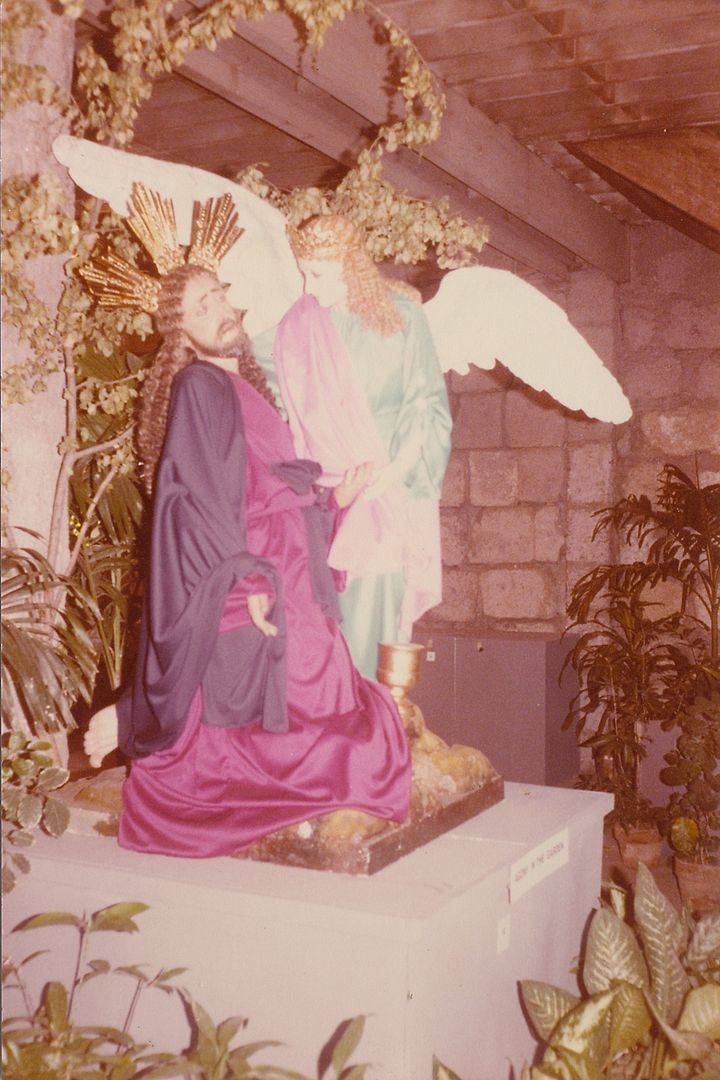
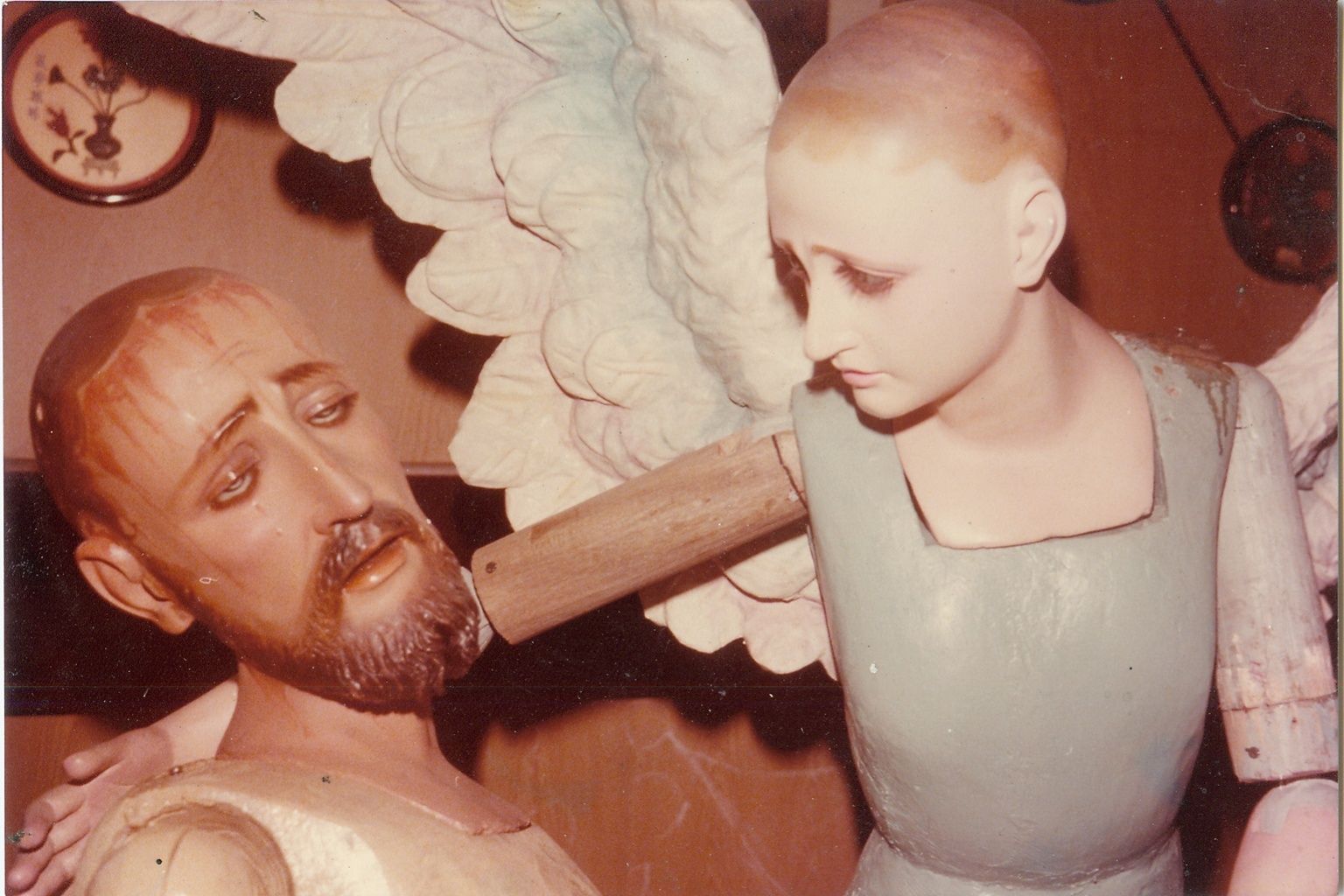
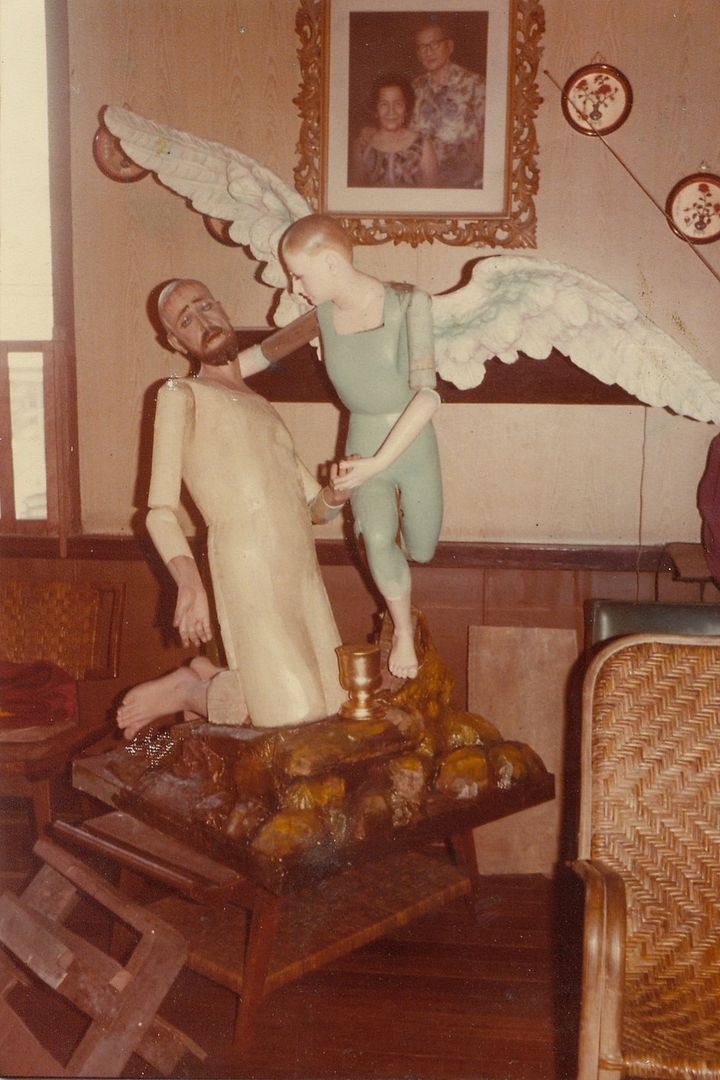
Apart from all those examples of different kinds of Agony in the Garden tableaux that we saw in Part One, the only other one that I had not come to was an antique, also from the Francisco Vecin Collection. Mr. Vecin had kept it for many years, and only rarely lent it out for exhibits, as in this old photo from his collection.
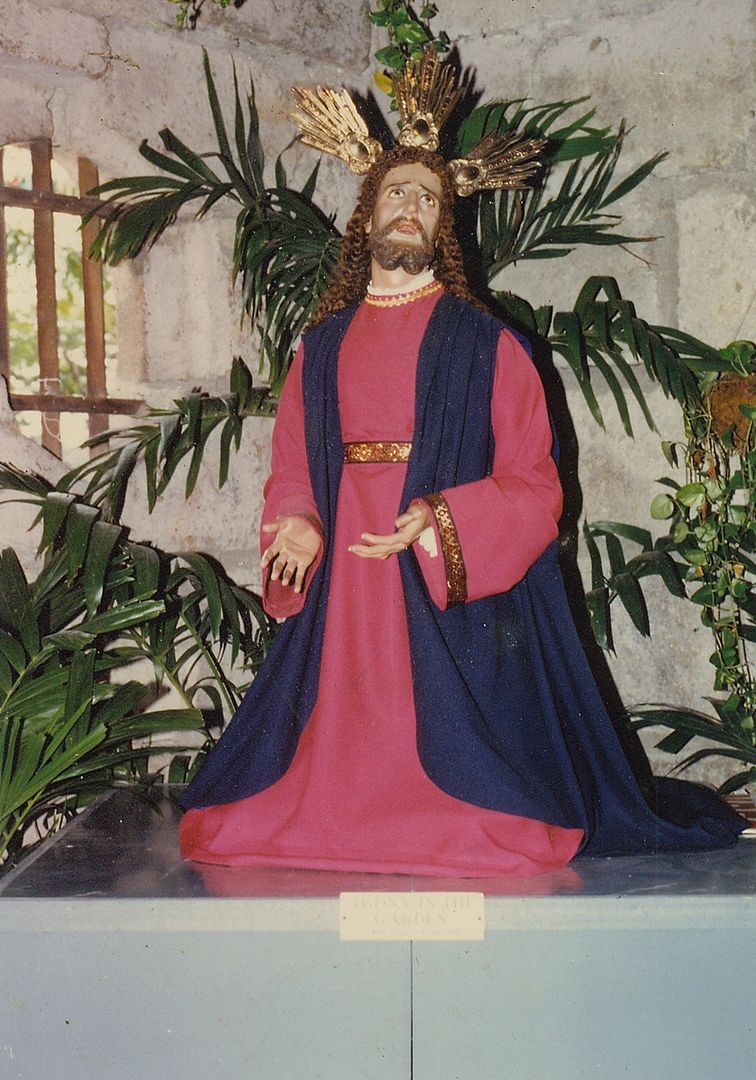
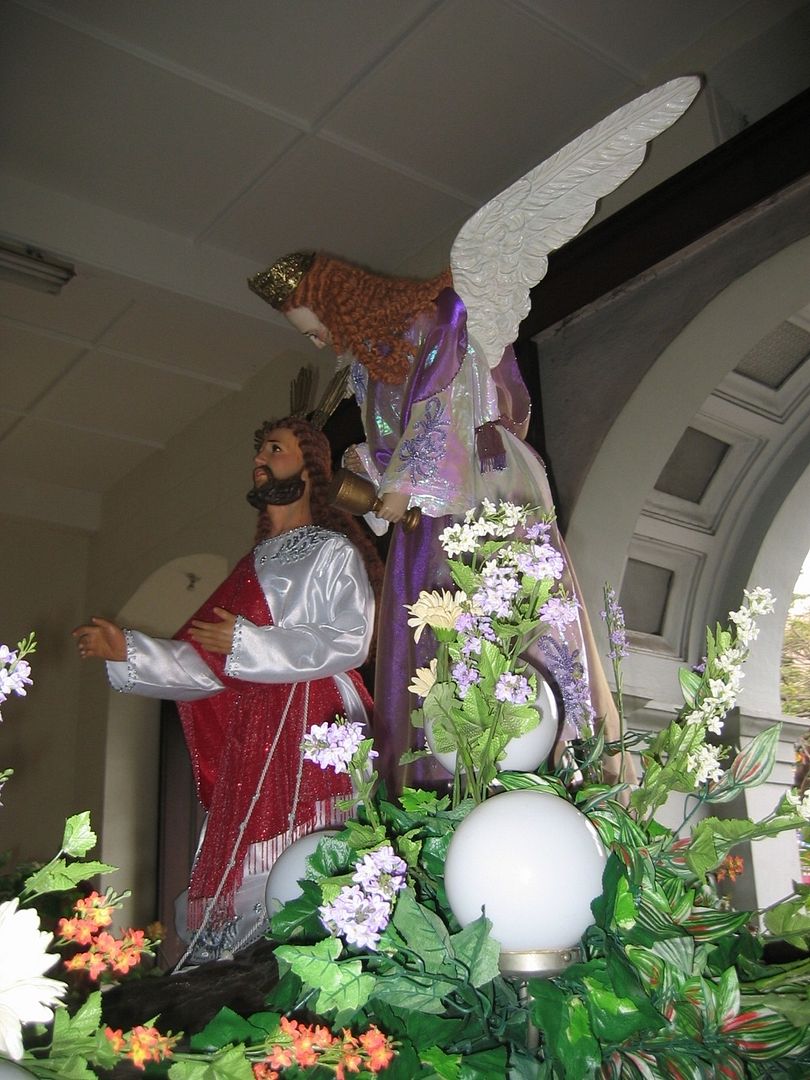
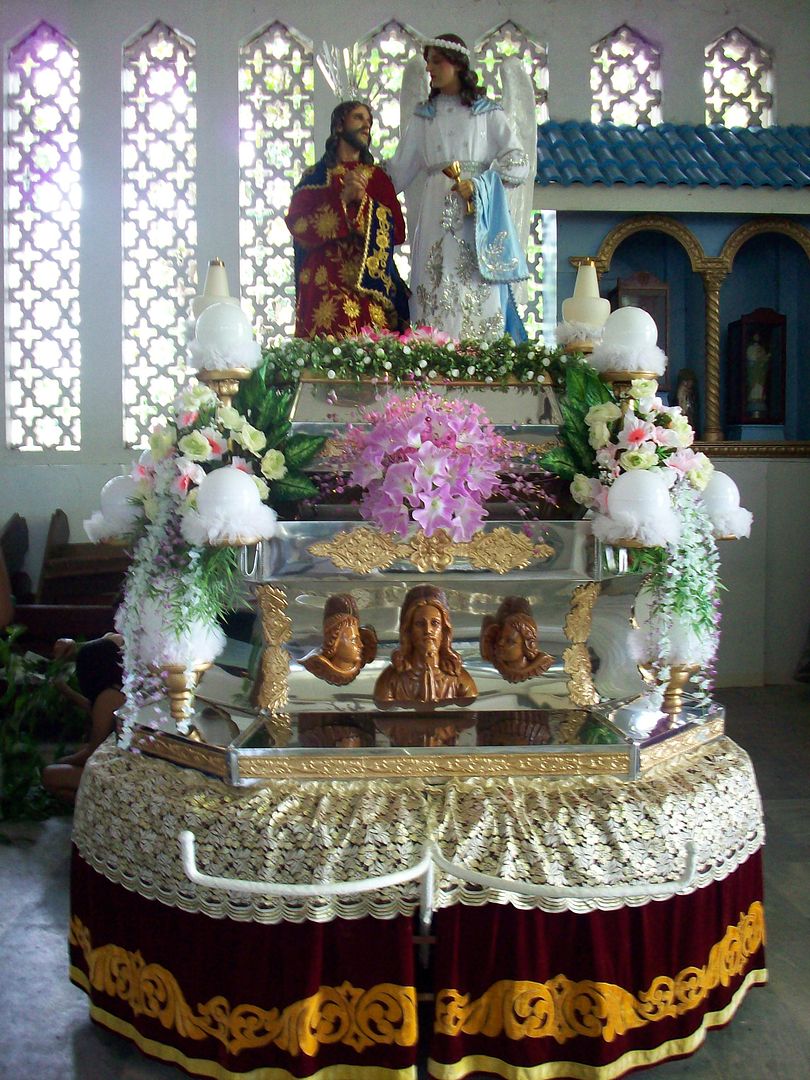
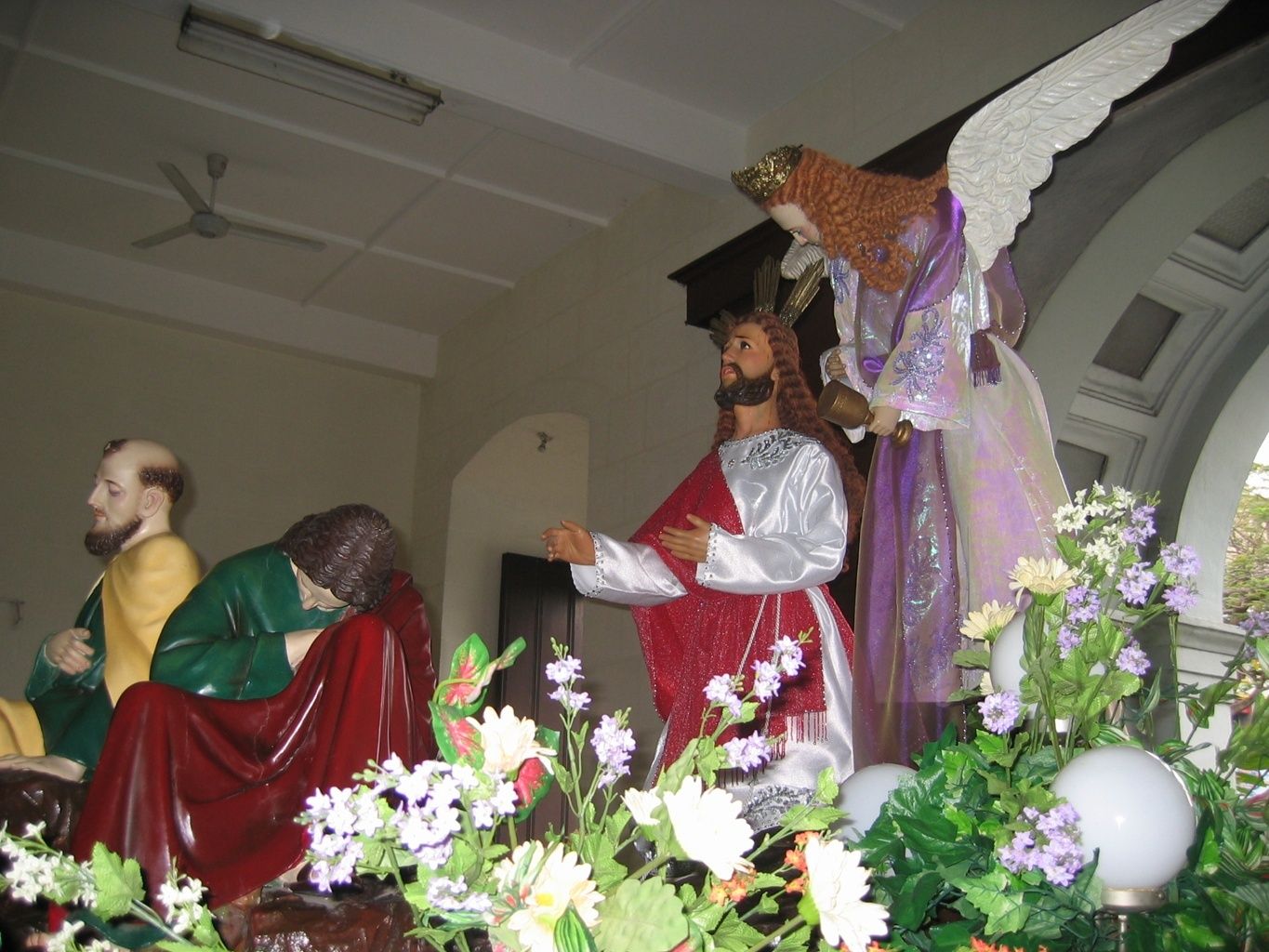
As the antique Cristo no longer had its original Angel, he made a new one for it, which was put to work when the tableau was borrowed for Holy Week processional use in San Pablo, Laguna some time ago, as seen in another page from Mr. Vecin’s photo album.
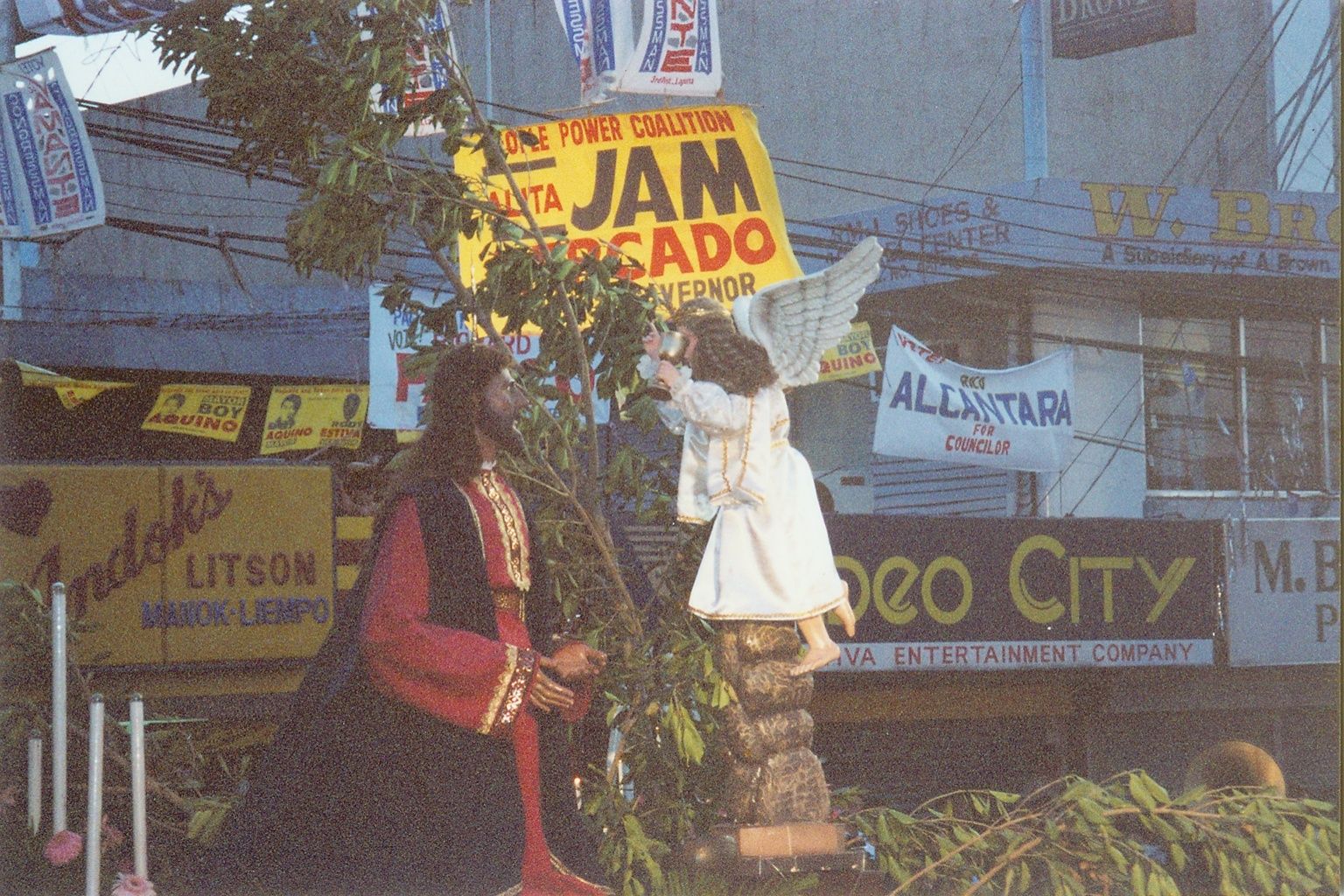
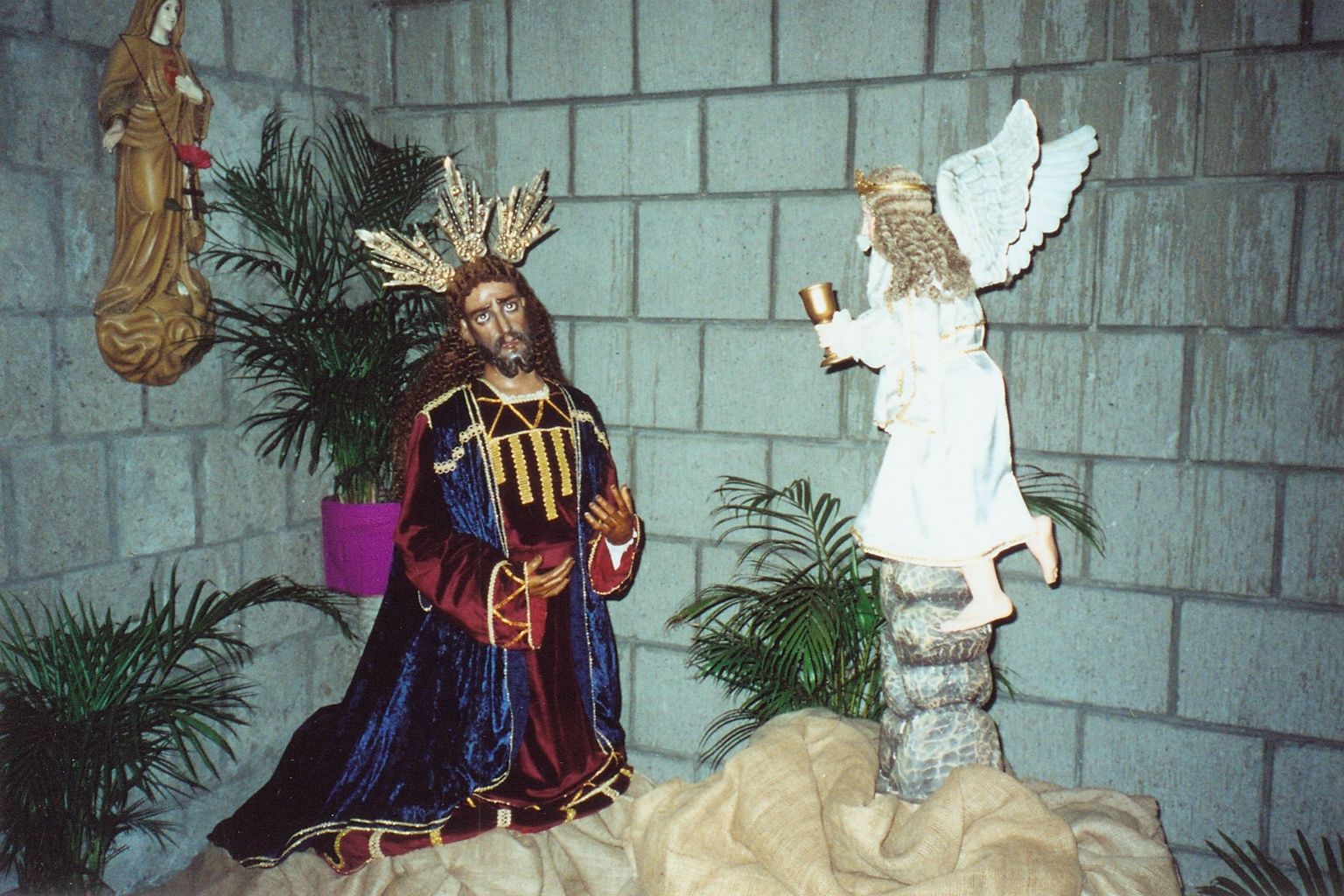
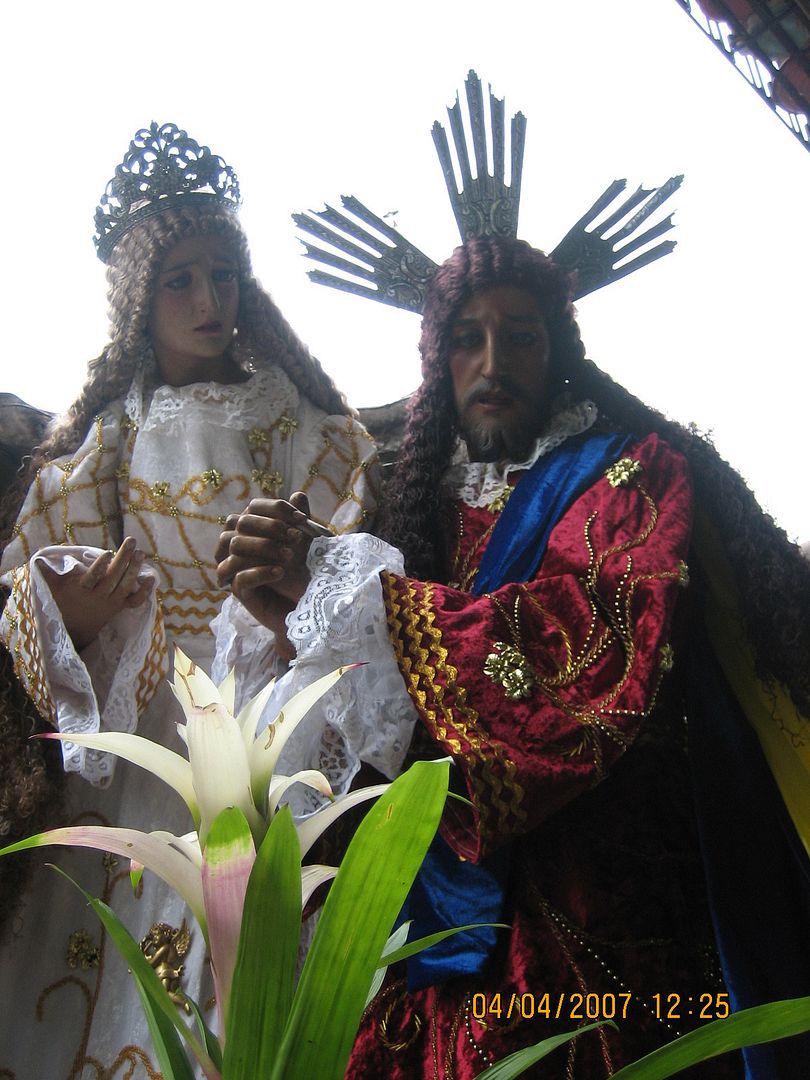
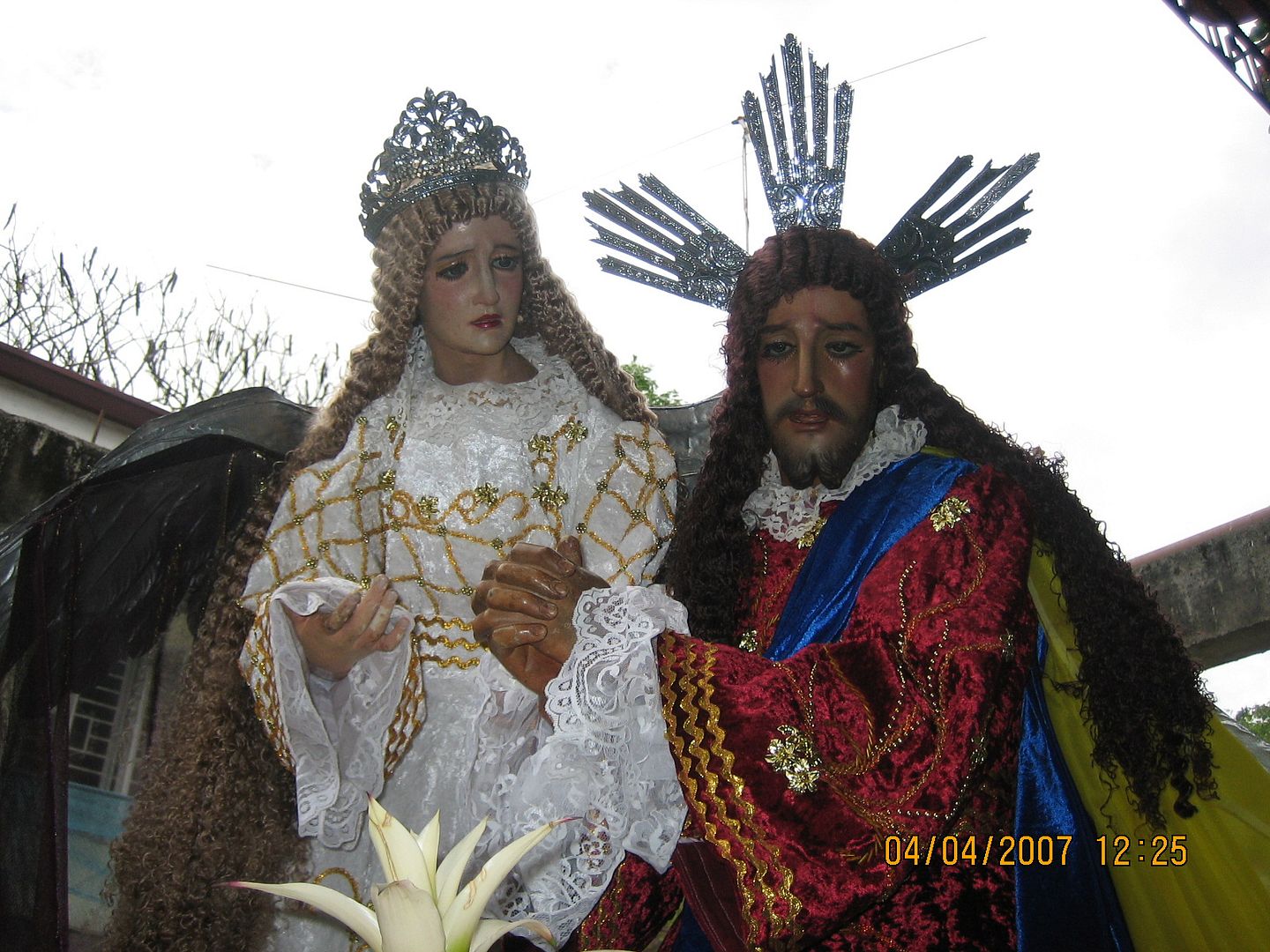
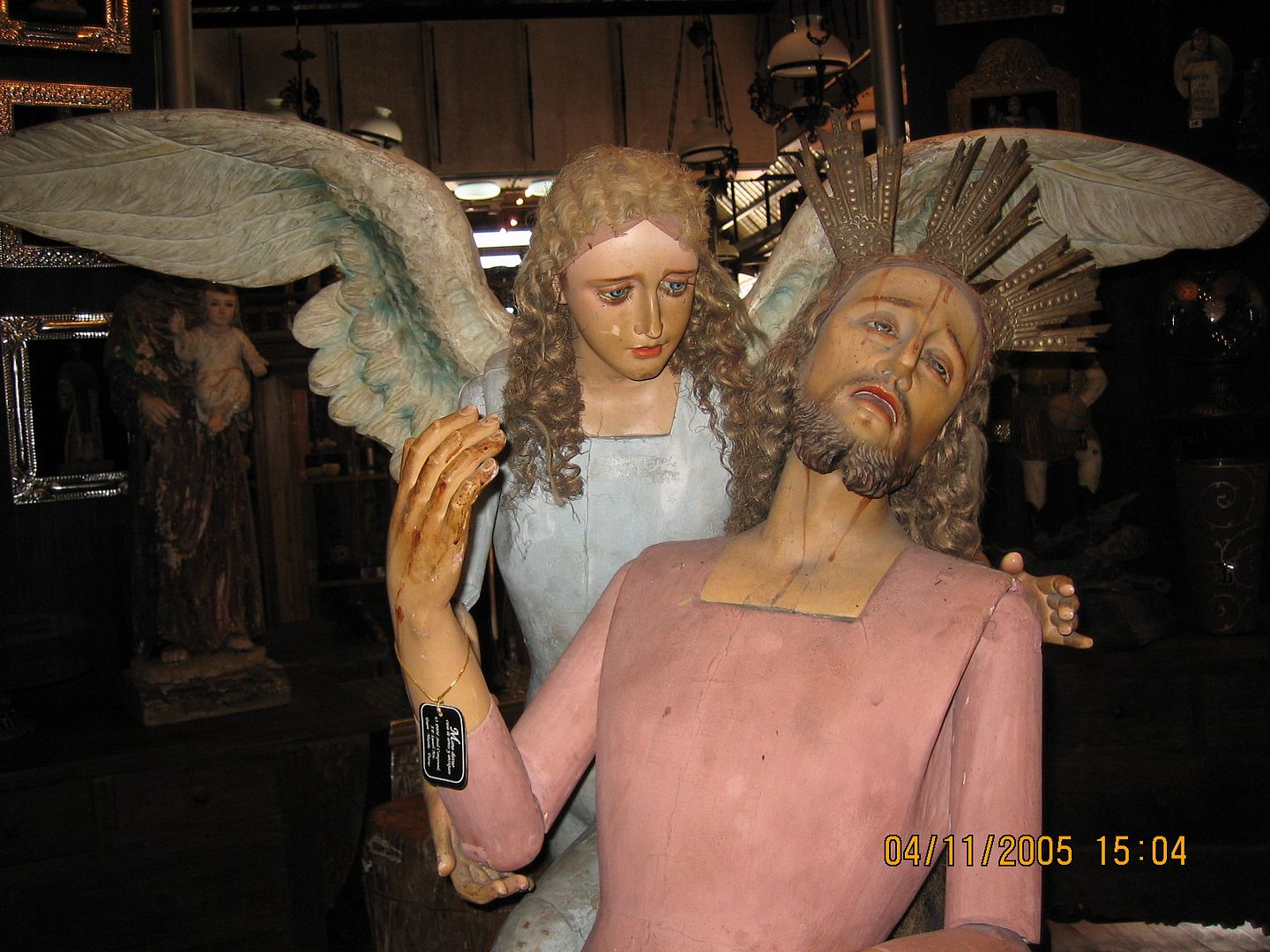
Eventually the Villa Escudero Museum acquired another antique Agony in the Garden from the Vecin Collection (as also seen in Part One), so this set no longer needed to do duty in San Pablo. Therefore it could be borrowed for use during Holy Week “Pabasa” activities in Mr. Vecin’s own neighborhood of Makati Poblacion. When I visited the Vecin Workshop shortly before Good Friday 2004, I saw and photographed the antique Christ all dressed up, waiting to be fetched by its volunteer minders.

The very good-looking Child Angel custom-made by the Vecin Workshop was also ready for picking up.

I thought to myself, these are it – these images are definitely the models for our desired Agony in the Garden tableau. I showed its photos to my family, who were also quite impressed with this particular pair, even after looking at all the other examples in the photos that Mr. Vecin had lent me.
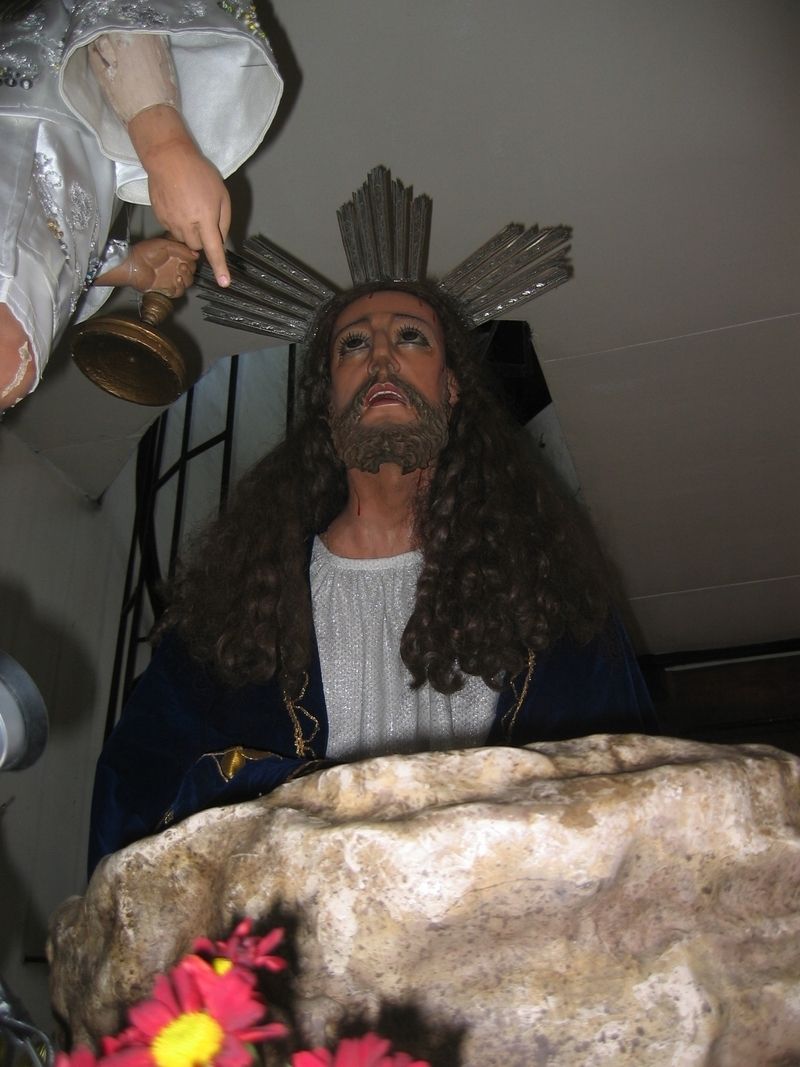
Therefore, some weeks after that first post-Holy Week visit to the Vecin Workshop when we had first discussed the possibility of commissioning this tableau, I had phoned Mr. Vecin and told him that his own antique set was our preferred prototype. A few days later, I visited his office, where he had already brought out the head of Christ and put it on his desk for my examination up-close.

He also brought its body out of storage and allowed me to photograph the form.
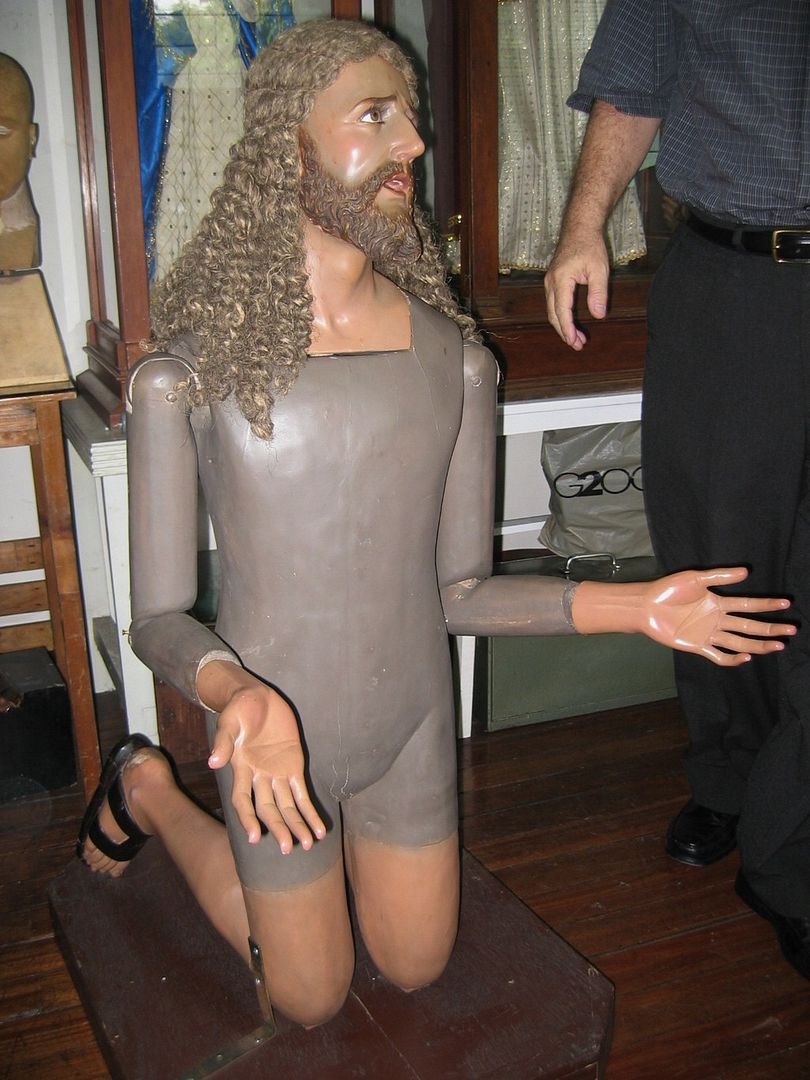
I then confirmed that this image was the one that we wanted replicated. On the other hand, we preferred a grown-up version of the Child Angel, as we wanted to conform to the traditional belief that it was the Archangel Gabriel who had arrived to offer relief to the Lord. Mr. Vecin responded that this would pose no problem at all – he and his craftsmen could “age-progress” the Child Angel (same process detectives use with photos of missing children?).
One other significant change with our commissioned tableau was that instead of the Angel holding the chalice, presumably containing some water to quench the Lord’s thirst, we wanted the Christ to hold the chalice, alluding to the part of Scripture that says
He withdrew about a stone’s throw beyond them, knelt down and prayed, “Father, if you are willing, take this cup from me; yet not my will, but yours be done.” (Luke 22: 41-42)
In our reading, the cup wasn’t an actual vessel containing cooling water that the Angel had carried from heaven, but a metaphorical one that represented Christ’s upcoming suffering and that He already had in hand. It is this latter interpretation that we sought to convey in our tableau.
Mr. Vecin thought over this idea, and after getting over his initial concern that this might lead a few devotees to confuse it for an image of Christ at the Last Supper, agreed that this represented a different and welcome take on the significance of this, the First Sorrowful Mystery, more than with just having some angel bring a cup of water.
- - - - - -
While the Vecin Workshop’s sculptors and painters got to work on these images, our discussions turned to what sort of carroza to employ for this tableau. Our photographic collection was helpful here, as we had interesting examples, for example, of the Lipa Agony in the Garden on what appears to be an all-metal (or is it silver-painted wood?) carroza.

Mr. Vecin and I agreed that it didn’t appear to be appropriate for what is really a somber and contemplative nighttime scene.
The Malolos Agony in the Garden was transported on this antique-looking metal-on-wood carroza.
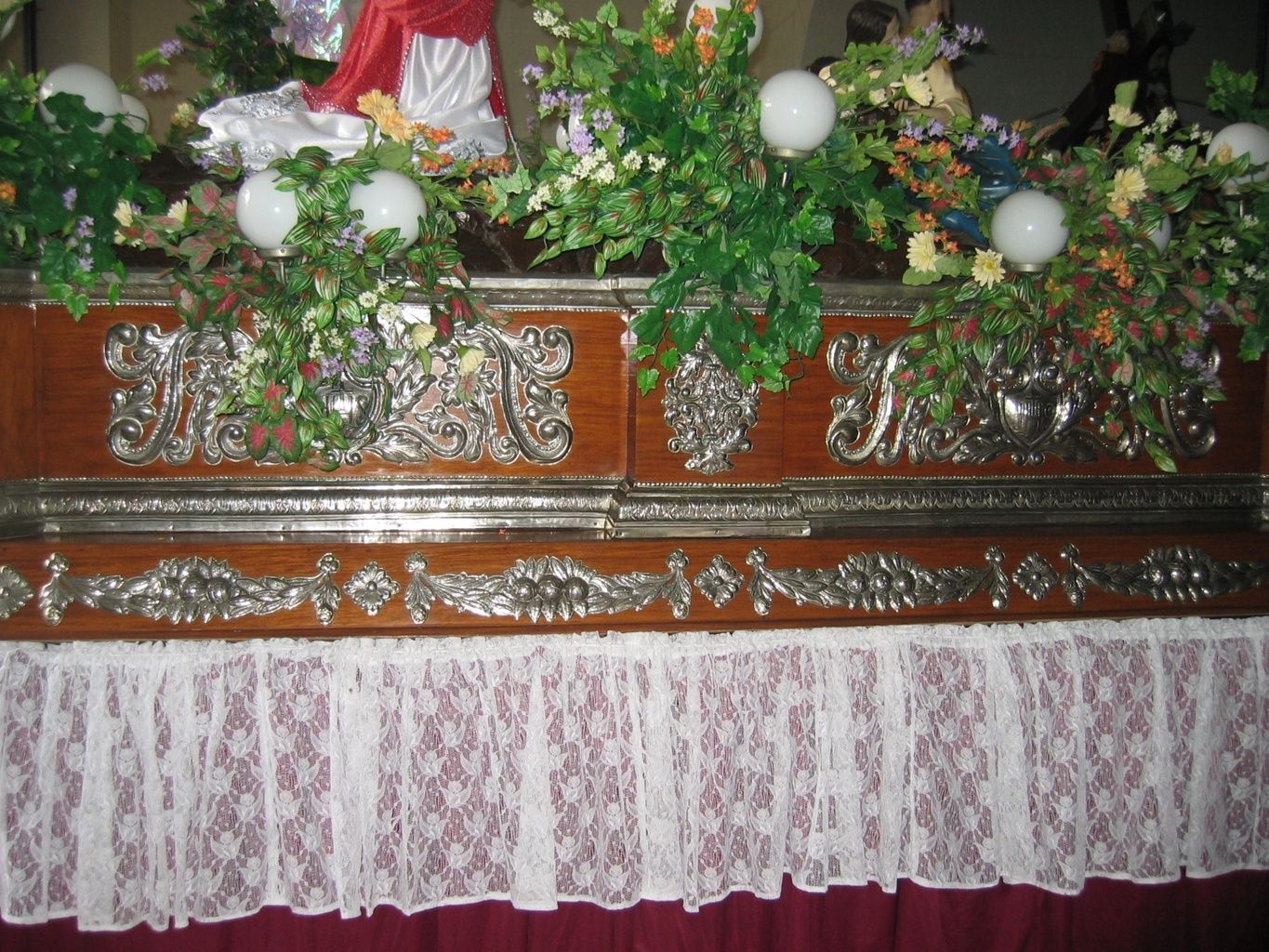
The metalwork was very well-designed and expertly-crafted.

The entire vehicle was large and impressive.
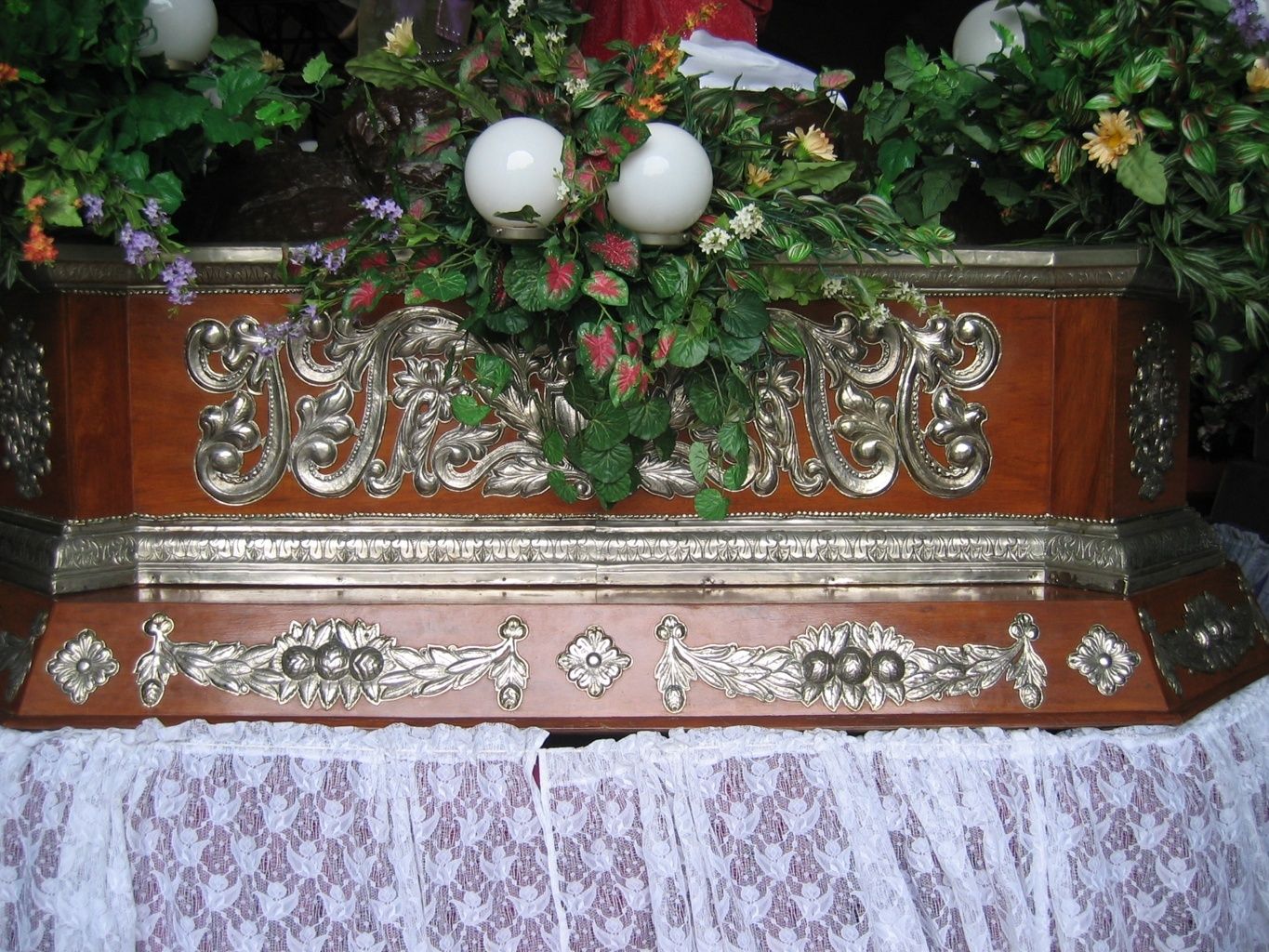
In fact, I thought it rather too large for a two-figure Agony in the Garden, which led me to speculate that perhaps it was not the original carroza for the Malolos tableau, and the newish-looking figures of the three sleeping Apostles (see Part One) were commissioned mainly to fill out all the extra space. I really wonder.
I told Mr. Vecin that since we had just commissioned a beautiful metal-on-wood carroza for our family’s Saint Martha (see series here), we should probably try something else and go for an all-wood scheme instead for a change. He agreed, and promised to get back to me with designs for my approval, before he actually builds the thing.
- - - - - -
Some months later, and right before Mr. Vecin was to start building the carroza, the plot took an unfortunate turn. The parish informed us that, in fact, our offer to introduce an Agony in the Garden tableau into the processional line-up would have to be kindly turned down, as another parishioner, who already had an Agony in the Garden tableau, insisted on participating with it.
The confusing turn of events was clarified somewhat when it was reported that this existing tableau had been part of the processional line-up in the neighboring parish. When our new parish was spun-off from that one and established as a quasi-parish, the owner, who was actually also from the new quasi-parish, continued to participate in the original parish’s Holy Week procession.
Until, according to the active parish hall gossip circuit (always a fertile field), the owner got into some unspecified dispute with the older parish, and, presumably discomfited, pulled out his tableau from there and now insisted on bringing it to his real home parish – which happened to be ours as well. Not a bad outcome really – except that it renders our still-in-the-making Agony in the Garden tableau stillborn, as it were.
I then call and tell Mr. Vecin the bad news, but confirm that while we will not order a carroza for it, we want to push ahead with the images. Not only is all the carving done and the wood just drying out before final painting, but we are also keen to see how the tableau will come out.
- - - - - -
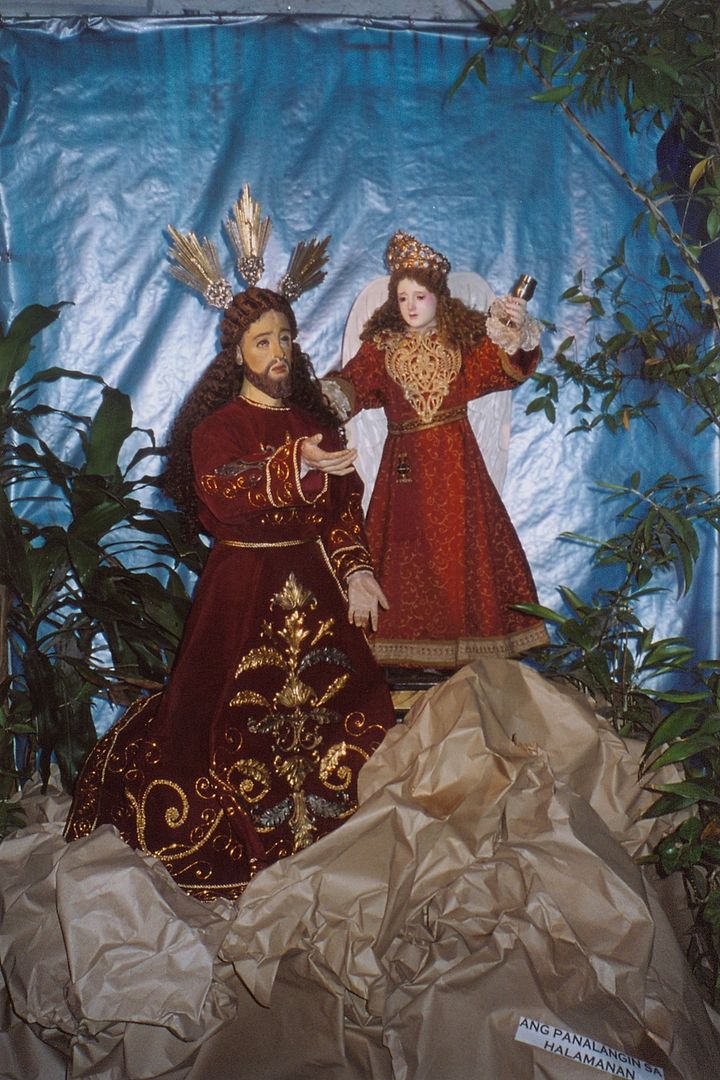
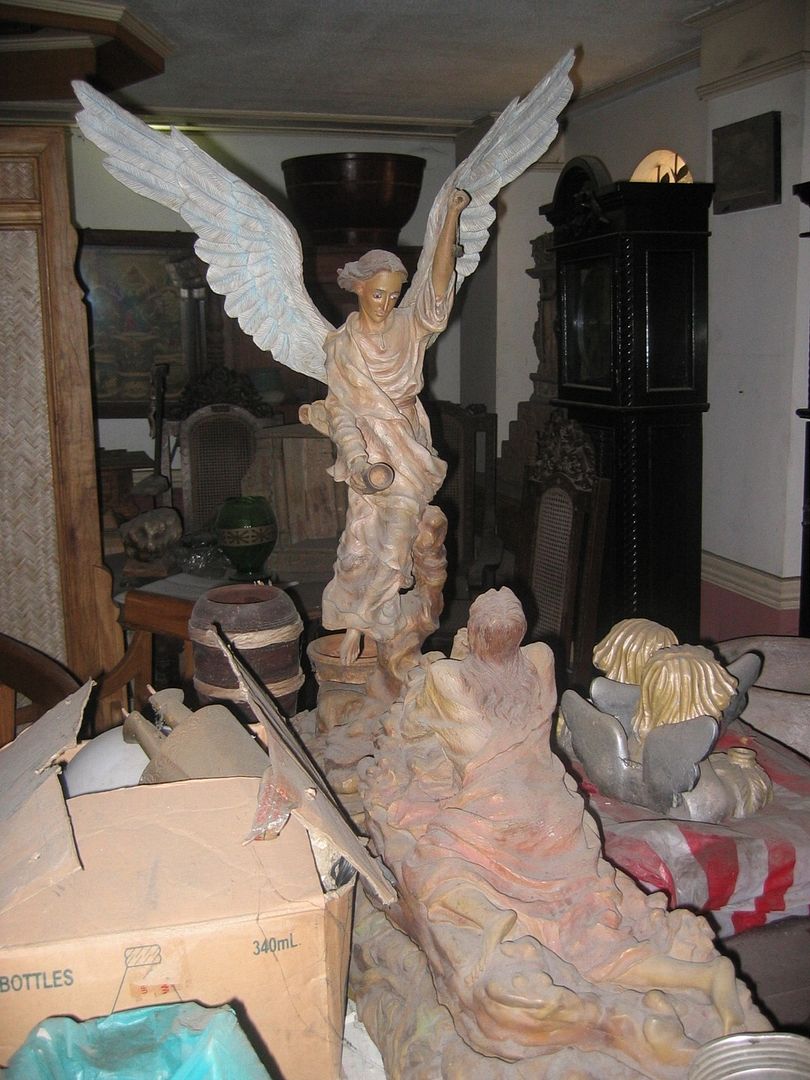
Before Palm Sunday 2005, the completed images were ready, and Mr. Vecin and his small team trooped over to my aunts’ house to set them up – not for processional use any longer obviously, but just for devotional purposes.
The results were extraordinary. The Christ, modeled on the antique from the Vecin Collection but with chalice in hand, was absolutely life-like.

You could almost hear it saying, “Tell me again why I’m not coming out in procession, please?”
The angel, now all grown-up and with wings spread wide, was beautiful in an appropriately androgynous way.
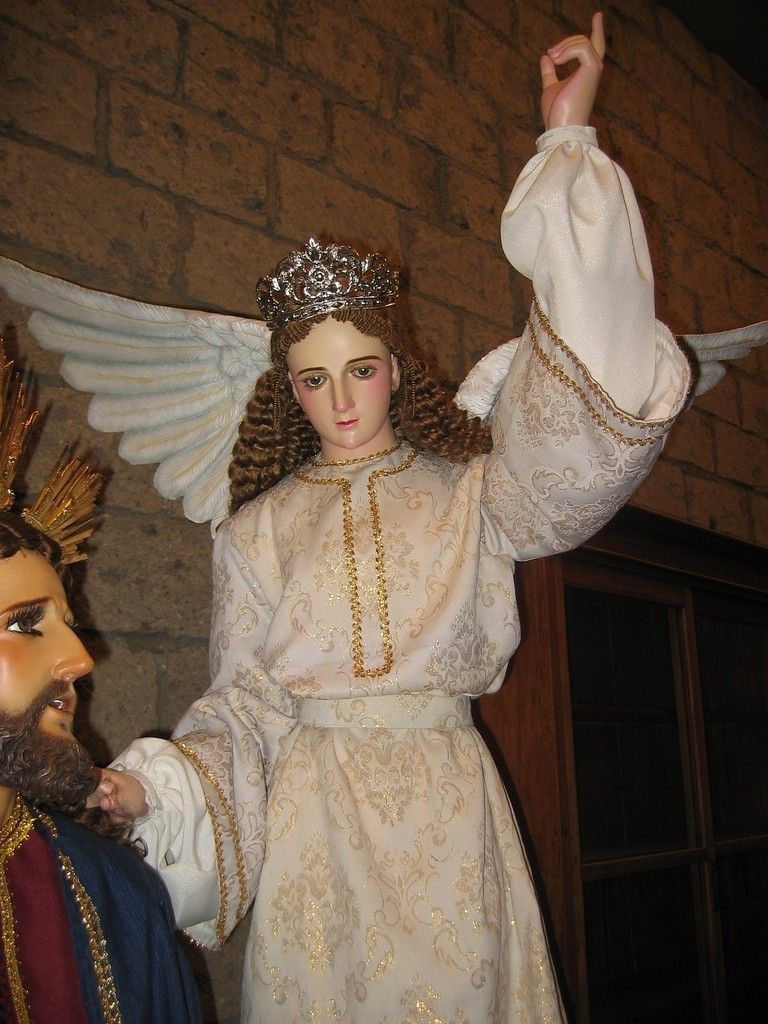
I could have sworn overhearing it say, “Don’t worry, I’ll stand right here while everyone else except us joins the procession.”
Together, I dare say that these images present stiff competition to those impressive teams from San Fernando, Angat, or Quiapo that we previously saw.
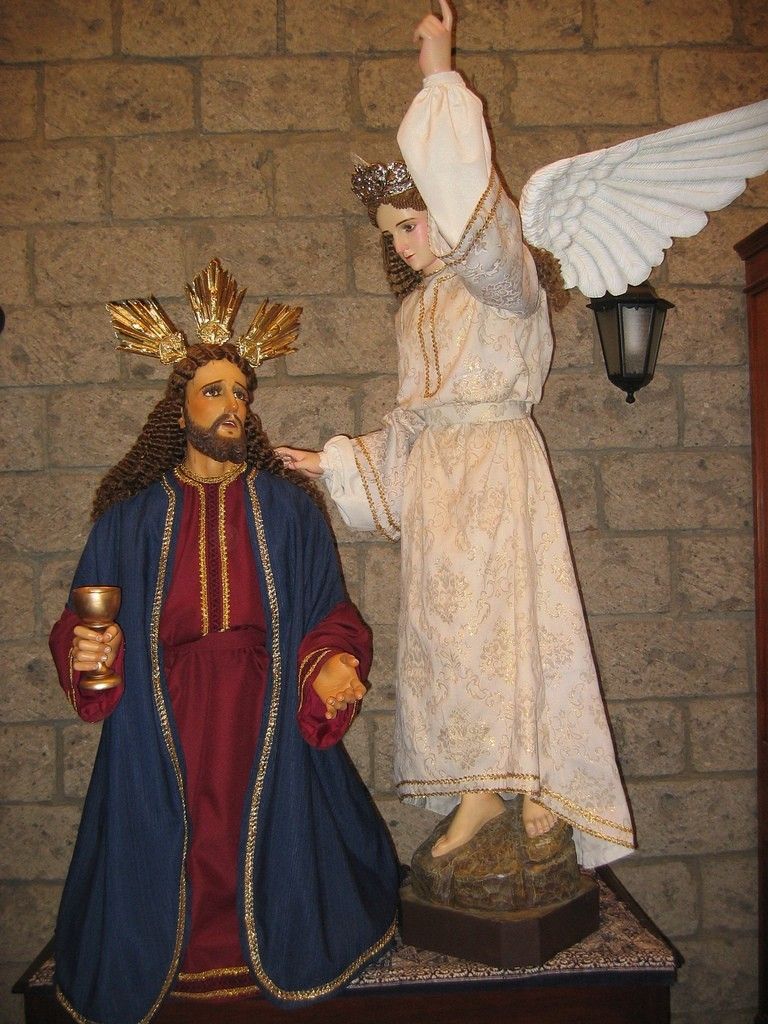
Unfortunately, it will have to sit out its debut on a table in the garage behind the carroza of Saint Martha.
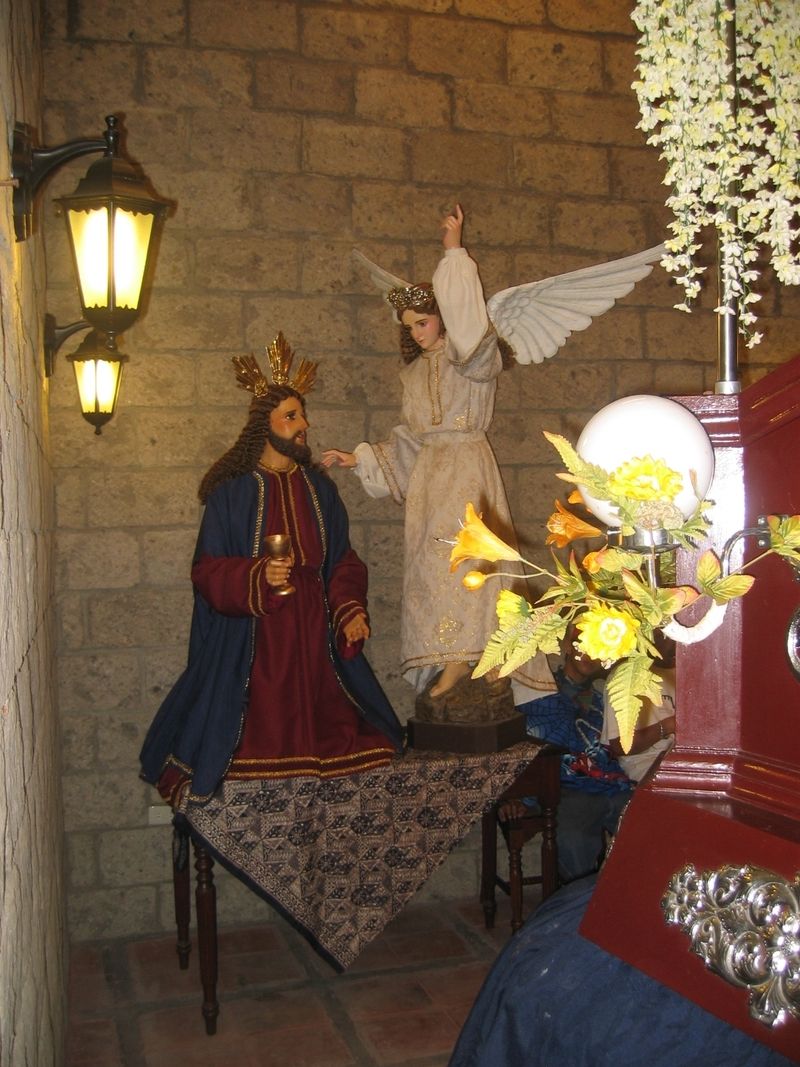
Some time after Holy Week, after Saint Martha and her carroza were cleared away for storage, the Agony in the Garden too had to be dismantled. The heads and hands were removed and the bodies wrapped up and stored inside the garage. Mr. Vecin had supplied torsos on which the heads could be mounted.
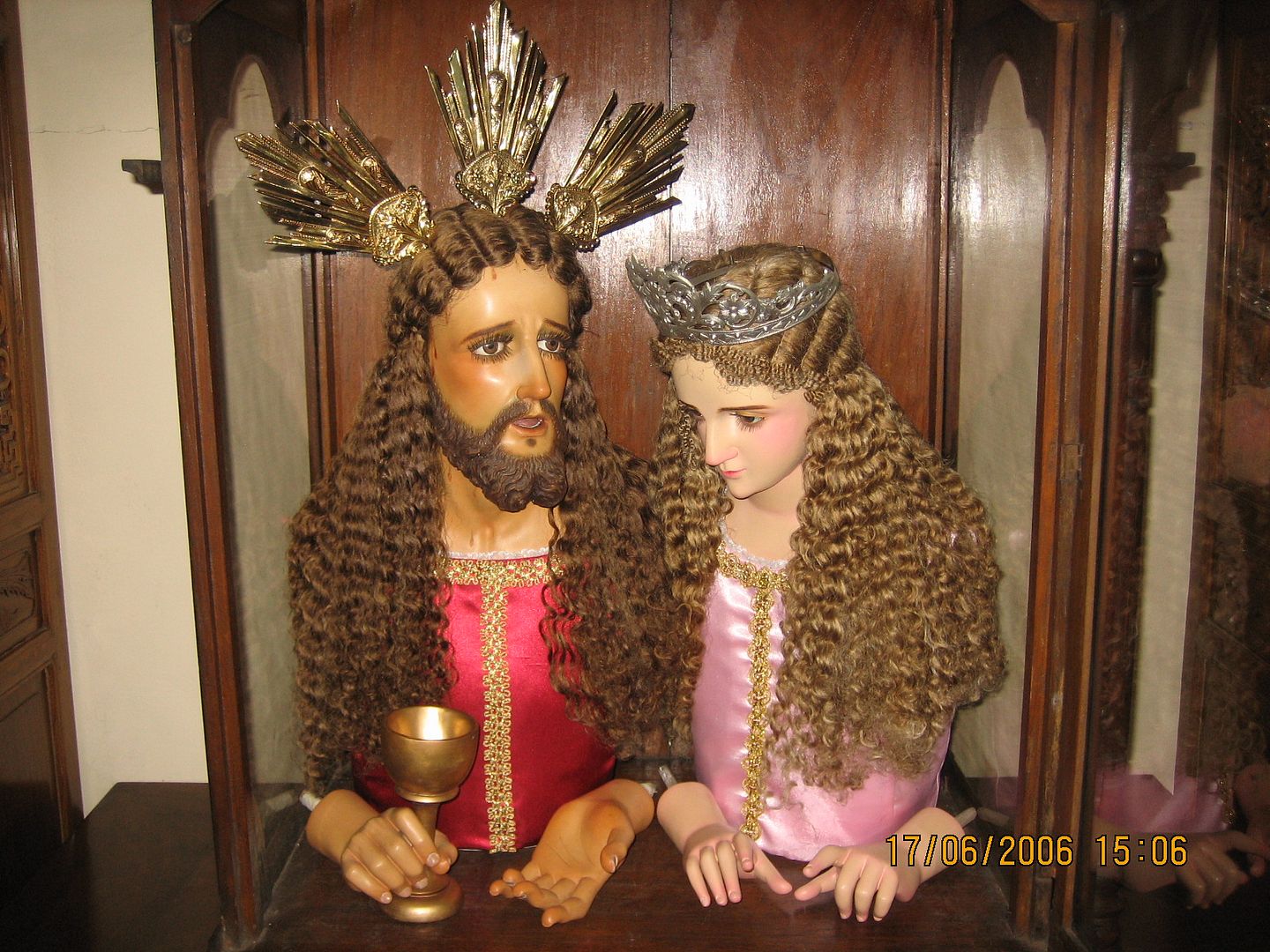
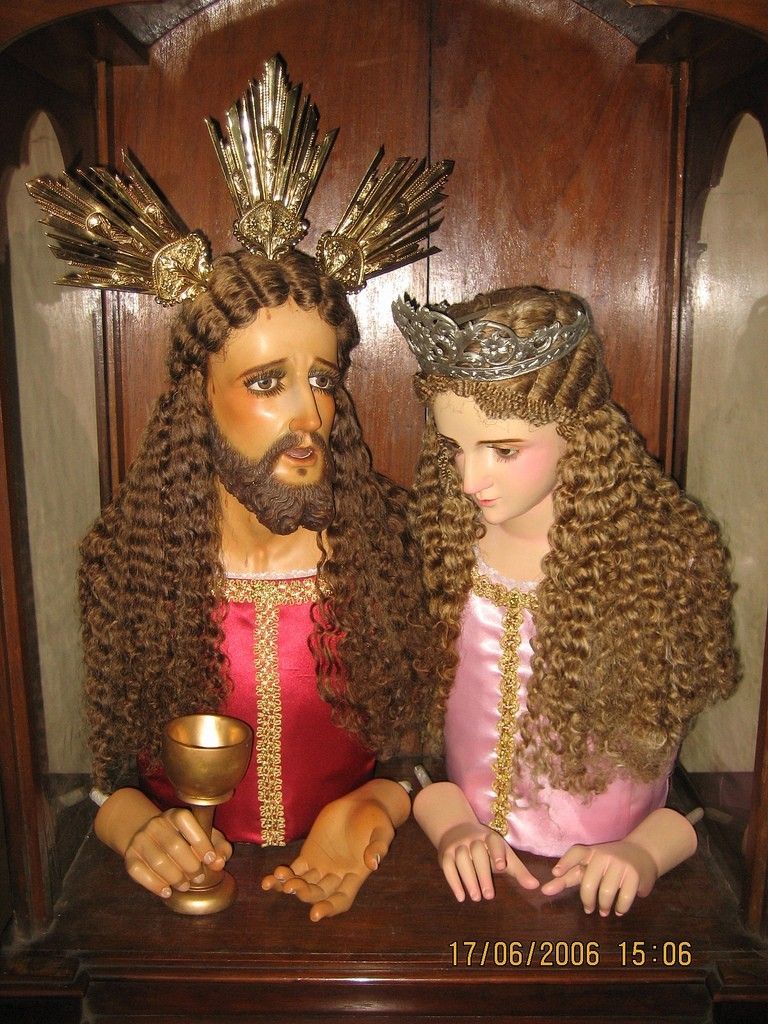
We had also acquired an antique balayong urna from the Vecin Collection, into which the busts fit very well.
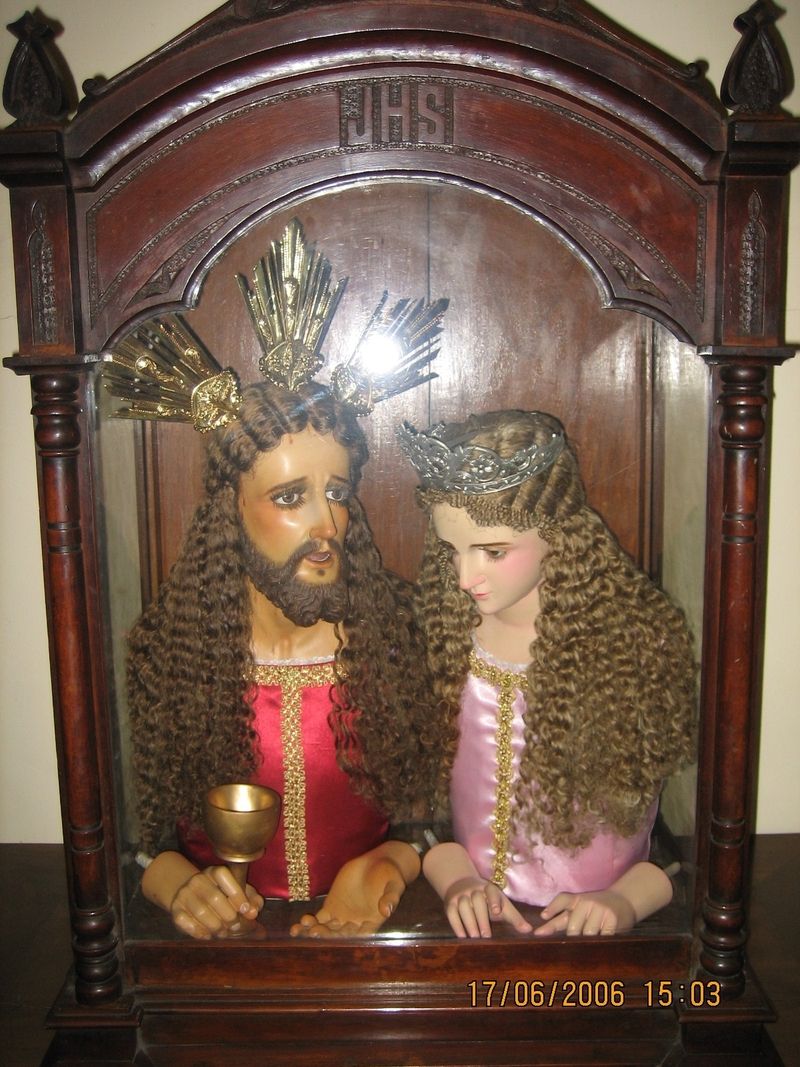
The pair could then be venerated indoors all year-round.
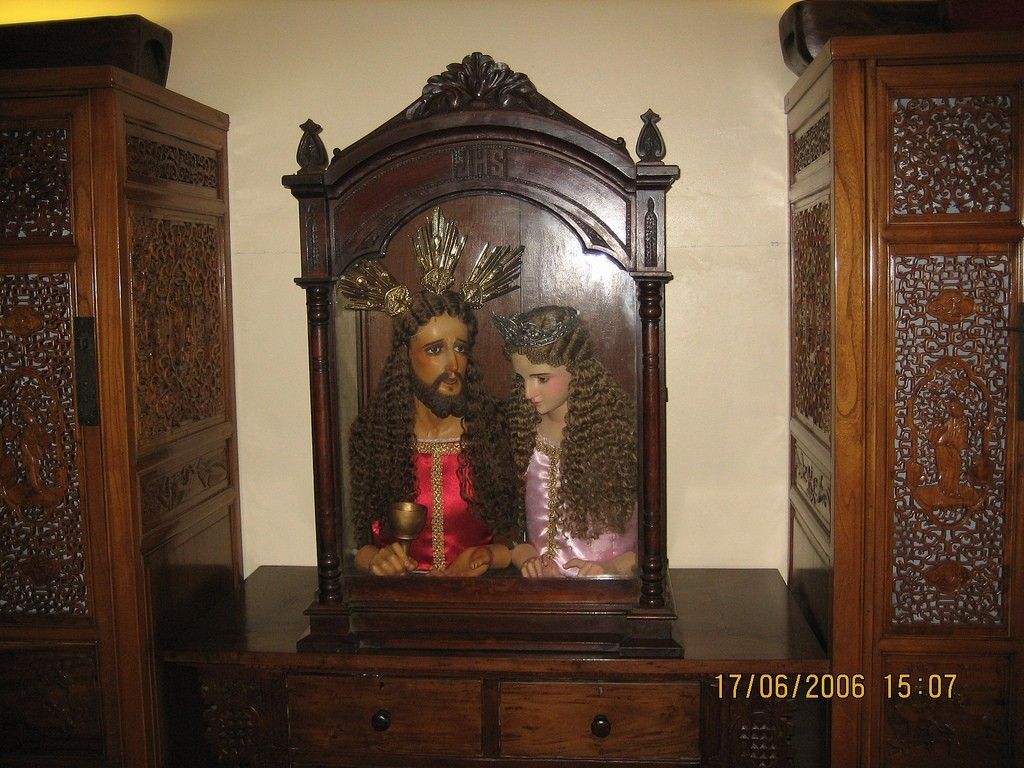
And this is where they will stay forever, not likely to ever be brought out in procession. (But before you place bets on it, let’s wait for this tale to unfold completely.)
- - - - - - -
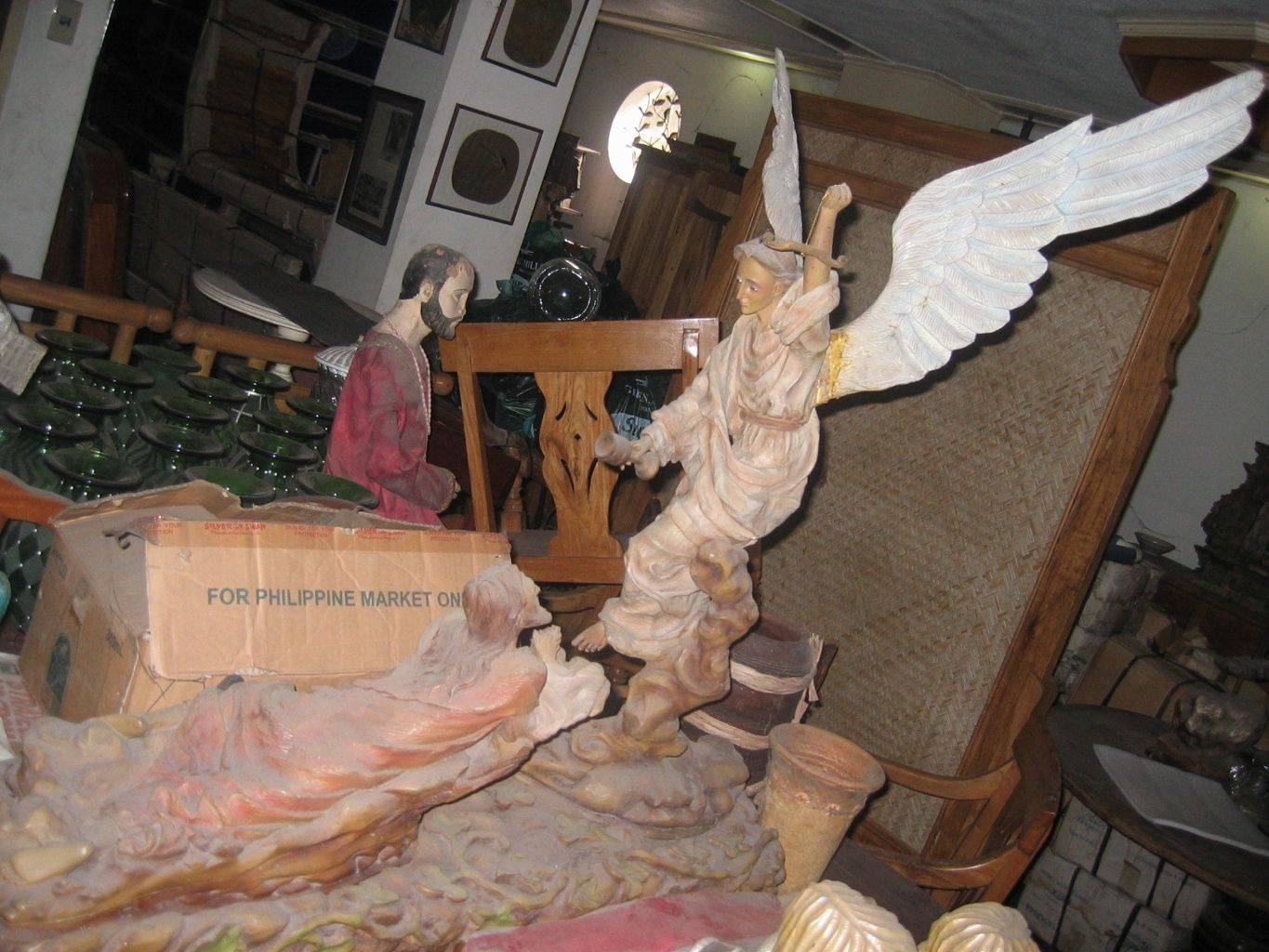
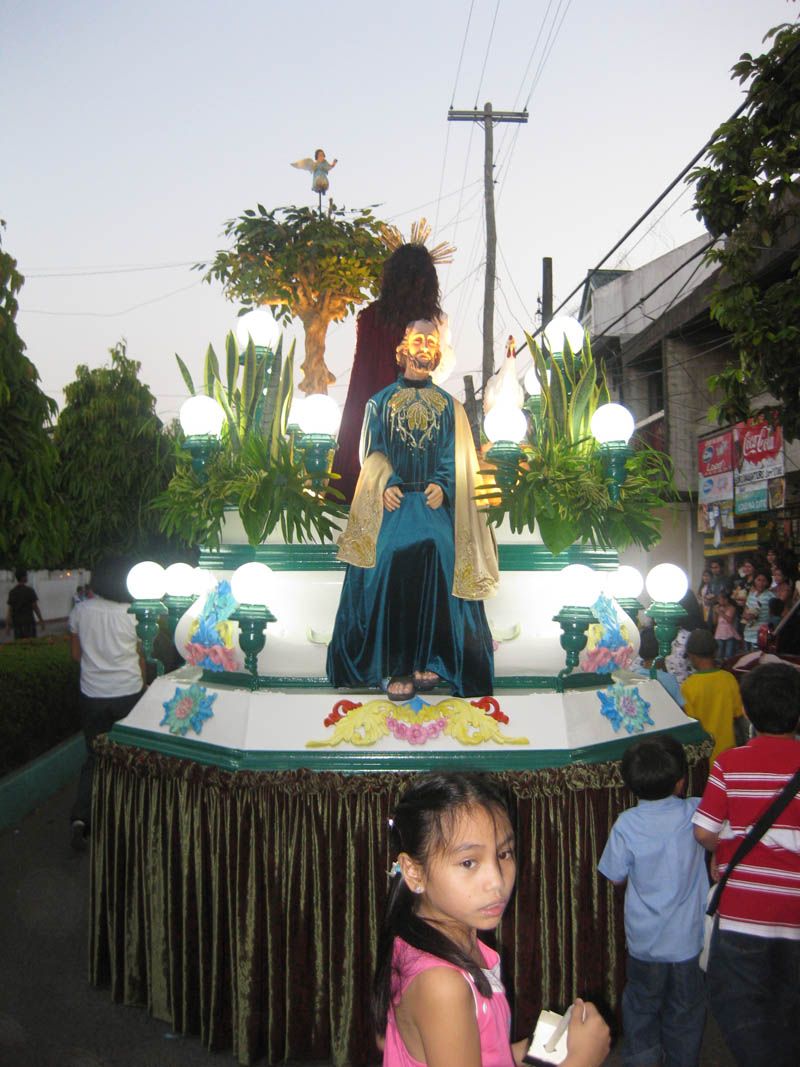
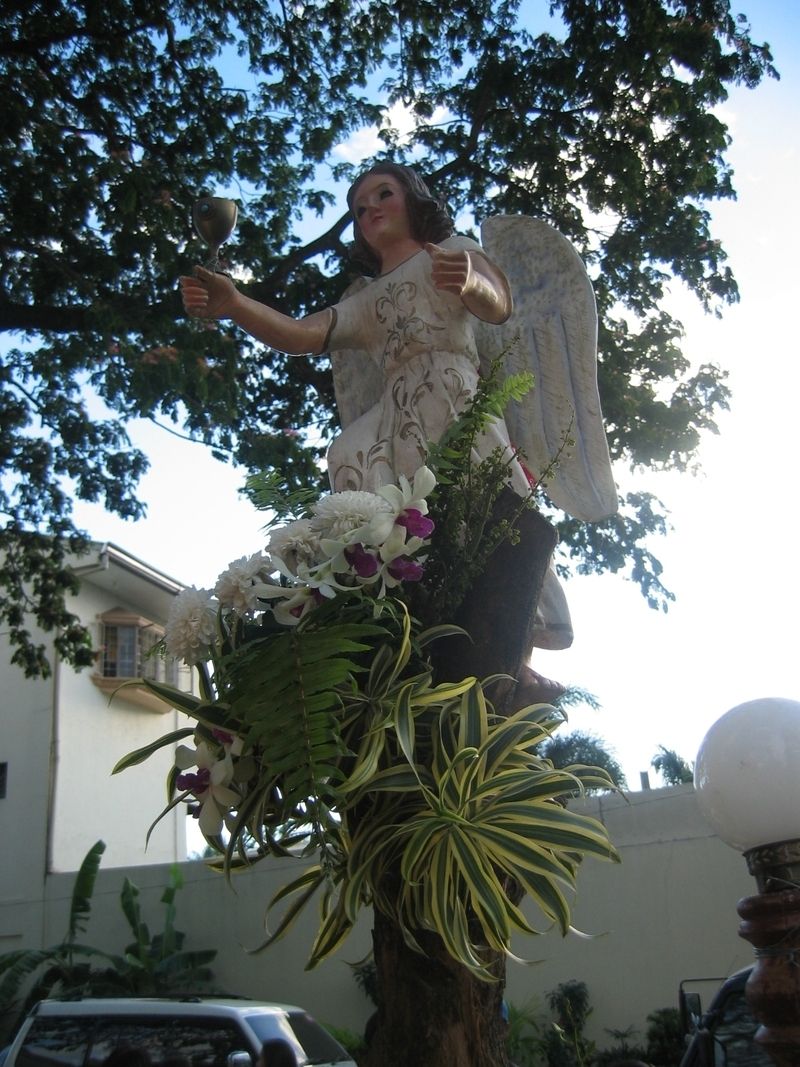
As for the existing Agony in the Garden tableau that suddenly showed up to join the parish’s processional line-up, I got a first look at it that same Holy Week in 2005, right before the Good Friday procession.
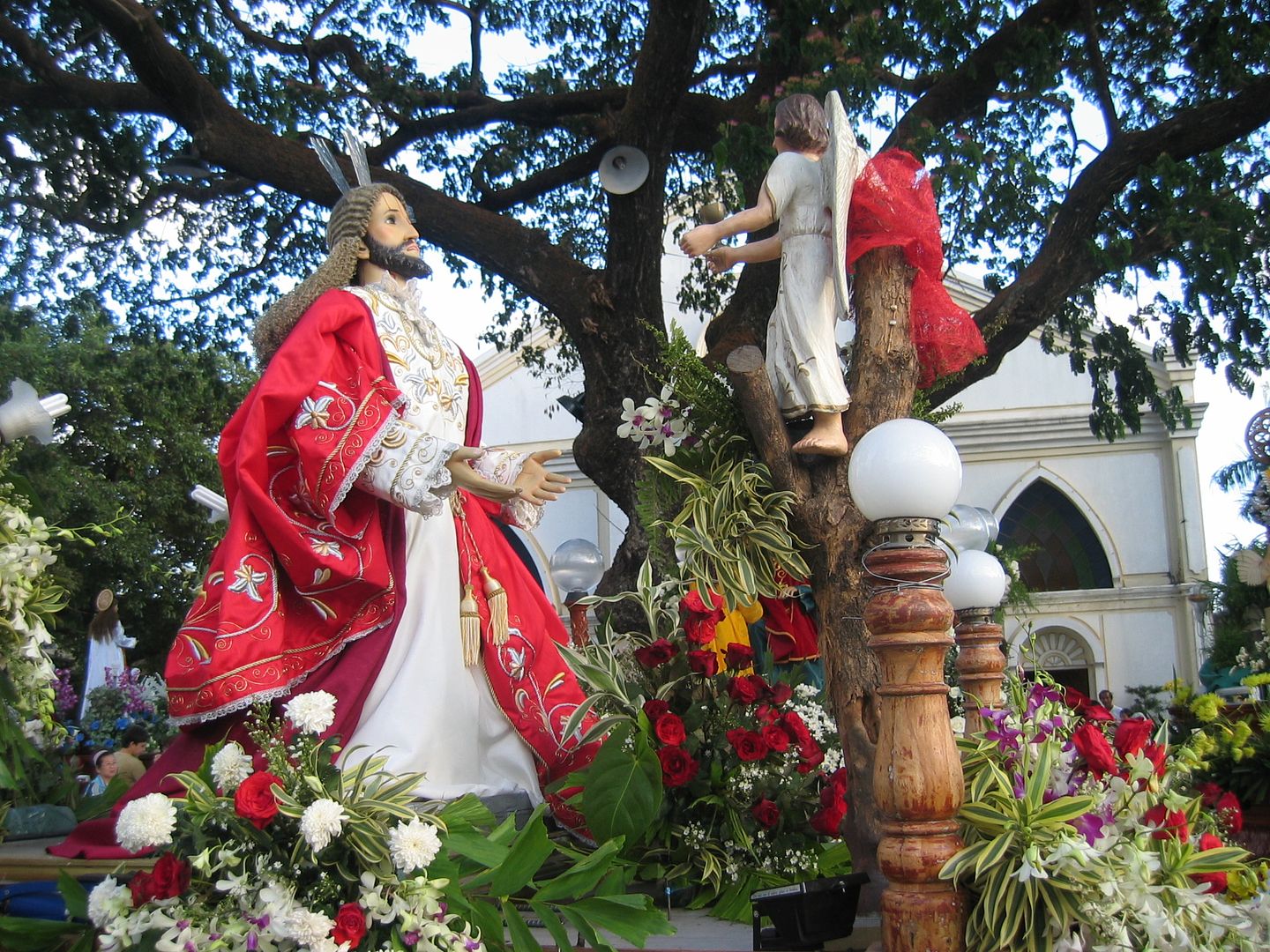
These images rendered me speechless, at least momentarily.
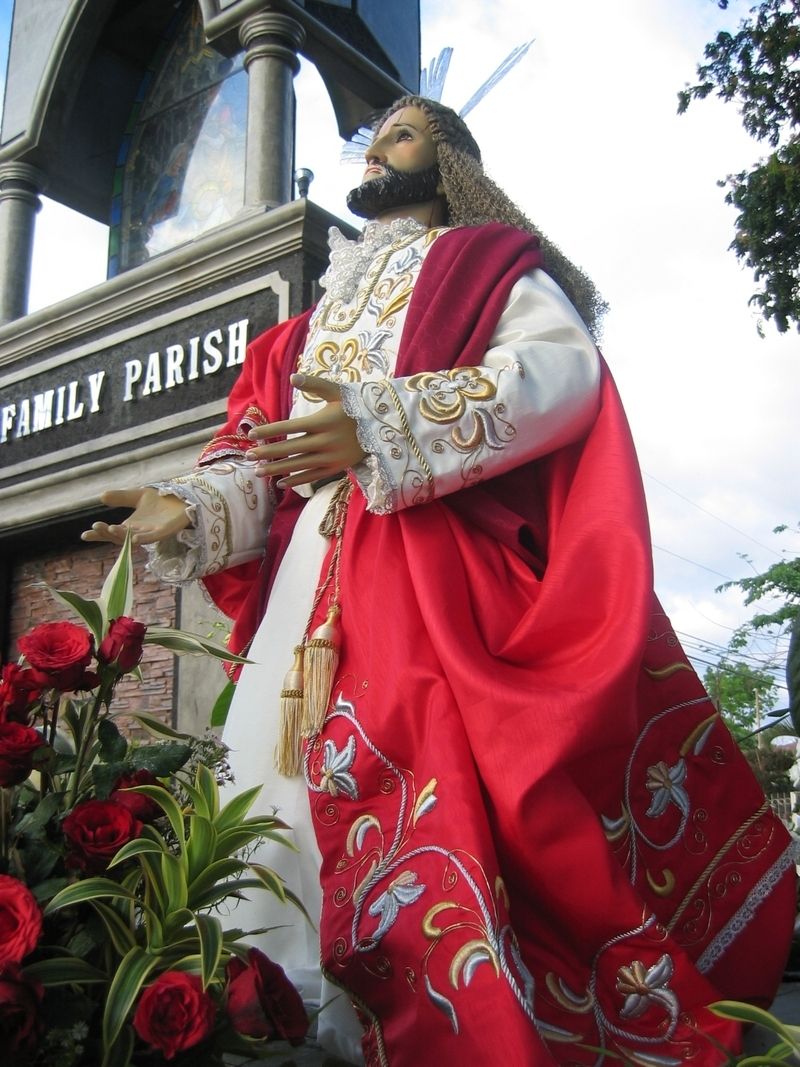
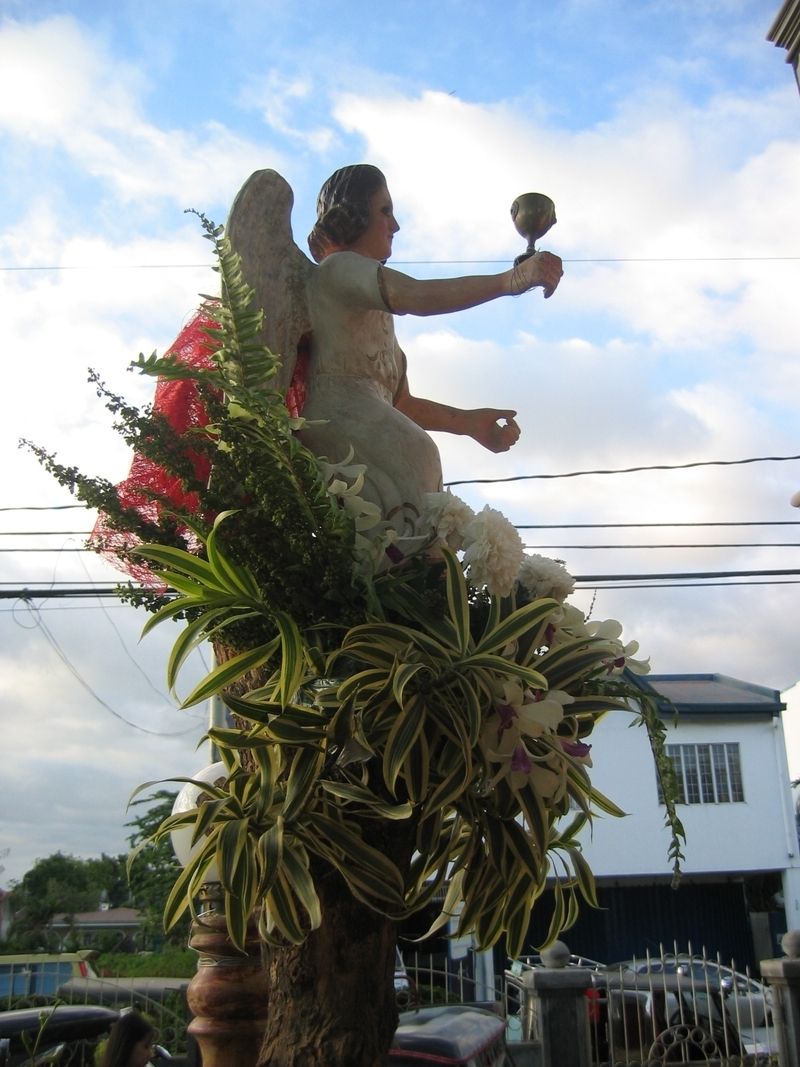
I’ll be polite and charitable now and not repeat my previous assertion that this has got to be the ugliest Agony in the Garden tableau ever.
(Continued here.)
Originally published on 10 October 2010. All text and photos (except as otherwise attributed) copyright ©2010 by Leo D Cloma. The moral right of Leo D Cloma to be identified as the author of this work has been asserted.
Original comments:
antigualla wrote on Oct 12, '10
Leo, your beautiful Agony in the Garden tableau might be needed in another parish, say one far away from San Rafael like...hmmm...can't think of any place right now but things always happen for a reason so, Im sure your beautiful Passion tableau will have its reason for being soon.
|
rally65 wrote on Oct 12, '10
Have you thought of branching out into astrology, fortune-telling, and predicting the future? Ha ha ha.
|
antigualla wrote on Oct 15, '10
Yes when it comes to santo! Hahaha. Anyway, may paggagamitan ka din niyang kagandagandang larawang iyan. Happy Weekend!
|
rally65 wrote on Oct 15, '10
You should try expanding those predictive skills to the Lotto! Ha ha ha.
|
iloveme97 wrote on Apr 18, '11
I really find the part in which you jokingly caption "You could almost hear it saying, “Tell me again why I’m not coming out in procession, please?”
irresistibly cute. along with the caption of the angel's picture "I could have sworn overhearing it say, “Don’t worry, I’ll stand right here while everyone else except us joins the procession.” offering relief indeed! Thank you for making my day. |
rally65 wrote on Apr 18, '11
iloveme97 said
I really find the part in which you jokingly caption "You could almost hear it saying, “Tell me again why I’m not coming out in procession, please?”irresistibly cute. along with the caption of the angel's picture "I could have sworn overhearing it say, “Don’t worry, I’ll stand right here while everyone else except us joins the procession.” offering relief indeed! Thank you for making my day.
Thanks for the visit and for reading through.
|