Showing posts with label Sacred Heart. Show all posts

Tuesday, July 26, 2016

CXXV. Visita Iglesia (Plus) Bohol X – The Maribojoc Church


With just an hour or so to spare before check-in time for my flight back to Manila, I make my way from Cortes to the next town northwards, Maribojoc. This is another old town, actually the mother parish of Cortes. While an earlier church was said to have been built in 1798, the present church dates from 1852 and was completed in 1872.

The church façade is wide, giving fair warning that the entire structure is quite massive.  A stone image of Christ the King exposing His Sacred Heart and with a Crown at His feet is positioned in the middle of the front yard
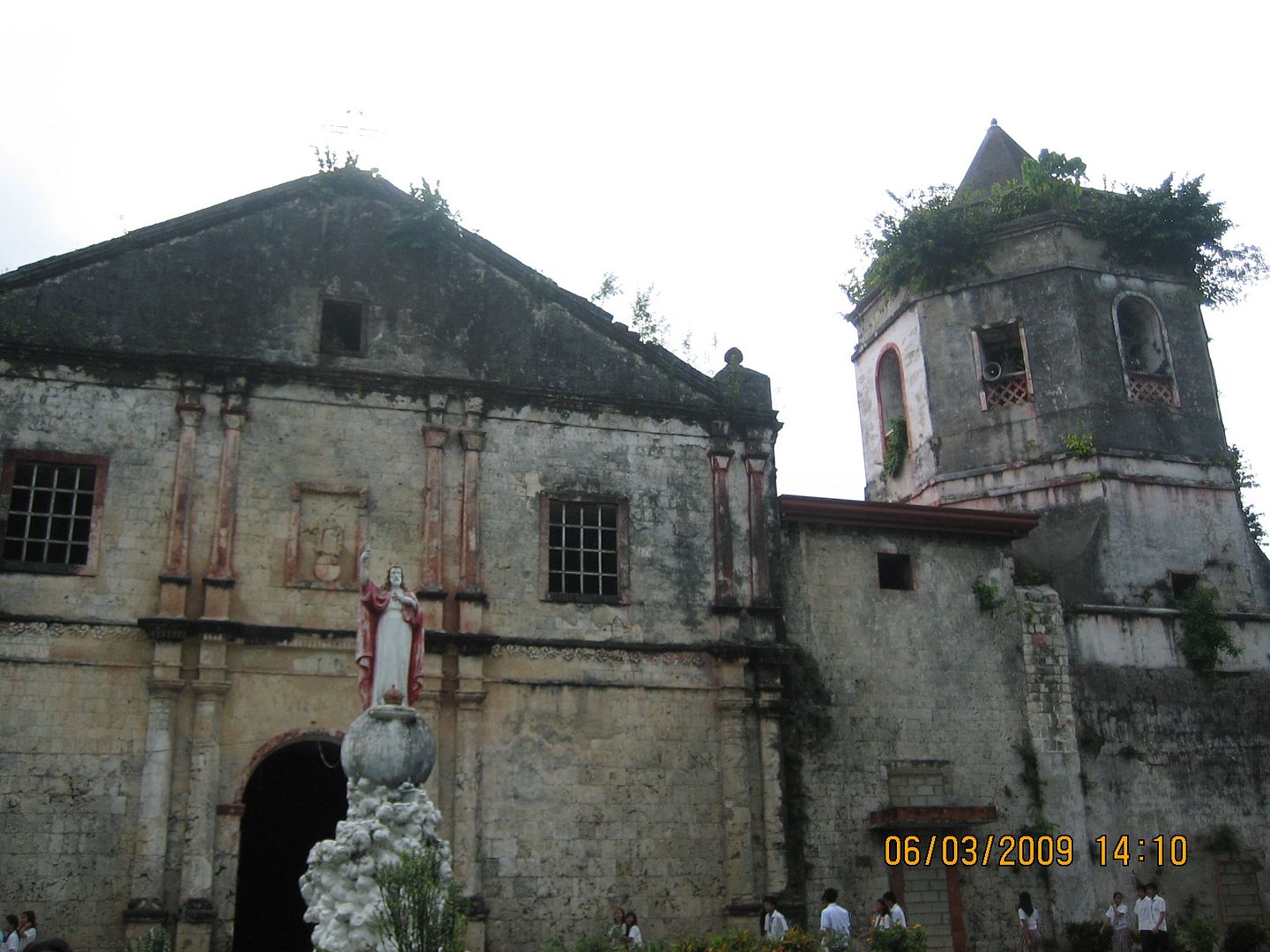

and a stout belltower stands on the right.
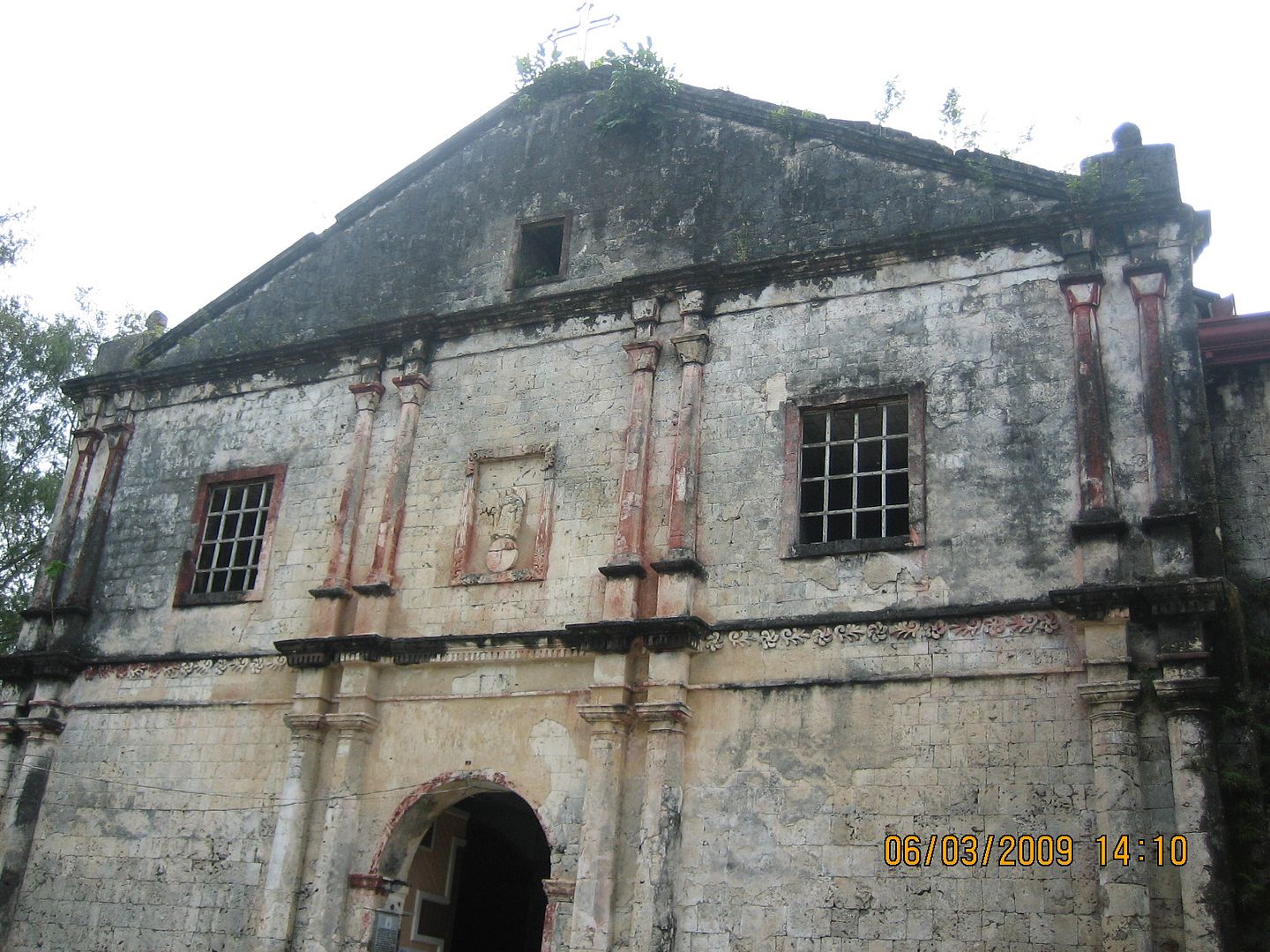

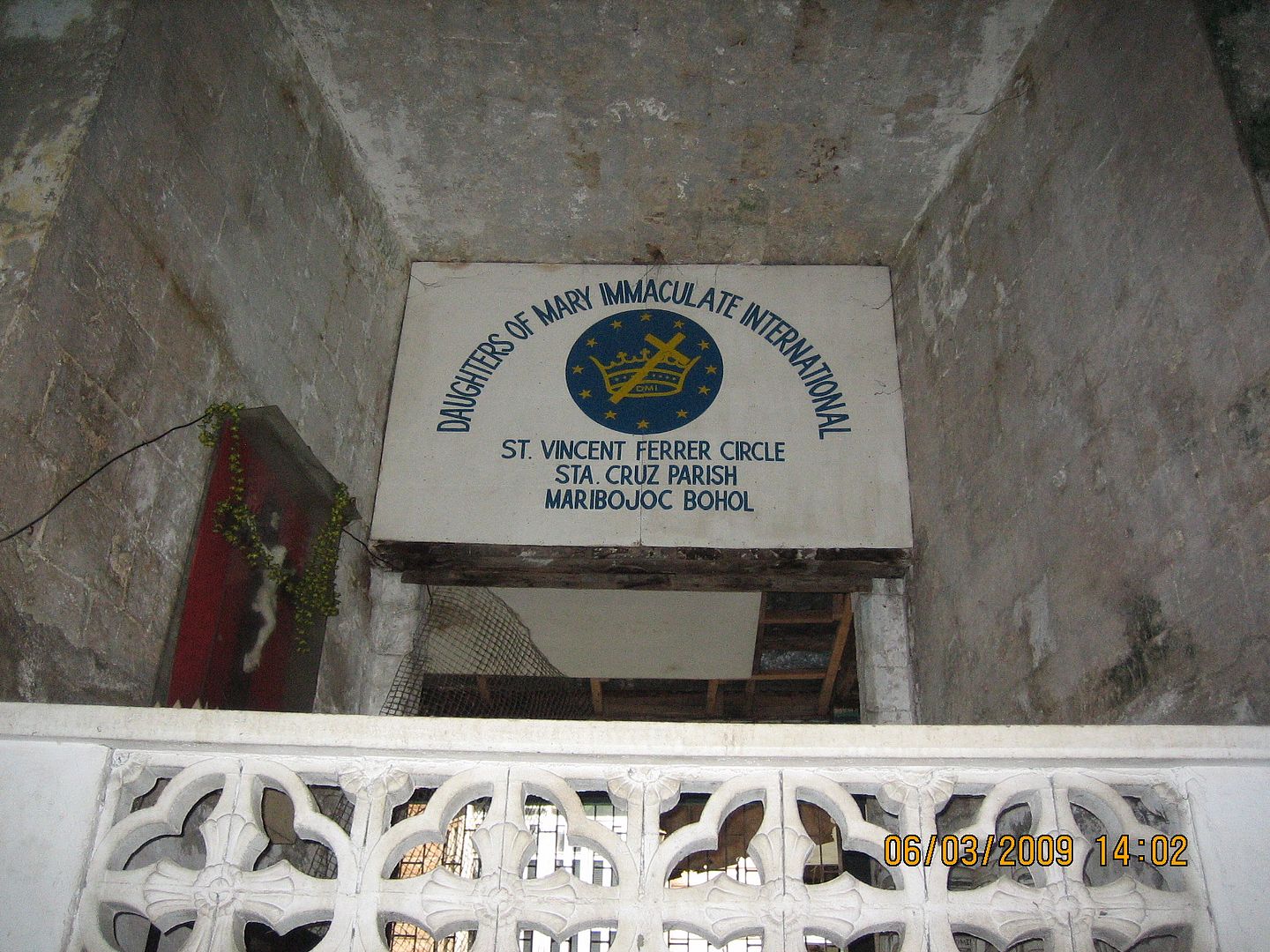
Above the main entrance and flanked by cross-hatched square windows is a stone relief depicting San Vicente Ferrer, the parish’s secondary patron.


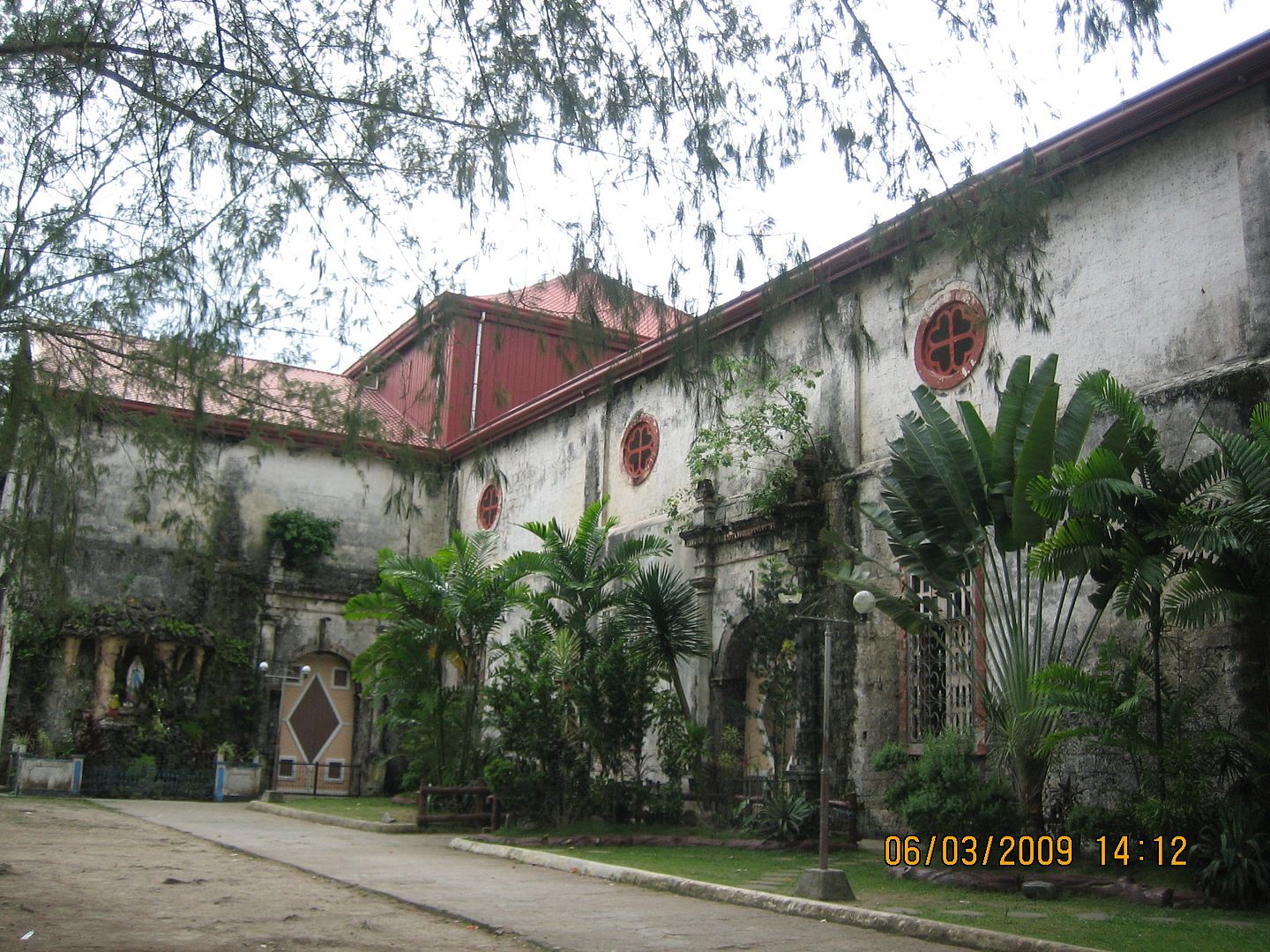
The sides of the exterior feature round windows along the upper half of the walls, and a four-sided red roof may be seen in the distance above the crossing.

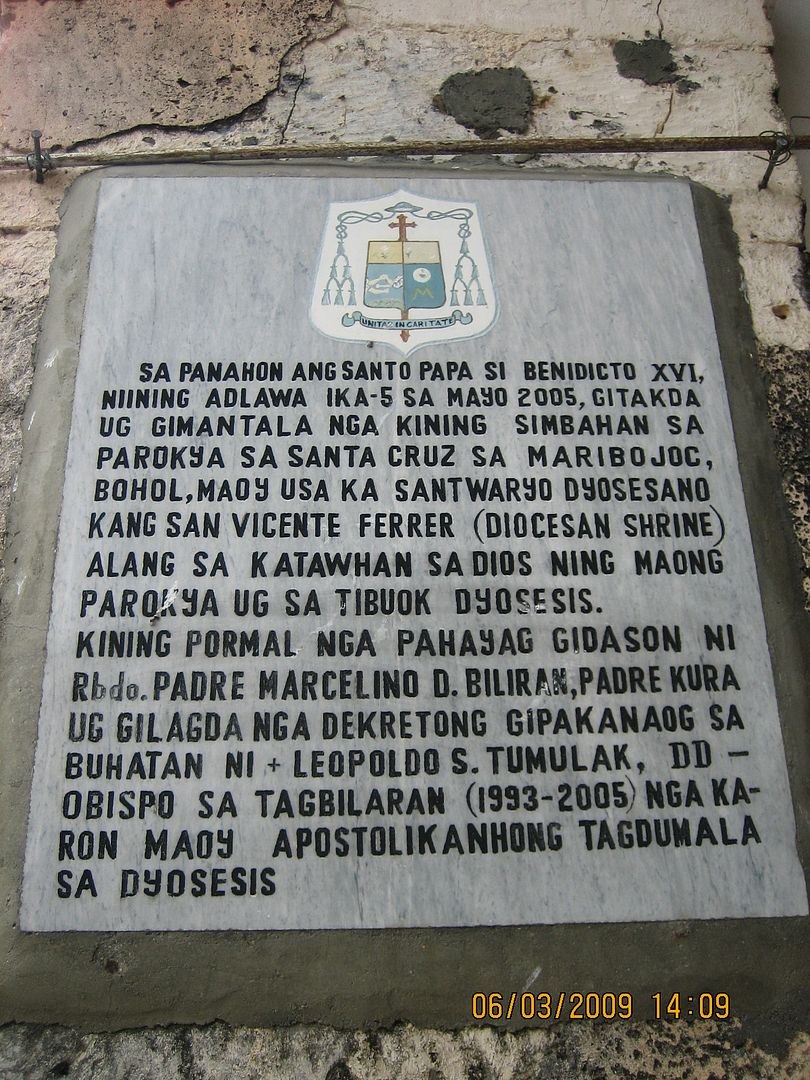
By the entrance is a marker to commemorate the establishment of this church as the diocesan shrine of Saint Vincent Ferrer.

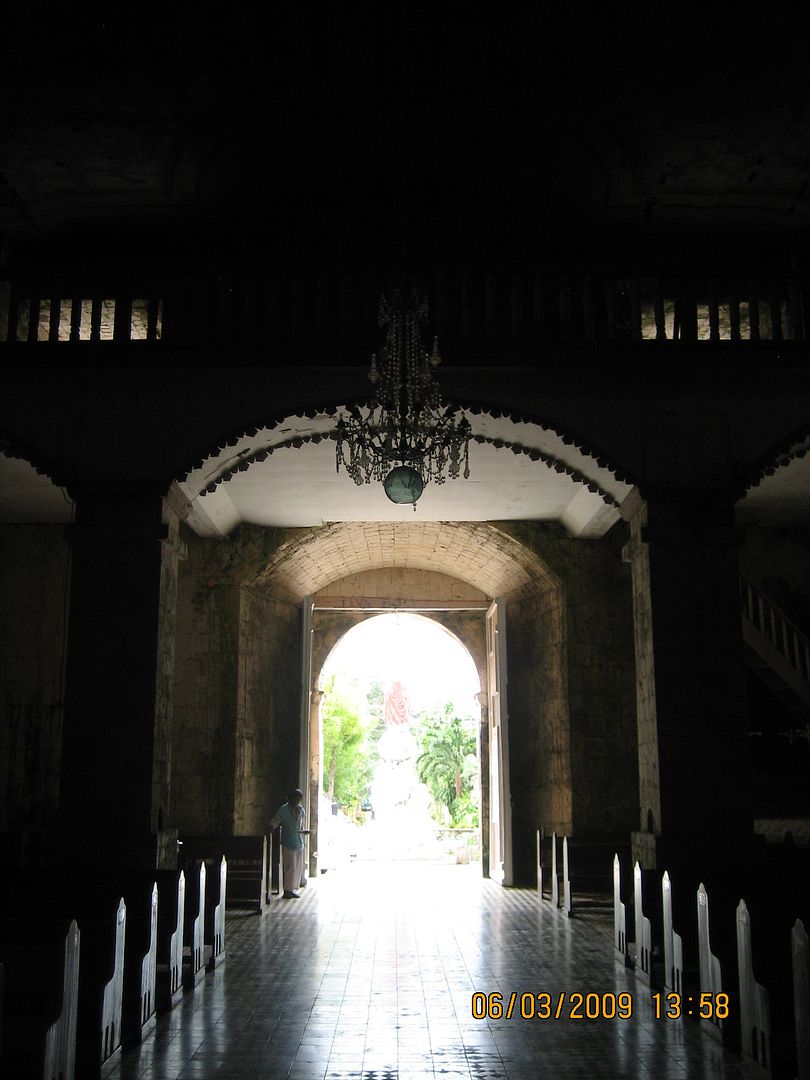
The front doors are wide open, so we can enter by this way and pass right under the choirloft.

Adjacent to the choirloft, to the right side, is the pipe organ,
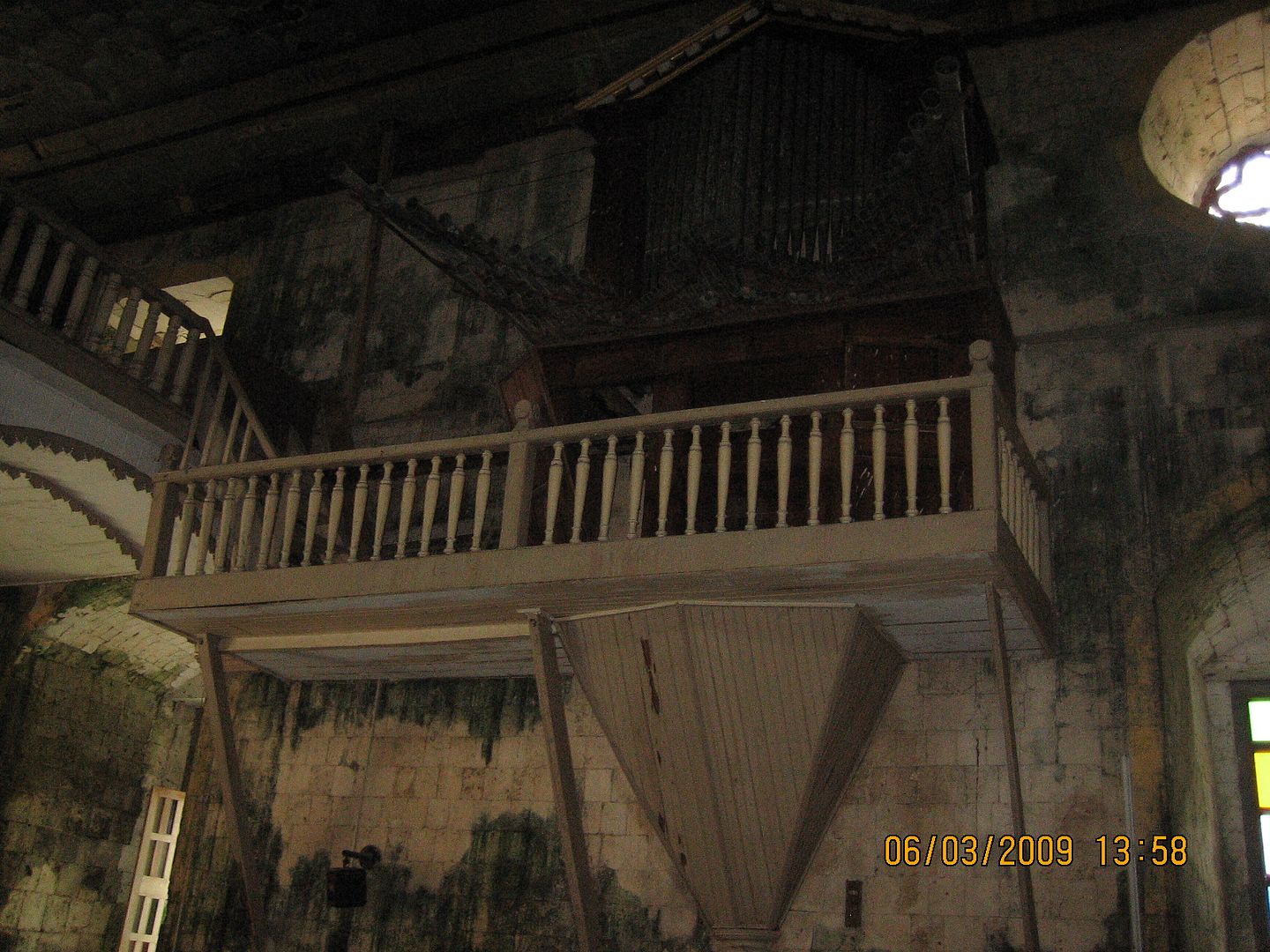

which is said to date from the 1890’s and is therefore newer than its early-19th century brethren in the other old Bohol churches that we have visited.
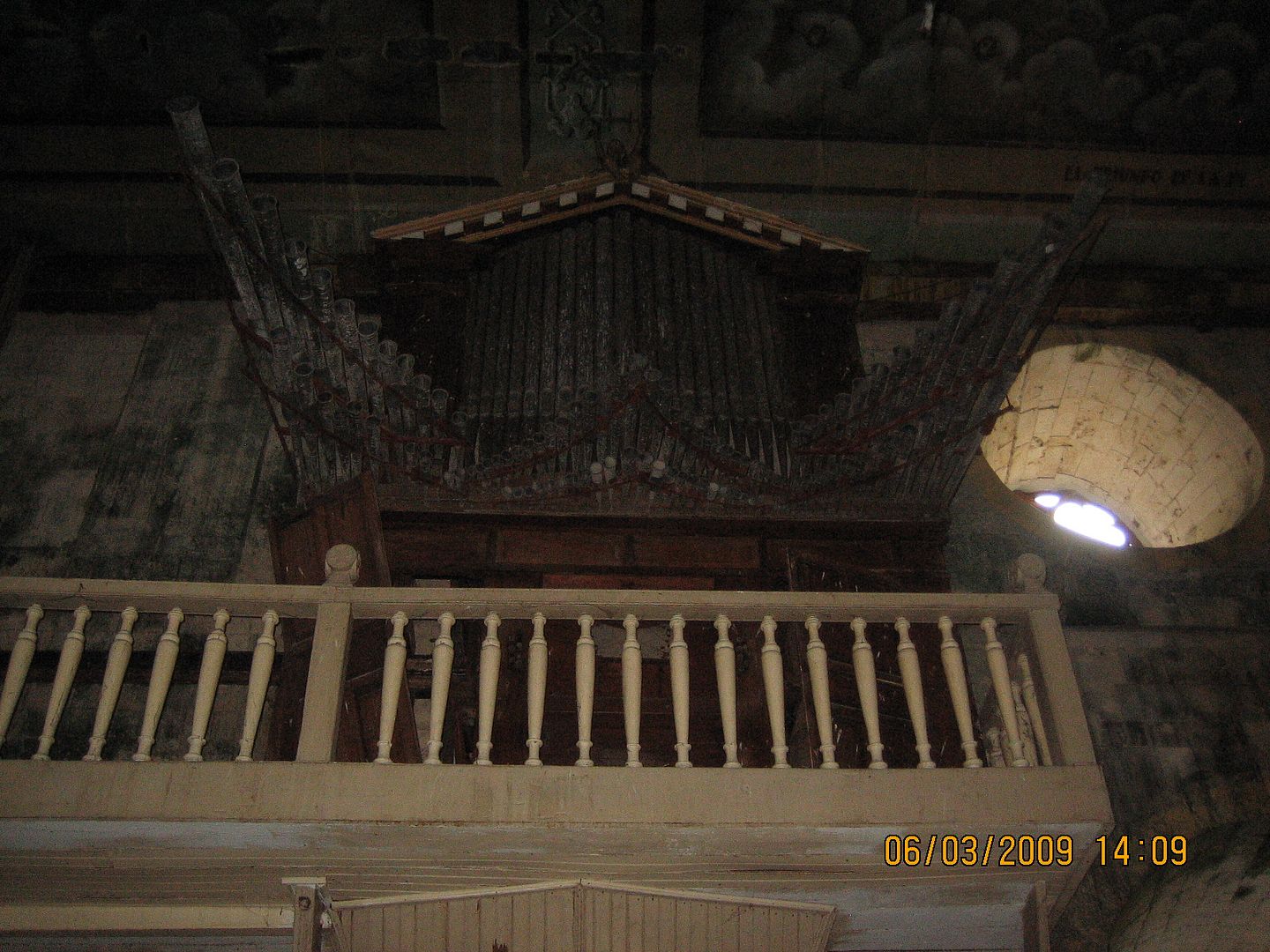

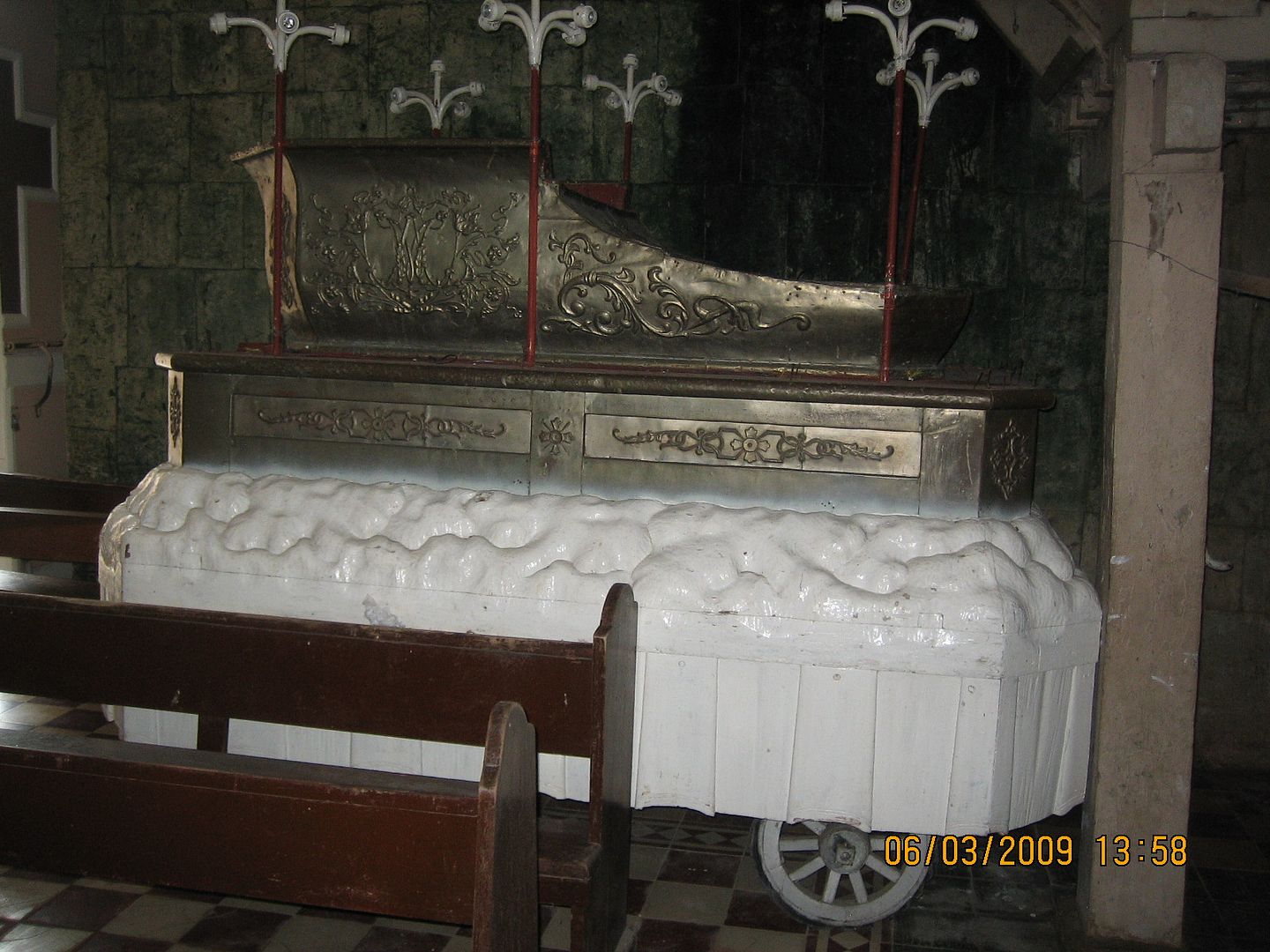
Right under the wooden staircase that leads up to the choirloft
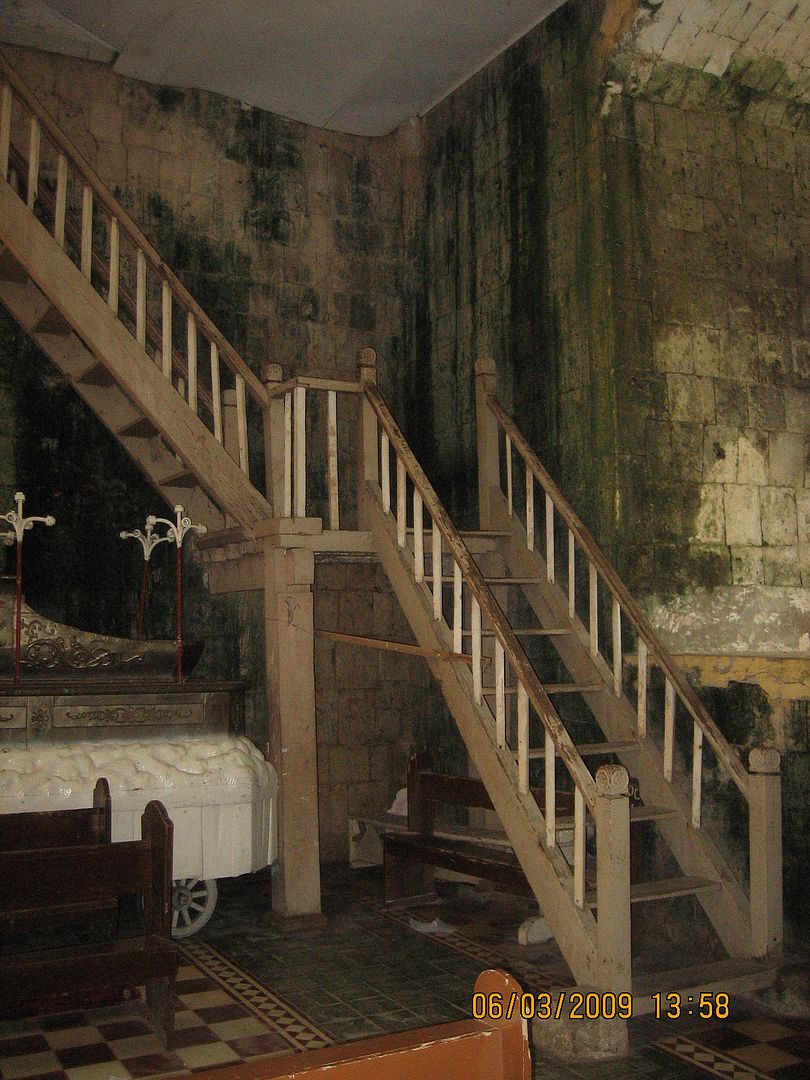

is a hammered-metal carroza with a white-cloud-skirt.

Making an about face, we admire the fine checkerboard floor
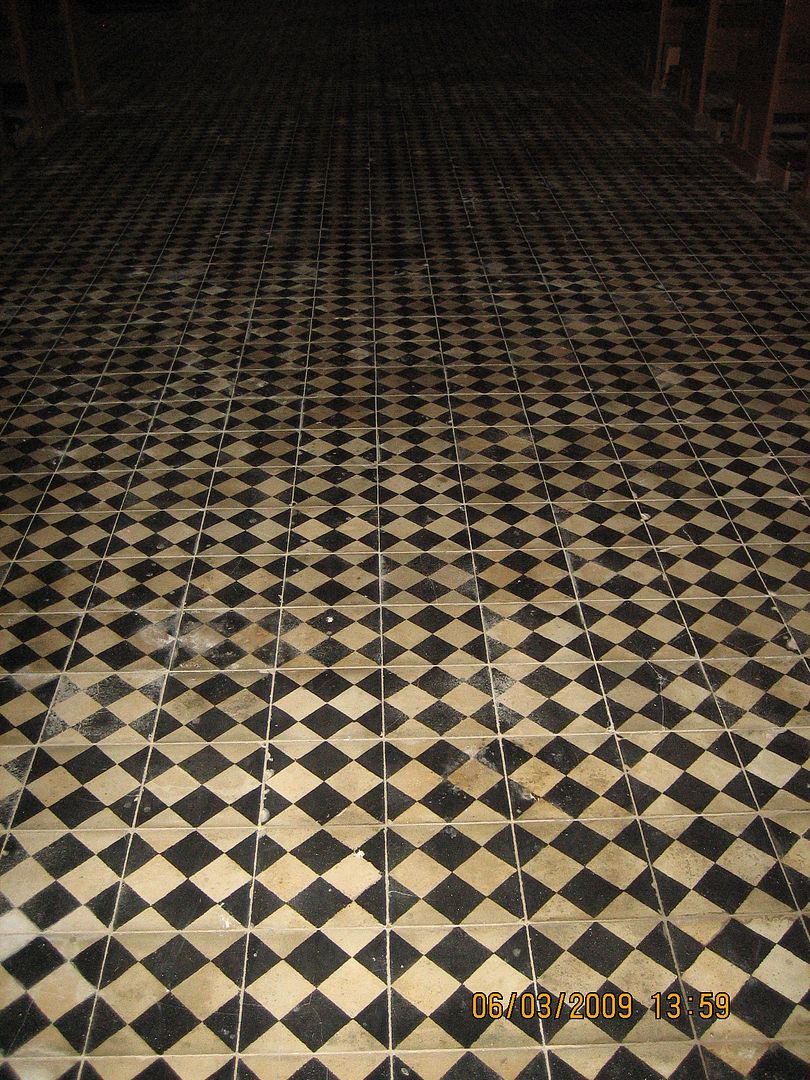

that paves the very wide aisle
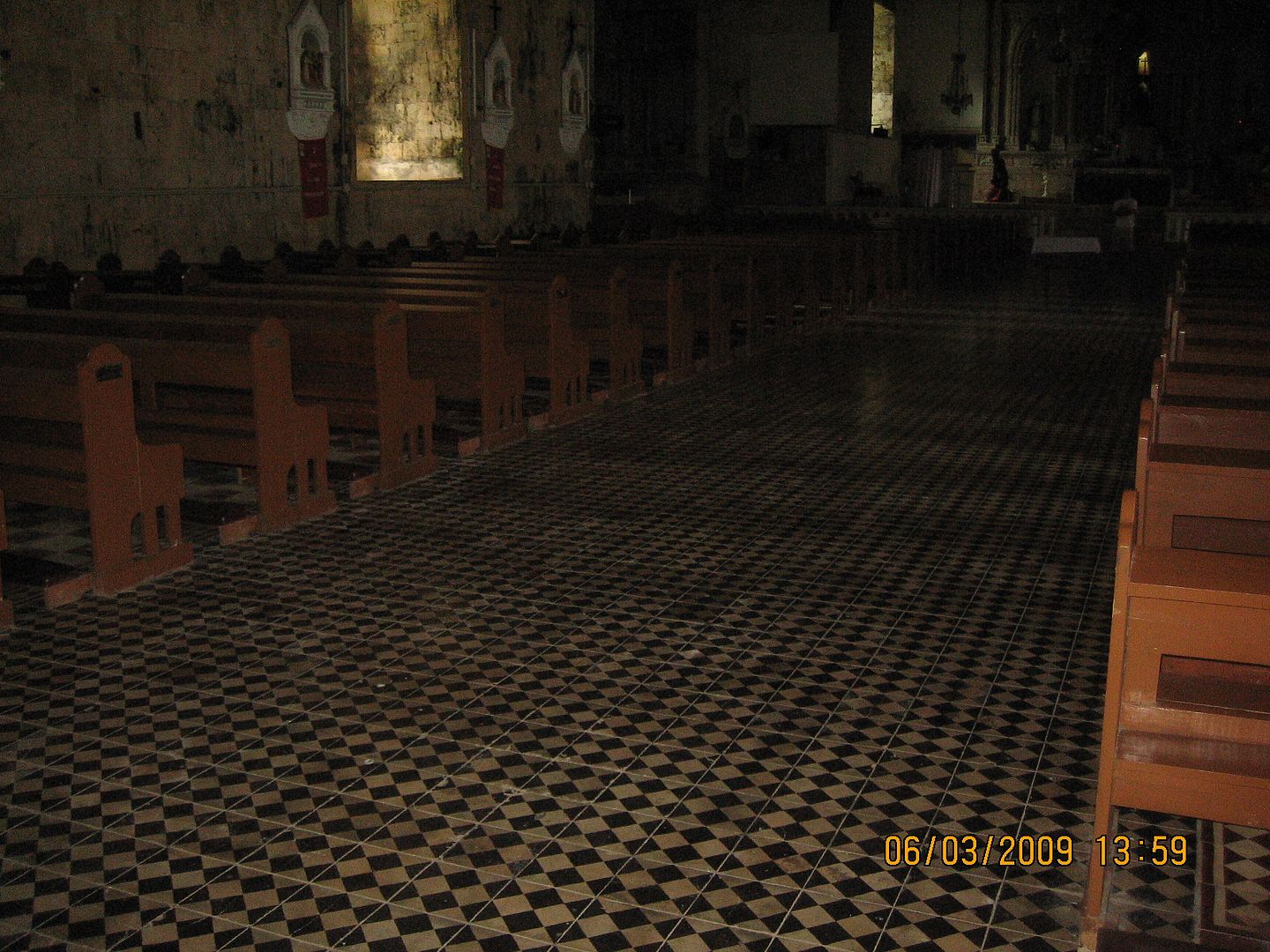

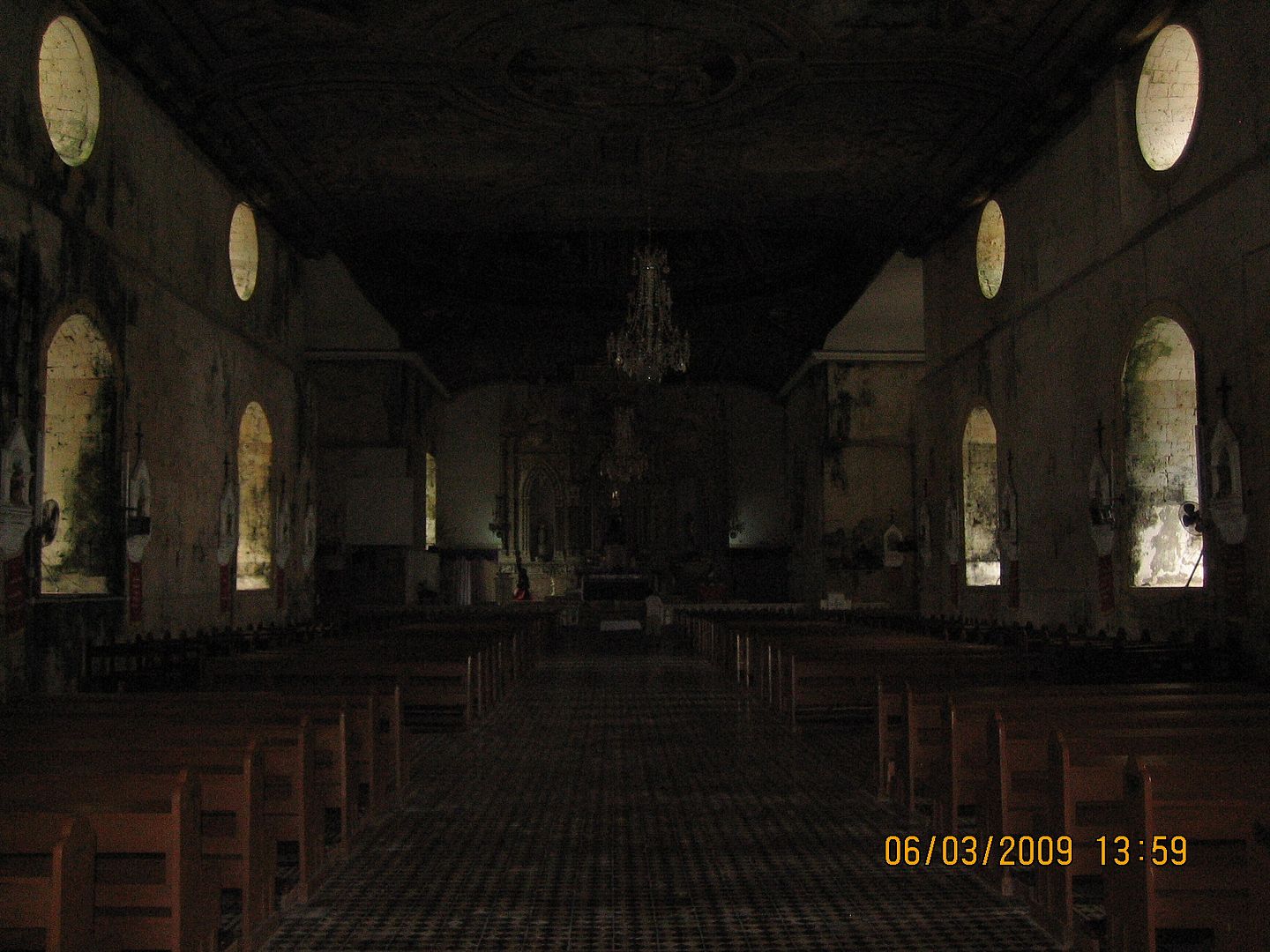
and leads to the altar in the far distance.

Elsewhere were other beautiful examples of old cement tiles, including a red-and-white checkerboard
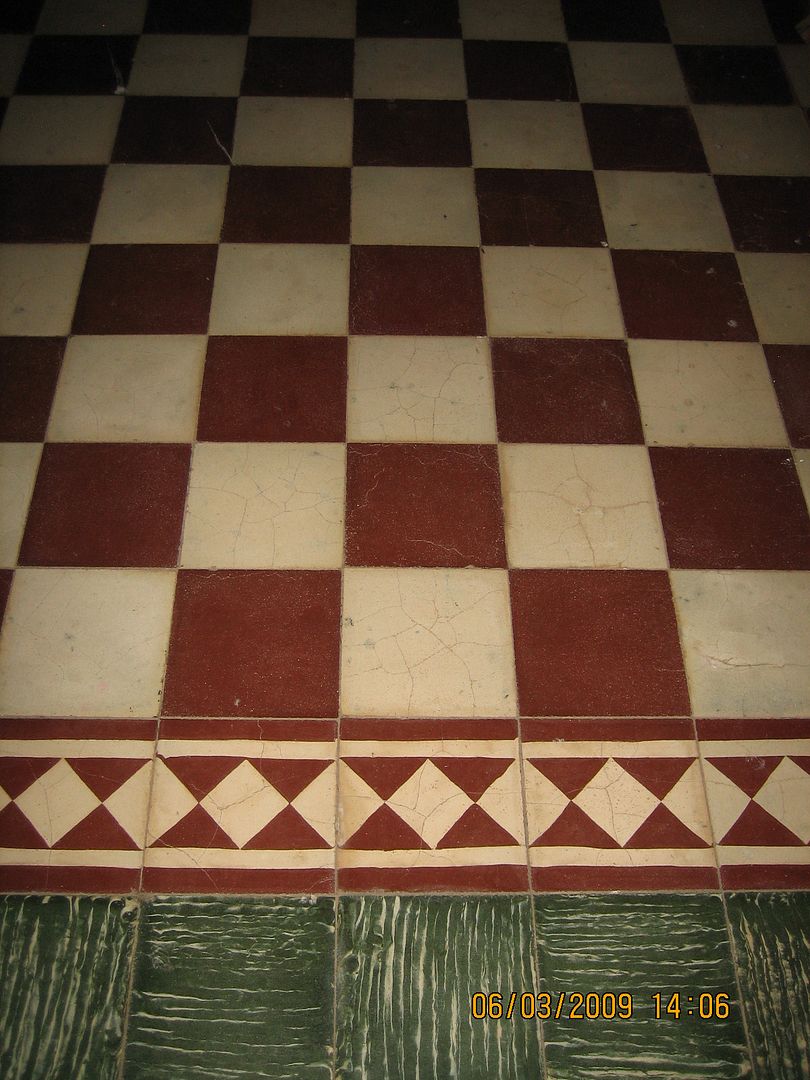

and something rather more colorful.
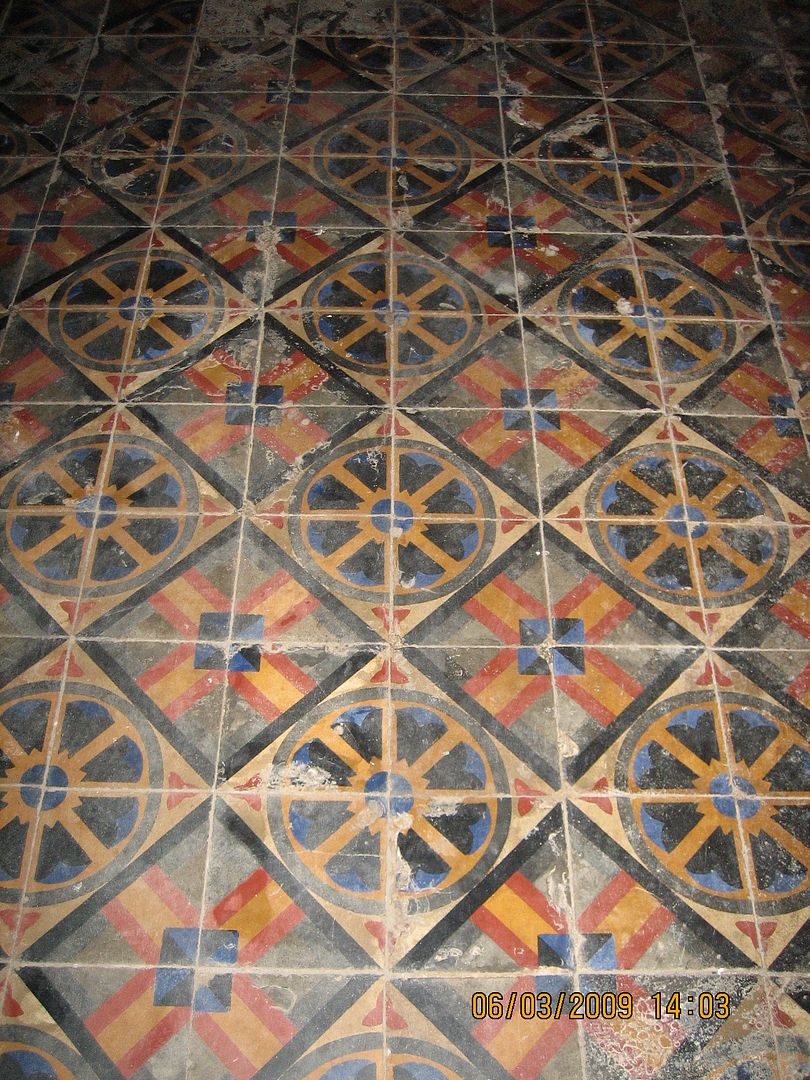

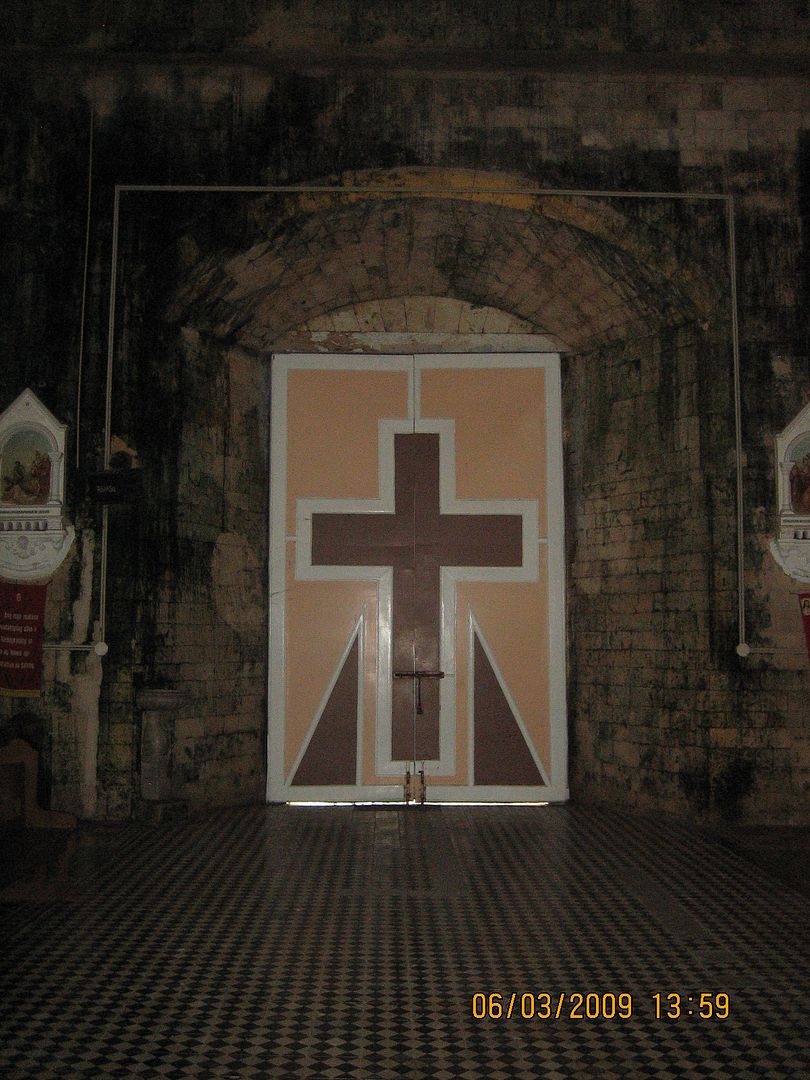
While walking up the aisle, one notices a doorway, currently shut.

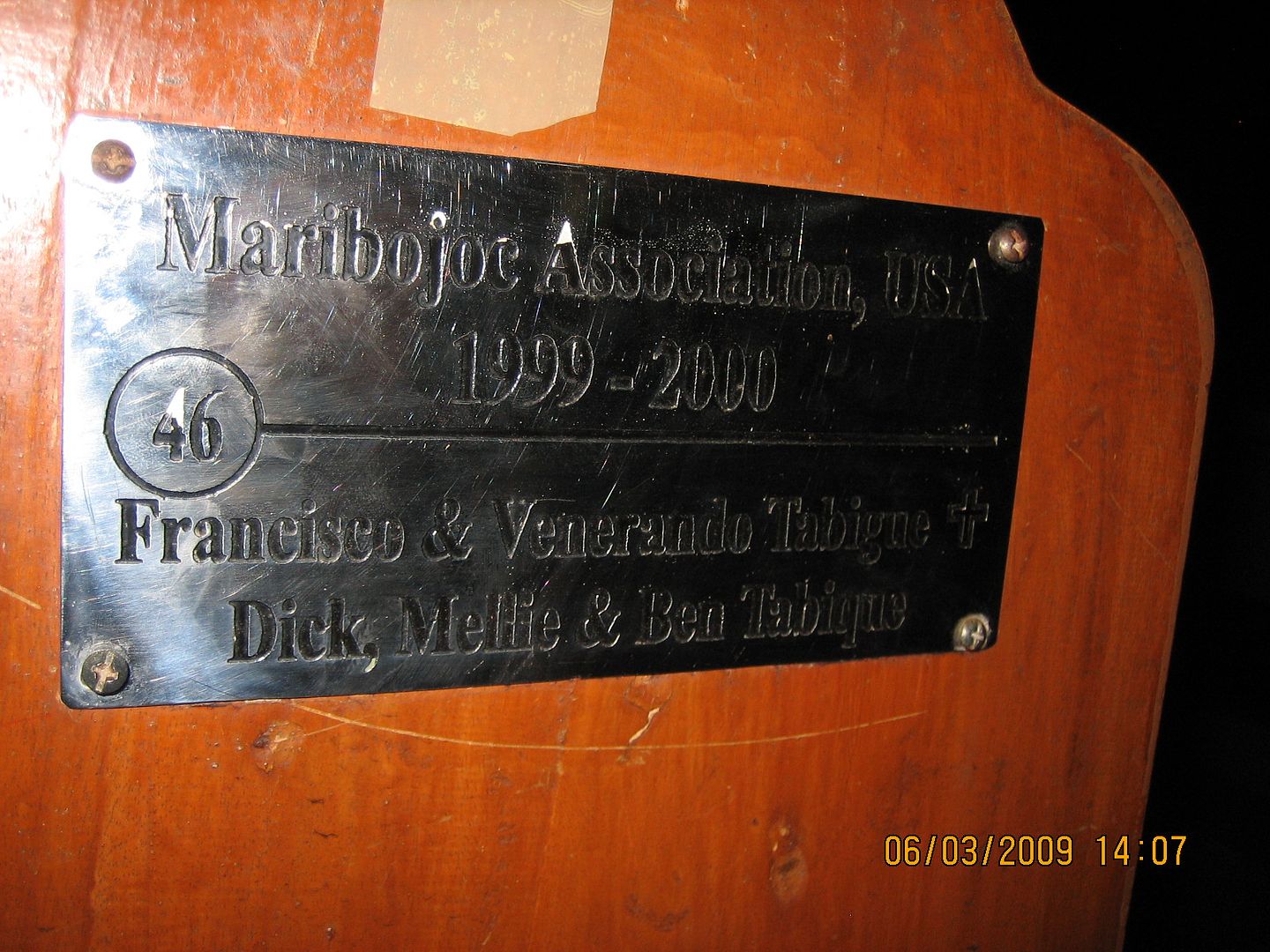
I also noticed that the pews had brass markers on them, acknowledging the generous patronage of the town’s natives who had since migrated to other parts.

Right under the dome of the crossing is an elaborate ceiling painting.

The Maribojoc church ceilings were painted by Ray Francia in the 1930’s; he and Canuto Avila painted many other church ceilings in Bohol, as we had already previously seen. Unfortunately, it was too dark inside this church to properly photograph this particular example.

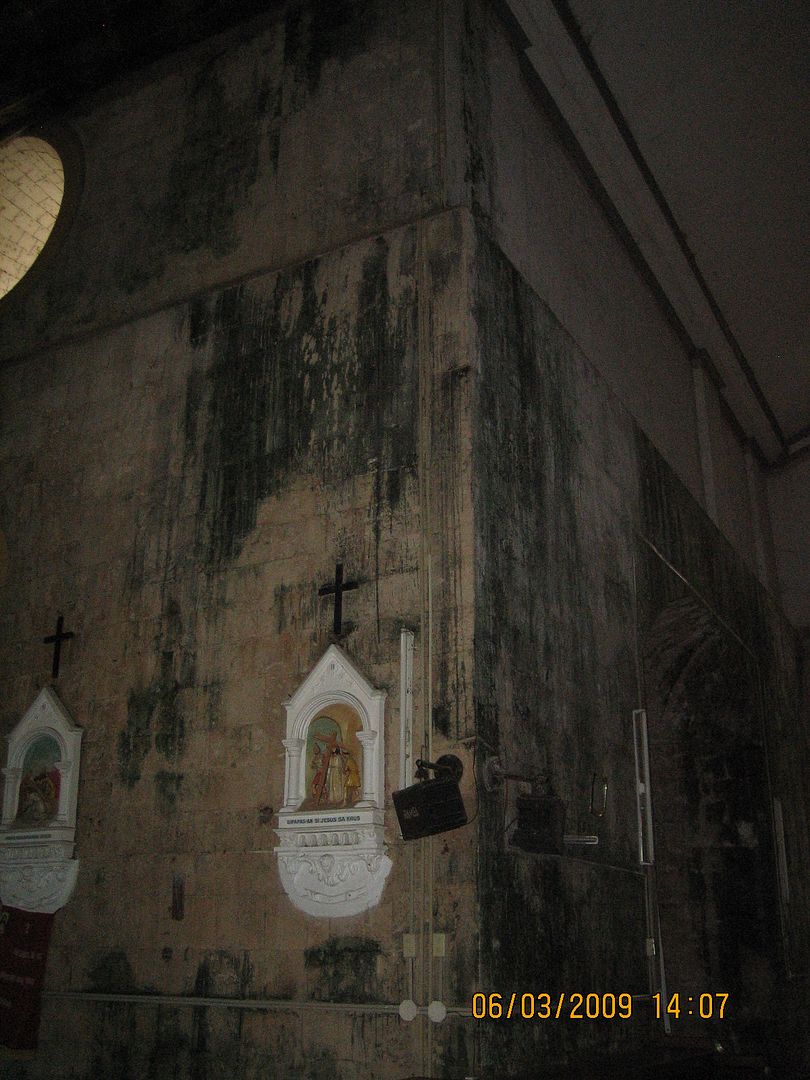
While the ceilings were lavishly painted, the walls were plain, with only the Stations of the Cross and some moss adorning them.

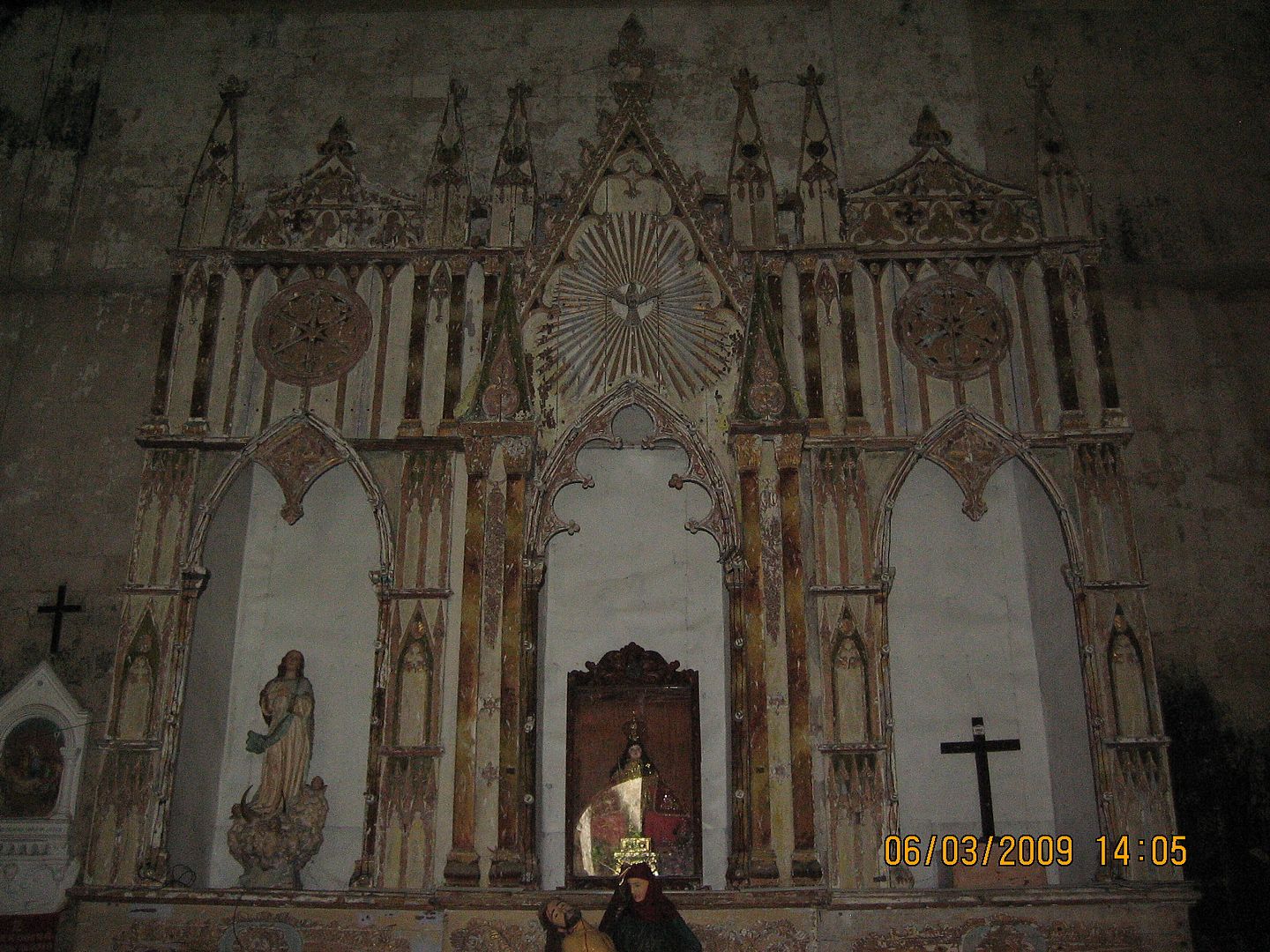
We move up close the sanctuary to take a good look at the main retablo.
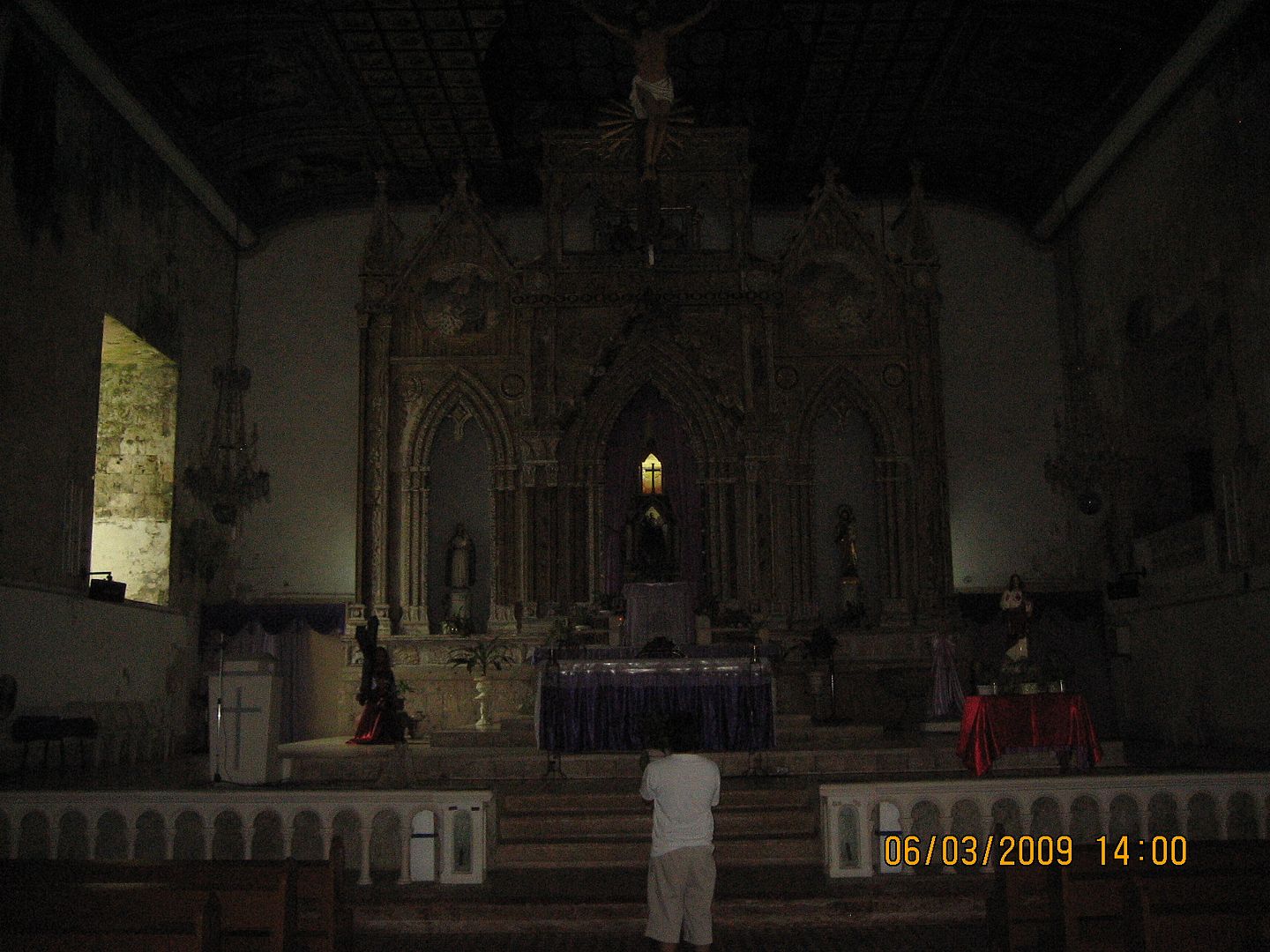


The pride of Maribojoc church must be its elaborate gothic-style retablos, dating from the 1930’s, all exceptionally well-carved and –painted. In the central niche of the main retablo is a small image of the secondary patron San Vicente Ferrer, right above which is a small image of the patron, the Santa Cruz (Holy Cross).
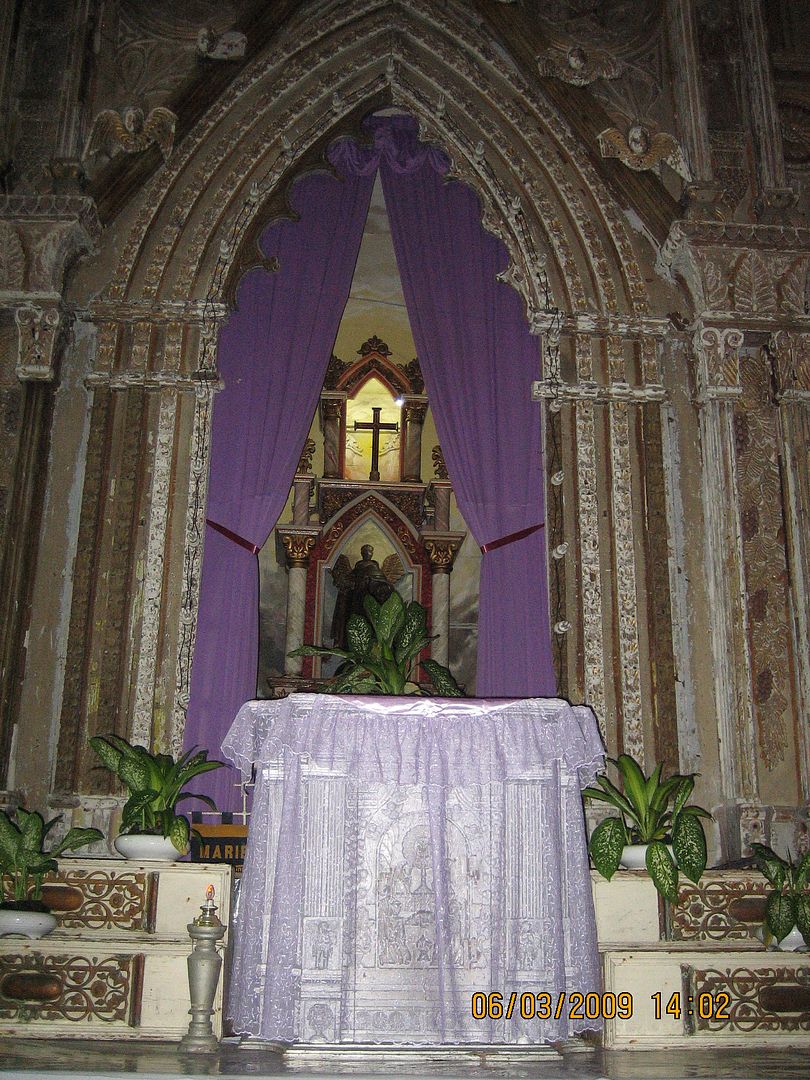

In the niche above is the Holy Trinity, which is flanked by roundels (round-shaped paintings), which according to our Visita Iglesia Bohol guidebook probably depicts allegories of the Finding and the Veneration of the True Cross.
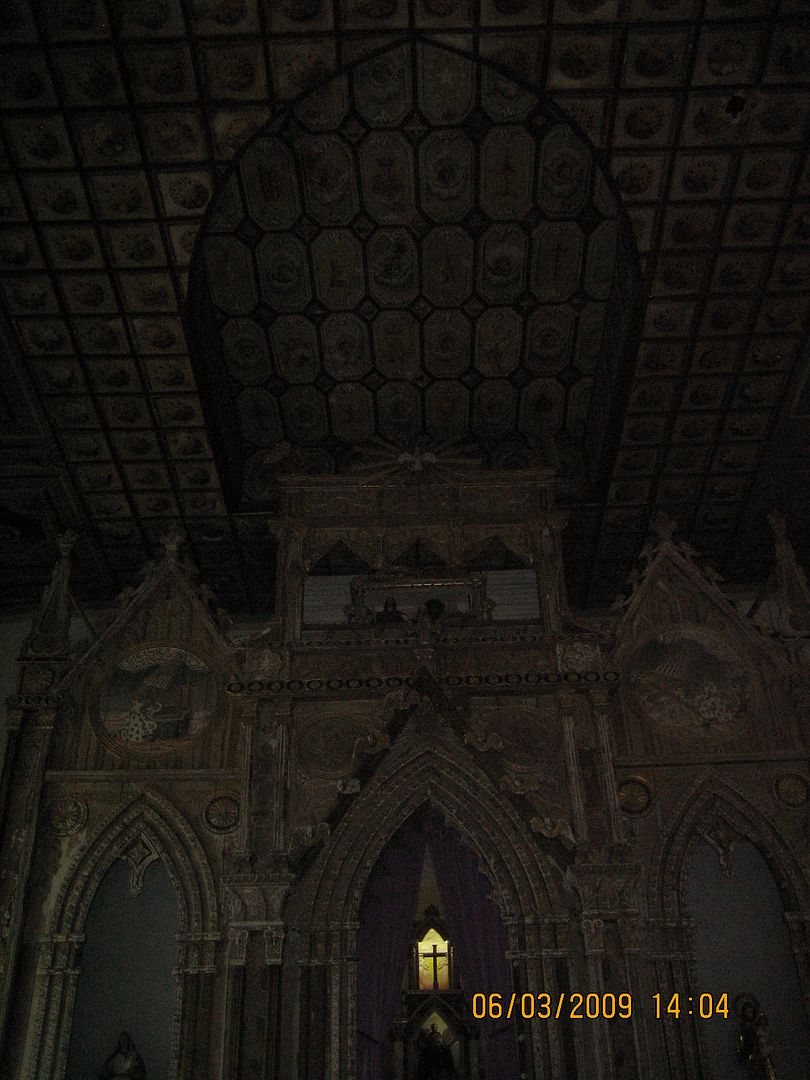

Below these and flanking the central niche are undersized images of the Madonna and Child and Saint Joseph and the Child Jesus.
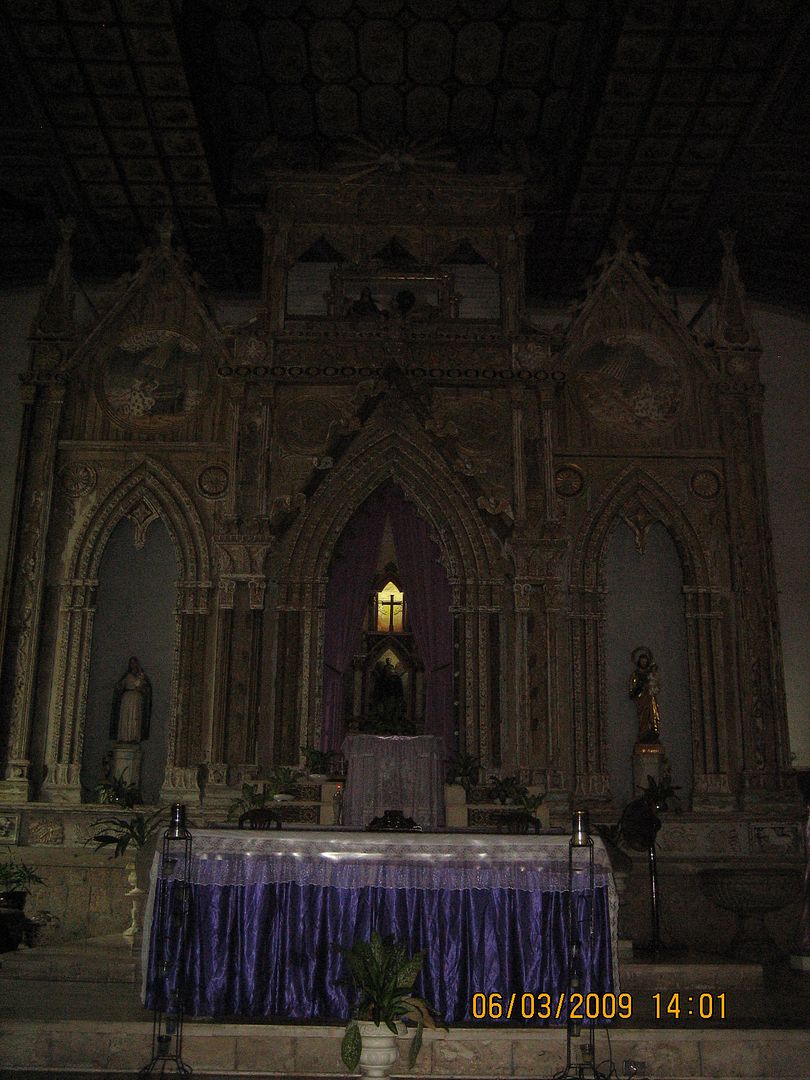

Overlooking the altar is a gallery, which unlike other altar galleries in other old churches is rather more exposed.

The left and right transepts have two other retablos each, also very finely carved and painted. The left-side retablos are these ones:
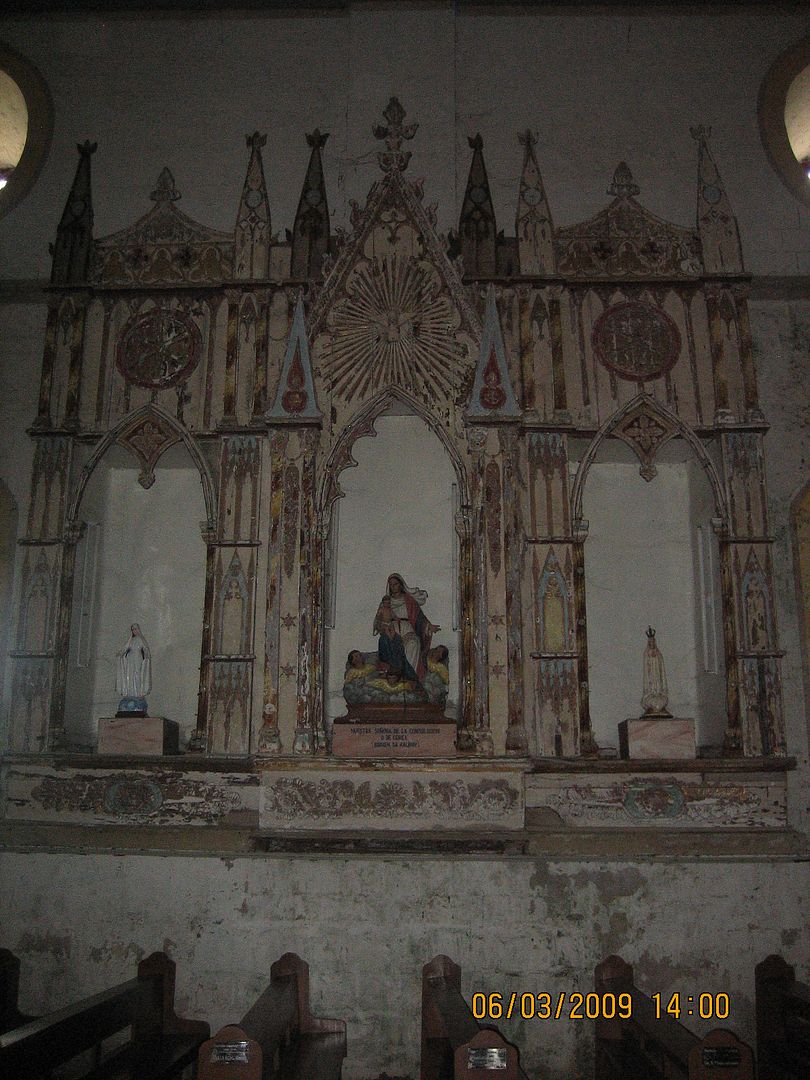
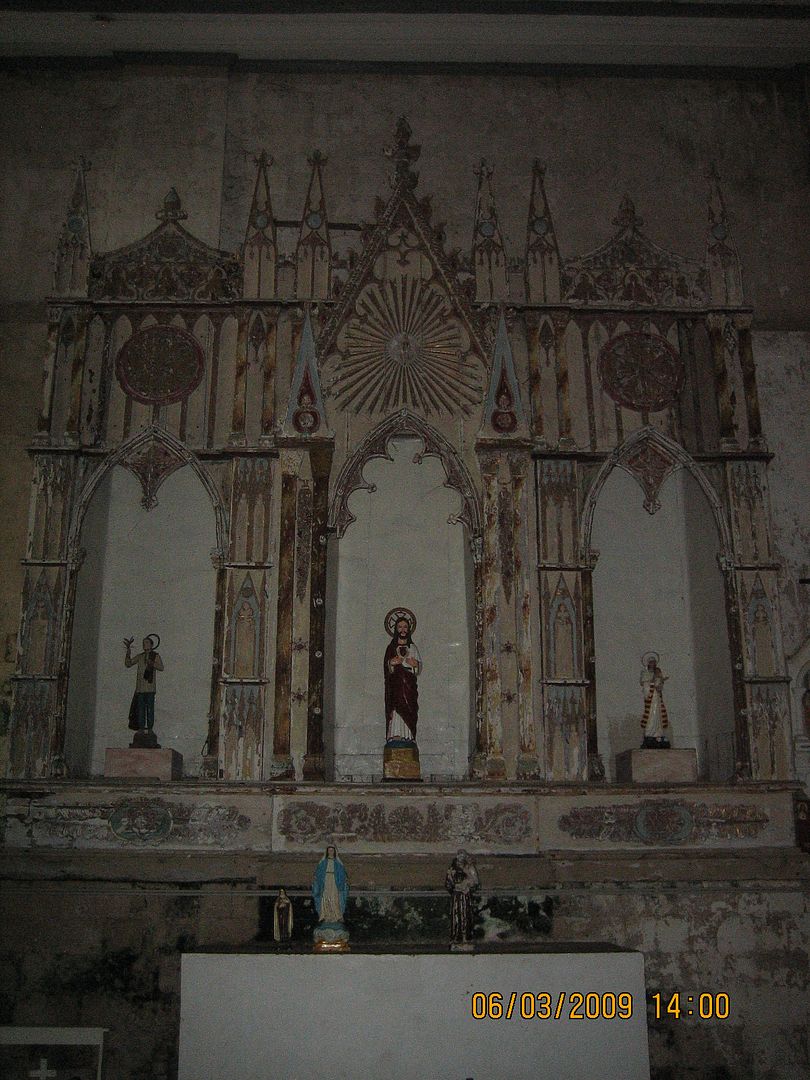

And the right-side retablos are these:
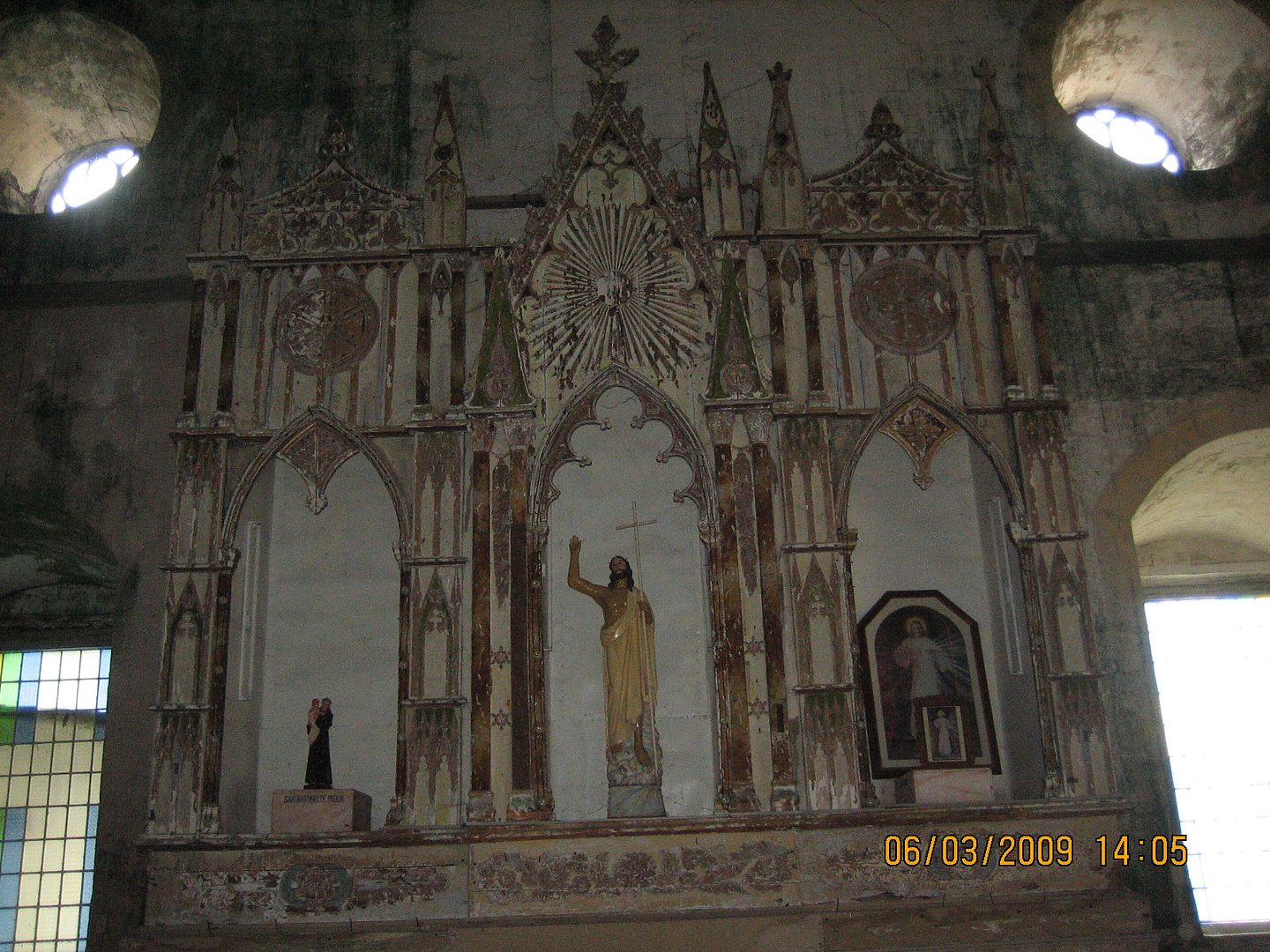


It is obvious that the images that they hold are far too small to be appropriate for these sizes of retablos. In the guidebook, Regalado Trota Jose surmises that perhaps the original images have been lost in the course of time, or even that funds had simply run out for commissioning proper images after paying for the retablos themselves!

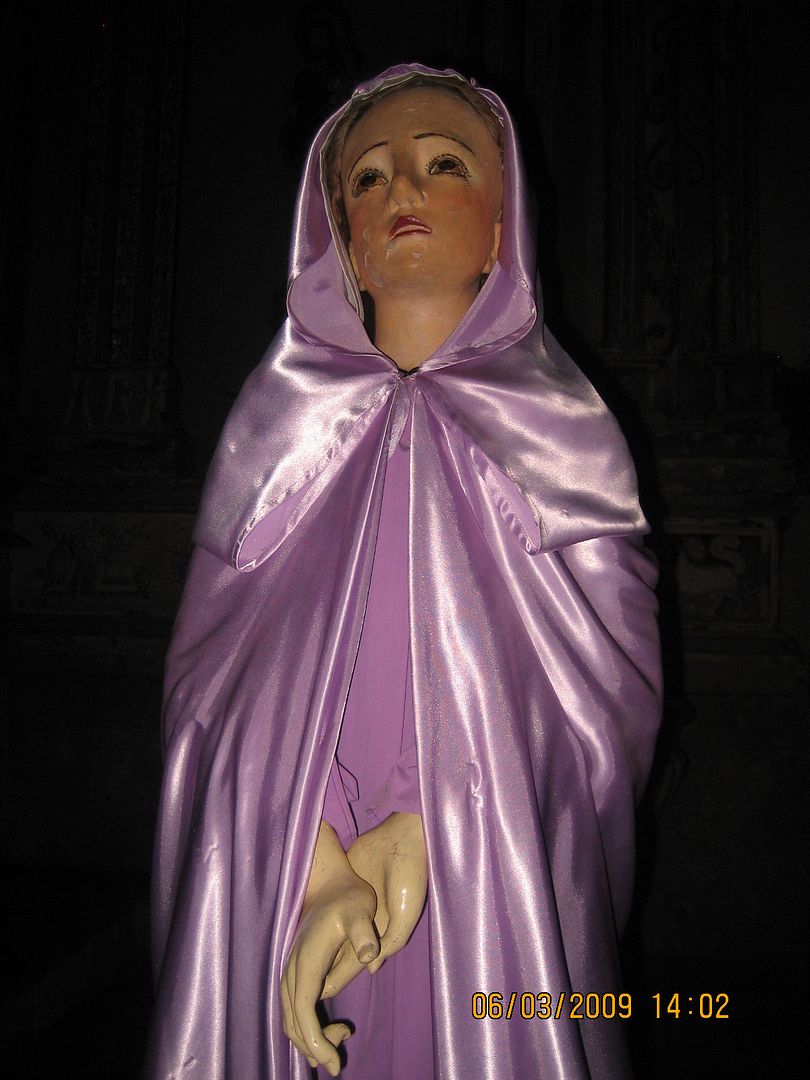
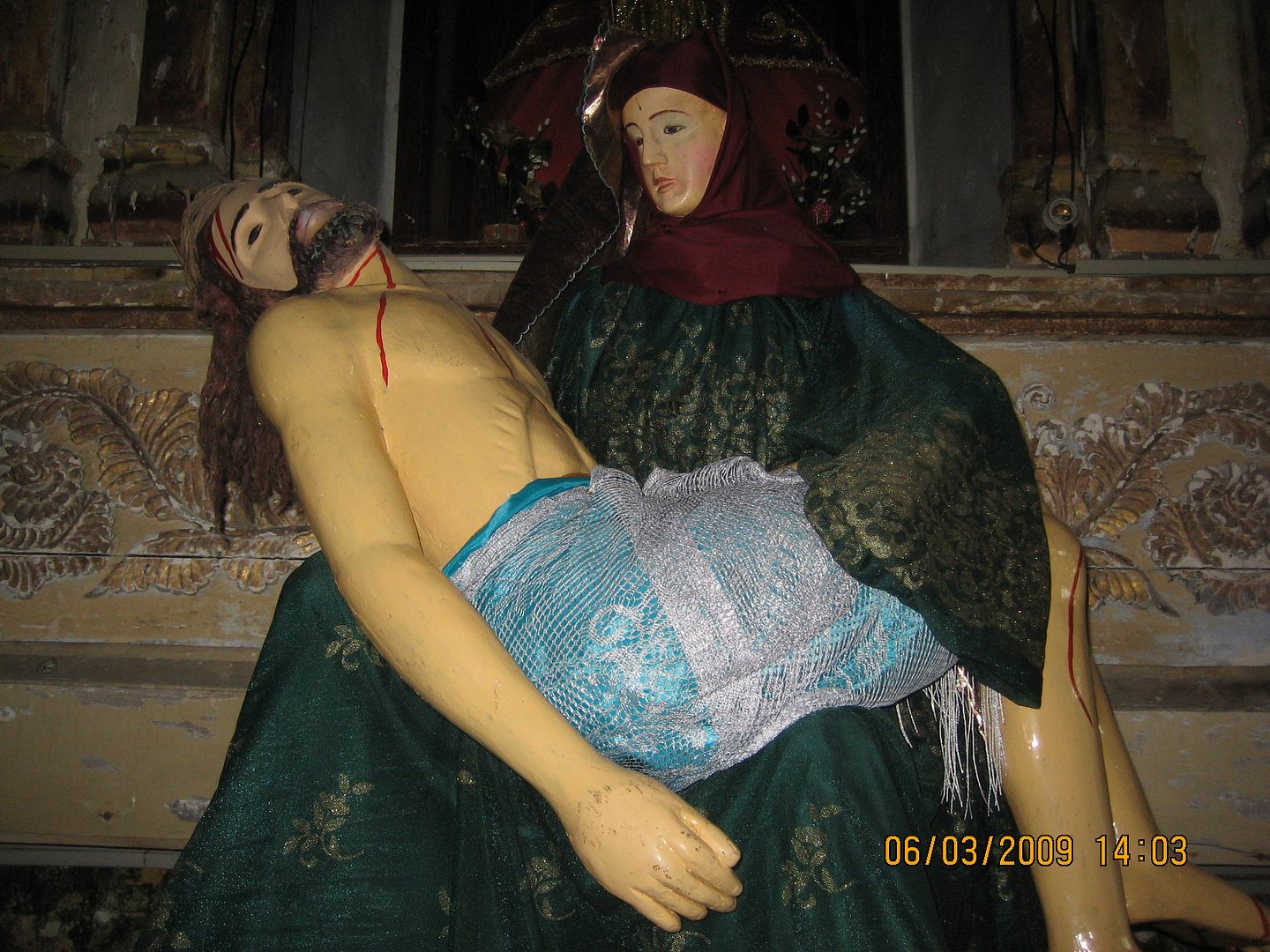
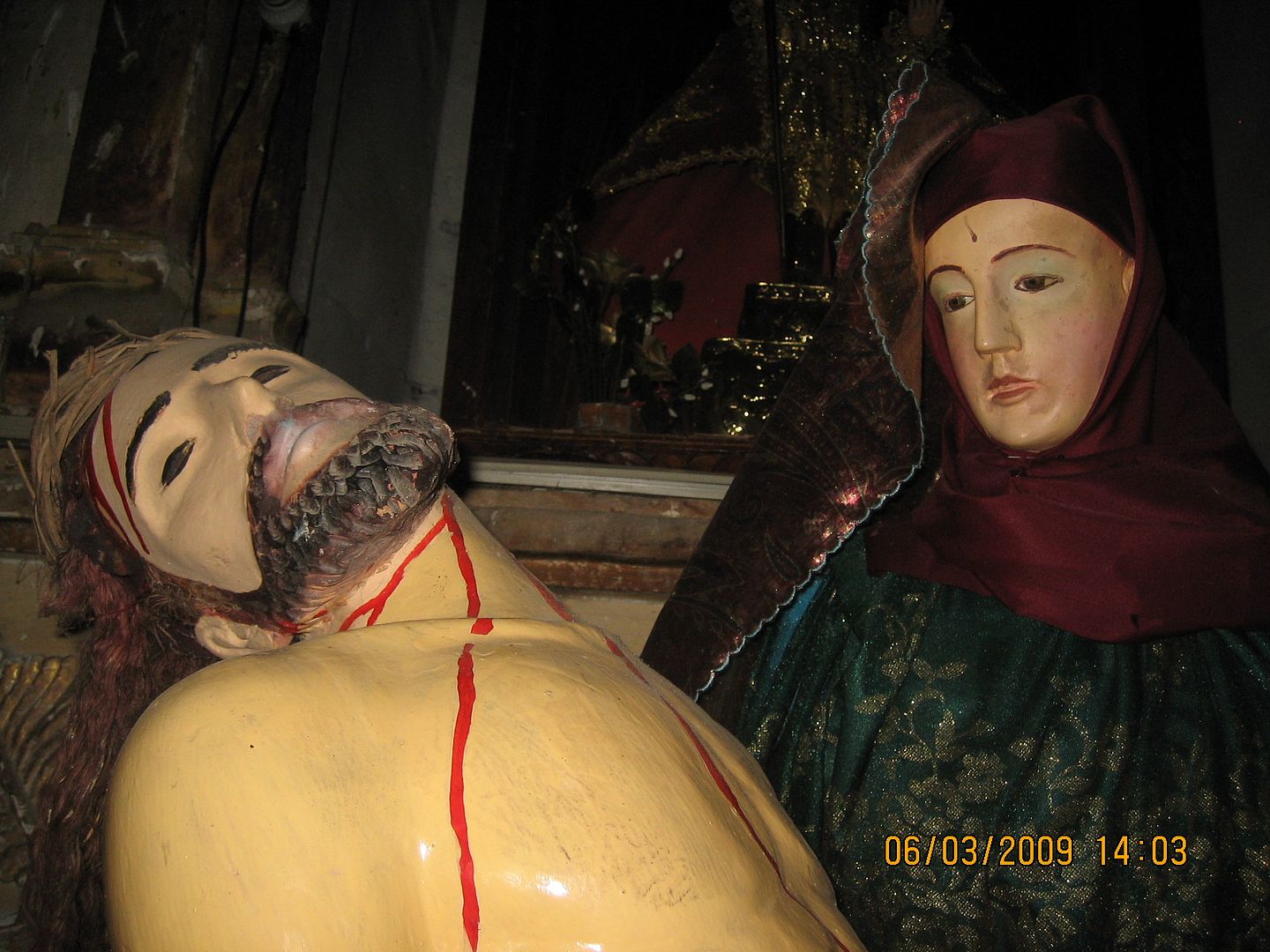
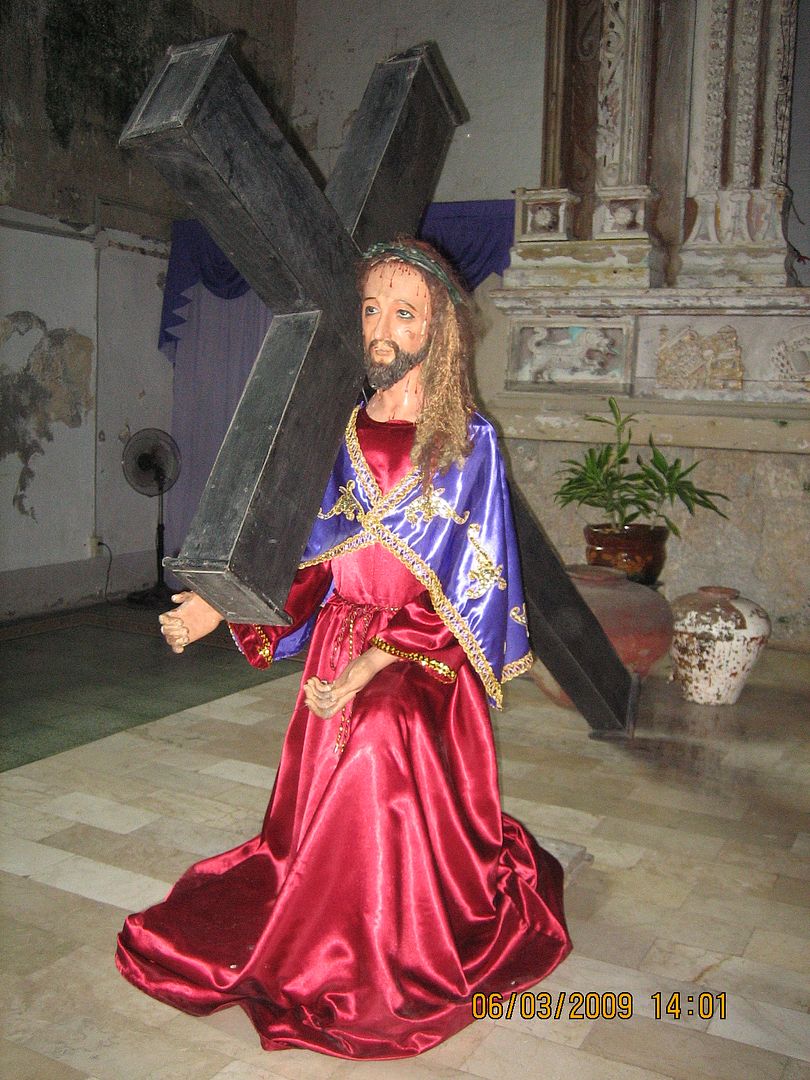
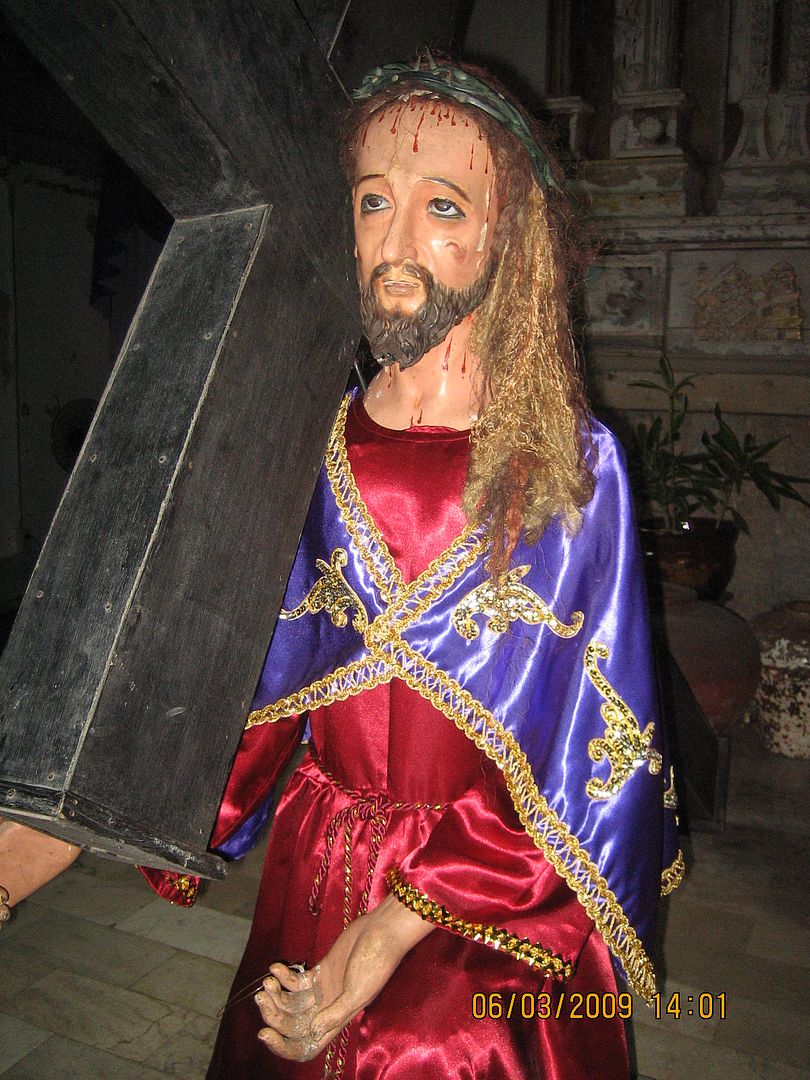
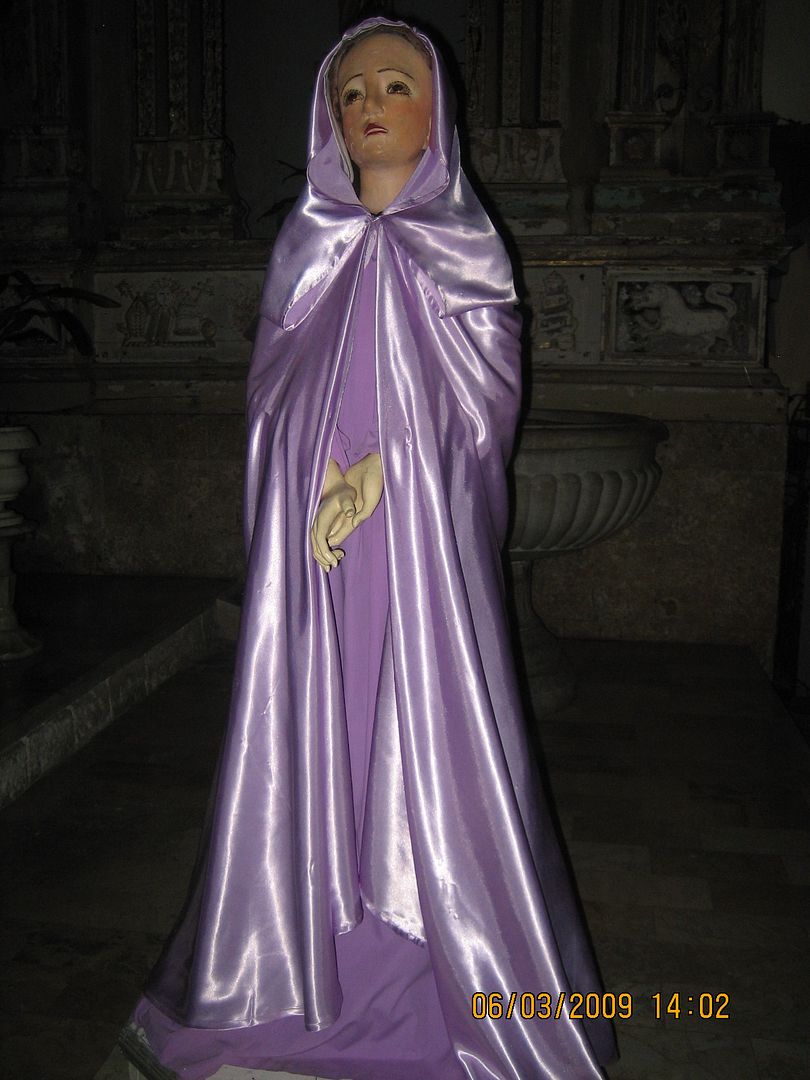
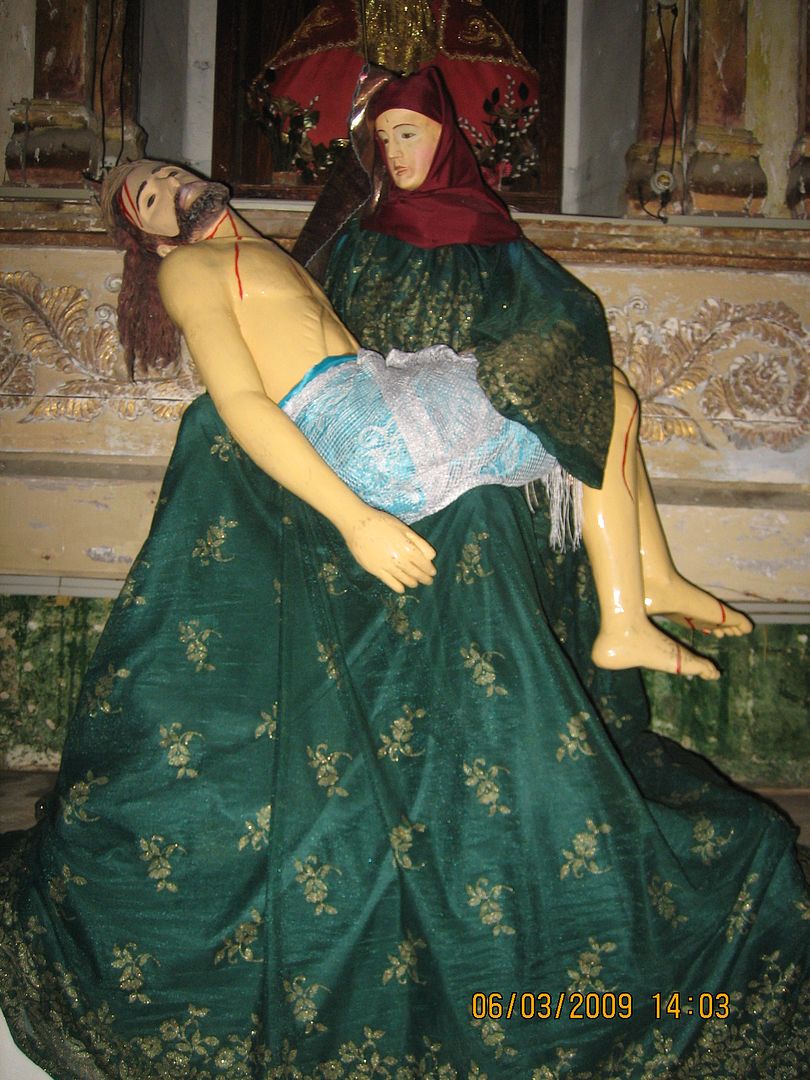
Fortunately, it was Lent when I visited, so Holy Week processional images were exposed and venerated in the sanctuary area, including this Nazareno


this Dolorosa


and this Pieta


And with just minutes to spare, I end this ten-part Visita Iglesia (Plus) Bohol, rush to the Tagbilaran airport, and resolve to do more of this at some future time. In the meantime, why not do your own self-guided Bohol nature and heritage tours yourself?

Originally published on 24 July 2011.  All text and photos copyright ©2011 Leo D Cloma. The moral right of Leo D Cloma to be identified as the author of this work has been asserted.


Original comments:

        Compare this with the Maribojoc church interior as it looked in 1912:
http://arcastro57.multiply.com/photos/album/66/BEFORE_STRANGE_ALTARS#photo=14


rally65 wrote on Sep 28, '11
The retablo looks to be exactly the same. It's interesting how there were so few pews in those days.

CXXII. Visita Iglesia (Plus) Bohol VII – The Loay Church

A short stroll down the road from the Clarin House, up a hill conveniently furnished with a stone stairway, leads directly to the rear of the Loay Church.  Instead of taking this route, however, we get back inside our van and drive around the short bend from the main highway into the front of the church plaza.

The plaza, though unpaved, was expansive, allowing the visitor to take in the impressive view of the church with its belltower on the right.


The three-storey octagonal belltower, standing independently from the church, is quite handsome.


I didn’t get to enter, but according to the “Visita Iglesia Bohol” guidebook by Regalado Trota Jose, there is a date of 1865 inscribed over the doorway.


The church itself is quite beautiful as well, with a neoclassical façade surmounted by a sculptural grouping of figures that according to the guidebook represents Faith, Hope, and Charity.


Above the central doorway is a Latin inscription “Deus Trinus et Unus,” alluding to the parish’s dedication to the Holy Trinity.  Atop the inner doorway is inscribed the year 1822, indicating its presumed date of completion.


As we have seen in our previous stops, Bohol churches frequently have added portico-façades.  Loay’s was apparently built in 1889, based on a date inscribed on one of its sides.  Today, it does double-duty as a parking slot for a simple white-washed wooden carroza.


On the inner façade under the portico is also a historical marker, which among other facts informs the reader that a certain Father Leon Inchausti was once assigned to this parish, that he was subsequently martyred in the Spanish Civil War of 1936-1939, and that he was canonized in 1999 and is now a saint.


I make my way inside via a postigo (cut-out doorway opening) in the main door.  Surprisingly, there were many people within on this late weekday morning.


It turns out that these parishioners were volunteer-cleaners, probably wrestling with how to rid the church's white interior walls of green molds.


In some parts, as in around this side door, the green stuff looked more like moss to me.


In the area above the main entrance was the choirloft, incorporating a larger area that resulted from the subsequent construction of the portico-façade.  A narrow staircase in one corner provided access to it.


Adjacent to the choirloft, on the opposite side from the staircase, was an impressive-looking pipe organ.


According to our guidebook, it was installed here in 1841


and was likely constructed by the famous workshop of Father Diego Cera in Las Piñas and dispatched here to his fellow Augustinian Recollects.


The ceiling above the nave was impressive,


beautifully filled-out with murals as in Panglao and other Bohol churches.


According to the guidebook, these are among the few that are signed by Ray Francia and even dated (above the choirloft) 15 June 1927.

Towards the front of the nave and against one of the posts supporting the dome on the right side facing the altar is an interesting-looking pulpit.


The canopy above, actually meant to serve as a sounding board, is in a Gothic style, and the pulpit’s base is decorated with a rather unusual wood-and-metal fringe.


The main altar is a colonnaded and domed neoclassical structure containing a traditional representation of the Holy Trinity, with God the Father seated on the right, God the Son on the left, and God the Holy Spirit in the form of a dove above them.


Above the altar is a most unique “tent” of sorts, an intricately lacey amalgam of what might be metalwork, wood carvings, and direct painting on the ceiling surface.


As in the other Bohol churches that we visited during this Lenten season, by the altar stand processional images of the Nazareno,


and the Dolorosa.


On one side altar is this bust of the Sacred Heart.


And elsewhere around the nave, we admire these massive side doors


and this unusual confessional in picket-fence style.


We make our way back to the main entrance, and admire these ancient floor tiles in the process.


By the main doors, our dedicated team of volunteer-cleaners is still at it, trying to remove those stubborn moss stains from the walls and posts.


Outside, across the very wide plaza from the church, is a unique collection of colonial structures, certainly another of Loay’s attractions.  We start with the pair of buildings on the left side of the plaza as one exits the church.


The stone building on the right in the above photo is believed to be town's original Casa Tribunal or Municipal Hall.   According to the guidebook, its non-centered openings may indicate that it is one of the earliest structures in this church complex.


Though the building is now apparently disused, its double doors seem to be in relatively good condition.


An upstairs balcony has its doors partly open, but these too appear to be in restorable shape.


And this wooden-barred opening on the ground floor is only missing a part of one crosspiece.


To the left of this building is a single-storey structure.


Its original doors are now missing, and the entrance blocked by roofing sheets.


But the wooden bars in one of its windows appear to be in near-perfect condition.


According to our trusty guidebook, this was built in the last quarter of the 19th century, also by the Recollects, originally as a schoolhouse.  In fact, directly opposite it across the church plaza is its twin, another schoolhouse,


this one in obviously better condition than the first, with its intact door (or a tasteful replacement of the original)


and wooden window panels behind iron bars.


To this schoolhouse’s right is a new structure, still in construction.


This appears intended to be a parish center or something similar.  A pity though that its design and construction did not hew more closely to all the heritage buildings around it.  Oh well.


Which leaves just the one structure in the center of the plaza.


No prizes for guessing that this is yet another assemblage for once-a-year use at dawn on Easter Sunday.


And yet despite the emerging similarity amongst Bohol’s churches, each one obviously possesses unique features and distinctive charm.  We’ve observed this in Baclayon, Panglao, Dauis, and now in Loay – let’s see if this persists as we move right along.

Originally published on 4 June 2011.  All text and photos copyright ©2011 Leo D Cloma. The moral right of Leo D Cloma to be identified as the author of this work has been asserted.


Original comments:

jamaica1ph wrote on Jun 13, '11
I attended a very nice concert in this church a few years ago. The organ was restored with the help the Ayala and Zobel Families.

We had dinner at the Clarin House and our little groupy was then led by torch light up the stairs by side of the church. We were in for a surprise for the church structure was decently floodlit.

I think it was Mrs. Butalid who played the organ for us her small audience. It was indeed a night to remember.

rally65 wrote on Jun 14, '11
jamaica1ph said
I attended a very nice concert in this church a few years ago. The organ was restored with the help the Ayala and Zobel Families.

We had dinner at the Clarin House and our little groupy was then led by torch light up the stairs by side of the church. We were in for a surprise for the church structure was decently floodlit.

I think it was Mrs. Butalid who played the organ for us her small audience. It was indeed a night to remember.


What a rare privilege that you were able to enjoy. I too would like to attend an authentic pipe organ concert in this or some other Bohol church. I know that several early 19th century pipe organs in the province have been progressively restored over the past few years.

cealwyn wrote on Jun 25, '11, edited on Jun 25, '11
The restoration of the Loay pipe organ was funded by the government through the efforts of then Congressman Isidro Zarraga who still remembers the organ when he was still an altar boy tasked to pump the bellows of the pipe organ. It was restored in 1998.

The Ayala Foundation funded the restoration of the pipe organ in Baclayon church in 2008. The organ is the third oldest existing in the country which was built in 1824 by Fr. Diego Cera.

rally65 wrote on Jun 25, '11
cealwyn said
The restoration of the Loay pipe organ was funded by the government through the efforts of then Congressman Isidro Zarraga who still remembers the organ when he was still an altar boy tasked to pump the bellows of the pipe organ. It was restored in 1998.
The Ayala Foundation funded the restoration of the pipe organ in Baclayon church in 2008. The organ is the third oldest existing in the country which was built in 1824 by Fr. Diego Cera.


Good to hear from you, Cealwyn. Thanks for the additional information.

Are all these early 19th century pipe organs in Bohol (and Cebu) attributed to Father Diego Cera?