Saturday, February 10, 2018

CXXXVI: Santo Addicts I Have Visited II: Louie Nacorda in Cebu


After a lengthy and inexcusable hiatus, and in reparation for that sin, we continue our Cebu series (see CXXVIII – The 1730 Casa Jesuita and CXXIX – The Yap-Sandiego House) with a simultaneous continuation of our Santo Addicts series (see CXV – Alex Castro).

I had known Mr. Louie Nacorda for some years, first online via the Flickr photo sharing site, which then led to his graciously helping me to arrange my visits to the Casa Jesuita and Yap Sandiego houses when I visited Cebu on a business trip in January 2010.  More than finally meeting Louie in person at that time, what was even more significant for me was that, like the previous subject in this series Mr. Alex Castro, Louie was a certified santo addict.

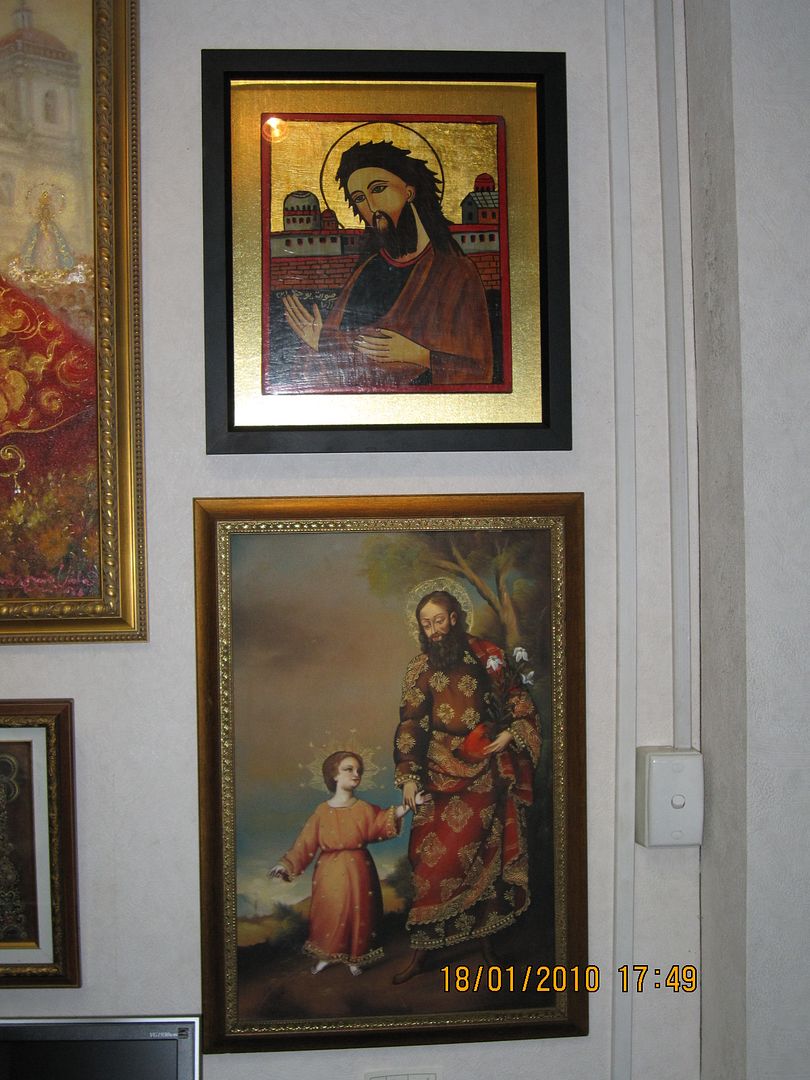
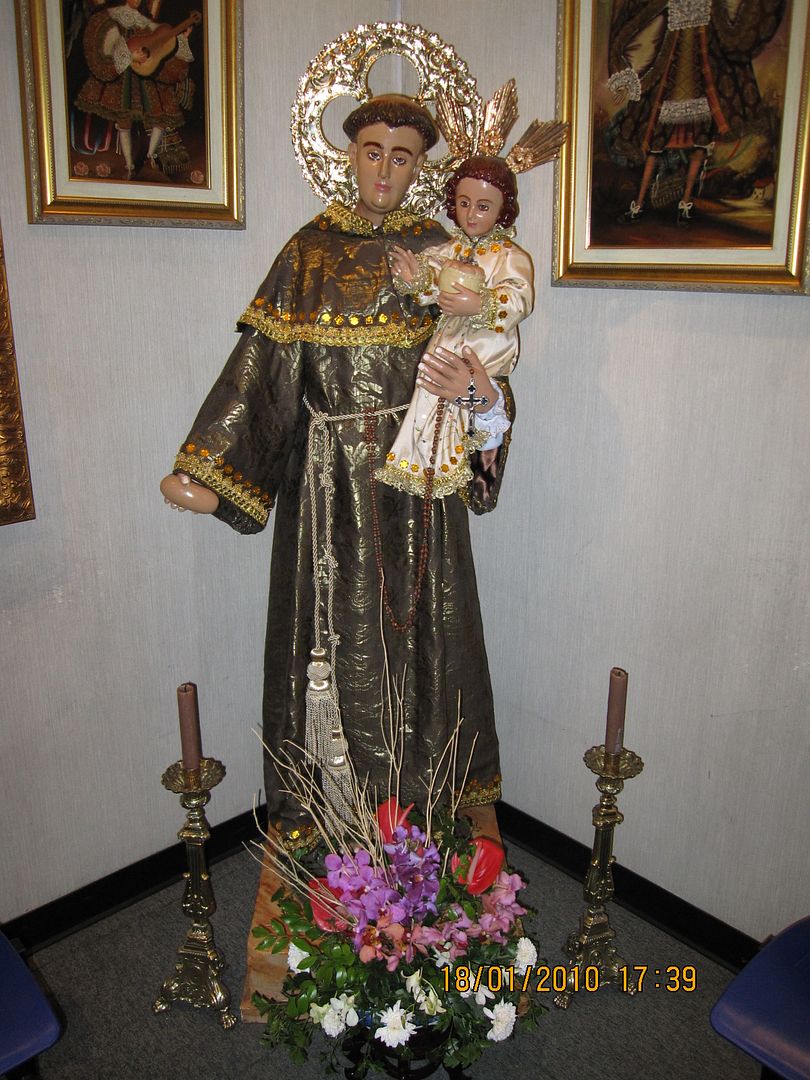
After he had accompanied me to those two aforementioned heritage houses, our next stop was the Pacific Online (a systems service provider) office in the city, which Louie was heading up at that time.  Most santo addicts would like to bring over their addiction to their workplaces, although for the vast majority of them that would be impractical or even downright violative of office rules.  Louie being the big boss here meant that he could get away with this, therefore upon entering their offices I was greeted by a not-small image of Saint Anthony of Padua.

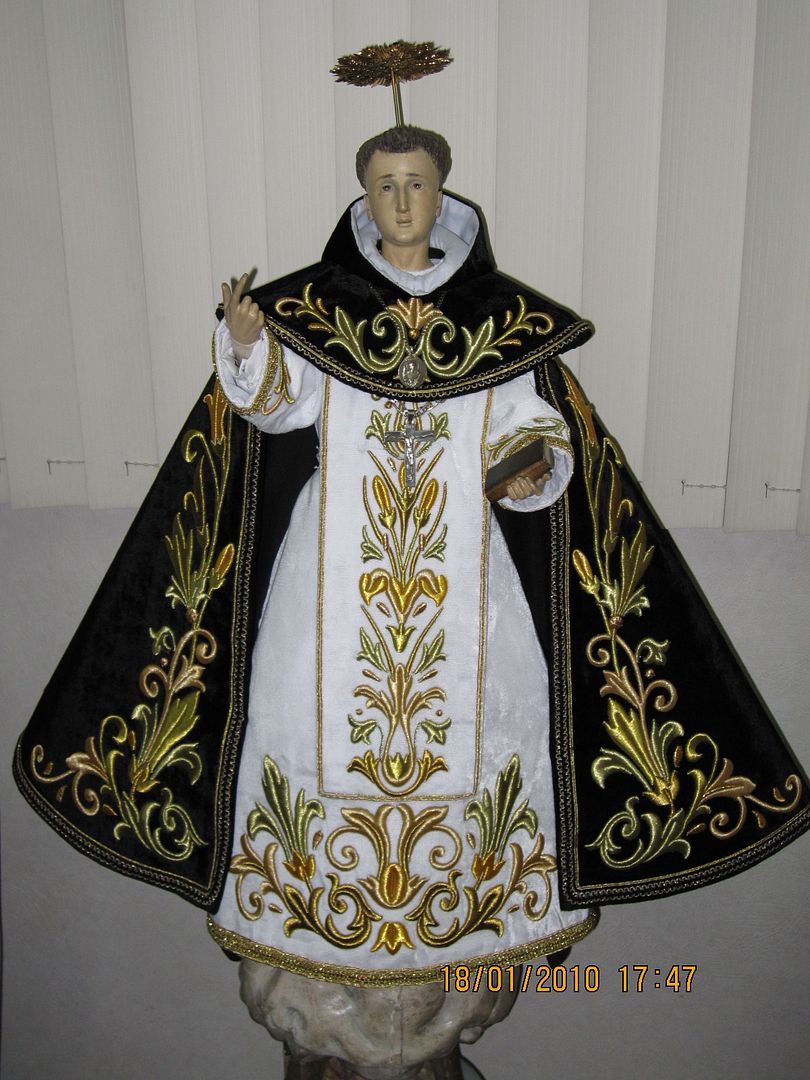
Elsewhere in the office was a smaller Saint Vincent Ferrer with a nicely-embroidered Dominican habit.

Beside it was an Our Lady of (perhaps) the Most Holy Rosary, surrounded by numerous reliquaries.
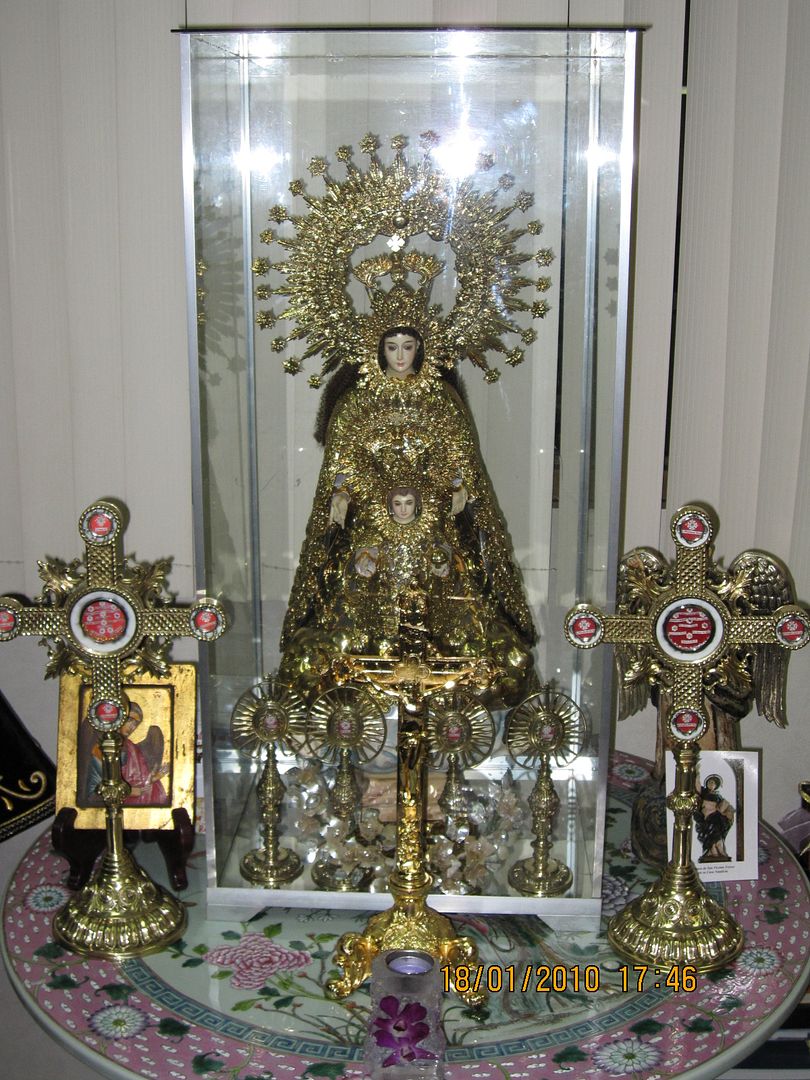

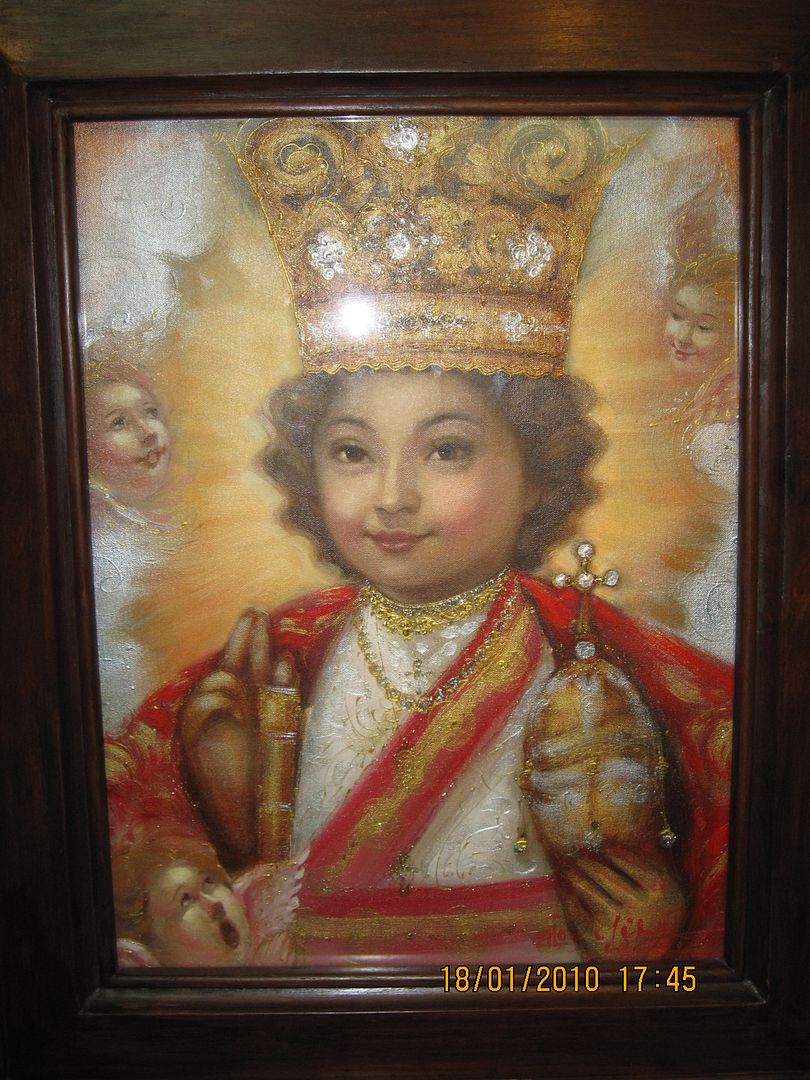
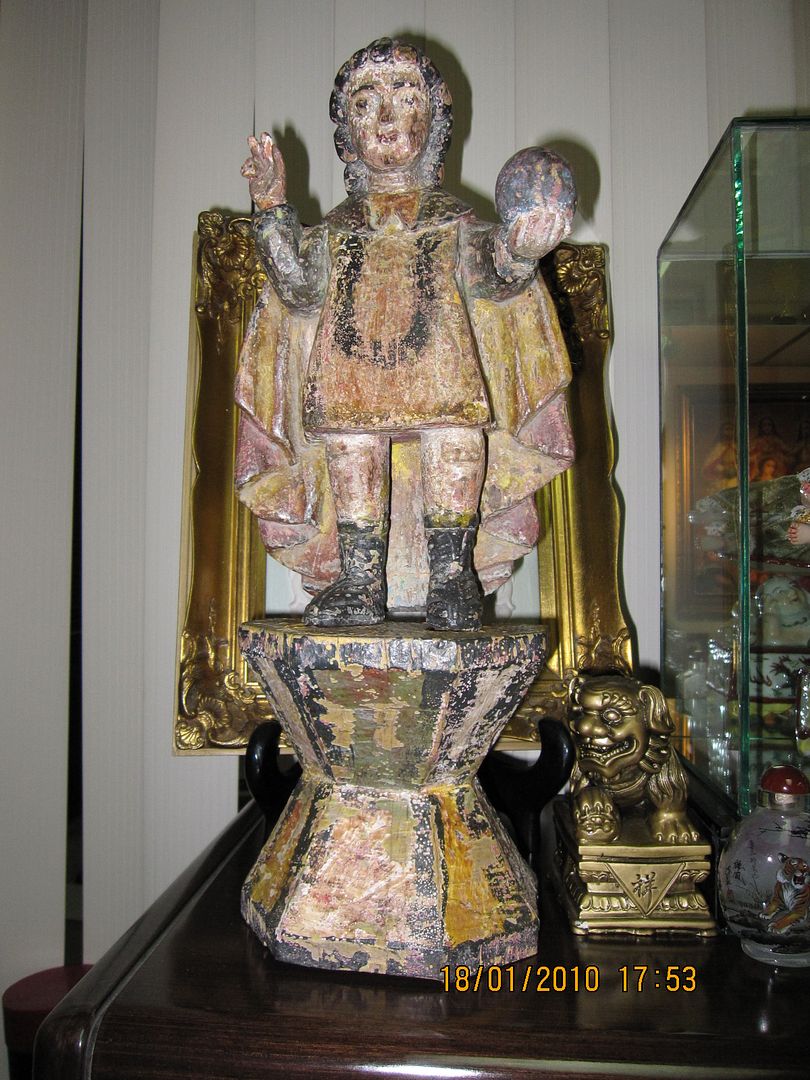
This being Cebu, which began the original devotion to the Santo NiƱo in the Philippines, I was not surprised to see many representations of the Holy Child in the office, including folk sculpture,

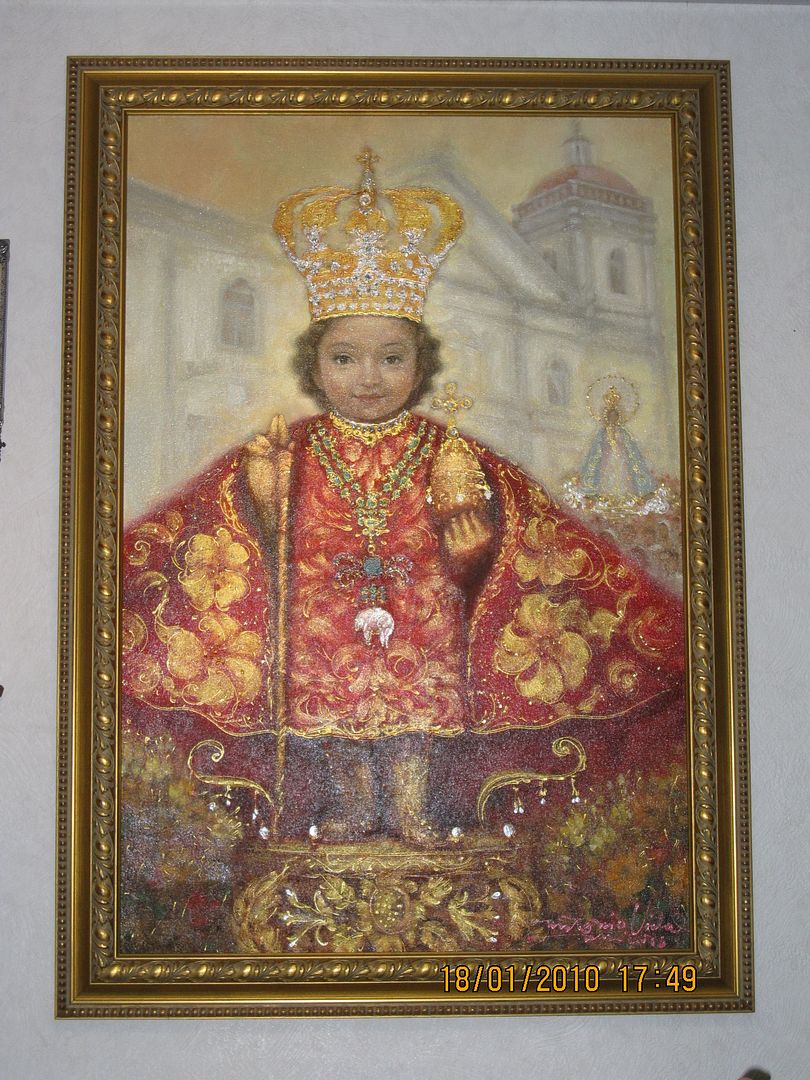
paintings


and classical sculpture,
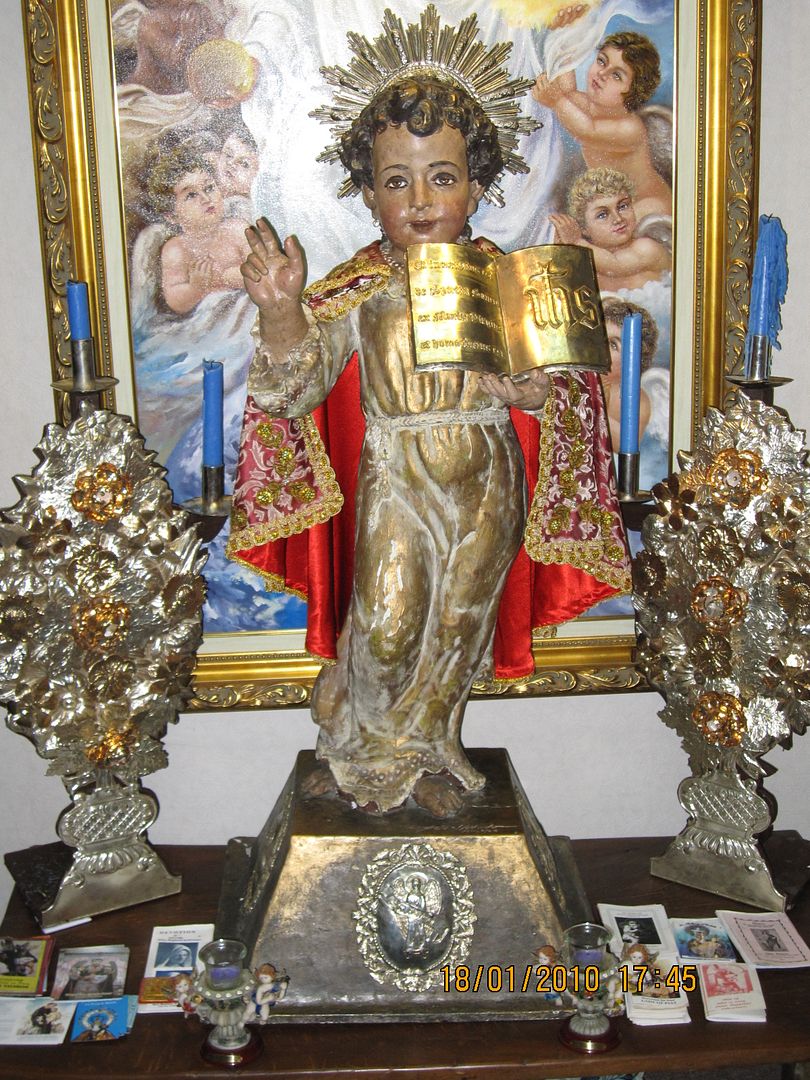

this last one nicely complemented by a backdrop depicting God the Father.
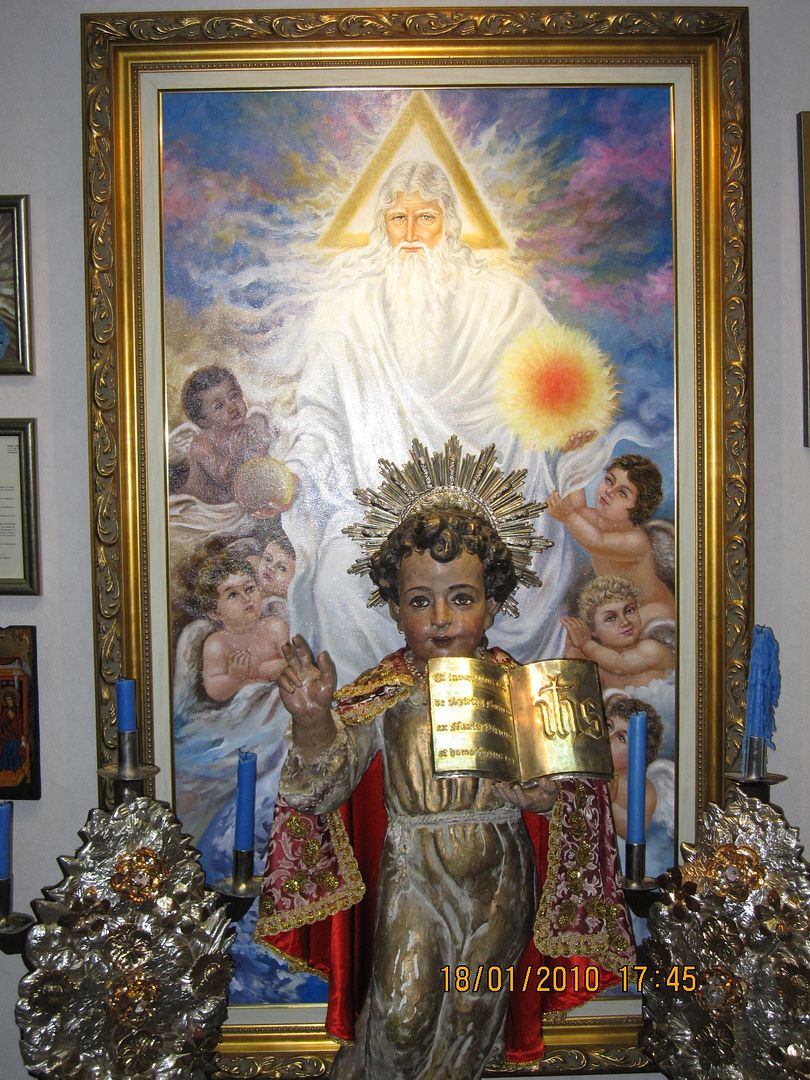

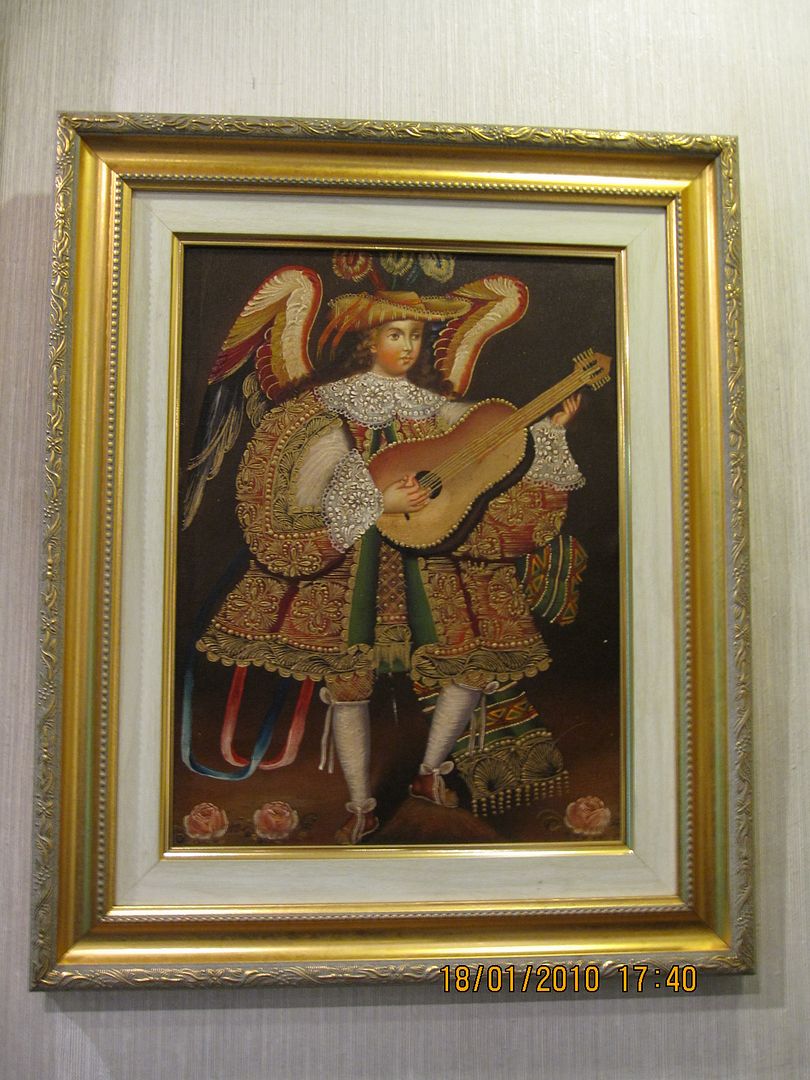
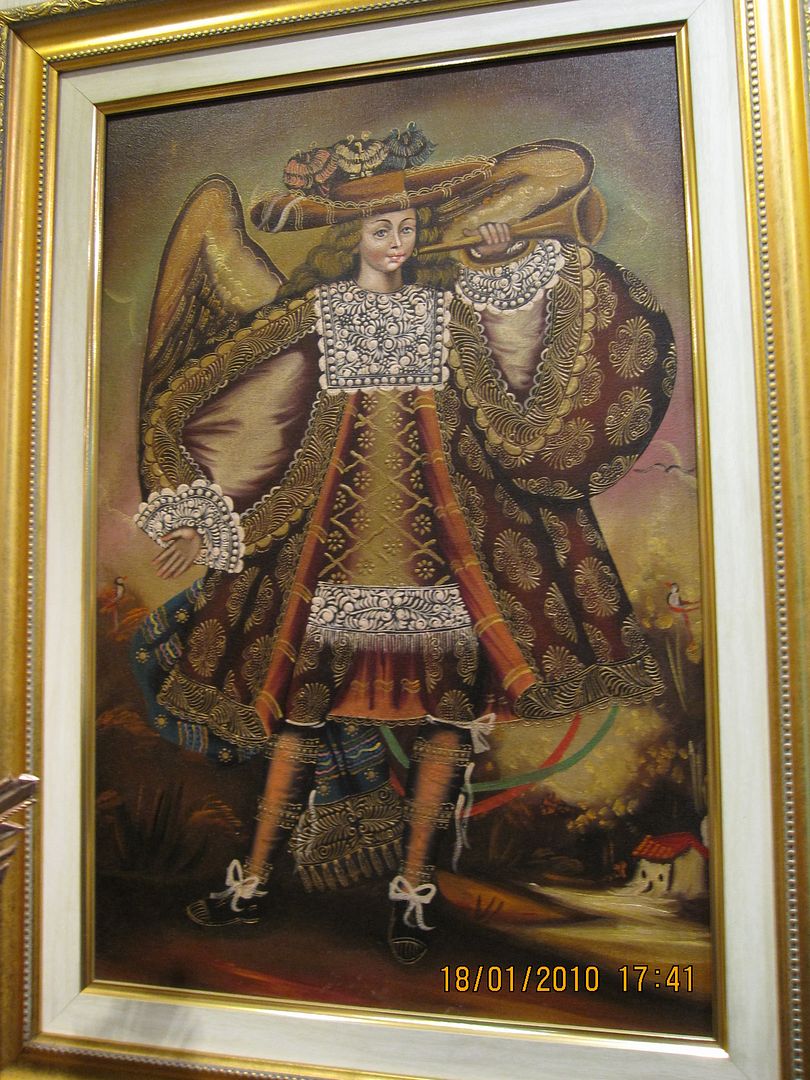
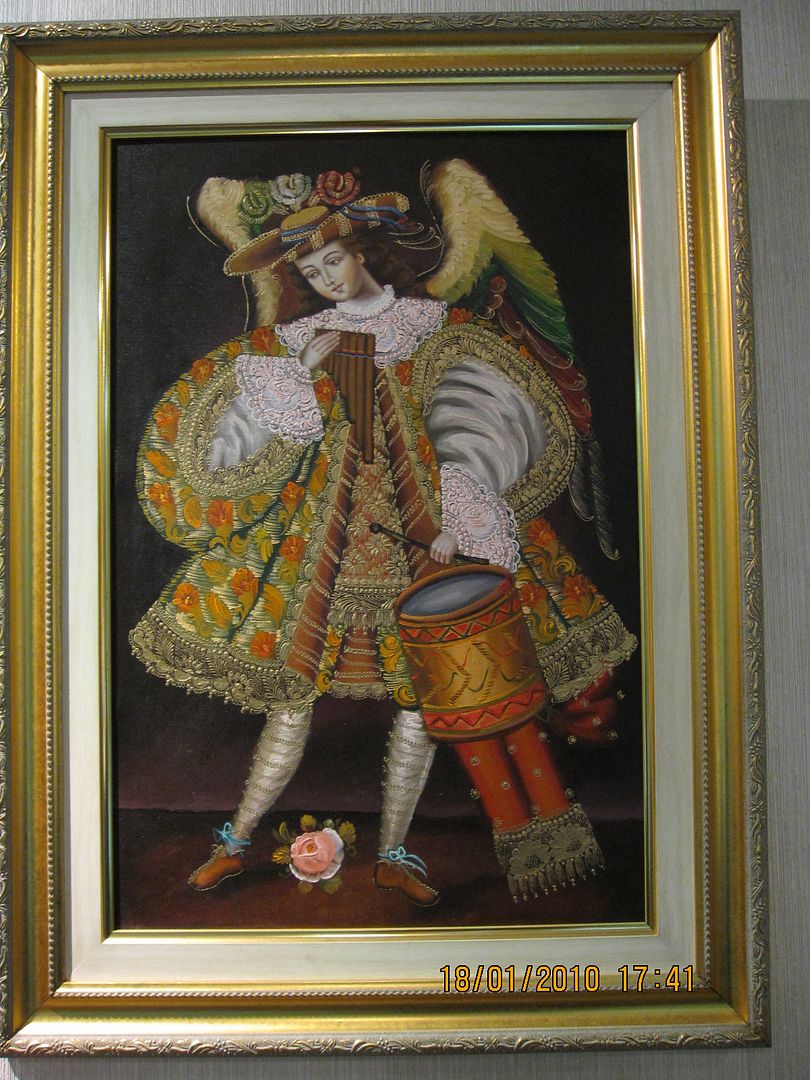
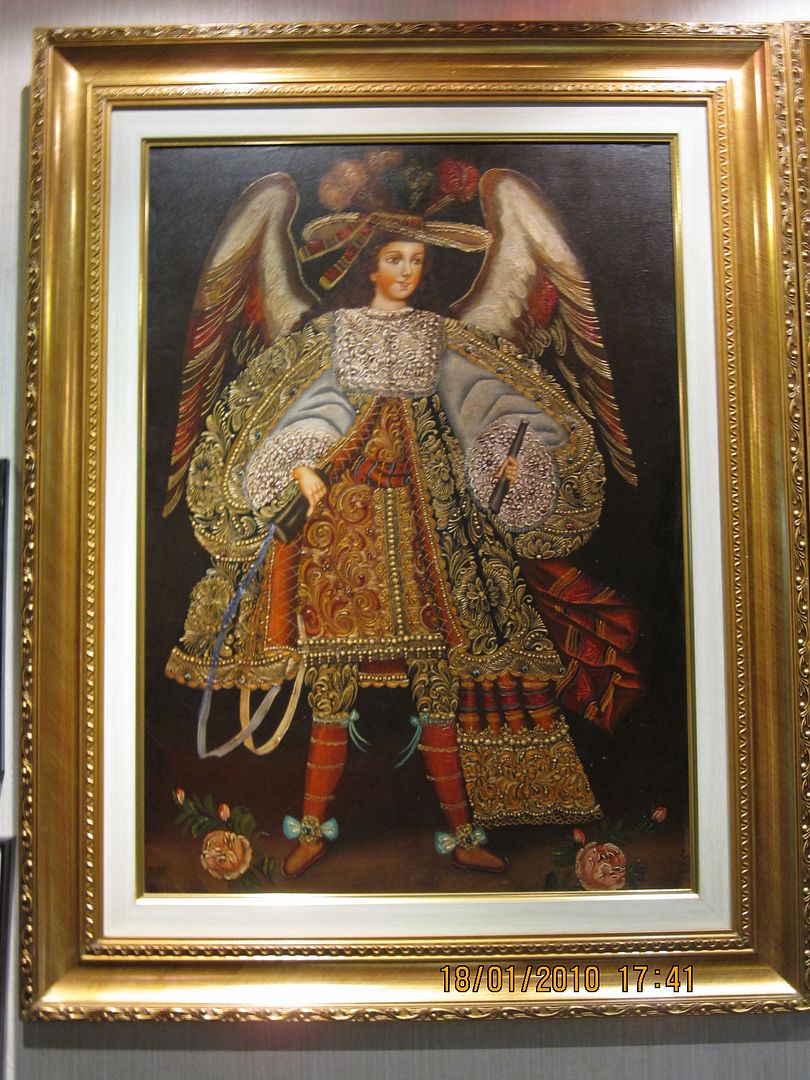
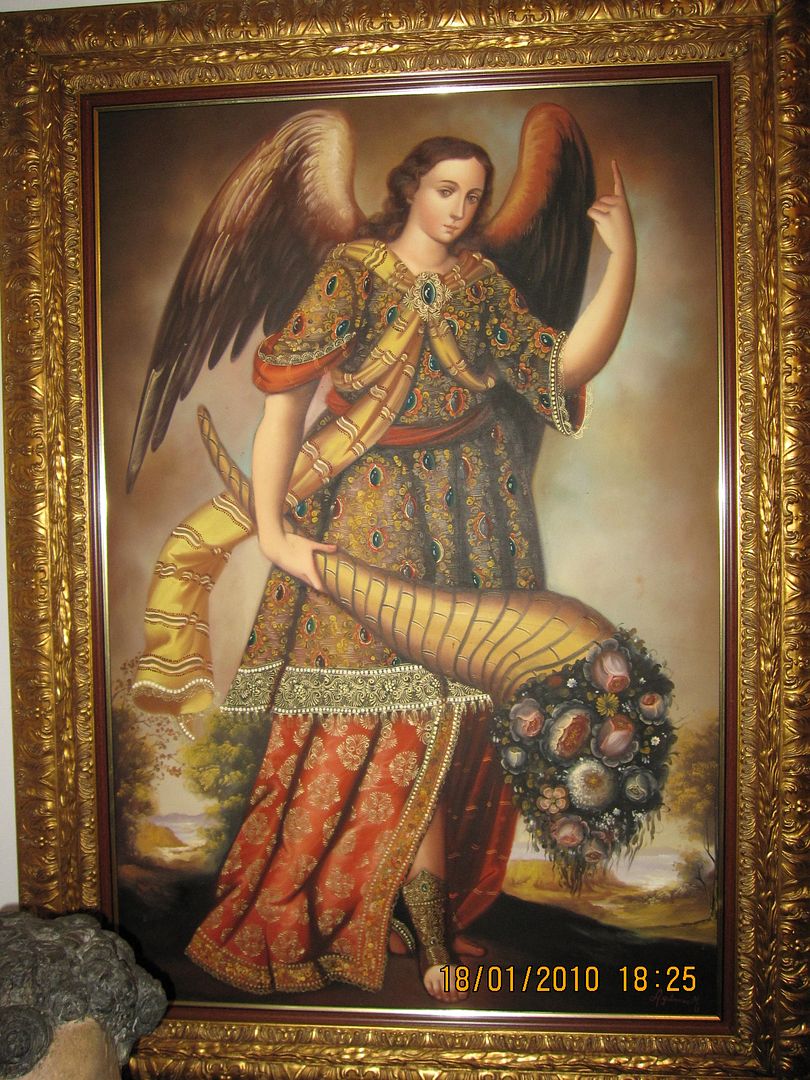
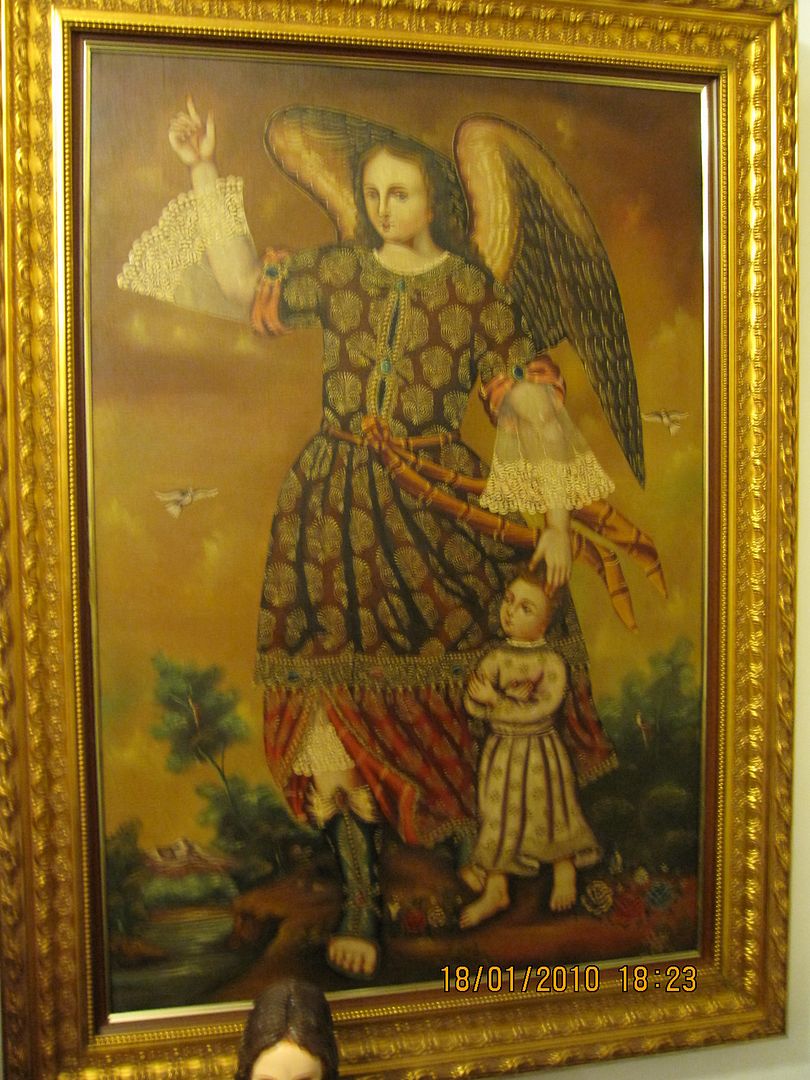
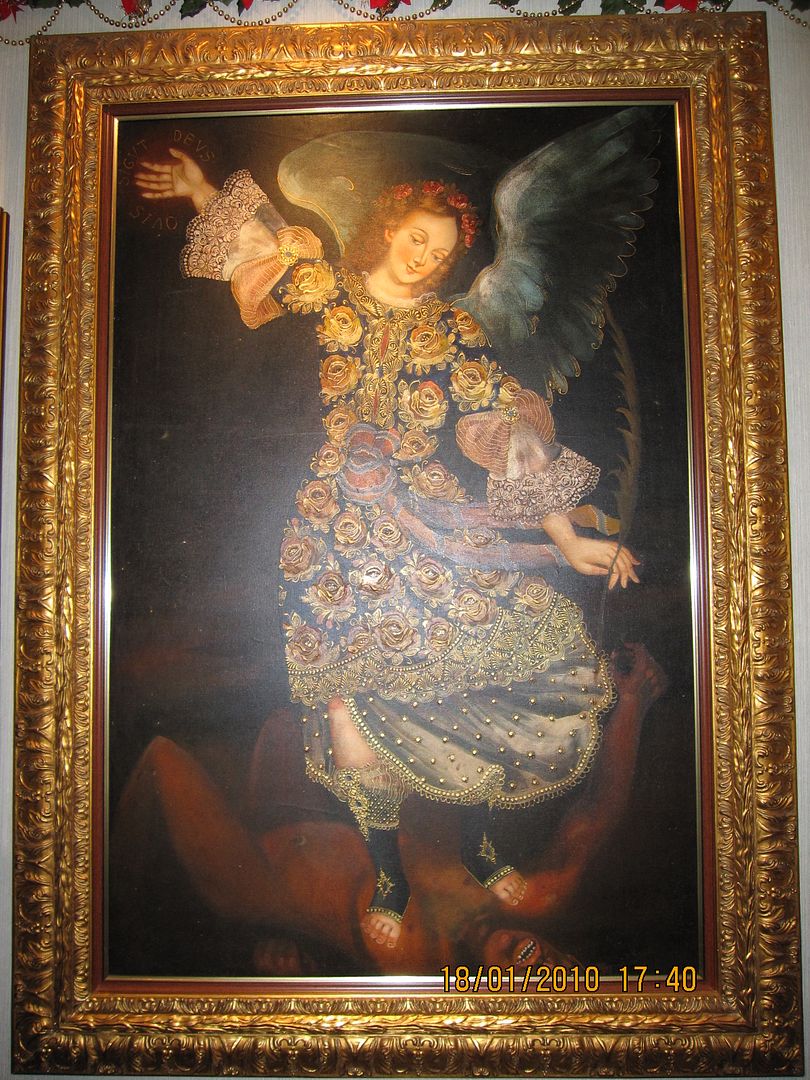
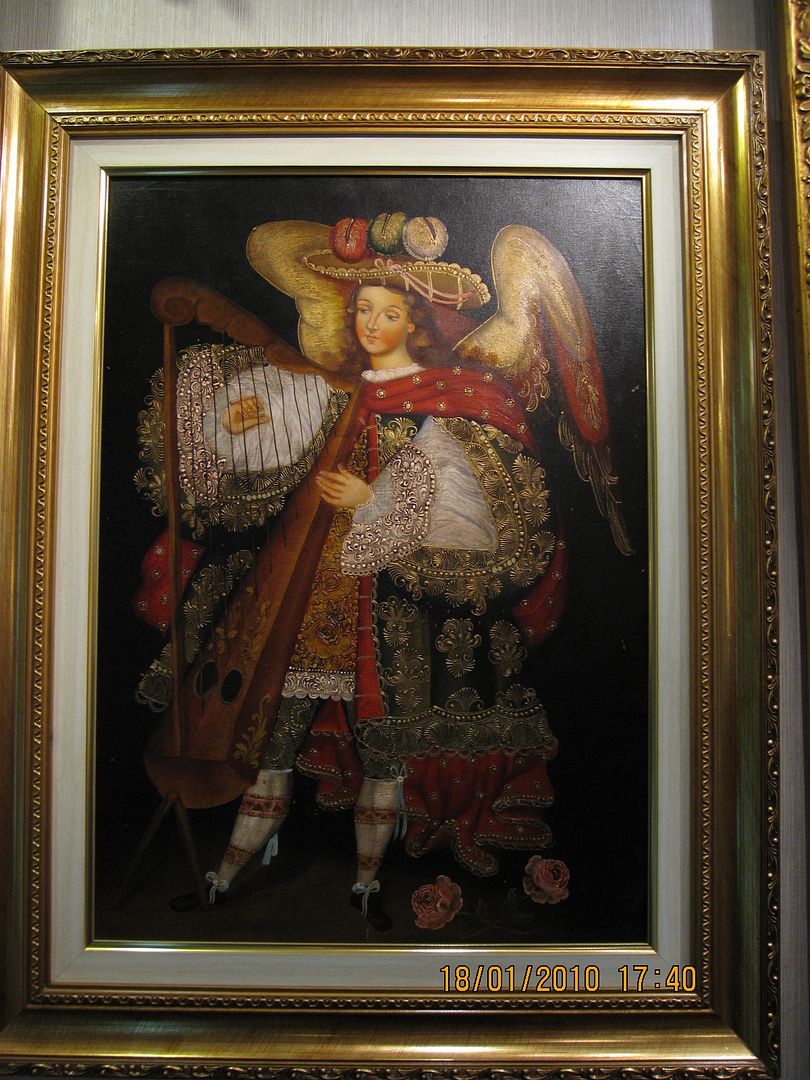
If some of those paintings appeared to be vaguely in the so-called “Cuzco style” of the 16th to 18th centuries (which expanded beyond Cuzco and Peru to what is now Bolivia and Ecuador), you would be warm, as elsewhere in Louie’s office were more religious artworks in this style, including several triumphant

and musical angels


and even a couple of combative ones.
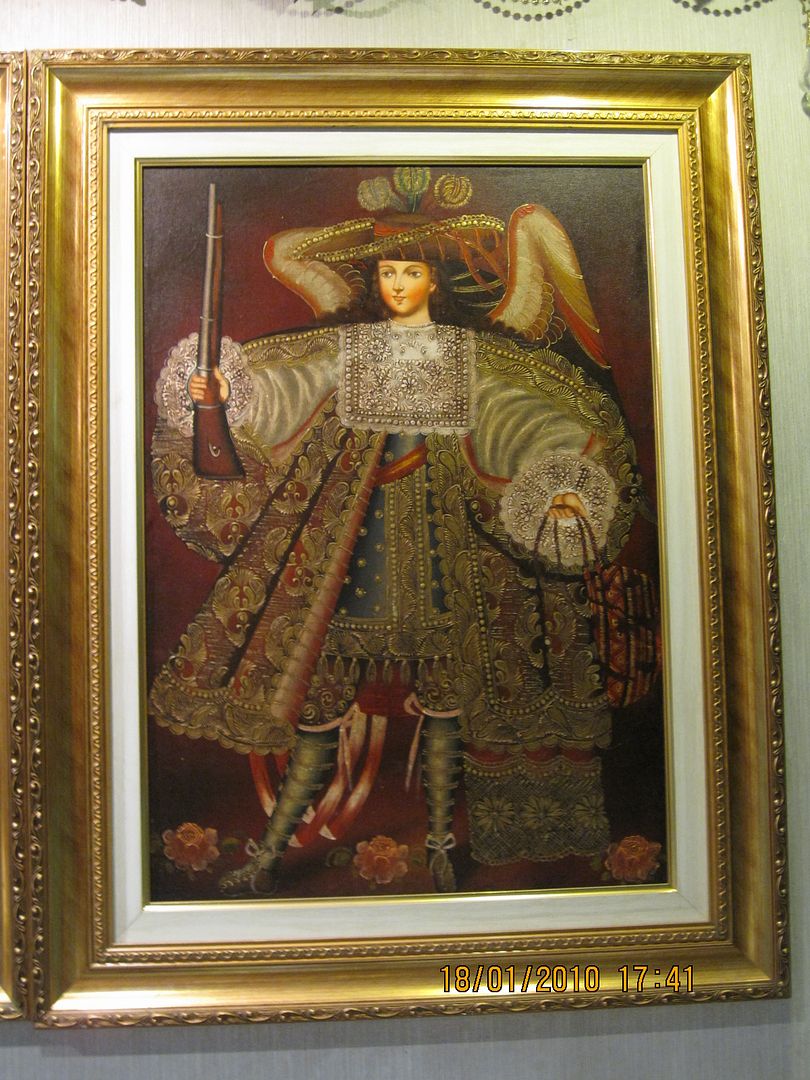


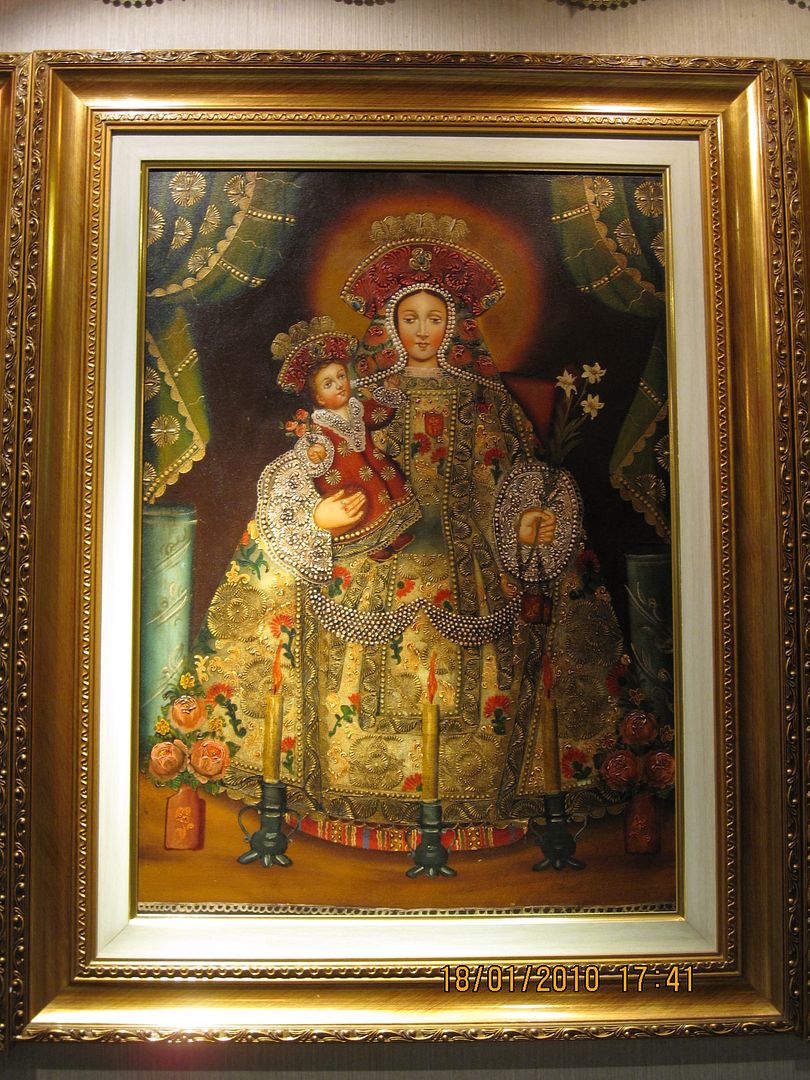
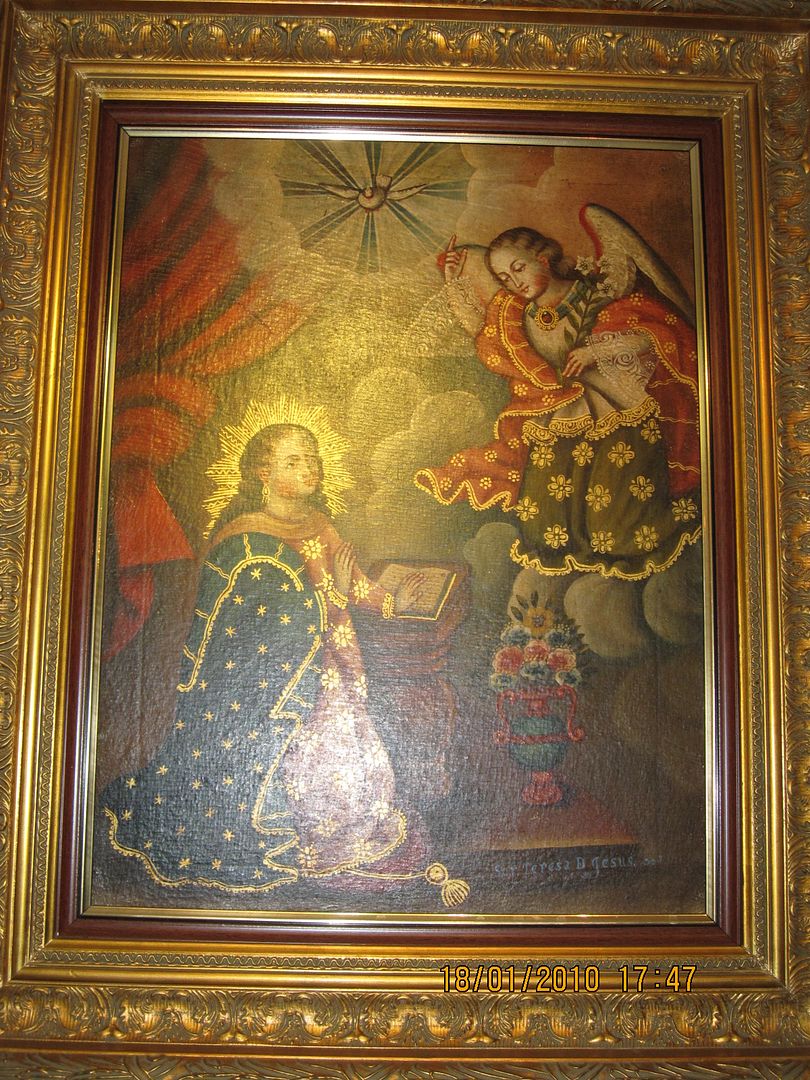
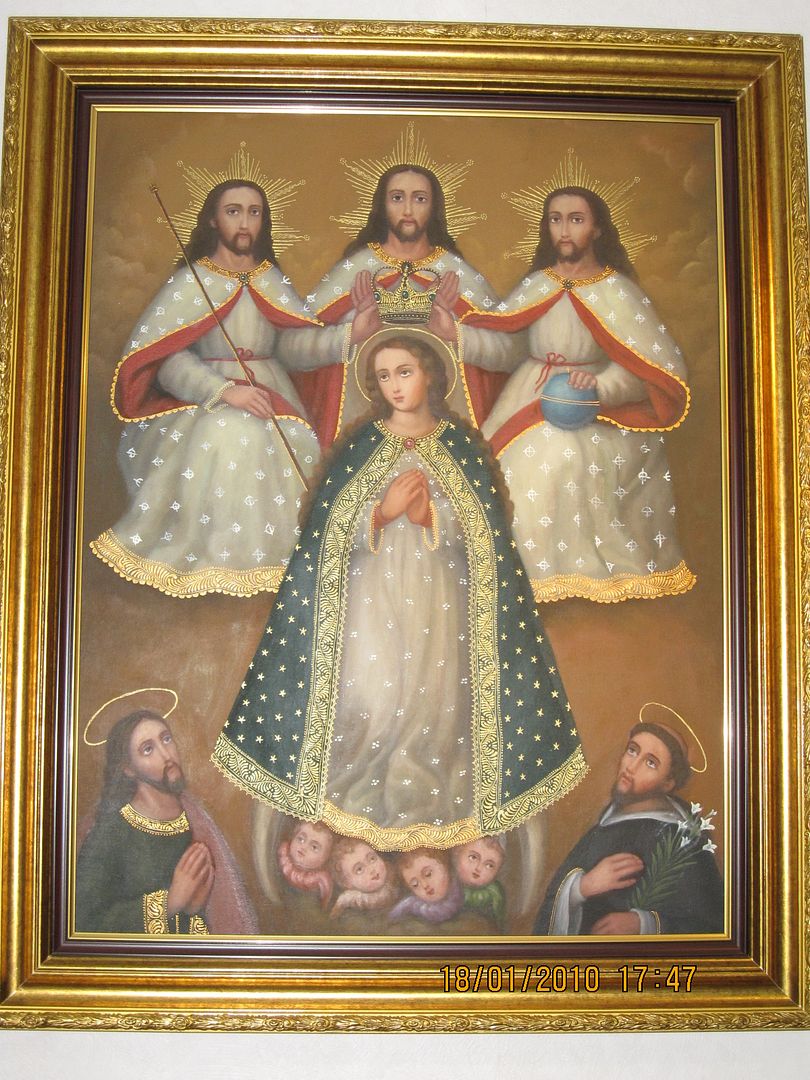
Other paintings in this style were hung from other walls in the office
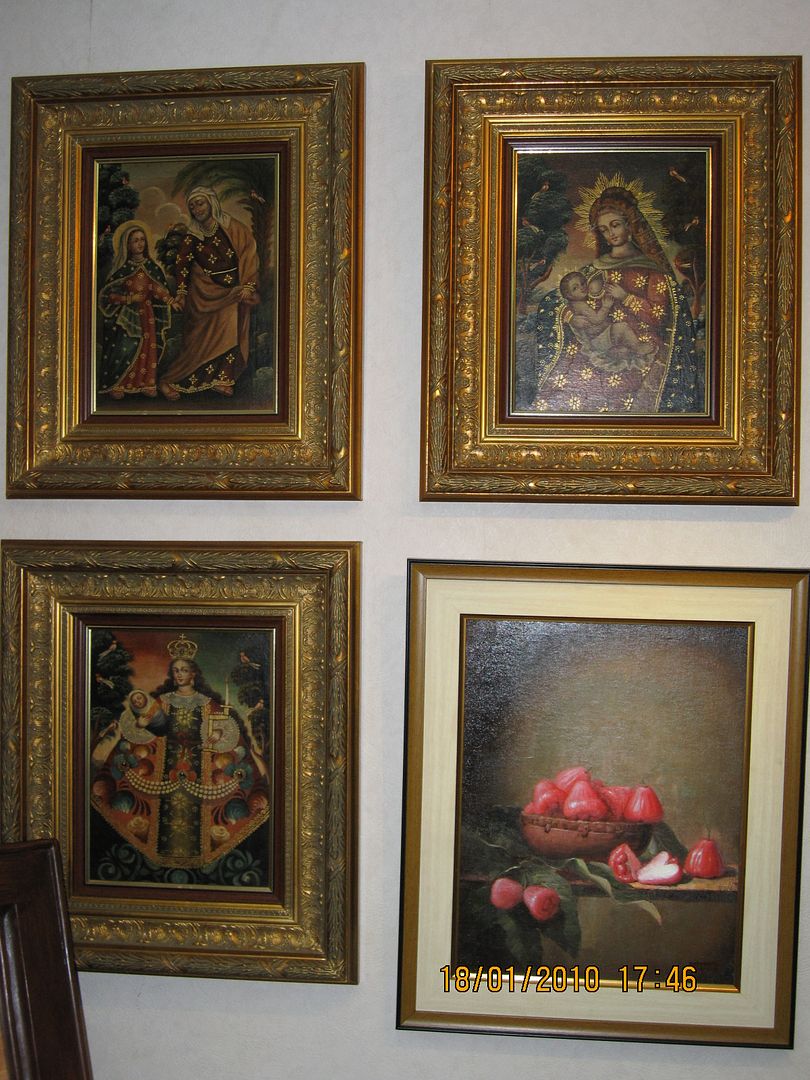

including the Blessed Virgin Mary and the Child Jesus,

the Annunciation,

and the Coronation of the Blessed Virgin Mary as Queen of Heaven and Earth, with adoring saints.

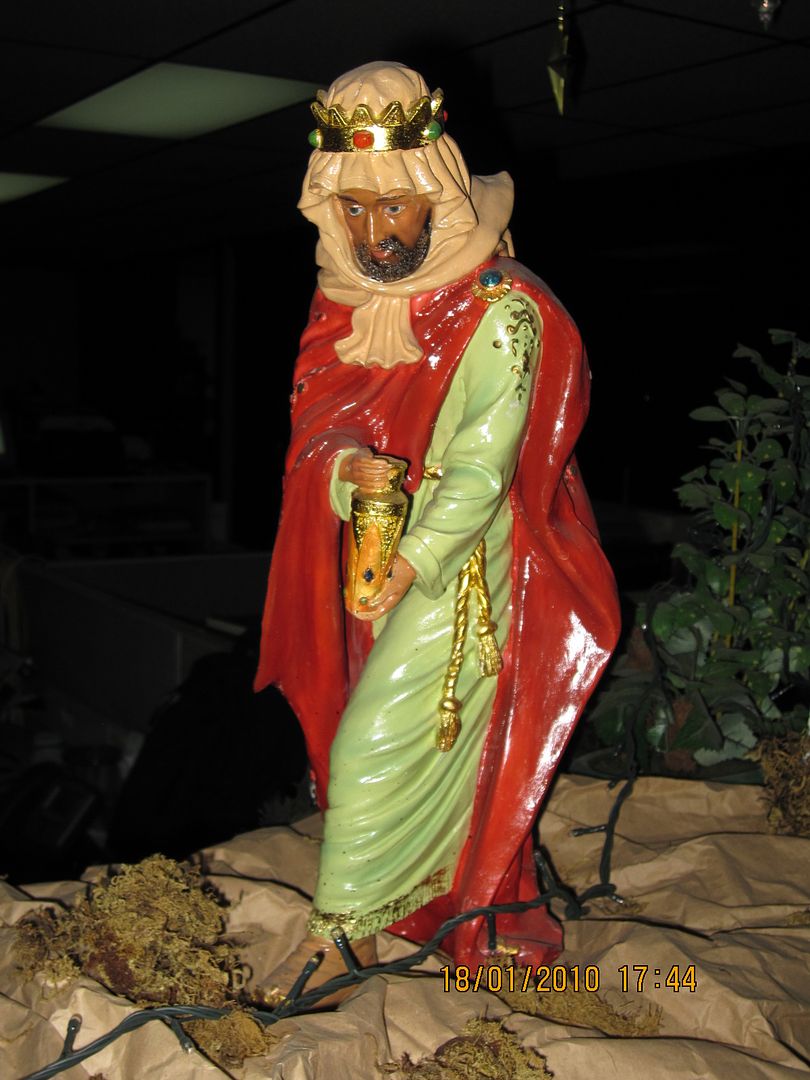
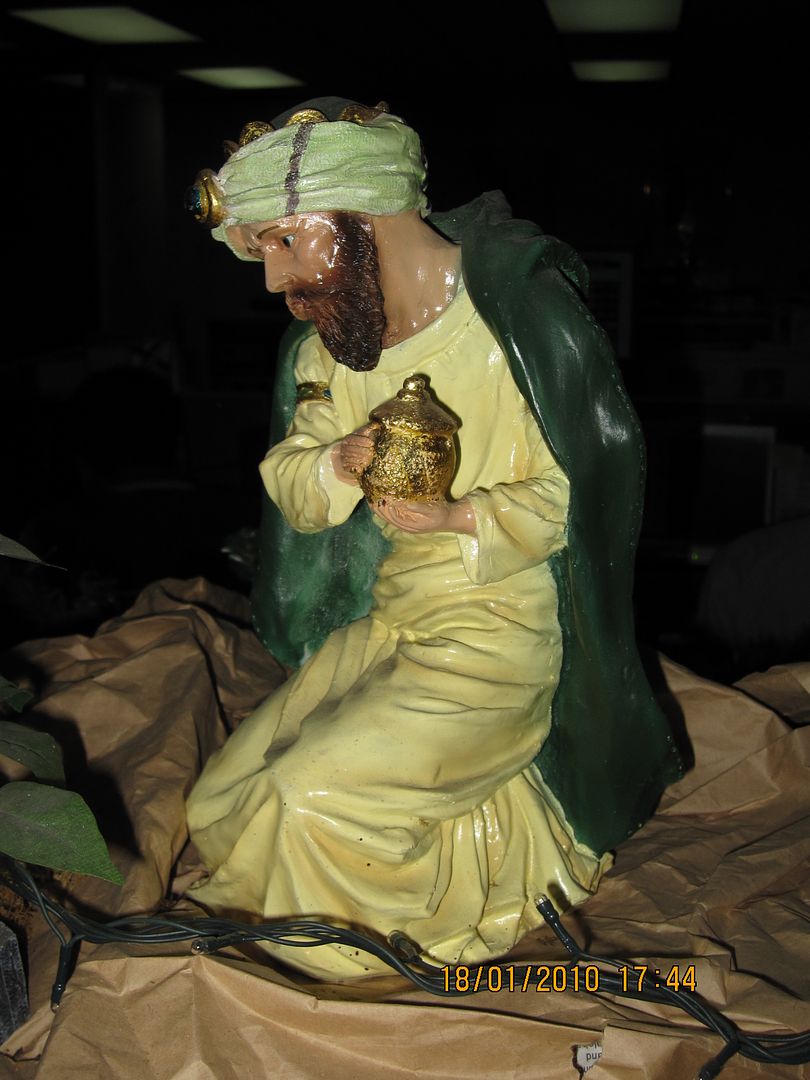
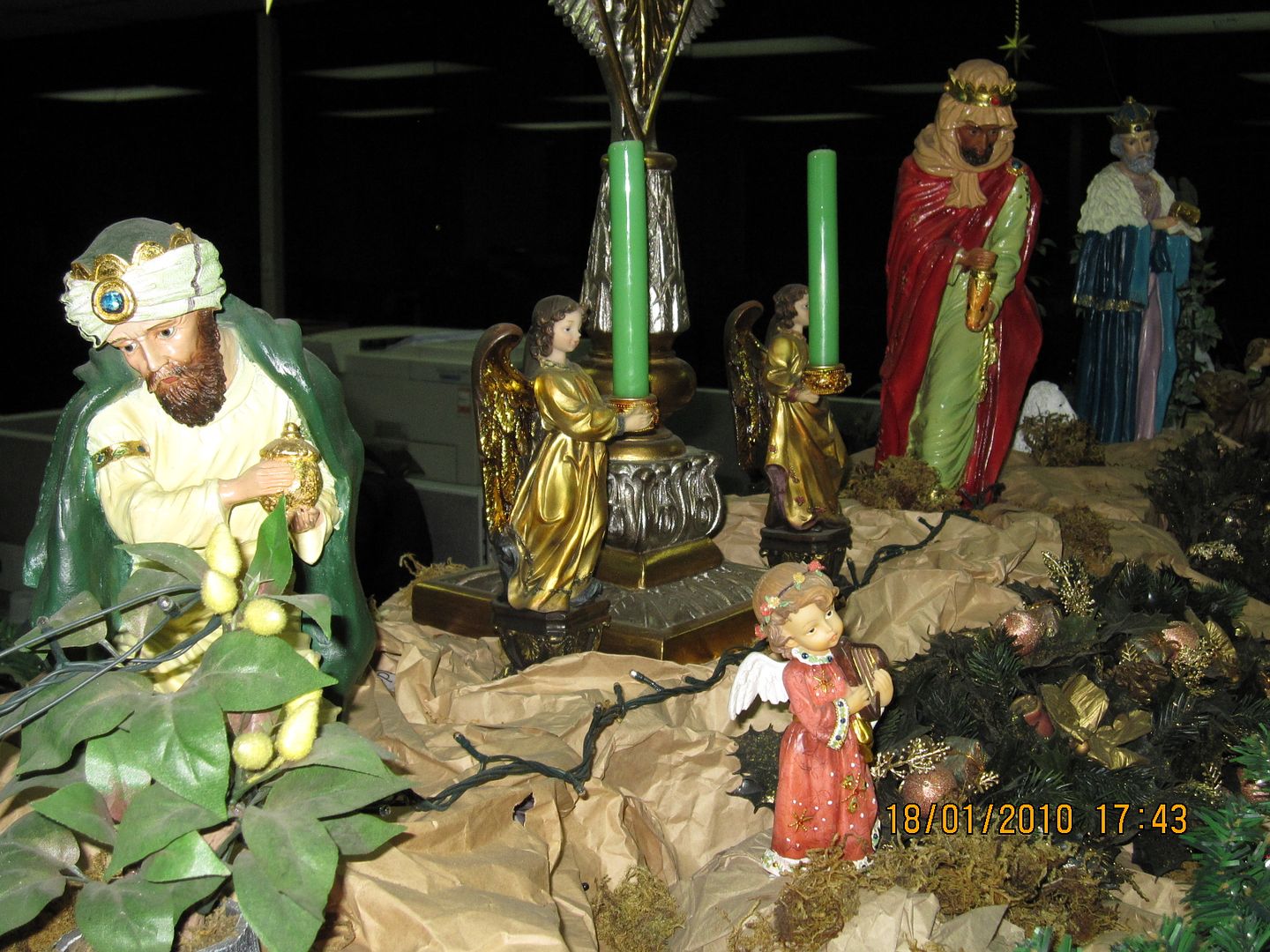
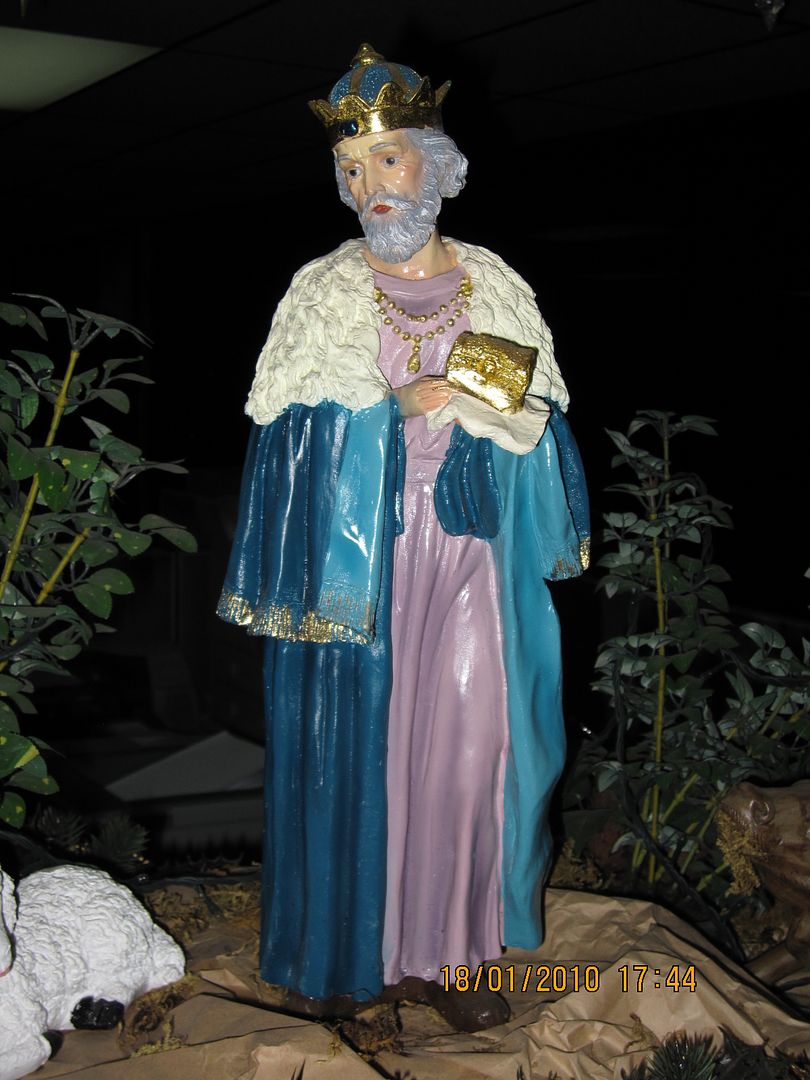
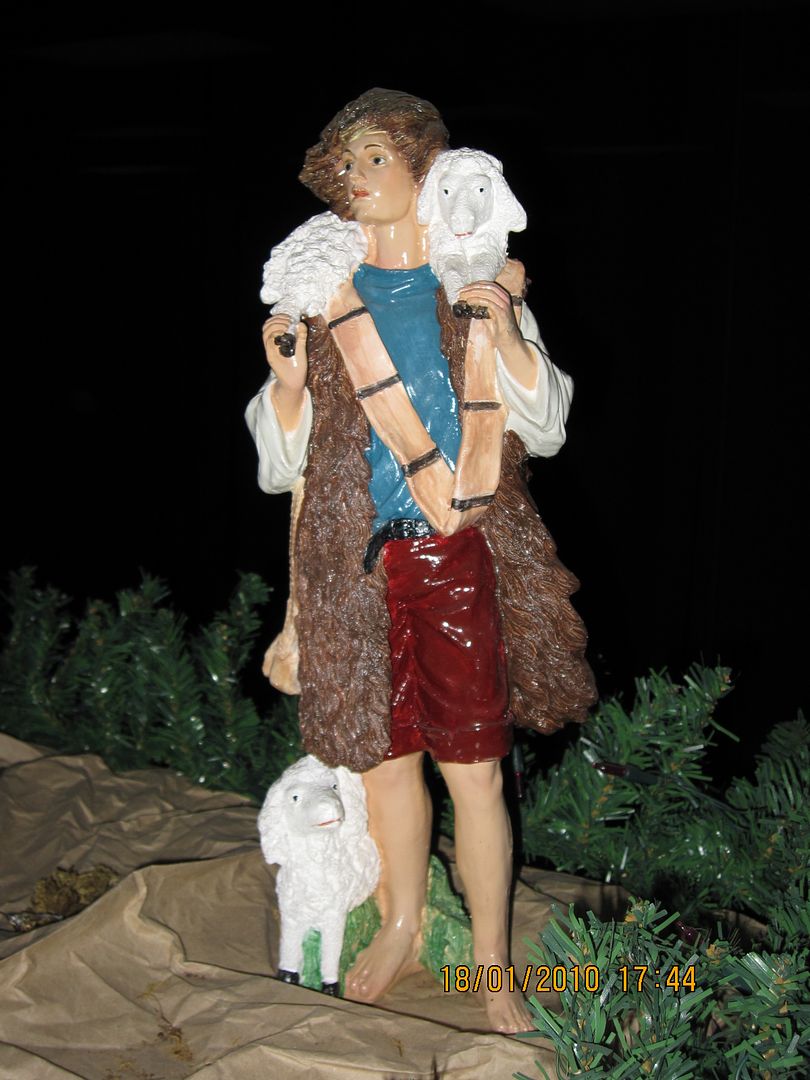
The Christmas season having just ended when I visited, I should have expected (but did not) to still see a tabletop Nativity tableau, which Louie will probably keep fully-decked-out all the way till Lent. 
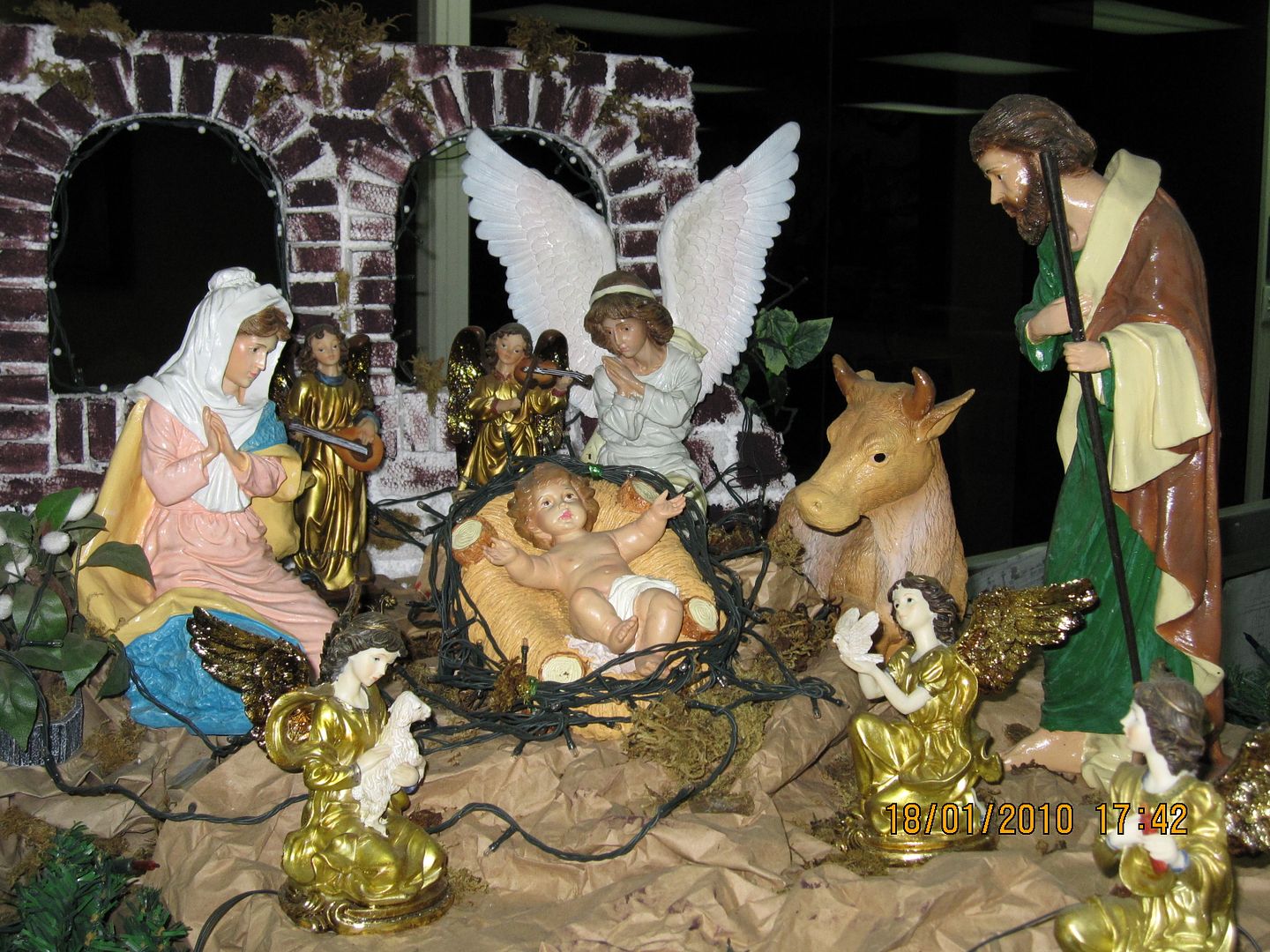

As the tableau included the full retinue of characters, e.g. wise men,


and shepherds

and animals,
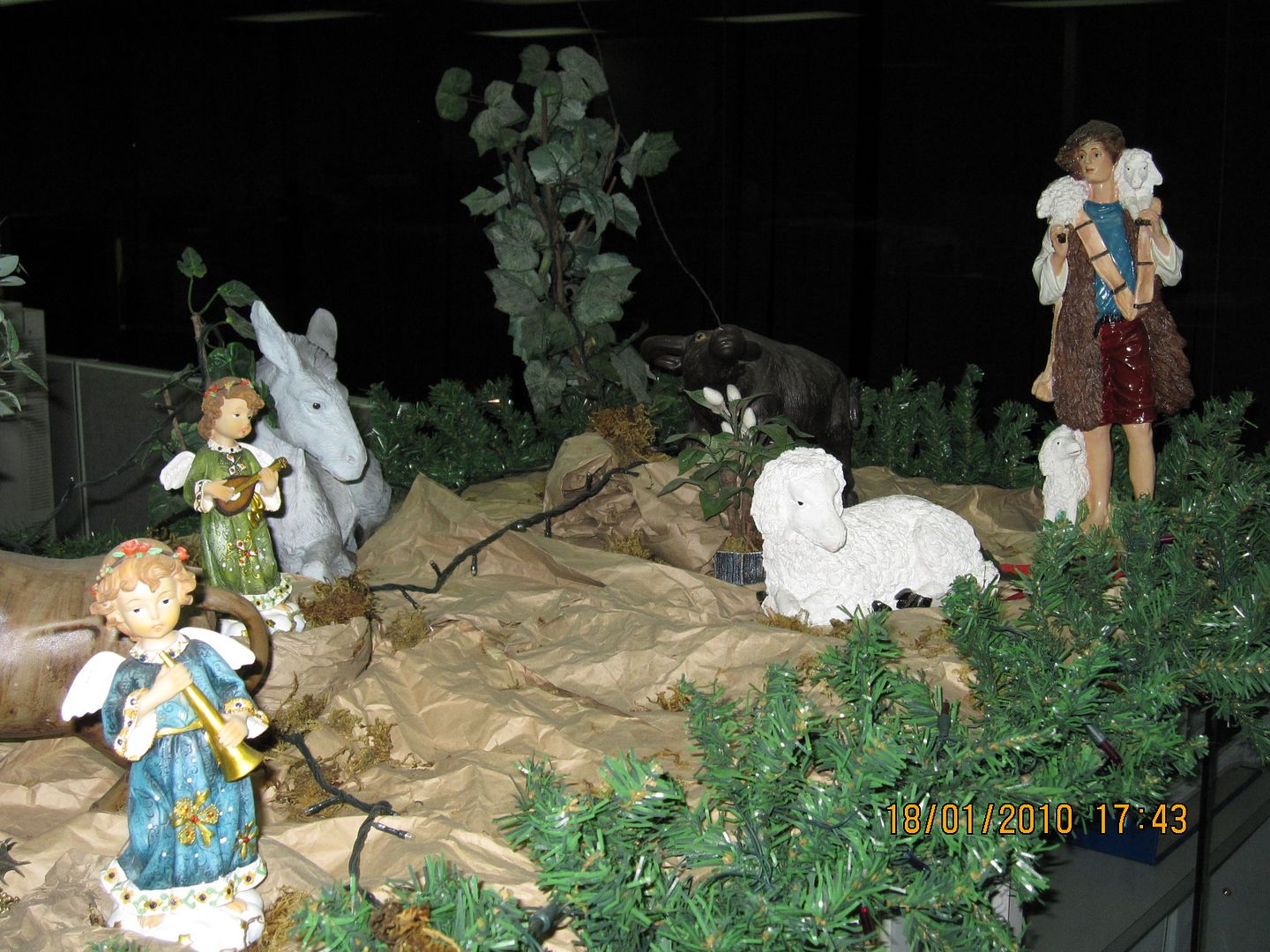

Louie’s solution to finding space for everyone involved setting it up lengthwise above and across several filing cabinets that bisected the office’s open area.
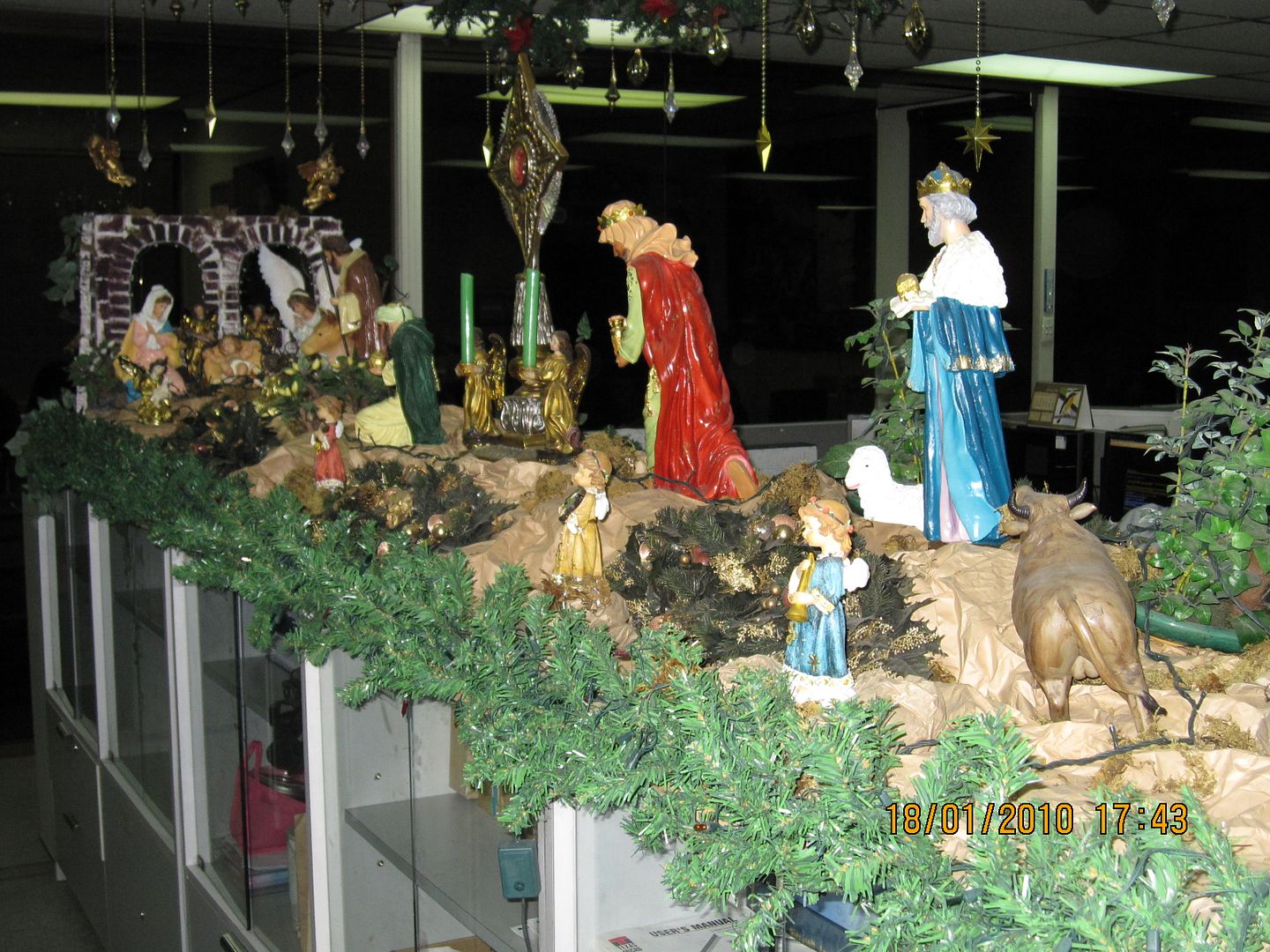

Not only did this set-up manage to accommodate everyone, but it also allowed Louie to employ a monstrance-like object to represent the Star of Bethlehem
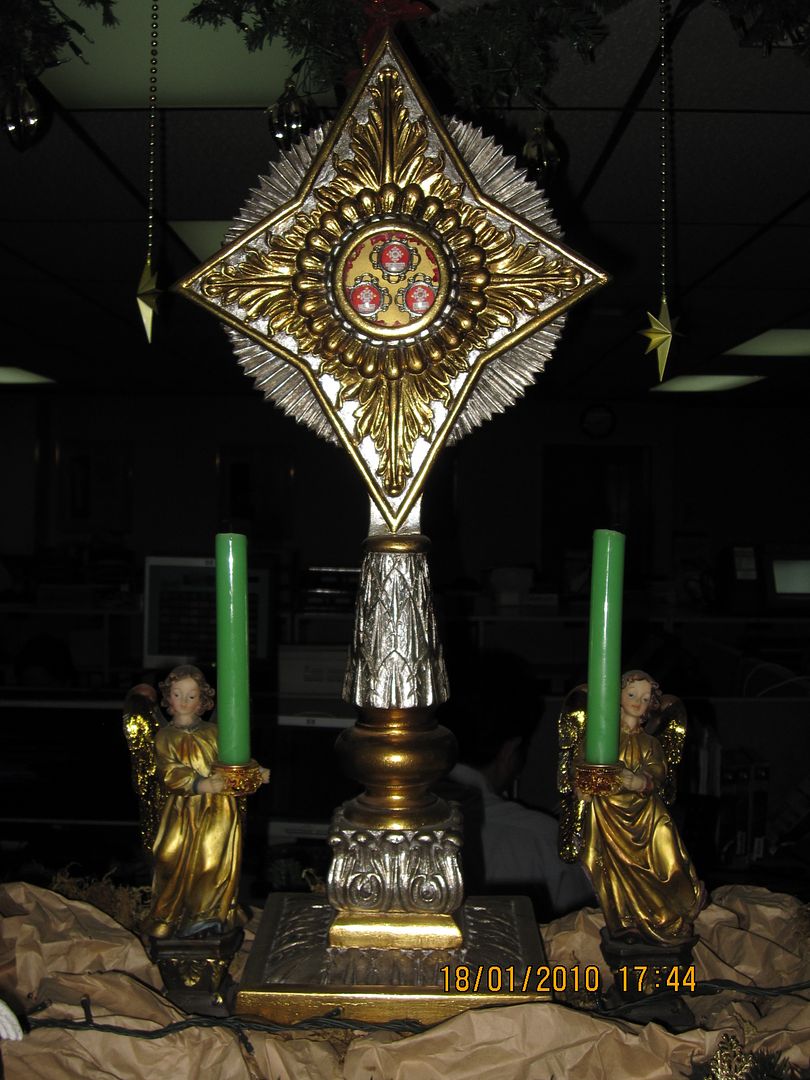

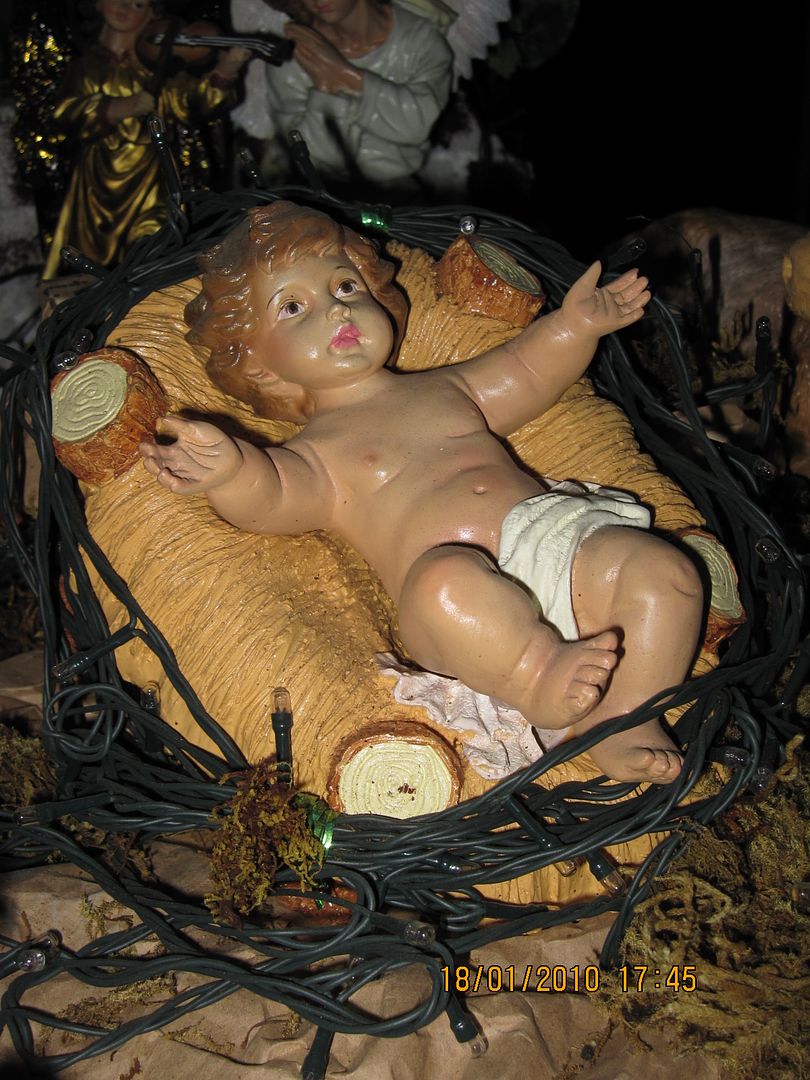
which totally overwhelmed the Child in the manger.

Office hours being over, we next headed off to Louie’s residential apartment elsewhere in the city. 
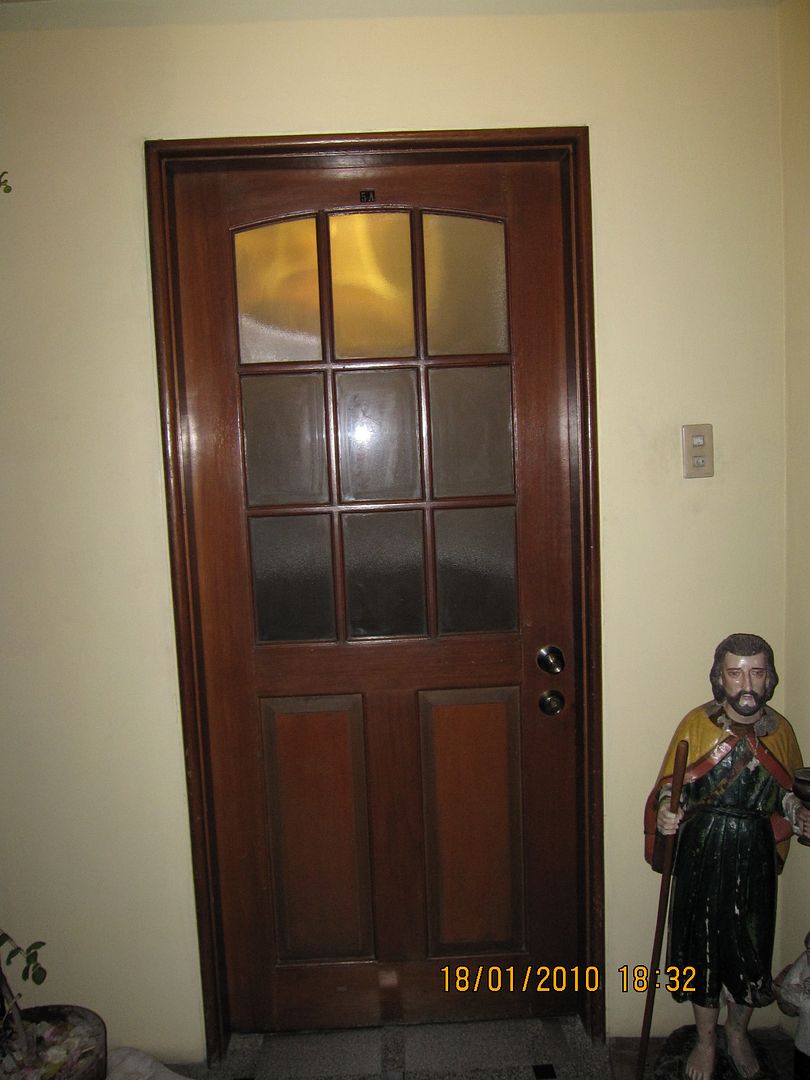

Unsurprisingly, the entrance was guarded by a santo.
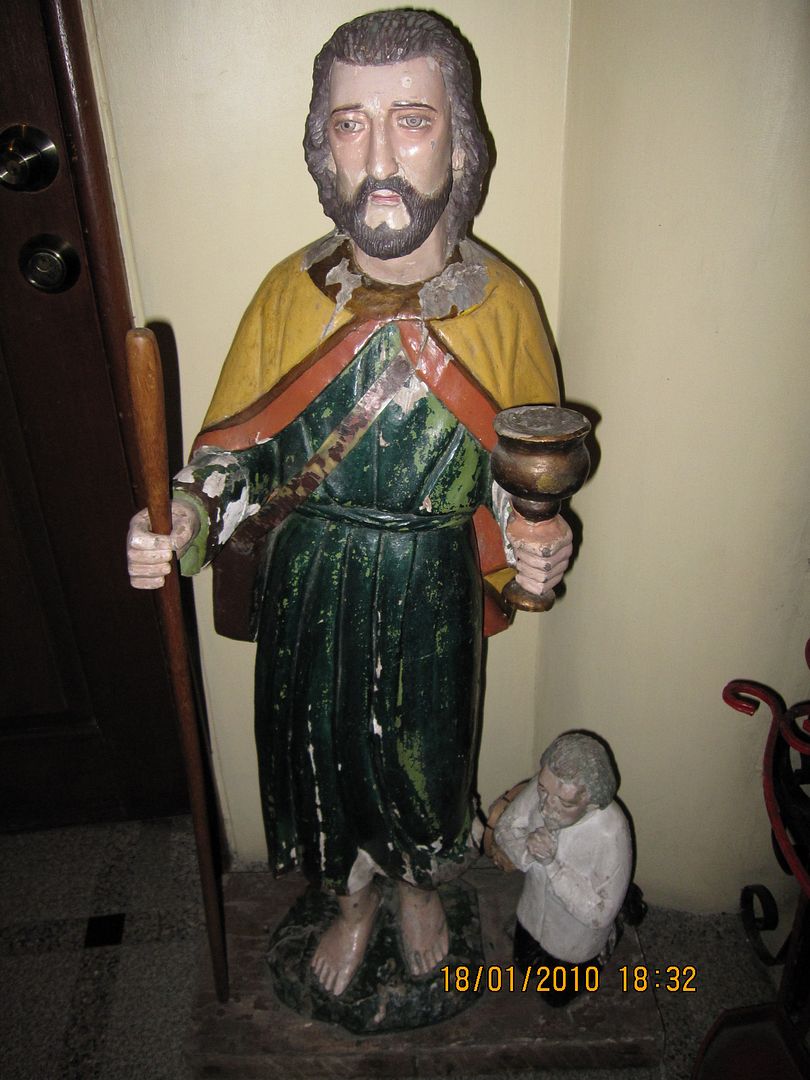

He did clarify that while the apartment was indeed residential, he did not actually live there.  Remembering that he was a santo addict, I just about figured out what was really going on.  And when I saw this cabinet packed with disembodied heads
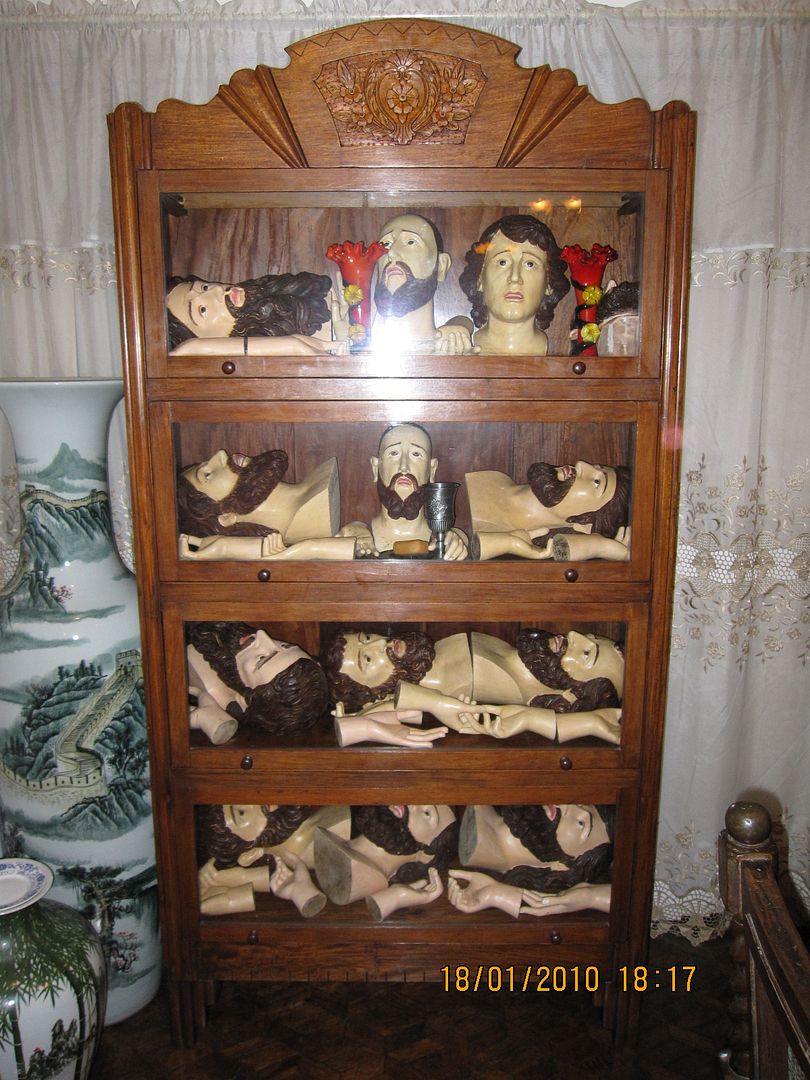

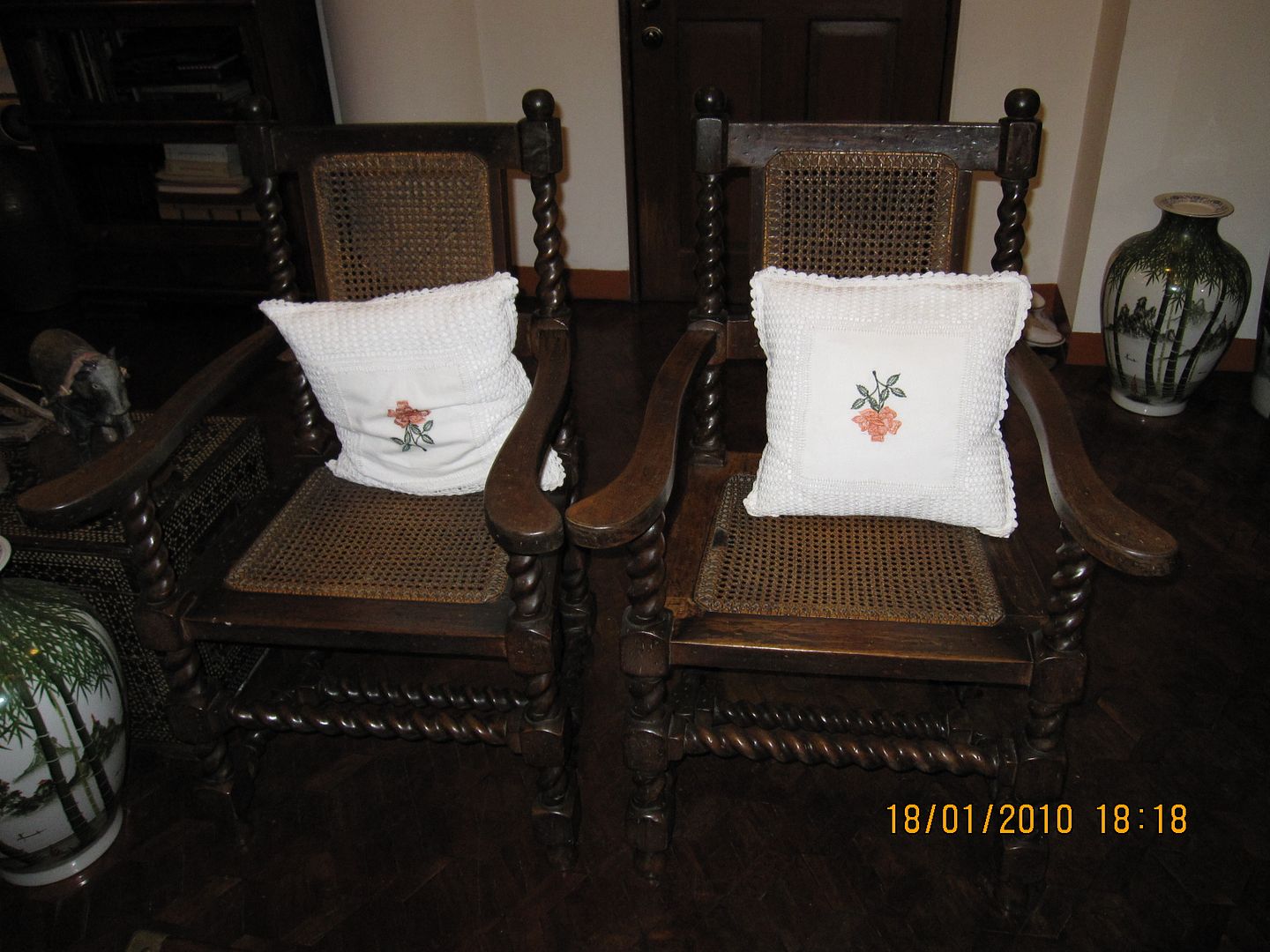
I realized that the residents were not living humans but yet more santos.  Therefore human-welcoming and tasteful seating arrangements like these
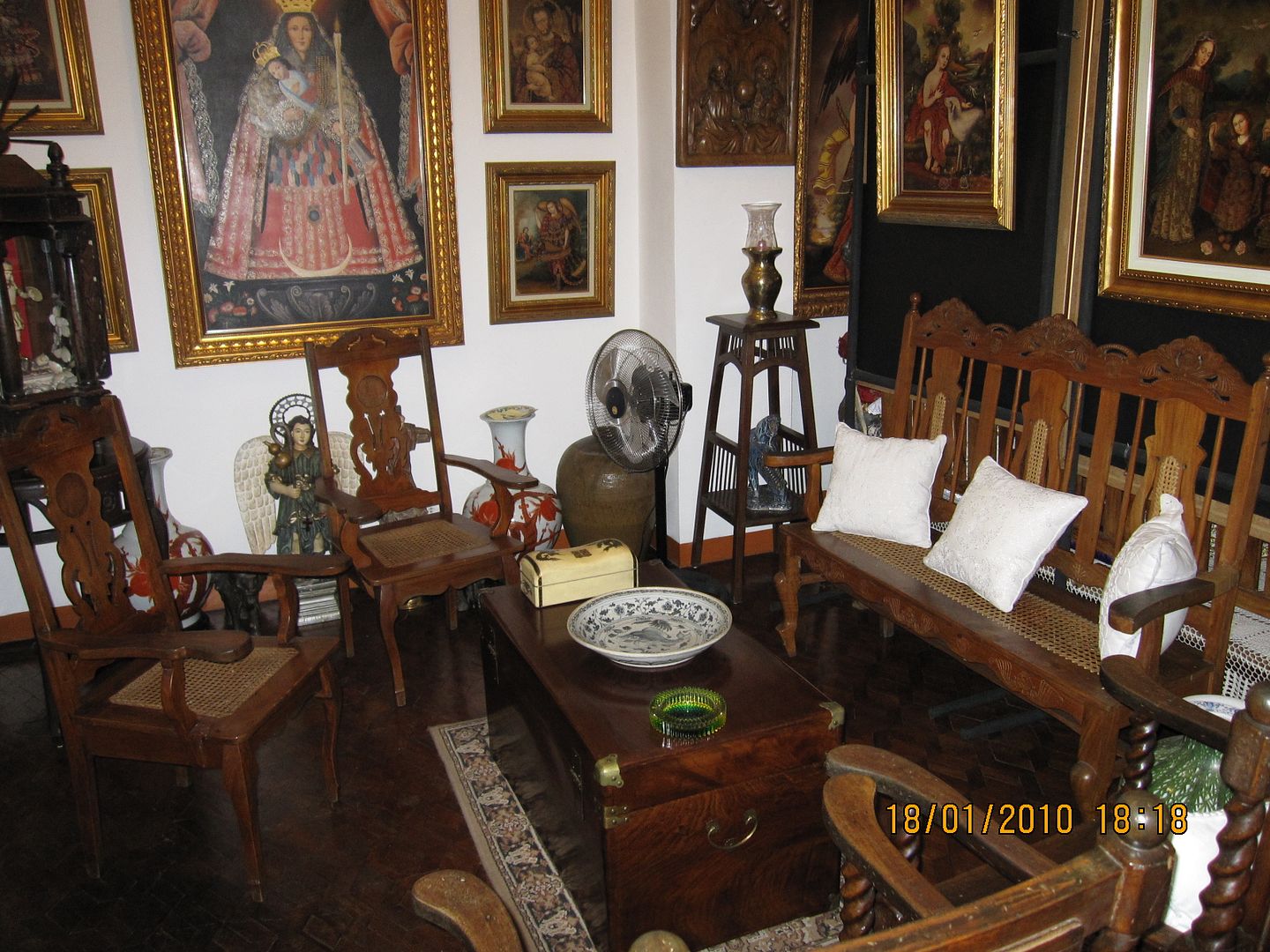


should not fool the visitor, as just out of view is
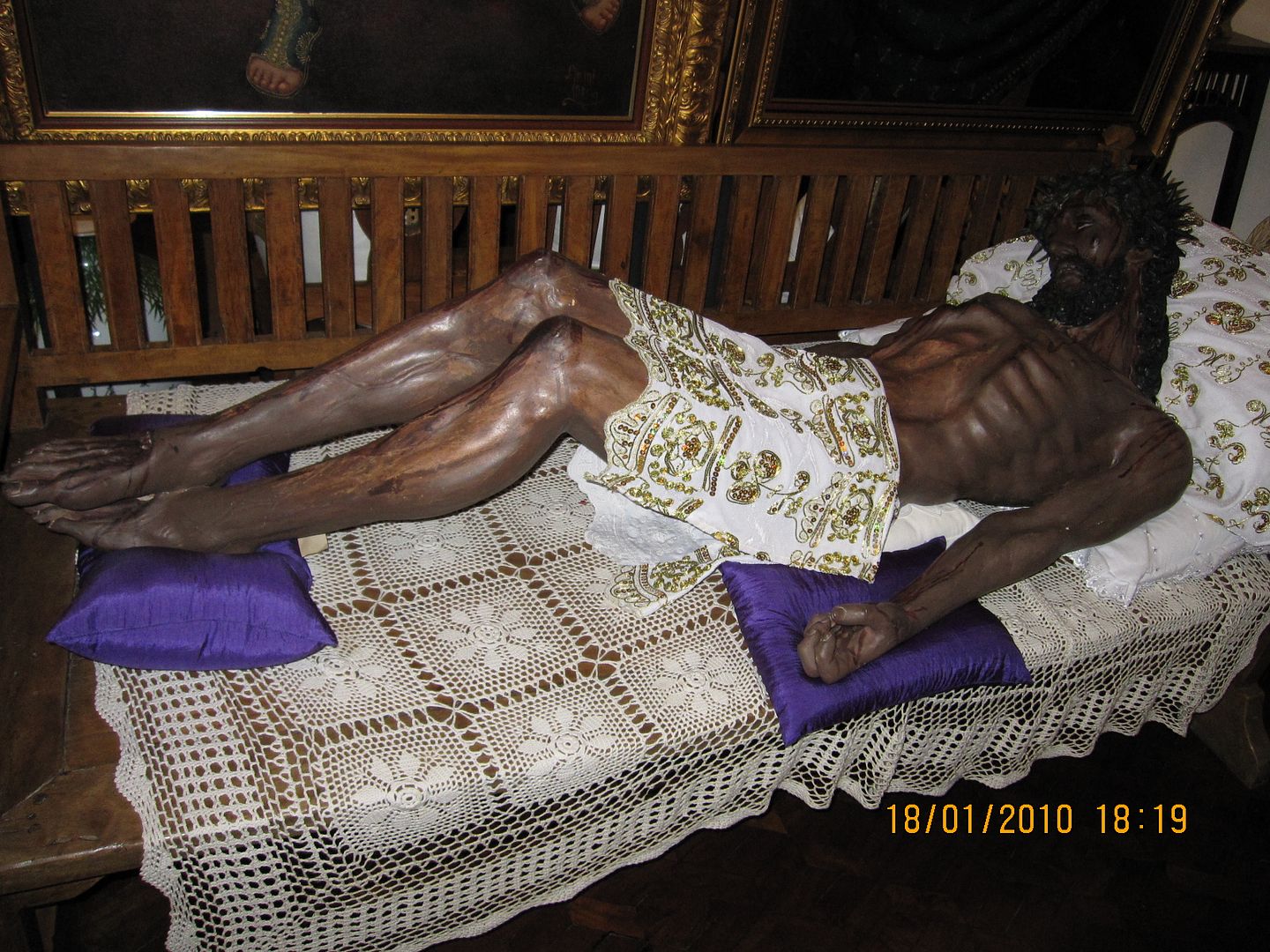

a life-sized Santo Entierro reclined on a daybed.  So much for the nap that I wanted to take on it.

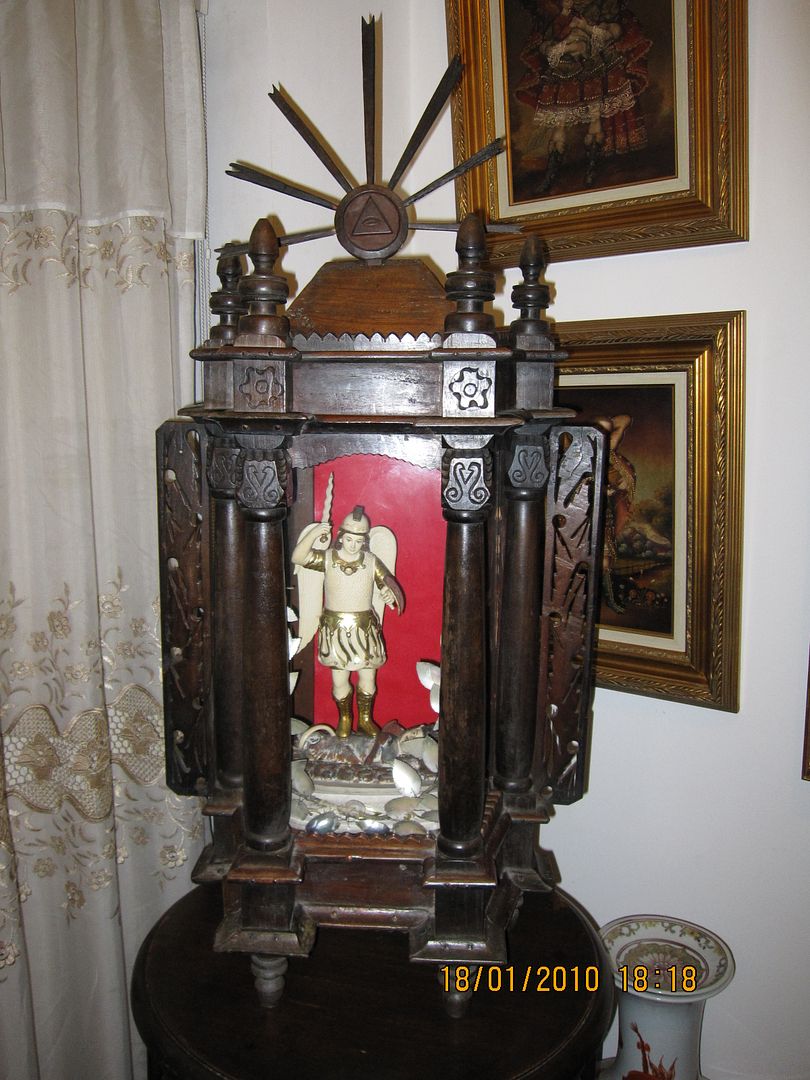
Elsewhere in this apartment was all manner and size of santo art and sculpture, including a small Saint Michael the Archangel in an old urna,

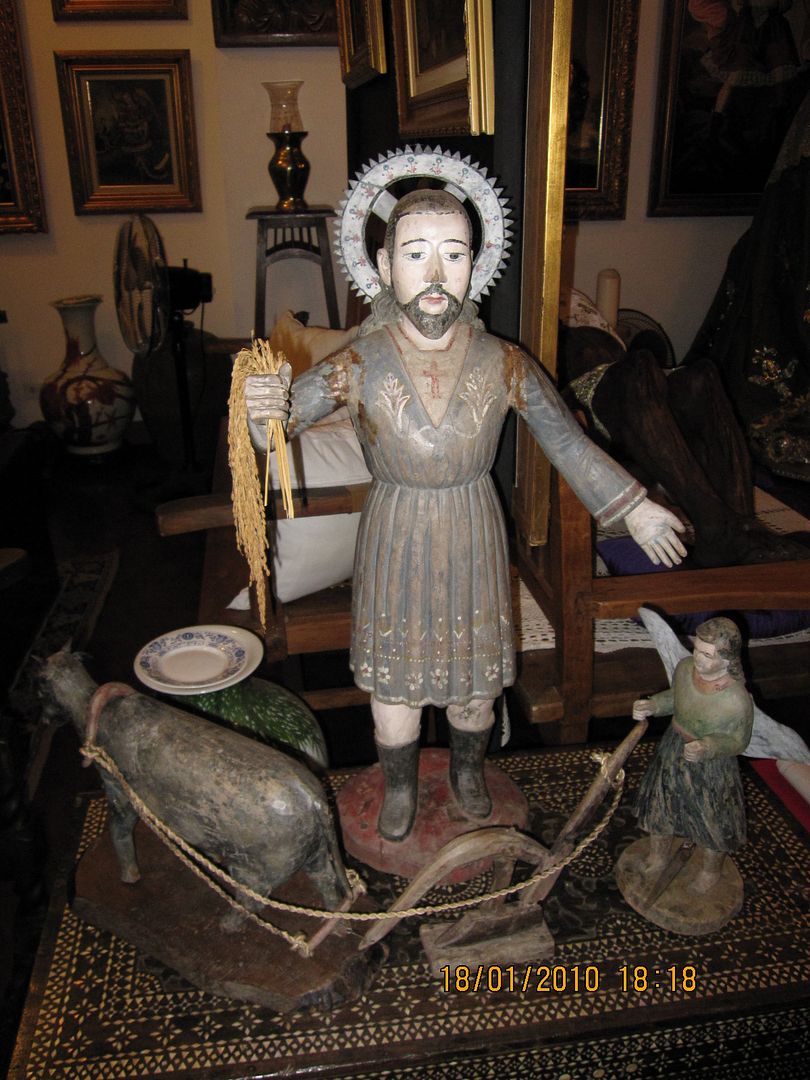
a tabletop ensemble of Saint Isidore the Farmer

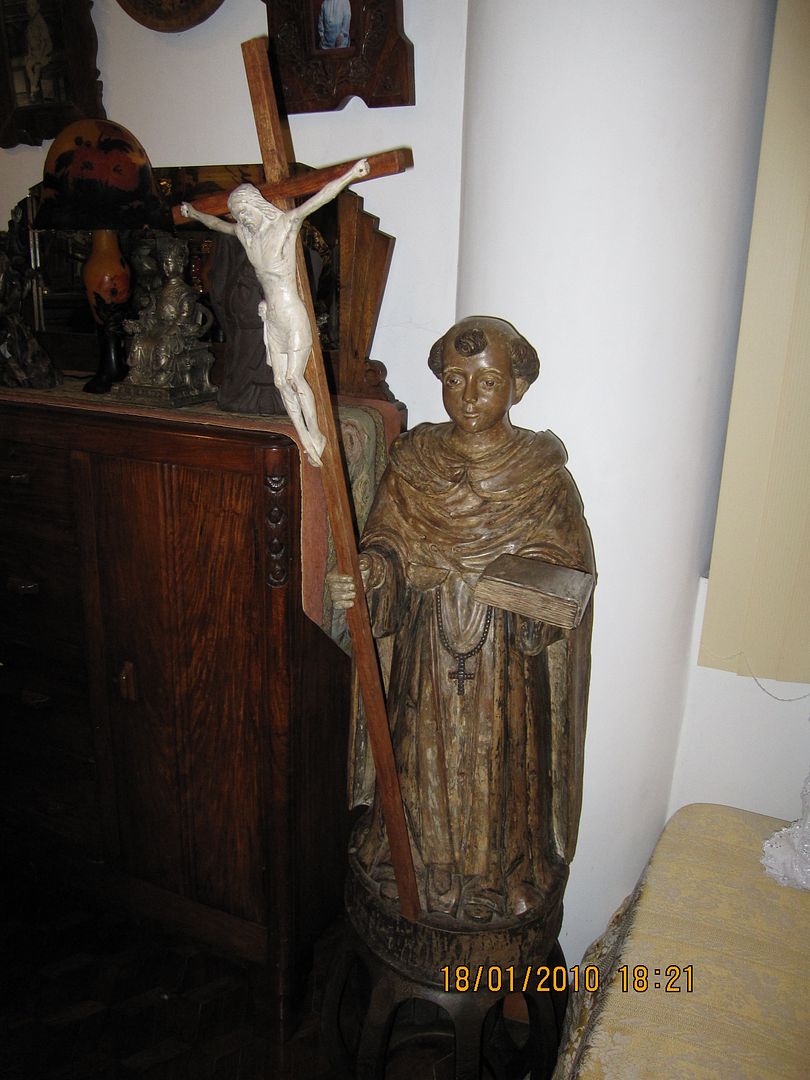
a preacher-saint holding an outsize crucifix

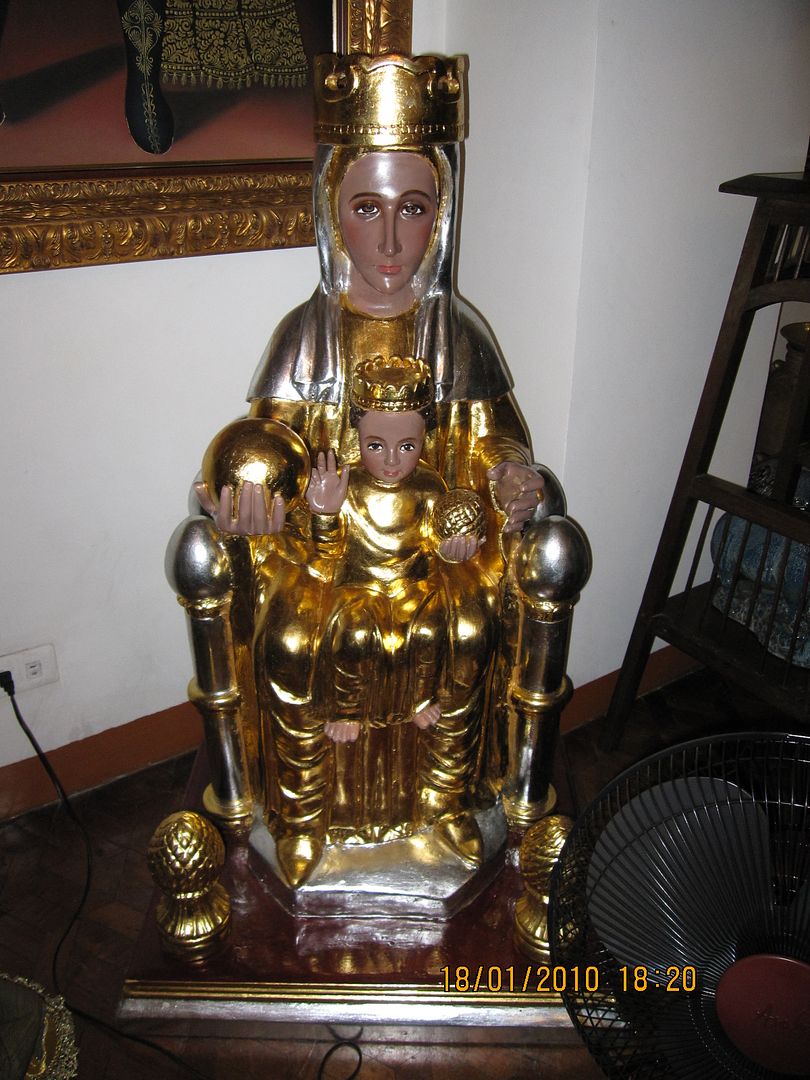
a Gothic-style Virgin and Child (in the manner of, e.g., Our Lady of Montserrat)

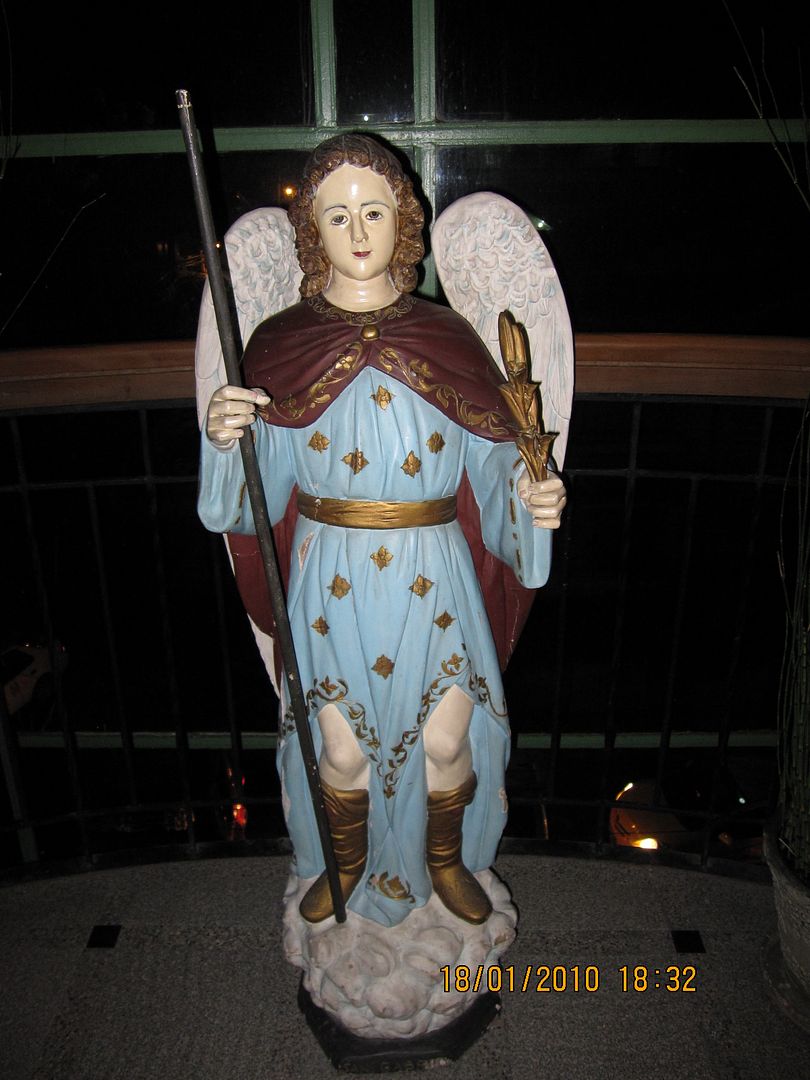
an angel posted on the apartment’s street-facing balcony (no doubt to keep cat-burglars out)

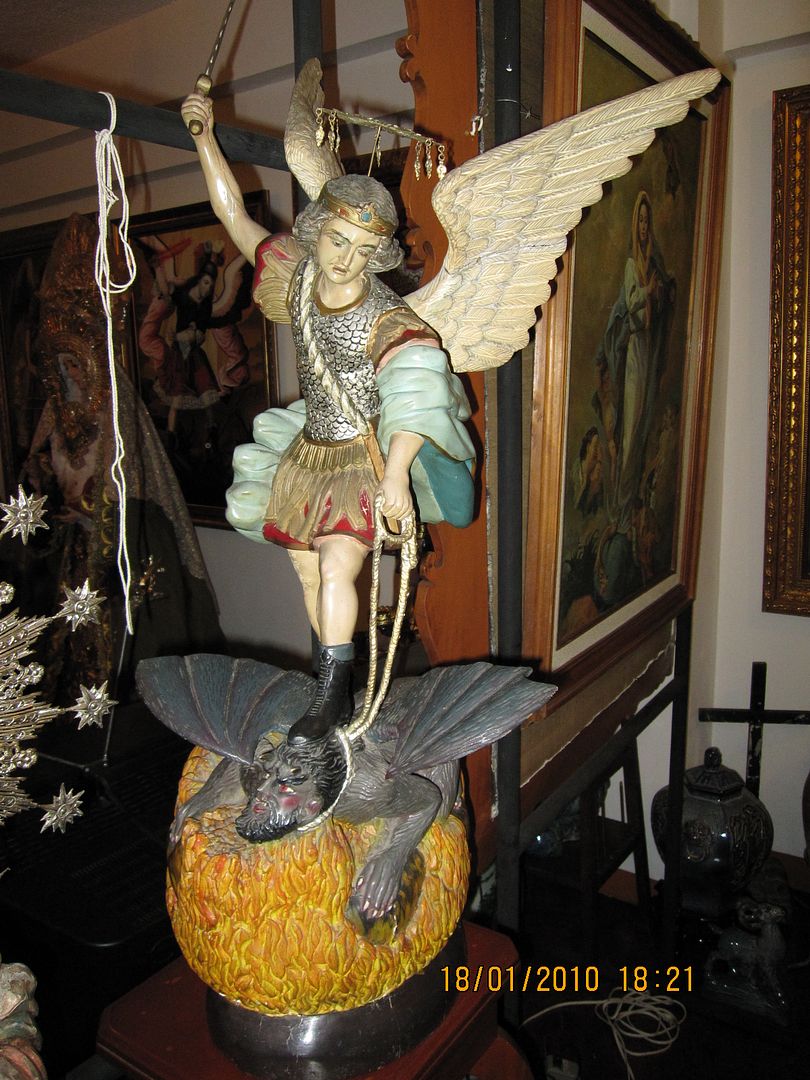
and another Saint Michael the Archangel with a frightful-looking devil underfoot.

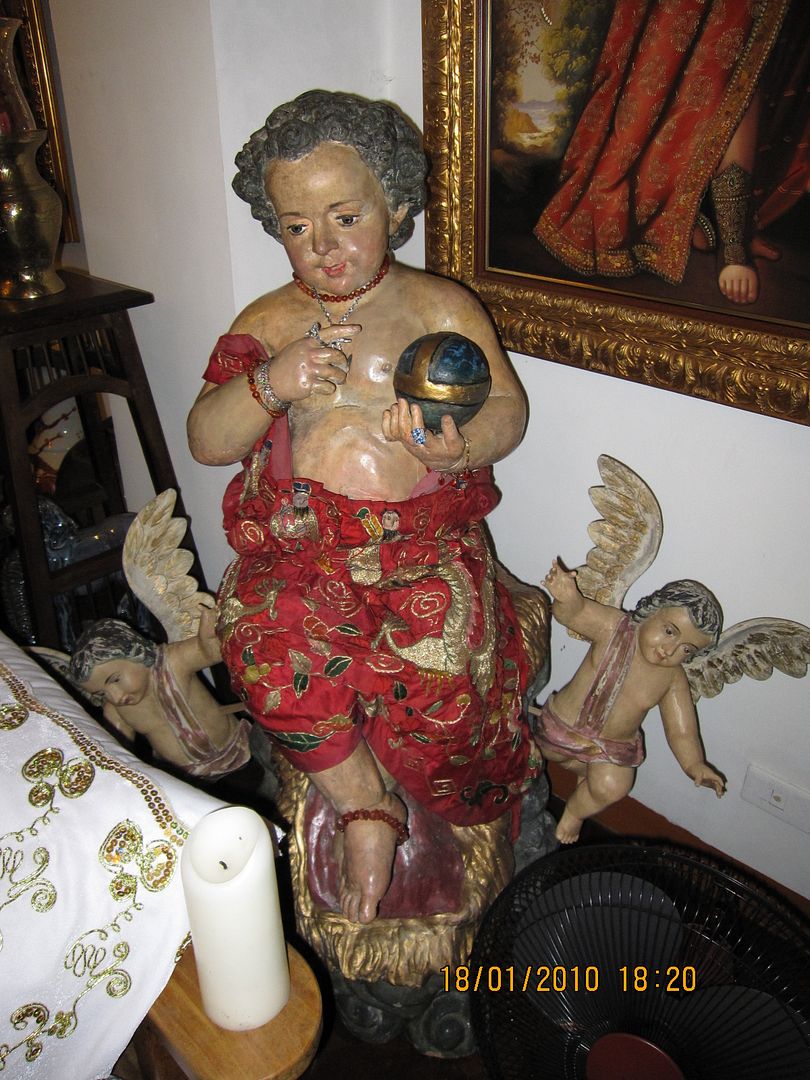
The well-laid-out space in this Cebu apartment allowed for multiple renditions of the Holy Child, including one with supporting angels

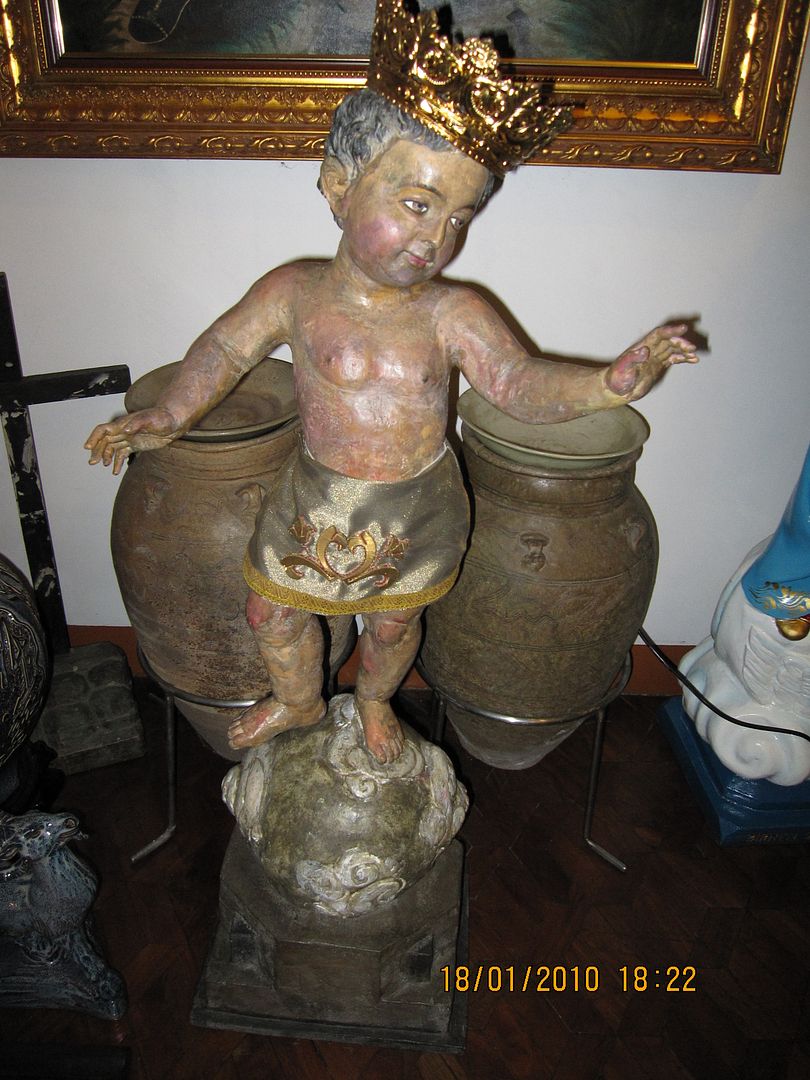
a similar one without but crowned

a more traditional Cebu-Flemish version
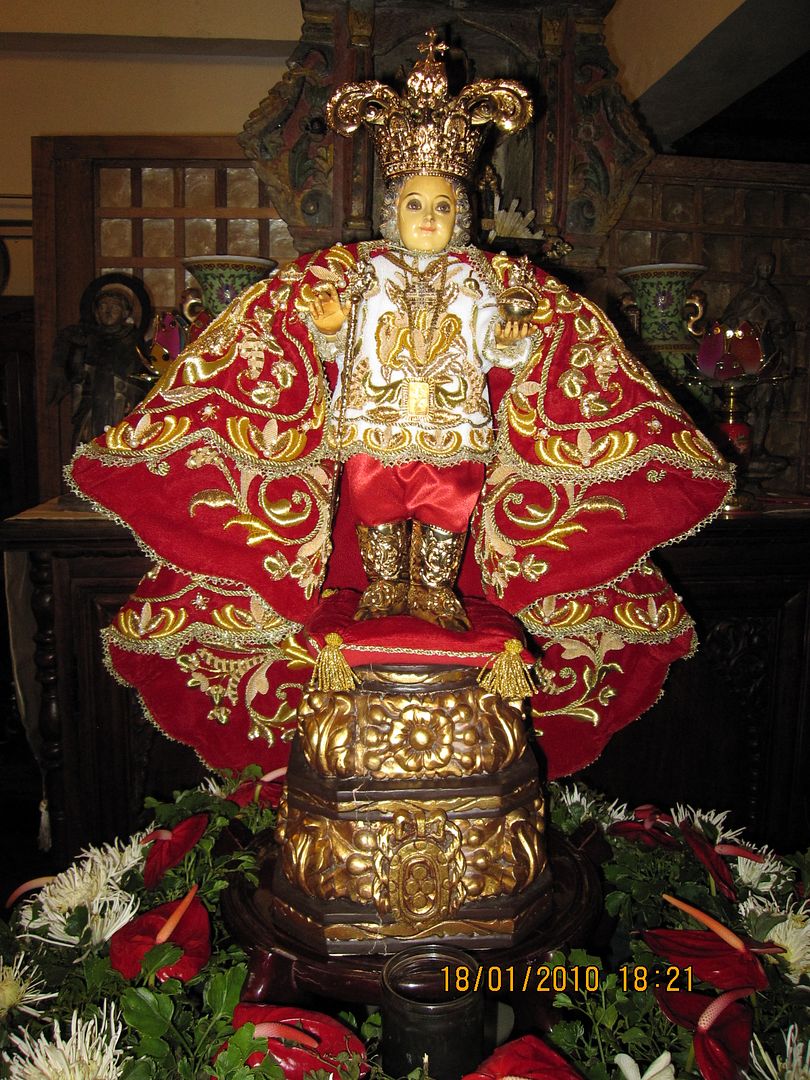

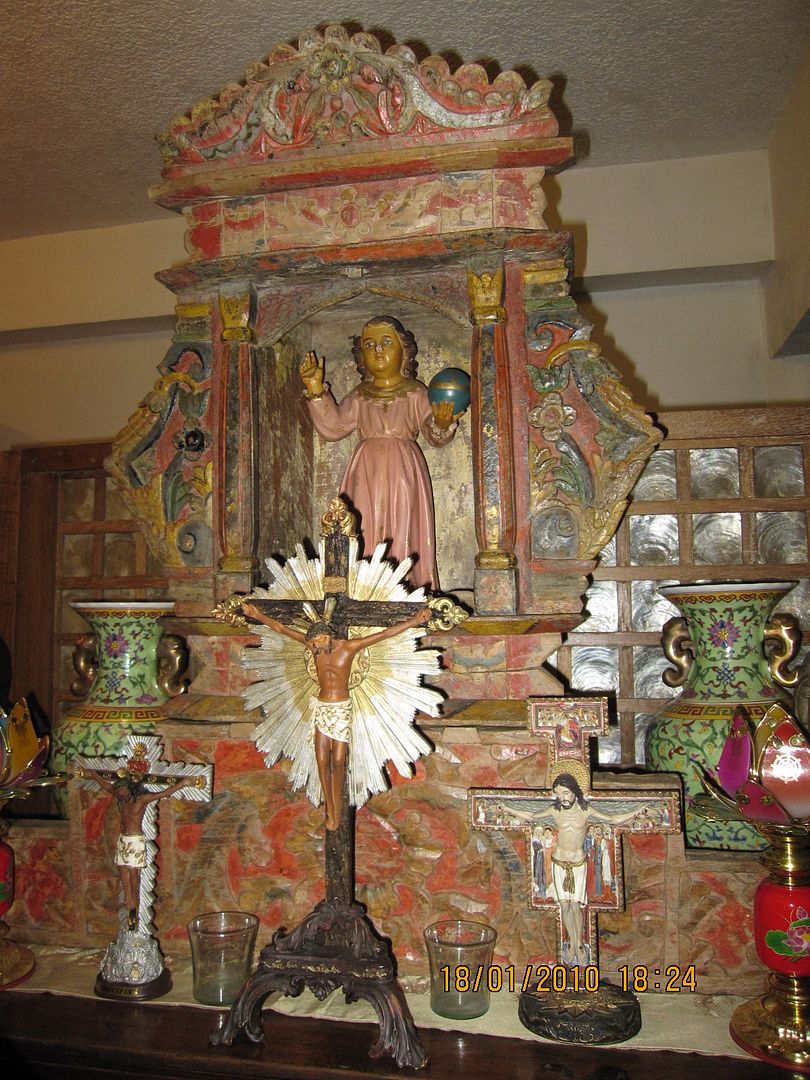
one that was part of folk retablo ensemble

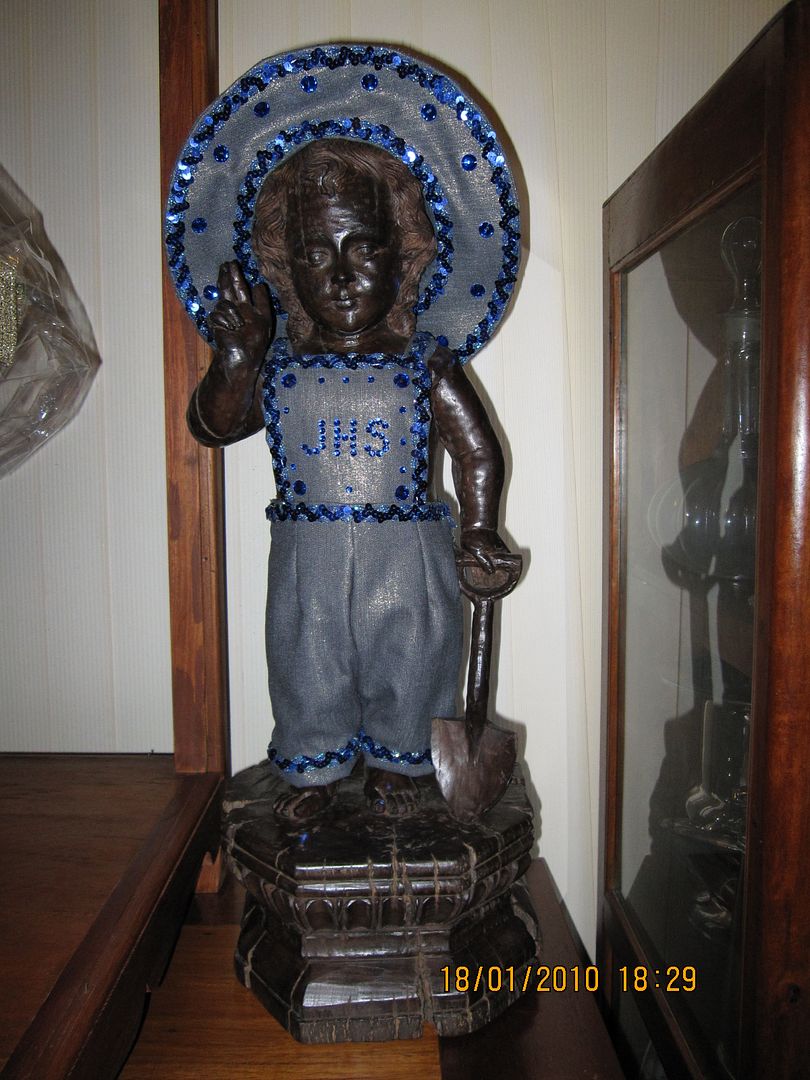
one that held a spade

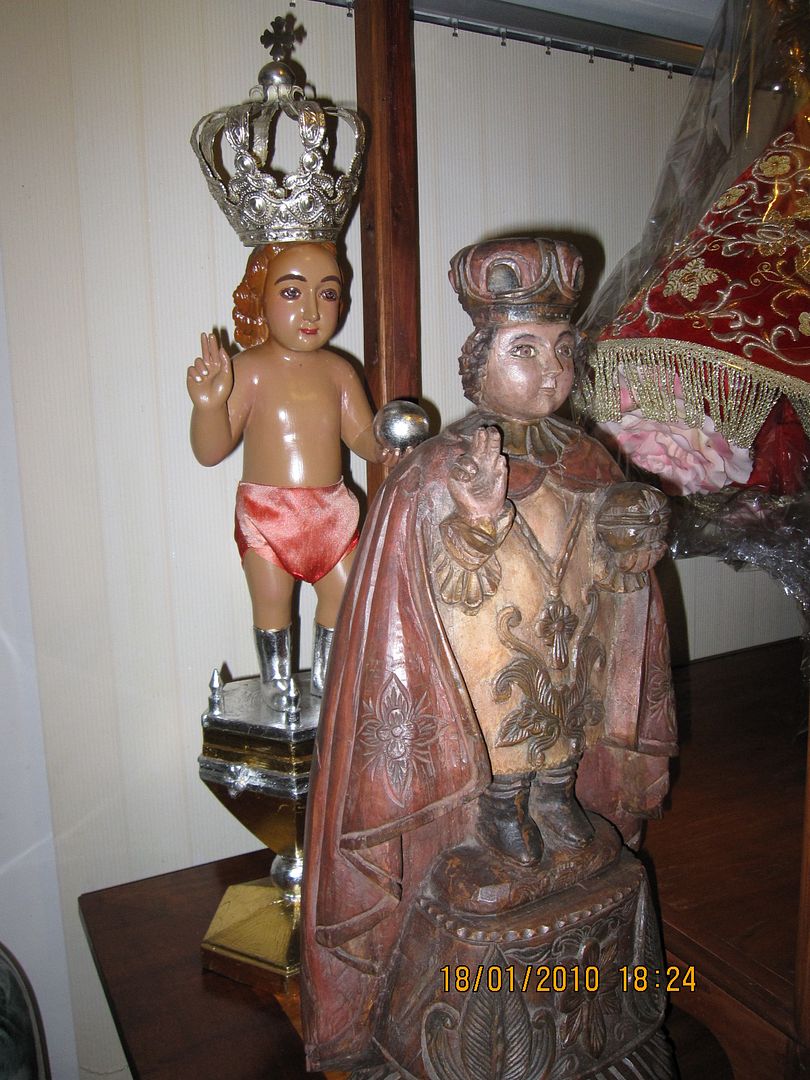
and two more that I had just run out of adjectives for.

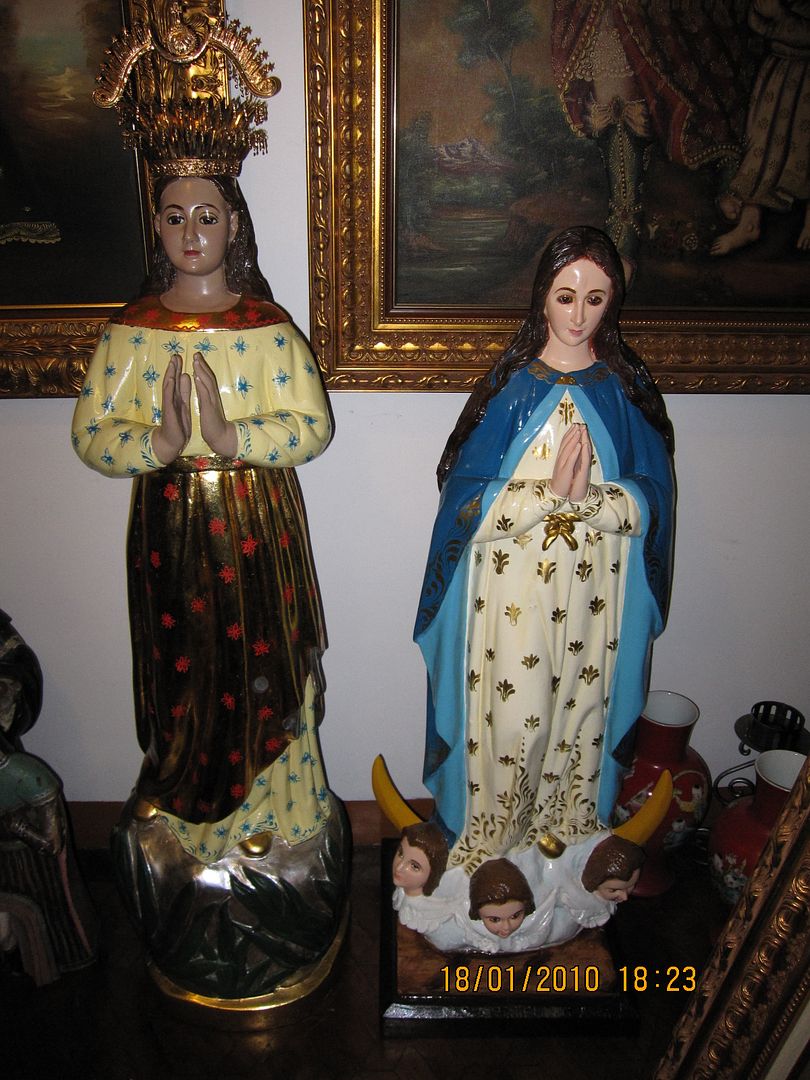
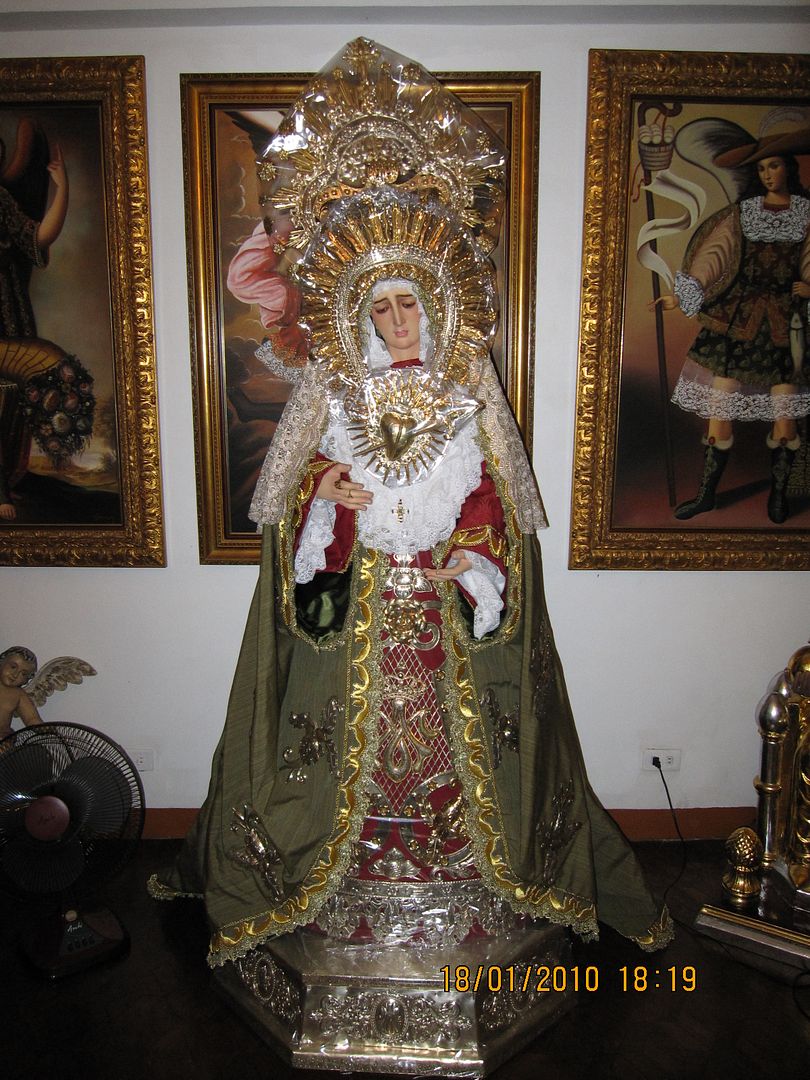
There were practically as many renditions of the Blessed Virgin Mary, in addition to the Gothic-style Mother and Child that we had seen, including a young-looking Immaculate Conception
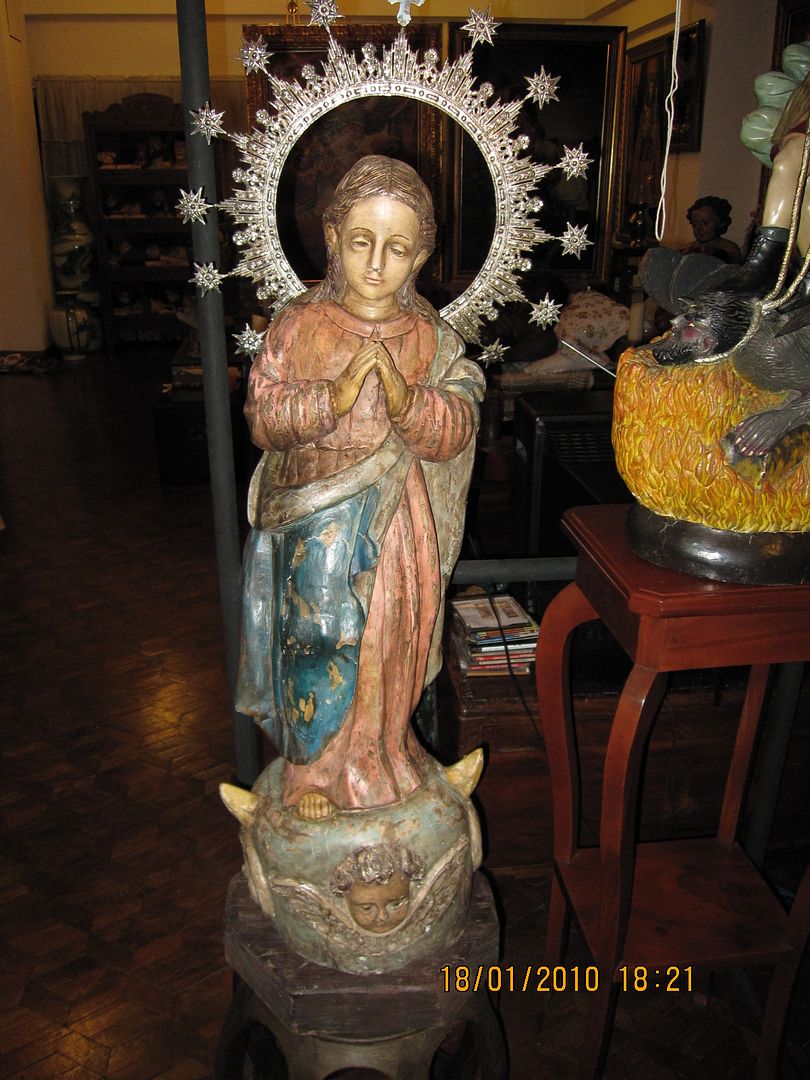

a small image in a wooden urna
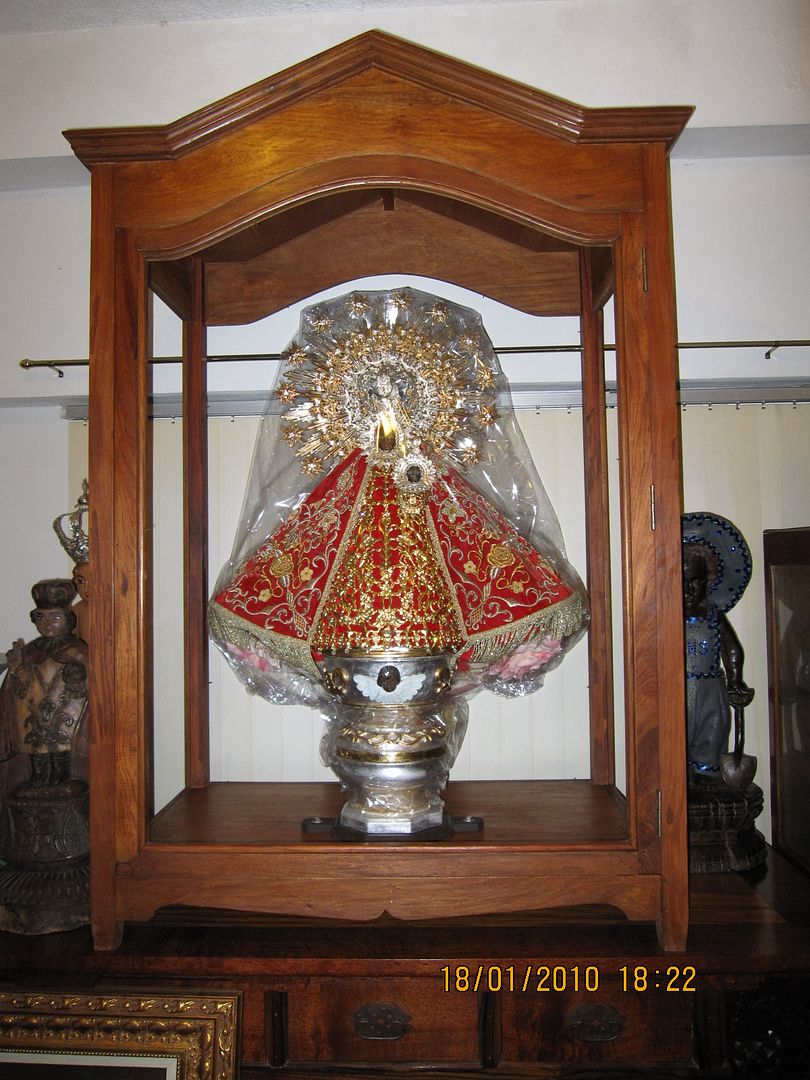

two tabletop-sized versions that might be Our Lady of Remedies and another Immaculate Conception

and a no-nonsense life-sized processional Dolorosa decked out in the Spanish style.

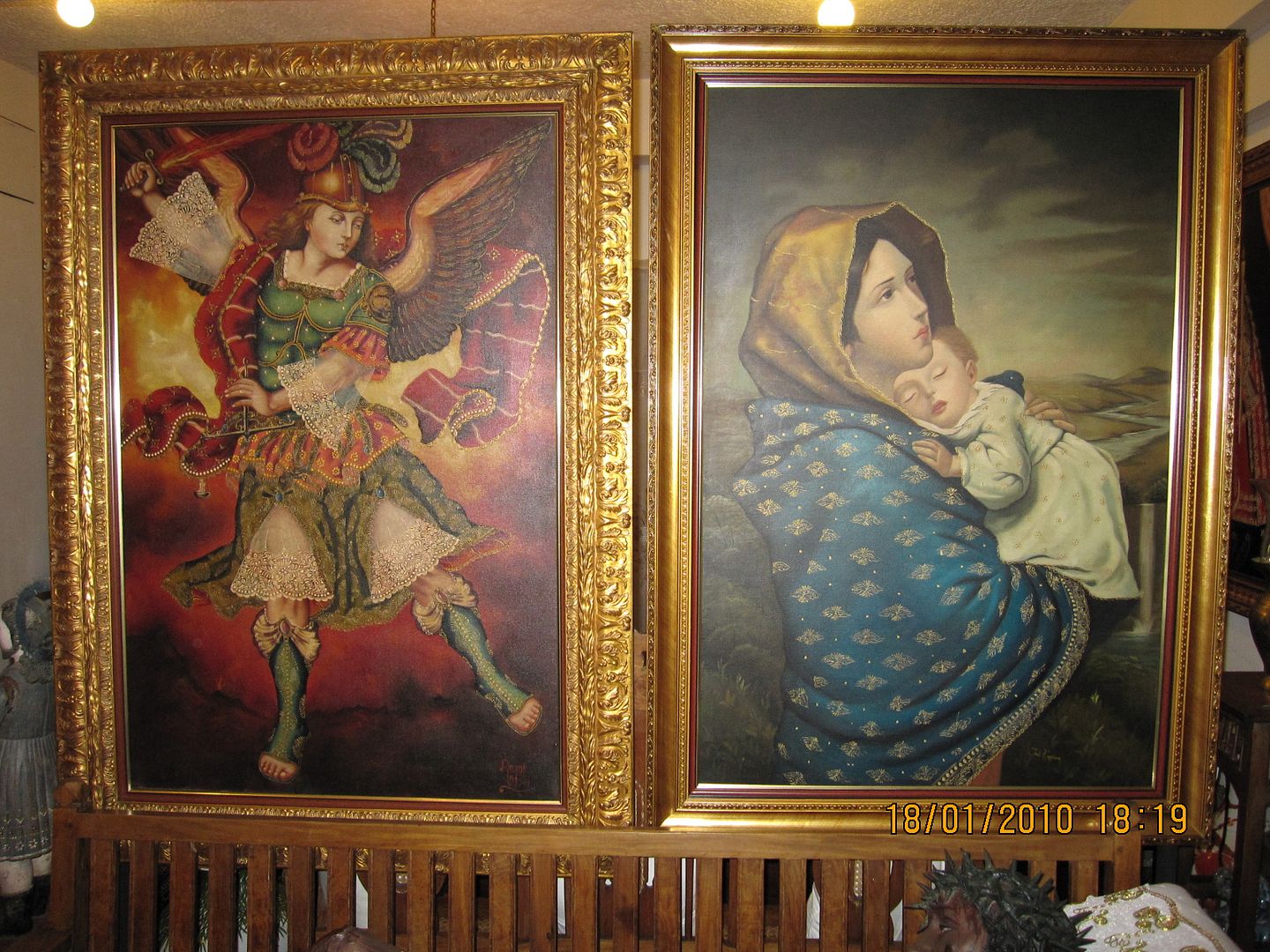
If Louie’s office featured Cuzco-style artwork on its walls, it would be ridiculous if his apartment had hardly any.  Therefore there is even more to be seen here, with three triumphant and joyous angels in various guises
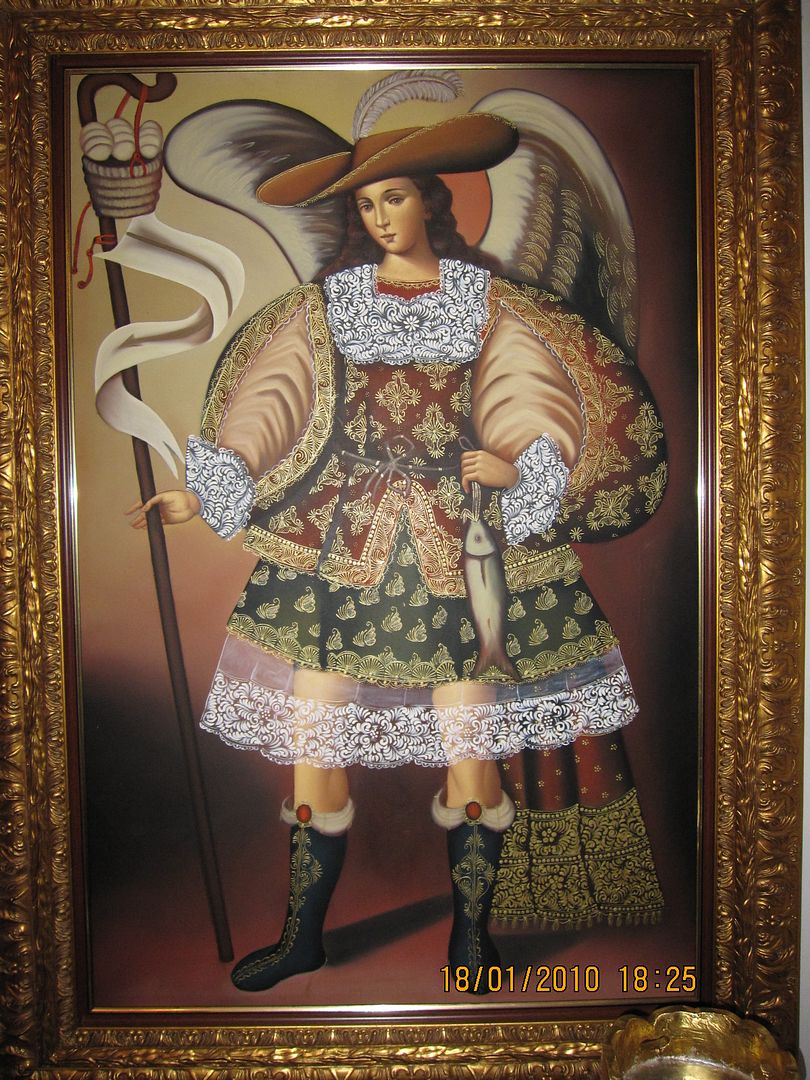


and a fourth one beside a Mother and Child in a not-really-Cuzco style.

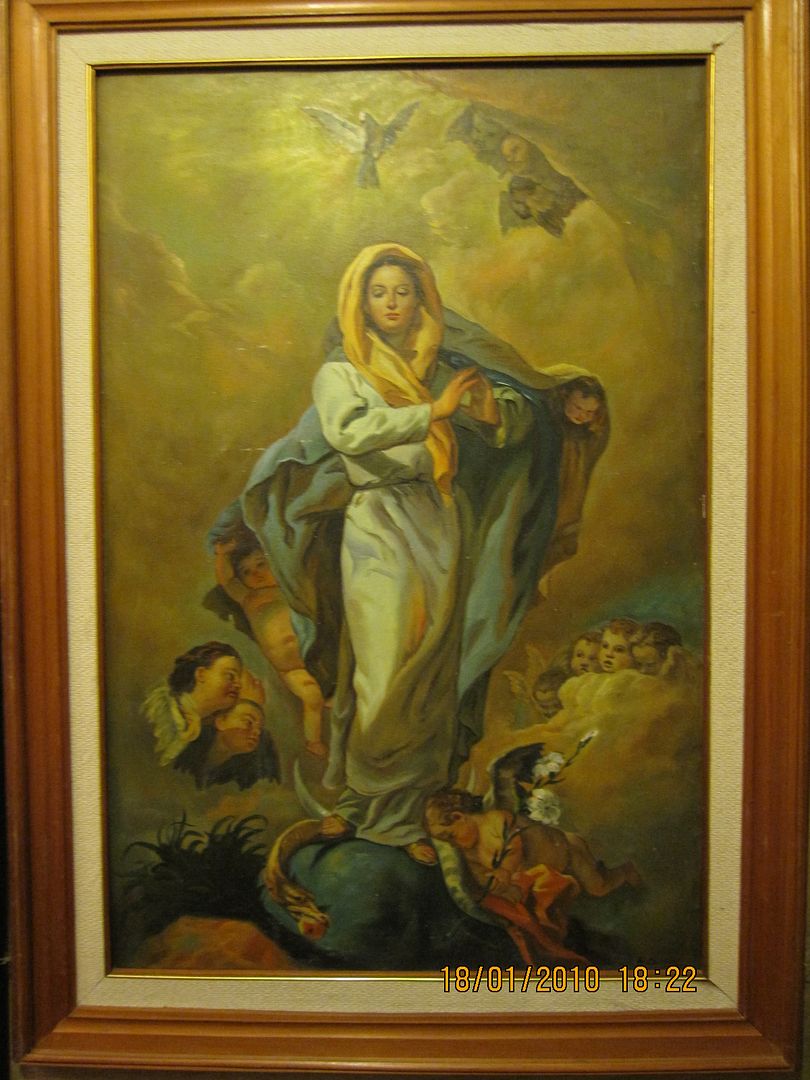
There was also a classical-style Immaculate Conception

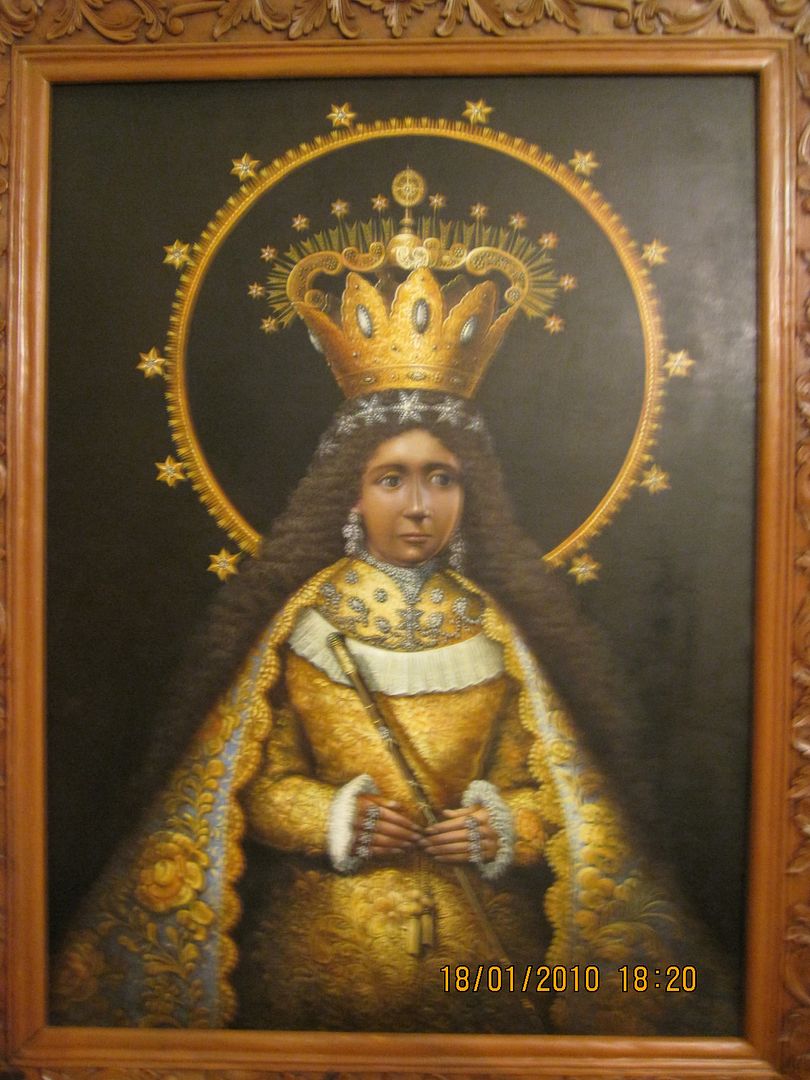
and an Our Lady of Antipolo

The wooden relief art form was represented by this combative horseman – was it Saint James? –
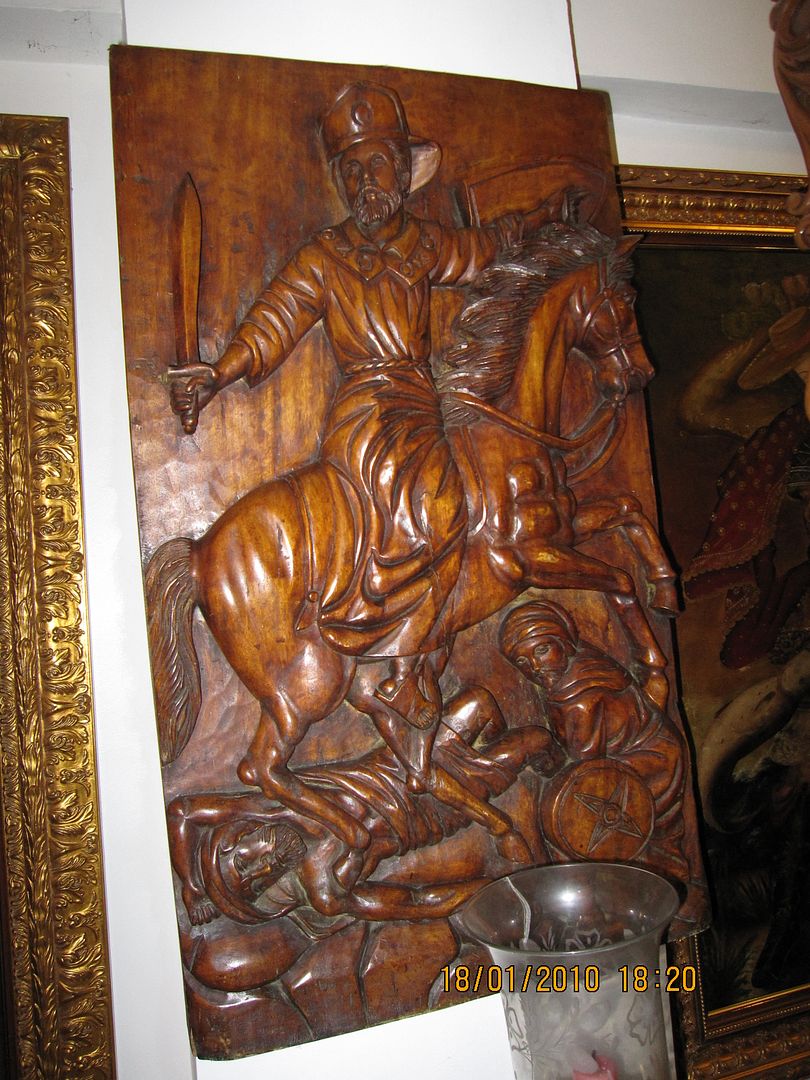

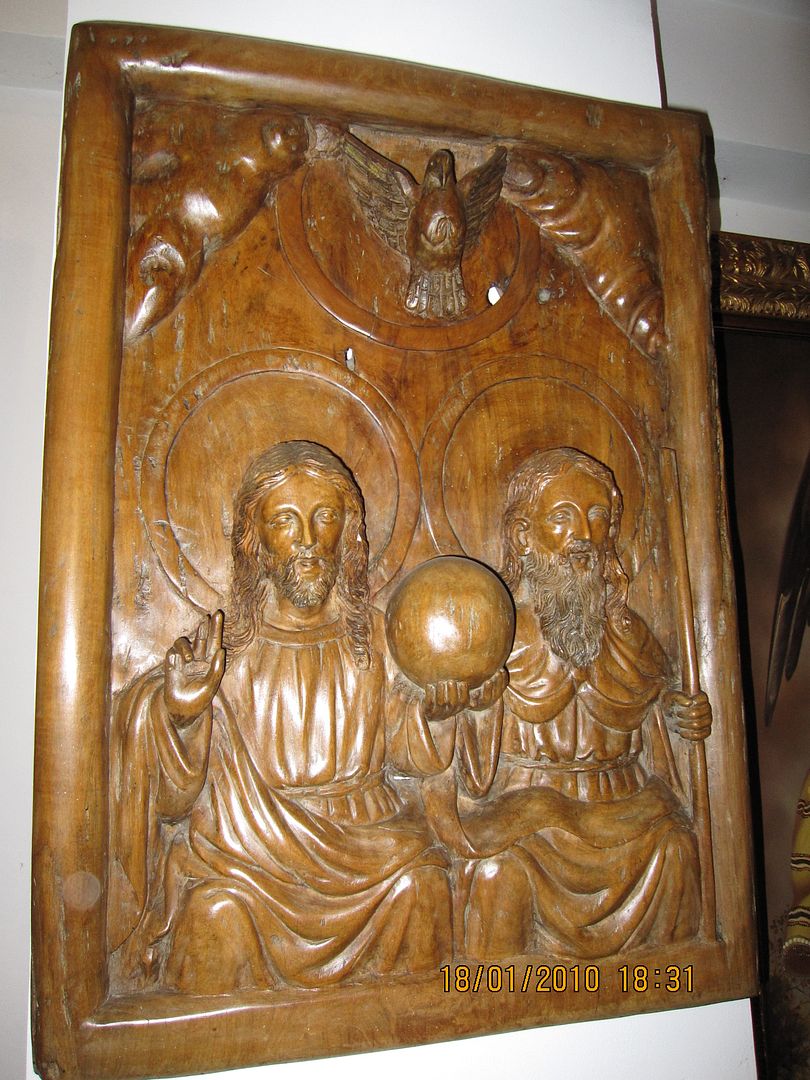
and a folk rendition of the Holy Trinity.

Apart from the seating that we saw at the start of this visit, Louie’s apartment also had other pieces of furniture in the same antique Filipino style, including barrister-style 1930’s bookcases filled with books
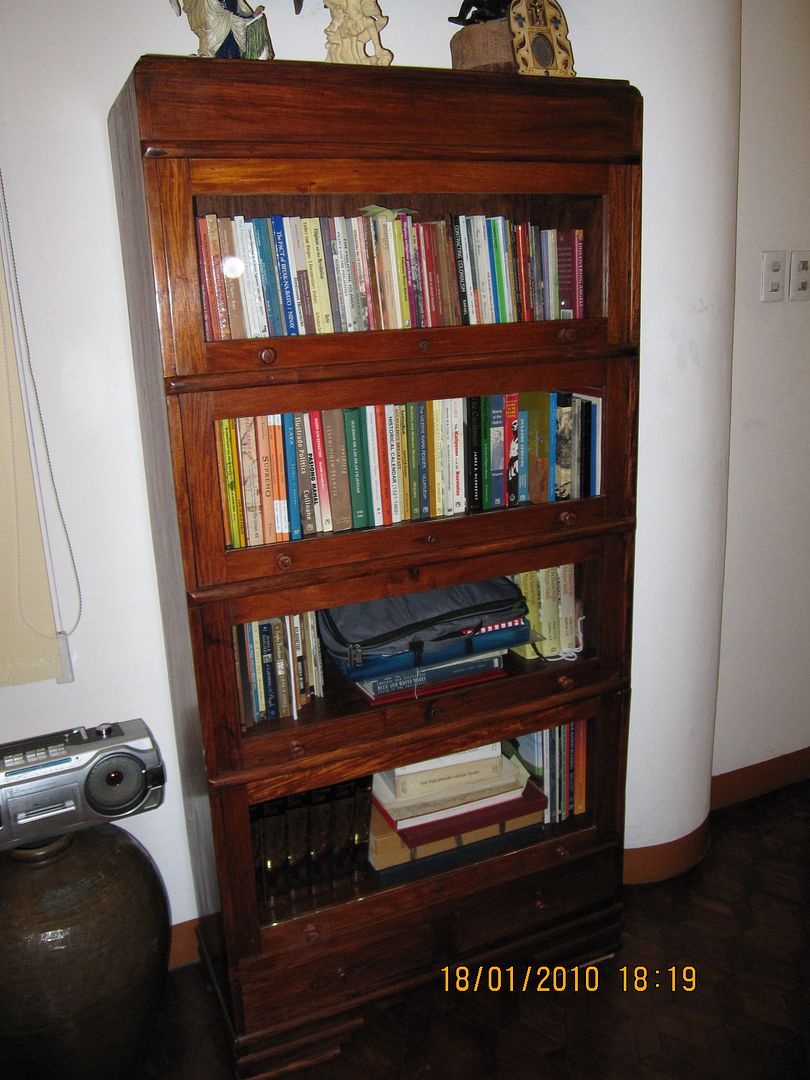

and non-books
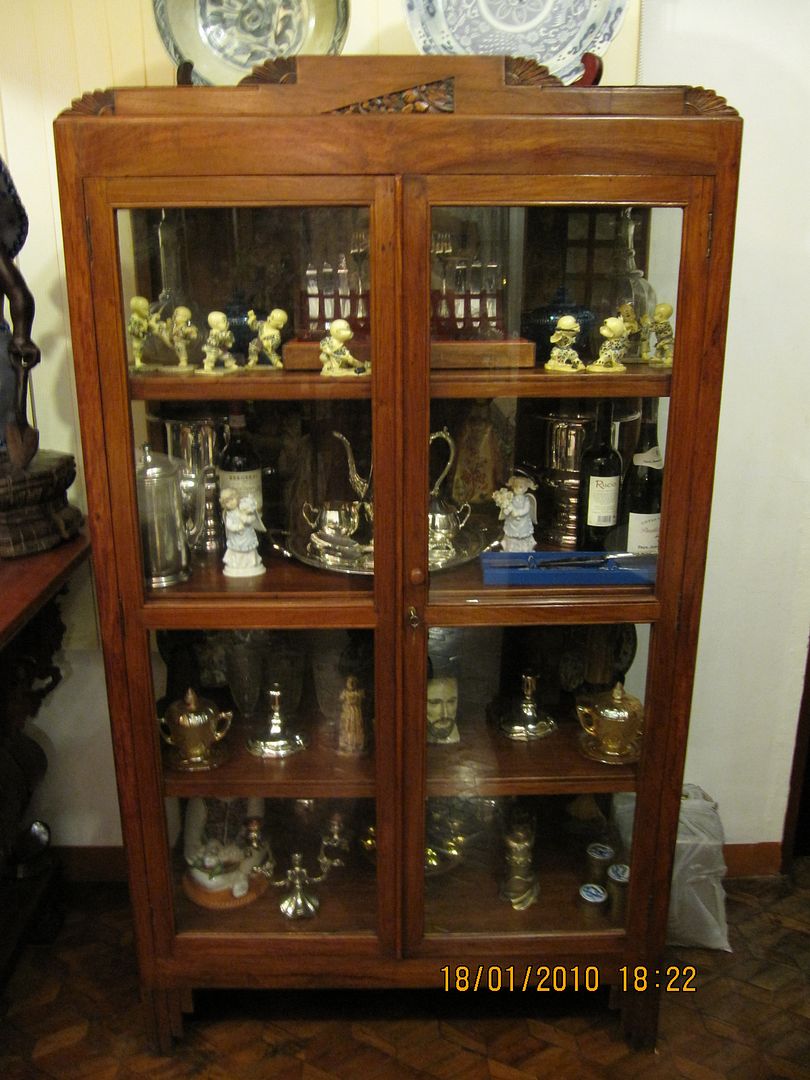

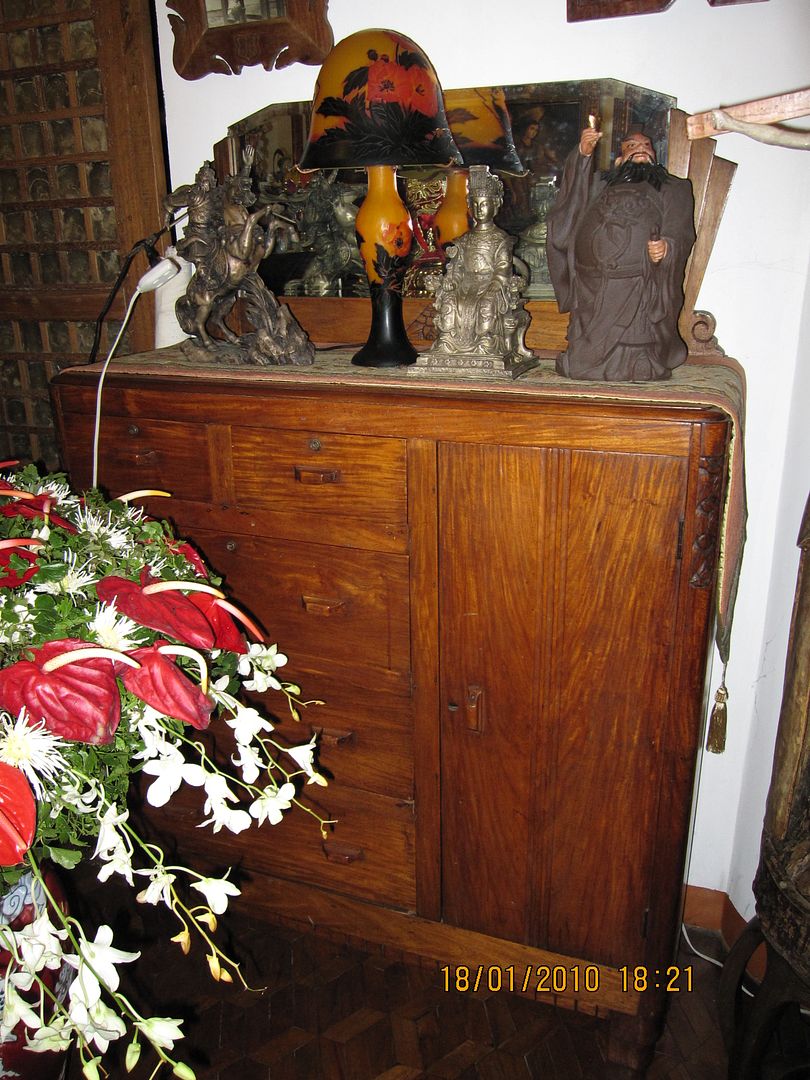
and a sideboard of the same period.

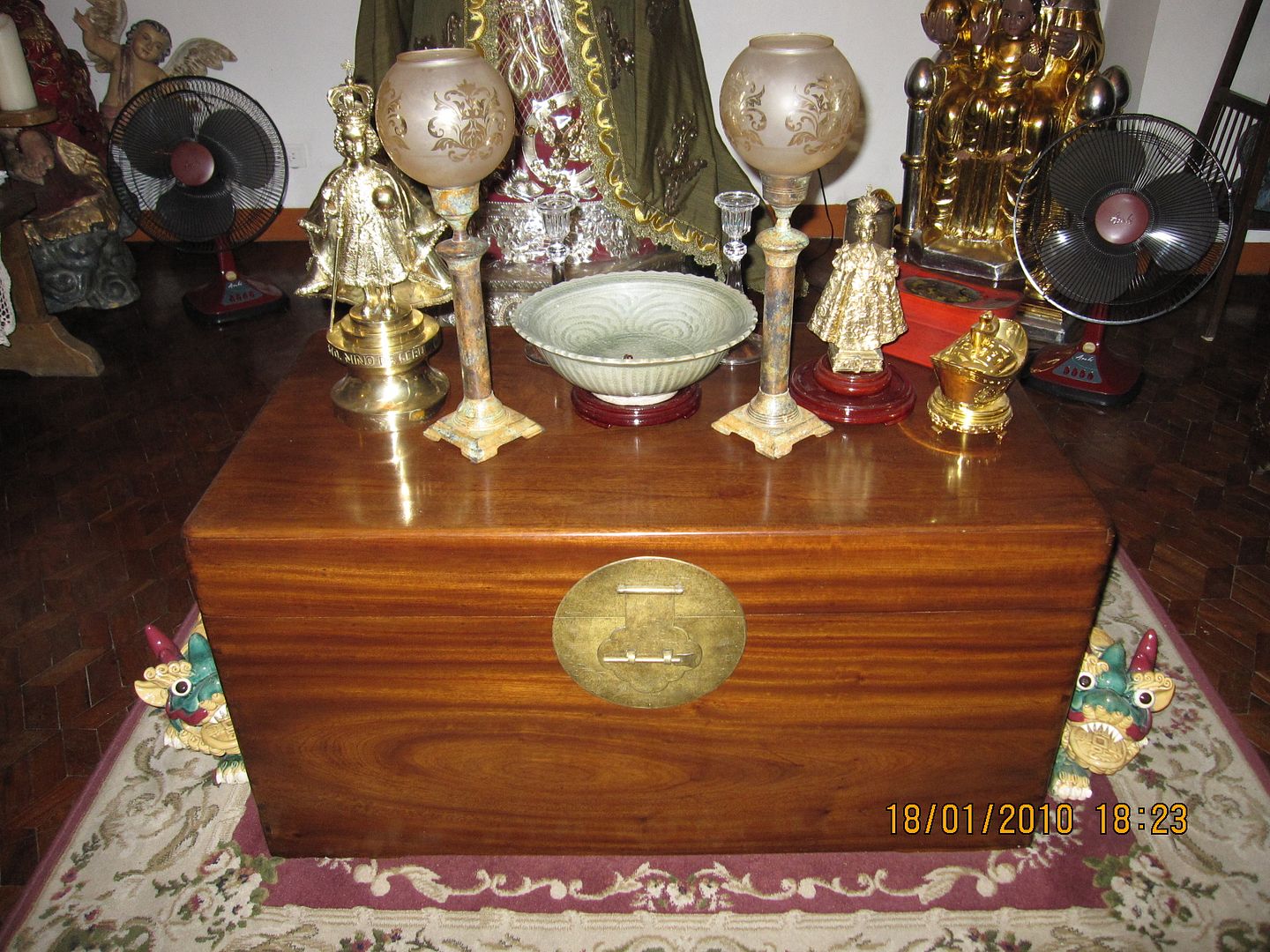
There was also a large chest used as an occasional table to display more artifacts

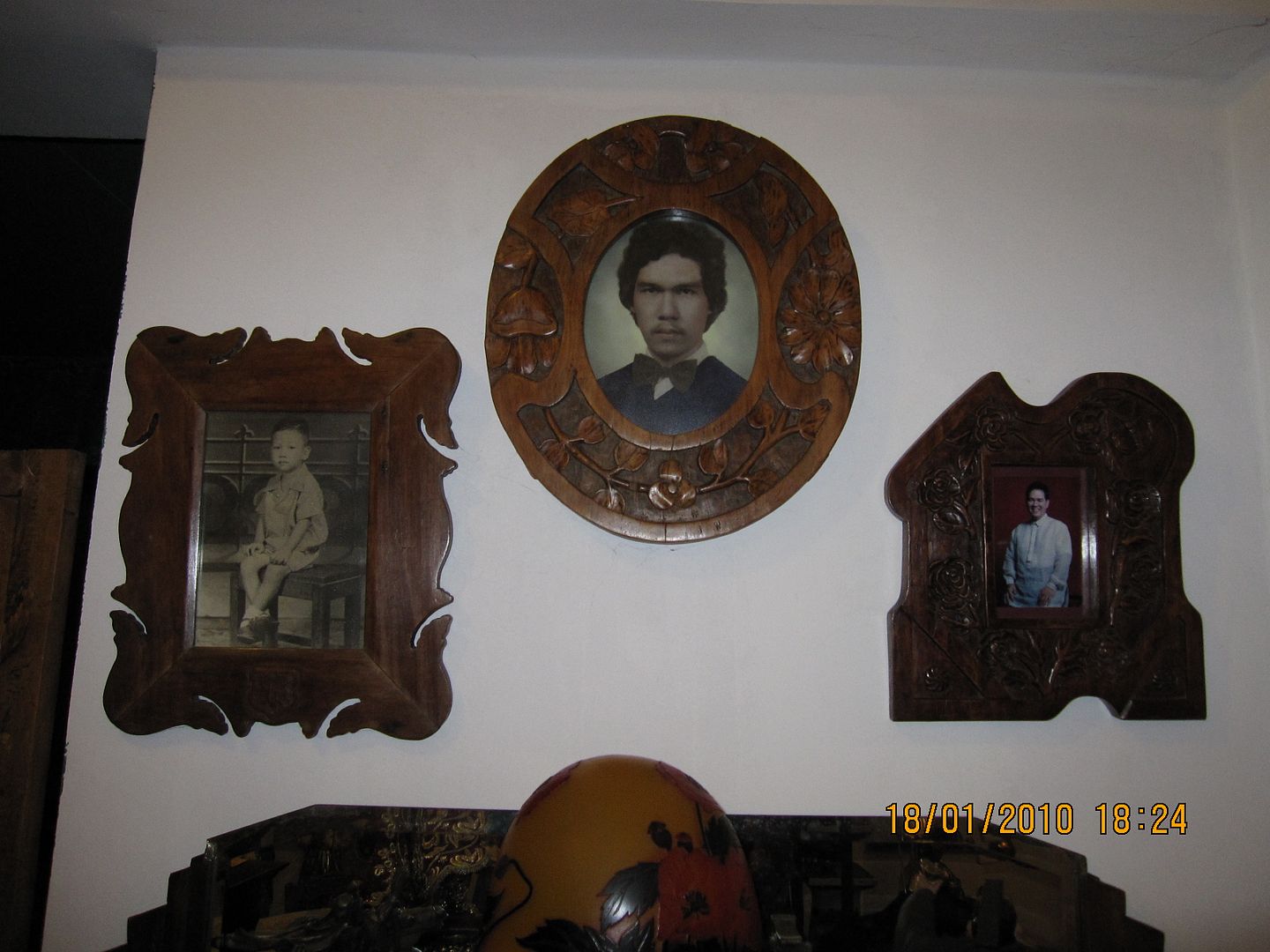
and on a far wall were Art Nouveau-style wooden frames holding images of the only non- (but perhaps future) santo in the apartment, the santo addict himself

to whom we are extremely grateful for the rare opportunity to visit.


Originally published on 7 February 2018. All text and photos (except where attributed otherwise) copyright ©2018 Leo D Cloma. The moral right of Leo D Cloma to be identified as the author of this work has been asserted.

Sunday, December 31, 2017

CXXXV: Give Art on Christmas Day 2017

This year, the 15th year of what is now a tradition of commissioning an original artwork for our family’s Christmas card, was perhaps smoother than usual, facilitated by a personal recommendation by the artist of our 2009 Christmas card

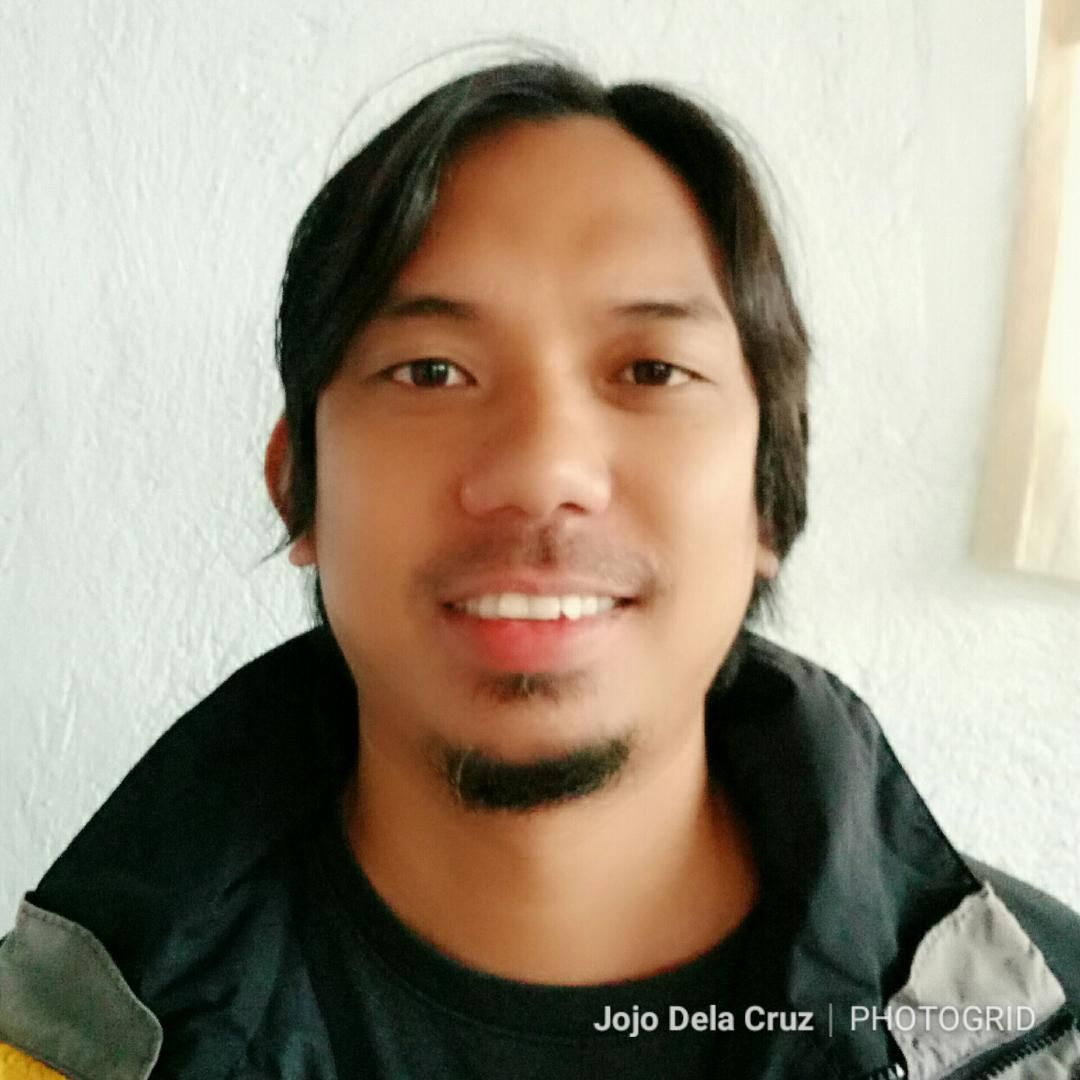
Marc Salamat recommended that we seriously consider his previous workshop apprentice, artist-colleague, and Hagonoy, Bulacan townmate, Jojo dela Cruz, for our 2017 Christmas artwork.  This naturally led to a first meeting and discussion, at which time he showed me photographs of works that he had done in the past.

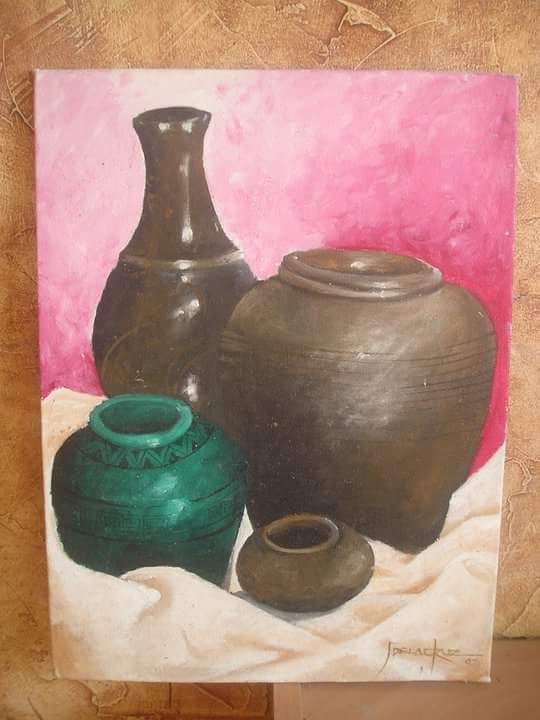
Jojo’s portfolio was impressive in its versatility.  Apart from oil-on-canvas works such as this still life,


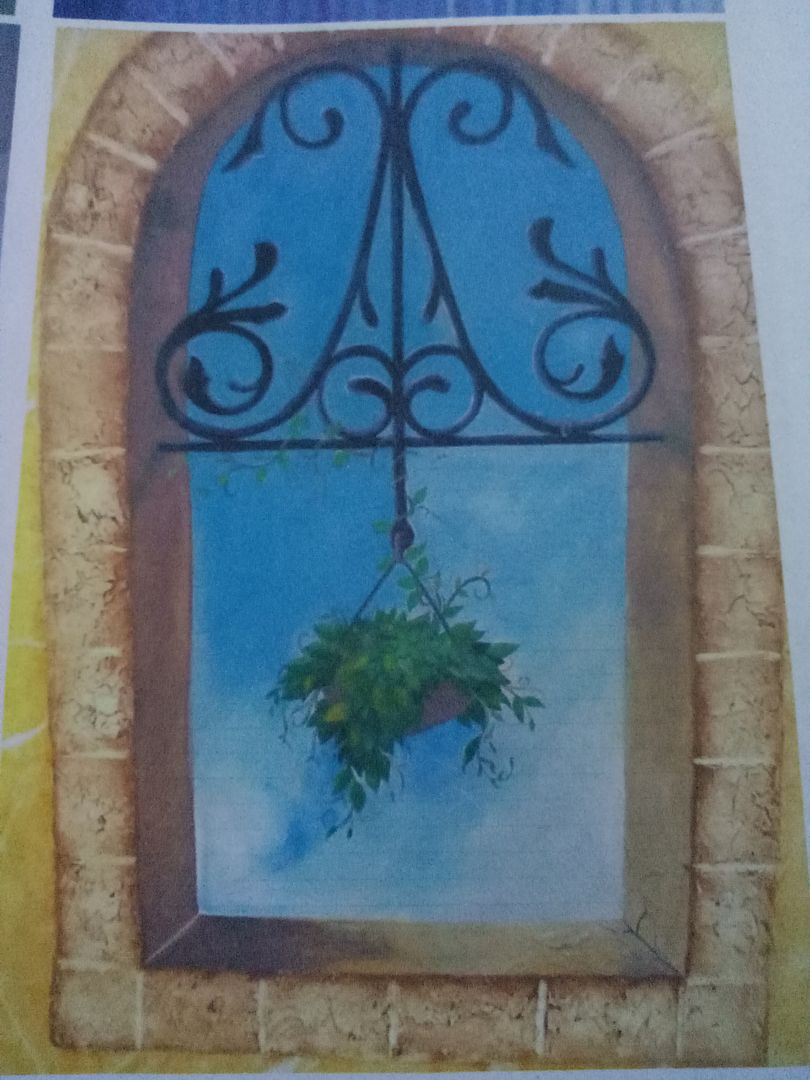
or this pensive open window,


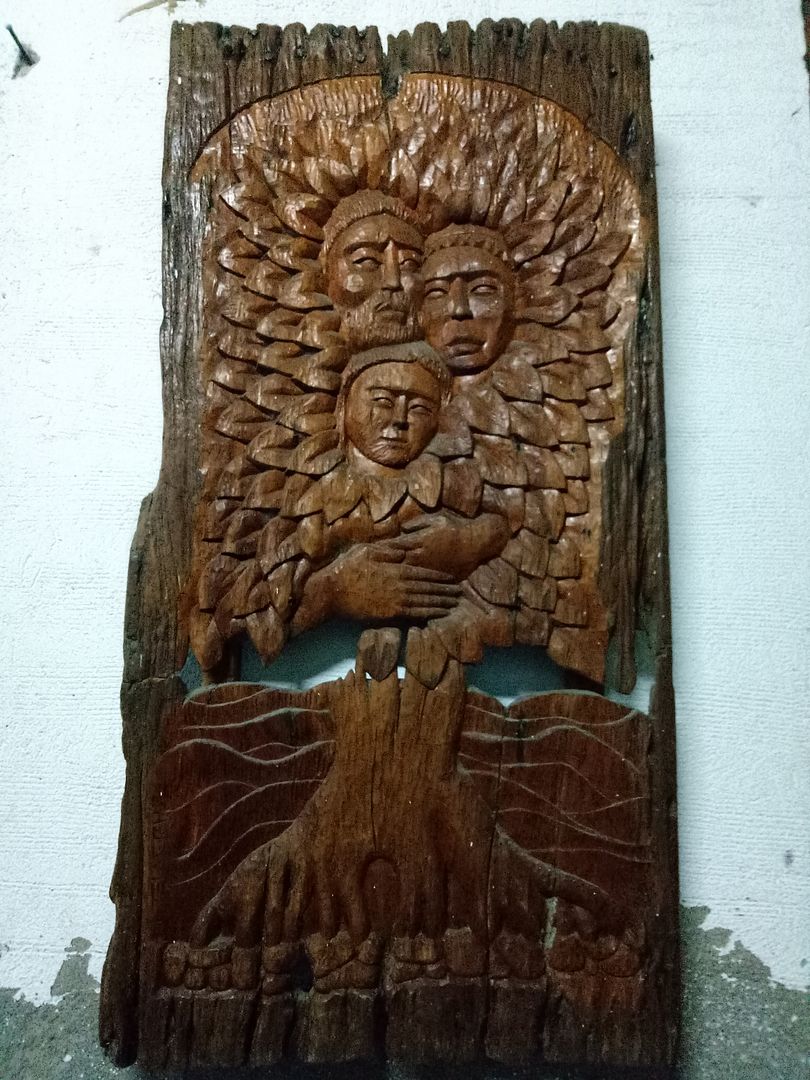
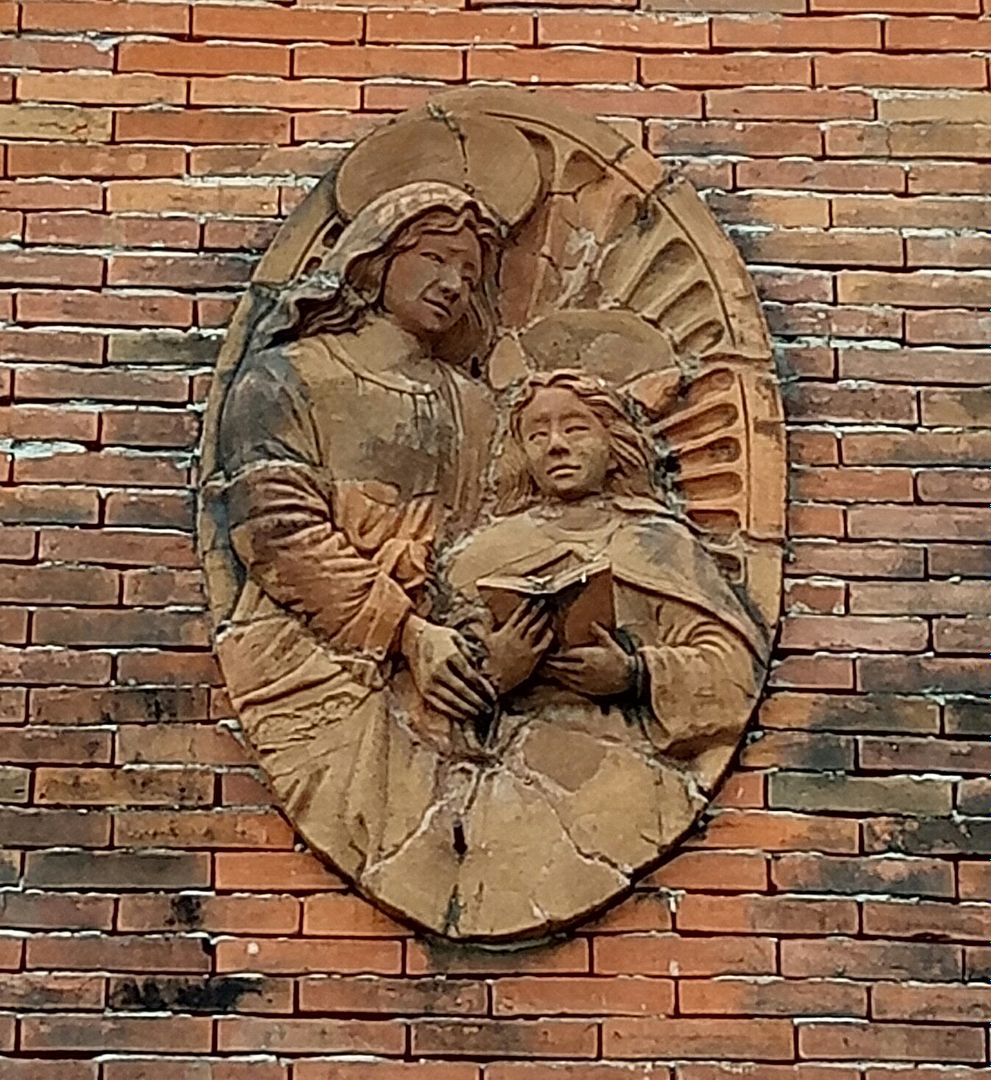
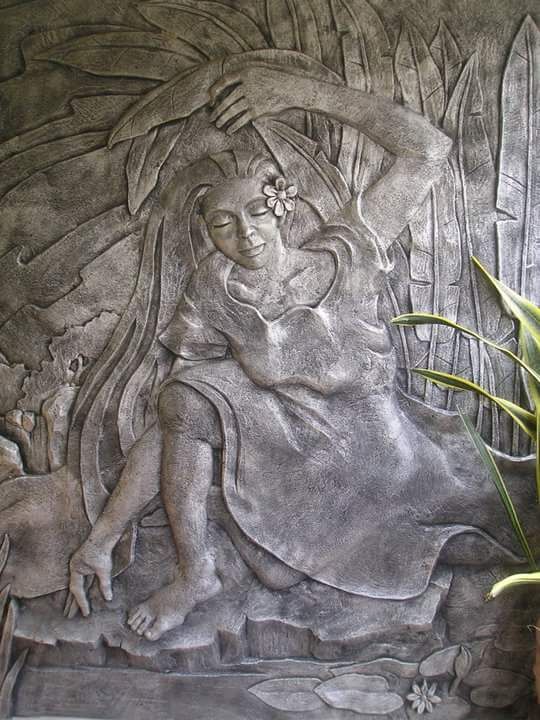
he has also made bas-reliefs in a variety of materials and finishes.


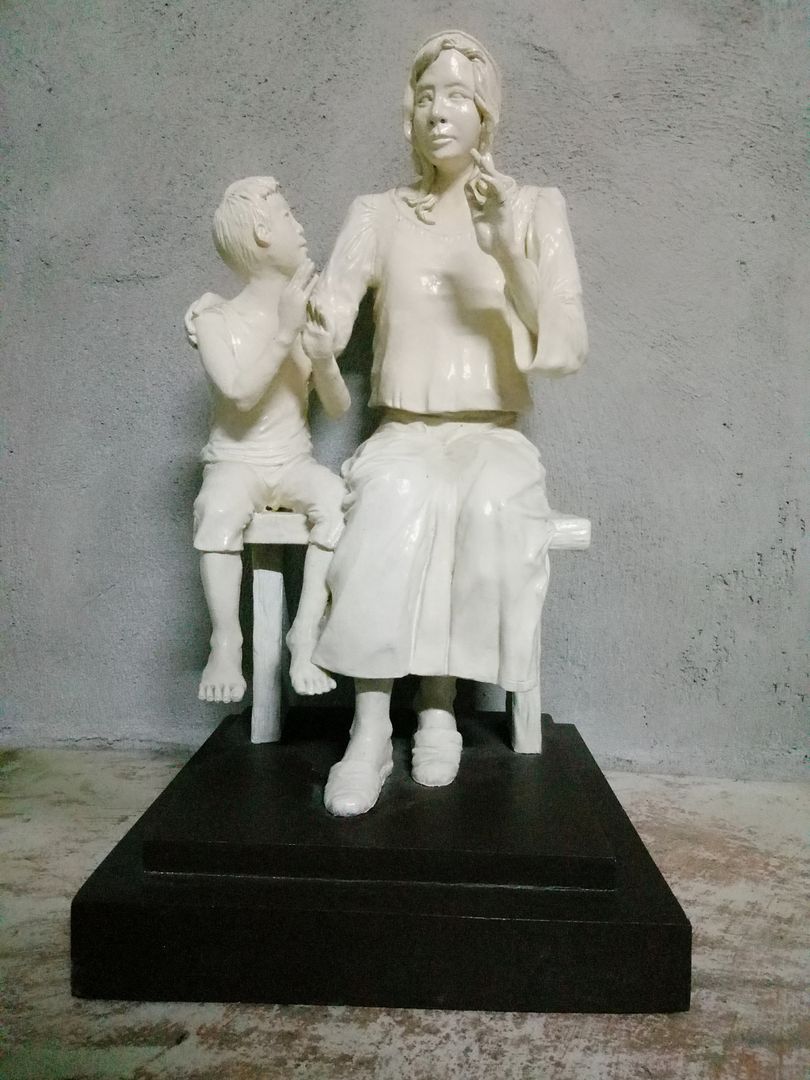
And if this was not yet sufficiently varied, Jojo also does three-dimensional resin sculpture to commission, with both secular and religious subjects.


That first meeting was so straightforward that we quickly came to an agreement, even without the need for numerous options or studies.  We simply confirmed our common understanding of what the broad theme needed to be – a Filipino Christmas – and what the specific subject could be – “namamasko.”

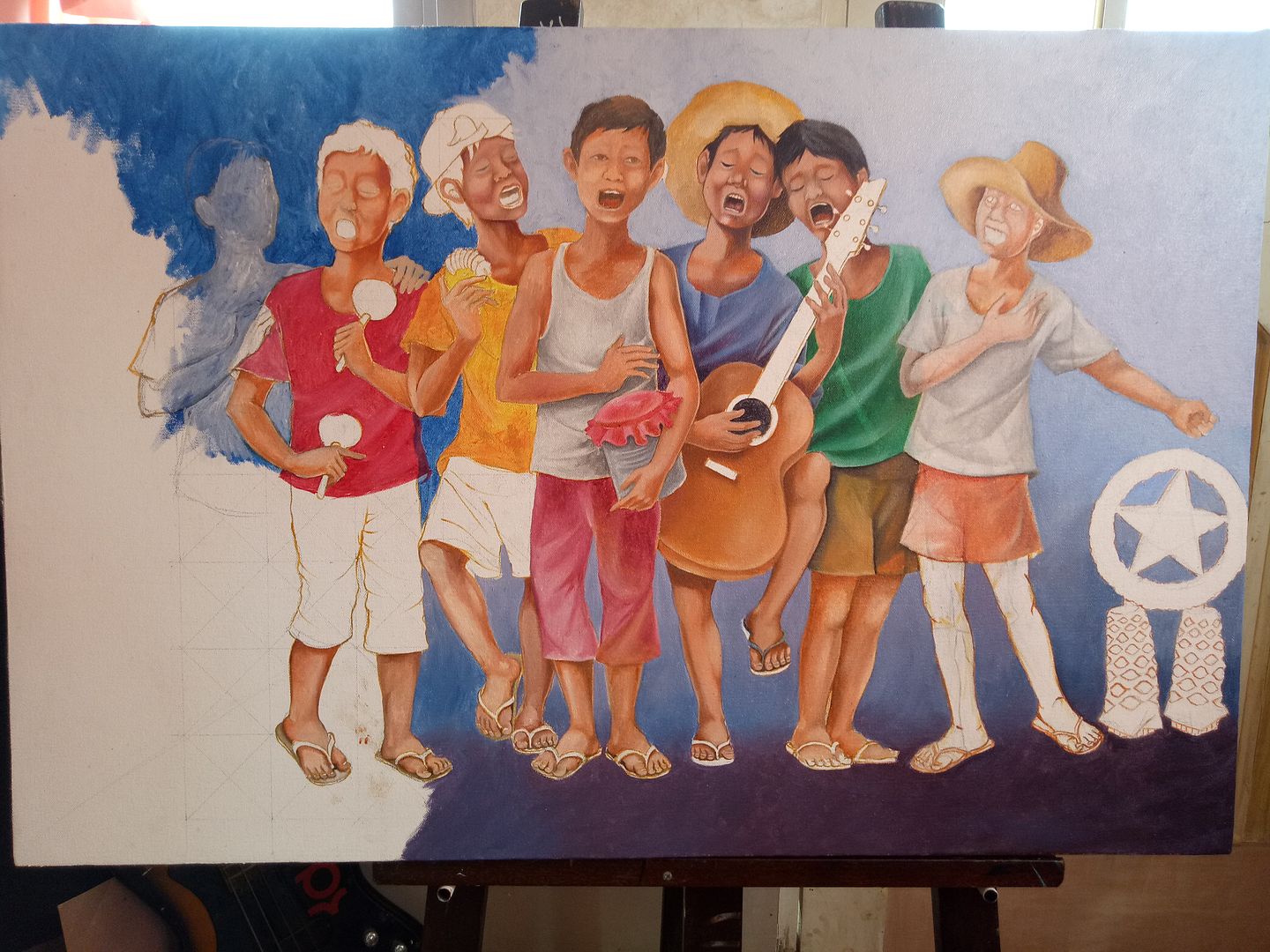
By mid-September, or in just a few weeks after that single meeting, Jojo had emailed me a photograph of the artwork in progress in his home workshop.


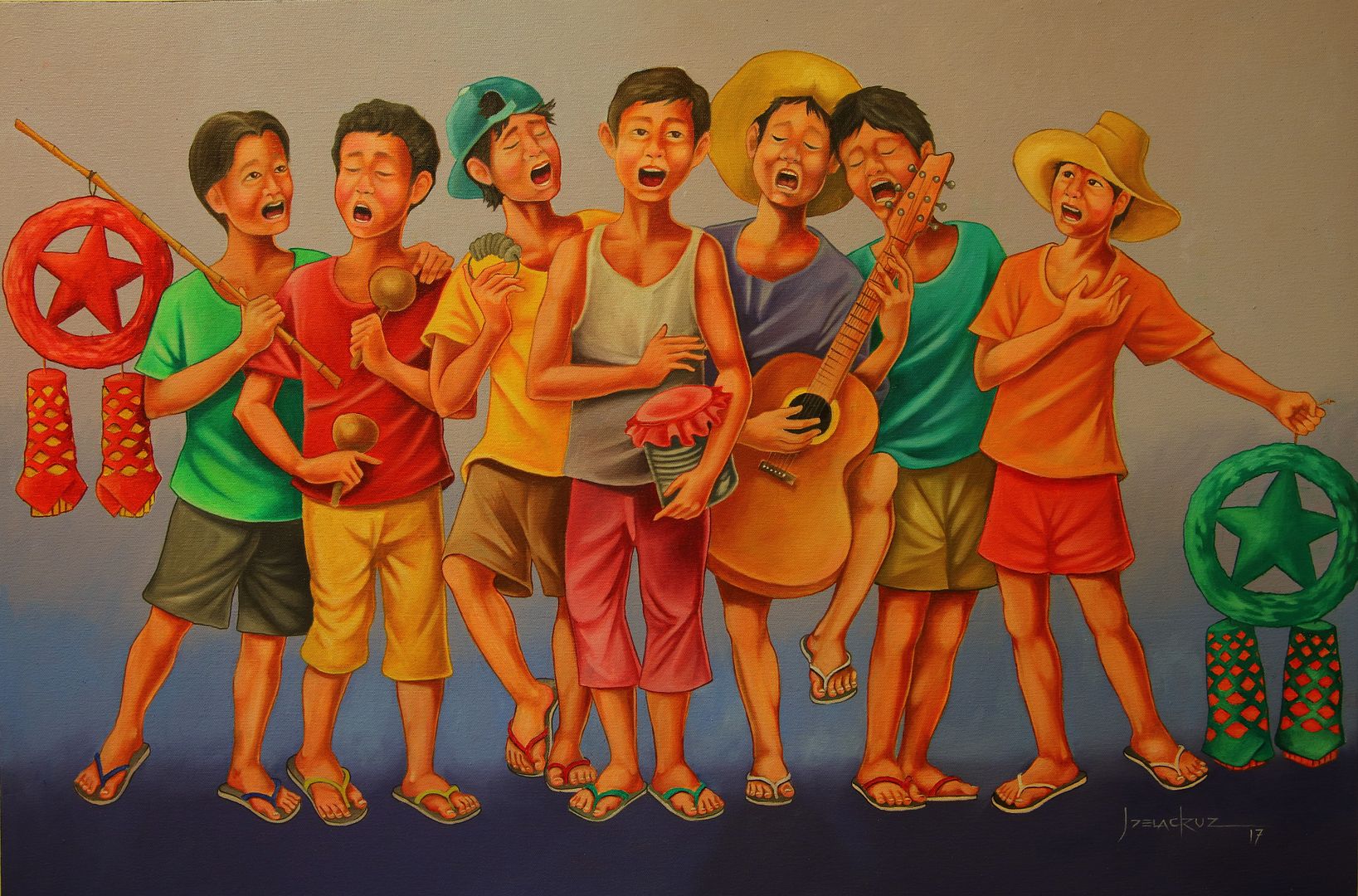
And by the third week of October, he delivered the finished artwork to my house – only the second time that we had met face-to-face.  Here is how it appeared on the cover of our Christmas card this year.


Jojo dela Cruz
“NAMAMASKO PO”
Oil on canvas
24” x 36” (61 cm x 91 cm)
2017


Born in Binangonan, Rizal in 1980, Jojo dela Cruz was orphaned at a young age and went off to live with relatives in Hagonoy, Bulacan.  He still lives there today, now with his wife and two children.

His interest in art was nurtured as early as secondary school, when his coach Mrs. Yolanda Narciso encouraged him to represent the school in art competitions, winning several awards and plaques of recognition in the process.

In 2005, he won a scholarship from the artist-author-professor Mr. Jun Cruz Reyes, also a Hagonoy native, to enter the University of the Philippines College of Fine Arts as a Sculpture major.  He left after two years to become a full-time artist.

Today, Jojo is a highly versatile artist in many media – he sculpts in wood, fiber glass, and clay, and paints on canvas, concrete, and wood.  He even undertakes landscape projects and designs waterfalls for them.  He is also a tattoo artist.

- - - - - - - -

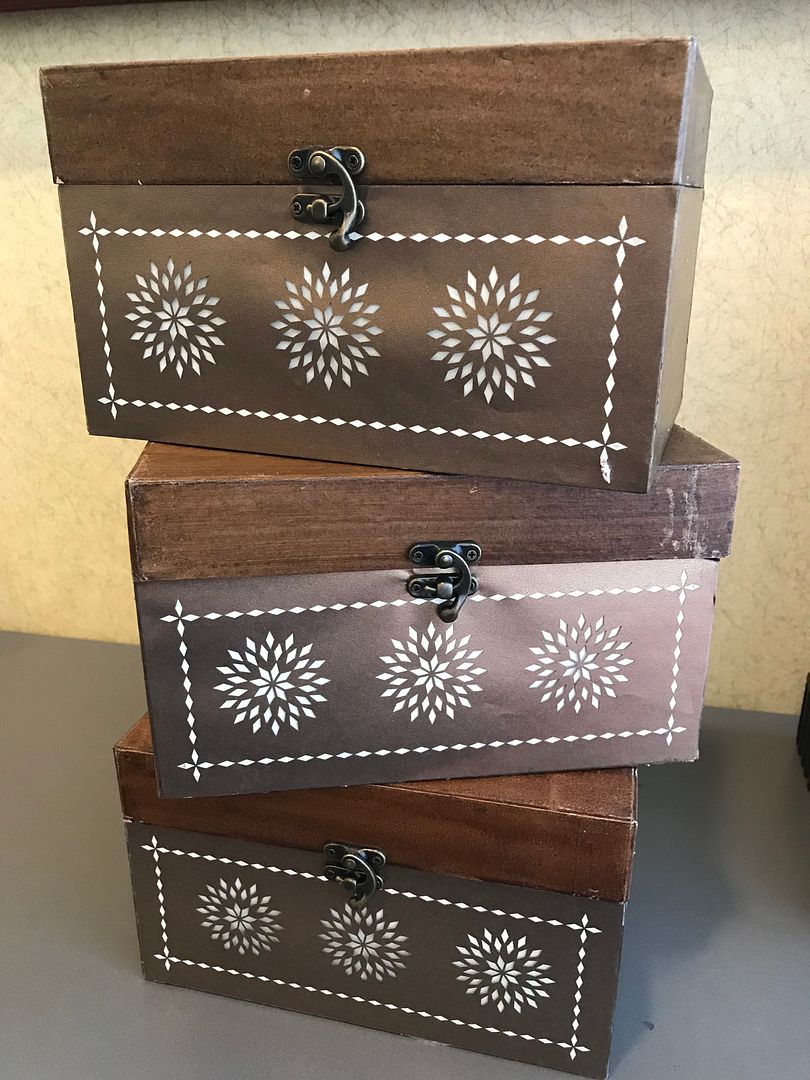
People lucky (hahaha) enough to be on our gift list will know that over the past few years, we have extended the “give art on Christmas day” effort beyond just our family’s Christmas cards to include even the materials we wrap our gifts in.  This year, our usual Christmas gift package (unfortunately too heavy and fragile to ship via courier to more distant addressees on the list) was encased in a specially-crafted “baul” (chest) mimicking those antique bone-inlaid narra bauls common in Bulacan and elsewhere in centuries past. 


As in previous years, this year’s custom-made packaging was crafted for us by our friendly Bulacan neighborhood artist and heritage worker, Rheeza Hernandez. 

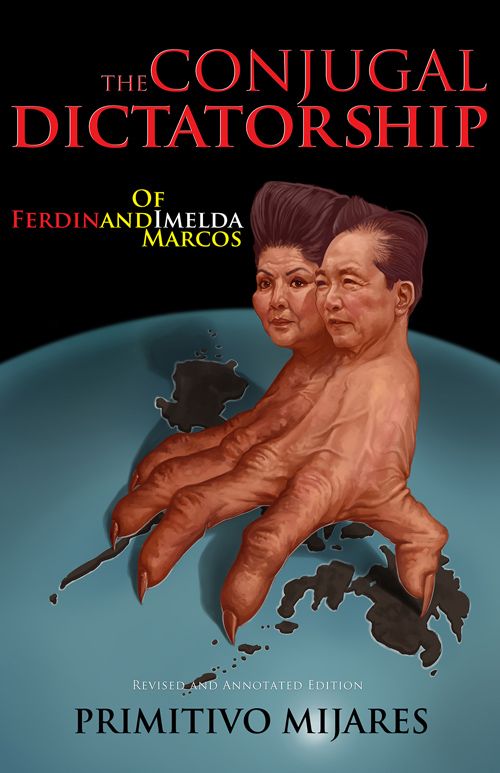
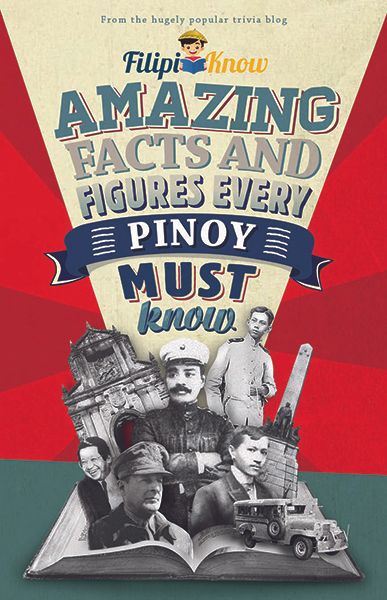
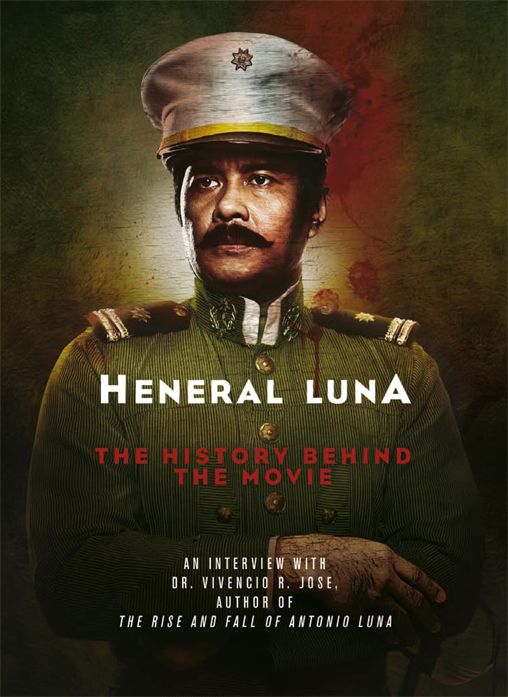
The 2017 Christmas baul held our three book selections for this year:


The Conjugal Dictatorship of Ferdinand and Imelda Marcos, by Primitivo Mijares, revised and annotated 2016 edition.


Amazing Facts and Figures Every Filipino Must Know, by Luisitio Batongbakal Jr.Alex Castro, and Marcus Vaflor.  Summit Books, 2016.


Heneral Luna: The History Behind the Movie, by Dr. Vivencio R. Jose.  Anvil Publishing, 2015.

These should keep our recipients occupied with reading over the first few weeks of 2018 at least!

- - - - - - - -

From my family and me to you and yours,

MERRY CHRISTMAS AND A HAPPY NEW YEAR!

MALIGAYANG PASKO AT MANIGONG BAGONG TAON!

- - - - - - - -

Originally published on 31 December 2017. All text and photos (except where attributed otherwise) copyright ©2017 Leo D Cloma. The moral right of Leo D Cloma to be identified as the author of this work has been asserted.
Monday, January 2, 2017

CXXXIV: Give Art on Christmas Day 2016

Having commissioned an annual Christmas card artwork for several years now, one would think that there might already be a formula or process for getting the next one done and dusted each year. 

In fact, there is: start scouting around for possible artists soon after the New Year, narrow down the choice of artist by Easter Sunday, ask the chosen artist for a few studies representing possible Christmas artwork ideas, choose one of those to pursue by Trinity Sunday, give the artist until September or so to complete the artwork, have the artwork professionally photographed before All Saints’ Day, send off the photographs to the layout artist, then finally have the cards printed and delivered before the first Sunday in Advent.

Whether the actual process complies with the above blueprint is another matter altogether of course.  Thankfully, in most years it does, more or less, or at least the built-in allowances in the schedule allow for the possibility of recovery in case of delays or hitches. 

In some years, one can “cheat” by starting the selection process even before Christmas of the prior year!  Unfortunately, this past year, that had not been the case, as it had already been the end of summer and we still had not identified the right artist for the commission.  (I am happy to note, though, that the usual reason for this is that many of the artists recommended to us are too busy with prior commissions or are preparing frantically for upcoming exhibitions, rendering them unable to complete yet a new commission in time for Christmas.)

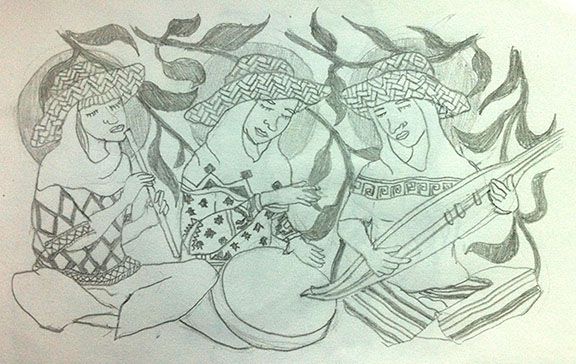
Fortunately, a strong recommendation came in before the onset of the monsoon season, and after preliminary introductions, we had agreed to look at some studies, which came in in mid-August.  The first one was provisionally entitled “Three Kings”.


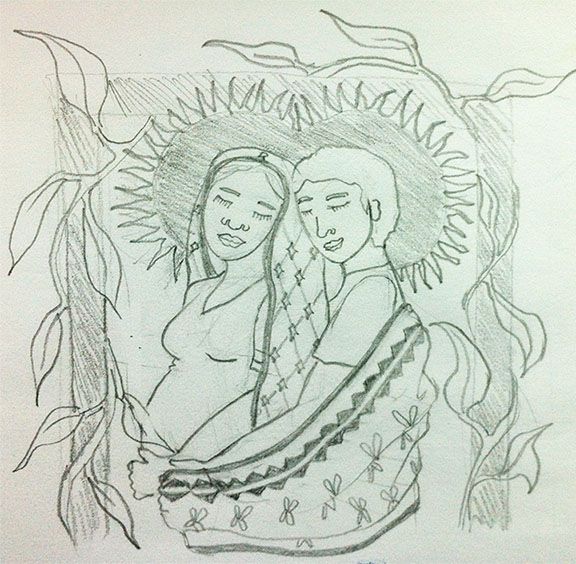
The next one was called “Holy Family”.


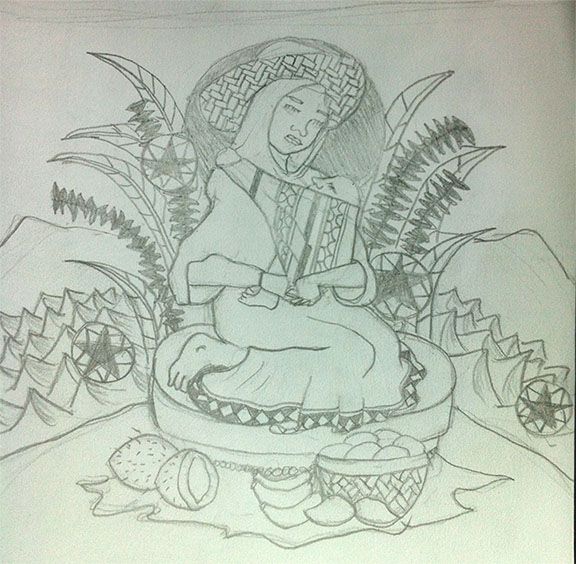
The last was “Mother and Child”.


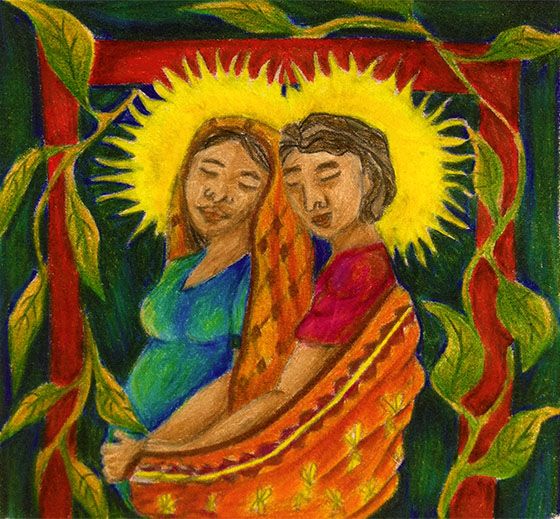
Clearly these were very good starting points, which begged to be rendered in full color.  The artist dutifully acceded, using the “Holy Family” study to show off her preferred color scheme. 


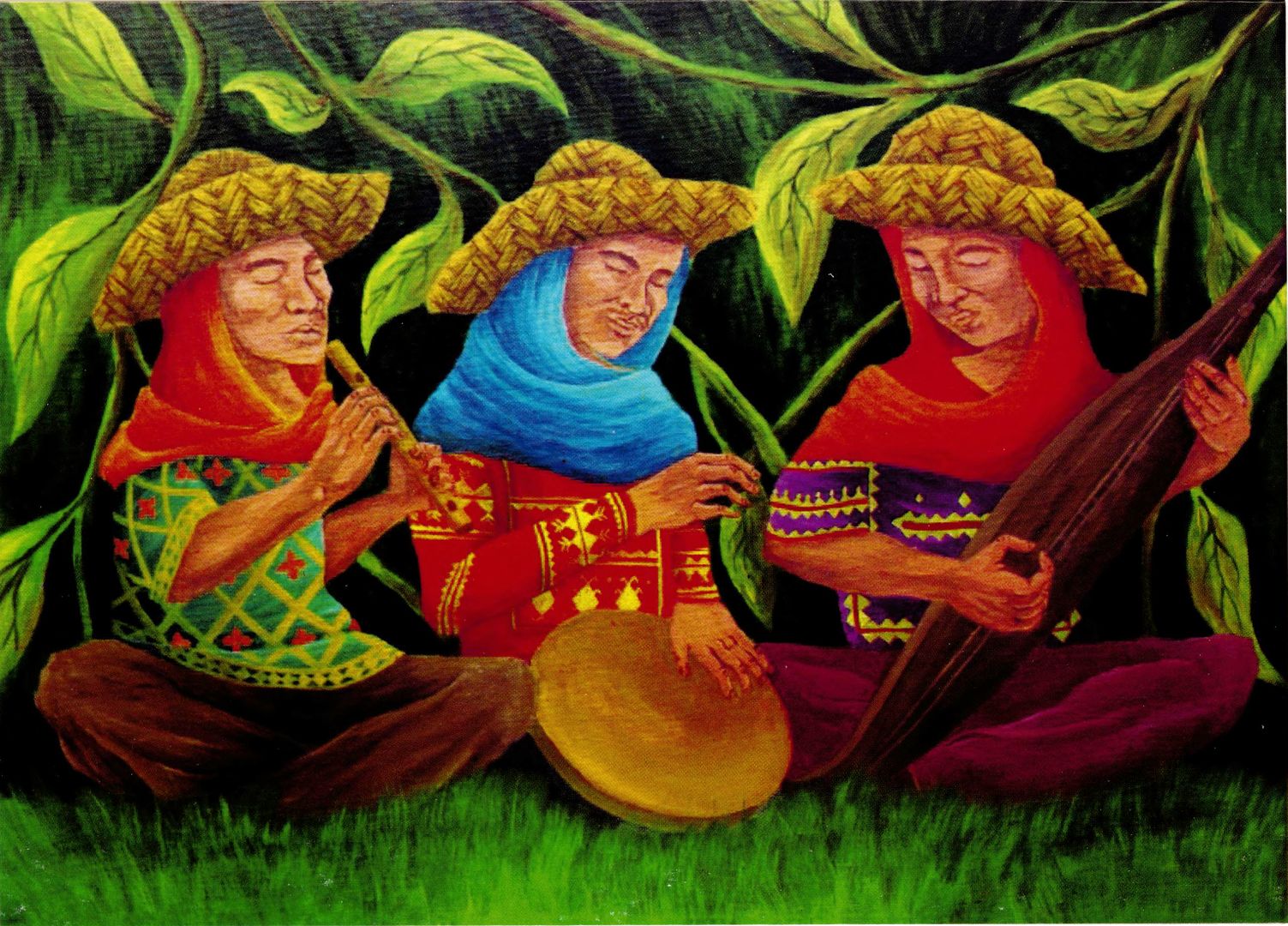
With such a bright and lively palette, the obvious next step was to go on with the production.  However, we chose to go with the “Three Kings” study as the basis of the final artwork.  The artist confirmed the start of the artwork production by sending me this color palette strip.


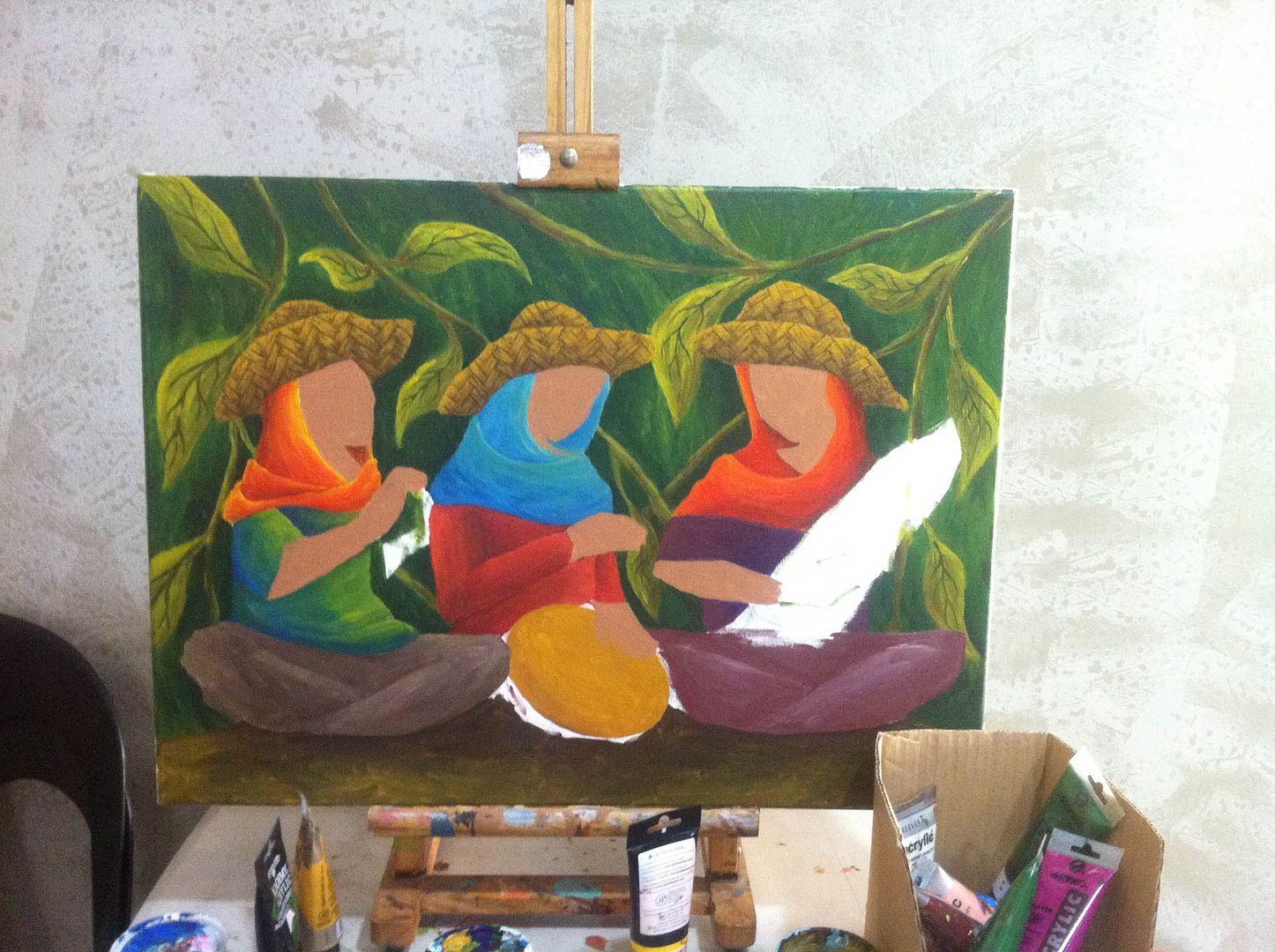
By October 1st, the artwork was well-fleshed out,


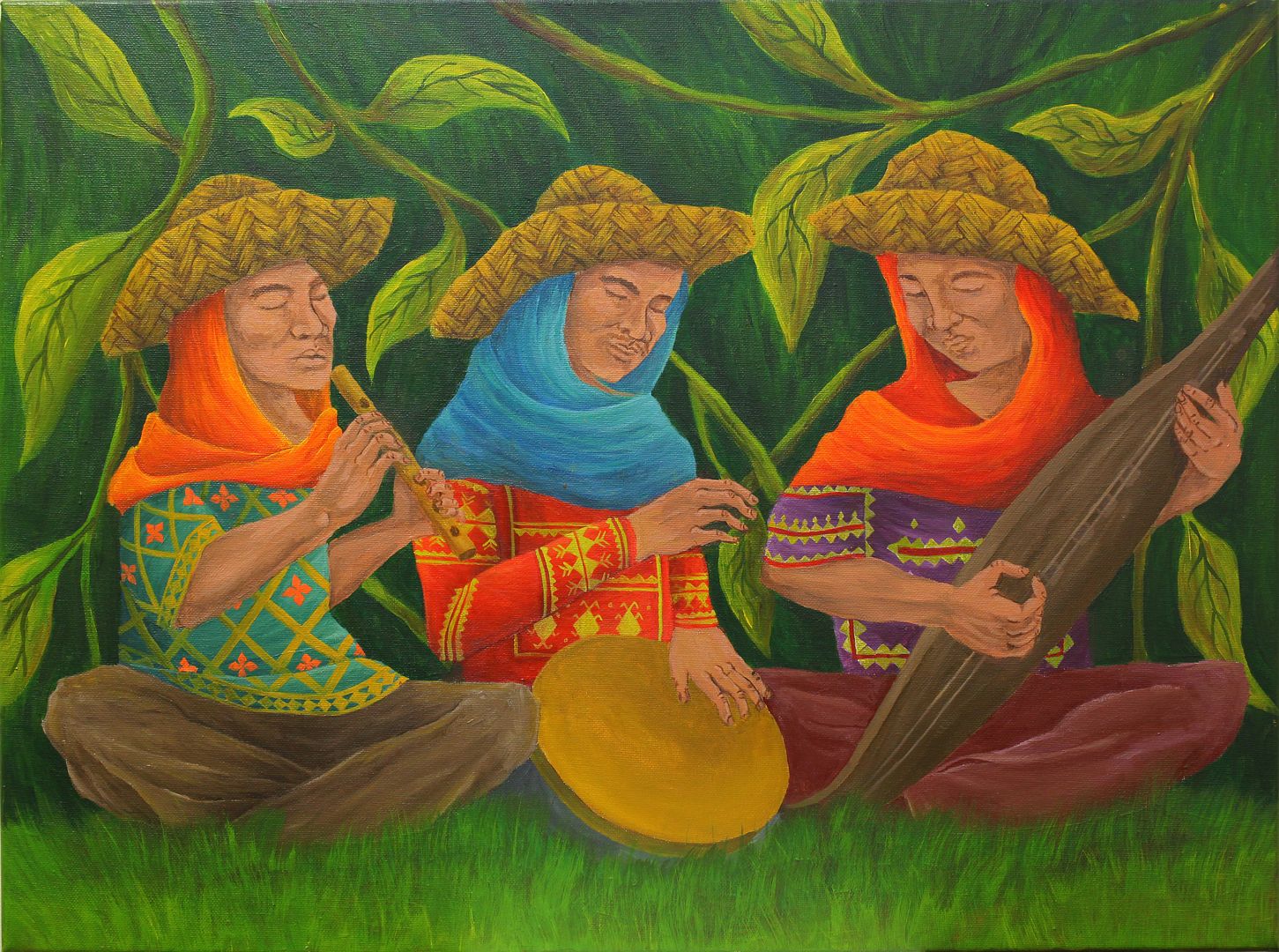
and by mid-month, the finished artwork had been delivered, with professional photography completed just a couple of days after,


and the printed cards on-hand by late November. 

Here’s the artist’s biographical note:


Born in Marilao, Bulacan in 1988, Catherine “Catcat” Mendoza graduated from the University of the Philippines in Diliman in 2011 with a bachelor’s degree in Fine Arts, major in Visual Communication, where she also took up ceramic classes.  She is now based in Occidental Mindoro, where she continues to work as an artist in painting and sculpture. 

Catcat’s work is driven by her interest in the spiritual beliefs and traditional practices of indigenous people, with a perceptive understanding of their social and cultural values
and their significance in today’s contemporary society.  Her present work, “Tatlong Mago,” reflects these interests, with the representation of traditional textiles and musical instruments working with a seasonal color palette to depict archetypal Christmas imagery.

As her relationship with art evolves, personal transformations navigated by the
teachings of the ancient people leave an imprint on Catcat’s artworks.  Her hope is that the process serves as a conduit to a healing path, which is what she believes is the heart of her craft.

- - - - - - - - -

In most years, we also have a standard Christmas gift that we distribute to all the individuals on our Christmas list.  In previous years, these had been specially selected (I do not dare pretentiously say “curated”) compact discs (CD’s) and digital video discs (DVD’s).  However, I have noticed that many people, especially the young ones (i.e., everyone younger than me, which is probably three-fourths of the Philippine population), no longer own playback devices for these discs.  Apparently, even if these technologies were groundbreaking twenty or thirty years ago, and are still mainstays in our own home, most people now consider them archaic, the same way I thought vinyl records were (although surprisingly those are now returning, but that’s another story), and just get their audio and video feeds via the internet and on handheld smartphones and equivalent devices.

Since we don’t like to give food for Christmas (there’s already too much of that going around this time of the year!), the thing to do was to identify another kind of standard gift that was not going to be rendered obsolete by rapidly advancing digital technology.  Without reaching too far back into recorded history (scrolls?  parchment?  stone tablets?), the obvious medium was the codex – that’s “book” to us 21st century homo sapiens sapiens.

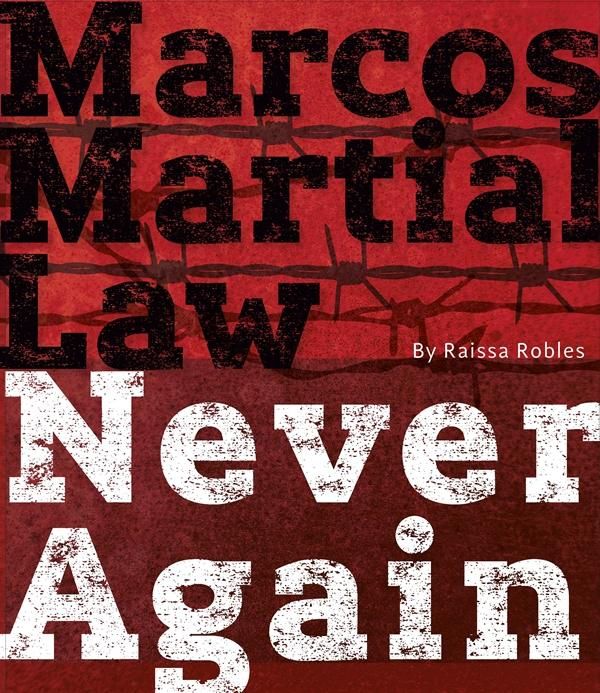
We had given books as standard Christmas gifts many times in the past, but it has never been easy to pick one that was not only not ubiquitous and pedestrian enough that it would not already be on the bookshelf of the recipient, but also so well-written to be our recommended read, AND sufficiently representative of what my family and I believe in and subscribe to.  Amazingly, there were a few such books that had come out in the past year, but we had focused on the outstanding new book from Raissa Robles, Marcos Martial Law: Never Again.


We were lucky enough to place a sufficiently large order with the publisher for a few hundred copies of the book last summer, at a bargain price and before it came out in bookstores, where it promptly sold out. 

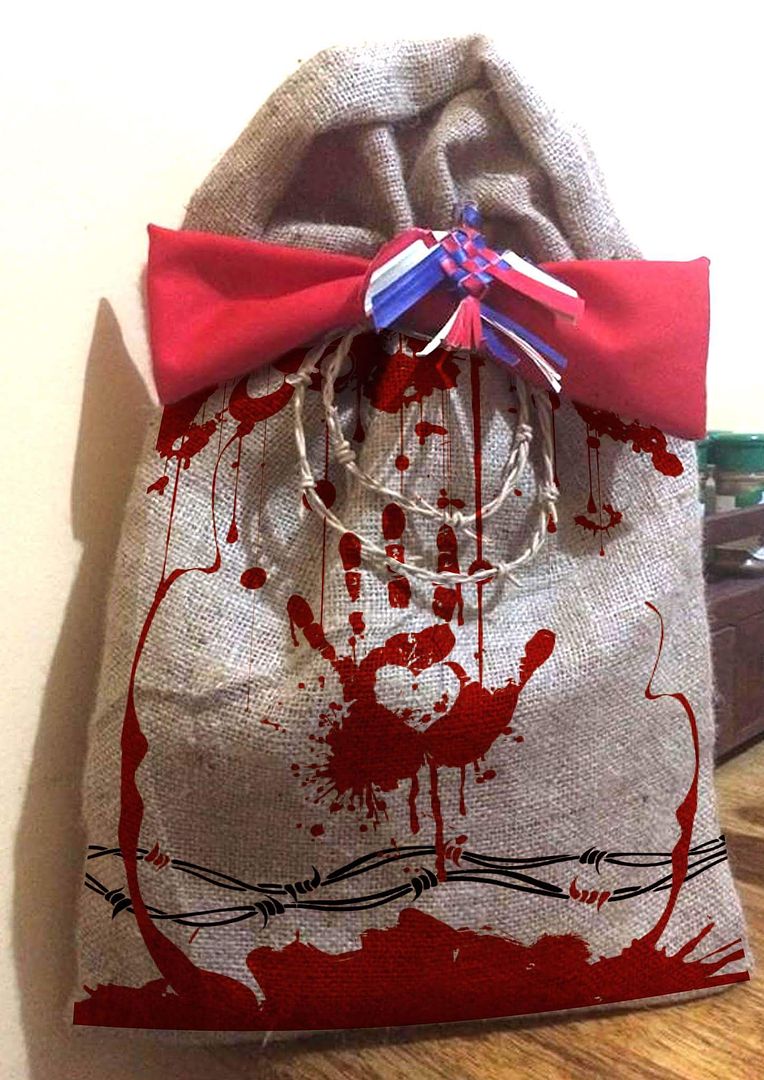
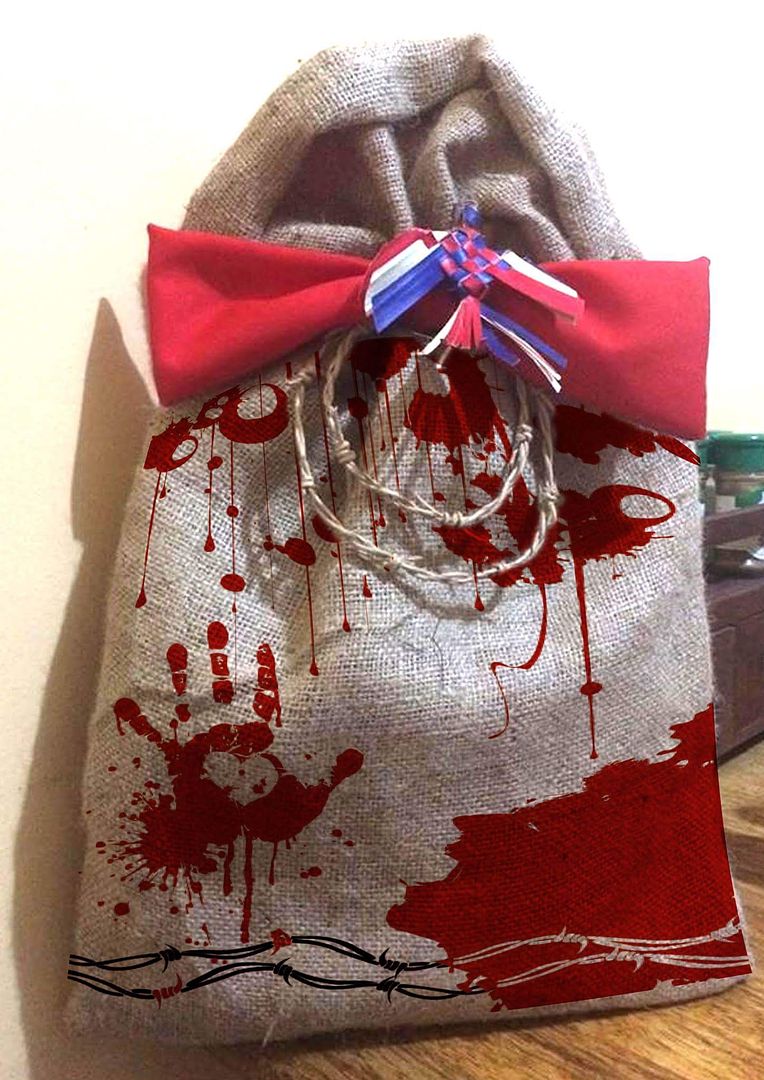
I don’t usually do book reviews, and this article is about giving art for Christmas, so instead of a review, let me talk about what we next did with the book.  In the past two years, our standard gifts (a DVD, then a book) were artfully packaged for us by our townmate, craftsperson and heritage advocate Rheeza Hernandez.  This year, we had asked her to take the Marcos Martial Law book and recommend appropriate packaging for it.  She promptly showed me three studies by mid-September.  The first one was “Hand”.


The second one was “Hand and Head”.


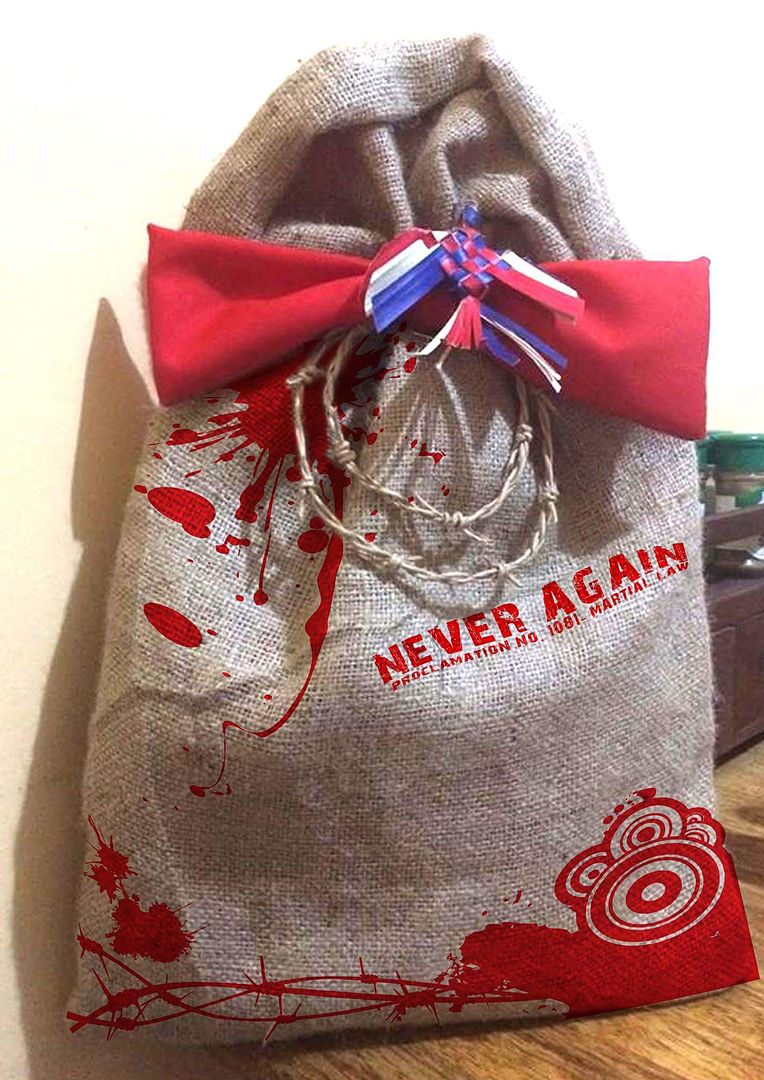
And the last one was “Splat”.


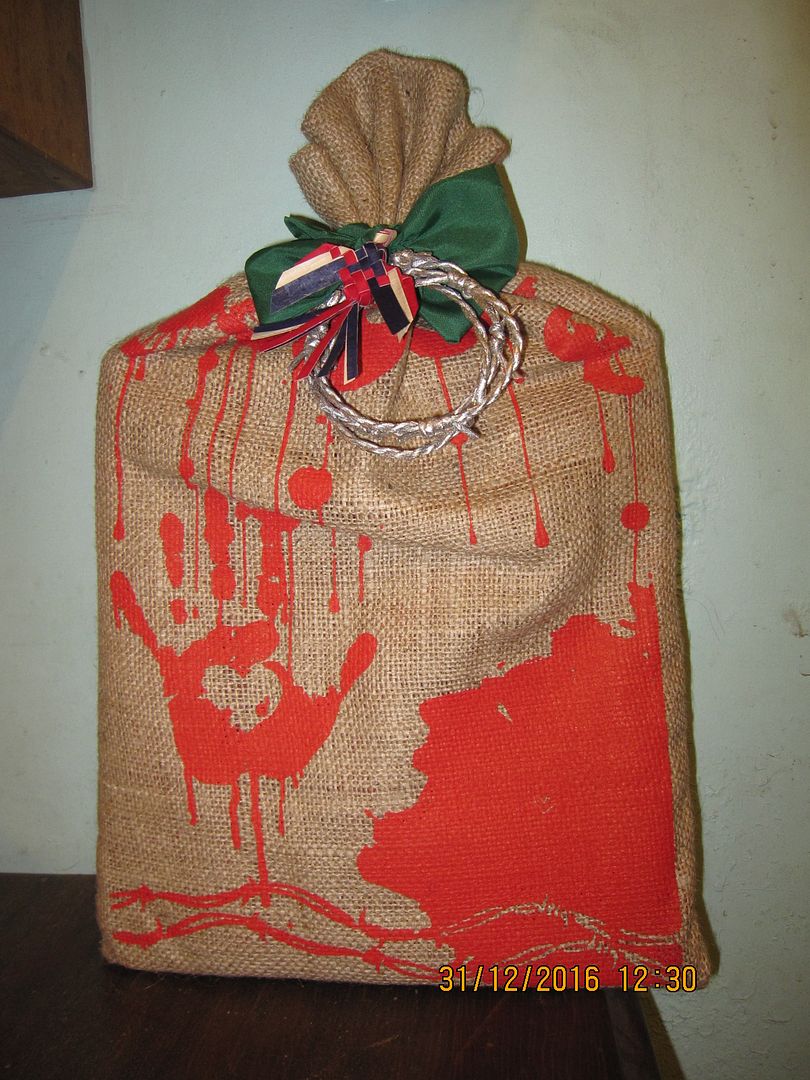
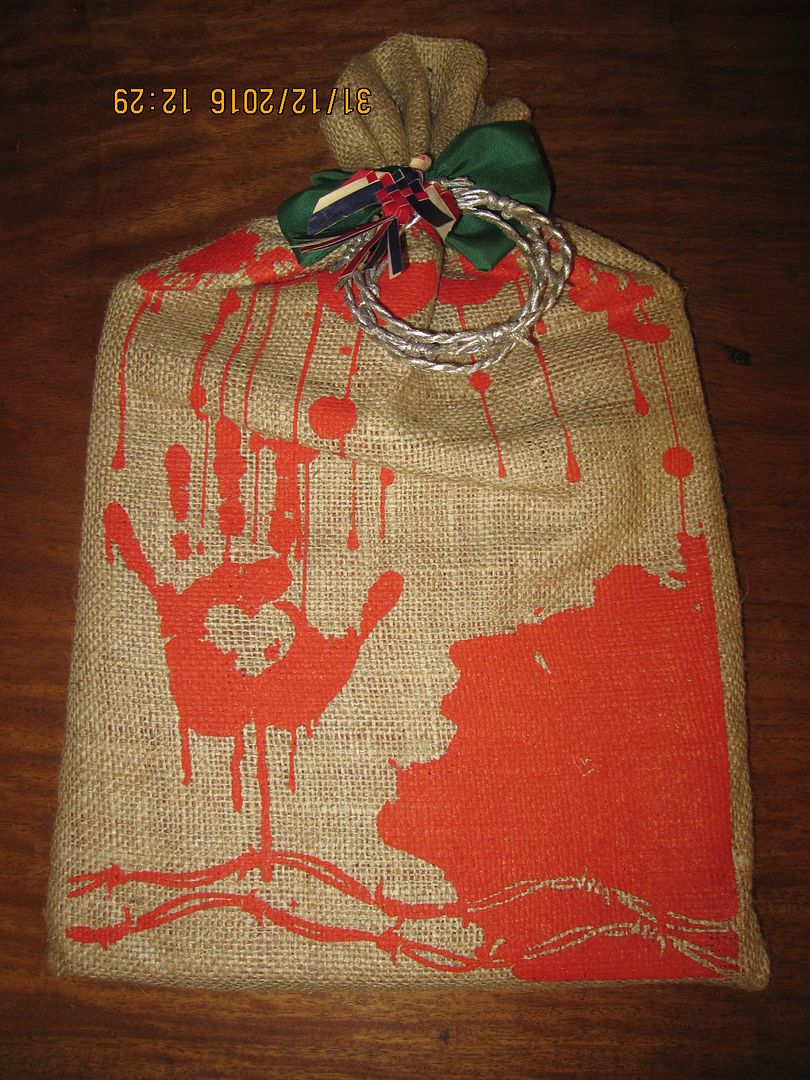
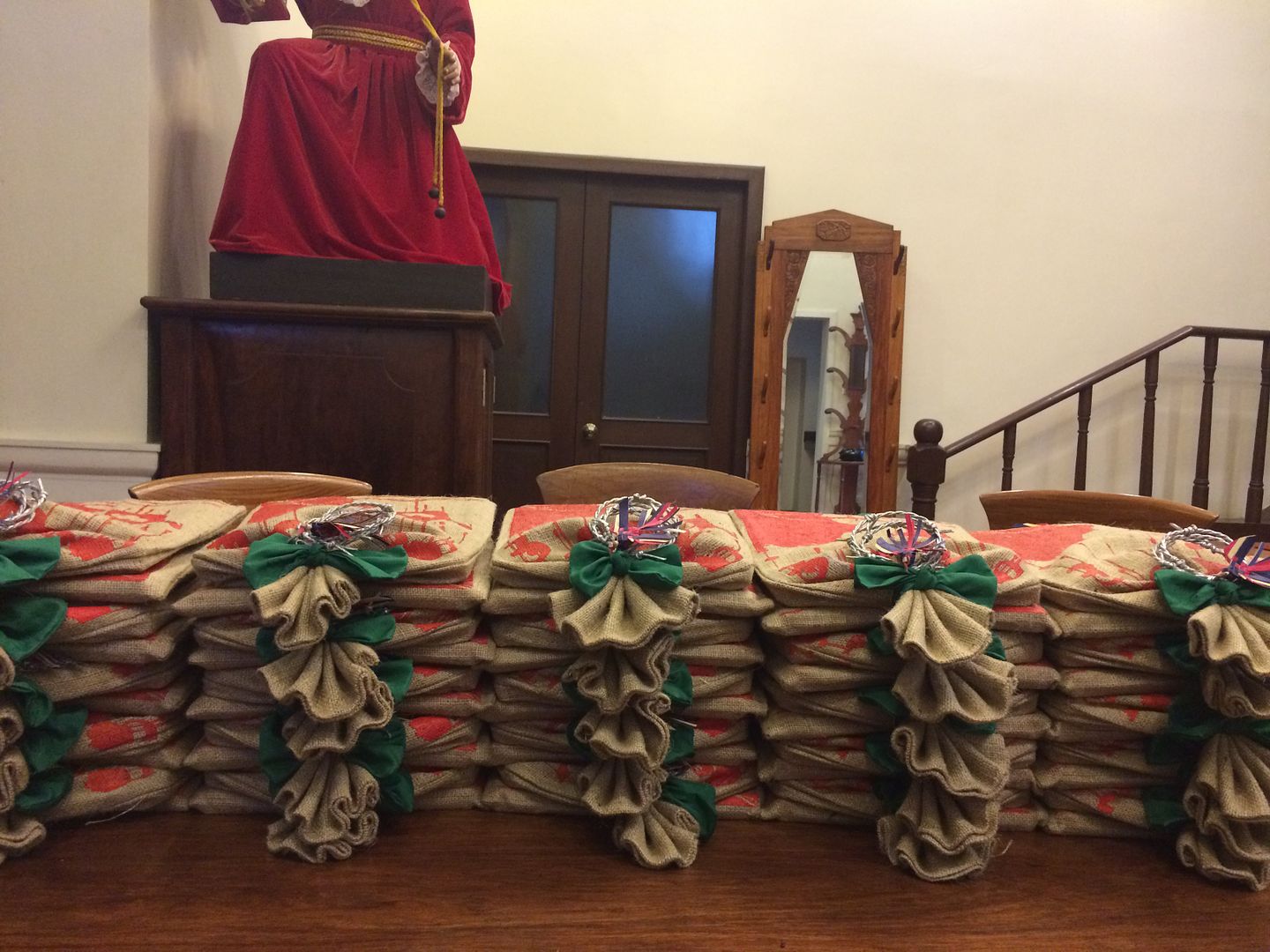
All of the options went for red-spray-painted-stencilled jute sacks, barbed-wire rendered in silver-painted rope, and a tricolor “puni” dove.

We chose to go with “Hand and Head”.  And in case the packaging was too “bloody”-looking and perhaps too morbid for Christmas, Rheeza and I agreed to change the ribbon from red to green.


By mid-November, most of the few hundred copies of the book had been packaged by Rheeza, ready for dispatch or hand delivery.


So if you were on our gift list for this book, consider yourself doubly fortunate for having received an originally crafted artwork (in the form of special book packaging) from the Rheeza Hernandez Workshop in Malolos, Bulacan.

- - - - - - - -

And triply fortunate because you would also have received Catcat Mendoza’s original artwork “Tatlong Mago” in the form of our 2016 Christmas card.


From my family and me to you and yours,

Merry Christmas and a Happy New Year!

Maligayang Pasko at Manigong Bagong Taon!

- - - - - - - -

Originally published on 31 December 2016. All text and photos (except where attributed otherwise) copyright ©2016 Leo D Cloma. The moral right of Leo D Cloma to be identified as the author of this work has been asserted.