Shortly after the “dress rehearsal” in early March, we had sent over the entire five-figure group to a photo studio in the
My brother, who is the real art critic in the family, did the honors of choosing which of the many resulting pictures would be used for the stampita. Out of the more than one hundred available, he chose this one:

A little strange and anticlimactic, you might think, for what about the compassionate Simon of Cyrene, the bossy Roman Captain, the sadistic Jewish temple guards? But I have to say that this was an excellent choice of stampita artwork, as it quite clearly focused attention on none other than the silently suffering Christ, ensuring that devotees were not distracted by the more “theatrical” elements of the tableau.
A little strange and anticlimactic, you might think, for what about the compassionate Simon of Cyrene, the bossy Roman Captain, the sadistic Jewish temple guards? But I have to say that this was an excellent choice of stampita artwork, as it quite clearly focused attention on none other than the silently suffering Christ, ensuring that devotees were not distracted by the more “theatrical” elements of the tableau.
We had also earlier already composed a prayer for the back of the stampita. This was essentially a conflation of the traditional Stations of the Cross prayers for the First Fall, the Second Fall, and the Third Fall, ensuring that there would be minimal fanatical debates about which of those "Falls" this tableau was supposed to represent. The Pilipino version was most expertly translated from the English by our mother, the “academic Tagalog” expert in the family.
For both English and Pilipino versions, we remembered to give credit to the Francisco Vecin Workshop, and to indicate that the whole activity was being undertaken in memory of our late grandmother.

(To request a more readable soft copy of the stampita, just post a comment below or send me an email.)
We had sent off the selected cover photo and the back page text to a printer-friend of ours, who very capably delivered 10,000 copies of this postcard-sized (six inches tall by four inches wide) stampita on Thursday, March 29th. [And if you failed to get your copy of this limited-edition keepsake, you've missed the opportunity to own something that will be a much-sought-after item a millenium from now, when paper no longer exists. (Just send me a PM if you want one -- I'll try to scrounge around a remaindered copy for you.)]
Finally, in keeping with the “delivery date” of March 2007 as indicated in the stampita, Saturday the 31st (Palm Sunday Eve) was a big day for everyone. It was the day when the so-called “Gang of the Fall of Christ” got together and converged on the quiet and genuinely rural barrio of Caingin,
I had picked up Kiko Vecin and his crack team early in the morning, and we got into his car and mine and motored over to
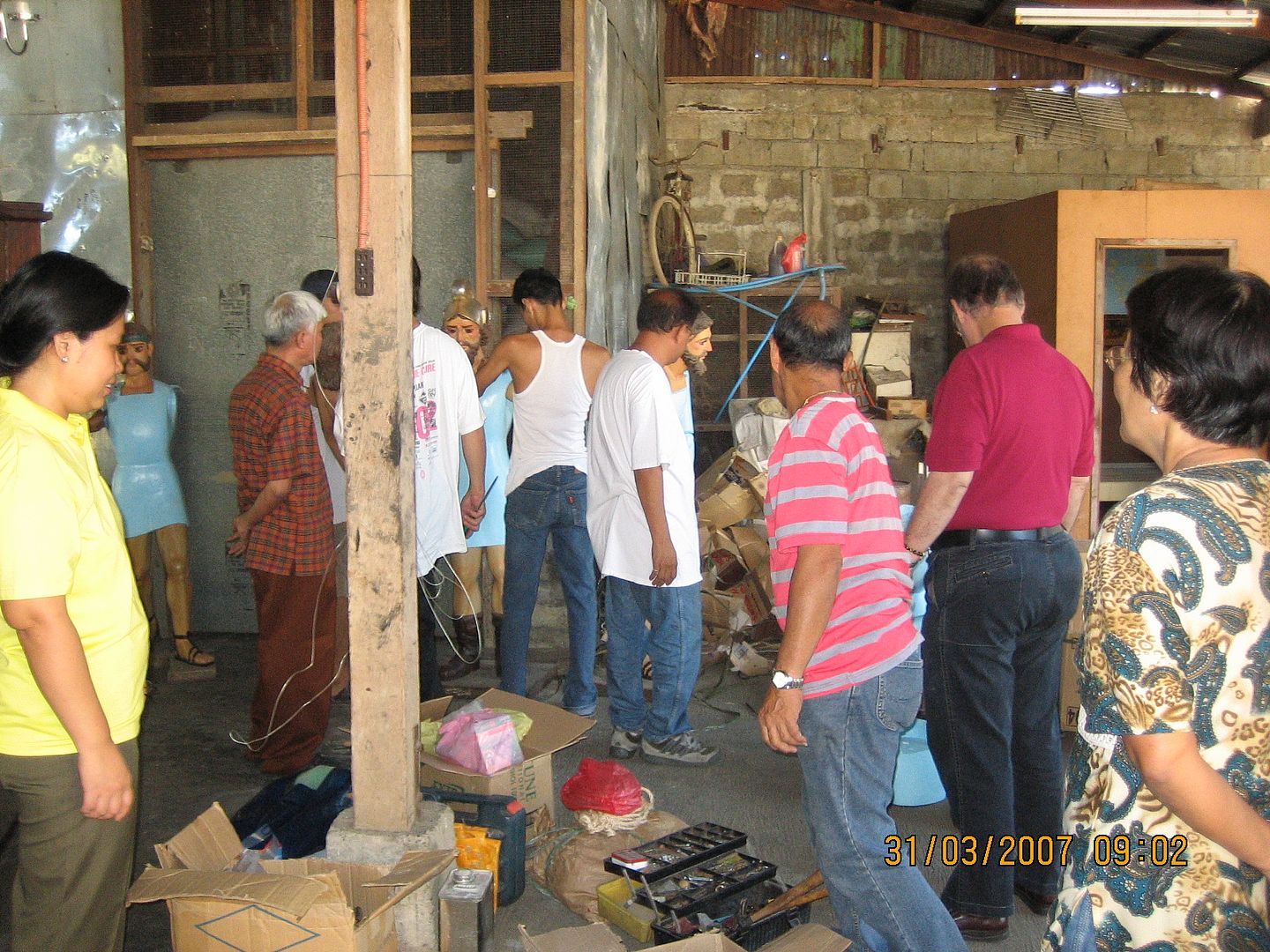
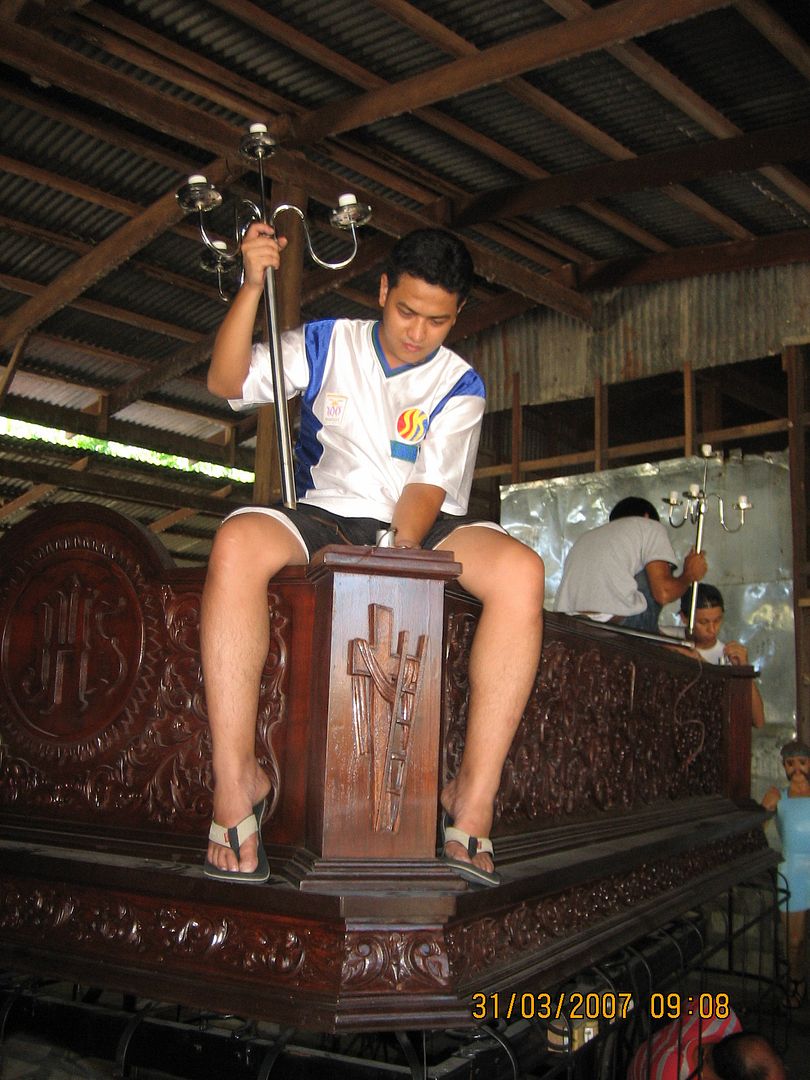
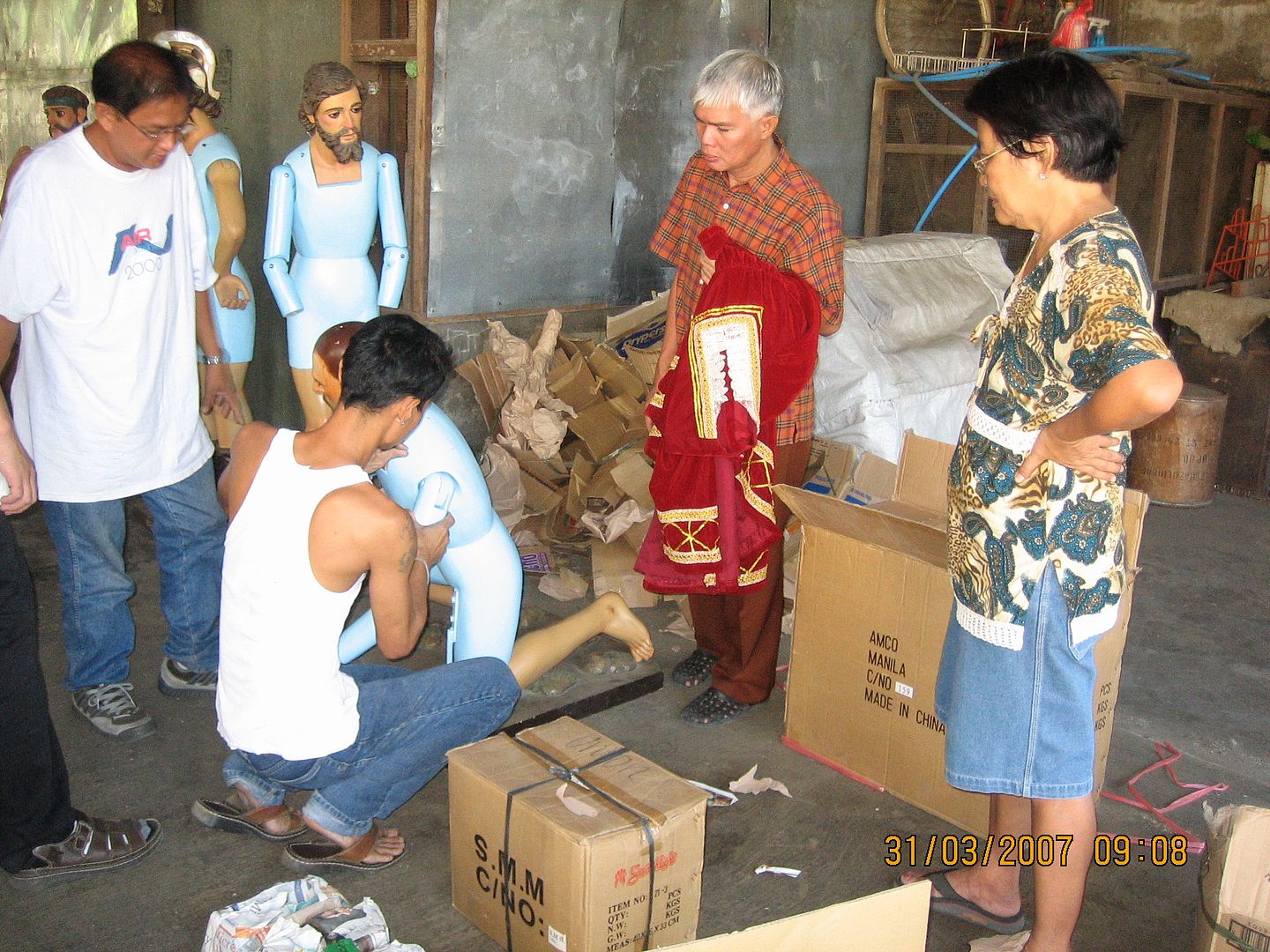
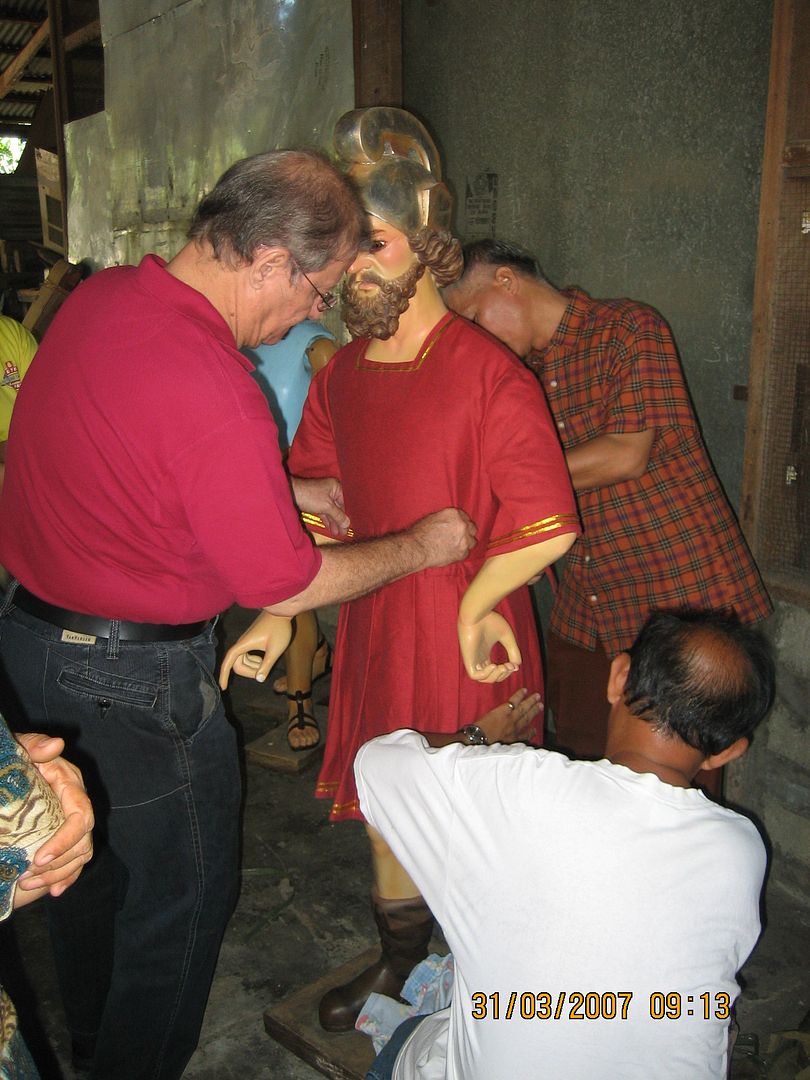
Kiko decides that the boss (the Captain) will get to be dressed first.
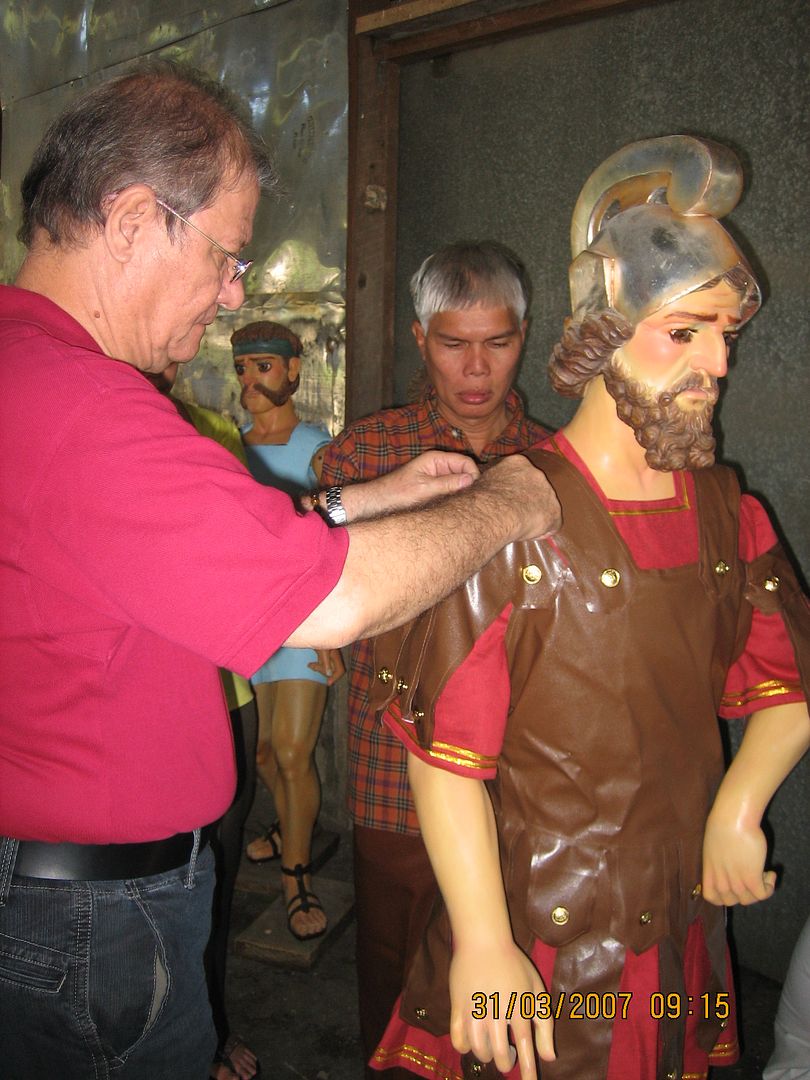
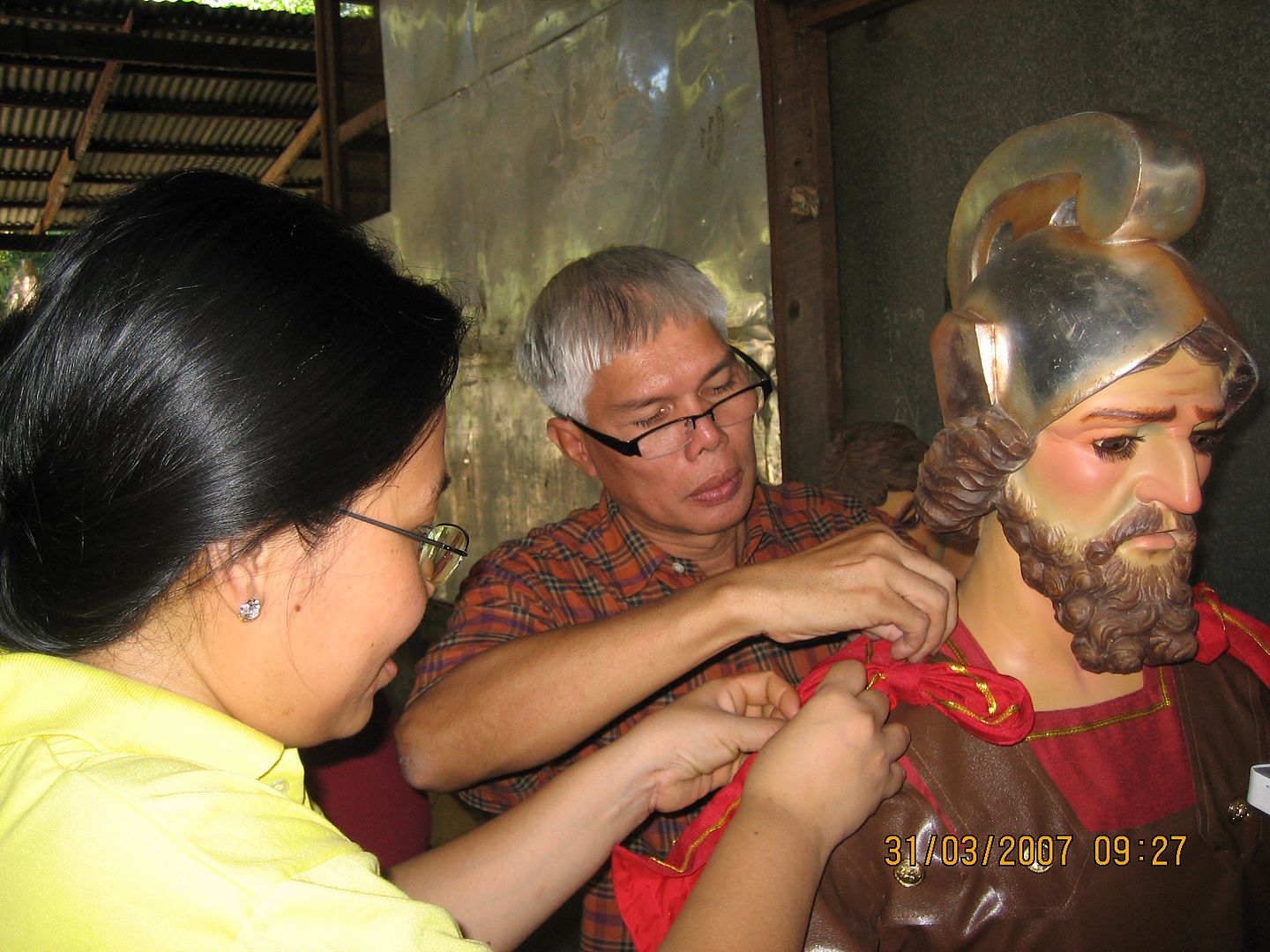
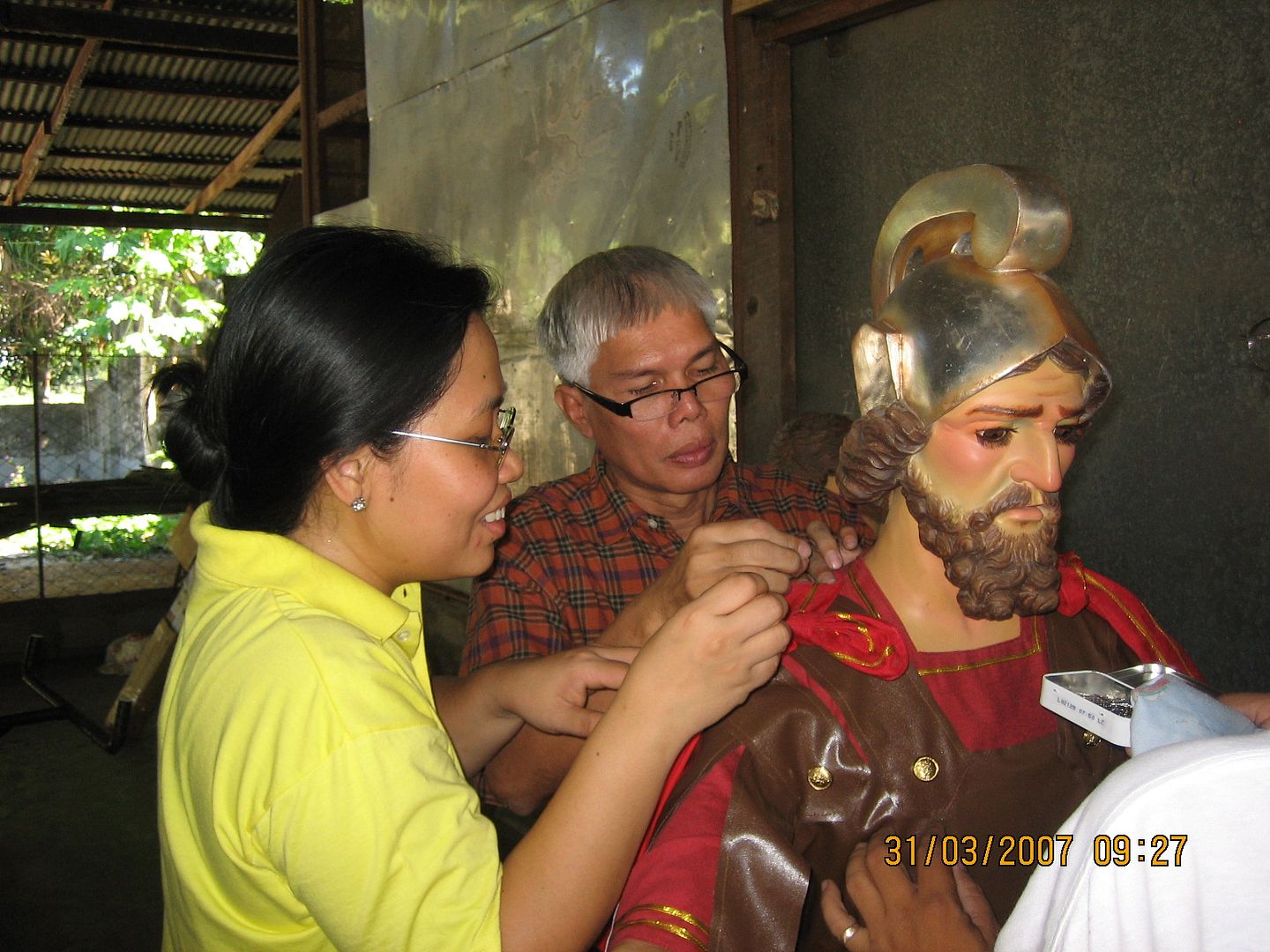
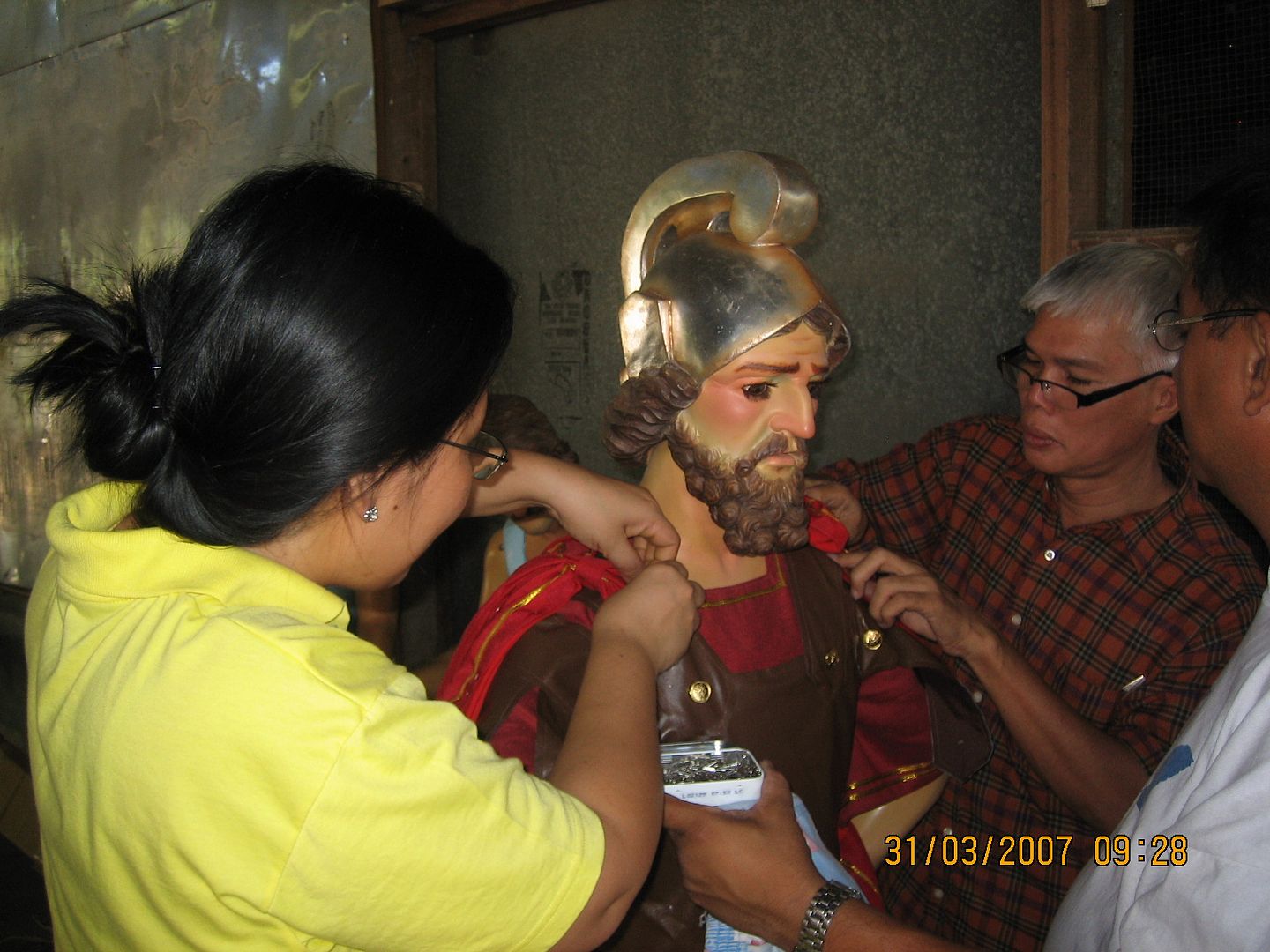
Simon of Cyrene is next. Even my aunt, who was previously just an observer, decides to dig in – it’s that much fun!
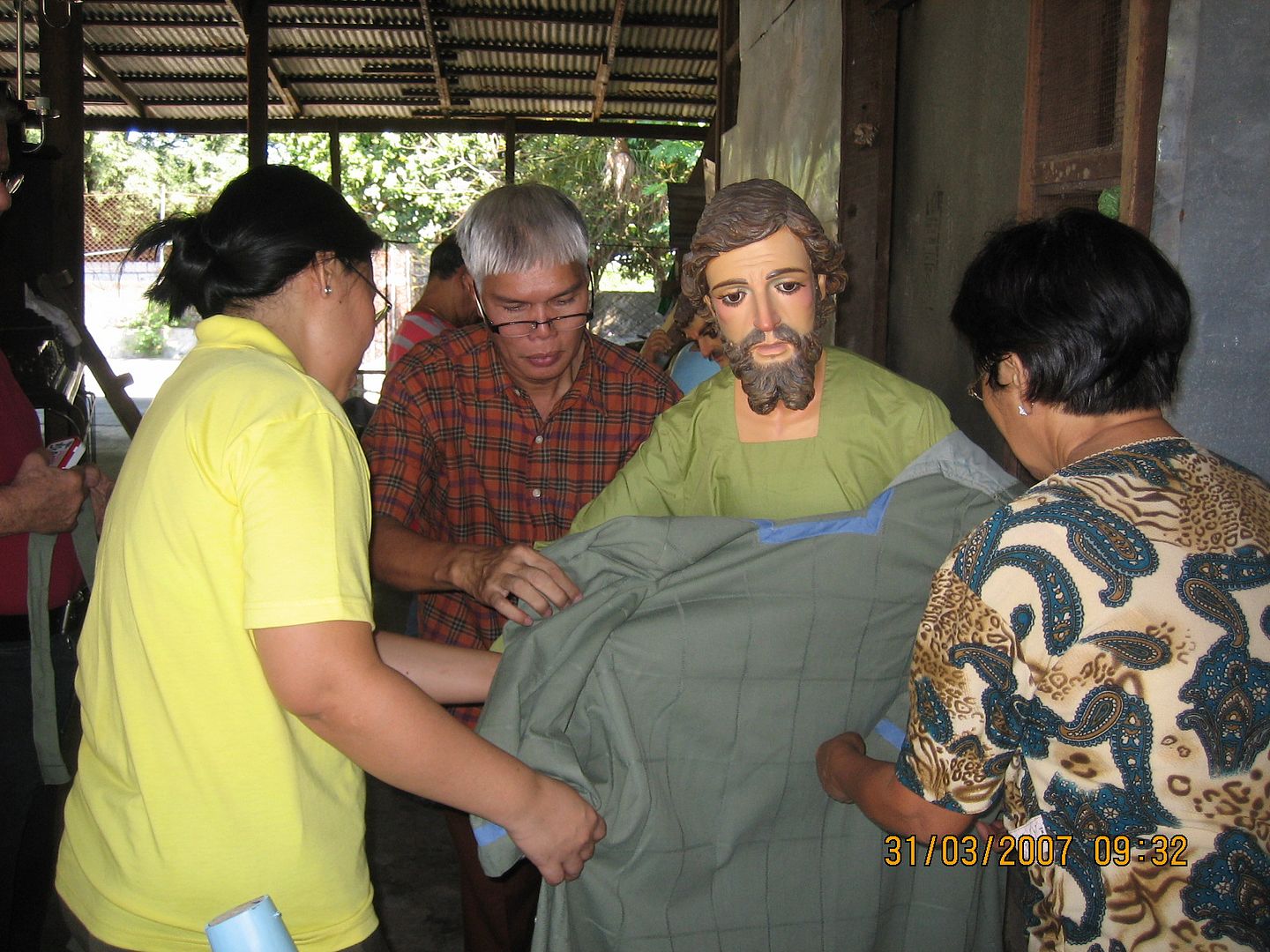
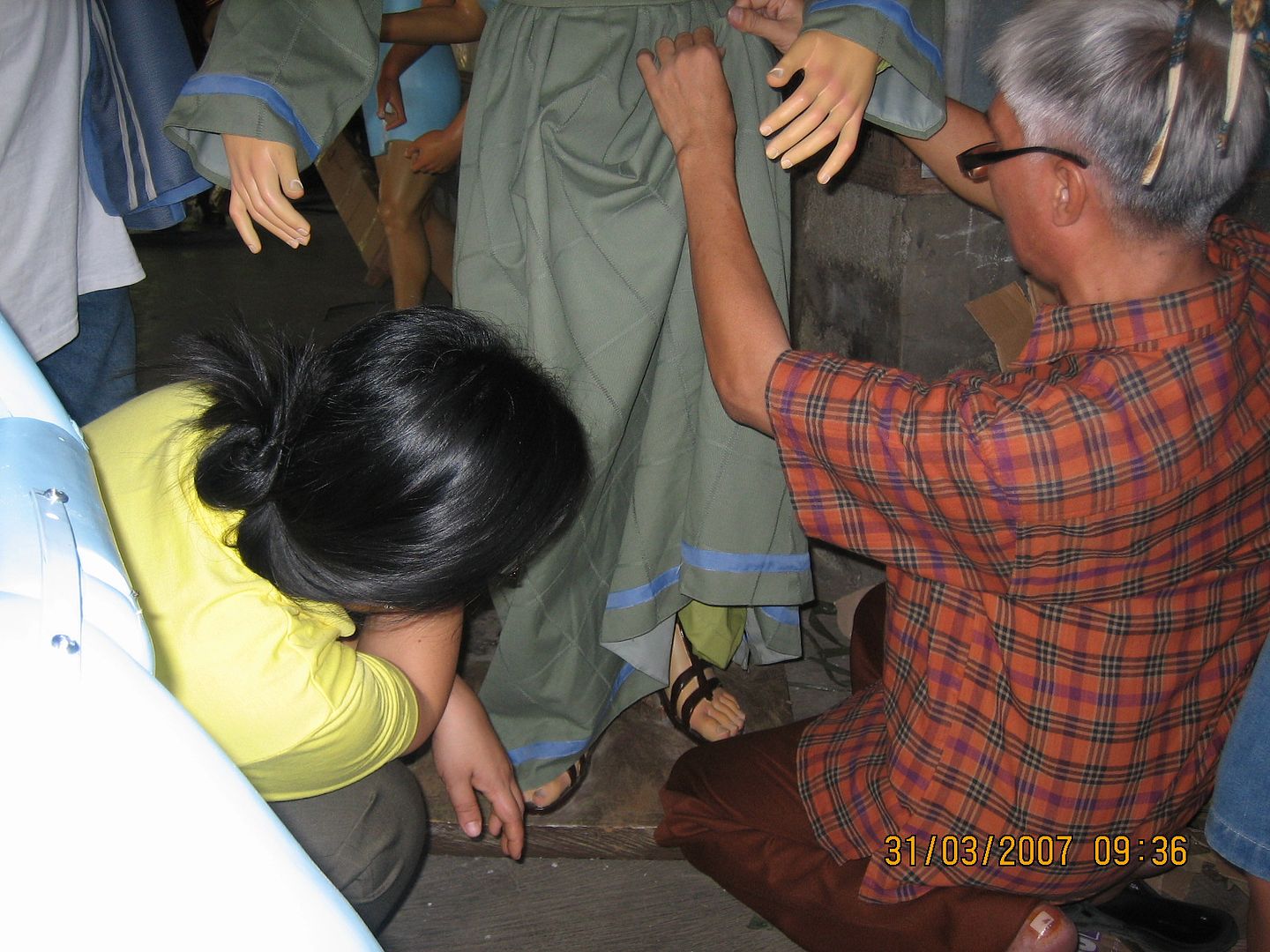
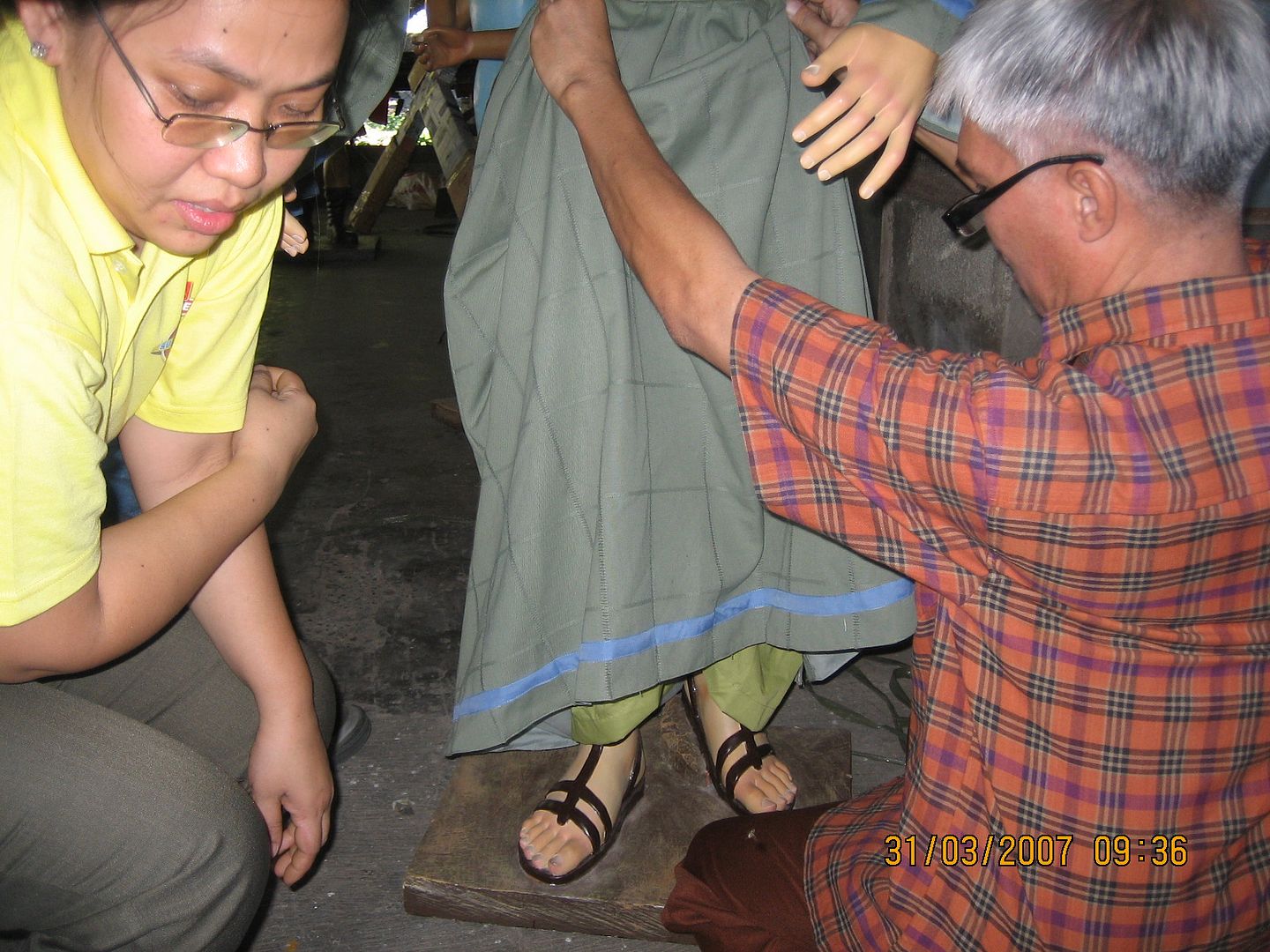
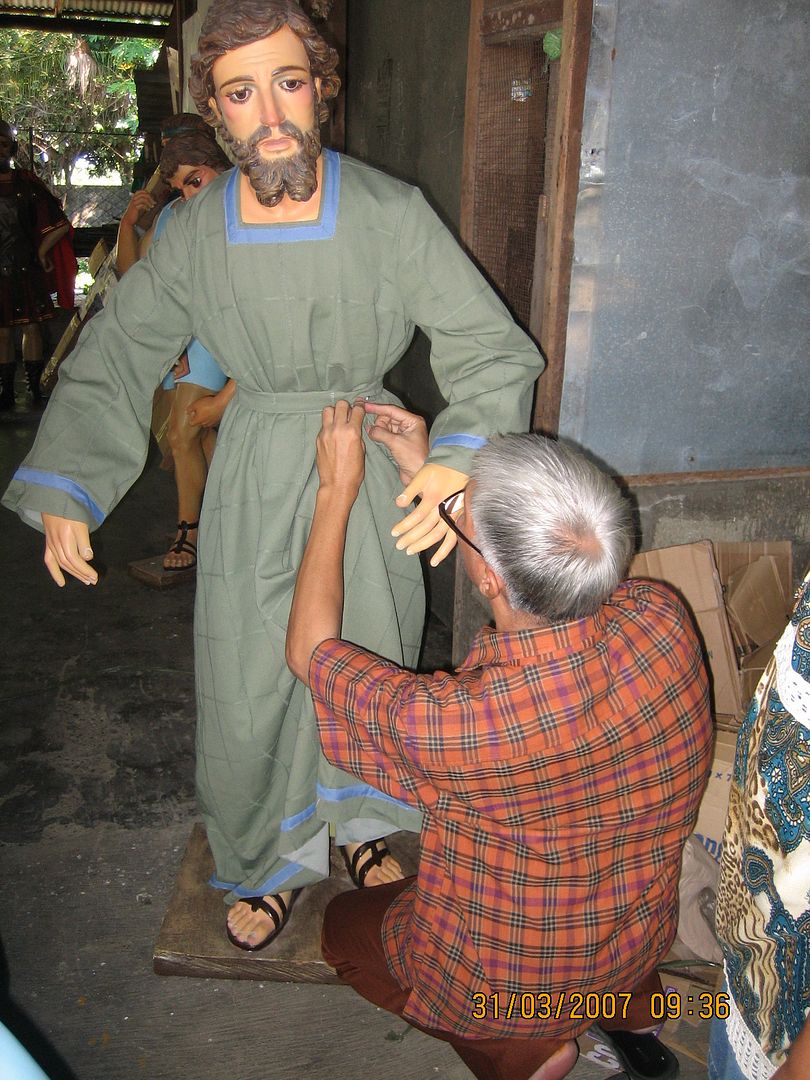
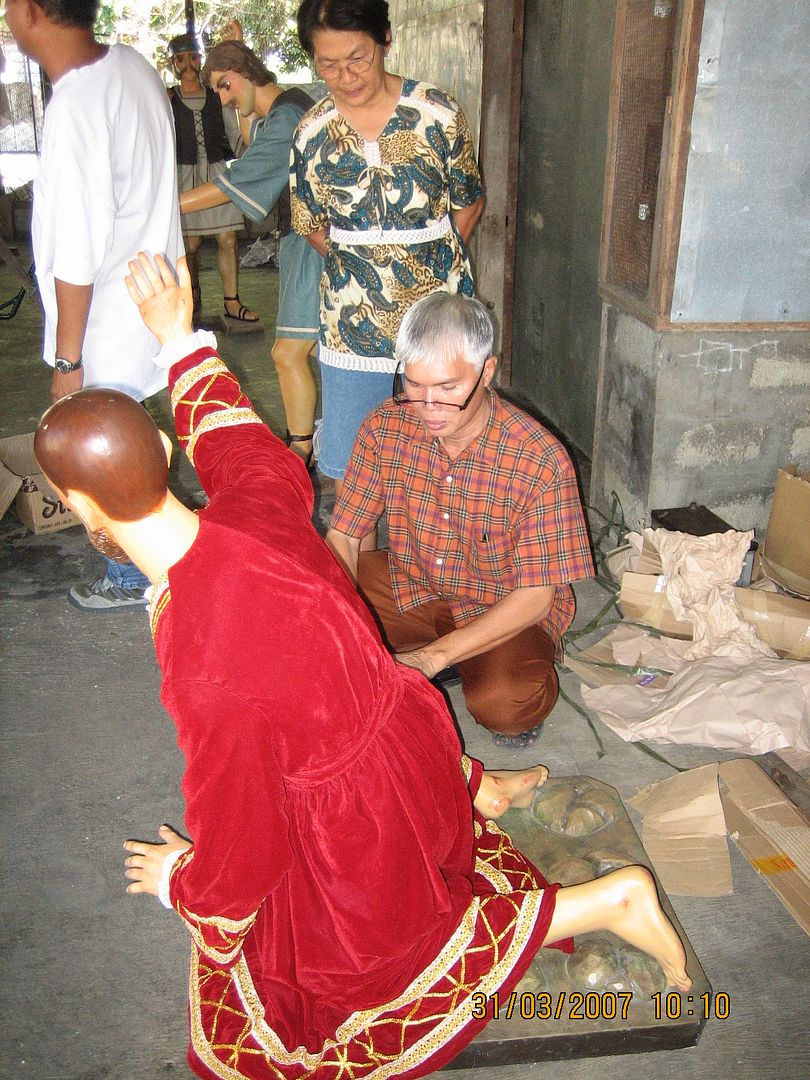
It will be clear from a close examination of the above photos that the Vecin Workshop’s standard for dressing processional images is quite high, with a minimum of three layers of clothing – an inner garment, a tunic over the inner garment, and a cape or cloak, which we will see Simon of Cyrene wearing later.
(I have seen many other processional images around with just one or two layers of clothing, often dispensing with the [apparently unnecessary and “not visible anyway”] inner garment. In fact, from my observation, the inner garment has at least two important functions: first, to ensure, by having tight cuffs, that the wrists and arms are not seen (for the hands are often carved separately from the arms and therefore there is a visible gap between them), and, second, to provide some body and volume over the image’s mannequin structure so that the tunic and other outer garments fall in place gracefully.)
Dardo proceeds to work (very quickly and with extraordinary nimbleness, in my view -- hundreds of pins and not one prick!) on the two temple guards, one of which is seen here:
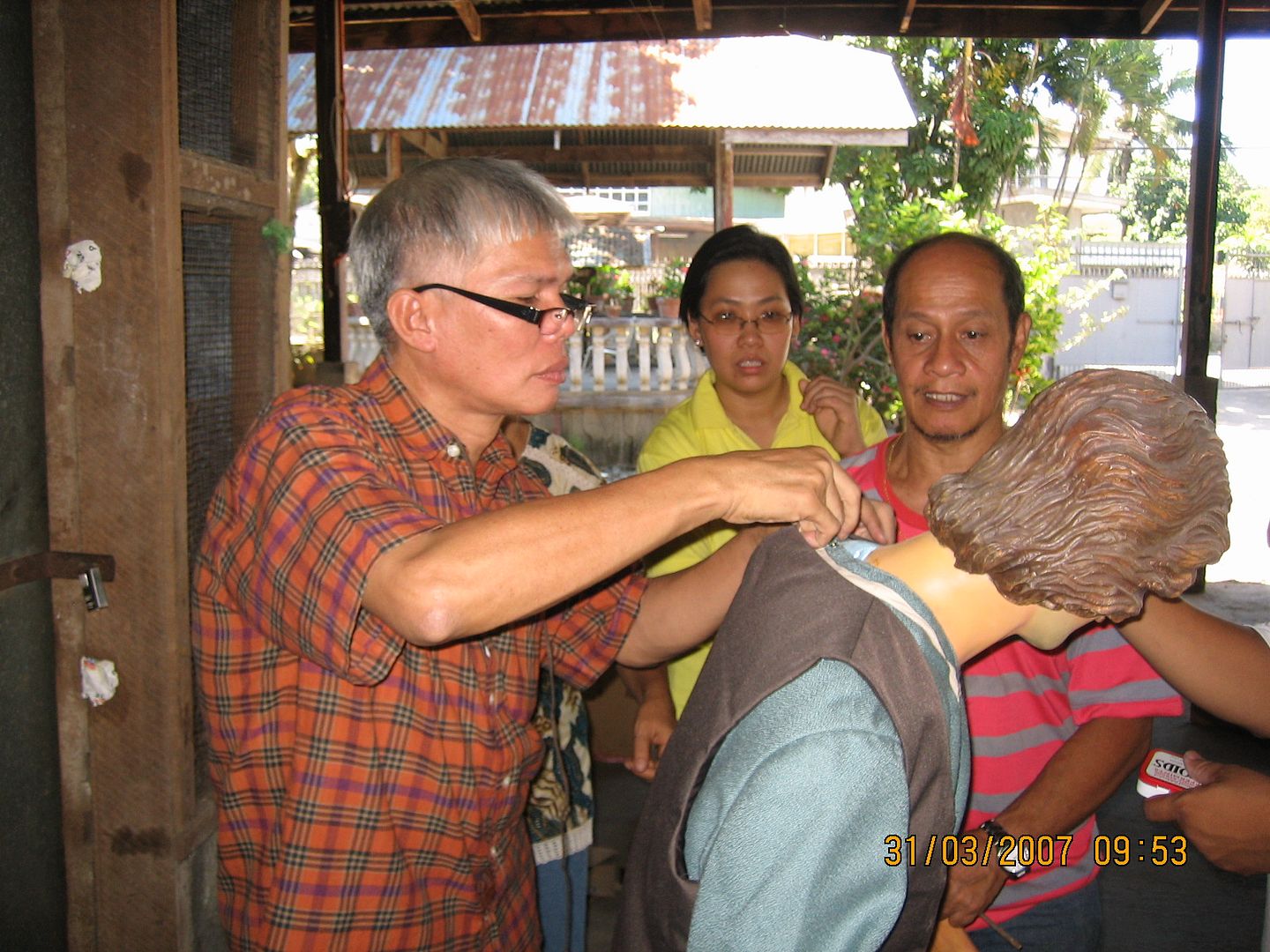
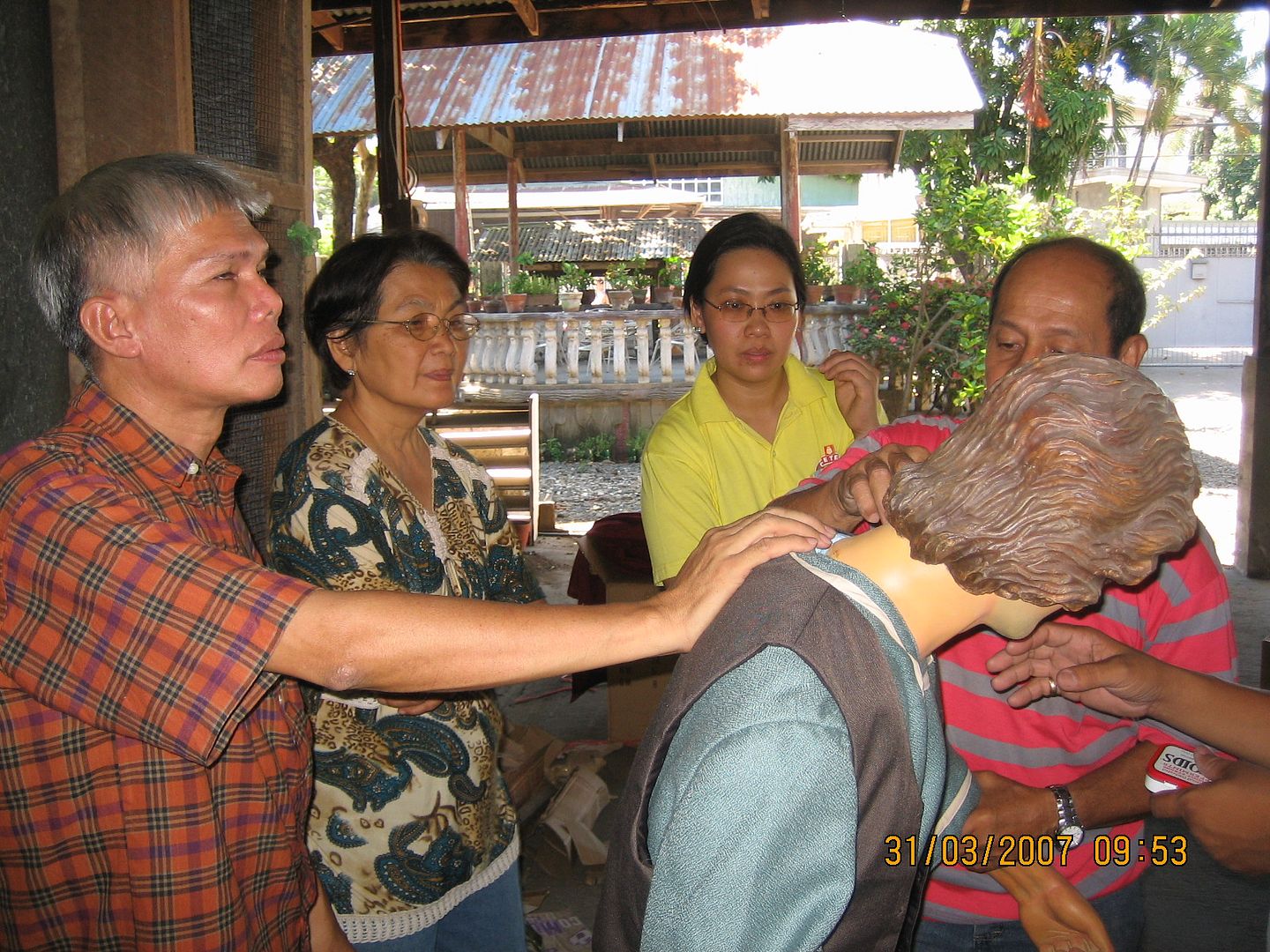
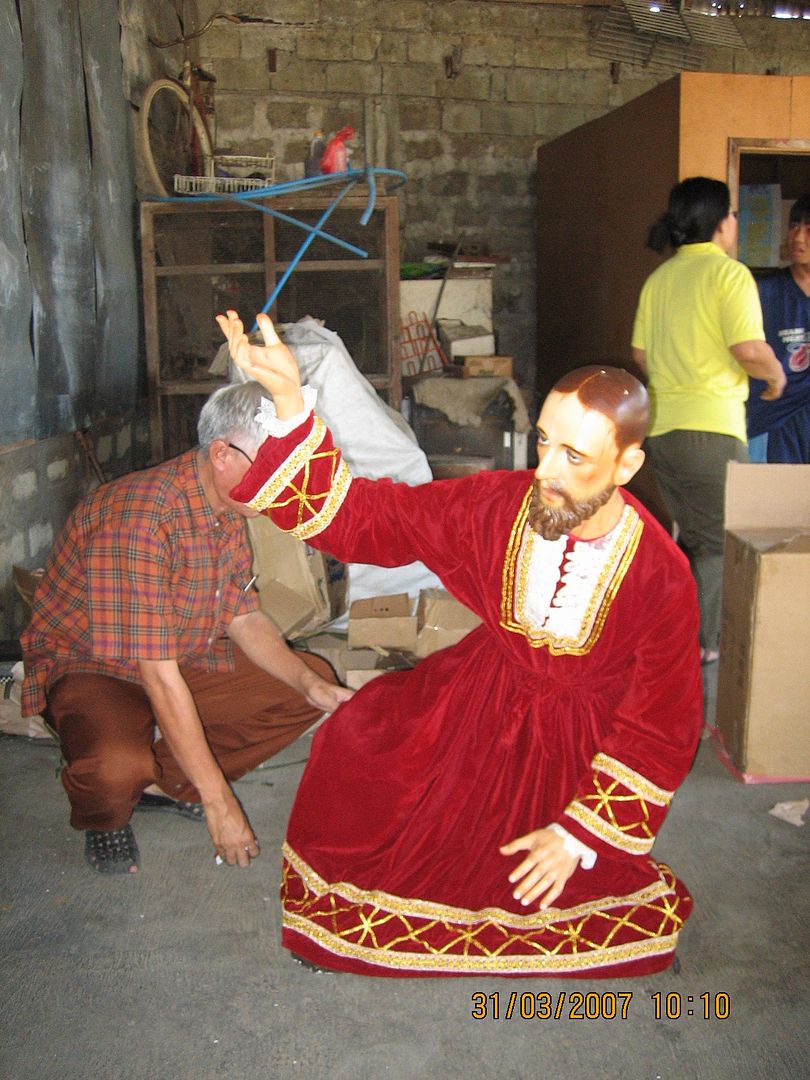
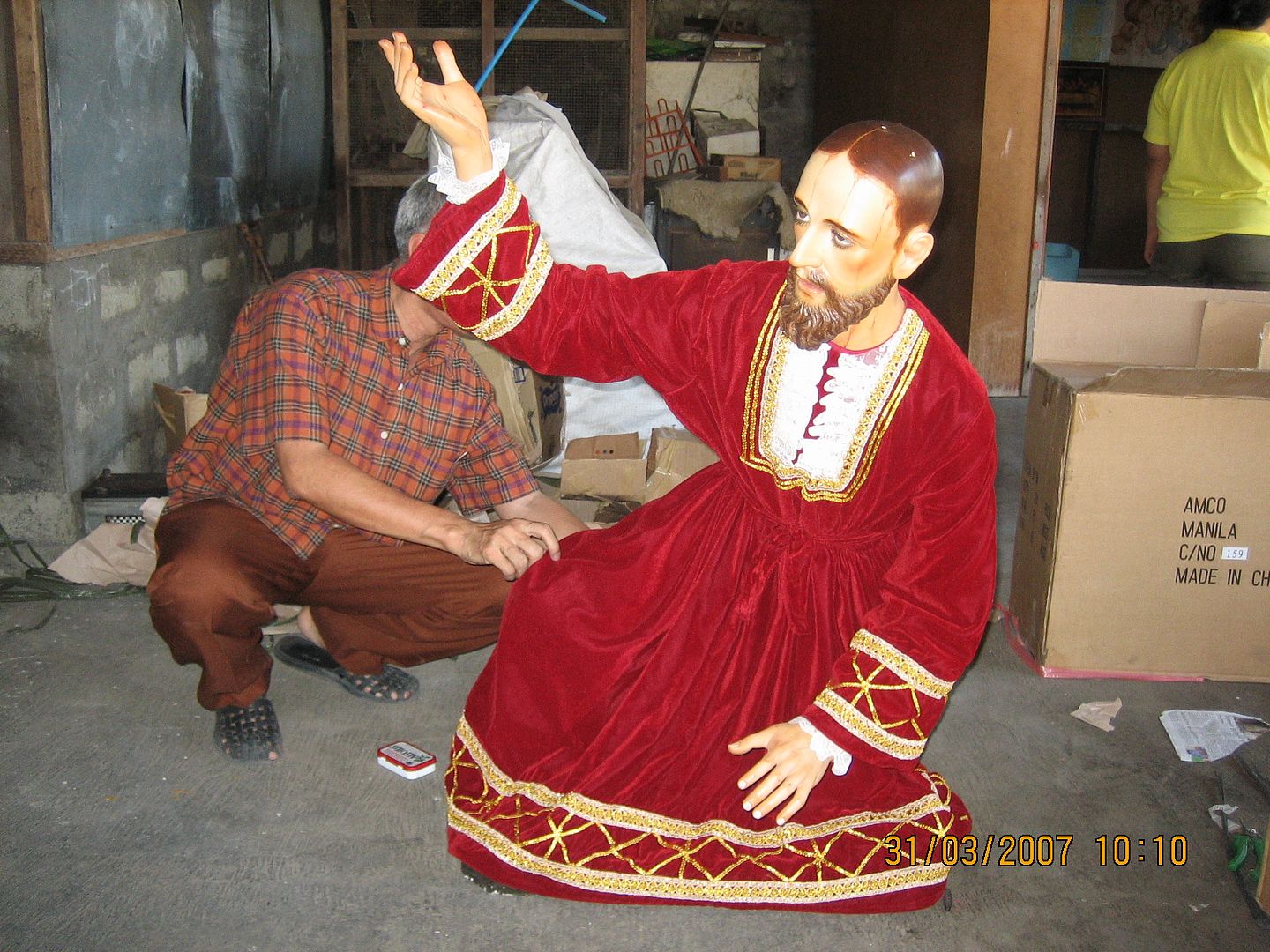
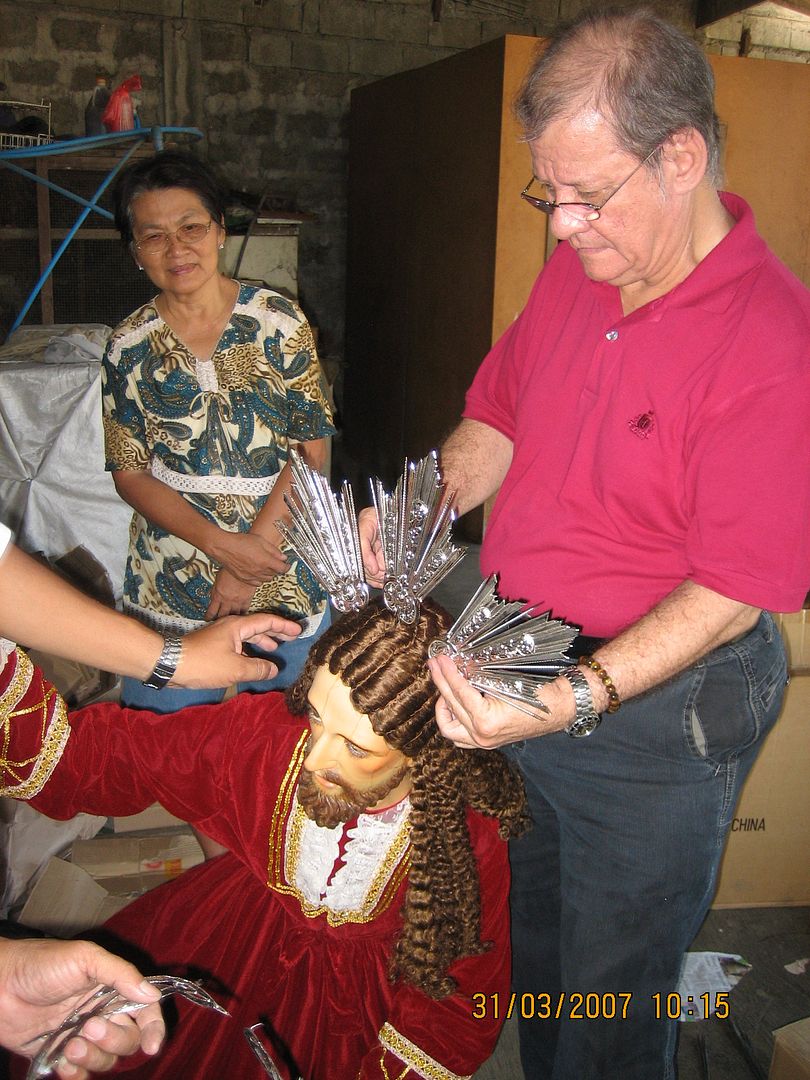
And then finally Dardo and Kiko work on the all-important figure of Christ, garbing Him in the simple yet elegant red velvet robe, putting on His jusi wig, and affixing His silver-plated “tres potencias” in place.
Then one by one, each figure (and the full-size cross) is brought up onto the carro and positioned firmly in their proper places with large nuts and bolts.
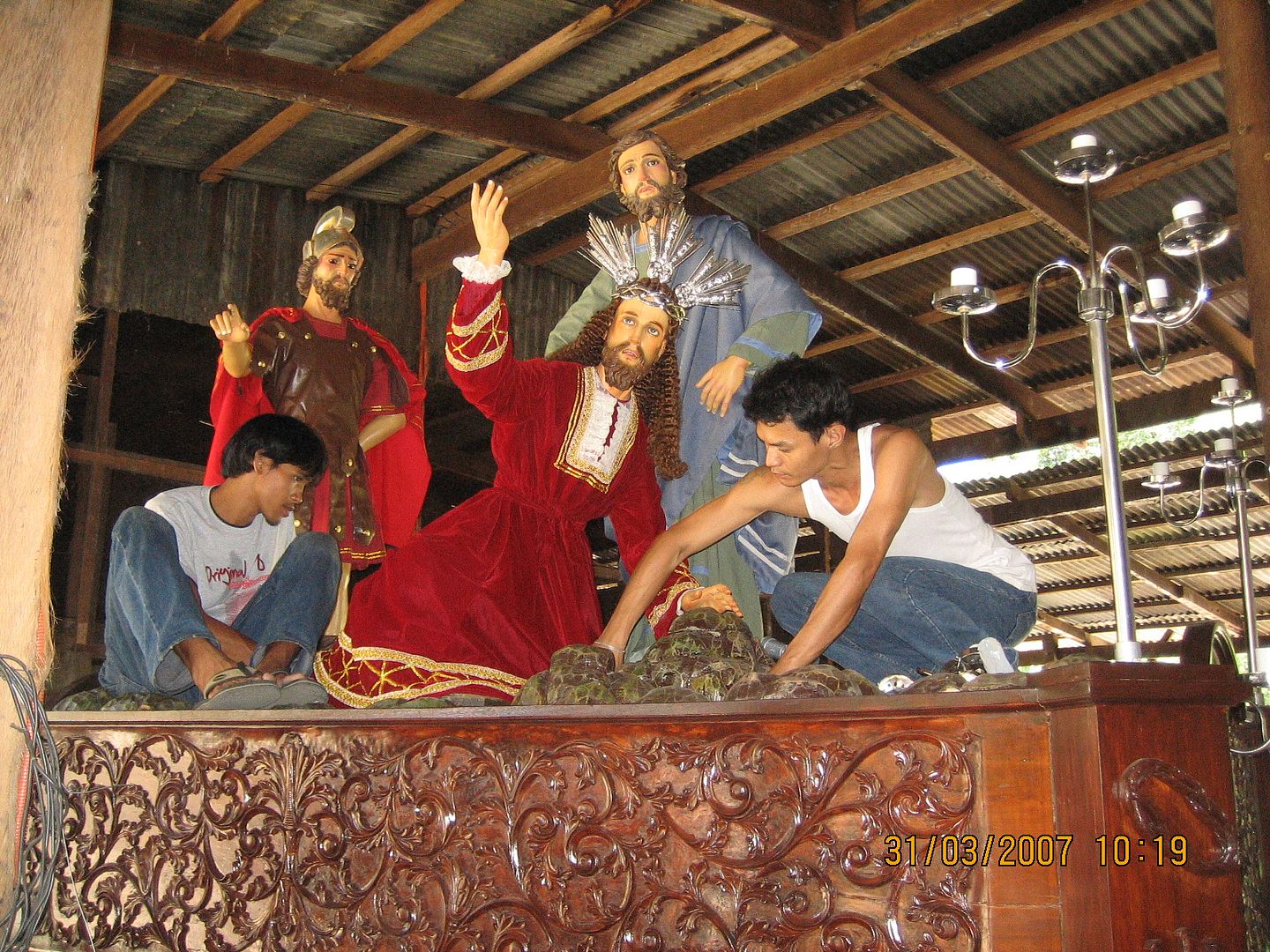
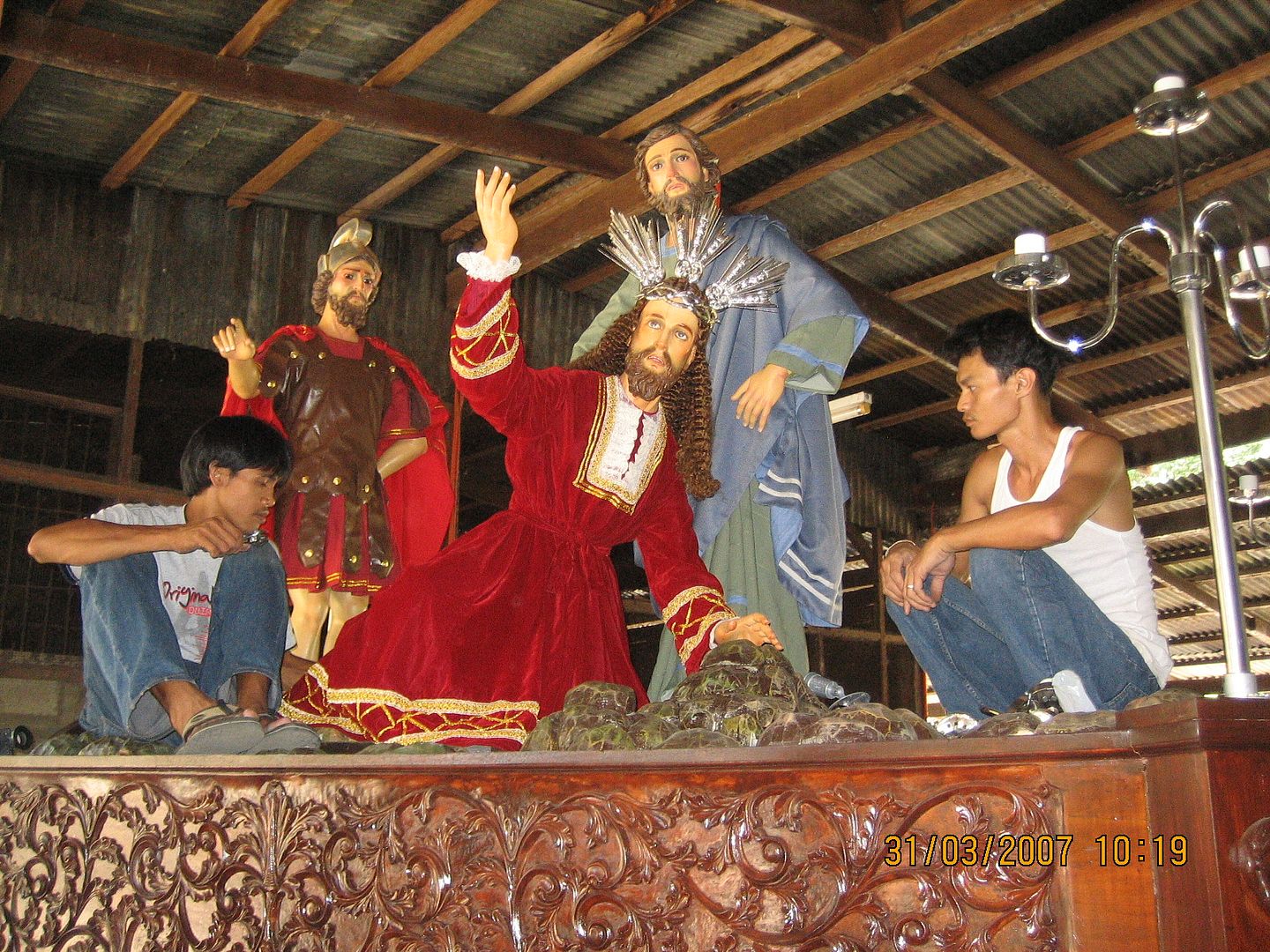
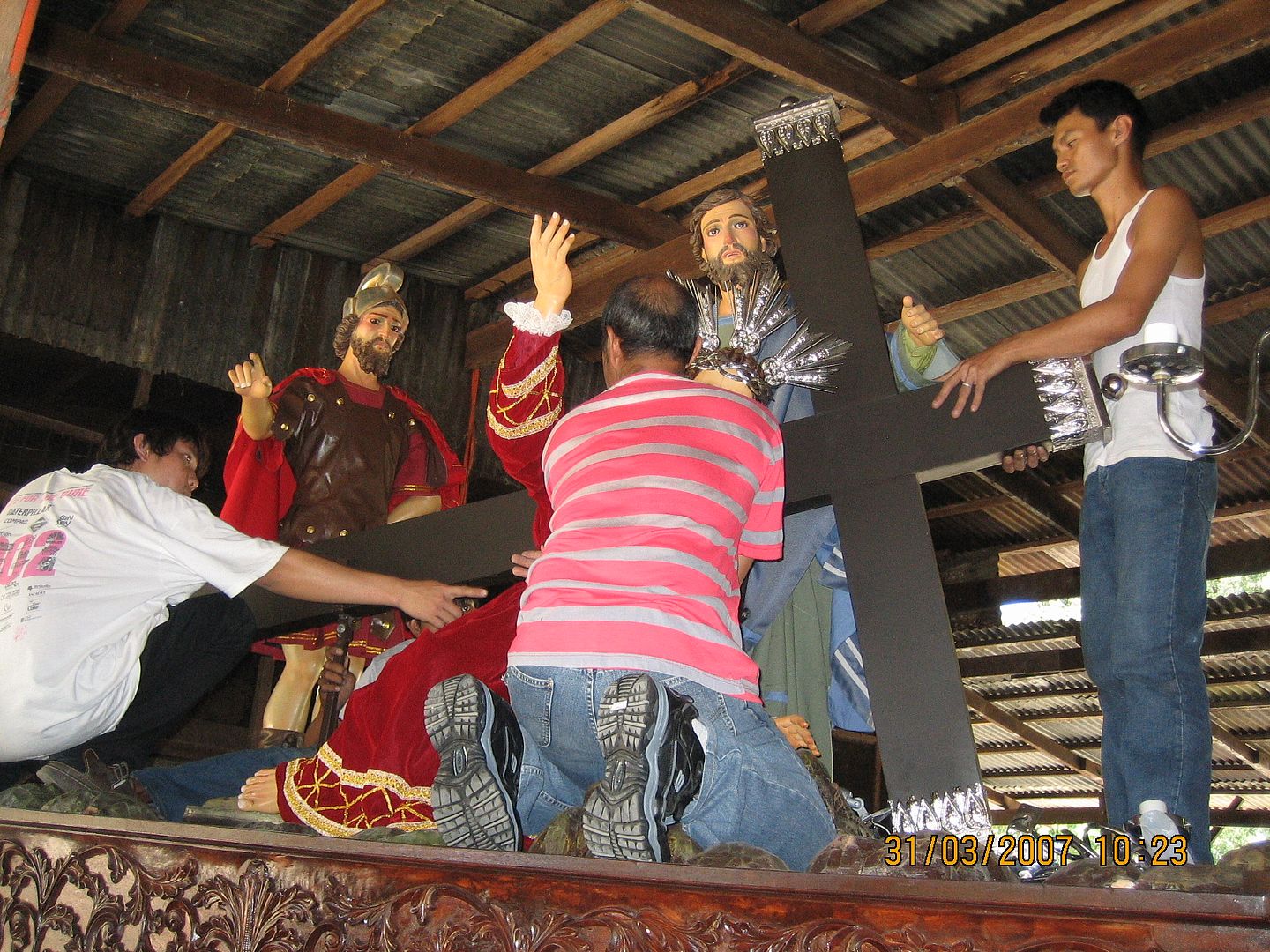
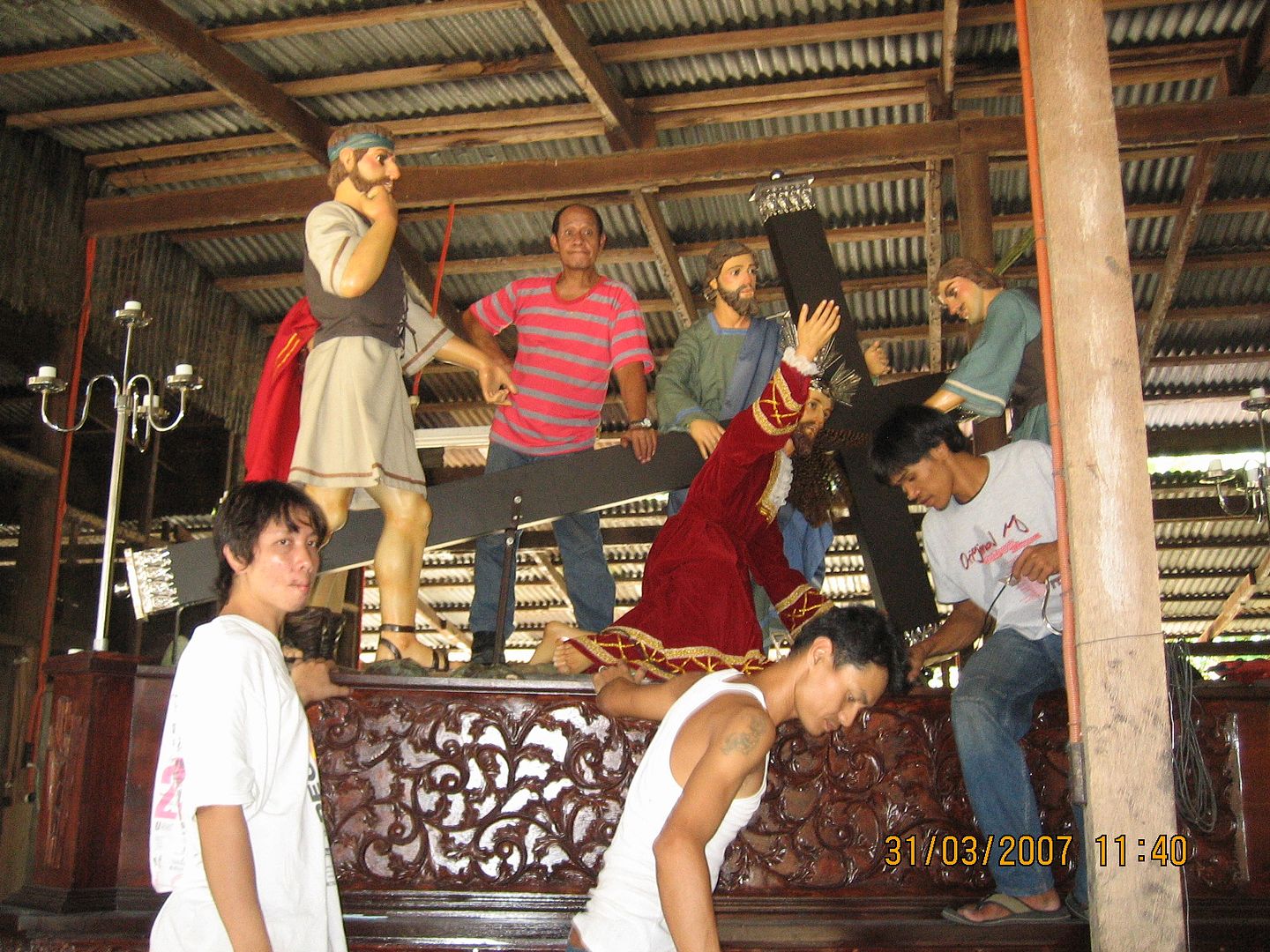
Kiko personally handles the final details of staging, including positioning the rope around Christ’s neck and through to the temple guard at the rear.

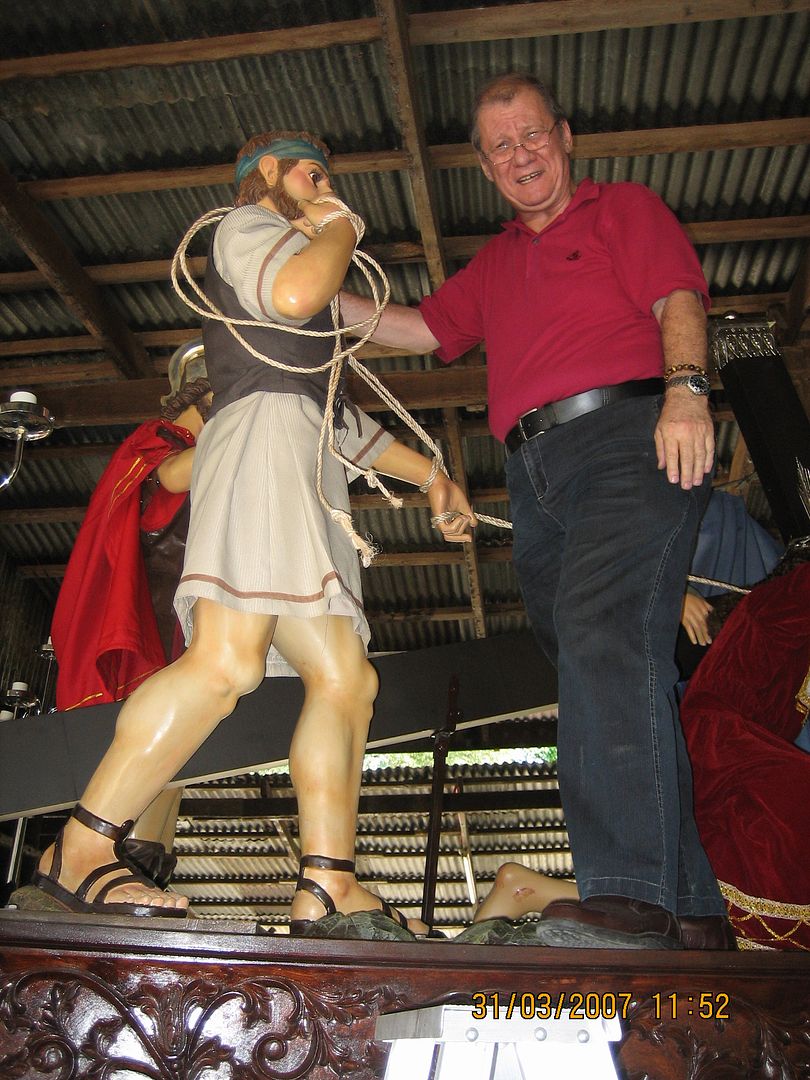

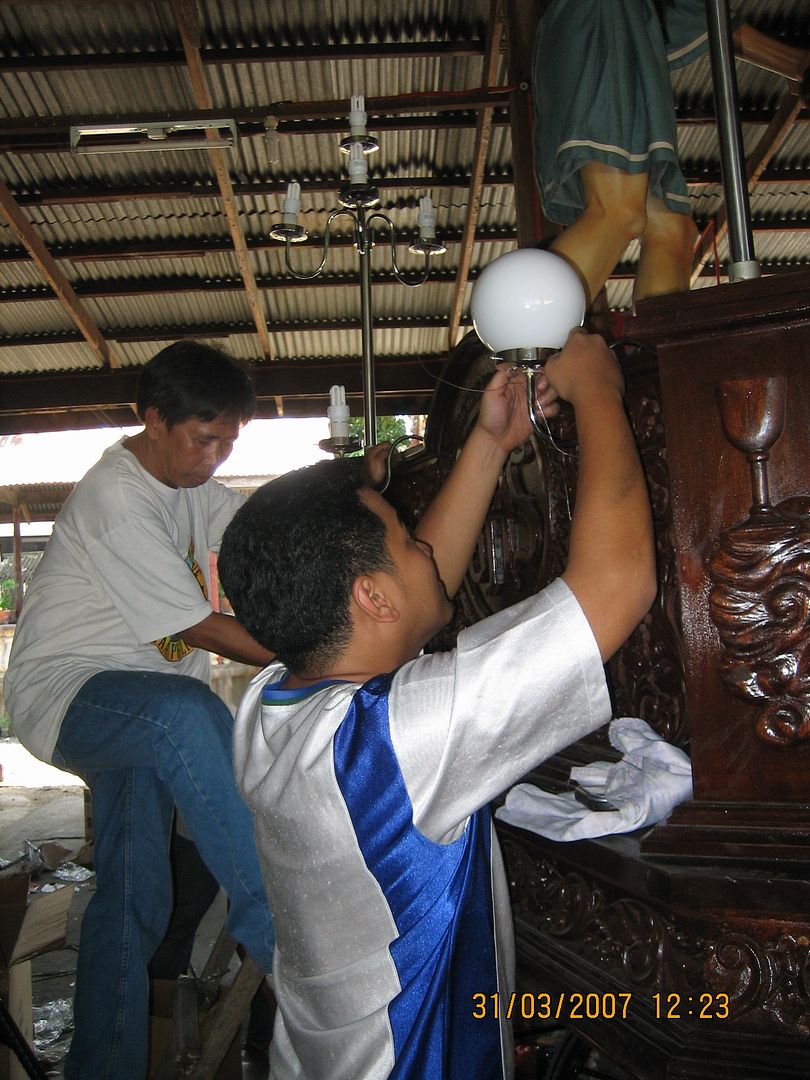
The pescantes (single-light-bulb perimeter sconces) are next attached, the light bulbs (“Philips High-Energy Compact Fluorescent Warm-White 8-Watt”) are screwed in, and the globo virinas (spherical milk-glass white-frosted light covers) are fixed in place.
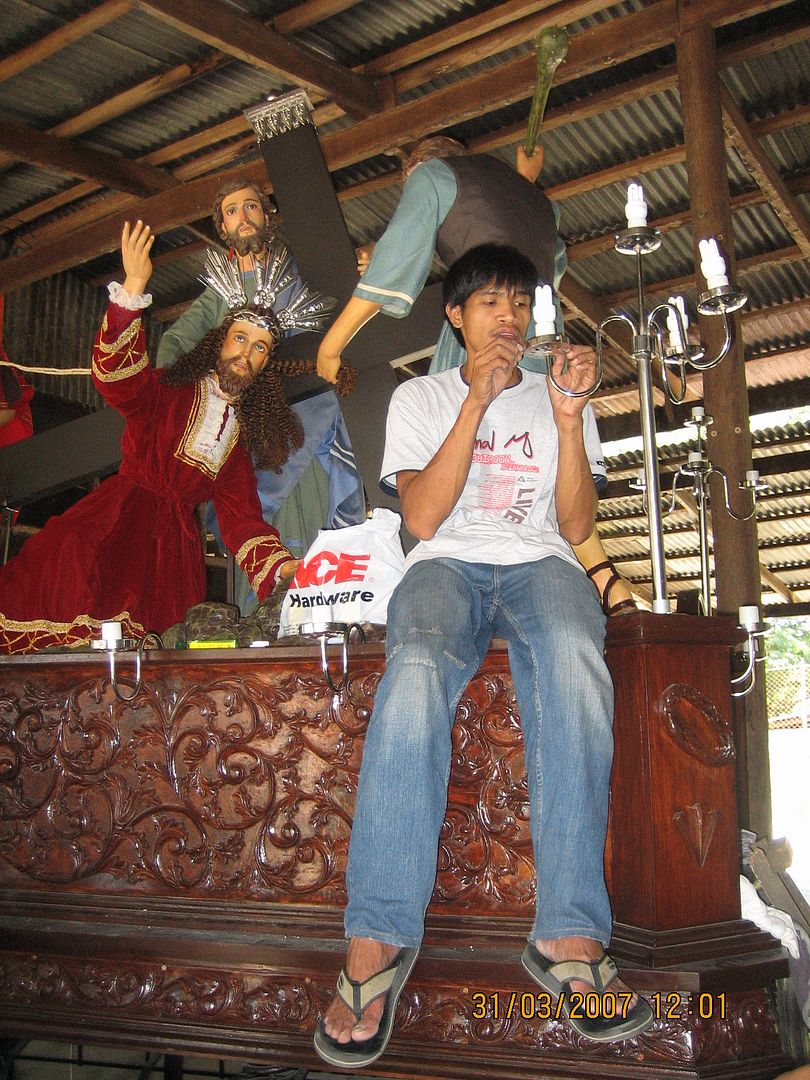
With all lighting fixtures installed, the last remaining phase of this setting-up is the floral decoration. Dardo de la Cruz is not only the Vecin Workshop’s regular image dresser and the official dresser as well of all of the Vecin Family’s own Holy Week processional images in Makati Poblacion (at least ten tableaux, all told). He is also a distinguished carroza decorator and is usually called in to work on the pasos of several other regular clients of the Vecin Workshop. Perhaps not too surprisingly, Kiko Vecin had brought him along on this all-important day as well.
In fact, Dardo and I had, just a few days earlier, taken a quick lunch-time trip to Divisoria to his favorite shop there offering very realistic-looking silk flowers. Having seen the carroza at the Vecin Workshop a few days earlier, he surveyed the shop’s product offerings and selected a number of items, including what I thought were deceivingly real-looking white lilies. (Well, I’m no botanist, so don’t send me emails on this point please.)
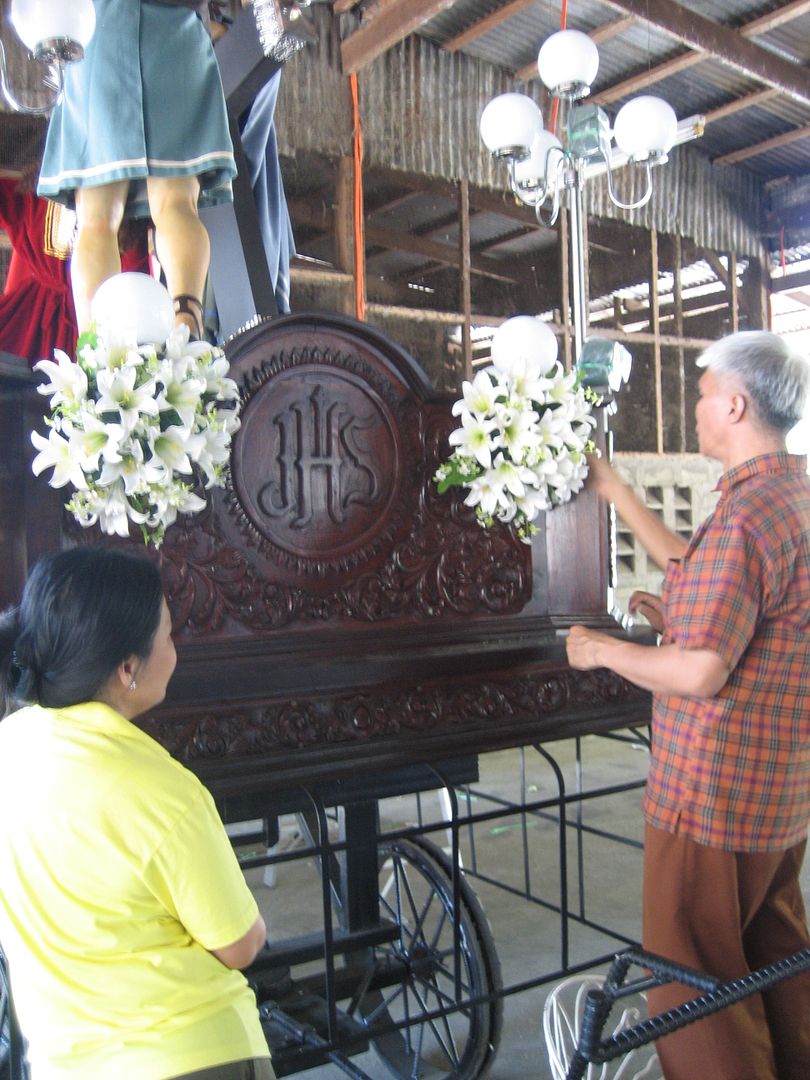
After being reminded by Kiko to keep it simple, go easy on the foliage, and make sure that the devotee on the ground will still have a flower-unimpeded view of the all parts of the tableau, Dardo offers the following test-flower-arrangement around a pescante for everyone’s review.
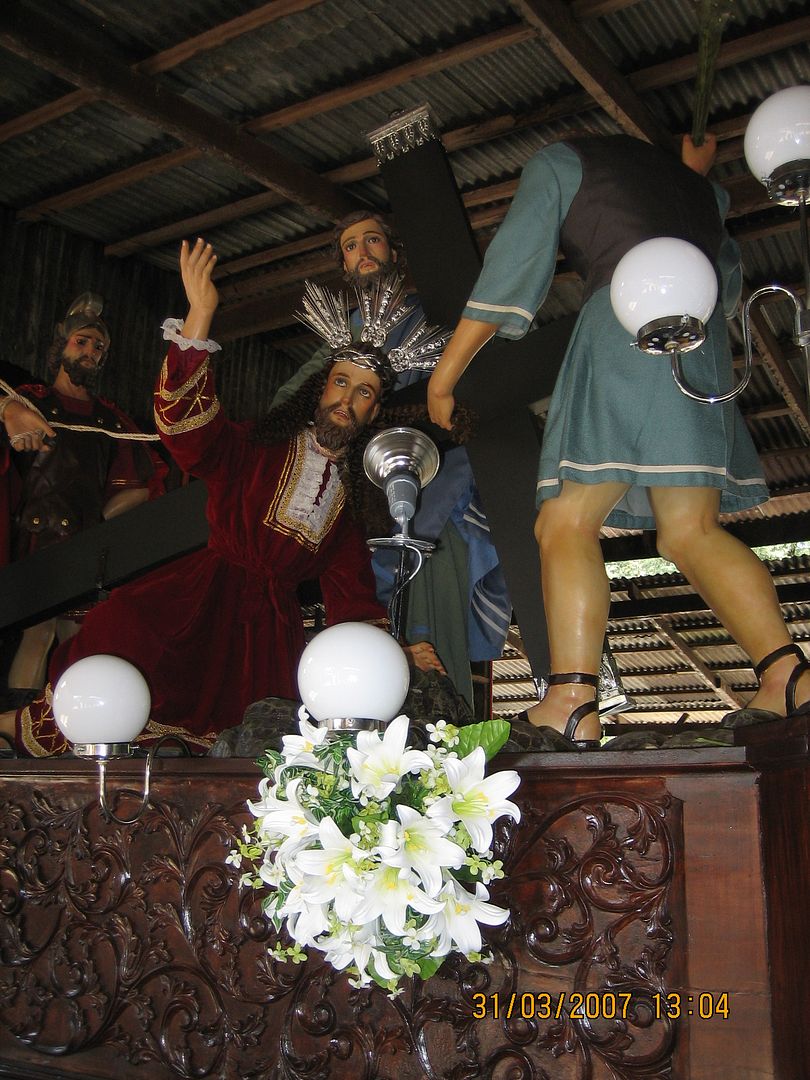
It quickly earns broad approval all-around, because not only does it achieve Kiko’s objectives of keeping it compact and simple and offering an unimpeded view of the action above, but it also somehow blends in with the sinewy Art Nouveau-style carvings on the carroza’s four slab-paneled sides.
After a quick lunch break for yet another hearty meal in our ancestral home’s dining room, we let Dardo take over the carro to complete the decorations, which he does surprisingly fast – just as fast as he was in dressing the figures earlier in the day.
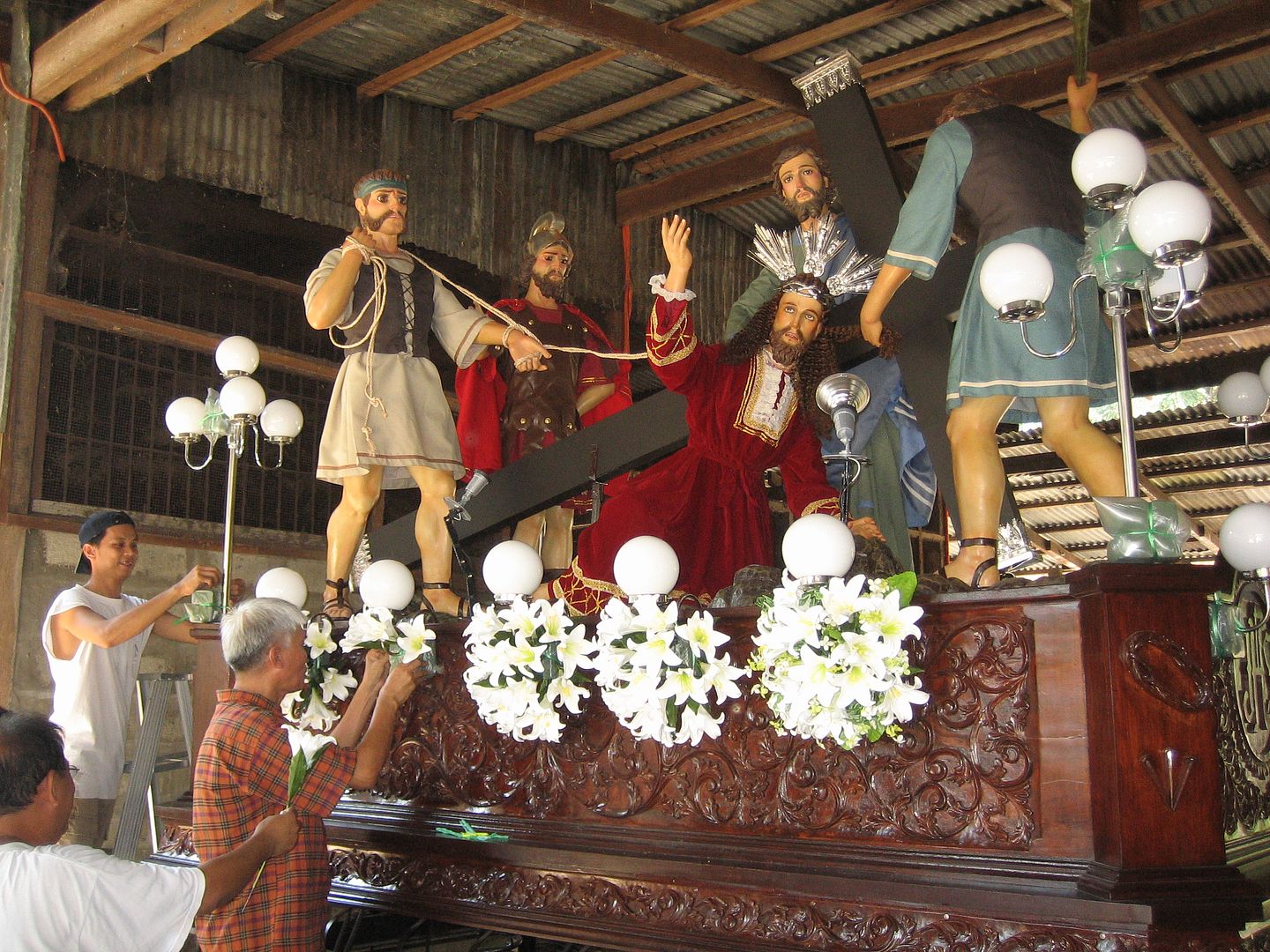
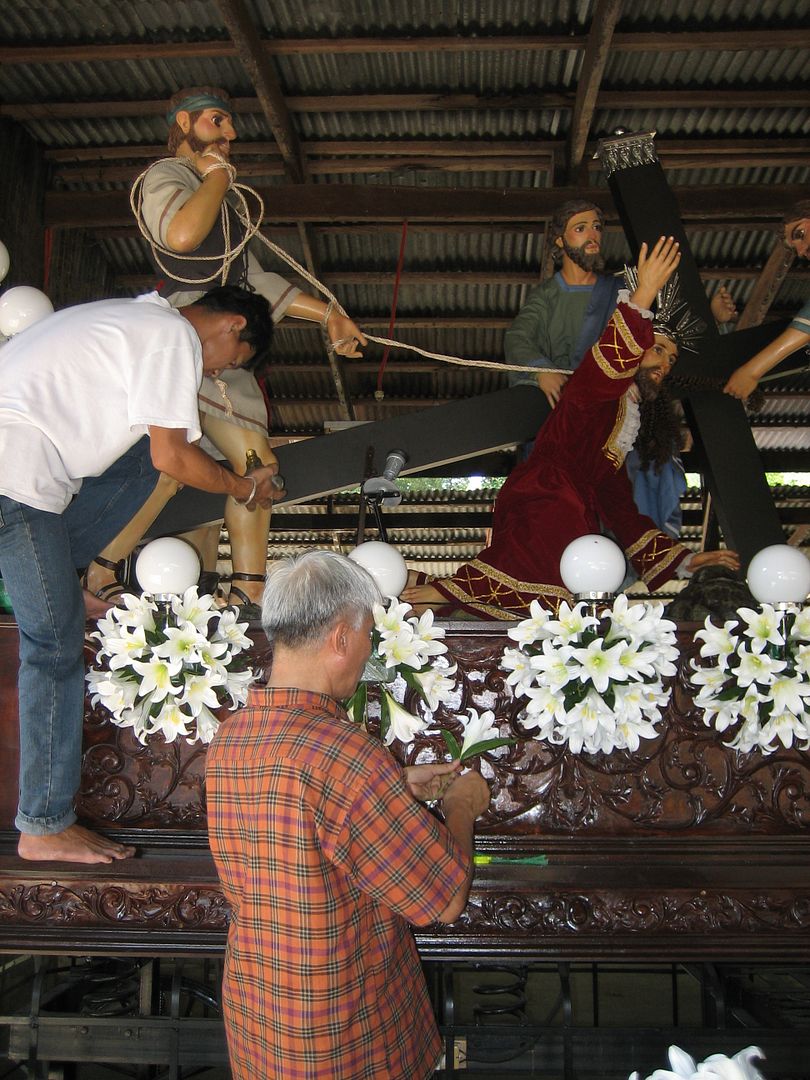
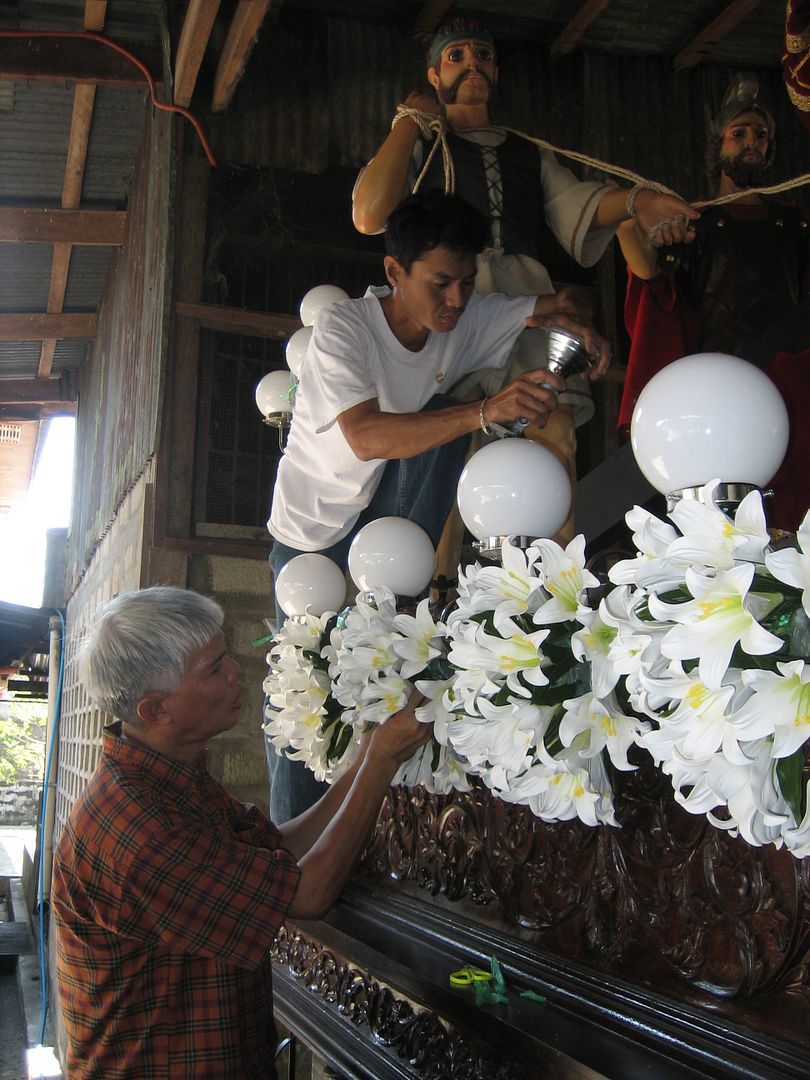
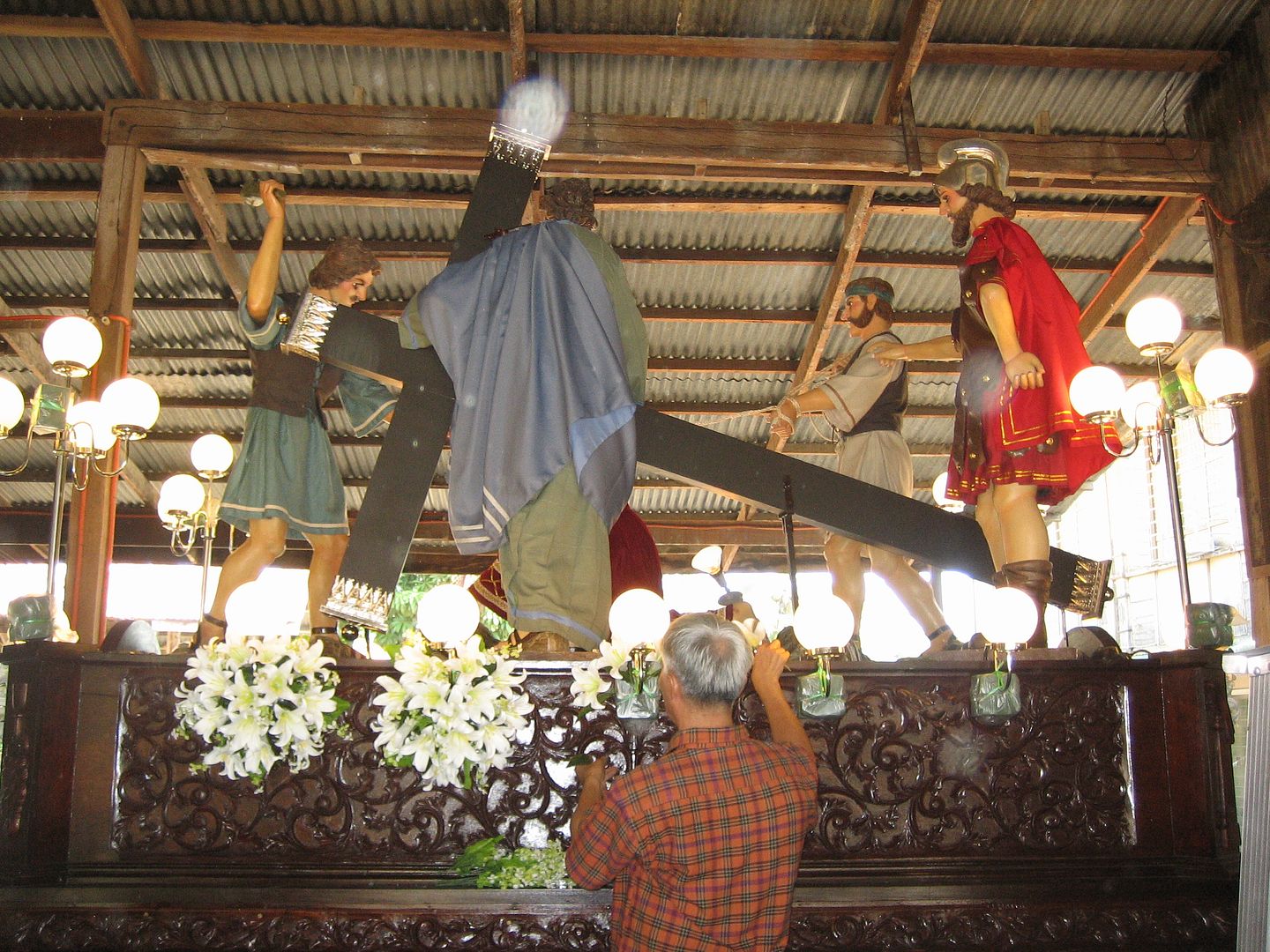
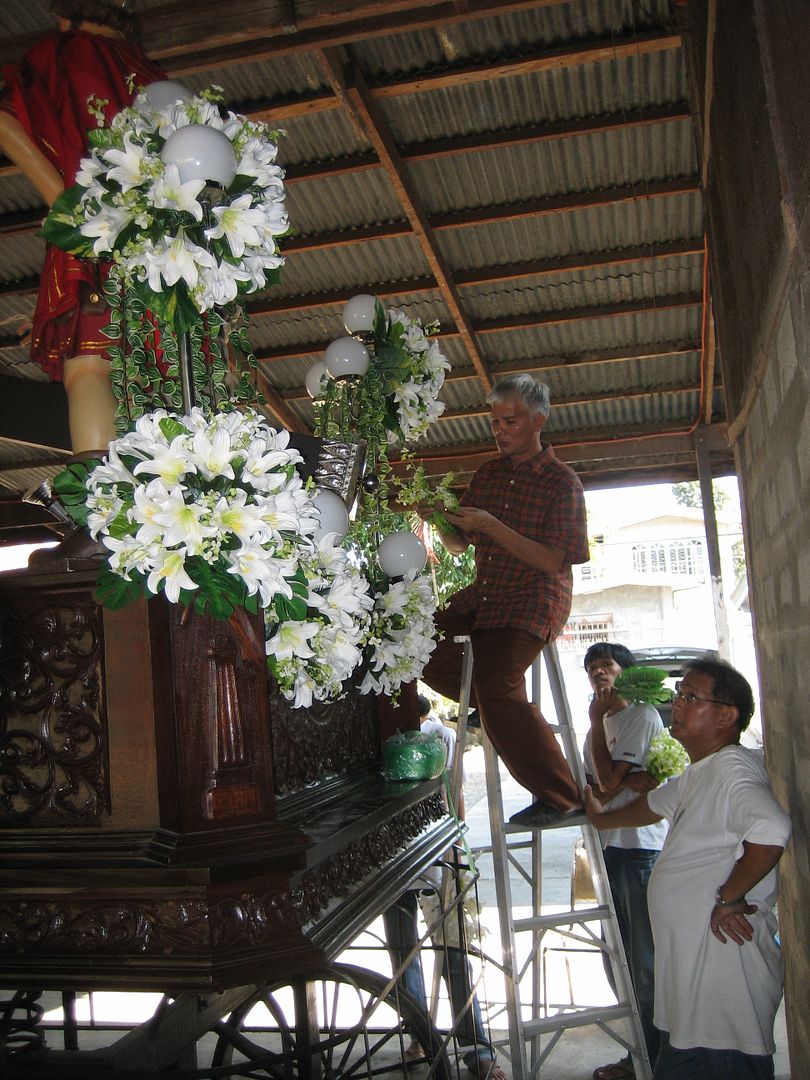
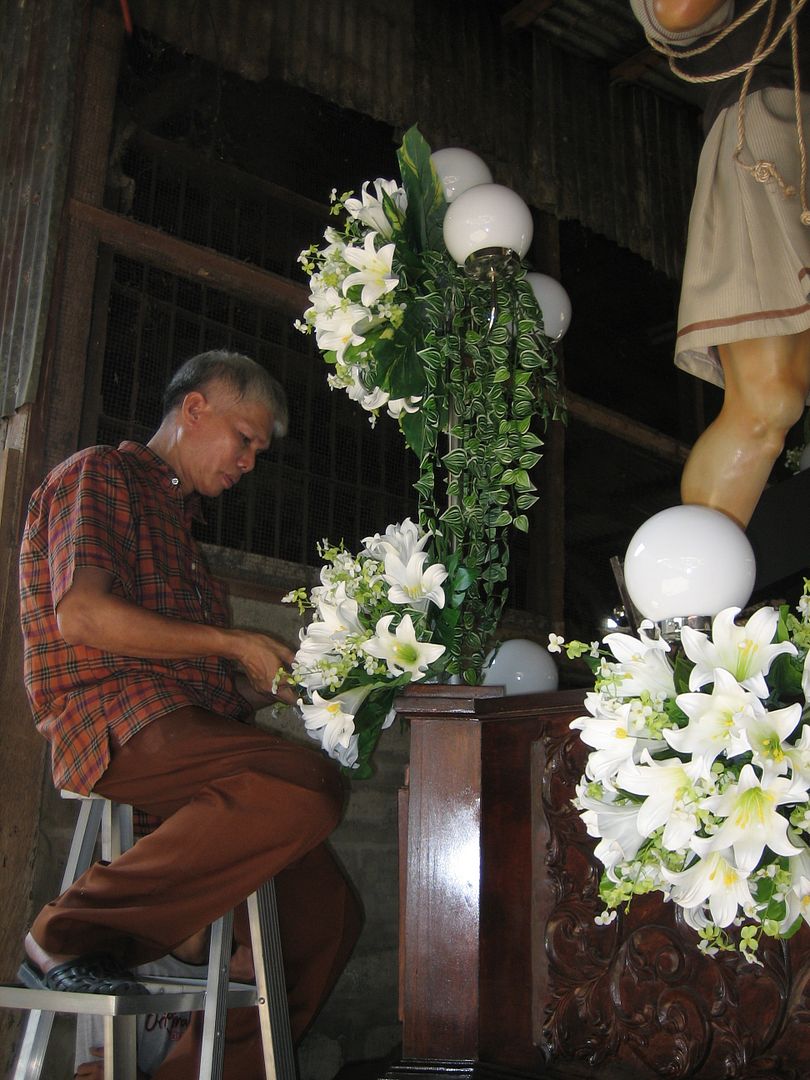
While that’s going on, my cousin ascends the carro platform and makes a slight adjustment to the Captain’s cape, pinning the middle hem to his garment to ensure that his “akimbo” left arm is always visible.
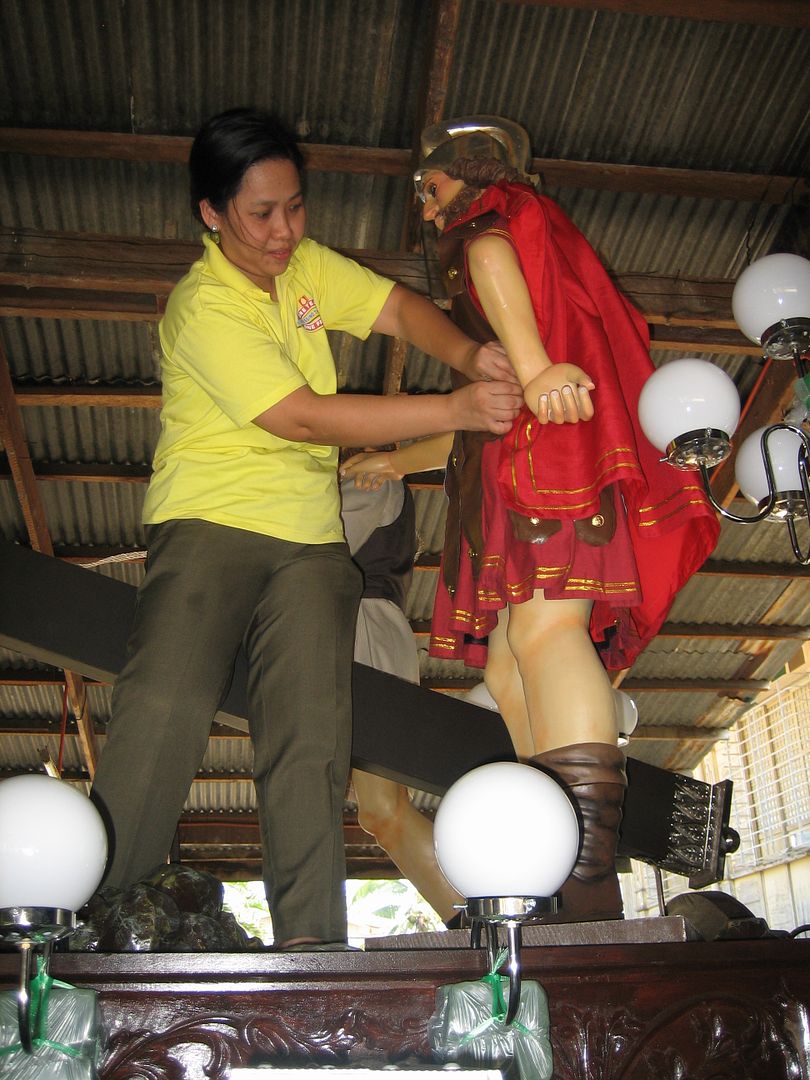
And then she goes back to observing how Dardo does it all so well and so fast.
Meanwhile, the super-compact, super-silent, and super-low-emission 1000-watt Elemax generator (“Made in Japan
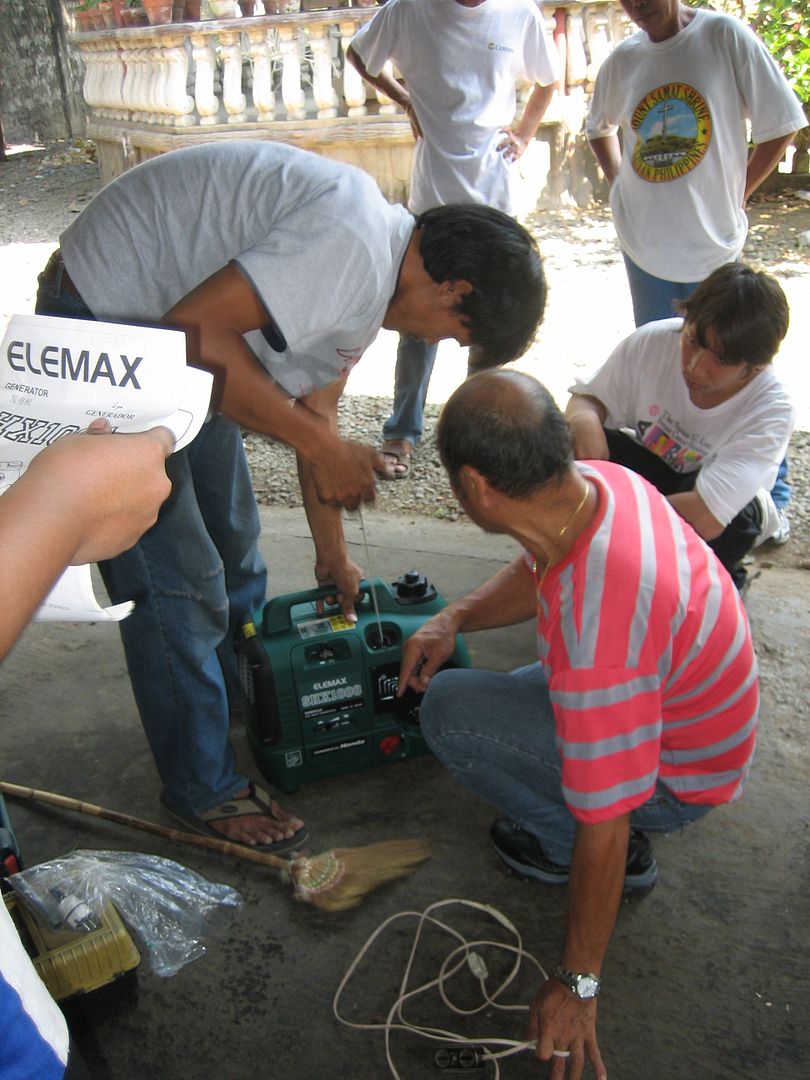
This is then placed on a platform under the carro (gearheads would say that it’s “a mid-engine design”), and hooked up to the pre-installed electrical system. The final component is the “Nazareno-Red” (not quite “UP-Maroon”)-colored carroza “skirt,” which is usually called “sayal” in Tagalog, and in Spanish, “faldon” (literally, “big falda”).
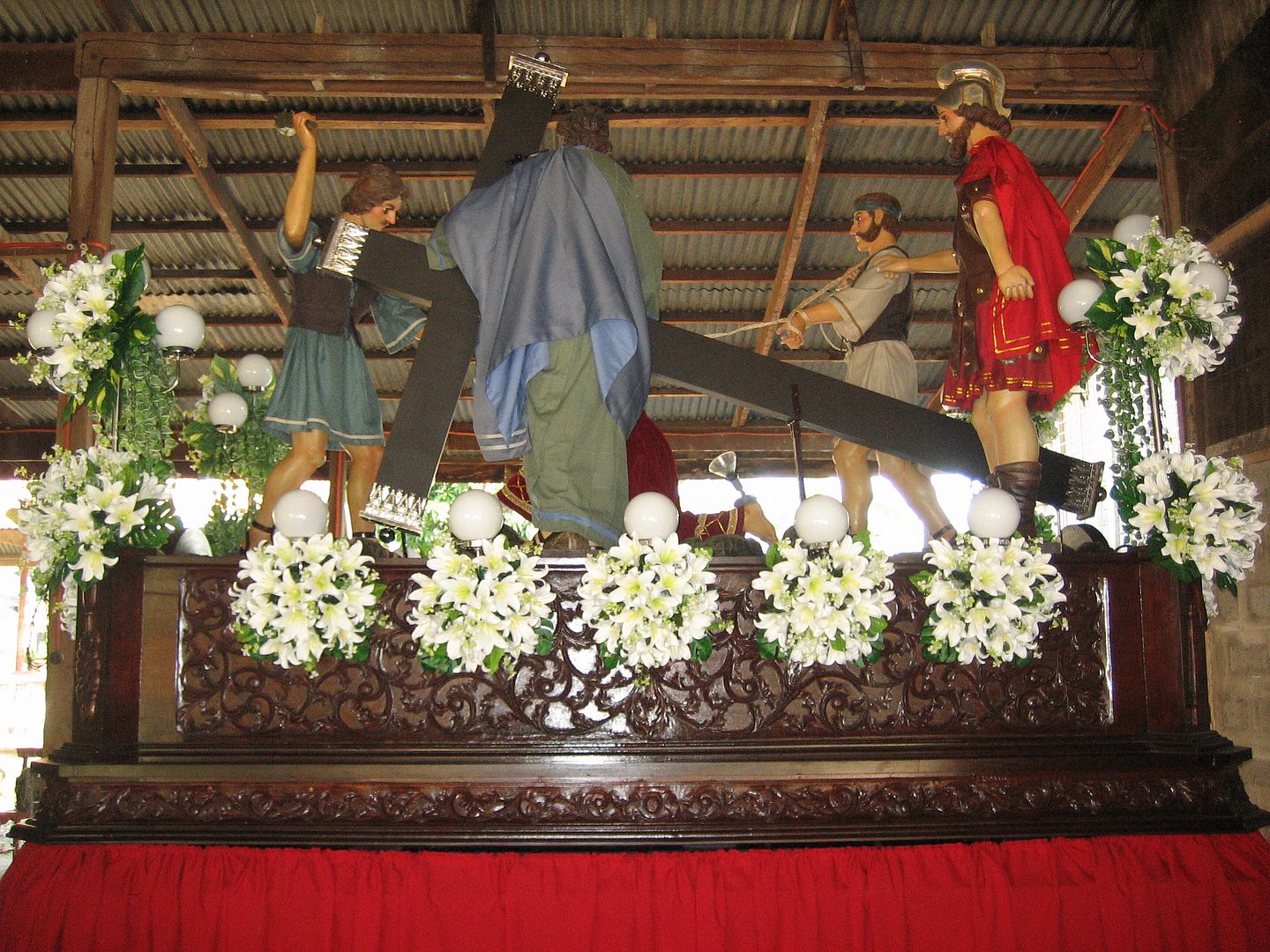
Whether from the “starboard” side
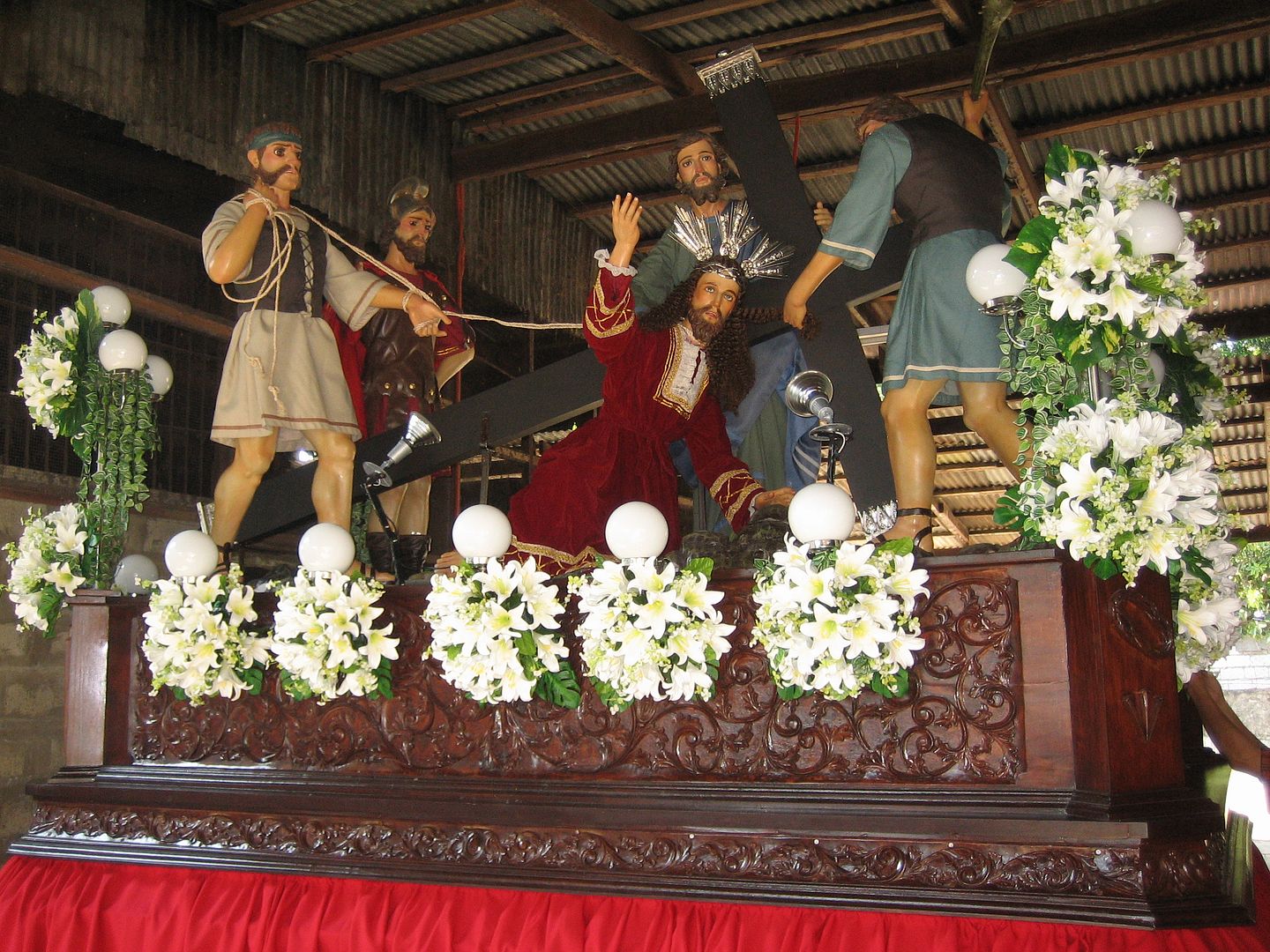
the “port” side (even though it’s really only the rear view of the action)
from a distance
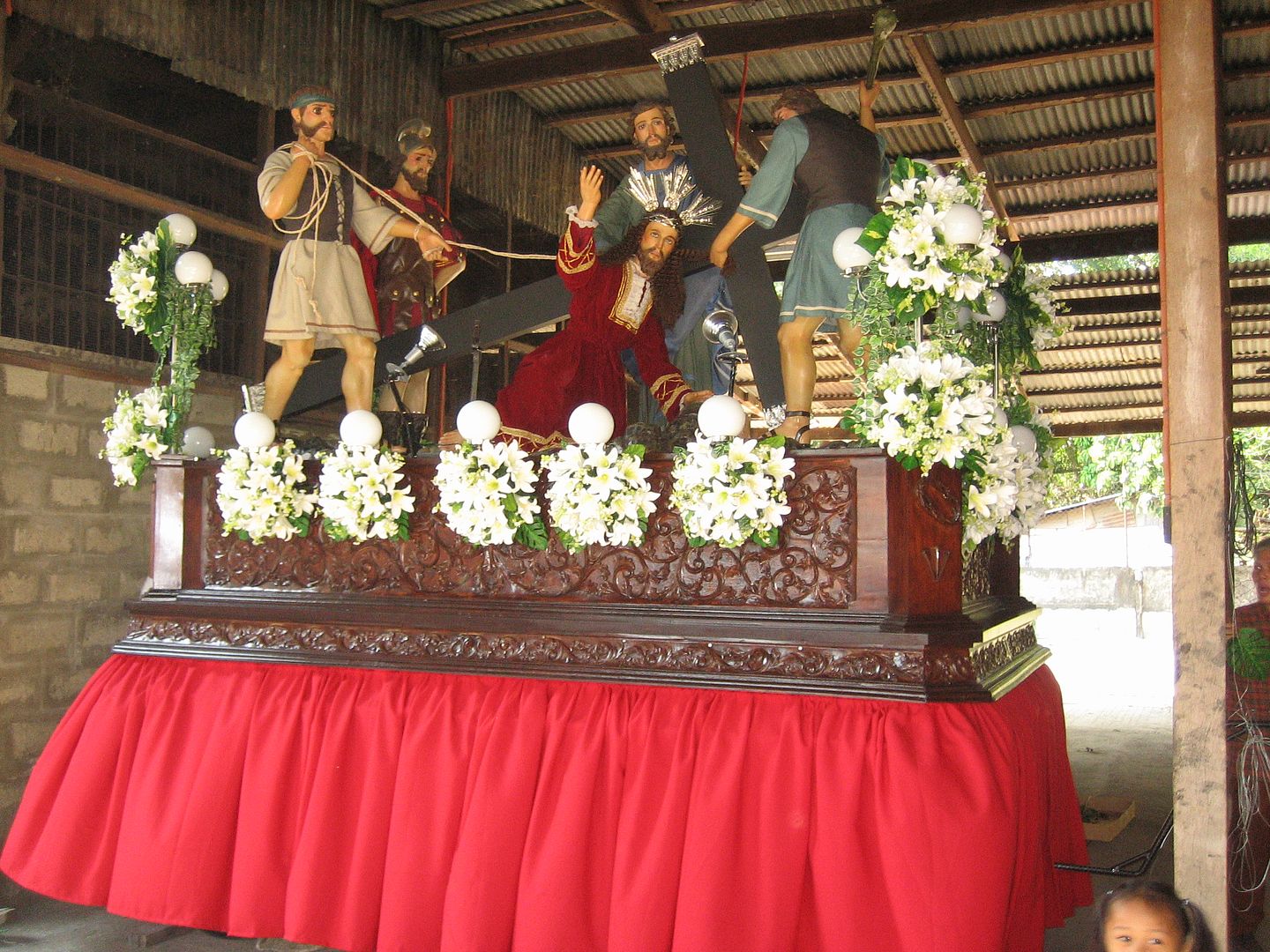
or in tighter shots
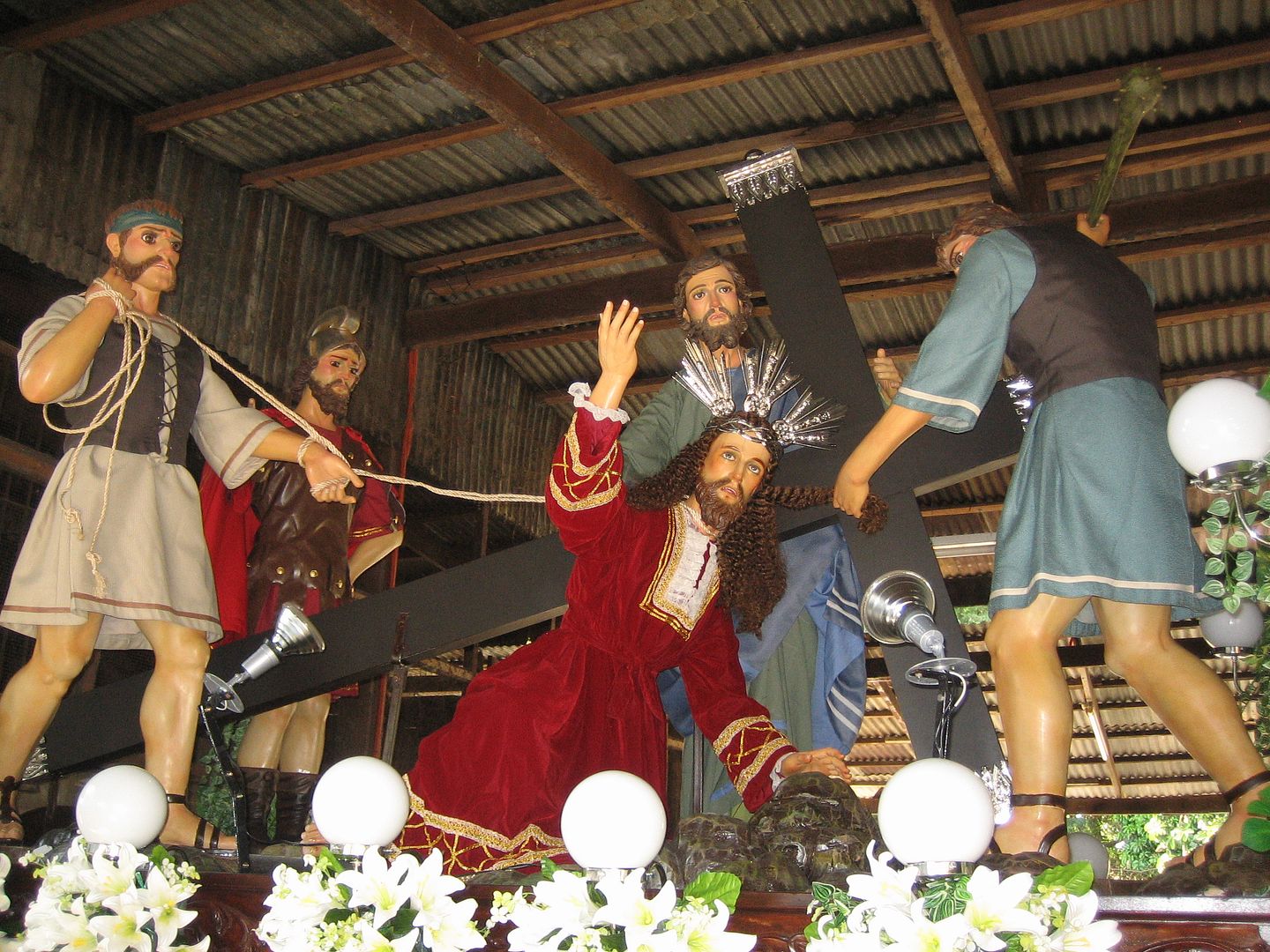
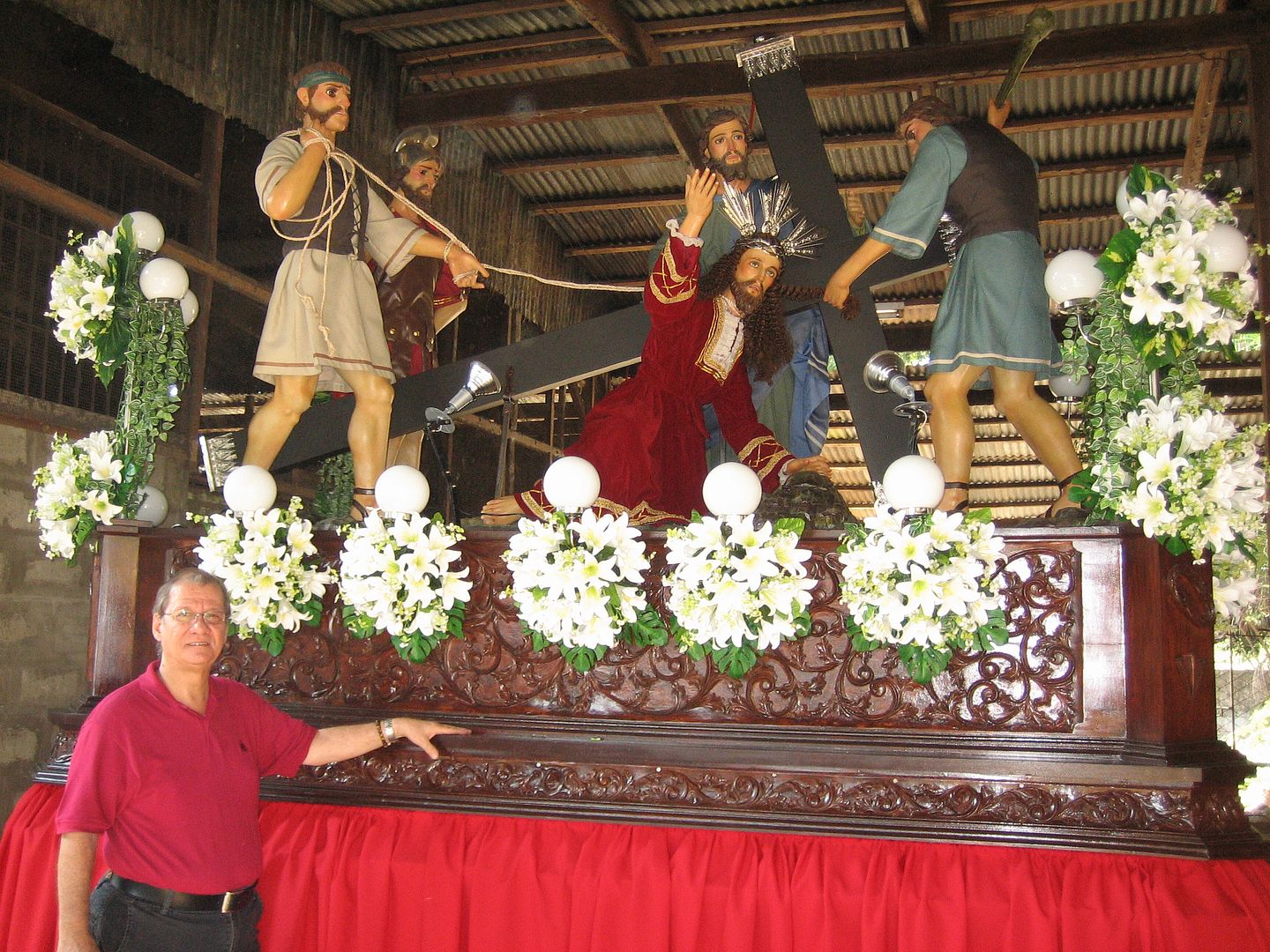
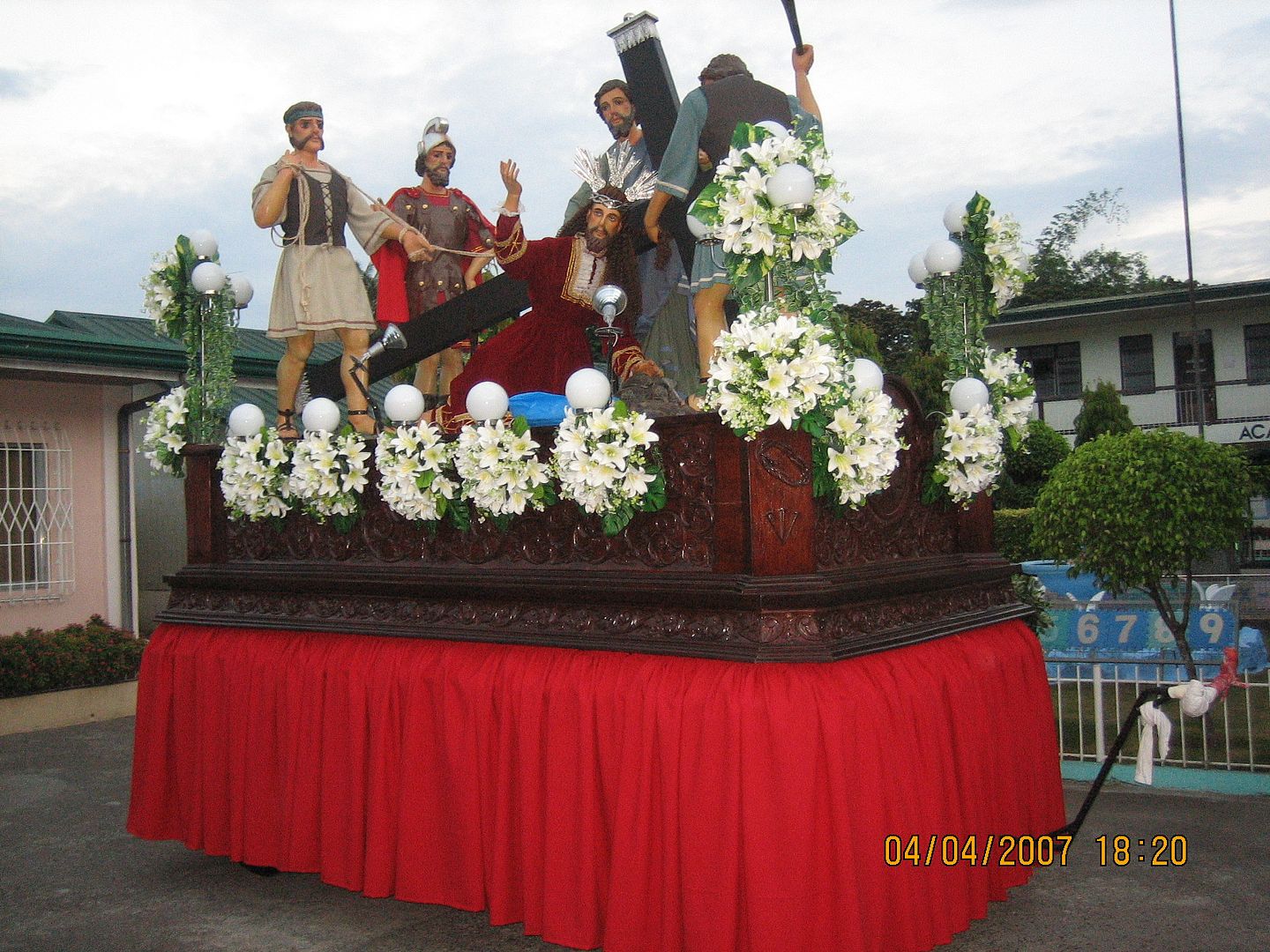
the entire “paso” (tableau on carroza) was indisputably “beautiful, regal, and dramatic,” as one kind reviewer put it.
All the day’s work having been completed, it was time for much-deserved “Kodakan” (although I’ve been using Canon digital cameras for years), starting with the maestro santero himself.
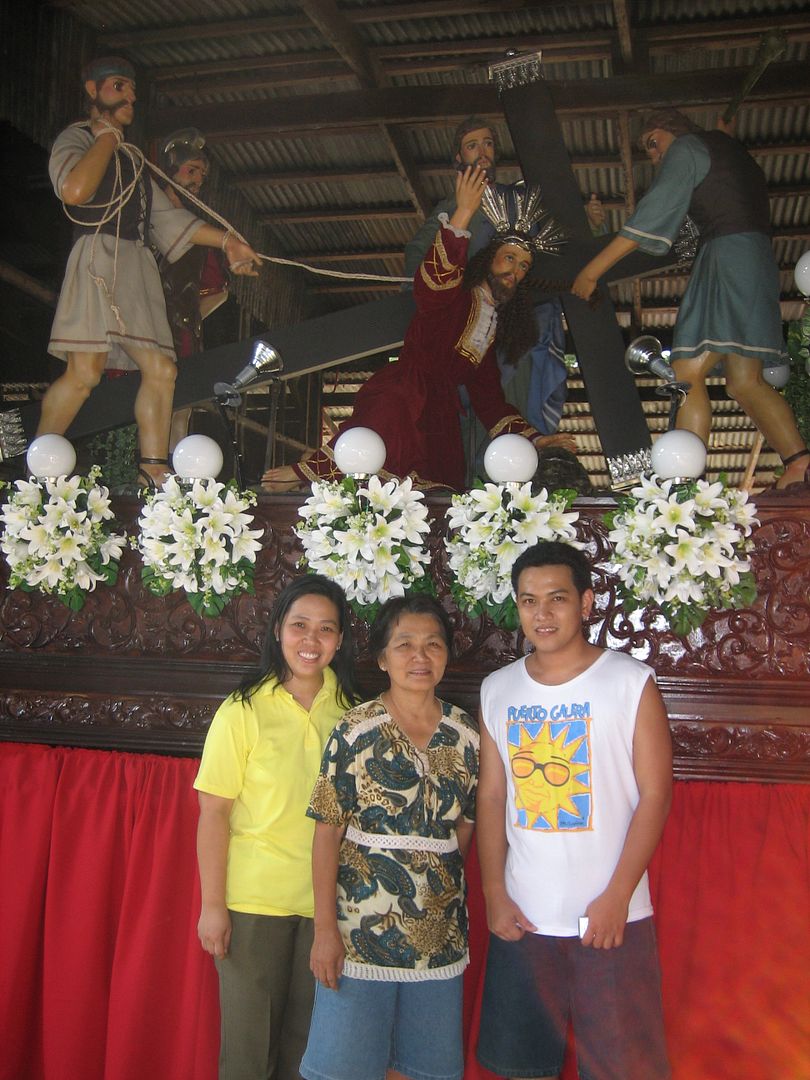
And the proud owners-caretakers, my aunt and two cousins.
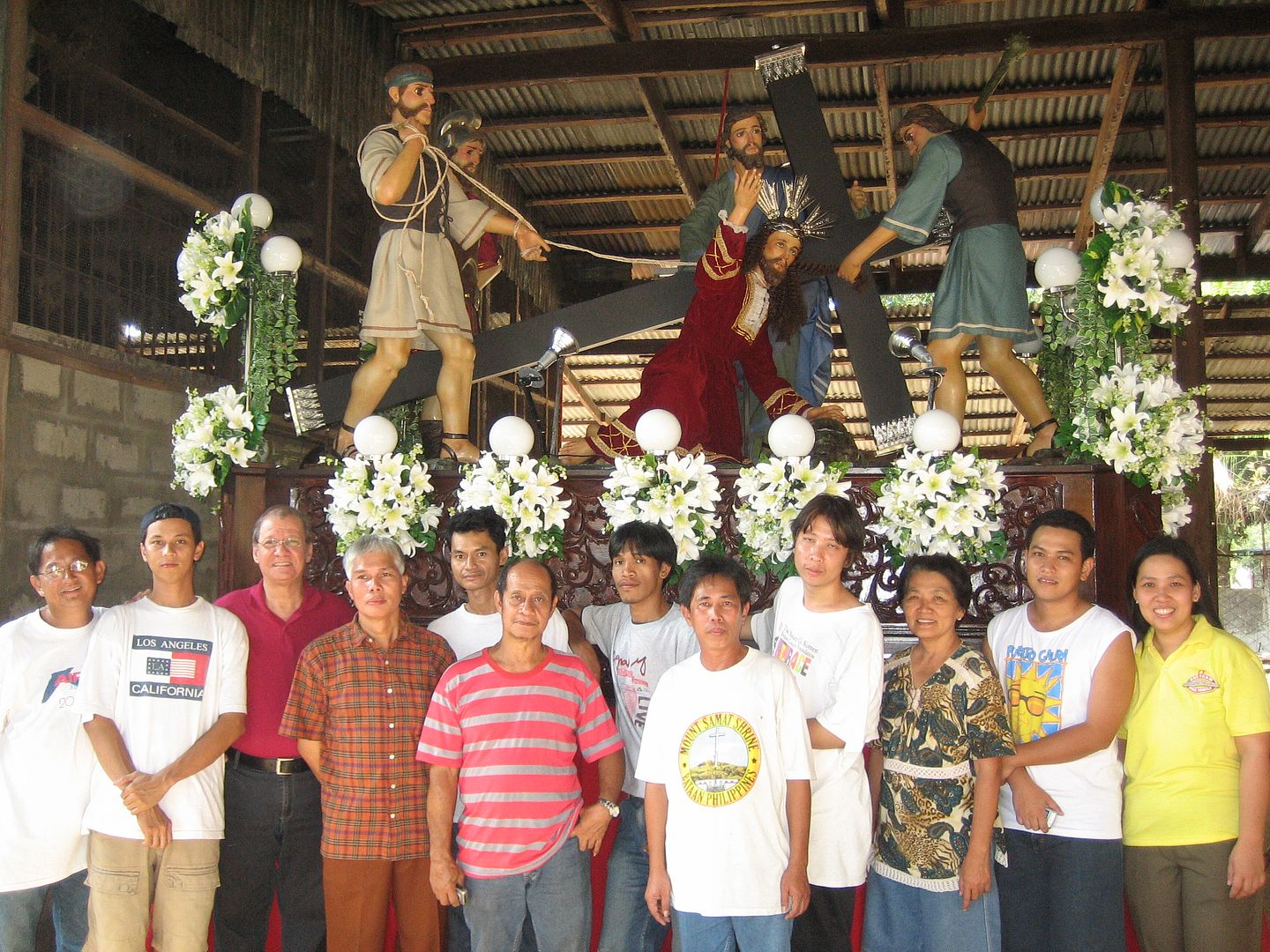
And then the whole Gang of the “Fall of Christ.”
But lest we forget the whole reason for all of this, I take a few more shots of the extraordinary image of our Most Serene Lord in His Sorrowful Passion and Painful Fall – a devotional masterpiece to be venerated for many generations to come, we're sure.
nsconsolacionycorrea wrote on Apr 21, '07
Mang Dardo is an artist!!!
|
rally65 wrote on Apr 21, '07
Nikki, this paso (and my family's other processional image of Santa Marta) has greatly benefited from very talented artists -- not just Mr. Vecin himself as the conceptualizer and designer, but also Dardo the image dresser and carro decorator, and perhaps more obviously the escultor and the encarnador in the Vecin Workshop, whom I talked about in the previous article.
There's also the Workshop's regular dressmaker, who selects only the finest European and Japanese fabrics with Mr. Vecin (in obscure locations in Manila). There's also their regular wigmaker, who supplies only properly-color-matched jusi wigs to Mr. Vecin's specs. And there's their metalsmith, who does all the haloes, diademas, tres potencias, and even those elaborate cantoneros (end-pieces) for the cross following original antique designs in Mr. Vecin's collection. Good artists are always available, even in abundance. They only disappear if their custom is not patronized. We therefore need to keep engaging them as much and as frequently as possible. So go ahead and commission your paso soon! |
robbyandharry wrote on Apr 21, '07
thanks again for sending me some of your estampitas...
btw... yung mga images nasa karo sila from march untill april or did they removed and store them after the blessing and then put them back for the holy week? |
rally65 wrote on Apr 21, '07
The images were set up on March 31, the day before Palm Sunday, and taken down a week later. So it's the normal period for keeping them there.
|


